Tuesday, December 02, 2025

A TALE OF TWO STATE APPS

Concern as India orders phone manufacturers to preload govt app

By AFP
December 2, 2025


New Delhi has given manufacturers 90 days to comply with new rules saying the app "Sanchar Saathi" -- meaning communication partner in Hindi -- must be "pre-installed on all mobile handsets manufactured or imported for use in India" - Copyright AFP/File Idrees MOHAMMED

India has ordered smartphone makers to pre-install a government-run cyber security app that cannot be removed, a move that has raised concerns about users’ privacy.

The country has a massive 1.16 billion mobile phone users, according to government data from 2024, and authorities say the app will better protect them from fraud.

Late on Monday, New Delhi gave manufacturers 90 days to comply with new rules saying the app “Sanchar Saathi” — meaning communication partner in Hindi — must be “pre-installed on all mobile handsets manufactured or imported for use in India”.

The order, detailed in a press release, also asked phone makers to ensure the app was “readily visible and accessible to the end users at the time of first use or device setup and that its functionalities are not disabled or restricted”.

The government said the app was designed to allow users to block and track lost or stolen phones.

It also lets them identify and disconnect fake mobile subscriptions made in their name, among other functions.

Government figures show the app has already helped trace more than 2.6 million phones.

However, rights advocates and politicians have sounded the alarm over potentially serious consequences.

Advocacy group Internet Freedom Foundation (IFF) said Tuesday it was concerned about the new directive.

The order “represents a sharp and deeply worrying expansion of executive control over personal digital devices”, it said in a statement on X.

“The state is asking every smartphone user in India to accept an open ended, updatable surveillance capability on their primary personal device, and to do so without the basic guardrails that a constitutional democracy should insist on,” the IFF said.

For devices that have already been manufactured and exist in the market across the country, the government mandated that “the manufacturer and importers of mobile handsets shall make an endeavour to push the App through software updates.”

Cyber security analyst Nikhil Pahwa said the rules were “clearly” an invasion of privacy.

“How do we know this app isn’t used to access files and messaging on our device, which is unencrypted on device? Or a future update won’t do that?” he said on X.

“This is clearly an invasion of our privacy,” he added.

Prime Minister Narendra Modi’s opponents in the Congress party demanded an immediate rollback of the order, calling the move unconstitutional.

“Big Brother cannot watch us,” Congress politician KC Venugopal said on X.

“A pre-loaded government app that cannot be uninstalled is a dystopian tool to monitor every Indian,” he added.

“It is a means to watch over every movement, interaction and decision of each citizen.”

In August, Russia issued a similar directive ordering manufacturers to include a new messaging platform called Max on all new phones and tablets, but rights advocates warned the app could be used as a powerful surveillance tool.

‘I don’t trust it: Russians sceptical about state-backed messenger


ByAFP
November 30, 2025


Russian social media giant VK unveiled the app earlier this year 
- Copyright AFP FADEL SENNA

A new Russian messaging platform that authorities hope will replace WhatsApp and Telegram is getting rave reviews from government officials, but on the streets of Moscow, reception has been mixed.

Max, released by Russian social media giant VK earlier this year, has been touted as a “super app” — capable of doing everything from accessing government services to ordering a pizza, similar to China’s WeChat or Alipay.

The government has directed manufacturers to include it on all new phones and tablets starting September 1, while simultaneously blocking calls on its foreign-owned rivals in what critics have called a brazen attempt to force users to switch.

Officials insist Max is safe and will cut Russia’s dependence on foreign-owned platforms that store data abroad, but rights advocates warn the app — which lacks end-to-end encryption — could be used as a powerful surveillance tool.

“I don’t trust it much,” said Ekaterina, a 39-year-old doctor who refused to give her last name.

Her employer required her to install the application for work but she mainly uses WhatsApp for personal communication, she said.

“There’s a personal history of messages that I don’t want to lose, as well as work-related communication,” she said of WhatsApp.

“I have many clients on it.”

– ‘I don’t see a problem’ –

Russians may not have much of a choice.

On Friday, media regulator Roskomnadzor announced it was considering fully banning WhatsApp, accusing it of being a vessel to perpetrate “crime”. It had already blocked calls on the platform from August.

WhatsApp, which boasts almost 100 million users in the country, accused Russia of wanting to ban it because it is “secure”.

“The situation is mixed,” 33-year-old Andrei Ivanov told AFP.

He said he feared information from WhatsApp could be “stolen by other countries”, but that it was “convenient to communicate there”.

“It is a certain restriction of our freedoms,” Ivanov said of the plans to strong-arm users into switching.

WhatsApp, owned by US technology giant Meta, uses end-to-end encryption. This means messages are scrambled when they leave the sender’s device and can only be read by the recipient.

The platform says it uses Meta’s servers to store encrypted messages while they are being delivered but deletes them once this is done, and has refused to hand them over to governments.

Some in Moscow were unconvinced, nonetheless.

“I understand that everything created abroad is now a threat to us,” said Russian pensioner Sergei Abramov, 67.

He said he saw no “big problem” if WhatsApp got shut down.

Maria Isakova, a 36-year-old designer, agreed.

“Our nation is inherently good at adapting to changing circumstances. We adapt — there are other messengers, there are alternatives to switch to,” she said.

“I don’t see any issues.”
How Australia plans to ban under-16s from social media


By AFP
December 1, 2025


Starting December 10, some of the world's largest social media platforms will be forced to remove all users under the age of 16 in Australia - Copyright AFP/File David GRAY

Australia will soon ban under-16s from the likes of Facebook and TikTok, a world-first move of huge interest to all those worried about the harms of social media.

Internet regulators the world over are watching to see if Australia can rein in the tech giants — but questions remain as the ban approaches on December 10.

Here’s what we know about how Australia will enforce the new restrictions.

– Prove age –

Starting December 10, some of the world’s largest social media platforms will be forced to remove all users under the age of 16 in Australia.

Hundreds of thousands of adolescents are expected to be impacted, with Instagram alone reporting about 350,000 Australian users aged 13 to 15.

Not every Australian will have to prove their age, only those suspected of falling foul of the ban.

And young users will still be able to access some social media without logging in — they just cannot register for their own accounts.

– Verification –

Social media platforms will be held responsible for weeding out underage accounts.

A number of trials have looked at different ways to do so, but the Australian government has so far refused to settle on a universally agreed method.

Meta, the parent company of Facebook, has started deactivating accounts based on information such as the age given when they were created.

Account holders flagged by mistake could verify their age using a “video selfie” or by providing government-issued ID, Meta said.

– Who’s in and out –

Which platforms fall under the ban continues to be debated.

Facebook, Instagram, Snapchat and TikTok are covered, as are streaming platforms including Kick and Twitch.

YouTube was added, despite the government’s suggestion that it would be exempt so that children could watch lessons online.

Other popular apps and websites such as Roblox, Pinterest and WhatsApp are currently exempt — but the list remains under review.

– Just browsing –

Australia expects rebellious teens will do their best to skirt the laws.

Guidelines warn they might try to upload fake IDs or use AI to make their photos appear older.

Platforms are expected to devise their own means to stop this happening.

“Of course, no solution is likely to be 100 percent effective all of the time,” the internet safety watchdog has said.

– Harsh penalties –

Australia concedes the ban will be far from perfect at the outset, and some underage users will fall through the cracks as issues are ironed out.

But platforms face the threat of $32 million fines if they fail to take “reasonable steps” to comply.

It remains unclear how Australia’s internet safety regulator would interpret or enforce what counts as reasonable.

“‘Reasonable steps’ means platforms have to act to enforce the restrictions in a way that is just and appropriate in the circumstances,” the regulator’s guidelines say.

Australia ban offers test on social media harm


By AFP

Dec 1, 2025


Researchers are pondering the impact of Australia's world first teen ban on social media - Copyright AFP Marvin RECINOS
Katie Forster

Australia’s under-16 social media ban will make the nation a real-life laboratory on how best to tackle the technology’s impact on young people, experts say.

Those in favour of the world-first December 10 ban point to a growing mass of studies that suggest too much time online takes a toll on teen wellbeing.

But opponents argue there is not enough hard proof to warrant the new legislation, which could do more harm than good.

Adolescent brains are still developing into the early 20s, said psychologist Amy Orben, who leads a digital mental health programme at the University of Cambridge.

A “huge amount” of observational research, often based on surveys, has tracked a correlation between teen tech use and worse mental health, she told AFP.

But it is hard to draw firm conclusions, because phones are so ingrained into daily life, and young people may turn to social media because they are already suffering.

“With technology, because it’s changing so fast, the evidence base will always be uncertain,” Orben said.

“What could change the dial are experimental studies or evaluations of natural experiments. So evaluating the Australia ban is hugely important because it actually gives us a window on what might be happening.”

– No ‘smoking gun’ –

To try and shed light on the cause-and-effect relationship, Australian researchers are recruiting 13- to 16-year-olds for a “Connected Minds Study” to assess how the ban affects their wellbeing.

A World Health Organization survey last year found that 11 percent of adolescents struggled to control their use of social media.

Other research has shown a link between excessive social media use and poor sleep, body image, school performance and emotional distress, such as a 2019 study of US schoolchildren in JAMA Psychiatry that found those who spent over three hours a day on social media could be at heightened risk for mental health problems.

So some experts argue the right time to act is now.

“I actually don’t think this is a science issue. This is a values issue,” said Christian Heim, an Australian psychiatrist and clinical director of mental health.

“We’re talking about things like cyberbullying, the risk of suicide, accessing sites on anorexia nervosa and self-harm,” he told AFP.

Evidence of a risk is growing, Heim said — pointing to a 2018 study by neuroscientist Christian Montag that linked addiction to the Chinese messaging app WeChat to shrinking grey matter volume in part of the brain.

“We can’t wait for stronger evidence,” Heim said.

Scott Griffiths of the Melbourne School of Psychological Sciences said a “smoking gun research study” was unlikely to emerge soon to prove the harms of social media.

But the ban was worth trying, he said.

“I’m hopeful that the major social media companies seeing this full-throated legislative action come into play will finally be motivated to more meaningfully protect the health and wellbeing of young people.”

– ‘Too blunt’ –

More than three-quarters of Australian adults agreed with the new legislation before it passed, a poll indicated.

However, an open letter signed by more than 140 academics, campaigners and other experts cautioned that a ban would be “too blunt an instrument”.

“People were saying: ‘Well, kids are getting more anxious. There must be a reason — let’s ban social media’,” argued one signatory, Axel Bruns, a digital media professor at Queensland University of Technology.

Children may simply have more reasons to be anxious, under pressure from pandemic-interrupted schooling and troubled by wars in Gaza and Ukraine, he told AFP.

And a ban might push some teens to more extreme, fringe sites, while preventing other marginalised young people from finding community.

Noelle Martin, an activist focused on image-based online abuse and deepfakes, feared the Australian ban would do little to help, given the country’s history on enforcement of existing laws.

“I don’t believe it will stop, prevent or do much to meaningfully combat this issue,” Martin said.

In any case, the political decision has been taken in Australia.

“Social media is doing social harm to our children,” Prime Minister Anthony Albanese said this year.

“There is no doubt that Australian kids are being negatively impacted by online platforms, so I’m calling time on it.”

‘Rescued my soul’: Hong Kong firefighters save beloved pets

By AFP
December 2, 2025


Fifteen-year-old poodle Jason was rescued by firefighters from the Wang Fuk Court blaze and reunited with owner Jacky Lee - Copyright AFP Peter PARKS
Zoe LOW

When Jacky Lee first heard about a raging fire at the Hong Kong housing estate where she lived, she rushed back to save Jason, her 15-year-old grey poodle still at home, fearing she would never see him again.

Lee arrived to find Wang Fuk Court complex engulfed in what would become the Chinese city’s deadliest blaze in decades, with at least 151 people killed when seven high-rises were burned to charred husks.

The 43-year-old airline engineer joined the crowd waiting anxiously at a nearby school-turned-shelter on Wednesday for news on rescue efforts.

After midnight, as the flames grew, a district councillor told her that the search for pets had ended.

Then, just as all seemed lost, her phone rang. A firefighter called to ask if she had a dog in unit 2703 of the Wang Kin House tower.

A day after the blaze started, Jason reappeared, cradled in the arms of a volunteer after he was saved from the still-burning towers.

“He was still shaking when I saw him from afar, then I called his name, he saw me and stopped. Then he smiled,” Lee told AFP.

“I was so happy I was out of my mind, I felt like I was in shock.”

A firefighter later told Lee they were able to coax Jason into a carrier after spotting his name left on little notes she had stuck onto walls.

The firefighters had “also rescued my soul”, Lee later wrote on social media.

– ‘Will to live’ –

The fire burned for more than 40 hours, and during that time Hong Kong social media was flooded with posts from worried pet lovers.

Pets are much-loved in the city, where pampered pooches are often pushed around the streets in prams, and shops selling animal outfits dot many neighbourhoods.

Animal welfare groups taking care of rescued pets shared pictures online, trying to match them to owners.

The SPCA in Hong Kong said 209 animals — including dogs, cats, fish, hamsters, turtles and more — were taken from the buildings, 63 of them had died.

District councillor Lau Chun-hoi said he still hoped more pets that survived, citing reports of strays.

“Animals have a very strong will to live,” Lau told AFP, proposing that food and water be left out on some of the buildings’ floors for them.

He urged people to check in on Wang Fuk Court residents who may have lost pets in the fire because “in their hearts, pets are family too”.

Remembrance messages were being shared on social media.

“Be good when you get to the rainbow bridge, play with the older brothers and sisters, grandpas and grandmas from the neighbourhood,” one user wrote.

Lee meanwhile called on the government to provide pet-friendly temporary housing, saying it was tough for displaced residents to arrange it on short notice.

The poodle had become timid and was reluctant to leave Lee’s side.

But, Jason was going to be alright: the vet said, aside from mild dehydration, the dog was already back to his fluffy, perky self.


From porcelain to tweed, EU opens protected label to crafts


By AFP
December 1, 2025


Europe's glassblowers, potters, jewellers and more will be able to register their product names under the EU's new geographical indication scheme for crafts and industries - Copyright AFP MEHDI FEDOUACH

Traditional crafts from French Limoges porcelain to Irish Donegal tweed became entitled to EU protected status as of Monday — on a par with agricultural products from Champagne to Parma ham.

Europe’s glassblowers, potters, jewellers and more will be able to register their product names under the bloc’s new geographical indication (GI) scheme for craft and industrial goods, extending the well-established system used for food and drink.

Under a law adopted in 2023 and taking effect December 1, the system offers protection for “iconic goods such as Bohemian glass, Limoges porcelain, Solingen knives and Donegal tweed, whose reputation and quality stem from their place of origin”, the European Commission said.

Geographical indications are intellectual property rights that link a product’s qualities, reputation, or features to its place of origin, the commission said.

Craftspeople and the European Parliament have long pushed for the extension of GI labels to non-food products in a bid to fight counterfeiting and support the sectors concerned.

The law draws on more than 30 years of experience with agricultural GIs, which safeguard over 3,600 names, generate around 75 billion euros ($87 billion) annually and account for some 15 percent of EU food and drink exports, according to Brussels.

The registration process for regional crafts will take place in two stages: first at national level, then at EU level.

“We are not only safeguarding the unique skills and traditions of our artisans, but also creating new opportunities for growth, jobs and many SMEs,” said the bloc’s industry chief Stephane Sejourne.
CRIMINAL CAPITALI$M

South Korean leader calls for penalties over e-commerce data leak


By AFP
December 1, 2025


Coupang is South Korea's most popular e-commerce platform, serving millions of customers with lightning fast deliveries of super cheap products, from groceries to gadgets - Copyright AFP/File Ed JONES

South Korea’s president ordered on Tuesday swift action to penalise those responsible for a major data leak at e-commerce giant Coupang affecting more than 33 million customers.

It was “astonishing that the company failed to recognise the breach for five months”, President Lee Jae Myung said, adding that the “scale of the damage is massive”.

Coupang is South Korea’s most popular online shopping platform, serving millions of customers with lightning-fast deliveries of products from groceries to gadgets.

Seoul has said the leak took place through overseas servers from June 24 to November 8.

But Coupang only became aware of it last month, according to police and local media, who said the company had issued a complaint in November against the alleged culprit — a former employee and a Chinese national.

On Tuesday, Lee ordered the government to “strengthen fines and make punitive damages a reality”, calling for “substantive and effective countermeasures”.

“The cause of the accident must be quickly identified and (those responsible) must be held strictly accountable,” he said.

Police said Monday they were tracing computer IP addresses and looking into possible international collaboration as part of their investigation.

They warned the leak could “threaten the daily lives and safety of every single citizen”.

Coupang has told customers that their names, email addresses, phone numbers, shipping addresses and some order histories had been exposed in the leak.

But the company said their payment details and login credentials had not been affected.

The case follows a major breach at South Korea’s largest mobile carrier SK Telecom, which was fined about 134 billion won ($91 million) in August after a cyberattack exposed data on nearly 27 million users.

South Korea is among the world’s most wired countries, but has also been a target of hacking by arch-rival North Korea.

Police announced last year that North Korean hackers were behind the theft of sensitive data from a South Korean court computer network — including individuals’ financial records — over a two-year period.

And last month Yonhap News Agency reported that South Korean authorities suspected a North Korean hacking group may be behind the recent cyberattack on cryptocurrency exchange Upbit, which led to the unauthorised withdrawal of 44.5 billion won in digital assets.

Pacific island office enabling sanctions-busting ‘shadow fleets’


By AFP
December 1, 2025


The Cook Islands was one of the 'top countries whose flags are used by shadow tankers transporting Russian crude oil', according to a European Parliament briefing from 2024 - Copyright AFP/File Marty Melville

Dozens of oil tankers suspected of smuggling contraband crude for Russia and Iran have been using a beachside office in the tropical South Pacific to cover their tracks, an AFP analysis of sanctions data has revealed.

Nestled next to a pizza shop in the far-flung Cook Islands is the modest headquarters of one of the fastest-growing shipping registries in the world.

Without ever setting foot in the palm-fringed microstate, foreign ship owners can pay Maritime Cook Islands to sail under its star-studded flag.

United States sanctions data identifies 20 tankers registered in the Cook Islands suspected of smuggling Russian and Iranian fuel between 2024 and 2025.

A further 14 Cook Islands-flagged tankers are blacklisted on a separate database of British sanctions covering the same period.

New Zealand, by far the Cook Islands’ closest diplomatic partner, said it was “alarming and infuriating” to see sanctions efforts undermined.

“New Zealand continues to hold serious concerns about how the Cook Islands has been managing its shipping registry, which it has repeatedly expressed to the Cook Islands government over many years,” said a spokesman for Foreign Minister Winston Peters.

“This is a completely unacceptable and untenable foreign policy divergence.”

The self-governing Cook Islands remain in “free association” with former colonial ruler New Zealand, which is still involved in areas such as defence and foreign affairs.

Maritime Cook Islands, which runs the shipping registry, denies failing to conduct proper checks or harbouring sanctioned vessels, saying any such ships are deleted from the registry.


– Shadow fleet –


Western sanctions aim to curb Iran and Russia cashing in on oil sales, limiting funding for Tehran’s nuclear programme or Moscow’s invasion of Ukraine.

“There are countries around the world that sign up to sanctions against Russia that wouldn’t allow these ships to fly their flag,” said Anton Moiseienko, an expert in sanctions and financial crime at Australian National University.

“But there are countries that are a bit more lax about that,” he told AFP.

“This is where the Cook Islands comes in.”

A UAE-based shipping company was in April accused of smuggling “millions of dollars” of fuel on behalf of the Iranian military in the Gulf.

The company owned tankers flagged in Barbados, Gambia, Panama and the Cook Islands, according to US sanctions.

Ships like these are allegedly cogs in a maritime smuggling network known as the “shadow fleet”, skirting sanctions by passing themselves off as cargo vessels on legitimate business.

They cover their tracks by registering in places such as the Cook Islands, where they can enjoy much less stringent oversight.

Often the registries are unaware of the vessel’s true purpose.


– ‘Fastest growing’ –


Shipping journal Lloyd’s List last year crowned Maritime Cook Islands the “fastest growing registry” in the world.

“There are a number of ships flying the Cook Islands flag that have been identified as part of the shadow fleet,” said Moiseienko.

“When it comes to flag states — Cook Islands, Liberia and others — there isn’t really any international mechanism to enforce their obligations.”

A few months later the registry was in the headlines again, when a tanker called the Eagle S damaged five underwater cables in the Baltic Sea.

Finnish investigators would later suggest the Cook Islands-flagged vessel — allegedly part of Russia’s shadow fleet — had sabotaged the cables by dragging its anchor across the seabed.


– Flags of convenience –


Shipping registries are also an easy way for revenue-starved Pacific island nations to bolster government coffers.

But these registries, typically operated as private companies, have run into trouble.

North Korean smuggling networks have long exploited shipping registries in South Pacific nations such as Palau, Niue and Tuvalu.

Many, including the Cook Islands, do not publicly list their fees.

But AFP obtained an estimate from Palau that suggested a 30,000 tonne oil tanker could expect to pay around US$10,000 in registration fees.

Shipping registries allowing foreign-owned ships to fly under their banner are known as “flags of convenience”.

“Many shadow fleet vessels use flags of convenience from countries that are either less inclined or unable to enforce Western sanctions,” notes a European Parliament briefing from 2024.

The Cook Islands was one of the “top countries whose flags are used by shadow tankers transporting Russian crude oil”, according to the briefing.

The Royal United Services Institute, a leading UK think tank, said Iran and North Korea had been exploiting small shipping registries for years.

But shadow fleet activity had “expanded dramatically” after Russia was hit with crippling sanctions following its invasion of Ukraine, the institute said in September.


– Diplomatic headaches –


Maritime Cook Islands operates the shipping registry as a private company “under a delegation of authority” from the government, and is overseen by the nation’s transport regulator.

Government revenue from shipping fees climbed more than 400 percent in the past five years, Cook Islands budget papers show, and were on track to total US$175,000 over the past financial year.

Maritime Cook Islands said any vessels accused of dodging sanctions were swiftly deleted from its shipping registry.

Sometimes suspicious vessels were deleted before they were named in sanctions, it said.

“The Cook Islands register has never harboured sanctioned vessels.

“Any sanctioned vessels are deleted.”

And the registry denied that it failed to conduct appropriate checks before signing up dubious vessels.

“The Cook Islands Registry has platforms that enable effective monitoring and detection of illicit activity.

It said it was “not aware” of concerns about sanctions-busting or of any instances of abuse.
MONOPOLY CAPITALI$M
Prada completes acquisition of flashy rival Versace


By AFP
December 2, 2025


Now owned by Prada - Copyright AFP/File Ed JONES

Italian fashion group Prada announced on Tuesday it had completed its acquisition of smaller rival Versace, announced earlier this year for 1.25 billion euros (now $1.45 billion).

Prada Group said in a statement that the deal with Capri Holdings, the US group which owned Versace, had “received all required regulatory clearances”.

Lorenzo Bertelli — the son of designer Miuccia Prada and chief marketing officer — will become executive chairman of Versace following the takeover.

Versace’s lustre had been waning in recent years, unlike that of the Prada Group, which is in robust health, fuelled by strong sales of its younger Miu Miu Line.

Prada Chief Executive Andrea Guerra told journalists during a factory visit that Versace was “extraordinarily different from our other brands in the portfolio”.

The flashy label “invented fashion as we know it today”, bringing it closer to popular culture, and as such “strikes a different aesthetic and appeals to a different consumer”, he added.

German economy in ‘deepest crisis’ of post-war era: industry group


By AFP
December 2, 2025


The German economy is in 'free fall', an industry group warned
 - Copyright AFP/File Ed JONES


Sam Reeves

Germany’s economy is suffering its “deepest crisis” since the aftermath of World War II, an industry group warned Tuesday, calling on Chancellor Friedrich Merz’s government to take urgent action to spark a revival.

Europe’s biggest economy “is in free fall, but the federal government is not responding decisively enough,” said Peter Leibinger, president of the Federation of German Industries (BDI).

Germany is facing a perfect storm: high energy costs burdening manufacturers, weak demand for its exports in key markets, the emergence of China as an industrial rival and the US tariff onslaught.

It has suffered two years of recession and is forecast to eke out just meagre growth in 2025.

The conservative Merz, who took power in May, has pledged to revive the eurozone’s traditional powerhouse, including through a public spending blitz on defence and infrastructure.

But industry leaders are increasingly voicing frustration that the efforts are moving too slowly and are insufficient to tackle a host of deep-rooted problems, from chronic labour shortages to heavy bureaucratic burdens.

“The economy is experiencing its deepest crisis since the founding of the federal republic, yet the federal government is not responding with sufficient determination,” said Leibinger.

“Germany now needs an economic policy turnaround with clear priorities for competitiveness and growth,” he added, warning that “decisive structural reforms” were urgently needed to arrest the decline.


– ‘Not a speedboat’ –


In its latest report released Tuesday, the BDI — an umbrella association for many industry federations — forecast that German factory output will fall two percent in 2025, which would mark its fourth consecutive year of contraction.

Heavy industry, from car-making to producing factory equipment and steel, remains crucial to the German economy. The country is home to more than 100,000 manufacturing firms of varying sizes, employing over eight million people, according to the BDI.

The group’s criticism chimed with concerns expressed elsewhere.

Last week the International Monetary Fund (IMF) said that Merz’s planned spending bonanza alone won’t be enough to guarantee a sustained revival of the economy, and called for the government to enact “pro-growth” reforms as well.

There is some light on the horizon, however. The economy is expected to start picking up speed next year with the government forecasting 1.3 percent growth.

Merz last week defended his government’s actions, pleading for more time to get the economy back on track.

“Germany is not a speedboat, Germany is a large ship,” he told an event hosted by the BDA employers’ association.

“A tanker of this size cannot be turned around in a matter of days, like a speedboat turning 180 degrees in the other direction. It takes time.”
Free Buses Can Be a Reality — Just Look at Maryland


Zohran Mamdani’s plan for free buses is not a pipe dream. Montgomery County, Maryland, made its buses free this year.
December 1, 2025

A bus that is part of Baltimore's free bus service, the Charm City Circulator, is seen in Baltimore, Maryland, on October 28, 2015.Jeffrey Greenberg / Universal Images Group via Getty Images

During the COVID-19 pandemic and its associated economic downturn, many people couldn’t pay their transportation costs, and often didn’t. In New York City in 2021, some 21 percent of bus riders did not pay the fare, a figure that grew to 48 percent in 2024. Some local governments, including New York City, responded with reduced or free fare programs. From 2023 to 2024, New York’s Metropolitan Transit Authority (MTA) ran a zero-fare bus pilot that served around 43,000 riders. The pilot, championed by then-assembly member Zohran Mamdani, offered free trips on one bus in each borough.

To expand this small pilot to universal zero-fare buses throughout New York City is a tall task, with a total 2024 bus ridership of 409 million and 6,300 buses. As mayor-elect Mamdani and his administration look to grow zero-fare buses in New York, they have a stellar example just a few hours south of New York, in Maryland.

The largest free bus program in Maryland by ridership is in Montgomery County, a suburb north of Washington, D.C.

Montgomery County first made its “Ride On” buses free to all riders under 18 in 2019. Then on June 29, 2025, it made all of its buses fare-free for all passengers. The system has a fleet of nearly 400 buses, 80 routes, and provided 19.2 million rides in the 2025 fiscal year. In the three months since free fares were instituted, ridership has increased by 5.4 percent. Phil McLaughlin, General Manager of Transit Services for Montgomery County Department of Transportation (MCDOT), said an estimated 1 percent to 2 percent of that ridership increase came from instituting zero fares.

One reason Montgomery Country’s City Council adopted the zero-fare program was financial. Montgomery County reduced fares during the pandemic from $2 to $1 and saw lower fare revenues (dropping from $10 million to roughly $1.6 million) overall. When faced with the need to upgrade its fare collection systems to tap-to-pay in order to align its fare boxes with Washington D.C.’s Metro system, it became clear that replacing the fare boxes would cost more than they would recoup: The cost was estimated at $22 million and would take approximately eight years to begin turning a profit. In addition, it cost the county $557,000 annually to collect fares. Montgomery County was faced with either paying police to enforce fares or going fare-free. County Executive Marc Elrich proposed a fully fare-free bus system in his 2026 fiscal year proposed operating budget, and the county council adopted it soon after.

Related Story

If Capital Strikes Against Mamdani, Organized Worker Power Can Strike Back
Let’s study how Wall Street sank Mamdani-style municipal plans back in 1975 — and get prepared for a similar fight.
By Jesse Hagopian , Truthout  November 10, 2025


Montgomery County Councilmember Evan Glass, chair of the Council’s Transportation & Environment Committee, told Truthout that fare-free buses are “bringing real impacts for Montgomery County residents” and the increased ridership shows that “cost barriers make a real difference. In a county with a median income of $115,000, compared to $35,000 for the average bus rider, fare-free transit is fundamentally about equity.”

The oldest free bus program in Maryland is likely Baltimore’s Charm City Circulator (CCC), first established in 2010 by then-mayor Sheila Dixon and funded through state transportation department grants. In 2024, the CCC provided 1.43 million rides, according to the Baltimore City Department of Transportation. The CCC has over 100 stops along five routes, with buses arriving every 13-20 minutes, and operates on an $8 million budget. Its impact has been overwhelmingly positive: a 2022 rider survey showed that over 40 percent of people who use the CCC would have used single-occupancy vehicles to make their trips, if not for this free service, thus reducing overall traffic congestion and vehicle emissions.

These programs, while crucial, still need to be built upon. Previously, local residents have pointed out that the bus service has a history of disproportionately serving majority-white neighborhoods and tourist mainstays, and has connected primarily to the city’s largest predominantly white institutions such as Johns Hopkins and the University of Maryland, while not offering the same level of service to majority-Black neighborhoods or Baltimore’s historically Black colleges and universities, such as Morgan State University or Coppin State. More public investment in the city-wide transit programs can help bridge the gap. In one promising improvement, Baltimore mayor Brendan Scott recently announced an expansion of the CCC to three East Baltimore neighborhoods beginning on December 7. The Baltimore City Department of Transportation told Truthout that the expansion is aimed at “improving equity of city services” and that it will add fast, free transit options to “communities that have relatively low vehicle ownership.”

Dr. Lawrence Brown, a research scientist in the Center for Urban Health Equity at Morgan State University, told Truthout that while “there is still work to be done,” the changes to the CCC since 2020 — including the Cherry Hill line addition in 2024 (which serves a neighborhood that is 90 percent Black and historically redlined) — “represents a change in the right direction.” Dr. Brown elaborated that “The Green line changes are definitely an improvement from an equity perspective as it extends into historically redlined central East Baltimore,” but “the Brooklyn/Curtis Bay community is still being left out although it also has tremendous transit needs.”

In an interview, Minister Glenn Isaac Smith, co-founder and president of the Baltimore Transit Equity Coalition, told Truthout, “We had long advocated for the extension of the circulator” including its expansion into Cherry Hill, and called the November changes “a welcome addition.” He continued, “The East Baltimore extension will service people who need transportation and a lot of times cannot afford it, especially if they are on a fixed income and need to travel to doctor’s appointments, or need to travel to buy groceries since it’s a food desert.”

West of Baltimore, the more rural but quickly-growing Frederick County made all of its mass transit free at the start of the COVID-19 pandemic and never went back. Transit Services of Frederick County, which includes buses and a paratransit service called Transit Plus, served a little shy of 1 million riders in fiscal year 2025 [928,650 riders], a record ridership for the county (up from over 540,000 trips in FY2022). It operates on a $9.3 million budget and has six lines and a fleet of 48 buses, four of which are all-electric and powered by a solar array at the Frederick County landfill, according to an emailed statement from Mary Dennis, Communications Manager for Transit Services of Frederick County. Its buses also serve many of the local food banks in Frederick, a fact advertised on Frederick Transit’s homepage.

Frederick resident and Transit Plus rider Jose Gabriel Coronado Flores, who uses a wheelchair, told Truthout that “I’m glad price is no longer a concern.” Coronado Flores pointed out that Transit Plus’ scheduled hours interfere with civic participation for the elderly and disabled people who rely on it, as many Frederick County government meetings happen later in the evening, when Transit Plus no longer schedules trips. This “keeps out many disabled people from participating in the processes which have to do with them,” Coronado Flores said.

Christian Benford, a candidate for Frederick County Council, told Truthout, “It is fantastic to have a program that provides alternative travel, reduces carbon emissions, and is at no-cost to residents.” Benford also pointed out improvements could be made to accessibility in the county overall, adding, “Frederick, as a whole, is not very walkable. So, while there are stops at key locations, it still requires crossing dangerous intersections or moving on uneven or poorly maintained public infrastructure.”

Like New York, Maryland faced reduced fare collections on buses in the state during the pandemic. Rather than increasing enforcement, Montgomery County and Frederick County, implemented temporary reduced or zero-fare measures. Seeing the financial and public benefits, both counties went fully zero-fare permanently. Zero-fare buses address a key equity gap noted in a 2024 report by Montgomery County called “Ride On Reimagined,” which found that 27 percent of Montgomery County residents in Maryland make less than $20,000 a year, showing the need for free public transit to connect residents to jobs and education. Maryland’s zero-fare bus programs provide an important model to the incoming Mamdani administration and others who want increased equity in their cities.

More can and should be done in Maryland, as these advancements in buses are coming amid a $2.1 billion statewide shortfall in public transit funding, leading to the elimination of many new road and transit projects. In Baltimore, a light rail extension called the Red Line was cancelled in 2015, and “set transportation in Baltimore back ten years,” said Smith. Maryland Gov. Wes Moore has made getting the Red Line built one of his platform promises, and Smith said, “We look forward to further expansions into the east-west corridor” of Baltimore.

Like in New York, there is much coordination that needs to take place between state, city, and county governing bodies to make public transit deliver better for all its residents. But Benford, at least, sees opportunity in what’s left to be done: “This is a great instance to foster better partnership between the county and city councils to engage with constituents. We may have different governing bodies but should always look for meaningful ways to work together.”


This article is licensed under Creative Commons (CC BY-NC-ND 4.0), and you are free to share and republish under the terms of the license.

Alexis Goldstein
Alexis Goldstein is a former Wall Street professional who now works on financial policy. She is a proud rank-and-file member of the National Treasury Employees Union, Chapter 335.


WORKING CLASS ANTI-WAR SAINT

Catholic Worker Dorothy Day’s grandchildren reflect on a legacy that still challenges the church

(RNS) — Kate Hennessy, the Catholic Worker co-founder’s granddaughter, said Day is a model for her fellow believers ‘to grasp faith and trust with all we have, even if it is by our bleeding fingertips.


Dorothy Day sits in protest as police stand by. 
(Photo by Bob Fitch, courtesy of Journey Films)

Fiona Murphy
December 1, 2025
RNS

(RNS) — It is rare for the close relatives of a candidate for sainthood in the Catholic Church to be alive, much less able to observe the process. Yet at a Vatican symposium, “A Pilgrim of Hope: An Academic Symposium on the Legacy of Dorothy Day,” on Wednesday (Nov. 26), the grandchildren of Dorothy Day were able to hear how others think about her work as a founder of the Catholic Worker movement, and introduce many to the woman they knew.


“What I really want to do is to share her with others, share her with you,” said Martha Hennessy, Day’s granddaughter, who is a Catholic Worker herself and peace activist who runs farms in Vermont. “She did belong to the world, but she also belonged to her family. So, I just want to share some stories about family life.”

Day currently holds the title “Servant of God,” the first formal stage in the canonization process. Her local diocese has completed its investigation into her life and submitted evidence and testimony to the Vatican’s Dicastery for the Causes of the Saints. If approved, the pope would declare her “Venerable,” recognizing that she lived a life of heroic virtue. From there, beatification and canonization typically require two miracles attributed to her intercession.

The process has moved slowly in Rome, with the Vatican taking its time. Among the advocates for her cause, sustaining public engagement and promoting reflection on her life are crucial as the church shows little urgency.

So, while the audience heard from Kevin Ahern, a leading advocate for her sainthood and a member of Manhattan University’s Dorothy Day Guild, which works to preserve and promote Day’s legacy of charity, pacifism and spirituality, the symposium emphasized recollections from those who knew her.


Dorothy Day’s grandchildren Martha Hennessy, left, and Kate Hennessy, right, participate in the Vatican-hosted symposium titled “A Pilgrim of Hope: An Academic Symposium on the Legacy of Dorothy Day,” on Nov. 26, 2025, in Rome. (Video screen grab)

One such person is Robert Ellsberg, the religious publisher and author who dropped out of Harvard in 1975 at age 19 to join the Catholic Worker movement in New York City. Day asked him to become the managing editor of its newspaper, the Catholic Worker, and he worked closely with Day until her death in 1980, and would go on to publish Day’s letters and diaries, most notably in “The Duty of Delight: The Diaries of Dorothy Day,” in 2008.

“This year marks the 50th anniversary of my encounter with Dorothy Day,” Ellsberg said. “I decided to take a little time off from college, which turned into five years, and quite soon I got hooked there (at the New York Catholic Worker). Kind of lost track of time.”

Some believe that Day’s cause for sainthood has been slowed because her life, which unfolded largely in New York, challenges the church’s comfort and conscience. In the Catholic Worker and elsewhere, she wrote relentlessly about workers’ rights and the lives of the marginalized. She also purchased buildings to house people living in poverty and chose to live among them, and was jailed for protesting war and nuclear weapons. She routinely refused to pay income taxes as an act of conscience.


Dorothy Day in 1968. (Photo courtesy of Milwaukee Journal/Marquette University Archives)

Cardinal Timothy Dolan, the archbishop of New York, who recently commissioned a large mural that includes a portrait of Day in the city’s St. Patrick’s Cathedral, appeared via a prerecorded video, saying the archdiocese is “really proud of her.” He called the symposium meeting “appropriate.”

“She belongs to the world; she belongs to the church universal,” Dolan said. “We look for the day when the church universal can recognize that by edifying her on the first step towards canonization. Thanks for doing it, everybody.”

Martha Hennessy, who was accompanied by her sister Kate Hennessy, anchored Day’s spiritual power very intimately in her grandmother’s physical presence.“When I was 3 years old, I remember sitting on Dorothy’s lap,” Martha said. “I do believe that that experience of having my ear on her chest, hearing the resonation of her voice and hearing her heartbeat, that, for me, was an incarnational experience of God.”

With her works, the houses of hospitality, Martha said, her grandmother showed her how to integrate faith into one’s daily life, and the daily lives of others.

“I would describe life and work at Maryhouse as the agony and the ecstasy,” Martha said, referring to the movement’s New York outpost. “The skills that we need at Maryhouse are, can you cook a lot of food, can you be nice when you serve the food, and can you help clean up on a regular basis?”

Kate, a writer and artist living in Ireland who published the book “Dorothy Day: The World Will Be Saved by Beauty, An Intimate Portrait of My Grandmother” in 2017, framed Day’s legacy as an enduring moral challenge.

Hennessy talked about the institutional, economic, political and personal ways Day continues to challenge both Catholics and society at large.


Martha Hennessy, right, Dorothy Day’s granddaughter and a member of New York’s Maryhouse Catholic Worker community, reads an excerpt from her grandmother’s book “On Pilgrimage” in the courtyard of the Vineapple Cafe in New York, Dec. 8, 2021.
 (RNS photo/Renée Roden)

“I think it would be an utter tragedy if those of us who lived privileged and protective lives choose to see Dorothy the saint, as a way to comfort ourselves,” she said. “I have seen over the years many attempts to tame her, conform her, or when that is impossible, to dismiss or ignore her. Dorothy asks us to see the world suffering and to not turn away and say, I can do nothing.”

She noted that Day often taught the power of small acts, likening them to a pebble whose ripples extend far beyond what we can see. In an emotional tone, Kate said her grandmother believed there is always something humanity can offer, which is Christ-like love, even in the face of vast suffering.

“I suggest that we all be terrified of what she is asking of us to gaze clearly on,” Kate said. “In the here and now, to grasp faith and trust with all we have, even if it is by our bleeding fingertips.”

A legacy, she warned, should never be sanitized or turned to for personal comfort. Kate prefaced her remarks by acknowledging the emotional weight of her grandmother’s life and canonization cause. “This topic is so emotional for me, I’m going to cry through it,” she said.

Nearly 50 years after Day’s death, her legacy lives on not only in the church’s canonization deliberations in Rome, but in the grief and love her grandchildren continue to carry forward.

“We will all feel grief in our love as we open our hearts, for we will now know what we have and what we are in danger of losing,” Kate said. “What a gift, what a task we all have before us.”

Trump loyalists 'declare war on the Catholic church'

CHRISTIAN NATIONALISTS ARE ANTI-PAPIST PROTESTANTS

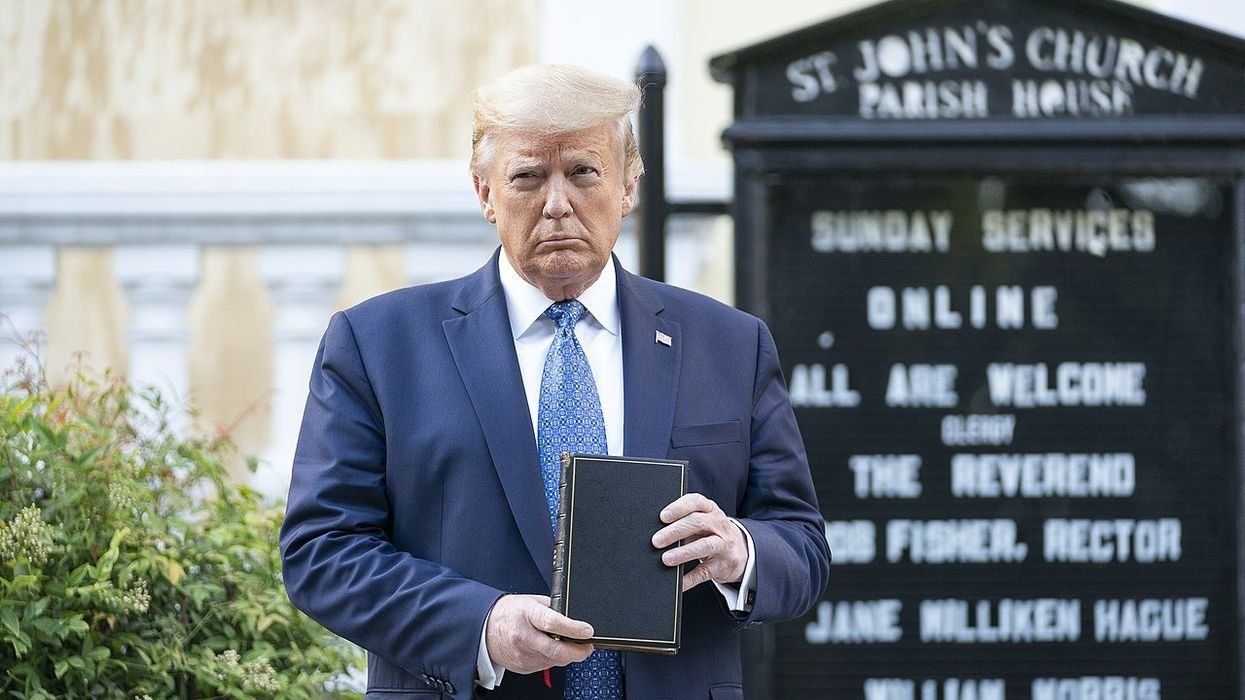
Donald Trump outside St. John's Episcopal Church in Washington, D.C. 
 (Official White House Photo by Shealah Craighead/Flickr)


December 01, 2025  
ALTERNET

Despite Pope Leo XIV to calling on his Catholic leadership to issue a forceful statement condemning President Donald Trump's "villification of immigrants," Trump loyalists, writes John Kenneth White in The Hill, have responded by declaring war on the Catholic church.

By a nearly unanimous vote, the United State Conference of Catholic Bishops issued their first special message in 12 years, saying they were “saddened by the state of contemporary debate and the vilification of immigrants,” and “concerned about the conditions in detention centers and the lack of access to pastoral care.”

They added that "we are grieved when we meet parents who fear being detained when taking their children to school and when we try to console family members who have already been separated from their loved ones.”

The bishops then put out a video denouncing the “dehumanizing rhetoric and violence” against those confronted by ICE — over 1.4 million have watched it so far, according to White.

But as clergy members continue to denounce the Trump administration's policies, MAGA has doubled down against the church.

“Boarder czar” Tom Homan condemned the bishops’ letter and the church as “wrong," adding “I’m saying it as not only border czar, I’ll say it as a Catholic. I think they need to spend time fixing the Catholic Church, in my opinion.”

White notes that Rep. Tim Burchett (R-TN) "accused the Catholic Church of using government grants to profit from services rendered to refugees. Gateway Pundit Jim Hoft charged that the bishops squandered more than $2.3 billion dollars received from the government, and praised Trump for terminating them."

Laura Loomer, Trump loyalist and so-called MAGA whisperer who called Pope Leo a "woke Marxist Pope," posted on X, "Are all of the Jew haters going to be calling out the Catholic bishops and the Marxist American Pope for condemning deportations?”

Matt Walsh, another Trump defender, White explains, "attacked the bishops, saying they didn’t make a video criticizing the Biden administration 'for supporting, funding, and facilitating the mass slaughter of children in the womb,' or 'its support for the castration and sexual mutilation of children.'"

White says that these attacks are the antithesis of the church's teachings.

"Those attacking the bishops and making reference to the sexual abuse scandals that have plagued the Catholic Church over the past decades does not diminish the bishops’ call for humane treatment of immigrants and adherence to the Gospel teachings of Jesus Christ," he writes.

"Trump casts himself as pro-Catholic and calls himself 'the most pro-life president ever.' But that does not mean that the maltreatment of those living outside the womb is no less a sin," he adds.

Actual Catholics, White says, are not happy with Trump.

"Catholics are swing voters and often determine election outcomes. Joe Biden won their votes in 2020; Donald Trump had a 12-point advantage in 2024. Today, a majority of Catholics disapprove of Trump," he writes.

"The Catholic Church is more than 2,000 years old. Declaring war on it is hardly civilized or politically smart. Trump has three years left in office. The Catholic Church will survive condemnation by those in power; it’s hardly the first time this has occurred in its long and storied history," he concludes.