It’s possible that I shall make an ass of myself. But in that case one can always get out of it with a little dialectic. I have, of course, so worded my proposition as to be right either way (K.Marx, Letter to F.Engels on the Indian Mutiny)
Wednesday, December 03, 2025
Maduro Vows Venezuela Will Be a ‘Colony Never Again’ as Trump Intensifies Threats
He has described President Donald Trump’s push for regime change as a “colonial threat” to “seize” Venezuela’s oil.
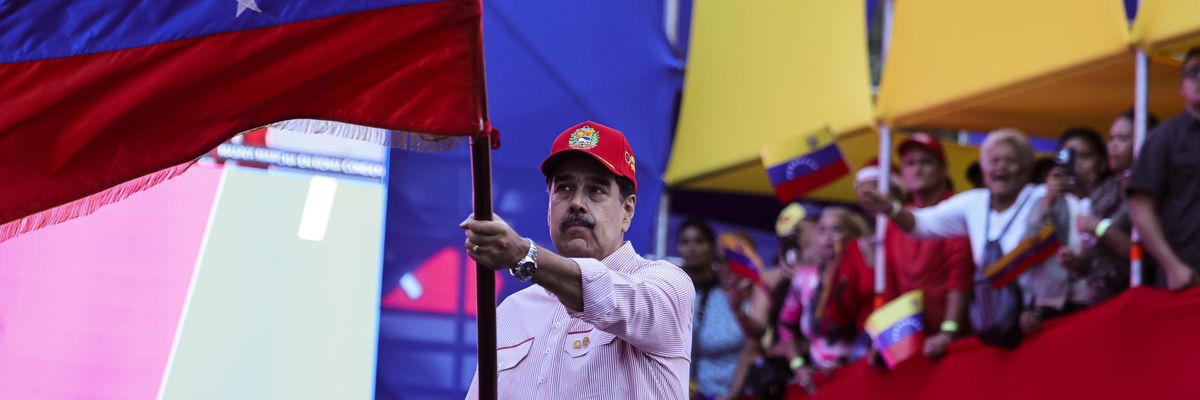
President Nicolás Maduro of Venezuela waves a Venezuelan flag during a protest to support him on December 1, 2025, in Caracas, Venezuela. (Photo by Jesus Vargas/Getty Images)
Venezuelan President Nicolás Maduro remained defiant on Monday as US President Donald Trump plotted “next steps” against the South American nation with top national security brass.
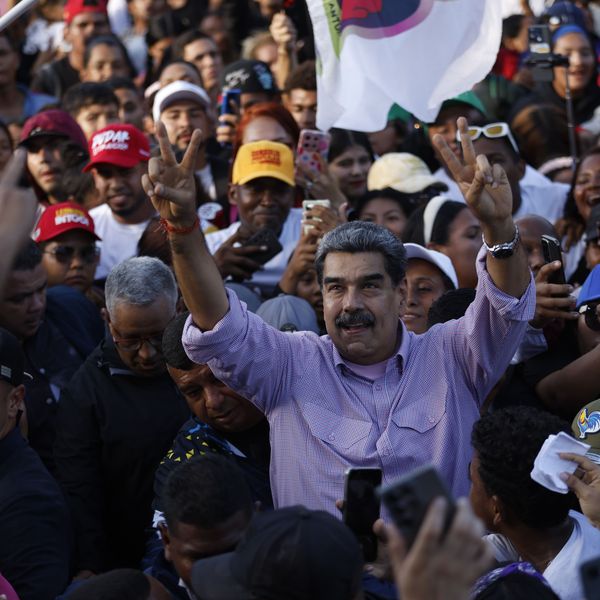
Before thousands of Venezuelans at a rally in Caracas, the nation’s embattled president said he would not accept peace on US terms unless it came “with sovereignty, equality, and freedom.”
“We do not want a slave’s peace, nor the peace of colonies! Colony, never! Slaves, never!” he said.
The speech came days after Trump announced that the US would close Venezuelan airspace, which many interpreted as a final step before a series of strikes on the mainland.
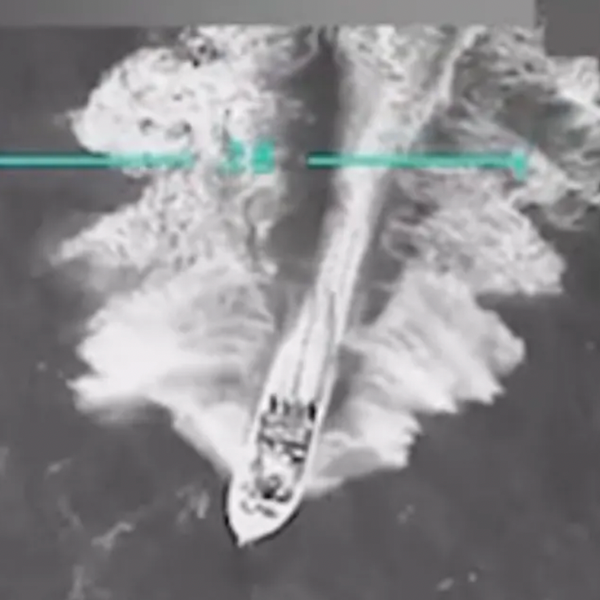
The US has framed its military buildup in the Southern Caribbean as part of a campaign to stop drug smuggling, the same justification it has used to carry out the extrajudicial bombings of more than 20 boats in the region—which have killed at least 83 people—while disclosing zero proof of the victims’ involvement with drug trafficking.
Trump has also accused Maduro of being the leader of the so-called “Cartel de los Soles,” which he slapped with the label of “Foreign Terrorist Organization” last month, even though it is not an “organization” at all, but a media shorthand to refer to alleged connections between Venezuelan leaders and the drug trade.
The US has amassed more than 15,000 troops outside Venezuela, the most it’s sent to the region since 1989, when the administration of former President George H.W. Bush launched a land invasion of Panama to overthrow its drug-running dictator Manuel Noriega. Documents obtained by The Intercept last week suggested that the US seeks to maintain “a massive military presence in the Caribbean” for years to come.
“By a factor of at least 10, the US presence is too great for even an intensified anti-drug operation,” wrote US national editor Edward Luce in the Financial Times on Tuesday.
Trump’s motive for stopping drug trafficking was further called into question after he pardoned former Honduran President Juan Orlando Hernández, a onetime US ally who was sentenced last year to 45 years in prison for helping to traffic at least 400 tons of cocaine to the US. The pardon was issued as part of Trump’s efforts to influence Honduras’ upcoming election to secure the victory of right-wing candidate Nasry “Tito” Asfura.
The goal of regime change was essentially confirmed on Monday when Reuters reported that Trump had offered Maduro safe passage out of Venezuela if he were willing to abdicate power during a phone call on November 21.
“You can save yourself and those closest to you, but you must leave the country now,” Trump reportedly told Maduro.
Maduro reportedly said he’d be willing to accept the offer if his family members were granted complete amnesty and the US removed sanctions against them, as well as over 100 other Venezuelan officials. He also asked for the case against him before the International Criminal Court (ICC) to be dropped.
Trump rejected that deal, and his offer of safe passage expired on Friday, the day before the US announced it had closed Venezuelan airspace. Trump confirmed to the press on Sunday that the talks had happened, but provided few additional details.
Maduro has categorically denied involvement with drug trafficking and has portrayed the White House’s sabre-rattling as a “colonial threat.” Last week, while brandishing the sword of South American anticolonial hero Simón Bolívar, he pledged that Venezuela would be a “colony never again.”
On Sunday, he accused Trump of trying to “seize” the nation’s oil reserves. He has called for the Organization of the Petroleum Exporting Countries (OPEC) to step in to help the country counter what he said were “growing and illegal threats” from Trump.
Venezuela has the world’s largest proven oil reserves—about a fifth of the Earth’s total, and more than Iraq had at the time of the George W. Bush administration’s 2003 invasion. However, US sanctions against Venezuela largely block American oil companies from accessing the reserves, which are controlled by the nation’s state-owned oil company Petróleos de Venezuela. These sanctions, which have limited Venezuela’s ability to export its most valuable natural resource, are considered one of the primary reasons for the nation’s economic instability in recent years.
While at a rally in 2023, Trump said he regretted not having “taken [Venezuela] over” during his first term. “We would have gotten to all that oil; it would have been right next door,” he said.
“We’ve seen this tragic play before,” wrote Richard Steiner, a former marine professor with the University of Alaska, this weekend in Common Dreams. “The Bush administration justified its disastrous 2003 invasion of Iraq with the pretext that Iraq had weapons of mass destruction, which, as it turned out, it didn’t. And as US Central Command commander General John Abizaid admitted about the Iraq war at the time: ‘Of course it’s about oil, it’s very much about oil, and we can’t really deny that.’”
“A similar pretext—this time ‘drug interdiction’—is being used to justify a potential US invasion and regime change in Venezuela,” he continued. “But this is not about stopping the flow of dangerous drugs, it is about actually increasing the flow of the dangerous drug some pushers want to keep us all hooked on—oil.”
Second US Strike on Boat Attack Survivors Was Illegal—But Experts Stress That the Rest Were, Too
“It is blatantly illegal to order criminal suspects to be murdered rather than detained,” said one human rights leader.
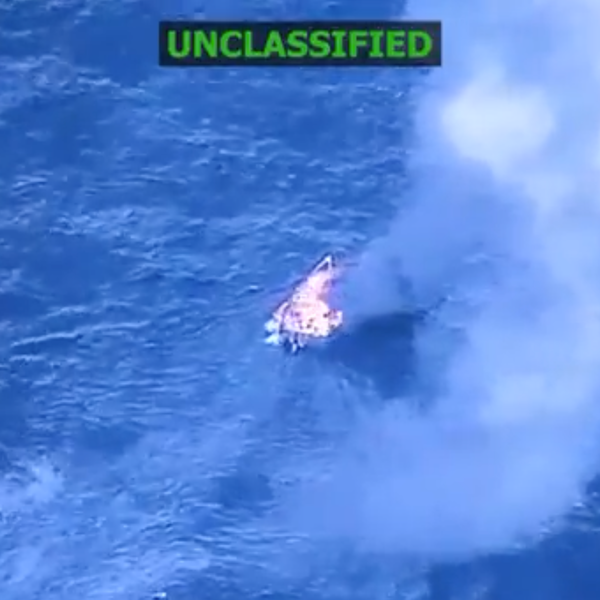
US President Donald Trump and Secretary of Defense Pete Hegseth announced that they bombed another boat in the Caribbean on October 3, 2025. (Photo: screenshot/Donald Trump/Truth Social
As the White Houseclaims that President Donald Trump “has the authority” to blow up anyone he dubs a “narco-terrorist” and Adm. Frank M. “Mitch” Bradley prepares for a classified congressional briefing amid outrage over a double-tap strike that kicked off the administration’s boat bombing spree, rights advocates and legal experts emphasize that all of the US attacks on alleged drug-running vessels have been illegal.
“Trump said he will look into reports that the US military (illegally) conducted a follow-up strike on a boat in the Caribbean that it believed to be ferrying drugs, killing survivors of an initial missile attack. But the initial attack was illegal too,” Kenneth Roth, the former longtime director of the advocacy group Human Rights Watch, said on social media Monday.
Roth and various others have called out the US military’s bombings of boats in the Caribbean and Pacific as unlawful since they began on September 2, when the two strikes killed 11 people. The Trump administration has confirmed its attacks on 22 vessels with a death toll of at least 83 people.
Shortly after the first bombing, the Intercept reported that some passengers initially survived but were killed in a follow-up attack. Then, the Washington Post and CNN reported Friday that Bradley ordered the second strike to comply with an alleged spoken directive from Defense Secretary Pete Hegseth to kill everyone on board.
The administration has not denied that the second strike killed survivors, but Hegseth and the White House press secretary, Karoline Leavitt, have insisted that the Pentagon chief never gave the spoken order.
However, the reporting has sparked reminders that all of the bombings are “war crimes, murder, or both,” as the Former Judge Advocates General (JAGs) Working Group put it on Saturday.
Following Leavitt’s remarks about the September 2 strikes during a Monday press briefing, Roth stressed Tuesday that “it is not ‘self-defense’ to return and kill two survivors of a first attack on a supposed drug boat as they clung to the wreckage. It is murder. No amount of Trump spin will change that.”
“Whether Hegseth ordered survivors killed after a US attack on a supposed drug boat is not the heart of the matter,” Roth said. “It is blatantly illegal to order criminal suspects to be murdered rather than detained. There is no ‘armed conflict’ despite Trump’s claim.”
The Trump administration has argued to Congress that the strikes on boats supposedly smuggling narcotics are justified because the United States is in an “armed conflict” with drug cartels that the president has labeled terrorist organizations.
During a Sunday appearance on ABC News’ “This Week,” US Sen. Chris Van Hollen (D-Md.) said that “I think it’s very possible there was a war crime committed. Of course, for it to be a war crime, you have to accept the Trump administration’s whole construct here... which is we’re in armed conflict, at war... with the drug gangs.”
“Of course, they’ve never presented the public with the information they’ve got here,” added Van Hollen, a member of the Senate Foreign Relations Committee. “But it could be worse than that. If that theory is wrong, then it’s plain murder.”
Michael Schmitt, a former Air Force lawyer and professor emeritus at the US Naval War College, rejects the Trump administration’s argument that it is at war with cartels. Under international human rights law, he told the Associated Press on Monday, “you can only use lethal force in circumstances where there is an imminent threat,” and with the first attack, “that wasn’t the case.”
“I can’t imagine anyone, no matter what the circumstance, believing it is appropriate to kill people who are clinging to a boat in the water... That is clearly unlawful,” Schmitt said. Even if the US were in an actual armed conflict, he explained, “it has been clear for well over a century that you may not declare what’s called ‘no quarter’—take no survivors, kill everyone.”
According to the AP: Brian Finucane, a senior adviser with the International Crisis Group and a former State Department lawyer, agreed that the US is not in an armed conflict with drug cartels.
“The term for a premeditated killing outside of armed conflict is murder,” Finucane said, adding that US military personnel could be prosecuted in American courts.
“Murder on the high seas is a crime,” he said. “Conspiracy to commit murder outside of the United States is a crime. And under the Uniform Code of Military Justice, Article 118 makes murder an offense.”
Finucane also participated in a related podcast discussion released in October by Just Security, which on Monday published an analysis by three experts who examined “the law that applies to the alleged facts of the operation and Hegseth’s reported order.”
Michael Schmitt, Ryan Goodman, and Tess Bridgeman emphasized in Just Security that the law of armed conflict (LOAC) did not apply to the September 2 strikes because “the United States is not in an armed conflict with any drug trafficking cartel or criminal gang anywhere in the Western Hemisphere... For the same reason, the individuals involved have not committed war crimes.”
“However, the duty to refuse clearly unlawful orders—such as an order to commit a crime—is not limited to armed conflict situations to which LOAC applies,” they noted. “The alleged Hegseth order and special forces’ lethal operation amounted to unlawful ‘extrajudicial killing’ under human rights law... The federal murder statute would also apply, whether or not there is an armed conflict.”
Goodman added on social media Monday that the 11 people killed on September 2 “would be civilians even if this were an armed conflict... It’s not even an armed conflict. It’s extrajudicial killing.”
When Obedience Becomes Complicity: From Mỹ Lai to Today’s Military Conscience
The bravest act is sometimes the one that defies orders, safeguards the innocent, and enforces the law.
President Donald Trump announced a US military strike on a fifth boat
in the Caribbean on October 14, 2025. (Image: screenshot/Donald Trump/Truth Social)
Courage is rarely convenient. Sometimes it is condemned. Ask Hugh Clowers Thompson Jr.
On March 16, 1968, Thompson, a young Army helicopter pilot in the 123rd Aviation Battalion of the 23rd Infantry Division, flew over the South Vietnamese village of Sơn Mỹ and witnessed something unimaginable. American soldiers were systematically killing unarmed civilians—women, children, and the elderly. There were no enemy combatants. This was not war. This was a massacre.
Most soldiers either did not see or refused to confront the truth. Thompson did. He acted decisively: He hovered his helicopter between the troops and the villagers; ordered his crew, Glenn Andreotta and Lawrence Colburn, to fire on American soldiers if the killing continued; and personally escorted terrified civilians to safety. He radioed repeated warnings to Task Force Barker headquarters. Eventually, his actions forced command to halt the massacre.
For Thompson, the cost of moral courage was immense. He endured ostracism, post-traumatic stress disorder, alcoholism, and personal strife for years. In 1970, he testified in a closed congressional hearing about what he had seen, facing hostility from some quarters of government and military leadership. Congressman Mendel Rivers (D-SC) even declared that Thompson was the only soldier at Mỹ Lai who should be punished, attempting to have him court-martialed for turning his weapons on fellow troops. As the US government tried to cover up the massacre, Thompson was vilified and received death threats. Recognition came decades later when the Army awarded him the Soldier’s Medal, a belated acknowledgment of moral courage under fire.
When the chain of command conflicts with the Constitution or the law, the obligation to act ethically supersedes the obligation to obey.
Decades later, Thompson’s example has returned to the national conversation. Recently, a group of Democratic lawmakers, including Sens. Mark Kelly (D-Ariz.) and Elissa Slotkin (D-Mich.) and Reps. Jason Crow (D-Colo.), Chrissy Houlahan (D-Penn.), Chris Deluzio (D-Penn.), and Maggie Goodlander (D-NH), released a video urging active-duty military and intelligence personnel to refuse illegal orders. “You can refuse illegal orders…you must refuse illegal orders,” the lawmakers said. “No one has to carry out orders that violate the law or our Constitution.” They framed their guidance as a duty to uphold the oath to the Constitution, not to any individual leader.
The reaction was swift and incendiary. President Donald Trump called the statement “seditious behavior at the highest level,” while Pentagon officials warned it could undermine “good order and discipline.” Some lawmakers were reportedly notified of an FBI inquiry. Social media amplified threats, escalating beyond rhetoric into menace. On Truth Social, a user openly called for the lawmakers to be hanged—a post the president reposted. Senate Minority Leader Chuck Schumer (D-NY) denounced the act, stating from the Senate floor that Trump was “calling for the execution of elected officials” and emphasizing, “This is an outright threat, and it’s deadly serious.” When questioned in an interview, Trump insisted he was “not threatening” the lawmakers, but added, “I think they’re in serious trouble. In the old days, they would have [been] dead.”
Yet legal experts insist the lawmakers’ message was not only lawful—it was accurate. “They did not encourage unlawful action,” explained Brenner Fissell, professor of law at Villanova University and vice president of the National Institute of Military Justice. “They were not encouraging the disobedience of lawful orders; they were encouraging the disobedience of unlawful orders. And that is a correct statement of the law.” Under the Uniform Code of Military Justice (UCMJ), service members must obey lawful orders, but there is a strong presumption that orders are lawful. At the same time, service members may refuse patently illegal commands, including those that constitute war crimes, and can even face prosecution for carrying them out.
The stakes of following orders have never been abstract. Recent reporting has raised alarms that American military officials may have been ordered to commit grave violations of the laws of war. A Washington Post report described a September strike in the Caribbean in which boats suspected of smuggling drugs were attacked, and survivors were allegedly targeted in a follow-up strike. According to the report, Defense Secretary Pete Hegseth had given a verbal order to “kill everyone aboard” the boats, prompting a military commander to carry out a second strike on those who initially survived.
Lawmakers across the aisle responded with alarm. Rep. Mike Turner, a Republican and former Intelligence Committee chair, called the act “very serious” and “an illegal act.” Sen. Tim Kaine, Democrat of Virginia, said the report—if accurate—“rises to the level of a war crime.” And Sen. Mark Kelly echoed the concern, stating plainly on CNN: “It seems to.”
The ethical unease is not just theoretical, it is coming from inside the chain of command. The Orders Project, founded five years ago to provide independent legal guidance to US service members, has seen a noticeable uptick in calls over the past three months. Staff officers involved in planning the Caribbean strikes have reached out seeking guidance, as have National Guard members concerned about potential domestic deployments. Some callers even express fear of legal complicity in what they describe as potential atrocities abroad, including US weapons being used in Gaza.
“These are people who are performing some sort of role in between,” explained retired Lieutenant Colonel Frank Rosenblatt, an Army lawyer and president of the National Institute of Military Justice, which runs The Orders Project. “They’re not the ones on the operations themselves, but they are concerned that the guidance they’re being asked to provide has been very disfavored. They’re feeling pressure from their higher-ups to convert a ‘nonconcur’ into a ‘concur.’”
From Sơn Mỹ to Capitol Hill, and now to the Caribbean, the principle is clear: Silence in the face of wrongdoing is complicity; conscience in the face of authority is courage. As historian Howard Zinn once observed, “There is no flag large enough to cover the shame of killing innocent people.” Thompson drew a line between duty and obedience, risking his career, reputation, and personal safety to protect the innocent. Today, lawmakers and service members alike are grappling with the same lesson: Patriotism is not measured by conformity—it is measured by integrity.
This is more than a legal debate; it is a moral one. History offers no ambiguity. When the chain of command conflicts with the Constitution or the law, the obligation to act ethically supersedes the obligation to obey. Thompson’s helicopter hovering over the bodies in Sơn Mỹ, the lawmakers’ warning to military personnel, the threats that followed, reports of potential unlawful strikes in the Caribbean, and internal military concerns about legal complicity are chapters of the same story: one of conscience, courage, and accountability.
In a time when authority can intimidate, mislead, or threaten the nation’s foundational laws, the lesson of Hugh Thompson Jr. endures. True service is not blind obedience. It is the willingness to say no, to defend the innocent, and to honor the Constitution, even when doing so invites condemnation, career jeopardy, or worse. Democracy is not measured by the strength of its institutions alone, but by the moral courage of those entrusted to uphold them.The challenge is timeless: The bravest act is sometimes the one that defies orders, safeguards the innocent, and enforces the law. From the rice paddies of Sơn Mỹ to the halls of Capitol Hill, and across oceans to the Caribbean, the measure of our nation, and its soldiers, is in the courage to act rightly, even when it costs everything. As General Omar N. Bradley once reminded the world, “Leadership is intangible, and no weapon ever designed can replace it.”
Our work is licensed under Creative Commons (CC BY-NC-ND 3.0). Feel free to republish and share widely.
George Cassidy Payne George Cassidy Payne is a writer, educator, and social justice advocate. He lives in Irondequoit, New York. Full Bio >
Experts Agree: It Was Illegal to Follow Hegseth’s Illegal Orders
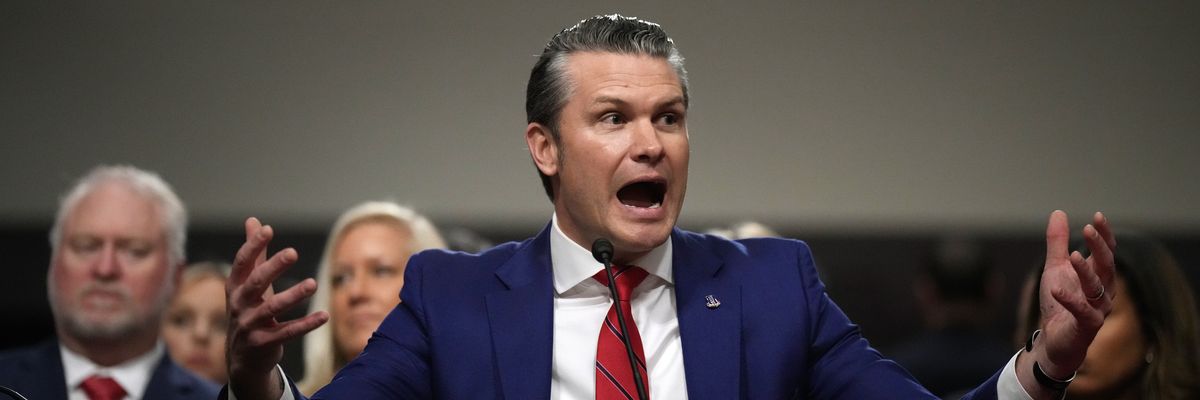
Under well-established law, those who complied with the orders cannot escape individual criminal responsibility for the killing of the two survivors in the event they are brought to trial. Secretary of Defense Pete Hegseth testifies during his Senate Armed Services confirmation hearing on Capitol Hill on January 14, 2025 in Washington, DC. (Photo by Andrew Harnik/Getty Images)
The question of when it is lawful for US military personnel to refuse an unlawful order has become a point of discussion in the political arena. Those conversations took a turn with the Washington Post and CNN reporting over Thanksgiving weekend that Secretary of Defense Pete Hegseth had issued a verbal order to “kill everyone” in the initial US military strike on suspected drug smugglers in the Caribbean, resulting in US special forces’ allegedly killing two shipwrecked survivors who were clinging to the wreckage of their vessel on Sept. 2, 2025.
In this article, we do not engage with the political discussion, but rather examine the law that applies to the alleged facts of the operation and Hegseth’s reported order. And with respect to the legal assessment of that operation, we will not be dealing with the broader question of whether the attack on the boat was unlawful as such, which it was (see articles published at Just Security by Marty Lederman; Michael Schmitt; and a podcast discussion with Tess Bridgeman, Brian Finucane, and Rebecca Ingber). Instead, we focus on a narrower aspect of the strike, the purported order to kill all aboard the vessel and the resulting second strike on the boat that killed the survivors.
As a matter of law, there are two central issues to address. The first concerns the circumstances in which military personnel have a duty to refuse to obey an order and, relatedly, whether a superior order can relieve them of criminal responsibility. The second is whether the orders in this case triggered that duty or provided those involved a defense. As both issues are context dependent, we begin with the facts.
The Reported Order(s) and Military Operation
Without rehashing the well-known and fairly straightforward reported chain of events on September 2, it is essential to understand that there were apparently two different orders in the military chain of command.
Secretary of Defense Pete Hegseth’s verbal order
The Washington Postreported: The longer the US surveillance aircraft followed the boat, the more confident intelligence analysts watching from command centers became that the 11 people on board were ferrying drugs.
Defense Secretary Pete Hegseth gave a verbal directive, according to two people with direct knowledge of the operation. “The order was to kill everybody,” one of them said.
Note that “Secretary of Defense Pete Hegseth had ordered the military prior to the operation to ensure the strike killed everyone on board, but it’s not clear if he knew there were survivors prior to the second strike, one of the sources said,” CNN reported.
The Washington Post reported: Two survivors were clinging to the smoldering wreck.
The Special Operations commander overseeing the Sept. 2 attack… ordered a second strike to comply with Hegseth’s instructions, two people familiar with the matter said. The two men were blown apart in the water.
Adm. Frank M. “Mitch” Bradley, told people on the secure conference call that the survivors were still legitimate targets because they could theoretically call other traffickers to retrieve them and their cargo, according to two people. He ordered the second strike to fulfill Hegseth’s directive that everyone must be killed.
This order implicates the duty of subordinate commanders and those executing the strike to refuse to comply with unlawful orders.
Following the strike, Hegseth told reporters, “We smoked a drug boat, and there’s 11 narco terrorists at the bottom of the ocean, and when other people try to do that, they’re going to meet the same fate.” Note that according to an earlier report by the New York Times, the targeted boat had “altered its course and appeared to have turned around before the attack started.”
The Duty to Refuse Unlawful Orders
From the perspective of those receiving them, unlawful orders raise two issues. The first is whether there is a duty to refuse them. The United States clearly imposes such a duty. In particular, the Department of Defense’s (DOD) Law of War Manual (2023) emphasizes the obligation, giving, as a paradigmatic example, an order to kill shipwrecked persons. 18.3.2.1 Clearly Illegal Orders to Commit Law of War Violations. The requirement to refuse to comply with orders to commit law of war violations applies to orders to perform conduct that is clearly illegal or orders that the subordinate knows, in fact, are illegal. For example, orders to fire upon the shipwrecked would be clearly illegal.
The Manual cautions, however, that “[s]ubordinates are not required to screen the orders of superiors for questionable points of legality, and may, absent specific knowledge to the contrary, presume that orders have been lawfully issued.” But in clear cases, the duty attaches. As the Manual for Courts-Martial explains, the general presumption that an order can be inferred to be lawful “does not apply to a patently illegal order, such as one that directs the commission of a crime.”
An even more granular explanation of the duty to refuse unlawful orders is provided in the US Navy-Marine Corps-Coast Guard Commanders Handbook on the Law of Naval Operations (§ 6.1.3.2): All naval personnel have a duty to comply with the law of armed conflict in good faith; prevent violations by others to the utmost of their ability; and refuse to comply with clearly illegal orders to commit violations of the law of armed conflict. Naval personnel have an affirmative obligation to promptly report violations which they become aware. When appropriate, naval personnel should ask questions through appropriate channels and consult with the command legal advisor on issues relating to the law of armed conflict. Naval personnel should adhere to regulations, procedures, and training, as these policies and doctrinal materials have been reviewed for consistency with the law of armed conflict. Commands and orders should not be understood as implicitly authorizing violations of the law of armed conflict where other interpretations are reasonably available.
These US duties track international law, for, as the International Committee of the Red Cross (ICRC) has asserted, under the law of armed conflict (LOAC), “[e]very combatant has a duty to disobey a manifestly unlawful order” (ICRC, Customary IHL study, Rule 154).
And refusal to obey an unlawful order is not an offense in the US armed forces. Under the Uniform Code of Military Justice, an offense occurs if the accused (1) violates or fails to obey any lawful general order or regulation; (2) having knowledge of any other lawful order issued by any member of the armed forces, which it is his duty to obey, fails to obey the order; or (3) is derelict in the performance of his duties (art. 92).
It is also an offense if a member of the armed forces “willfully disobeys a lawful command of his superior commissioned officer” (art. 90). Thus, the fact that an order is unlawful precludes conviction for its violation. So, although orders may generally be presumed lawful, if they are clearly unlawful, US military personnel have an affirmative duty to refuse them and may not be prosecuted for doing so.
No Defense of Superior Orders
The second issue raised by orders is whether they constitute a defense available to those acting unlawfully, but pursuant to them. It has long been the case under customary international law that “superior orders” is no defense for war crimes. The Charter of the International Military Tribunals at Nuremberg and Tokyo excluded the defense (arts. 8 and 6, respectively), as did the 1950 Nuremberg Principles (prin. IV). The absence of a superior orders defense has also been confirmed in the statutes of modern war crimes tribunals, including those of the International Criminal Court and the International Criminal Tribunals for the Former Yugoslavia and Rwanda (arts. 33, 7, and 6, respectively). Indeed, the defense is unavailable to international law violations generally. For instance, the United Nations Convention Against Torture and the Inter-American Convention on the Forced Disappearance of Persons prohibit superior orders as a defense in national legislation implementing their prohibitions (arts. 2 and VIII, respectively).
As with the affirmative duty to disobey an unlawful order, the ICRC has accurately stated that under customary international law, “[o]beying a superior order does not relieve a subordinate of criminal responsibility if the subordinate knew that the act ordered was unlawful or should have known because of the manifestly unlawful nature of the act ordered.” (ICRC Customary International Humanitarian Law study, Rule 155).
US military law likewise rejects the defense of superior order in the Manual for Courts-Martial. Rule 916(d) provides, “It is a defense to any offense that the accused was acting pursuant to orders unless the accused knew the orders to be unlawful or a person of ordinary sense and understanding would have known the orders to be unlawful.” The touchstone case reflecting the principle is US v. Calley, which dealt with the murder of 22 children, women, and old men in the South Vietnamese village of My Lai. Lt. Calley claimed he was obeying an order because “he had been taught the doctrine of obedience throughout his military career” and that he “was acting in ignorance of the laws of war.” The US Court of Military Appeals held that, the obedience of a soldier is not the obedience of an automaton. A soldier is a reasoning agent, obliged to respond, not as a machine, but as a person. The law takes these factors into account in assessing criminal responsibility for acts done in compliance with illegal orders.
The acts of a subordinate done in compliance with an unlawful order given him by his superior are excused and impose no criminal liability upon him unless the superior’s order is one which a man of ordinary sense and understanding would, under the circumstances, know to be unlawful, or if the order in question is actually known to the accused to be unlawful.
Thus, it is unlawful to obey an unlawful order, and merely following clearly illegal orders provides no defense. This being so, the questions in the September 2 strikes are whether Secretary Hegseth’s reported order to Adm. Bradley was clearly unlawful and whether Bradley’s apparent follow-on order to conduct the second strike was likewise manifestly unlawful.
What Law Applied to the Reported Orders?
Much attention has been focused on the laws of war as they may relate to the Hegseth order and resulting operation. In that regard, we must emphasize that LOAC did not apply to the September 2 strikes, because, as has been explained in multiple Just Security articles referenced above, the United States is not in an armed conflict with any drug trafficking cartel or criminal gang anywhere in the Western Hemisphere. There is no international armed conflict because, inter alia, there are neither hostilities between States nor the requisite degree of State control over alleged drug cartels operating the boats. And there is no non-international armed conflict, both because the cartels concerned do not qualify as organized armed groups in the LOAC sense, and because there were no hostilities between the United States and the cartels on September 2, let alone hostilities that would reach the requisite level of intensity to cross the armed conflict threshold. For the same reason, the individuals involved have not committed war crimes.
However, the duty to refuse clearly unlawful orders—such as an order to commit a crime—is not limited to armed conflict situations to which LOAC applies. Nor is rejection of a defense of superior orders restricted to war crimes. In fact, the more restrictive rules of international human rights law applied instead. As will be explained, the alleged Hegseth order and special forces’ lethal operation amounted to unlawful “extrajudicial killing” under human rights law (see also here). The federal murder statute would also apply, whether or not there is an armed conflict. (See, e.g., Marty Lederman’s analysis).
That said, the administration has reported to Congress, stated publicly, and recorded in legal and operational memoranda that it believes one or multiple “non-international armed conflicts” exist between the United States and 24 organizations in Latin America (whether it views the situation as one armed conflict, 24 separate ones, or some other combination is unclear). This being so, before turning to the law that was actually violated through the September 2 and subsequent operations, allow us to counterfactually consider the law that would apply had the administration been correct in characterizing the operation as occurring during an armed conflict.
The Prohibition of Ordering Denial of Quarter or Denying Quarter
Assuming solely for the sake of discussion that there was a non-international armed conflict at the time of the September 2 strikes, the most relevant LOAC rule applicable to the Hegseth and Bradley orders is the “denial of quarter,” i.e., an instruction not to allow any survivors (see, e.g., Working Group of Former Judge Advocates Generals’ statement on the Hegseth order).
The status of the prohibition on the denial of quarter (and on ordering or threatening its denial) was settled well over a century ago. It is applicable in both international and non-international armed conflicts as a matter of customary international law (ICRC, Customary International Humanitarian Law study, Rule 46). This is so with respect to its status as a violation of LOAC entailing the responsibility of the State concerned and as a war crime by the individuals issuing orders to deny quarter or carrying them out. We need not repeat here the major international texts and tribunal decisions that support that conclusion. One of us (Schmitt) walked through all of the relevant texts, from the US Civil War’s Lieber Code to the present, in a 2023 essay concerning a “kill everyone” order by the head of Russia’s Wagner Group (coauthored with LtCol John Tramazzo).
Here, suffice it to note that the DOD Law of War Manual is categorical: “It is… prohibited to conduct hostilities on the basis that there shall be no survivors, or to threaten the adversary with the denial of quarter. This rule is based on both humanitarian and military considerations.” The Manual further emphasizes that the rule “also applies during non-international armed conflict” (§ 5.4.7).
A closely related prohibition implicated in the September 2 strikes, which also applies in both international and non-international armed conflict, is on attacking those who are hors de combat, a condition that includes those who are “defenseless” because they are shipwrecked (see ICRC Customary International Humanitarian Law study, rule 47 and related practice). As the DOD Law of War Manual explains (§ 5.9.4), Shipwrecked combatants include those who have been shipwrecked from any cause… Persons who have been incapacitated by… shipwreck are in a helpless state, and it would be dishonorable and inhumane to make them the object of attack. In order to receive protection as hors de combat, the person must be wholly disabled from fighting.
The Commander’s Handbook on the Law of Naval Operations similarly provides, “Intentional attack on a combatant who is known to be hors de combat constitutes a grave breach of the law of armed conflict” (§ 8.2.3). Indeed, as noted in the Newport Manual on the Law of Naval Warfare published by the US Naval War College’s Stockton Center, Geneva Convention II sets forth a legal framework for the humane treatment and protection of victims of armed conflict at sea. The Convention requires parties to the conflict to, inter alia, respect and protect individuals falling within the scope of the Convention “who are at sea and who are wounded, sick or shipwrecked.” Parties to a conflict are thus required, after each engagement and without delay, to “take all possible measures to search for and collect the shipwrecked, wounded and sick,” without discriminating between their own and enemy personnel.
To be clear, there is no exception to the prohibition on attacking those who are hors de combat due to being shipwrecked because they might escape or otherwise receive rescue assistance from their forces. The only basis for treating them as subject to continued attack is if they are, in fact, not hors de combat because they continue to fight. Doctrine and Prosecutions on Denial of Quarter
This analysis of the LOAC rules merits being supplemented with three additional points. First, each US servicemember has an obligation to report evidence that any US operation potentially involved killing shipwrecked survivors or a denial of quarter. According to the Commander’s Handbook on the Law of Naval Operations (§ 6.3; see also DOD Directive 2311.01): All military and US civilian employees, contractor personnel, and subcontractors assigned to or accompanying a DOD component must report through their chain of command all reportable incidents, including those involving allegations of non-DOD personnel having violated the law of war.
Examples of incidents that “must be reported” include: (1) “Offenses against the Wounded, the Sick, [and] Survivors of Sunken Ships,” such as “willfully killing”; (2) “Other Offenses against Survivors of Sunken Ships,” including, “when military interests permit, failure to search out, collect, make provision for the safety of, or to care for survivors;” and (3) “Denial of quarter, unless bad faith is reasonably suspected” (§ 6.3).
Second, a landmark 1921 case emerging out of World War I clearly set forth the rule that killing shipwrecked survivors of a boat strike is a war crime and that superior orders offer no defense to such conduct, because such orders must be disobeyed. In the Llandovery Castle case, the Imperial Court of Justice considered a June 1918 incident after a German U-boat sank the Llandovery Castle, a Canadian hospital ship. The U-boat Commander claimed he thought the ship was carrying American airmen. In convicting the defendants for firing on the survivors who were in lifeboats, the court noted that by that point, the international legal prohibition on killing survivors of a maritime attack was manifest. The firing on the boats was an offence against the law of nations. In war on land the killing of unarmed enemies is not allowed (compare the Hague regulations as to war on land, para. 23(c)), similarly in war at sea, the killing of shipwrecked people, who have taken refuge in life-boats, is forbidden. … The fact that his deed is a violation of international law must be well-known to the doer, apart from acts of carelessness, in which careless ignorance is a sufficient excuse. In examining the question of the existence of this knowledge, the ambiguity of many of the rules of international law, as well as the actual circumstances of the case, must be borne in mind, because in war time decisions of great importance have frequently to be made on very insufficient material. This consideration, however, cannot be applied to the case at present before the court. The rule of international law, which is here involved, is simple and is universally known. No possible doubt can exist with regard to the question of its applicability. (emphasis added)
Accordingly, the court held that the German crew could not claim to be following orders as a defense because such an order would be clearly unlawful: It is certainly to be urged in favor of the military subordinates, that they are under no obligation to question the order of their superior officer, and they can count upon its legality. But no such confidence can be held to exist, if such an order is universally known to everybody, including also the accused, to be without any doubt whatever against the law. This happens only in rare and exceptional cases. But this case was precisely one of them, for in the present instance, it was perfectly clear to the accused that killing defenceless people in the life-boats could be nothing else but a breach of the law. … They should, therefore, have refused to obey. As they did not do so, they must be punished.“ (emphasis added)
The DOD Law of War Manual cites and quotes the Llandovery Castle case to illustrate the point that clearly illegal orders must be refused (see DOD Law of War Manual, § 18.3.2.1).
Notably, in its sentencing assessment, the court stated that “the principal guilt rests with” the U-boat Commander who issued the order, while his subordinates could obtain some mitigation of sentence given the pressure entailed in refusing a military order.
Third, a famous World War II case involved a similar set of facts. In the 1945 Peleus Trial, a British Military Court sitting in Hamburg considered a March 1944 incident in which a German submarine sank a Greek ship chartered by the British Ministry of War Transport. Upon the orders of the German commander Heinz Eck, the U-boat members fired a machine gun and threw grenades at Peleus’ crew members who had survived the first attack but were shipwrecked in the water. The prosecutor and the judge advocate (who at that time served as the court’s legal adviser) both relied on the Llandovery Castle case. In response to the defendants’ plea of superior orders, the judge advocate stated: The duty to obey is limited to the observance of orders which are lawful. There can be no duty to obey that which is not a lawful order. …
It is quite obvious that no sailor and no soldier can carry with him a library of international law, or have immediate access to a professor in that subject who can tell him whether or not a particular command is a lawful one. If this were a case which involved the careful consideration of questions of international law as to whether or not the command to fire at helpless survivors struggling in the water was lawful, you might well think it would not be fair to hold any of the subordinate accused in this case responsible for what they are alleged to have done; but is it not fairly obvious to you that if in fact the carrying out of Eck’s command involved the killing of these helpless survivors, it was not a lawful command, and that it must have been obvious to the most rudimentary intelligence that it was not a lawful command, and that those who did that shooting are not to be excused for doing it upon the ground of superior orders? (emphasis added)
The court sentenced Eck and two other defendants to death, another to life imprisonment, and the fifth defendant to 15 years imprisonment.
Assuming the facts as reported about the September 2 strike, and if LOAC and war crimes law had applied (they do not), Secretary Hegseth and Admiral Bradley’s orders were self-evidently unlawful because they ordered no quarter. Moreover, the second strike on the boat would qualify as an attack on those shipwrecked persons who are hors de combat. Whether Secretary Hegseth knew there were shipwrecked survivors is unclear, but Admiral Bradley reportedly did and ordered their attack anyway.
If those involved believed they were engaged in an armed conflict, we find it difficult to imagine they could not have known that the orders were unlawful. The more military training and experience they have, the more implausible such a claim is. Applying International Human Rights Law to the Alleged Facts
The law of armed conflict is generally a more permissive legal regime for the use of military force than international human rights law (IHRL). In particular, the LOAC permits targeting members of the armed forces, including members of organized armed groups, based on their status, and others if and for such time as they “directly participate in hostilities,” which encompasses more than conducting attacks. By contrast, targeting based on status outside an armed conflict is prohibited. Acts opening the door to the use of force against an individual are generally limited to situations in which they pose an imminent threat of death or grievous bodily harm. If the Hegseth and Bradley orders and the ensuing second strike had been violations of LOAC in a non-international armed conflict, they would, a fortiori, have violated human rights law as a matter of peacetime law enforcement.
With respect to the US lethal strikes on suspected drug trafficking vessels at issue here, two of us (Schmitt and Goodman, along with coauthor Marko Milanovic) have explained why “there is absolutely no question that the US lethal strikes on the boats are a violation of international human rights law.” Without rehashing that analysis here, the bottom line is that the US strikes on suspected drug traffickers at sea are clearly arbitrary deprivations of the right to life under IHRL, an obligation that the United States acknowledges applies extraterritorially. As they wrote: The widely-accepted standard for arbitrariness prohibits the use of force likely to cause death or grievous bodily injury “except in self-defence or defence of others against the imminent threat of death or serious injury, to prevent the perpetration of a particularly serious crime involving grave threat to life, to arrest a person presenting such a danger and resisting their authority, or to prevent his or her escape, and only when less extreme means are insufficient to achieve these objectives” (Basic Principles on the Use of Force and Firearms by Law Enforcement Officials; see also UN Human Rights Committee, General Comment 36, para 12).
If the lack of an imminent threat of death or serious injury on the part of individuals suspected of trafficking drugs at sea (quite plausibly here, ferrying cocaine from Venezuela to a transhipment point for onward distribution in Europe) is obvious with respect to the campaign as a whole, it is doubly so with respect to a vessel that, as has been reported, had turned around prior to the US strike. It is even more patently obvious that it is an arbitrary deprivation of the right to life—i.e., murder—to fire on the shipwrecked survivors of that strike, as has now been reported.
In sum, there is simply no plausible argument that the reported killing of two survivors clinging to the burning wreckage of their stricken vessel could be anything other than an extrajudicial killing. It is equally clear that, according to long-standing law (including prevailing US legal interpretations), the reported Hegseth and Bradley orders to fire on them were manifestly unlawful, and that those carrying out that order cannot rely on a superior orders defense if prosecuted for those actions due to the egregious illegality of the order.
Concluding Thoughts
The September 2 strikes on the purported drug boat neither violated the law of armed conflict nor amounted to war crimes, because they did not occur during an armed conflict. However, if the facts are as reported, there is little question that the order by Secretary Hegseth and the ensuing order by Admiral Bradley to conduct the second strike were unlawful, because the killing of the two survivors was a serious violation of international human rights law.
Moreover, both orders were clearly unlawful. Under well-established law, those who complied with the orders cannot escape individual criminal responsibility for the killing of the two survivors in the event they are brought to trial in a US military court-martial, a federal trial, or a domestic criminal proceeding in another State that has jurisdiction, for instance, based on the nationality of the victims. If actually issued, these orders irresponsibly and unlawfully placed all those involved in the attack in serious legal jeopardy. If the reporting is accurate, those orders should, as a matter of law, have been refused. Editor’s note: Readers may also be interested in Jeremy Chin, Margaret Lin, and Aidan Arasasingham, Timeline of Vessel Strikes and Related Actions
Michael Schmitt Michael Schmitt is professor of international law at the University of Reading, affiliate at Harvard Law School’s Program on International Law and Armed Conflict, and visiting research professor at the International Institute of Humanitarian Law. He formerly served as the G. Norman Lieber distinguished scholar at West Point, chair of the Stockton Center for International Law at the US Naval War College, where he is pofessor emeritus, dean of the George C. Marshall Center European Center for Security Studies, and professor of law at the University of Exeter, Durham University, and the United States Air Force Academy. Professor Schmitt is a retired US Air Force judge advocate, having specialized in international and operational law. He is the general editor of the Lieber Studies series (OUP) and sits on many international law advisory and editorial boards. Full Bio >
Ryan Goodman Ryan Goodman is the Anne and Joel Ehrenkranz professor of law at New York University school of law, specialising in international human rights. Follow him on Twitter @rgoodlaw Full Bio >
Tess Bridgeman Dr. Tess Bridgeman is coeditor-in-chief of Just Security. She served in the White House as special assistant to the president, associate counsel to the president, and deputy legal adviser to the National Security Council (NSC) during the Obama administration. She also served at the State Department in the Office of the Legal Adviser as special assistant to the legal adviser and, prior to that role, as an attorney adviser in the Office of Political-Military Affairs. Full Bio >
YANKEE MURDER ON THE HIGH SEAS
'They know they got caught': National security expert slams defense of boat strikes
A national security expert slammed the Trump administration during a podcast interview on Tuesday over its shifting defenses about its strikes against alleged drug boats.
The administration has conducted at least 21 strikes against alleged drug boats and killed upwards of 80 people, according to multiple reports. A recent report from The Washington Post, citing two sources familiar with the matter, indicates Defense Secretary gave an order to kill survivors of one of the strikes, which experts have said could amount to a war crime.
"The headline of this whole thing is that they know they got caught committing murder," Rhodes said. "They are acting like people who are guilty of murder because they are."
During a press conference on Tuesday, Hegseth claimed that he wasn't aware of any survivors of the attack in question and had departed for another meeting when the strike order was given. Some analysts noted that this claim seemed to contradict Hegseth's previous claims that he watched the strike in its entirety.
His shifting answer seemed to match the Trump administration's evolving narrative about the particular strike, The Washington Post reported on. Initially, the administration claimed they were removing a hazard. Since then, the administration has claimed it was self-defense, podcast co-host Tommy Veitor noted.
"The whole world is watching video evidence of a war crime," Rhodes said. "And it's a sign too that even Pete Hegseth...is aware that he's going to have a life after Donald Trump is there to protect him. This is becoming an increasingly common thread with this group, that they're aware that there's some accountability that may be on the horizon for them."
Military's top brass worried as highest-ranking officer disappears amid crisis: analyst
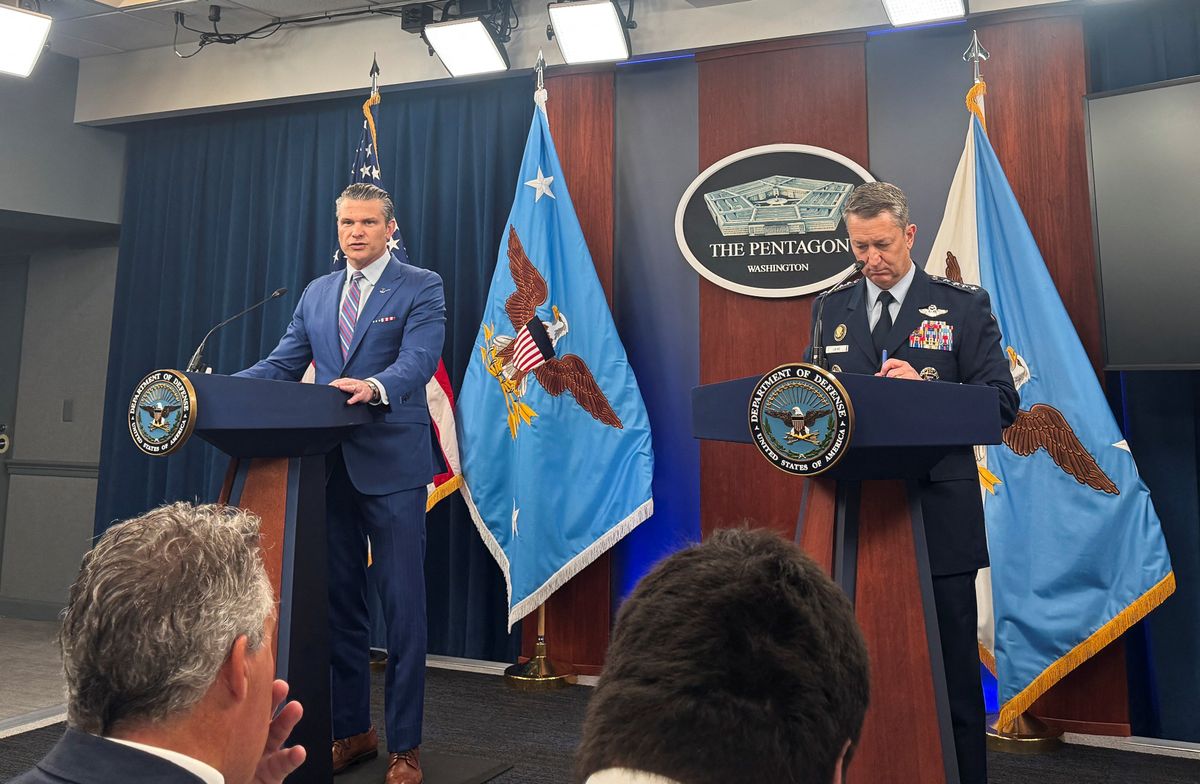
U.S. Defense Secretary Pete Hegseth and Chairman of the Joint Chiefs of Staff Air Force General Dan Caine, speak during a press conference at the Pentagon in Arlington, Virginia, U.S., June 26, 2025. REUTERS/Idrees Ali
With the Pentagon mired in a major crisis amid accusations that Defense Secretary Pete Hegseth committed a war crime, the Washington Post’s David Ignatius reported there is one missing voice in all the hubbub.
During an appearance on MS NOW’s “Morning Joe,” co-host Joe Scarborough shared a clip of former Pentagon head Leon Panetta raising concerns about a deadly strike that reportedly killed two survivors of an earlier attack as they clung to the damaged vessel.
He then pressed Ignatuis, “David, where is the chairman of the Joint Chiefs? Where is General [Dan] Caine in all of this? We haven't heard anything from him.”
“So it’s a good question,” the columnist replied. “This is a period where the uniformed military is being asked, in effect, to take the fall for the Secretary of Defense. And you'd think that General Caine, at a time when people in the Pentagon are deeply concerned about this, would be more visible.”
“He [Caine] spoke over the weekend to the chairman of the House and Senate Armed Services Committee, and went through, in a classified way, details that they wanted to know about, about these operations in the Caribbean,” he reported.
“But this is a time when we're really looking for the person who represents our military to be present, to, in a sense, offset or counterbalance the Secretary of Defense. And so it would be a good time to see more of General Caine. But the fact that he's been so absent has been noted to me by several senior military officials in the last 24 hours.”
'Wow': Newsmax analyst stuns warning Trump admin should face war crime prosecution
A Newsmax legal analyst delivered a sharp and stunning rebuke of the Trump administration this week, telling viewers of the right-wing network that Defense Secretary Pete Hegseth and anyone else involved in a controversial, deadly boat strike ought to be "prosecuted for a war crime."
Hegseth has faced intense scrutiny and criticism following a report that he ordered an unlawful no-survivors strike on a suspected drug boat in the Caribbean. Legal experts and ex-military lawyers have said such an order would constitute a war crime if the reports are accurate.
Newsmax's judicial analyst Andrew Napolitano delivered a sobering assessment to viewers on the show National Report.
"It gives me no pleasure to say what I’m about to say because I worked with Pete Hegseth for seven or eight years at Fox News. This is an act of a war crime," he said. "Ordering survivors — who the law requires be rescued — instead to be murdered; there’s absolutely no legal basis for it.”
Napolitano continued, "Everyone along the line who did it, from the Secretary of Defense to the admiral to the people who actually pulled the trigger should be prosecuted for a war crime for killing these two people."
The remarks caught observers off guard, with Democratic commentator Kaivan Shroff writing on X, "Woah."
"Newsmax’s legal analyst just said Pete Hegseth and everyone involved in the illegal boat strike should be 'prosecuted for a war crime.' They’ve even lost Newsmax on this one," he said.
Ryan Goodman, a chaired law professor at New York University, simply added, "Wow."2
Goodman shared another remarkable quote from Napolitano, who said Republicans in Congress "seem to be as exasperated by it as the Democrats do."
"I think it’s getting beyond politics now. The killing is out of hand. And this last one, in which Pete Hegseth first denied that he gave the order, and then the White House said he did give the order ... and then the White House said it was in self-defense. Self-defense! You got two people in the ocean clinging to a burning boat to stay alive, and they’re gonna be killed for self-defense? That doesn’t make any sense.”
'Admirals have receipts': Hegseth warned subordinates will have evidence of his orders
Should a serious inquiry be conducted by Congress into the reported killing of two survivors left clinging to a vessel after a kinetic strike on an alleged drug-running boat, Defense Secretary Pete Hegseth should be prepared to face military officials who will go in prepared to defend themselves.
Late Monday, the Wall Street Journal editorial page editors suggested, “If Mr. Hegseth is right, then the factual record will support him. There are layers of bureaucracy between the Secretary of Defense and the business end of a missile. You can bet senior military officers bought insurance on their own careers by recording the advice they gave and the directions they received.”
Using that as a jumping-off point, MS NOW host Joe Scarborough agreed and pointed out that the Pentagon chief could find himself in a war with his subordinates as he tries to fend off blame — and they will likely come with “receipts.
After noting that Admiral Alvin Holsey, former head of U.S. Southern Command, which oversees all military activity in the Caribbean and South America, resigned abruptly after the supposed drug interdiction attacks began, the “Morning Joe” co-host remarked, “Think about how chilling it is for Pete Hegseth that you have somebody who resigned in anger reportedly over this, and also, as David Ignatius said, well, actually, he's quoting the Wall Street Journal editorial page — these admirals, these officers, they have receipts.”
“They aren't going to do this without making sure they have evidence of authority sent by Pete Hegseth,” he predicted. “Which is why I'm just — I personally believe — which is why the White House had to come out yesterday and admit this happened and not blame it, as Pete Hegseth did, on lefty fake news reporters.”
'Does that sound familiar?' Erin Burnett wallops Hegseth with clip of his own words
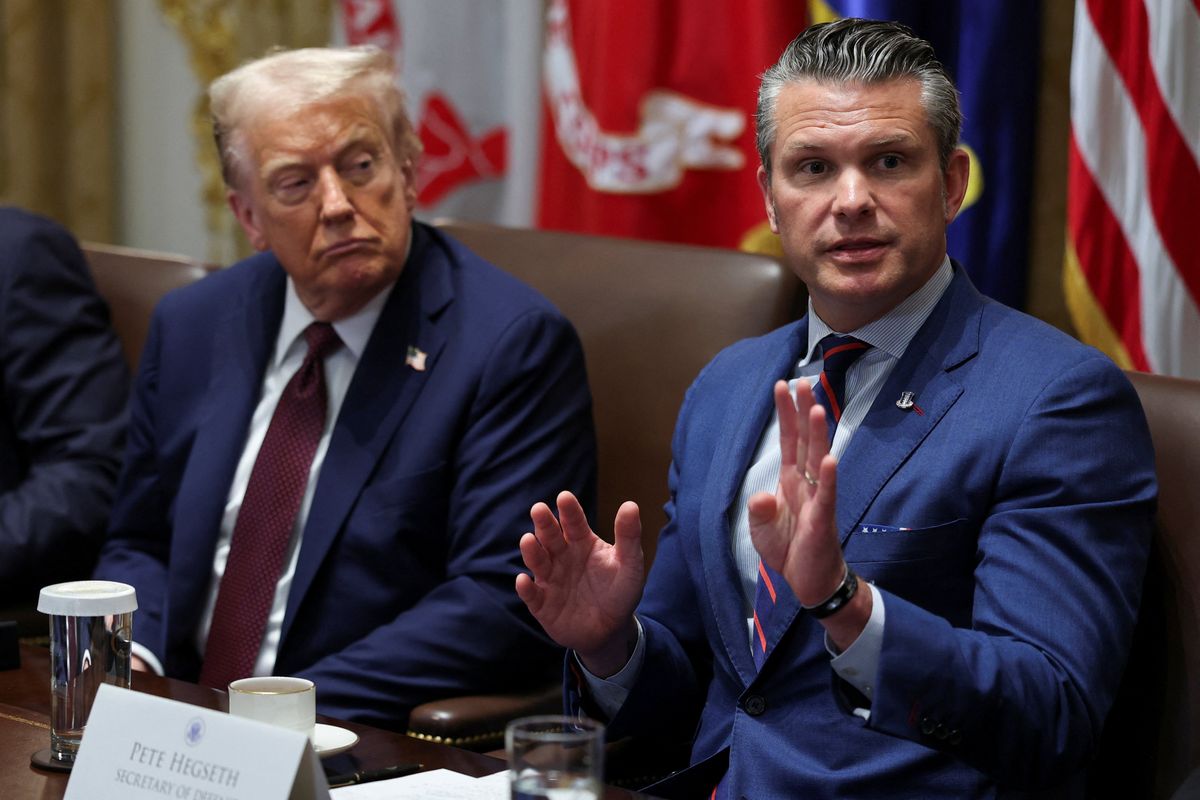
Donald Trump and Defense Secretary Pete Hegseth attend a cabinet meeting. REUTERS/Jonathan Ernst
CNN host Erin Burnett uncorked a brutal fact check on Tuesday of Defense Secretary Pete Hegseth's claims that members of the military have to follow orders, regardless of their legality.
During a segment on her show, "Erin Burnett OutFront," Burnett played a video that CNN's KFile investigators found of Hegseth talking about illegal orders in 2016. Burnett pointed out that Hegseth's rationale at the time was starkly different than the one he has displayed recently.
"I do think there have to be consequences for abject war crimes," Hegseth said in the video. "If you're doing something that is just completely unlawful and ruthless, then there is a consequence for that. That's why the military said it won't follow unlawful orders from their commander in chief."
"He's talking about not following unlawful orders," Burnett said. "Does that sound familiar?"
The Trump administration's strikes against alleged drug boats in international waters have inspired debate about military orders. To date, the administration has conducted more than 20 strikes that have killed nearly 100 people, but has provided scant evidence that their targets are a threat to national security.
Multiple Democrats, all of whom are military veterans, recently made a video telling military members that they do not have to follow illegal orders. Trump described the video as "seditious behavior," and Hegseth has threatened to court-martial the Democrats featured in the video.
Trump 'ultimately responsible' for war crimes: retired colonel
Retired Colonel Cedric Leighton told CNN anchor Kate Bolduan that Trump is the man in charge of a potential war crime attack in the Caribbean — no matter how hard his administration may try to hurl a U.S. commander under the bus.
The Washington Post reported last week that on September 2, U.S. forces fired on a vessel in the Caribbean Sea, then fired on it again in an obvious “double tap” when it was determined that some of the occupants had survived the initial strike. This reportedly came as the result of a directive from Defense Secretary Pete Hegseth to "kill them all."
These strikes, claimed with little evidence to be drug traffickers, are now drawing criticism from Republican lawmakers with Sen. Rand Paul, (R-Ky.) wondering to Semafor if Defense Secretary Pete Hegseth was "incompetent" or "lying." Anonymous officials described the move of blaming Adm. Frank M. Bradley for the second strike as throwing service members “under the bus” and “protect Pete’ bulls——.”
“The way this is characterized was kind of interesting because when Secretary Hegseth made his announcement via tweet, basically saying that he backs up all the decisions that admiral Bradley made, the real underlying current here seems to be the fact that the decisions were admiral Bradley’s and Hegseth himself is not really taking responsibility for these actions,” said Leighton.
“But the fact of the matter is, these actions were carried out at the behest not only of secretary Hegseth, but also of President Trump. So, they are ultimately responsible for how the military carries out these missions,” Leighton added. “They have to not only ensure that these orders are carried out, if they want them carried out, but they also have to make sure that those orders are lawful. And if you don't make sure those orders are lawful and people engage in these kinds of attacks and the so-called double-tap attack, that would be a significant breach of the laws of war, but it is also potentially a war crime.”
'Lot of heartburn in the Pentagon' over double-tap blame game: national security reporter
Members of the military attend a meeting convened by U.S. Defense Secretary Pete Hegseth, at Marine Corps Base Quantico, in Quantico, Virginia, U.S., September 30, 2025. REUTERS Kevin Lamarque
CNN National Security correspondent Natasha Bertrand reports the Trump administration is causing headache with its back and forth over who is responsible for a deadly double strike that destroyed a Caribbean boat and then killed its stricken passengers floating in the water.
“[T]here is a lot of heartburn in the Pentagon right now amongst officials who are saying, ‘how is [Secretary of Defense Pete] Hegseth shifting entirely the blame to [Navy Adm. Frank] Bradley… while at the same time he's saying that he has his back?’ Clearly he's trying to shift responsibility for the entire strike to him.”
Former military officials are saying Bradley would be court martialed “under normal circumstances” for ordering strikes against helpless swimmers after an initial strike destroyed their boat.
“I think he's very much trying to have this both ways,” Bertrand told CNN anchor Dana Bash. “On the one hand, [Hegseth] is saying that we fully support what these commanders are doing. On the other hand, he's saying that we're going to keep striking narco-terrorists and put them at the bottom of the ocean. But also, this was Admiral Bradley’s decision. He's the one that made this decision on September 2nd to kill the survivors of that of that strike.”
This, said Bertrand, suggests “a little bit of vulnerability’ on the part of both Hegseth and the Trump administration.
“The reality is that there are serious questions about why they made that decision to kill survivors of that first strike and ultimately why they then changed course and began repatriating survivors after that first strike,” she said. “Was there a recognition there by lawyers, perhaps, that, ‘hey, maybe this is not going to be good for us in the future?’
Heads are also spinning because White House Press Secretary Karoline Leavitt reiterated multiple times that ultimately, Hegseth and Donald Trump are the ones who make all the decisions about the operations — but, at the same time, she and Hegseth both say Bradley was in charge of this particular operation, and ordered that second strike that killed the survivors.
“So while Pete Hegseth … said, ‘kill them all’ it was Admiral Bradley, according to the Pentagon, who then made the decision,” said Betrand. “And I think that there's a lot of exploiting this nuance and saying that because Hegseth didn't necessarily order that second strike to kill the survivors, … then that kind of absolves him of all culpability in this.”