Wednesday, December 03, 2025


Source: TRANSCEND with Cylvia Hayes

The global economy is broken and brutal. This is clearly evident in the United States. Unless you are born into some level of wealth it is extremely difficult to climb into a higher economic class. Economic mobility is determined more by a person’s zip code than merit and hard work. Estimates suggest between 52 and 67 percent of Americans are living paycheck to paycheck with little or no savings. For low-income people working full-time and often multiple jobs there is not enough space in a day to “work harder” to improve their situation. They are literally doing all they can just to meet basic needs. I know this because I’ve lived it.

The official U.S. poverty rate was listed as 10.6% in 2024, representing 35.9 million people. But in reality that number is ridiculous and highly misleading. Federal poverty rates are based on guidelines by the US Department of Health and Human Services (HHS) to determine eligibility for various federal programs. The current official poverty income line is $15,650 per year for a single person and just $32,150 for a family of four which means one must be utterly impoverished to qualify for government benefits. Can any person really make it through a year in the United States with income of $15,651 per year? Can a family of four do so on $32,151?

How much it truly costs to make ends meet varies by state, but estimates suggest the average for a family of four in 2022 was approximately $104,000 annually before taxes. For a single adult with no children, the estimated annual income needed is between $40,415 and $62,233 depending upon the state. Unlike the federal poverty rate the living wage includes the cost of transportation and childcare along with the basic food and housing.

On top of a plague of low wage jobs, another brutality is that the United States is the only industrialized nation without a universal health care system. One result is that a health crisis and medical debt is now the leading cause of bankruptcy. Due to high costs of service uninsured people often put off necessary treatment until the problem becomes so bad they wind up in the emergency room, which is the costliest form of health care. Many suffer chronically poor health due to lack of preventative care. This is only going to get worse as republicans remove subsidies for coverage under the Affordable Care Act.

On the other end of the spectrum, the current form of capitalism has led to a billionaire class that consumes resources at a mind-blowing rate and has taken control of our society through ownership of the internet, social media, corporate media, and elected officials.

A typical campaign for a seat in the U.S. House of Representatives costs over $2 million for a first-time position and over $8 million for an incumbent running for reelection. A senate reelection campaign costs over $11 million. Presidential campaigns now run into the billions (yes with a b) of dollars. According to Open Secrets the biggest chunk of campaign money for congressional races for both democrats and republicans is now individual large donors. In 2024, uber-wealthy individuals provided 46.6% of campaign funds for democratic house of representative campaigns, 36.3% for house republican races, 52.4% for senate democrat races, and 41.2% of funding for senate republican campaigns. These numbers dwarf the amounts contributed by combined smaller donors and even political action committees (PACs).* This means a tiny minority of people have massive influence over elected officials and the shaping of policy.

In addition to wielding enormous power over our political and communications systems the US’s super-rich are burning through natural resources and spewing climate change emissions at 4,000 times the speed of the world’s poorest 10%. These billionaires and multimillionaires, who comprise the wealthiest 0.1% of the US population, emit an average of 2.2 tons of CO2 every day, equivalent to the weight of a rhinoceros or an SUV. A study, conducted by Oxfam, found that 308 of the world’s billionaires had a combined CO2 tally that, if they were a country, would make them the 15th most polluting country in the world. The report also found that almost 60% of billionaire investments are in “high climate-impact sectors”, such as mining or oil and gas companies.

Our current capitalist system is structured so that millions of us are overworked and stressed about how we’ll pay for rent or groceries while a tiny, privileged few own private jets, build rockets for amusement, and buy elections. It’s a system that is also stripping our planet of forests, clean water, and wildlife in the name of economic growth (here’s a piece I wrote about this).

The U.S. claims to be the richest country in the history of the world, but the lived reality on the ground for most Americans does not portray a strong or great nation.

I have advocated for economic system change my entire career, now spanning four decades. I’ve promoted the idea of evolving past a system that chews up the planet and keeps people trapped in poverty. I cannot tell you how many times I have been criticized, even belittled for being anti-capitalism. The idea of capitalism as the only acceptable economic system has been deeply baked into American culture. Now, forty years into this work I sense a shift.

Over the past few months several mainstream media programs have started discussing, even tentatively questioning, capitalism. No doubt part of this has been driven by the unexpected success of Zohran Mamdani’s candidacy for mayor of New York. Mamdani is an outspoken Democratic Socialist. His ideas for a more communal and caring economic system have lit a fire, especially in younger voters. I believe Mamdani’s historic landslide victory was a strong statement by those of us who know the entire underlying status quo economic and political systems are failing us.

Recently on two separate occasions I found myself in conversation with Millennials. One was a young dental hygienist. In a moment when the mirrors, scrapers and fingers weren’t in my mouth I asked her how she got into dental hygiene. She explained that she had gone to college to be a journalist but changed direction when she realized how little fact-checking was taking place and how difficult it was to make a good income. She explained that she’d come out of college with significant school loan debt and decided to get into a field that would pay better. She said she was lucky because her partner was Irish and had dual citizenship. College is free in Ireland, and her partner had come out with a degree in engineering and no debt. He immediately got a good-paying job and was helping her with expenses as she paid down her school loans. She noted they were planning not to have children because they didn’t believe they’d be able to afford it.

A few weeks later I was having my car serviced at the Toyota shop. The young rep who was checking me in for my appointment noted that my car was a hybrid. He said, “You know they’re telling us we’ll all be in electric vehicles, but they know people like me will never be able to afford one. Plus, there isn’t enough lithium to make that many EVs. I think the rich people who control everything are trying to set it up so most of won’t be able to drive at all.” A little stunned I said, “Yeah it’s a broken system and a corporatocracy to be sure.” He said, “Yeah, and they don’t care. They’ll trash this planet and then what? Colonize Mars or something?” My heart went out to him when next he said, “I don’t want to wake up every morning in the dark and go out and break rocks.” He gestured to the beautiful Cascade mountains beyond the tall windows in the showroom and said, “I don’t want to live where I’ll never see another Earth sunset.”

This kind of angst, and contraction of dreams is widespread given the harshness of the current economic system which is now structured to make the rich richer and keep everyone else struggling to make ends meet.

As I write, the U.S. government is in partial shutdown with millions of federal employees going without paychecks (even while still going to work) and funds frozen for the Supplemental Nutrition Assistance Program (SNAP) low-income food assistance program. Approximately 42 million Americans rely on SNAP to get enough to eat. Many of these people work low-income jobs. In fact, studies show that 89% of SNAP households with at least one working age, non-disabled adult were in the workforce. Approximately 70% of those worked full-time.

The country is fixated on how to end the congressional budget stand-off and get SNAP benefits moving again to those who need them. But the deeper question should be why do we allow businesses to pay such low wages that even full-time employees need food stamps? SNAP is often framed as a hand-out to the lazy and undeserving, but the truth is SNAP is corporate welfare.

When people working full-time earn so little they qualify for SNAP, Medicaid, and TANF taxpayers are literally giving a handout to corporations. Employers can keep full-time employees on very low wages and no benefits and therefore maximize their own profits. What started out as programs to help the unemployed or disabled people have, in this corporatocracy, turned into billion-dollar subsidies for morbidly rich employers and massive corporations.

In my career in the New Economy movement, I’ve been ridiculed for being anti-capitalist and accused of being socialist. In truth I am neither. I am opposed to the current version of capitalism that chews up people and planet and I do think there are aspects of socialism that are beneficial. In fact, the U.S. is already partially socialist with programs like Social Security and Medicare. However, I don’t think we have yet created an economic system that is suited for our times. Whatever we wind up calling it, I am for an economy that is based on environment and resource restoration rather than extraction and consumption, measures success through the wellbeing of society rather just the size of the GDP and provides genuine opportunity for people to have basic financial security and live meaning-filled lives.

I’m encouraged by the growing frustration among Millennials and so many of the rest of us. I’m encouraged that people like young Zohran Mamdani and old Bernie Sanders (both democratic socialists who challenge the current economic system) are packing stadiums around the country. The frustration is reaching critical mass, and it will drive change. The question is what type, and direction, of change? Within that question tremendous opportunity bubbles, and now we must find the will and the way to alchemize it into a world that works better for all beings.

Cylvia Hayes is a unity minister, motivational speaker, author, and economic system change expert. She is committed to raising consciousness and redesigning civilization so all creation can thrive.


Trump is Attracting Investment to the US – but at a Huge Cost to Workers and the Environment

Source: The Conversation

Early in his second presidency, Donald Trump’s imposition of tariffs was met with widespread scepticism. Critics warned of economic decline and a global backlash. Yet the current landscape for the United States paints a more complex picture.

Less than a year into his second term in office, the White House claims that Trump is bringing manufacturing back to the US. It also proclaims that Trump has secured trillions of dollars of foreign direct investment (FDI) in 2025 alone. Other voices, however, estimate that these commitments will amount to just a fraction of that.

So what’s the true picture? Much of this FDI is going into the US’s burgeoning semiconductor sector. This inward investment is indeed a stark reversal from the post-1991 trend of outbound American capital, when US firms raced to set up factories in countries where it was cheaper to manufacture.

And the surge is bolstered by commitments of US$300 billion (£225 billion) in capital investment commitments from tech giants like Amazon, Microsoft, Alphabet and Meta. These investments reflect both Trump’s aggressive diplomacy and his close relationship with Silicon Valley’s tech elite.

Despite concerns about a tech bubble, these investments signal a deepening state-private partnership, and a reorientation of priorities with a view to coming out on top in the global AI race.

Central to this strategy is the reshaping of global supply chains. At a conference of venture capitalists in March, US vice-president J.D. Vance criticised US firms for their reliance on cheap overseas labour. He warned of the risks of losing the US’s technological advantage, especially to China.

The solution, Vance and Trump argue, is to bring investments and jobs back home. But does this logic – backed by massive domestic and foreign investment – translate into the kind of reshoring (when operations that were previously moved abroad transfer back to the country) that delivers good jobs?

In our new book Capitalist Value Chains, Christin Bernhold and I argue that global supply chains have made labour exploitation and environmental degradation worse. Efforts by both former president Joe Biden and Trump to contain China’s rise reflect not a retreat from globalisation, but a strategic reconfiguration of supply chains.

In the early days of globalisation, American administrations supported China’s rise as the workshop of the world and an exporter of low-cost consumer goods to the US. But over the last 15 years, the US has increased efforts to contain China’s technological rise, while continuing to rely on its cheap imports.

Trump’s tariffs on China represent a step change. The US’s strategy now seems to have shifted from slowing China’s advance to attempts to inflict severe economic damage on the Chinese economy in order to reduce it to a subordinate, rather than rival, trading partner.

So will these investments create quality employment? And what are the environmental consequences? The likely answers are probably not, and probably terrible.

Reshoring doesn’t mean abandoning global supply chains. Recently, Trump threatened sweeping tariffs on China in response to its restrictions on rare earth exports. Western industries – especially automotive and defence – warned that this escalation could break supply chains. US chip-dependent sectors such as electronics, defence and telecoms still rely heavily on Chinese rare earths.

Even if the US succeeds in reshaping supply chains, it doesn’t guarantee the creation of good jobs. Despite Trump’s pro-labour rhetoric, his administration’s actions tell a different story.

In March 2025, Elon Musk’s Department of Government Efficiency laid off 216,000 federal workers. Collective bargaining rights were stripped from 400,000 employees across agencies like Veterans Affairs, the Environmental Protection Agency and the Transportation Security Administration. The White House also revoked the US$15 per hour minimum wage requirement for publicly-funded businesses.

Pain for US workers

Traditional sectors are suffering. Since April, machinery giant John Deere has cut more than 2,000 jobs, citing cost increases blamed on Trump’s tariffs. The big three carmakers – Ford, GM and Stellantis – claim that tariffs will cost them US$7 billion in lost earnings in 2025, with severe consequences for pay and jobs.

Will the tech sector’s massive capital spends offset these losses? Most of the US$300 billion pledged by firms like Apple and Amazon is earmarked for AI infrastructure: high-powered data centres, custom chips, graphics processing units and cloud networks.

These are capital-intensive projects that generate short-term construction jobs but offer little in the way of long-term employment.

Simultaneously, tech companies are downsizing as they substitute AI for human labourMicrosoft announced layoffs of 6,000 and 9,000 employees from its 228,000-strong global labour force in May and July 2025, including 800 in Washington, Microsoft’s home state.

And what about the quality of the remaining jobs? At Amazon, for example, the company’s software engineers have described how it is using AI to cut jobs and speed up work. According to reports, tasks that previously took weeks are now expected to be completed in days. One engineer told journalists that his team was halved in size, but is expected to produce the same amount of code, using AI tools.

The environmental costs of AI are mounting. Researchers have found that data centres already consume 4.4% of the US’s electricity. By 2028, AI could require as much power as 22% of American households use annually.

This surge in demand, combined with federal budget cuts to green energy initiatives, is diverting renewable energy away from broader decarbonisation efforts such as hydrogen tech projects, battery plants and upgrades to the electric grid.

These figures are only set to rise if the surge continues. According to the International Energy Agency, fossil fuels – particularly coal and natural gas – are expected to supply more than 40% of the additional electricity needed by data centres until 2030.

Trump’s push towards AI, coupled with his tariff regime and alliance with Silicon Valley’s elite, may reshape the economy and global supply chains – but not in favour of workers or the planet. The promise of revitalised manufacturing and job creation masks deeper risks: automation, weakened labour protections and escalating environmental harm.


EU Offshore Study: Average Wind Turbine Hits Only One Dozen Birds Per Year

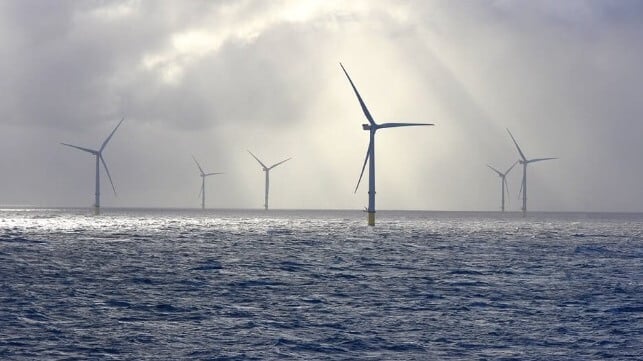
Wind turbine
iStock

Published Nov 30, 2025 4:57 PM by The Maritime Executive


A new industry-backed study aims to push back on claims that the offshore wind industry is a threat to migratory birds. The consultancy-performed study concludes that (at least in the EU) birds almost completely avoid wind turbines and that the risks of collisions are significantly lower than previously assumed.

The study commissioned by industry lobby group German Offshore Wind Energy Association (BWO) has now refuted assumptions that high migration intensity by birds in waters where offshore wind farms are being developed automatically lead to collisions. In its findings, the study contends that over 99.8 percent of migratory birds avoid wind turbines. In essence, it means that blanket shutdowns of turbines during periods of heavy bird migration is not a sensible approach.

Conducted by research and consulting firm BioConsult SH GmbH, the study sought to establish the risks of collisions between migratory birds and offshore wind farms in the North and the Baltic Sea, regions that are fast becoming hubs for offshore wind power.

With the study site being the Windtestfeld Nord wind farm near Husum, Germany, the researchers were able to analyze the movement patterns of over 4.2 million birds over a period of one and a half years. The wind farm spans approximately 150 hectares with five operating wind turbines of varying types and sizes being used for the study, where bird species like geese, ducks, gulls, waders and songbirds are common.

To understand the movements of the birds, camera systems were installed on two of the turbines and recorded all bird (and bat) passages through the rotor plane both during the day and at night. Nocturnal activity was captured using infrared cameras in combination with infrared emitters. To assess general migration intensity in the area, the team used a specialized bird radar that was operated continuously throughout the entire study period, and which was designed for real-time monitoring of bird movements.

BWO has described the combination of radar and the AI-based cameras as a methodological breakthrough that enabled unprecedented accuracy in recording bird flight movements in the rotor plane. In effect, this allowed the team to come to the conclusion that nocturnally migrating birds avoid collisions with wind farms and that the overall collision risk in relation to the total amount of birds passing a wind farm at night is very low.

This was based on the results of the fatality surveys, which indicated a relatively low number of collision victims of an estimated total of 99.7 fatalities of all bird species being recorded across the study period at the five monitored wind turbines. This corresponds to a mean of 12.9 collision fatalities per year and turbine.

“The new study shows that migratory birds avoid wind turbines. This confirms that the environmentally sound expansion of offshore wind energy works in harmony with these birds and not against them. With this research, we want to depoliticize the discussion, improve the data basis, and make decisions based on facts,” said Stefan Thimm, BWO Managing Director.

The study, which now provide a solid basis for the expansion of offshore wind energy, comes when Germany is pursuing growth in renewable energy. The country has set targets to increase offshore wind capacity to 30 GW by 2030, 40 GW by 2035 and 70 GW by 2045. By end of last year, a total of 1,639 turbines with a capacity of 9.2 GW were installed in the country.


Ocean Winds Secures Financing to Begin Offshore Wind Farm in Poland

offshore wind farm
Ocean Wind completed the financing for its first Baltic offshore wind farm, which will be in Poland (Ocean Winds)

Published Dec 1, 2025 8:15 PM by The Maritime Executive


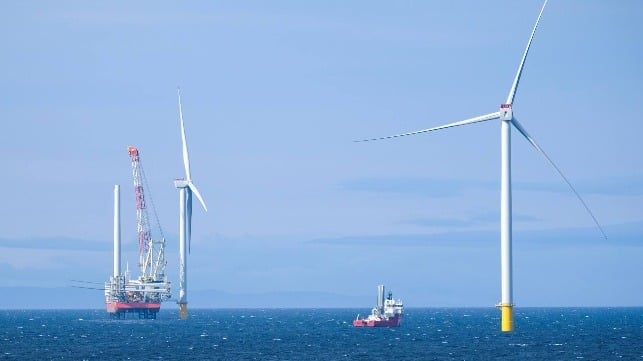
In another bit of positive news for the beleaguered offshore wind power industry, Ocean Winds reports it has secured financing and completed the financial close for one of the first offshore wind farms in Poland. The company, which is a 50-50 joint venture between EDP Renewables and ENGIE, highlights strong support from the European finance community that is making the project possible.

The company reports that as part of the financial close, it secured nearly €2 billion (US$2.3 billion) from a syndicate that includes the European Investment Bank. EIB contributed nearly a third of the total financing, along with Instituto de Credito Official Español and 13 commercial banks.

The company said work will begin on the wind farm in 2026 with the design and construction of the onshore substation and export cable route. It emphasizes that the project will be conducted in large part by Polish companies. The service base will be in Wladystawowo. 

“At Ocean Winds, we are convinced that Poland has the potential to become a regional leader in offshore wind – both in terms of clean energy production and industrial capability,” said Bautista Rodriguez, Chief Operating Officer, at Ocean Winds. “In Poland, offshore wind energy is a key driver of the country’s energy transition and a real opportunity for the development of a revitalized economic sector.”

Poland has substantial goals for offshore wind power, targeting 6 GW by 2030 and a total of 8–11 GW by 2040. Its first offshore wind farm, Baltic Power, is currently under construction and is expected to be operational in 2026.

Kacper Kostrzewa, Managing Director for Poland at Ocean Winds, said it marked a milestone for the project and for the company. It will be Ocean Wind’s first offshore wind farm in the Baltic. Critically, he said that the financial close for the project is also a milestone for the Polish offshore wind industry.

The project will also be the first to be fully delivered from Polish ports. Swinoujscie will serve as the marshaling harbor for foundations. Gdansk will be used for the wind turbines.

Known as BC-Wind, the project will be 23 kilometers (14 miles) north of the Polish coast, located entirely in the Polish EEZ. It will consist of 26 turbines rated at 14 MW, but with a power boost feature, the capacity can be increased to 15 MW. Total planned capacity is up to 390 MW.


Seatrium Seeks Arbitration Against Maersk Offshore Wind Over WTIV

wind turbine installation vessel
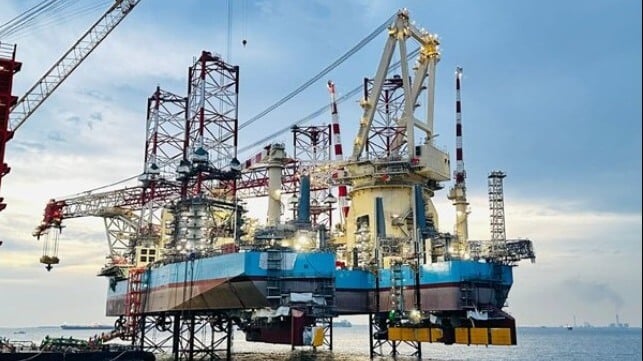
The nearly completed vessel has become the focus of an arbitration claim between Maersk Offshore Wind and builder Seatrium (Maersk Offshore Wind)

Published Dec 1, 2025 2:29 PM by The Maritime Executive


Singapore-based Seatrium has filed a counterclaim for arbitration against Maersk Offshore Wind in the ongoing dispute over the nearly completed newbuild wind turbine installation vessel ordered in 2023. The dispute emerged in October after Maersk Offshore Wind filed a surprise termination notice for the nearly completed vessel.

Seatrium rejected an arbitration claim made by Maersk Offshore Wind in October, which alleged problems with the construction project without supplying specific details. The claim that “disputes had arisen” during the project. Seatrium said it would “vigorously prosecute its position and defend any claims.”

On November 28, Seatrium filed its notice of arbitration seeking to commence a case against the buyer of the vessel. The builder continues to claim that the contract was wrongfully terminated in a notice dated October 9. It is seeking a declaration that the contract is “valid and subsisting” and that Maersk Offshore should be ordered to meet its obligations. Further, it seeks to have damages assessed.

Seatrium reported that when it received the cancellation notice, the vessel was 98 percent complete. Since then, it has said that the vessel would be delivered by January 30, 2026.

The contact, which is reportedly valued at approximately $475 million, was placed before the merger that created Seatrium. The company reports the order was not structured with progressive milestone payments, and as such, Maersk Offshore has only paid 20 percent of the contract price. It is seeking to compel the buyer to pay the remaining 80 percent.

The 475-foot-long ship was launched in May 2025 and was designed as part of a push by the then Maersk Supply Services to expand into the wind turbine installation space. It incorporates a unique locking system to receive feeder vessels from shore with the components for the wind farms. The plan was to use the vessel in the United States with the supply system providing a solution to meet the requirements of the Jones Act. Maersk Supply Services, which is owned by AP Moller Holdings, was renamed Maersk Offshore Wind to further emphasize its business focus.

The WTIV is under contract to Empire Wind for the installation of the project offshore from New York. Seatrium has said that it would also be exploring opportunities directly with Empire Wind for the vessel. 
 

Trump Administration Targets Another Offshore Wind Farm Project

staging for wind farm
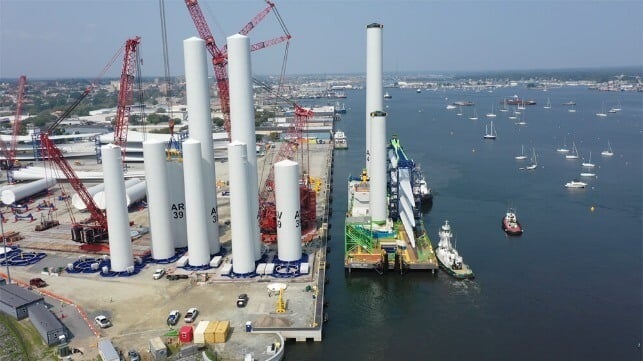
The new challenge also jepordizes the use of the terminals in New Bedford and Salem which would gain long-term work from the wind farms

Published Dec 2, 2025 8:20 PM by The Maritime Executive


Using a now familiar technique, the U.S. Department of Justice on Tuesday, December 2, made a filing in U.S. District Court targeting yet another offshore wind farm project. Speaking on behalf of the Bureau of Ocean Energy Management, the Department of Justice confirmed that the Bureau is reviewing the approval for the New England Wind project, which is to be developed by Iberdrola’s subsidiary Avangrid.

The filing asks the court for a voluntary remand of a case filed by a local environmental group, saying it is warranted to “promote judicial economy.” The Department of Commerce and Avangrid were sued in May 2025 by a group calling itself Ack For Whales, which is challenging the July 2024 approval of the wind farm by the federal government. The plaintiffs argue that the approval by BOEM failed to adequately ensure there would be less interference with other users, such as commercial fishing, sportfishing, recreation activities, boating/shipping, etc. The courts in the past have viewed these as nuisance suits and dismissed them on the grounds that the groups have time to make their cases during the permit approval process.

The original lease was awarded in April 2015 to a project then known as Park City Wind. It was amended on several occasions, splitting the project into two phases and renaming it New England Wind. It would be located southwest of Vineyard Wind, which is nearing construction completion in an area selected for a series of wind farms south of Martha’s Vineyard and Nantucket, Massachusetts. Phase 1 would be for between 41 and 62 wind turbines with a projected total generation capacity of 804 MW. The second phase, which has also been called Commonwealth Wind, would consist of up to 88 wind turbines and a total generation capacity of 1,232 MW.

The project gained its federal approval with the Record of Decision from the Department of the Interior in April 2024. BOEM approved the Construction and Operation Plan in July 2024. Since then, the developer has been seeking to complete its power agreements with the state’s power authority.

DOJ asks the court to stay the litigation by Ack, saying BOEM is “likely to make a new agency action, and that action may affect – or potentially moot” the claims. The Bureau is reviewing the construction plan, saying it believes the COP “understated impacts that were improperly weighed in reaching the determinations.” It points to Donald Trump’s executive order on the first day in office in January, calling for a review of the leases and leasing process. A group of states filed a separate case earlier this year challenging the open-ended review process.

It is a similar tactic that was also used with a suit by Nantucket against SouthCoast Wind, also in Massachusetts, and by activists against U.S. Wind in Maryland. The court sided with BOEM and DOJ, permitting the review for SouthCoast Wind to proceed while also saying timelines must be established as the reviews cannot drag on indefinitely. The court hearing the Massachusetts case ordered regular reviews and updates and set deadlines.

In the new filing, DOJ argues New England Wind is not under construction, and it is not imminent, and as such, the review does not cause harm. It neglects that the review sidelined negotiations for the power purchase agreements, which were placed in jeopardy. 

The New Bedford Light newspaper, reporting on the filing, also highlights that it jeopardizes planned large investments in the local community. New England Wind and SouthCoast Wind were to base operations at the New Bedford Foss Marine Terminal, where they plan to locate their operations and maintenance facilities. New England Wind was also participating in the planned redevelopment in Salem for a terminal that would be the staging for the construction of the project.

DOJ, in its filing, asks for an indefinite stay of the environmentalists' case. It does not propose a timeline for completing the review. 


Terrestrial biodiversity grows with tree cover in agricultural landscapes


University of Illinois College of Agricultural, Consumer and Environmental Sciences
Riparian buffers increase biodiversity 

image: 

New University of Illinois Urbana-Champaign research finds that for every 10% increase in riparian forest cover adjacent to agricultural fields, an additional terrestrial species is present.

view more 

Credit: Eric Larson, University of Illinois Urbana-Champaign


URBANA, Ill. — Farmers plant or preserve riparian buffers for various reasons, such as improving water quality, controlling erosion, or maintaining hunting habitat. Now, a new study from the University of Illinois Urbana-Champaign underscores the benefits of riparian buffers to terrestrial biodiversity, finding that for every 10% increase in forest cover, an additional species is present. 

“We found raccoon and common snapping turtle DNA all over the place,” said senior study author Eric Larson, associate professor in the Department of Natural Resources and Environmental Sciences (NRES), part of the College of Agricultural, Consumer and Environmental Sciences at Illinois. “But the fact that we found bobcats and big brown bats with our sampling method was exciting, and shows just how much is going on in those riparian buffers.”

The sampling method Larson is referring to — environmental DNA metabarcoding — is one he and fellow ecologists have leaned into in recent decades to detect rare or hard-to-capture species. By extracting DNA fragments from water, soil, snow, or even air, scientists can reconstruct the animals that have traipsed, swam, or flown nearby. 

When Larson and Olivia Reves, the study’s first author, decided to study biodiversity in riparian buffers, they already knew the benefits of tree cover for aquatic organisms. For example, shade from overhanging trees protects the water from thermal extremes and creates more favorable fish habitat. But less was known about the benefits of riparian buffers to terrestrial animals in agricultural areas.

To fill this gap, Reves and Larson used eDNA metabarcoding to identify terrestrial species from water adjacent to agricultural land across 47 sites in Central Illinois, varying in forest cover.     

“This monitoring tool has been overlooked to identify the benefits of agricultural conservation actions like riparian buffers for terrestrial biodiversity,” said Reves, who recently completed her master’s degree with Larson.

But why sample water to detect terrestrial species?

“If we looked for fish in these samples, we would certainly find fish DNA,” Larson said. “But water in a stream or river incorporates DNA from all of the animals using the surrounding landscape. You dip down to the stream for a drink, and you leave some of your DNA to be detectable downstream.”

After isolating and identifying all of the DNA fragments from the water, the researchers could then look at the relationships between terrestrial diversity and forest cover. Not only did they find an additional species for every 10% increase in forest cover, but sites with complete forest cover supported three times the terrestrial vertebrate species compared to those lacking tree cover. Also, community composition turned over in higher-cover locations.

“We saw a gradient in the animal communities linked with forest cover,” Reves said. “At one end, we saw grassland species — mice, ground squirrels, killdeer — that are adapted to more disturbed environments. In the high forest cover sites, it was a totally different set of species. The fact that we saw forest-dependent species, including southern two-lined salamanders, North American river otters, and ruby-throated hummingbirds, really drives home the idea that riparian buffers are beneficial in agricultural landscapes.”

Reves added that, despite the biodiversity benefits, not all agricultural landowners are sold on riparian buffers.

“Some landowners see them as unkempt or think they bring pests to their fields. But we found a lot of species, like bats, that actually draw pests away or prey on those pests. In addition, riparian buffers can help with soil erosion and water quality,” she said. “I hope our study informs the voluntary and regulatory implementation of forested riparian buffers across the Midwest.”

The study, "Environmental DNA quantifies the terrestrial biodiversity co-benefit of forested riparian buffers in agricultural landscapes," is published in the Journal of Applied Ecology [DOI: TBD]. Authors include Olivia Reves, Nick Iacaruso, Mark Davis, and Eric Larson.

Research in the College of ACES is made possible in part by Hatch funding from USDA’s National Institute of Food and Agriculture. This study was also supported by a project funded by USDA’s McIntire-Stennis program [grant no. 7004745].