It’s possible that I shall make an ass of myself. But in that case one can always get out of it with a little dialectic. I have, of course, so worded my proposition as to be right either way (K.Marx, Letter to F.Engels on the Indian Mutiny)
In its latest market report, Fitch Solutions’ BMI has raised itstin price forecast for 2026 to $35,000 a tonne from $32,000 previously, as continued supply issues keep markets on edge in the face of steady demand from the semiconductor industry.
Supply is dominated by Indonesia, where production and exports are being affected by delays in approving annual work permits. The Southeast Asian nation has long been the world’s largest exporter and the flow of metal to world markets has been interrupted several times in the past when the government tightened production and export rules.
Tin’s supply chain is not just beholden to Indonesia’s resource nationalism but also to that of the Wa State in Myanmar. In July, the International Tin Association announced that shipments from Wa State will resume in the coming months, as several operators at Man Maw — the region’s major tin mine that is currently undergoing a controlled restart — have reportedly secured three-year mining permits.
With no further update at the time of BMI’s report in late November, Fitch analysts have adopted a “wait and see approach”, as news of a resumption of tin mining in Wa State have circulated markets for months without actually materializing.
Historically, Myanmar is the world’s third largest tin producer, and, according to USGS data. It is estimated to have the third largest reserves in the world, at 700,000 tonnes or 15% of total global reserves, after China and Indonesia (800,000 and 720,000 tonnes respectively).
Supply & demand
Three-month futures prices on the LME were hovering around $36,787/t on November 14, and BMI expects prices to remain supported by continued supply issues in the face of steady demand from the semiconductor industry.
China’s tin smelter production remains constrained by the lack of sufficient concentrates, while the resilience in economic activity amid easing trade tensions have boosted demand from the semiconductor industry, analysts note.
On the supply side, a thin pipeline of mining projects will tighten the tin concentrate market, leading to increased competition among smelters and constrained ore feed for refined output growth, BMI forecasts.
On the demand side, the Fitch unit predicts that global use of tin will increase rapidly through the metal’s use in electronics (especially as electric vehicles increasingly contain greater amounts of electronics in their body) and solar panels (in photovoltaic cells), cementing tin’s status as a commodity of the future.
Ultimately, this will allow the market to tighten, and the firm expects a market deficit to tighten.
CU
Vale, Glencore explore Canada JV in bid to boost copper exposure
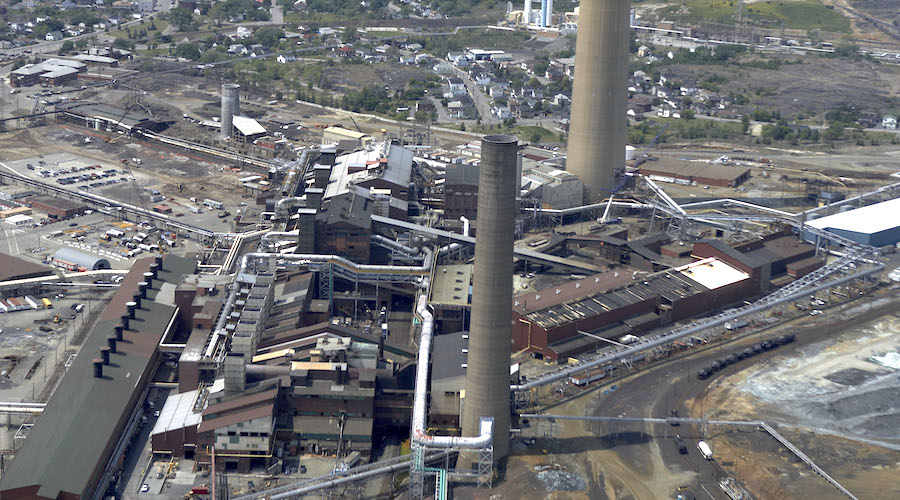
The old Copper Cliff nickel mine. (Image courtesy of Vale Agency.)
Vale SA and Glencore Plc are considering a joint copper project in Canada as the two companies look to increase their exposure to a metal projected to be in short supply as the world electrifies.
The proposed collaboration between Vale’s base metals unit and the Swiss commodities giant is to jointly develop a $1.6 billion to $2 billion project at their neighbouring properties in the Sudbury basin, Vale said in a statement Tuesday. It would churn out 880,000 metric tons over 21 years.
While Vale and Glencore have been mulling a Canadian partnership for two decades, the agreement is the latest example of collaboration in the industry. Miners are teaming up to contain costs and lift output as ore quality deteriorates and new projects get pricier to develop — at a time when demand for the wiring metal is increasing due to the energy transition and building of data centers to power AI.
The deal may help appease Glencore investors who have grown increasingly frustrated by the stock’s under-performance, with the company’s copper production expected to drop for a fourth straight year.
Vale has laid out a plan to double the base metals unit’s production capacity to about 700,000 tons a year by 2035. That would still be modest compared to rivals, and the Brazilian firm reportedly held on-and-off talks about a combination with Teck Resources Ltd. before the latter agreed to merge with Anglo American Plc.
The Vale-Glencore agreement in Canada provides a framework to explore combining underground operations, including deepening an existing shaft at Glencore’s Nickel Rim South Mine and developing new drifts to tap copper deposits.
The intention is that Vale and Glencore will transition to a joint venture as equal partners in the project. Besides copper, the companies would also produce nickel, cobalt, gold and other critical minerals.
Detailed engineering, permitting and consultation work will take place next year, with a final investment decision penciled in for the first half of 2027.
(By Mariana Durao and James Attwood)
Port Canaveral Nudges PortMiami Out to Become Busiest Cruise Homeport
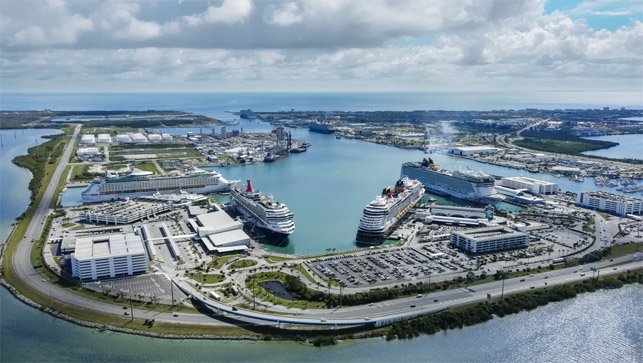
Port Canaveral, Florida became the busiest cruise homeport topping Miami with over 8.6 million passengers (Port Canaveral)
The rivalry between PortMiami in South Florida and Port Canaveral in Central Florida took a surprising turn with Port Canaveral nudging Miami from its traditional number one ranking in FY 2025. The difference was small between the two ports, just 0.4 percent, but it is a major achievement for Port Canaveral as it continues to see rapid growth in its cruise business.
Port Canaveral topped even its own projections, which had set a target of around 8.4 million passenger movements (counting embarkation and debarkations separately as two movements) for FY 2025. The final number came in at 8,602,047 passengers, a better than 13-percent increase over the prior FY.
It is not the first time Port Canaveral has taken the top honors, as it rebounded in 2022 ahead of PortMiami from the pandemic. The Central Florida seaport, which is close to the theme park attractions in the Orlando area, handled 4.21 million passengers in 2022 compared to just over 4.0 million that passed through Miami. Amazingly, the numbers have doubled again.
Canaveral has traditionally benefitted from ships that do short cruises with turns twice per week, but in recent years has also seen strong growth as a homeport for 7-day cruises. Last summer, it became the home to one of the world’s largest cruise ships, Star of the Seas, which operates 7-day cruises, while its fleet mate, Utopia of the Seas, operates 3- and 4-day cruises from Canaveral.
In March 2025, Port Canaveral set a record with its highest monthly passenger movements. That month, it hosted 925,994 passengers, which was up 16 percent versus March 2024. At the time, port officials said they were on track for 8.4 million passengers for the year, up from 7.6 million in the prior year.
“It wasn’t long ago when we exceeded 500,000 guests in a single month. Now, with numbers like this approaching nearly a million, it’s not just remarkable, it demonstrates the strong demand for sailings from our port. We’ve been predicting it, and we were ready for it,” stated Capt. John Murray, Port Canaveral CEO, in April 2025.
The port moved quickly to establish LNG capabilities and was rewarded with the first LNG-fueled cruise ships in North America. It is now implementing a $912 million five-year capital improvement initiative. The port is expanding two existing terminals and will develop a seventh terminal. Just last week, it received one of Princess Cruises’ largest ships for the first time, and in 2027, Carnival Cruise Line will send its new giant Carnival Festivale to the port alongside the Mardi Gras, while MSC will expand its operations by basing the MSC World Atlantic at the port.
PortMiami was just under 8.6 million passengers as it grew including handling 10 cruise ships in a day (PortMiami)
While the rivalry continues between the ports, it also shows the strong growth in the cruise market, and specifically in Florida. Port Everglades is also seeing strong demand, as is Tampa.
PortMiami reported 4 percent growth in its passenger totals, handling a record 8,564,225 cruise passengers in the just concluded FY between October 1, 2024, and September 30, 2025. Long known as the Cruise Capital of the World, PortMiami highlights that it will receive 10 first-time cruise ships in this new year, including five newbuilds. It continues the growth for the port, which in the spring saw the opening of the new MSC Terminal (AA), which is billed as the world’s largest cruise terminal. The port has recently handled 10 cruise ships in a single day.
The rivalry will continue as both ports position for continued strong growth. While cruising continues to grow, Florida remains the epicenter of the industry, and in turn, it contributes a key part of Florida's tourist economy.
Philadelphia Starts Construction on Homeport Cruise Terminal
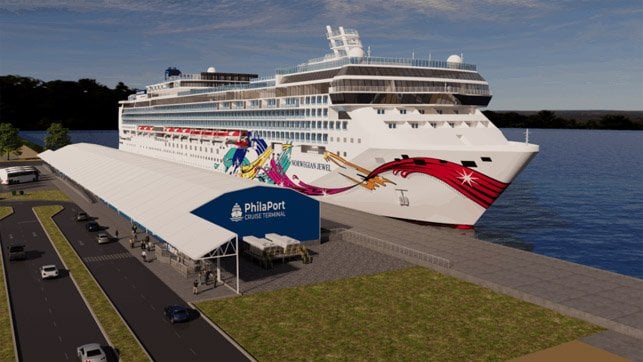
Philadelphia will have a cruise homeport in 2026 for the first time in many years (Philaport rendering)
The Port of Philadelphia announced the groundbreaking for the new PhilaPort Cruise Terminal as the city looks to capitalize on the rapid growth in cruise travel. Philadelphia has not had a cruise business since at least 2011, with travelers forced to go to either New York or Baltimore to sail on a cruise.
Norwegian Cruise Line in 2024 announced that it had entered into a new agreement with Philadelphia to seasonally homeport its cruise ship Norwegian Jewel (93,500 gross tons) in the city for cruises to Bermuda and other destinations. They said the new homeport for NCL would provide residents in the U.S. Mid-Atlantic region more access to cruising, with NCL committed to run cruises through October 17, 2026.
Regional homeporting is a growing trend in the cruise industry over the past decade of more. Norwegian was an early innovator, positioning ships closer to more people, making it possible to drive to their vacations instead of the traditional fly-cruise market. Smaller cities, ranging from Baltimore and Norfolk a well as Charleston for many years, Boston, Galveston, Tampa, have seen their cruise business develop based on people driving to the port.
Philadelphia’s new terminal is the result of coordinated efforts and partnership among PhilaPort, Norwegian Cruise Line Holdings, and Energy Transfer Marketing and Terminals (ETMT). PhilaPort and ETMT have finalized the agreement of sale of property for the site in Tinicum Township, formerly known as the Hog Island Dock Terminal Facility, clearing the way for its redevelopment. It is a 16-acre site adjacent to Philadelphia International Airport.
PhilaPort will manage all marine-side improvements, while Norwegian Cruise Line Holdings will lead the land-side construction and development of the terminal. Under a seven-year berthing agreement running from April 15, 2026, through March 31, 2033, NCLH’s cruise brands will operate as Philadelphia’s exclusive homeport with an initial commitment of 41 sailings per year.
“This is a unique opportunity, and we are fortunate to have two outstanding partners in Energy Transfer and Norwegian Cruise Line, both of whom see tremendous potential in Philadelphia,” said Jeff Theobald, PhilaPort Executive Director and CEO. “It took a lot of hard work to bring this agreement together, and Energy Transfer and Norwegian Cruise Line were committed every step of the way. We have a lot of hard work ahead of us, but we are ready and excited to welcome cruise passengers this spring.”
The terminal’s inaugural season will also likely benefit as the United States celebrates its 250th anniversary in 2026, with Philadelphia hosting a wide range of events and tourism experiences.
According to PhilaPort officials, cruise operations at the new terminal are projected to generate 2,185 direct and indirect jobs and approximately $300 million in annual economic output throughout Pennsylvania, supporting labor-intensive services that contribute to regional economic well-being.
New Cruise Company Signs with China Merchant for Eight B-to-B Ships
United Waterways released a rendering of its concept design reporting it will build expedition and coastal cruise ships with tour and lifestyle brand partners (Tillberg Design of Sweden)
Ship manager United Waterways announced its plans to expand its unique B-to-B approach into ocean cruising, focusing on the popular expedition and coastal cruising segments. The company, which has been a provider of ship management services, announced earlier this year plans to expand into the ownership of river cruise ships and now says it has booked construction slots with China Merchant for the expedition and coastal ships.
The B-to-B concept calls for the company to build the vessels, but instead of direct marketing, it is seeking partners. It reports strong interest from well-known tour operators and also looks to expand into lifestyle brands. The ships will operate under the name of the partner brands. Using a similar approach, the well-known Lindblad Expeditions is launching its first river cruises in 2026 by partnering with another company, Transcend Cruises, which is using a similar B-to-B business model.
United Waterways first announced earlier this year plans to build 10 river cruise ships. The company reports it found partners within six months, working with prestigious brands. The ships are being built in Europe, and the company says it is working with partners in the United States, Asia, and Europe. The ships, they report, will be the first multi-fuel platform and will be ready to comply with the European Union’s emerging regulations.
Based on the strong partner response to the river cruise segment, United Waterways believes there is a similar opportunity in the expedition and coastal cruising segments. It booked construction slots for a total of eight ships, four for coastal and four for expedition, with China Merchant Heavy Industry (Jiangsu) Shipyard. United Waterways is launching a new brand, Ocean Advice, for these ships, and says it believes there will be crossover opportunities with its river partners. It says three of the eight vessels have already been reserved, and it expects to book all the ships within the next 12 months.
It notes that China Merchant has strong experience in the expedition and small cruise ship segment. The shipyard built seven 200-passenger expedition ships for SunStone, which are chartered to major brands. The last of the ships was recently delivered. China Merchant had said it would be deemphasizing the small cruise ships based on strong demand from other segments.
United Waterways reports it has two design concepts, designed in partnership with the well-known Tillberg Design of Sweden. For the expedition market, the ships will have a capacity of 186 passengers. For coastal cruising, the ships will have a capacity of 260 passengers.
Both of the ship classes are focused on providing cozy spaces and exploiting a destination focus. The size will permit the ships to reach out of the way and smaller destinations unavailable to bigger ships. Working with China Merchant, they will also incorporate China’s developments in electrification to make the ships hybrids.
As part of its agreement with China Merchant, the company reports it has already exercised the first slot, signing a contract for an expedition ship due for delivery in 2028. It expects the first coastal ship in 2029.
Philippines Reports Oman Arranged for Release of Crew Held by Houthis
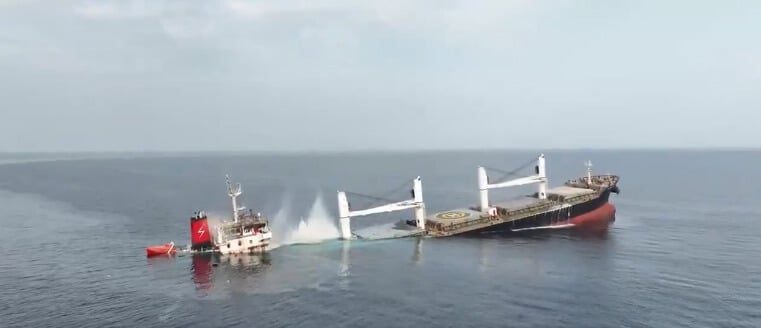
The crew went into the water as the Eternity C began to sink ( Houthi Military Media)
After four months of captivity, the crew of the bulker Eternity C is expected to be released by the Houthis. The Philippines Department of Foreign Affairs reports it has been advised of the release by the government of Oman, although no timing or details were provided.
The Philippines said it had been discussing the plight of the individuals with the Omani authorities as it sought to gain their freedom. The Philippines had made an initial appeal in July when the Houthis reported they had “rescued” several of the crewmembers from the ship. The Philippines reports it again raised the matter with Omanis during a phone call in November.
The statement says that nine individuals will be released and transferred from Yemen to Muscat, Oman. The DFA expressed its “sincere appreciation” to the Sultanate of Oman for the assistance in winning the repatriation of the crew.
The Eternity C was one of the two vessels attacked in rapid succession by the Houthis in the Red Sea in July. It marked a renewal of the aggression timed to the war in Gaza. The vessel was attacked three times by as many as eight boats firing small arms and RPGs on July 7, and the following day, again assaulted by the Houthis after the ship had already been damaged. The reports said that no warships had yet been able to reach the bulker and that its lifeboat had been destroyed, making it impossible for the crew to abandon ship.
The ship started to sink on July 9, and the crew was forced to jump into the water. Cosmoship Management had hired a salvage team, which was working frantically to rescue the crewmembers. They were able to save eight crewmembers and two security guards. The body of another security guard was retrieved, and the death toll was set at a total of nine.
A mystery ensued with the Houthis saying they had rescued several of the crewmembers. They released a video showing nine individuals, and a 10th was shown in a hospital bed. The group said the crew was receiving medical care and was in good condition.
This is believed to be the last of the crew detained by the militants. They previously also held the crew of the car carrier Galaxy Leader for 14 months before the Omanis were also able to negotiate their release.
Haitian Gangs are Setting Up Shop for Seaborne Drug Smuggling
Gang members on patrol in Port-Au-Prince, Haiti (UN)
The United Nations warns that gang warlords in Haiti have turned the country’s coastal waters into a pivotal transshipment hub for drugs originating from South America and destined for key markets across the Caribbean, the U.S. and Europe.
As the country plunges deeper into the abyss of lawlessness, the UN contends that large gangs have taken control and are deeply entrenched along strategic corridors, in effect turning most of the country’s coastal waters into transit routes not only for drugs but also arms and human smuggling. Île de la Tortue (Tortuga), an island located off the north coast of Haiti, has become a transshipment center for most of the international drug trafficking activity owing to its size and remoteness.
While the rocky and mountainous island has a history of having been a playground for pirates, in recent times organized criminal networks involved in drug trafficking, human smuggling and other illicit activities have turned it into a logistical and storage platform for illicit shipments. This owes to its geographical position, which provides direct maritime access to the Bahamas, Cuba and Jamaica, as well as the Turks and Caicos Islands.
Île de la Tortue’s role as a drug trafficking hub is highlighted by the seizure of 1,045 kilograms of cocaine in July, the country’s largest drug bust in over 30 years. In the operation, the Haitian National Police and other agencies seized 49 bags containing a total of 959 packets of cocaine following a shootout with suspected traffickers who were using a boat. Three traffickers of Jamaican nationality were killed, while a fourth individual, a Bahamian national, sustained injuries. Notably, the cocaine was believed to have originated in South America and was intended for distribution across the Caribbean and the U.S.
Just two weeks later, another 426 kilograms of cannabis was confiscated in Petite-Anse, near Cap-Haïtien again in the north of the country. In the same month, two Haitian nationals were arrested in Jamaica with over 1,350 kilograms of cannabis worth $9.3 million.
That some of the drugs entering the European market originate from Haiti is also evident. In August 2025, Belgian authorities seized 1,156 kilograms of cocaine hidden in a container at the port of Antwerp. Investigations indicated that the consignment departed Cap-Haïtien and transited through Kingston before arriving in Belgium where it was intercepted. A year earlier, law enforcement authorities in the Turks and Caicos had interdicted over $2.7 million worth of marijuana traced back to Île de la Tortue.
According to the UN Office on Drugs and Crime (UNODC), drug traffickers and other smugglers involved in illicit activities are using Île de la Tortue as a departure point for overcrowded boats to run their illegal trade leveraging maritime expertise, familial links and cultural connections. Control of domestic routes has allowed gangs to move drugs with impunity while also extorting tolls from boats and engaging in armed robbery at sea, the office says.
“The seizures of drugs both in Haitian waters and in Europe indicate sophisticated, coordinated and established trafficking routes that require a robust regional response by law enforcement agencies,” said the UN.
UNODC is leading efforts to support Haiti in dealing with the growing menace, with measures cutting across helping authorities increase interdiction capacity at ports, airports and land borders, strengthening the capabilities of the Haitian coast guard, identifying and dismantling cross-border criminal networks among others.
Coal Fire Doused on Bulker Loading in India
Paradip, which is a busy bulker port, reported a fire as a ship was loading coal (Paradip Port Authority file photo)
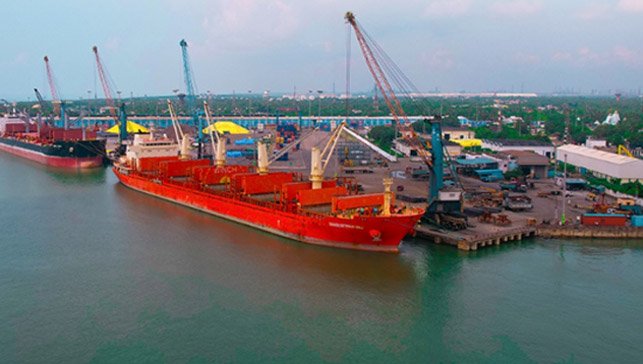
Fire services responded quickly to reports of smoke billowing from a bulker that was loading in the Paradip, India, port over the weekend. They were able to successfully douse the fire without injuries to the crew, but it again raised questions about the handling of the dangerous cargo.
The Greek-owned bulker Eco Colonel, registered in Liberia, had arrived at Paradip on November 27. Over the weekend, the vessel was loading a cargo of nearly 30,000 metric tons of coal for shipment in India. According to the local media reports, smoke was observed coming from one of the vessel’s holds as the coal was being loaded by conveyor belt.
As the smoke grew thicker and more intense, the decision was made to move the vessel, which is 82,000 dwt and 229 meters (751 feet), to another berth within the port to gain better access to the hold. Fire crews began offloading and watering the coal. Port operations were also suspended.
The Paradip Fire Department at the port said that after about two hours, it believed the fire had been contained. They said it was safe to reopen the port. There was minor damage reported to both the vessel and the coal loading conveyor belt.
The Eco Colonel, which was built in 2012, remains at the port as the investigation is ongoing. The authorities are thankful that a port worker quickly alerted the teams to the potential danger and that it could be controlled quickly. They have yet to confirm what caused the fire.
Media reports cite the high flammability of the coal and the danger of spontaneous combustion. Port officials are reportedly looking at the watering of the coal and whether there had been insufficient amounts of water sprayed before the loading. A lack of ventilation in the hold or in the stockpile could also have contributed to the fire.
The dangers of handling and shipping coal were demonstrated in August at the Port of Baltimore when an explosion tore a 30-ton hatch cover off a bulker. The vessel W Sapphire had completed loading and just departed the terminal when a massive explosion shook the ship, followed by a small fire. The force of the explosion hurled a portion of the number two hatch cover into the air and over the side of the ship. Luckily, no one was injured, and the local fire departments and Coast Guard were quickly able to stabilize the situation.
X-Press Pearl Compensation Dispute with Sri Lanka Intensifies
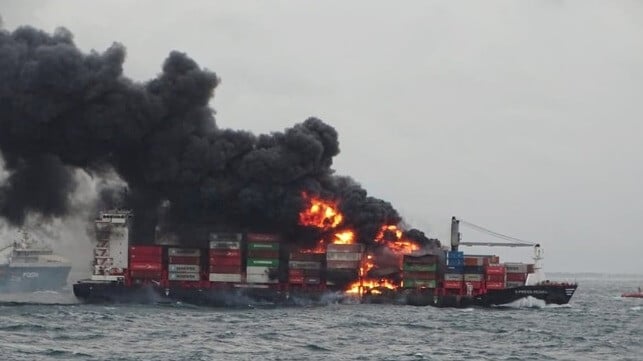
X-Press Pearl burned for days before it sunk causing an environmental disaster while the authorities attempted to tow the hulk into deep water (Sri Lanka Ports Authority)
The London P&I Club, acting as assurer to the owners of the MV X-Press Pearl, is intensifying its approaches to the authorities in Sri Lanka over the compensation awarded to cover damage caused by the shipwreck of the vessel off Colombo.
The X-Press Pearl, a newly built containership with a capacity of 2,750 TEU, was owned by Singapore's X-Press Feeders. It was on a voyage eastward bound in May 2021 when at least one container began leaking onto the deck shortly after leaving Jebel Ali. The cargo is believed to have included 25 tons of Iranian-manufactured nitric acid, among multiple classes of other dangerous cargo. The master sought and was denied refuge first in Port Hamad, Qatar, and at its next scheduled port of call in Hazira, India, before sailing on to anchor off Colombo, Sri Lanka, its next scheduled port of call. Off Colombo, a fire broke in Number 2 Hold of the ship, but given the mix of dangerous cargo on board, it has still not been established exactly what the cause of the fire or where the seat of the fire was located.
Reports assert that there were some delays in initially providing the ship with firefighting services and later in permitting the ship to be moved to deeper waters, by which time it was already sinking. The situation was unrecoverable by the time specialist firefighting and anti-pollution vessels and aircraft arrived on the scene, both from Sri Lanka and India. Acids, caustic soda, epoxy resin, plastic pellets, and bunker oil on board were either released or sank in containers when the ship went down, potentially creating a very large plastics spill. Officials indicate that 1,075 tons of debris have been collected from Sri Lankan beaches, along with dead turtles, whales, large numbers of fish, and at least six dolphins. But it is unclear whether what was recovered from the beaches was linked either directly or indirectly to the X-Press Pearl. As a precautionary measure, the Sri Lankan authorities halted local fishing due to fears of acid contamination and also to allow salvage operations to continue safely.
In July 2025, Sri Lanka's Supreme Court ruled in favor of local fishermen in a human rights claim. The finding criticized both X-Press Feeders for not sharing information and the government for not responding effectively enough. Without hearing expert evidence on the quantum, the court set the value of the loss at an arbitrary figure $1 billion, to be paid by the owner as the polluter, with further sums to be calculated by a committee.
X-Press Feeders have financed the clean-up efforts made so far, covering fisheries and beach clean-up, as well as salvage, wreck and debris removal. But, along with the London P&I Club, they have declined to make further payments, asserting that jurisdiction for environmental damage in this case lies in Singapore. Further, they contend that the cost calculations in other areas are largely based on theoretical estimates of damage using unapproved methodologies, which diverge from recorded evidence on the ground. They have referenced impartial technical advice issued by the International Tanker Owners Pollution Federation (ITOPF), which recommends internationally-accepted methodologies for assessing Oil Spill Damage, Nitrogen Added to Ocean, Human Health Air Pollution Impacts, Turtle Damage, Impacts on Whales, Microplastic Related Damages - Fisheries, Microplastic and Chemical Related Damages - Fish Consumers and Beach Users, Fisher Livelihoods, Incurred Costs and Future Monitoring.
The London P&I Club is now seeking the UK government's support to help with opening a dialogue with the Sri Lankan government, which is standing by its judiciary's finding, and is not responding to approaches. Neither the British nor the Sri Lankan government appears to be communicating with the other over the matter.
James Bean, CEO of the London P&I Club told The Maritime Executive that the London P&I Club's position is that a negotiated settlement is in the best interests of the Sri Lankan government and the international maritime community. They report that they are working with X-Press Feeders to achieve a rules-based outcome compliant with the norms of international trade.
The Caspian Pipeline Consortium (CPC)
CPC Shuts Down Export Loadings After Attack on SPM Buoy
The Caspian Pipeline Consortium (CPC) has ceased loading at its offshore terminal outside Novorossiysk after an apparent Ukrainian drone boat attack, its managers said in a statement Saturday. The news parallels a Ukrainian attack on two "shadow fleet" tankers in the Turkish sector of the Black Sea, and if accurate, it suggests an increasing willingness to target the Russian oil economy by all available means - even if that means attacking nominally neutral targets.
CPC is co-owned by Chevron and Exxon, and it primarily transports Kazakh oil to market. Its main connection with Russia is geographic, as its pipeline crosses Russian soil en route to a terminal on a Russian coastline. Historically it has exported only a small quantity of Russian oil. However, it has been attacked before: CPC's operating headquarters in Novorossiysk, Russia were reportedly hit in a Ukrainian missile and drone strike in late September, and one of its pumping stations was attacked in February.
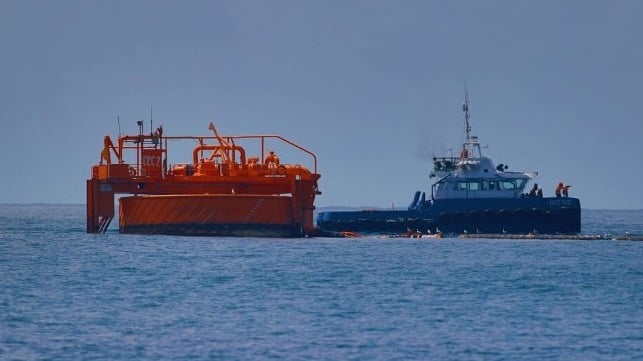
This time, according to the consortium, a "targeted terrorist attack" took aim at the single-point moorings that are permanently anchored off the coast. These three SPMs handle about one percent of all global oil trade, and they could be attractive targets for a drone boat attack: stationary, isolated, far offshore, and of strategic importance. CPC's statement suggested that the strike caused "significant" damage to one SPM buoy.
Ukraine has not claimed responsibility for the strike, but Kazakhstan has issued a warning to Kyiv to cease and desist attacks on "civilian" infrastructure.
"The CPC pipeline system is an international energy project, and any forceful impact on its facilities creates direct risks for global energy security and causes substantial harm to the economic interests of the consortium’s participants," the Kazakh energy ministry said in a statement. "We regard this incident as an action detrimental to the bilateral relations between the Republic of Kazakhstan and Ukraine, and we expect the Ukrainian side to take concrete measures to prevent such incidents from recurring."
Ukraine has systematically targeted Russian petroleum export terminals in Novorossyisk and Tuapse over the past two months, leaving the CPC terminal as the last large oil export facility in operation on the Russian Black Sea Coast.
On Friday, Ukrainian forces struck and damaged two Russia-linked "shadow fleet" tankers in the southern Black Sea, disabling both and forcing the crews to abandon ship. No injuries were reported, but Turkish responders are working to prevent bunker fuel pollution from spreading. Whether by accident or by design, both vessels selected for targeting were in ballast at the time of the strike, reducing the potential for a catastrophic spill.
Scrap Metal Fire in UK Highlights Growing Risk of Contaminated Cargoes
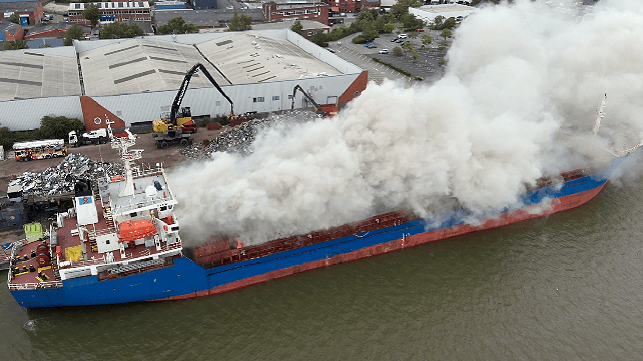
Scrap metal is among the most notorious cargoes for fire risk, not because of its inherent properties but because it is often contaminated with flammable debris and ready-made sources of ignition, like damaged lithium-ion batteries. A recent blaze at the port of Hull, UK illustrated the continuing danger to shipping, port facilities and public health from scrap-related fires.
On June 27, 2025, the freighter Altay was alongside a scrap yard at Albert Dock in Hull, England to take on a cargo for export. At about 0945 hours, the master spotted smoke coming from the newly-loaded cargo in the hold. The captain sounded the general alarm to muster the crew for firefighting duty, and called on the shoreside stevedoring team to begin discharging the hold with a grab in order to help expose the seat of the fire.
The crew responded quickly, and two fire teams were in place and ready within 10 minutes. Meanwhile, their crewmates cleaned out the rails on the coamings to make ready to close the hatches if needed.
At about 1030 hours, shoreside fire teams arrived on scene and took over the job on board, allowing the crew to evacuate to the pier. The master and chief officer remained on scene to keep an eye on the vessel's stability as the shore teams added more water into the hold. The fire put out large quantities of noxious smoke, forcing the authorities to issue a shelter-in-place order to local residents and businesses. Two roads had to be closed to traffic and several businesses had to temporarily shut down because of risks related to air pollution.
The blaze continued to burn until early in the morning of June 28. The accumulated firefighting water was deemed too dirty to discharge into the Albert Dock, so it was pumped off into tank trucks for specialized treatment. No injuries were reported, but the steel structure of the ship's after hold showed signs of fire damage; the ship had to wait for regulatory surveys, then departed to Turkey for shipyard repairs. The cargo stayed behind on the pier and was carefully scrutinized by investigators.
In a preliminary conclusion released last week, MAIB found that the fire likely started from an undischarged battery (a common cause of scrap fires) or from another source of a spark. Once ignited, the agency asserted, there was enough flammable material present to sustain a fire. "The scrap cargo contained hazardous impurities, including batteries, oil drums, and oily residues, which posed a fire risk," MAIB reported.
According to MAIB, the scrapyard at Hull was in the practice of applying a visual check to incoming metal shipments that passed through its gates, but did not have a facility for sorting and screening to remove contaminants. Instead, the yard relied upon its suppliers to screen their own recyclables, and it classified the resulting mixed product as a Group C nonhazardous cargo - in short, a clean cargo, according to MAIB.
Leading marine insurer Gard has noticed an unwanted trend of increasing risk of scrap metal fires, and has suggested that the Group C definition may need to be adjusted to account for current industry realities in the metal recycling trade.
"It is . . . apparent from several serious scrap metal fires involving Group C declarations that the cargoes contained quantities of combustible and/or potentially hazardous foreign materials, such as batteries, rubber, plastics, wood, foam, oils/greases, gas bottles and rags," Gard recently observed. "In one accident report an experienced representative of the scrap facility highlighted to investigators the fire dangers associated with lithium-ion batteries and their increasingly prolific use: 'It’s becoming more of a problem every month, every year in our industry.'"
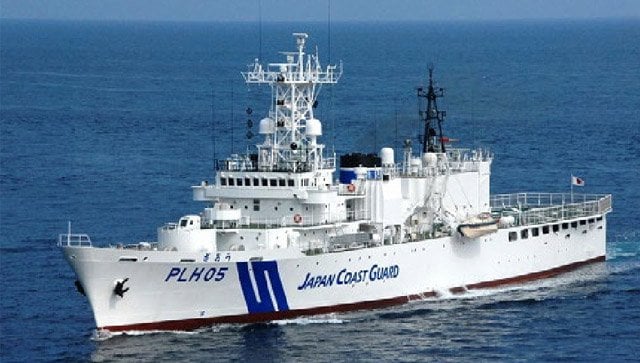
Japanese and Chinese Coast Guard Face Off in Disputed Island Chain
Japan and China cannot agree who expelled whom from the disputed islands after a showdown over a Japanese fishing boat (JCG file photo)
There was a new confrontation on Tuesday morning, December 2, as China continues its expansionist policies, claiming larger areas in the surrounding waters, but unlike other recent events, this one was with the Japanese. The two sides are telling different versions of the incident.
Japan and China have long been at odds over a small group of islands known by the Chinese as Diaoyu Islands, while the Japanese, who assert the administration of the area, refer to the islands as Senkaku. Similar to the disputed area with the Philippines, this group is a small area of just five uninhabited islands and three reefs. They sit just over 100 miles east of Taiwan and just over 250 miles to the west of Okinawa, Japan.
Tensions have long brewed over the region, which is reported to have oil and natural gas assets as well as rich fishing areas. The countries agreed nearly 20 years ago to jointly develop the resources of the area, but China has published new maps seeking to expand its region of control.
The long-simmering tensions, however, have increased over the past six weeks as Japan’s new prime minister, Sanae Takaichi, has vowed a strong response to the Chinese. In November, just days into her new role, she said Japan might have to militarily defend Taiwan from Chinese aggression.
The only thing the two sides agree on in today’s event is that there was a Japanese fishing boat in the area. The Japanese Coast Guard says it detected Chinese vessels on the so-called “rights-protection patrols.” China is reported to have four Coast Guard vessels on one of these patrols that began in mid-November.
The Japanese say they warned the Chinese Coast Guard not to approach the fishing boat. They report positioning between the Chinese vessels and the fishing boat and intercepting two China Coast Guard vessels. The Japanese report that they stayed with the fishing boat until the Chinese withdrew.
Official Chinese channels, however, are saying they expelled the Japanese fishing boat. They are claiming the Japanese fishing boat illegally entered China’s area and that they conducted a “rights-defending law enforcement operation.” They assert that it is inherently Chinese territory and that they warned the Japanese to leave the area.
Japan claims China has increased the frequency of its presence in the area, conducting 350 trips around the islands last year. They report China had a presence around the islands for a total of 215 days. The previous patrol in July had also raised concerns with China saying it was acting to stop the illegal Japanese boats in the region.
Russia Reports Drone Attack on Tanker but Ukraine Denies Involvement
A small Russia-flagged product tanker was attacked early on Tuesday, December 2 sailing near the Turkish coast, with photos released showing minor damage. Ukraine was quick to say it was not involved and said the situation did not make sense, suggesting Russia might have staged the attack as propaganda.
Russia’s Federal Agency for Sea and Inland Water Transport (Rosmorrechfot) reported the attack to the TASS News Agency. Turkey’s Ministry of Transport and Infrastructure also said it had been advised of the attack, but that the vessel was not requesting assistance.
The ship was identified as the Midvolga-2 (6,573 dwt) and flying the Russian flag. Built in 2014, the ship is 140 meters (459 feet) in length with a crew of 13 aboard. The ship’s AIS signal has not broadcast in nearly two weeks since it was inbound to Ros-on-Don, Russia, on November 23. The report said it was transporting sunflower oil to Georgia.
Russia blamed the attack on a drone and reported damage to the superstructure but said the crew was unharmed. The hull was reported not to have been damaged, and the vessel was proceeding to Sinop, Turkey, under its own power. Photos were released showing damage to the bridge and debris reported to be from the drone. The ship was reported to have been 80 miles north of the Turkish coast.
A spokesperson for Ukraine’s Ministry of Foreign Affairs, Heorhii Tykhyi, posted messages on social media questioning the reports. He said Ukraine was not involved.
“We officially refute any allegations of such kind made by Russian propaganda. Furthermore, the alleged route from Russia to Georgia across Türkiye's EEZ makes no sense—and suggests that Russia may have staged the whole thing,” wrote Tykhyi.
The incident came after Ukraine took credit for attacks last week on two crude oil tankers in the Black Sea. It was believed to be part of a wider effort to impact Russia’s oil industry and to apply pressure as a new round of peace negotiations is underway.
Turkish President Recep Tayyip Erdo?an on Monday called the escalation “worrying.” In a broadcast speech, he said, “We cannot condone these attacks, which threaten navigational safety, life, and the environment, especially in our own exclusive zone. We are issuing the necessary warnings to all parties regarding such situations.”
The Middle Volga Shipping Company, which operates the vessel in the past, has been linked to the Russian oil industry. Ukraine has sanctioned the company for its involvement in Russian exports.