Wednesday, December 03, 2025

‘We Must Stop Tinkering Around the Edges’: Van Hollen Makes Case for Medicare for All Amid ACA Fight

“Yes, let’s extend the ACA tax credits to prevent a huge spike in healthcare costs for millions,” said Sen. Chris Van Hollen. “Then, let’s finally create a system that puts your health over corporate profits.”
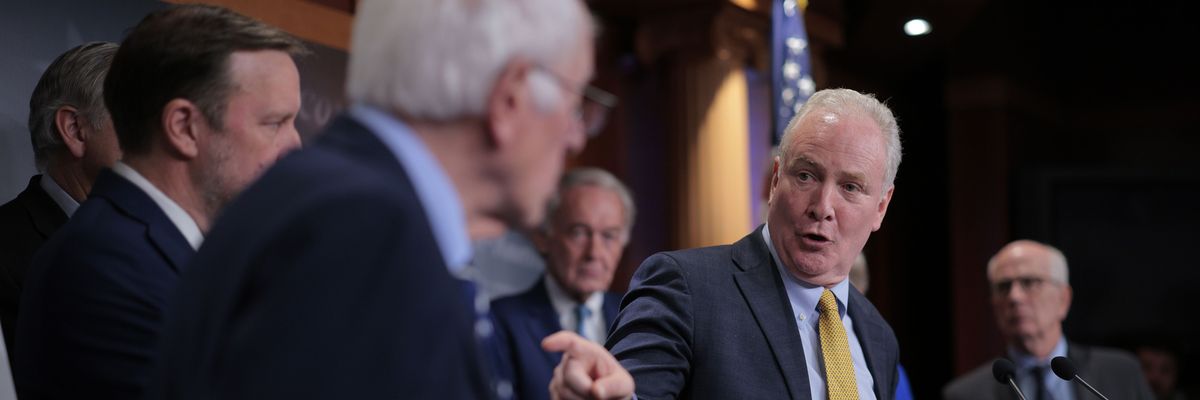

US Sen. Chris Van Hollen (D-Md.) speaks during a news conference on October 29, 2025 in Washington, DC.
(Photo by Chip Somodevilla/Getty Images)

Jake Johnson
Dec 02, 2025
COMMON DREAMS

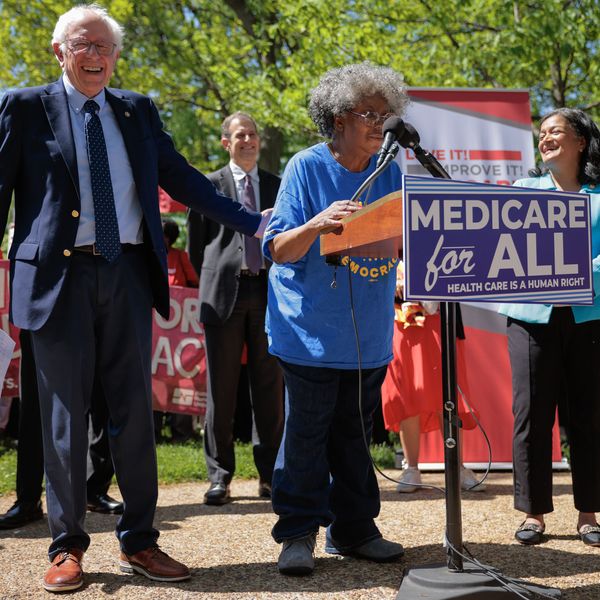
Democratic US Sen. Chris Van Hollen on Monday became the latest lawmaker to champion Medicare for All as the best solution to the country’s healthcare woes as tens of millions of Americans face soaring private insurance premiums.

In a social media post, Van Hollen (D-Md.) said that “we must stop tinkering around the edges of a broken healthcare system,” pointing to massive administrative costs and poor health outcomes under the for-profit status quo.



Medicare for All Backers Argue It’s a Better Solution Than Whatever Trump Is Cooking Up


Trump Healthcare Payment Proposal Sparks Fresh Medicare for All Demands to Fix ‘Broken’ Healthcare System

“Yes, let’s extend the [Affordable Care Act] tax credits to prevent a huge spike in healthcare costs for millions,” said Van Hollen. “Then, let’s finally create a system that puts your health over corporate profits. We need Medicare for All.”

Van Hollen’s remarks came as lawmakers continued to negotiate a possible deal to extend enhanced ACA subsidies that are set to lapse at the end of the year, an outcome that would further drive up healthcare costs for millions.

Politico reported late Monday that most senators “believe the chances for a bipartisan breakthrough” before a planned vote next week “are roughly zero.”


“Instead, the most likely outcome is that Senate Democrats put up a bill that has little GOP support for a vote, if any, while Republicans offer a competing bill of their own,” the outlet noted. “And even those partisan proposals remained in flux as lawmakers returned to Washington from a weeklong recess.”

Neither side of the negotiations is offering much more than a Band-Aid on a gaping wound. Democratic leaders want a clean extension of the subsidies to avert catastrophic cost increases, while President Donald Trump and Republican lawmakers are demanding new restrictions on the ACA that would make the system worse.

A handful of progressive lawmakers have used the worsening US healthcare crisis to make the case for a fundamental overhaul, one that would replace the for-profit model with a Medicare for All system that guarantees coverage to everyone for free at the point of service—and at a lower overall cost than the current system.

Van Hollen is the newest Senate cosponsor of the Medicare for All Act, formally backing the legislation led by Sen. Bernie Sanders (I-Vt.) just last month.

Rep. Pramila Jayapal (D-Wash.), the lead sponsor of the Medicare for All Act in the House, expressed “100%” agreement with Van Hollen’s Monday post.

“Thank you, Chris Van Hollen!” Jayapal wrote.


New Face of GOP Healthcare Fix Is Senator Linked to Largest Medicare Fraud Scheme in US History

Sen. Rick Scott is warning fellow Republicans of a “slow creep” toward single-payer healthcare if they don’t craft an alternative to the Affordable Care Act.


Sen. Rick Scott (R-Fla.) talks with reporters after the Senate luncheons in the U.S. Capitol on Tuesday, December 2, 2025.
(Photo: Tom Williams/CQ-Roll Call, Inc. via Getty Images)

Jake Johnson
Dec 03, 2025
COMMON DREAMS

US Sen. Rick Scott, former CEO of the company that was at the center of the biggest Medicare fraud scheme in American history, has emerged as the most vocal Republican proponent of healthcare reform, warning his fellow GOP lawmakers that continued refusal to engage with the issue risks a “slow creep” toward single-payer healthcare.

On Thursday, according to Axios, Scott (R-Fla.) is “convening a group of House and Senate conservatives on Capitol Hill to pore over fresh polling to develop GOP alternatives to the Affordable Care Act.”


Medicare for All Backers Argue It’s a Better Solution Than Whatever Trump Is Cooking Up

Trump Healthcare Payment Proposal Sparks Fresh Medicare for All Demands to Fix ‘Broken’ Healthcare System

Late last month, Scott unveiled his own proposal titled the More Affordable Care Act, which would keep ACA exchanges intact while creating “Trump Health Freedom Accounts” that enrollees could use to pay for out-of-pocket costs. Scott’s plan, as the health policy group KFF explained, would allow enhanced ACA tax credits to expire and let states replace subsidies in the original ACA with contributions to the newly created health savings accounts.

“Unlike ACA premium tax credits, which can only be used for ACA Marketplace plans, the accounts in the Scott proposal could be used for any type of health insurance plan, including short-term plans that can exclude people based on preexisting conditions,” KFF noted. “States could also waive certain provisions of the ACA, including the requirement to cover certain benefits.”

“While ACA plans would still be required to cover people with preexisting conditions under the Scott proposal,” the group added, “it is likely that the ACA marketplace would collapse in states that seek a waiver under his approach.”

Last month, amid the longest government shutdown in US history, Scott leapt at the opportunity to champion possible Republican alternatives to the healthcare status quo, despite his ignominious record.

In 2003, the US Justice Department announced that the hospital chain HCA Inc.—formerly known as Columbia/HCA—had agreed to pay hundreds of millions of dollars in penalties and damages to settle what the DOJ characterized as the “largest healthcare fraud case in US history.”

Scott resigned as CEO of Columbia/HCA in 1997, days after federal agents raided company facilities as part of the sweeping fraud probe. The federal government and company whistleblowers said the hospital giant “systematically defrauded” Medicare, Medicaid, and other healthcare programs through unlawful billing and other ploys.

“In 2000, Scott invoked the Fifth Amendment 75 times in a deposition as part of a civil case involving his time leading the company,” Florida Phoenix reported last year. A former HCA accountant accused Scott, who was never directly charged in the case, of leading “a criminal enterprise.”

Scott later served two terms as governor of Florida and is now one of the wealthiest members of Congress, and he maintains he was the victim of a politically motivated DOJ investigation.

“The Clinton Justice Department went after me,” Scott complained during his 2024 Senate reelection campaign.

It’s unclear whether Scott’s healthcare ideas will gain sufficient traction with President Donald Trump and Republican lawmakers, who have seemed content to bash the existing system without proposing anything concrete or viable to replace it. Trump was supposed to unveil his own healthcare proposal last month, but the White House pulled the plug amid GOP pushback.

Some members of the Democratic caucus, meanwhile, are making the case for the very system Scott is warning his colleagues about.

“Let’s finally create a system that puts your health over corporate profits,” Sen. Chris Van Hollen (D-Md.) said earlier this week. “We need Medicare for All.”


Billionaire-Funded ‘Trump Accounts’ for Kids Slammed as ‘Another Tax Shelter’ for the Rich

“If the White House were serious about supporting families struggling with the costs of living, it would be advocating for investments in childcare,” said one children’s advocate.


Susan Dell and Michael Dell attend the 12th Annual Mack, Jack & McConaughey Gala at ACL Live on April 25, 2024 in Austin, Texas.
(Photo by Rick Kern/Getty Images)

Julia Conley
Dec 02, 2025
COMMON DREAMS

After Silicon Valley CEO Michael Dell and his wife, philanthropist Susan Dell, announced Tuesday their plan to invest $6.25 billion in seed money in individual investment accounts for 25 million American children, adding to the number of kids who would receive so-called “Trump Accounts” that were included in the Republican spending bill this year, advocates acknowledged that a direct cash investment could feasibly help some families.

But the National Women’s Law Center (NWLC) was among those wondering whether the Dells’ investment of $6.25 billion—a fraction of their $148 billion fortune—would ultimately benefit wealthy investors far more.

“While we support direct investments in families, the Trump Accounts being hailed by the White House are a policy solution that doesn’t meet most families’ needs,” said Amy Matsui, the vice president of income security and child care at NWLC. “As currently structured, these accounts will just become another tax shelter for the wealthiest, while the overwhelming majority of American families, who are struggling to cover basic costs like food, childcare, and housing, will be hard pressed to find the extra money that could turn the seed money into a meaningful investment.”

The Dells, who are behind Dell Technologies, announced the investment plan months after President Donald Trump signed the One Big Beautiful Bill into law. The tax and spending law includes a provision that would start an investment account for every US citizen child born between January 2025-December 2028, with a $1,000 investment from the US government.

As Jezebel reported, the couple’s contribution would got to an additional 25 million children, up to age 10, who were born prior to the 2025 cut-off date for the initial Trump Accounts.


“Around 80% of children born between 2016-2024 would theoretically qualify, although there are cutoffs based on household income: Applying families would have to live in ZIP codes where the median household income is less than $150,000 per year,” wrote Jim Vorel.

In the corporate press, the Dells were applauded for making what they called the largest single private charitable donation to US children, but Vorel questioned the real-world impact of “a gift of $250, thrown vaguely in the direction of millions of American families by members of our billionaire ruling class.”

“What can that money realistically do in terms of providing for a child’s future?” he wrote. “Is it the seed that is going to allow them to go to college, to buy a house some day? Does that really seem likely? Or are we primarily talking about billionaires running PR campaigns for a president who recently hit new second term lows in his overall approval numbers?”

The success of the individual investment accounts hinges on whether Americans and their employers—who can contribute up to $2,500 per year without counting it as taxable income—will be able to consistently and meaningfully invest money in the accounts until their children turn 18, considering that about a quarter of US households are living paycheck to paycheck, according to a recent poll.

“Do you know many families in 2025 that would describe themselves as having a spare $5,000 per year to immediately start investing in a government-backed investment account, even if that might be relatively sound financial strategy? Or are the families in your orbit already scraping to get by, without being able to commit much attention to investing in the future?” asked Vorel, adding that the artificial intelligence “bubble” is widely expected to soon burst and drag the stock market in which Trump is urging families to invest “into a deep pit of despair.”

“As is so often the case, the families most benefited by the concept of Trump Accounts will be those ones who are already on the best financial footing, aka the wealthiest Americans,” he wrote.

Jonathan Cohn of Progressive Mass was among those who said the Dells’ investment only served to demonstrate how “they should pay more in taxes” to ensure all US children can benefit from public, not private, investment in education, healthcare, and other social supports.

“The government should not be funding only what can secure the sympathies of erratic rich people,” said Cohn.

The NWLC argued the Trump Accounts are an example of the White House’s embrace of “pronatalism”—the belief that the government should incentivize Americans to have more children—but fall short of being a policy that would actually make a measurable positive impact on families.

“In the end, this policy mirrors the rest of the law: another giveaway to the richest Americans that leaves everyone else further behind,” said Matsui. “If the White House were serious about supporting families struggling with the costs of living, it would be advocating for investments in childcare, an expanded Child Tax Credit, and undoing the historic cuts to SNAP and Medicaid.”
GOP Spending Law Gives Corporations $16 Billion in Retroactive Tax Breaks: Analysis

“You cannot change what a company did in the past, so that half-year of retroactive effect of the provision is just a windfall to companies,” said one critic.


US President Donald Trump, joined by Republican lawmakers and others including First Lady Melania Trump, wields a gavel after signing the One Big Beautiful Bill Act into law on the South Lawn of the White House on July 4, 2025 in Washington, DC.
(Photo by Eric Lee/Getty Images)


Brett Wilkins
Dec 02, 2025
COMMON DREAMS

Corporations are likely to claim $16 in fresh tax breaks on expenditures made before the passage of the budget legislation signed earlier this year by US President Donald Trump, according to an analysis by a nonpartisan congressional committee released Tuesday.

The analysis by the Joint Committee on Taxation (JCT)—a panel composed of five members each from the Senate Finance Committee and House Ways and Means Committee—came in response to a September query from Sen. Elizabeth Warren (D-Mass.) regarding the One Big Beautiful Bill Act’s (OBBBA) extension of full bonus depreciation, a tax-savings tool allowing businesses to automatically deduct costs of qualifying assets.

As Warren explained in her letter, full bonus depreciation enables corporations “to immediately deduct some or all of the cost of new business investments, such as the purchase of manufacturing equipment, software, and furniture, rather than deducting those costs over the estimated lifetime of those assets.”

“This policy was first implemented in 2010 as an intended temporary economic stimulus in the aftermath of the Great Recession, and Congress allowed it to expire the following year,” Warren noted.

“However, President Trump’s 2017 tax law reinstated 100% bonus depreciation from 2018 through 2022 in what amounted to a massive corporate giveaway,” the senator continued, highlighting nearly $67 billion in tax savings for more than two dozen corporations including Google, Facebook, UPS, and Target.

“And after extensive lobbying from billionaire-funded right-wing lobbying groups, the OBBBA reinstated 100% bonus depreciation permanently to the tune of hundreds of billions of more dollars over the next decade,” Warren added.

Applying retroactively to capital expenditures since January 19, corporate tax deductions under the OBBBA’s reinstatement of the full bonus depreciation will cost $16 billion in lost federal revenue, according to the JCT’s analysis. The tool has been hailed as game-changer for Bitcoin miners, who can write off 100% of hardware costs in the year of purchase.

The OBBBA provision allows firms to use the deduction to write off certain qualifying business-related properties, such as corporate jets. Meanwhile, millions of lower-income US households are suffering from the law’s unprecedented cuts to vital social programs including Medicaid and the Supplemental Nutrition Assistance Program.

While proponents of the full bonus depreciation argue that large corporations benefit most from the tool because they make up the lion’s share of investments, critics point out that such breaks are generally poor investment incentives because they are applied after companies have already made their spending decisions.

“Thanks to Donald Trump and Republicans’ Big Beautiful Bill, giant corporations will win big while American families see their costs skyrocket,” Warren said Tuesday in response to the JCT analysis. “Next year, the federal government will spend over five times more on these tax handouts for billionaire corporations than it spends each year on childcare.”

“Time and time again, Donald Trump and Republicans have made clear that they stand with billionaires and billionaire corporations—not American families,” she added.

Numerous corporations taking advantage of the full bonus depreciation have paid effective federal corporate tax rates far below the statutory 21%, according to a 2023 analysis by the Institute on Taxation and Economic Policy (ITEP).

One tax expert called the deduction “a cheat code to saving millions in taxes,” as thousands of companies have dodged paying their fair share by effectively reducing their income to zero, or even making it negative.

As Warren noted Tuesday, “over 80% of the 100% bonus depreciation claimed by corporations from 2018-22 went to companies with over $1 billion in yearly income,” while “99% of bonus depreciation benefits went to corporations making over $1 million annually.”

ITEP federal policy director Steve Wamhoff told the Washington Post Tuesday that “it is quite obvious that if an incentive is retroactive, it is not actually an effective incentive.”

“You cannot change what a company did in the past, so that half-year of retroactive effect of the provision is just a windfall to companies,” Wamhoff added. “That part is just ridiculous.”


The most dangerous corporation in America is one you may not have heard of


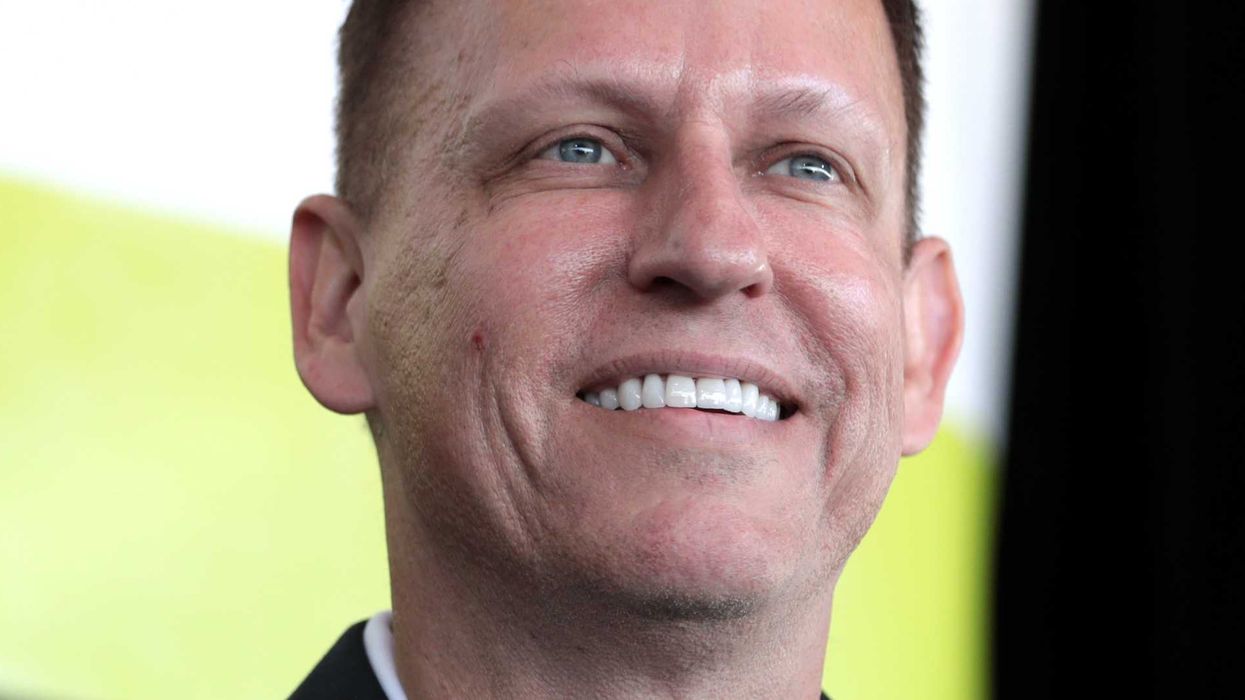
 far-right billionaire Peter Thiel 


Robert Reich
December 03, 2025
ALTERNET

It’s called Palantir Technologies, a Silicon Valley tech company that may put your most basic freedoms at risk.


Palantir gets its name from a device used in Tolkien’s The Lord of the Rings, in which a “palantir” is a seeing stone — something like a crystal ball — that can be used to spy on people and distort the truth. During the War of the Ring, a palantir falls under the control of the evil Sauron, who uses it to manipulate and deceive.

Palantir — co-founded by far-right billionaire Peter Thiel and its current CEO Alex Karp — bears a striking similarity.

It sells AI-based data platforms that let their clients, including governments, militaries, and law enforcement agencies, quickly process and analyze massive amounts of your personal data.

Whether it’s social media profiles, bank account records, tax history, medical history, or driving records, the tools that Palantir sells are used to help clients identify and monitor individuals — like you.


Why should this matter to you? Billions of your tax dollars are going to Palantir, and what Palantir is working on could be used against you.

As Palantir’s Karp says: “Palantir is here to disrupt and make the institutions we partner with the very best in the world and, when it’s necessary, to scare enemies and on occasion kill them.”

Early in his current term, Trump signed an executive order requiring government agencies to consolidate all of their information about you into one giant database — something that has never been done before. To help process this massive amount of information, Trump chose Palantir.

Trump claims this is about “efficiency.” But as one Silicon Valley investor described it, Palantir is “building the infrastructure of the police state.”

Data privacy experts warn that when government data is pooled together, it can be used by a tyrant to intimidate or silence opposition. The possibilities for abuse are huge. One of Palantir’s major projects is a new immigrant surveillance system for ICE’s deportations.

We’ve already seen Trump target people or organizations he considers enemies. Imagine if he could punish or deny services to individual Americans based on their political affiliation, whether they’ve attended a protest, or even posted an unflattering picture of him online.

Palantir could be giving Trump the power to do just this.

Palantir co-founder and Trump ally Peter Thiel has made no secret of his disdain for democracy, writing “I no longer believe that freedom and democracy are compatible.”

But when he speaks of “freedom,” he isn’t thinking about you. To Thiel, “freedom” means that he and his fellow tech oligarchs get to do what they want, without consequences, while the rest of us live in an authoritarian police state.

It’s a match made in Mordor — Trump gets the infrastructure to go after his enemies. Thiel gets to end American democracy.

The danger of Palantir’s AI-powered super database on all Americans is amplified by the vast wealth and power of those associated with it, and their apparent disdain for democratic institutions.

To protect democracy and our individual freedoms, we need to elect leaders who will defend the public from corporations like Palantir — not partner with them.

Tolkien’s palantir fell under the control of Sauron. Thiel’s Palantir is falling under the control of Trump.

How this story ends is up to all of us. Please, help spread the word by sharing this video.


Robert Reich is a professor of public policy at Berkeley and former secretary of labor. His writings can be found at https://robertreich.substack.com/

Backlash brews against Trump as voters reject assumption people 'enjoy suffering'


Adam Lynch

December 03, 2025
ALTERNET


“Daily Blast” podcaster Greg Sargent spoke with The American Prospect senior writer Paul Waldman about the backlash brewing among American voters against MAGA and Trump-style cruelty.

Sabrina Carpenter recently condemned the White House for using her song in a video of people getting arrested, pinned to the ground and handcuffed, which Carpenter called “evil and disgusting.” The White House replied with a statement blasting Carter for defending “these sick monsters” and suggested she “must be stupid, or is it slow?”

“It’s intentionally juvenile,” said Waldman, who added that administration spokespeople had “abandoned” principles of earlier administrations by handing out responses that basically say: “Your mom.”

“Their attitude is ‘no, we’re just going to be like the worst 4chan troll because we think that’s funny and we think people will respond to it and like it and our base will like it when we’re being abusive to people. And when it comes to people like immigrants — that we’re being literally sadistic to them — that we want people to enjoy their suffering,’” Waldman said.

But Americans appear to be turning on the childish sadism, said Sargent.


“You could … argue that they’re losing the war over social media spectacle because all the polls are showing very clearly that there’s widespread revulsion and rejection of the mass deportations,” Sargent said. “Trump has completely thrown away whatever advantage he had on the broader immigration issue. Thank you, [White House advisor] Stephen Miller, for doing that. [Trump] has really wrecked his standing on the issue with all these deportation raids and so forth. And I think they almost weren’t prepared for it in one critical sense, which is funny because they sort of pose as very savvy in terms of social media and the cultural stuff.”

All over the country, ICE is becoming a pariah agency, said Sargent. “People are taking out their phones, filming these things,” suggesting that the Trump administration is losing the “spectacle wars” they started by filming agents abusing children and family members.

“I think maybe they are,” said Waldman. “The theory at the heart of what the administration is doing and what Trump’s entire career is based on is that we should all be our worst selves, that our kind of darkest impulses should be the ones that reign. We should be the most bigoted, the most corrupt, the most angry and hateful — that that’s our truest self is our worst self.”

“And if you look at who is in this administration, it is a collection of the worst people from top to bottom,” Waldman continued. “And the implicit argument is that we should all be that way. And we should cheer when people get brutalized. And we should laugh when we see the corruption because everybody is corrupt and everybody is sadistic, and that’s who we ought to be,” said Waldman. “But the truth is that that’s not who most people want to be.”

Read and hear the New Republic podcast at this link.

White House scrambles for 'damage control' as report pins job losses on Trump policy


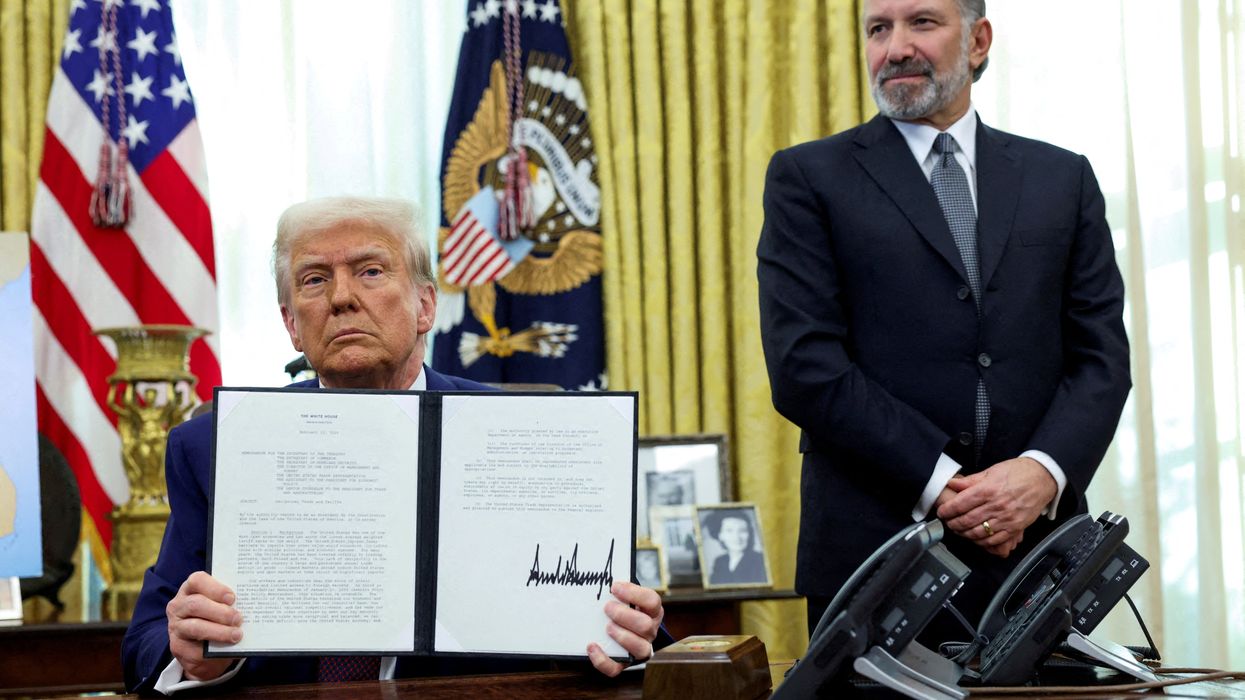
U.S. President Donald Trump holds an executive order about tariffs increase, flanked by U.S. Commerce Secretary Howard Lutnick, in the Oval Office of the White House in Washington, D.C., U.S., February 13, 2025. REUTERS/Kevin Lamarque//File Photo

December 03, 2025 
 ALTERNET


One of the President Donald Trump's top economic advisors is scrambling to blame anything but tariffs after a new jobs report indicated that they might be 'hammering" small business jobs, a move the New Republic dismissed as "only damage control."

“No, no, it’s not tariffs,” Lutnik told CNBC’s Sara Eisen. “Remember, you had the Democratic shutdown, right, and what do you think happens to small business, the people who do business with the U.S. government, they know they’re not getting paid, so they slow down their projects.

“Remember, as you deport people, that’s gonna suppress private job numbers of small businesses," he added. "But they’ll rebalance and they’ll regrow, so I think this is just a near-term event, and you’ll see as the numbers come through over the next couple of months, you’ll see that all pass."

Reacting to Lutnick's claims, a report from the New Republic dismissed them as "damage control" and cited numerous other factors to back up the claim that tariffs are harming the U.S. economy in ways Trump said they would not.

"Domestic manufacturing, as measured by the Institute for Supply Management Manufacturing index, fell for the ninth month in a row, showing that the tariffs are hurting an area that Trump boasts they will improve," the piece explained. "And private companies, including wholesale retailer Costco, are suing the government to get a refund of the tariffs they’ve paid.

The report from ADP found that, for the month of November, private sector businesses employing at most 50 people saw job losses of nearly 32,000. This was notably off from the initial prediction that these businesses would add 10,000 new jobs. Small businesses, those that employ at most 50 people, were hit the hardest, losing 120,000 jobs. Medium-sized businesses, meanwhile, added 51,000 jobs, and largest businesses added 39,000, all of which was still not enough to create net positive job growth.

Reporting on these new numbers, CNBC host Steve Liesman said that Trump's tariffs may be to blame for some of the pain felt by small businesses.

"That's the fourth negative number in the past six months," Liesman said. "The estimate was for plus 40,000, so the street was off on this one... Small business getting hammered and there is some information that some of this may be coming from being hammered by the tariffs."

During an appearance on CNBC later in the day, Trump's Commerce Secretary denied the theory that tariffs were to blame, instead putting the onus on the administration's preferred target: Democrats.


‘Yikes’: New Jobs Data Further Undermines Trump Fiction of Thriving Economy

“The booming job market exists only in Donald Trump’s demented head,” 
said economist Dean Baker.


A trader works on the floor of the New York Stock Exchange (NYSE) in New York on December 1, 2025.
(Photo by Charly Triballeau/AFP via Getty Images)


Brad Reed
Dec 03, 2025
COMMON DREAMS

Economists on Wednesday expressed significant concerns after new data from global payroll processing firm ADP estimated that the US economy lost 32,000 jobs last month.

As reported by CNBC, small businesses bore the brunt of the job losses, as firms with fewer than 50 employees shed a total of 120,000 jobs, more than offsetting the 90,000 in job gains reported by firms with 50 or more employees.

The loss of 32,000 jobs in November marked a major miss for economists’ consensus estimate of 40,000 jobs added on the month, and CNBC noted that the total number of jobs lost according to ADP data “was the biggest drop since March 2023.”

Heather Long, chief economist at Navy Federal Credit Union, noted in a post on X that the job losses recorded by ADP were widespread across the US economy.

“Yikes,” she wrote in reaction to the report. “Most industries were doing layoffs. The only ones still are hiring are hospitality and healthcare.”

Long also said the disparity between small and large businesses in terms of job growth was more evidence that the US is experiencing a “K-shaped” economy in which those at the top of the economic ladder thrive, even as everyone else struggles.

“Larger companies are still hiring,” she explained. “Smaller firms (under 50 workers) are doing the layoffs. It’s been a very tough year for small biz due to tariffs and more selective spending from lower and middle-class consumers.”

Kevin Gordon, head of macro research and strategy at the Schwab Center for Financial Research, observed that ADP hasn’t reported such a big drop in small-business employment since October 2020, when the US economy was suffering through the peak of the Covid-19 pandemic.

Alex Jacquez, chief of policy and advocacy at Groundwork Collaborativecautioned against reading too much into ADP data, although he added that “in the absence of up to date government payrolls, all other signs point to a further deteriorating labor market.”

Charlie Bilello, chief market strategist at financial planner Creative Planning, argued that the ADP jobs numbers were part of a negative three-month trend in which the US economy lost an estimated 4,000 jobs per month, which he said was “the first three-month decline since the 2020 recession.”

Bilello added that “a year ago, we were adding over 200,000 jobs per month.”

Diane Swonk, chief economist at accounting firm KPMG, argued that the ADP report showed job losses in the US economy were “broad based” and “were accompanied by a cooling of wage gains” for workers who still have jobs or are switching from one job to another.

“Those with a job are clinging on, while those without are left wanting,” she explained.

Dean Baker, senior economist at the Center for Economic and Policy Research, argued that the ADP report blows up President Donald Trump’s spin about the health of the US economy.

“The booming job market exists only in Donald Trump’s demented head,” he wrote.


As Prices Soar, Trump Denounces ‘Affordability’ as ‘Democrat Scam’

“The president is trying to gaslight Americans into believing that everything is fine.”


Customers scan groceries at a Walmart Supercenter self-checkout area in Doral, Florida on October 10, 2025.
(Photo by: Jeffrey Greenberg/Universal Images Group via Getty Images)

Brad Reed
Dec 02, 2025
C0MMON DREAMS

President Donald Trump on Tuesday blew off US voters’ concerns about affordability, even as polls show most voters blame him for increasing prices on staple goods.

At the start of a Cabinet meeting, Trump falsely claimed that electricity prices are coming down, despite the fact that Americans across the country are struggling with utility bills being driven higher in large part by energy-devouring artificial intelligence data centers.

The president then claimed more broadly that voter concerns about increased costs were all figments of their imaginations.

“The word ‘affordability’ is a Democrat scam,” Trump declared. “They say it and they go onto the next subject, and everyone thinks, ‘Oh they had lower prices.’ No, they had the worst inflation in the history of our country. Now, some people will correct me, because they always love to correct me, even though I’m right about everything. But some people like to correct me, and they say, ‘48 years.’ I say it’s not 48 years, it’s much more, but they say it’s the worst inflation we’ve had in 48 years, I’d say, ever.”


Later in the Cabinet meeting, a reporter asked Trump if he believed voters were growing “impatient” with his policies, which have not produced the kind of broad-based decline in prices he once promised.

Trump, however, doubled down.

“I think they’re getting fake news from guys like you,” he said. “Look, affordability is a hoax that was started by Democrats, who caused the problem of pricing.”

The president’s claims about affordability being a “scam” issue are at odds with what US voters are telling pollsters, however.

A Yahoo/YouGov poll released late last month, for instance, found 49% of Americans say that Trump’s policies have done more to raise prices in the last year, compared with just 24% who say that he’s lowered their costs. The survey also found voters are more likely to blame Trump for higher prices than they are to blame former President Joe Biden.

During the 2024 presidential campaign, Trump routinely campaigned on affordability and vowed to start lowering the cost of groceries starting on the very first day of his presidency. Since then, however, Trump has slapped heavy tariffs on a wide range of imported goods, which economists say have led to further price increases.


Many Democrats were quick to pounce on the president declaring affordability a “scam.”

“There you have it folks,” wrote Rep. Darren Soto (D-Fla.) on X. “From ‘I will lower prices on Day 1’ to this.”

Rep. Brad Schneider (D-Ill.) argued that Trump was trying to make Americans’ economic anxieties disappear by telling them not to believe their own bank balances.

“The president is trying to gaslight Americans into believing that everything is fine,” he observed. “The reality is millions of Americans are worried about their checking accounts and whether they can put food on the table, afford healthcare, and pay their bills.”

Rep. Sylvia Garcia (D-Texas) said that Trump’s dismissal of voters’ affordability worries are “easy to say when you are a billionaire who has never had to choose between groceries and the light bill.”

“Working families in Texas know the real scam is his tariffs, his higher premiums, and his complete failure to offer any plan to address the housing crisis or actually lower prices,” Garcia added.


Trump Is Lying About Grocery Prices; What Else?​

You cannot trust someone who says things you know from your own experience to be false.


People shop at Sabor Tropical Supermarket in Miami Beach, Florida.
(Photo by Jeffrey Greenberg/Universal Images Group via Getty Images)

Mitchell Zimmerman
Dec 02, 2025
Common Dreams

Remember the old saying? Fool me once, shame on you. Fool me twice, shame on me.

President Donald Trump has fooled too many people too many times—many more than twice. Perhaps many people are ready to believe anything Trump says because he attacks people who they enjoy seeing targeted. But what if this time it is people like us who are actually the targets of Trump’s attacks?

What else can you make of it when Donald Trump tells flagrant falsehoods about something important to our families’ well-being: The fact that rising prices are eating up our income? What should you make of it when Donald Trump denies something you know to be true from your own experience?

In 2024 Trump promised voters that when he was elected, “Inflation will vanish completely.” He even vowed, further, that “prices will come down, and they’ll come down fast, with everything.” “When I win, I will immediately bring prices down.”

It’s time to ask ourselves: Who’s running the con job? And what else has Donald Trump been saying that just ain’t so?

It has been nearly a year. Prices have not gone down. Everyone knows this. But Donald Trump refuses to admit it.

On October 31, Trump was interviewed for the CBS News’ program “60 Minutes.” When reporter Norah O’Donnell pointed to the fact that “grocery prices are up,” Trump blew up.

“No, you’re wrong,” he insisted. “Right now they’re going down... Inflation, I’ve already taken care of… We have no inflation. We have no inflation.”

Trump asserted prices have already dropped. “Every price is down,” he said in early November. “Everything is way down.” Gasoline prices have “plummeted” and “we’re at almost $2 for gasoline.”

Really? At a gas pump near you? Here in the real world, on Thanksgiving weekend, the national average gas price was $3 a gallon.

“Everything” is certainly not “way down.” Prices are obviously going up again.

You are not alone if you see a disconnect between Trump’s pontificating and our reality.

On November 19, Fox News released a poll on the cost of living. Eight-five percent of Americans say they are paying more for groceries than last year. Four out of five say the cost of utilities has gone up. Two-thirds say their healthcare expenses and their housing expenses have increased. “Everything is” not “way down.”

Nope. The US Bureau of Labor Statistics reported the jump in food and other prices for the first nine months of Trump’s presidency. (Beef up 13%. Oranges up 15%. Electricity 7%. Natural gas 6%. Gasoline 6%.)

The US Department of Agriculture certainly did not tell Trump that produce prices are “way down.” The USDA said food prices would “rise faster than the historical average rate of growth” in 2025—and projected they would continue to rise nearly as fast in 2026.

The US Bureau of Labor Statistics’ Consumer Price Index for September 2025 (the latest month for which data is now available) shows prices 3% higher than one year ago.

No one misinformed President Trump. He invented his own lies.

Just making things up that sound good is second nature to Donald Trump. Remember he was going to make Mexico pay for the wall? Cap credit card interest rates at 10%? Make in-vitro fertilization treatment free? End the Ukraine war on Day One? (Trump now claims that was “said in jest.” Ending a war is a joke?) Provide a tax credit for family caregivers? (Forgotten on Day One, and certainly when Trump’s One Big Beautiful Bill Act gave the richest 1% of Americans a $75,000 tax break!)

But it takes a special kind of chutzpah to tell people who see their grocery prices going up that their grocery prices are going down. Trump, like one of the Marx Brothers in a 1933 movie, is saying, “Who you gonna believe, me or your own eyes?”

If you believe your own eyes about the prices you see in the supermarket and on your utility bill, Trump thinks you’re a sucker—taken in by “a con job by the Democrats.”

It’s time to ask ourselves: Who’s running the con job? And what else has Donald Trump been saying that just ain’t so?

Here’s one easy example: Who is paying the tariffs on the things you buy that come from overseas?

Donald Trump told voters over and over during the 2024 campaign that they would not be paying for tariffs. Tariffs are “a tax on another country,” Trump insisted. “It’s not going to be a cost to you, it’s going to be a cost to another country.”

That was a lie. Ask any business person. Tariffs are a sales tax that US importers are paying, and since they are passing the expense on in higher prices, you are bearing the expense. They are part of the reason prices are going up.

Trump recently admitted the lie. In response to the soaring prices of tariff-burdened foods like coffee, tea, and bananas (coffee is up 20%), Trump recently cut those tariffs, saying that would bring down coffee prices “in a very short period of time.” The only way a tariff cut can bring down prices is when tariffs were the reason prices went up in the first place.

Sometimes Trump’s lies are so obvious it’s hard to believe even MAGA supporters take them seriously. Consider the lie about renaming the Gulf of Mexico.

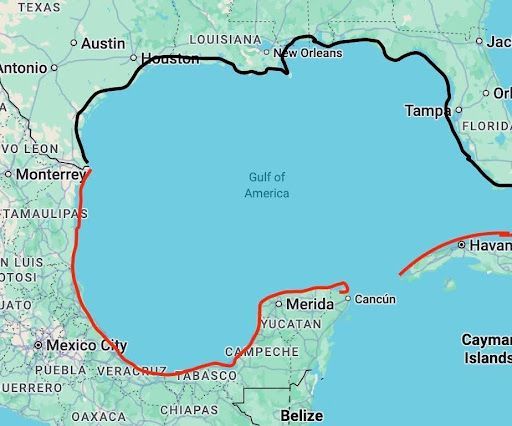
“I called the Gulf of Mexico, the Gulf of America,” Trump explained, “because to me, it was always the Gulf of America. We have 92% of the frontage. Why isn’t it the Gulf of America?”

Let’s look at the map:


The black line shows US coastal frontage from Texas to Florida. The red line shows the rest of the Gulf’s coastal frontage, along Mexico and part of Cuba. Does it look to you like the black line is 92% of all the shoreline? No one could claim that with a straight face. Except Donald Trump. He thinks Americans are too dumb to notice his lies.

Here is a more consequential lie for the 83 million people—about 1 in 5 Americans—who rely on Medicaid for comprehensive coverage of health and long-term care. What Trump called the “One Big Beautiful Bill” made savage cuts in the Medicaid program, based on One Big Ugly Lie.

Trump said he was going to leave Medicaid alone. “We’re not doing any cutting of anything meaningful,” he said. “We’re not changing Medicaid.” Immediately after his Big Beautiful Bill was passed, Trump repeated the claim that “we’re not going to touch” Medicaid.

False. Trump’s bill will, over a 10 year period, hack $1 trillion off Medicaid funding, by making it more difficult for individuals to qualify or remain qualified for Medicaid, reducing benefit and reimbursement rates, and other changes. Over 14 million people will lose health coverage.

The American Medical Association condemned the bill:
Care will be less accessible, and patients may simply forego seeing their physician because the lifelines of Medicaid and CHIP [the Child Health Insurance Program] are severed… This bill will make patients sicker… Acute, treatable illnesses will turn into life-threatening or costly chronic conditions.

About $1 trillion taken from Medicaid is just about the right amount to offset the One Big Beautiful Bill’s $1 trillion tax gift to the top 1% of Americans. These are people who make more than $1,149,000 each year. They will get a much-needed $75,400 tax break next year.

Finally, let’s look at Trump’s lies about undocumented immigrants. He wants to deport over 10 million people, an action that Trump’s own Labor Department has said is already making food shortages and increased agricultural prices likely, and is impacting home construction, meat packing, and the availability of home health aides.

Trump seeks to justify the disruption and downright cruelty by saying he’s only deporting “the worst of the worst.” But there aren’t millions of criminals among the immigrants who came to America without proper authorization. They came seeking a better life or desperate to escape brutal gang violence in their homelands, and the overwhelming majority are law-abiding and hardworking.

Even Fox News reports that the “worst of the worst” claim is false: “The majority of people currently detained by ICE [Immigration and Customs Enforcement] have no criminal convictions. Of those who do, relatively few have been convicted of high-level crimes.”

A US government-funded study confirmed the point, finding that “undocumented immigrants are arrested at less than half the rate of native-born US citizens for violent and drug crimes and a quarter the rate of native-born citizens for property crimes.”

Common sense tells us Trump is lying. ICE is not seizing people for deportation by the millions by targeting particular individuals found guilty of serious crimes. By the US government’s own explanation in court, ICE “contact teams” try to find undocumented immigrants by looking for individuals who have a Spanish accent or look Hispanic and who are found in locations such as bus stops, car washes, day laborer pickup sites, and agricultural sites.


Enrique Lozano’s ice cream cart was left behind after ICE grabbed him.


ICE’s targets are not the worst of the worst. In Culver City they seized a beloved ice cream man. Law-abiding young people, who were brought here as small children, are being targeted when they are about to graduate from high school. Day laborers at Home Depot. Shoppers in a Walmart parking lot. Patients in a hospital.

Trump’s lies about immigrants are shameful.

It would take an encyclopedia to list and correct all the lies Donald Trump has told. When you encounter Trump’s pronouncements on matters such as whether federal troops are needed in our cities—whether crime is out of control—whether all third-world immigrants are a threat—whether voter fraud is a real problem—whether civil rights laws discriminate against white people—whether the 2020 election was stolen from Trump—or whether anything Donald Trump does not like to hear must be fake news, ask yourself: Are groceries cheaper?


Our work is licensed under Creative Commons (CC BY-NC-ND 3.0). Feel free to republish and share widely.

Mitchell Zimmerman
Mitchell Zimmerman is an attorney, longtime social activist, and author of the anti-racism thriller "Mississippi Reckoning" (2019).
Full Bio >

Trump Moves to Supercharge U.S. LNG as Exports Hit New Highs


  • U.S. LNG exports and feedgas flows hit record highs.

  • Europe remains the top buyer, pushing U.S. exports above 10 million tons per month as new capacity ramps up from Cheniere, Venture Global, and other Gulf Coast terminals.

  • Rising exports are tightening domestic supply, driving U.S. natural gas prices sharply higher as winter demand surges.

The U.S. federal government is considering further steps to speed up the buildout of liquefied natural gas export infrastructure as flows of natural gas to LNG plants hit a record high. Exports, as it happens, are also running at all-time highs.

The Federal Energy Regulatory Commission’s chairwoman announced the coming changes in a statement that said, “Energy infrastructure needs to be built now, and existing projects need to be maintained efficiently to ensure grid reliability today and in the future. We are taking a hard look at our processes and ways we can simplify certain activities.”

To speed up new infrastructure construction, the commission is considering a blanket permit regime rather than assessing each new project individually before granting approval for its construction. The same changes are being considered for hydropower plants as well, with a view to strengthening the grid.

A couple of days after the FERC statement, Bloomberg reported that natural gas flows to the liquefaction trains along the Gulf Coast had reached an all-time high of 19 billion cu ft daily this last Friday. Of this total, two companies took about half, with Cheniere Energy drawing in 5.1 billion cu ft for its plant in Sabine Pass, and Venture Global taking in 4.5 billion cu ft as it continued to expand production at its second LNG export facility, Plaquemines. The two accounted for 72% of total U.S. LNG exports in October.

The news coincided with data suggesting the United States was on track to post another record month for LNG exports as Europe soaks in whatever volumes are available to stock up on gas ahead of winter. The data, from energy analytics firm Kpler, showed that the monthly total for November was on track to reach 10.7 million tons, which would represent a 40% increase on November 2024 and the highest ever exported by a single LNG-producing country.

The United States is already the biggest exporter of liquefied gas in the world. The Trump administration is working to ensure it stays this way, with the U.S. president making energy imports a mandatory part of his trade deal with the European Union—the largest market for American LNG right now.

If the Federal Energy Regulatory Commission goes ahead with the planned changes, it could encourage even faster growth in LNG export capacity as global energy demand forecasts see consistent growth in demand for liquefied gas specifically.

Already, the Energy Information Administration projects that if all currently planned LNG facilities get built, this would boost the United States’ liquefaction capacity more than twofold, by some 13.9 billion cu ft daily between this year and 2029. Interestingly, the EIA made that projection last month, citing average daily flows to LNG plants of 15.4 billion cu ft.

Last month, Reuters reported that the United States had become the first country to export 10 million tons of liquefied natural gas in a single month. Citing data from LSEG, the publication reported that U.S. LNG exports in October had hit 10.1 million tons, of which 6.9 million tons went to Europe, and another 1.96 million tons went to Asia. Europe accounted for 69% of total U.S. exports of liquefied gas, cementing the continent’s top spot among U.S. LNG clients.

With winter setting in across the Northern hemisphere, chances are that U.S. LNG export rates will remain elevated in the coming months as withdrawals from storage in Europe accelerate amid peak heating demand season. This fits into the Trump administration’s energy dominance agenda—but it also raises gas prices for the average American.

Three months ago, natural gas futures were trading at below 43 per million British thermal units. Last week, the U.S. benchmark hit $4.85 per mmBtu. The price jump reflects strong global demand for liquefied gas amid a colder start to the winter than last year’s. Also, the EIA has reported two consecutive weekly inventory draws in natural gas, reinforcing the perception of tightening supply. This highlights the flip side of the energy dominance agenda: tighter supply at home.

U.S. energy industry insiders argue that there is plenty of natural gas to go around both at home and abroad, and while this may well be true, this supply is by no means unlimited. If all the planned new LNG export terminals get built, exports could increase by as much as 75% by 2030, according to analysts. This would mean daily flows into liquefaction trains of 30 billion cu ft daily by that year.

This, in turn, would necessitate higher production—and indeed, the EIA has projected a record-breaking 2025 for gas production, at 107.1 billion cu ft daily, followed by another record-breaking year in 2026, with output rising to 107.4 billion cu ft. Add to this demand from data centers and higher gas prices become inevitable. The question is just how high they would go.

By Irina Slav for Oilprice.com


Delays in Egyptian LNG Unloadings Are Disrupting Gas and Shipping Markets

FSRU arriving in Egypt
Egypt now has three FSRUs but still there are delays impacting the LNG shipping market (BESIX)

Published Dec 1, 2025 5:40 PM by The Maritime Executive


Delays in unloading LNG cargos at Ain Sokhna in Egypt are exacerbating the shortage of LNG tankers in the Atlantic. 

Ain Sokhna lies on the western coast of the Red Sea, 30 miles south of Suez. Besides its LNG facilities, Ain Sokhna has container, bulk, and general cargo terminals. There is also a logistics park developed by DP World. 

Historically, Egypt has been a net exporter of LNG, although it began importing some LNG in 2015. But from 2024 onwards, imports of LNG rose substantially, as output from existing fields declined and domestic consumption rose. In the first nine months of 2025, Egyptian LNG imports were up over 50 percent in comparison with the previous year. In 2025, Egypt plans to import up to 160 shipments, and last week signed an agreement with Hartree Partners for 80 shipments to be delivered from January 2026 onwards. These level of imports makes Egypt the biggest importer of LNG in the Middle East, surpassing Kuwait.

Egypt’s Minister of Petroleum and Mineral Resources Karim Badawy has said that Egypt intends to increase natural gas production to 6.6 billion cubic feet per day by 2030, a 58 percent increase from the current rate of 4.2 billion cubic feet. The investment program involves drilling 14 offshore exploratory wells in the Mediterranean next year.

But in the meantime, delays in unloading at the Ain Sokhna terminal in recent weeks have seen tankers waiting at anchor off the terminal for berthing spaces for between 10 to 15 days, industry sources report. With Atlantic LNG freight rates peaking at $146,750 per day on November 28, the highest for the year to date, the cost of extended ship chartering time clearly impacts gas prices. But the delays also have a knock-on effect, increasing shipping rates and reducing tanker availability in the Atlantic. This is compounding the pressures also created by increased LNG production and exports from both Nigeria and the United States. 

Coping with the temporary switch from export to import profile, the Ain Sokhna terminal employs three Floating Storage and Regasification Units (FSRUs), Energos EskimoEnergos Power, and Hoegh Galleon. The delays are associated with both the unloading capacity available but also local operational difficulties, in the face of rising import requirements. As the Egyptian government's investment plans are focused on expanding domestic exploration and production rather than the construction of permanent regasification import facilities, the delays are likely to persist.

In a reflection of a rise in the Atlantic rates. Pacific rates also climbed to $89,250 per day, the highest level since December 2023, according to Spark Commodities.