Wednesday, December 03, 2025

Democrats in Congress Are Out of Touch With Constituents on Israeli Genocide

The political issue of complicity with genocide will not go away. And that’s a good thing.
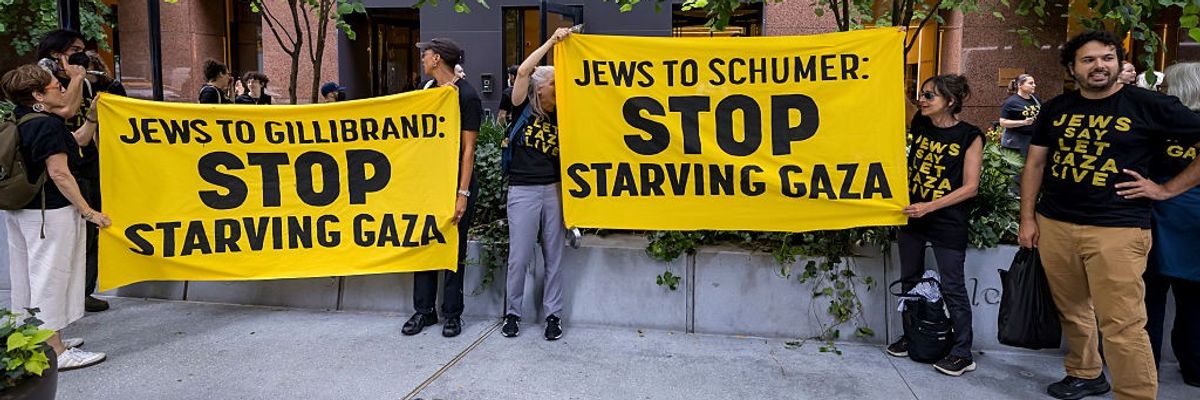

Over 200 members from the organization Jewish Voice for Peace occupy the lobby outside the offices of U.S. Senate Minority Leader Chuck Schumer (D-NY) and U.S. Senator Kirsten Gillibrand (D-NY). The group is protesting the senator’s military support of the Israeli government and the continued starvation and genocide of the Palestinian people in Gaza.
(Photo by Michael Nigro/Pacific Press/LightRocket via Getty Images)

Norman Solomon
Dec 03, 2025
Common Dreams

Last month, some House members publicly acknowledged that Israel has been committing genocide in Gaza. It’s a judgment that Amnesty International and Human Rights Watch unequivocally proclaimed a year ago. Israeli human-rights organizations have reached the same conclusion. But such clarity is sparse in Congress.

And no wonder. Genocide denial is needed for continuing to appropriate billions of dollars in weapons to Israel, as most legislators have kept doing. Congress members would find it very difficult to admit that Israeli forces are committing genocide while voting to send them more weaponry.

Three weeks ago, Rep. Rashida Tlaib (D-Mich.) introduced a resolution titled “Recognizing the genocide of the Palestinian people in Gaza.” Twenty-one House colleagues, all of them Democrats, signed on as co-sponsors. They account for 10 percent of the Democrats in Congress.

In sharp contrast, a national Quinnipiac Poll found that 77 percent of Democrats “think Israel is committing genocide.” That means there is a 67 percent gap between what the elected Democrats are willing to say and what the people who elected them believe. The huge gap has big implications for the party’s primaries in the midterm elections next year, and then in the race for the 2028 Democratic presidential nomination.

The party’s leadership remains stuck in a bygone era.

One of the likely candidates in that race, Rep. Ro Khanna (D-Calif.), is speaking out in ways that fit with the overwhelming views of Democratic voters. “I agree with the UN commission’s heartbreaking finding that there is a genocide in Gaza,” he tweeted as autumn began. “What matters is what we do about it—stop military sales that are being used to kill civilians and recognize a Palestinian state.” Consistent with that position, the California congressman was one of the score of Democrats who signed on as co-sponsors of Tlaib’s resolution the day it was introduced.

In the past, signers of such a resolution would have reason to fear the wrath—and the electoral muscle—of AIPAC, the Israel-can-do-no-wrong lobby. But its intimidation power is waning. AIPAC’s support for Israel does not represent the views of the public, a reality that has begun to dawn on more Democratic officeholders.

“With American support for the Israeli government’s management of the conflict in Gaza undergoing a seismic reversal, and Democratic voters’ support for the Jewish state dropping off steeply, AIPAC is becoming an increasingly toxic brand for some Democrats on Capitol Hill,” the New York Times reported this fall. Notably, “some Democrats who once counted AIPAC among their top donors have in recent weeks refused to take the group’s donations.”

Khanna has become more and more willing to tangle with AIPAC, which is now paying for attack ads against him. On Thanksgiving, he tweeted about Gaza and accused AIPAC of “asking people to disbelieve what they saw with their own eyes.” Khanna elaborated in a campaign email days ago, writing: “Any politician who caves to special interests on Gaza will never stand up to special interests on corruption, healthcare, housing, or the economy. If we can’t speak with moral clarity when thousands of children are dying, we won’t stand for working Americans when corporate power comes knocking.”

AIPAC isn’t the only well-heeled organization for Israel now struggling with diminished clout. Democratic Majority for Israel, an offshoot of AIPAC that calls itself “an American advocacy group that supports pro-Israel policies within the United States Democratic Party,” is now clearly misnamed. Every bit of recent polling shows that in the interests of accuracy, the organization should change its name to “Democratic Minority for Israel.”

Yet the party’s leadership remains stuck in a bygone era. Sen. Kirsten Gillibrand (D-NY), the chair of the Democratic Senatorial Campaign Committee, typifies how disconnected so many party leaders are from the actual views of Democratic voters. Speaking in Brooklyn three months ago, she flatly claimed that “nine out of 10 Democrats are pro-Israel.” She did not attempt to explain how that could be true when more than seven out of 10 Democrats say Israel is guilty of genocide.

The political issue of complicity with genocide will not go away.

Last week, Amnesty International released a detailed statement documenting that “Israeli authorities are still committing genocide against Palestinians in the occupied Gaza Strip, by continuing to deliberately inflict conditions of life calculated to bring about their physical destruction.” But in Congress, almost every Republican and a large majority of Democrats remain stuck in public denial about Israel’s genocidal policies.

Such denial will be put to the electoral test in Democratic primaries next year, when most incumbents will face an electorate far more morally attuned to Gaza than they are. What easily passes for reasoned judgment and political smarts in Congress will seem more like cluelessness to many Democratic activists and voters who can provide reality checks with their ballots.


Our work is licensed under Creative Commons (CC BY-NC-ND 3.0). Feel free to republish and share widely.


Norman Solomon
Norman Solomon is the national director of RootsAction.org and executive director of the Institute for Public Accuracy. The paperback edition of his latest book, War Made Invisible: How America Hides the Human Toll of Its Military Machine, includes an afterword about the Gaza war.
Full Bio >
200+ Luminaries Back Demand for Israel to Free Marwan Barghouti

The Israelis want the Palestinian leadership weak and divided, and they have succeeded in arranging for this outcome.


Demonstrators, led by the Anti-War Committee Chicago and the Chicago Coalition for Justice in Palestine, march down Michigan Avenue, chanting for justice in Palestine and demanding the release of Marwan Barghouti, while motorcyclists waving Palestinian flags amplify the protest on August 23, 2025 in Chicago, Illinois, United States.

(Photo by Jacek Boczarski/Anadolu via Getty Images)

Juan Cole
Dec 03, 2025
Informed Comment

Two hundred prominent literary, cultural and political figures have signed an open letter demanding the release from Israeli prison of Palestinian activist Marwan Barghouti. Barghouti 66, is widely thought to be one of the few figures who could unite the Palestinians and lead them to statehood. Israel has imprisoned him for 23 years after a trial most observers consider extremely flawed to say the least. Israel is apparently preparing to go on an execution spree against Palestinian prisoners, some of whom are held without charges or trial for indefinite periods of time.

The star-studded list of signatories includes Margaret Atwood of “The Handmaid’s Tale” fame; Mark Ruffalo a.k.a. the Incredible Hulk, Philip Pullman, author of “His Dark Materials;” Paul Simon, who knows a thing or two about bridges over troubled waters; Benedict Cumberbatch a.k.a. Dr. Strange; Sting, who knows when someone’s watching you; artist Ai Weiwei (who was once arrested and held without charges for 81 days himself); television personality and author Stephen Fry; billionaire entrepreneur Richard Branson; and other prominent writers and culture figures.

The campaign is being likened to the effort to free Nelson Mandela from the prisons of Apartheid South Africa in the late 1980s, which presaged the end of Apartheid itself.

Palestinian leadership is a mess, though this is largely the fault of Israel and the United States. Occupied people are often divided and ruled by outsiders, who bribe and spy and set honey traps. They turn any successful indigenous leader into either a collaborator or a terrorist. They damage the local economy and so set the stage for societal failure. The Oslo Accords of 1993 turned the Palestine Liberation Organization, which gave up its chief bargaining chip by recognizing Israel, into a tool for policing Palestinians to keep them from rising up over being brutally occupied. As a result, the PLO is now widely hated. Not to mention that the Israeli refusal to allow elections to be held after 2006 has ensured that the Palestine Authority leaders became a corrupt gerontocracy.

Hamas was alternatively bankrolled by the Israelis or at their behest and cooped up in a large open air concentration camp, a combination that made them dangerous rather than complacent and as a result they committed the horrors of October 7, 2023, ensuring that no Israeli or American government could deal with them ever after.

The Israelis want the Palestinian leadership weak and divided, and they have succeeded in arranging for this outcome.

Bargouti has none of the taint of corruption and collaborator status that now clings to the PLO, since although he is a member of Fateh he has been in prison for the bad old days. He has from his youth been opposed to Hamas.

Barghouti was born in 1959 in the hamlet of Kober in Ramallah governorate. His wife Nadwa is an attorney and women’s rights activist.

Barghouti in his teens joined the Communist Party and participated in peaceful demonstrations. As historian Joel Beinin showed in his Was the Red Flag Flying There? Marxist Politics and the Arab-Israeli Conflict in Eqypt and Israel 1948-1965, the Communist Party was one of the few political vehicles in Israel and Palestine that had both Israeli and Palestinian members, since Marxism rejects nationalist chauvinism.

The Israeli-Palestine problem, however, did not seem to him likely to be resolved by sitting around the campfire singing the Marxist equivalent of Kumbaya, and he gravitated to Fateh, the leading group within the Palestine Liberation Organization, led by Yasser Arafat. In 1978, the Israelis arrested Barghouti when he was around 19, apparently just for being associated with the PLO. They imprisoned him for four years. He finished up his high school degree at Prince Hassan High School in Bir Zeit by completing correspondence courses from prison.

After he was released in 1982, when he must have been about 23, he went to Bir Zeit University and did a BA in History and Political Science. Then he did an MA at Bir Zeit in International Relations. During the 1980s he was active in campus politics and was elected head of the Bir Zeit University student council.

In 1987, the Israelis expelled him to Jordan, which is a war crime. That is, an occupying power is forbidden in the Fourth Geneva Convention of 1949 of displacing members of the occupied population. He had to remain in forced exile until 1993, when Israel signed the Oslo Accords with the PLO and the latter recognized Israel, ending the state of conflict between the two in principle.

On his return to his homeland, Barghouti landed a teaching position at the main Abu Dis campus of al-Quds University in Jerusalem. In the 1990s, Barghouti was known for having good relationships with Israelis. He rose to become secretary-general of Fateh in the Palestinian West Bank, and then was elected to the Palestinian parliament established after Oslo. He established the secular Tanzim paramilitary to combat rising fundamentalist Hamas militants. He was seen as a young comer in Palestinian politics, as someone on whom the old guard like Yasser Arafat depended. But he was also critical of the corruption that arose in the Palestine Authority.

But during the Second Uprising (Intifada), the relationship between the Israelis and Palestinians again turned violent. In 2002, Barghouti wrote an op ed for the Washington Post entitled “Want Security? End the Occupation.” He said,“Over the past 15 months, Israel has killed more than 900 Palestinian civilians, 25 percent of them under the age of 18.”

He added,“I am not a terrorist, but neither am I a pacifist. I am simply a regular guy from the Palestinian street advocating only what every other oppressed person has advocated — the right to help myself in the absence of help from anywhere else. This principle may well lead to my assassination.”

Thereafter, a militant Fateh wing committed violence in Israel, killing dozens of Israelis and the Israeli authorities tagged Barghouti as involved, though they never made public what evidence they had of his involvement. In 2004 he was sentenced to five life sentences.

I am a severe critic of terrorism in the sense of targeting civilians for political purposes. But in the real world of politics, people who deploy that tactic sometimes do have a political comeback. Menahem Begin, who boasted of machine-gunning down innocent Palestinian women and children at Deir Yassin in 1948, became prime minister of Israel and won the Nobel Peace Prize. Ahmed al-Shara, formerly head of an al-Qaeda offshoot, who was imprisoned by US marines in Iraq, and who certainly committed a ton more terrorism than Begin, was just recently an honored guest in the Trump White House. Nelson Mandela himself committed political violence in his youth, for which he was imprisoned; he was no pacifist. Released from prison, he became president of South Africa and urged reconciliation.

In prison Barghouti finished a doctorate in political science in 2010 and is known for having argued for restraint and against violence to his Palestinian audience on the outside.

His advice to the Israelis in 2002, which, to say the least they haven’t heeded, is still the best advice. If you want security, end the occupation. If Barghouti could help do that, it might save Israel from its own most self-destructive instincts — which are at the moment sinking it.


© 2023 Juan Cole


Juan Cole
Juan Cole teaches Middle Eastern and South Asian history at the University of Michigan. His newest book, "Muhammad: Prophet of Peace Amid the Clash of Empires" was published in 2020. He is also the author of "The New Arabs: How the Millennial Generation Is Changing the Middle East" (2015) and "Napoleon's Egypt: Invading the Middle East" (2008). He has appeared widely on television, radio, and on op-ed pages as a commentator on Middle East affairs, and has a regular column at Salon.com. He has written, edited, or translated 14 books and has authored 60 journal articles.
Full Bio >
In ‘Historic Victory’ for Oceans, Norway Pauses Controversial Deep-Sea Mining Plans

“We will not let this industry destroy the unique life in the deep sea, not in the Arctic, nor anywhere else,” one campaigner said.


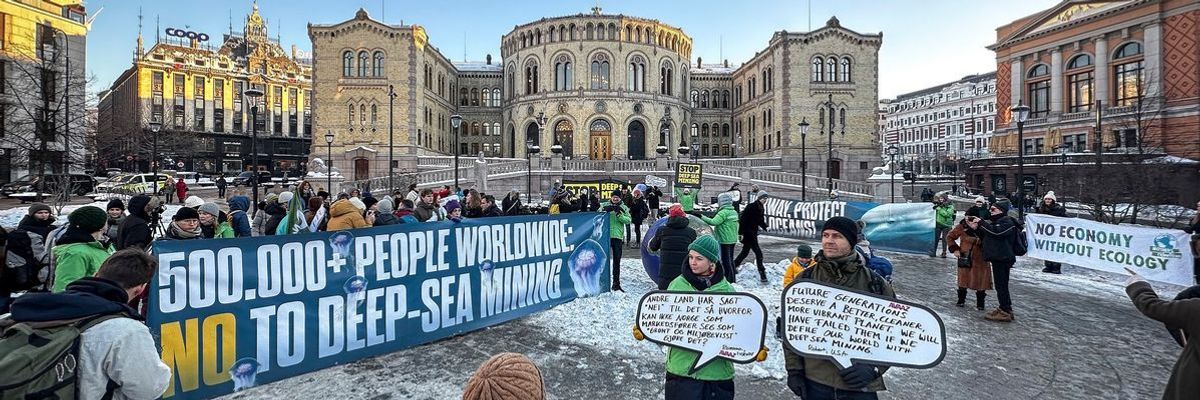
Activists gathered outside the Norwegian parliament in Oslo during a vote to approve deep-sea mining on January 9, 2024
(Photo by Will Rose/Greenpeace)

Olivia Rosane
Dec 03, 2025
COMMON DREAMS

In a move celebrated by environmental advocates as a “massive win for nature,” the Norwegian government on Wednesday delayed the issuing of deep-sea mining licenses in its Arctic waters for a second year in a row, this time until 2029.

In January 2024, Norway drew massive criticism from ocean campaigners and scientists when it became the first European country to open its waters to the controversial practice. Since then, however, smaller parties have twice succeeded in delaying the granting of licenses in return for passing the yearly budget.

“Deep-sea mining in Norway has once again been successfully stopped,” Haldis Tjeldflaat Helle, the deep-sea mining campaigner at Greenpeace Nordic, said in a statement. “We will not let this industry destroy the unique life in the deep sea, not in the Arctic, nor anywhere else.”

Wednesday’s decision came as part of the new Labour government’s budget negotiations, as the Reds, the Socialist Left Party, and the Green Party all opposed granting licenses. To pass its state budget, the government agreed “not to launch the first tenders for deep-sea mining during the current legislative term,” which lasts four years, according to Agence France-Presse. The agreement comes a year after a similar intervention by the Socialist Left Party delayed the first round of licenses.

“Wherever this industry tries to start, it fails. We can protect the oceans from extraction.”

The Norwegian government also said it would no longer direct public funds toward mapping for minerals, which Greenpeace called a “major shift in its stance on deep-sea mining.”

The World Wildlife Fund (WWF) agreed, saying, “This decision represents a significant shift in Norway’s position and is a historic victory for nature, science, and public pressure.”

A 2024 Greenpeace report warned that mining the Arctic seabed could cause “irreversible harm” to its unique ecosystems and even drive some as yet unstudied species extinct.

“This decision is a historic victory. Norwegian politicians decided to listen to scientific expertise and to the strong public demand to protect the vulnerable deep-sea environment, rather than being swayed by the mining lobby,” Karoline Andaur, CEO of WWF-Norway, said in a statement.

Louisa Casson, a Greenpeace International deep-sea mining campaigner, wrote on social media: “Deep-sea miners thought it would be easy to start mining the Arctic seafloor… But thanks to campaigning, Norway has just halted all deep-sea mining development! Wherever this industry tries to start, it fails. We can protect the oceans from extraction.”

Deep-sea mining opponents like Greenpeace saw Norway’s decision as “another blow” to an industry that has faced widespread popular opposition. It follows the decision by the Cook Islands last month to postpone a determination on deep-sea mining until 2032.

“There is no version of seabed mining that is sustainable or safe,” Greenpeace Aotearoa campaigner Juressa Lee said in a statement at the time. “Alongside our allies who want to protect the ocean for future generations, we will continue to say a loud and bold no to miners who want to strip the seafloor for their profit.”

Following its pause on licenses, environmental advocates want Norway to bolster the growing momentum against deep-sea mining by joining the nations who have signed on in support of a global moratorium.

“Now Norway must step up and become a real ocean leader, join the call for a global moratorium against deep-sea mining, and bring forward a proposal of real protection for the Arctic deep sea,” Helle said.

WWF’s Andaur noted that “as cochair of the High-Level Panel for a Sustainable Ocean Economy, Norway now has a unique opportunity be consistent and stand alongside their cochair Palau and the 40 countries already supporting a global moratorium or pause on deep-seabed mining, turning this national pause into true global ocean leadership.”

“Millions of people across the world are calling on governments to resist the dire threat of deep-sea mining to safeguard oceans worldwide,” Greenpeace’s Casson said. “This is yet another huge step forward to protect the Arctic, and now it is time for Norway to join over 40 countries calling for a moratorium and be a true ocean champion.”
Report Shows How Recycling Is Largely a ‘Toxic Lie’ Pushed by Plastics Industry

“These corporations and their partners continue to sell the public a comforting lie to hide the hard truth: that we simply have to stop producing so much plastic,” said one campaigner.


A tractor drives through a giant pile of plastic bottles at the San Francisco Recycling Center in San Francisco, California.
(Photo by Justin Sullivan/Getty Images)

Brett Wilkins
Dec 03, 2025
COMMON DREAMS

A report published Wednesday by Greenpeace exposes the plastics industry as “merchants of myth” still peddling the false promise of recycling as a solution to the global pollution crisis, even as the vast bulk of commonly produced plastics remain unrecyclable.

“After decades of meager investments accompanied by misleading claims and a very well-funded industry public relations campaign aimed at persuading people that recycling can make plastic use sustainable, plastic recycling remains a failed enterprise that is economically and technically unviable and environmentally unjustifiable,” the report begins.

“The latest US government data indicates that just 5% of US plastic waste is recycled annually, down from a high of 9.5% in 2014,” the publication continues. “Meanwhile, the amount of single-use plastics produced every year continues to grow, driving the generation of ever greater amounts of plastic waste and pollution.”

Among the report’s findings:Only a fifth of the 8.8 million tons of the most commonly produced types of plastics—found in items like bottles, jugs, food containers, and caps—are actually recyclable;
Major brands like Coca-Cola, Unilever, and Nestlé have been quietly retracting sustainability commitments while continuing to rely on single-use plastic packaging; and
The US plastic industry is undermining meaningful plastic regulation by making false claims about the recyclability of their products to avoid bans and reduce public backlash.

“Recycling is a toxic lie pushed by the plastics industry that is now being propped up by a pro-plastic narrative emanating from the White House,” Greenpeace USA oceans campaign director John Hocevar said in a statement. “These corporations and their partners continue to sell the public a comforting lie to hide the hard truth: that we simply have to stop producing so much plastic.”

“Instead of investing in real solutions, they’ve poured billions into public relations campaigns that keep us hooked on single-use plastic while our communities, oceans, and bodies pay the price,” he added.

Greenpeace is among the many climate and environmental groups supporting a global plastics treaty, an accord that remains elusive after six rounds of talks due to opposition from the United States, Saudi Arabia, and other nations that produce the petroleum products from which almost all plastics are made.

Honed from decades of funding and promoting dubious research aimed at casting doubts about the climate crisis caused by its products, the petrochemical industry has sent a small army of lobbyists to influence global treaty negotiations.

In addition to environmental and climate harms, plastics—whose chemicals often leach into the food and water people eat and drink—are linked to a wide range of health risks, including infertility, developmental issues, metabolic disorders, and certain cancers.

Plastics also break down into tiny particles found almost everywhere on Earth—including in human bodies—called microplastics, which cause ailments such as inflammation, immune dysfunction, and possibly cardiovascular disease and gut biome imbalance.

A study published earlier this year in the British medical journal The Lancet estimated that plastics are responsible for more than $1.5 trillion in health-related economic losses worldwide annually—impacts that disproportionately affect low-income and at-risk populations.

As Jo Banner, executive director of the Descendants Project—a Louisiana advocacy group dedicated to fighting environmental racism in frontline communities—said in response to the new Greenpeace report, “It’s the same story everywhere: poor, Black, Brown, and Indigenous communities turned into sacrifice zones so oil companies and big brands can keep making money.”

“They call it development—but it’s exploitation, plain and simple,” Banner added. “There’s nothing acceptable about poisoning our air, water, and food to sell more throwaway plastic. Our communities are not sacrifice zones, and we are not disposable people.”

Writing for Time this week, Judith Enck, a former regional administrator at the US Environmental Protection Agency and current president of the environmental justice group Beyond Plastics, said that “throwing your plastic bottles in the recycling bin may make you feel good about yourself, or ease your guilt about your climate impact. But recycling plastic will not address the plastic pollution crisis—and it is time we stop pretending as such.”


“So what can we do?” Enck continued. “First, companies need to stop producing so much plastic and shift to reusable and refillable systems. If reducing packaging or using reusable packaging is not possible, companies should at least shift to paper, cardboard, glass, or metal.”

“Companies are not going to do this on their own, which is why policymakers—the officials we elected to protect us—need to require them to do so,” she added.

Although lawmakers in the 119th US Congress have introduced a handful of bills aimed at tackling plastic pollution, such proposals are all but sure to fail given Republican control of both the House of Representatives and Senate and the Trump administration’s pro-petroleum policies.
Trump Ripped for Multilevel Stupidity of Scrapping Automobile Efficiency Standards

“In one stroke, Trump is worsening three of our nation’s most vexing problems,” said one critic.


A gas pump is seen on November 26, 2025 in Austin, Texas.
(Photo by Brandon Bell/Getty Images)

Brad Reed
Dec 03, 2025
COMMON DREAMS

President Donald Trump’s administration drew criticism from climate advocates on Wednesday for taking a hatchet to fuel efficiency standards aimed at reducing US gas consumption and mitigating the damage done by human-made climate change.

The National Highway Traffic Safety Administration (NHTSA) has proposed slashing former President Joe Biden’s fuel economy requirements for new cars down from 50.4 miles per gallon down to just 34.5 miles per gallon on average by 2031.

NHTSA claims that the change in fuel-efficiency standards would slash up-front costs to cars by roughly $900, although it acknowledges that this would also increase US gasoline consumption, which could mean higher prices at the gas pump.

The move has the support of America’s major automobile manufacturers, who said the new rules would give them more flexibility. Ford CEO Jim Farley, for instance, told the Washington Post that the rule change means that the auto industry “can make real progress on carbon emissions and energy efficiency while still giving customers choice and affordability.”

Many environmental advocates were quick to hammer Trump for making what they described as a shortsighted policy decision that cost Americans more over the long run in terms of both higher gas prices and carbon emissions.

Kathy Harris, director of clean vehicles at the Natural Resources Defense Council, said that Trump is “sticking drivers with higher costs at the pump, all to benefit the oil industry” and predicted that “drivers will be paying hundreds of dollars more at the pump every year if these rules are put in place.”

The rule change also drew a scathing review from Dan Becker, director of the Center for Biological Diversity’s Safe Climate Transport Campaign, who said that the Trump administration’s actions were self-destructive on a number of levels.

“In one stroke, Trump is worsening three of our nation’s most vexing problems: the thirst for oil, high gas pump costs, and global warming,” he said. “Trump’s action will feed America’s destructive use of oil, while hamstringing us in the green tech race against Chinese and other foreign carmakers. The auto industry will use this rule to drive itself back into a familiar ditch, failing to compete.”

The move on fuel-efficiency standards wasn’t the only climate-related policy move the administration made this week, as Bloomberg reported on Tuesday that the US Department of Energy also began unwinding a Biden-era program aimed at decarbonizing the building sector by allowing for the certification of “zero emissions” buildings.

Amneh Minkara, deputy director of Sierra Club’s Clean Heat Campaign, said that repealing this program was particularly nonsensical since it was a voluntary standard that “did not place any additional burden on builders or owners,” and instead represented “a clear way to meet consumer demand for pollution-free buildings.”

“Defining what makes a building ‘zero emissions’ gives consumers certainty that when builders or sellers say a building is clean that it actually meets a specific set of criteria,” Minkara emphasized. “It also would reduce energy waste, at a time when energy demand is at an all-time high, and lead to lower utility bills.”
‘Truth Is Not a Fireable Offense’: Former EPA Staffers File Legal Challenge Over Terminations by Trump

“Federal employees have the right to speak out on matters of public concern in their personal capacities, even when they do so in dissent,” said one of the lawyers representing the fired workers.


A bronze sign marking the entrance to the US Environmental Protection Agency (EPA) headquarters building is framed in the flowering trees on September 15, 2024, in Washington, DC.
(Photo by J. David Ake/Getty Images)


Stephen Prager
Dec 03, 2025
COMMON DREAMS


Six former employees of the US Environmental Protection Agency filed a First Amendment challenge in court on Wednesday to their firing earlier this year for criticizing the Trump administration’s environmental policies.

The employees were among 160 who were fired shortly after signing a “declaration of dissent” in June against EPA Administrator Lee Zeldin, whom they said was “recklessly undermining” the agency’s mission and “ignoring scientific consensus to benefit polluters.”

In their claim before the US Merit Systems Protection Board, which adjudicates appeals from fired federal workers, the six employees argued that they were illegally fired for exercising their First Amendment right to free speech and that those firings were carried out in retaliation for their political affiliation.

The fired workers also argued that they arbitrarily received harsher treatment than many other employees who signed the letter, who were suspended without pay for two weeks.

According to Public Employees for Environmental Responsibility (PEER), one of the groups defending the employees, many of them had lengthy, distinguished careers of federal service.

One of them, John Darling, was a senior research biologist who spent over two decades helping the EPA curb the damage to endangered aquatic species.

Another, Tom Luben, is an expert in environmental epidemiology who worked at the EPA for over 18 years investigating how air pollution can cause pregnancy complications, and had received 14 National Honor Awards for his contributions over the years.

A third, Missy Haniewicz, served for a decade and was working on hazardous waste cleanup projects at more than 20 sites across Utah at the time she was fired.

PEER provided an example of one of the termination notices the fired employees received. Both the names of the employee and the official who sent the notice were redacted, along with other identifying information.

The termination notice states that the individual was fired for “conduct unbecoming of a federal employee.” Although the document notes the employee’s “[years] of federal service, most recent distinguished performance rating, awards, and... lack of disciplinary history,” it says all of that was outweighed by the “serious nature of your misconduct.”

“The agency is not required to tolerate actions from its employees that undermine the agency’s decisions, interfere with the agency’s operations and mission, and the efficient fulfillment of the agency’s responsibilities to the public,” the notice adds. “As an EPA employee, you are required to maintain proper discipline and refrain from conduct that can adversely affect morale in the workplace, foster disharmony, and ultimately impede the efficiency of the agency.”

The legal team defending the employee and their colleagues argues that this is untrue. They argue that these employees’ terminations violate the Civil Service Reform Act of 1978, which says employees are “protected against arbitrary action, personal favoritism, or coercion for partisan political purposes.” It also protects whistleblowers who publicize information they reasonably believe to be a violation of law, abuse of authority, or danger to public health and safety.

“Federal employees have the right to speak out on matters of public concern in their personal capacities, even when they do so in dissent,” says Joanna Citron Day, general counsel for PEER. “EPA is not only undermining the First Amendment’s free speech protections by trying to silence its own workforce, it is also placing US citizens in peril by removing experienced employees who are tasked with carrying out EPA’s critical mission.”

The second Trump administration has laid off approximately 300,000 federal civil servants over the past year, with some of them being carried out in apparent retaliation for dissent.

On Tuesday—after being briefly reinstated—14 employees at the Federal Emergency Management Agency (FEMA) were placed back on administrative leave for signing an open letter of dissent in August, warning that cuts to the agency were putting it at risk of similar failures to those after Hurricane Katrina in 2005.

And weeks after over a thousand anonymous Department of Health and Human Services employees called for the resignation of Secretary Robert F. Kennedy Jr. in September, accusing him of “placing the health of all Americans at risk,” more than a thousand employees across the department were culled in what was dubbed a “Friday Night Massacre.”

Eden Brown Gaines, whose law firm is also defending the employees, said, “If America is to remain on the course of democracy and honor the principles of its Constitution, we must allow its judicial system to restore employment for those unjustly fired and our collective faith in our country.”

“Truth is not a fireable offense,” PEER said in a statement.


Analyst flags 'most telling' sign that Trump admin is hiding something about boat strikes


Robert Davis
December 3, 2025 
RAW STORY


CNN screenshot

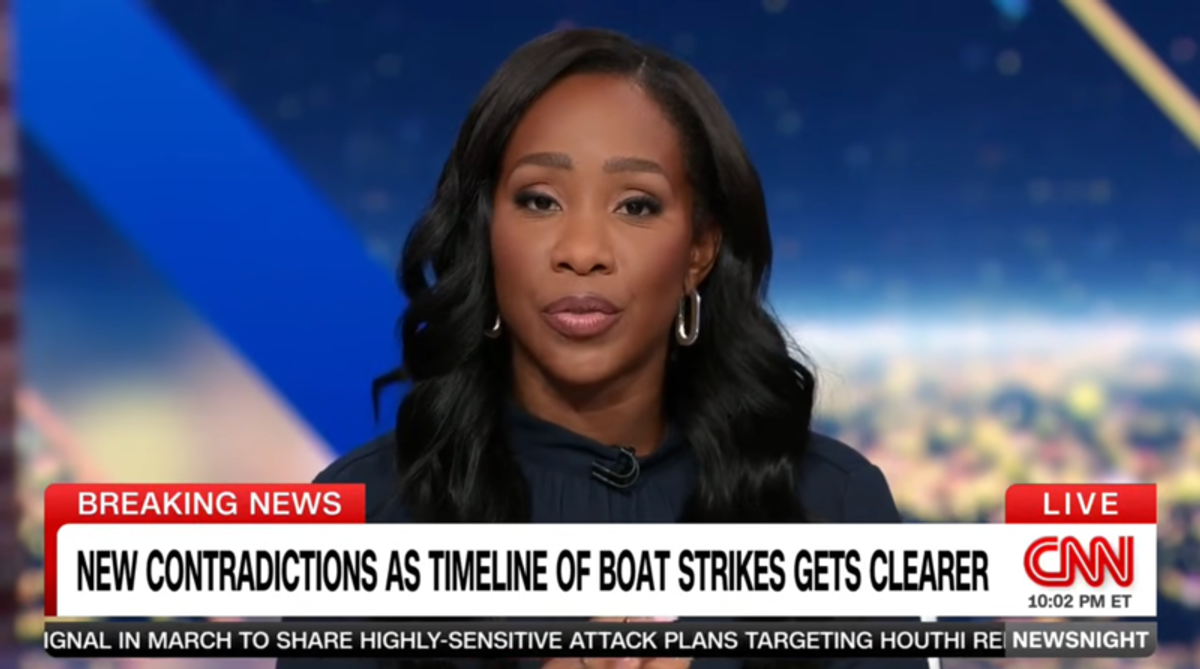
CNN anchor Abby Phillip on Wednesday flagged what she described as "the most telling sign" that President Donald Trump's administration is trying to hide something about the strikes it conducted against alleged drug boats.

Phillip opened her nightly show, "NewsNight," with a montage of shifting claims made by administration officials about the boat strikes. She said the comments made by Secretary of State Marco Rubio were the "most telling" because they showed the administration knows it needs to stick to a pre-determined narrative about the event.

She played a clip of Rubio telling reporters that one boat the administration struck in September was "probably headed to Trinidad or some other country in the Caribbean." A few months later, Rubio told another group of reporters that the same boat was traveling to the United States.

"That very first clip that we played of Marco Rubio, where he said initially that it was not going to the United States, it was going to Trinidad or some other country, and then he corrected himself to get in line with what the administration was saying," Phillip pointed out. "That's the most telling to me, that they know that they need to have a particular narrative about this."

The video also highlights other contradictions in the Trump administration's explanation about the boat strikes. For instance, Defense Secretary Pete Hegseth claimed during Tuesday's cabinet meeting that he did not "stick around long enough" to see if there were any survivors from the September 2 attack. That statement seemed to contradict a previous claim he made about seeing the entirety of the attack live on television.

To date, the administration has conducted more than 20 strikes against alleged drug boats, killing more than 80 people, according to reports.


There They Go Again: Venezuela Edition

A US president is trumping up a nonexistent threat to menace a country most Americans couldn’t find on a map.


The USS Gravely warship enters the port of Port of Spain on October 26, 2025; the US warship will visit Trinidad and Tobago for joint exercises near the coast of Venezuela amid Washington’s campaign against alleged drug traffickers in the region.
(Photo by Marin Bernetti/ AFP via Getty Images)

Kevin Martin
Dec 03, 2025
Common Dreams


Mark Twain allegedly quipped, “God created war so Americans would learn geography.” Whether or not he actually said that, might it not be a good test, that the world’s most mighty military power be prevented from waging war if a majority of Americans failed to find the alleged enemy on a world map?

Frivolity aside, this should not need to be said, but the United States has no legal authority to attack Venezuela (nor Iran, Sudan, Somalia, or any other country), nor engage in covert action to overthrow its government. Should the US do so, it will be opposed by everyone south of the Rio Grande, and rightly be seen as a racist resumption of the Monroe Doctrine. Whatever one thinks of the current government, nearly 30 million people live in Venezuela, and they don’t deserve to be demonized or threatened for the policies of their president, as Venezuela poses no threat to the United States.

The American people get this. A recent CBS News poll shows widespread public skepticism and disapproval of any US military attack against Venezuela, properly so, with 70% opposing the US taking military action.

Moreover, the current US military buildup in the Caribbean is an unnecessary and dangerous provocation. US Navy warships and Marine deployments to the region should be reversed to ease tensions. It is very unlikely the US would invade Venezuela with ground forces as even gung ho for blood Secretary of War Pete Hegseth must know a quagmire would ensue, but the Trump administration may see political advantage to have this as a simmering, manufactured “crisis,” to distract from the Epstein files; President Donald Trump’s sagging popularity; and his failed economic, domestic, and foreign policies. And Trump’s declaration closing Venezuelan air space has zero legitimacy, though it did scare many airlines into changing flight routes.

Trump is about to risk American lives, when nobody voted to have their sons and daughters fight a war with Venezuela, or any other country.

An obvious question comes to mind. Is this really about oil, not drugs? Fentanyl is not coming into the US via Venezuela, and the alleged drug ring run by Venezuelan President Nicolas Maduro does not exist. However, Venezuela does have the world’s largest known oil reserves.

I can’t imagine anyone wants a rerun of the Iraq wars. Let’s not test the adage that “history may not repeat itself, but it does rhyme” (which again, Mark Twain may or may not have said). We don’t want to have to dust off our “No War for Oil!” protest signs. And there is also already a metastasizing problem with violent competition for rare earth minerals in Venezuela.

The brouhaha about the second attack on the alleged “drug boat” on September 2 (and no evidence has been presented that it was a “drug boat” and even if it was, there was no legal authority to attack it, once or twice) possibly being a war crime misses the point, though Hegseth should be held to account; all the attacks on the alleged “drug boats” are illegal, and unauthorized by Congress.

Speaking of which, Congress needs to not only investigate these shady “drug boat” attacks, but assert its constitutional authority by passing a War Powers Resolution to stop the out-of-control Trump administration from further attacks or escalation. The US Senate failed to pass such a measure last month, 51-49, with all Democrats voting in favor and all but two Republicans voting against upholding the Constitution, but “the world’s greatest deliberative body” should try again. Perhaps Republicans can read the polls better now.

Also, US economic sanctions are hurting the people and economy of Venezuela, and should be at least reconsidered, if not scrapped altogether. Unfortunately, some self-appointed foreign policy experts think sanctions are a humane alternative to war, and better than “doing nothing.” The reality is broad economic sanctions hurt ordinary people the most, and are an immoral and ineffective way to try to get hungry people to overthrow their government, regardless of its domestic popularity or lack thereof.

Lastly, while I never bought this, wasn’t Trump supposed to be about “America First” and avoiding foreign wars? His voters thought so. Trump is about to risk American lives, when nobody voted to have their sons and daughters fight a war with Venezuela, or any other country. Congress needs to listen to the wisdom of the American people and shut this ill-conceived threat to Venezuela and its neighbors down now.


Our work is licensed under Creative Commons (CC BY-NC-ND 3.0). Feel free to republish and share widely.


Kevin Martin
Kevin Martin is the president of Peace Action and Peace Action Education Fund, with over 40 years experience as a peace and justice organizer. He is helping coordinate the Cease-Fire Now Grassroots Advocacy Network.
Full Bio >


Pope Leo Presses Trump to End Military Escalation Against Venezuela

“So often, who suffers in these situations is the people, not the authorities,” the first American pope said as another regime change war looms.


Pope Leo XIV meets with journalists aboard the papal plane on December 2, 2025 on a flight back to Rome, Italy.
(Photo by Elisabetta Trevisa/Vatican Media via Vatican Pool/Getty Images)

Stephen Prager
Dec 03, 2025
COMMON DREAMS

Amid escalating threats from the White House in recent days, Pope Leo XIV pleaded for President Donald Trump to pursue diplomacy with Venezuela rather than another regime change war.

“It is better to search for ways of dialogue, or perhaps pressure, including economic pressure,” said the first American pope as he returned to Rome from Lebanon.

Since September, the Trump administration has launched airstrikes against at least 22 boats mostly in the Southern Caribbean that have extrajudicially killed at least 83 people. While the administration has claimed these people are “narcoterrorists” from Venezuela, it has provided no evidence to support this.

Trump said he had ordered the closing of Venezuela’s airspace on Saturday, which has left many observers holding their breath in expectation of military action against the South American nation.

As Reuters reported Monday, Trump also offered safe passage to Venezuelan President Nicolás Maduro last month if he left the country, suggesting that regime change is the administration’s ultimate goal.

“On one hand, it seems there was a call between the two presidents,” said the pope, referring to that ultimatum from Trump last month. “On the other hand, there is the danger, there is the possibility there will be some activity, some [military] operation.”

“The voices that come from the United States, they change with a certain frequency,” Leo added.

The pope has been a frequent critic of the Trump administration’s policies since he was elected earlier this year, with harsh rebukes issued towards the White House’s attacks on immigrants.


While the pope did not denounce the idea of US-imposed regime change in Venezuela entirely, he said it should search for other means “if that is what they want to do in the United States.”

The US has notably already applied a great deal of “economic pressure” to Venezuela, via a regime of crippling sanctions that are considered one of the major causes of the nation’s economic instability in recent years.

On Tuesday, Abigail Hall, a senior fellow at the Independent Institute, warned that “a US invasion, however framed, would impose steep costs on both nations.”

“For the United States, an attempt at regime change in Venezuela would likely be another foray into failed foreign policy, with all the costs that go with it,” she said. “A destabilized Venezuela could also trigger another wave of migration across the region, straining neighboring countries and potentially reaching US shores.”

“For Venezuelans, the costs would be even greater,” she added. “Beyond the immediate human toll of conflict, the long-term costs are incalculable. Even if Maduro were removed, a chaotic transition could destroy prospects for rebuilding Venezuela’s institutions, economy, and civil society.”

Amid Trump’s latest series of threats, Pope Leo echoed this warning aboard the papal plane. He said Venezuela’s bishops are “looking for ways to calm the situation” and pursue “the good of the people, because so often who suffers in these situations is the people, not the authorities.”


Congressman announces articles of impeachment against Trump's Pentagon chief for 'murder'

Carl Gibson
December 3, 2025
ALTERNET


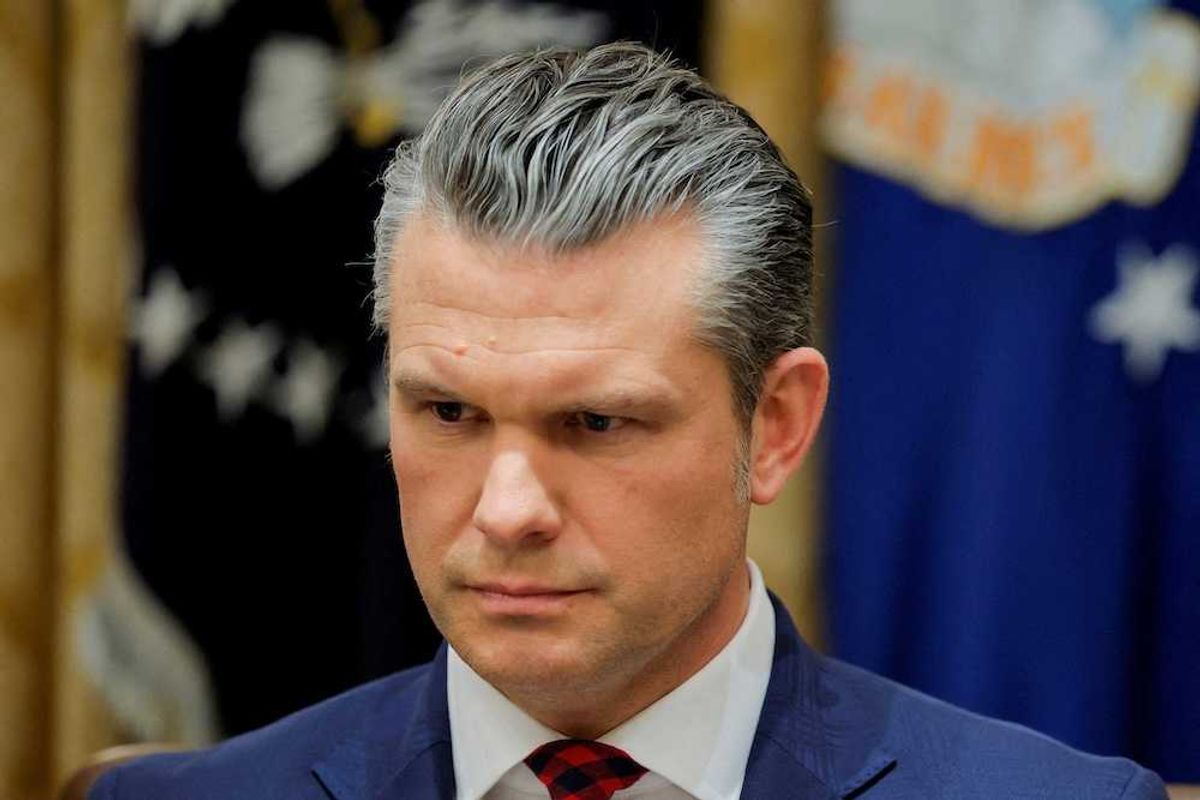
U.S. Secretary of Defense Pete Hegseth attends a cabinet meeting with U.S. President Donald Trump at the White House in Washington, D.C., U.S., December 2, 2025. REUTERS/Brian Snyde

Defense Secretary Pete Hegseth is now facing an impeachment push from a Democratic member of the House of Representatives, who is accusing him of committing murder.

Axios' Andrew Solender reported Wednesday that Rep. Shri Thanedar (D-Mich.) will be officially unveiling articles of impeachment against the embattled Pentagon chief during an event at Union Station in Washington D.C. on Thursday morning. Thanedar is introducing the legislation alongside a group that has been carrying out a sustained 24-hour, daily protest against President Donald Trump's administration.

"Defense Secretary Pete Hegseth has committed war crimes through his military strikes in the Caribbean and the Eastern Pacific Ocean and his reckless and unlawful handling of classified information," a statement accompanying the announcement read.

According to the statement, Thanedar's impeachment legislation accuses Hegseth of "murder," "conspiracy to murder" and "reckless and unlawful handling of classified information." The Michigan Democrat has previously filed articles of impeachment against Trump alleging obstruction of justice and abuse of executive power, as well as usurpation of appropriations power and abuse of trade powers, among others.

Hegseth has been the target of Congressional probes this week after the Washington Post reported that he ordered the killing of two survivors left adrift following a September 2, 2025 boat strike in the Caribbean Sea. The White House didn't deny the attack occurred, but clarified that Admiral Frank M. Bradley was the commander of that mission and officially gave the order to carry out the secondary strike on the two survivors.

International Humanitarian Law (IHL) stipulates that anyone deemed hors de combat (French for "out of the fight") is to be spared from further attacks. IHL also prohibits "no-quarter" orders, in which survivors of an attack are declared to be non-combatants. Former judge Advocate General Corps (JAG) officer Dan Maurer told CNN this week that if the Post's reporting is true, then Hegseth and everyone involved in the chain of command for the September 2 mission committed "murder." Rep. Don Bacon (R-Neb.), who is a retired Air Force brigadier general, also called on Trump to fire Hegseth.


The defense secretary was also singled out on Wednesday after the Pentagon's Office of the Inspector General found that his sharing of classified information via the Signal messaging app endangered the lives of U.S. troops. Hegseth accidentally included Atlantic editor-in-chief Jeffrey Goldberg on a group text in which he shared sensitive details about air strikes against Houthi rebels in Yemen.

Hegseth ‘Responsible’ for ‘Murder’: Family Files Formal Complaint Over Killing of Colombian Fisherman

NOT DRUG BOATS, BUT FISHING BOATS


According to the official filing, Trump’s Defense Secretary “has admitted that he gave such orders despite the fact that he did not know the identity of those being targeted for these bombings and extra-judicial killings.”


Jon Queally
Dec 03, 2025
COMMON DREAMS

The family of Colombian fisherman Alejandro Carranza Medina, believed killed by the US military in a boat bombing in the Caribbean Sea on Sept. 15, has filed a formal complaint with the Inter-American Commission on Human Rights accusing US Secretary of Defense Pete Hegseth of murder over the unlawful attack.

“From numerous news reports, we know that [Hegseth] was responsible for ordering the bombing of boats like those of Alejandro Carranza and the murder of all those on such boats,” reads the petition, filed Tuesday on behalf of Carranza’s family by Dan Kovalik, a human rights attorney based in Pittsburgh.

“Secretary Hegseth,” the petition continues, “has admitted that he gave such orders despite the fact that he did not know the identity of those being targeted for these bombings and extra-judicial killings.”

The complaint also notes that President Donald Trump, the commander in chief of the US military, “ratified the conduct of Secretary Hegseth described herein.”

First reported on by The Guardian, the filing of the petition with the IACHR—an autonomous body under the charter of Organization of American States (OAS) designed to uphold human rights in the Western Hemisphere—could result in the initiation of an investigation and the release of findings about the bombing that took the life of Carranza and two other individuals believed to be aboard the vessel.

The petition, the outlet noted, “marks the first formal complaint over the airstrikes by the Trump administration against suspected drug boats, attacks that the White House says are justified under a novel interpretation of law.” Experts in international human rights law have stated from the outset that the administration’s justifications lack legal basis and that the attacks constitute unlawful criminal acts.

According to The Guardian:
Carranza, 42, appears to have been killed in the second strike of the Trump administration’s bombing campaign, on 15 September. The administration has publicly disclosed 21 strikes on alleged drug boats. Carranza’s family says he was a fisher who would often set out in search of marlin and tuna.

On the day of the strike, Trump announced on his Truth Social platform that “This morning, on my Orders, US Military Forces conducted a SECOND Kinetic Strike against positively identified, extraordinarily violent drug trafficking cartels and narcoterrorists in the SOUTHCOM area of responsibility”. Trump attached video marked “unclassified” of a small boat floating in the water before it was struck.

Both Hegseth, the highest-ranked civilian at the Pentagon, and Trump have been under growing scrutiny for the series of boat bombings that have resulted in the extrajudicial killing of over 80 people since September. Experts have said the killings should be seen as “murder, plain and simple.”

New revelations about a strike on Sept. 2, in which two survivors of an initial bombing were later killed as they clung to the exploded boat on which they were traveling, has evelated that concern in Washington, DC this week with lawmakers seeking answers about the attack which, even if one accepted the legality of the initial strike under the construct the Trump administration has tried to claim, would constitute a clear human rights violation amounting to a war crime.

In an interview with Agence France-Presse in October, Katerine Hernandez, Carranza’s wife in Colombia, said her husband was “a good man” devoted to fishing and providing for his family. “Why did they just take his life like that?” she asked.

Hernandez denies that Carranza was involved in drug trafficking, as Trump and Hegseth have alleged without providing evidence, but also suggested that even if drug trafficking was taking place, it would not justify his murder. “The fishermen have the right to live,” she said. “Why didn’t they just detain them?”

In a Tuesday statement, the IACHR urged the US government to “ensure respect for human rights” during any and all extraterritorial military operations in the region, noting the deaths of a high number of persons both in the Caribbean and in the Pacific, where other strikes have taken place.

“While acknowledging the seriousness of organized crime and its impact on the enjoyment of human rights, the Commission recalls that States are obliged to respect and ensure the right to life of all persons under their jurisdiction,” the statement reads.

“According to the Inter-American jurisprudence, this duty extends to situations when State agents exercise authority or effective control, including extraterritorial actions at sea,” it continues. “When lethal force is used by security or military personnel outside national territory, States have the obligation to demonstrate that such actions were strictly lawful, necessary, and proportionate, and to investigate, ex officio, any resulting loss of life. These obligations persist irrespective of where the operations occur, or the status attributed to the individuals affected. Likewise, persons under State control must always enjoy full respect for due process and humane treatment.”

The commission called on the US to “refrain from employing lethal military force in the context of public security operations, ensuring that any counter-crime or security operation fully complies with international human rights standards; conduct prompt, impartial, and independent investigations into all deaths and detentions resulting from these actions; and adopt effective measures to prevent recurrence.”
After Trump’s Latest Racist Rant, Ilhan Omar Hopes ‘He Gets the Help He Desperately Needs’

“His obsession with me is creepy,” said Rep. Ilhan Omar, the first Somali American ever elected to the US Congress.


Rep. Ilhan Omar (D-Minn.) is seen before President Donald Trump’s address to a joint session of Congress in the House Chamber of the US Capitol on March 4, 2025.
(Photo by Tom Williams/CQ-Roll Call, Inc. via Getty Images)

Jake Johnson
Dec 03, 2025
COMMON DREAMS

Rep. Ilhan Omar, the first Somali American ever elected to the US Congress, said Tuesday that she hopes President Donald Trump “gets the help he needs” after he ended a Cabinet meeting with a bigoted tirade against Somali immigrants.

Trump specifically attacked Minnesota’s Somali community—falsely claiming that “they contribute nothing”—and singled out Omar (D-Minn) by name, calling her “garbage” and a “terrible person.”

Omar hit back in a brief social media post, characterizing the president’s remarks as clear evidence that he’s unwell.

“His obsession with me is creepy,” Omar wrote.


Trump’s comments came as his administration prepared to target Somali immigrants with Immigration and Customs Enforcement (ICE) raids in the Minneapolis-St. Paul region. Around 80,000 Somalis live in Minnesota.

The New York Times reported Tuesday that the directive for ICE raids in Minnesota “came immediately after” Trump used his social media platform to launch an appalling attack on Somalis and others in the wake of the shooting of two National Guard members. The man charged with the shooting is an Afghan national who worked as a member of a CIA-backed “Zero Unit” during the war in Afghanistan before resettling in the US.

Kristi Noem, head of the US Department of Homeland Security, has exploited the shooting to ramp up the administration’s anti-immigrant agenda, proposing what she called “a full travel ban on every damn country that’s been flooding our nation with killers, leeches, and entitlement junkies,” echoing Trump’s white nationalist rhetoric.

Following Trump’s latest attack on Somalis, Minnesota Attorney General Keith Ellison said in a statement that the president’s “disgraceful attacks on Minnesota’s Somali community are injecting more of his poisonous racism into our beloved home state.”

“Hearing him single out our people based solely on their race and country of origin is downright disgusting,” Ellison said. “Minnesotans stand up for our neighbors when they’re under attack. And as Minnesota’s attorney general, I will use every tool I have to protect all our neighbors, including our vibrant Somali community, from these dangerous, racist threats. Our neighbors deserve no less.”