Friday, December 12, 2025

Microsoft faces complaint in EU over Israeli surveillance data


By AFP
December 4, 2025


Microsoft's AI assistant 'Copilot' specializes in sales, accounting and online services - Copyright AFP/File ETIENNE LAURENT, EVARISTO SA

Microsoft is facing a complaint in the European Union filed by a non-profit organisation alleging it illegally stored data on Palestinians used for Israeli military surveillance.

The Irish Data Protection Commission (DPC) confirmed Thursday it had received the complaint against the US tech giant, saying it was “currently under assessment”.

Since Microsoft’s European headquarters are located in Ireland, the DPC is the EU’s lead data regulator for the company.

The organisation that brought the complaint, Eko — which says it fights for “people and planet over profits” — accused Microsoft of violating Europe’s data protection law.

“Microsoft unlawfully processed personal data belonging to Palestinians and EU citizens, enabling surveillance, targeting, and occupation by the Israeli military,” it said a statement.

The complaint follows a report in British newspaper The Guardian that the Israeli Defense Forces used Microsoft’s cloud service Azure “for the storage of data files of phone calls obtained through broad or mass surveillance of civilians in Gaza and the West Bank”.

After investigating the report, Microsoft cut the Israeli army’s access to certain cloud services in September.

Eko has said that “new evidence shared by Microsoft whistleblowers indicates that the company rapidly offloaded vast quantities of illegally captured surveillance data after a Guardian investigation”.

In a statement, a Microsoft spokesperson said: “Our customers own their data and the actions taken by this customer to transfer their data in August was their choice.

“These actions in no way impeded our investigation,” they added.

According to The Guardian, the data was stored on Microsoft’s servers in Ireland and the Netherlands, placing it under the EU’s strict General Data Protection Regulation (GDPR).

GDPR, launched in 2018, aims to protect European consumers from personal data misuse and breaches.
Microsoft announces $17.5 bn investment in India, its ‘largest ever’ in Asia


By AFP
December 9, 2025


Microsoft CEO Satya Nadella says the company is focused on leading the way into the 'AI Era" - Copyright AFP Jason Redmond

Global technology giant Microsoft announced on Tuesday plans to invest $17.5 billion to help build India’s artificial intelligence infrastructure, with CEO Satya Nadella calling it “our largest investment ever in Asia”.

Several global corporations have announced large investments this year in the South Asian nation, which is projected to have more than 900 million internet users by year’s end.

“To support the country’s ambitions, Microsoft is committing US$17.5B (billion) — our largest investment ever in Asia — to help build the infrastructure, skills, and sovereign capabilities needed for India’s AI first future,” Nadella said in a post on X.

Nadella made the announcement on social media after he met Prime Minister Narendra Modi in New Delhi, thanking the leader for “an inspiring conversation on India’s AI opportunity”.

In a statement, Microsoft said the investment would be spread over four years.

“Together, Microsoft and India are poised to set new benchmarks and drive the country’s leap from digital public infrastructure to AI public infrastructure in the coming decade,” the statement said.

The tech giant said one of the key priorities of its investment plan was “building secure, sovereign-ready hyperscale infrastructure to enable AI adoption in India”.

“At the heart of this effort is the significant progress being made at the India South Central cloud region, based in Hyderabad — that is set to go live in mid-2026,” Microsoft added.

The planned cloud region is twice the size of the iconic Eden Gardens stadium in India’s eastern city Kolkata, which has a capacity of over 65,000 people.

Microsoft said the latest announcement “builds on” a previous investment pledge Nadella had made earlier this year, committing $3 billion for AI and cloud infrastructure in India over the next two years.

Modi said he was “happy” that the tech giant had chosen India as the destination for its largest investment in Asia.

“The youth of India will harness this opportunity to innovate and leverage the power of AI for a better planet,” the prime minister said in a post on X.

“When it comes to AI, the world is optimistic about India,” Modi added.

– Tech giants –

Global technology giants are aggressively courting more users in India, the world’s most populous country and fifth-largest economy.

A special area of focus has been artificial intelligence with US startup Anthropic in October unveiling plans to open an office in India. Its chief executive Dario Amodei has also met Modi.

The same month, Google said it will invest $15 billion in India over the next five years, as it announced a giant data centre and artificial intelligence base in the country.

OpenAI has said it will open an India office, with its chief Sam Altman noting that ChatGPT usage in the country had grown fourfold over the past year.

AI firm Perplexity also announced a major partnership in July with Indian telecom giant Airtel, offering the company’s 360 million customers a free one-year Perplexity Pro subscription.

But India’s bid to become a global technology and artificial intelligence hub is colliding with increasingly tightening digital regulations.

According to recent media reports, authorities are drafting plans to ensure that manufacturers enable satellite location tracking in smartphones that cannot be turned off by users — a proposal that rights groups have raised the alarm over.
Haitians dance with joy over UNESCO musical listing


By AFP
December 9, 2025


People in Port-au-Prince dance to compas, a modern merengue-style dance music from Haiti that is to be added to UNESCO's Intangible Cultural Heitage list
 - Copyright AFP Clarens SIFFROY


Jean Daniel SENAT

From the bars of the capital Port-au-Prince to Haiti’s most remote villages and its worldwide diaspora, people listen and dance to the sensual rhythms of compas.

This musical source of pride among Haitians — known as konpa or kompa in Creole — is expected to be added by UNESCO to its Intangible Cultural Heritage list on Wednesday.

“Today, compas is the main artistic (and) musical representation of Haiti abroad,” said Frantz Duval, the director of Ticket, the country’s leading cultural magazine.

The anticipated listing is a boost of national pride for Haiti — along with the Caribbean nation’s recent qualification for the 2026 football World Cup — and comes against a backdrop of entrenched poverty and instability driven by gang violence.

Compas “resists crises because everyone listens to it and dances to it even during times of crisis,” Duval said. “If we can’t dance or organize shows in Port-au-Prince, we do it in the regions. Otherwise, we do it in Haitian communities abroad.”

Both a musical genre and a dance style, “compas is a defining creation of the Haitian people,” according to the official nomination document submitted to Paris-based UNESCO.

The compas “transcends social classes, forging a unique characteristic within Haitian identity,” it said.

“Deeply rooted in Haitian society, the compas is an essential element of festive and ritual life, playing a key role in significant moments for individuals, families, and communities.”

The genre typically blends percussion, guitars, and keyboard instruments, with syncopated drumming that drives the rhythm.


– Nation’s ‘collective memory’ –


At any time on a given day in Haiti, this merengue-style music can be heard in restaurants with dance floors, buses, public squares, and on the radio.

It’s hard for Haitians to resist the rhythms of compas, or not to nod their heads or dance a few steps while listening to a song.

On TikTok, videos tagged with #kompa (spelled in various ways) reach hundreds of thousands of viewers, and often feature couples dancing sensually.

Compas “is the collective memory of the nation,” Emmelie Prophete, Haiti’s former culture minister, who worked on the UNESCO application, told AFP.

“We are delighted with this inscription on the list,” she said. “This recognition comes at a time when we need to talk about Haiti in a way other than its political and security issues.”

Haiti, the poorest country in the Americas, in recent years has been gripped by political instability and violence from gangs, which control a large part of the capital.


– Crossing borders –


The musical genre’s birth dates back to a concert held in July 1955 in Port-au-Prince by Nemours Jean-Baptiste, a renowned Haitian saxophonist.

With roots in Africa and France, the former colonial power, compas also draws inspiration “from Cuban and Dominican songs that Haitians listened to on shortwave stations broadcasting from the island of Cuba and neighboring Dominican Republic,” musician Yves Joseph, who is popularly known as Fanfan Tibot, told AFP.

His band, Tabou Combo, is famous for having exported compas far beyond Port-au-Prince. He recalled that “New York City,” a track released in 1975, was successful in the Caribbean and in France.

“This led us to change our strategy, to sing in English and Spanish in order to win over more fans. Since then, other musical groups have helped compas continue to cross borders,” he said.

“This rhythm represents Haiti very well internationally, and I hope it will endure,” said Duval, who is also the editor-in-chief of the Haitian daily Le Nouvelliste.
Veggie ‘burgers’ at stake in EU negotiations


By AFP
December 9, 2025


EU consumption of plant-based alternatives to meat products has grown five-fold since 2011 - Copyright AFP Fabrice COFFRINI

EU countries and lawmakers will wrangle Thursday over whether to give plant-based “sausages” and veggie “burgers” the chop, amid a push to restrict such labels to meat products.

Many of Europe’s livestock farmers see plant-based foods that mimic meat products as potentially misleading for consumers, and a threat to their already troubled sector.

Lawmakers at the European Parliament in October backed a proposal to reserve a list of labels including burger and sausage for foods containing meat.

The EU’s 27 member states will now look to hash out the initiative with negotiators from the parliament as part of a broad-ranging package of new measures to protect farmers.

Some countries seem reticent — and officials say it may need more rounds of negotiations to reach an agreement.

Food retailers in Germany, Europe’s largest market for plant-based alternative products, have spoken out against the move, along with environmentalists and consumer advocates.

Among the high-profile opponents is also former Beatle and famed vegetarian Paul McCartney, who co-signed a letter to the EU’s executive arguing against the measure.

“We urge you not to adopt these restrictions, as we are deeply concerned about the significant global impact they could have,” the letter said.

“The evidence is clear: existing legislation already protects consumers; consumers themselves overwhelmingly understand and support current naming conventions.”

But livestock farmers argue the opposite, with French industry group Interbev saying it “confuses consumers and undermines recognition” in meat products.

EU consumption of plant-based alternatives to meat products has grown five-fold since 2011, according to data from BEUC, a consumer group.

Concerns over animal welfare and greenhouse gas emissions from livestock farms as well as health arguments have fuelled the boom.

This is not the first time there has been a push to beef up rules on the labelling of such products in the EU.

The debate has stirred emotions in France, which passed a similar label ban in 2024 to appease angry farmers — only for it to be overturned the following January in line with a ruling by the EU’s top court.

And a similar proposal was rejected by European lawmakers in 2020.

The balance of power has since shifted, as the 2024 European elections saw big gains by right-wing parties that cultivate close ties to the farm sector.

But even among those groups there is no clear consensus, with centre-right leader Manfred Weber insisting the proposal was “not a priority at all”.


PUTIN'S HANDPUPPET
Trump says had ‘pretty strong words’ with Europeans on Ukraine


By AFP
December 10, 2025


The Ukraine war has been the deadliest conflict on European soil since World War II. — © AFP Darya NAZAROVA

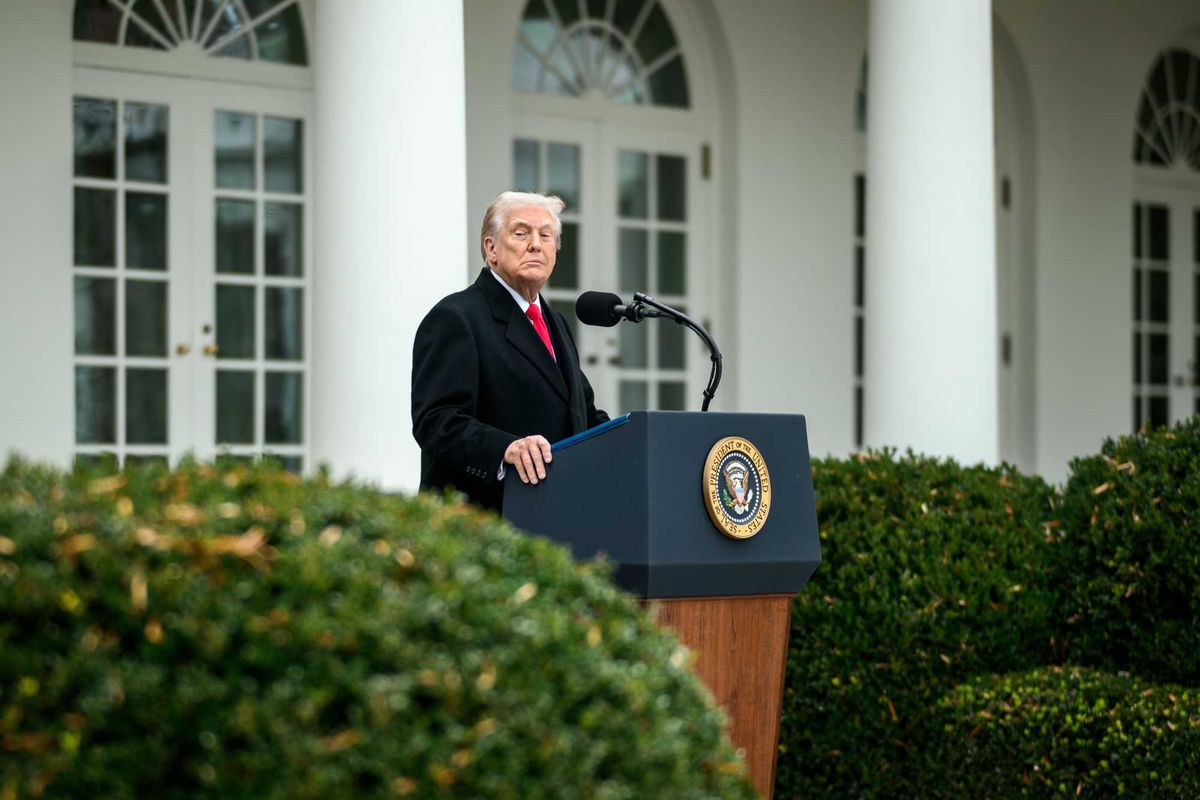
US President Donald Trump said he exchanged “pretty strong words” Wednesday with the leaders of France, Britain and Germany on Ukraine, in the latest sign of a growing rift on how to end Russia’s invasion.

Trump added that the Europeans wanted to hold fresh talks this weekend but warned that that they risked “wasting time” amid divisions over a US plan to bring the war to an end.

“We discussed Ukraine in pretty strong words,” Trump told reporters when asked about the phone call with British Prime Minister Keir Starmer, French President Emmanuel Macron and Germany Chancellor Friedrich Merz.

“I think we had some little disputes about people, and we’re going to see how it turns out. And we said, before we go to a meeting, we want to know some things,” Trump added.

“They would like us to go to a meeting over the weekend in Europe, and we’ll make a determination depending on what they come back with. We don’t want to be wasting time.”


US President Donald Trump has actively pressed European leaders to help end Russia’s invasion of Ukraine – Copyright AFP ANDREW CABALLERO-REYNOLDS

Trump has been pushing Ukrainian President Volodymyr Zelensky to agree to a US plan, and accused Zelensky of not reading the plan.

But Ukrainian officials told AFP on Wednesday that Kyiv had sent an updated draft of the plan to Washington.

An initial US plan that involved Ukraine surrendering land that Russia has not captured was seen by Kyiv and its European allies as aligning too closely with many of Russia’s hardline demands, and has since been revised.

Talks between US officials and Russian President Vladimir Putin in the Kremlin last week also failed to reach a breakthrough.

Trump’s comments come amid a growing rift with Europe after he described it as “decaying” and “weak” on immigration and Ukraine, days after a new US national security strategy said the continent risked “civilizational erasure.”

The US leader meanwhile gave the latest in a series of hints that he may walk away from a conflict he blames on his predecessor Joe Biden, and which he once said he could end within 24 hours of returning to office in January.

“Sometimes you have to let people fight it out and sometimes you don’t,” Trump said on Wednesday.

“But the problem with letting people fight it out is yet you’re losing thousands of people a week. It’s ridiculous. The whole thing is ridiculous.”

Trump administration has EU scrambling as 'uncertainty' of US is 'just too high'

Ewan Gleadow
December 10, 2025 
RAW STORY


President Donald Trump and First Lady Melania Trump participate in the annual ceremony to pardon the national Thanksgiving turkeys, Tuesday, November 25, 2025, in the White House Rose Garden. (Official White House Photo by Daniel Torok)

The European Union is fast-tracking plans to preserve peace without the aid of the United States following comments from Donald Trump's administration.

A defense official representing a European country told Politico that "awkward" conversations over America's involvement in the continent were now being prioritized as the "uncertainty" of how the US would react to global conflicts is "just too high". The preparation comes following the release of the Trump administration's National Security Strategy.

Though the administration has played a part in peace talks between Ukraine and Russia, the National Security Strategy makes it clear the US will no longer prop up "the entire world order". Such comments have caused uncertainty in European nations, some of which are now fast-tracking plans for a continent without America's influence.

The strategy published by Trump's administration reads, "The days of the United States propping up the entire world order like Atlas are over. Wealthy, sophisticated nations ... must assume primary responsibility for their regions."

Trump's discontent was made clear in an interview earlier this week where he said world leaders in Europe "don't know what to do" and that the continent is "decaying".

Experts had warned earlier this week that Trump's disinterest in Europe would be a "brutal lose-lose" for everyone involved. Analysis from Georg Riekeles and Varg Folkman saw the pair warn a deprioritization of European stability would be "remarkably abstruse."

They wrote, "hina, they argue, is the decisive theatre, not Europe, and US attention and assets must shift accordingly. Washington has signalled some version of this pivot for more than a decade. Yet European governments have found the idea that the US might actually deprioritise the continent’s security remarkably abstruse."

"The war in Ukraine has intensified this tension: Europe’s thinking is that a US withdrawal or an imposed, unequal peace would produce chaos in Ukraine and instability across Europe." Riekeles and Folkman believe this is part of a larger plan from the US government to shape European politics in a Trump-friendly system.

They wrote, "Because it is clear that as Washington draws back militarily, it will pull even harder on its other levers: financial power, diplomatic pressure, export controls, trade measures and secondary sanctions. These instruments will increasingly be used to steer Europe in the political direction the US wants."

Trump slams ‘decaying’ and ‘weak’ Europe


By AFP
December 9, 2025


US President Donald Trump said there were some 'stupid' leaders in Europe 
- Copyright AFP ANDREW CABALLERO-REYNOLDS


Danny KEMP

President Donald Trump blasted Europe as “decaying” and “weak” on immigration and Ukraine in an interview published Tuesday, deepening a rift between the United States and some of its oldest allies.

Speaking to Politico, Trump also called on war-battered Ukraine’s President Volodymyr Zelensky to hold elections despite Russia’s invasion and said that Moscow had the “upper hand.”

Trump’s comments doubled down on extraordinary criticism of top US partners in his administration’s new national security strategy last week, which recycled far-right tropes about civilizational “erasure” in Europe.

“Most European nations, they’re decaying,” Trump told Politico in the interview, conducted Monday.

The 79-year-old billionaire, whose political rise to power was built on inflammatory language about migrants, said that Europe’s policies on migrants were a “disaster.”

“They want to be politically correct, and it makes them weak. That’s what makes them weak,” Trump said, adding that there were “some real stupid ones” among Europe’s leaders.

Trump also criticized European nations over Ukraine, amid growing differences over a US plan to end the war that many in Europe fear will force Kyiv to hand over territory to Russia, which launched a full-scale invasion of the country in 2022.

“NATO calls me daddy,” Trump said, referring to comments by the military alliance’s leader Mark Rutte at a summit in June when leaders backed Trump’s call to raise defense spending.

But he added: “They talk but they don’t produce. And the war just keeps going on and on.”

European leaders have been trying to woo Trump since his return to office in January, especially on maintaining US support for Ukraine against Russia.

Trump’s interview will intensify the alarm in European capitals sparked by the US security strategy last week, with its calls for “cultivating resistance” in Europe on migration and warnings of so-called “civilizational erasure.”

Experts have said parts of it echo elements of the “great replacement theory” promoted by the far-right — and Trump’s former ally Elon Musk — which alleges a conspiracy to replace white populations.


– ‘Not a democracy anymore’ –


In contrast to the savaging of close US allies, Russia and China got off relatively lightly in the US strategy. The Kremlin said the US document aligned with its own worldview.

A French minister, Alice Rufo, said Tuesday that the US security strategy was an “extremely brutal clarification of the ideological stance of the United States.”

In his Politico interview, Trump said countries including Britain, France, Germany, Poland and Sweden were being “destroyed” by migration.

He also launched a new attack on “horrible, vicious, disgusting” Sadiq Khan, London’s first Muslim mayor. Khan told Politico that Trump was “obsessed” with him and said US citizens were “flocking” to live in London.

Trump also had sharp words for Ukraine and for Zelensky, in his latest seesaw in relations with the leader whom he called a “dictator without elections” in January and then berated in the Oval Office in February.

“I think it’s an important time to hold an election. They’re using war not to hold an election.” Trump said. “It gets to a point where it’s not a democracy anymore.”

Elections in Ukraine were due in March 2024 but have been postponed under the imposition of martial law since the Russian invasion of Ukraine in February 2022. About 20 percent of the country is under occupation.

Fresh elections were included in the draft US plan to end the war.

He also reiterated claims about Zelensky having not read the US plan. “It would be nice if he would read it. You know, a lot of people are dying,” Trump said.

Top US negotiators met Putin in Moscow last week, then held days of negotiations with Ukrainian officials, but there has been no apparent breakthrough.

Zelensky said on Tuesday in response to Trump’s comments that he was “ready for the elections” if security was ensured.

He said he hoped to send Ukraine’s updated version of the US plan on Wednesday.
Thyssenkrupp pauses steel production at two sites citing Asian pressure


By AFP
December 11, 2025


Specialist sites in Gelsenkirchen in western Germany and Isbergues in northern France that make high-end steel often used in power grids would close from mid-December to the end of the year, Thyssenkrupp's steel subsidiary said. - Copyright AFP Kirill KUDRYAVTSEV

Europe’s largest steelmaker Thyssenkrupp is to pause steel production at two sites for about two weeks because of Asian competition, the German firm said Thursday, as the European Union considers tightening its steel tariffs.

Specialist sites in Gelsenkirchen in western Germany and Isbergues in northern France that make high-end steel would close from mid-December to the end of the year, Thyssenkrupp’s steel subsidiary said.

The French site would further run only at half-capacity for at least four months from January, it added.

The measures were in response “to a massive increase in low-priced imports, particularly from Asia,” Thyssenkrupp Steel Europe said.

“These developments have led to a dramatic change in order volumes and thus to a significant underutilisation of capacity at European production facilities.”

Hammered by exorbitant energy costs and cheaper Asian competition, Germany’s steel industry has been mired in deep crisis for several years.

Thyssenkrupp Steel Europe said in November last year it would seek to cut or outsource 11,000 jobs by 2030 — about 40 percent of its workforce –- and cut production capacity to around nine million tons a year, down from 11.5 million.

Taking a leaf from US President Donald Trump’s book to shield the bloc’s struggling industry from cheap Chinese imports, the EU in October floated plans to double tariffs on foreign steel and cut the amount allowed in tariff-free.

“The rapid implementation of efficient and appropriate trade protection measures at European level would help to increase capacity utilisation at both locations back to a sustainable level,” Thyssenkrupp Steel Europe said, adding that about 1,200 people were employed at the two sites.

The wider Thyssenkrup group said on Tuesday that it expected to make a loss of up to 800 million euros ($932 million) next year, largely driven by the costs of restructuring its steel division.


Bleak year for German engineering firms amid US, China turmoil


By AFP
December 9, 2025


Germany's mechanical and plant manufacturing group VDMA is urging the government to improve conditions for companies - Copyright AFP/File Fabrice COFFRINI

Production in Germany’s key engineering sector plunged for a third straight year in 2025 as firms were squeezed by US tariffs and fierce Chinese competition, an industry group said Tuesday.

The VDMA, which represents some 3,600 companies in the export-oriented machinery and equipment manufacturing sector, expects production to fall five percent for the full year.

But it should pick up next year, tracking a broader upswing in Europe’s struggling top economy, with output set to rebound one percent, the group added.

VDMA President Bertram Kawlath added his voice to calls for the government of Chancellor Friedrich Merz to urgently take steps to improve conditions for companies in Germany.

“Genuine, far-reaching reforms in Germany are essential if we want to prevent more and more research, production and — thus innovation — from taking place abroad,” he said.

The sector, whose companies employ more than one million workers in Germany, has been hard hit by US President Donald Trump’s tariffs, particularly the 50-percent duties on steel and aluminium.

Two-thirds of about 400 companies that participated in a VDMA survey expect a decline in revenues due to the tariffs.

Describing the levies as “poison”, Kawlath urged Germany and the European Union to seek to renegotiate them, saying they were counterproductive for both sides.

An even bigger challenge was competition from Chinese companies that are increasingly rivalling German firms in more and more sectors, and in some cases benefitting from government subsidies, the VDMA warned.

“Our companies are fighting with all means to remain competitive, but in many cases that is no longer enough,” said Kawlath, urging an improvement in conditions in Germany through such measures as slashing red tape.

He called on the EU to strengthen its “inadequate” market oversight and block imports of Chinese products that do meet European standards.

The problems for Germany’s engineering sector reflect a broader downturn in the economy, although a recovery is expected next year on the back of a public spending blitz pushed by Merz’s coalition.


BMW names new boss to steer car giant in tough times


By AFP
December 9, 2025


BMW's production chief Milan Nedeljkovic named as its next chief executive - Copyright AFP Ian LANGSDON

BMW said Tuesday its head of production Milan Nedeljkovic will take over as chief executive as the German auto giant contends with challenges ranging from the electric shift to Chinese competition.

An engineer by training and an employee of the Munich-based manufacturer since 1993, the 56-year-old will succeed current CEO Oliver Zipse in May when he reaches the end of his term, the group said in a statement.

Nedeljkovic currently oversees the group’s factories worldwide, which produce both electric and combustion engine models on the same production lines.

A key task will be advancing BMW’s expansion of its electric vehicle (EV) offerings, already well underway under Zipse’s leadership.

But the Serbian-born executive takes over at a time of deep crisis for Germany’s flagship auto sector.

BMW, which also owns the Mini and Rolls-Royce brands, is seeing its sales decline in the key Chinese market due to strong local competition, particularly when it comes to EVs.

BMW, like domestic rivals Mercedes-Benz and Volkswagen, has also been impacted by US tariffs, although it has fared somewhat better as its largest factory in the world is located in South Carolina.

The carmaker reported rising profitability in the third quarter due to healthy worldwide sales, with Zipse saying the group had proven itself “resilient” in the face of headwinds.
ExxonMobil slows low-carbon investment push through 2030


By AFP
December 9, 2025


Oil giant ExxonMobil is dialing back low-carbon investments - Copyright GETTY IMAGES NORTH AMERICA/AFP/File Michael M. Santiago

ExxonMobil is slowing medium-term investments in low-carbon ventures by some $10 billion compared with its outlook a year ago, the oil giant announced Tuesday.

The US petroleum company expects to spend about $20 billion in low-emission investments between 2025 and 2030, according to its annual corporate plan.

The equivalent forecast last December estimated $30 billion in spending over the same period.

Investments in low-carbon solutions “will continue to be contingent on the development of supportive policy and broader market formation, balancing risks and opportunities to ensure strong returns and delivery of shareholder value,” the company said in a press release.

Under either investment scenario, the low-carbon ventures represent a small percentage in the company’s overall capital budget, which is still heavily tilted towards conventional fossil fuels. ExxonMobil’s capital budget will range between $27 and $32 billion annually over that stretch.

An ExxonMobil slide presentation listed seven US Gulf Coast carbon capture and storage (CCS) projects at various stages of development. The projects remove carbon dioxide gas from industrial sites, transports it through pipelines and injects it deep underground.

“We have seen CCS really start to pick up in terms of customer interest,” said Chief Financial Officer Kathy Mikells, who added on a company webcast that the hydrogen market has been “more slowly developing that we originally expected.”

ExxonMobil’s outlook also lifted the company’s overall forecast for earnings growth and cash by $5 billion over the same period, citing the boost from lower operating costs.

TotalEnergies in deal for Namibia offshore oil field


By AFP
December 9, 2025


TotalEnergies will join Portuguese firm Galp to operate Namibia's Mopane oil field, which could contain at least 10 billion barrels, according to estimates - Copyright GETTY IMAGES NORTH AMERICA/AFP Andrew Harnik

TotalEnergies said Tuesday it had reached a deal to become a partner in the Mopane oil field off the coast of Namibia, where exploration remains underway.

The deal with Galp will see TotalEnergies joining the Portuguese firm as an operator as more exploration wells are drilled in view to develop the field for production.

“The transaction positions TotalEnergies as the operator of the two largest oil discoveries in Namibia and opens the way for the development of a major producing hub, generating long-term value for the country and partners,” the French firm said in a statement.

Galp said last year it estimated the Mopane field could contain at least 10 billion barrels of oil.

The deal will see TotalEnergies take a 40 percent stake in the petroleum exploration licence that includes Mopane. Galp will retain a 40 percent stake, alongside the Namibian national oil company Namcor and private firm Custos, which each hold 10 percent stakes.

In exchange, TotalEnergies will finance half of Galp’s capital expenditures for exploration and appraisal of the Mopane field, as well as initial development, with repayment to come from future cash flows from the project.

Galp will also get a 10 percent stake in the nearby Venus exploration zone, where TotalEnergies has discovered oil.

TotalEnergies said it hopes to make a final investment decision on whether to develop production at Venus next year.

TotalEnergies shares were up 0.4 percent in afternoon trading on the Paris stock exchange, where the blue-chip CAC 40 index was down 0.6 percent.

Japanese ivory trade attracts fresh global scrutiny


By AFP
December 10, 2025


Hajime Sasaki says there is little demand for the ivory ornaments he sells, which can legally only be bought and sold witin Japan - Copyright AFP JULIA MARETTO


Kyoko HASEGAWA

At his store in Tokyo’s ritzy Ginza district, Hajime Sasaki displays a disparate array of wares, from chopsticks to Buddha statues — including many made of ivory.

International trade in elephant ivory is illegal, but Japan hosts one of the world’s largest remaining legal domestic markets for the product, which can only be bought and sold within its borders.

It is fed with stockpiles of ivory imported before the international ban more than 30 years ago, or bought in one-off government auctions.

But conservationists warn Japan’s ivory often leaks overseas, fuelling black market trade, while driving demand and undermining bans in countries like China.

Sasaki’s shop displays pamphlets in Chinese and English explaining that ivory cannot be taken abroad, but he still “receives many Chinese customers”, he told AFP.

“Tourists give up buying ivory when I explain you can’t bring it outside Japan,” said the softly-spoken 69-year-old.

Conservationists estimate between 10,000 and 15,000 elephants from the two African species are killed for their tusks each year.

And seizure data suggests ivory is leaving Japan’s domestic market.

Since 2008, more than 3,600 kilograms (four US tons) of ivory linked to Japan has been seized by authorities around the world, according to data presented at a recent global wildlife trade meeting in Uzbekistan.

Dozens of interceptions were destined for China, according to the document presented at the meeting of the Convention on International Trade in Endangered Species of Wild Fauna and Flora (CITES).

The data suggests “some weakness in Japan’s law enforcement”, the document warned.


– ‘Organised criminals’ –


In 2023, a shipment reportedly bound for Thailand carrying 710 pieces was intercepted, another CITES document said.

Shipments of that size “suggest organised criminals are also involved”, said Matt Collis, senior policy director at the International Fund for Animal Welfare (IFAW).

At the CITES meeting, four African nations unsuccessfully urged adoption of a document that would have called for the closure of all remaining domestic ivory markets.

And Japan fiercely denies that its national market impacts elephant conservation.

It disputed the interpretation of the data presented at CITES, and said it continues to “implement strict control measures” to prevent leakage.

Japan’s alleged leakage problem is particularly problematic for China, once the world’s biggest market for ivory, which banned trade in 2017 — around the same time as the United States.

“China is doing their best to enforce their domestic ivory ban and to change public perceptions,” said Collis.

“But you have a neighbouring country that is undermining these efforts by not enforcing controls and perpetuating demand.”

Ivory was once widely used in Japan for personal seals and musical instruments.

Today the country has a 250-tonne stockpile, boosted by two CITES-approved auctions in 1999 and 2008.

At Sasaki’s shop, shelves are lined with exquisitely-carved ornaments. A Buddha statue worth more than $1,500 (238,000 yen) is safely housed inside a gold-painted cabinet.

But there is little demand.

Sasaki says he has just one or two buyers a month, mostly older Japanese.

That is partly due to growing awareness of the ivory trade’s devastating impact, said Masayuki Sakamoto, director of the Japan Tiger and Elephant Fund (JTEF).

“So inventory in Japan is piling up, and demand from China and other countries persists,” he said.


– ‘Sustainable use’ –


Although China’s ban has tamped down interest somewhat, ivory carvings, jewellery and trinkets remain highly prized in Asia’s largest economy.

“Given the size of China, even lower levels of demand can provide powerful incentives for traffickers to seek to get ivory into China’s black market,” Collis said.

Experts also question Japan’s system for tracking its domestic ivory, which is based mostly on tracing whole tusks, even though trade is primarily in small, derivative products.

Japan has shown little interest in curtailing domestic sales, and supported a proposal by Namibia at CITES that would have allowed a one-off government auction of the African country’s ivory stocks to other governments.

The bid was defeated, to the relief of conservationists who argue further sales will only fuel demand.

But Sasaki said he felt the tusks should be sold to help conservation efforts, echoing the Tokyo Ivory and Crafts Association, which says it backs “sustainable use” of ivory, as a “form of conservation”.

“Smuggling is bad”, said Sasaki.

“But I think reusing elephant tusks would be better (than disposing of them), and generate
 income.”


EU launches antitrust probe into Google’s data use for AI


By AFP
December 9, 2025


The EU has announced a probe into whether Google breached antitrust rules over its use of online content to train its AI - Copyright AFP Aris MESSINIS

The EU announced Tuesday it had opened a probe to assess whether Google breached antitrust rules by using content put online by media and other publishers to train and provide AI services without appropriate compensation.

The European Commission said the investigation would look into concerns that the US tech giant might be distorting competition by imposing unfair terms and conditions on publishers and content creators, or by granting itself privileged access to their output.

“A free and democratic society depends on diverse media, open access to information, and a vibrant creative landscape,” the European Union’s competition chief, Teresa Ribera, said.

“AI is bringing remarkable innovation and many benefits for people and businesses across Europe, but this progress cannot come at the expense of the principles at the heart of our societies”.

The commission, the European Union’s antitrust regulator, said the probe would focus on two issues.

It would look into whether Google used YouTube videos to train its generative AI models without adequately paying the creators who post the clips online — and without offering them the possibility to refuse such use of their content.

“Google does not remunerate YouTube content creators for their content, nor does (it) allow them to upload their content on YouTube without allowing Google to use such data,” the commission said.

“At the same time, rival developers of AI models are barred by YouTube policies from using YouTube content to train their own AI models.”

The probe would also check whether the firm used online content from other sites, such as newspaper websites, to provide generative AI-powered services, again with no compensation or possibility to opt-out.

This relates in particular to Google’s AI-generated summaries that pop-up in response to a user’s search query and to the firm’s “AI Mode” — a search tab similar to a chatbot which answers users’ questions, the commission said.

“We are investigating whether Google may have imposed unfair terms and conditions on publishers and content creators, while placing rival AI models developers at a disadvantage, in breach of EU competition rules,” Ribera said.

There is no deadline for the commission to complete its investigation and the opening of a probe does not prejudge its outcome. The company, however, risks a hefty fine.


Intel sees record EU fine reduced further

By AFP
December 10, 2025


Intel image: — © AFP

The EU General Court dealt a blow to the European Commission on Wednesday in reducing what was initially a record fine against US chipmaker Intel to 237 million euros ($276 million) — a quarter of the original sum.

Brussels imposed an initial 1.06-billion-euro fine on the group in 2009, then a record amount, for abusing its dominant market position between 2002 and 2007 and attempting to drive its only serious competitor, AMD, out of the microprocessor market.

Intel has since engaged in lengthy legal proceedings to have the fine overturned.

In 2022, it won its case when the General Court, based in Luxembourg, partially invalidated the penalty and ordered the Commission to reassess the total fine.

In September 2023, Brussels set a new amount of 376 million euros.

But the US group again appealed.

In the new ruling published Wednesday, the court said it had “substantially upheld the 2023 decision”, but reduced the fine to 237 million euros.

The court justified the move citing, firstly, the “relatively limited number of computers” affected by certain restrictions Intel imposed on computer manufacturers such as Acer and Lenovo to hinder AMD.

Secondly, it cited a 12-month interval between “some of the anti-competitive practices”.
US drops bid to preserve FIFA bribery convictions

TRUMP KICKBACK FOR PEACE PRIZE

By AFP
December 10, 2025


The case was one of several to emerge from a sweeping 2015 probe by the US Justice Department - Copyright AFP/File Michael Buholzer

The US government has moved to drop its case against a former Fox broadcasting executive involved in the FIFA corruption scandal that plunged the world’s footballing body into crisis.

Prosecutors told the Supreme Court on Tuesday they wanted to end their fight to preserve the convictions of Hernan Lopez and Argentine sports marketing firm Full Play.

Both were found guilty in March 2023 of paying bribes to secure lucrative television rights to international football officials. The convictions were overturned on appeal months later, before being reinstated this July.

The case was one of several to emerge from a sweeping 2015 corruption probe by the US Department of Justice (DOJ), which ultimately led to the downfall of then-FIFA president Sepp Blatter.

In a filing to the Supreme Court, which Lopez had asked to review his conviction, prosecutors said that dismissal of the case is “in the interests of justice,” without giving further details.

They asked the case be returned to a lower court for its formal dismissal.

“I’m grateful the truth prevailed, and I’m also confident more of that truth will come out,” Lopez, a US and Argentine citizen, wrote on X late Tuesday.

While there was no indication of Donald Trump’s involvement, the US president has issued a string of pardons including for corruption related offenses.

In February, he ordered the DOJ to pause enforcement of a long-established law that prohibits American companies from bribing officials of foreign governments to gain business.


Lopez was facing up to 40 years in prison and millions of dollars in penalties after his conviction for money laundering conspiracy and wire fraud conspiracy.

During the trial, a US court heard that the main beneficiaries of the kickback scheme were six of the most powerful men in South American football.

They included former CONMEBOL president Nicolas Leoz, who died in 2019, former Argentine football executive Julio Grondona, who died in 2014, and former Brazilian football chief Ricardo Teixeira.

The United States will host the World Cup alongside Canada and Mexico next year.

FIFA president Gianni Infantino has cozied up with Trump ahead of the sporting event, this month awarding him the governing body’s inaugural “peace prize.”