Sunday, December 14, 2025


Filipino Fishermen Hurt as Chinese Push Them Away from Disputed Shoal
China assaulting Filipino fishing boats
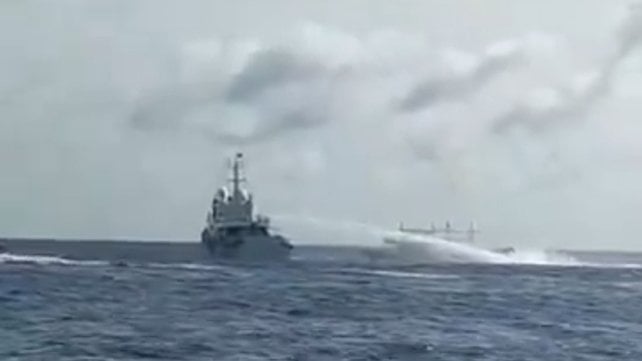
China blasted the fragile Filipino fishing boats with water cannons and cut their anchor lines (Philippine Coast Guard)

Published Dec 13, 2025 9:33 PM by The Maritime Executive


Several Filipino fishermen and their vessels were damaged on Friday, December 12, as the China Coast Guard and Chinese Maritime Militia worked to drive the vessels away from one of the disputed shoals in the Spratly Islands in the South China Sea. The Philippines Coast Guard responded to protect the fishing vessels and provide medical assistance to the injured fishermen.

China said it implemented “necessary control measures” to protect its territories. The shoal called Sabina (Escoda) is approximately 35 miles to the east of Second Thomas Shoal, which has been the focus of many of the disputes between China and the Philippines.

The Philippine Coast Guard is calling the Chinese actions “unprofessional and unlawful.” 

The action began according to the fishermen around midday on Friday and continued for at least three hours, led by vessels of the China Coast Guard. The incident ended when the fishing boats had moved away from the shoal, but the China Coast Guard boats remained in the area, menacing the fishermen.


Jay Tarriela, spokesperson for the Philippine Coast Guard, said there were approximately 20 fishing boats in the area when the incident began. The Filipinos use large, wooden boats/rafts, typically each with 10 to 15 fishermen. It was estimated that 300 fishermen were working the area.

Two China Coast Guard vessels reportedly used water cannons and sirens in the effort to drive the fishing boats away from the shoal. Tarriela said it was the first time the cannons had hit the fragile fishing boats, but that the Chinese had used them in the past to menace the fishermen. He also accused the Chinese vessels of taking dangerous blocking maneuvers against the fishing boats.

The China Coast Guard also used small rigid-hull inflatable boats during the encounter. Tarriela claimed they were used to deliberately cut the anchor lines of the fishing boats. The Filipinos called it a dangerous action because of the strong currents and high waves in the area.


The fishermen assisted their fellow countrymen, towing some of the damaged vessels and evacuating some of their colleagues. They also took videos of the interaction, which were released by the Philippine Coast Guard.

The fishermen called the Philippine Coast Guard for assistance during the encounter. According to the report, vessels from the China Coast Guard undertook blocking and dangerous maneuvers in an attempt to prevent the Philippine Coast Guard from reaching the fishing boats. The Coast Guard said that one of the Chinese vessels came within 35 yards of a Philippine Coast Guard vessel during nighttime navigation.

The relief vessels from the Philippine Coast Guard and the Bureau of Fisheries reached the fishermen on Saturday morning. They are reporting that three of the fishermen had suffered injuries, including bruises and wounds. They provided medical assistance. In addition, two of the Filipino fishing boats were reported to have suffered significant damage from the water cannons. Tarriela said one of the boats had taken on water, but was drained after possibly suffering engine damage.


The Filipino forces also brought fuel, ice, food, and other supplies to the fishing boats. They distributed the aid to sustain the fishing operations.

The incident followed ongoing interactions between the Chinese and the Philippines’ coast guards. China has tried to prevent the resupply missions using similar tactics with the water cannons. They have also conducted dangerous maneuvers, which have resulted in the vessels bumping or colliding. In August, a China Coast Guard vessel, while chasing a Philippine Coast Guard boat, collided with a Chinese naval vessel, causing significant damage to the bow of the China Coast Guard vessel. There were reports that four Chinese sailors were likely killed in the collision, and it appeared the Chinese vessels were conducting a man overboard search.

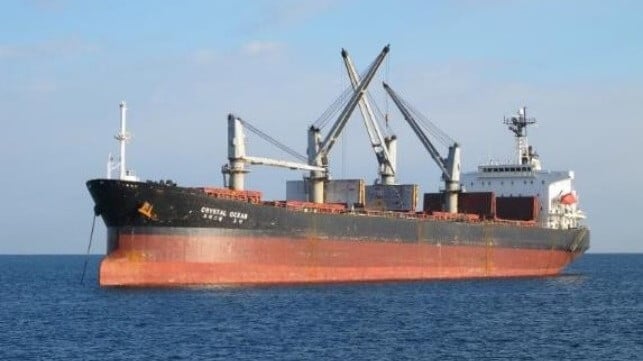
 

U.S. Intercepts Ship Carrying Chinese Missile Components to Iran

MV Honestar, sailing under one of its many previous names (VesselFinder), and likely to be the ship intercepted
MV Honestar, sailing under one of its many previous names (VesselFinder / Andy Ru)

Published Dec 13, 2025 9:53 PM by The Maritime Executive


Reports originating in the United States and based on briefings from officials suggest that several weeks ago, a US special operations team intercepted a ship off Sri Lanka and confiscated part of its cargo. The ship was not named in these reports.

The cargo seized is said to have consisted of dual-use components manufactured in China, such as spectrometers and gyroscopes, which can be used to improve the precision of guided missiles. The components were en route to Iran.

On November 12, the US Treasury sanctioned a widespread network of companies based in China, Iran, Turkey and the UAE involved in the supply and delivery of dual-use components used for Iranian ballistic missile and drone production. The sanctions notice detailed supply, shipping routes, and one specific ship. The Panama-flagged bulk carrier Shun Kai Xing, this week known as the Honestar (IMO 9187368), was sanctioned in the US Treasury notice for shipping "a computer numerical control machine used to produce fiber optic gyroscopes, guidance and control systems for weapons systems including ballistic missiles and UAVs."

Iranian-manufactured ballistic missiles and drones have been used both by Iran and its proxies to attack Israeli and American targets, as in the attacks on the Al Udeid airbase on June 23, 2025 and Al Asad, the latest occurring in August 2024. Exported to Russia, the same systems have been used in attacks on Ukraine.

Dual-use products - and specifically if they were being conveyed on a ship belonging to the UN-sanctioned Islamic Republic of Iran Shipping Lines (IRISL) - should fall under the provisions of UN Security Resolution 1929, which cautions states to be aware of IRISL’s sanctions-breaking activities and its role in supporting Iran’s missile development, manufacture and maintenance activities. UNSCR 1929 specifically covers weapons systems related (or dual-use) materials. It calls on "States to inspect any vessel on their territory suspected of carrying prohibited cargo, including banned conventional arms or sensitive nuclear or missile items. States are also expected to cooperate in such inspections on the high seas and are obligated to seize and dispose of the prohibited items when they are found." These sanctions have been strengthened since snap-back sanctions were re-imposed by the UN Security Council on September 28 this year.

The American action in conformity with UNSCR 1929 is not only defensive in character. It may have been designed to obviate the need for other parties to take direct action once the materials arrived in Iran, which in turn could have led to an escalatory Iranian counter-attack and thus a restarting of open warfare in the region. 

The Maritime Executive has tracked numerous dual-use cargos on their passage from China to Iran, and specifically the deliveries from Shanghai to Bandar Abbas made by IRISL cargo ships MVs Golbon and Jairan.  These vessels brought in a total of 58 containers of sodium perchlorate used for manufacturing solid fuel for ballistic missiles, a consignment widely believed to have precipitated the explosion in Bandar Abbas which devastated the commercial port area on April 26.

Sodium perchlorate is the primary material used to manufacture ammonium perchlorate, which in turn makes up 70% of the standard fuel load of most of Iran’s solid-fueled ballistic missiles.

The Bandar Abbas explosion did not however deter further dual-use shipments from China.  Post the MVs Golbon and Jairan shipments, the Wall Street Journal (WSJ) noted that a further 185 20-foot containers of sodium perchlorate had been ordered by Iran, sufficient to fuel a further 800 ballistic missiles. Three sanctioned medium-sized container ships owned by IRISL were identified in the CMK/K14 anchorage off Shanghai, namely MVs Barzin (IMO 9820269), Rayen (IMO 9820245) and Behta (IMO 9349590), ready to take the cargo on board. 

European intelligence sources named a further four sanctioned ships, carrying a total of 2,000 tons of sodium perchlorate, that made the journey between China and Bandar Abbas in September and October. The ships involved in the latest shipments are believed to be MV Basht (IMO 9346536, ex Zhuhai on September 15, arrived Bandar Abbas September 29), MV Barzin (IMO 9820269, ex Gaolan on October 2, arrived in Bandar Abbas  October 16), MV Artavand (IMO 9193214, ex Liuheng, arrived in Bandar Abbas October 12) and MV Elyana (IMO: 9165827, ex Changjiangkou September 18, arrived Bandar Abbas October 12). CNN reported that these ships carried sufficient material to fuel about 500 ballistic missiles. 

Some of the ships involved in these deliveries then went back to China, presumably to carry further consignments. Hence there was a need for more resolute action if further such shipments were to be curtailed, along with the risk of escalation.

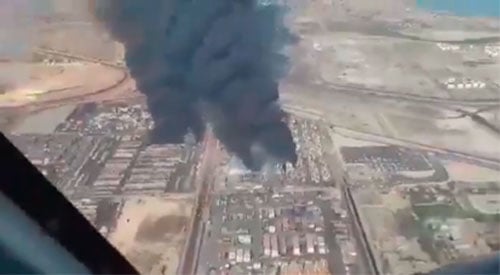
Fires burning in the Rajaei Port container park days after the explosion on April 26 (https://x.com/i/status/1930786589665267956)


Video: Russian Drone Hits Product Tanker in Black Sea After Leaving Ukraine

tanker hit by drone
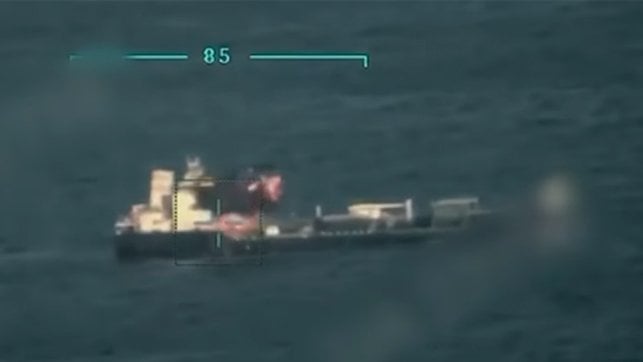
Turkish-owned product tanker was struck off the coast of Ukraine by a Russian drone (Ukrainian Navy)

Published Dec 13, 2025 7:22 PM by The Maritime Executive


A Turkish-owned product tanker was struck by a Russian drone after the vessel departed Ukraine bound for Egypt. The Ukrainian Navy released a video of the strike, reporting that the crew was uninjured, and the vessel was damaged but proceeding on its trip.

The product tanker Viva (16,116 dwt) is registered in Tuvalu and owned by Turkish shipping company Chemtankers Shipping. The vessel was built in 1999 and has been operating for the Turkish company since 2023. 

According to the report from the Ukrainian Navy, the vessel had loaded a cargo of sunflower oil. It was more than 20 miles off the coast of Ukraine on Saturday, December 13, and outside the country’s air defenses, when it was targeted by a Russian drone. Ukraine emphasized that it was in the recognized corridor established for grain cargo ships.

The vessel was struck in the area of the accommodation block. The images show debris and scorching marks on the structure. The ship has 11 Turkish crewmembers aboard, but the reports said they were uninjured in the attack. Some reports are saying the vessel was targeted with two drones, with the second one striking near the bow.

The Ukrainian Navy said it was in contact with the captain of the vessel. The maritime search and rescue service is reported to be prepared to provide assistance if needed.


They denounced the attack, saying it “violates the norms of international maritime law.” They cited the principles of freedom of navigation, but made no mention of the strikes Ukraine recently carried out in the Black Sea on shadow fleet tankers heading to Russia to transport oil.

Today’s attack followed multiple assaults on Ukrainian ports on Friday, December 12. Additional videos appeared online of the drone attack on the Greater Odesa port complex and the strike on a Turkish RoPax that was set on fire


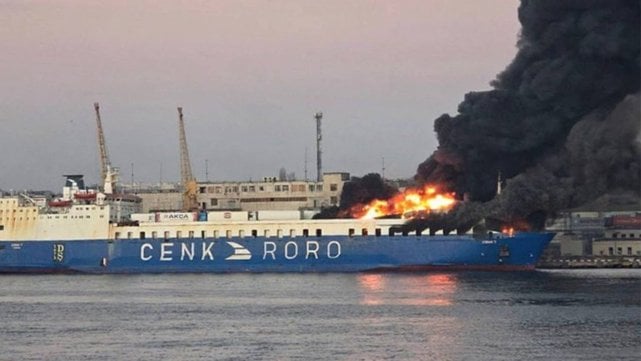
(Friday's strike on the Turkish RoPax docked in Chornomorsk)


Media reports are saying the vessel named Cenk T was transporting generators, with containers visible on deck from a company called ASKA, a manufacturer of diesel, gasoline, and gas generators. The reports point out that the generators were destined to supplement Ukraine’s damaged power system. The reports highlighted that multiple areas of Ukraine are experiencing large-scale power outages, often exceeding 10 to 12 hours per day.

In addition to the large fire started on the RoPax Cenk T, the Odesa Regional Military Administration said a fire was started on a second ship in the port. A worker for a private company in the port of Odesa, it says, was injured, and a container crane was damaged. Later in the day, they report that Russia again attacked the Odesa Port, damaging more port infrastructure and causing a fire that was quickly extinguished by firefighters.

Vanguard Tech warned yesterday that commercial vessels calling at Odesa, Chornomorsk, and Pivdennyl are currently facing elevated risk from short-notice, high-intensity strikes targeting port infrastructure. Russian President Vladimir Putin had threatened to cut off Ukraine’s access to the sea after the recent strikes on the shadow fleet tankers in the Black Sea.


Turkish-Owned RoPax on Fire After Russian Attack on Odesa Region

cargo ship on fire
RoPax on fire after a Russian attack on the port region of Ukraine (Telegram)

Published Dec 12, 2025 2:18 PM by The Maritime Executive


A Turkish-owned RoPax transporting cargo to Ukraine was set on fire during a midday Russian attack on the Great Odesa region. Reports indicate that one person, possibly a dockworker, was injured, but there are no fatalities.

The Ukrainian Air Force had issued the alert at around 1500 local time, reporting high-speed targets coming from the south. It is believed that at least two ballistic missiles had been fired, as well as a launch of drones. It followed an overnight barrage on the same region, which reportedly left more than 90,000 families without electricity. The missiles were targeting Odesa and Chornomorsk, while the drones also targeted Pividennyi. 

The Turkish Foreign Ministry confirmed a vessel strike, reporting that the crew and truck drivers were being evacuated. Pictures and videos posted online show the forward section of the vessel ablaze with Ukrainian firefighters working to control the fire.


The vessel is the Cenk T, owned by Turkey’s Cenk RoRo. Built in 1978, the vessel previously operated for Stena and has been owned by the Turks since 2021. It is 21,000 GT / 8,400 dwt with a capacity to transport up to 130 trucks. Security consultants Vanguard quotes the vessel's owners as saying the ship was carrying "essential food supplies."

The Turkish ministry, in its statement, reiterated its “concerns regarding maritime security and freedom of navigation, as the ongoing war in our region is spreading to the Black Sea… we once again emphasize the importance of urgently ending the war between Russia and Ukraine, and we recall the need for an arrangement to ensure navigation safety in the Black Sea and for the parties to suspend attacks targeting energy and port infrastructure in order to prevent escalation.”

Vanguard quotes the Ukrainian Navy as reporting a total of three ships were damaged in today's attacks at two of Ukraine's ports. The details on the other ships have not been confirmed, and the damage appears to be minor compared to Cenk T which continued to burn into the night.

Pandemic ‘beneath the surface’ has been quietly wiping out sea urchins around the world

Canary Islands as the ‘missing link’ in a global sea urchin killer pandemic


Frontiers

Sea urchin epizootic 

image: 

Images of moribund D. africanum off Tenerife Island during the September 2022 mass mortality event: a) Moribund individual of D. africanum showing abnormal position and movement of the spines with white and greenish bare areas devoid of tissue; b) Accumulation of detached spines and dead D. africanum individuals on the sea bed; c) The fish Thalassoma pavo predating upon a moribund individual of D. africanum; and d) The polychaete Hermodice carunculata feeding on a dead individual of D. africanum.

view more 

Credit: Cano, Lorenzo-Morales, Bronstein, Sangil and Hernández


Sea urchins are ecosystem engineers, the marine equivalent of mega-herbivores on land. By grazing and shredding seaweed and seagrass, they control algal growth and promote the survival of slow-growing organisms like corals and some calcifying algae. They are likewise prey for a plethora of marine mammals, fish, crustaceans, and sea stars. However, when they become overabundant, for example when these predators are overhunted or overfished, sea urchins can also inflict substantial damage to marine habits and form so-called ‘urchin barrens’.

Now, a study in Frontiers in Marine Science has revealed that over the last four years, an unrecognized pandemic that has been wiping out sea urchins around the world has hit the Canary Islands. The consequences on marine ecosystems aren’t yet fully known, but likely profound.

“Here we show the spread and impacts of a ‘mass mortality event’ which severely hit populations of the sea urchin Diadema africanum in the Canary Islands and Madeira through 2022 and 2023,” said Iván Cano, a doctoral student at the University of La Laguna on Tenerife in the Canaries Islands, Spain.  

“At approximately the same time, ther Diadema species have been observed to be dying off in the Caribbean, the Mediterranean, the Red Sea, the Sea of Oman, and the western Indian Ocean.”

The genus Diadema comprises eight species inhabiting subtropical and tropical waters around the globe. These include D. africanum, which used to thrive on rocky reefs off western Africa and the Azores, between five meters and 20 meters deep. In the Canary Islands, its numbers had been increasing since the mid-1960s, likely due to overfishing of predators and global warming. At some sites in the archipelago, its increased numbers even caused ‘urchin barrens’ in the past, which prompted unsuccessful efforts at biological control between 2005 and 2019.

Sea change

In February 2022, Cano and colleagues observed that D. africanum had begun to die en masse off the islands of La Palma and Gomera in the western Canaries. Spreading eastwards across the archipelago over the course of that year, the disease caused the sea urchins to move less and in an abnormal way, become unresponsive to stimuli, and lose their flesh and spines before dying.

The scientists recognized these symptoms, because this was not the first outbreak of such mass mortality events in the islands. In early 2008, and again in early 2018, a disease killed an estimated 93% of D. africanum individuals off Tenerife and La Palma, and 90% off the islands in the neighboring Madeira archipelago.

But the 2022 outbreak was different: while many affected populations had recovered – sometimes surprisingly fast – after the 2008 event, this didn’t seem to happen in 2022. Rather, a second wave of mass mortality struck the Canary Islands over the course of 2023.

To assess the impact of the die-off, Cano et al. surveyed D. africanum numbers at 76 sites across the archipelago’s seven main islands between the summer of 2022 and the summer of 2025, comparing these to historical data. The authors also invited professional divers to give information on its relative abundance at their usual dive sites in 2023 and between 2018 and 2021. They then used traps to collect dispersing larvae at four sites off eastern Tenerife in September 2023, the annual peak of the spawning season. Finally, they quantified the number of newly settled juveniles at the same sites in January 2024.

“Our analyses showed that the current abundance of D. africanum across the Canary Islands is at an all-time low, with several populations nearing local extinction,” said Cano.

“Moreover, the 2022-2023 mass mortality event affected the entire population of the species across the archipelago. For example, since 2021 there has been a 74% decrease in La Palma and a 99.7 % decrease in Tenerife.”

Prickly issue

The authors also concluded that since the 2022-2023 event, effective reproduction of D. africanum has mostly ceased on the eastern coast of Tenerife: only negligible numbers of larvae were caught in the traps, and no early juveniles were observed in any of the shallow rocky habitats surveyed.

“Reports from elsewhere suggest that the 2022-2023 die-off in the Canary Islands was another step in a broader marine pandemic, with serious consequences for these key reef grazers,” concluded Cano.

“We don’t yet know for certain which pathogen is causing these die-offs. Mass mortality events of Diadema elsewhere in the world have been linked to scuticociliate ciliates in the genus Philaster, a kind of single-celled parasitic organisms,” said Cano.

“Previous die-offs in the Canary Islands were associated with amoebae such as Neoparamoeba branchiphila and followed episodes of strong southern swells and unusual wave activity, similar to what we saw again in 2022. Without a confirmed identification, we cannot say whether the agent arrived from the Caribbean by currents or shipping, or whether climate change is to blame.”

“We aren’t yet sure how this pandemic will evolve. So far, it seems to have not spared to other Diadema populations in Southeast Asia and Australia, which is good news – but we cannot rule out the possibility that the disease will reappear and potentially spread further.”

Environmental variability and migration promote the evolution of cooperation among humans: A simulation-based analysis


University of Tsukuba


Tsukuba, Japan—Cooperation is fundamental to human societies. Building on the hypothesis that heightened environmental variability in Africa during the Middle Stone Age influenced behavioral evolution, this study investigates the joint influence of environmental variability and human migration on the evolution of cooperation.

In their simulation model, the variability is represented as the random movement of resource-rich zones across a two-dimensional space, and the migration is represented by the resource-seeking migration of agents (e.g., humans). The agents interact cooperatively or competitively for resources and adopt their behavioral strategies by imitating neighbors with more resources.

The simulation results reveal that cooperation is more likely to evolve when environmental variability and mobility are sufficiently high. Moreover, the interactions between these factors hinders non-cooperative groups and encourages the formation of cooperative groups.

Unlike previous studies that examined environmental variability and migration separately, this study systematically analyzes their combined effects on the evolution of cooperation. Thus, it offers a novel perspective on how environmental dynamics and mobility may have shaped the evolution of human cooperation and, by extension, sociality.

###
This work was supported by JSPS KAKENHI Grant Number JP23K20588 and by the Fujikura Foundation.
 

Original Paper

Title of original paper:
Evolution of cooperation among migrating resource-oriented agents under environmental variability

Journal:
Chaos, Solitons & Fractals

DOI:
10.1016/j.chaos.2025.117592

Correspondence

INABA, Masaaki
Doctoral Program in Policy and Planning Sciences, Degree Programs in Systems and Information Engineering, Graduate School of Science and Technology, University of Tsukuba

Professor AKIYAM,A Eizo
Institute of Systems and Information Engineering, University of Tsukuba

Related Link

Institute of Systems and Information Engineering