Tuesday, December 23, 2025

Mamdani For the Masses or the Masses For Mamdani?

Ganesh Trichur 


The future of American politics struggles to be rewritten in the aftermath of Mamdani’s stunning victory. For, the party to which he belongs is far from forging a vision adequate to the challenges ahead.


New York Mayor-elect Zohran Mamdani. Image credit: @ZohranKMamdani on X

A sea change of major proportions took place in the political system of the United States when Zohran Mamdani, a state assemblymember from Queens borough and a member of the Democratic Socialists of America (DSA), defeated not only his formidable rival, the former Democrat Governor of New York Andrew Cuomo, but also the Republican candidate Curtis Sliwa in the November 2025 general elections. 

Mamdani’s decisive victory, with over 50% of the votes cast makes him New York’s first South Asian and Muslim mayor of a city of 8.5 million.  As Nathan Gusdorf, the Director of the Fiscal Policy Institute, observes, he may well be ‘the most important American socialist to ever hold executive office’. Mamdani isn’t however the first socialist mayor of New York City, nor is he the first to be endorsed by the DSA. 

The DSA in 1989 endorsed David Dinkins who became New York’s first African American socialist mayor (1990-1993), in the wake of the great but short-lived political momentum built up by Jesse Jackson’s famous 1988 Rainbow coalition.  But the DSA that endorsed Dinkins in the 1990s also supported Israel; it was only in the second decade of the 21st Century that the DSA became an outspoken critic of Israel and denounced it as an apartheid and racist state.  

Mamdani is also a strong critic of the racial state of Israel, in a way Dinkins never was. There is, moreover, a qualitative difference in the times to which the two socialist mayors belong.  David Dinkins served as mayor when the Soviet Union was collapsing, when the US was celebrating its unipolar geopolitical moment, and when establishment liberals like American political scientist Francis Fukuyama were declaring ‘the end of history’.

Mamdani’s tenure, by contrast, unfolds at a time when US world hegemony is finished; Russia has resurged as a Great Power; and a majority of Americans (those within the Republican Party included) are not only critical of Israeli humanitarian crimes committed in Gaza; they are also questioning the unconditional financial and military support that the US offers Israel. A formidable legitimacy crisis confronts US power and prestige on world-scale, worsened by Trump’s tariff wars on Europe and Asia and his blatant disregard for norms of international law. 

Inside the nation, creeping inflation fuels a profound cost of living crisis while violent raids on immigrant neighbourhoods spread fear and anxiety among the labouring masses.  Within this conjuncture, Mamdani’s anti-racist politics combines well with his affordability agenda to strike a powerful chord with the working-class majority in the city and in the nation. 

WORLD-HISTORICAL FOUNDATIONS OF MAMDANI’S POLITICAL VICTORY

To explain the phenomenal political victory of Zohran Mamdani – first in the June primary and again in the November 2025 general elections – to understand how and why a South Asian socialist secured a mandate from over a million voters, it is best to begin by noting that the city in which the masses elected him to be their mayor, is a city of violent extremes. 

Those who visit New York for the first time are dazzled instantly by its tremendous vitality.  It is a city that never sleeps – thanks to its fleet of taxi drivers and a subway system that remains accessible through the night.  The city’s aura of restless, inexhaustible energy is powered by dreams of upward mobility. These dreams make New York’s working class stretch itself beyond the limits of the working day, working late into the night. The wealthy in the city also work hard, to transform the enormous productive surplus generated by the city’s workers into astronomical profits, much of which concentrates in the towering superstructures of lower Manhattan.

As the epicentre of world-spanning financial networks that converge on Wall Street, New York is home to billionaires who celebrate capitalist ‘creative destruction’ as their destiny, which they identify with that of the city. Alongside its glittering skyscrapers, world-class universities, and first-rate public libraries, New York is also home to an artistic and cultural avant-garde who frequent its majestic museums and vibrant theatres. The city’s green spaces and public parks are urban oases in the hot summer, places to recuperate vital life lost in endless work; and its innumerable bars and high-class restaurants serve global cuisine that charms travelers.

The Statute of Liberty, the global symbol of the American Dream to immigrants from all over the world, remains irresistible to tourists. New York is also headquarters of the United Nations (UN), the symbol of world-government, the place where representatives of the world’s nation-states assemble to uphold norms of international law. 

New York is at the same time a city of destructive creation that harshly regulates its poor. It is the most expensive city to live in the world. For working class New Yorkers, whose inexhaustible productivity throws off that tremendous energy that defines the aura of the city, New York is often a nightmare. As it is for the large population of poor households who toil in a twilight zone of existence.  Many of the homeless in New York are people with mental illness, criminalised by New York’s police department.  The city’s poorest neighborhoods are constantly targets of severe police surveillance. Aggressive policing of African American and Latinx people and their neighbourhoods enforces deep-seated ethno-racial status inequalities.

New York also reflects extraordinary economic inequalities of income and wealth, much more than the US does. Insofar as the Gini coefficient is a reliable index of economic inequality, for the US as a whole, the Gini was 0.486 in 2022; for New York City in the same year, it was 0.555.  Among the 10 largest cities in the US, New York City alone holds the dubious distinction of displaying a statistically significant increase, between 2010 and 2022, in the Gini index of inequality.

These inequalities began during the neoliberal turn of the 1970s and widened and deepened during the 1980s and beyond. During those decades the US ruling class responded to its squeeze on profitability – an outcome of competitive catching up by Germany and a Japan-led East Asian region – by actively promoting deregulation and deindustrialisation; by shutting down industrial plants; by downsizing and layoffs; by offshoring and outsourcing production; but, above all, by redirecting itself toward producing and reproducing a speculative financial expansion on world scale, centered on New York City. 

Fiscal and monetary policies were deployed to redistribute incomes and wealth toward the top 1% of the city’s financial elite.  In the first decade of the 21st century, unregulated financial speculation created the conditions for the great crash of 2007-09 in Wall Street, which was swiftly followed by an equally great bailout (amounting to $750 billion) of the bankers and financiers – by the newly elected Democratic President Barack Obama – responsible for the meltdown in the heartland of global capitalism. The argument for these bailouts was that the banks were ‘too big to fail’. No such bailouts were offered to the working class or the middle class. 

The tremendous resentment against bailouts of the capitalist elite birthed the Occupy Wall Street (OWS) movement in New York in September 2011. The movement that began with the occupation of Zuccotti Park – renamed Liberty Park by its occupiers – in the heart of Wall Street, spread like wildfire throughout the US and soon most of the world.  Grounded in the deep disaffection of working class and middle class New Yorkers who identified the top 1% as their target, this movement became for three long months, the global symbol of resistance to the neoliberal dogma that ‘there is no alternative’.

From general assemblies in the five boroughs to insurgent rallies and rowdy marches that swept through Wall Street with slogans – ‘no war but class war’; ‘they got bailed out; we got sold out’; ‘they say cutback, we say fight back’ – directed against the ruling elite, the movement was ultimately subject to violent police repression and arrests.  If the occupiers of Liberty Park were evicted in December 2011, the movement lived on throughout the city in different social centres.

The restless, irrepressible energy of the Occupy Movement also contributed directly and indirectly to the political expansion of the DSA, which campaigned for Alexandria Ocasio-Cortez and identified with the dissenting position within the Democratic party of Bernie Sanders, the Senator from Vermont, whose commitment to working class values in 2016 inspired Mamdani’s campaign.

There are understated overlaps, despite the differences, between the OWS movement and the DSA campaign.  Both came out strongly in solidarity with the Black Lives Matter (BLM) movement; both demonstrated against arbitrary police violence in the rebellion that followed the murder of George Floyd in 2020, with Mamdani supporting anarchist calls to defund the police. Both were linked, directly or indirectly, with the 2016 Bernie Sander’s campaign against revolting economic inequality. If Sander’s denunciations of the oligarchs who rule America divided Democratic party politics, it was nevertheless unable to sway the Democrats to change course, to abandon the party’s commitments to the ruling political class.  

It was left to the Republican candidate Donald Trump to champion the great resentment of a large part of the working-class majority in America (63% of the labour force, according to Michael Zweig) and win the 2016 elections on the promise to ‘drain the swamp’ of corruption that infected national political institutions. Although Trump lost to Joe Biden in part because of his failure to govern the effects of the Covid-19 pandemic, the Democratic party that won elections in 2020 under Biden, did little to address key issues of affordability that mattered most to the working- class majority.

Trump won again in the 2024 elections, in large part because of Biden’s blindness on issues of affordability. Biden chose to offer unlimited financial support for Ukraine following the Russian invasion in February 2022; and he committed the nation’s taxpayers to finance unconditional military support for Israel’s relentless bombardment of Palestinians when Hamas broke out of its concentration camp in Gaza on October 7, 2023, killing at least a thousand Israeli civilians and taking hundreds hostage.

As Israel unleashed full-scale military assault on Gaza, the huge casualties that immediately followed turned public opinion against Israel. It compelled South Africa in late December 2023, to launch a case at the International Court of Justice (ICJ) accusing Israel of committing genocide. 

By the time Mamdani announced he was running for mayor of New York late in October 2024, massive worldwide demonstrations against Israeli State-terrorism routinely dominated global social media.  By September 16, 2025, a report published by the UN Independent International Commission of Inquiry on the Occupied Palestinian Territory, claimed that Israel committed genocide against Palestinians in Gaza. In fact, several human rights organisations explicitly condemned the Israeli State for committing genocide – these include Amnesty International, Human Rights Watch, Oxfam, Genocide Watch, as well as B’Tselem (the Israeli Human Rights organisation).

Mamdani’s criticisms of the Israeli State remain grounded in harsh empirical reality; he rejected the charge of anti-semitism leveled against him and is supported by at least 30% of Jews in New York, including organisations like Jewish Voice for Peace.

Along with issues of political and corporate corruption in the city, Palestine and Islamophobia became controversial watchwords of the Mamdani campaign against lacklustre mainstream rivals in the summer primary and in the general elections in November.  Noteworthy is Zohran Mamadani’s use of multiple forms of social media (on YouTube, on Instagram) to connect directly with the younger generation in multiethnic languages, working class concerns.  These short savvy media messages repeatedly conveyed the image of an uncompromising ally of working families.

Mamdani’s road to victory was built on exemplary focus on what mattered most to millions of New Yorkers: integrity instead of dishonesty, corruption, and complicity in genocide; a working class politics that emphasised respect for the dignity of all working families instead of corporate welfare handouts (tax cuts and subsidies for big businesses); and an affordable city for its multitudes rather than a city for sale to a small clique of billionaires.

MAMDANI’S CROSS-CLASS COALITION

In two insightful articles the historian Adam Tooze identifies the core of Mamdani’s new coalition as belonging to a “middle income band” that stretches from $60,000 to $150,000; while Cuomo did best in the income band that stretches over $150,000 and beyond. Does this mean that Mamdani rode to power on the backs of a middle-class coalition?  This is, of course, partly true. However, as the working-class theorist Michael Zweig (The Working Class Majority: America’s Best-Kept Secret, Cornell University Press, Ithaca, NY) argues, class is best seen not in terms of income or consumption or lifestyle, but in terms of power, defined by the extent of autonomy and authority at the workplace. Income is, of course, associated with class; but it is workplace-power that determines class-belonging.

The middle class of small business owners, foremen and supervisors, managers and professionals, shares some common ground with both the capitalist class and the working class. Although the middle class enjoys relatively greater autonomy and authority at the workplace compared with the working class, its relative power dwindled during the neoliberal decades of austerity and cutbacks.  Lower-level managers in big businesses experienced layoffs and downsizing during the 1990s and beyond, even as small business owners in working class neighborhoods lost market share to big businesses. 


As capitalist restructuring reshaped lower and higher levels of the educational institution, it also reshaped the lives of teachers in middle and high schools, and of faculty in the City University of New York (CUNY), where the the majority of teaching responsibilities are outsourced to strongly qualified but poorly paid adjunct intellectual workers. All these professional groups – lower-level managers, teachers, adjunct professors, as well as doctors serving in working class neighborhoods, and the majority of nurses – tend to be more closely associated with the working class: most of them have experienced long-term downward social mobility.


Other middle-class groups more closely associated with the capitalist class prospered dramatically – like corporate lawyers, tax accountants, financial professionals – in large part because their work the top 1-2% of the owners and directors of big businesses to make huge fortunes.  There is probably no clear answer, as author-activist Barbara Ehrenreich argues, to the question of whether the middle class is an extension of the working class or an elite group more closely aligned with the interests of the capitalist class. (Barbara Ehrenreich (1989) Fear of Falling: The Inner Life of the Middle Class: Pantheon, NY)

The political inclinations of the middle class may or may not be inclined to the Left, or to the Right. Historical circumstances determine the choice. Inequalities in the US distribution of income worsened between 1968 and 2009.  If polarisation was moderate at the national level since 2010, it steeply increased in New York City where the earnings of those in the top 3% or 10% saw sharp upward spikes in incomes and wealth, while the rest saw real wage increases that barely kept up with rising costs of living.

The neoliberal austerity decades of the1980s and beyond, thus not only damaged the lives of the working class; it also downgraded the middle class to the status of skilled workers.  In New York City, during the Occupy movement, the middle class made its political choice by joining the great class war against big businesses.  In 2025, the middle class again made its political choice by strongly supporting Mamdani’s campaign platform that ‘New York is not for sale’ to the billionaires who poured millions into Andrew Cuomo’s campaign even after Cuomo lost the summer primary.  The larger point is that the middle class was most certainly not alone in backing Mamdani. It made its choice to combine with the deeper and more powerful working-class currents that swept Mamdani to power.

MAMDANI AND THE LABOUR MOVEMENT

These multiple class currents cannot be contained in the unions that claim to represent the working class. The labour movement is far bigger than the unions that claim to represent the city’s hugely diverse working class. The divisions within unions make the future of American working-class politics so unpredictable! 

As early as December 2024, well before the summer primary in June 2025, the United Auto Workers (UAW Region 9A) with its 20,000 members was outstanding in its principled endorsement of Mamdani. The same may be said of the City University of New York (CUNY) and its Professional Staff Congress (PSC-CUNY); as well as of the largest public sector union representing 150,000 city workers, AFSCME District Council 37.  But these were still exceptions.  The UAW and the New York’s Taxi Workers Alliance deserve special mention because what they ultimately endorsed was Mamdani’s unimpeachable integrity, his deep respect for the dignity of working-class families, so rare among politicians.  The UAW’s appreciation for Mamdani’s personal involvement in auto workers’ livelihood struggles was expressed by its director Brandon Mancilla: “He's been front and centre at every single one of our fights, whether it’s in higher education at Columbia or at the Mercedes-Benz first contract rally.” 

But Mamdani was also front and centre of the 15-day hunger strike for debt relief waged by New York City’s taxicab drivers in 2021. His participation in that strike earned him the loyalty, affection, and abiding trust of the city’s 50,000 multiethnic taxi workers – Algerian, Bangladeshi, Senegalese and South Asian workers – who make New York a city that never sleeps. As Bhairavi Desai, president of the New York Taxi Workers Alliance explains, “Members witnessed this humble state assembly member insist on being the last in line behind them to be checked by physicians during the hunger strike”. Taxi workers and their families became Mamdani’s campaign guides and foot soldiers, who along with DSA’s volunteers, knocked on millions of doors in solidarity with a new type of city politics. Bhairavi observes that taxi drivers identified completely with Mamdani’s focus on immigrants and workers: “they see Mamdani carrying the working class with him in every step he takes toward power”.[1]


If the UAW lobbied hard for support for Mamdani among other labour unions before the summer primary, these efforts were in vain!  Most unions backed the corrupt Cuomo, perhaps in part because Mamdani was a political nonentity before February 2025, polling in the 1-5% range. New York City’s Central Labor Council (NYC-CLC) of the AFL-CIO with its million workers belonging to 300 unions did not endorse Mamdani until he had decisively defeated Andrew Cuomo in June, winning 56% of the votes to become the Democratic party’s candidate in the general elections in NovemberIt was only then that previously neutral unions like the United Federation of Teachers, as well as former Cuomo endorsers like the largest healthcare union in the northeast (SEIU-1199) and SEIU-32BJ (representing doormen and building workers), stepped up to endorse him.  

Mamdani had to prove capable of defeating Cuomo with whatever support he could mobilise with his radically different vision for the future of the labour movement.  NYC-CLC President Vincent Alvarez seems to have realised Mamdani’s authenticity only at the end of June 2025, when he admitted that “Zohran Mamdani shares the… Labor Movement’s vision for a city where working people have power, dignity, and opportunity….  We look forward to partnering with him to advance a pro-worker agenda and … to fight for policies that protect the right to organise, invest in union jobs, and ensure economic growth doesn’t come at the expense of workers”.  For his part, Mamdani accepted the NYC-CLC endorsement, as ‘a profound honor that confers a solemn responsibility to deliver on our shared vision’, and he promised to stand with organised labour and deliver a city everyone can afford.

MAMDANI AND MINORITY GROUPS

One reason for Mamdani’s success was his willingness to listen attentively to voters’ concerns.  Many African American and Latinx voters who voted for Trump in the 2024 general elections, voted for Mamdani because the core issues of unaffordability resurfaced strongly despite Trump’s victory.  Although Mamdani did less well in predominantly lower-income African American neighborhoods of the city in the June primary, he did far better in the November general elections in those same minority neighborhoods, as his working-class and middle-class volunteers extended their campaign into the city’s lower-income precincts. Younger voters, irrespective of race and gender, turned out in unprecedented numbers to vote for Mamdani. 

Mamdani has often been accused of anti-semitism by his opponents because of his criticisms of Israel. Critics of Israel are branded as Hamas supporters.  To equate anti-semitism with criticism of Israel is highly questionable. Mamdani denies the charge, and a non-trivial slice of Jewish New Yorkers back him. At least 30% of Jewish New Yorkers voted for Mamdani; and 68% percent of American Jews have negative views of Israel’s current government.

If Americans should not discount the resurgence of anti-semitism in the US, neither should they dismiss Islamophobia. Since the terrorist attacks on Manhattan’s twin towers, Islamophobia became embedded in the nation. Political policing of Muslims became part of the US War on Terror and ‘Black Identity Extremists’, and as part of the effort to undermine the Black Lives Matter Movement. There was no attempt in mainstream media to ask if US foreign policy in Afghanistan and West Asia were connected to international terrorism.

Mahmood Mamdani (the mayor-elect’s world-renowned father who teaches at Columbia University) observed in 2004 that stereotypical media constructions of ‘good’ and ‘bad’ Muslim in American minds, are simplistically associated with support for or criticism of US foreign policy in West Asia and US endorsement of Israeli state terrorism. 

As for the anti-Jewish threat in the nation, it comes largely from the right. As journalist Ed Luce (Don’t blame the left for US antisemitism”, Financial Times, November 4, 2025) observed in the Financial Times, “Trump has built his appeal on licensing every prejudice under the sun.  In nativist social media, and especially on Musk’s X, Nazi admiration is no longer in hiding.  Now it threatens to enter America’s bloodstream”, as “a constellation of figures – from JD Vance, the US vice-president, to Elon Musk, the world’s richest man – are, wittingly or otherwise, making antisemitism respectable again.”

CAN MAMDANI’S AGENDA SUCCEED?

For young Mamdani, governing a sprawling municipal bureaucracy of 300,000 city workers serving 8.5 million New Yorkers will be a big challenge. He has begun the process of selecting an expert administrative team.  Can they implement his progressive agenda of rent freeze, free buses, free childcare, and 200,000 new affordable housing units, all paid for by taxes on billionaires and millionaires? 

Mamdani took the bold step of meeting with President Trump in Washington in late November. To everyone’s surprise, the meeting was not a ‘showdown’ between two diametrically opposite personalities, perhaps because both agreed to reaffirm their common affordability agenda on which both won their elections. It is not clear whether Trump will deploy ICE on New York’s streets to pursue his anti-immigrant politics. For the moment, we may want to trust on Mamdani’s resourcefulness.

That still leaves Governor Hochul in Albany, a centrist Democrat, who endorsed Mamdani’s campaign, supports his universal childcare agenda (New Yorkers currently spend $22,500/year on childcare for one child), but remains opposed to increasing taxes by 2% on millionaires. Freezing the rent (2.5 million New Yorkers live in rent-stabilised buildings) can be done without Albany’s assistance.  The other parts of his agenda will depend on Mamdani’s relationship with Albany.  Free buses will deprive New York’s Metropolitan Transit Authority (MTA) of over $700 million/year.  What alternative sources of revenue will Mamdani’s administration provide to the MTA? Will he able to fund free childcare?

Trump’s One Big Beautiful Bill Act (OBBA) cuts federal taxes by $4.5 trillion over the next 10 years, paid for through higher deficits on the one hand; and $1.1 trillion in cuts to Medicaid and the Supplemental Nutrition Assistance Program (SNAP) on the other. These Federal funding cuts, however, will not directly impact the $7 billion in annual Federal funding that New York City receives. These Federal funding cuts, however, will impact New York’s State-budget by about $4.5 billion per year in lost federal funding, in large part through Trump’s elimination of Obamacare subsidies for legal resident immigrants. They may thus impact the $19 billion in annual funding that NY State channels to New York City, putting pressure on the city’s budget of $116 billion/year. Mamdani’s new administration will have to demand that the state government in Albany manage OBBBA impacts without implementing spending cuts.

Nathan Gusdorf’s instructive appraisal of the fiscal challenges confronting Mamdani’s administration underlines the importance of resisting the anti-tax movement in New York. “The idea that taxing a handful of billionaires is sufficient to achieve social democracy remains a progressive fantasy”.  Trump’s OBBA tax cuts are not only skewed towards the top 1%; it is the top 20% of households who earn over $120,000 annually that will receive 70% of the benefits from OBBA tax cuts (= $3.15 trillion).  New York can successfully surmount the fiscal challenges it will confront, because “the state and the city are both in a sound economic position to raise taxes given the stock of upper-middle- and high-income earners”. All of the costs of implementing the mayor-elect’s affordability agenda could be effectively covered by his proposed tax increases, which are designed to raise $10 billion annually.

The future of American politics struggles to be rewritten in the aftermath of Mamdani’s stunning victory. Some of the recent electoral turns may be signs of the future. Katie Wilson, a Democratic Socialist, became Seattle’s new Mayor-elect after campaigning on affordability issues. New Jersey’s new Governor-elect, Mikie Sherrill, also won an affordability campaign as a Democratic party candidate.  In Virginia, Abigail Spanberger become Virginia’s new Democrat Governor-elect.  If these wins bode well for the Democrats’ immediate future in the midterms, it is unclear whether the party machine can muster the will to radically shift course.  After all, neither Obama nor the Clintons endorsed Mamdani.  The NY Senator Chuck Schumer did nothing for Mamdani. 

Divided by loyalty to the Israel lobby, and committed to oligarchical interests, the party of the Democrats seems unable to see into the future.  Alongside this myopia it retains an enormous condescension for subaltern groups.  If Mamdani represents a different life and symbol, the party to which he belongs is far from forging a vision adequate to the challenges ahead.

Ganesh Trichur teaches historical sociology and political economy at the City University of New York. The views are personal.


Dhoom Macha Le: How Zohran Mamdani’s NYC Mayoral Victory Challenges Authoritarian Trends


Zohran Mamdani’s victory will have reverberations beyond New York and beyond America


Harish Khare
Updated on: 10 November 2025 
OUTLOOK. INDIA
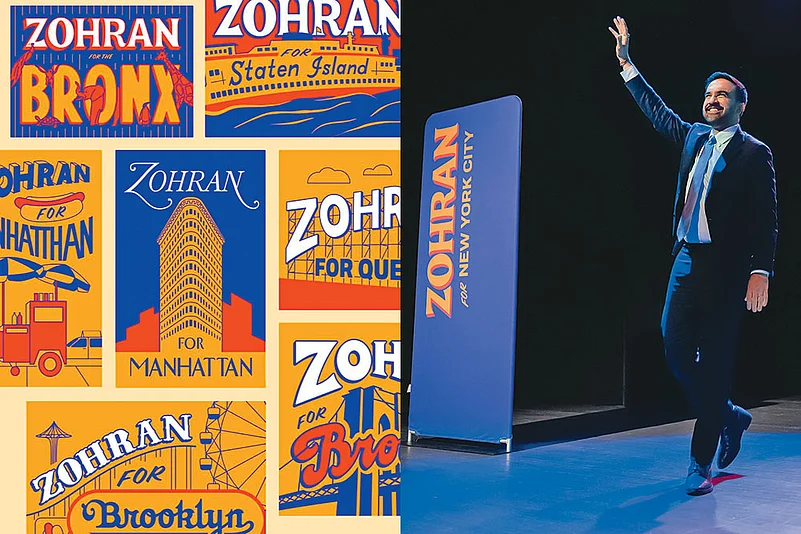


Questioning the Status Quo: (Left) Campaign posters of Zohran Mamdani; (right) Mamdani at an election party in New York

Summary of this article


Zohran Mamdani’s election as NYC mayor marks a major rejection of divisive, Trump-era politics and reaffirms faith in democratic, inclusive ideals.


His victory symbolises a new political movement that challenges entrenched power and prioritizes ordinary citizens over oligarchic interests.


The outcome resonates globally, inspiring democratic voices beyond the US by proving that course correction in a democracy is still possible.


Just when we were being made to believe that the future belongs to autocrats and authoritarian demagogues, there is cheerful news from New York City: democracy has not exhausted its potential for enlightened change and for moral refurbishing.

Democrats and otherwise sober men and women across the world have every reason to be humming Liza Minnelli’s ode to that city:

Start spreading the news,


I’m leaving today,


I want to be a part of it,


New York, New York


Just a little over two decades ago, the city was the site of a horrendous terrorist act; the iconic Twin Towers got gutted as evil men drove two hijacked aeroplanes into them; thousands died; “9/11” changed the way the world thought about its values and beliefs and priorities; warmongers manufactured a narrative that took us away from basic democratic principles; that cataclysmic event set the stage for over-use of military power, state terror, Islamophobia, and the eruption of a very ugly nationalism. Legitimacy and acceptability accrued to any demagogue who could use the pulpit to talk the language of bigotry and hate. Religious fanaticism all over the world found new voices and new adherents and partisans.

Now the same city has elected a 34-year-old man with a Muslim name as its mayor. His rivals sought to make much of his religion and his ethnic background, but the city voters refused to be scared into favouring those who prosper by mongering distrust and divisiveness. Instead, the voters chose to back a man who was offering hope and togetherness.

Zohran Mamdani’s victory has been cheered across the world because it was as much a triumph of a new kind of politics as it is a rebuff to President Donald Trump and his politics of intimidation and invective, at home and abroad. Trump had, needlessly but unsurprisingly, injected himself into the New York mayoral contest by backroom quarterbacking of Mamdani’s rivals, as also by threatening to slash federal funds for the city should this challenger of status quo got elected.

It is necessary to note that both Mamdani and Trump are quintessential products of that great city. A town of hustlers, swindlers, conmen, creative geniuses, ethnic vibrancy; a city that favours men and women of elegance, style, fashion, wit, imagination, optimism, and sheer perseverance. It refuses to be a settled down place; always willing to engage with one more experiment in social arrangements. Both Trump and Mamdani are New Yorkers at the core. On November 4, the city created a new narrative for itself and it will be decoded and deciphered around the world—for inspiration and for replication. Just as Liza Minnelli sang: “If I can make it there, I’ll make it anywhere.”
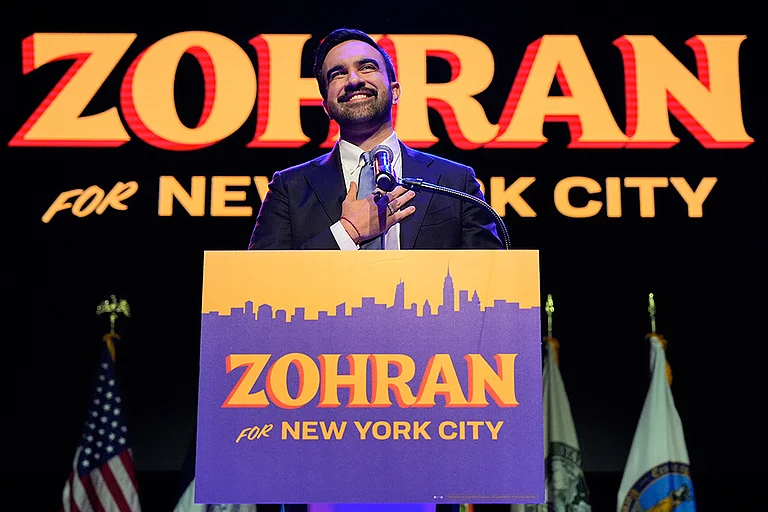

Indian Reaction To Indian-Origin Mamdani's Win In NYC Somewhat Mixed

Since his second presidential innings began in January, 2025, Trump has relentlessly devalued the idea of American democracy in the eyes of millions and millions of Americans, and, in the process, has sent out an unhappy message to the world that looked upon the US as an ideal democracy, worthy of emulation. The maximalist interpretation that Trump has put on his presidential powers—and has been allowed to get away with it—has given heart to all the “strongmen” across the world who use the paraphernalia of elective democracy to hollow out the very concept of democracy. In the Trumpian theocracy, authority is not to be questioned; ‘obedience must be rendered to the Caesar’. The very idea of dissent has been reduced to a dirty concept.

Now, a Mamdani victory has not only dented the Trump Supremacy, it has also proved that there is nothing inevitable about Trump and Trumpism. A veritable bonfire of the Trumpian vanities has become the most pleasing spectacle. For one shining moment, New York City has reaffirmed its romantic streak and has given hope to millions and millions, way beyond that exotic metropolitan.

Mamdani was wilfully not a part of the establishment; he wormed his way into the affection of the New Yorkers by questioning the status quo, challenging the political priorities, and the governing protocol of an establishment that is firmly in the grip of oligarchs and other power brokers. Mamdani reminded the city’s voters of the harshness of life behind all the glitter and the shimmer of the Manhattan skyline. And then, he promised to make life for the average voter less harsh and less dehumanising. He invoked the curative power of inclusion, without brandishing the animosities of politics of exclusion that has cast a mesmerising spell on so many Americans. He invited opposition and hostility from every established site of traditional power.

The Mamdani victory will have reverberations beyond New York and beyond America. Because this man, with a very un-American name, has shown how a politician can rekindle a society’s conscience and how he or she can summon the faithful and the hopeful to defiance and resistance to callous authority, and, can enthuse a community to reach out to its inner resources and resilience to forge a higher collective nobility. A seductive moment in history.

The world will watch with attention how Mamdani will defuse and defang the entrenched interests in America’s greatest city and how he will cope with militant non-cooperation, even hostility, from the Trump White House. And, as the older Cuomo, Mario, once remarked that while “you campaign in poetry, you govern in prose”. Governance is a tricky affair; it requires competence, passion, commitment, and conviction to exhort citizens and followers to rise above personal and petty interests. Aspirant political leaders across the world would very much want a Mamdani City Hall to set an example as to how to govern in prose without losing the imagination of a poet.

It is not easy to pigeonhole Mamdani and his fellow-travellers in any recognised political category, but they do constitute a “new” urge and a “new” insistence that the operating principles of governance must be aligned with the needs and requirements and hopes of a majority, rather than being the handmaiden of the dozen-odd billionaires and political honchos.

The progressive, liberal, and other democratic souls around the world would observe how creative and adept Mamdani turns out in using the mandate of the crowds through the existing political institutions; how he would avoid the pitfalls of impatience and righteousness; and, how he would not let his rivals’ viciousness define him. A Mamdani mayoralty in the world’s most global city has a tantalising cachet to it. From the dark days of “9/11” New York moved back, on “11/4” to its old zeitgeist. All is not lost.

Many in India would feel entitled to think of Mamdani’s triumph as a reaffirmation of the intrinsic validity of our own democratic values. That his mother is an Indian, that he would quote Jawaharlal Nehru in his victory oration, that he did not shy away from his Muslim identity are enormously satisfying to our liberal and republican votaries. More than the elevation of a Rishi Sunak as the prime minister of England, a Zohan Mamdani as the Mayor of New York somehow is a pleasing development. In this age of inter-connectedness, a Mamdani victory in New York will give hope to the dispirited democrats call over the world. India will not remain untouched. Some would hope for a similar de-contamination. Never underestimate a democracy’s potential for undertaking course-correction and other similar miracles.

(Views expressed are personal)

Dressing the part

The fashion industry has impacted women’s low self-esteem.
December 21, 2025 
DAWN

EVERY time I go see M, a local fashion designer I discovered earlier this year after deciding to only buy local brands, she asks me how that piece of clothing makes me feel. She doesn’t approach fashion asking ‘how do they look on you’ but ‘how it makes you feel’. It may sound funny but I really started to think about how I felt in clothes at her studio. I began to consider how clothes draped, how they moved when I did for example, rather than the singular lens with which I used to consider any clothing: does this make me look fat?

I suppose growing older has helped insofar as I care less about what others think. I have always chosen comfort but I realised that was just a guise for fear of standing out. Even though I said I was exercising choice in my clothes, I realise that choice was driven by societal expectations. What will people think of me if I go off script, like, not subscribe to the three-piece lawn suit or, more recently, the coordinated suits which resemble pajamas? One time I laughed at my image in the mirror because I looked like a doily you use under cakes but, even then, I thought at least I blend in.

Ah, the pitfalls of women wanting to stand out!

In that respect, the body positivity and body inclusivity movement has challenged stereotypes of what women are expected to look like. It heralded an era of plus-size models in editorial campaigns for fashion houses, especially high street wear, including in Pakistan where options were previously limited. Everyone welcomed a better body representation in the fashion industry. I believe that is changing again, starting in the West, with a return to how things were, ie, skinny is back in again. Old-timers like myself will remember growing up to ‘heroin chic’ as a style aspiration. The fashion industry has impacted women’s low self-esteem with its constant change in trends and making girls feel compelled they have to conform. This, along with its exploitation of workers, is its worst crime.

Then came social media which all but pushed the nail in the coffin of how we perceive our bodies, ourselves.

At a recent talk between three creatives in art and fashion, discussing among other things, the human body, M said something incredibly profound. “We were never meant to know what people think of us.”

The fashion industry has impacted women’s low self-esteem.

Yet we live at a time where all we know is what people think of us and that usually starts with the body.

Our bodies have become a source of attack on social media which promotes unrealistic beauty standards — think skinny or youthful sculpted faces or ‘glass skin’ — and fosters a comparison culture. I have written in the past about girls as young as 11 performing 10-step skincare regimes which parents think are harmless when it is quite the opposite. Has playing outdoors become obsolete for children?

Compare this to our mothers or grandmothers’ generations who truly dressed for themselves and didn’t feel any compulsion to conform. When I say ‘graceful’, you are likely to think of an elderly woman, not an influencer, probably shilling for a designer who copies other designers.

Social media makes us push an image that our life is perfect but it is actually a mask we wear to hide our imperfections. We used to celebrate individuality but now we worry it will be a source of attack. Over the years, I have seen more and more women covering themselves not for cultural reasons but because they don’t want to attract male attention. Therein lies the problem which needs far more urgent redressal. Women are disappearing from public spaces — we don’t laugh out loud for fear we will draw attention to ourselves, we don’t walk on the streets that are not safe, we quit jobs because we are harassed, etc.

An ideal woman is one who stays off the radar.

Who gains from us conforming to ideals, or more importantly, who creates these ideals — in fashion, beauty, wellness, etc? The self-help/ wellness industry is a fast-growing one, estimated by the Global Wellness Institute to be valued at $6 trillion. Everyone is selling something that promises you to lead an ideal life. It is exclusive and anti-poor because the community it encourages to build is one that creates health disparities. One clear example of this is the GLP drug meant for obesity patients which is widely used, even in Pakistan, by wealthy people as a popular weight loss drug. The price of these injections has skyrocketed because of the demand.

Skinny is not a trend. It should also not be an aspiration. Instead we must question where these messages and biases come from and ask if we want to embrace them or challenge them.

Published in Dawn, December 21st, 2025


The writer is an instructor of journalism.

X: @LedeingLady


The writer is co-producer and host of Unpressedented, a podcast on the media landscape in Pakistan.


Attention spans

Neda Mulji 
Published December 22, 2025
DAWN


YOUNG people focus attention for hours during a football game that they are passionate about, or while watching a nail-biting cricket match, or when they play video games with their eyes glued to the screen. Their interest, laser-sharp focus and relentless engagement begs the question: why can’t we get this kind of attention in our classrooms? Very often, teachers talk about short attention spans as the reason why students cannot sustain attention during lessons. While this may be true to some extent, there is more to the story.


Although there is some research on shorter attention spans, none of it is actually conclusive. In fact, most research on reduced attention spans, over the last few decades, focuses on correlation, not causation. Prof Gloria Mark reports that the average attention span when using digital devices has dropped from 2.5 minutes in 2004 to just 47 seconds today. This shift is linked to cognitive overload and multitasking stress. The shorter attention spans in this scenario are related to an external barrier — information overload.

A 2025 white paper from the Community Research Institute found that Gen Z’s average attention span is eight seconds, with high smartphone and social media use contributing to constant distraction. However, we are not told what we are comparing this revelation to and whether there is causation associated with device and social media use or correlation. Distraction takes away attention, it does not necessarily reduce it.

What has reduced, however, is tolerance for academic work, given digital distractions and a host of other more engaging activities. It also points towards a developing habit of scrolling through a wide range of media, with a fast momentum, so that children no longer have the patience to listen passively to a one-way lecture.

Amidst this kaleidoscope of information, students only involve themselves in learning when their curiosity is sparked enough. Their attention span demands immersive experiences and instant gratification through digital rewards. In fact, they have come to expect rewards for their time. But it is not just rewards that grab attention.

Tightly woven into the need for gratification is the desire for involvement in their lessons: ‘where am I in all this?’ To fulfil this need, they need opportunities to demonstrate what they have learnt.


Students are learning things way beyond classroom topics.

They now live in a world where they are inclined to share every moment, memory and experience across media. This phenomenon is just as important in classrooms where teachers can design opportunities for students to get gratification from learning. This is where digital integration in teaching and learning becomes paramount. Making their own videos and blogs, participating in discussion forums and maintaining a digital footprint enhances learning in unprecedented ways.

Children like to enjoy the agency of deciding what to do with their learning. Decades ago, they didn’t have this choice. If they didn’t ‘pay attention’ in class, they missed the boat. The opportunities provided by multimedia have ensured that there is no such thing as losing out. Now, there are infinite ways of catching up, with self-study options, AI support, personal tutors, etc.

Students are on a carousel of technology that adults are still catching up on. They are learning things way beyond classroom topics, acquiring skills well beyond their years and can communicate through various media that are outside the purview of classrooms.

Lamenting the loss of attention spans will not help educators find solutions. What might be needed is understanding that students’ learning styl­­es, decision-making capacity and respo­n­ses in the classroom have changed dramatically. This will help educators plan better.

Their attention span may be scattered rather than shortened and, if teachers hope to win back engagement, they might have to devise more creative teaching methods. The unfortunate reality is that most teachers tend to fall back on age-old techniques that they have either grown up with as students or used for decades as teachers. Techniques such as teaching in micro-bursts with bite-sized explanations, videos and memes, gamification such as a treasure hunt to find answers or using movement in class are still new to many teachers.

Moving away from traditional methods can be a game changer, especially as students continue to resist passive listening. In a world of rapid scrolling, attention is a rare currency available only to those who have learnt to connect with their listeners. Just like respect, attention cannot be demanded. It is earned through curiosity and communication — not coercion.

The writer is an author, teacher educator and Fellow of the Higher Education Academy, UK. The views expressed are her own and do not reflect those of her employer.

Published in Dawn, December 22nd, 2025


neda.mulji@gmail.com

X: @nedamulji

Neda Mulji has been teaching children and adults for over 15 years in Karachi, London and Dubai. Currently, she is a lecturer of Communication Skills at Amity University, Dubai.

Fatwas & narrative war
December 21, 2025
DAWN


IT was troubling to witness India and Pakistan descend into a futile blame game after the tragic Bondi Beach incident in Sydney, with both sides obsessively speculating over the nationality of those involved. This is precisely what religiously motivated terrorists want. When states and societies become entangled in such narratives, they inadvertently provide space for extremist propaganda to spread, amplify its impact, and divide people into opposing camps. These dynamics often provoke harsh state responses, which in turn validate extremist worldviews and escalate tensions within and between societies.

For several days, public opinion in both India and Pakistan remained hostage to this obsession, labelling the perpetrators as belonging to one nation or the other, without recognising a fundamental reality: for religiously motivated terrorists, the nationality and boundaries of the nation-state are irrelevant. They operate with an entirely different worldview, one that rejects not only international borders but even the judgements and doctrines of their own ideological or religious authorities when those contradict their violent practices.

This pattern is clearly visible in Afghanistan today. More than 1,000 Afghan ulema have issued a fatwa declaring the use of Afghan soil for terrorist attacks impermissible. Yet such voices have failed to resonate with terrorist groups. The same disregard was shown towards the numerous fatwas issued by Pakistani ulema against terrorism over the past two and a half decades.

In principle, the Afghan ulema’s fatwa is a welcome and positive development. However, the critical question remains: how can such pronouncements meaningfully curb cross-border terrorism when terrorists have repeatedly demonstrated their indifference to religious, moral, and scholarly authority?

History suggests that moral declarations, however well-intentioned, rarely translate into effective security outcomes unless backed by the political will and coercive capacity of those tasked with enforcing them. Fatwas, resolutions, and statements primarily articulate moral positions. Their transformation into implementable policy depends on calculations of power, politics, strategy, and tactics. The terrorist groups are acutely aware of this gap between moral authority and enforcement, and they have repeatedly adjusted their strategies to exploit it.

Pakistan’s own experience offers a useful parallel. Over the years, several Pakistani clerics issued fatwas against terrorism. Early efforts, including those from Lahore-based Darul Uloom Jamia Naimia and Jamia Ashrafia, representing the Barelvi and Deobandi schools respectively, were framed with significant caveats. Although Jamia Naeemia’s principal, Maulana Sarfraz Naeemi, was later assassinated in a terrorist attack, these initial fatwas themselves were riddled with many ‘ifs and buts’ that limited their impact.

It was only in January 2018, when the state convened leading religious scholars in Islamabad to endorse Paigham-i-Pakistan, that a semblance of consensus emerged. Even then, the process was not organic, but state-driven. Prior to this, many religious parties continued issuing conditional fatwas that outlawed violence within Pakistan while leaving ample space for justifying violence elsewhere, often against vaguely defined ‘oppressors’. Although Paigham-i-Pakistan sought to close these loopholes, clerics continued to apply contextual exceptions, particularly in relation to jihad beyond Pakistan’s borders.

It remains unclear whether the Afghan ulema’s fatwa represents an Afghan equivalent of Paigham-i-Pakistan. If Pakistan’s experience is any guide, exemptions and selective interpretations are likely to persist. In Pakistan’s case, terrorist groups that had earlier endorsed the consensus fatwa remained allegedly embedded in the state’s proxy networks. When these groups were later incorporated into counter-extremism initiatives, the consequences were twofold: first, militant leaderships lost credibility among their own cadres, and the state’s commitment to dismantling religious militancy came under question.


The state’s will is essential to eliminating ambiguities surrounding terrorist narratives.

Predictably, groups such as the TTP and Jamaatul Ahrar responded by rejecting the fatwa outright, arguing that many of the same clerics had previously legitimised violence, both sectarian and political, through dozens of fatwas. This inconsistency allowed terrorists to challenge the religious legitimacy of the entire exercise.

There is little reason to assume that the Afghan ulema’s fatwa will yield different results unless it is accompanied by decisive action from the Taliban regime. Terrorist violence is unlikely to subside merely through religious censure unless the infrastructure sustaining groups such as the TTP and Al Qaeda is systematically dismantled.

The oft-repeated claim that the Taliban lacks full control over these groups increasingly sounds less like an explanation and more like an excuse. At some point, the cost-benefit calculus must shift. Maintaining ties with transnational terrorist networks carries a far higher price tag than managing difficult relations with neighbouring states.

Pakistan’s own trajectory is instructive. The long-term costs of proxy warfare, economic decline, social fragmentation, political instability, and international isolation continue to haunt the country. For a Taliban-ruled Afghanistan, burdened with a weak economy, limited public legitimacy, geographic isolation, and minimal global support, the margin for strategic error is even thinner. Sustaining relationships with terrorist groups under these conditions is not merely risky; it is potentially ruinous.

The will of the state is essential to eliminating ambiguities surrounding the objectives and narratives of terrorist groups. When the state appears reluctant, or when the phenomenon of terrorism is allowed to persist over a prolonged period in a country or region, it continues to inspire individuals or small groups elsewhere in the world who share the same ideological worldview. States often take missteps, which terrorist networks are quick to exploit. When public opinion becomes hostage to narrow or sensationalist narratives, it further fuels reaction and polarisation.

The attackers at Bondi Beach in Australia may have been influenced by developments in the Middle East, particularly the Israel-Hamas conflict. However, it is terrorist networks that exploit such situations, interpreting them through rigid ideological frameworks and attempting to cultivate susceptible minds, either by establishing direct links or by encouraging individuals to self-radicalised and engage in acts of violence.

In moments of crisis, states rightly turn to religious authorities to de-legitimise terrorists and undermine their claims to moral or religious justification. Yet, states often struggle to consistently cultivate, and project positive narratives centred on peace, coexistence, love, and harmony. Despite repeated efforts, these narratives have failed to secure meaningful space in public opinion and the social media ecosystem, where polarising and emotive content continues to dominate.

Published in Dawn, December 21nd, 2025


Muhammad Amir Rana is a security analyst. He is the Director of Pak Institute for Peace Studies (PIPS), Islamabad, Pakistan.

In decline

The PM has declared that Pakistan’s economy ‘is out of the woods’. Clearly, he is looking at a different field of woods.
December 19, 2025
DAWN

The writer is a political economist and heads the IBA, Karachi. The views are his own and do not represent those of the institution.

PAKISTAN is in decline — in serious, considerable and sharp decline — as manifested by its economic, social and human development indicators. This decline is both relative to other comparable developing countries which have now steadily and increasingly outpaced Pakistan as indicated by multiple indicators, and by what Pakistan’s own indicators used to be. In other words, the economy and related and ancillary sectors, especially in human and social development, are worse now than what they were some years or decades ago. To make matters worse, Pakistan’s recent political economy reorganisation, centralisation and consolidation will ensure that these indicators deteriorate further.

The simplest and most basic indicator which encompasses economic growth, the real GDP growth rate, has been falling consistently over the last four decades and it is improbable that this long-term decline in GDP will be significantly reversed. From highs of near and above six per cent per year, this secular decline has led to a growth rate of barely 3pc. In fact, just in the last six years, GDP growth has been negative in two of those years, minus 1.3pc in 2019-20 and again minus 0.2pc as recently as 2022-23.

It is worth adding that on average, the population in Pakistan has been growing by 2.6pc annually over the last decade, and hence in real terms Pakistanis are worse off. Importantly, in just 25 years, Pakistan will become the third most populous country. At least on one count, there is huge progress and our population multiplies; over the last many years, our population growth rate has been much higher than economic growth.

Beyond these very basic numbers and economic growth rate and population trends, things are even more worrying. When one considers human development, the quality of Pakistan’s 250 million population has been falling markedly. In terms of the UN’s Human Development Index, Pakistan has gradually fallen in position. In 2020-21, Pakistan was ranked 161, in 2023-24 it fell to 164th and in the latest index it has fallen to 168th place, clearly a very considerable and sharp decline.

The PM has declared that Pakistan’s economy ‘is out of the woods’. Clearly, he is looking at a different field of woods.

Crucially, when it comes to women, unconditionally at the core of any development, social, economic or population strategy, things have deteriorated even further. The Global Gender Gap Report 2025 shows that Pakistan is ranked the lowest — 148th out of 148 countries — and has fallen three positions since 2024. Pakistan is ranked in the lower-middle income countries with 16 countries much poorer than Pakistan, yet its ranking is even lower than these countries and is the lowest of all 148 countries in terms of gender ranking. Female labour participation remains very low and access to finance is a major issue. By delaying putting women at the centre of every policy and strategy, Pakistan’s slide will be accentuated.

Every government official parrots the ambition of being ready for the revolution that has taken place in communication and information technology; they cite ideas related to AI which most have not even been able to grasp fully. Yet, Pakistan’s secondary enrolment rate today is at the level where South Korea’s was in 1972, while Pakistan’s tertiary enrolment rate today is where South Korea’s was in 1979. These are astonishing numbers, which show that in terms of human capital, so critical for the information and technological age, Pakistan is half a century behind South Korea. With even basic literacy, reading and numeracy skills lacking, we are decades behind other countries and this distance will increase over the next few years.

The prime minister has just declared that Pakistan’s economy ‘is out of the woods’ and the crisis is over. This, at a time when data shows that unemployment in Pakistan today is 7.1pc, the highest in 21 years, with 5.9m people unemployed of which 4.6m are illiterate. Moreover, those who remind us of a ‘demographic dividend’ from having a young population, need to be told that the hi­­­ghest unemployment is amongst those aged 15-29 years, with 3.5m young men and women entering the job market every year. Moreover, research has shown that even for those who work, the real wage of workers in Pakistan has fallen by almost 20pc in the last three years. With the overall investment-GDP ratio the lowest since 1973, at a mere 13pc, and declining further, any hope of reviving the economy seem completely absent. Clearly, the PM is looking at a different field of woods.

Relative to our peers and neighbouring countries, Pakistan is being further left behind. At the recently concluded DawnMedia Conference on Population, economist after economist showed data which emphasised the dismal state of Pakistan’s economy compared to others. Dr Hanid Mukhtar presented figures showing that in 1990, the per capita income of Pakistan was twice that of Bangladesh and 56pc higher than that of India. In 2024, Bangladesh’s per capita income is 53pc higher, and that of India is 71pc higher than that of Pakistan. Moreover, he showed how the growth of Pakistan’s per capita GDP has been lower than that of Bangladesh by 3.5pc per annum, and 3.2pc vis-à-vis India. These significant gaps will grow further, and any attempt to catch up will be outpaced by all other countries around us and in the region. Pakistan is on a losing streak, compared to its own past and compared to other countries which were once less developed than Pakistan.

Given these trends, all of which are downward — and there are a multitude of other datasets amplifying them — signifying relative and absolute deterioration, many economists feel that things have never been this bad. We have all used terms like ‘critical juncture’ or ‘crises’ at numerous points in the past, but perhaps in a highly globalised and competitive world, things may never have been where they currently are. Stabilisation has morphed into stagnation. Given the focus of those running Pakistan’s political economy and making decisions, there is no confidence in either their ability or vision to reverse these trends.

Published in Dawn, December 19th, 2025

Monday, December 22, 2025

Japan prepares to restart world’s biggest nuclear plant, 15 years after Fukushima


December 22, 2025 

Protesters take part in a rally near Niigata prefectural government office building before voting takes place in the prefectural assembly on a partial restart of the Tokyo Electric Power Company’s (TEPCO) in Niigata, Japan on December 22, 2025. — Reuters

Japan took the final step to allow the restart the world’s largest nuclear power plant on Monday as the region of Niigata voted to resume operations, a watershed moment in the country’s return to nuclear energy nearly 15 years after the Fukushima disaster.

Kashiwazaki-Kariwa, located about 220 km (136 miles) northwest of Tokyo, was among 54 reactors shut after the 2011 earthquake and tsunami crippled the Fukushima Daiichi plant in the worst nuclear disaster since Chernobyl.

Since then, Japan has restarted 14 of the 33 that remain operable, as it tries to wean itself off imported fossil fuels. Kashiwazaki-Kariwa will be the first operated by Tokyo Electric Power Co (TEPCO), which ran the doomed Fukushima plant.

On Monday, Niigata prefecture’s assembly passed a vote of confidence in Niigata Governor Hideyo Hanazumi, who backed the restart last month, effectively allowing for the plant to begin operations again.

Ahead of the vote, around 300 protesters, mostly older people, holding banners reading ‘No Nukes’, ‘We oppose the restart of Kashiwazaki-Kariwa’ and ‘Support Fukushima’ gathered in front of the Niigata prefecture assembly in temperatures of 6 degrees Celsius.

As the rally started, the mostly older crowd sang ‘Furusato’ — a national song about connection to a birthplace, meaning ‘homeland’ in Japanese.

“Is TEPCO qualified to run Kashiwazaki-Kariwa?”, a protester asked into the microphone, with the crowd yelling: “No!”

TEPCO is considering reactivating the first of seven reactors at the plant on January 20, public broadcaster NHK reported.

“We remain firmly committed to never repeating such an accident and ensuring Niigata residents never experience anything similar,” said TEPCO spokesperson Masakatsu Takata.

Takata declined to comment on timing.
Reluctant residents wary of restart

TEPCO earlier this year pledged to inject 100 billion yen ($641 million) into the prefecture over the next 10 years as it sought to win the support of Niigata residents. But many locals remain wary.

A survey published by the prefecture in October found 60 per cent of residents did not think conditions for the restart had been met.

Nearly 70pc were worried about TEPCO operating the plant.

Ayako Oga, 52, settled in Niigata after fleeing the area around the Fukushima plant in 2011 with 160,000 other evacuees.

Her old home was inside the 20km irradiated exclusion zone. The farmer and anti-nuclear activist has now joined protests against what she sees as a new threat on her doorstep.

“We know firsthand the risk of a nuclear accident and cannot dismiss it,” said Oga, adding that she still struggles with post-traumatic stress-like symptoms from what happened at Fukushima.

Even Niigata Governor Hanazumi hopes that Japan will eventually be able to reduce its reliance on nuclear power. “I want to see an era where we don’t have to rely on energy sources that cause anxiety,” he said.
Strengthening energy security

The Monday vote was seen as the final hurdle before TEPCO restarts the first reactor, which alone could boost electricity supply to the Tokyo area by 2pc, Japan’s trade ministry has estimated.

Prime Minister Sanae Takaichi, who took office two months ago, has backed nuclear restarts to strengthen energy security and to counter the cost of imported fossil fuels, which account for 60pc to 70pc of Japan’s electricity generation.

Japan spent 10.7 trillion yen ($68 billion) last year on imported liquefied natural gas and coal, a tenth of its total import costs.

Despite its shrinking population, Japan expects energy demand to rise over the coming decade due to a boom in power-hungry AI data centres.

To meet those needs, and its decarbonisation commitments, it has set a target of doubling the share of nuclear power in its electricity mix to 20pc by 2040.

Joshua Ngu, vice chairman for Asia Pacific at consultancy Wood Mackenzie, said public acceptance of the restart of Kashiwazaki-Kariwa would represent “a critical milestone” towards reaching those goals.

In July, Kansai Electric Power, Japan’s top nuclear power operator, said it would begin conducting surveys for a reactor in western Japan, the first new unit since the Fukushima disaster.

But for Oga, who also joined Monday’s protests outside the assembly chanting ‘Never forget Fukushimas lessons!’ together with others, the nuclear revival is a terrifying reminder of the potential risks.

“As a victim of the Fukushima nuclear accident, I wish that no one, whether in Japan or anywhere in the world, ever again suffers the damage of a nuclear accident,” she said
PAKISTAN


Labour abuse
December 22, 2025
DAWN


EUROPEAN patients sleeping on clean hospital sheets likely pay no attention to the hands that stitched them and the terrible cost paid by those hands. A new study, authored by Swedish NGO Swedwatch with Pakistani partner AwazCDS-Pakistan, shows how the EU’s public expenditure is linked to labour abuse, especially within Pakistan’s textile sector. 

Based on interviews with 89 workers in nine Faisalabad and Karachi factories, the report tells a shameful tale. Most workers are not hired directly but through private contractors, often without written contracts, allowing factories to dodge responsibility for wages, benefits and safety. 

Many workers do not even know which brands or countries their products go to, only that they are ‘for export’.

 In reality, much of this production supplies EU public hospitals, including bed linen, patient garments and staff uniforms.

 Pakistan’s legal minimum wage is Rs37,000 a month, yet workers in Faisalabad reported earning Rs15,000-30,000, while some survive on as little as Rs250 a day if work is scarce. In Karachi, workers earn Rs20,000-30,000 but only by working 16- to 18-hour shifts. The law says Rs37,000 is enough, but the report shows a family needs more than Rs75,000 to live with dignity, meaning even ‘legal’ wages keep workers poor.

The list of injustices runs longer. Work hours routinely exceed the legal 48-hour week, with overtime unpaid or disputed. Safety is barebones, if at all it exists. Workers describe poor ventilation, chemical exposure, blocked fire exits, and masks handed out only for audits. Injuries are common, yet compensation is rare. Women and trans workers are exposed to greater harm. The study documents a clear gender pay gap, sexual harassment that goes unpunished, and grievance systems that workers do not trust. Unionising is effectively forbidden, so much so that even suspicion of union activity can lead to dismissal. The report argues that European buyers rely on easily staged audits that fail to detect abuse. Its key recommendation is for the EU to make human rights due diligence mandatory in public procurement, ending price-only contracts and demanding real transparency from suppliers. But Pakistan need not wait for Europe. Provincial governments should license labour contractors, digitise worker registration for social security, and link export incentives to verified wage and overtime payments. Most importantly, workers must be allowed to organise without fear. EU taxpayers’ money should heal patients, not quietly bankroll exploitation.

Published in Dawn, December 22nd, 2025
Ending the war within


Abbas Nasir 
December 21, 2025 
DAWN


SERIOUS global challenges and their likely impact on Pakistan’s fragile economy make it incumbent on this country to initiate a process of national reconciliation. But any such move will not have a prayer unless both the hybrid set-up and the opposition step back from their confrontation.

After US Secretary of State Marco Rubio’s statement at a briefing in Washington, expressing gratitude to Pakistan for “their offer to be part of it, or at least their offer to consider being part of it [the International Stabilisation Force (ISF) for Gaza]”, what was clear was that issues remain to be addressed before any move forward on the matter.

Contacts have been going on since the ceasefire in Gaza in October this year. More recently, whe­ther it has been US-led activity in Doha or Florida or visits to Pakistan by the Jordanian monarch, the Indonesian president or the Egyptian defence minister, they all appear to be links in the same chain.

Around the time the October ceasefire was announced by US President Donald Trump, the perceptive king of Jordan made the observation, which is at the heart of the matter — that his country and other Muslim nations would have a ‘peacekeeping’ but not a ‘peace enforcement’ role.

This observation is what has triggered the contacts and conversations around the region and the world because regardless of what the US and Israel want, at least the prospective Muslim part of the ISF is reluctant, in fact adamant, not to play any role in ‘disarming’ Hamas.

For its part, Hamas has linked the laying down of its weapons to a complete Israeli withdrawal from Gaza, which is nowhere on the cards, and said it would surrender weapons to a Palestinian state authority only after a complete cessation of the Israeli military operation and the establishment of an independent and sovereign Palestinian state, with East Jerusalem as its capital. None of these conditions are likely to be met in the foreseeable future.

The state of the economy, the rise in foreign-inspired terrorism and domestic political instability are all areas of concern.

There are indications that the Hamas stance is to take a tough negotiating position but it is also clear that if Israel, the apartheid state, also adopts a similar posture the whole process will begin to unravel or worse, stay locked in a state of suspended animation, with no end in sight for the sufferings of the Palestinians in Gaza in particular.

The last thing any Muslim contingent of the ISF would want is to be seen to be doing the genocidal Zionist state’s bidding. This will neither be acceptable to the leaders of any participating countries nor to their people who are sympathetic to the Palestinian cause.

Honestly speaking, even if the entire ISF were made up of contingents from non-OIC member states, even then any sane leaders/ commanders would be reluctant to take on Hamas in Gaza as it would be a pointless, long and bloody fight and one they would not win where the Israeli Occupation Forces failed.

There can be no doubt that Donald Trump has staked his personal credibility on the Gaza ceasefire and his own 20-point peace plan. Therefore, the efforts of the US administration members and officials seem aimed at delivering the plan.

Given what is in the public domain so far, it isn’t easy to assess how far the US can bend Israel to force the latter to enable conditions for a long-term peace to become a reality. Even then, it’s easy to say at this point that the doubters seem more credible than those who are optimistic.

With Trump now unleashing his fury on Europe, because he feels that it is less Russian President Vladimir Putin and more the leaders of the European Union and the UK who have not done enough to end the Ukraine war, God knows who will have to bear his wrath if his Gaza plan is slow to gain traction or if it fails.

For countries like Pakistan, there are two avenues of safety. One is safety in numbers. Its leadership should ensure, whatever the negotiations and the final position taken, that all OIC member states who have been asked to consider joining the ISF say exactly the same thing. They should evolve a consensus view and collectively own it.

For the resource-rich Gulf states and Indonesia, the fallout from a possible (and for the sake of the Gaza Palestinians one hopes that it never happens) collapse of the Trump plan will be minimal. I wish I could say the same for our IMF-dependent economy. We need to have all our ducks in a row. It is critical to make an effort at national reconciliation too.

There are many advocates of the so-called hard state in the media these days, with the voices calling for the opposite being far and few. But that does not mean the point they make is without merit. From the various courts sentencing the opposition leaders — from the top and middle tiers — to long jail terms, it is clear that protagonists of the hard state have the upper hand.

The state of the economy, which is the result of forever delaying structural reform, the rise in foreign-inspired terrorism and domestic political instability are all areas of concern. For any attempt at starting a national dialogue, temperatures will have to be lowered. As a first step, the rhetoric should be toned down. Personal attacks should be put on hold.

The hybrid set-up has seen through some serious challenges to its existence and now seems co­­m­­fortably ensconced in power. It should use its po­­­sition of strength to lay out reasonable terms for a dialogue. No matter how principled their position may be, it is time equally for the opposition leaders to practise politics as the art of the possible.

Confrontation has delivered nothing to them and kept the country on tenterhooks. People’s issu­­es are multiplying. The country won the war aga­inst the arch-enemy earlier this year. It is to time to bring the war within to a successful conclusion.

abbas.nasir@hotmail.com

Published in Dawn, December 21st, 2025
What to expect
Here are five things I believe at year end, that I didn’t 12 months ago.

Published December 22, 2025
DAWN


WHAT a difference a year makes. 2025 has not merely been eventful, it has been transformative. Many of us will be ending the year with firm beliefs that we may not have held at its outset. Rarely does a calendar year precipitate such fundamental reorientation. The outlook, unfortunately, is bleak. But the new year resolution is clear: accept, adapt, strive to survive.

Here are five things I believe at year end, that I didn’t 12 months ago.

1.5 is dead:
As a mother with a perceived obligation toward future generations, I clung to my climate optimism as long as I could. But the UN Environment Programme this year confirmed that there is no plausible pathway to keeping global warming to 1.5 degrees Celsius above pre-industrial levels. Despite talk of greenhouse gas emissions peaking, all credible models point to warming of between 2.6°C to 3.3°C this century if current climate policies persist. If G20 countries meet net zero targets by 2050, and devastating floods, droughts and hurricanes force a rethink among climate deniers, the best we can do now is 1.8-2.3°C — still catastrophic. In 2026, expect talk of climate adaptation to discreetly supplant mitigation ambitions.

A third world war is a real prospect, not a looming threat:
Russian belligerence, Great Power competition, a renewed focus on defence expenditure across Europe, surging right-wing nationalism, economic protectionism, dwindling natural resources, global nonchalance to the immense human suffering and ravages of war, as evidenced in the reaction to Gaza — these are the ingredients of a global conflagration. What 2025 has clarified is that unlike previous global conflicts, this one will manifest as perma-conflict. Expect even more frequent conflicts (China vs Taiwan, US vs Venezuela, etc) that will morph into overlapping wars and intersecting proxy battles. Add to this cyberattacks, drone incursions, disinformation campaigns on social media, bio-warfare, and water conflict, and the myth that peace is the default state of the international world order will soon erode.


Expect even more frequent conflicts.

Democracy is done — for now
: 2024 was the ‘super year’ of elections, with half the world’s population going to the polls. A UNDP Human Development Report last year found that nine in 10 people worldwide support democracy. And yet, in 2025 it is clear that democracy is no longer delivering for the majority of people around the world. The democratic toolkit — free press, independent courts, rights to peaceful protest, public accountability, regard for human rights, inclusion — is broken, and no longer fit for purpose in a world of strongmen, Big Tech and economic inequality. New grassroots movements rooted in concepts of justice, fair treatment and accountability will emerge, but it’s going to get worse before it gets better.

Globalisation will endure
— in competing orbits: Since the pandemic, there has been talk of the end of globalisation. Trump’s Liberation Day on April 2 and the tariff wars anticipated thereafter were meant to mark the end of economic integration. But 2025 has confirmed that globalisation must endure in a world reliant on critical minerals, solar supply chains, semiconductor and logic chips and the energy infrastructure needed to support AI and crypto mining. Here’s the difference: international supply chains will fragment into geopolitical camps dominated by competing global powers. Countries like Pakistan will spend 2026 deciding which orbit to plug into, and whether it’s possible to juggle multiple orbits.

AI won’t steal my job, it’ll co-opt my mind:
At the start of the year, I feared losing my job to an AI-enabled app. Through 2025, the consultant-speak mantra of ‘workplace efficiency and optimisation’ has sunk in, and unemployment concerns have subsided. I am now more worried about losing my mind. The rapidity with which we have outsourced even basic thinking to ChatGPT heralds widespread cognitive decline, diminished problem solving, memory loss, exacerbated social isolation and a greater tendency for bias. An MIT Media Lab study released this year found that ChatGPT users in a study had the lowest brain engagement, underperforming at ‘neural, linguistic and behavioural’ levels. Forget about people’s diminished capacity for critical thinking, 2026 will raise concerns about their ability to think at all.

It’s not all bad news, though. 2025 will also be remembered as the year that longevity became an expectation, not a wish. With each troubling headline has come news of miracle cancer cures, gene editing breakthroughs, weight-loss drugs, life extension treatments and another Tech Bro’s grant funding for a start-up promising to reverse ageing through cell hacking. Why anyone wants to live forever in the world we’re now resigned to creating is my Big Question for 2026.

The writer is a political and integrity risk analyst.

X: @humayusuf

Published in Dawn, December 22nd, 2025
An ‘America First’ strategy

December 22, 2025 
DAWN

The writer is a former ambassador to the US, UK and UN.

THE National Security Strategy (NSS) recently released by the Trump administration leaves little doubt that it is an effort to redirect US foreign policy and break in several ways from the past. How much of this will translate into actual policy actions that can be implemented in the real world of changing geopolitics and rapid developments waits to be seen.

The intent is to make protection of ‘core national interests’ the sole focus of strategy in pursuit of President Donald Trump’s America First foreign policy and reflecting his domestic priorities. Economic nationalism is central to the NSS which accords overriding importance to US economic and mercantilist interests. Stren­gthening America’s economic power and maintaining its economic pre-eminence is a priority goal and trade policy the means to ensure that. The strategy reflects Trump’s transactional and unilateralist view of how America should engage with the world.

A distinguishing aspect of the NSS is implicit acknowledgement that the world is now multipolar, where US leverage has limits. It says America will not seek to dominate the world. This can be read not just as a choice but recognition of a world where there has been a redistribution of global power, especially economic power. When the strategy refers to the US working to “maintain global and regional balances of power” it implies acceptance of that reality and of the influence of the world’s “great and middle powers”.

No longer aspiring to global dominance doesn’t mean the US will not act to prevent others seeking such ascendancy. According to the NSS “The US cannot allow any nation to become so dominant that it could threaten our interests”, so it will ally with others to prevent the emergence of “dominant adversaries”. But it won’t waste “blood and treasure” to curtail the influence of all the world’s powers.

The kind of global leadership envisioned is apparent from the document. Positing a narrower view of national interests suggests selective global engagement and therefore a departure from past US leadership. The document states plainly “The days of the United States propping up the entire world order like Atlas are over”. It sharply criticises previous national security strategies that followed the end of the Cold War for being open-ended and overreaching by trying to “shoulder forever global burdens”. Past “American foreign policy elites,” it says, “convinced themselves that permanent American domination of the entire world was in the best interests of our country.” Instead, it argues “the affairs of other countries should concern the US only if their activities directly threaten American interests”. This is the ‘course correction’ the new NSS aims to carry out.


Trump’s redirection of foreign policy is driven by economic nationalism.

As others have also noted, the strategy envisions a ‘spheres of influence’ world where different big powers hold sway and call the shots in their regions of priority. “The outsized influence of larger, richer, and stronger nations is a timeless truth of international relations,” the document says. In another departure from the past, the NSS omits any mention of big power competition and the US engaging in this. It takes a non-confrontational approach to China and Russia. Nowhere does it describe them as adversaries. It talks of re-establishing “strategic stability” with Russia. The EU, on the other hand, is viewed as a threat for US interests.


The biggest threat is seen to come from migration, which the strategy seeks to prevent as a top homeland security priority. This goal is projected on to foreign policy. The Western hemisphere is deemed as the most important region where a revived Monroe doctrine will be enforced. US aims in the region are to stop migration, cross-border drugs smuggling and counter China’s growing presence and influence.

China is described as a ‘near-peer’ power and seen as a competitor, not a threat. But that doesn’t mean the US policy of containment is weakening. The Indo-Pacific is regarded as a region of high priority precisely because of that and as the battleground where the US must “win the economic future” and “compete successfully”. China’s industrial efficiency and economic progress are referred to with admiration in the document. The goal is to rebalance America’s relationship with China while forging a “mutually advantageous economic relationship with Beijing”. The commitment to deter a conflict over Taiwan is reiterated. The announcement of $11 billion in arms sales to Taiwan is in pursuit of that objective and marks an escalatory US move.

India figures in US balance-of-power considerations in the context of the Indo-Pacific strategy, which accords it elevated importance. Improvement is sought in commercial and other ties with India. But it is to encourage New Delhi to contribute to regional security that a greater role for India is envisaged. Despite current difficulties in the relationship, the US continues to see India as a strategic counterweight to China. That provides a firm foundation for longer-term Indo-US relations.

The Middle East no longer counts among core strategic priorities. Among reasons given for this are diversification of US energy supplies, waning of superpower competition by the advantageous position held by America and Iran’s weakening after Israeli and US military attacks. Nevertheless, the strategy commits the US to prevent domination of the region and control of energy chokepoints by an adversary.

Europe is not only downgraded but comes in for harsh criticism. It is depicted as being in economic decline and facing “civilisational erasure” due to immigration and EU institutions. European governments are also assailed for subverting democracy. Because they have failed to curb mass migration, the document pledges to help right-wing populists in Europe come to power, who can secure borders. This despite the NSS claim of non-intervention in other countries. The contradiction between this pledge and actual practice is also laid bare by ongoing US actions against Venezuela, including declaring its government as a ‘foreign terrorist organisation’.

Pakistan is not mentioned in the document. But the new strategy has implications for Islamabad that need to be carefully assessed. At the end of the day, it is actual US foreign policy conduct that will count. How much of the strategy is put into practice is what will matter especially with a leader whose mercurial personality and whimsical ways put US consistency and reliability in serious doubt.

Published in Dawn, December 22nd, 2025