Wednesday, December 24, 2025

Key Trump campaign promise is now the 'punchline to a sad joke': analysis


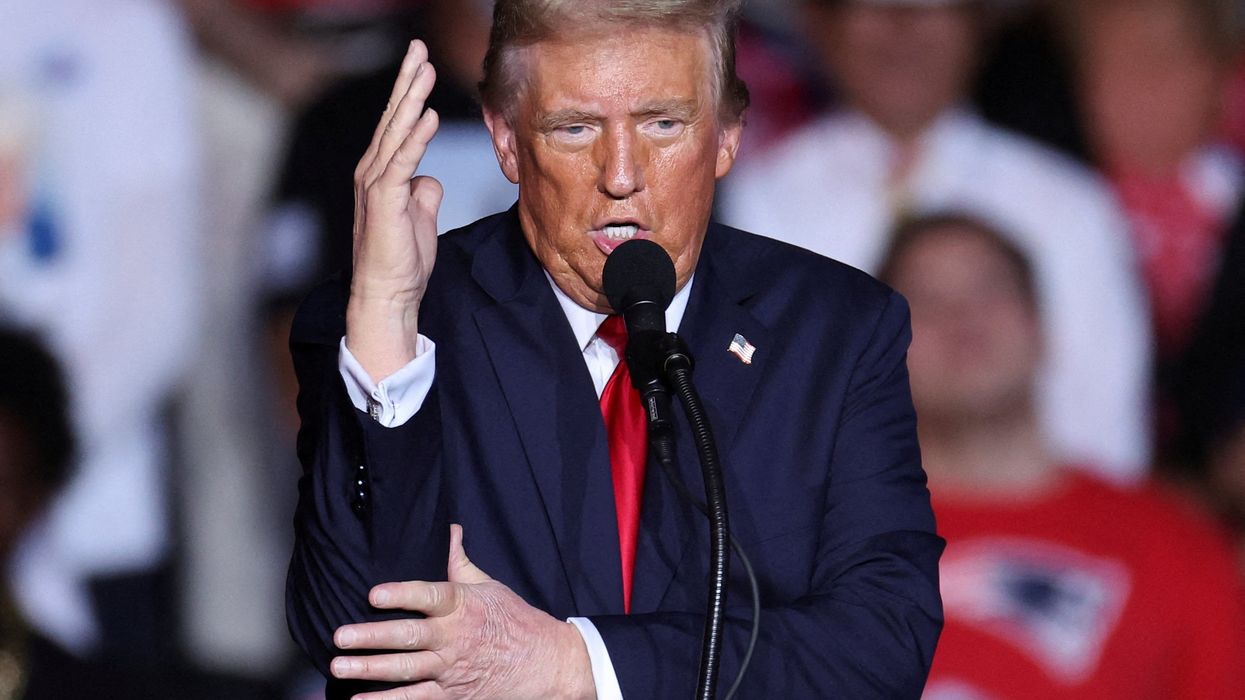
Republican presidential nominee and former U.S. President Donald Trump speaks during a rally, in Henderson, Nevada, U.S. October 31, 2024. REUTERS/Mike Blake TPX IMAGES OF THE DAY

December 23, 2025 
ALTERNET

With President Donald Trump’s massive corruption pulling down billions of dollars for himself and his family, MS NOW producer Steve Benen says it’s easy to forget that Trump originally campaigned on “draining the swamp.”

“As laughable as it might seem in hindsight, Donald Trump told voters that he saw the political establishment as a corrupt cesspool that he’d clean up in ruthless fashion,” Benen said. “… A decade later, amid frequent allegations of White House corruption and reports that the president is profiting from his office in unprecedented ways, that vow has become the punch line to a sad joke. And it’s striking to see the problem spreading in systemic ways as the first year of the Republican’s second term comes to an end.”

The New York Times released a recent report on nearly $2 billion Trump and his allies raised since Trump won his second term. Benen called this “a staggering sum for an incumbent who can’t run for reelection,” which the Times wrote “hints at a level of transactionalism for which it is difficult to find obvious comparisons in modern American history.”

Subsequently, the donors received wondrous hand-outs for their generosity.


“The New York Times conducted a comprehensive investigation. It relied on previously unreported documents and public campaign finance filings, as well as interviews with dozens of people who are familiar with the solicitations or are involved in the fund-raising,” the Times reports. “It traced a large portion of the funds raised — more than half a billion dollars’ worth — back to 346 donors who each gave at least $250,000. It also found that more than half of them have benefited, or are involved in an industry that has benefited, from the actions or statements of Mr. Trump, the White House or federal agencies.”

Benen said “to fully appreciate the scope of the underlying concern,” consider that of the 346 contributors who donated at least $250,000, at least 197 of them, which is more than half, either personally benefitted or their respective industry benefited “from policies of and actions taken by the president and his administration,” including favorable regulatory moves, pardons, the dropping of legal cases, presidential access and more.

“If you’re a voter who genuinely believed Trump’s ‘drain the swamp’ rhetoric ahead of Election Day 2016, I have some very bad news for you,” Benen said.

Read Benen's MS NOW column at this link.


State AGs Sue Vought Over ‘Unlawful’ Scheme to Bankrupt Consumer Protection Bureau

“By refusing to fund the CFPB, even when legal and appropriate funding mechanisms are available, the Trump administration has sharpened its message that it does not care about affordability.”

   
US Office of Management and Budget Director Russell Vought listens as President Donald Trump delivers remarks on October 21, 2025 in Washington, DC.
(Photo by Anna Moneymaker/Getty Images)


Jake Johnson
Dec 23, 2025
COMMON DREAMS


A coalition of attorneys general from across the US sued White House budget chief Russell Vought on Monday over his effort to completely starve the Consumer Financial Protection Bureau of funding, a ploy that—if successful—would eliminate a key path of recourse for Americans harmed by corporate abuses.

The lawsuit was filed in a federal court in Portland, Oregon by the top law enforcement officials of 20 states—including New York, California, Maine, and Hawaii—and the District of Columbia. The suit notes that Vought, in his capacity as acting director of the consumer bureau, “has worked tirelessly to terminate the CFPB’s operations by any means necessary—denying plaintiffs access to CFPB resources to which they are statutorily entitled.”

The attorneys general specifically challenge Vought’s “unlawful” refusal to request CFPB funding from the Federal Reserve. Under the law that established the consumer bureau, the agency receives funding from the Fed rather than congressional appropriations.

Vought has advanced a tortured definition of “earnings” to argue the Fed lacks funds from which the CFPB can draw, leaving him with no choice but to allow the agency he and his far-right allies have long opposed to languish.

The new lawsuit argues that Vought’s position violates the Administrative Procedure Act and the US Constitution. If allowed to stand, Vought’s refusal to seek CFPB funds would “make it all but certain that the CFPB will run out of funding completely in January 2026.”

California Attorney General Bonta said in a statement Monday that the Trump administration’s “latest effort to destroy the CFPB means that hundreds of thousands of consumer complaints will fall on deaf ears.”

“By refusing to fund the CFPB, even when legal and appropriate funding mechanisms are available, the Trump administration has sharpened its message that it does not care about affordability, that it does not care to be on the side of families and working Americans,” said Bonta.

The CFPB has been a target of big banks and other powerful corporations since its creation in the wake of the 2008 financial crisis. The agency’s success—it has returned more than $21 billion to consumers since 2011—has only intensified efforts by corporate-friendly lawmakers and right-wing bureaucrats to gut it.

Since taking control of the CFPB earlier this year, Vought has effectively shut down bureau operations and signaled a lax approach to enforcement.

US Sen. Elizabeth Warren (D-Mass.), an architect of the CFPB, applauded the state attorneys general for taking legal action against Vought.

“The Trump administration’s latest illegal attempt to shut down the Consumer Financial Protection Bureau will hurt families in every state across the country—and now states are fighting back,” said Warren. “Today’s new lawsuit underscores how illegally starving the agency of funding would turn off the consumer complaint database that has helped millions of Americans at the end of their rope after getting scammed.”

“If courts uphold the law,” she added, “they’ll reject this attempt to sideline the financial cop on the beat that has returned more than $21 billion directly to Americans cheated by big banks or giant corporations.”


Trump ‘Sends a Dangerous Message’ With ‘America First’ Diplomat Purge, Says Union

The American Foreign Service Association said the move “tells our public servants that loyalty to country is no longer enough—that experience and oath to the Constitution take a back seat to political loyalty.”


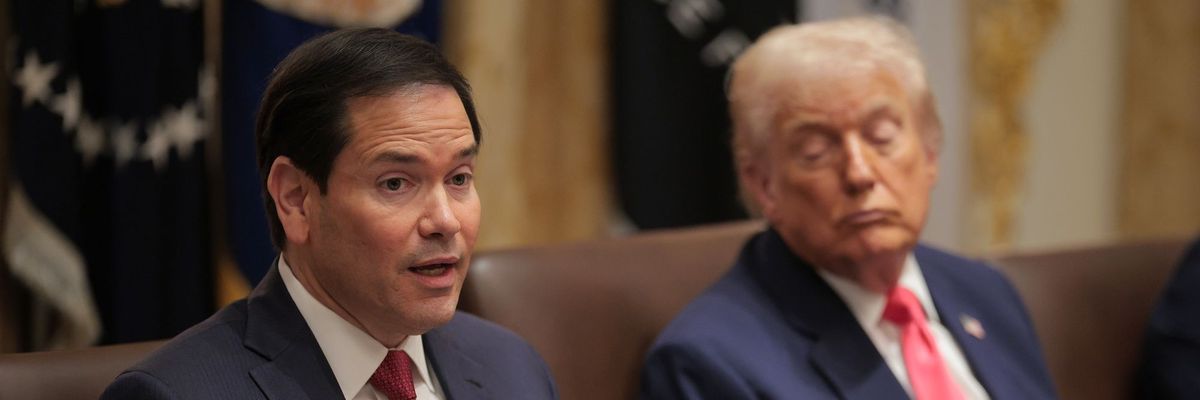
US Secretary of State Marco Rubio speaks beside President Donald Trump during a Cabinet meeting at the White House in Washington, DC on December 2, 2025.
(Photo by Chip Somodevilla/Getty Images)


Jessica Corbett
Dec 23, 2025
COMMON DREAMS

Following Politico‘s Friday reporting that “the Trump administration is recalling a number of career ambassadors appointed by former President Joe Biden,” several news outlets confirmed Monday that the purge is affecting at least 29 diplomats.

“This is a standard process in any administration,” an unnamed senior official at the US Department of State claimed to multiple journalists. “An ambassador is a personal representative of the president, and it is the president’s right to ensure that he has individuals in these countries who advance the ‘America First’ agenda.”

However, Nikki Gamer, a spokesperson for the diplomats’ union, the American Foreign Service Association (AFSA), told the New York Times that “those affected report being notified abruptly, typically by phone, with no explanation provided.”

“That method is highly irregular,” she said. “The lack of transparency and process breaks sharply with long-standing norms.”

Gamer told Reuters that “abrupt, unexplained recalls reflect the same pattern of institutional sabotage and politicization our survey data shows is already harming morale, effectiveness, and US credibility abroad.”

In a statement, the AFSA added: “To remove these senior diplomats without cause or justification sends a dangerous message. It tells our public servants that loyalty to country is no longer enough—that experience and oath to the Constitution take a back seat to political loyalty.”

According to the Associated Press:
Africa is the continent most affected by the removals, with ambassadors from 13 countries being removed: Burundi, Cameroon, Cape Verde, Gabon, Ivory Coast, Madagascar, Mauritius, Niger, Nigeria, Rwanda, Senegal, Somalia, and Uganda.

Second is Asia, with ambassadorial changes coming to six countries: Fiji, Laos, the Marshall Islands, Papua New Guinea, the Philippines, and Vietnam affected.

Four countries in Europe (Armenia, North Macedonia, Montenegro, and Slovakia) are affected; as are two each in the Middle East (Algeria and Egypt); South and Central Asia (Nepal and Sri Lanka); and the Western Hemisphere (Guatemala and Suriname).


Noting that there are about 80 vacant ambassadorships, Senate Foreign Relations Committee Ranking Member Jeanne Shaheen (D-NH) accused President Donald Trump of “giving away US leadership to China and Russia by removing qualified career ambassadors who serve faithfully no matter who’s in power.”


Eric Rubin, a retired career diplomat and former AFSA president, similarly highlighted that over half of US embassies won’t have a confirmed ambassador, which he called “a serious insult to the countries affected, and a huge gift to China.”

“This has never happened in the 101-year history of the US Foreign Service,” Rubin told CNN. “Ambassadors serve at the pleasure of the president. But every president has kept most career professional ambassadors in place until their successors are confirmed by the Senate.”

“The ambassadors who have been dismissed will mostly have to retire, which means the State Department will lose a large number of our most senior, experienced, and accomplished professionals,” he explained. “This is bad for our diplomacy, bad for our national security, and bad for our influence in the world.”
Japan

Takaichi Administration’s Two Months


Tuesday 23 December 2025, by Toshizo Omori


While LDP-JIP coalition government has been trying to promote right-wing policies, how should the left forces fight against them?


Approximately two months have passed since LDP (Liberal Democratic Party) President Takaichi became the prime minister with the support of the Japan Innovation Party (JIP) outside the cabinet, establishing the Takaichi administration. During this period, the government has pursued policies markedly divergent from the previous Ishiba administration, including accelerating the increase in military spending to 2% of GDP and formulating a large-scale supplementary budget that embodies Takaichi’s long-held stance on “aggressive fiscal policy.” This marks a return from a centrist-right administration to a conservative government inheriting the Abe administration’s policies. On the diplomatic front, while making its debut through summits with Trump and Xi Jinping and participation in the G20 summit, it also demonstrated indifference to the climate crisis by skipping the COP30 summit. Then came the remarks on Taiwan emergency situations during the Diet session on November 7th. Here, we will organize these series of moves by the Takaichi administration, analyze the political character of the government and its position within the international framework, and clarify the challenges and tasks of the left forces confronting this administration.

What Takaichi’s Remarks Sn “Taiwan emergency situations” Mean

First, let us examine Takaichi’s remarks on “Taiwan emergency situations”, which arguably most succinctly reveal both the political character of her administration and the position it finds itself in. During the House of Representatives Budget Committee session on November 7, when repeatedly questioned about a “Taiwan emergency situations” by Constitutional Democratic Party (CDP) member Katsuya Okada, Prime Minister Takaichi stated, “Various scenarios are conceivable,” adding, “If it involves the use of warships and the exercise of force, this would undoubtedly constitute a situation threatening Japan’s existence.” This statement by Takaichi significantly deviated from the “New Three Conditions for the Use of Force" approved by the Cabinet in July 2014 when the Abe administration shifted to permitting the exercise of collective self-defense rights. The first item of the “New Three Conditions states: Use of Force can be permitted “when an armed attack against Japan occurs or when an armed attack against a foreign country that is in a close relationship with Japan occurs and as a result threatens Japan’s survival and poses a clear danger to fundamentally overturn people’s right to life, liberty and pursuit of happiness,” but Takaichi’s remarks fundamentally changed the interpretation of collective self-defense itself. Consequently, this statement drew strong backlash from the Chinese government. On the 8th, Chinese Consul General in Osaka Xue Jian commented on X, citing news articles about Takaichi’s Diet statement: “That filthy neck that dared to stick its head in will have to be chopped off without a moment’s hesitation.” The Japanese government protested this comment, but online, right-wing rhetoric surged, with calls like “Expel the Consul General!” escalating. Takayuki Kobayashi, Chairperson of the LDP Policy Research Council and a right-wing figure within the party, further inflamed right-wing sentiment by stating at a party meeting, “As a party, we demand the government to take a resolute stance, including declaring him Persona non grata.”

Meanwhile, during the House of Representatives Budget Committee session on November 10, Prime Minister Takaichi stated she would not retract her November 7 ramarks. However, she also clarified that this did not constitute a change in the government’s previous stance. She then stated, “As a point for reflection, I believe it is prudent to refrain from explicitly mentioning specific cases in this forum,” effectively revising her remarks in order to calm the situation. Furthermore, during the December 16th Budget Committee meeting of the House of Councillors, she stated, “I recognize as a point for reflection that my remarks were perceived as going beyond the government’s previous position,” but she did not withdraw her remarks.

However, the Chinese government stated, “If (the Japanese side) dares to intervene militarily in the Taiwan Strait situation, even at the risk of danger, it will be crushed before the iron wall of the Chinese military’s defense and pay a bitter price.” (Chinese Ministry of National Defense Spokesperson Jiang Bin), and “Anyone who deludes themselves into challenging the Chinese people’s last line of defense will inevitably face China’s direct and severe counterattack, smashing their heads against the iron Great Wall built with the blood and flesh of 1.4 billion Chinese people, leaving them bloodied and broken.” (Chinese Foreign Ministry Spokesperson Lin Jian) Such statements were made, and countermeasures were swiftly implemented, including requests for Chinese citizens to refrain from traveling to Japan and to “exercise caution regarding study abroad,” de facto suspension of seafood imports, and cancellations of cultural exchanges and events. The Chinese government continues to demand a “withdrawal of the remarks,” and some reports indicate rare earth export procedures have begun to stall.

Regarding Takaichi’s “Taiwan emergency situations” remarks, Akira Koike, JCP Secretary-General, criticized the prime minister’s remarks as “provocative rhetoric that escalates tensions, … It’s not too late now. We demand a retraction.” While this criticism is understandable, even the Sankei Shimbun, a dairy newspaper representing conservative opinion, noted: “There is no sign the government as a whole carefully prepared for this response, … The reality is that in the back-and-forth of Diet debate, she let her true feelings slip,” and while “the content of the Prime Minister’s response itself is not incorrect, … it cannot be denied that there is a danger in Takaichi’s remarks.”

Thus, after the “Taiwan emergency situations” remarks, the government was immediately forced to scramble to contain the damage (and insist it was “consistent with the government’s previous stance”). This is likely because Japan’s bourgeois majority, while approving military expansion policies, currently does not wish to see a deterioration in relations with China. Furthermore, U.S. President Trump also does not currently desire a worsening of Japan-China relations in order to secure a deal between the U.S. and China (there are also reports that Trump urged Takaichi to exercise restraint during a Japan-U.S. summit phone call). Amidst the Japanese bourgeois majority’s paramount demand for “political stability,” the scope for adventurous policies is preemptively restricted. However, the government faces a dilemma: retracting the “Taiwan emergency situations” remarks would risk losing the support of conservative public opinion—arguably its sole foundation—and jeopardize its current high approval ratings, potentially leading to its collapse. Thus, retraction is realistically impossible.

Takaichi’s remarks themselves are an extension of the Abe administration’s series of military expansion policies, from permitting the exercise of collective self-defense and enacting security legislation, to revising the three security documents, deploying the Self-Defense Forces to the Southwest Islands and constructing missile bases, and expanding military spending. Moreover, they align with Takaichi’s longstanding positions. In that sense, her remarks themselves were not surprising. However, it is also a fact that previous government leaders, even if they privately held similar views (former Prime Minister Abe made similar remarks after leaving office), never voiced them in official settings due to diplomatic considerations. This point has been criticized, as mentioned earlier, by the Sankei Shimbun.

One crucial point to highlight here is that both Takaichi’s statement and China’s reaction to it share a common flaw: they completely disregard and ignore the struggles and right to self-determination of the Taiwanese people. Looking back historically at the situation surrounding Taiwan, over the past 150 years since modern times, particularly since Japanese imperialist colonial rule, we see a history of colonial governance and resistance against it, followed by post-war arrangements after Japan’s defeat, the US-Soviet Cold War era, and China’s subsequent rise as a new hegemonic power after the Cold War’s end. Concurrently, Taiwan experienced anti-authoritarian movements, democratization, and economic development. Through this process, Taiwan has formed an identity, institutions, and way of life distinct from mainland China under the CCP. It has become a political and economic entity possessing a degree of autonomy and independence within the international community, irrespective of its state recognition status. In other words, the Taiwanese people’s right to self-determination has historical justification, and discussions of easing tensions or achieving peace in East Asia cannot proceed without acknowledging this fact.

Takaichi’s “Taiwan emergency situations” remarks, which intensify tensions in East Asia and fuel further arms races among the involved nations, must be retracted. We must demand this retraction as a shared demand of the people of East Asia. Within Japan too, there is a need to build a movement that converges with this shared demand. In a sense, Takaichi’s remarks amount to a “declaration of war,” and the ones who will ultimately suffer the consequences are the people of East Asia, the residents of Okinawa and the Southwest Islands, and the young people who will be mobilized for war.

The Takaichi LDP-IJP Coalition Administration as The Transitional One

As pointed out in the article, “Takaichi Administration established by the LDP-JIP Coalition : How to interpret the current Japanese political situation”( IVP, November 7), the Takaichi administration came into being as a result of political realignment within the conservative-centrist forces. This occurred in a context where the left is decisively weak within Japanese politics, particularly in the parliamentary arena, and where social movements and mass movements also lack significant influence. Consequently, the left does not pose a perceived threat to the conservative-centrist forces. This occurred due to a combination of factors; increasing sense of crisis within the LDP over the fact that the former ruling coalition of LDP and Komeito lost its majority in the House of Councillors following the House of Representatives, that an far-right party positioned to the right of the LDP made significant gains, and that a portion of the LDP’s conservative supporters shifted their allegiance to the far-right; the changing balance of power between the Democratic Party for the People and the Japan Innovation Party within the center-right bloc, combined with the Constitutional Democratic Party’s inability to take political initiative as the largest opposition party, created the conditions for Sanae Takaichi to be elected LDP president and subsequently nominated as prime minister. However, as the article also points out, the Takaichi administration’s foundation is not rock-solid, and its policy options are not entirely unrestricted.

Indeed, in the House of Representatives, the addition of three lawmakers expelled from the Japan Innovation Party to the LDP caucus barely secured a majority. In the House of Councillors, efforts are underway to secure a majority through cooperation requests from the JIP to far-right parties. Nevertheless, the situation is far from the stable governance seen during the previous LDP-Komeito coalition. In any case, the Takaichi administration is fundamentally a transitional government. In this sense, we must recognize that political realignment within the conservative-centrist bloc will continue for a certain period, potentially even drawing in far-right parties to some extent. The problem is that the left is being completely left out of this political realignment process.

The global Remilitarization Trend Led by the Ruling Class and the Japanese Government’s Military Expansion Policy

Japan’s military buildup, initiated under the Abe administration and further advanced under the Kishida and Ishiba administrations, is part of the arms race in East Asia. It also fits within the global trend of remilitarization triggered by Russia’s invasion of Ukraine and the return of the Trump administration. President Trump demanded that allied nations in Europe and East Asia increase their military spending to 5% of GDP, while reducing his own military presence in these regions and shifting toward a military strategy centered on the Western Hemisphere. European nations are already further advancing remilitarization through substantial increases in military spending and transitions to conscription. In East Asia, amid the geopolitical rivalry between the United States and China, the US military is being redeployed, and military buildup is occurring in South Korea, Taiwan, and Japan in response to China’s military expansion. The “U.S. National Security Strategy” released on December 5 states, “We will build a military capable of denying aggression anywhere in the First Island Chain. But the American military cannot, and should not have to, do this alone. Our allies must step up and spend—and more importantly do—much more for collective defense.” It further states, “America’s diplomatic efforts should focus on pressing our First Island Chain allies and partners to allow the U.S. military greater access to their ports and other facilities, to spend more on their own defense, and most importantly to invest in capabilities aimed at deterring aggression.” This effectively pressures the Takaichi administration to implement substantial increases in military spending, accelerate military expansion, and strengthen the deployment of Japan’s Self-Defense Forces in Okinawa and the Southwest Islands.

Even within this international framework, the Takaichi administration’s acceleration of military expansion far exceeds that of previous LDP-Komeito governments. For example, the LDP-JIP coalition agreement lists items such as; “In response to the most severe and complex changes in the strategic environment since the postwar period, the Three Strategic Documents will be revised ahead of schedule,” “We will steadily advance the development and land-based deployment of long-range missiles with counterstrike capabilities, while simultaneously promoting policies to acquire next-generation VLS-equipped submarines powered by advanced propulsion systems. These submarines will carry long-range missiles and enable extended-duration, long-distance submerged operations.,” and “From the perspective of strengthening the defense production and technological base, the 2026 ordinary session of the Diet will abolish the “five categories” of the “Guidelines for the Application of the Three Principles on Defense Equipment Transfer.” Furthermore, it is reported that some members within IJP are also seeking to permit arms exports to countries involved in conflicts.

Although the Takaichi administration publicly denies it, discussions to review the “not permitting the introduction of nuclear weapons” principle within the “Three Non-Nuclear Principles” have reportedly resurfaced within the LDP and may be debated during the revision of the “Three Strategic Documents.” Takaichi did not explicitly affirm adherence to the “Three Non-Nuclear Principles” in her Diet response, which aligns with her longstanding position.

In addition, foundation for national unity supporting military expansion rests on an authoritarian repressive regime and xenophobic policies that create external enemies. Concrete expressions of this include the enactment of the “National Flag Desecration Law,” the Anti-Espionage Law, and strengthened regulations on foreigners.

Imposing Sacrifices on Working People Through an “Active Fiscal Policy” Approach

Globally and historically, capitalism faces a new crisis where it has lost the ability to encompass society as a whole. Capitalism has no choice but to intensify its economic and social attacks on working people. This has led to a worldwide spread of distrust toward bourgeois governments. In the absence of a mass-visible alternative, the far right is rising. This situation has belatedly become a reality in Japan as well. In this context, Takaichi has proposed a “responsible active fiscal policy” alongside a strong state and nationalism and has explicitly incorporated the military-industrial complex into her economic growth strategy. This is precisely why she is seeking to abolish the “five categories [rescue, transport, surveillance, monitoring, mine clearance]” stipulated in the “Guidelines for the Application of the Three Principles on Defense Equipment Transfer,” and fully lift the ban on arms exports.

Masaru Kaneko describes this as “Military Keynesianism,” explaining it as “a concept where, instead of creating effective demand through public works as intended, military spending is used to generate immediate employment and economic stimulus.” He points out, “The frightening aspect of Military Keynesianism is the loss of restraint. The U.S. military-industrial complex is already built into the American economy, making the U.S. the most war-prone nation in the postwar world.”

Takaichi’s economic policy, built on the twin pillars of “responsible active fiscal policy” and “Military Keynesianism,” inherently contains contradictions. The massive issuance of government bonds needed to support “active fiscal policy” risks undermining confidence in the financial system, potentially triggering a triple dip of falling stocks, bonds, and the yen. Indeed, on November 18th, Tokyo’s financial markets saw a “triple dip” as bonds, stocks, and the yen all sold off simultaneously. “The yield on the benchmark 10-year government bond rose to 1.755% at one point (bond prices fell), hitting its highest level in about 17 and a half years since June 2008. The yen also weakened to the low 155 yen per dollar range. The Nikkei Stock Average fell over 1,600 points, dropping below the 50,000 mark” (Jiji Press). As of December 9, long-term interest rates have reached 1.95%. The weak yen is fueling persistent inflation, driving up prices for food and other goods (the consumer price index for October 2025 rose a full 3.0%!). Attempts to counter this could trap us in a negative spiral of relying on more government bond issuance. The only beneficiaries of the weak yen are large export-oriented corporations. Meanwhile, inflation driven by the weak yen continues to erode workers’ real wages (the decline in real wages was 1.4% in September and 0.7% in October, marking ten consecutive months of decline), pushing pensioners and non-regular workers into increasingly difficult living conditions.

A massive supplementary budget reliant on government bond issuance, shifting focus to economic growth and increased military spending

At a press conference on November 21, Prime Minister Takaichi announced a supplementary budget proposal totaling 21 trillion yen (including tax reduction of 2.7 trillion yen). Takaichi stated, "What Japan must do now is not to weaken national strength through excessive fiscal austerity, but to strengthen it through active fiscal measures. As the IMF (International Monetary Fund) has pointed out, we must recognize that hasty fiscal consolidation that harms growth actually undermines fiscal sustainability. Fiscal sustainability cannot be maintained without growth.” However, she showed no reflection whatsoever on the failure of her mentor, former Prime Minister Abe’s ”Abenomics," to generate any growth in the Japanese economy.

Nevertheless, to maintain his current high approval ratings, she had to propose some measures against rising prices. Thus, the primary pillar of the supplementary budget is “Living Security and Countermeasures against High Prices.” Its contents include household price relief measures; “529.6 billion yen for electricity and gas bill support” (reducing household burdens by about 7,000 yen from January to March), “2 trillion yen for expanding the Special Tax Revenues Allocated to Local Government, including 400 billion yen allocated separately as a ‘Special Supplement for Rising Food Prices’ equivalent to 3,000 yen per person” (e.g., distributing “rice coupons”), and “367.7 billion yen for the Child-Rearing Support Allowance to Counter Rising Prices” (providing 20,000 yen per child up to high school age). However, regarding the “rice coupons” strongly advocated by Agriculture Minister Suzuki, many municipalities—starting with Katano City in Osaka—have declared they “will not distribute rice coupons” due to issues like the coupons only allowing purchases worth 440 yen for a 500-yen coupon and the enormous distribution costs involved. Furthermore, regarding the abolition of the provisional gasoline tax rate (¥25.1) as a tax reduction measure, the Mitsubishi Research Institute states that “the reduction in gasoline spending from abolishing the provisional tax rate will be outweighed by increased spending due to inflation if the yen weakens by another ¥5” (Mainichi Shimbun), suggesting the actual effect is unlikely to be significant.

In this manner, while introducing stopgap measures that lack real effectiveness to address livelihood anxieties, the budget allocates 6.433 trillion yen to the second pillar, “Realizing a Strong Economy through Crisis Management Investment and Growth Investment.” Furthermore, it allocates 1.656 trillion yen to the third pillar, “Strengthening Defense and Diplomatic Capabilities.” This aims to achieve the 2% GDP target for defense spending ahead of schedule, including ¥502.1 billion for defense capability development plan expenditures.

To fund these expenditures, government bond issuance will exceed last year’s supplementary budget of 6.6 trillion yen, reaching 11.7 trillion. Combined with the initial budget, the total bond issuance after adjustments will amount to 40.3 trillion yen. In a sense, this is an economic policy that relies on sustained inflation to increase tax revenues and reduce the government debt balance. On the other hand, measures abound that seek to cover the collapse of social systems by extracting from the working people; continued cuts to welfare benefits, increases in nursing care insurance premiums and user fees, hikes in health insurance premiums, higher out-of-pocket medical expenses for the elderly, and rising medical costs. Furthermore, to fund increased military spending, the government is preparing to implement tax hikes, including increases in income tax.

Labor Time Deregulation Policies Driving Workers to Death by Overwork

Another pillar of the Takaichi administration’s policies is a structural shift in labor policy. On October 20th, Prime Minister Takaichi instructed the Minister of Health, Labor, and Welfare to deregulate labor hours, positioning this as a cornerstone of the growth strategy. This aims to further relax the working hour regulations (which, though insufficient, were achieved due to worker demands but still allow levels leading to death from overwork—the overtime cap is generally 45 hours per month and 360 hours annually, but under special circumstances, up to 100 hours per month and an average of 80 hours over 2-6 months is permitted), forcing workers into even longer hours. Takaichi’s statement, “We will work and work and work and work and work,” was selected for the New Words and Buzzwords Awards, heightening the sense of crisis among families of overwork suicide victims, who have gone so far as to hold protest press conferences. We absolutely must not allow this new relaxation of working hour regulations.

Against the Takaichi Administration’s Destruction of Livelihoods and Military Expansion, Let Us Build a Mass Movement of Working People and Achieve the Revival of the Left

As the capitalist system has lost its ability to control and unify society as a whole, bourgeois governments are increasingly turning authoritarian and intensifying their attacks on the working people. This has heightened distrust in the existing ruling order and fueled the rise of the far right. Yet, simultaneously, a counteroffensive by the working people, especially centered on the younger generation, is surging globally. In recent years, this has erupted most typically across Asian nations; overthrowing governments in Bangladesh, Sri Lanka, and Nepal; expanding mass protest movements in Indonesia and the Philippines; and in South Korea, thwarting a coup attempt and leading to a change of government. In Myanmar, the struggle against the military dictatorship continues. While there remains a weakness in the absence of initiatives to steer these struggles toward a break with the capitalist system, the counterattack has indeed begun.

In Japan, compared to these countries, it cannot be said that large-scale mass actions, strikes, or street protests centered on the younger generation have emerged. However, the signs are definitely beginning to appear. In various places, objections and counterattacks against the bourgeois government’s policies are gradually starting. Moreover, we should not underestimate the fact that the younger generation expressed support for the Democratic Party for the People and the Sanseito (Party of Do it Yourself) instead of traditional parties, influencing election results, which was surely a sign of change. The temporary support these parties are gathering reflects precisely the marginalization of the left and its failure to propose a clear alternative. Moreover, such alternatives will be meaningless unless they are visualized as slogans and claims that resonate with the working people. Concrete slogans for struggle are forged through the collective effort of the movements, drawing on its experiences. This is precisely the challenge the left must confront.

To achieve this, it is crucial to mobilize dissatisfaction, objections, and demands against the Takaichi administration’s destruction of livelihoods and military expansion into a movement, forging them into a united, powerful current. Concurrently, building the subjects necessary for this mobilization—such as restoring the power of labor unions and constructing broad-based movement networks—must be pursued. Exerting strength in this endeavor will become one pathway leading to the left’s rebirth.

December 17, 2025

Translated by Tsutomu Teramoto from Weekly Kakehashi


Attached documentstakaichi-administration-s-two-months_a9323.pdf (PDF - 938.7 KiB)
Extraction PDF [->article9323]

Japan
Takaichi Administration established by the LDP-JIP Coalition : How to interpret the current Japanese political situation
A warning from history: ‘This is what is going to happen to you’
Racism deliberately concealed for 100 years
Start of radical political change for the working class in Japan
Homophobia that has exposed more than 300 people to sexual violence for decades


Toshizo Omori  is a Japanese Fourth Internationalist.


'This terrifies me!' CNN's Maria Cardona freaks out that Trump might deport her

Travis Gettys
December 23, 2025
ALTERNET


Penny Nance and Maria Cardona/CNN

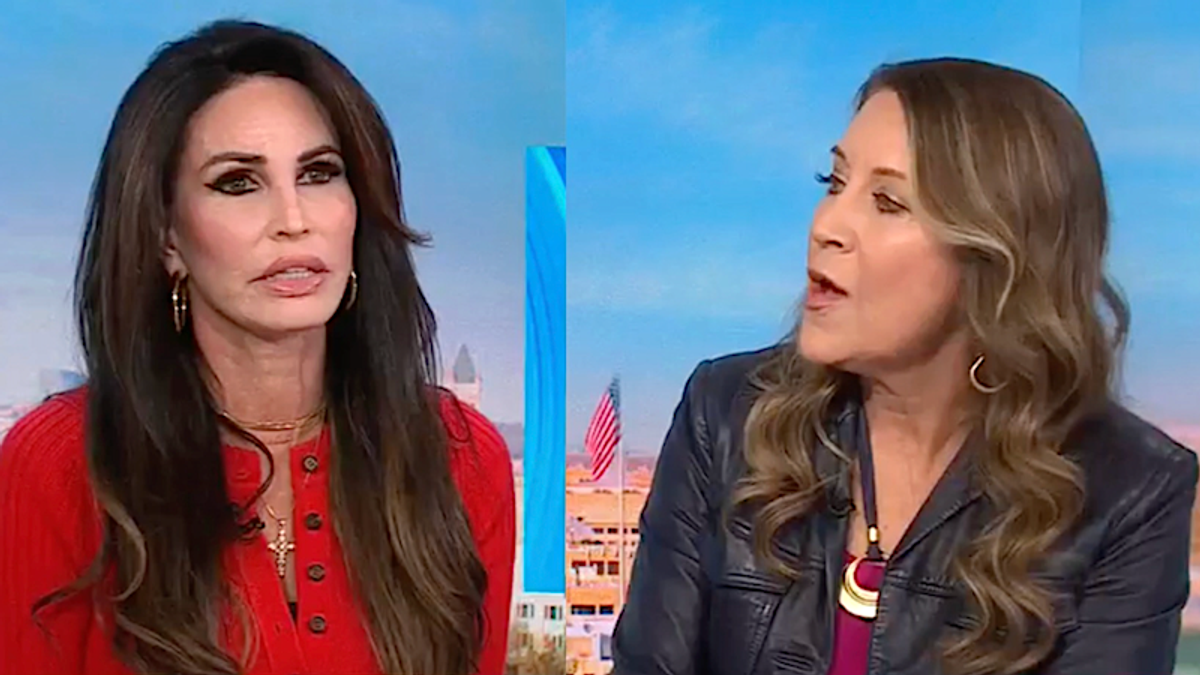
CNN's Maria Cardona lost patience with a conservative panelist's efforts to justify the detention and deportations of U.S. citizens as part of President Donald Trump's immigration crackdown.

The panelists were discussing the case of Dulce Consuelo Díaz Morales, a Baltimore mother in ICE custody whose attorney says was born in the United States, but Concerned Women for America CEO Penny Nance argued that mistaken deportations were to be expected in a massive operation she deems necessary, citing two examples of women who were slain by undocumented migrants.

"Listen, that was a very sympathetic story, and I did feel for her parents who said there's an empty place at their dinner table for Christmas," Nance said. "But I also think about Jocelyn Nungaray's family, who have an empty place forever, and also Laken Riley's family, who have an empty place forever, and the people who died because of drunk drivers who weren't supposed to be in this country..."

"Hold on, let me just finish," Nance said, fending off Democratic strategist Cardona's attempts at retort. "We need to make sure we get it right, and they need to do this. No, hold on, the overall story is the fact that 77 million people voted for Donald Trump, and they want us to close the borders and they want to clean up the mess because Venezuela sent in criminals into our country, and people that shouldn't be here were allowed in, and we've got to clean it up, and it's just messy."

Cardona finally got a chance to say her piece.

"Penny, you know I love you and we have been friends for quite a while, but what you're saying has absolutely nothing to do with this," Cardona said. "This woman is a U.S. citizen, she was born here. If that's true. Hang on, hang on, this makes – her lawyer was showing her birth certificate. What else do they need for this to be true?"


This makes my blood boil, and it makes everyone's blood run cold who are not just U.S. citizens," Cardona added. "I am a naturalized citizen – this terrifies me."
‘Devastating’: Amnesty Rips Hegseth Memo Reversing Limits on Landmines

“Antipersonnel landmines are inherently indiscriminate weapons that take a disproportionate toll on civilian lives, oftentimes long after conflicts end,” said the group’s director for Europe and Central Asia.


Ukrainian deminers from the HALO Trust, worldwide humanitarian nongovernment organization, clear territories on April 17, 2025 in Chernihiv Oblast, Ukraine. Due to the ongoing Russian-Ukrainian war, Ukraine is now one of the most mined countries in the world.
(Photo by Maksym Kishka/Global Images Ukraine via Getty Images)


Stephen Prager
Dec 23, 2025
COMMON DREAMS

In a move decried by human rights organizations, the Trump administration has scrapped a Biden-era prohibition on the use of antipersonnel landmines, which killed thousands of noncombatants last year.

The Washington Post reported on Friday that US Secretary of Defense Pete Hegseth sent a memo on December 2 reversing the policy, saying the use of such mines would provide the US military with a “force multiplier” against enemies during “one of the most dangerous security environments in its history.”


‘Truly Barbaric’: Number of People Killed or Maimed by Landmines Hits Five-Year High


Poland to Weaken Global Treaty by Making Landmines for Eastern Border and Possibly Ukraine

“Antipersonnel landmines are inherently indiscriminate weapons that take a disproportionate toll on civilian lives, oftentimes long after conflicts end,” explained Ben Linden, Amnesty International USA’s advocacy director for Europe and Central Asia, in a statement on Tuesday.

According to a report published earlier this month by the Nobel Peace Prize-winning International Committee to Ban Landmines (ICBL), antipersonnel landmines and other explosive remnants of war killed at least 1,945 people and injured another 4,325 in 2024—the highest yearly casualty figure since 2020 and a 9% increase from the previous year.

Ninety percent of those casualties were civilians, and 46% of those civilians were children.

More than 160 countries have signed an international treaty, written in 1997, banning the use of antipersonnel landmines, defined as mines “designed to be exploded by the presence, proximity or contact of a person and that will incapacitate, injure or kill one or more persons” in war.


The US military has not used antipersonnel mines widely since the Persian Gulf War over three decades ago. However, it is one of the few countries that has not signed the treaty, known as the Ottawa Convention, and until earlier this year was the only NATO member not to participate.

In June 2022—just months after Russia launched its invasion of Ukraine—then-President Joe Biden announced the US would begin to follow many provisions of the convention, outlawing the use of antipersonnel mines in war zones with the exception of the Korean Peninsula. It was a return to a policy instituted under former President Barack Obama, before it was rolled back during the first Trump administration.

The Biden White House cited the mines’ “disproportionate impact on civilians, including children,” and drew a contrast with Russia, which it said was using the mines “irresponsibly” in civilian areas.

But Biden would reverse the policy just two years later, opting in 2024 to greenlight their provision to Ukraine, which was forbidden from acquiring or using the mines under the treaty.

The ICBL, a leading donor to global mine clearance, condemned the move, noting that “Ukraine already faces years of demining due to Russian landmine use.”

In his memo, Hegseth has delivered another blow to global demining efforts. According to the Post:
He outlines five objectives for the new policy—including lifting geographic limits on the use of landmines, which would allow for their use globally, and giving combatant commanders the authority to use the explosives. It would also limit the destruction of landmines in the US inventory only to those that are “inoperable or unsafe.”

The decision comes as other state actors are rapidly abandoning their obligations under the landmine treaty. Last week, Poland announced that after withdrawing from the convention, it plans to start producing antipersonnel mines again, deploying them to the eastern border, and possibly exporting them to Ukraine.

According to the ICBL report, Cambodia, Iran, Myanmar, and North Korea have all been alleged to have used mines within the last year. Meanwhile, Estonia, Finland, Latvia, and Lithuania are also in the process of withdrawing from the Ottawa Treaty, while Ukraine is trying to “suspend the operation” of the convention during its war with Russia.

Hegseth’s memo also states that President Donald Trump has rescinded the US Humanitarian Mine Program, a long-running government initiative that helps partner nations find and destroy unexploded landmines.

According to the Landmine and Cluster Munition Monitor, the research arm of the Campaign to Ban Landmines, the US was the largest global donor to mine-clearing actions around the world in 2024. According to the State Department, it has provided more than $5 billion in assistance to more than 125 countries and areas since 1993.

Some of the money for the program has already been revoked through the Trump administration’s slashing of funds for the US Agency for International Development (USAID) at the beginning of his term. The administration ordered mine-clearing nonprofits funded by the agency to cease operations “effective immediately.”

According to a report earlier this month from the Century Foundation, the State Department “terminated or let expire” nearly 100 security assistance programs, which included demining programs, as part of its “foreign aid review” in January.

Hegseth’s memo states that despite the end of the program, the US will remain “a global leader in unexploded ordnance clearing assistance and in conventional weapons destruction.” It provides no details on how the new policy would allow for this.

Linden at Amnesty International called Hegseth’s reversal of the landmine policy a “devastating decision.”

“Not only will this policy change put more civilians at increased risk of harm, but it will undermine global efforts to eliminate the use of these dangerous weapons,” Linden said. “This landmine policy reversal would make the United States and its partners less safe by eroding the prohibition against the use of these indiscriminate weapons on the battlefield.”
‘Dangerous and Cruel’: Trump VA Quietly Bans Abortion Even for Rape and Health Risks

“This decision endangers the health, lives, and futures of the people who have served our country—and it proves what we’ve long warned: Trump and his allies won’t stop until they’ve imposed a national abortion ban.”


Jessica Corbett
Dec 23, 2025
COMMON DREAMS

Defenders of reproductive rights on Tuesday responded with alarm after President Donald Trump’s administration quietly imposed an abortion ban at the US Department of Veterans Affairs following a legal opinion penned by a deputy assistant attorney general.

After the 2022 Roe v. Wade reversal, the Biden administration allowed the VA to provide abortion counseling and care for service members and beneficiaries in cases of rape, incest, or if the pregnancy threatened the health of the patient. Once Trump returned to power, the department proposed a rule that would end those exceptions—though the VA would continue treating ectopic pregnancies and miscarriages, and allow abortions “when a physician certifies that the life of the mother would be endangered if the fetus were carried to term.”

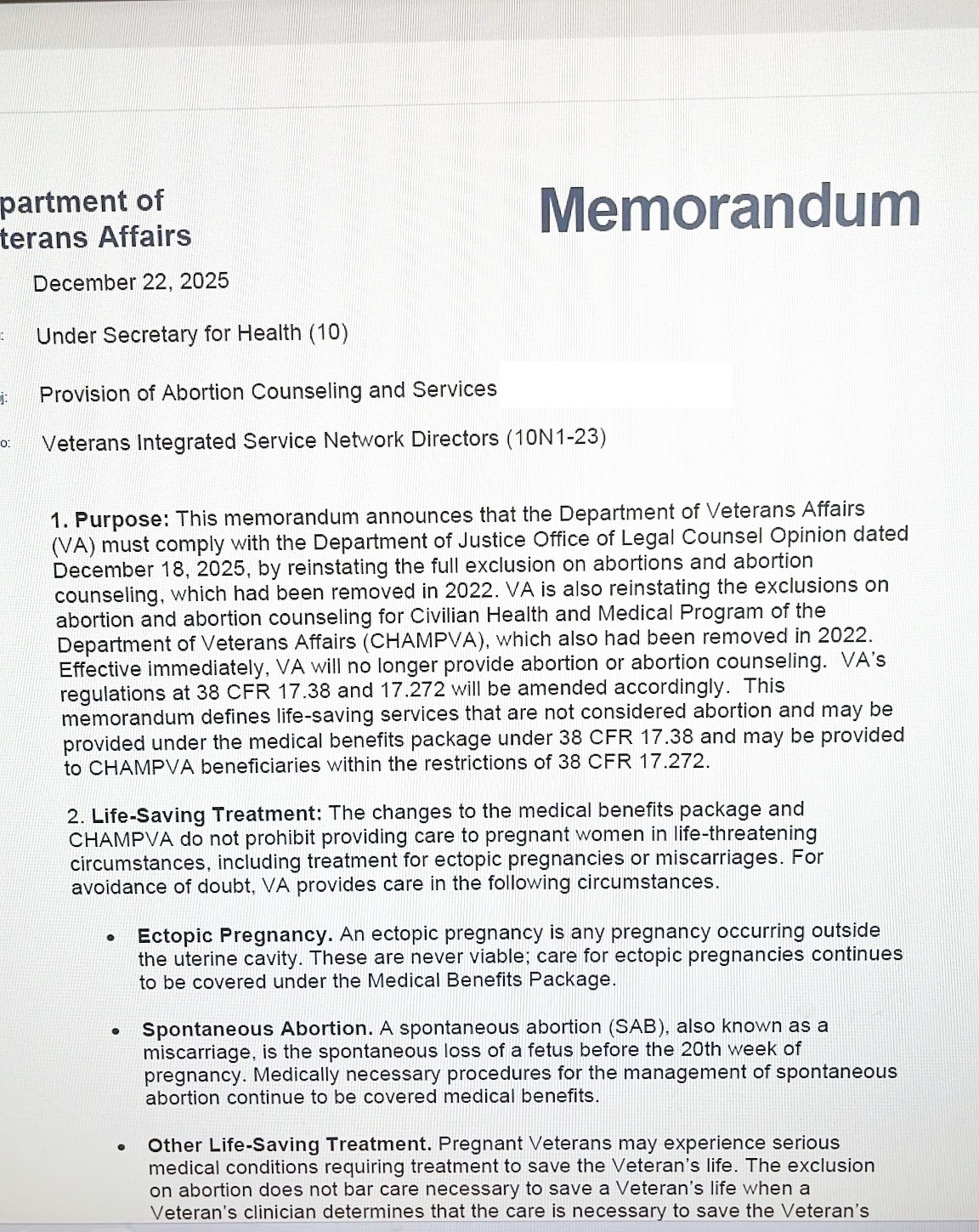
Although that rule hasn’t taken effect, the US Department of Justice last week issued a memo in which Joshua Craddock of the Office of Legal Counsel concludes that the 2022 policy wasn’t legally valid. The VA on Monday issued its own internal memo—obtained by the legal group Democracy Forward and reported by MS NOW—announcing immediate compliance with the DOJ’s opinion, effectively implementing the proposed rule without finishing the formal process for doing so.

“DOJ’s opinion states that VA is not legally authorized to provide abortions, and VA is complying with it immediately,” Pete Kasperowicz, press secretary for the VA, confirmed to MS NOW, without answering further questions. “DOJ’s opinion is consistent with VA’s proposed rule, which continues to work its way through the regulatory process.”

Skye Perryman, president and CEO of Democracy Forward, said in a statement that “denying veterans essential healthcare and abortion access—even in cases of rape or serious health risk—after they have sacrificed so much for our country is callous and inhumane.”

Democracy Forward represented Minority Veterans of America in submitting a comment opposing the proposed rule, and Perryman pledged that “we will continue to fight its implementation now that it has been finalized.”

“This abortion ban makes it clear that the Trump administration will always choose its dangerous political agenda, even if the cost is veterans and their families’ access to essential care.”

Minority Veterans of America co-founder and executive director Lindsay Church also denounced the “dangerous and cruel” policy shift.

“Veterans face unique challenges that make it critical for us to be able to access abortion care, including possible exposure to toxic chemicals, waiting to start a family until after our service, and experiencing sexual assault,” she said. “Abortion should not be a political issue—it is necessary, life-saving medical care, and denying this care will put veterans and their loved ones’ lives in danger.”

Fatima Goss Graves, president and CEO of the National Women’s Law Center, warned that “the Trump administration is confirming what we’ve always known: its promise to leave abortion to the states was a lie. No one is safe from their anti-abortion crusade, not even our nation’s veterans.”

Goss Graves called on federal lawmakers to “pass legislation to reverse this harmful new policy and reinstate abortion access to all veterans and their loved ones who depend on the VA for care,” though such a bill is unlikely to advance in the current Republican-controlled Congress.

Reproductive Freedom for All president and CEO Mini Timmaraju similarly declared that “this decision endangers the health, lives, and futures of the people who have served our country—and it proves what we’ve long warned: Trump and his allies won’t stop until they’ve imposed a national abortion ban.”

Nancy Northup, president and CEO at the Center for Reproductive Rights, argued that “everyone should be appalled by this heartless policy. President Trump said he would leave abortion to the states, but he continues to seize new opportunities to restrict it nationally.”


Planned Parenthood Federation of America highlighted that “this ban goes into effect as the Trump administration and its allies in Congress continue a full-scale attack on access to sexual and reproductive health: stripping veterans of essential healthcare, slashing Medicaid, and ‘defunding’ Planned Parenthood.”

Alexis McGill Johnson, the group’s president and CEO, said that “this abortion ban makes it clear that the Trump administration will always choose its dangerous political agenda, even if the cost is veterans and their families’ access to essential care.”

Earlier this year, House Committee on Veterans’ Affairs Ranking Member Mark Takano (D-Calif.) and Senate Committee on Veterans’ Affairs Ranking Member Richard Blumenthal (D-Conn.) led over 230 of their colleagues in submitting a public comment against the Trump administration’s proposed rule. Takano and other members of the House panel also spoke out on Tuesday.

“As a country, we made a solemn promise to honor veterans’ service and ensure they receive the healthcare they have earned. Veterans should be able to trust that promise and know they can walk into a VA medical center and receive the care they need,” said Takano. “Instead of trusting veterans to make the healthcare decisions that are best for them, VA is allowing political opinion to supplant its duty to veterans.”

“Instead of allowing veterans to discuss all their healthcare options openly and honestly with their providers, VA has decided that the government should be in charge of making healthcare decisions, even in matters of life and death,” he continued. “And instead of fulfilling its duty to provide needed healthcare to veterans, VA has refused to acknowledge the unique and complex healthcare needs of veterans who are more likely to have complex health conditions that can increase the risks associated with pregnancy. Veterans fought for our rights. Now it’s our responsibility to fight for theirs.”


‘Cruel, Unnecessary, and Irresponsible’: Trump Admin to Resume Garnishing Wages of Student Borrowers

One group noted “the irony of a billionaire being in charge of collecting pennies from debtors.”


Student loan borrowers and advocates gather for a rally on February 28, 2023 in Washington, DC.
(Photo by Jemal Countess/Getty Images for People’s Rally to Cancel Student Debt)

Jake Johnson
Dec 23, 2025
COMMON DREAMS

The US Education Department confirmed Monday that, starting next month, it will resume seizing the pay of student loan borrowers in default as the Trump administration wages a broader war on debt relief and cancellation efforts.

The department, led by billionaire Linda McMahon—who is working to gut the agency from the inside—told the Washington Post that “it will notify about 1,000 defaulted borrowers of plans to withhold a portion of their wages to pay down their past-due debt,” beginning the week of January 7, 2026.

“After that, the department said, notices will be sent to larger numbers of borrowers each month,” the Post reported. “There were about 5.3 million borrowers who had not made a payment on their federal student loans for at least 360 days as of June 30, according to the latest available data from the Education Department. Many of them were in default before the federal government stopped collecting defaulted loans because of the pandemic nearly six years ago.”

Persis Yu, deputy executive director and managing counsel of the advocacy group Protect Borrowers, said in a statement Tuesday that “at a time when families across the country are struggling with stagnant wages and an affordability crisis, this administration’s decision to garnish wages from defaulted student loan borrowers is cruel, unnecessary, and irresponsible.”

“As millions of borrowers sit on the precipice of default, this administration is using its self-inflicted limited resources to seize borrowers’ wages instead of defending borrowers’ right to affordable payments,” said Yu. “There are still nearly a million unprocessed Income-Driven Repayment applications, and this administration has admitted to denying en masse borrowers who applied and requested the US Department of Education’s help in accessing the most affordable payment option.”

“Finally, during the last Trump administration, hundreds of thousands had their wages improperly taken at the peak of the pandemic because the US Department of Education was unable to control this tool,” Yu added. “It is irresponsible to turn on a debt collection tool that the administration cannot turn off.”

In May, the Trump administration ended a pause on student loan repayments that had been in place since the onset of the Covid-19 pandemic in 2020.

The administration has also attacked student debt relief efforts launched under former President Joe Biden. Earlier this month, the Trump Education Department cut a deal to effectively end the Saving on a Valuable Education (SAVE) plan, jacking up monthly payments for millions of borrowers enrolled in the Biden-era program.

“While millions of student loan borrowers struggle amidst the worsening affordability crisis—as the rising costs of groceries, utilities and healthcare continue to bury families in debt—billionaire Education Secretary Linda McMahon chose to strike a backroom deal with a right-wing state attorney general and strip borrowers of the most affordable repayment plan that would help millions to stay on track with their loans while keeping a roof over their head,” Yu said in a statement after the deal was announced.

“The real story here,” Yu added, “is the unrelenting, right-wing push to jack up costs on working people with student debt.”

“The federal government also wields vast extrajudicial powers to collect student debt, including garnishing wages and seizing Social Security payments.”

The Education Department is legally allowed to withhold up to 15% of a borrower’s after-tax income to pay down defaulted debt. As the Post noted, the Trump administration has already resumed seizing tax refunds and Social Security benefits student loan borrowers in default.

The Debt Collective, the first debtors’ union in the US, noted “the irony of a billionaire being in charge of collecting pennies from debtors.”

“The Department of Education pushes debtors toward payment to get out of default,” the group added. “They don’t want you to know that you have other options. These include traditional repayment options, nonpayment options, and lesser-known options.”

The Trump administration’s decision to resume garnishing borrowers’ wages comes as advocates are warning of a “default cliff” as borrowers struggle to afford basic necessities, leaving them unable to keep up with loan repayments. A Data for Progress survey released earlier this month found that more than 40% of borrowers report making tradeoffs between covering basic needs and staying current on student loan debt payments.“

“Student loan default comes with severe and punitive consequences,” Michele Zampini, associate vice president of federal policy and advocacy at the Institute for College Access and Success, wrote in a blog post earlier this month.

“In addition to ongoing credit score damage and hefty collection fees, the federal government also wields vast extrajudicial powers to collect student debt, including garnishing wages and seizing Social Security payments and tax refunds that are targeted to households with very low incomes, including the Child Tax Credit and the Earned Income Tax Credit,” Zampini added. “These seizures compound financial hardship for those who can least afford it.”

Sanders Slams Private Equity Scrooges Ending Paid Holidays for Walgreens Workers


“While the rich get richer, workers are struggling, and your decision to cut workers’ paid vacation is making the problem worse.”


Brett Wilkins
Dec 23, 2025
COMMON DREAMS

Independent US Sen. Bernie Sanders on Tuesday urged the private equity firm that recently acquired Walgreens to reverse its decision to strip hourly workers at the second-largest US pharmacy chain of paid days off on Christmas and other major holidays.

After Sycamore Partners finalized its $10 billion purchase of Walgreens in late August, the pharmacy chain—now headed by CEO Mike Motz—eliminated paid holidays for New Year’s Day, Memorial Day, Independence Day, Labor Day, Thanksgiving, and Christmas. Workers were notified of the move, which was first reported by Bloomberg, in October.
The move is typical of what private equity firms—sometimes called vulture capitalists—often do in order to maximize profits. In addition to slashing paid time off and benefits, they often reduce or freeze pay, fire workers, close locations, introduce aggressive sales targets, and reduce job security by replacing full-time positions with hourly or independently contracted workers. Walgreens announced last year that it planned on closing around 1,200 of its roughly 8,000 US stores, citing their struggling performance.

“This Thanksgiving, Walgreens’ hourly workers faced the impossible choice between losing pay and spending the holiday with their loved ones,” Sanders (Vt.)—who is the ranking member of the Senate Health, Education, Labor, and Pensions (HELP) Committee—wrote Tuesday in a letter to Sycamore Partners founder and managing director Stefan Kaluzny.

“Walgreens employs 220,000 employees, the vast majority of whom are hourly workers... Sycamore Partners’ decision to cut paid holidays for these hourly workers is unfortunately not surprising,” the senator continued. “The firm follows the private equity playbook of buying businesses and aggressively extracting profit while using and abusing workers.”


Our people-powered journalism cannot survive without you

Your support allows Common Dreams to continue covering the stories and amplifying the voices that the corporate media never will. Make a tax-deductible year-end gift to ensure we can sustain the reporting needed to meet the challenges of 2026.


“For example, just one year after Sycamore Partners purchased Staples, the firm extracted $1 billion from the company as it closed 100 stores and laid off 7,000 workers,” Sanders noted. “That same year, Sycamore Partners drove Nine West into bankruptcy and was accused of siphoning off over $1 billion in funds.”

“Meanwhile, from 2016-22, companies owned by Sycamore Partners racked up over $3 million in labor violations, including wage-and-hour and workplace safety and health violations,” he added.

Sanders contrasted a reality in which “60% of Americans are living paycheck to paycheck” with the fact that “more private equity managers make over $100 million annually than investment bankers, top financial executives, and professional athletes combined.”

“While the rich get richer, workers are struggling, and your decision to cut workers’ paid vacation leave is making the problem worse,” he stressed. “Some Walgreens workers make as little as $15 an hour. Cutting their paid leave will make it even more difficult for these workers to pay for housing, childcare, healthcare, and groceries.”

“In short,” Sanders concluded, “Sycamore Partners is forcing workers to sacrifice their basic needs for private equity profit.”


New HHS Panel Appointee Pushed Unfounded Theory Linking COVID Shots to Cancer


“There is no evidence that COVID-19 vaccines cause cancer,” the National Cancer Institute says.

By Chris Walker
Truthout
December 22, 2025


Last week, the Department of Health and Human Services (HHS) announced the appointment of Harvey Risch, an epidemiologist and professor emeritus at Yale University, to the President’s Cancer Panel.

Risch has a long history of researching cancer prevention methods. But during the coronavirus pandemic, he peddled disinformation to the public, baselessly sowing doubt in the use of mRNA-based vaccines and promoting untested treatment methods.

In a statement accompanying the announcement of Risch to the cancer panel, HHS Secretary Robert F. Kennedy Jr. — himself a promoter of anti-vaccine sentiments and conspiracy theories — claimed that Risch will “confront the factors driving cancer rates, and provide the public with science they can trust.”

Risch expressed appreciation for his appointment. “I am thankful for the opportunity President Trump has given me to transform cancer prevention in the United States,” he said.

Risch has previously faced criticism for his views on COVID vaccines.

In 2023, Risch postulated a possible link between mRNA-based vaccines, like those used in some COVID shots, and supposed “turbo cancers” — parroting the debunked conspiracy theory that cancer is sped up in people who receive such vaccinations. Risch expressed his views on a conservative podcast, suggesting that rising rates of cancer in young people could be connected to the vaccines.

Most experts agree, however, that generational differences in diet, lifestyle, smoking, and alcohol consumption are likely to blame for higher cancer rates. There is no scientific evidence backing Risch’s beliefs, and indeed, the rise in cancer diagnoses for young people pre-dates the availability of COVID-19 vaccines.

“There is no evidence that COVID-19 vaccines cause cancer, lead to recurrence, or lead to disease progression,” the National Cancer Institute says on its website.

In the same interview, Risch claimed that vaccines have done “various degrees of damage to the immune system,” leading to people “getting COVID more often” or “getting other infectious diseases” and “perhaps cancer in the longer term.” Those claims are disputed by studies and experts, who widely agree that the immune system is not detrimentally affected, overall, by COVID shots, and that vaccines reduce the likelihood of a person contracting COVID.

Risch also offered errant advice in the first few months of the pandemic. In May 2020, he argued in favor of using hydroxychloroquine as a treatment method for COVID, despite no evidence suggesting that the antimalarial medication would be effective in treating COVID. At the time, federal health officials opposed using the medication, although President Donald Trump had wrongly claimed it was a “game-changer.”

Multiple studies later found that hydroxychloroquine was ineffective at treating coronavirus.

Risch’s appointment comes as agencies within HHS have pushed numerous questionable claims about vaccines. A recently published internal memo within the FDA, for example, claimed that at least 10 children died as a result of adverse actions from COVID vaccines. A subsequent investigation discovered that that assertion was made before a preliminary examination of those deaths, and that the actual number of children dying from the vaccine could be as high as seven or as low as zero.

Americans in general are losing trust in HHS and its various agencies, in large part due to disinformation peddled by Kennedy.

A Quinnipiac University poll published in September found that only 33 percent of Americans approve of Kennedy’s job performance, while 54 percent expressed disapproval. The same poll found that only 39 percent of respondents had confidence that the information Kennedy provided to the public was accurate, with 57 percent saying they didn’t have confidence in his statements.