Wednesday, December 24, 2025

New species are now being discovered faster than ever before, study suggests


According to a team of researchers from the University of Arizona, new species are being discovered at a faster rate than ever before, one that far exceeds extinction


University of Arizona

Indian lanternfly 

image: 

Among the approximately 16,000 new species described every year, roughly 6,000 are insects. Pictured here is a lanternfly from India.

view more 

Credit: John J. Wiens


About 300 years ago, Swedish naturalist Carl Linnaeus set out on a bold quest: to identify and name every living organism on Earth. Now celebrated as the father of modern taxonomy, he developed the binomial naming system and described more than 10,000 species of plants and animals. Since his time, scientists have continued to describe new species in the quest to uncover Earth's biodiversity.

According to a new University of Arizona-led study published in Science Advances, scientists are discovering species quicker than ever before, with more than 16,000 new species discovered each year. The trend shows no sign of slowing, and the team behind the new paper predicts that the biodiversity among certain groups, such as plants, fungi, arachnids, fishes and amphibians is richer than scientists originally thought. 

"Some scientists have suggested that the pace of new species descriptions has slowed down and that this indicates that we are running out of new species to discover, but our results show the opposite," said John Wiens, a professor in the University of Arizona Department of Ecology and Evolutionary Biology, in the College of Science, and senior author of the paper. "In fact, we're finding new species at a faster rate than ever before."

The team analyzed the taxonomic histories of roughly 2 million species, spanning all groups of living organisms. Between 2015 and 2020 – the most recent period with comprehensive data – researchers documented an average of more than 16,000 new species each year, including more than 10,000 animals (dominated by arthropods and insects), 2,500 plants and 2,000 fungi. 

"Our good news is that this rate of new species discovery far outpaces the rate of species extinctions, which we calculated to about 10 per year," said Wiens, pointing to another study he led that published in October. "These thousands of newly found species each year are not just microscopic organisms, but include insects, plants, fungi and even hundreds of new vertebrates."

More species than ever – and still more to come

Scientists are describing more species per year than at any point in history, Wiens and his co-authors found. The team also analyzed the rates of new species appearing over time to project how many species will be discovered and described in the future. For example, they projected that there might be as many 115,000 fish species and 41,000 amphibian species, even though there are only about 42,000 fish and 9,000 amphibian species described now. They also projected that the final number of plant species might be over a half million.

"As the famous ecologist Robert May said, if visiting aliens asked us how many species live on our planet, we would have no definitive answer," said Wiens. "Right now, we know of about 2.5 million species, but the true number may be in the tens or hundreds of millions or even the low billions."

For now, the scientists predict that the discovery rate of new living things will continue to increase. For example, scientists have currently identified around 1.1 million insect species, yet many scientists believe that the true number is somewhere around 6 million. In a previous paper, Wiens suggested it could even be in the ballpark of 20 million. 

"Right now, most new species are identified by visible traits," said Wiens. "But as molecular tools improve, we will uncover even more cryptic species – organisms distinguishable only on a genetic level. This is especially promising for revealing more unique bacteria and fungi."

Benefits to humanity

"Discovering new species is important because these species can't be protected until they're scientifically described," Wiens added. "Documentation is the first step in conservation – we can't safeguard a species from extinction if we don't know it exists." 

Additionally, the discovery of new species contributes to finding new natural products for human benefit. Some examples of natural products include GLP-1 receptor agonists, increasingly popular weight-loss drugs inspired by a hormone found in Gila monsters. Spider and snake venoms and many plants and fungi also contain natural products with potential medicinal applications, including treatments for pain and cancer.

Beyond medicine, many species have adaptations that can inspire human inventions, such as materials mimicking the "super-clinging" feet that allow geckos to climb up vertical surfaces.

"We're still just scratching the surface of what these species can do for humanity," Wiens said. 

Going forward, the researchers plan to map where most new species are commonly found to identify geographic hotspots for undiscovered biodiversity. They are also interested in who is making the discoveries and are testing whether it has changed from predominantly European scientists to researchers documenting new species from their own countries.

"Even though Linnaeus' quest to identify species began 300 years ago, 15% of all known species have been discovered in just the past 20 years," Wiens said. "So much remains unknown, and each new discovery brings us closer to understanding and protecting the incredible biodiversity of life on our planet."


The study shows that there may be more than 16,000 reptile species on Earth, of which only about 12,000 have been formally described, including this hump-nosed viper from India.


Giant clams thrive with Indigenous management in American Sāmoa


University of Hawaii at Manoa

Close-up of green giant clam 

image: 

A color variation of Tridacna maxima in Fagasa, American Sāmoa.


view more 

Credit: Paolo Marra-Biggs


A new study led by researchers at UH Mānoa Hawaiʻi Institute of Marine Biology (HIMB) ToBo Lab has revealed that giant clam populations in American Sāmoa are far more stable and abundant than previously thought, demonstrating the effectiveness of traditional, community-based resource management. The research, published in the journal PeerJ, analyzed multi-decadal survey data and found that marine areas managed by local villages consistently support higher clam densities and larger clam sizes compared to federally designated no-take reserves.

“Many expected that giant clam populations would be in sharp decline, especially near populated islands,” shares Paolo Marra-Biggs, lead author of the study and a PhD student at HIMB. “Instead, we found that clam abundances have remained relatively stable over the past 30 years, and in some areas have maintained high abundances. The biggest surprise was that village-managed closures outperformed federally protected no-take areas, highlighting the efficacy of cultural stewardship.”

The findings carry significant implications for conservation policy, particularly concerning the current federal process to list giant clams under the Endangered Species Act (ESA). The study argues that blanket federal restrictions may not be the best fit for regions where effective Indigenous management systems are already in place.

“The push for ESA listing is supposed to protect giant clams, but our data show that in areas where federal no-take protection already exists, clams populations were among the lowest,” notes Robert Toonen, senior author of the study and Principal Investigator of the ToBo Lab. “Instead, areas under traditional Indigenous management had some of the highest densities of giant clams. If giant clams were listed as endangered species, these traditional practices that have maintained high clam densities in the region would become illegal.”

The research team conducted a territory-wide survey from 2022–2024, adding 264 new transects to historical surveys that were initiated in 1994. The resulting data set represents the most complete, multi-decadal compilation of giant clams for American Sāmoa, assessing population stability across six islands and various management zones.

Marra-Biggs noted that working directly with local communities was a highlight of the project.

“I am grateful to be able to work alongside local agencies and resource managers who care deeply about their reefs,” Marra-Biggs notes. “This study intersects science, culture, and conservation, and seeing our results highlight the value of traditional management and support community decision-making made the work especially meaningful. It is an honor to contribute to the stewardship of the absolutely stunning reefs of American Sāmoa.”

The success of this study hinged on critical Pacific-to-Pacific collaboration with partners like the American Sāmoa Department of Marine and Wildlife Resources, the National Park, and the National Marine Sanctuary of American Sāmoa. This joint effort not only supports Indigenous management and strengthens food security in the territory, but the lessons learned also extend directly to Hawai‘i’s efforts to revive traditional stewardship and restore coastal fisheries.


Urban wild bees act as “microbial sensors” of city health.


New study finds gut metagenome analysis of solitary mason bees reveals how urban environments shape diet, microbiome stability, pathogen exposure, and antibiotic resistance


Insect Science, Chinese Academy of Science

Osmia gut metagenome 

image: 

Fig. 1: A diagram depicting the information extracted from the Osmia gut metagenome.

view more 

Credit: Dr. Min Tang


As cities grow and natural habitats shrink, urban wildlife must adapt to rapidly changing environments. A new study published in Insect Science shows that the guts of urban-dwelling wild bees contain detailed microbial signatures that reflect both bee health and the quality of the surrounding environment, offering a powerful new tool for monitoring ecological well-being in cities.

Researchers at Xi’an Jiaotong-Liverpool University (XJTLU) used metagenomic sequencing of the solitary mason bee Osmia excavata to analyze dietary pollen, gut bacteria and viruses, and antibiotic resistance genes across 10 urban agricultural sites in Suzhou, China. Their findings reveal how gut community data from a single tiny pollinator can expose hidden environmental pressures such as floral scarcity, pathogen spillover, and chemical contamination.

Our study shows that the gut of a wild bee can act as a sensitive biological sensor of urban environmental quality,” said corresponding author Dr. Min Tang of XJTLU. “By integrating diet, bacteria, viruses, and antibiotic resistance into a single metagenomic workflow, we capture ecological pressures that traditional field surveys often overlook.

Bee gut DNA reveals constrained diets shaped by urban vegetation

Metagenomic analysis of plant DNA showed that urban Osmia bees rely heavily on a small subset of floral resources, especially Brassica crops and the ornamental tree Platanus. Because Platanus is not typically preferred by bees, its frequent appearance suggests that city bees often forage opportunistically when options are limited.
Diet patterns varied across sites and closely matched local vegetation, demonstrating how the structure of urban landscapes strongly influences seasonal foraging opportunities.

A stable but environmentally sensitive microbiome

Across Suzhou’s varied habitats, the bees maintained a relatively consistent “core” gut microbiome dominated by Gammaproteobacteria, particularly the bacterial genus Sodalis. This symbiont encoded the widest variety of enzymes needed to break down the pollen coat, underscoring its importance for bee nutrition.
At two sites, however, Sodalis was nearly absent, replaced by opportunistic bacteria such as Pseudomonas, indicating potential environmental stress or microbiome disruption.

Antibiotic resistance profiles mirror human impacts

The bee microbiomes carried 173 antibiotic resistance genes, including multidrug-resistant types that varied widely between sites. Although overall ARG levels were low, their distribution suggests exposure to different microbial communities or pollutants across the city.

Wild bees silently accumulate signals of ecological stress from limited floral resources to traces of antibiotic resistance,” said Dr. Tang. “These microbial cues can help identify threats to both pollinators and urban ecosystems.”

A diverse virome reveals pathogen spillover

The bees’ gut virome contained a broad array of previously unknown bacteriophages as well as the Apis mellifera filamentous virus (AmFV), a major honeybee pathogen. Its presence at multiple sites suggests a potential virus transmission via shared floral resources between managed honeybees and wild species.
Network analyses showed that phages played a key role in stabilizing gut microbial communities, while shifts in viral composition corresponded to disruptions in the bacterial community.

Microbial networks as early-warning indicators

The study found that bee gut ecosystems containing both bacteria and viruses were more resilient than bacteria-only communities. Reduced numbers of lytic phages, combined with increases in opportunistic bacteria and animal viruses, marked sites experiencing potential environmental stress.

“While our work focuses on a single bee species in one city, the approach is widely scalable,” Dr. Tang added. “We hope these methods will inform pollinator-friendly urban planning and help develop early-warning microbiome biomarkers aligned with One Health principles.”

Conclusion:
Urbanization fragments habitats, alters plant diversity, and exposes wildlife to pollutants and pathogens. Traditional biodiversity surveys rarely capture the physiological stress or microbe-mediated challenges faced by species such as wild bees, which play vital roles in pollinating urban and agricultural plants.
Metagenomic sequencing, analyzing all DNA within an organism’s gut, provides a window into nutrition, microbial symbiosis, pathogen exposure, and environmental contaminants. This study demonstrates that such data can serve as a sensitive measure of wildlife well-being in human-dominated landscapes.

About the research team

The study was led by Dr. Min Tang, Department of Biosciences and Bioinformatics at XJTLU. Her research group focuses on the health of wild bees, host–symbiont interactions, conservation biology, and microbiome ecology. Integrating metagenomics, computational biology, and environmental science, the team investigates how insects respond and adapt to rapidly changing environments. The group brings together biologists, environmental scientists, and bioinformaticians, reflecting XJTLU’s interdisciplinary research culture.

Read the full article here: https://onlinelibrary.wiley.com/doi/10.1111/1744-7917.70051

Jaguars Are Returning to Southern Arizona—Will Trump’s Wall Stop Them?

Construction crews are creating what will be the longest unbroken stretch of border wall in an area of Arizona that serves as a critical wildlife corridor.


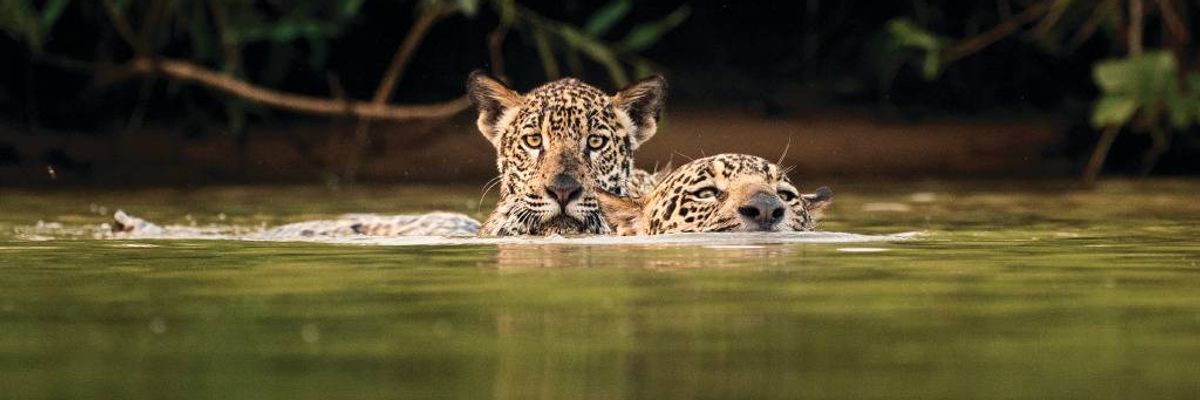
A six-month old jaguar cub rides on his mother’s back as she fords a stream in Pantanal, Brazil.
(Image by Sebastian Kennerknecht)


James Campbell
Dec 23, 2025
Common Dreams


Across the world, efforts to reintroduce imperiled animals to their natural habitats have gained momentum, but in the Madrean Sky Islands of Arizona, jaguars are doing it on their own.

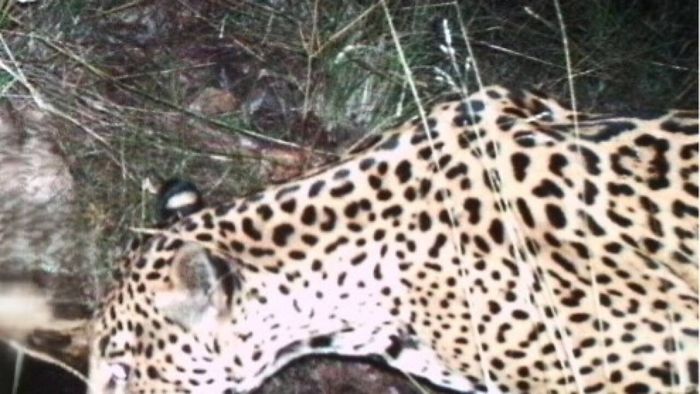
Less than a month ago, Chris Schnaufer, a citizen scientist volunteer with the University of Arizona Wild Cat Research and Conservation Center, and another volunteer, were checking one of their remote trail cameras. Schnaufer, a long-distance hiker, often got the center’s toughest assignments, and both men were tired when they reached the mountain camera site. They replaced batteries and collected the SD card and hiked back to the trailhead. That night, at home, Schnaufer scrolled through the images of deer, bear, bobcats, mountain lions, foxes, owls, skunks, and a coatimundi. And then, there it was, in the semidarkness of early morning, the striking image of a jaguar drinking from a waterhole. The photos showed its muscular shoulder and its distinctive inky-black rosettes.

When the University of Arizona Wild Cat Research and Conservation Center released the photographs of the jaguar roaming the rugged mountains of southern Arizona, it confirmed that it was a never-before-recorded big cat. Jaguars have their own unique markings, as singular as a human’s fingerprint, and this was one new to the center’s database. Though it has not yet identified its sex, the center is calling it Jaguar No. 5, dubbed Cinco, the fifth jaguar to be photographed in the Sky Islands since 2011, the second one discovered since 2023, and the ninth one spotted in the US since 1996.


Jaguar No. 5. (Photo by UA Wild Cat Research and Conservation Center)

When the photos were made public, and news agencies across the country buzzed with excitement about the future of the state’s wild jaguar population, Schnaufer still felt the existential thrill of knowing he had been hiking in jaguar country.

Three-quarters of a century ago, Aldo Leopold penned his essay “The Green Lagoons,” which chronicles a 1923 canoeing adventure in the Delta region of the Colorado River. He and his brother Carl hoped to “find sign of the… the great mottled jaguar, el tigre.” They “saw neither hide nor hair of him, but his personality pervaded the wilderness.”

While I was researching my book, Heart of the Jaguar, and backpacking sections of the Sky Islands, three jaguars called the Sky Islands home—Cochise, Sombra, and O:ṣhad Ñu:kudam. I never saw so much as a track, but what mattered most to me was what the presence of a big, spotted cat prowling the mountains of southern Arizona implied: a kind of wildness.


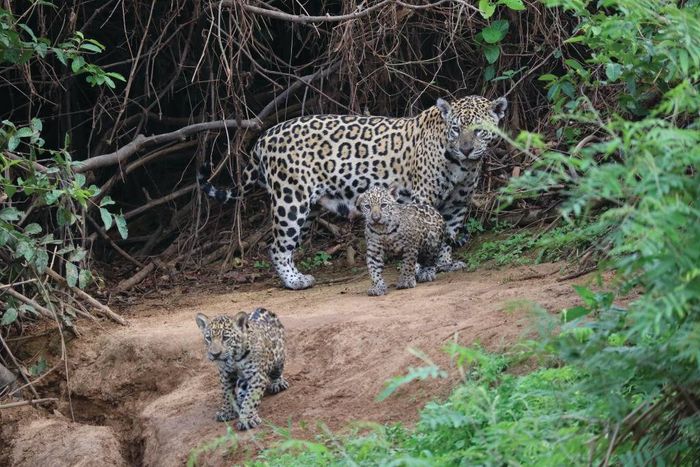
A jaguar and cubs are seen in Corixo Negro, Encontro das Aguas State Park. (Photo by April Kelly)

The Sky Islands, situated at the northern edge of a 5,000-mile jaguar range that extends as far south as Argentina, are indeed wild. More than a century ago, they were prime jaguar habitat. Some biologists and conservationists, including Susan Malusa, director of the Wild Cat Research and Conservation Center for the last 13 years, think they still are. “The picture of Jaguar No. 5 is a moment in time,” Malusa says. “But it’s part of a greater story, and that story is that the Sky Islands are part of the jaguar’s historical range. Jaguars wouldn’t be coming here if they weren’t finding what they need.”

The entire jaguar range is based on the principle of connection. Alan Rabinowitz, the celebrated zoologist and co-founder of Panthera, the global wild cat conservation organization, (who passed away in 2018), envisioned the jaguar realm as a mammal’s circulatory system. The core areas of jaguar production are its heart; the corridors linking them are its veins and arteries. A functioning system would nurture the species, while at the same time allowing nomadic, individual cats the freedom to spread their genetics across the corridor.

Susan Malusa believes it could be just a matter of time before other jaguars cross over from Mexico into the United States. “The cats are coming,” she says. “This is our chance to get it right; we have an obligation. Essentially, our job is not to screw it up.”

But screwing it up is exactly what we are doing. Currently, construction crews are dynamiting huge swaths of the unspoiled Coronado National Memorial and building hulking, 30-foot walls in the San Rafael Valley, creating what will be the longest unbroken stretch of border wall in an area of Arizona that serves as a critical wildlife corridor.

The Trump administration, which is not known for its love of wild places, waived the Endangered Species Act, the National Environmental Policy Act, and a host of other laws, to build a wall that will stop jaguars and dozens of other species in their tracks. And southern Arizona will be poorer for it. Apex predators like jaguars maintain ecosystem health, balance prey populations, and sustain biodiversity. They also change the spirit of the land. They contribute to what Aldo Leopold described as a “vast pulsing harmony.” And when they are gone, a “glory has departed.”

But perhaps in spite of the obstacles in their path, that glory is beginning to come back, as exemplified by Jaguar No.5.

Our work is licensed under Creative Commons (CC BY-NC-ND 3.0). Feel free to republish and share widely.


James Campbell
James Campbell is an award-winning author of five nonfiction books and many magazine articles. His most recent book, Heart of the Jaguar: The Extraordinary Conservation Effort to Save the America's Legendary Cat, was released by W.W. Norton and Company in 2025.
Full Bio >