It’s possible that I shall make an ass of myself. But in that case one can always get out of it with a little dialectic. I have, of course, so worded my proposition as to be right either way (K.Marx, Letter to F.Engels on the Indian Mutiny)
Wednesday, December 24, 2025
Invisible but deadly: Scientists warn of a growing global threat from amoebae in water and the environment
Biochar Editorial Office, Shenyang Agricultural University
Credit: Jianyi Zheng, Ruiwen Hu, Yijing Shi, Zhenzhen He & Longfei Shu
A group of environmental and public health scientists is sounding the alarm on a largely overlooked but increasingly dangerous group of pathogens: free living amoebae. In a new perspective article published in Biocontaminant, the researchers highlight how these microscopic organisms are becoming a growing global public health threat, fueled by climate change, aging water infrastructure, and gaps in monitoring and detection.
Amoebae are single celled organisms commonly found in soil and water. While most are harmless, some species can cause devastating infections. Among the most notorious is Naegleria fowleri, often referred to as the brain eating amoeba, which can trigger a rare but almost always fatal brain infection after contaminated water enters the nose during activities such as swimming.
“What makes these organisms particularly dangerous is their ability to survive conditions that kill many other microbes,” said corresponding author Longfei Shu of Sun Yat sen University. “They can tolerate high temperatures, strong disinfectants like chlorine, and even live inside water distribution systems that people assume are safe.”
The authors also emphasize that amoebae act as hidden carriers for other harmful microbes. By sheltering bacteria and viruses inside their cells, amoebae can protect these pathogens from disinfection and help them persist and spread in drinking water systems. This so called Trojan horse effect may also contribute to the spread of antibiotic resistance.
Climate warming is expected to worsen the problem by expanding the geographic range of heat loving amoebae into regions where they were previously rare. Recent outbreaks linked to recreational water use have already raised public concern in several countries.
The researchers call for a coordinated One Health approach that connects human health, environmental science, and water management. They urge stronger surveillance, improved diagnostic tools, and the adoption of advanced water treatment technologies to reduce risks before infections occur.
“Amoebae are not just a medical issue or an environmental issue,” Shu said. “They sit at the intersection of both, and addressing them requires integrated solutions that protect public health at its source.”
===
Journal reference: Zheng J, Hu R, Shi Y, He Z, Shu L. 2025. The rising threat of amoebae: a global public health challenge. Biocontaminant 1: e015
About Biocontaminant: Biocontaminant is a multidisciplinary platform dedicated to advancing fundamental and applied research on biological contaminants across diverse environments and systems. The journal serves as an innovative, efficient, and professional forum for global researchers to disseminate findings in this rapidly evolving field.
Credit: Neng Yan, Alessandro Parodi, Fei Dang & Jianbo Shi
Invisible pollutants at the nanoscale are quietly entering bodies and ecosystems, yet standard toxicology tools still treat living organisms like a black box. A new perspective article in the journal New Contaminants describes how cutting edge bioimaging is turning that black box into a transparent map, revealing where these particles go and how they may harm health.
Lighting up hidden nano pollution
Emerging nanoscale contaminants such as engineered nanomaterials and nanoplastics are now found in water, soil, food and even the air we breathe, but their tiny size and complex behavior make them hard to track with traditional methods. Conventional toxicology usually looks only at endpoints, like tissue damage, and often misses the step by step journey and subtle early effects of these particles inside living organisms.
The new paper highlights advanced bioimaging tools that can follow nanoscale contaminants in real time, from the moment they enter cells to their accumulation in organs and eventual clearance from the body. These methods range from high resolution electron microscopy to whole body imaging, with fluorescence imaging emerging as a central bridge between cellular details and organism level effects.
A new class of “switch on” probes
A key focus of the article is a special group of fluorescent probes called aggregation induced emission luminogens, or AIEgens, which become brighter instead of dimmer when they clump together. This unusual property directly addresses a major limitation of traditional dyes, which often lose their signal when particles aggregate, exactly when scientists most need to see them.
“AIE technology allows us to watch the entire life cycle of nanoscale pollutants in living systems, from their first contact with cells to long term storage in organs, without losing sight of them over time,” says lead author Dr Neng Yan of China University of Geosciences. Because AIEgens are highly photostable and compatible with biological systems, they can support long term time lapse imaging that captures slow, chronic effects relevant to real world environmental exposures.
From cell level events to whole body maps
Using AIE labeled particles, scientists can distinguish how nanoplastics or metal based nanoparticles enter cells, for example via rapid clathrin mediated endocytosis or slower macropinocytosis, and follow them as they move through endosomes and lysosomes. Sudden changes in fluorescence patterns can even reveal critical events such as lysosomal membrane rupture, which is linked to toxicity.
At the tissue and organ level, AIE based imaging can be combined with tissue clearing and light sheet microscopy to build three dimensional “cartographies” of where contaminants accumulate, including in sensitive regions like the brain. In live animals, near infrared AIE probes in the NIR I and NIR II windows allow deeper imaging with less background, enabling researchers to quantify how quickly particles cross barriers, circulate through blood vessels and are eventually eliminated.
Toward predictive toxicology for the nano age
The authors note that important challenges remain, including avoiding disturbance of particle behavior by labels, balancing resolution with penetration depth and handling the huge volumes of imaging data. They argue that the next leap will come from combining smarter multimodal probes, integrated imaging workflows and artificial intelligence driven analytics that can turn images into predictive models of toxicity.
“By visualizing where nanoscale contaminants go and how they interact with cells over time, we can move from simply observing damage to forecasting risk and designing safer materials before they are released into the environment,” says co author Prof Jianbo Shi of the Chinese Academy of Sciences. The perspective concludes that such imaging powered, predictive toxicology frameworks will be essential to ensure that the benefits of nanotechnology are realized without compromising environmental and human health.
===
Journal reference: Yan N, Parodi A, Dang F, Shi J. 2025. Shedding light on the invisible: aggregation-induced emission-based bioimaging for assessing the environmental impact of emerging nanoscale pollutants. New Contaminants 1: e019
Shedding light on the invisible: aggregation-induced emission-based bioimaging for assessing the environmental impact of emerging nanoscale pollutants
Article Publication Date
17-Dec-2025
From waste to wonder: Universiti Sains Malaysia engineers a precision adsorbent to capture antibiotic pollutants
Dr. Azam Taufik Mohd Din’s team at Universiti Sains Malaysia unveils SiO₂@MIPs-CAPcr—a highly selective, reusable adsorbent for chloramphenicol removal, powered by advanced ARGET ATRP synthesis
Biochar Editorial Office, Shenyang Agricultural University
Credit: Zulkarnain Mohamed Idris, Siti Kartini Enche Ab Rahim, Bassim H. Hameed, Lei Ye & Azam Taufik Mohd Din
Published on November 12, 2025, in the open-access journal Carbon Research (Volume 4, Article 69), the study introduces SiO₂@MIPs-CAPcr—a novel surface-imprinted polymer grafted onto ordered mesoporous silica—engineered specifically to capture chloramphenicol (CAP), a widely used but environmentally persistent antibiotic.
Led by Dr. Azam Taufik Mohd Din from the School of Chemical Engineering, Universiti Sains Malaysia, the work combines cutting-edge polymer chemistry with practical environmental engineering to tackle one of today’s most pressing water quality challenges.
The Problem: Antibiotics Don’t Just Disappear
When antibiotics like chloramphenicol enter rivers, lakes, or groundwater—through agricultural runoff, pharmaceutical waste, or inadequate wastewater treatment—they don’t just vanish. They accumulate, fuel antimicrobial resistance, and disrupt ecosystems.
Conventional filtration methods often lack the precision to remove specific contaminants without also stripping beneficial minerals or requiring costly processes. What’s needed is selectivity—and reusability.
Enter SiO₂@MIPs-CAPcr: A Molecular “Lock” for CAP
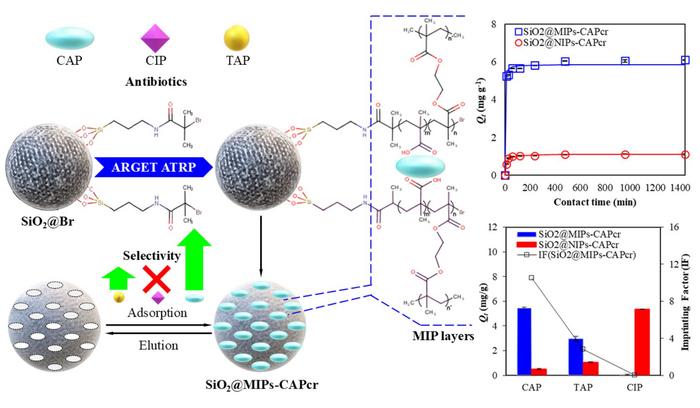
The team developed their adsorbent using activator regenerated by electron transfer atom transfer radical polymerization (ARGET ATRP)—a controlled, efficient technique that allows precise grafting of molecularly imprinted polymers (MIPs) onto a silica scaffold.
First, they synthesized a silica-based initiator (SiO₂@Br) with uniform spherical nanoparticles, confirmed via XRD, SEM, and HRTEM. This material boasted an impressive specific surface area of 638.31 m²·g⁻¹ and a total pore volume of 0.4152 cm³·g⁻¹—ideal for high-capacity adsorption.
Then, using CAP as a template, they grew a thin MIP layer around it. After removing the template, the resulting cavities perfectly matched the size, shape, and chemical features of CAP molecules—like a lock waiting for its key.
FTIR, TGA, TEM, and XRD analyses confirmed successful polymer grafting. As expected, the final SiO₂@MIPs-CAPcr showed reduced surface area and pore volume compared to the bare silica—but gained extraordinary selectivity.
Performance That Delivers
Under optimized batch conditions, the adsorbent achieved a maximum CAP adsorption capacity of 19.68 mg·g⁻¹, following a pseudo-second-order kinetic model. Thermodynamic analysis revealed the process was spontaneous and exothermic—meaning it works efficiently even at ambient temperatures.
Most impressively, SiO₂@MIPs-CAPcr showed strong preference for CAP over structurally similar antibiotics like thiamphenicol (TAP) and ciprofloxacin (CIP). Even after four regeneration cycles, it retained over 93% of its original capacity—losing only 6.87%—proving its robustness and cost-effectiveness.
“This isn’t just about adsorption—it’s about intelligent design,” says Dr. Azam Taufik Mohd Din, corresponding author and researcher at Universiti Sains Malaysia’s Engineering Campus in Nibong Tebal, Penang. “By combining molecular imprinting with ordered mesoporous silica, we’ve created a material that’s both highly specific and durable.”
A Malaysian Innovation with Global Impact
Based at one of Southeast Asia’s top research universities, Dr. Azam’s lab exemplifies how advanced chemical engineering can address real-world sustainability challenges. Universiti Sains Malaysia—particularly its School of Chemical Engineering—has emerged as a regional leader in materials science for environmental applications.
And because the paper is published open access, scientists, water treatment facilities, and regulatory agencies worldwide can immediately apply these insights—accelerating deployment beyond the lab.
The Bigger Picture: Tailored Solutions for a Cleaner Planet
This breakthrough isn’t limited to chloramphenicol. The same ARGET ATRP-driven approach can be adapted to target other pollutants—pesticides, hormones, industrial dyes—simply by changing the molecular template.
In a world where water security and antibiotic resistance are urgent global priorities, SiO₂@MIPs-CAPcr offers more than performance. It offers precision. Reusability. And hope.
Thanks to the ingenuity of Dr. Azam Taufik Mohd Din and his team at Universiti Sains Malaysia, the future of water purification is not just cleaner—it’s smarter, one molecule at a time.
===
Journal reference: Mohamed Idris, Z., Enche Ab Rahim, S.K., Hameed, B.H. et al. ARGET ATRP based surface-imprinted polymer-ordered mesoporous silica composites for selective chloramphenicol adsorption. Carbon Res.4, 69 (2025).
The journal Carbon Research is an international multidisciplinary platform for communicating advances in fundamental and applied research on natural and engineered carbonaceous materials that are associated with ecological and environmental functions, energy generation, and global change. It is a fully Open Access (OA) journal and the Article Publishing Charges (APC) are waived until Dec 31, 2025. It is dedicated to serving as an innovative, efficient and professional platform for researchers in the field of carbon functions around the world to deliver findings from this rapidly expanding field of science. The journal is currently indexed by Scopus and Ei Compendex, and as of June 2025, the dynamic CiteScore value is 15.4.
For many of us, the holiday season can mean delightful overeating, followed by recriminatory New Year’s resolutions.
But eating enough and no more should be on the menu for all of us, according to a recent UBC study. It found that 44 per cent of us would need to change our diets for the world to warm no more than 2 C.
Dr. Juan Diego Martinez, who led the research as a doctoral student at UBC’s Institute for Resources, Environment and Sustainability, discusses the study’s findings and the simple dietary changes we can all make.
What did you find?
Half of us globally and at least 90 per cent of Canadians need to change our diets to prevent severe planetary warming. And that number is conservative, because we used 2012 data. Since then, emissions and the world’s population have both increased. Looking ahead to 2050, we found that 90 per cent of us will need to be eating differently.
We looked at data from 112 countries, accounting for 99 per cent of food-related greenhouse gas emissions globally, and divided each country’s population into 10 income groups. We calculated a food emissions budget for each person by combining emissions from food consumption, global food production and supply chains, and compared these emissions to the total the world can afford if we want to stay below 2 C of warming.
Why focus on dietary changes rather than, say, flying less?
The world’s food systems are responsible for more than one-third of all human greenhouse gas emissions.
We found that the 15 per cent of people who emitted the most account for 30 per cent of total food emissions, equaling the contribution of the entire bottom 50 per cent. This select group consists of the wealthiest people in high emissions countries, including the Central African Republic, Brazil and Australia.
Even though this group is emitting a lot, there is a much higher number of people whose diets are above that cap. This is why half, not just the richest, of the global population needs to change diets. In Canada, all 10 income groups are above the cap.
Debates around flying less, driving electric and buying fewer luxury goods are valid: We need to reduce emissions any way we can. However, food emissions are not just a problem for the richest—we all need to eat, so we can all make a change. For people who are both flying frequently and eating lots of beef, it’s not an either/or: Try to reduce both.
What changes can we make to our diets?
Eat only what you need. Repurpose what you don’t. Less wasted food means fewer emissions, less cooking and more easy, tasty leftovers.
Eliminate or reduce your beef consumption—43 per cent of food-related emissions from the average Canadian come from beef alone. We could have had our beef and eaten it too if we’d followed the agreements laid out in the Kyoto Protocol, but we’re now at a point where food emissions also need to fall to avoid the worst of climate change.
I grew up in Latin America where eating a lot of beef is part of the culture, so I get how much of an ask this is. But we just can’t deny the data anymore.
Vote with your fork. This is a first step to demand change from your political leaders. The more we talk about our own dietary changes and what matters to us, the more politicians will begin to care about policies that bring positive changes to our food systems.
Healthy, sustainable school meals could cut undernourishment, reduce diet-related deaths and significantly lower environmental impacts, according to a new modelling study led by a UCL (University College London) researcher.
The study is part of a new collection of papers published in Lancet Planetary Health by members of the Research Consortium for School Health and Nutrition – the independent research initiative of the School Meals Coalition. The papersfind that well-designed school meal programmes could be a strategic investment in a healthier, more sustainable future.
Drawing together modelling, case studies and evidence from multiple disciplines, the six-paper collection demonstrates how planet-friendly school meal programmes can simultaneously improve child nutrition, reduce the prevalence of long-term diet-related illness, lessen climate and environmental pressures, and stimulate more resilient, agrobiodiverse food systems.
School meals: a strategic investment in human and planetary health
Global food systems are responsible for a third of human-induced greenhouse gas emissions while also contributing to rising malnutrition and diet-related diseases. At the same time, national school meal programmes feed 466 million children every day, representing 70% of the global public food system – a scale that provides governments unparalleled leverage.
A global modelling study, led by Professor Marco Springmann, modelling lead for the Research Consortium basedat UCL’s Institute for Global Health, finds that providing a healthy, sustainable meal to every child by 2030 could:
Reduce global undernourishment by 24%, with particularly strong impacts in food-insecure regions. This translates to 120 million fewer people in the world not getting enough vitamins, minerals, and energy from food
Prevent over 1 million deaths every year from diet-related illnesses such as diabetes and coronary heart disease, assuming today’s schoolchildren retain, at least in part, preference for healthy foods into adulthood
Halve food-related environmental impacts, including emissions and land use, when meals follow healthy, sustainable dietary patterns, for instance by increasing the proportion of vegetables and reducing meat and dairy products
Generate major health and climate savings, significantly offsetting investment needs
Currently only one in five children in the world receive a school meal.
Professor Springmann said: “Our modelling shows that healthy and sustainable school meals can generate substantial health and environmental gains in every region of the world. Importantly, the climate and health savings that result from healthier diets and lower emissions can help offset the costs of expanding school meal programmes. The evidence is clear: investing in school meals is both effective and economically sound.”
A framework for transforming food systems
To support governments to transition to planet-friendly school meal programmes, the collection sets out a conceptual framework for how school meals can drive systemic food systems transformation at scale, structured around four essential pillars:
Healthy, diverse, culturally relevant school menus
Clean, modern cooking methods
Reduced food loss and waste
Holistic food education that connects children, families and communities
Together, these pillars offer governments a pathway to improve child health and food literacy, strengthen agrobiodiversity, stimulate ecological local production and build climate-resilient food systems. Crucially, the framework emphasises that these pillars must be embedded in public procurement rules, nutrition standards and policy reforms to unlock their full potential and shift demand towards healthier and more sustainable food systems.
Dr Silvia Pastorino, Diets & Planetary Health Lead for the Research Consortium and curator of the collection based at the London School of Hygiene & Tropical Medicine (LSHTM), said: “This framework highlights how school meals are not just a nutrition programme – they are a powerful lever for transforming food systems. When meals are healthy, sustainable and linked to food education, they improve children’s wellbeing today and foster long-term sustainable habits, while helping countries protect biodiversity, reduce emissions and build resilient communities. Few interventions deliver such wide-ranging, long-lasting benefits.”
The framework builds on insights first published in the Research Consortium’s 2023 White Paper, School Meals and Food Systems, which brought together 164 authors from 87 organisations worldwide, also coordinated by Dr Pastorino.
Food, learning, energy, and biodiversity
To further explore each of the four pillars laid out in the framework, the wider Lancet Planetary Health collection includes:
A viewpoint from FAO (Food and Agricultural Organization of the United Nations) on integrating food education into learning to build lifelong sustainable habits
A personal view from a Loughborough University team on the critical role of clean, reliable energy in delivering safe, planet-friendly meals
A scoping review from Alliance Bioversity-CIAT on the importance of agrobiodiversity in providing nutritious, climate-resilient school menus
A personal view from an Imperial College London team on promoting regenerative agriculture, agrobiodiversity, and food security through school feeding
From evidence to action: supporting governments to implement planet-friendly policies
In partnership with international organisations and government partners, the Research Consortium is now developing a Planet-Friendly School Meals Toolkit to help countries assess the costs, environmental impacts and health benefits of shifting to sustainable school meal models. Co-created with partners in Kenya and Rwanda, the first results are expected in spring 2026.