Thursday, December 25, 2025

Unpacking Copper’s Phantom Deficit

  • The current record-high copper price, driven by a nearly 40% rise in 2025, is primarily a result of "economically trapped" inventory—between 730,000 and 830,000 tonnes of copper held in US warehouses by traders hedging against potential 15% tariffs.

  • The article argues that the market is running on a "belief-based" deficit narrative, largely fueled by the energy transition story, while on-the-ground data shows a surplus of metal that is simply in the wrong location for industrial use.

  • The structural deficit is projected to become genuine in 2026, but the short-term volatility hinges on political factors; if anticipated tariffs are lighter than expected, the trapped US inventory could be released, triggering a price collapse.

The headlines from the London Metal Exchange tell a story of a world on the brink of a copper famine. 

2025 is closing out with prices up nearly 40%...the most violent annual move since the post-crisis bounce of 2009. 

We’ve watched prices breach $12,000 a tonne, a level that would usually imply the world’s electrical grids were physically melting.

But if you look at the actual hardware...the physical metal sitting in sheds...the story isn't one of scarcity, but of a massive, expensive game of logistical hide-and-seek.

The reality is this: the world isn't out of copper. It has just moved the copper to places where it is functionally useless for industry, but highly profitable for traders. 

We are witnessing the birth of the "economically trapped" inventory, where metal is diverted not to be turned into wire or transformers, but to sit as a hedge against a political "what-if."

The Architecture of a Fake Shortage

The friction point isn't in the mines, at least not yet. It’s in the spread between the LME in London and the CME in Chicago. 

Data from Benchmark Minerals suggests that by October, between 730,000 and 830,000 tonnes of copper were "economically trapped" in the US.

To put that number in perspective: that’s enough copper to build about 10 million electric vehicles or wire up every AI data center planned for the next three years...

And yet, it is doing neither.

It is sitting in warehouses because traders are terrified of the 15% tariffs rumored to be coming from the Trump administration.

If you bring the metal in now, you beat the tax. Once it’s inside the U.S. border, the arbitrage and the premium environment mean there is zero incentive to move it. It’s a one-way valve.

We have reached a bizarre state where the world's most critical industrial metal is being treated like a digital token...hoarded for its future value rather than used for its current utility.

The 17-Year Lead Time vs. The 10-Minute Trade

The mining companies have done a masterful job of selling the "Transition Narrative." They point to the declining ore grades...which have dropped from 1.5% in 1900 to about 0.6% today...and the fact that a new copper deposit now takes an average of 17 years to move from discovery to first production.

The story is compelling. It’s also a convenient screen for the current price chaos.

Investors have bought the long-term deficit story so completely that they’ve priced in 2035’s shortages in 2025. This "belief-based" pricing has pushed mining equity valuations to 18x forward EBITDA, well above the 12x historical average.

The industry is currently running on the "vibes" of the energy transition rather than the reality of the order books. In China, the actual consumer of over half the world’s copper, construction and manufacturing remain soft. The "vibe" says we are in a deficit; the "boots-on-the-ground" data says we have nearly a million tonnes of surplus metal currently parked in the wrong zip code.

Who Pays for the "Green" Premium?

We need to talk about who is collecting the equity in this new copper regime. As prices hover near $12,000, we aren't just seeing a commodity cycle; we are seeing a shift from public service infrastructure to private platform extraction.

  • The Privateers: Private equity mining investments tripled this year, hitting $12 billion compared to $4 billion in 2024.
  • The Grid Tax: Modernizing the North American grid is projected to cost $2.5 trillion by 2035. Every dollar added to the price of copper is a hidden tax on every household's utility bill.
  • The Substitution Trap: At these prices, engineers are desperately trying to swap copper for aluminum. But aluminum requires 1.5 to 2 times the volume for the same conductivity and brings its own set of thermodynamic headaches.

The "limitless growth" promised by the AI and EV sectors assumes that the laws of finance will eventually bend to the needs of the "Cloud." They won't.

A 100-megawatt AI data center can suck up 2,000 to 3,000 tonnes of copper. At $12,000 a tonne, the metal alone is becoming a significant percentage of the CapEx. Eventually, the balance sheet will force a choice: build the data center or pay the copper speculators. You cannot do both at these levels.

The Maintenance vs. Growth Binary

The most sobering data comes from the existing hardware. This year, 18 of the world’s 25 largest copper miners reported production decreases.

This isn't just about strikes at Grasberg or Kamoa-Kakula. It's about the maintenance bill. We are spending more capital just to keep production flat. The capital intensity to build a new mine has doubled, rising from $8,000 per annual tonne in 2010 to nearly $20,000 today.

Most of the "growth" we see in corporate press releases is actually just a desperate attempt to outrun the depletion of existing assets.

Asset

2024 Performance

2025 Reality

Grasberg (Indonesia)

Production Leader

Long-term disruptions; recovery post-2027

QB2 (Chile)

"Growth Engine"

Ramp-up delays and technical friction

Kamoa-Kakula (DRC)

High-grade hope

Logistical bottlenecks and quota fears

The industry is effectively running up a down escalator.

2026: The Year of the Structural Snap

If 2025 was the year of the "Trade Hedge," 2026 is where the math starts to get real.

BloombergNEF warns that the market will enter a genuine structural deficit next year. The safety valves...scrap and substitution...are already being pushed to their limits. 

Scrap currently accounts for 36% of manufacturing supply, but it’s a lagging indicator. You can't recycle a car that was built yesterday; you have to wait 15 years for that metal to come back.

For 2026, I’m watching the "Trump Volatility" closely. 

If the anticipated tariffs are lighter than expected, that million-tonne "trapped" inventory in the US could flood back onto the global market, triggering a price collapse that would catch the "deficit" bulls off guard.

However, if the tariffs land and the AI build-out continues its current trajectory, we are looking at a fractured global market where copper prices in the US and the rest of the world decouple entirely.

The deficit is coming, but the volatility is already here.

By Michael Kern for Oilprice.com

Super Copper’s Cordillera project approved by Chile’s National Mining Authority

Super Copper is focused on developing projects in northern Chile. 
(Image courtesy of Supper Copper.)

Super Copper (CSE: CUPR) said on Wednesday it has received approval from Chile’s national mining authority (Sernageomin) for its Cordillera Cobre project.

The approval pertains to a total of 26 mining concessions covering approximately 6,858 hectares in the Atacama copper belt.

Super Copper said it has now completed the most technical and challenging portion of the Chilean mining rights process, with 26 exploitation concessions that make up the Cordillera Cobre claim block fully approved by the National Geology and Mining Service.

Of these concessions, 25 have received formal court resolutions establishing them and 15 have had their legal extract published in the official mining gazette; registration in the Copiapó mining registry is now underway.

Once registration is complete, each concession becomes a legally constituted exploitation concession, granting full and permanent mining rights, the company noted.

“This is a critical milestone for Super Copper. Securing exploitation concessions, not just exploration rights, gives full and permanent mining rights at Cordillera Cobre,” Super Copper CEO Zachary Dolesky said in a news release.

“With the title process effectively complete and registration progressing as planned, we are positioned to submit our drill program promptly upon finalizing results from our most recent exploration work,” Dolesky said. “This positions Super Copper to advance one of the most exciting new copper projects in the Atacama region, at a time when global copper demand is entering a major structural deficit.” 

In July, the Canadian junior also struck a deal to acquire 100% of the Castilla copper project, locking down a 5,800-hectare land package near the historic Manto Negro mine.

 

US rare earth buyers still see China curbs despite Trump deal

Close-up of neodymium magnets. Stock image.

China is still restricting the rare earth elements that the US needs to produce its own permanent magnets and other products even after President Donald Trump reached a deal with his Chinese counterpart in October to lift restrictions on the supplies, according to market participants.

More than a dozen consumers, producers, government officials and trade experts said that while China has boosted deliveries of finished products — primarily permanent magnets — the US industry remains unable to acquire the inputs needed to make those items on its own, a key priority for the administration. The people asked not to be identified discussing matters that aren’t public.

The reduced trade highlights continuing tensions in the US-China relationship in the months since Trump and Xi Jinping hammered out a truce in South Korea on Oct. 30, with the US cutting tariffs and China pledging to restore rare earth supplies. At the time, Trump said the deal amounted to the “de facto removal” of a range of limits China had imposed.

By restricting deliveries of raw materials, China is hamstringing US efforts to build its own industry to process rare earths into magnets used in everything from consumer goods to missile guidance systems. The Trump administration has made developing domestic production capacity for permanent magnets and other rare earth products a key priority after China spent years building a global monopoly.

The White House didn’t respond to a request for comment for this article. Administration officials have said in recent weeks that China is complying with the terms of the deal on rare earth supplies.

China’s Commerce Ministry also didn’t respond to a request for comment. Beijing has said it’s already approved some applications for rare earth exports. But it continues to restrict supplies that could go to military contractors.

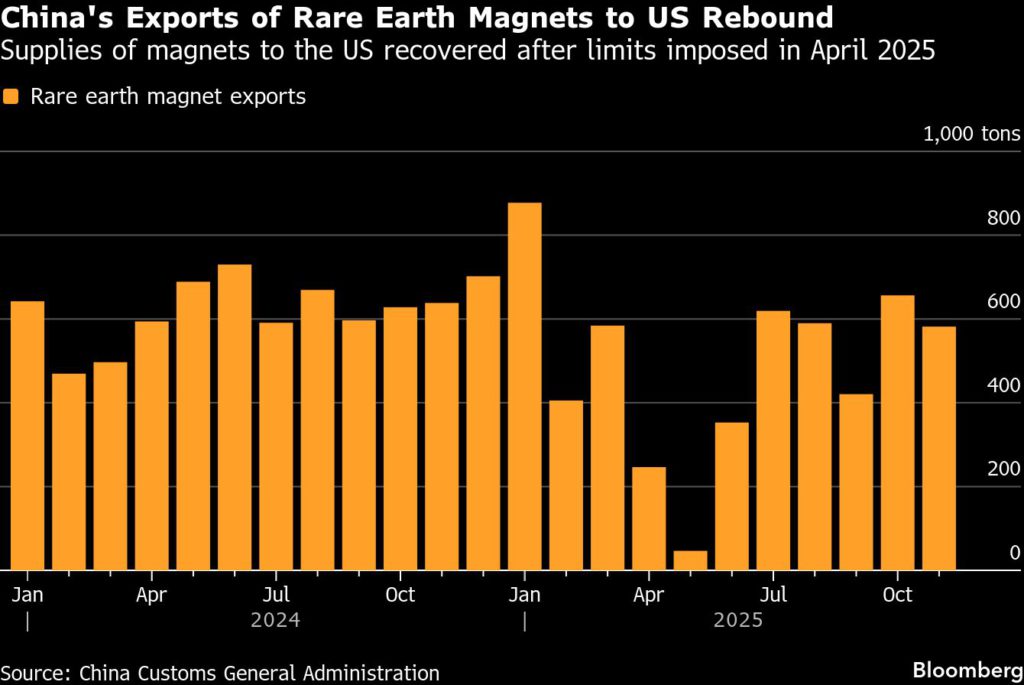
Official Chinese data released Dec. 20 showed magnet supplies to the US dropped 11% in November from the month before, but remain above the lows seen when Beijing restricted them in April. Overall, China’s exports of rare earth elements and products — including magnets — were up 13% in November from the month before, according to Bloomberg calculations using official customs data.

Industry officials and market participants said the reality is different for US players.

“People aren’t getting materials out of China, you’re not getting dysprosium metal or oxide if you’re a US entity,” Scott Dunn, the chief executive of Noveon Magnetics Inc, said in an interview, citing his contacts with others in the industry. Noveon is one of just a few US makers of permanent magnets. The company doesn’t buy rare earth inputs from China, but Dunn said some of his customers do.

“Outside of China, the world can produce 50,000 tons of magnets, but there isn’t even close to the equivalent in rare earth minerals to support those tons outside of China,” Dunn said. “China restricts materials far beyond what it restricts in magnets to keep that dynamic in place.”

To be sure, Beijing’s easing of restrictions on products like magnets made from rare earths has, for the moment, removed the risk that consuming industries like autos and technology might have to shut down production, according to Gracelin Baskaran, director of the critical minerals security program at the Center for Strategic and International Studies in Washington.

“Given we import further down the supply chain, companies don’t feel that interruption nearly as much,” she said. “Because we import more magnets, the impact is much softer.”

China’s overall exports of the raw materials have risen since last year, but the US hasn’t received a similar uptick, according to government data. The stasis for US firms continues even as the European Union said Dec. 15 that China started granting licenses with lengthier terms to allow European companies to obtain rare earths.

The US and China still haven’t reached an agreement on key details of how Beijing will free up sales of rare earths, according to a person familiar with the negotiations. Bloomberg News reported last month that the two sides had given their teams until the end of November to agree on terms for so-called “general licenses” for exports. This has left market participants worried that the truce could collapse.

“We reached various temporary agreements in London, in Geneva, in South Korea and they were reneged,” Baskaran said. “So no agreement so far has proved to be final, and that gives industry a level of skittishness that’s justified.”

The upcoming expiration of six-month temporary export licenses China approved in the early summer to ease market congestion as the two nations negotiated also means American companies will be applying for renewals around the same time, likely creating a logjam of applications. The worry among buyers is that China, as they did in May and June, will slow-walk approvals — a move seen by industry players as a type of export control.

“In discussions with Chinese counsel, the recommendation is to proceed with license applications before the pause expires,” said Mark Ludwikowski, the chair of Clark Hill’s international trade practice. “They could pull the plug on this at any point if this goes south.”

(By Joe Deaux)

First Quantum to sell Spanish mine for $190M

A 2018 view of the Las Cruces mine in southern Spain. Credit: First Quantum.

First Quantum Minerals (TSX: FM) agreed to sell the past-producing Cobre Las Cruces copper mine in Spain to an investment fund for up to $190 million to free up cash for other priorities.

Global Panduro, an entity controlled by US private equity firm Resource Capital Funds, will acquire Las Cruces to develop a polymetallic primary sulphide project on the site, First Quantum said late Tuesday in a statement. The transaction is expected to close in the first half of 2026.

“First Quantum had earlier highlighted that the mine was non-core and stated its intention of monetizing the asset as a measure to support liquidity,” Shane Nagle, a mining analyst at National Bank Financial, said Wednesday in a note.

Under the terms of the transaction, Global Panduro will pay $45 million in cash at closing and issue a $65 million loan note to First Quantum. The purchase price also includes about $80 million in deferred payments tied to certain project development milestones, as well as other deferred payments tied to exit and liquidity events.

The sale caps a busy year for First Quantum that has seen the Toronto-based miner expand copper production, boost liquidity, restructure its debt and sign a $1 billion streaming pact while its massive Cobre Panama mine remains on a preservation and safe maintenance plan.

News of the transaction comes almost two years after First Quantum published an updated NI 43‑101 technical report that set out plans for a next‑phase redevelopment of the site via a new underground mine feeding a refinery to produce copper, zinc, lead and silver.

For Resource Capital, the acquisition adds a European asset that it expects to benefit from rising long-term demand due to artificial intelligence and grid electrification.

Located about 20 km northwest of Seville, Las Cruces includes a high-grade open-pit copper mine and hydrometallurgical plant that produced copper cathode from 2009 until 2021. It also completed tailings reprocessing from 2021 to 2023.

First Quantum shares fell 2.1% to C$36.19 Wednesday morning in Toronto, cutting the company’s market value to about C$30 billion ($22 billion).

VIDEO: Sean Boyd on why smart money is rushing back to gold and Canada


World economies and financial systems are on uncertain ground, and smart money knows it. That’s why it’s moving decisively toward gold, says Sean Boyd, former CEO and current Chair of Agnico Eagle, one of the world’s leading gold producers.

In this interview, Boyd discusses why gold is breaking out across currencies, why critical minerals have become strategic assets, and why Canada’s moment in mining has arrived.

With decades of experience building one of the highest-quality businesses in global mining, Boyd also shares why gold has shifted from a trading instrument to a core investment, why processing — not geology — is the real bottleneck in critical minerals, and why Canada needs speed, coordination, and conviction to compete.


Alex Deluce is the founder of Gold Telegraph, an online news site covering gold, mining, and global economic trends. He has spent over a decade analyzing precious metals and interviewing key figures in finance and mining

Troilus in talks on German funding for Quebec gold-copper mine

Credit: Troilus Gold

The German government is in talks with Canadian firm Troilus Mining Corp. to fund investment in a large mining project, helping secure copper supplies that are key to the energy transition.

The money will come from Germany’s new raw materials fund, which allows a capital injection of as much as €150 million ($176 million) per project, according to people familiar with the matter who asked not to be named as the matter is private.

Copper demand has been soaring on broader optimism around the global energy transition and concerns about future supply disruptions due to mining outages. The metal has benefited from governments worldwide pushing for more green infrastructure, since it’s a key input for electric vehicles, grid upgrades and renewable power.

Montreal-based Troilus plans to revive a gold mine in north-central Quebec, which will also produce copper as a by-product.

Germany’s raw materials fund is a key tool to secure supplies of such critical inputs and is administered by development bank KfW. It can tap as much as €1 billion of budget resources. Earlier this month, the fund provided part of the financing for Vulcan Energy Resources Ltd.’s lithium project that will use geothermal power. It’s also planning to support another project in Australia.

The German Economy Ministry didn’t comment on the talks with Troilus. However, a spokesperson said via email that beyond Vulcan, two other projects were currently undergoing in-depth reviews. Troilus did not immediately respond to an email seeking comment.

Troilus had closed an offtake agreement with Germany’s Aurubis AG for copper concentrate in August. The Canadian company has a market value of about C$850 million ($617 million). It counts Quebec’s pension fund manager Caisse de Depot et Placement du Quebec among its top shareholders, according to data compiled by Bloomberg.

Aurubis didn’t comment on the funding talks.

Troilus has also secured as much as $700 million in financing to restart the mine from KfW, Societe Generale SA and Export Development Canada.

(By Petra Sorge and Mathieu Dion)

SolGold agrees to $1.2 billion takeover by top investor Jiangxi Copper


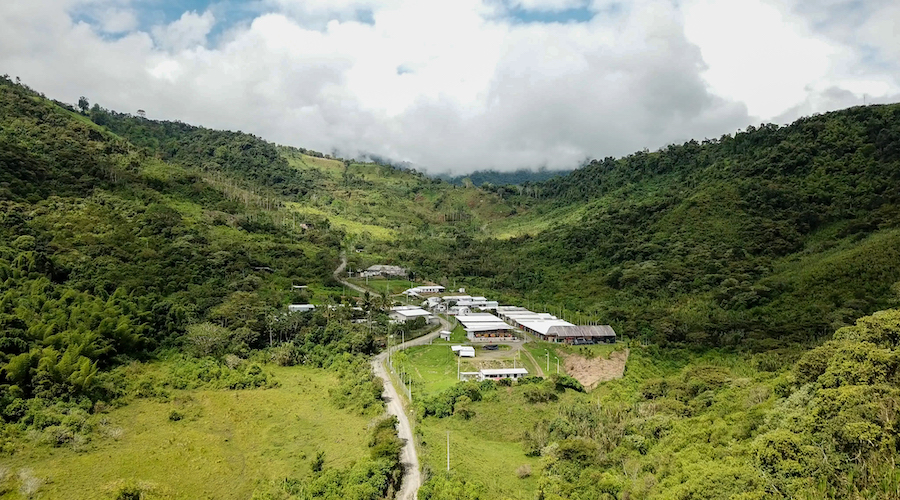
Cascabel copper-gold project in northern Ecuador. (Image courtesy of SolGold.)

Gold and copper miner SolGold said on Wednesday it had agreed to be acquired by its largest shareholder Jiangxi Copper in a deal valuing it at 867 million pounds ($1.17 billion).

The 28-pence-per-share deal represents an almost 43% premium to Ecuador-focused SolGold’s closing price on November 19, the day before Jiangxi first approached the company for a deal.

SolGold’s shares closed marginally higher at 25.65 pence in a holiday-shortened trading session on Wednesday.

The agreement gives Jiangxi control of SolGold’s Cascabel project in Ecuador’s Imbabura province, as miners race to secure copper supplies amid rising demand driven by electric vehicle and AI infrastructure investments.

The region is home to one of the world’s largest undeveloped copper-gold deposits in South America.

The London-listed miner said earlier this month it was inclined to recommend the offer, which was Jiangxi’s third proposal to acquire the company.

“JCC is delighted to have received the unanimous recommendation of the SolGold board and strong support from other large shareholders in favour of the acquisition. JCC is excited by the potential of the Cascabel project,” Shaobing Zhou, vice chairman and general manager of Jiangxi, said in a statement.

SolGold’s other top investors include global miner BHP and Newmont.

($1 = 0.7405 pounds)

(By Shashwat Awasthi; Editing by Shilpi Majumdar and Kirsten Donovan)

 Bauxite boom pollutes water and crops in Guinea

Stock image.

Tala Oury Sow has to wash her kitchen utensils and clothes in brown, murky water in the village of Koussadji in Guinea’s western Kindia region.

“Do you think we can cook and wash with this? We have no other choice,” the 28-year-old farmer said, gesturing to the water she collected from a nearby river, 500 metres (550 yards) from her home in the Telimele prefecture of the West African nation.

Sow blames the state of the water on the Indian mining company Ashapura Minechem, which opened a bauxite mine about 2 km from Koussadji in 2019.

Bauxite, the raw material in aluminum, is in high global demand because it plays a key role in enabling the clean energy transition, and Guinea holds the world’s largest reserves.

But the people of Koussadji and nearby villages say they are not benefitting from the bauxite boom, but instead suffer from the environmental consequences of large-scale mining, including water and air pollution.

Their complaints resonate across Africa, where many governments and activists are pushing for more domestic control – and economic benefits – of the critical minerals vital for the energy transition away from polluting fossil fuels.

Aluminum is used in solar panels, wind turbines and electric vehicles, as well as energy-efficient appliances and insulation materials in greener buildings.

“Look at this water, look at the gift they’ve given us. With this water, do you think life is possible?” said Sow, who grows rice, cassava, groundnut and cashews and blamed her falling crop yields on pollution.

Ashapura did not respond to three emails requesting comment on the villagers’ allegations of pollution.

The company did build a borehole in the nearby village of Bembou Silaty a year ago, but the water does not cover people’s needs, according to Souleymane Bah, a teacher from the village.

Ashapura has also faced allegations of environmental pollution in India.

In Bembou Silaty, Tokpa Fehand, a nurse working at the Poste de Sante health centre, said the village is adversely affected by mining activity, both in the dry and wet seasons.

“There are respiratory illnesses from the dust, the village is surrounded by the mine, and the machinery hardly ever stops working,” he said.

A 2023 community audit of the environmental and social impacts of mining in the nearby region of Boke linked bauxite mining to water pollution, a drop in agricultural productivity and a rise in air pollution.

Oumar Totiya Barry, executive director of the independent Guinean Observatory for Mines and Metals, said the problems experienced in Bembou Silaty were typical.

“Bauxite waste contains heavy metals and acid; in cases of pollution, it is sedimentation linked to drainage during the rainy season,” he said.

Just transition?

Guinea exports some 3.7 million tons of bauxite per week and produced about 146 million tons last year.

The country ships most of its exported bauxite to China.

The military-led government, which took power in a 2021 coup, is pushing foreign mining companies to add more value to bauxite before shipping the ore overseas for processing.

As part of this drive, it has revoked licences and pressed mining companies to build alumina refineries, joining countries from gold producer Mali to oil-rich Nigeria that are looking to boost domestic refining capacity in recent years.

Despite a push by several African countries at last month’s COP30 UN climate talks, the issue of a just transition for communities in resource-rich countries was not addressed in the final text.

China and Russia, among others, opposed any explicit reference to minerals, participants said.

“Talk of a just transition rings hollow so long as governments ignore the minerals required by the energy systems of the future,” said Antonio Hill, an advisor at the policy organization Natural Resource Governance Institute.

“By looking the other way, governments are feeding delay, forfeiting leadership and forsaking the chance to anchor equity and justice at the heart of the global energy transition,” he said in a statement after the talks.

In the meantime, Guinea is taking unilateral action.

Mamady Doumbouya, the general who led the coup and is running for president in an election on Dec. 28, has acted to force companies to add value to bauxite in Guinea.

Mines Minister Bouna Sylla said in November the country would fast-track the development of alumina refineries and iron ore pellet plants to end decades of raw ore exports.

New approach

Bauxite mines, which involve surface level or “strip” mining, can contaminate rivers and streams by removing vegetation and facilitating erosion, Human Rights Watch said in a 2021 report on aluminum production and mining that also referenced Guinea.

Barry said the noxious consequences of mining is a factor driving young Guineans to migrate, many opting for risky boat journeys to Spain’s Canary Islands.

“(Guinea is) rich in resources, but has not managed to turn them into national wealth, rather into a tool used to consolidate state power,” he said, adding that mining revenues are used to pay policemen, soldiers and civil servants.

He said legislation is needed to guarantee Guinean citizens a decent standard of living.

The employment benefits are limited too, as many young people do not have the training needed to secure permanent jobs.

The women of Allawalli, a farmers’ association in Bembou Silaty and Koussadji, said pollution from the nearby mines has decreased food production.

Rice production in Telimele plunged by 90% between 2018 and 2022, according to data from Guinea’s national institute of statistics.

Binta Boye, 35, grows rice, groundnuts and cassava in Bembou Silaty and is a member of Allawalli.

“What I produced before was enough to feed my family. Now it’s not enough anymore. We’re in God’s hands, if we want this to change,” she said.

(By Jaume Portell Cano; Editing by Clar Ni Chonghaile and Jon Hemming)


Report: Instability Costs Western Indian Ocean Economy $1.1B a Year

Hellas Aphrodite
Courtesy EUNAVFOR

Published Dec 21, 2025 8:13 PM by The Maritime Executive


The Western Indian Ocean (WIO) continues to see a rise in maritime threats, with Red Sea security remaining uncertain throughout 2025. The volatile security environment includes a resurgence of piracy along the Somali coastline. The most recent high-profile incident occurred in November, when pirates attacked and boarded the Maltese-flagged tanker Hellas Aphrodite off Puntland's coast.

But as maritime threats intensify, there is a cost for the region's vast blue economy potential. According to a report published last week by the UN Economic Commission for Africa (ECA), maritime insecurity was singled out as a leading factor affecting the growth of ocean-based industries in the WIO. The report estimate that maritime threats are costing the region $1.1 billion annually, equivalent to six percent of the WIO’s gross marine product. (For context, the region’s natural capital is valued at $330 billion, with the blue economy industries in WIO generating $20 billion annually in gross marine product.)

Some of the quantifiable threats that the report focused on include the impact of Illegal, unreported and unregulated (IUU) fishing, estimated at $245 million. With the increase in shipping traffic in WIO, environmental catastrophes could potentially cost the region over $100 million in clean-up costs. A case in point is the Wakashio disaster off the coast of Mauritius back in 2020. The incident involved the grounding of the bulk carrier MV Wakashio, spilling around 1,000 metric tons of fuel oil into pristine ocean ecosystems. The immediate clean-up cost is estimated at $50 million, excluding long-term restoration activities at the grounding site.

Notably, piracy continues as a persistent risk in WIO. Decades of regional efforts appeared to have suppressed the crime, but it is now resurging as piracy networks evolve. Although the peak levels seen in 2010-2012 may not be seen again, piracy will remain as a hidden cost to maritime trade in WIO. At its lowest level in 2021, piracy risk cost the WIO shipping community $160 million, mainly in the form of insurance premiums and private security costs.

In commenting about the report, the Secretary General of the Indian Ocean Commission (IOC) Edgard Razafindravahy called for long-term financial planning in maritime security initiatives in the region. “While regional arrangements like the Regional Maritime Information Fusion Center and the Regional Coordination Operations Center have delivered real gains, they lack stability,” said Razafindravahy. “To protect livelihoods, economies and marine ecosystems, these capabilities should be integrated into national and regional budgets, as well as have data gaps closed.”

Indeed, security architectures in the WIO depend on short-term donor funding. Without national commitments from governments in the region, there is only much the regional initiatives can achieve.

ONEX Shipyards Wins Greece’s First Newbuild Order in Decades

contract signing for new tugboats built in Greece
ONEX and MEGATUGS marked a milestone with the first new shipbuilding order in decades for Greece (ONEX)

Published Dec 22, 2025 8:11 PM by The Maritime Executive


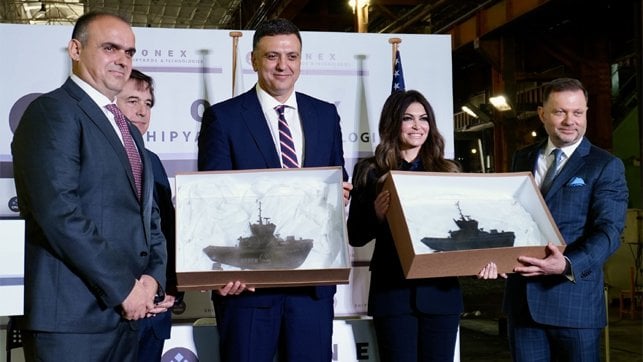
Greece’s ONEX Shipyards and MEGATUGS announced an agreement to build new tugboats at the Elefsina shipyard. It makes a key milestone for the restoration of the shipyard industry in Greece, as it is the first newbuild order placed in Greece in decades.

MEGATUGS ordered two state-of-the-art tugboats to be built using Robert Allen’s RAstar 2800 design for ASD Escort/Terminal tugs. It also has an option to build two additional tugs at the Greek shipyard. Each of the tugs will be just over 28 meters (92 feet) in length with a bollard pull of up to 85 tonnes. They will be powered by twin MAN engines and Schottel rudder propellers.

The versatile tugs will be capable of escort operations, harbor, and open-sea towing. They will also be outfitted with FiFi 1 firefighting systems and an oil recovery capability. 

“Today marks an important milestone for the ONEX Group Shipyards and the Greek shipbuilding industry,” said Panos Xenokostas, Chairman & CEO of ONEX Shipyards & Technologies Group and President of the Hellenic Shipyards Association. “Less than three years after the restart of the Elefsina Shipyards and seven years after the restart of the Syros Shipyards, we are operating at full production capacity, serving hundreds of vessels.”

The company highlights that it has been working to create an integrated production line and to restore the capabilities of the yards. They resumed dry dock and repair operations and recently announced the next phase of the revitalization of Greek shipbuilding and repair operations with an investment at the Syros yard.

ONEX highlighted that it took over the Elefsis shipyard after it had fallen into disrepair and debt. In 2022, it was reported that the yard had not received a commercial ship in five years. It undertook repairs on a Star Bulk vessel in November 2022 as it restarted work. In 2023, they lifted the Number 1 dry dock for the first time in five years.

A U.S. corporation, ONEX received $125 million in financing from the US International Development Financing Corporation to aid in the redevelopment of the Elefsina shipyards. US Ambassador Kimberly Ann Guilfoyle attended the signing ceremony and, in her remarks, called it a new chapter for Greek shipbuilding. She said it was tangible proof of the strategic partnership between the United States and Greece and said the U.S. looks forward to helping in the enhancement of Greece’s shipbuilding industry.

MONOPOLY CAPITALI$M

Product Tanker Giant Hafnia Launches Plan for Mega-Merger with Torm

Torm tanker
File image courtesy Torm

Published Dec 23, 2025 2:47 PM by The Maritime Executive


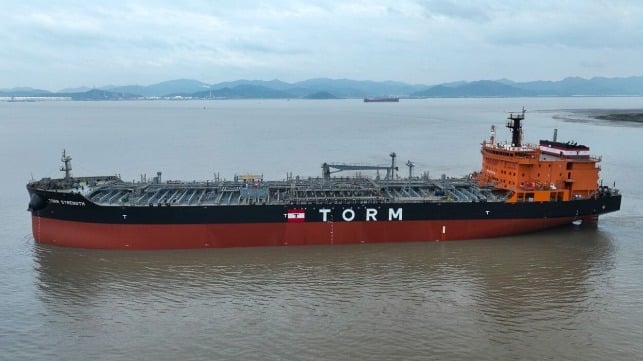
World-leading product tanker company Hafnia has purchased a large block of shares in competitor Torm, and has signaled plans to pursue a mega-merger bringing together two leading fleets in the segment. 

In dual statements, the companies said that Hafnia has acquired about 14 percent of Torm's issued share capital from Oaktree Capital Management, drawing on its own working capital and its lines of credit to make the purchase. The share purchase is large enough to give Hafnia consultation rights on the appointment of one representative on Torm's board. The closing conditions required the approval of regulators in Denmark and Brazil, and all conditions were satisfied before the purchase announcement, Hafnia said. 

Hafnia says that it "believes consolidation is positive for the tanker industry generally and for the shareholders" of both companies, and it is looking at options for a combination of the two businesses. It plans on discussing possibilities for a merger with Torm's board. 

Hafnia is the largest global operator of chemical and product tankers, and it moves crude and various products for blue chip oil majors. The energy shipping conglomerate BW Group holds a 44 percent controlling interest in Hafnia, along with BW's separate divisions for LNG, LPG, specialty gas, dry cargo, offshore wind and FPSO solutions. 


Takeover Offers Prompt Debate Over ZIM's National Security Role

ZIM sammy ofer container ship
File image courtesy ZIM / Seaspan

Published Dec 23, 2025 11:14 PM by The Maritime Executive


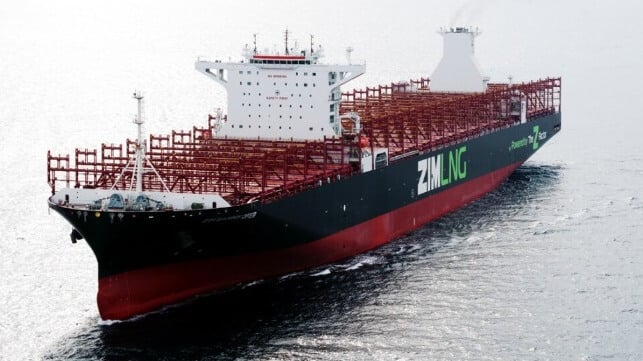
Shares in Israeli container line ZIM soared in value on Tuesday after the company's board said that it is evaluating a possible private buyout. At least one offer has already been declined, but two foreign offers are still under consideration, according to Israeli media. 

The buyout competition started last month with an offer from the firm's sitting CEO, Eli Glickman, who proposed to take ZIM private in cooperation with Israeli businessman Rami Unger. ZIM's boardmembers solicited competing offers in order to maximize shareholder value. On Monday, they said that they had decided to reject Glickman's proposal, claiming that the CEO's buyout bid undervalued the company. Glickman remains at the helm of the firm.

Rumored names of other competing bidders have been passed around in the Israeli press. Number-one container carrier MSC is not involved, despite a public mention, the firm told multiple shipping outlets. The two other alternatives named in the Israeli press are Hapag-Lloyd and Maersk. 

If one of the proposals is accepted, ZIM would be a unique candidate for a transnational merger, as it has a dual-purpose role. It is a commercial shipping company, but has a longstanding national-defense commitment: it was launched in 1945 in order to transport personnel and supplies to the region that would soon become formally known as Israel, and its logistical capabilities assisted before and after the creation of the Israeli state in 1948. Today, the Israeli government still holds a "golden share" in ZIM to secure national interests in military logistics and global market access. At the outset of the conflict in Gaza, ZIM offered up the entirety of its fleet for the Israeli government's use in order to facilitate imports of munitions and defense cargoes, and it helped keep the Israeli military supplied throughout the operation. 

The workers' committee at ZIM told Israeli business outlet Calcalist that the line's employees will go out on strike in protest if the board tries to sell the storied firm to a foreign buyer. Union leaders are lobbying Israeli ministers to exercise the state "golden share" if needed in order to block any potential foreign sale.  

"Our struggle is not only against the German Hapag-Lloyd, but against any other foreign company. We will do everything we can to ensure that Zim does not pass into foreign hands, but remains Israeli," committee chairman Oren Caspi told Calcalist. 

The leadership of Israel's National Emergency Authority (NEA) also opposes the idea of a foreign sale, according to local logistics outlet Port2Port. The outlet reports that NEA favors action to "keep the control over the company in Israeli hands" and ensure the "continuity of state function." NEA chief Eitan Yitzhak has circulated a memo to this effect among senior Israeli government ministers, Port2Port reports.


Low E-Fuel Production Slows Europe's Decarbonization

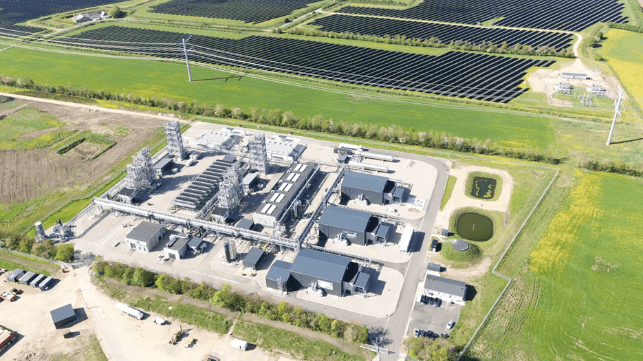
The KassĆø e-methanol project in Denmark is the largest of its kind in Europe (European Energy)

Published Dec 21, 2025 8:54 PM by The Maritime Executive


Europe’s ambitions to decarbonize the shipping industry face obstacles due to the fragile state of the alternative fuel supply chain, an analysis by the activist NGO Transport & Environment (T&E) shows.

Though Europe is setting the pace in efforts to cut down on shipping emissions, the review shows that production of green hydrogen and other e-fuels remains significantly low, with the largest e-fuel plant serving the maritime sector only becoming operational this year. For many other projects, a lack of regulatory certainty is preventing advancement beyond the planning stage.

T&E examined 80 green hydrogen and e-fuels projects that could potentially serve the maritime sector in Europe. While the listed projects could produce 3.6 million tonnes of oil equivalent by 2032, less than five percent are dedicated primarily to shipping, and only a small portion is linked to operational projects.

The NGO says that while some projects have progressed in their development, total shipping e-fuels production appears unlikely to reach targeted levels unless new policy incentives are implemented. The low production means that Europe is unlikely to meet its own target of at least one percent of e-fuels uptake by 2031 and two percent uptake by 2034 under the FuelEU agreement.

The analysis comes just weeks after the European Commission adopted its Sustainable Transport Investment Plan (STIP) that sets out the roadmap for accelerating the energy transition for both maritime and aviation sectors. To meet the fuel targets, Europe needs significant volumes of around 20 million tonnes of sustainable alternative fuels (13.2 tonnes of biofuels and 6.8 tonnes of e-fuels) by 2035. To drive production, investments amounting to $120 billion are required by 2035.

T&E says that while the majority of the investments are expected to come from the private sector, public funding is essential to de-risk first-of-a-kind projects and steer the market toward fuels that align with Europe’s priorities. And although STIP is a positive step to support the e-fuels industry, the fact that it relies on tools such as the European Hydrogen Bank auctions or the Innovation Fund could hinder its effectiveness.

Currently, Norway has the largest quantities of fuels dedicated primarily to the maritime sector, followed by Spain, Finland and Denmark. For Norway, nearly one-quarter of projected volumes target shipping as their main end user primarily through e-ammonia.

The KassĆø e-methanol project in Denmark, which became operational in May this year, remains as the largest operational e-fuel project serving the maritime sector. Developed by European Energy, the plant has an annual production capacity of 42,000 tonnes and is supplying e-methanol to Maersk, the LEGO Group and Novo Nordisk, among others.

“The biggest maritime e-fuels project went online this year. This shows what is possible, but scaling up projects remains a challenge. Current shipping targets just aren’t ambitious enough to get investors to put money on the table. As well as demand incentives, fuel producers need hard cash,” said Constance Dijkstra, T&E maritime policy manager.

Dijkstra added that for Europe, fostering a strong e-fuels sector can bolster the continent’s industrial leadership and reduce the dependence on imported fossil fuels.