Thursday, December 25, 2025

Petronas Deepens LNG Ties With CNOOC in Long-Term Supply Deal

Petronas has strengthened its position in Asia’s liquefied natural gas market after signing a long-term LNG supply agreement with China National Offshore Oil Company (CNOOC), underscoring the continued importance of gas in the region’s energy transition.

Under the sale and purchase agreement, Petronas LNG Ltd. will deliver 1.0 million tonnes per annum (MTPA) of LNG to CNOOC Gas and Power Singapore Trading & Marketing, extending a partnership that has spanned years of LNG cooperation between the two state-backed energy companies.

The deal aligns with China’s stated “Dual Carbon” objectives, which target peak carbon emissions before 2030 and carbon neutrality by 2060. Natural gas, particularly LNG, is expected to play a central role in China’s strategy to displace coal while maintaining energy security amid rising power demand.

Petronas said the agreement reflects more than just incremental LNG volumes, framing it as an expansion of a broader strategic relationship with CNOOC. The Malaysian energy major has increasingly emphasized long-term contracts as a way to balance portfolio stability with Asia’s structural demand growth for cleaner-burning fuels.

China remains one of the world’s largest LNG importers, and long-term supply contracts have regained prominence after the market volatility of recent years exposed the risks of heavy reliance on spot purchases. Chinese buyers have been actively locking in LNG volumes from a range of suppliers to underpin supply security and price stability.

For Petronas, the agreement reinforces its standing as a reliable LNG supplier to North Asia at a time when competition among exporters is intensifying. The company markets LNG from an established portfolio that includes production in Malaysia and international assets, allowing it to serve customers across Asia under flexible commercial structures.

The agreement also reflects a broader trend in Asian LNG markets, where national oil companies are using long-term deals to support decarbonization goals without sacrificing reliability. While renewables capacity continues to expand across the region, gas remains a critical bridging fuel for power generation, industrial use, and grid stability.

Petronas has been actively positioning LNG as a lower-carbon solution within its broader energy transition narrative, while continuing to invest in upstream gas, LNG infrastructure, and trading capabilities. China, for its part, is expected to remain a cornerstone market for LNG demand growth over the next decade, even as it accelerates investments in renewables and nuclear power.

The latest agreement highlights how long-term LNG partnerships are increasingly being framed not only around supply security, but also around shared transition objectives between producers and consumers.

By Charles Kennedy for Oilprice.com

Energy-as-a-Service: A Subscription Trap for Heavy Infrastructure

  • The Energy as a Service (EaaS) market is projected to double to over $55 billion by 2030, driven by rising electricity prices and aggressive new building performance standards that force commercial entities to seek alternatives to high-cost capital retrofits.

  • The EaaS model is a high-stakes bet where the provider takes on the "performance risk," making Operational & Maintenance (O&M) a dominant and growing segment, as the cost of complex, technology-driven systems is merely being hidden behind a long-term contract.

  • The marketing promise of "Zero Upfront" capital expenditure ultimately translates to a Higher Total Cost of Ownership, as providers price in the cost of capital, performance risk, and management fees, effectively turning the building owner into a permanent tenant of their own infrastructure.

The digital economy’s favorite gimmick...the subscription...has finally arrived for the world of physical steel and copper.

Data from the latest sector forecasts indicates the commercial Energy as a Service (EaaS) market is set to double, ballooning from $28.79 billion in 2024 to over $55 billion by 2030

On paper, it is a clean, easyu narrative: commercial landlords and data center operators trade their volatile utility bills and aging HVAC units for a smooth, predictable monthly fee.

But when you audit the reality of a 11.4% compound annual growth rate, you find something far more complex than "energy efficiency." You find a massive transfer of infrastructure control...

The EaaS model is essentially a "reality bridge" for CFOs who are currently trapped between two immovable objects: rising electricity prices and aggressive new building performance standards. In the U.S. alone, commercial electricity rates jumped 6.3% in the last year, with some regions like D.C. seeing spikes of over 20%.

When a hospital or a university realizes it can no longer afford to ignore its carbon footprint...or its power bill...it looks for a way out. EaaS providers like Ameresco or Siemens offer that exit. 

They take the "hardware" (solar panels, battery arrays, microgrids) off the balance sheet and turn it into an operating expense.

It sounds like liberation. In reality, it is a high-stakes bet on the long-term performance of the physical world.

Who Owns the Decay?

The most telling data point in the current market shift isn't the growth of new solar installations. It is the dominance of operational & maintenance (O&M) services.

Under an EaaS agreement, the provider doesn't just build the plant; they own the "performance risk." If a commercial solar array underperforms or a battery's round-trip efficiency degrades faster than expected, the provider...not the building owner...eats the loss. This is why O&M is the second-largest segment of the market.

Providers are effectively selling a guarantee against the laws of thermodynamics...

I’ve seen this play out in other sectors of heavy industry. When you promise "uptime" in a world where hardware naturally breaks, your profit margin lives or dies by your ability to predict failure before it happens.

Data from the IEA’s 2025 World Energy Investment Report shows that to reach global climate targets, investments in building efficiency need to triple to $1.9 trillion by 2030. EaaS is the vehicle meant to carry that weight. 

However, the trouble lies in the "Service" part of the name. 

As these systems become more complex...integrating AI-driven demand response and sub-6-hour battery storage...the cost of keeping them running isn't going down. It is merely being hidden behind a subscription wall.

The North American Power Grab

North America is currently the epicenter of this shift, and the reason is purely regulatory.

It isn't just about "wanting" to be green. It’s about the legal "iron fist" of Building Performance Standards (BPS). From Cambridge, Massachusetts, to the state of Washington, new mandates are putting hard caps on building emissions. In Colorado, for instance, violating these standards can now carry penalties of up to $5,800 per violation.

For a commercial landlord, the math is brutal. You can either:

  1. Raise the capital to deep-retrofit your building (impossible for many in a high-interest-rate environment).
  2. Pay the fines (unsustainable).
  3. Sign an EaaS contract and let a private equity-backed provider own your roof.

The result is a shift from public service to private platform. We are watching the "platformization" of the power grid.

The "equity" in this scenario isn't being held by the local community or the building owner. It is being collected by the financial entities that can aggregate these small-scale projects into bankable portfolios. The Cost of Capital Observatory notes that while renewable costs are falling, the "bankability" of projects remains a massive hurdle. EaaS providers act as the middleman, taking on the regulatory and technical risk in exchange for a 10-to-20-year lock-in on the energy revenue.

The Data Center Delusion

The hype surrounding EaaS often points to the "explosive growth" of data centers as a primary driver.

It’s true that data center investment is expected to hit $580 billion in 2025...surpassing the $540 billion being spent on global oil supply. But here is the "reality audit" on that figure: hyperscalers like Microsoft and Google are increasingly building their own power plants because the existing grid can't handle their load.

When a market forecast says EaaS is "driving" efficiency in data centers, it’s often describing a desperate scramble for power availability rather than a noble quest for sustainability.

Almost a quarter of the new data center projects tracked by BloombergNEF in 2025 are over 500 megawatts each. That is the annual electricity consumption of 2 million electric vehicles. An EaaS provider entering this space isn't just "optimizing" energy; they are effectively acting as a private utility for a single corporate client.

They are building the "hardware of the world" to bypass the grid entirely...

The Hidden Cost of the "Zero Upfront" Promise

The marketing brochure for EaaS always leads with "Zero CapEx."

It is the siren song for every facility manager with a shrinking budget. But as a reporter who has spent years looking at balance sheets, I know that "Zero Upfront" is just another way of saying "Higher Total Cost of Ownership."

When a provider finances your new HVAC system and solar array, they aren't doing it out of the goodness of their heart. They are pricing in:

  • The Cost of Capital: Currently 8.5% to 9.75% for infrastructure projects.
  • The Performance Risk: A premium to cover the "what if" of technical failure.
  • The Management Fee: A margin for the digital platform that monitors the sensors.

If you paid for the equipment yourself, you’d own the asset and its eventual "free" energy. Under EaaS, you are a permanent tenant of your own infrastructure.

The industry is betting that you’re too scared of the volatility to care...

The Bottom Line

We need to decide if this $55 billion market represents a leap forward or just a massive bill to keep the lights on.

The IEA suggests that current investments, while record-breaking, are still below what is needed for a true transition. EaaS bridges that gap by unlocking private capital, but it does so by creating a new class of "energy landlords."

The story isn't the CAGR. The story is the friction. 

It’s the cost of the technicians who have to replace the inverters in year seven. It’s the legal battles over "performance guarantees" when the sun doesn't shine as much as the model predicted. It’s the reality that you can’t "disrupt" the laws of physics with a clever subscription model.

The promise of "abundance" usually comes with a very specific, long-term invoice...

By Michael Kern for Oilprice.com


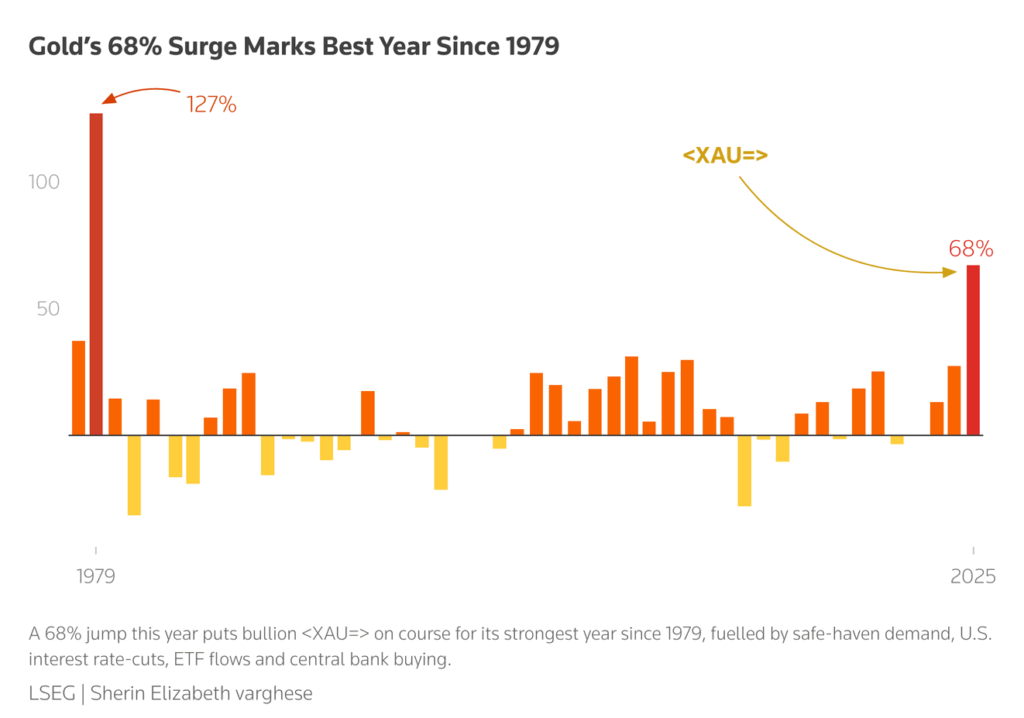
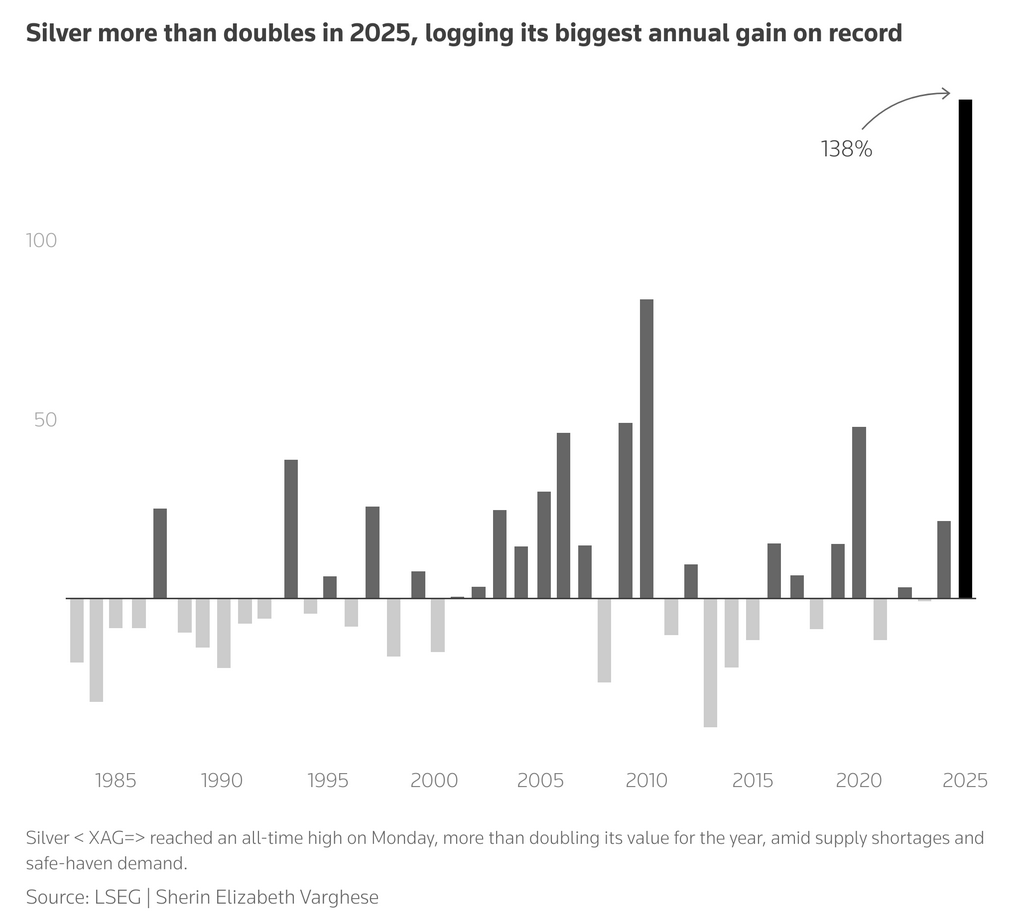
GRAPHIC: Gold and silver soar in year-end rally


Gold, silver and miners just can’t jump
Stock image.

Gold surged close to the $4,500-per-ounce mark on Tuesday, while silver hovered just shy of $70, as expectations of looser US monetary policy and simmering geopolitical tensions propelled both precious metals toward record highs.

Spot gold traded as high as $4,497.55, while silver climbed to a record peak of $69.98, extending hefty gains this year.

“With precious metals making record prices so late in the year, when ordinarily one might have found time to write a Christmas card or two, perhaps the biggest takeaway is that investors have not treated the festive break as an occasion to take profits,” Mitsubishi analysts said.

Geopolitical and macro drivers

Bullion has hit multiple record highs this year, underpinned by US interest rate cuts and a weaker dollar. Analysts see more upside into next year, with Goldman Sachs forecasting gold at $4,900 by December 2026.

The dollar has slumped nearly 10% in 2025, putting it on track for its worst year in eight. Many investors expect the currency’s decline to resume in 2026 as global growth picks up and the Federal Reserve eases policy further.

“Rate cut bets have ramped up following the recent inflation and labour data prints in the US, which is helping drive precious metal demand,” said Zain Vawda, analyst at MarketPulse by OANDA.

Safe-haven demand is also expected to remain strong amid tensions in the Middle East, uncertainty over a Russia-Ukraine peace deal and, more recently, US action against Venezuelan tankers.

ETF inflows and and central bank buying

Central bank demand for gold has been elevated for four years and is likely to continue into 2026, alongside strong investment demand, analysts said.

Central banks are on track to buy 850 tons of gold in 2025, down from 1,089 tons in 2024, said Philip Newman, managing director at consultancy Metals Focus. “It’s still a very healthy figure in absolute terms,” he added.

Physically-backed gold exchange-traded funds are on course for their biggest inflow since 2020, attracting $82 billion, equivalent to 749 tons, so far this year, according to the World Gold Council.

Jewellery demand has been under pressure due to high prices, partly offset by strong retail investment in bars and coins. Jewellery consumption in India fell 26% year-on-year to 291 tons in January-September, with the fourth quarter also looking weak, Metals Focus said, adding that softness would carry into 2026.

Retail investment in bars and coins in India rose 13% to 198 tons in the same period, driven by record prices and bullish expectations, Metals Focus said.

Silver outshines gold

Spot silver has surged over 140% this year, outpacing gold’s gain of more than 70%, supported by robust investment demand, its inclusion on the US critical minerals list, and momentum buying.

Silver exchange-traded product inflows have surpassed 4,000 tons, said Standard Chartered analyst Suki Cooper.

“Momentum and fundamentals support further gains, though stretched positioning and low year-end liquidity may cause volatility, with traders buying dips while real yields remain low and physical supply tight,” Mitsubishi analysts said.

Silver is already technically overbought, analysts said, as it now takes just 64 ounces of silver to buy an ounce of gold, down from 105 ounces in April.

“There will definitely be people trading the gold-silver ratio, but otherwise, when this febrile atmosphere evaporates, they will decouple and silver will almost certainly be the underperformer,” StoneX analyst Rhona O’Connell said.

(By Sherin Elizabeth Varghese, Ishaan Arora, Polina Devitt and Anmol Choubey; Editing by Mark Potter and Harikrishnan Nair)


Platinum price soars to record above $2,300 on tight global supplies

Stock image.

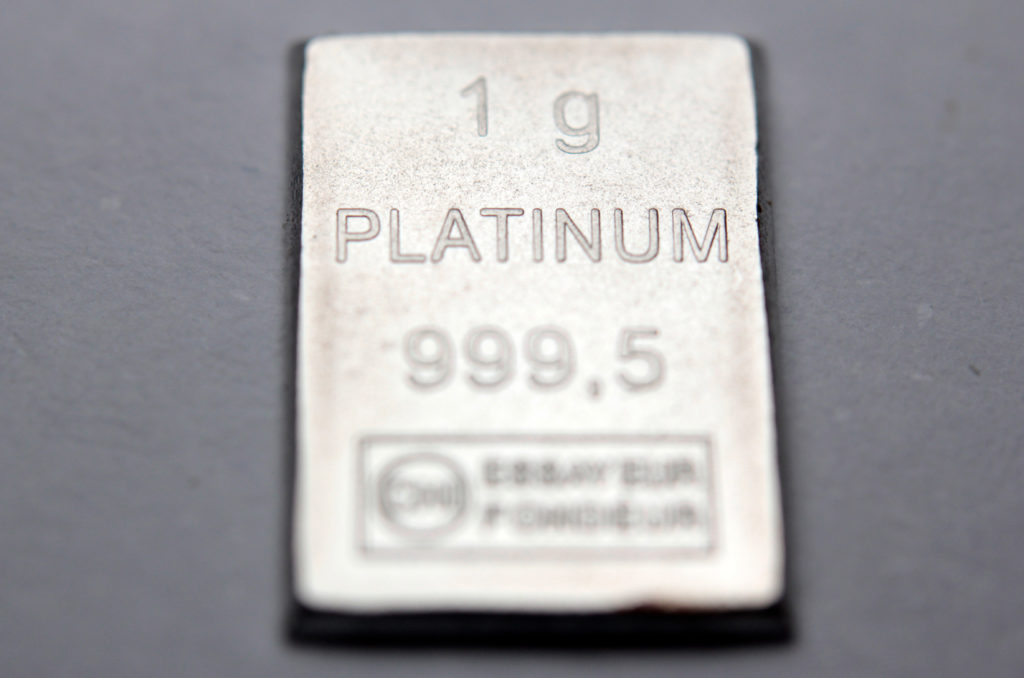
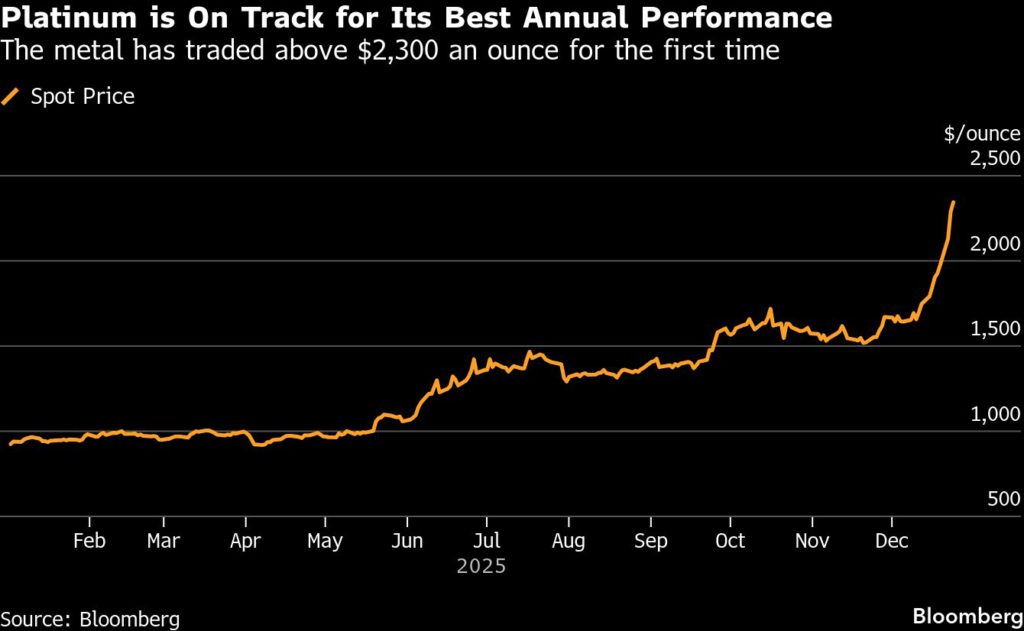
Platinum soared to an all-time high, trading above $2,300 an ounce for the first time on tight supplies and historically elevated borrowing costs.

The metal rose for a 10th straight session — its longest winning streak since 2017 — and has advanced more than 150% this year, the biggest annual gain since Bloomberg began compiling data in 1987. The recent surge has come as the London market shows signs of tightening, with banks parking metal in the US to insure against the risk of tariffs.

Used in the automotive and jewelry sectors, platinum has been caught up in the wave of investment that poured into precious metals this year. Gold and silver have also risen to records.

More than 600,000 ounces of platinum are sitting in US warehouses — an amount much higher than usual — as traders await the outcome of Washington’s Section 232 probe, which could lead to tariffs or trade restrictions on the metal.

Meanwhile, shipments to China have been robust this year, and demand optimism has been bolstered as contracts recently began trading on the Guangzhou Futures Exchange. Prices in Guangzhou have risen well above other international benchmarks.

Platinum is on course for a third annual deficit this year, due to supply disruptions in major producer South Africa. High borrowing costs have also been an issue for manufacturers that use the metal to produce goods ranging from chemicals to glass to laboratory equipment. Industrial users often choose the less capital-intensive option of leasing, rather than buying the commodity outright.

Platinum rose as much as 3.1% to a record $2,361.23 as of 8:19 a.m. in Singapore. Sister metal palladium gained as much as 2.5%.

(By Robin Paxton)

Unpacking Copper’s Phantom Deficit

  • The current record-high copper price, driven by a nearly 40% rise in 2025, is primarily a result of "economically trapped" inventory—between 730,000 and 830,000 tonnes of copper held in US warehouses by traders hedging against potential 15% tariffs.

  • The article argues that the market is running on a "belief-based" deficit narrative, largely fueled by the energy transition story, while on-the-ground data shows a surplus of metal that is simply in the wrong location for industrial use.

  • The structural deficit is projected to become genuine in 2026, but the short-term volatility hinges on political factors; if anticipated tariffs are lighter than expected, the trapped US inventory could be released, triggering a price collapse.

The headlines from the London Metal Exchange tell a story of a world on the brink of a copper famine. 

2025 is closing out with prices up nearly 40%...the most violent annual move since the post-crisis bounce of 2009. 

We’ve watched prices breach $12,000 a tonne, a level that would usually imply the world’s electrical grids were physically melting.

But if you look at the actual hardware...the physical metal sitting in sheds...the story isn't one of scarcity, but of a massive, expensive game of logistical hide-and-seek.

The reality is this: the world isn't out of copper. It has just moved the copper to places where it is functionally useless for industry, but highly profitable for traders. 

We are witnessing the birth of the "economically trapped" inventory, where metal is diverted not to be turned into wire or transformers, but to sit as a hedge against a political "what-if."

The Architecture of a Fake Shortage

The friction point isn't in the mines, at least not yet. It’s in the spread between the LME in London and the CME in Chicago. 

Data from Benchmark Minerals suggests that by October, between 730,000 and 830,000 tonnes of copper were "economically trapped" in the US.

To put that number in perspective: that’s enough copper to build about 10 million electric vehicles or wire up every AI data center planned for the next three years...

And yet, it is doing neither.

It is sitting in warehouses because traders are terrified of the 15% tariffs rumored to be coming from the Trump administration.

If you bring the metal in now, you beat the tax. Once it’s inside the U.S. border, the arbitrage and the premium environment mean there is zero incentive to move it. It’s a one-way valve.

We have reached a bizarre state where the world's most critical industrial metal is being treated like a digital token...hoarded for its future value rather than used for its current utility.

The 17-Year Lead Time vs. The 10-Minute Trade

The mining companies have done a masterful job of selling the "Transition Narrative." They point to the declining ore grades...which have dropped from 1.5% in 1900 to about 0.6% today...and the fact that a new copper deposit now takes an average of 17 years to move from discovery to first production.

The story is compelling. It’s also a convenient screen for the current price chaos.

Investors have bought the long-term deficit story so completely that they’ve priced in 2035’s shortages in 2025. This "belief-based" pricing has pushed mining equity valuations to 18x forward EBITDA, well above the 12x historical average.

The industry is currently running on the "vibes" of the energy transition rather than the reality of the order books. In China, the actual consumer of over half the world’s copper, construction and manufacturing remain soft. The "vibe" says we are in a deficit; the "boots-on-the-ground" data says we have nearly a million tonnes of surplus metal currently parked in the wrong zip code.

Who Pays for the "Green" Premium?

We need to talk about who is collecting the equity in this new copper regime. As prices hover near $12,000, we aren't just seeing a commodity cycle; we are seeing a shift from public service infrastructure to private platform extraction.

  • The Privateers: Private equity mining investments tripled this year, hitting $12 billion compared to $4 billion in 2024.
  • The Grid Tax: Modernizing the North American grid is projected to cost $2.5 trillion by 2035. Every dollar added to the price of copper is a hidden tax on every household's utility bill.
  • The Substitution Trap: At these prices, engineers are desperately trying to swap copper for aluminum. But aluminum requires 1.5 to 2 times the volume for the same conductivity and brings its own set of thermodynamic headaches.

The "limitless growth" promised by the AI and EV sectors assumes that the laws of finance will eventually bend to the needs of the "Cloud." They won't.

A 100-megawatt AI data center can suck up 2,000 to 3,000 tonnes of copper. At $12,000 a tonne, the metal alone is becoming a significant percentage of the CapEx. Eventually, the balance sheet will force a choice: build the data center or pay the copper speculators. You cannot do both at these levels.

The Maintenance vs. Growth Binary

The most sobering data comes from the existing hardware. This year, 18 of the world’s 25 largest copper miners reported production decreases.

This isn't just about strikes at Grasberg or Kamoa-Kakula. It's about the maintenance bill. We are spending more capital just to keep production flat. The capital intensity to build a new mine has doubled, rising from $8,000 per annual tonne in 2010 to nearly $20,000 today.

Most of the "growth" we see in corporate press releases is actually just a desperate attempt to outrun the depletion of existing assets.

Asset

2024 Performance

2025 Reality

Grasberg (Indonesia)

Production Leader

Long-term disruptions; recovery post-2027

QB2 (Chile)

"Growth Engine"

Ramp-up delays and technical friction

Kamoa-Kakula (DRC)

High-grade hope

Logistical bottlenecks and quota fears

The industry is effectively running up a down escalator.

2026: The Year of the Structural Snap

If 2025 was the year of the "Trade Hedge," 2026 is where the math starts to get real.

BloombergNEF warns that the market will enter a genuine structural deficit next year. The safety valves...scrap and substitution...are already being pushed to their limits. 

Scrap currently accounts for 36% of manufacturing supply, but it’s a lagging indicator. You can't recycle a car that was built yesterday; you have to wait 15 years for that metal to come back.

For 2026, I’m watching the "Trump Volatility" closely. 

If the anticipated tariffs are lighter than expected, that million-tonne "trapped" inventory in the US could flood back onto the global market, triggering a price collapse that would catch the "deficit" bulls off guard.

However, if the tariffs land and the AI build-out continues its current trajectory, we are looking at a fractured global market where copper prices in the US and the rest of the world decouple entirely.

The deficit is coming, but the volatility is already here.

By Michael Kern for Oilprice.com

Super Copper’s Cordillera project approved by Chile’s National Mining Authority

Super Copper is focused on developing projects in northern Chile. 
(Image courtesy of Supper Copper.)

Super Copper (CSE: CUPR) said on Wednesday it has received approval from Chile’s national mining authority (Sernageomin) for its Cordillera Cobre project.

The approval pertains to a total of 26 mining concessions covering approximately 6,858 hectares in the Atacama copper belt.

Super Copper said it has now completed the most technical and challenging portion of the Chilean mining rights process, with 26 exploitation concessions that make up the Cordillera Cobre claim block fully approved by the National Geology and Mining Service.

Of these concessions, 25 have received formal court resolutions establishing them and 15 have had their legal extract published in the official mining gazette; registration in the Copiapó mining registry is now underway.

Once registration is complete, each concession becomes a legally constituted exploitation concession, granting full and permanent mining rights, the company noted.

“This is a critical milestone for Super Copper. Securing exploitation concessions, not just exploration rights, gives full and permanent mining rights at Cordillera Cobre,” Super Copper CEO Zachary Dolesky said in a news release.

“With the title process effectively complete and registration progressing as planned, we are positioned to submit our drill program promptly upon finalizing results from our most recent exploration work,” Dolesky said. “This positions Super Copper to advance one of the most exciting new copper projects in the Atacama region, at a time when global copper demand is entering a major structural deficit.” 

In July, the Canadian junior also struck a deal to acquire 100% of the Castilla copper project, locking down a 5,800-hectare land package near the historic Manto Negro mine.