Thursday, December 25, 2025

MERRY FUCKING XMAS

Canadian retailer drops Canada Post as its carrier ahead of holiday season


ByRobin Della Corte
 December 24, 2025 

People make their way from a Canada Post Office during the holiday season in Ottawa on Tuesday, Dec. 19, 2023. (The Canadian Press)

This holiday season, one Canadian retailer says its using alternative carriers after relying on Canada Post for more than 10 years to deliver their products to their clients.

Province of Canada co-founder Julie Brown says with all their merchandise made in Canada, and with most of their clients in Canada, it made sense to use Canada Post as their carrier.

READ: Canada Post, union reach tentative agreements, with vote expected in new year

Although Canada Post and the union representing postal workers reached a tentative agreement for a new contract on Monday, it follows two years of negotiations that has led to labour disputes and strikes, causing major disruptions for businesses that rely on the Crown service.

Because of this, Brown says it was best to switch carriers.

“After last year’s strike and then this September, we just didn’t feel we had the confidence to go into the holiday season with them again, which saddened us because we’ve used them for the last 11 years,” Brown told CTV News Channel on Tuesday. “But we had to go a different route this holiday season. We just couldn’t afford to have the disruptions we had last year.”

“We had to replace them with four to five other carriers to make it work this year, but at least we didn’t have to deal with the strike,” she added.

Earlier this year, Canada Post reported losing $407 million in the second quarter. It also said that 2025, which will be the eighth consecutive year it lost money, was expected to be the worst fiscal year in the Crown corporation’s history.READ: ‘Government would likely step in’: Canada Post unlikely to go under, analyst says

The postal service has recognized that continued unresolved negotiations between it and its union, the Canadian Union of Postal Workers (CUPW), significantly impacted its business.

Butterpot Designs in Kitchener, Ont., and Lemon & Lavender in Toronto are among the other businesses who have also opted to go with other carriers this holiday season, due to lack of trust in Canada Post to deliver.

Canada Post trucks are seen in a distribution centre in Montreal on Dec. 13, 2024. THE CANADIAN PRESS/Christinne Muschi (Christinne Muschi)

The Canadian Federation of Independent Business (CFIB) says many Canadian businesses have expressed similar concerns.

“Businesses have learned the hard way that Canada Post is an increasingly unreliable provider of delivery services - and so many have made decisions to permanently move away from Canada Post,” Dan Kelly, CFIB President, told CTVNews.ca last month.

For Brown, she says last year’s holiday strike made her think twice about using Canada Post this time around.

“Last Christmas was really challenging on so many levels,” she said. “I felt like our entire staff, we were just dealing with it, trying to figure out what was going to happen everyday.

“We were spending more time on logistics than we were on customers and marketing,” she added.

A Canada Post worker delivers mail in Barrie, Ont., after a large snowstorm blanketed the region one day before Christmas, Tuesday, Dec. 24, 2024. THE CANADIAN PRESS/Christopher Drost (Christopher Drost)

The tentative agreement would be in effect until Jan. 31, 2029, which includes a 6.5 per cent wage increase in the first year and a three per cent increase in the second. The agreement also covers both the Urban and Rural and Suburban Mail Carrier (RSMC) bargaining units.

However, while Brown has always loved the service Canada Post provided, she says there is still too much instability to switch back right now.

“We were in quite a pickle last year, which is why this year we were like, ‘this is out of the question, we just can’t go down this path again without real certainty that we can rely on Canada Post,’” she said.

Brown adds that if Canada Post and the union are able to sort things out, they would reconsider going back to them next Christmas.


Robin Della Corte
CTVNews.ca Journalist
LUBE FOR XMAS

CPP Investments acquires minor stake in lubricants company Castrol

ByThe Canadian Press
December 24, 2025 

The Bay Street Financial District is shown with the Canadian flag in Toronto on Friday, August 5, 2022. THE CANADIAN PRESS/Nathan Denette (Nathan Denette)

TORONTO — The Canada Pension Plan Investment Board says it has acquired a minority stake in lubricants company Castrol alongside private investment firm Stonepeak.

Stonepeak is acquiring a majority controlling stake in Castrol from BP plc in a deal that values Castrol at an enterprise value of about US$10.1 billion.

The pension fund says it will invest up to US$1.05 billion in the deal.

CPP Investments managing director and head of sustainable energies Bill Rogers says the investment aligns with its strategy of backing businesses that are essential to the energy system.

Castrol is known for its lubricants, such as engine oils, industrial fluids and greases for automobiles and airlines.

The transaction is expected to close by the end of 2026.

This report by The Canadian Press was first published Dec. 24, 2025.


ALL CAPITALI$M IS STATE CAPITALI$M

Canadian Government intervenes with $115M to protect Northwest Territories’ mining hub


ByThe Canadian Press
Published: December 18, 2025 

The Ekati Diamond Mine in the Northwest Territories is shown in this undated handout photo. THE CANADIAN PRESS/Handout — Burgundy Diamond Mines Limited, Dave Brosha Photography (Mandatory Credit) (HO)

OTTAWA — The owner of a mine in Northwest Territories will receive a $115 million loan from the federal government to keep operations running as U.S. tariffs depress the global diamond market.

Arctic Canadian Diamond Company Ltd., a subsidiary of Australia’s Burgundy Diamond Mines Ltd., operates the Ekati mine in the Lac de Gras region of Northwest Territories, roughly 300 km northeast of Yellowknife.

Finance Canada says Ekati employs more than 600 workers and hundreds of additional contractors, more than 200 of them Indigenous. The department estimates the diamond sector is responsible for nearly 20 per cent of the territory’s economy.

Ottawa is extending the relief through its large tariff enterprise loan program, a $10-billion fund set up in March to help companies and workers affected by U.S. President Donald Trump’s global trade disruption.

Burgundy announced in July it had laid off employees at its Point Lake open pit mine because the operation wouldn’t be profitable in the tariff-stricken diamond market. Mining has continued at the underground Misery site, Ekati’s main production centre.


In a filing to the Australia Securities Exchange in September, the company said the United States’ 50 per cent tariffs on gem and jewelry imports from India — a hub for diamond refining — have driven down global prices.

The International Diamond Exchange’s price index shows sharp declines in diamond prices since 2022, which many analysts correlate with flagging demand and the rising popularity of lab-grown gems. But Burgundy said the imposition of tariffs has compounded declines over the past year.

“A further drop in rough diamond prices can be directly attributed to the imposition of the U.S. tariffs applicable to the global diamond trade,” Burgundy’s filing read.

“These tariff measures have placed additional downward pressure on rough diamond prices and materially impacted the company’s revenues.”

Burgundy previously asked to have its trading suspended on the Australian exchange until it could secure external financing.

The company said in July it would maintain its Point Lake site to resume mining if market conditions improved.

In a media statement, Finance Minister François-Philippe Champagne said the loan to Burgundy will offer “stability” and support jobs in the key northern mining industry.

Ottawa made changes to the loan facility in September to open the financing up to a broader range of firms and to require employers to prioritize worker retention.

The federal government gave Sault Ste. Marie, Ont.-based Algoma Steel $400 million via the large enterprise tariff loan facility in September, alongside $100 million from the Ontario government.

That company announced last month it would lay off more than 1,000 employees as part of its transition away from blast furnaces and toward a greener, more efficient process for steelmaking.

This report by The Canadian Press was first published Dec. 18, 2025.
Craig Lord, The Canadian Press

Feds, Ontario to sign deal reducing regulatory burden on Ring of Fire, other projects

ByThe Canadian Press
Published: December 17, 2025 

A helicopter moves equipment fuel between work sites near the Ring of Fire mineral deposit in the James Bay lowlands of northern Ontario, Friday, Oct. 24, 2025. THE CANADIAN PRESS/Christopher Katsarov (Christopher Katsarov)

Ottawa and Ontario are set to finalize a deal Thursday that will reduce the regulatory burden on large projects, including the road to the Ring of Fire, The Canadian Press has learned.

Provincial and federal government sources who are not allowed to speak publicly say Ottawa has agreed to eliminate any duplicative work on its impact assessments on large projects.

A draft agreement posted on the Impact Assessment Agency of Canada’s website says the goal is to work together to implement the “One Project, One Review and One Decision” approach.

Ontario Premier Doug Ford was asked if this would be the final piece of the puzzle in order to begin building the roads to the Ring of Fire next year.

“I believe so,” he said.

Webequie First Nation and Marten Falls First Nation are leading environmental assessments on three roads that would connect the provincial highway system to their communities and mining activities in the mineral-rich Ring of Fire region in northern Ontario.

In a side deal on the Ring of Fire roads, the federal government has committed to completing its impact assessment on the same timeline as the province’s environmental assessment, as both First Nations say they are set to begin building the roads in 2026.

The province has also signed a deal with Aroland First Nation further south at the foot of the roads to the Ring of Fire that will see an old nearby logging road upgraded.

“This is about bringing them prosperity, bringing Ontario prosperity, making sure that we work with the communities up there,” Ford said.

Ontario Indigenous Affairs Minister Greg Rickford called the upcoming deal “good public policy” that will help the First Nations the province has partnered with to build the roads and other badly needed infrastructure in those communities.

“It need not be smothered in regulatory processes that just serve to make the development of this infrastructure and the penultimate goal of bringing the world its critical minerals longer than it should,” he said.

Energy and Mines Minister Stephen Lecce said they need to get on with building.

“I think part of this agreement that (Ford) has landed is really about securing a path to delivering the roads and ultimately delivering prosperity and more self reliance for Canada,” he said.

Prime Minister Mark Carney and Ford will sign the deal at a ceremony in Ottawa on Thursday. Carney’s office did not respond to a request for comment.

The Canadian Press learned about the details during a recent trip to the Ring of Fire region as part of a reporting project supported by the Pulitzer Centre.

Both Webequie and Marten Falls say the roads will help lift the fly-in communities out of poverty, though other nearby First Nations are not on board with the plan.
RELATED STORY: Inside the Ring of Fire: A tale of two First Nations and a road that could change everything

A source in Ford’s office who is not allowed to speak publicly about the yet-to-be-announced deal says the changes will dramatically speed up big projects across the province, including roads, highways and mines.

“This is huge, not just for the Ring of Fire, but for mining in general, and building roads and highways,” the premier’s office source says. “It will be 10 times more transformational than any major project.”

A senior federal government source, who likewise was not authorized to speak publicly about the deal, says it is all about eliminating duplication. The environmental standards will remain stringent and rights and protections will be upheld, the source promises, including for the roads to the Ring of Fire.

The federal government has launched a regional assessment working group to better understand the impacts of development, but the province and Webequie and Marten Falls say it will not affect the road.

The two governments aim to work together on assessments of navigable waters, species at risk and migratory birds, all long in the federal purview.

With these deals in place, the province is no longer expected to use controversial new powers to designate the road to the Ring of Fire a special economic zone. That provision would have allowed the province to suspend provincial and municipal laws with the goal of speeding up construction of a proposed mine in the Ring of Fire.

The area is said to be replete with critical minerals, but many other First Nations are against development in the region — including the roads and the mine they would lead to.

Wyloo, the Australian mining giant, is nearing completion of its feasibility study on two proposed, connected underground mines at its Eagle’s Nest site.

Wyloo and Juno Corp., a Canadian junior mining company formed in 2019, own the vast majority of the more than 40,000 claims staked in the Ring of Fire. Two other companies, Teck Resources (which recently merged with Anglo American) and Canada Chrome Corporation, also hold a significant number of claims.

The companies say they’ve found a wide variety of critical mineral and base metal deposits, including nickel, copper, chromite, titanium, platinum, vanadium, iron and gold. They are used to make all types of batteries, cellphones, stainless steel, semi-conductors, drones, satellites, data centres and computers.

Meanwhile, Ontario has finalized its regulations to allow for the designation of special economic zones, which will come into force on Jan. 1, 2026.

That was a key component in Ontario’s Bill 5 omnibus package that passed into law last spring. The province gave itself the power to suspend any and all provincial and municipal laws in an effort to speed up the construction of large projects, particularly mines.

Ford has mused about using it for his proposed traffic and transit tunnel under Highway 401.

The special economic zone idea sparked outrage among the majority of First Nations in the province, who saw it as a threat to their way of life.

The new regulations give Economic Development Minister Vic Fedeli the power to choose which areas could be deemed a special economic zone, which company or individual can be deemed a trusted proponent and which projects would be part of the designation.

Those decisions will pass through cabinet first.

“Special economic zones will bolster Ontario’s economic advantage by cutting red tape, accelerating approvals and protecting the jobs and industries that keep our province resilient and competitive,” Fedeli said in a statement.

This report by The Canadian Press was first published Dec. 17, 2025.
Liam Casey, The Canadian Press


SOMETIMES WE'RE THE BAD GUYS

Taiwan launches WTO complaint over Canadian steel tariffs

ByAFP
Published: December 18, 2025 
Rolled coils of steel sit in the yard at Algoma Steel Inc., the second largest steel producer in Canada, in Sault Ste. Marie, Ont., Friday, July 25, 2025. THE CANADIAN PRESS/Nick Iwanyshyn (Nick Iwanyshyn/The Canadian Press)

Geneva, Switzerland -- Taiwan has launched a complaint with the World Trade Organization over Canadian tariffs slapped on imports of steel goods, the global trade body said Thursday.

WTO said that Taiwan, which is known as Chinese Taipei within the organisation, had requested that it initiate “dispute consultations with Canada”, charging it was breaching international trade rules.

The complaint, it said, regarded “Canadian measures imposing tariff rate quotas (TRQs) and surtax on imports of certain steel goods and a global duty on imports of certain steel derivative goods”.

The request was filed on Monday, but was only circulated to WTO members on Thursday.

In the request, Taiwan charged that a string of measures announced since June, including a 50-percent surtax on imports of certain steel goods and a global 25-percent tariff on certain steel-derivative products, appeared “to be inconsistent with Canada’s obligations under several WTO provisions”.

WTO consultations give the parties an opportunity to discuss the matter and to find a satisfactory solution without proceeding further with litigation.

After 60 days, if consultations have failed to resolve the dispute, the complainant may request adjudication by a panel.
U.S. lumber dependence gives Canada trade advantage

HEWERS OF WOOD, DRAWERS OF WATER


ByJoshua Santos
Published: December 24, 2025 

Canada is in a unique position to leverage America’s need for lumber as officials review the Canada-United States-Mexico Agreement (CUSMA) in the New Year, according to a trade expert.

U.S. President Donald Trump claims the U.S. doesn’t need anything from Canada yet Canada produces about 25 per cent of all U.S. lumber demand. Nearly 90 per cent of softwood lumber is exported to the American market.

“The good news is they need our wood. We think that there’s an ability to make a deal at some point,” Daryl Swetlishoff, head of research at Raymond James Ltd. told BNN Bloomberg in an interview.

Softwood lumber tariffs now reached a combined 45 per cent after the U.S. added a 10 per cent tax to existing anti-dumping and countervailing duties. CUSMA ensures a large portion of goods remain tariff-free, however softwood lumber is specifically excluded from these protections.

While the U.S. relies on Canadian supply, Swetlishoff said Canada relies on the U.S. as its primary customer. He said the sheer volume of Canadian production makes diversification to markets in Europe or Asia difficult.


“We have a very efficient large industry and the reality is the U.S. will be the home for the lion’s share of our market for the foreseeable future,” said Swetlishoff.

The U.S. could open state-owned forests in Washington, Oregon and Idaho but it does not have enough capacity to mill, process and ship new timber, according to the Government of British Columbia.


Impact of tariffs


The Canadian lumber sector is currently facing massive tariffs following accusations of unfair trade practices by American lumber companies. British Columbia accounts for 50 per cent of Canada’s exports to the U.S. but has seen sawmills close.

“You’re seeing cash losses throughout the U.S. south, and we’re going to see curtailments manifest itself in that region as well,” said Swetlishoff.

He said valuations for lumber companies are near all-time lows, which makes some stocks attractive. He recommends companies like Canfor, Doman, and Stella Jones because of their strong balance sheets, good margins, and potential growth through acquisitions.

“The bad macro makes their targets quite attractive, and we see them all growing their top and bottom line through mergers and acquisitions over the next 12 to 18 months,” said Swetlishoff.

Help is on the way

Canada announced the Green Construction through Wood (GCWood) program to invest over $9 million in projects to accelerate the adoption of innovative Canadian wood products such as mass timber.

The federal government previously announced a $1.2 billion to assist struggling softwood lumber companies. This includes a $500-million increase from the Softwood Lumber Guarantee Program, which provides businesses with essential access to government-backed loans.

With files from The Canadian Press
Joshua Santos
Journalist, BNNBloomberg.ca
CUSMA/USMCA/NAFTA 2.0
A tariff exemption was Canada’s salvation in 2025. It’s ‘absolutely’ at risk in 2026

ByThe Canadian Press
Published: December 22, 2025 

A sign for Duty Free at the Canada/U.S. border crossing in Saint-Bernard-de-Lacolle, Que., Thursday, April 10, 2025. THE CANADIAN PRESS/Graham Hughes (Graham Hughes)

OTTAWA — U.S. President Donald Trump’s tariff campaign appeared to move at a breakneck pace towards Canada’s economy this year.

But beyond threats of double-digit tariff rates and sharp pain in manufacturing-heavy industries, a key exemption has allowed the majority Canadian goods to continue to cross the southern border duty-free.

Experts who spoke to The Canadian Press warned this saving grace for the economy is at risk in 2026 as North American trade officials prepare for a review of the Canada-U.S.-Mexico agreement, or CUSMA.

“It would be a worst-case scenario of the (CUSMA) deal basically being eliminated or not renewed,” said Tony Stillo, director of Canada economics at Oxford Economics.

“And that would put the full weight of the current tariffs — without compliance or exemptions or carve-outs — on the economy.”


Over the course of 2025, the Trump administration levied waves of tariffs on different goods using various mechanisms and justifications.

In addition to steep sectoral specific tariffs on key industries like steel, aluminum and softwood lumber, the current blanket tariff on Canadian goods heading to the United States stands at 35 per cent.

But the vast majority of Canadian businesses exporting to the United States are not paying that tariff rate. Data from the U.S. Census Bureau showed 90 per cent of Canadian goods entered the States tariff-free as of July.

That’s because goods that are compliant with CUSMA are exempt from those blanket tariffs from the United States.

William Pellerin, international trade lawyer at McMillian LLP, said CUSMA compliance can be a straightforward or a “very, very complicated process.”

In essence, businesses can demonstrate their compliance with the trade pact by proving their product — a screwdriver, a sweater, a cabinet — was substantially made in Canada.

Pellerin said the idea of tariffs between North American trading partners runs counter to the agreement itself, but allowing for the CUSMA exemption is a workaround of sorts for the Trump administration.

Currently, only the 35 per cent blanket tariffs — not sectoral-specific tariffs on the steel or aluminum industries, for example — are eligible for the CUSMA exemption.

Prime Minister Mark Carney has held up the CUSMA exemption as one of the factors giving Canada, as he has called it, “the best trade deal of any country with the U.S.”

Factoring in the CUSMA exemption and ongoing tariffs on hard-hit industries, the Bank of Canada said in its updated October forecasts that it pegs the effective or average U.S. tariff rate on Canada at 5.9 per cent, up from near-zero at the start of the year.

“U.S. trade policy remains unpredictable, and tariffs could increase or broaden in the near term. The upcoming review of CUSMA is also an ongoing uncertainty,” the central bank’s third-quarter monetary policy report read.


Oxford Economics pegs the average tariff rate a little higher at 6.3 per cent, Stillo said.

Earlier in 2025, the firm was forecasting a sharp recession would hit Canada in the wake of tariff disruption. But Stillo said the CUSMA exemption and Ottawa ending the bulk of its counter-tariffs in September pulled the economy out of quicksand.

If the CUSMA exemption were to end, Stillo said Canada’s economy would face “longer-term scarring.”

“The size of the economy would be lower for several years, probably permanently,” he said.

Pellerin said the 2026 CUSMA review is meant to be just that — a review, not a renegotiation. It’s intended to be a chance for the parties to rectify a few issues with the agreement, but the Trump administration has signalled a willingness to walk away from the agreement if the U.S. doesn’t secure certain concessions from Canada and Mexico.

Pellerin said with ongoing tariffs already running against the spirit of the agreement, the CUSMA exemption itself “absolutely could be at risk” in talks next year.

“I view that very much as a nuclear option,” he said.

Pellerin said he expects some form of permanent tariffs are “possible if not likely” at the end of the 2026 review, possibly in the form of side letters between Canada and the U.S.

Carney said last week he doesn’t expect to secure any separate deals on sectoral tariffs in the near future, believing those talks will run up against the CUSMA review process.

Stillo, too, said Oxford Economics’ baseline forecast for 2026 calls for a renegotiation that leaves lower but ongoing U.S. tariffs on steel, aluminum and agricultural industries in Canada.

Both Stillo and Pellerin said the Trump administration appears to be wising up to the pain tariffs are inflicting on U.S. industry and consumers. In November, the United States rolled back tariffs on coffee, beef and other consumer staples facing sharp inflation in recent months.

“These negative implications of the higher tariffs are starting to hit home and maybe they’re starting to soften their view on tariffs as a blunt instrument for their industrial strategy,” Stillo said.

This report by The Canadian Press was first published Dec. 22, 2025.

Craig Lord, The Canadian Press

Carney says sectoral tariff talks likely folding into CUSMA review as U.S. makes new trade demands

 December 19, 2025 


Prime Minister Mark Carney says if U.S. President Donald Trump wanted to sit down as soon as this weekend to “hammer out” sectoral deals to ease tariffs hitting certain industries, Canada is “ready,” while conceding the chances of short-term relief for steel, aluminum and lumber sectors is unlikely.

Carney said that, given trade talks remain terminated, the federal government anticipates those negotiations will roll in to the broader Canada-U.S.-Mexico Agreement (CUSMA) review process kicking off in 2026.

A statement Thursday from the Prime Minister’s Office said Dominic LeBlanc, the minister responsible for Canada-U.S. trade, will meet with U.S. counterparts in mid-January to launch formal discussions.

Trump called off negotiations after the Ontario government ran an anti-tariff ad in the U.S. in the fall.

“We’re less likely, we’re unlikely, given the time horizons coming together, to have a sectoral agreement,” Carney told reporters on Thursday, speaking alongside Ontario Premier Doug Ford on Parliament Hill where the two leaders signed a new federal-provincial co-operation accord.

“Although, if the United States wants to come back on that in those areas, we’re always ready,” Carney said

.
Ontario Premier Doug Ford, left, and Prime Minister Mark Carney take part in a signing ceremony on Parliament Hill in Ottawa on Thursday, Dec. 18, 2025. They are joined by Ontario Minister of the Environment, Conservation and Parks Todd McCarthy, back left, and Minister of Transport and Leader of the Government in the House of Commons Steven MacKinnon, back right. THE CANADIAN PRESS/Sean Kilpatrick (Sean Kilpatrick/The Canadian Press)

Pressed on whether this means sectoral deals are off the table, the prime minister said, while he remains “busy” building up the domestic economy in the meantime, agreements are still possible from Canada’s perspective.

“If the U.S. wanted to sit down this weekend, we could sit down this weekend and hammer out sectoral deals. I’m confident of that from our side,” Carney said. “But there is now a process the U.S. is doing consultations for what they call USMCA, we call CUSMA. They’ll finish those, and then that will roll into this review process.”

Worried about CUSMA concessions?


That CUMSA review is shaping up to be another round of tough talks, with U.S. officials signalling Canada will need to make concessions.

On Wednesday, U.S. Trade Representative (USTR) Jamieson Greer – speaking to Congress about the administration’s strategy for approaching the six-year joint review – said that while CUSMA has delivered benefits, Washington is not prepared to automatically extend it without addressing “specific” issues.

“(CUSMA) has been successful to a certain degree,” he said, citing the certainty for North American trade it has provided, according to a document shared after Greer’s closed-door meeting. Though he also said the deal’s gains do not outweigh what he described as “structural shortcomings.”

“USTR will keep the President’s options open, negotiating firmly to resolve the issues identified, but only recommending renewal if resolution can be achieved,” Greer’s prepared remarks state.

Asked about the Americans’ wish list of sorts on Thursday, the prime minister wouldn’t say whether he feels more or less discouraged about the upcoming talks based on what the U.S. intends to put on the table.

“We will always pursue an agreement that is in the interest of Canadian workers, Canadian families, and we’ll only sign an agreement that’s consistent with that,” Carney said. He also committed to working with any province or territory that may be affected by potential adjustments to the trilateral deal.


Stating that there are “many” examples of where working together makes all three countries’ economies stronger, “we need a structure that aligns the incentives across both sides of the border, particularly on the American side, that will provide consistency of that market access.”

USTR cites dairy, streaming, booze bans

Indicating there will be both bilateral and trilateral negotiations to try and iron out respective issues with Mexico and Canada, Greer said the U.S. will specifically be pushing this country to expand access to its supply managed dairy market.

While Canada allows a limited amount of U.S. dairy to enter tariff-free under CUSMA, Greer told U.S. lawmakers that Canadian policies “unfairly restrict market access” for American products.

Greer also cited Canada’s Online Streaming Act – which he said “discriminates against U.S. tech and media firms,” and the Online News Act, as irritants. Both Trudeau-era laws bring streaming and digital news platforms under Canadian cultural and broadcasting rules.

Another area irking the Americans, according to Greer, is Canadian provinces’ bans on U.S. alcohol products.

A half-empty shelf of American whiskey is pictured at the 100 Queens Quay East LCBO in Toronto on Tuesday, March 4, 2025. THE CANADIAN PRESS/Laura Proctor (Laura Proctor)

Weighing in on that aspect on Thursday, premier Ford said Ontario wineries and distillers are having “a record year” and should the two countries reach a deal that works for both countries, he’d be “more than happy” to resume stocking Kentucky bourbon.

“But until then, we’re going to hold off,” Ford said. “Full confidence in the prime minister and his negotiating with President Trump.”

Trump’s trade chief also flagged “discriminatory” procurement rules in Ontario, Quebec, and British Columbia, “complicated customs registration” for Canadian recipients of U.S. exports, and Alberta’s “unfair treatment of electrical power distribution providers in Montana.”

The prime minister called these issues “a subset… of a much bigger discussion,” and re-affirmed his government’s vow to protect Canada’s supply management system.

Later Thursday, Carney held a First Ministers meeting. With international trade, including with the U.S. but also other countries on the agenda, it was expected that Greer’s cross-Canada list of irritants would also be raised. A senior government source told CTV News after the conversation concluded that the focus was almost entirely on CUSMA and Canada’s broader trade agenda.

With files from CTV News’ Tammy Ibrahimpoor and Abigail Bimma
Rachel Aiello

National Correspondent, CTV News


U.S. lists demands Canada must meet to extend CUSMA


By Tammy Ibrahimpoor
Updated: December 17, 2025


U.S. trade officials are suggesting that Canada will have to address specific and structural issues if Washington is to extend the Canada-U.S.-Mexico Agreement.

U.S. trade officials are signalling that Canada will need to make policy changes if it wants long-term certainty under the Canada-U.S.-Mexico Agreement (CUSMA), as the trade deal comes up for mandatory review next year.

U.S. Trade Representative Jamieson Greer told members of U.S. Congress Wednesday that, while the trade deal has delivered benefits for American exporters, Washington is not prepared to automatically extend it for another 16 years without addressing “specific and structural issues.”Will Trump keep CUSMA trade deal? What LeBlanc thinks

“(CUSMA) has been successful to a certain degree,” he said, according to a document shared after Greer’s closed-door meeting, adding the gains do not outweigh what he described as “structural shortcomings.”

The United States is calling on Canada to expand access to its dairy market and address concerns about exports of certain industry products.
A settlement panel has rejected complaints from the U.S. Trade Representative’s office over how Canada is allocating its dairy import quotas. (Ryan Remiorz/THE CANADIAN PRESS FILES)

While Canada allows a limited amount of U.S. dairy to enter tariff-free under CUSMA, Greer told U.S. lawmakers that Canadian policies “unfairly restrict market access” for American products.


Fact-checking Trump’s claims that Canada has 300% tariffs on U.S. dairy

Greer also addressed Canada’s Online Streaming Act and Online News Act, which bring both streaming and news platforms under Canadian cultural and broadcasting rules.

“Canada insists on maintaining its Online Streaming Act, a law that discriminates against U.S. tech and media firms, as well as a number of other measures that restrict digital services trade,” Greer said.

Other Canadian measures flagged by Greer include provincial bans on U.S. alcohol products, procurement rules in Ontario, Quebec and British Columbia, and what he describes as “complicated customs registration for Canadian recipients of U.S. exports.”

Bottles of Jack Daniel's Tennessee Whiskey, line the shelves of a liquor outlet in Montpelier, Vt., in this Dec. 5, 2011 file photo. (AP Photo/Toby Talbot)

Greer also pointed to a dispute involving what he called, “Alberta’s unfair treatment of electrical power distribution providers in Montana,” saying it must be addressed as part of the CUSMA review.

In March, the Office of the U.S. Trade Representative listed Alberta’s non-profit electrical grid operator (AESO) as a trade barrier, claiming Montana-based electricity producers aren’t being afforded fair access to the Alberta market.

“For example, during times of surplus or transmission congestion, AESO favours electricity generated within Alberta over equally priced U.S. power flowing across the border,” the report said. “The AESO has also proposed additional fees and other restrictions on imported energy.”


Minister of Affordability and Utilities Nathan Neudorf is sworn into cabinet, in Edmonton, Friday, June 9, 2023. THE CANADIAN PRESS/Jason Franson.

Alberta Affordability and Utilities Minister Nathan Neudorf said at the time that the province does not “treat generators in the U.S. or any other jurisdiction any differently than generators within Alberta.”Montana electricity generators not treated unfairly: Alberta utilities minister

Neudorf added that the report might have had something to do with Alberta having imported less energy from Montana over the past two years, while increasing electrical exports to the state.

The AESO’s 2024 Annual Market Statistics report still listed Montana as a net exporter of electricity to Alberta despite the reduced imports. It also says Alberta imported more power in 2024 from Montana than it did from British Columbia or Saskatchewan.

With files from The Canadian Press
Ford Motor’s latest EV losses explain why projects like Oakville stalled

ByAnam Khan
Published: December 18, 2025

Ford Motor Co.’s latest losses in its electric vehicle (EV) business shed light on why massive projects tied to Canada never moved forward, especially at the company’s flagship plant in Oakville, Ont.

Earlier this week, Ford announced it will take a $19.5 billion charge on its EV business and move away from its EV plans because of weak consumer demand, ending production of its fully electric F-150 Lightning pickup truck.Ford scraps fully-electric F-150 Lightning as mounting losses and falling demand hits EV plans

The pullback shows how difficult it has been for automakers to justify large EV investments without strong demand and policy support, Flavio Volpe, president of the Automotive Parts Manufacturers’ Association explained to BNN Bloomberg.

“These companies are not charities, and they’re not state-owned enterprises like the Chinese,” said Volpe.

“They’ve got to make a profit to invest into new product, and they’ve got to make a product to be able to continue to produce vehicles.”

Oakville’s plan scrapped and delayed plans in Ingersoll and Windsor

The Ford plant in Oakville, Ont., was touted as Canada’s flagship EV hub.

Ford announced a $1.8 billion plan to turn its Oakville assembly plant into an electric vehicle manufacturing hub for its three-row electric SUVs in 2020.

But the project was scrapped last year and the facility pivoted toward a $3 billion conventional truck production.

The Oakville decision is not an isolated case.

General Motors ended production of its electric delivery vans in Ingersoll, Ont., two months ago, citing weak consumer demand.

Honda Canada postponed its plan to build a $15-billion EV supply chain in Alliston, Ont., while Stellantis delayed production of the electric Dodge Charger in Windsor. Both companies cited U.S. tariffs as a primary reason.

Speaking on Ford’s recent decision to scrap its electric pickup truck, Volpe said Ford’s EV strategy was built on expectations that the U.S. government would support EV adoption through subsidies for vehicle production, consumer purchases and charging infrastructure.

“When the Trump administration turned a full 180 on all three of those, they killed whatever short- to mid-term market potential there was for these vehicles,” said Volpe.

The slowdown has also weighed on Canada’s battery supply chain.


Unicore delayed construction of its EV battery plant in Kingston, Ont., citing a declining EV market.

But not all investments have stalled.

Volpe said Volkswagen’s battery plant in St. Thomas, Ont., remains central to supplying batteries for the automaker’s North American production.
How weak U.S. demand affects Canada

Because Canadian auto plants largely produce vehicles for the U.S. market, weaker demand south of the border has a direct impact on investment decisions in Canada.

The auto manufacturing sector contributes more than $16 billion to Canadian GDP, and over 90 per cent of Canadian-made cars are exported to the U.S., according to the Canadian Vehicle’s Manufacturing Association.
Canada has done a lot to push EVs: Volpe

Canada could not have done more than it already has to encourage EV sales, said Volpe.

It structured its EV subsidies by tying funding to actual production rather than upfront payments, which protected taxpayers.

“Those billions were dependent on production. Make the batteries, show us the production evidence, and then we’ll flow funds against that,” said Volpe.

“So when you see bad news, it’s terrible news for workers and suppliers, but it isn’t the same pain and punishment for taxpayers, because those billions have not flown.”

Canada paused its federal rebates for EVs in Canada after funding ran out earlier this year; however, U.S. President Donald Trump eliminated the up to US$7,500 tax credit in the U.S. this fall through his “Big Beautiful Bill.”The EV slowdown: Are Canadians losing interest?
Hybrids are the right focus for Ford

Ford announced that it will be focusing on its hybrid cars as part of its broader business strategy. The company said it expects 50 per cent of its global volume to be hybrids, extended-range EVs, and fully electric vehicles by 2030.

Hybrids should be a strategic tool used by car companies as they learn more about the EV market, Garrett Nelson, Senior VP and equity analyst at CFRA, explained to BNN Bloomberg.

“Our take is it was always a little bit too early,” said Nelson.

“The good news for Ford is it has had a lot of success with its hybrid models,” he said, pointing to the Ford Maverick truck and the Ford F-150 Hybrid truck.

Anam Khan

Journalist, BNNBloomberg.ca
STILL FRIENDS💓

Canadians poured $61 billion into U.S. securities in five months: StatCan

ByJoshua Santos
 BNNBLOOMBERG


Canadian investors have looked over the border to grow their money amid a trade war with the United States.

New data from Statistics Canada says investors funneled a massive $61 billion in U.S. securities in the first half of 2025.

Securities include treasury bills, notes and bonds and are considered low risk as they are backed by the U.S. government’s financial health.

The report states investors poured $38.1 billion in U.S. equities and investment fund shares alongside $22.3 in U.S. corporate and government bonds from February to June.

Only $1.3 billion was invested in all other non-U.S. foreign securities combined with bond purchases offsetting divestments in money market instruments and equities.


The agency says over three-quarters of acquisitions occurred in February and March when Canadian households, businesses and government grappled with high levels of uncertainty over Canada’s economic relationship with the U.S.


Over three-quarters of these acquisitions occurred in February and March when Canadian households, businesses and governments were grappling with high levels of uncertainty over Canada’s economic relationship with the United States. (Statistics Canada)

Canadian investors continued to increase their holdings of U.S. assets, adding $31.9 billion in equities and investment fund shares, government and corporate bonds and money market instruments during July and August.
Foreigners initially reduce exposure to Canadian securities, but demand returns

While Canadians were investing in U.S. portfolio assets, foreign investors were reducing their exposure to Canadian securities.

The agency says foreign acquisitions of Canadian securities declined steadily resulting in a net decrease of $22.4 billion from February to May.

Foreign investors however rekindled their demand for Canadian securities adding $31.9 billion in equities and investment fund shares, government and corporate bonds and money market instruments in the months of July and August.

Net purchases totalled $49.0 billion, more than offsetting the cumulative divestment of $22.4 billion in the first half of the year.

The acquisition of foreign securities by Canadian investors and the divestment in Canadian securities by foreign investors combined generated a net outflow of funds from the Canadian economy totalling $84.7 billion during the first half of 2025.

Joshua Santos

Journalist, BNNBloomberg.ca
November 26, 2025 


GREEN REVANCHISM


Canadian Government suspending ban on single-use plastic exports


ByThe Canadian Press
 December 24, 2025

Plastic straws are pictured in North Vancouver, B.C.
 THE CANADIAN PRESS Jonathan Hayward (JONATHAN HAYWARD)

OTTAWA — The federal government is suspending the planned export ban on single-use plastics due to tariffs and supply chain issues “creating significant pressure on the domestic economy.”

The government launched a 70-day consultation about not moving forward with the single-use plastic export ban on Saturday through the Canada Gazette.

The government says the progress on environmental benefit expected with the export ban is not proportional to the economic impact.

The plastic sector generated $35 billion in revenue shipping single use plastics in 2023, according the notice in the Gazette.

The posting notes that while many producers of single-use plastics have shifted toward making paper, fibre and compostable alternatives, a “significant number” of producers have not made the conversions.


The government says a majority of these operations are small businesses and stopping the export ban would minimize losses associated with shuttered production lines and stranded manufacturing assets.

Businesses that continue to produce single-use plastics will have to keep records for five years showing that products have or will be exported.

The domestic ban on single-use plastics such as grocery bags, straws, cutlery and ring carriers for cans remains in place.

The government notice in the Gazette says the effect on domestic plastic pollution is expected to be “negligible.”

On the international side, the Gazette posting says that single-use plastics are a global market and removing Canadian products means customers will find another supplier, so the government does not expect international plastic pollution to change as a result of a Canadian export ban.

The export ban had been scheduled to take effect Dec. 20.

This report by The Canadian Press was first published Dec. 24, 2025.

Canadian Press Staff, The Canadian Press
Memo to Trump: Wind Power Is Freedom Power

The decision to halt new wind projects should leave no doubt in anyone’s mind as to who this administration actually cares about. Hint: It’s not you and me.


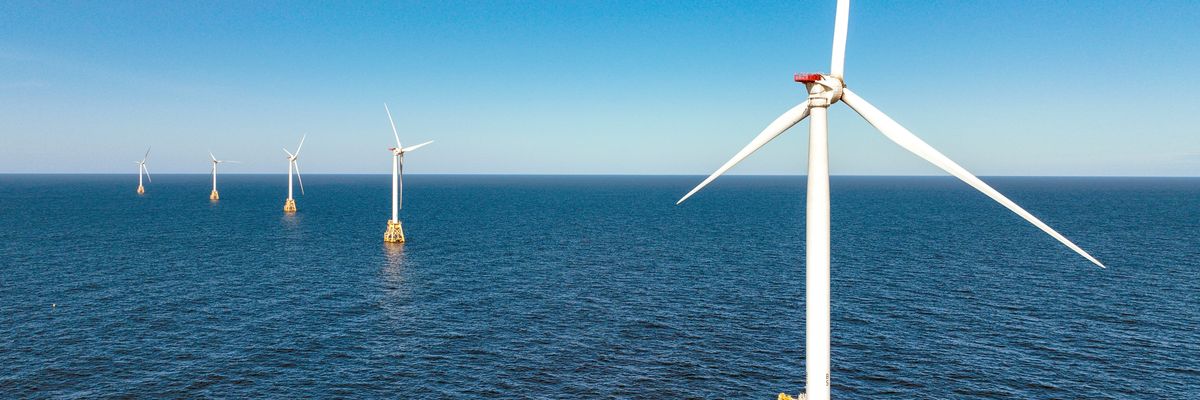
In an aerial view, wind turbines generate electricity at the Block Island Wind Farm on July 7, 2022 near Block Island, Rhode Island.
(Photo by John Moore/Getty Images)

Sabine von Mering
Dec 24, 2025
Common Dreams


On Monday morning we woke up to the news that the Trump administration had halted five wind farms in the Northeastern USA, because they supposedly pose a “security risk”. The exact opposite is true: Not expanding wind power poses the security risk. Even the military had been calling climate change a “threat multiplier” for decades—until the Trump administration told them to stop considering climate change.

The truth is, wind power equals freedom power. Wind power means freedom from fossil fuels; freedom from extraction; freedom from pollution; freedom from billions of healthcare costs; freedom from dangerous jobs in coal, oil, and gas. Shutting down wind power projects equals shutting down all these freedoms. It equals shutting down your freedom and mine for the benefit of the freedom of a few fossil fuel billionaires and their wealth. The decision to halt these wind projects should leave no doubt in anyone’s mind as to who this administration actually cares about. Hint: it’s not you and me.


2026 is just days away. That leaves exactly four years to 2030, by which, scientists say, we must cut greenhouse gas emissions in half. Instead, as emissions continue to rise, the president of the most economically powerful country with the highest per capita emissions is not only taking away our very ability to protect ourselves from climate catastrophe. He is doubling down on exacerbating the problem by prioritizing fossil fuel expansion instead, also right here in the Northeast, and pressuring others to do the same. Thus actively reducing the likelihood of a livable future not only for all Americans but for humans around the world.

To be sure, this should not come as a surprise to anyone. As this administration is eagerly checking off the to-do lists of its “Project 2025,” it has done everything in its power since January to destroy any shred of American climate leadership. None of us who have been working tirelessly for climate action over the past years are surprised by the wrath behind this destruction. It fits perfectly with the fact that the administration is in bed with a desperate industry fighting for survival. They are desperate, because for years now, renewable energies have become cheaper and cheaper. In fact, they are already far cheaper than fossil fuel projects. The only thing that should still surprise us is how many people they are still able to lull into their myths of climate denial, given the mountains of evidence that are literally growing by the minute. Nobody has to look very far from their home to see an extreme weather disaster that was made worse by global warming.

Our 250th birthday is just the right moment for the people to wake up and stare down the fossil fuel industry and their political lackeys in power.

By halting these wind projects, the administration is therefore not only engaging in what Bill McKibben calls “solutions denial” (in Here Comes the Sun. The Last Chance for the Climate and a Fresh Chance for Civilization, 2025), it is also adding to our costs, thereby further threatening yet another freedom that is already greatly in peril: the affordability of our basic needs. In fact, with costs totaling $101.4 billion associated with extreme weather events, the first half of 2025 was the costliest ever. And the job losses are piling up as well.

The fact that a growing number of Americans is concerned about climate change is likely another reason for the speed at which this administration is proceeding with its dismantling of climate protection. They know the sleeping giant, i.e., the American people, once fully awakened, will not view these actions kindly.

You can gaslight people and spread lies for a few more years, but there will come the time when people start paying attention to the increasingly urgent warnings by those who understand the science best. People will wake up and understand that they are indeed being harmed by the greedy fossil fuel companies that brought us air pollution and black lung disease, and made us pay for the consequences, and not by renewable energy powered by the sun that is shining for free and will never send a bill.

The United States is a country built on the fight for freedom. Renewable energies are freedom energies. What stands between us and our freedoms therefore poses the true security risk. Our 250th birthday is just the right moment for the people to wake up and stare down the fossil fuel industry and their political lackeys in power. Because if they are not giving us liberty, they are giving us death.


Our work is licensed under Creative Commons (CC BY-NC-ND 3.0). Feel free to republish and share widely.


Sabine von Mering is a 2023 public voices fellow on the climate crisis with The OpEd Project, in partnership with the Yale Program on Climate Change Communication, a climate activist with 350MAss, and the director of the Center for German and European Studies at Brandeis University.
Full Bio >


U.S. Offshore Wind Developers Stop Work and Explore Next Steps

wind turbine installation
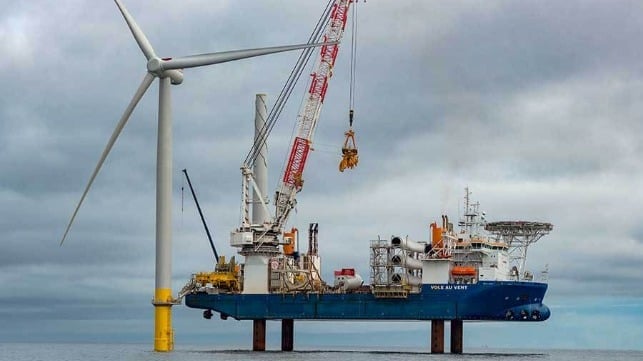
Five U.S. offshore wind projects complying with offshore stop work orders while questioning the delays (Dominion Energy file photo)

Published Dec 23, 2025 5:09 PM by The Maritime Executive


From New England to the Mid-Atlantic regions, offshore wind developers reported they were complying with the government order to suspend offshore installation work while also expressing frustration. The Bureau of Ocean Energy Management followed up the public announcement with a written notification to the developers of the five projects ordering them to stop their offshore work on the Outer Continental Shelf while the government conducts a review.

Several of the projects highlighted that they were just weeks away from beginning to deliver power under their respective power agreements. Ørsted said that its Revolution Wind project was expected to begin generating power in January, while Dominion Energy said its project was “within months” of generating power. Vineyard Wind 1 has already started delivering power as it was proceeding with its commissioning process.

Canary Media obtained a copy of the BOEM letter and reports that it says the Department of War and the Department of the Interior would be reviewing whether the risks posed by the projects can be mitigated. The companies confirmed the notice says it is a 90-day suspension, but that BOEM can extend it for additional 90-day intervals. In the past, the federal courts have been critical of the open-ended nature of the review ordered by Donald Trump in January 2025 and, in one case, set a timeline for BOEM to report back to the court on progress.

“Based on BOEM’s initial review of this classified information, the particularized harm posed by this project can only be feasibly averted by suspension of on-lease activities,” the letter asserts, according to Canary Media. “BOEM will consider all feasible mitigation measures before making a decision as to whether the project must be canceled.”

Each of the projects highlighted that they had gone through years of review. Ørsted specifically noted that Revolution Wind and Sunrise Wind consulted closely and directly with the U.S. Department of Defense Military Aviation and Installation Assurance Siting Clearinghouse to “evaluate and address potential impacts to national security and defense capabilities,” from the construction and operation of the two wind farms. 

Equinor, which is developing Empire Wind, highlighted that it is complying with relevant national security-related requirements. It said it plans to continue to work with BOEM and other federal agencies to continue to implement all necessary mitigation for the project. Equinor also highlighted that it has extensive experience in the U.S. and around the world operating offshore energy infrastructure and working with military and civilian authorities to ensure compliance with national security requirements.

Dominion Energy responded by saying Coastal Virginia Offshore Wind is “essential for American national security,” noting that Virginia is the home to major military installations as well as the largest warship manufacturer. It noted that Virginia’s demand for electricity is doubling, and the project is one key element in the plan to meet energy needs, which include AI operations and the largest concentration of data centers.

The Virginia project highlights that it is located 27 to 44 miles offshore and its review and approval involved close coordination with the military.

The impact of the Trump administration order, analysts noted, goes far beyond the projects themselves. They involve multiple subcontractors and have placed orders for shipbuilding, have contracts for support services, and have committed to investments in ports and manufacturing capabilities. Equinor highlights that Empire Wind has dozens of vessels and around 1,000 people who have been working in conjunction with the project.

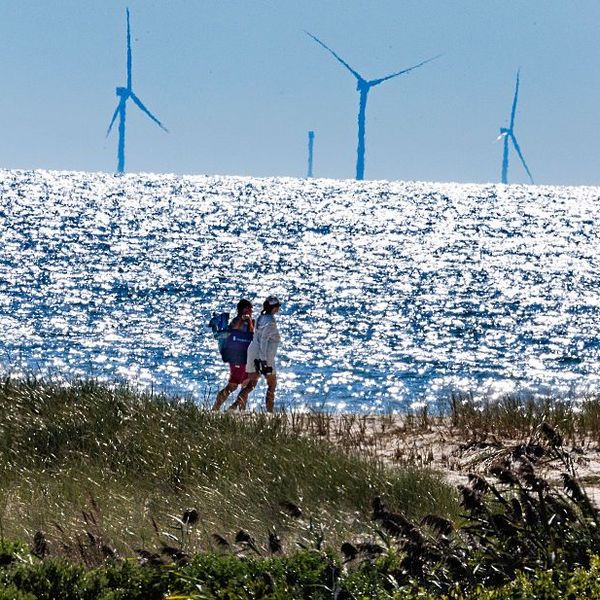
Commentators noted that one commercial-scale offshore wind farm, South Fork Wind off New York, delivered its first power in 2023 and completed commissioning in July 2024. It, along with two smaller pilot projects, two wind turbines for Dominion operating for the past five years, and the Block Island Wind Farm, which has been operating since 2016, were not included in the order and continue normal operations.

The companies each said they would be engaging with BOEM and the other agencies to resolve the concerns. Ørsted said that in addition to engaging with the BOEM and the permitting agencies, it would evaluate potential legal proceedings.
 

U.S. Suspends Licenses for Five Under Construction Offshore Wind Farms

offshore wind farm installation
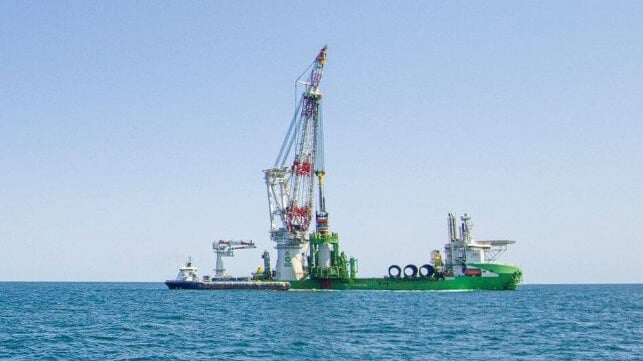
Several of the projected impacted by today's action are nearing completion (DEME file photo)

Published Dec 22, 2025 12:35 PM by The Maritime Executive


In its latest moves to stop the development of offshore wind energy projects, the Trump administration on Monday, December 22, announced it is suspending all the licenses for under-construction offshore wind farms. It impacts five projects, many of which are nearing completion, with a generating capacity for 5.8 GW of energy, and sent shock waves through the industry.

In a statement from the Department of the Interior, the administration says the pause is due to “national security risks identified by the Department of War in recently completed classified reports.” It said that the pause would give the Department of the Interior, Department of War, and other relevant agencies “time to work with leaseholders and state partners to assess the possibility of mitigating the national security risks posed by these projects.”

The non-profit Oceantic Network, which lobbies in support of the industry, quickly issued a statement calling the move “another veiled attempt to hide the fact that the President doesn’t like offshore wind.” 

Trump, immediately after returning to the office, issued an Executive Order pausing the leasing and approvals and ordering a review of the industry. Since then, it has been reported that he directed all government agencies to work together to stop the development of wind farms, and the administration has gone to court to challenge the approvals of several projects. It also attempted to stop construction work on both the Empire Wind project in New York and Revolution Wind off the coast of Rhode Island.

The five projects impacted by today’s actions are Vineyard Wind 1, Revolution Wind, Coastal Virginia Offshore Wind, Sunrise Wind, and Empire Wind 1. Many of the projects are nearing completion, and in the case of Vineyard, are already generating power, or are due to begin delivering power in 2026. 

“Today’s action addresses emerging national security risks, including the rapid evolution of the relevant adversary technologies, and the vulnerabilities created by large-scale offshore wind projects with proximity near our east coast population centers,” said Secretary of the Interior Doug Burgum.

According to the Department of the Interior, unclassified reports from the government have “long found that the movement of massive turbine blades and the highly reflective towers create radar interference called ‘clutter.’ The clutter caused by offshore wind projects obscures legitimate moving targets and generates false targets in the vicinity of the wind projects.”

They continue by saying the Department of Energy in 2024 stated that a radar’s threshold for false alarm detection can be increased to reduce some clutter. They assert that those steps could cause radar to miss actual targets.

“The U.S. offshore wind industry has continuously worked with the Department of Defense to address national security concerns, and its own Clearinghouse has signed off on every offshore wind lease ahead of construction,” noted Liz Burdock, CEO of Oceantic Network. “This newest claim contradicts years of rigorous, interagency reviews, as these projects have already passed explicit clearances from the Department of Defense and the Pentagon before construction began.”

This action comes just two weeks after a U.S. District Court found that the presidential executive order suspending the industry was unlawful because it violates the Administrative Procedures Act that governs how agencies administer programs. In the opinion, the court wrote that the order was “arbitrary and capricious.” It was the result of a lawsuit filed by 17 states and the District of Columbia challenging the executive order. The order has been used as the basis for many of the actions to challenge projects in 2025.

Federal courts have permitted the administration to proceed with its review of the approval process for projects off the New England coast and Maryland. However, another district court issued an injunction when the administration issued a stop work order for the Revolution Wind project. The dispute, just as offshore work was due to start for the Empire Wind project, was settled with an agreement between the federal government and New York State.

Experts are predicting that today’s action will be quickly challenged in the courts.