Friday, December 26, 2025

As the planet warmed, politics wobbled: The defining climate moments of 2025


Copyright Michael Buholzer/Keystone via AP

By Jeremy Wilks
Published on 26/12/2025 - EURONEWS


Record warming met weak political resolve as climate pressures mounted this year.


2025 was a challenging year for climate politics, and a challenging one for our warming planet.

In the past 12 months, climate change has been impossible to ignore, whether we would like to or not. Euronews takes a look back at a year of record highs and lows.


The 11 warmest years on record

Let's start with some climate facts for 2025, which make for sober reading.

The World Meteorological Organisation has already said that the past 11 years were the warmest on record, and 2025 is most likely to be either the joint second or third warmest year on record.

The final tally in January is expected to show that the last three years all surpassed the 1.5°C above pre-industrial levels goal set out in the decade-old Paris Agreement, according to the Copernicus Climate Change Service.

Tourists use umbrellas to shelter from the heat as they line up for a tour of the Forum in Rome in July. AP Photo/Gregorio Borgia

So why is this happening? Greenhouse gas concentrations hit a record high in 2025. These gases are produced by human activities like the combustion of fossil fuels and from changes in land use linked to deforestation and industrial agriculture. The gases trap heat from the sun faster than the atmosphere radiates it back into space, creating global heating.

Trump calls climate change a 'con job'


The year started with Donald Trump in the White House, again, as Forrest Gump would say, and pulling the US out of the Paris Agreement, again. It was a campaign promise to American voters, and he stuck to the script.

What was a little more off-script was Trump's speech to the United Nations General Assembly in September, in which he said renewables were a “joke” that were “too expensive”. He captured headlines with one particular zinger, describing climate change as "the greatest con job ever perpetrated on the world".

Trump lifted the freeze on liquified natural gas (LNG) export approvals the day he came into office, and since then, US sales have soared.

LNG is a fossil fuel often promoted as a means to 'transition' to renewables, yet the associated production and transport of LNG make its emissions 33 per cent higher than coal. America supplied almost half of Europe's LNG this year.


President Donald Trump attends the national prayer service at the Washington National Cathedra. AP Photo/Evan Vucci

So, in the snakes and ladders game of emissions reduction, the US slid down a snake in 2025, while its rival China climbed a few ladders. Although it remains the world's biggest emitter, analysis from Carbon Brieffound that China's CO2 emissions have been flat or falling for 18 months.

Did China just peak? Possibly. The country saw dips in emissions from transport, steel and cement production, and the country's fossil fuel power plants should have their first annual drop in generation in a decade this year as a result of the massive expansion of renewables to meet rising demand.

In Brussels, the EU's climate and energy policy seemed more like a Christmas puzzle in 2025. Just recently, it wound back on plans to abolish the sale of internal combustion engine cars from 2035. This came only a few days after it finally sealed the deal on a legally binding target to reduce greenhouse gas emissions by 90 per cent compared to 1990 levels by 2040. Are those two both technically and politically compatible?

Pieces of the Green Deal legislation were slid around the puzzle for months as part of the Omnibus I package, proposed in February 2025. Meant to 'simplify' rules, it was widely criticised for backsliding on standard-setting environmental laws, and offering critics of 'net zero' an easy chance to score points. The EU's Carbon Border Adjustment Mechanism, due to come into force on New Year's Day 2026, was relentlessly pushed and shoved around by industries over exactly how it should be applied and who can claim to be exempt.

Amnesty International called Omnibus I a 'bonfire' of regulation, while BLOOM described Europe as entering 'democratic darkness'.

In November, the COP30 climate summit also saw a few fiery moments, not least when part of one pavilion actually caught ablaze. Hosted in Brazil, on the edge of the Amazon rainforest, it has been praised for two things.

Firstly, after three previous COPs hosted in anti-democratic and authoritarian countries, the climate campaigners could at least make themselves seen and heard a little more easily this year. Secondly, in the absence of easy progress on the UNFCCC's Paris Agreement objectives, a series of coalitions between more climate-friendly countries began to emerge. It signals a fresh departure from the status quo that pits the eager and willing against the cranky and reticent.

COP30 President André Corrêa do Lago sits as UN officials talk over him during a plenary session at the UN Climate Summit in Belem. AP Photo/Andre Penner, File

Overall, COP30 wasn't viewed as a success, with the well-respected Climate Action Tracker describing it as 'disappointing', with 'little to no measurable progress in warming projections - for the fourth consecutive year'. They calculate we are currently on track for warming of 2.6 degrees Celsius above pre-industrial averages by 2100, and warming continues into the next century.

Ice melting, seas rising, land roasting

Meanwhile, in the most remote parts of the planet, changes are accelerating, amid fears that irreversible planetary tipping points are being passed. If the politics of climate change in 2025 doesn't leave your head spinning, then the reality of the warming over land, across the cryosphere and in the oceans probably will.

Firstly, look up and enjoy the view of any icy peaks while you can, because they won't be around for long. A 2025 study from ETH Zürich found that we're about to enter a period they label 'peak glacier extinction'. Places like the Alps, the Rocky Mountains, the Caucasus, and the Andes will change forever.

The sun shines over the melting Rhone Glacier near Goms, Switzerland. AP Photo/Matthias Schrader, File

This year, it was confirmed that Venezuela haslost its last glaciers. By 2100, Central Europe will have a mere three per cent of today's total number of glaciers following current warming trends. This has profound implications not only for beautiful tourist hotspots, but also for hydropower and farming communities that rely on meltwater in summer. The related dangers of glacier collapse were brought to the world's attention when the Swiss village of Blatten was crushed by a torrent of ice, mud and rock in May.

Elsewhere, astudy published in June 2025 turned heads as it simulated the collapse of the AMOC, the conveyor belt of heat from the equator that keeps northern Europe mild and wet. There's no timeline, but the modelling is extraordinary. In a moderate emissions scenario with a rapid slowdown of the ocean currents, there would be sea ice reaching Scotland and winter temperatures in London as low as -20 °C. Northern Europe would be the only part of the planet to get colder, rather than warmer.

In the Antarctic, researchers have also been watching the ice shelves destabilise. A team from the University of East Anglia in the UK, using the fabulously-named British research submarine Boaty McBoatface, carried outthe first ever survey of the 'grounding line' beneath the Dotson Ice Shelf, the spot where the glacier floats onto the sea. They found that the water deep inside the cavity was 'surprisingly warm', and they're now rushing to explain how it got there.

In Greenland, it was a long summer. Scientists from the Danish Meteorological Institute found that ice melt began in mid-May 2025 and continued into September. That means that summer arrived 12 days earlier than the 1981-2025 average, and the territory lost 105 billion tonnes of ice in the 2024-2025 season.

That melt is one of the factors contributing to the steady acceleration of sea level rise. We don't have figures for 2025 just yet, but in 2024 we saw a record 5.9 millimetres of sea level rise, and the 2014-2023 average is now 4.7 millimetres per year.

Coastal communities worldwide are now paying attention and demanding action, even in Trump's America. On the South Carolina coast, where Forrest Gump fished for shrimp, local people are coming together to document the high tides in a citizen science project organised by the South Carolina Aquarium. If you're into murky pictures of rising water, it's the place for you.

Looking back at the last 12 months, there's a long list of natural disasters amplified by climate change. Mexico and Sri Lanka experienced flooding and landslides, while exceptional rains in Indonesia and Malaysia left hundreds dead and hundreds of thousands displaced. Cuba and Jamaica were smashed by Hurricane Melissa.
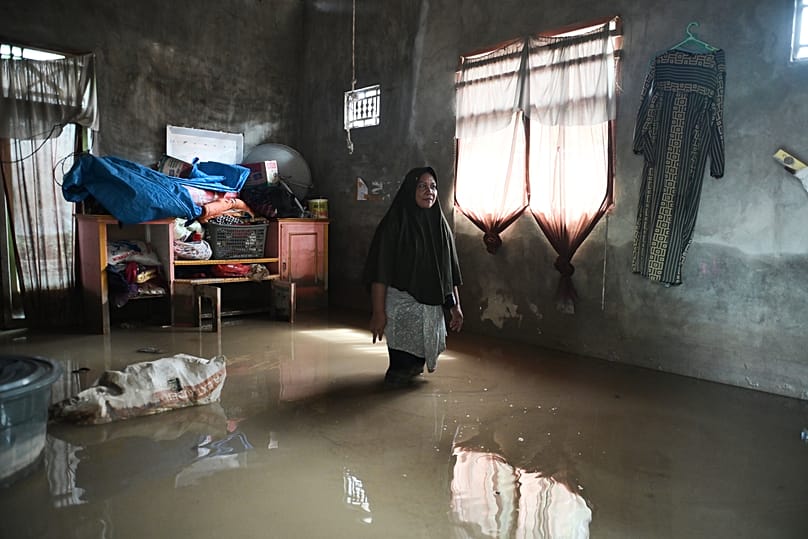
A woman stands inside her flooded house in Pidie Jaya, Aceh province, Indonesia. AP Photo/Reza Saifullah, File

Five years of drought have turned the Fertile Crescent into a dustbowl. Iran, Iraq, and Syria are also facing severe and potentially catastrophic water shortages. Droughts have always occurred in these regions, but rapid analysis by the scientists at World Weather Attribution found that a year-long drought would only be expected every 50 to 100 years in a cooler, pre-industrial climate,and it's expected to return every 10 years today.

In Europe, there wererecord emissions from wildfires this summer, according to the Copernicus Atmosphere Monitoring Service. Just under 13 gigatonnes of CO2 were released, and PM2.5 air pollution was above WHO guidelines across large parts of Spain and Portugal.

In terms of temperatures, there were fresh highs around the world this year. Although 2025 won't rank at the top, it was still an exceptionally warm year. Finland saw repeated temperatures above 30°C over a two-week heatwave, Türkiye hit a new national high of 50.5°C, while similar temperature readings were seen in Iran and Iraq. Station records were beaten in China, and Japan faced an extended summer, with 5 August 2025 hitting a new national temperature record of 41.8°C.

What does 2026 have in store?

In 2026, the UK's Met Office outlook suggests that we will experience one of the four warmest years on record.

Professor Adam Scaife, who leads the global forecast team, said: “The last three years are all likely to have exceeded 1.4°C and we expect 2026 will be the fourth year in succession to do this. Prior to this surge, the previous global temperature had not exceeded 1.3°C.”

Looking further ahead, anticipation is building around the first international conference on the 'Just Transition Away from Fossil Fuels', due to take place in Colombia on 28th and 29th April, co-hosted by Colombia and the Netherlands.

The event will be held in a major coal port, and the objective is to shift the needle on climate-friendly policy.


From historic rulings to the green energy boom: Here are the climate wins of 2025 worth celebrating
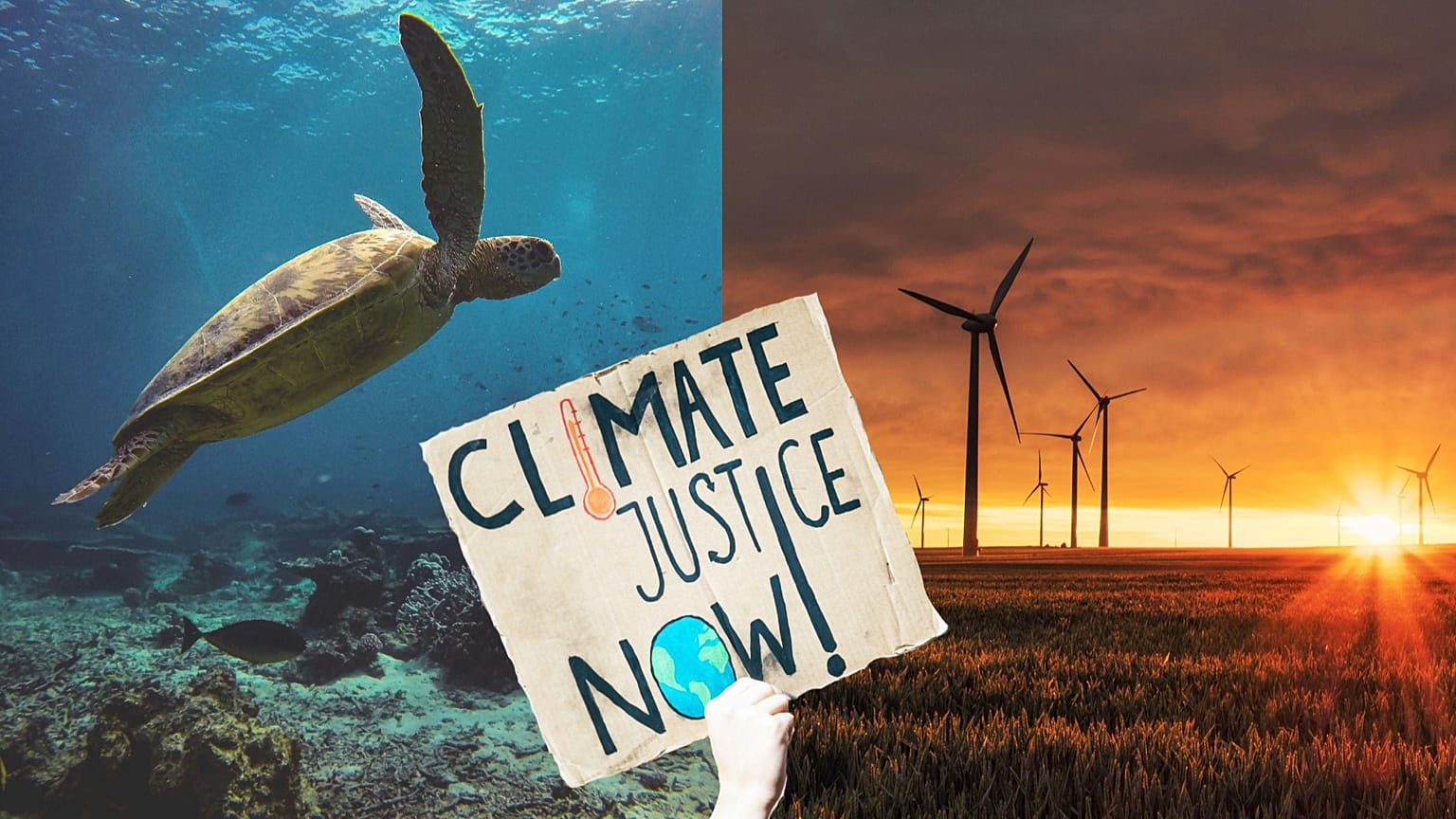
Green sea turtle (left), a sign reading "climate justice now!" and wind turbines on a grass field (right).
Copyright Jesse Schoff, Markus Spiske and Karsten Würth via Unsplash.


By Liam Gilliver
Published on 

Despite the influx of climate doom and irreversible damage, 2025 scored some pretty big victories for the planet.

Climate change’s ubiquitous presence looms over the world like a grey cloud, pushing millions into a constant state of fear.

The internet is saturated with bad news, not all of it accurate. But the reality is extreme weather events are getting worse, planetary boundaries have been breached, and fossil fuel emissions are at an all-time high – despite the stark consequences of baking our planet.

These headlines often drown out the good news, meaning landmark progress and conservation efforts are pushed aside. So, to end the year with a much-needed silver lining, here are five of the biggest climate wins you may have missed in 2025.

The ICJ’s historic climate ruling

In July, the UN’s highest courtdelivered a historic opinion on climate change, outlining states’ responsibilities under international law. It was the largest case ever seen by the International Court of Justice (ICJ), with more than 150 submissions from states, international organisations, and civil society groups.

In a 133-page advisory opinion, the ICJ affirmed that a “clean, healthy and sustainable environment” is a human right, just like access to water, food and housing. Although not legally-binding, it has helped lay down the legal foundations to hold big polluters to account and empower communities that have been hit the hardest by climate change.

It adds to the momentum built by the groundbreaking Urgenda case, which marked the first time a court anywhere in the world ordered a government to take stronger climate action. “We’ve never been in a better place to use the law to protect people and the planet from climate change,” says Dennis van Berkle, Legal Counsel at Urgenda.

2025 was a groundbreaking year for climate litigation, with several cases hitting the headlines. In November, the hearing between Belgian farmer Hugues Falys and TotalEnergies finally began, almost two years after the case was filed.

Falys is taking the fossil-fuel giant to the commercial court of Tournai to seek compensation for damage to his farm that he says is directly caused by climate change.

The High Seas Treaty

The European Union and six of its member states formally ratified the United Nations treaty to protect the high seas back in May – a move described as a “historic step” towards conserving the world’s oceans.

Ratification means that the states have formally agreed to the treaty becoming binding international law. This often involves aligning national legislation with what the treaty outlines.

The High Seas Treatypaves the way for protecting marine life in areas outside of national maritime boundaries, which covers nearly two-thirds of the world's oceans. These regions are under growing threats from pollution, overexploitation, climate change and biodiversity loss.

It allows for the creation of marine protected areas and supports the global goal of safeguarding at least 30 per cent of the world’s oceans by 2030.

“EU leadership is essential in confronting the biodiversity and climate crises,” says Nathalie Rey of the High Seas Alliance. “This bold move sends a clear message that ocean protection is not optional – it’s a global priority.

A boom in renewable energies

Despite petro-states blockingCOP30from establishing a fossil-fuel phaseout roadmap, worldwide solar and wind power generation has outpaced electricity demand this year – and for the first time on record, renewable energies generated more power than coal.

A report by think tank Ember found that global solar generation grew by a record 31 per cent in the first half of the year, while wind generation also increased by 7.7 per cent. Together, the renewable energy forms grew by more than 400 terawatt hours, which was more than the overall global demand increase in the same period.

Solar energy shone the brightest in 2025, and was crowned the “key driver” in the world’s transition to clean energy due to its ultra-low cost. A study from the University of Surrey named solar the cheapest source of power, costing as little as €0.023 to produce one unit of power.

Due to the price of lithium-ion batteries falling by 89 per cent since 2010, the study also found that making solar-plus-storage systems is now equally as cost-effective as gas power plants.

It could help progress in moving away from fossil fuels at Colombia’s Global Fossil Fuel Phaseout conference, which will be co-hosted with the Netherlands in April next year.

Economies are growing - without emissions

The link between GDP and rising emissions is finally starting to shatter, as an increasing number of countries are growing their economies without harming the planet.

A recent report from the Energy and Climate Intelligence Unit (ECIU) analysed 113 countries using the latest 2025 Global Carbon budget data. Researchers found that 92 per cent of global GDP and 89 per cent of global emissions are in economies that have either relatively or absolutely decoupled. This is where emissions rise but more slowly than GDP, or when emissions fall alongside positive economic growth.

A majority of European countries were ranked as consistent decouplers, including Austria, Belgium, Bulgaria, Czechia, Germany, Denmark, Spain, Estonia, Finland, France, the UK, Hungary, Ireland, the Netherlands, Norway, Poland, Romania, Slovakia and Sweden.

These results used consumption-based emissions to address concerns that advanced economies are “off-shoring” their emissions by outsourcing carbon-intensive production to developing nations.

“We’re sometimes told that the world can’t cut emissions without cutting growth,” says John Lang, one of the report authors and Net Zero Tracker Lead at ECIU.

“The opposite is happening. Decoupling is now the norm, not the exception, and the share of the global economy that is decoupling emissions in an absolute sense is steadily increasing.”

Endangered turtles make a rebound

2025 was a challenging year for wildlife, but decades of marine conservation are finally starting to pay off. In October, green sea turtles were officially reclassified from “endangered” to “least concern”.

Found in tropical and subtropical waters around the world, the global population of green sea turtles plummeted to concerning levels in the 1980s due to years of extensive hunting by humans. The species were slaughtered en masse to make soup and other culinary delicacies, while their eggs were commonly used for decoration in some cultures.

However, after spending more than 40 years on the International Union for Conservation of Nature’s (IUCN) red list, the turtles have made a dramatic comeback. In fact, the global population of green sea turtles has increased by approximately 28 per cent since the 1970s.

The rebound has been attributed to efforts focused on protecting nesting females and their eggs on beaches, reducing unsustainable harvesting of turtles and their eggs for human consumption, and tackling accidental capture of turtles in fishing gear.


 

Why Christmas tree farms are turning to drones and AI this year

 
By Roselyne Min
Published on 

Christmas tree farms around the world are increasingly turning to drones, artificial intelligence (AI), satellite imaging, and laser scanning to manage their fields more efficiently.

As the Christmas season nears, tree sellers are once again filling streets and town squares across Europe, stacking rows of firs destined for homes, offices and public spaces.

Behind the scenes, however, the way those trees are grown is beginning to change.

In Denmark, some farmers started using drones to map their fields and artificial intelligence (AI) to count and measure trees.

Denmark is Europe’s second biggest Christmas tree producer after Germany and the world’s biggest exporter, according to the Danish Christmas tree association.

In a case study shared with Euronews, the Serbian AI firm Agremo said a family-owned Christmas tree farm in Denmark replaced traditional manual counting with drones- and satellite-based imaging and analysis, reducing time spent walking the fields and limiting human error.

Agremo’s AI uses machine learning and computer vision to “teach the software how the tree looks,” and it can learn to “recognise the trees in the drone imagery,” according to Luka Živković, Agremo’s head of sales.

Christmas trees typically take around a decade to reach harvest. That long growth cycle makes regular monitoring of tree health, growth and yield essential for farmers.

Many growers previously relied on workers to walk fields and count or measure trees manually, a process that could take days and still produce inconsistent results.

The Serbian company said its system can map a 100-hectare plantation in around 30 minutes and count trees within 24 hours with an accuracy of up to 98 per cent.

“Some big nurseries that we work with (have) more than 100,000 trees, so measuring them and counting them would take them first a lot of labour and then a lot of time,” said Živković.

The AI tool also gives each tree an ID, allowing tracking of growth and sales.

‘Exciting time for Christmas trees’

Experts say drones can help farmers “save time and money”, as they can operate during early hours and reduce the need for manual labour.

In the United States, North Carolina State University supports growers through its Christmas Tree Extension programme, which provides research-based, practical guidance to the local industry.

North Carolina is one of the country’s leading Christmas tree-producing states, with around 33,000 acres (about 13,350 hectares) under cultivation.

At some farms, drones are now taking on work that previously required five to ten people, according to William H. Kohlway IV, a Christmas tree production specialist at North Carolina State University in the United States

“It’s a really exciting time for Christmas trees,” Kohlway told Euronews Next.

He said drones have moved rapidly from experimental tools to everyday equipment over the past three to five years, particularly for larger growers. Some producers are now investing in multiple agricultural drones because of their effectiveness in the field.

Kohlway said the rapid growth is partially thanks to Light Detection And Ranging (LiDAR), a laser-based surveying technology, that can scan entire plantations in detail.

Drones can also carry out targeted spraying, applying fertilisers or herbicides to just the parts of the fields that need them.

“In fact, a lot of the guys who used to mainly do the stuff have now become drone operators, and they love it because they don't have to haul a backpack. They can just have the drone do the heavy lifting,” said Kohlway.

Unlike in Denmark, many Christmas trees in North Carolina are grown on slopes, where conventional machinery struggles and the risk of accidents is higher.

Autonomous ground-based drones, effectively robotic mowers, are being developed to work in areas that may be difficult or dangerous for humans to reach.

“We have some Christmas tree fields at like 60, 70 degree slopes. And a lot of mowers cannot handle that kind of steep slope. So the ones that are just now coming out are heavy-duty, kind of tank tread-based flail mowers, that can actually handle our inclines,” said Kohlway.

The true cost

Despite the promise, barriers remain.

The cost of drones hovers around €25,600 and software, along with training requirements and strict aviation rules, can make adoption difficult, particularly for smaller growers.

The Danish Christmas Tree Association also says that currently, “drones are used by big companies for inventory assessments only”.

“Danish growers vary a lot in size from small family companies (5-10 hectares) to big enterprises with more than 500 hectares. Therefore, their challenges are different, and their ways of dealing with the issues are equally different,” the association told Euronews Next in a statemen

Still, experts say interest is growing.

“Despite those small hurdles, a lot of people are really pushing to go into those things [drone technologies],” said Kohlway.

“And the adoption rate is rapidly increasing and as the drones get better every year and the price goes down and our growers become more technologically savvy, it's honestly a great thing to do because it's also bringing in a lot of the next generation of growers,” he added.

For more on this story, watch the video in the media player above.

Jimmy Kimmel warns against fascism and Donald Trump in 'Alternative Christmas Message'


Copyright Screenshot Channel 4


By Tokunbo Salako
Published on 26/12/2025 - EURONEWS


US talk show host Jimmy Kimmel targeted fascism and unsurprisingly Donald Trump in his 'Alternative Christmas' message broadcast on Britain's Channel 4 television network.

US comedian and talk show host Jimmy Kimmel has renewed his war of words with Donald Trump in a British television address known as "The Alternative Christmas Message."

In a speech broadcast of Channel 4 on Christmas Day, Kimmel warned about the rise of fascism and took aim at the US president who he said behaves as if he's a king.

“From a fascism perspective, this has been a really great year," he said. “Tyranny is booming over here."

Channel 4 began a tradition of airing an alternative Christmas message in 1993, as a counterpart to the British monarch's annual televised address to the nation. Channel 4 said the message is often a thought-provoking and personal reflection pertinent to the events of the year.

A history of beef

The comedian has regularly targeted Trump since returning to the air after ABC indefinitely suspended the “Jimmy Kimmel Live!” show in September following criticism of comments the host made over the killing of conservative activist Charlie Kirk.

Kimmel made remarks in reference to the reaction to Kirk’s shooting suggesting that many Trump supporters were trying to capitalise on the death.

Trump celebrated the suspension of the veteran late-night comic and his frequent critic, calling it “great news for America.” He also called for other late night hosts to be fired.
RelatedDonald Trump is reshaping the US media landscape: After Kimmel, who’s next?
Jimmy Kimmel suspended: How late-night hosts are taking a stand for free speech

The incident, one of Trump’s many disputes and legal battles waged with the media, drew widespread concerns about freedom of speech and freedom of the press.

Hundreds of leading Hollywood stars and others in the entertainment industry urged Americans to “fight to defend and preserve our constitutionally protected rights.” The show returned to the air less than a week later.


Kimmel told the UK audience that a Christmas miracle had happened in September when millions of people — some who hated his show — had spoken up for free speech.


“We won, the president lost, and now I’m back on the air every night giving the most powerful politician on Earth a right and richly deserved bollocking,” he said.

Channel 4 previously invited whistle-blower Edward Snowden and Iranian President Mahmoud Ahmadinejad to deliver the alternative Christmas message.


Kimmel, who said he didn't expect Brits to know who he was, warned that silencing critics is not just something that happens in Russia or North Korea.

Despite the split that led to the American Revolution 250 years ago, he said the two nations still shared a special relationship and urged the UK not to give up on the US as it was “going through a bit of a wobble right now.”

“Here in the United States right now, we are both figuratively and literally tearing down the structures of our democracy from the free press to science to medicine to judicial independence to the actual White House itself,” Kimmel said, in reference to demolition of the building's East Wing. “We are a right mess, and we know this is also affecting you, and I just wanted to say sorry.”


 US Department of Homeland Security turns Santa into an ICE agent in 'digusting' AI video

ICE AI Santa video blasted online as 'disgusting'
Copyright X screenshot

By David Mouriquand
Published on 

The US Department of Homeland Security has taken its holiday-themed campaign for mass deportations to a whole new low with an AI-generated video that turns Santa Claus into an Immigration and Customs Enforcement agent.

Ho ho... holy hell.

US Immigration and Customs Enforcement (ICE) has been getting into the festive spirit, and their latest AI-generated video has sparked backlash online, with many labelling it as "disgusting" way to promote a divisive immigration agenda.

The clip posted by the Department of Homeland Security, aimed to promote voluntary self-deportation before the end of 2025, was shared on social media with the slogan “Avoid ICE Air and Santa’s naughty list!”.

It casts Santa Claus as an ICE agent putting on body armour, handcuffing ‘migrants’ and loading them onto a deportation plane.

Check out the AI slop below:

Critics have described the Christmas-themed campaign “evil” and “disgusting.”

The video does make one wonder if the Department of Homeland Security realises that:

  1. Santa Claus is based on Saint Nicholas, who was known for his generosity of spirit and therefore completely at odds with everything ICE stands for.
  2. Saint Nicholas was a 4th century Greek bishop from Myra, now modern-day Turkey, and therefore not American.
  3. Santa is known for ignoring border controls and international airspace regulations to spread joy and presents, presumably without a visa, ESTA form or passport.

With all this in mind, ICE would probably consider Santa an illegal immigrant and deport him. Talk about a self-own.

Lumps of coal for you this year, Department of Homeland Security.


'Enjoy what may be your last Christmas!' Trump attacks 'sleazebags' in dark holiday screed

Robert Davis
December 25, 2025
RAW STORY


President Donald Trump attacked people he described as "losers" and "sleazebags" in a dark screed on social media on Christmas night.

In the post, Trump attempted to distance himself from disgraced financier Jeffrey Epstein, someone he has previously referred to as a close friend. This comes at a time when new revelations from recently released Epstein files show Trump rode on Epstein's private plane, dubbed the "Lolita Express," at least eight times. Other documents indicate Trump spent time at Epstein's home in New York City, and that the two men exchanged birthday pleasantries.

"Merry Christmas to all, including the many Sleazebags who loved Jeffrey Epstein, gave him bundles of money, went to his Island, attended his parties, and thought he was the greatest guy on earth, only to 'drop him like a dog' when things got too HOT, falsely claimed they had nothing to do with him, didn’t know him, said he was a disgusting person, and then blame, of course, President Donald J. Trump, who was actually the only one who did drop Epstein, and long before it became fashionable to do so," Trump wrote on Truth Social.

"When their names get brought out in the ongoing Radical Left Witch Hunt (plus one lowlife 'Republican,' Massie!), and it is revealed that they are Democrats all, there will be a lot of explaining to do, much like there was when it was made public that the Russia, Russia, Russia Hoax was a fictitious story - a total Scam - and had nothing to do with 'TRUMP,'" he wrote.

Trump also attacked "losers" like The New York Times for its coverage of his election and second administration.


"The Failing New York Times, among many others, was forced to apologize for their bad and faulty Election 'Reporting,' even to the point of losing many subscribers due to their highly inaccurate (FAKE!) coverage," Trump wrote. "Now the same losers are at it again, only this time so many of their friends, mostly innocent, will be badly hurt and reputationally tarnished. But sadly, that’s the way it is in the World of Corrupt Democrat Politics!!! Enjoy what may be your last Merry Christmas!"

Observers pounce on Trump's hateful Christmas rant: 'Never get used to this insanity'

David McAfee
December 25, 2025 
RAW STORY

Donald Trump caused a stir among his critics when he released a Christmas screed attacking his perceived enemies.

The president took to his own social media site, Truth Social, to strike a familiar tone for his celebrations of various holidays.

"Merry Christmas to all, including the Radical Left Scum that is doing everything possible to destroy our Country, but are failing badly. We no longer have Open Borders, Men in Women’s Sports, Transgender for Everyone, or Weak Law Enforcement," he wrote. "What we do have is a Record Stock Market and 401K’s, Lowest Crime numbers in decades, No Inflation, and yesterday, a 4.3 GDP, two points better than expected. Tariffs have given us Trillions of Dollars in Growth and Prosperity, and the strongest National Security we have ever had. We are respected again, perhaps like never before. God Bless America!!!"

This message didn't resonate well with political analysts.

Columnist Molly Jong-Fast wrote, "Nearly a decade of this …"

Another columnist (who never worked for Trump), Michael A. Cohen, also chimed in:

"I know people are going to complain about this … but Trump is directly quoting the original version of the Sermon on the Mount."

Economics expert Tahra Hoops said, "This is something you definitely say when the economy is thriving and your constituents are happy."

One popular user, Mark Mangino, simply said that Trump "can’t help himself."

Podcaster Spencer Hakimian quoted Trump and added, "Just as Jesus envisioned it."

Author Jennifer Erin Valent wrote, "One of my Christmas wishes is that we never, ever get used to this insanity."


'Holy projection': Internet erupts after Trump's Christmas Day screed


Robert Davis
December 25, 2025
RAW ST0RY

Political analysts and observers on Thursday chided President Donald Trump's dark screed against "sleazebags" and "losers."

Trump posted a holiday message on his Truth Social platform, where he decried how the recently released Jeffrey Epstein files have impacted his presidency, and attacked political enemies like the Democrats and Rep. Thomas Massie (R-KY) for forcing the administration to release the files. Trump also threatened that this year may be "the last Christmas" because of how he's been treated.

"Sadly, that’s the way it is in the World of Corrupt Democrat Politics!!!" Trump wrote on Truth Social. "Enjoy what may be your last Merry Christmas!"

Political analysts and observers shared their thoughts on social media.

"The walls are closing in on Donald Trump and his corrupt, criminal regime, and he’s absolutely losing his mind," Rep. Yassamin Anasari (D-AZ) posted on X. "Merry Christmas!!"

"Holy projection," Democratic analyst Adam Mockler posted on X.

"Trump, who has (sic) accused of raping young girls alongside Epstein in recently released DOJ files, is projecting again," writer Polly Singh posted on X.

"When bombing Nigeria doesn’t change the subject, might as well try whatever the hell this is supposed to be," Jeopardy champion Hemant Mehta posted on X.

"Why is @realDonaldTrump calling himself a 'Sleazebag'?" Democratic congressional candidate George Conway posted on X.

"He doesn’t sound merry," former CNN anchor Jim Acosta posted on X.

'Pathetic loser': Trump spends his Christmas posting over 100 times to social media

Alex Henderson
December 25, 2025 
ALTERNET


Donald Trump using a laptop aboard his private airplane on July 27, 2016
 (Image: Screengrab via Facebook / Donald J. Trump)


On Christmas Eve 2025, President Donald Trump took to his Truth Social platform and posted: "Merry Christmas to all, including the Radical Left Scum that is doing everything possible to destroy our Country, but are failing badly. We no longer have Open Borders, Men in Women's Sports, Transgender for Everyone, or Weak Law Enforcement."

Trump continued, " What we do have is a Record Stock Market and 401K’s, Lowest Crime numbers in decades, No Inflation, and yesterday, a 4.3 GDP, two points better than expected. Tariffs have given us Trillions of Dollars in Growth and Prosperity, and the strongest National Security we have ever had. We are respected again, perhaps like never before. God Bless America!!! President DJT."

But that post was just the beginning of Trump's Christmas posting blitz. He published more than 100 posts to his Truth Social account in the early hours of Christmas morning, the Independent reported.

Trump ranted about a variety of subjects, attacked Somali immigrants and bragged about his economic policies. The president also reiterated his repeatedly debunked claim that the 2020 presidential election was stolen from him.

Trump also reposted a video from deputy White House chief of staff Stephen Miller, who claimed that the president's opponents want to turn the United States into Somalia.

Miller, in the video, told viewers, "When you see the state of Somalia, that's what they want for America. Because it's easier to rule over an empire of ashes than it is for the Democratic Party to rule over a functioning, western, high-trust society with a strong middle class. That's their model for America: to make the whole country into a version of Somalia."

Trump's avalanche of Truth Social posts got a negative reaction from attorney Ari Cohn. Highlighting his posts about the 2020 election, Cohn posted, "What a pathetic loser."


The Donroe Doctrine

Happy Xmas (under Trump, war is far from over)

William Hartung,
 Common Dreams
December 25, 2025 


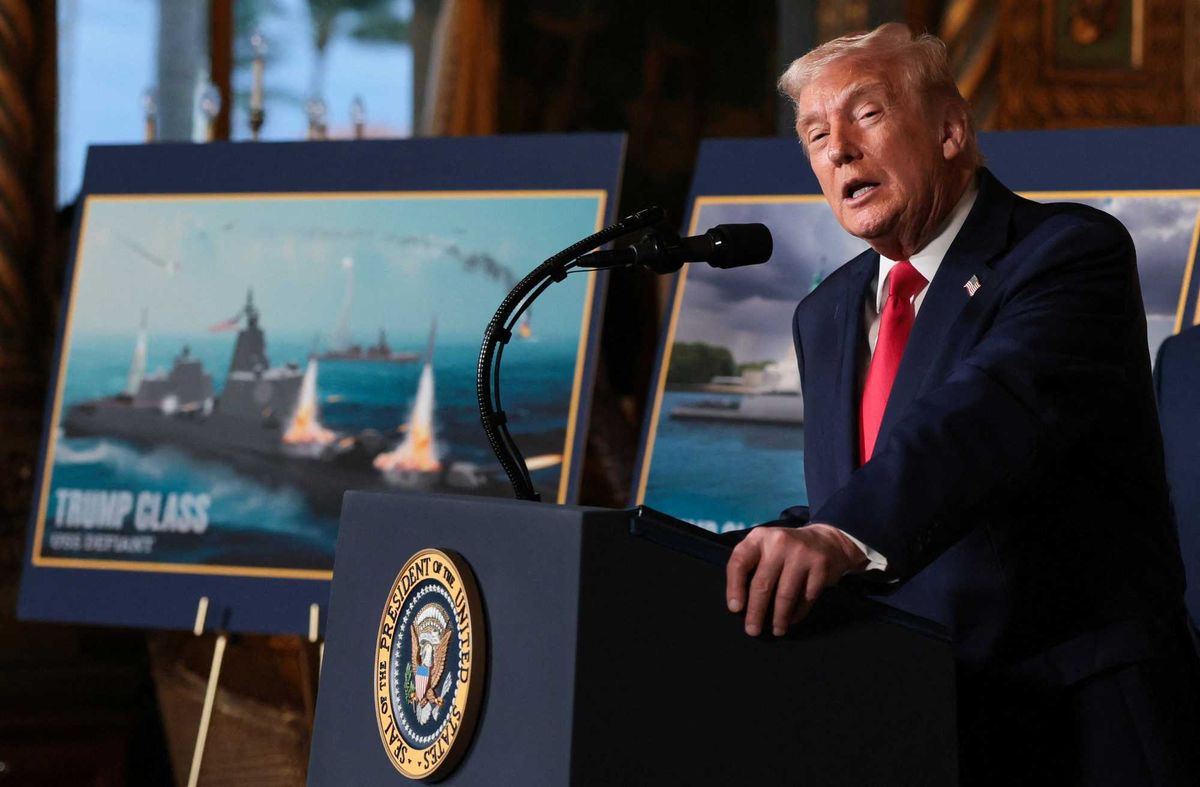
Donald Trump makes an announcement about new US Navy ships. REUTERS/Jessica Koscielniak

Earlier this month, the Trump administration released its new National Security Strategy, or NSS. Normally, such documents are poor predictors of what’s likely to happen in the real world. They are more like branding tools that communicate the attitudes of a given administration while rarely offering a detailed or accurate picture of its likely policies.


The reason documents like the NSS are of limited import is simple enough: foreign and military policies aren’t set by documents but by power and ideology. Typically enough, the current U.S. approach to the world flows from struggles among representatives of contending interest groups, some of which, like the military-industrial complex (MIC), have a significant advantage in the fight. The weapons industry and its allies in the Pentagon and Congress wield a wide array of tools of influence, including tens of millions of dollars in campaign contributions, more than 1,000 lobbyists, and jobs tied to military-related facilities in the states and districts of key members of Congress. The MIC — which my colleague Ben Freeman and I refer to in our new book as the trillion-dollar war machine — also has considerable influence over the institutions that shape our view of the world, from the media to DC think tanks, Hollywood, the gaming industry, and our universities.

But the power and influence of the war machine are not going completely unchallenged. The grip of militarism and the institutions that profit from it are indeed being challenged by organizations like The Poor People’s Campaign: A Call for Moral Revival; Dissenters, a youth antimilitarism group based in Chicago; antiwar veterans organizations like About Face, Common Defense, and Veterans for Peace; longstanding peace groups like the Friends Committee on National Legislation and Peace Action; networks like People Over Pentagon and Dismantle the Military-Industrial Complex; the ceasefire and Palestinian rights movements on U.S. campuses and beyond; and groups working for racial and economic justice, gay and trans rights, immigration reform, the demilitarization of the police, or compensation for environmental damage caused by nuclear weapons testing and other military activities.

As such organizations coalesce, bringing together tens of millions of us whose lives and prospects are impacted by this country’s ever-growing war machine, let’s hope it might be possible to create the power needed to build a better, more tolerant, and more peaceful world, one that meets the needs of the majority of its people, rather than endlessly squandering precious resources on war and preparations for more of it.

So why pay attention to that new strategy document if what really determines our safety and security lies elsewhere? There are several reasons to do so.

First, the NSS has prompted discussion in the mainstream media and elite circles of what U.S. priorities in the world should actually be — and such a discussion needs to be expanded to include the perspectives of people and organizations actually suffering the consequences of our militarized domestic and foreign policies.

Second, that strategy paper reflects the unnerving intentions and worldview of the current administration, which, of course, has the power to determine whether this country is at war or peace.

Finally, it suggests just how the Trump administration would like to be perceived. As such, it should be considered a weapon in the debate over what kind of country the United States should be.

'President of Peace'


From the start, the submission letter that accompanies the new strategy document is pure Donald Trump. In case you hadn’t noticed, the current occupant of the Oval Office would have us believe that everything — every single thing! — he does is bigger, better, and more beautiful than anything that ever came before it. And that’s definitely the case, in the first year of his second term, when it comes to his view of what this country’s national security policies should actually be. As the letter puts it:
“Over the past nine months, we have brought our nation — and the world — back from the brink of catastrophe and disaster. After four years of weakness, extremism, and deadly failures, my administration has moved with urgency and historic speed to restore American strength at home and abroad, and bring peace and stability to our world.
”No administration in history has brought about such a dramatic turnaround in so short a time.“

Needless to say, we’re expected to attribute that alleged American revival to the brilliance and tough-guy attitudes of the president and his team. But any reasonable American should instantly have doubts about that. After all, one of the Trump administration’s proudest accomplishments, as the new document notes, has been getting “radical gender ideology and woke lunacy out of our military.” Or, to put it slightly differently, under the guise of its crusade against DEI (diversity, equity, and inclusion), the administration has effectively dismantled programs designed to reduce racism, misogyny, and anti-gay and anti-trans violence in the ranks of the military.

Whether the programs aimed at reducing entrenched discrimination in those ranks were ever sufficient is certainly doubtful, but that discrimination in the military needs to be addressed should have been and should still be beyond question. To cite just one example, a 2024 study by political geographer Jennifer Greenberg conducted for the Costs of War Project at Brown University found that there were more than 70,000 cases of sexual assault in the U.S. military in 2021 and 2023 (the years covered by her analysis). Her report also noted that, “on average, over the course of the war in Afghanistan, 24 percent of active-duty women and 1.9 percent of active-duty men experienced sexual assault.”

Pretending that widespread sexual violence doesn’t exist in the U.S. military or dismissing it as an example of “radical gender ideology and woke lunacy” should be considered, at best, a policy equivalent of criminal negligence. And it’s certainly not a great look for the person who desperately wants to be known as the “president of peace.”

But our commander-in-chief is nothing if not persistent (and predictable). In his introduction to the new strategy document, I’m sure you won’t be shocked to learn that President Trump takes the opportunity to pat himself on the back for allegedly ending “eight raging conflicts” in his first eight months in office — including those between Cambodia and Thailand, Kosovo and Serbia, Armenia and Azerbaijan, India and Pakistan, and Israel and Iran.

Of course, residents of many of those countries can be forgiven for not being aware of President Trump’s purported role in bringing relative peace to their regions or, in some of those cases, for failing to note that the peaceful situations he claims to have brought about don’t even exist. And they would be right to be skeptical. After all, this is the same president who has decimated the U.S. diplomatic corps and dismantled Washington’s main economic and humanitarian aid organization, the U.S. Agency for International Development — hardly the actions of a president of global peace.

Trump’s rhetoric in his introductory letter contrasts with some of the more sober passages in the document itself. His ranting and self-praise, however, are undoubtedly of more relevance when it comes to understanding the world that we’re actually in than the words in the body of that strategy’s blueprint. If his time in office tells us anything, it’s that his administration’s policies are heavily influenced by his personal desires and resentments, whether or not they square with existing laws, procedures, or policy pronouncements.

The Donroe Doctrine


The aspect of the newly announced military strategy that has gotten the most attention (and may be the closest to the president’s heart) is its focus not on the rest of the world but on the Western Hemisphere, including what the president has called the “Trump Corollary” to the Monroe Doctrine, or what’s come to be known as the “Donroe Doctrine.”

The hemispheric focus includes the administration’s harsh immigration crackdown. Immigration and Customs Enforcement (ICE) is now literally kidnapping people off the city streets of this country, often regardless of their actual immigration status and absent the alleged criminal histories that have been used to justify its activities. President Trump sees this wave of repression as a badge of honor, arguing that “starting on my first day in office, we restored the sovereign borders of the United States and deployed the military to stop the invasion of our country.”

The hyper-militarization of the border has been paralleled by a wildly more aggressive posture in the hemisphere as a whole, most notably in the repeated attacks on alleged drug-trafficking boats in the Caribbean Sea, the waters off of Venezuela, and even the eastern Pacific Ocean, and the preparations for what could become a regime-change war against the government of Venezuelan President Nicolás Maduro. No matter that his country poses no direct threat whatsoever to the United States. And Republican calls for a full-scale war against that nation are occurring despite the disastrous results of this country’s regime-change policies in Afghanistan, Iraq, Libya, and beyond in this century.

The attacks on those defenseless ships, targeting individuals who pose no direct threat to the United States and haven’t even been proven to be involved in drug trafficking, violate international law and are being carried out without the approval of Congress. That was no less true of the recent seizure of a Venezuelan cargo ship transporting oil to Asia and the imposition of sanctions on six more oil-carrying ships.

Unfortunately, waging war without input from Congress has been the norm in U.S. military interventions of this century. Data generated by the Military Intervention Project at Tufts University indicates that the United States has used military force or engaged in outright warfare 30 times since 2001, with Congress largely on the sidelines. And rarely have those interventions achieved anything like their stated objectives, as documented by the Costs of War Project, which has shown that America’s post-9/11 war on terror has cost at least $8 trillion, involved the deaths of hundreds of thousands of civilians, and left a huge cohort of U.S. veterans with physical and psychological injuries, all without faintly achieving the stated goals of promoting democracy or stability in the targeted nations.

End endless wars?

Despite its increasingly aggressive posture in the Western Hemisphere (and on U.S. soil), some analysts hold out hope that the Trump administration will ultimately reduce the frequency of U.S. military intervention globally and perhaps even “end endless wars.” There is rhetoric in the new strategy document that could support such a notion, but the real question is whether the president will act on it in any meaningful way.

Judging by its rhetoric alone, the administration’s strategy document would seem to suggest at least an implicit reduction in the use of force overseas, as evidenced in its discussion of strategy:

“A strategy must evaluate, sort, and prioritize. Not every country, region, issue, or cause — however worthy — can be the focus of American strategy…American strategies since the end of the Cold War have fallen short — they have been laundry lists of wishes or desired end states; have not clearly defined what we want but instead stated vague platitudes.”

The document then goes further, seeming to denounce the American war machine and the drive for U.S. military dominance globally:
“After the end of the Cold War, American foreign policy elites convinced themselves that permanent American domination of the entire world was in the best interests of our country… Our elites badly miscalculated America’s willingness to shoulder forever global burdens to which the American people saw no connection to the national interest. They overestimated America’s ability to fund, simultaneously, a massive welfare-regulatory-administrative state alongside a massive military, diplomatic, intelligence, and foreign aid complex.”

Secretary of Defense Pete Hegseth reinforced such themes in a Dec. 6 speech at the Reagan National Defense Forum, while highlighting the administration’s usual condemnations of efforts to reduce discrimination in the military or this country or address climate change. As he summed it up, “The War Department will not be distracted by democracy building, interventionism, undefined wars, regime change, climate change, moralizing and feckless nation building.”

Taken seriously, such observations would lead to a sharp reduction in the American global military footprint of 750 foreign bases, more than 170,000 troops deployed overseas, a Navy designed to support combat anywhere in the world, dozens of ongoing “counterterror” operations globally from Somalia to Yemen, and arms-supplying relationships with more than half the nations on earth.

Needless to say, so far that hasn’t happened, whether a Republican or a Democrat was at the helm of the administration. But as with President Trump’s professions of being a peacemaker or his occasional rhetorical jabs at “war profiteers” and “warmongers,” the anti-interventionist language in some of the administration’s new National Security Strategy is clearly aimed mainly at those parts of the president’s base here at home who are indeed sick of war and skeptical of large corporations and the “deep state.”

All too sadly, President Donald Trump, Secretary of “War” Hegseth, and the rest of the crew seem all too willing to make war in the Western Hemisphere in a significant fashion, while essentially ignoring the U.S. military’s other warring activities elsewhere on the planet. (Only recently, for instance, U.S. Africa Command confirmed that it had launched 111 airstrikes in Somalia in 2025.) And whether Trump supporters here at home are willing or in any fashion able to hold Trump to his antiwar rhetoric and blunt his penchant for using military force remains to be seen.

Fight for peace

To resist and reverse the militarization of American foreign policy will mean speaking truth to power, while working to debunk the myths that rationalize this country’s permanent war footing. But it will also require confronting power with power by generating a broad people’s movement against militarism in all its manifestations, including the militarization of foreign policy, immigration enforcement, and policing in this country, as well as the military’s role in generating staggering amounts of greenhouse gases and so accelerating climate change and threatening public health.

There are people and organizations fighting on all those fronts. Building a network of resistance that respects the priorities of each of them will take dedicated organizing and relationship-building. Much of that work is already underway. But the question remains: Can the public interest overcome the special interests and bankrupt ideologies that continue to make war and the threat of more war America’s face to the world? It’s a question on which none of us can afford to remain neutral.

William D. Hartung is a Senior Research Fellow at the Quincy Institute for Responsible Statecraft, and the author most recently of "Pathways to Pentagon Spending Reductions: Removing the Obstacles."