Friday, December 26, 2025

Trump admin dealt major blow as migrant's trial canceled and 'vindictiveness' hearing set

Matthew Chapman
December 26, 2025 
RAW STORY


Kilmar Abrego Garcia, a Salvadoran migrant who lived in the U.S. legally with a work permit and was erroneously deported to El Salvador, is seen wearing a Chicago Bulls hat, in this handout image obtained by Reuters on April 9, 2025. 
Abrego Garcia Family/Handout via REUTERS

President Donald Trump's legal war on a Salvadoran immigrant was dealt a bitter blow on Friday, as a federal judge in Tennessee canceled the current date for his trial on human smuggling charges — and will instead hold a hearing on the legality of the prosecution.

The order, by U.S. District Judge Waverly Crenshaw, was first reported by NBC Washington's Paul Wagner. It comes after Kilmar Abrego Garcia's legal team presented evidence that he was being targeted for selective and vindictive prosecution.

"Once a defendant establishes a prima facie showing of vindictiveness, 'a presumption arises in defendant's favor,'" wrote Crenshaw, an appointee of former President Barack Obama. "The Court has already found that Abrego has made such a showing, entitling him to discovery and an evidentiary hearing on why the government is prosecuting him ... Given this, the burden has shifted to the government."

Crenshaw added that if the one-day evidentiary hearing on vindictive prosecution, now set for Jan. 28, goes against the government, the charges against Abrego could be dismissed outright.

It's the latest setback for the Trump administration in the Abrego case, after a court ruling earlier this month that he must be released from federal lockup.

Abrego, who has lived for years with his family in Maryland, was mistakenly deported to the infamous CECOT megaprison in El Salvador earlier this year, despite a standing court order prohibiting his removal to that country. The Trump administration has claimed he is involved with the criminal gang MS-13, based on a hearsay allegation from a now-suspended police detective. Abrego has denied any gang involvement.

After months of the government claiming it lacked jurisdiction to repatriate Abrego to the United States, officials finally bowed to public outcry and brought him back, but immediately charged him with gang-related trafficking offenses. Officials also vowed to deport him to another country; Abrego has stated he would accept deportation to neighboring Costa Rica, but the administration has resisted this and instead, repeatedly and fruitlessly, tried to get various African countries to take him in.

To fight claims of vindictive prosecution, the Trump administration has asserted that no one in a politically appointed office was involved with the decision to press charges against Abrego, but recent filings suggest this is not true.


AMERIKAN GESTAPO

Federal Judge Halts Trump’s ‘Arbitrary and Capricious’ Immigration Court Arrests


“This decision means I can finally focus on my asylum case, not on the ICE officers who might be waiting for me outside the courtroom door,” said the plaintiff in the class action suit.



Masked US Immigration and Customs Enforcement (ICE) agents look over lists of names and their hearing times and locations inside the Federal Plaza Courthouse in New York City before making arrests on June 27, 2025.
(Photo by Bryan Smith/AFP via Getty Images)

Brett Wilkins
Dec 26, 2025
COMMON DREAMS

A US judge on Wednesday temporarily blocked two federal agencies from arresting noncitizens at immigration courthouses in the San Francisco area, a ruling hailed by migrant justice advocates amid ongoing legal challenges to the Trump administration’s policy.

US District Judge for the Northern District of California Casey Pitts granted a stay in Sequen v. Albarran blocking Immigration and Customs Enforcement and the Executive Office for Immigration Review (EOIR) from carrying out courthouse arrests within ICE’s San Francisco Area of Responsibility, pending the outcome of a broader legal challenge.


“Plaintiffs have established a likelihood that members of the courthouse-arrest class will suffer irreparable harm in the absence of a stay,” Pitts, an appointee of former President Joe Biden, wrote in his 38-page ruling. “ICE has arrested large numbers of noncitizens at immigration courthouses in northern California pursuant to the challenged courthouse arrest policies, and it avows that it will continue doing so.”

“This ruling is a critical step in ensuring that immigrants can safely pursue their immigration cases without fear of arrest.”

For decades, federal immigration authorities eschewed arrests at “sensitive locations,” including places of worship, hospitals, schools, and—during the Obama and Biden administrations—immigration courts. Trump began targeting courthouses during his first term.

“This circumstance presents noncitizens in removal proceedings with a Hobson’s choice between two irreparable harms,” Pitts wrote in his decision. “First, they may appear in immigration court and face likely arrest and detention... And for many class members whom ICE arrests under the challenged policies... such an arrest would likely violate their rights under the due process clause of the Fifth Amendment.”

“Alternatively, noncitizens may choose not to appear and instead to forego their opportunity to pursue their claims for asylum or other relief from removal,” Pitts wrote. “As the declarations of immigration attorneys and former immigration judges establish, dozens of noncitizens are already taking this path and receiving in absentia removal orders as a result.”

“Accordingly, if noncitizens wish to avoid the irreparable harm of arrest and detention, they must instead irrevocably give up their pursuit of potentially valid immigration claims and be ordered removed,” he noted. “There can be little question that this permanent loss of noncitizen’s opportunity to have their claims heard, and their resulting removal, is an irreparable injury.”

Pitts found that the class plaintiffs “are likely to succeed on the merits of their claims” that the Trump administration’s ICE and EOIR courthouse arrest policy is “arbitrary and capricious.”

Wednesday’s decision follows a November 25 preliminary injunction in the same case requiring ICE to remedy unconstitutionally unsafe conditions in temporary holding cells at the agency’s San Francisco field office.

Responding to Wednesday’s ruling, class plaintiff Carmen Pablo Sequen said: “I fled persecution to seek safety, only to find myself arrested in the courthouse, the one place I was told to trust. The terror of that day has haunted me. This decision means I can finally focus on my asylum case, not on the ICE officers who might be waiting for me outside the courtroom door.”

Plaintiffs’ lawyer Jordan Wells, a senior staff attorney at the Lawyers’ Committee for Civil Rights of the San Francisco Bay Area, said in a statement that “the administration’s reckless policy is an affront to justice, designed to sabotage the immigration court system and force people to abandon their lawful claims.”

“This ruling is a critical step in ensuring that immigrants can safely pursue their immigration cases without fear of arrest,” Wells added.

Laura Sanchez, legal director at the Central American Resource Center of Northern California, said, “For our clients, who are asylum seekers, survivors of violence, parents fighting to stay with their children, this ruling begins to lift a cloud of terror.”

“They can now walk into court, not as targets, but as people lawfully pursuing their cases,” Sanchez added. “This stay is a profound affirmation of their humanity and their right to be heard.”

“This ruling begins to lift a cloud of terror.”

In a separate case, Pitts earlier this week issued a 67-page order in Garro Pinchi v. Noem blocking the Trump administration’s rearrest and redetention policy targeting noncitizens who had previously been released and later taken into custody after attending immigration court hearings or check-ins.

Other courts have ruled against the arrest of noncitizens at immigration courthouses, including in a 2019 preliminary injunction granted by District Court Judge Indira Talwani—an appointee of former President Barack Obama—blocking ICE “from civilly arresting parties, witnesses, and others attending Massachusetts courthouses on official business while they are going to, attending, or leaving the courthouse.”

A federal appellate court reversed Talwani’s preliminary injunction in the case, which did not result in any final judgment for or against ICE’s courthouse arrest policy, as plaintiffs voluntarily dismissed their lawsuit as moot after the Biden administration ended such apprehensions.

Earlier this month, US District Judge for the District of Columbia Beryl Howell—an Obama appointee—issued a ruling in Escobar Molina v. US Department of Homeland Security that preliminarily blocked warrantless civil immigration arrests by DHS officers in Washington, DC absent probable cause.


DYSTOPIA NOW!

What Mess Will Trump Have Made of the USA by 2029?

If he simply persists in his policies for another 37 months, his impact on the American version of a world order will undoubtedly prove so profound that it will strain the limits of language.


LONG READ


Alfred W. Mccoy
Dec 26, 2025
TomDispatch

For writers, the future has long been a tricky terrain. While the past can prove unsettling and the present uncomfortable, the future seems to free the mind from reality’s restraints and let the imagination soar. Yet it has also proven full of political pitfalls.

Sometimes writers can tweak a trend of their moment to produce a darkly dystopian future, as with George Orwell’s omniscient tyranny in 1984, Margaret Atwood’s institutionalized misogyny in The Handmaid’s Tale, or Ray Bradbury’s book-burning autocracy in Fahrenheit 451. And ever since H.G. Wells’s novel War of the Worlds (about technologically advanced Martians invading this planet) was published in 1898, space has been a particularly fertile frontier for the literary imagination. It has given us Isaac Asimov’s seven-part galactic Foundation fable, Frank Herbert’s ecological drama Dune, and Philip K. Dick’s post-nuclear wasteland in Blade Runner, opening us to possible techno-futures beyond our mud-bound presence on this small planet.

From the time that Henry George published his influential futuristic treatise Progress and Poverty in 1879, inspiring many of the Progressive Era’s key reforms, American writers across the political spectrum have used the future to frame an agenda for present-day political action, sometimes progressive, sometimes violently regressive. Published in 1938, Ayn Rand’s second novel, Anthem, was a futuristic saga whose hero, named “Equality 7-2521,” rejected the socialist society that raised him and struggled to rediscover his inherent individuality, articulating libertarian ideals that would inspire generations of American conservatives. And amid the social turmoil of the 1970s, William Luther Pierce’s The Turner Diaries imagined a future armed revolt against the US government that has provoked violence from generations of white nationalists.

So, with some trepidation, let me venture into the immediate future and imagine what the United States will be like when President Donald J. Trump finally leaves office (if, of course, he does) in January 2029. To keep such projections within the bounds of possibility, let’s clip the wings of our imaginations and hew closely to Trump’s policies and policy statements.

America’s Place in the World of 2029


In just 11 action-packed months since his January inauguration, President Trump has already demolished the fundamental geopolitics that have undergirded US global hegemony for the past 80 years. Even if he simply persists in his policies for another 37 months, his impact on the American version of a world order will undoubtedly prove so profound that it will strain the limits of language.

To grasp something of the scope of his impact, it’s necessary to briefly outline the world order Washington built over those 80 years. After fighting for four years and sacrificing 400,000 lives during World War II, Washington captured vital bastions at both ends of the vast Eurasian land mass and spent the next 40 years of the Cold War ensuring its control of that strategic continent with circles of steel—military alliances like NATO, hundreds of overseas military bases, powerful naval fleets, and a massive armada of nuclear-armed aircraft and missiles. With the Sino-Soviet communist bloc largely trapped behind what came to be known as the Iron Curtain, Washington crushed most of their attempts to break out of geopolitical isolation with deft covert operations. As the communists flailed, the US continued to build a global order, while patiently waiting for those socialist economies to implode.

President Trump has put forward a tricontinental geopolitical vision for the world’s major powers—with Russia dominant in the old Soviet sphere, China acting as an Asian hegemon, and the US securing the Americas.

When the Cold War finally ended in 1991, Washington got busy knitting the world into a unified market through massive capital exports, free-trade agreements, and a grid of global communications, thanks in part to satellites and fiber-optic cables. Beyond its awesome array of raw economic and military power (and the distinctly less than successful wars that it fought), Washington prettied up its intrusions into sovereign societies worldwide through its advocacy of universal human rights, its commitment to the rule of law (unless it got in the way of American interests), and its support for international institutions like the United Nations that assured inviolable sovereignty for even the smallest of countries. Thanks to a delicate balance of force, beneficence, and self-interest, the United States would enjoy both great national wealth and historically unprecedented global dominance.

Washington’s world order, like any complex global system, was distinctly flawed and its failings were (to say the least) legion, but its achievements weren’t inconsequential either. After two world wars that left 100 million dead, there has not been a major global conflagration for 80 years (though from Korea and Vietnam to Afghanistan and Iraq, there were all too many disastrous American-inspired local or regional wars). The share of the world’s population living on less than $3 a day dropped markedly from 43% in 1990 to just 11% in 2020. Reflecting those improved conditions, average life expectancy worldwide rose sharply for the first time in several centuries, from 46 years in 1950 to 72 years in 2020. Similarly, the world literacy rate climbed from 66% in 1976 to 87% in 2020. Whether from choice or necessity, we humans have enjoyed increasing freedom of movement, with the number of migrants globally reaching a record 304 million in 2024, representing nearly 4% of the total global population.

Not only did the US have the largest economy and military budget, but until recently, it was the world’s leading donor for public health and poverty eradication, sparing many millions of the world’s poor from the worst kinds of hunger and disease. All of those significant improvements in the human condition had complex causes, but the fundamental fact remains that they were products, direct or indirect, of Washington’s world order.

Then came President Donald Trump. From the first day of his second term in office in January 2025, he set out to tear down the US global order and transform America’s place in the world. With billionaire Elon Musk serving as his in-house wrecking ball, he quickly demolished the US Agency for International Development (USAID), slashing more than 80% of American nutritional and medical aid in ways expected, by 2030, to lead to a staggering 14 million extra deaths globally (including more than 4.5 million children). The misery now being inflicted on poor people crowded into cesspool camps from the Congo to Bangladesh defies description. In addition, by shutting down Voice of America broadcasts along with those USAID programs, the US has committed what one former NATO official called “soft power suicide,” clearing the way, as political scientist Joseph Nye put it, for China “to fill the vacuum that Trump is creating.”

Throughout the Cold War and its aftermath, a key US force multiplier was its global network of alliances—the Rio Pact for the Americas, five key bilateral pacts along the Pacific-island chain from Japan to Australia, and, above all, the extraordinarily effective NATO alliance for Europe. In 11 short months, Trump has already ruptured all the alliances that assured America’s security for some 75 years. On April 2 (or what he called “liberation day”), the president also slapped punitive tariffs on imports from loyal allies, ranging from 20% for the European Union to 24% for Japan.

Reflecting his longstanding hostility to the NATO alliance, particularly its Article Five mutual-defense clause, Trump’s recently released National Security Strategy (NSS) states that Europe faces “the stark process of civilizational erasure,” battered by “regulatory suffocation,” multi-racial migration, and “cratering birthrates” that raise the question of whether its nations will stay “strong enough to remain reliable allies.” Through their supposed “subversion of democratic processes,” the president has also claimed that European governments are resisting US attempts “to negotiate an expeditious cessation of hostilities in Ukraine.” To save Europe from itself, in that NSS the Trump administration came out for the growth of “patriotic European parties” (in other words, far-right ones), while discouraging the very idea of NATO “as a perpetually expanding alliance.”

In case anyone missed the meaning of that message, Trump told a Politico interviewer on December 8 that some European leaders are “real stupid” because their tolerance of immigrants from places like the “prisons of the Congo” will ensure that key European nations like Germany “will not be viable countries any longer.”

The Trump Corollary to the Monroe Doctrine


More broadly, President Trump has put forward a tricontinental geopolitical vision for the world’s major powers—with Russia dominant in the old Soviet sphere, China acting as an Asian hegemon, and the US securing the Americas. By claiming Greenland, branding Canada “the 51st state,” and threatening to reclaim the Panama Canal during his first weeks in office, Trump articulated a strategy grounded, not in global hegemony, but in geopolitical dominance over the Western Hemisphere.

Formalizing that strategy in the recent NSS, the White House proclaimed a “Trump Corollary to the Monroe Doctrine” aimed at a “potent restoration of American power” to achieve an unchallenged “American preeminence in the Western Hemisphere.” To that end, the US will reduce its “global military presence to address urgent threats in our Hemisphere,” deploy the US Navy to “control sea lanes,” and use “tariffs and reciprocal trade agreements as powerful tools” to make the Western Hemisphere “an increasingly attractive market for American commerce.” It will also push out “non-Hemispheric competitors” (think: China), giving the US distinctly preferential access to the region’s “many strategic resources.” In essence, according to the NSS, “the United States must be preeminent in the Western Hemisphere as a condition of our security and prosperity.”

In reality, Trump was miming the convoluted Victorian rhetoric of President Theodore Roosevelt’s famed corollary to the Monroe Doctrine. In a December 1904 message to Congress, Roosevelt disdained any “unmanly” inclination to a “peace of tyrannous terror, the peace of craven weakness, the peace of injustice.” Instead, he embraced the manly duty of the “great civilized nations of the present day” to ensure that the countries of the Western Hemisphere remain “stable, orderly, and prosperous.” Cases of “chronic wrongdoing… may… force the United States, however reluctantly… to the exercise of an international police power.” Faced with the “intolerable conditions in Cuba” (then under Spanish rule), T.R. proclaimed it “our manifest duty” to take “justifiable and proper” action “in asserting the Monroe Doctrine.” (Think Venezuela at the moment!)

Though he promised the use of only a restrained “police power” in the Western Hemisphere, Roosevelt opened the door to decades of US interventionism, with the Marines occupying Nicaragua for 20 years (1912-33), Haiti for 19 years (1915-34), and the Dominican Republic for nine years (1916-24). Just as Trump’s chatter about making Canada the “51st state” has sparked “anger and incredulity” in America’s closest ally, so his proclamation of a Trump Corollary to the Monroe Doctrine, exemplified by his recent devastating gunboat diplomacy in the Caribbean Sea, is likely to inflame the anti-imperialist sentiment that lies just beneath the skin of Latin America, thereby corroding relations with our southern neighbors.

Trump’s Asia-Pacific Policy

While Trump’s posture toward Latin America is grimly clear, his Asia-Pacific policy seems muddled by ambiguity, if not outright confusion. In early October, oblivious to the rapid erosion of US hegemony in Asia, Trump declared a “trade war” with China, imposing a 130% tariff on its imports and a complete ban on exporting “critical software” to that country. By month’s end, however, he had to swallow his bravado after Beijing retaliated by barring the export of strategic rare earth metals needed for the US military’s weaponry (and so much else). That forced Trump to “fold” during his October 30 summit with China’s President Xi Jinping in South Korea—quickly rescinding his high tariffs and removing the ban on the export of Nvidia’s semiconductor chips that China desperately needs for Artificial Intelligence.

In the seven years since Trump’s last trade war with China in 2018, as the Wall Street Journal reported, that country has pursued “greater self-reliance in food and energy… for an era of sustained hostilities with the US.” According to the New York Times, the vivid diplomatic defeat at that South Korean summit was an historic inflection point, showing that “China could now face America as a true peer” and had already become “America’s geopolitical equal.”

Trump’s delusions of dominance over China pervade his recent National Security Strategy. Amid all its self-indulgent palaver, it displays a dangerously willful ignorance about fast-changing geopolitical realities in the Asia-Pacific region. By the time Trump leaves office in 2029, China’s gross domestic product will already be larger than America’s and it’s expected to become 36% bigger in the years to follow.

Trump’s Domestic Legacy


Just as Trump’s “America First” foreign policy is damaging the country’s diplomatic relations with Asia, Europe, and Latin America, so his domestic policies are likely to cripple this country’s economic competitiveness. Despite his stated commitment to building “the world’s most robust industrial base,” his energy policy is damaging, if not destroying, the country’s largest industry—automobile manufacturing. In 2024, the US automobile industry produced 3% of the country’s gross domestic product, created more than 8 million jobs, supplied transport for 92% of all American households, and accounted for $1.6 trillion in consumer finance, second only to home mortgages.

By his aggressive attack on the very idea of climate change and on America’s once-promising green-energy infrastructure, President Trump is inflicting serious damage on Detroit’s future capacity to compete against China’s rapidly rising production of electric vehicles (EVs). According to the International Energy Agency, EV purchases will reach 20 million in 2025, or one-quarter of world auto sales, and are on track to hit 40% by 2030, with China already accounting for 70% of global EV production. While EVs are still 30% more expensive than gas vehicles in the US, in China they are less expensive and now account for 60% of that country’s car sales (compared to just 11% in the US).

By 2029, Trump’s inept mix of foreign and domestic policies will confront American workers with a “hell-broth” of powerful economic troubles not seen since the Great Depression of the 1930s.

With massive robotic factories cranking out EVs by the millions, a fleet of dedicated ships to carry those low-cost cars to global markets, and new factories opening in Asia, Africa, Europe, and Latin America, China seems poised to conquer the global car market with models like BYD’s self-driving Seagull EV priced at only $9,000. Just as making an iPhone in America now seems almost unimaginable, by the time Trump leaves office, the US automotive industry could find itself incapable of producing a competitive EV, potentially losing access to half the world’s auto market. “I have 10,000 dealers around the world,” said Ford’s CEO Jim Farley recently. “Only 2,800 are in the US. So you do the math.” And given Trump’s costly tariffs on steel and aluminum imports (among other things), that core American manufacturing industry is likely to be in truly unsettled shape by 2029.

More broadly, the Trump administration is crippling this country’s overall economic competitiveness by cutting its scientific research and conducting a shotgun wedding between fossil fuels and the nation’s electrical grid. According to the International Renewable Energy Association, in 2024, solar power was 41% less expensive (and onshore wind 53% less) than the cheapest form of fossil fuel. When backed by cost-effective storage batteries, those alternative energies now provide the quickest, most affordable means to expand electrical infrastructure in developed and developing nations.

But by slashing EV tax credits, blocking offshore wind farms, and opening yet more federal lands for oil and natural gas drilling, President Trump is using the full powers of his presidency to derail America’s adoption of cost-competitive green energy. And keep in mind that he’s doing so at the very moment when a boom in energy-intensive data centers for Artificial Intelligence (AI) is straining the national grid, while simultaneously raising electricity costs for households and businesses. By the time he leaves office in 2029, American industry, still wedded to costly fossil fuels, could be paying double the price of foreign competitors for energy, rendering its products unaffordable, even at home.

Through a mix of ignorance and arrogance, the Trump administration is also hampering this country’s ability to conduct basic scientific research, the seedbed of its economic innovation for more than a century. Although immigrants have won 36% of the country’s Nobel Prizes in science over the past 125 years, the White House has now restricted H-1B visas for skilled immigrants and imposed a nearly 20% cut in foreign graduate students at US universities. By denying university science labs such critical student workers and slashing the nation’s budget for basic science by up to 57%, the Trump White House is liquidating the world’s most successful research industry and effectively ceding the rest of the 21st century to China.

A Witch’s Brew of Failure

Since the start of his second term, Donald Trump has used a seemingly random mélange of policies to mix a malevolent brew. Think of it as akin to the one that the witches in Shakespeare’s Macbeth cast into their cauldron to see the future, as they chanted: “Eye of newt and toe of frog, wool of bat and tongue of dog… For a charm of powerful trouble, like a hell-broth, boil and bubble.”

Indeed, by 2029, Trump’s inept mix of foreign and domestic policies will confront American workers with a “hell-broth” of powerful economic troubles not seen since the Great Depression of the 1930s. By 2030, Trump’s tariffs will have cut US consumption by a projected 3.5% and, over the longer term, are likely to reduce average wages by 5% and GDP by 6%—a major change for an economy that has long enjoyed steady growth. With AI data centers projected to consume as much as 12% of the nation’s electricity by 2029, and Trump blocking the green energy that’s the only quick fix to meet rising demand, consumers could face an average increase of 20% in their electric bills by 2030 (and a possible 25% rise in states with data centers). While AI might raise living standards over the long-term, its unchecked expansion, as mandated by one of Trump’s executive orders, could contribute to the loss of 300 million full-time jobs globally and negatively impact two-thirds of all employment in the United States.

Worse yet, his demolition of the Biden administration’s attempt at a green energy revolution will have untold consequences for the US economy (not to say for the planet itself). As China, with its low-cost, high-efficiency EVs, conquers the global auto market by 2030 (and the larger green-energy production market as well), it will become the world’s largest economy, with exports surpassing its present record-breaking trillion-dollar mark and its currency increasingly dominant in global trade.

With the US global retreat leaving China and what’s likely to become its satellite state, Russia, dominant on the Eurasian land mass, home to 70% of the world’s population, Washington will be forced to fall even more fully back on the Western Hemisphere (where its welcome is already wearing ever thinner). With its presence certain to shrink across the planet, the dollar’s role as the global reserve currency will, as J.P. Morgan noted in a recent study, certainly “come into question.” With erratic US government policies undermining “the perceived safety and stability of the greenback” and US tariffs causing “investors to lose confidence in American assets,” there are already clear market signs of a global “de-dollarization” that will raise the cost of servicing this country’s national debt and cut into every aspect of the American economy. By 2030, the sum of those changes—compounded by a 20% increase in household electricity prices, soaring healthcare costs, and a “white collar bloodbath” as AI kills off half of all entry-level jobs—will have distinctly begun to reduce the quality of life in this country.

As Shakespeare’s witches saw the future in their cauldron’s bubbling brew and said of Macbeth, a man who would be king (whatever the cost), “Something wicked this way comes,” they also caught our Trumpian moment so many centuries later.

© 2023 TomDispatch.com


Alfred W. Mccoy
Alfred W. McCoy is professor of history at the University of Wisconsin-Madison is the author of "In the Shadows of the American Century: The Rise and Decline of U.S. Global Power". Previous books include: "Torture and Impunity: The U.S. Doctrine of Coercive Interrogation" (University of Wisconsin, 2012), "A Question of Torture: CIA Interrogation, from the Cold War to the War on Terror (American Empire Project)", "Policing America's Empire: The United States, the Philippines, and the Rise of the Surveillance State", and "The Politics of Heroin: CIA Complicity in the Global Drug Trade".
Full Bio >

The Morbidly Rich Have Killed the American Dream

The promise that if you work hard and play by the rules, you will get ahead, or if you don’t, surely your children will, was broken long ago. But there’s a way to turn this around.


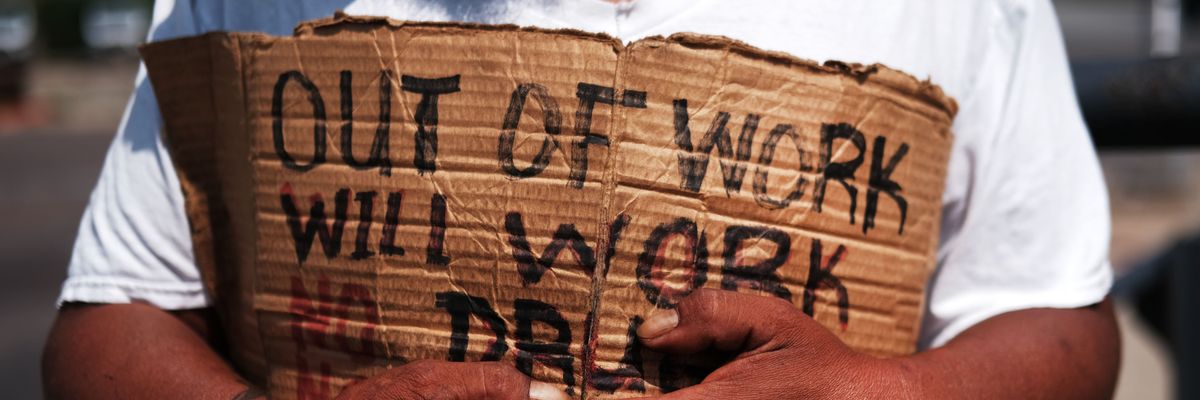
George, who is homeless, panhandles along a street in Lawrence  Massachusetts. Lawrence, once one of America’s great manufacturing cities with immigrants from around the world coming to work in its textile and wool processing mills, has struggled to find its economic base since the decline of manufacturing.
(Photo by Spencer Platt/Getty Images)

John Miller
Dec 26, 2025

Dollars & Sense

If Americans’ hopes of getting ahead have dimmed, as the Wall Street Journal reports yet again, it could only be because the lid of the coffin in which the “American Dream” was long ago laid to rest has finally been sealed shut.

The promise that if you work hard and play by the rules, you will get ahead, or if you don’t, surely your children will, was broken long ago. And today’s economic hardships have left young adults distinctly worse off than their parents, and especially their grandparents.


Global System ‘Rigged for the Wealthy’ Delivers World With ‘More Billionaires Than Ever’

This long decline has stripped away much of what there was of U.S. social mobility, which never did measure up to its mythic renderings. Let’s look closely at what the economic evidence, compiled in many meticulous studies, tells us about what passed for the American Dream, its demise, and what it would take to make its promised social mobility a reality.

The Long Decline

For at least two decades now, the Wall Street Journal has reported the dimming prospects of Americans getting ahead, each time with apparent surprise. In 2005, David Wessell presented the mounting evidence that had punctured the myth that social mobility is what distinguishes the United States from other advanced capitalist societies. A study conducted by economist Miles Corak put the lie to that claim. Corak found that the United States and United Kingdom were “the least mobile” societies among the rich countries he studied. In those two countries, children’s income increased the least from that of their parents. By that measure, social mobility in Germany was 1.5 times greater than social mobility in the United States; Canadian social mobility was almost 2.5 times greater than U.S. social mobility; and in Denmark, social mobility was three times greater than in the United States.

That U.S. social mobility lagged far behind the myth of America as a land of opportunity was probably no surprise to those who populated the work-a-day world of the U.S. economy in 2005. Corrected for inflation, the weekly wages of nonsupervisory workers in 2006 stood at just 85% of what they had been in 1973, over three decades earlier. An unrelenting increase in inequality had plagued the U.S. economy since the late 1970s. A Brookings Institution study of economic mobility published in 2007 reported that from 1979 to 2004, corrected for inflation, the after-tax income of the richest 1% of households increased 176% and increased 69% for the top one-fifth of households—but just 9% for the poorest fifth of households.

The Economist also found this increasing inequality worrisome. But its 2006 article, “Inequality and the American Dream,” assured readers that while greater inequality lengthens the ladder that spans the distance from poor to rich, it was “fine” if it had “rungs.” That is, widening inequality can be tolerated as long as “everybody has an opportunity to climb up through the system.”

Definitive proof that increasing U.S. inequality had not provided the rungs necessary to sustain social mobility came a decade later.

The American Dream Is Down for the Count


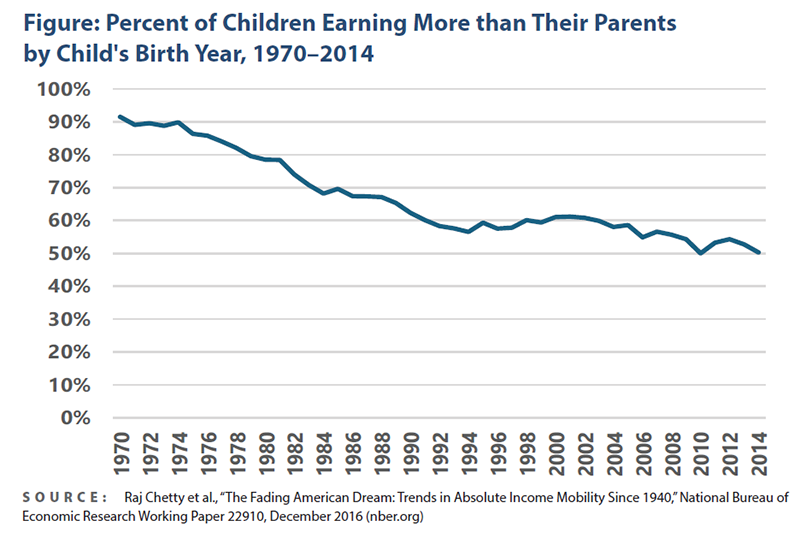
In late 2016, economist Raj Chetty and his multiple coauthors published their study, “The Fading American Dream: Trends.” They documented a sharp decline in mobility in the U.S economy over nearly half a century. In 1970, the household income (corrected for inflation) of 92% of 30-year-olds (born in 1940) exceeded their parents’ income at the same age. By 1990, just three-fifths (60.1%) of 30-year-olds (born in 1960) lived in households with more income than their parents earned at age 30. By 2014, that figure had dropped to nearly one-half. Only 50.3% of children born in 1984 earned more than their parents at age 30. (The figure below depicts this unrelenting decline in social mobility. It shows the relationship between a cohort’s birth year, on the horizontal axis, and the share of the cohort whose income exceeded that of their parents at age 30.)

The study from Chetty and his co-authors also documented that the reported decline in social mobility was widespread. It had declined in all 50 states over the 44 years covered by the study. In addition, their finding of declining social mobility still held after accounting for the effect of taxes and government transfers (including cash payments and payments in kind) on household income. All in all, their study showed that, “Severe Inequality Is Incompatible With the American Dream,” to quote the title of an Atlantic magazine article published at the time. Since then, the Chetty group and others have continued their investigations of inequality and social mobility, which are available on the Opportunity Insights website (opportunityinsights.org).

The stunning results of the Chetty group’s study got the attention of the Wall Street Journal. The headline of Bob Davis’s December 2016 Journal article summed up their findings succinctly: “Barely Half of 30-Year-Olds Earn More Than Their Parents: As wages stagnate in the middle class, it becomes hard to reverse this trend.”

Davis was correct to point to the study’s emphasis on the difficulty of reversing the trend of declining mobility. The Chetty group was convinced “that increasing GDP [gross domestic product] growth rates alone” would not restore social mobility. They argued that restoring the more equal distribution of income experienced by the 1940s cohort would be far more effective. In their estimation, it would “reverse more than 70% of the decline in mobility.”


Social Mobility Has Gotten Worse, Not Better

Since 2014, neither U.S. economic growth nor relative equality has recovered, let alone returned to the levels that undergirded the far greater social mobility of the 1940s cohort. Today, the economic position of young adults is no longer improving relative to that of their parents or their grandparents.

President Donald Trump was fond of claiming that he oversaw the “greatest economy in the history of our country,” during his first term (2017–2020). But even before the onset of the Covid-19-induced recession, his economy was neither the best nor good, especially when compared to the economic growth rates enjoyed by the 1940s cohorts who reached age 30 during the 1970s. During the 1950s and then again during the 1960s, U.S. economic growth averaged more than 4% a year corrected for inflation, and it was still growing at more than 3% a year during the 1970s. From 2015 to 2019, the U.S. economy grew a lackluster 2.6% a year and then just 2.4% a year during the 2020s (2020–2024).

Also, present-day inequality continues to be far worse than in earlier decades. In his book-length telling of the story of the American Dream, Ours Was the Shining Future, journalist David Leonhardt makes that clear. From 1980 to 2019, the household income of the richest 1% and the income of the richest 0.001% grew far faster than they had from 1946 to 1980, while the income of poorer households, from the 90th percentile on down, grew more slowly than they had during the 1946 to 1980 period. As a result, from 1980 to 2019, the income share of the richest 1% nearly doubled from 10.4% to 19%, while the income share of the bottom 50% fell from 25.6% to 19.2%, hardly more than what went to the top 1%. Beyond that, in 2019, the net worth (wealth minus debts) of median, or middle-income, households was less than it had been in 2001, which, as Leonhardt points out, was “the longest period of wealth stagnation since the Great Depression.”

No wonder the American Dream took such a beating in the July 2025 Wall Street Journal-NORC at the University of Chicago poll. Just 25% of people surveyed believed they “had a good chance of improving their standard of living,” the lowest figure since the survey began in 1987. And according to 70% of respondents, the American Dream no longer holds true or never did. That figure is the highest in 15 years.

In full carnival barker mode, Trump is once again claiming “we have the hottest economy on Earth.” But the respondents to the Wall Street Journal-NORC poll aren’t buying it. Just 17% agreed that the U.S. economy “stands above all other economies.” And more than twice that many, 39%, responded that “there are other economies better than the United States.” It’s a hard sell when the inflation-adjusted weekly wages of nonsupervisory workers are still lower than what they had been in 1973, now more than half a century ago.

And economic worries are pervasive. Three-fifths (59%) of respondents were concerned about their student loan debt, more than two-thirds (69%) were concerned about housing, and three-quarters (76%) were concerned about health care and prescription drug costs.

Rising housing costs have hit young adults especially hard. The median price of a home in 1990 was three times the median household income. In 2023, that figure had reached nearly five times the median household income. And the average age of a first-time homebuyer had increased from 29 in 1980 to 38 in 2024.

Finally, in their 2023 study, sociologists Rob J. Gruijters, Zachary Van Winkle, and Anette E. Fasang found that at age 35, less than half (48.8%) of millennials (born between 1980 and 1984) owned a home, well below the 61.6% of late baby boomers (born between 1957 and 1964) who had owned a home at the same age.
Dreaming Big

In their 2016 study, the Chetty group writes that, “These results imply that reviving the ‘American Dream’ of high rates of absolute mobility would require economic growth that is spread more broadly across the income distribution.”

That’s a tall order. Fundamental changes are needed to confront today’s economic inequality and economic woes. A progressive income tax with a top tax rate that rivals the 90% rate in the 1950s and early 1960s would be welcomed. But unlike the top tax rate of that period, the income tax should tax all capital gains (gains in wealth from the increased value of financial assets such as stocks) and tax them as they are accumulated and not wait until they are realized (sold for a profit). Also, a robust, fully refundable child tax credit is needed to combat childhood poverty, as are publicly supported childcare, access to better schooling, and enhanced access to higher education. Just as important is enacting universal single-payer health care and increased support for first-time homebuyers.

The belief that “their kids could do better than they were able to,” was what Chetty told the Wall Street Journal motivated his parents to emigrate from India to the United States. These fundamental changes could make the American Dream the reality that it never was.

© 2023 Dollars & Sense


John Miller
John Miller is a member of the Dollars & Sense collective, is professor of economics at Wheaton College.
Full Bio >


Whatever Happened to Trump’s “Golden Age” for American Workers?

MORE LIKE A GOLDEN SHOWER


by Lawrence S. Wittner / December 26th, 2025

Although Donald Trump’s Department of Labor announced in April 2025 that “Trump’s Golden Age puts American workers first,” that contention is contradicted by the facts.

Indeed, Trump has taken the lead in reducing workers’ incomes. One of his key actions along these lines occurred on March 14, 2025, when he issued an executive order that scrapped a Biden-era regulation raising the minimum wage for employees of private companies with federal contracts. Some 327,300 workers had benefited from Biden’s measure, which produced an average wage increase of $5,228 per year. With Trump’s reversal of policy, they became ripe for pay cuts of up to 25 percent.

America’s farmworkers, too, many of them desperately poor, are now experiencing pay cuts caused by the Trump administration’s H-2A visa program, which is bringing hundreds of thousands of foreign agricultural workers to the United States under new, lower-wage federal guidelines. The United Farm Workers estimates that this will cost U.S. farm workers $2.64 billion in wages per year.

As in the past, Trump and his Republican Party have blocked any increase in the federal minimum wage―a paltry $7.25 per hour―despite the fact that it has not been raised since 2009 and, thanks to inflation, has lost 30 percent of its purchasing power. By 2025, this wage had fallen below the official U.S. government poverty level.

Furthermore, the Trump administration is promoting subminimum wages for millions of American workers.  Although the Biden administration had abolished the previous subminimum wage floor for workers with disabilities by raising it to the federal minimum wage, the Trump Labor Department has restored the subminimum wage.  In addition, the Trump administration is proposing to strip 3.7 million home-care workers of their current federal minimum wage guarantee.

Trump’s Labor Department has also scrapped the Biden plan to expand overtime pay rights to 4.3 million workers who had previously lost eligibility for it, thanks to inflation.  And it is promoting plans to classify many workers as independent contractors, thereby depriving them of key labor rights, including minimum wage and overtime pay.

Not surprisingly, the U.S. Bureau of Labor Statistics reported on December 18, 2025, that, from November 2024 to November 2025, the annual growth of the real wages (wages adjusted for inflation) of American workers had fallen to 0.8 percent.

Trump’s policies have also fostered unemployment.

Probably the best-known example of this is the Trump administration’s chaotic purge, led by billionaire Elon Musk, of 317,000 federal workers without any clear rationale or due process. On top of this, however, it has shut down massive construction projects, especially in the renewable energy industry. Trump’s recent order to halt the construction of the huge wind farms off the East Coast is expected to result in the firing of thousands of workers.

Ironically, as two economic analysts reported in mid-December 2025, “key sectors of the economy that are central to Trump’s agenda have contracted, with payrolls in manufacturing, mining, logging and professional business services all falling over the last year.” Despite Trump’s repeated claims to be reviving U.S. manufacturing through tariffs, 58,000 U.S. manufacturing jobs were lost between April (when the administration announced its “Liberation Day” tariffs) and September 2025.

Consequently, U.S. unemployment, which, during the Biden presidency, had bottomed out at 3.4 percent, had by November 2025 (the last month for which government statistics are available) risen to 4.6 percent. This is the highest unemployment level in four years, leaving 7.8 million workers unemployed―700,000 more than a year before.

The Trump administration has also seriously undermined worker safety and health. According to the latest AFL-CIO study, workplace hazards kill approximately 140,000 workers each year, with millions more injured or sickened. Although the Occupational Safety and Health Administration is supposed to enforce health and safety standards, the Trump administration cut its workplace inspections by 30 percent, thereby reducing inspections of each site to one every 266 years.

Similarly, Trump has nearly destroyed the National Institute for Occupational Safety and Health, which provides research on workplace safety standards, by reducing its staffing from 1,400 employees to 150 and slashing its budget by 80 percent.

Through executive action, the Trump administration eliminated specific measures taken to protect workers. This process included blocking a Biden rule to control heat conditions in workplaces, where 600 workers die from heat-related causes and nearly 25,000 others are injured every year.  Moreover, in the spring of 2025, the Trump administration announced that it would not enforce a Biden rule to protect miners from dangerous silica exposure and moved to close 34 Mine Safety and Health Administration district offices. Although a public uproar led to a reversal of the office closures, the administration then proposed weakening those offices’ ability to impose mine safety requirements and also weakening workplace safety penalties for businesses.

In addition, Trump appointed corporate executives to head relevant federal agencies, gutted Equal Employment Opportunity guidelines, and, in March 2025, issued an executive order that terminated collective bargaining rights for more than a million federal government workers. This last measure, the largest single union-busting action in American history, ended union representation and protections for one out of every 14 unionized workers in the United States.

In a special AFL-CIO report, issued on December 22, 2025, the labor federation’s president, Liz Shuler, and secretary-treasurer, Fred Redmond, declared: “Since Inauguration Day . . . the fever dreams of America’s corporate billionaires have come to life with a relentless assault on working people,” and “every day has brought a new challenge and attack:  On federal workers.  On our unions and collective bargaining rights.  On the agencies that stand up for us and the essential services we rely on. . . .  On our democracy itself.”

Although Trump’s second term in office might have provided a “Golden Age” for the President and his fellow billionaires, it has produced harsh and challenging times for American workers.

rence S. Wittner is Professor of History Emeritus at SUNY/Albany and the author of Confronting the Bomb (Stanford University Press). Read other articles by Lawrence, or visit Lawrence's website.
Backward American Capitalism (and Trump) Are Getting Electrical Vehicles All Wrong

The dirty fossil fuel industry keeping gas-powered vehicles on the road are like the horse-and-buggy companies of 1902, which laughed at Henry Ford’s Model T for a while before being put out of business by it.


A BYD Birdsong L luxury EV sedan. “Wang Chuanfu, the CEO of BYD, the largest EV company in the world, is the Henry Ford of the 21st century, not an American,” writes Cole.
(Photo: BYD/promotional)


Juan Cole
Dec 26, 2025
Informed Comment

Euan Gregor at the Ember energy think tank makes a novel argument: The adoption of electric vehicles has spread in a major way to the Global South and is no longer only a Chinese, European and American phenomenon. By EVs Ember means both hybrid and pure battery electric cars.

But it certainly is a Chinese phenomenon, since in that country nearly half of new car sales were electric this year. That is an incredible statistic.


‘An Abject Failure’: Economists Trash Trump’s Disastrous Job Creation Record in Year-End Reviews

Globally, Yale Climate Connections says, 25% of new car sales were electric of some sort. Road transportation, this site says, accounts for 12% of global carbon emissions.

When we say that people in the Global South are buying EVs hand over fist, alas, we aren’t saying that they are buying Chevy Bolts or Nissan Leafs or Teslas. They are mostly buying BYDs, Geelys, BWMs and other Chinese makes, which are 65% the price of a Tesla. Since automobile transportation will be electrified over the next 30 years, the country that makes all those EVs will become the industrial powerhouse of the 21st Century. Most of the growth in Chinese EV exports, Ember says, has come in countries outside the relatively wealthy 38 nations that belong to the Organization for Economic Co-Operation and Developmentnon (OECD).

Backward American capitalism has been captured by dirty petroleum interests and is like the horse-and-buggy companies of 1902, which laughed at Henry Ford’s Model T for a while before being put out of business by it. (They started by saying that automobiles were impractical because they would scare the horses).

The petroleum industry and the dirty oil countries are aware that China and Europe are electrifying transport, but they had pinned their hopes on a continued demand for internal combustion engine vehicles (ICEV) in Africa, Asia and Latin America. Ember is saying that that hope is a pipe dream (pun intended). Exhibit A: Ethiopia has banned the importation of gasoline cars.

Wang Chuanfu, the CEO of BYD, the largest EV company in the world, is the Henry Ford of the 21st century, not an American. America is a sinking ship under the anti-science, anti-technology, anti-greeen Trump administration, which is more likely to kill off the population with preventable diseases by halting vaccinations than to dominate the world economically.

Ember says, “39 countries have reached an EV sales share larger than 10% in 2025, a third of which are outside Europe.” In 2019, all countries with substantial EV sales had been in Europe.

In particular, the Association of Southeast Asian Nations (ASEAN) has emerged in 2025 as a major adopter of EVs. Nearly 40% of new vehicle registrations in Vietnam were electric, more than in the European Union and more than the UK, and the electric vehicle industry could generate 6.5 million jobs there over the next 30 years. In Singapore 43% of new car sales were electric in the first nine months of this year. More than 20% of new cars bought in Thailand were electric this year, again more than in the EU or Britain. In Indonesia, about 18% of new vehicle registrations were electric this year, an increase of 49% over 2024. In Malaysia, EV sales were up 74%, and in the Philippines they increased a whopping 656%. Because they started from a low base, however, these two countries are still seeing only 5-6% of new car sales as electric.

India, Mexico and Brazil, two of them BRICS countries, are also emerging as significant EV markets. In Brazil EVs made up 9-10% of new passenger car sales. Since Brazil has an exceptionally clean grid, EVs are almost carbon-free there. In Mexico 8-9% of new vehicle registrations were electric. I visited Mexico twice this year, and noticed the BYD dealerships. In India, about 5% of new passenger car sales were electric this year, a big increase over the past. Five percent doesn’t sound like much, but Indians buy about 4.5 million new cars every year, so that was 225,000 EVs this year. In Turkiye 17% of new car sales are EVs, most of them battery electric. That country makes its own EV, the Togg, but also has attracted Chinese investment for a BYD manufacturing plant.

© 2023 Juan Cole

Juan Cole teaches Middle Eastern and South Asian history at the University of Michigan. His newest book, "Muhammad: Prophet of Peace Amid the Clash of Empires" was published in 2020. He is also the author of "The New Arabs: How the Millennial Generation Is Changing the Middle East" (2015) and "Napoleon's Egypt: Invading the Middle East" (2008). He has appeared widely on television, radio, and on op-ed pages as a commentator on Middle East affairs, and has a regular column at Salon.com. He has written, edited, or translated 14 books and has authored 60 journal articles.
Full Bio >


Trump admin fudged the numbers to make faltering economy look better: economists


Adam Lynch
December 26, 2025 
ALTERNET

Los Angeles Times reporter Michael Hiltzik writes that President Donald Trump and his helpers are cheering prematurely over some good economic numbers that came out this month.

On Dec. 18, the Bureau of Labor Statistics (BLS) reported that inflation had fallen to an annual rate of 2.7 percent in November, down from 3 percent in September. Then, on Tuesday, the Bureau of Economic Analysis reported that real gross domestic product had gone up by a surprising 4.3 percent annual rate in the third quarter of 2025.

“Unsurprisingly, the Trump administration and its Republican acolytes seized on the figures to boast about Trump's economic policies,” Hiltzik writes in the Tribune National. “White House economic advisor Kevin Hassett proclaimed the inflation figure to be ‘an absolute blockbuster report,’ and described the GDP figure as ‘a great Christmas present for the American people.’

After being hounded by bad numbers for most of Trump’s first year, House Speaker Mike Johnson (R-La.) happily jumped aboard, announcing "America is winning again" after the GDP report. He even called it "the direct result” of congressional Republicans’ and President Trump’s policies.

“Um, not so fast,” said Hiltzik, pointing out that the 43-day government shutdown from Oct. 1 to Nov. 12 was the most important cause of gaps in the collected data for the consumer price index calculation.

“You've got to take it with a grain of salt," said Diane Swonk, chief economist at KPMG US, of the inflation report. "It's confusing and it doesn't quite square with prices that we've observed."

Swonk said Trump’s steep cutbacks at the BLS had already reduced the staff assigned to sampling prices by 25 percent. That prompted the agency to substitute "imputed" numbers in lieu of hard data.

"Those cases can show up as zeros in the percent change of the release," Swonk wrote, which lowers the bottom-line figure. In fact, a sampling scheduled for mid-October had to be canceled, so figures dating from August were used instead. This conceals any price increases in subsequent months.

“A major problem concerns housing costs, which account for about one-third of the data inputs for the (Consumer Price Index),” Hiltzik reports. “Because the BLS was unable to collect rental data for October, it implied that the monthly change in rents was 0 percent in October — further skewing the reported CPI lower. Experts say it will take at least six months to use newly collected data to provide a reliable estimate of housing inflation.”

The delay in sampling, Swonk said, means some seasonal price phenomena, such as airfares, also went unreported. The originally scheduled sampling would have incorporated a pre-Thanksgiving run-up in fares, but by the time the data were collected fares had returned to a non-holiday level.

On top of this, Hiltzik says economists are warning “that some economic factors haven't yet fully played out.”

“That includes Trump's tariffs, which in their execution have been lower than they appeared on the surface, and higher healthcare premiums, which have been forecast or announced but won't actually become effective until 2026.”

Read the full report at this Kansas City Star link.

Trump is pointlessly trying to resurrect jobs that 'aren't coming back': Washington Post


U.S. President Donald Trump gestures as he arrives to deliver remarks on the U.S. economy and affordability at the Mount Airy Casino Resort in Mount Pocono, Pennsylvania, U.S. December 9, 2025. REUTERS Jonathan Ernst

December 25, 2025 
ALTERNET

Politicians and President Donald Trump sell the vision of a manufacturing renaissance, but the Washington Post Editorial Board argues their vision of “massive factories employing thousands of people” are not possible in real-life America.

“Some places have had manufacturing renaissances,” reports the Post, citing its coverage of Bridgeport, Connecticut, with an old manufacturing city allegedly sputtering “back to life,” according to the headline.


Once the home of Remington and divisions of General Electric, which filed for bankruptcy in 1991, the area is now serving vocational education programs that are helping workers without college degrees cultivate welding and technician skills, which almost guarantee careers.

It was a “feel-good story politicians want to hear,” writes the Post, though the paper observed that the hard truth of re-emerging factory jobs “barely registered” in the overall data on Bridgeport’s economy. Manufacturing employment in the Bridgeport-Stamford-Danbury metropolitan statistical area saw only “a small bump” and remains near 30-year lows, according to the Bureau of Labor Statistics.

“Real manufacturing output in the Bridgeport metro area has been rising but is also quite low compared to before the Great Recession, according to the Bureau of Economic Analysis,” the Post reports. “The turnaround in the past few years is that manufacturing is no longer a drag on Bridgeport’s GDP growth, as it was during most years since the Great Recession. It flipped positive in 2021” — But is has remained “barely above zero” since then.

The problem, according the Post, is that the new jobs “are relatively few in number,” however high in compensation.

“These newer, successful manufacturing companies in Bridgeport don’t have assembly lines with workers performing repetitive tasks. They have high-skilled workers meeting exacting specifications for a relatively small number of picky customers,” said the Post. “That’s what most American manufacturing firms look like today. Ninety-eight percent of U.S. manufacturing firms employ fewer than 500 people, and 93 percent employ fewer than 100, according to 2022 data.”

The “manufacturing” jobs actually employ more robots than anything, per the Post's editorial. Automation makes them extremely productive, and more productive workers are paid more, but it still means fewer people work in manufacturing than in the past.

“Pro-manufacturing politicians face a choice,” says the Post. “They can applaud the success of places like Bridgeport while conceding that manufacturing isn’t a jobs juggernaut. Or they can continue to yearn for the mass-production plants of yesteryear, which aren’t coming back. Even if they did, they would yield worse, lower-paying jobs than the high-tech manufacturing plants of today.”

Read the Post's editorial at this link.

JD Vance Is Wrong: DEI Is Not What’s Dividing America—He Is

In the America that Vance envisions, people are only judged for “who they are”—unless they’re immigrants, transgender, women, Muslims, or people of color.


US Vice President JD Vance arrives at the Turning Point’s annual AmericaFest conference, in remembrance of late right-wing political activist Charlie Kirk, in Phoenix, Arizona on December 21, 2025.
(Photo by Olivier Touron / AFP via Getty Images)

Jordan Liz
Dec 26, 2025
Common Dreams


On December 21, at Turning Point USA’s annual national conference, Vice President JD Vance took to the stage to denounce the evils of diversity, equity, and inclusion initiatives.

He told the crowd:
We don’t treat anybody different because of their race or their sex, so we have relegated DEI to the dustbin of history, which is exactly where it had belonged. In the United States of America, you don’t have to apologize for being white anymore. And if you’re an Asian, you don’t have to talk around your skin color when you’re applying for college. Because we judge people based on who they are, not on ethnicity and things they can’t control. We don’t persecute you for being male, for being straight, for being gay, for being anything. The only thing that we demand is that you be a great American patriot. And if you’re that, you’re very much on our team.

For Vance, DEI and affirmative action policies are so vile that it “pisses [him] off a million times more” than racial slurs aimed at his own children by an actual white supremacist.

This is because DEI policies, in his view, are specifically designed to harm white men. On December 17, Vance posted on Twitter that, “A lot of people think ‘DEI’ is lame diversity seminars or racial slogans at NFL games. In reality, it was a deliberate program of discrimination against white men. This is an incredible piece that describes the evil of DEI and its consequences.”

The “incredible piece” is an article by Jacob Savage entitled “The Lost Generation.” Savage argues that “DEI wasn’t a gentle rebalancing—it was a profound shift in how power and prestige were distributed.” A redistribution that, Savage argues, harmed “white male millennials” who saw opportunities that would have ordinarily gone to people like him go to people of color and women instead. Savage’s grievance is premised on the assumption that the people who succeed in his place were less qualified—the type of people that he would have triumphed over if not for DEI.

Much of the article is typical anti-DEI rhetoric. But, toward the end, Savage makes the following—almost insightful—point:
It’s strange and more than a little poisonous to see yourself buffeted by forces beyond your control. But there’s also a comfort in it. Because it’s less painful to scroll through other people’s IMDb pages late at night, figuring out what shortcut—race, gender, connections—they took to success, than to grapple with the fact that there are white men my age who’ve succeeded, and I am not one of them. I could have worked harder, I could have networked better, I could have been better. The truth is, I’m not some extraordinary talent who was passed over; I’m an ordinary talent—and in ordinary times that would have been enough.

Savage, like Vance and most anti-DEI advocates, champions “American meritocracy.” Yet, he is somehow upset and surprised that someone with “ordinary talent” failed to succeed. Isn’t this outcome exactly what true, unfettered meritocracy would produce? If everyone, regardless of race, sex, and gender, were able to compete equally, then those who are not “extraordinary” would always struggle to find financial security and success.

The actual problem that Savage is unknowingly pointing to is not DEI. It’s capitalism. Within a capitalist system that prioritizes maximizing profits over people’s well-being, and a political system that offers little to no protection for those capitalism leaves behind, most people will struggle to survive. That is by design.

Capitalism will always, by its very nature, produce “winners” and “losers.” The more people there are competing for a steadily decreasing number of jobs, the more “losers” there will be. A problem that AI—aided by the Trump administration’s effort to eliminate any regulations against it—will likely worsen in the coming years. The only real “winners” in this dynamic are the ultra-wealthy class who continue to succeed regardless of their own individual talents.

He is evoking racial animosity to distract his supporters from the real problems that capitalism is generating and that the Trump administration is ignoring.

If Vance really cared about treating people equally and with dignity, then he would concern himself with tackling the affordability crisis, increasing wages, lowering healthcare costs, building more social safety nets—all issues that the Trump administration is currently failing to address. Worse even, this administration is actively working to undermine many of the programs that would help people like Savage who are struggling to get by.

No matter what Vance says, being “a great American patriot” will never be enough to succeed within the current capitalist system. And Vance knows this. In Hillbilly Elegy, Vance discusses the significance of “social capital,” or leveraging the networks of people and institutions around us to “connect us to the right people, ensure that we have opportunities, and impart valuable information.” For Vance, his social capital, which included Yale professors, tech billionaires, and former presidential speechwriters, was critical to his success. However, that capital is reserved for the upper class. As he writes, “Those who tap into it and use it prosper. Those who don’t are running life’s race with a major handicap. This is a serious problem for kids like me.”

Ultimately, Vance is not concerned with equality or discrimination. His attacks on DEI are nothing more than a smokescreen. He is evoking racial animosity to distract his supporters from the real problems that capitalism is generating and that the Trump administration is ignoring. He is hoping to exploit people’s genuine frustrations with the status quo to become president in 2028.

Vance preaches inclusivity, but his entire social and political ideology is divisive. He claims that, “We all got wrapped up over the last few years in zero sum thinking. This was because the people who think they rule the world pit us against one another.” But the reality is that Vance’s pro-capitalist, Christian nationalist, and ethnonationalist values are all zero sum ways of thinking that function precisely to divide people.

Vance says that “in the United States of America, you don’t have to apologize for being white anymore.” Yet, white people have never had to apologize for being white. This is performative anger. Vance is using the same rhetoric still used by the KKK—“Never! Never! Apologize for Being White!—to fuel hatred and contempt for his own political gain.

In the America that Vance envisions, people are only judged for “who they are”—unless they’re immigrants, transgender, women, Muslims, or people of color. Within the very same speech that Vance champions equality for all, he attacks Somali Americans. He tells the audience that “Democrats are not sending their best. Omar Fateh was Ilhan Omar’s candidate for mayor of Mogadishu. Wait, I mean Minneapolis. Little Freudian slip there”—smiling as the crowd laughed along.

As one of his former friends puts it, Vance is a “chameleon. Someone who is able to change their positions and their values depending on what will amass them political power and wealth. And I think that’s really unfortunate, because it reflects a lack of integrity.” His drastic change of heart about Trump is proof of how easily he can change his colors. Vance went from Trump is “America’s Hitler” to now serving as his vice president within the span of a few years. His anti-DEI rhetoric is just another political maneuver meant to serve his own interest.

All that said, Vance is right about one thing—“The people who think they rule the world pit us against one another.” Those people include him. We can’t let him succeed.


Our work is licensed under Creative Commons (CC BY-NC-ND 3.0). Feel free to republish and share widely.

Jordan Liz
Jordan Liz is an Associate Professor of Philosophy at San José State University. He specializes in issues of race, immigration and the politics of belonging.
Full Bio >