Saturday, December 27, 2025

The Bright Side: Wild cat feared extinct for 30 years rediscovered in Thailand


An elusive wild cat long feared extinct in Thailand has been rediscovered three decades after its last recorded sighting, conservation authorities said. Camera traps in southern Thailand’s Princess Sirindhorn Wildlife Sanctuary captured 29 detections, including a female with her cub, offering rare hope for the endangered flat-headed cat.


Issued on: 26/12/2025 
By:  FRANCE 24
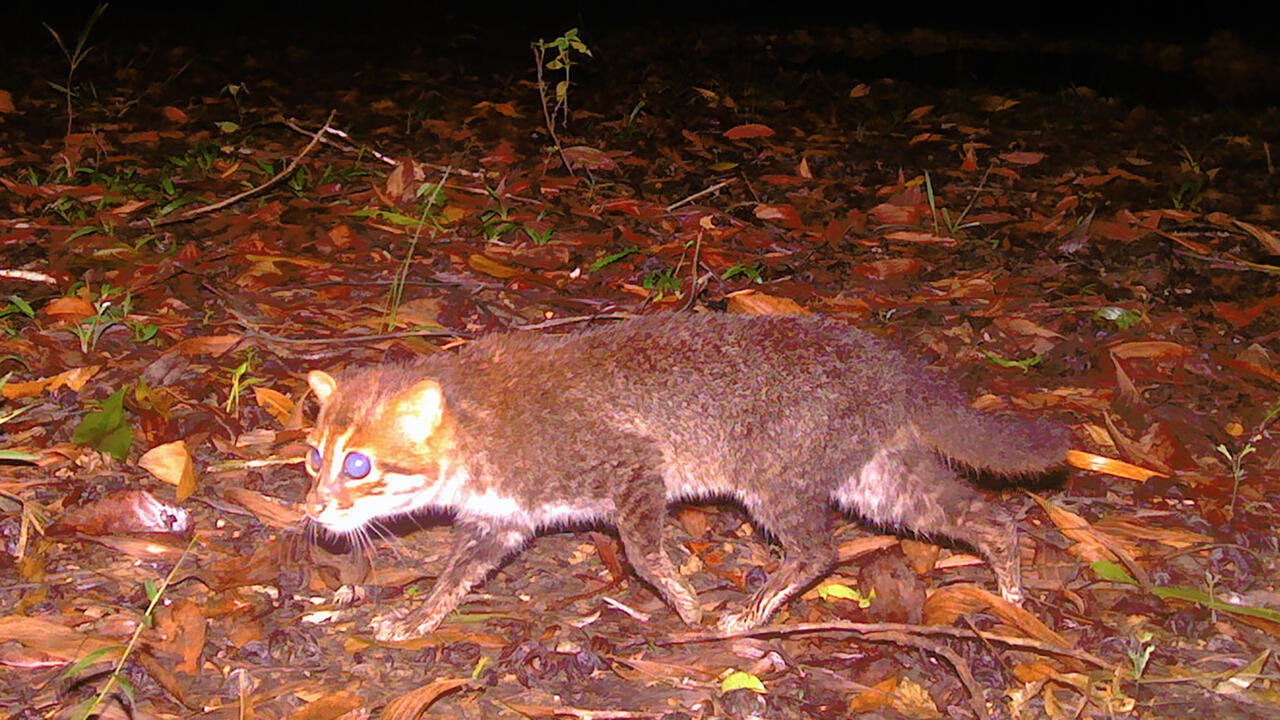
Flat-headed cats are among the world's rarest and most threatened wild felines. 
© Panthera Thailand, AFP

An elusive wild cat long feared extinct in Thailand has been rediscovered three decades after the last recorded sighting, conservation authorities and an NGO said Friday.

Flat-headed cats are among the world's rarest and most threatened wild felines. Their range is limited to Southeast Asia and they are endangered because of dwindling habitat.

The domestic cat-sized feline with its distinctive round and close-set eyes was last spotted in a documented sighting in Thailand in 1995.

But an ecological survey that began last year, using camera traps in southern Thailand's Princess Sirindhorn Wildlife Sanctuary, recorded 29 detections, according to the country's Department of National Parks, Wildlife and Plant Conservation and wild cat conservation organisation Panthera.

"The rediscovery is exciting, yet concerning at the same time," veterinarian and researcher Kaset Sutasha of Kasetsart University said, noting that habitat fragmentation has left the species increasingly "isolated".

It was not immediately clear how many individuals the detections represent, as the species lacks distinctive markings which makes counting tricky.

But the findings suggest a relatively high concentration of the species, Panthera conservation programme manager Rattapan Pattanarangsan said.

The footage included a female flat-headed cat with her cub – a rare and encouraging sign for a species that typically produces only one offspring at a time.

Nocturnal and elusive, the flat-headed cat typically lives in dense wetland ecosystems such as peat swamps and freshwater mangroves, environments that are extremely difficult for researchers to access, Rattapan said.

Globally, the International Union for Conservation of Nature estimates that around 2,500 adult flat-headed cats remain in the wild, classifying the species as endangered.

In Thailand, it has long been listed as "possibly extinct".

Thailand's peat swamp forests have been heavily fragmented, largely due to land conversion and agricultural expansion, said Kaset, who was not involved in the ecological survey but has researched wild cats for years.

The animals also face mounting threats from disease spread by domestic animals, and they struggle to reproduce across isolated areas.

While the rediscovery offers hope, it is only a "starting point" for future conservation efforts, he said.

"What comes after this is more important – how to enable them to live alongside us sustainably, without being threatened."

(FRANCE 24 with AFP)
South Korea to end overseas adoptions amid UN concern over human rights abuses


South Korea on Friday announced plans to end foreign adoptions over a five-year period, aiming for zero by 2029, as UN investigators raise “serious concern” over decades of abuses. Many adoptees were sent abroad with falsified records or suffered mistreatment, and critics say Seoul has failed to provide truth-finding, reparations, or full accountability for past violations.


Issued on: 26/12/2025 
By: FRANCE 24

South KoreanVice Minister of Health and Welfare Lee Seuran speaks during a briefing at the government complex building in Seoul, South Korea, Friday, December 26, 2025. © AP

South Korea’s government said it plans to end its waning foreign adoptions of Korean children, while United Nations investigators voiced “serious concern” over what they described as Seoul’s failure to ensure truth-finding and reparations for widespread human rights violations tied to decades of mass overseas adoptions.

The announcement Friday came hours after the United Nations human rights office released South Korea’s response to investigators urging Seoul to spell out concrete plans to address the grievances of adoptees sent abroad with falsified records or abused by foreign parents.

The issue had rarely been discussed at the UN level, even as South Korea faces growing pressure to confront widespread fraud and abuse that plagued its adoption programme, particularly during a boom in the 1970s and 1980s when it annually sent thousands of children to the West.

The country will phase out foreign adoptions over a five-year period, aiming to reach zero by 2029 at the latest as it tightens welfare policies for children in need of care, Vice Minister of Health and Welfare Lee Seuran said during a briefing.


WATCH MORESouth Korean adoption scandal: Belgian adoptees seek justice

South Korea approved foreign adoptions of 24 children in 2025, down from around 2,000 in 2005 and an annual average of more than 6,000 during the 1980s.

In the health ministry’s briefing and response to the UN, officials focused on future improvements rather than past problems.

“Adoptions were mainly handled by private adoption agencies before, and while they presumably prioritised the best interests of the child, there may have also been other competing interests,” Lee said.

“Now, with the adoption system being restructured into a public framework, and with the Health Ministry and the government having a larger role in the process for approving adoptions, we have an opportunity to reassess whether international adoption is truly a necessary option,” she added, citing efforts to promote domestic adoptions.

UN investigators, including special rapporteurs on trafficking, enforced or involuntary disappearances and child abuse, raised the adoption issue with Seoul after months of communication with Yooree Kim. The 52-year-old was sent to a French family in 1984 without her biological parents’ consent, based on documents falsely describing her as an abandoned orphan.

Kim said she endured severe physical and sexual abuse by her adopters and petitioned the UN as part of a broader effort to seek accountability from governments and adoption agencies in South Korea and France.

Citing broader systemic issues and Kim’s case, UN investigators criticised South Korea for failing to give adoptees effective access to remedies for serious abuses and for the “possible denial of their rights to truth, reparations, and memorialisation”.

They also voiced concern over the suspension of a government fact-finding investigation into past adoption abuses and fraud, despite reports of grave violations including cases that may amount to enforced disappearances.

In its response, South Korea highlighted past reforms focused on abuse prevention including a 2011 law that reinstated judicial oversight of foreign adoptions, which ended decades of control by private agencies and resulted in a significant drop in international placements.

South Korea also cited recent steps to centralise adoption authority.

However, the government said further adoption investigations and stronger reparations for victims would hinge on future legislation. It offered no new measures to address the vast backlog of inaccurate or falsified records that have blocked many adoptees from reconnecting with birth families or learning the truth about their origins.

Choi Jung Kyu, a human rights lawyer representing Kim, called South Korea’s response “perfunctory”. He noted that promises of stronger reparations, which were meant to reduce the need for victims to litigate, are not clearly spelled out in draft bills proposing a relaunch of the Truth and Reconciliation Commission to investigate past human rights abuses.

The government also vetoed a bill in April that would have removed the statute of limitations for state-related human rights violations, although that was before President Lee Jae-myung took office in June. Lee issued an apology in October over past adoption problems, as recommended by the truth commission.

READ MORES. Korean president apologises over foreign adoptions of stolen children

Choi, who represents multiple plaintiffs suing the government over human rights abuses under past dictatorships, said they often face prolonged legal battles when authorities dismiss truth commission findings as inconclusive or cite expired statutes of limitations.

Kim, who could not immediately be reached for comment, filed a rare petition for compensation against the South Korean government in August, noting that authorities at the time of her adoption falsely documented her as an orphan despite having a family.

Following a nearly three-year investigation into complaints from 367 adoptees in Europe, the US and Australia, the truth commission in March recognised Kim and 55 other adoptees as victims of human rights violations including falsified child origins, lost records and child protection failures.

That was weeks before the commission halted its adoption investigation following internal disputes among commissioners over which cases warranted recognition as problematic. The fate of the remaining 311 cases, either deferred or incompletely reviewed, hinges on whether lawmakers establish a new truth commission through legislation.

The commission’s findings acknowledged state responsibility for facilitating a foreign adoption programme rife with fraud and abuse. The programme was driven by efforts to reduce welfare costs and enabled by private agencies that often manipulated children’s backgrounds and origins. The findings largely aligned with previous reporting by The Associated Press.

The AP investigation, in collaboration with Frontline (PBS), detailed how South Korea’s government, Western countries and adoption agencies worked in tandem to send some 200,000 Korean children overseas despite evidence that many were procured through questionable or unscrupulous means.

Seoul’s past military governments passed special laws promoting foreign adoptions, removing judicial oversight and giving vast powers to private agencies, which bypassed proper child relinquishment procedures while shipping thousands of children overseas each year.

Western nations largely ignored the abuses and sometimes pressured South Korea to maintain the supply to meet their high demand for babies.

(FRANCE 24 with AP)
'We won't stop': How Gen Z’s anger became a global movement in 2025


From Kathmandu to Lima, Generation Z took to the streets in 2025 to denounce inequality, corruption and political exclusion. Across the Global South, young people turned scattered local protests into a shared moment of mobilisation. FRANCE 24 looks back on a pivotal year for a generational movement set to remain in the spotlight in 2026.


Issued on: 27/12/2025 - 
FRANCE24


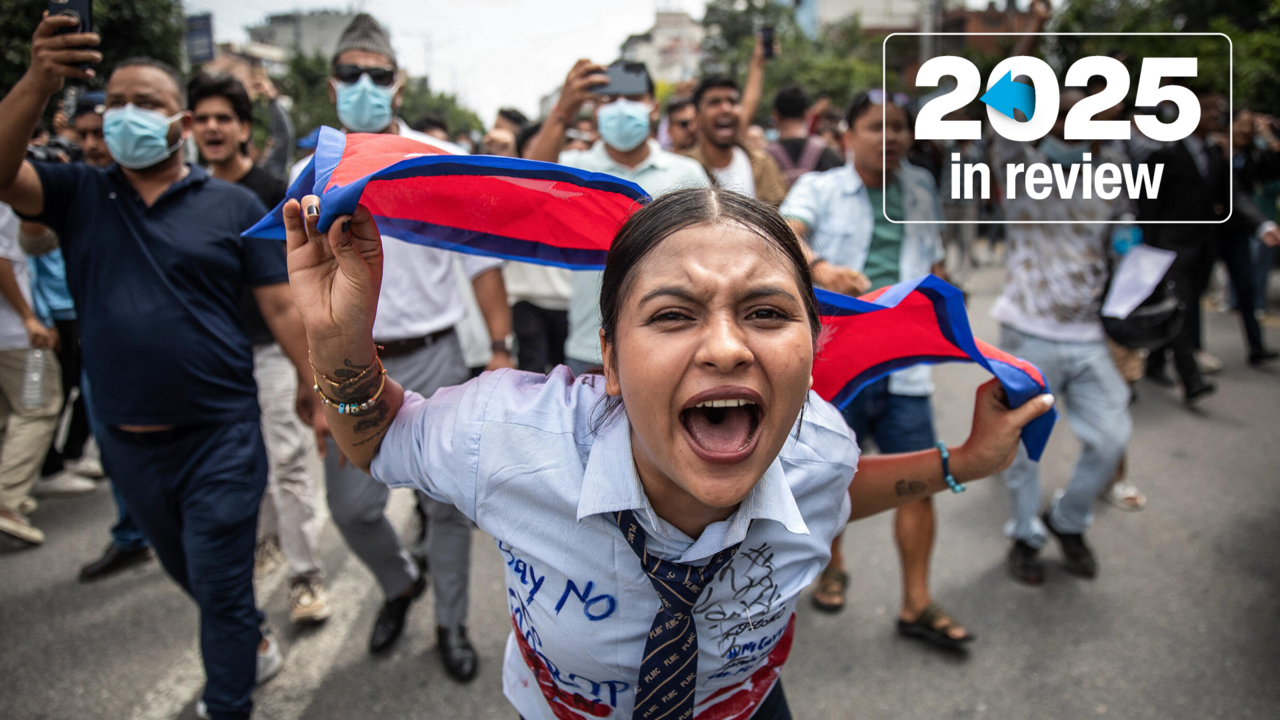
In this file photo, a demonstrator shouts slogans during a protest outside the Parliament in Kathmandu Nepal on September 8, 2025. © Prabin Ranabhat, AFP

Across continents and cultures, young people faced very different daily realities, from experiencing insecurity in Lima to living with rolling power cuts in Antananarivo. Yet in 2025, one experience brought them together: protests. Generation Z – born between the late 1990s and early 2010s – shared frustration and anger at elites seen as out of touch, and a determination to be heard.

Across countries separated by thousands of kilometres, similar scenes unfolded, featuring young crowds, hand-painted placards, viral slogans born on platforms like TikTok or Discord and simple demands.

"This is a generation that is not acting only for itself, but so that everyone has access to education, healthcare and housing, and to put an end to corruption in power," said sociologist Michel Wieviorka, director of studies at the School for Advanced Studies in the Social Sciences (EHESS). “It is a protest driven by universal values.”


Gen Z: How social media fuel this generation's global revolt
EN Gen Z thumbnail © France 24
02:18


A contagion effect

The movement began in Indonesia at the end of the summer. In Jakarta, the announcement of housing allowances for MPs – nearly ten times the minimum wage – acted as a trigger, prompting students to take to the streets.

One symbol quickly emerged from the marches: the pirate flag from the world’s best-selling manga, "One Piece", which became the emblem of the Gen Z revolt.

In September, the movement gained dramatic momentum in Nepal. Viral videos on Instagram and TikTok exposed the lavish lifestyles of “nepo-kids”, while the government blocked around twenty digital platforms.

Anger erupted in Kathmandu, where parliament was set on fire. For two days, the country was gripped by violent riots.

READ MORENepal's parliament burns as PM gives in to protesters' call to resign

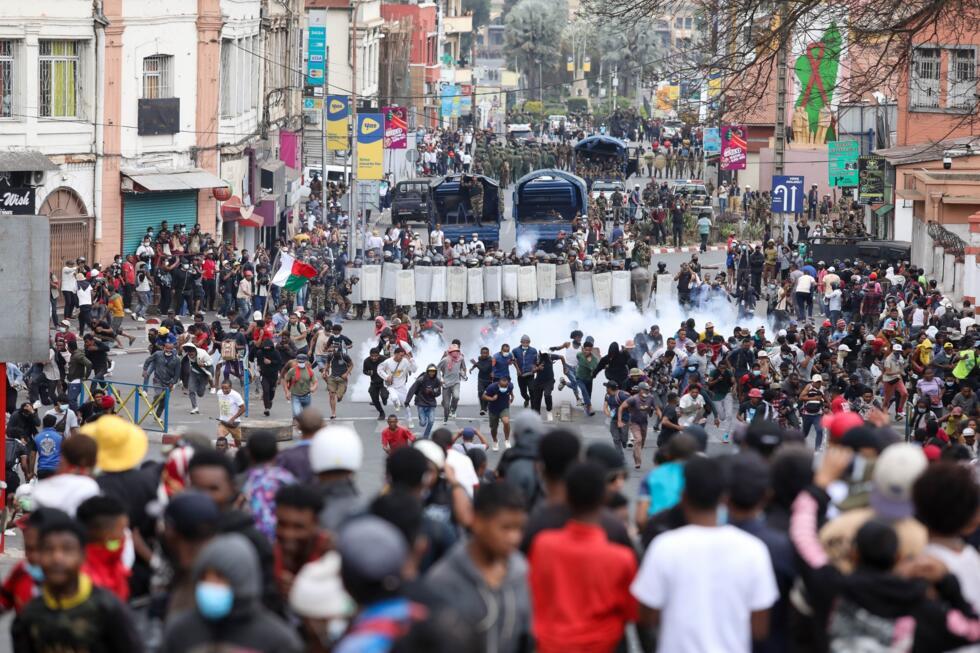
The shockwave then reached Africa. In Madagascar’s capital Antananarivo, youth-led protests no longer denounced only water and power cuts but also demanded the resignation of the president.

"We are not asking for luxury, just the means to live with dignity," demonstrators chanted, many of them students or young precarious workers.

In Morocco, mobilisation took a different form. The Gen Z 212 collective – a reference to the country’s telephone code – organised on Discord, coordinating calls to demonstrate and pushing its priorities, including school reform, access to healthcare and social justice.

On the American continent, Peruvian youth mobilised from Lima to Cusco against political instability, corruption and record levels of insecurity.

READ MOREPeru to impose state of emergency in Lima after Gen Z protests turn deadly

While demands differed, the broader context was similar.

"These are countries where democracy, if it exists, remains illiberal or weakly liberal," Wieviorka said. "They are also more or less authoritarian regimes, where power responds with repression, fuelling a spiral of violence."

The toll was heavy: a dozen people were killed in Indonesia, at least three in Morocco and five in Madagascar. In Nepal, at least 76 people died and more than 2,000 were injured, according to police.
This file photo shows demonstrators protesting against chronic electricity and water cuts confront riot police in Antananarivo, Madagascar, on September 30, 2025. © Mamyrael, AP

Victories and disappointments

Despite repression, Generation Z made gains. In Nepal, the protest movement led to the fall of the government.

In an unprecedented move, an interim prime minister – former Supreme Court chief justice Sushila Karki – was appointed following a vote organised on Discord.

A commission of inquiry was tasked with shedding light on the deaths of protesters.

For Nepal’s youth, this marked a victory: for the first time, a mobilisation born online and on the streets resulted in a tangible political transition.

In Madagascar, the outcome left a bitter taste. After several weeks of demonstrations, President Andry Rajoelina was overthrown in a military coup.

READ MOREWho is Michael Randrianirina, the colonel who toppled Madagascar's president?

The government that followed, however, remained in the hands of a familiar actor in the country’s political life: the army.

"The military hijacked a protest that had failed to constitute itself as a political force," Wieviorka said.

In Morocco, the protest did not shake the monarchy but forced the authorities to respond.

The royal cabinet announced modernisation measures and investments in hospitals and schools, implicitly acknowledging the legitimacy of the demands.

READ MOREMorocco vows social reforms after youth-led protests shake government

Repression nevertheless tempered the momentum. According to official figures, 1,473 young people remain detained, including 330 minors.
Lasting momentum or fleeting wave?

In Nepal, mobilisation has not subsided. Early legislative elections are scheduled for March 2026.

"We are in the second phase of the movement," protester Yujan Rajbhandari told AFP.

The focus has shifted to voter registration and the fight against corruption.

"We won’t stop," he said.

READ MOREAfter toppling a government, young Nepalis drive a new wave of voters and candidates

Elsewhere, the future remains uncertain.

"This movement can endure and produce lasting effects, or on the contrary, fade away as a whole," Wieviorka said. "There are no rules."
People take part in a youth-led protest calling for education and healthcare reforms, in Tangier, Morocco on October 18, 2025. © Mosa'ab Elshamy, AP

Recent history urges caution. From the Arab Spring to Spain’s “indignados”, from Occupy Wall Street to France’s Nuit debout, movements have emerged, lost momentum and sometimes left lasting traces, sometimes not.

"Social movements are not eternal," Wieviorka said.

One feature nevertheless distinguishes Generation Z: its ability to organise, impose its themes and extract concessions without immediately seeking to take power.

"They do not have a fully formed political platform,” Wieviorka said. “But they do have a clear horizon: that of profound change."

This article was translated from the original in French by Anaƫlle Jonah.


BREAKING – Taiwan, southwestern Japan hit by M7.0 earthquake

BREAKING – Taiwan, southwestern Japan hit by M7.0 earthquake
/ Taiwan Central Weather Administration
By Mark Buckton - Taipei December 27, 2025

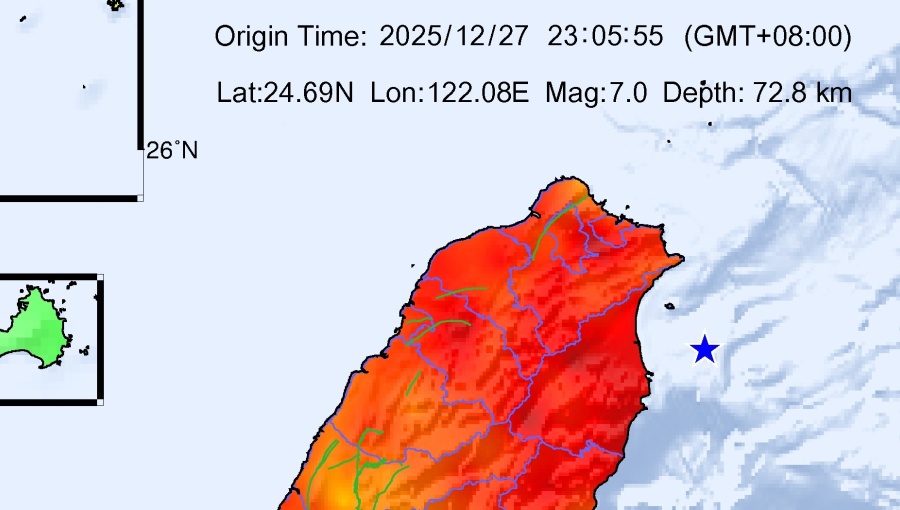
Taiwan and the southwestern islands of Japan have been hit by an earthquake initially reported as measuring magnitude 7.0 by Taiwanese authorities.

Japanese government agencies meanwhile reported the tremor as a M6.7 quake. The quake hit the Pacific island nation at 11:05 pm local time on the evening of December 27.

The epicentre was off the northeast coast of Taiwan near Turtle Island - itself a dormant volcanic peak - at a depth of just over 70km Taiwan’s Central Weather Administration reported.

The tremors shook the whole island with much of the north, including the capital Taipei recording a level of 4 according to local reports.

More to follow in the next few hours.

Too scary to show? Kazakh horror series becomes festival favourite for gore fans


Copyright Copyright: Adilkhan Yerzhanov

By Galiya Khassenkhanova
Published on 27/12/2025
EURONEWS

Initially deemed too terrifying for streaming platforms, a Kazakh horror series has found big success on the festival circuit where its exploration of exotic folklore and ancient evil has gripped global audiences.

A neo-noir and folk-horror TV series dubbed Kazakh Scary Tales found its place among eager fans at festivals after being considered too scary and gory for streaming audiences.

The show by Kazakh director Adilkhan Yerzhanov premiered at the Fantasia International Film Festival in Montreal this summer and saw a local release in November.

The story follows Birzhan, a police officer reassigned to a remote village, where he has to solve mysterious deaths, while dealing with corrupt officials.

He partners up with a local witch, who helps him figure out the ancient evil, find ways to fight it, and maybe learn the truth about himself.

Besides Fantasia, the series was screened at France's L'etrange Festival (seen here), Seriesly Berlin and Austria's Slash film festival. Copyright: Adilkhan Yerzhanov


Too scary for spoilers?


Early test screenings raised questions about whether the show would be appropriate for wide audiences. Producers did not expect commercial success, thinking it was too niche, so they sent it to festivals instead.

“For example, the scene in the maternity ward where the characters start bleeding. Is that even appropriate for family viewing? Wouldn't it be shocking?” Yerzhanov explains.

But the Tales exceeded expectations, when the first four episodes were released on YouTube.

A scene from Kazakh Scary Tales. For the director it was important that modern-day bleak reality co-existed with folklore Copyright: Adilkhan Yerzhanov

“It's precisely the combination of folklore and modernity that attracted attention. Our audience was ready to see our folklore integrated into a modern series,” the director said.

Viewers praised the series online, calling it the “Stranger Things of Kazakhstan,” and sharing eerie folk stories passed down through generations.
International reaction and social commentary

To grasp the attention abroad, Yerzhanov says Kazakh filmmakers must offer something distinct.

“You can't come up with a Kazakh horror film built on Hollywood or Japanese models. You can't get noticed if you're working within established rules,” he explains

He believes two elements of Kazakh Scary Tales resonated most with the connoisseurs of the horror genre: the unusual blend of humour and terror, and the originality of the mythical creatures.

“I realized that international audiences are drawn to the humour in the scariest moments. They find it incredibly intriguing, unique, and different,” said the filmmaker.

The Tales are not afraid to show gory details, but they are available only in Kazakhstan. Episodes on YouTube blur disturbing scenes. Copyright: Adilkhan Yerzhanov

Many reviews highlighted Birzhan's banter and bromance with the local pathologist, where they exchange slightly inappropriate jokes at completely random moments.

Meanwhile, the monsters rooted in Kazakh mythology felt refreshingly original to horror enthusiasts.

"As they say, monsters in Kazakh Scary Tales are less dangerous than the people who created them. They are interested in the fact that all the monsters in the series arose from injustice, from the actions of some characters, some men," commented Yerzhanov.

This theme forms the backbone of the series, which doubles as a social commentary on violence against women. In the show, women hurt by men transform into monsters, which then devour those men (and others along the way).

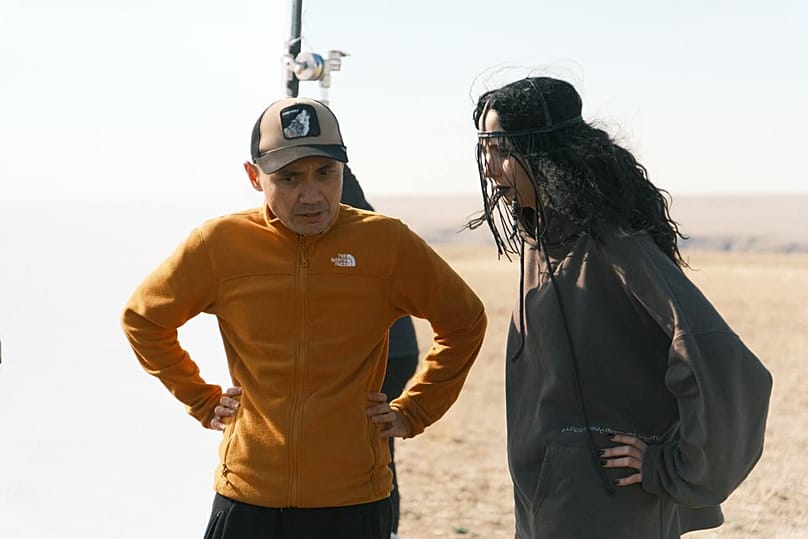
Director Adilkhan Yerzhanov and actress Anna Starchenko, who played the witch Sara, on the set of Kazakh Scary Tales. Copyright: Adilkhan Yerzhanov

The first three episodes centre on the albasty, an evil female spirit from Turkic mythology believed to torment pregnant women and infants. The director points out that, as in many Eastern mythologies, most demons in Kazakh folklore are female.

"Everything irrational, everything that any man, any warrior, is afraid of. He is afraid of the irrational , which he identifies with women," Yerzhanov explains.
Ancient fear

A defining choice in the production was Yerzhanov’s refusal to use CGI, when making his monsters. He was looking for naturalistic representation of the ancient horror that his mom used to tell him about as a kid.
The head of the albasty spirit created for the show by production designer Yermek Utegenov and make-up artist Andrei Tsirulnik. Copyright: Adilkhan Yerzhanov

"In my childhood imagination, these monsters didn't look computer-generated or drawn; they looked very naturalistic, I would even say physiological. It was this physiology, this homespun nature, that I wanted to express in this series," the filmmaker said.

This is why the team created animatronic albasty operated by several people. A stunt performer wore an artificial head for wide shots.

For close-ups they created a carcass of the head covered in silicone, where one person moved the upper lip, the other moved the lower lip, the third person moved the tongue and two more people open and closed its eyes.

"Any computer graphics led the monsters towards a pasteurized Hollywood, where everything is artificial, where everything is too modern," he said.

Poster for Kazakh Scary Tales Copyright: Adilkhan Yerzhanov

Yerzhanov himself is not fond of horror films, but he believes that best movies of the genre were made by non-horror filmmakers such as William Friedkin's The Exorcist or Stanley Kubrick's The Shinin

Unfortunately, audiences outside of Kazakhstan don't yet have the chance to watch the show, but the director says he's working hard on making it available on streaming services.

By 


Waste from tomato processing will serve to power aircraft. Under the leadership of Graz University of Technology (TU Graz), the EU project ToFuel is developing a new biorefinery concept that will convert tomato residues into sustainable aviation fuel as well as into fertiliser, animal feed and nutritional oil. The research team is aiming for a waste-free and climate-neutral process that is also economically competitive and thus makes an important contribution to the defossilization of air transport.

Residual material as a valuable resource

Tomatoes are the second most consumed vegetable in the world after potatoes. The EU is the third largest producer with around 17 megatonnes of tomatoes harvested. However, tomato production produces large quantities of residual biomass – plant material such as flowers, leaves and stems, peel, seeds and tomatoes of inadequate quality. Most of these residues are incinerated as agricultural waste or disposed of at high cost. At the same time, the goal of European climate neutrality and the associated reduction of CO₂ emissions in the aviation sector is largely dependent on the production of competitive and sustainable aviation fuels (SAF) from renewable raw materials.

“According to estimates, around three per cent of the sustainable aviation fuels required in Europe by 2030 could be covered from the amount of tomato pomace produced throughout the EU, i.e. the residues from tomato processing,” explains project manager Marlene Kienberger from the Institute of Chemical Engineering and Environmental Technology at TU Graz.

From plant to oil to aviation fuel

In order to turn tomato waste into a high-quality fuel, the biomass must first be processed so that microorganisms can utilise it efficiently. ToFuel is investigating two modern fractionation technologies. During extrusion, the biomass is treated under heat and pressure and then broken down into its cellular components by an abrupt drop in pressure. This creates an optimally digested biomass for the subsequent fermentation process, in which microorganisms produce lipids that are later processed into aviation fuel. In the second fractionation technology, hydrothermal liquefaction, the biomass is converted into bio-oil and biochar under high pressure and at high temperatures. Before the extracted bio-oil can be refined into aviation fuel, it must be purified of mainly nitrogen-containing interfering ions. These unwanted ions would otherwise have a negative impact on the subsequent conversion into a sustainable aviation fuel. The corresponding fractionation, biotechnological and purification processes are being developed by the Laboratório Nacional de Energia e Geologia (LNEG) in Lisbon, TU Graz and the University of Zagreb in close cooperation.

The lipids and bio-oil are then converted into a fuel that fulfils the international quality standards for sustainable aviation fuel using the HEFA process at the University of Leoben. HEFA stands for “hydrogenated esters and fatty acids” and is a process for producing sustainable aviation fuel from vegetable, animal or recycled fats and oils. The processes developed in the project are gradually being scaled up to a pre-industrial scale and comprehensively tested. Consortium leader Marlene Kienberger emphasises: “Our clear goal is to produce sustainable aviation fuel based on tomato waste at a competitive sales price. Ultimately, sustainable aviation fuels simply have to be economically viable.” The project team is also analysing the ecological, economic and social impact of the technologies. The utilisation of tomato residues also creates new sources of income for food processing companies.


Strong European consortium

The official project start date for “ToFuel: An integrated biorefinery for sustainable aviation fuel production from tomato residues” is 1 January 2026. A total of eleven partners from seven European countries are working on ToFuel. In addition to TU Graz, these include the Portuguese research institute LNEG, the University of Zagreb, Vienna University of Technology, Lappeenranta University of Technology in Finland, University of Leoben and the Fraunhofer-Gesellschaft. Industry partners Mutti and Podravka will provide tomato residues and contribute their many years of expertise in processing plant-based raw materials. The research will be accompanied by a comprehensive commercialisation and publication strategy, which will be developed by the project partners ESEIA and EEIP. At least six PhDs, twelve master’s and 15 bachelor’s students are to be trained as part of the project. The project budget amounts to 3.5 million euros over four years, one million of which will go to the consortium leader TU Graz.


Shortcut To Zaporizhzhya: Russian Forces Creep Across Drained Reservoir After Dam Breach – Analysis


By 


By Yevhenia Nazarova

Before a massive dam on the Dnieper River burst in what Ukraine says was an act of sabotage by Russian forces, the Kakhovka Reservoir was big and broad and reached a depth of up 26 meters — a body of water so large that people living on its shores sometimes called it a “sea.”

The breach in June 2023, about 16 months into Russia’s full-scale invasion of Ukraine, sent water levels plunging and drained much of the reservoir, which is part of the Dnieper and the front line in the war, exposing its bed in many areas and leaving it covered by shallow water in others.

Downstream from the ruined dam, the breach caused catastrophic flooding. Upstream, it abruptly exposed remnants of the past – a skull in a Nazi helmet, a boat believed to be 500 years old — and gave rise to a riot of vegetation in soil that had been underwater for decades or more.

Now, Ukraine’s military says, Russian forces are using the thickening natural cover – fast-growing trees, tangled bushes, and tall reeds – to try to advance into Ukrainian-held territory south of Zaporizhzhya, Ukraine’s sixth-largest city and the capital of one of five regions that Russian baselessly claims as its own.


Natural Cover

“In the area of the Prymorske settlement, the occupiers are trying to penetrate our flank through the former Kakhovka Reservoir, where there is lush vegetation and reeds several meters high,” Ukraine’s Southern Defense Forces said in statement on November 6. It said Ukrainian troops were “destroying them.”

Prymorske is on the western shore of the former reservoir, about 30 kilometers southeast of the center of the city of Zaporizhzhya.

Two days earlier, the Ukrainian military intelligence agency, HUR, reported that special forces had “discovered and eliminated” an unspecified number of Russian troops near a group of former islands about 7 kilometers offshore. It said the clash took place in the “gray zone” — a term for areas whether the front line is blurred.

On the overgrown reservoir bed, discovering enemy movement can be difficult.

“Thickets and complex terrain on the bed, such as ravines and berms, provide natural cover, which complicates visual observation and the use of drones to monitor the entire territory. Russian troops are quite actively using landscape changes to conduct reconnaissance and sabotage operations,” said Serhiy Bratchuk, a spokesman for the Ukrainian Volunteer Army.

“Their tactics are primarily to use the bed to bypass positions. In the ‘gray zones,’ combat clashes and artillery shelling regularly occur on islands and in coastal areas, which have now become more accessible,” he said, adding that “both sides are actively mining drained areas, which creates additional dangers.”

Strategic Importance

Russian forces turned to the reservoir bed after failing to push toward Zaporizhzhya along a route further east, Oleh Tyahnybok, a battalion commander with Ukraine’s 128th Separate Heavy Mechanized Brigade, told RFE/RL in August. He was describing the situation near Kamyanske, which lies south of Prymorske at the edge of the reservoir and is held by Russian forces.

“For the [Russians], this area is important even strategically, because it’s the shortest route to Zaporizhzhya. They tried to get to Zaporizhzhya through Orekhiv — they did not succeed. Our troops stopped them,” Tyahnybok said. “Accordingly, they have accumulated a serious amount of forces in the Kamyanske direction and are now trying to break through.”

Russian forces “sometimes manage to crawl very effectively, imperceptibly, especially through the territory that was the Kakhovka reservoir, and now it has actually turned into impassable thickets,” he said.

While the thickening vegetation shields soldiers from the sight of opposing forces on the ground, “nothing can hide you from drones,” Vladyslav Voloshyn, a spokesman for Ukraine’s Southern Defense Forces, said in a video clip from November that showed him standing amid reeds that towered over him, with taller but sparsely leaved treetops above.

The burgeoning plant life can make for tough going for soldiers on either side, Mykhaylo Mulenko, acting head of the nature protection sector of the Khortytsia National Reserve, which is on a lush river island north of the reservoir, suggested.

“If you enter these thickets — willows, poplars — a person becomes very disoriented, because in fact the forest is very dense and it is very difficult to imagine the sides of the world,” he told RFE/RL. “And if you go deep into this vegetation, you lose track of where you are going, and it is very difficult to orient yourself.”

While statements from both Russian and Ukrainian authorities about battlefield developments are difficult to verify, Roman Pohoriliy, co-founder of DeepState, an open-source analyst group with ties to Ukraine’s military, suggested that Russian forces have made little headway on the reservoir bed.

“They are trying to crawl through but they’re not very successful,” Pohoriliy said, adding that the reservoir bed was “not their main route to Prymorske.”

“Accordingly, it is impossible to say that this section poses a huge threat. It is a normal section where they have tried and where they are trying, but they are not succeeding — they are advancing more through Plavni,” he added, referring to a settlement that lies between Prymorske and Kamyanske.

A Threat That ‘Exists Everywhere’

Still, similar dangers exist further southwest, according to Bratchuk.

“Potentially vulnerable are the riverside areas of the Kherson and Mykolayiv regions, where the [Dnieper] and its floodplains have also undergone significant changes. The possibility of hidden crossing of water arteries and the use of complex terrain increases the risks of enemy penetration into rear areas,” he said. “Ukrainian military units are constantly conducting sweeps of these ‘gray zones’ and islands to minimize such threats.”

Pohoriliy said the threat of Russian advances “exists everywhere, at any point” along the more than 1,000-kilometer front line, which stretches from the northeast through the Donbas and down to the Dnieper Delta in the Kherson region.

“It’s necessary to monitor this and react accordingly: to know that they can sneak through and prepare to repel them — or do nothing and fail to defend” the country, he said.

Russian forces hold a substantial part of the Zaporizhzhya region and have been trying to push westward and northward toward the regional capital, which is the target of frequent Russian air attacks. A guided bomb attack badly damaged residential buildings and injured at least 26 people in the city and nearby areas, regional authorities said.

Russian President Vladimir Putin groundlessly declared in September 2022 that Ukraine’s Luhansk, Donetsk, Zaporizhzhya, and Kherson regions are Russian, and he has vowed that Russia will take the land it considers its own by force if it is unable to do so through diplomacy.

Adapted from the original Ukrainian article by Steve Gutterman.

  • Yevhenia Nazarova is a freelance correspondent for RFE/RL’s Ukrainian Service

RFE RL

RFE/RL journalists report the news in 21 countries where a free press is banned by the government or not fully established.