Saturday, December 27, 2025

Opinion...

The penalty for disagreeing with UK government policy on Palestine is 14 Years in prison

December 27, 2025
 Middle East Monitor
 

Protesters called for “an end to the occupation and a halt to arms sales to Israel” during the national march organized in London by the Palestine Solidarity Campaign in London, United Kingdom on November 29, 2025. [Raşid Necati Aslım – Anadolu Agency

by Tony Greenstein

On 5 January I will go on trial at Kingston Crown Court charged with an offence under Section12 of the Terrorism Act 2000. The maximum penalty if found guilty is 14 years in gaol. There are others due to follow me.

You might be forgiven for thinking that my ‘offence’ was preparing a bomb intended for the Israeli Embassy. In fact, it was disagreeing with government policy and received opinion.

I was arrested on 20 December 2023 by Counter-Terrorism Police in a dawn raid under the Terrorism Act 2000. My ‘crime’ was posting a tweet, one month previously, saying that I supported the Palestinian resistance against the Israeli Defence Forces.

The anti-terrorism police are reminiscent of the Thought Police (Thinkpol) in George Orwell’s 1984, who spent their time hunting down “thought crime.” Britain’s equivalent of seized my electronic devices – computers, laptop, mobile phone etc. When I applied to the courts to recover these items, the police justified their retention by saying that they provided a ‘highly relevant insight’ into my mind.

The aim of Orwell’s Thought Police was to enforce mental conformity, ensuring citizens police their own minds. In his Expert Witness Statement in the Case for the Deproscription of Hamas, Jonathan Cook, a journalist who has worked on The Guardian, The Observer and The Times amongst other papers and a recipient of the Martha Gellhorn Special Prize for Journalism in 2011, wrote:

Over the past several months, I have been watching with growing professional alarm – and personal trepidation – what I can only describe as a campaign of political intimidation and persecution of a number of journalists in the UK. The journalists who have been targeted share one thing in common: they report and comment on Israel’s actions in Gaza from a critical perspective that judges those actions to be genocidal…


A legal victory that shakes the Zionist narrative: What comes after the Bob Vylan and Reginald D Hunter cases?

(This) has been justified under an expansive interpretation of both Section 12 of the 2000 Terrorism Act and Sections 1 and 2 of the 2006 Terrorism Act. These laws tightly restrict commentary about Hamas and other Palestinian organisations the UK government has proscribed.

I now find myself in a situation where, for the first time in my 36-year professional career, I am no longer sure what by law I can write or say in my capacity as a journalist on an issue of major international importance.

The fact that Hamas was freely elected as the government of Gaza in 2006 is irrelevant. By opposing Israel militarily they have become ‘terrorists’.

I have been charged ‘inviting support for a proscribed organisation’. By posting a blog Full Support for the Gaza Ghetto Uprising I was inviting support for Hamas as an organisation.

I have posted many articles opposing the politics and practices of Hamas including an article condemning torture by Hamas and its attacks on NGOs in Gaza.

However I support resistance to the Israeli occupation, whoever is participating in it. The proscription of Hamas as a ‘terrorist’ organisation, when it has never operated outside Palestine, demonstrates that contrary to its official position, in practice the British government supports Israel’s unlawful occupation of the Palestinian Territories. The justification for the proscription is that.

Hamas has used indiscriminate rocket or mortar attacks, and raids against Israeli targets. During the May 2021 conflict, over 4,000 rockets were fired indiscriminately into Israel. Civilians, including 2 Israeli children, were killed as a result.

Presumably Israel using snipers to deliberately target children isn’t terrorism. Over 20,000 children have been killed by Israel since October 7 but what is that compared to two Israeli children? The racist hypocrisy of the British government is exposed for what it is.

Overseas doctors operating in Gaza during the genocide have all testified that Palestinian children are being targeted. Why? Because children are seen as the future of the Palestinian people.

At a conference of pre-military yeshivas on 7 March 2024, Rabbi Eliyahu Mali of the Bnei Moshe yeshiva in Jaffa explained that Palestinian children should be killed because they are the future generation of Palestinian fighters. Mali spoke about how in the case of Gaza, they shouldn’t leave “a soul” alive there.

Today’s terrorists are the children of the prior [military] operation that left them alive. The women are essentially the ones who are producing the terrorists,… It’s not only the 14 or 16-year-old boy, the 20 or 30-year-old man who takes up a weapon against you but also the future generation. There’s really no difference.

This is the same argument that Himmler made about exterminating Jewish children. At Posnan on 6 October 1943 he told SS Generals:

“For I did not consider myself justified in exterminating the men… and then allowing their children to grow up to wreak vengeance on our children and grandchildren.

In a poll conducted by Pennsylvania University 47% of respondents said that the Israeli army should kill all the inhabitants of any city they conquer. This rose to over 60 per cent when asked whether they believe there is a ‘current incarnation of Amalek’ – the tribe that god said the ancient Hebrews had to wipe out. This is what Starmer and our rulers believe constitutes the ‘right to self defence’.

In July 2024 the International Court of Justice ruled that Israel’s occupation of the Palestinian territories was unlawful. By saying that armed resistance to that occupation is ‘terrorist’ the British government is de facto supporting the occupation, despite claims to support a two state solution.

What Blair and Straw did with the passing in 2000 of the Terrorism Act was to make it a crime to support a national liberation or anti-colonial movement that is seeking to free itself from colonial domination or occupation, when the British government is friendly with the occupying power.

If the Terrorism Act had been in force during the era of Apartheid in South Africa then the ANC would have been classified as a ‘terrorist’ group.

When I gave my support to the 7 October attack I wasn’t giving my support to Hamas as an organisation, despite the attempts of the Crown to pretend that this is what it amounted to.

The example I gave to the Police was that of the Polish Home Army. In 1944 its officers told Jewish servicemen in Britain that when they went into battle then they would be shot in the back. Their slogan was that ‘Every Pole has two bullets—the first for a Jew and the second for a German’. The problems that Jewish servicemen faced in the Polish forces stationed in this country were debated in the Commons on 6 April 1944 in a debate initiated by Tom Driberg MP.

If I had been alive then I would not have supported the AK as an organisation but when they led the Warsaw Uprising in August 1944 I would have supported them against the Nazi occupiers.


From Guantanamo to UK prisons: In solidarity with the hunger strikers

What is happening is a naked attempt to use the anti-terrorism laws in order to curtail free speech on Palestine. As John Dugard, an Emeritus Professor of Law at the Universities of Leiden and Witwatersrand and an ad-hoc Judge of the ICJ wrote:

Terrorism is an emotive word that has no place in the assessment of the conduct of either a government or a resistance movement. One man’s freedom fighter is another man’s terrorist. Few would today label members of the French resistance in World War II as “terrorist” and most would have no hesitation in describing the Nazi forces as “terrorist”.

One piece of legislation that has remained a dead letter is the International Criminal Court Act 2001, Section 52 of which renders assistance to the commission of genocide abroad an offence meriting a sentence of 30 years imprisonment. In allowing the supply of arms to Israel and providing military help via the overflight of RAF planes, this government is guilty of having actively supported genocide.

Fortunately though the permission of a member of the government, the Attorney General, is required in order that a prosecution can be initiated. Thus in order to bring a criminal prosecution against the government permission first has to be sought from that government!

Speaking of the corruption of the government’s law officers it was necessary in my case that the Attorney General approve my prosecution as being ‘in the public interest’. Because Richard Hermer is on record as saying that ‘I have dear family members currently serving in the IDF’ he chose to delegate the task to the Solicitor General, Sarah Sackman, who gave the go ahead.

And who is Sarah Sackman if not a dedicated Zionist, who was Vice-Chair of the Jewish Labour Movement from 2015 to 2024. The JLM waged the ‘anti-Semitism’ smear campaign against Jeremy Corbyn and the Labour Left. It is not surprising that on her promotion to Minister of State at the Ministry of Justice the JLM wrote ‘We’re so pleased for Sarah, our former vice chair, and know she’ll be fantastic in this new position.’ I imagine they are very pleased that one of her first tasks as Solicitor General was to approve the prosecution of a leading Jewish anti-Zionist. In the process she accused me of ‘anti-Semitism’ terming me ‘problematic’.

Since Sackman is supposed to act in a quasi-judicial role it beggars belief that she didn’t think there was a conflict of interest.

On 5th January I am calling for a protest demonstration outside Kingston Crown Court to demonstrate the strength of feeling at the deployment of the Terrorist Act against those who support the Palestinians.

The views expressed in this article belong to the author and do not necessarily reflect the editorial policy of
  Tne Middle East Monitor


Opinion

Is the UK imprisoning pro-Palestine activists on Israel's behalf?

As Western states arm Israel, they criminalise Palestine activists. Beauty Dhlamini explains the link between Israel’s prisoners and UK hunger strikers.


Beauty Dhlamini
23 December, 2025 
THE NEW ARAB
Voices


Protestors block Whitehall outside Downing Street in support of the Palestine Action hunger strikers on December 11, 2025. [GETTY] in London, United Kingdom

Whilst Western governments continue to provide protection and support for Israel, including by supplying arms which the Israeli Offense Forces (IOF) use in the ongoing genocide in Gaza, a brutal persecution is being waged against those in support of Palestinian liberation.

The criminalisation of solidarity with Palestinian liberation, has come under sustained attack since 7 October 2023. A report by the International Federation for Human Rights (FIDH) revealed how the UK, the US, France and Germany, continue to misuse their immigration, counter-terrorism legislation as well as antisemitism hate crime laws to suppress support for Palestinian rights in Gaza and the occupied West Bank.

Despite the laws of all the mentioned countries differing, it is clear they represent a persistent trend of global repression.
Prisoners of war

As Western governments continue to pretend to call for an end to Israel’s punitive governance and policy of ethnic cleansing, and displacement, they have adopted the relentless legislative pursuit of those actively trying to prevent it. This is not new, and only proves what has been true since the 1917 Balfour Declaration: Israel exists as a proxy state for Western imperialism and settler-colonialism

Rabeea Eid

In the face of this repression, however, coverage in the mainstream media is still limited. This is representative of a wider failure to interrogate how governments and prison systems inflict terror, whilst conflating the identities and beliefs of minorities being illegally detaining, with terrorism.


To understand the stakes of Western media complicity is to therefore expose the reality these actionists are fighting to dismantle when they interfere with the infrastructures their governments build, sustain and fund to enact genocidal violence. For example, the UK government continues operations of Elbit Systems, Israel’s largest weapons manufacturer which provides its airforce with 85% of its combat drones, and its land forces with 80% of the weapons and equipment they use against Palestinians.

This is why all those detained for taking action against the complicity, are seen as prisoners of war proxy by solidarity movements around the world, they too are targets of Israel’s brutal apparatus. And this is made more apparent with the revelation by Declassified through a Freedom of Information (FOI) request to the Home Office, that government officials had a private meeting with Elbit Systems in December 2024.
Extending and exporting repression

Indeed, the persecution of activists in the West is merely an extension of the cruelty of the Israeli prison system, where over 10,000 Palestinian political prisoners (over 2,900 of them from Gaza), are still fighting for their freedom Palestinians.

Over 3,500 of these Palestinian prisoners are held under the Israeli system of 'administrative detention’ which allows them to imprison Palestinians for up to six months without charge or trial. Since 7 October, this system has only intensified, with scenes of systemic torture, starvation, lack of access to lawyers or family members, punitive strip searches and humiliation of detainees becoming the norm.

Detention orders are reified by an Israeli military court, and the six-month period of imprisonment can be renewed indefinitely, with none of the detainees or their legal teams having access to evidence detailing the reasons. Many have consequently been imprisoned for years without any due process.
Related

The same repressive playbook is being used globally, and an archipelago of political prisoners is being built by Israel with the facilitation of Western governments. In October 2025, 11 of 27 members of the Greek delegation participating in the Global Sumud Flotilla were captured and shortly after, announced their collective hunger strike to protest their illegal detention by Israeli authorities under anti-terrorist laws.

In Italy Palestinians, Anan Yaeesh, Mansour Doghmosh and Ali Irar continue to be held since March 2024, where they exist in the same judicial limbo as Palestinian administrative detainees. An Italian Court of Appeal refused the extradition bid by Israel for Yaeesh – who has been on hunger strike since October – because he faces the risk of torture in Israeli prison. This begs the question why the Italian judiciary system continues to detain him in “preventative custody“ for supporting the resistance of the illegal military occupation in Tulkarem, in the West Bank.

Similarly, a Palestinian who was granted asylum has been held in remand within a French prison for over a year and half after being detained under France’s anti-terrorism legislation at the Israeli government's request. Having already experienced administrative detentions prior to leaving Palestine in 2014, it seems Israel is determined to insure its punitive unjust judiciary process follows him wherever he goes.

Even in the US, Palestinian student Leqaa Kordia, who participated in the Columbia University protests whilst grieving the murder of hundreds of family members by the IOF, has been held in ICE immigration detention in Texas for nine months.
A global struggle

Meanwhile, in the UK the largest pro-Palestinian hunger strike remains steadfast. Of the 29 pro-Palestine activists (Filton 24 and Brize Norton 5) who are being held without trial in remand over their alleged involvement in actions against UK subsidiaries of Elbit Systems and the Royal Air Force (RAF) Brize Norton base, eight have been on hunger strike (some for up to 50 days). Whilst none have been charged with terrorism, the counter-terrorism laws that keep them in remand, and the forced retrospective association with the now proscribed group Palestine Action, exemplifies how Western governments punish those who carry out direct action in support of Palestine liberation.

The hunger strikers are demanding: an end to censorship as they await trial, immediate bail, immediate release, guarantee of safety as full citizens (especially those with a migrant status), the end of Israeli interference in their judiciary processes, and the end of the genocide in Gaza. These sit within the broader demands to de-proscription Palestine Action and exonerate the over 2,000 citizens arrested under the Terrorism Act for holding signs indicating support for the group.

Despite being geographically separated, the resolve of all of Israel’s global political prisoners is connected. For the actionists, activists and organisers alike who have been detained and imprisoned, parallels should constantly be drawn between their resistance and those of Palestinian prisoners in Israeli jails.

This is particularly important in the face of bigger Palestine solidarity platforms either being selective or largely ignoring the plight of the prisoners, especially the UK hunger strike currently taking place.

It is clear that growing crackdowns are linked to Western governments failing to quash the unshakeable international solidarity and resistance efforts over recent years. Whilst the growing number of Israel’s global political prisoners of war is supposed to instil fear in the rest of us, and to dissuade us from organising and protesting against Israel’s crimes, movements have only grown bigger and stronger.


Beauty Dhlamini is a Tribune columnist. She is a global health scholar with a focus on health inequalities and co-hosts the podcast Mind the Health Gap.
Follow her on Twitter: @BeautyDhlamini

Opinions expressed in this article remain those of the author and do not necessarily represent those of The New Arab, its editorial board or staff.

Palestinian factions have come together to thwart Israeli plans in Gaza, for now

The U.S. appears ready to reassess its tactics in carrying out Donald Trump’s plan for Gaza. The news vindicates the strategy Palestinians have used during the ceasefire to avoid the surrender Israel has demanded in exchange for ending the genocide.

 December 26, 2025 
MONDOWEISS

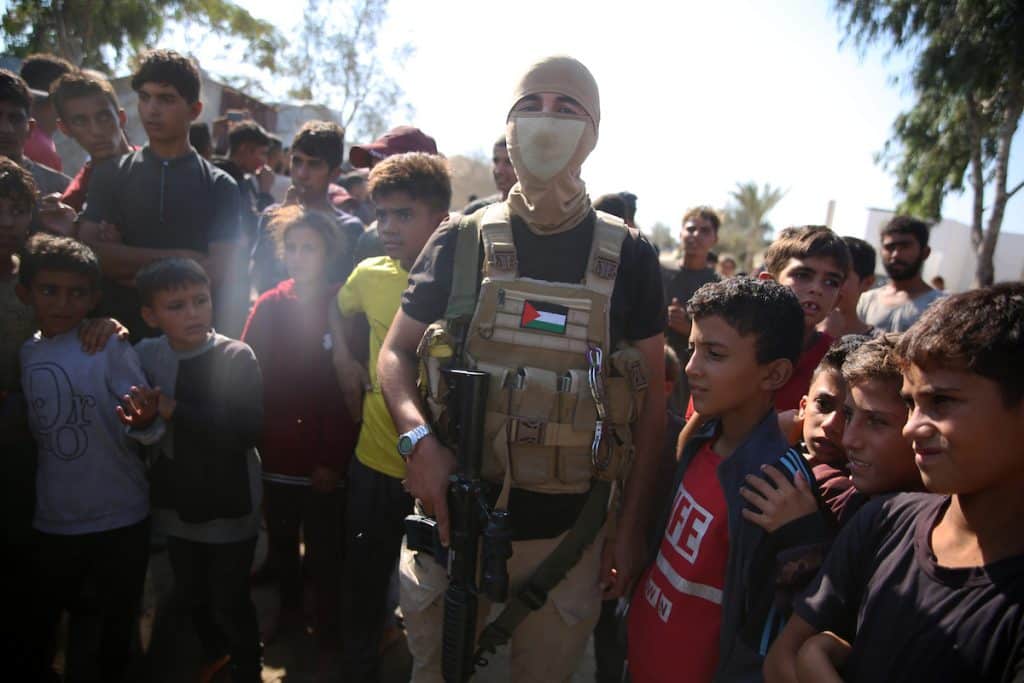
Palestinian militants of the Izz al-Din al-Qassam Brigades, the military wing of Hamas, stand guard next to a crowd watching the transfer of released Israeli hostages to the Red Cross in the south of Deir el-Balah in the central Gaza Strip, October 13, 2025. (Photo: Omar Ashtawy/APA Images)


The United States seems to be poised to reevaluate its tactics in implementing President Donald Trump’s plan for the Gaza Strip. It seems they are considering installing a Palestinian technocrat government and Palestinian police force before assembling their International Stabilization Force (ISF), which they are finding no country wants to be part of.

While this remains very far from acknowledging the rights of the Palestinian people, and even farther from realizing those rights in practice, it is a real vindication for the strategic decisions that the assortment of Palestinian factions — not only Hamas — made in the wake of the diminishment of Israel’s genocide in October.

According to recent reports, the governments of Egypt, Türkiye, and Qatar have managed to make the Trump administration understand that their push for quick Palestinian disarmament in Gaza and the subsequent occupation of the Strip by an international force that would not include Palestinians is a non-starter.

Now, Washington is trying to come up with a formula that is more in keeping with what they’ve heard from their allies and would still be something they can sell to Israel. For its part, Israel has been conspicuously silent about all of this, probably waiting for their prime minister’s visit to Washington next week to voice their objections.

On paper, that all seems to amount to a minor victory at best, but digging deeper, we can see it vindicates the strategy the Palestinians have pursued to end Israel’s genocide and avoid the total surrender that Israel has pursued as the price for ending that horror.
A Palestinian gamble pays off

It’s worth keeping in mind that, while most media portray Hamas as the sole conductor of diplomacy in Gaza, decisions that affect all the people of Gaza and Palestine have actually been reached by a consensus of a wide array of Palestinian factions. This has even included Palestinian Authority President Mahmoud Abbas’ Fatah party, although it has been an inconsistent member and has often acted independently, often undermining the loosely unified factions.

That coalition agreed to the first stage of Trump’s plan, in which the militant factions, led by Hamas, ceased their offensive operations against Israelis, released all the remaining living hostages, as well as the bodies of those who are deceased (save two, one Israeli and one Thai hostage, who remain buried under rubble).

However, they never agreed to the rest of the plan, neither accepting nor rejecting it outright. In what was a bold but very risky move, the Palestinians insisted on more negotiations to find an accommodation that would allow Hamas to step aside from governance and lay down their arms without disappearing completely from Palestine or sacrificing the principle that they have the right to resist Israel’s violent occupation and apartheid, even with force, as international law provides.

The factions gambled that the Trump administration really wanted the worst of the ceasefire to stop, and that the U.S. would negotiate to maintain the ceasefire, however illusory it may be. And thus the very worst of the genocide was diminished.

It seemed a pyrrhic victory. The United States pressed forward with its efforts to assemble an international force to disarm Hamas and police Gaza, while its “Board of Peace” would govern Gaza with Palestinian technocrats merely operating the administrative, day-to-day tasks. Israel continued its attacks and refused to allow sufficient aid, including material for shelter in the winter months, and Palestinians continued dying and suffering, albeit at a lower rate. Yet the factions held to their bet.

Finally, now, it seems the bet has paid off. The Trump administration seems to have gotten the message that disarming Hamas cannot happen by force or coercion. Israel was unable to accomplish the feat in two years of violence that the Trump administration does not want to return to. The countries the U.S. was trying to recruit for its International Stabilization Force are willing to act as peacekeepers but unwilling to go and fight Israel’s battles for it.

That became even more apparent this week when Azerbaijan backed out of the ISF. It had been one of the first countries to indicate willingness to participate in the force, but could not agree to it once it became clear that they would actually have to fight Palestinians. The exclusion of Azerbaijan’s ally, Türkiye, whose participation in the ISF was vetoed by Israel, made it clear what the intent of the ISF was, and the Azerbaijanis, were unwilling to take that on.

The same was true of other states. They are unwilling to enter into a force whose mandate is not clear, and which might be used as an occupying force.

Türkiye, Qatar, and Egypt seem to have finally been able to make Washington understand that they were not going to be able to get a foreign army to disarm Hamas.

Implicit in that understanding was the realization that the U.S., much to Israel’s chagrin, would have to pursue a diplomatic avenue with Hamas on disarmament. Contrary to widespread misinformation, Hamas, while unwilling to accept terms of surrender that include completely giving up all its weapons, is willing to negotiate terms that would, essentially, see it mothball most of them.

According to Drop Site News — one of the very few news outlets that actually reports directly on what Palestinian factions themselves are saying and discussing — “Hamas has expressed an openness to a deal that would see the weapons of Hamas and Islamic Jihad stored or ‘frozen,’ a configuration that would come with the endorsement of the Palestinian resistance groups themselves.” Such an agreement would be a lot more trustworthy and efficient, even from Israel’s point of view, than trying to simply confiscate all of the factions’ small weaponry. Israel, of course, would never admit that this is true, but it is. If the goal is to ensure that Hamas won’t attack Israel again as it did in October 2023, this would be by far the best way to do that.

The factions are not going to make any public commitments until there is a specific plan they can discuss, and that is sensible. But they bet that, by maintaining ambiguity about Trump’s plan and a clear openness to reasonable negotiation, they could get Trump’s Arab and Muslim friends to prevail upon Washington to back away from Israel’s maximalist demands that were clearly intended to collapse the so-called “ceasefire” and reignite the genocide.

That bet had long odds, but it paid off.

American reassessment

Last week, U.S. Secretary of State Marco Rubio sounded a very different tone on Hamas disarmament than he had in the past.

Speaking at a press conference in Washington, Rubio said, “You’re not going to convince anyone to invest money in Gaza if they believe another war is going to happen in two, three years. So, I would just ask everyone to focus on what are the kind of weaponries and capabilities that Hamas would need in order to threaten or attack Israel—as a baseline for what disarmament would look like.”

That is a far cry from the sort of rhetoric we had been hearing. It sounds a lot closer to the tone set by the Turkish Foreign Minister Hakan Fidan after his meetings in Washington, when he said the discussions had centered on “arrangements aimed at ensuring that Gaza is administered by the people of Gaza.”

Reports are that Qatar’s Prime Minister echoed these views at the same meeting. And, of course, it makes sense even on the most pragmatic level.

While news outlets have repeatedly portrayed Hamas as attempting to “reestablish control” over Gaza, the reality is that Hamas fighters have, for the most part, been trying to fill the vacuum in Gaza where there is no police force and rival gangs and thieves are, like the rest of the people of Gaza, at their most desperate. They have also pursued some militias that had aligned themselves with Israel during the genocide, but for the most part, they have simply been trying to fill the void in Gaza until some more structured solution can be agreed to.

Thus, Qatar, Egypt, and Türkiye have been pressing hard to arrange for thousands of Palestinian Authority police officers to be deployed in Gaza. While PA police may not have a great reputation, this is not at all unprecedented. When Hamas took over in Gaza in 2006, PA police simply switched uniforms. A similar situation would occur in Gaza today.

In fact, police in both the West Bank and Gaza are largely functionaries, civil service employees, much like in other places. They aren’t really “PA” or “Hamas” police.

The factions have been active in these discussions as well, and they would support such a police force, even to the extent that they would agree that this force would have a monopoly on the use and carrying of firearms, a key component of the kinds of “disarming” they are proposing.

Qatar, Egypt, and Türkiye are keen to see this force coalesce as soon as possible. They are pushing the Trump administration to agree to the idea before Israeli Prime Minister Benjamin Netanyahu’s visit to Washington next week. Although Netanyahu is expected to try to use the trip primarily to drum up support for a new attack on Iran, the Muslim states are concerned that Netanyahu will influence Trump to also take a harder stand on Gaza. Getting an agreement and starting the process of bringing a Palestinian police force to Gaza would make that more difficult for Netanyahu.

While all of this remains very far from Palestinians governing themselves in Gaza, as any people have a right to do, it still represents tremendous progress compared to Trump’s initial, purely colonial plan. That Palestinian success has not gone unnoticed among Washington hawks.

Speaking from Israel after meeting with Netanyahu, the uberhawk Republican Senator Lindsey Graham said that, “Hamas is not disarming. They’re rearming. Hamas is not abandoning power. They’re consolidating power.”

Graham went on to say that the U.S. should “Put [Hamas] on the clock. If they don’t disarm in a credible way, then unleash Israel on ’em.”

Graham’s voice carries little weight in the Republican Party these days and is not often heard in the White House. But he is as close to Netanyahu as any American official, and his words certainly reflected a message from the Israeli PM.

The effort to dissuade the Trump administration from the course Israel has laid out for it—a course which is intended to lead back to all-out genocide—remains a difficult and fraught one.

However, it has taken a significant step forward this week due to the efforts of a unified Palestinian leadership, albeit one that remains largely outside the spotlight. It is a testament to what Palestinians can accomplish with such unity, and it explains why Israel has worked so tirelessly for decades to block it.
Opinion

The problem with Jewish advocacy for a ‘one-state solution’: Clarifying the role of Jewish anti-Zionists in dismantling Zionism

Jewish advocacy for a one-state solution represents a form of Zionism that centers Jews in Palestine's future. Instead, anti-Zionist Jews must aim to accelerate the dismantling of Zionism both in Palestine and worldwide.
 December 27, 2025 
MONDOWEISS


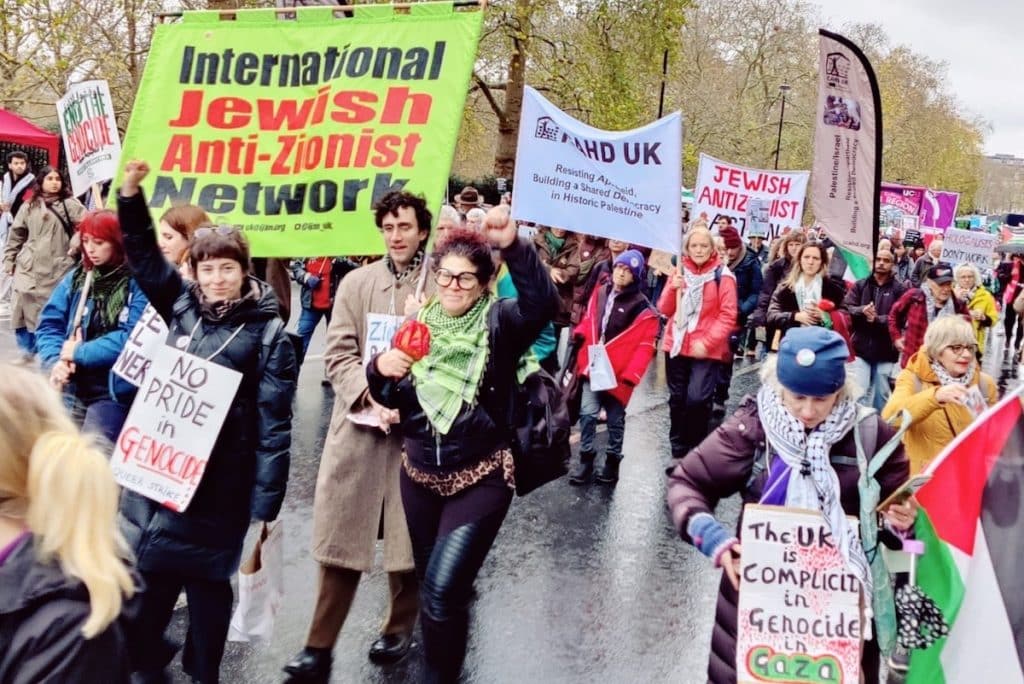
International Jewish Anti-Zionist Network contingent at the Palestine Solidarity March, London, UK, on November 29, 2025.


The clarity and questions raised by Lara Kilani’s astute piece, “Liberation Is Not Integration: On liberal Zionism, one-state fantasies, and what Palestinians actually want” and Rima Najjar’s incisive response, “The Settlers Are Not Leaving: Decolonization, not coexistence,” place the discussion of the future Palestine where it belongs – among Palestinians. The questions both pieces raise affirm a long-standing opinion of the International Jewish Anti-Zionist Network, of which I am a co-founder, that Jews do not and should not play a role in envisioning, directing, or participating in the designs of a liberated Palestine. Instead, as anti-Zionist Jews, our role lies in expediting the dismantling of Zionism – both its genocidal, colonial expression and expansion in Palestine and its fortification through organizations and institutions across the globe. As Najjar argues, such de-Zionization is a precondition of sorts for Palestinians to have the space and possibility to determine what liberation looks like and the society they want to build in its aftermath.

As anti-Zionist Jews, our role lies in expediting the dismantling of Zionism – both its genocidal, colonial expression and expansion in Palestine and its fortification through organizations and institutions across the globe.

It is and has always been Palestinians who must determine the nature of “the state” and the society they want to live in once colonialism is dismantled. “Greater Israel” is closer to being secured than ever before – through collaboration and shared interests of the ruling elite in the United States, Saudi Arabia, the United Arab Emirates (UAE), Qatar and Turkey. As Najjar notes, calls for one state without a clear plan for decolonization and de-Zionization risk replicating rather than dismantling Zionism. Furthermore, discussions of a one-state solution that fails to assert the centrality of Palestinian self-determination – particularly the right to not be forced to integrate with those who have not only committed but celebrated genocide against you – is not only abstract, but damaging.

When Jewish academics, activists and organizations call for and lift up their vision of a one-state in Palestine, it is Zionism. One way or another, it is based on an investment in Palestine remaining a place in which Jews are central to the vision of the state and society. It is, therefore, our mandate to be unwavering in our support for the decolonization and de-Zionization of Palestine and the means necessary to shift the structural conditions in this direction.
Your donation will be MATCHED!


At minimum, this includes engaging in the divestment and dismantling of all Zionist institutions and structures and BDS, and reinforcing, without hesitation, the Palestinian right to resist, right to return, and right to rebuild, as well as broader anti-imperial, anti-monarchy, anti-capitalist struggles in the region.


Our mandate to be unwavering in our support for the decolonization and de-Zionization of Palestine and the means necessary to shift the structural conditions in this direction.

For the very small number of anti-Zionist Jews from ‘48 (“Israelis”) who have worked, often over decades, with Palestinians calling for a “democratic one-state,” it could be argued that the role in these discussions might be different. However, this movement does not currently exist. Until there is a mass movement led by Palestinians in which Jews on the ground in Palestine are participating in the dismantling of colonialism, fully supporting the right of return, and taking action in solidarity with Palestinian resistance, any individuals currently dedicated to one state are just that – a handful of individual Jews against a majority that is actively participating, complicit and/or not active in stopping genocide and colonial expansion. In light of this reality, when anti-Zionist Jews from ‘48 or elsewhere organize with the explicit goal of a one-state solution, they are assuming that Jewish people remain a central consideration and feature of Palestine once Zionist colonization is dismantled.

Our work against Zionism is specific and, of course, different from the work of Palestinians in their own liberation. The self-determination of Palestinians includes their agency to set the terms of their struggle, to not, as Najjar says, have their aspirations overwritten by the interests of others. Against “neutralizing” the “political meaning of Palestinian suffering” through liberal and abstract notions of integration, “equity” and/or “co-existence” in an attempt to ameliorate Jewish anxiety and advance self-interest, the goal of anti-Zionist organizing is, as she names, supporting the conditions for “building decolonial power.”

Kilani’s questions highlight the need to translate this goal into concrete strategies. In addition to participation in the broader work of the growing mass movement for Palestine, Jewish anti-Zionists can play a more specific role in expanding BDS to target Zionist organizations, funders and corporations. Campaigns like Stop the Jewish National Fund, can expose the parastatal nature of Zionist organizations (directly facilitating the work of the State of Israel through funding, lobbying and attacks on its opponents). It should not just be the State of Israel who returns “more than a hundred years of looted wealth, land, and resources.” As we call for the stripping of their farcical “non-profit” status, we can also call for seizing of the assets of Zionist organizations as a consequence for their participation in genocide; redirecting them towards the rebuilding of Gaza and Palestine more broadly as a form of reparations.

Additionally, it is our work to expose, dismantle and/or reclaim so-called Jewish community organizations, and institutions, including religious ones, that have been repurposed, warped into vehicles for defending and advancing Zionism. Jewish Anti-Zionists can organize civil society and social justice groups to isolate and begin to reject funding from Zionist funders, such as the Jewish Federation, who both use their funding of social justice organizations as a “form of philanthropy-washing” and economic coercion to silence criticism and solidarity. Another role of Jews living outside of Palestine could be to facilitate the mass exodus of Jews who do not have the means and wish to relocate. This could mean turning the early “Renounce Aliyah” campaigns of anti-Zionist Jews into a practical project – a sort of anti-Zionist Jewish (relocation) Agency, particularly for working class and poor Southwest Asian North African, Ethiopian, ultra-Orthodox (anti-Zionist), and Russian Jews.

As raised by both pieces, harder questions arise about the process of decolonization in relation to the settlers committed to retaining “sovereignty, military dominance, and demographic permanence.” The de-Zionization of Palestine is unlikely without the forced removal of settlers that will be met with the violence they have consistently used and are prepared to escalate. As Najjar names, this is a reality that cannot be avoided nor the flight of settlers assumed. Instead, anti-Zionist Jews must be ready to support how Palestinians chose to address this aspect of their anti-colonial struggle.

Picking up where Najjar concludes, “A just future depends not on selecting the correct blueprint but on reorganizing Palestinian political life, weakening the structures that sustain Israeli supremacy, cultivating international leverage, and restoring Palestinian agency to the center of political imagination.” As Palestinians reorganize the representatives political leaders of that self-determination in the aftermath of the long-standing political undermining and assassinations of their political leaders, it is imperative that the “left,” including and particularly anti-Zionist Jews, does not rush in to pre-define the “endpoint of Palestinian liberation.” Just as the liberation of Palestine is not limited to the choice of liberal or reactionary Zionism, Palestinian liberation and political imagination is not limited to either a liberal one-democratic state or a two-state solution. The endpoint must and will arise from the decolonization itself; the needs, priorities and political imagination of Palestinians, and not from a proscribed state vision of socialism, secularism or liberal democracy.

The proximity, stake and therefore role of anti-Zionist Jews in the process of de-Zionization is, of course, different than that of Palestinians. It is, first and foremost, solidarity with the struggle for the survival, self-determination and liberation of Palestinians, yet dismantling Zionism is ultimately also critical for Jews. It is central to redirecting history away from the most violent strands of the 20th century, including the most successful genocide of Jews, but moreso, it is central to the collective future of humanity. In 2005, we traveled to Palestine to present the idea of an international network of Jewish anti-Zionists to combat the international role and impact of Zionism to Palestinian organizers. Founding organizer of the Palestinian BDS National Committee (BNC) and founder of Stop the Wall, Jamal Juma’s response was that, “we don’t need Jewish people for the liberation of Palestine, we need anti-Zionist Jews as part of the broader global struggle against imperialism,” of which Israel, with the U.S., is a watchdog and key beneficiary.

Meaning, the stake is not based on the “intertwining of fates” or vague concerns for “safety” that liberal Zionists attempt to push and that leave Jews short from truly fulfilling our mandate as anti-Zionists. It is the willing, principled and self-motivated participation we enact as anti-Zionists in anti-imperialist struggle, which represents a return to and affirmation of historical Jewish participation in struggles towards collective liberation. This is not only a mandate for anti-Zionist Jews but for all those who understand that Zionism is part of the devaluing of life, the unsustainable extraction and depletion of resources, the destruction of the planet, and escalating authoritarianism required to suppress growing dissent. Therefore, contributing to the conditions in which Palestinians build the power to decolonize their homeland is at the heart of building the power we all need for the pressing fight for the preservation of humanity and life on the planet. Anti-Zionist Jews are part of this, but not exceptionally so. Our ability to participate with clarity is part of rejoining us with the rest of humanity from which Zionism – its Jewish exceptionalism and supremacy – has separated us. To do so, we need to know and claim our place without displacing the centrality of Palestinian will and imagination.
Opinion

I did not understand I grew up in a concentration camp until I left Gaza

Growing up in Gaza, I didn't realize that the siege I was living under was unique or that others didn't face a constant threat of death. It was only after I left that I understood I had grown up in a concentration camp, and that it shaped my life.
 December 24, 2025
MONDOWEISS


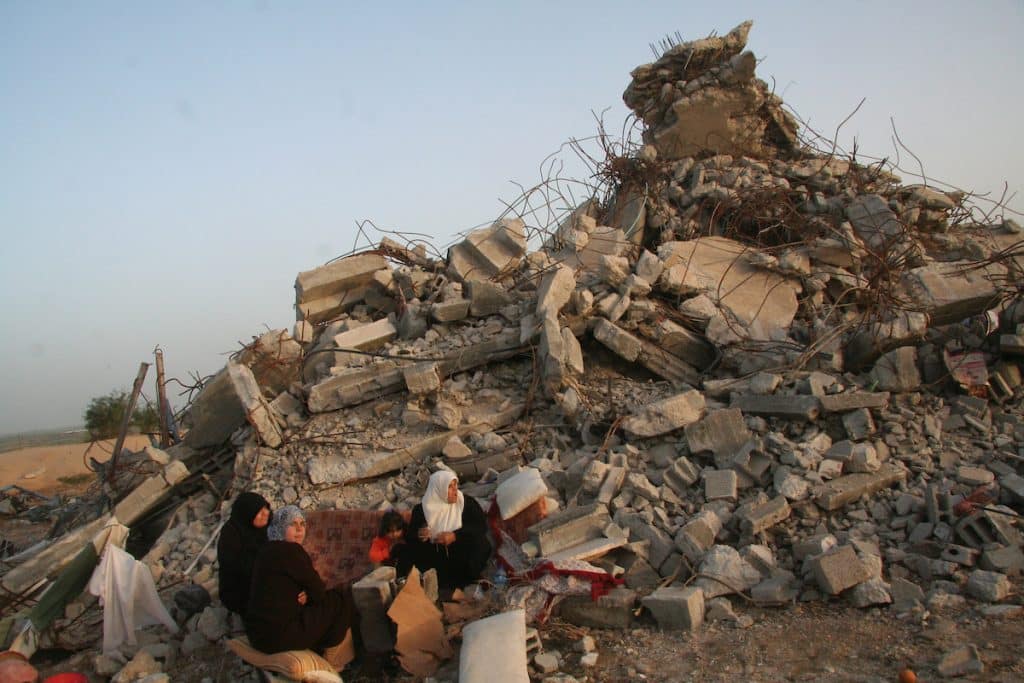
A Palestinian family sits on the rubble of their home destroyed during Israel’s 22-day offensive in Jabalia in the northern Gaza Strip on February 16, 2009. The attacks came despite ceasefires declared on January 18, 2009, after a three-week Israeli offensive against the territory’s Hamas rulers that killed 1,330 Palestinians (Photo: APAIMAGES PHOTO / Ashraf Amra)


I was around ten years old when I first saw death carried through the street like a neighbor.

I was outside our house in Gaza, playing in the street the way children do when they have no parks. I was kicking a crushed soda can like it was a football. The air was soft, the kind of afternoon when the sun is gentle and you forget, for a moment, that you live under occupation. Then I heard it. At first it was only a faint noise, something like a distant drum. Footsteps, many of them, all at once

I remember hearig voices before I saw faces. A wave of chanting rolled toward me, words I could not understand, broken by the rhythm of marching feet. For a few seconds, I thought it might be a wedding. In Gaza, chanting and loudspeakers can mean joy or grief, and as a child you do not always know which is which.

The crowd came closer. Men filled the street, packed shoulder to shoulder, moving with a kind of heavy purpose. In the middle of them, high above the heads, I saw a body wrapped in white.

They were not walking like people going to the market. They were marching. The body moved with them, lifted up on arms, swaying slightly with each step. I froze in the middle of the road. Dust stuck to my legs. The air smelled like sand and sweat. Someone near me whispered the word “shaheed.”

A martyr.

I did not know what that meant. I only knew that a human being was being carried past me and that nobody seemed surprised. Some people joined the march. Others watched from windows. The chants grew louder. I remember feeling very small, as if the crowd would swallow me. Then, suddenly, I ran.

I sprinted back home, heart racing, my slippers slapping against the ground. I burst through the door and asked my father what I had seen. He said it was a funeral procession of a martyr, a young man shot by Israeli soldiers because he was throwing stones, because he was protesting, because he wanted freedom and a decent life.

My father said it simply, like a weather report.

The word “martyr” settled in my mind long before I understood politics or international law. Funeral marches like that became part of the background of my childhood. They passed through our streets often enough that they stopped being strange. You might be doing homework, or buying bread, or visiting a relative, and somewhere in the distance you would hear the chant begin and know that another body was being carried through the city.

Death, at some point, stopped being an event and became a pattern.

Years later, another scene welded itself into me. By then I was in high school. It was late December 2008, the beginning of one of the major assaults on Gaza. That day I left school and walked, not to my parents’ house, but to the apartment of my sister who had just been married. I went there the way any younger brother would: to see how she was settling into her new home and, if I am honest, to eat baklava.

In Gaza, weddings mean sweets. Even in poverty, people borrow money to buy chocolates and pastries for guests. It is a way of insisting that joy still exists.

I reached her building, climbed the stairs, and sat on the couch in the new living room. The house still smelled like fresh paint and new furniture. My sister was smiling. There was a tray of sweets. I remember the taste of the baklava, the syrup and pistachio, still in my mouth.

Then the first bomb hit.

The sound was not like anything I had heard before. It was not just loud. It had weight. It grabbed the entire house and shook it. The doors flew open. The windows shattered. Glass exploded inward across the floor. We all jumped to the ground without planning it. My ears were ringing. The air tasted of dust and something metallic.

For a few seconds the world felt like it was breaking apart, and I did not know if the next bomb would land on us.

My sister screamed. Her husband tried to calm her, but his face was pale. I remember my own body trembling. Outside, more explosions. The house that had been “new” a few minutes earlier looked wounded, its windows blown out, its clean floors covered with shards and dust.

There is a moment in every war where your mind shifts from “this might happen” to “this is happening right now.” That was my moment.

I wanted to run back to my parents’ home. My sister did not want me to leave, because we did not know where the bombs would fall. For an hour I stayed there, my heart sprinting inside my chest, listening to the sound of distant strikes, wondering if my family knew where I was. She called my father to tell him I was safe with her. Eventually, when there was a pause in the bombing, I ran home through streets that felt different from the ones I had walked in that morning.

It took years for me to understand that these scenes were not just “war memories” or “a hard life.” They were the daily rituals of a place designed to keep people inside and under control. I did not know the language of “open air prison” or “concentration camp.” I only knew that my world was full of bodies in the street, glass on the floor, and a silence in my father’s eyes that I could not yet read.

Later, much later, I would find the words. Human Rights Watch would publish a report marking fifteen years of blockade and say clearly that the closure “trapped” more than two million Palestinians in a small coastal strip, turning Gaza into an open air prison. The Norwegian Refugee Council would describe Gaza in the same terms, as would War Child, sharing testimonies of Palestinian children who say they feel like they are growing up in a prison without a roof. UN experts would go further and describe the entire occupied territory as a system of open air imprisonment, and would call Gaza “the open air prison of our time.”

By the time I read those words, the camp was already there, all around me. I was just a child growing up inside it
.
Palestinians stuck in Egypt wait to cross into Gaza at Rafah’s border crossing, in the southern Gaza Strip. Egypt has warned Palestinians against trying to break through its resealed Gaza border about two weeks after Hamas militants blew it open to defy an Israeli-led blockade in January 2008. (Photo: APA Images)

The blockade did not arrive in my life as a headline. It arrived in my father’s breathing.

I was in high school when it began. People talked about “al hisar,” the siege, as if it were just another word in the long dictionary of Palestinian suffering. At first I did not understand what it really meant. I only understood that my father’s world began to collapse.

Before the blockade, he worked in construction. He brought building materials into Gaza, especially cement. He dealt with suppliers, trucks, crossings. His work was not easy, but it was a life. He could provide for eight children, his wife, and his mother. He was proud of that.

Then the borders tightened.

Cement stopped coming in. One restriction after another, one permit after another denied, until his entire business simply died. There was no big announcement. No one from any government came to our house and said: “From now on, your father will not work, your family will not have a stable income, your future will narrow to the width of this strip.”

It just ended.

Much later, when I began to read economists like Sara Roy, I saw my father’s story turned into data. She calls it “de development,” a deliberate policy that makes normal economic life impossible, that turns a society from productive to dependent. In her books on Gaza, she shows how closures and restrictions are not side effects. They are design. When I read her work, I saw my father’s shoulders inside every chart about unemployment and every paragraph about destroyed industry.

Our house was small. Three narrow bedrooms and a living room that did not deserve to be called a living room. At first I shared a room with my brother, who is five years older than me. As he grew up, he needed his own space. I understood that. There was nowhere else to go, so I moved my mattress into the living room. That became my bed.

My father’s computer was also in the living room.

From the day the blockade started, a new routine entered our home. Every morning, after the dawn prayer, he would sit at the computer and open the news. These were the years before social media became central. He moved between local sites and Hebrew news, trying to read the decisions that controlled our lives.

I would wake up as soon as he turned on the computer. The light from the screen cut across the dark room. I did not tell him I was awake. I lay there on my mattress, my back to him, listening.

He rarely spoke, but I could hear his breathing. Long exhale. Short inhale. Sometimes a small sound, not even a word, just something like “ah” that slipped out of him before he pulled it back. I waited for a sentence that never came. He did not say, “The crossings opened.” He did not say, “Cement is allowed in again.” He did not say, “Things will go back to how they were.”

Day after day, he searched for a different answer. Day after day, the answer stayed the same.

I did not yet have the language of “collective punishment” or “economic strangulation.” I only had the image of my father’s shoulders becoming heavier over time. I do not remember seeing him truly relaxed or financially comfortable after the blockade began. His face became more serious, his patience shorter, his smile rarer. He was not sick. He was not weak. He was a man who could no longer fulfill his role in a place where roles were broken on purpose.

There were eight of us children. At one point, four of us were at university at the same time. Tuition, books, transportation, daily expenses, all resting on a man whose business had been wiped out not by market failure, but by policy.

He tried different things. Small projects. New ideas. Each time he hoped this one would work. Each time, the same walls appeared. Closures. Shortages. A shattered economy inside an already shattered place. Failure did not mean he was not trying hard enough. It meant the cage was doing what it was designed to do. Researchers like Sara Roy describe this as making Gaza “unviable.” Think tank reports speak about policies that “make Gaza unlivable.” I did not need those words to know that our living room, with its glowing computer screen and silent man in the dark, was part of that same design.

I do not think he ever stopped looking up news about the crossings. He just stopped talking about what he wanted to rebuild.

It was not only my father who changed. The atmosphere around us shifted. Before the blockade, life in Gaza was never “normal,” but people still imagined futures. They talked about working in Israel, or finding a way to study abroad, or saving to build a house. After the blockade, those dreams sounded more and more like fiction.

People stopped making long-term plans. You cannot plan ten years ahead when you do not know if you will have electricity tomorrow. You cannot plan a life that moves when all the exits are locked. Human Rights Watch and B’Tselem describe this reality in legal language. They talk about a “closure” regime that controls who and what goes in or out, how materials are rationed, how even medical patients and students are blocked from travel. When I read their reports, I recognize the small conversations that disappeared from our house, the way people stopped saying “one day I will” and started saying “inshallah” with less and less conviction.

Even worship was affected. My mother, like many older women in Gaza, always dreamed of going to Mecca for Hajj. It is one of the pillars of her faith, one of the deepest wishes of her life. She has still never gone. Not because she did not save money. Not because she did not want to. Simply because the borders insist that a woman in Gaza, who has done nothing but raise a family in a refugee strip, cannot move.

In testimonies collected by human rights groups, you can read stories about people blocked from leaving Gaza to get life saving treatment, to study, to work, to reunite with family. They speak of “separation,” of families torn apart by travel bans and closed crossings. Each testimony sounds like it was written in my parents’ living room, under that same dim light.

This is not the kind of prison you see in movies, with bars and guards in uniforms. It is a different kind of cage, built out of permits and crossings and invisible decisions made in offices far away. A cage that makes you fight with your own poverty and then blames you for losing. Scholars of carceral geography now study Gaza as an example of how space itself can be turned into a punishment, a place where an entire population is confined and monitored without the walls of a traditional prison. But before the theory, there was my father at the computer, reading the invisible walls in the morning news.

While all this was happening, the infrastructure of our days was slowly stripped away.

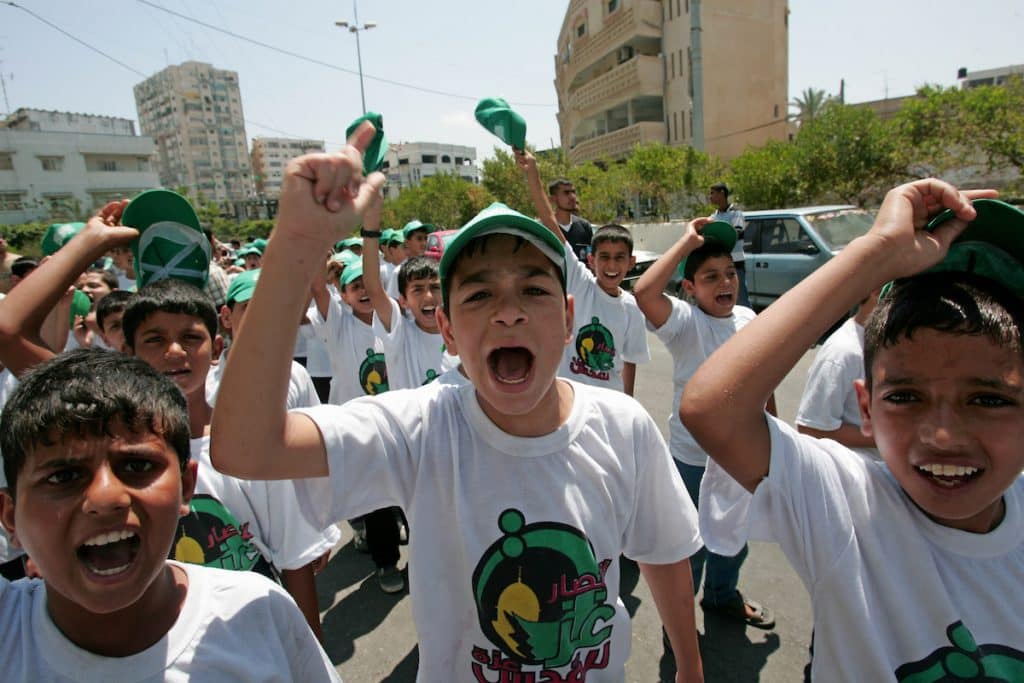
Palestinian boys take part in a rally calling for an end to the siege on Gaza in front of the UN headquarters in Gaza City on July 07, 2009. (Photo: Naaman Omar/APA Images)

Electricity became a timetable rather than a constant. At the beginning, we might have fourteen hours of power, then fewer and fewer. After each war, after each major assault, the power plant would be hit again. First you hear the news, then you feel it when the lights go out for longer periods. Ten hours without power. Twelve. Sixteen. In the last years before I left, we had around four hours of electricity a day.

Health experts now write about how Gaza’s health system is collapsing inside this open air prison. They talk about hospitals that cannot run equipment because of fuel shortages, water that is unsafe to drink, sewage that cannot be treated. Policy reports explain that this is not an accident but a result of a blockade that limits fuel, materials, and even calorie counts. For us, it showed up as spoiled food in the fridge, dark classrooms, and nights when the only light came from phones and candles.

Time itself bent around the schedule of the grid. You learn to count your life by those hours. When to cook. When to wash clothes. When to study. When to charge your phone and the emergency batteries. The rest of the day belongs to the dark.

Charging a phone should be a thoughtless act. You plug it in, you forget about it. Under the blockade, it became a task, a small journey. Some people in each neighborhood had fuel and generators. They became the unofficial charging stations. You would see people walking with phones, chargers, and power strips, heading there when the power was off in their own homes.

Imagine having to leave your house and walk to another street just to give your phone a little life. Imagine doing this again and again, week after week, year after year, not because of a natural disaster, but because someone decided that this is how you should live.

When I was a university student, this took a special kind of cruelty. Professors started assigning online homework and quizzes, trying to keep up with the modern world. We would sit in front of our screens, our eyes on the questions, our minds on the ticking clock in the corner and the invisible clock of the electricity cut.

You begin an online quiz knowing that at any moment the power might go out. The screen could go black in the middle of a sentence, and all your answers would disappear with it. Sometimes that meant losing grades. Sometimes you could not retake the quiz. Then came the explanations: messages to professors, begging them to understand that you are not lazy, you are just plugged into a fragile grid controlled by people who do not know your name and do not care about your GPA.

Even when teachers believed us, the fear stayed. Every assignment became a small test not only of knowledge, but of whether the electricity gods would be kind for an hour.

The shrinking of Gaza was not only political. It was personal. The shrinking lived inside my chest before I ever named it. I felt it when I hesitated to dream about simple things, like choosing a career because I loved it or imagining a future house that was not already cracked. I felt it when relatives told me to “be realistic,” not because my grades were bad, but because the borders were. Even my hopes had to fit inside the map of Gaza, inside the hours of electricity, inside whatever work my father could still find. Little by little, I stopped asking “What do I want to do with my life?” and started asking “What is even possible here?”

It showed itself in small, almost embarrassing comparisons with people my age who lived normal lives.

I remember one moment clearly. I had a friend named Steve, an African American guy from Miami. We met online because I wanted to improve my English. Most of our conversations were simple. What we ate for breakfast, what classes we were taking, how the day was going. Nothing deep. Nothing political. Just daily life.

Then one day Steve told me he was moving to Poland.

Not forever. Not because of danger. Not because he was fleeing anything. Simply because he wanted to study there. He decided it, booked a flight, moved, started classes, and then came home for winter break like it was a weekend trip.

He told the story casually, the way someone tells you they changed their phone plan. But for me, something cracked. I realized he had the ability to move in and out of countries like someone opening and closing doors in their own house. I realized that if he woke up one morning and wanted to study in another place, he could just go. There were airports. Visas. Consulates. Borders that opened.

The thought felt unreal, like hearing that someone can breathe underwater.

Then there were the video calls.

We would talk, laugh, argue about stupid things. And then, suddenly, in the middle of a sentence, the electricity would cut. The screen would freeze, blink, and disappear. The room would fall dark. Eight hours. Ten hours. Sometimes more. No explanation. No apology. Just silence.

When I came back online, Steve would ask:

“What happened? Are you okay?”

I had to explain every time.
The power cut.
The electricity schedule.
The generator shortage.
The siege you can hear in the walls.

For him, a power cut was something announced in advance or caused by a storm. For me, it was a constant reality. A thing that could interrupt any moment of life.

Years later, after arriving in the US, I received a text message from the electricity company saying:

“The power will go off for five minutes between this time and this time.”

A warning.
A courtesy.
A luxury so simple it hurt.

I stared at the message as if it were written in another language. For twenty years of my life, electricity never announced its absence. It vanished like a punishment.

That was the moment I realized the world outside Gaza was not just different. It was larger. Softer. Built for human beings. Built for planning, dreaming, leaving, returning. Built for people who were allowed to exist without rationing light.

Gaza, by contrast, had become a world where even a phone battery felt like borrowed time.

These details might sound like simple hardships, the way people talk about “life is hard in poor countries.” But Gaza is not just “a poor place.” Poor places usually let you leave. In Gaza, poverty is welded to confinement. The blockade does not simply make life difficult. It arranges difficulty in such a way that your energy is spent on basic survival instead of on building a future.

Writers and activists have been trying for years to name this combination. Some call Gaza a ghetto, a bantustan, a carceral zone. As early as the 1980s, analysts were already comparing Gaza to apartheid townships in South Africa. Later, an Israeli sociologist would call it the world’s largest concentration camp, and other commentators would argue that the shift from slow “spacio cide” to open massacre has turned parts of Gaza into something closer to an extermination camp. UN experts now warn that what is happening in Gaza is not only an open air prison but a test of the whole international order.

The funeral marches I saw as a child and the bombs that shook my sister’s new home were open acts of violence. The blockade is quieter. It comes as a morning ritual at a computer, as a mother who cannot go to Hajj, as a son sleeping in a living room listening to his father breathe, as a student racing against a power cut, as a phone in your hand that is always close to dying.

If a city can be turned into a kind of cell, this is how it begins. Not with a single event. With a long, slow shrinking of what is possible, until you wake up one day and realize that almost no one you love believes that “things will get better soon” anymore.

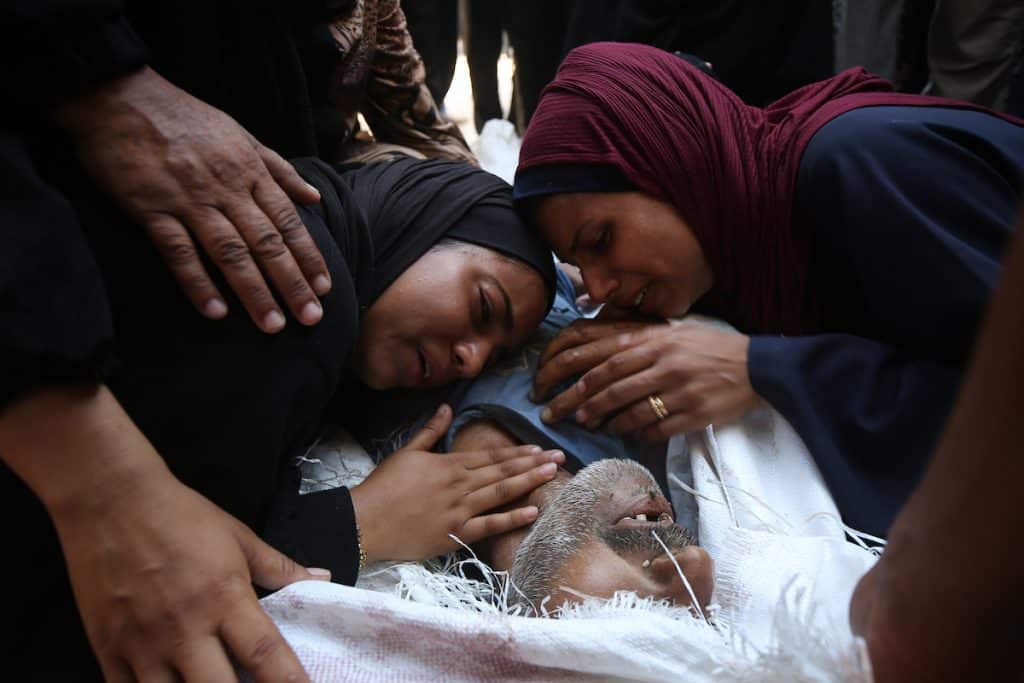
Palestinians mourn over the bodies of loved ones who were killed by Israeli fire while trying to receive aid, according to medics, at Al-Shifa Hospital, in Gaza City, August 4, 2025. (Photo by Omar Ashtawy/APA Images)

On August 4, 2025, my sister, Elham, was devastated by an unspeakable act. Israeli forces took the life of her husband, my brother in law, Haitham. He was a father simply trying to fulfill the most basic duty: securing food for his wife and their five young children. He was killed in one of the most cruel and senseless ways imaginable, caught in the death traps surrounding the humanitarian aid trucks near the borders.

Report after report now documents how families in Gaza are killed while trying to reach food or water, how entire families are wiped out in attacks that human rights groups call possible war crimes. Amnesty International describes whole families being erased in a moment. Gideon Levy collects dispatches about “the killing of Gaza.” To the outside world these are case studies and evidence. To my sister, they are the empty side of the bed and five children asking where their father went.

Abdalrahim Abuwarda
Abdalrahim Abuwarda is a Palestinian scholar and PhD candidate in English (Public Humanities) at the University of Wyoming. His research and teaching explore media representation, rhetoric, and the politics of storytelling in Palestine and beyond.

 ZIONIST IMPERIALISM

Israeli forces’ assault on Qabatiya continues into second day


Members of the Israeli forces take positions during a military raid in the West Bank town of Qabatiya, Saturday, Dec. 27, 2025. (AP)


WAFA
December 27, 2025

Residents of Jenin town forced to evacuate, properties seized

Troops dig up roads, cut electricity supply


RAMALLAH: Israeli troops questioned residents, searched homes and damaged buildings and roads in Qabatiya, south of Jenin, in the occupied West Bank, on Saturday as their operation in the town continued for a second day.

Some residents were forced to evacuate as soldiers took over a number of properties, including a school, to use as a base and to hold and question people, the Palestine News Agency WAFA reported.

Bulldozers were used to dig up streets and create roadblocks at key access points, while the electricity supply to several neighborhoods was cut off.

Also on Saturday, Israeli settlers attacked Palestinian vehicles at the entrance to the town of Bil’in, west of Ramallah, but there were no reports of any injuries to people or damage to property, WAFA said.

The Wall and Settlement Resistance Commission reported that Israeli forces and settlers carried out 2,144 attacks in November, mainly in the governorates of Ramallah and Al-Bireh (360), Hebron (348), Bethlehem (342) and Nablus (334).

Since early Saturday, Israeli forces have closed entrances to several villages and towns north and west of Ramallah, including Ni’lin and Kharbatha Bani Harith, causing traffic congestion and making it hard for Palestinians to move around.

Israeli soldiers also closed the Atara military checkpoint, making it harder for Palestinians to travel, especially for those going to and from villages northwest and west of Ramallah and from northern areas. A report by the Wall and Settlement Resistance Commission in October said that the number of permanent and temporary checkpoints, including iron gates, across the Palestinian territories had risen to 916.

Israeli authorities have erected 243 iron checkpoint gates since the start of the conflict on Oct. 7, 2023.

On Dec. 20, Israel's military said that they killed a person in Qabatiya who “hurled a block toward the soldiers.”

It later said that the killing was under review, after Palestinian media aired brief security footage in which the youth appears to emerge from an alley and is shot by troops as he approaches them without throwing anything.

An Israeli reservist soldier rammed his vehicle into a Palestinian man ​as he prayed on a roadside in the occupied West Bank on Thursday, after earlier firing shots in the area, the Israeli military said.

"Footage was received of an armed individual running over a Palestinian individual," it said in a statement, adding the individual was ‌a reservist ‌and his military service ‌had been terminated.

The ​reservist ‌acted "in severe violation of his authority" and his weapon had been confiscated, the military said.


Israeli forces raid Syrian town in Quneitra countryside


December 27, 2025 
Middle East Monitor


A view of Al Qunaitra, where, over the past year since the fall of the Assad regime, the Israeli army has detained more than 40 people, established nine military bases in and around civilian settlements and strategic hills, and took over approximately 12,000 acres of land in the province in southern Syria on December 17, 2025. [Bakr Al Kasem – Anadolu Agency]

Israeli forces raided a countryside town in Syria’s southwestern province of Quneitra on Saturday in a new violation of the Arab country, according to official Syrian media, Anadolu reports.

The state-run Al-Ikhbariya TV channel reported that Israeli troops entered the town of Jabata al-Khashab with six military vehicles accompanied by an armored personnel carrier.

There was no immediate comment from the Israeli army or the Syrian authorities on the media report.

On Friday, Israeli forces fired medium-caliber​​​​​​​ machine guns from the Western Tal Ahmar position toward the Eastern Tal Ahmar in the southern rural Quneitra province. No casualties were immediately reported.

Israeli forces have carried out near-daily incursions in southern Syria in recent weeks, particularly in Quneitra province, conducting arrests, setting up checkpoints, and destroying forested areas, actions that have fueled growing local anger toward Israel.

Israeli forces have repeatedly entered Syrian territory and launched airstrikes, killing civilians and destroying Syrian military sites, vehicles, weapons, and ammunition.

After the fall of the Bashar al-Assad regime in late 2024, Israel expanded its occupation of the Syrian Golan Heights by seizing the demilitarized buffer zone, a move that violated a 1974 agreement with Syria.

UN peacekeeper injured from Israeli gunfire near patrol in southern Lebanon


December 27, 2025 
Middle East Monitor


The United Nations Interim Forces in Lebanon (UNIFIL) are seen as they have reported that the Israeli army constructed two walls inside Lebanese territory along the border, in violation of UN Security Council Resolution 1701, near the town of Yaroun, Nabatieh, Lebanon on November 15, 2025. [Ramiz Dallah – Anadolu Agency]

A UN peacekeeper was injured by gunfire from Israeli army positions and a bomb explosion in southern Lebanon, the UN mission in the country, UNIFIL, announced Friday, Anadolu reports.

The peacekeeping mission said heavy machine gunfire from Israeli positions south of the Blue Line made impact near a UNIFIL patrol inspecting a roadblock in the village of Bastarra, followed by a grenade explosion nearby.

“The sound of the gunfire and the explosion left one peacekeeper slightly injured with ear concussion,” it added in a statement.​​​​​​​

No damage was reported.

In a separate incident, the UNIFIL said a second patrol carrying out “a routine operational task” in the village of Kfar Shouba also reported machine gunfire from the Israeli side in immediate proximity to their position.

The UN mission said that it had informed the Israeli army in advance about the patrol activities “following usual practice for patrols in sensitive areas near the Blue Line.”

The mission described incidents on or near peacekeepers as “serious violations of Security Council resolution 1701,” reiterating its call on the Israeli army “to cease aggressive behaviour and attacks on or near peacekeepers working for peace and stability along the Blue Line.”

A ceasefire has been in place in Lebanon since November 2024, after more than a year of attacks that killed more than 4,000 people and injured 17,000 others against the backdrop of the Israeli war in Gaza.

At least 335 people have been killed and 973 others wounded in Israeli attacks since the ceasefire, according to Lebanon’s Health Ministry.

The Israeli army was supposed to withdraw from southern Lebanon in January 2025 under the ceasefire, but instead only partially pulled out and continues to maintain a military presence at five border outposts.
Israel uproots 8,000 trees in West Bank in one week, causing $7m in losses

December 27, 2025 
Middle East Monitor


Israeli soldiers stand by as Israeli construction vehicles destroy agricultural lands and uproot centuries-old olive trees in the village of Karyut, south of the city of Nablus, West Bank on December 08, 2025. [Issam Rimawi – Anadolu Agency]


Israel uprooted and bulldozed more than 8,000 trees, most of them olive trees, in the West Bank in just one week, according to documentation released by the Palestinian Ministry of Agriculture on Thursday. The ministry estimated the financial losses at around $7 million.

The ministry said Israeli army forces and settlers carried out the attacks as part of an intensifying escalation that directly targeted the agricultural sector and sources of food security in Palestinian areas.

It described the situation as a “dangerous and rapidly increasing” escalation, noting that the attacks took place during the third week of December and were part of what it called a systematic policy aimed at seizing land and removing its original residents.

According to the report, most of the attacks were concentrated in the northern and central West Bank. Israeli forces uprooted about 5,000 olive trees in the town of Silat al-Harithiya, west of Jenin, and another 3,000 olive trees in Turmus Ayya, east of Ramallah.

The ministry also recorded separate bulldozing operations that destroyed 156 olive trees in Mukhmas, east of Jerusalem, and 100 fig trees in the towns of Ramin and al-Nazla al-Sharqiya in the Tulkarm area.

Further damage included the uprooting of 13 olive trees in Al-Funduk village, east of Qalqilya, and 19 olive trees, including 10 old trees, in Deir Istiya in Salfit and Al-Minya in Bethlehem.
Amid Starvation and Mass Killings, This Gaza Baker Refused to Stop Her Work


“Finding flour alone took five full days,” says Dema Al-Buhisi, who continued baking in Gaza amid famine and bombings.
December 26, 2025

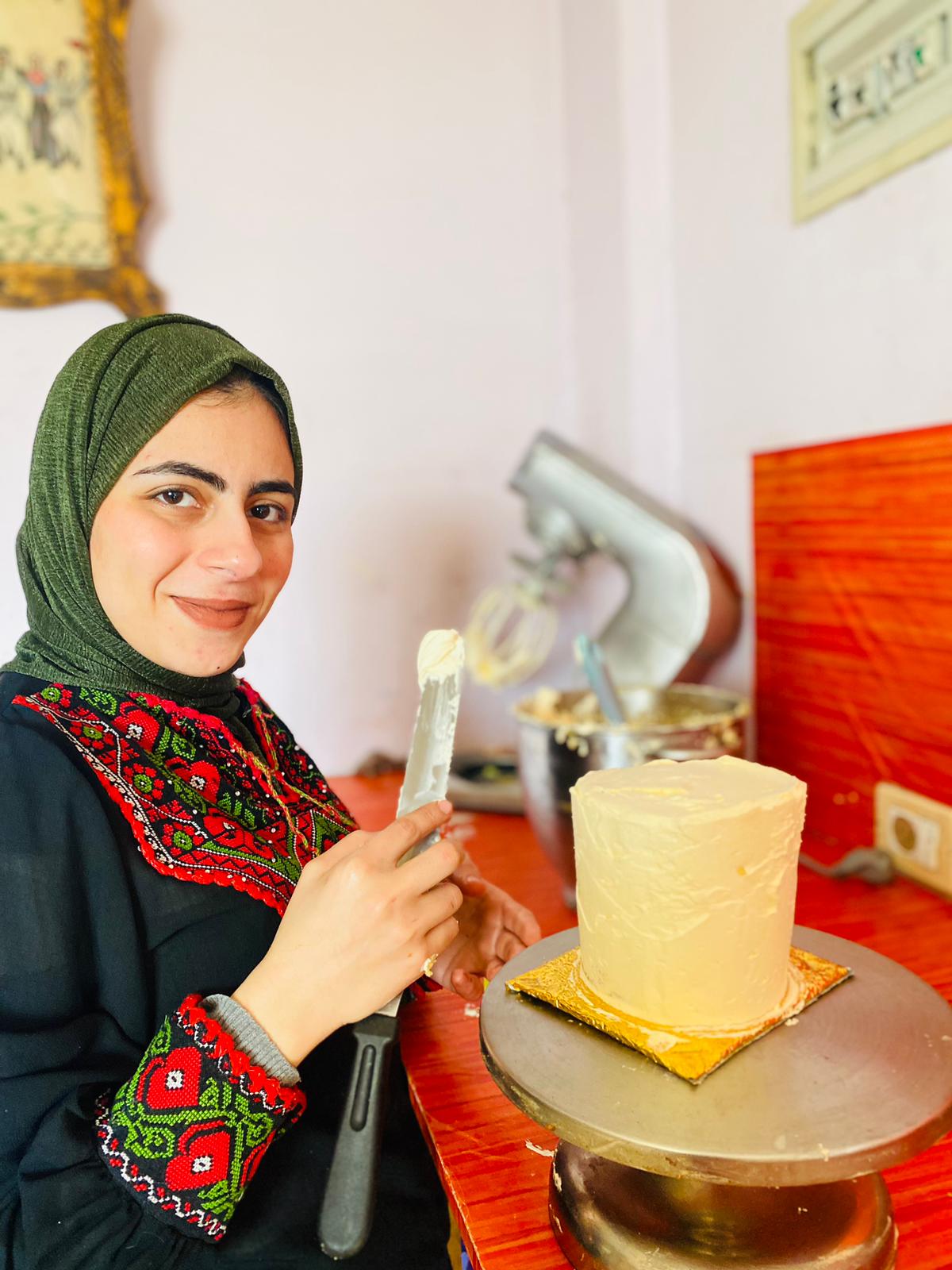
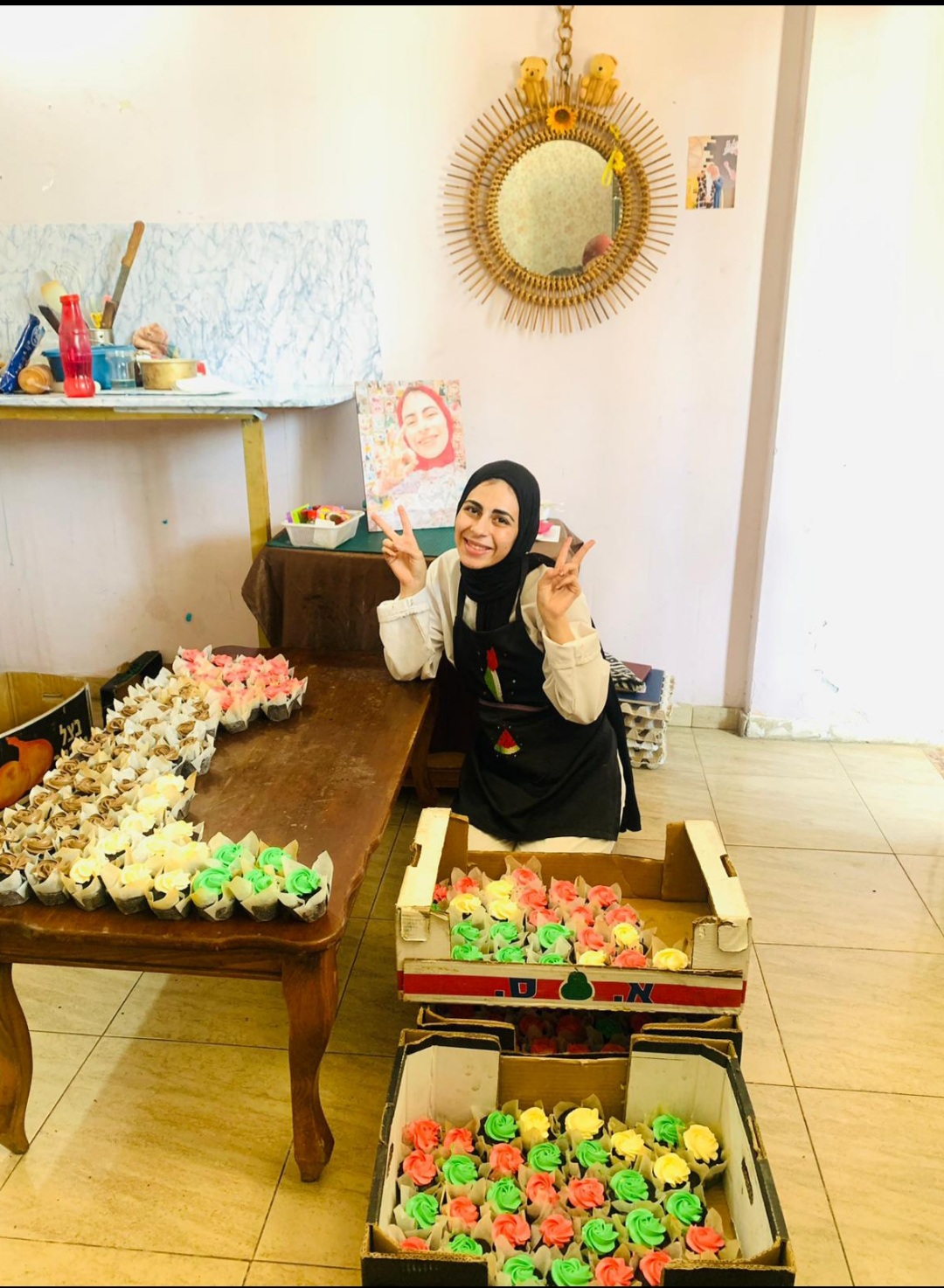
Dema, the cake girl who became known not only for creating cakes but for spreading joy. A young woman with unshakable determination, who began her dream as a university student with “Cake Online” — here she is decorating a cake with all her love, a dream that succeeded and continues to grow with her passion and resilience. Captured by Dema’s sister.


“The hardest part of working during the war was the endless search for the ingredients I needed to make cakes,” 23-year-old Gaza baker Dema Al-Buhisi tells me.

“For months, that struggle consumed me,” she adds. “Finding flour alone took five full days — five days just to get clean, unspoiled flour that hadn’t gone bad. And what about the famine we lived through? There was no meat, no vegetables, no fruit, not even medicine … so how could I possibly find anything related to baking cakes in the middle of all that scarcity?”

And yet with a resourcefulness and tenacity that moved everyone around her, Al-Buhisi found ways to continue baking throughout the worst days of the shelling and starvation inflicted by the Israeli military.

For this, she has become known in Gaza as the “Cake Girl”: she is an embodiment of how so many of us in Gaza have risked death to watch our dreams breathe.

Al-Buhisi has inspired many of us with her creativity and innovation. During the harshest days of famine, I was drawn to photos of her cakes on Instagram — they were colorful and inviting, even though we had no access to eggs or traditional food coloring!


Children Are Dying of Cold Exposure as Winter Hits Gaza
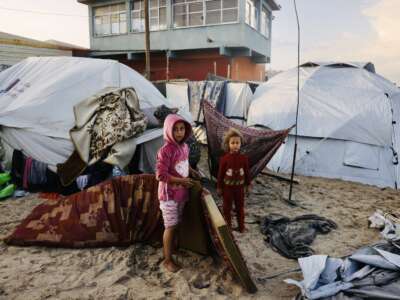
Israel has continued to restrict the entry of tents, tarps, and blankets into Gaza amid the bone-chilling rains. By Shahad Ali , Truthout December 20, 2025


I asked her the secret behind her creativity, and she told me it came from the alternatives she invented herself: She used vinegar instead of eggs, and replaced fruit and coloring with turmeric to give her cakes a beautiful yellow hue.
“When I Work, I Feel Like I Can Breathe Again”

Ten years ago, Al-Buhisi carried a small dream that grew within her: to have her own space in the world of desserts.

“When I was a child, I loved making sweets — especially cakes,” she told me. “I thought it was a normal hobby every girl might have, but with time I realized my passion wasn’t ordinary at all.”

In February 2022, Al-Buhisi launched her online cake business while studying accounting at Al-Azhar University. She ran the entire operation from a small private room in her family’s home in Deir al-Balah, in the south of the Gaza Strip, turning it into a workshop of creativity and determination. Her family believed in her completely; they bought her the tools she needed, and even a refrigerator to start her work. Al-Buhisi says that moment was one of the happiest in her life — it felt like she was finally stepping onto the path she loved.

Her name began to spread, her cakes gained recognition, and her dream was slowly taking shape — until the genocide began. Israel’s sustained assault on Gaza beginning in October 2023 brought life to a halt, forcing us all to focus solely on survival. And just like that, Al-Buhisi stopped making cakes — for six long months.

“The war drained me mentally,” Al-Buhisi said. “I felt a kind of depression I had never experienced before, especially after I stopped doing the things I love.”

Having lost all access to a refrigerator, a working oven, eggs, fruit, food coloring, and much more, she started modifying her recipes and baking small batches of cakes in a clay oven.

Her father, who works in the psychological field, noticed how heavily it was weighing on her. He advised her to return to the work she loved, because it was the only space where she could release her energy — and all the emotional pressure we live under here.

Al-Buhisi said, “When I work, I feel like I can breathe again. I love bringing joy to people. They used to call me the maker of happiness — even though all I do is make cakes — because I get to share their celebrations, their sweet moments.”

But when Al-Buhisi decided to resume baking in mid-March 2023, the shock of the barriers to doing so hit her hard. She had remained in Deir al-Balah, in the south, staying in her home throughout the war, but the room she used to work in — with all her tools, her refrigerator, and her supplies — had been damaged when the Israeli military bombed their neighbors’ house, leaving her own home severely affected. And every ingredient she had previously relied on had expired during those long six months of war.

And yet, Al-Buhisi did not consider giving up. Having lost all access to a refrigerator, a working oven, eggs, fruit, food coloring, and much more, she started modifying her recipes and baking small batches of cakes in a clay oven.

I know very well how exhausting it is to use a clay oven, especially since we have also been relying on one for the past two years due to the lack of gas. Even when gas is available, it comes only once a year.

Now, in order to bake, Dema must set up her clay oven, buy the firewood to burn inside it, and struggle to light it. It takes a long time to get it going, which is especially difficult for baking, because pastries normally require a gas oven.


Even obtaining firewood to fuel our clay ovens has become a challenge, so people have started burning wooden furniture from their homes.

Over time, even obtaining firewood to fuel our clay ovens has become a challenge, so people have started burning wooden furniture from their homes, and some have sold it for the same purpose.

Nevertheless, in the face of these challenges, Al-Buhisi has continued to find creative ways to make cakes throughout the recent years of war. She even gained supporters from abroad who sent her money to bake cakes and cupcakes for distribution in camps of displaced people living in tents in southern Gaza. She told me she personally volunteered to distribute her cakes and cupcakes in the camps because she loves to hear children’s laughter.

During the hepatitis outbreak, Al-Buhisi baked cakes specifically for affected children, using ingredients safe for their kidneys.

A photo taken on February 2, 2025 to honor Dima’s remarkable journey of success, celebrating the dream she began on February 2, 2022, and kept alive, even in the midst of war.    Norma Abu Jaiab

Her project became a source of joy for many families during the war. Parents ordered special cakes for their children’s birthdays in an attempt to offer them moments of happiness and momentarily erase the relentless experience of bombing and killing. As Al-Buhisi says, “Children have the right to feel joy. What we adults endured was unbearable — how could they not deserve a little happiness?”

Now, amid the so-called ceasefire that has in reality been characterized by ongoing attacks by the Israeli military on Palestinians, Al-Buhisi continues her work in the face of many challenges.

Food is still not available in the quantities that were common before the war, nor at the same prices. Food and fuel supplies are still limited, and even when traders manage to bring goods into Gaza, it costs them a great deal due to the blockade, which requires obtaining permission from the occupation authorities for any delivery.

I asked her, “What do you struggle with the most even after the ceasefire?”


Parents ordered special cakes for their children’s birthdays in an attempt to offer them moments of happiness and momentarily erase the relentless experience of bombing and killing.

She told me that she is still baking using the clay oven that she has had to rely on since 2023, and that making cakes with it is extremely difficult — especially during the summer, when it exhausts her completely. She added that the hardships are far from over: Eggs remain very expensive and difficult to find, even long after the official start of the ceasefire in January 2025.

And Al-Buhisi also carries with her the trauma of having lost her dearest and most beloved friend, Tasneem Abu Zakrya, who was killed by the Israeli army a year and a half ago in Al-Nuseirat during an operation carried out by the Israeli forces, supposedly to free Israeli prisoners held in Gaza. Al-Buhisi had talked on the phone with Abu Zakrya right before she was killed.

Moments after their conversation ended, Al-Buhisi received the devastating news — she learned that Abu Zakrya’s body had been reduced to fragments. Al-Buhisi told me that Abu Zakrya was not just a friend; she was part of Al-Buhisi’s soul and family.

Al-Buhisi’s decision to continue pursuing her dream doesn’t mean she is without pain. We all suffer, and we all carry the memories of the war and its hardships.
Dema with her cakes.

Yet what sets us apart — and reveals our true strength — is our ability to rise again, to return to life, and to hold on to what we love.

At the height of Israel’s attacks on Gaza this year, I thought children would never return to their education after their schools were destroyed or turned into shelters for the displaced. I wondered: What about university students whose campuses were completely erased? What about Al-Shifa Hospital, which rose again like a phoenix after being destroyed and besieged more times than we can count?

Yet somehow, even in this landscape of ruin, the universities — like the Islamic University and Al-Azhar University — have begun announcing their slow return. Not full reconstruction, but the first fragile signs of life. And some children, too, have found their way back to learning through small educational centers that have emerged from the rubble, trying to restore the rhythm of a stolen normalcy.

Just like Gaza’s “Cake Girl,” we keep moving forward, cherishing every small moment, and holding on to hope — as long as we remain alive.

This article is licensed under Creative Commons (CC BY-NC-ND 4.0), and you are free to share and republish under the terms of the license.


Dalia Abu Ramadan is a Palestinian storyteller and aspiring graduate of the Islamic University of Gaza, sharing powerful narratives that reflect the strength, resilience, and challenges of life in Gaza.