Sunday, December 28, 2025

COMMENT: Myanmar’s 2025 vote - an election with the ending already written
COMMENT: Myanmar’s 2025 vote - an election with the ending already written
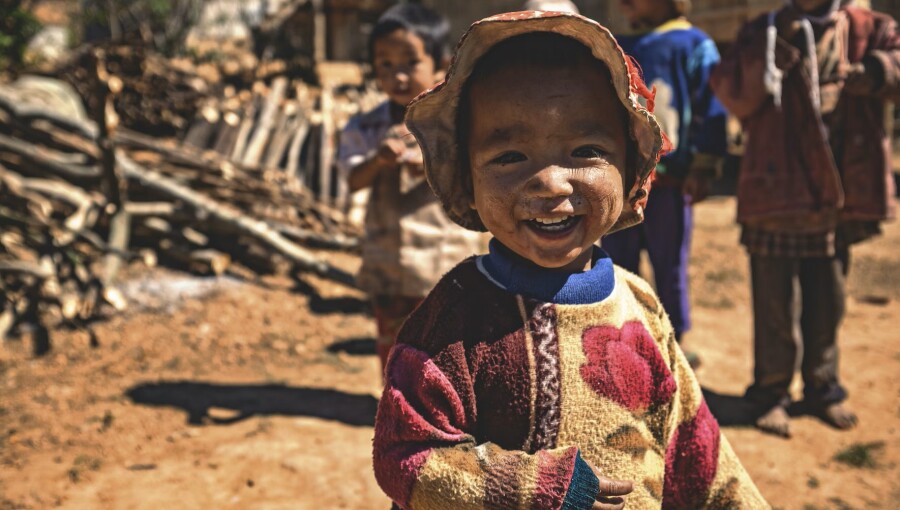
A young child in Shan State, Myanmar / Jesse Schoff - Unsplash
By Mark Buckton - Taipei December 28, 2025

Myanmar’s generals have finally produced the ballot box they have been promising since their 2021 coup. After five years of civil war, mass displacement of entire towns and villages and systematic repression across the country, the junta has staged the first part of what it calls a return to democratic rule.

However, as was reported by the Hindustan Times across the 1,640km border with India - the world’s largest democracy - what appears to be unfolding on election day, Sunday December 28, looks less like an election than a carefully managed performance; one designed to legitimise continued military control while excluding any genuine or effective political competition.

It is a play being staged without many of the actors though, as across junta-held parts of the country, polling stations opened to sparse crowds. In some locations, officials and journalists have reportedly outnumbered voters, reports say. This is a striking contrast to the long queues seen in the last nationwide election in 2020. That was a vote the military annulled before overthrowing the elected government and arresting its leaders the following year.

Under cover of COVID and Russia’s invasion of Ukraine, the generals have spent the intervening years insisting that a new election would restore stability. What is unfolding on the ground, however, bears little resemblance to that narrative.

The sham in action

As is, Myanmar, a nation of around 50mn, remains fractured by conflict, with large swathes of territory outside the military’s control. Voting is not taking place in rebel-held areas, in effect disenfranchising tens of millions of citizens. Even in cities such as Yangon and Mandalay, where polling stations are open, the atmosphere was largely subdued and tightly policed, the Hindustan Times says.

Added to this, the most popular political force in the country is absent altogether. Aung San Suu Kyi, the former civilian leader and enduring symbol of Myanmar’s democratic movement, remains behind bars and ageing. Now 80-years-old and from time to time reported as being in ill-health, her party, which won a landslide victory in 2020, has been dissolved and barred from contesting the vote. In its place, a field of military-aligned ‘parties’ and approved candidates are competing in a process widely criticised as being rigged from the outset.

As a result, international reaction has been scathing. Human rights groups, Western governments and the United Nations have all dismissed the election as a sham. Think Tank at the European Parliament ran a piece earlier in the month to this end, titled in part “Myanmar: Towards a 'sham' election”.

Efforts to shame the junta’s sweeping restrictions on free speech, assembly and the press, in addition to the ongoing imprisonment of thousands of political opponents is well known.

To this end, the only real beneficiary of the process is the Union Solidarity and Development Party, a pro-military vehicle widely seen as a civilian façade for continued martial rule. Victory for the party will - not would - allow the generals to claim constitutional legitimacy without surrendering real power, thus for Myanmar’s military leadership, the election is not a risk but an insurance policy.

Continued trade with regional partners

On the ground in Myanmar, the junta has long argued that restoring order must come before political freedoms. Yet, as its regional neighbours and the wider world know, it was the coup itself that plunged the country into chaos. Many leaders in the region though opt to turn a blind eye and have to some extent chosen to ignore the internal crisis and oppression of the populace in order to maintain business and trade ties.

These include China, a long time partner pushing the China-Myanmar Economic Corridor under the Belt and Road Initiative and Thailand for whom cross-border commerce includes agricultural products and consumer goods. India too, as well as Singapore and to a lesser extent Malaysia and Indonesia continue to trade with the junta. This is despite the fact that within Myanmar’s borders, air strikes on civilian areas and village burnings coupled to mass arrests continue and have become routine. More than 1mn people have been displaced and humanitarian needs continue to rise. This was only exacerbated by the magnitude 7.7, March 28 earthquake in the region which killed over 3,600.

In this context, the ‘election’ looks less like a step towards any form of effective stability and peace and more like an attempt to rewrite the historical and political narrative - with the tacit help of trade partners across South and Southeast Asia.

By pointing to ballot boxes and polling stations, the generals hope to persuade the wider world to accept the status-quo as it is recognised by China, Thailand India et al, albeit without looking too closely.

For many living in Myanmar, with nowhere else to go, however, staying away from the polls is the only form of protest still open to them.

Myanmar's ruling junta says election will provide path to peace as polls open - but opponents criticise 'sham' vote

Since seizing power by force nearly five years ago, Myanmar's ruling military junta has imprisoned thousands of its opponents - most notably Aung San Suu Kyi, the last democratically elected leader.


By Shingi Mararike, news correspondent, in Yangon
Sunday 28 December 2025 

UK
SKY NEWS


'Nobody talks about the election, people are scared. That's why they don't speak up. Because of the government' one woman told Shingi Mararike.


Yangon is Myanmar's beating heart. The bustle of busy market stalls and sight of glittering Buddhist monuments are a vision of the country those in power want the world to see.

The ruling military junta has granted the media rare access to some parts of the country in time for the election - a vote it hopes represents a return to normal, restoring civilian rule here for the first time since 2021.

But that notion has been widely criticised.

Tom Andrews, the United Nation's Special Rapporteur on human rights for Myanmar, has dismissed the polls, split into three stages, as "sham elections". Other human rights organisations and governments have also condemned the ballot.
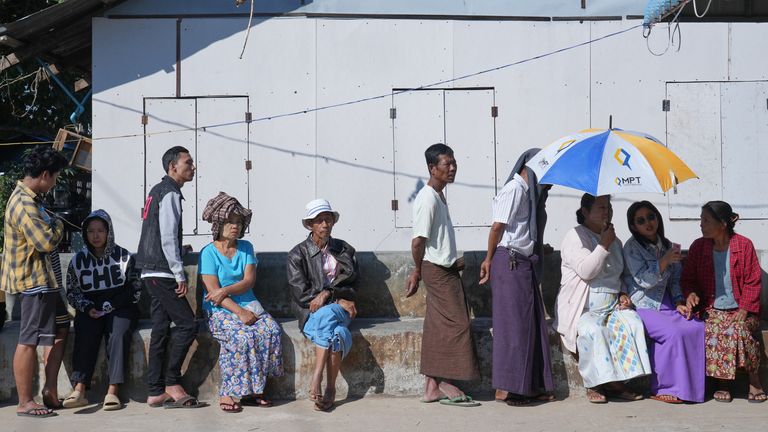
Voters line up to cast their ballots at a polling station in Naypyitaw, Myanmar. Pic: Ap

Since seizing power by force nearly five years ago, the junta has imprisoned thousands of its opponents. The most notable of those is Aung San Suu Kyi, Myanmar’s last democratically elected leader. Her party, the National League For Democracy (NLD), has been dissolved and cannot run in this election. If it could, it would most likely win.

The coup also triggered a civil war that is still ongoing, with the junta locked in battle against a collection of ethnic armed groups and civilian activist forces. That means in large swathes of the country, people will be unable to vote.


Myanmar's former leader Aung San Suu Kyi was imprisoned in 2021

There are multiple options on the ballot, but none represent genuine opposition to the junta.

The Union Solidarity and Development Party, the main military-backed party, is seen as the winner in waiting, because of its close alignment with the junta.

Image:Myanmar's junta chief Min Aung Hlaing casting his ballot. Pic: Reuters

Some of the party's team in Yangon take us out on the campaign trail, determined to show us this election is free and fair.

READ MORE: Inside Myanmar's secret jungle hospital
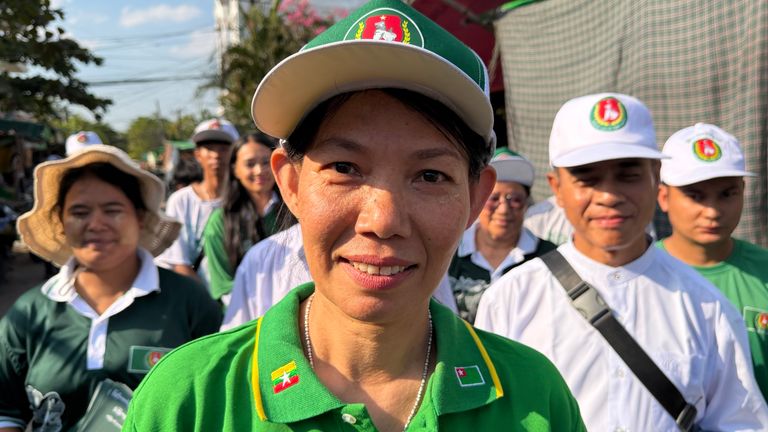
Candidate San San Htlay runs for the military-backed Union Solidarity and Development Party in Dagon Myothit South, Yangon

'People are scared, that's why they don't speak up'

As we walk through the market stalls in town, USDP candidate San San Htay hands out flyers while telling me she has had encouraging conversations with voters. "Mostly they say they will support me and they tell me what they want me to do for them if I win," she says, before turning her thoughts to the criticism from the UN’s Special Rapporteur.

"This is what he says, and that's his opinion," she tells me, "but we have sovereignty over our nation and we have our own rights. We only need the will of our people, we only need to satisfy the will of our people."

San San Htay is all smiles as she moves through a market, but shortly after the campaign team leaves the mood is cagey. One woman we speak to tells us she knows nothing about the vote. Another is fearful.

"In my neighbourhood nobody talks about the election," says the second woman. "People are scared, that's why they don’t speak up, because of the government."
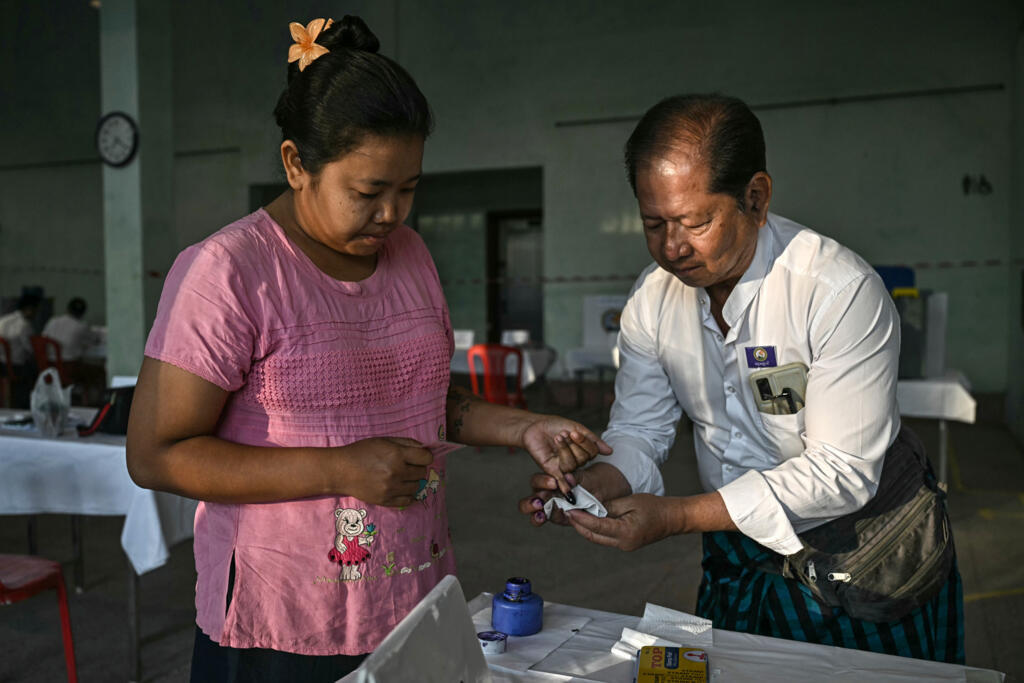
A polling official assists a woman during voting at a polling station. Pic: Reuters

The junta isn't just waging a war on free speech. On the battlefield, one of the world's longest running civil wars continues to rage, leaving part of this nation smouldering, tens of thousands dead and millions unable to vote.

Footage from earlier in December shows an airstrike by the junta on a hospital in the western state of Rakhine, which killed 33 people. Other videos show civilian houses burning in Western Mogok town in Mandalay, reportedly after military air strikes.

'If the military was fair we wouldn't need to use weapons'

Among those who are resisting the military junta are Kyaw Kyaw and Hla Khin, not their real names, who speak to us anonymously because they are concerned about their safety and the consequences of criticising the regime.

They were both jailed for opposing Myanmar’s ruling military junta as supporters of Ms Suu Kyi's now dissolved NLD.

The two former prisoners believe the ongoing civil war in the country will not end "until democracy is restored".

Hla Khin describes why she feels strongly about the need for an armed resistance, stating: "Even though I was scared in the beginning, we protested peacefully for democracy, we didn’t take up arms. But the junta turned into a violent dictatorship, and our generation felt this was unjust."

"If the military was fair we wouldn’t need to use weapons, but they’re not, so we fight too. That’s why young people are undergoing military training and fighting," she says.
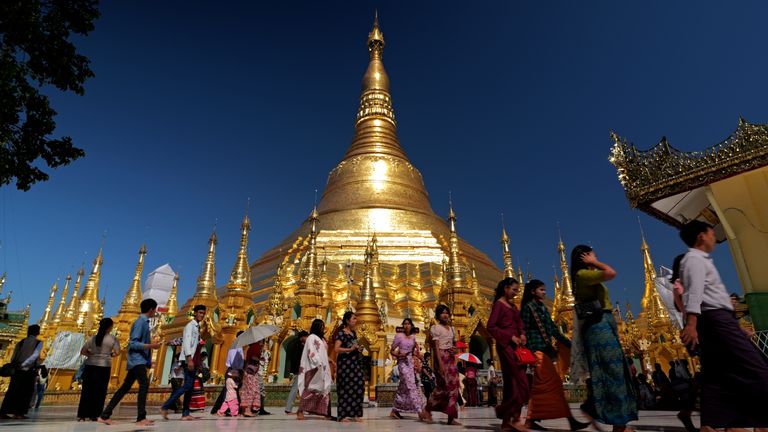
Myanmar has been plunged into civil war since the 2021 coup.

Kyaw Kyaw, who held a political role in the NLD, described the oppressive conditions he says he faced in prison, including being "shackled for 45 days".

"I was beaten during military interrogation and at the entrance of the prison by the prison staff," he says.

"We weren’t allowed to write poetry or read political literature. If they found us doing that, people were locked in solitary confinement and beaten. Some were hospitalised."

As for the future after the election. Both see no end in sight to a civil war which has raged on since the coup.

"If the military junta chief Min Aung Hlaing won’t give up, well young people won’t give up either. Not until democracy is restored," says Hla Khin.

"This situation won’t end until democracy is back. If the conflict gets worse the people will suffer."

'They're trying to intimidate and terrify people'

Commander Tin Oo is one of the soldiers fighting against the junta in central Myanmar, as part of the People's Defence Force, a civilian-led resistance group formed after the coup.

Leaving the frontline to speak to me on a video call, he says the bombing by the junta has intensified in some rebel-held areas in the lead up to the election.

"The junta is intentionally carrying out air attacks on civilians in the area we control, even though it's far away from the frontline," he says before adding. "They’re trying to intimidate and terrify the people. Part of the reason the junta is bombing us is to protect the areas where they will hold elections."

Myanmar goes to the polls

The election beginning on 28 December will be Myanmar's first in five years.

Two more rounds of voting will be held on 11 and 25 January before the election is complete.

More than 4,800 candidates from 57 parties are running for seats in national and regional legislatures.

Only six parties are running candidates nationwide, meaning they will have the clout to affect change in parliament.

The election is being supervised by the military government.

Voting will take place in 102 of Myanmar's 330 townships during the first round.

The military-backed Union Solidarity and Development Party is the favourite to win.

Min Aung Hlaing, the general who has ruled since the 2021 coup, is speculated to assume the presidency.

Fighting continues across the country, displacing 3.6 million people, as armed groups clash with the military.

The final result is not expected to be announced until February.

It means the junta is preventing the revolutionary forces from taking over where the elections are happening.

As polling stations open, his assessment of what happens in this splintered nation is bleak.

"Nothing will change after this sham election," he tells me. "The fighting will carry on."

Despite the opposition and spectre of violence, the junta says this election will provide a path to peace - with votes expected to be counted at the end of January.

Many in Myanmar, and around the world, have a less optimistic view of the future though - with concerns the thin veneer of a civilian government will only serve to strengthen an oppressive regime.


How Myanmar's junta-run vote works, and why it might not

Yangon (Myanmar) (AFP) – Myanmar's junta presides over elections starting on Sunday, advertising the vote as a return to democratic normality five years after it mounted a coup that triggered civil war.


Issued on: 27/12/2025 - RFI
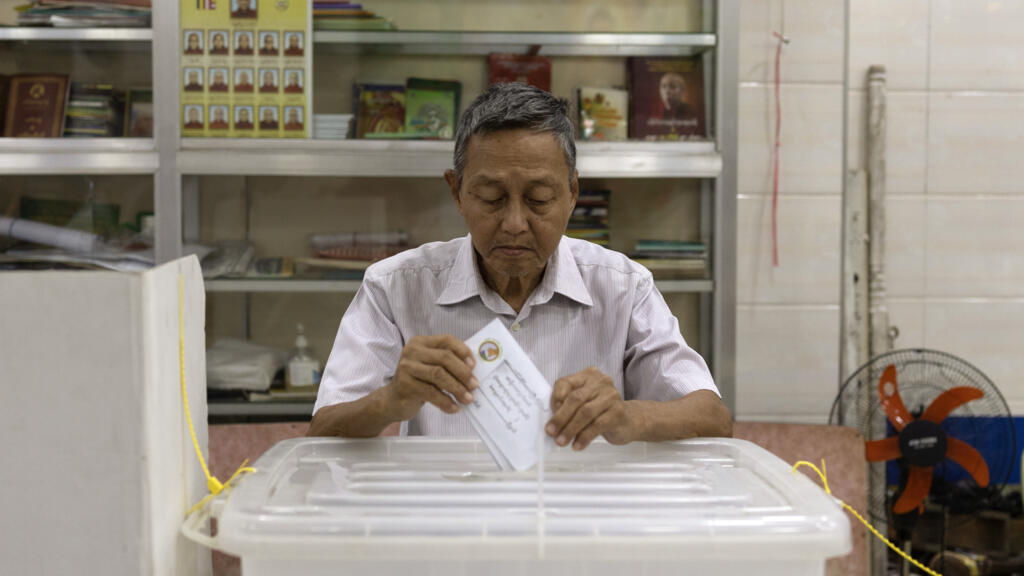
Myanmar's general elections have been widely slated as a charade to rebrand military rule © Lillian SUWANRUMPHA / AFP/File

The vote has been widely slated as a charade to rebrand the rule of the military, which voided the results of the last elections in 2020, alleging massive voter fraud.

Here are some key questions surrounding the heavily restricted polls:

- Who is running? -

The pro-military Union Solidarity and Development Party is by far the biggest participant, providing more than a fifth of all candidates, according to the Asian Network for Free Elections (ANFREL).

Former democratic leader Aung San Suu Kyi and her massively popular National League for Democracy party, which won a landslide in the last vote, are not taking part.

After the 2021 coup, Suu Kyi was jailed on charges rights groups say were politically motivated.

According to the Assistance Association for Political Prisoners advocacy group, some 22,000 political prisoners are languishing in junta jails.

The National League for Democracy and most of the parties that took part in the 2020 vote have been dissolved. ANFREL says organisations that won 90 percent of seats then will not be on Sunday's ballot.

Polling is taking place in three phases spread over a month, using new electronic voting machines which do not allow write-in candidates or spoiled ballots.

Who can and cannot vote?

Myanmar's civil war has seen the military lose swathes of the country to rebel forces -- a mix of pro-democracy guerillas and ethnic minority armies which have long resisted central rule -- and the vote will not take place in the areas they control.

A military-run census last year admitted it could not collect data from an estimated 19 million of the country's 50 million-odd inhabitants, citing "security constraints".

Amid the conflict, authorities have cancelled voting in 65 of the 330 elected seats of the lower house -- nearly one in five of the total.

More than one million stateless Rohingya refugees, who fled a military crackdown beginning in 2017 and now live in exile in Bangladesh, will also have no say.
How is a winner decided?

Seats in parliament will be allocated under a combined first-past-the-post and proportional representation system which ANFREL says heavily favours larger parties.

The criteria to register as a nationwide party able to contest seats in multiple areas have been tightened, according to the Asian election watchdog, and only six of the 57 parties standing have qualified.

Results are expected in late January.

Regardless of the outcome of the vote, a military-drafted constitution dictates a quarter of parliamentary seats be reserved for the armed forces.

The lower house, upper house, and military members each elect a vice president from among their ranks, and the combined parliament votes on which of the three will be elevated to president.

What happened in the run-up?
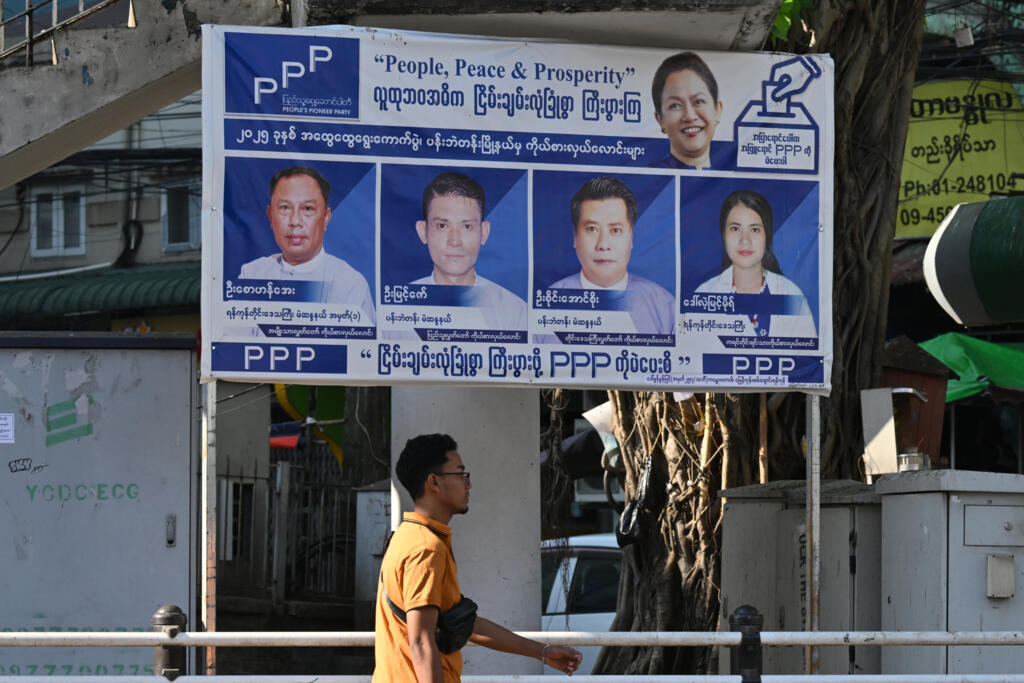
Myanmar's military-drafted constitution dictates a quarter of parliamentary seats be reserved for the armed forces © NHAC NGUYEN / AFP


ANFREL says the Union Election Commission overseeing the vote is an organ of the Myanmar military, rather than an independent body.

The head of the commission, Than Soe, was installed after Suu Kyi's government was toppled and is subject to an EU travel ban and sanctions for "undermining democracy" in Myanmar.

Social media sites including Facebook, Instagram and X have all been blocked since the coup, curtailing the spread of information.

The junta has introduced stark legislation punishing public protest or criticism of the poll with up to a decade behind bars, pursuing more than 200 people for prosecution under the new law.

Cases have been brought over private Facebook messages, flash mob protests scattering anti-election leaflets, and vandalism of candidate placards.

Myanmar has invited international monitors to witness the poll, but few countries have answered.

On Friday, state media reported a monitoring delegation had arrived from Belarus -- a country that has been ruled since 1994 by strongman President Alexander Lukashenko, who put down pro-democracy protests six years ago.

© 2025 AFP

Myanmar junta stages election after five years of civil war

Yangon (Myanmar) (AFP) – Voters trickled to Myanmar's heavily restricted polls on Sunday, with the ruling junta touting the exercise as a return to democracy five years after it ousted the last elected government and triggered a civil war.


Issued on: 27/12/2025 - RFI
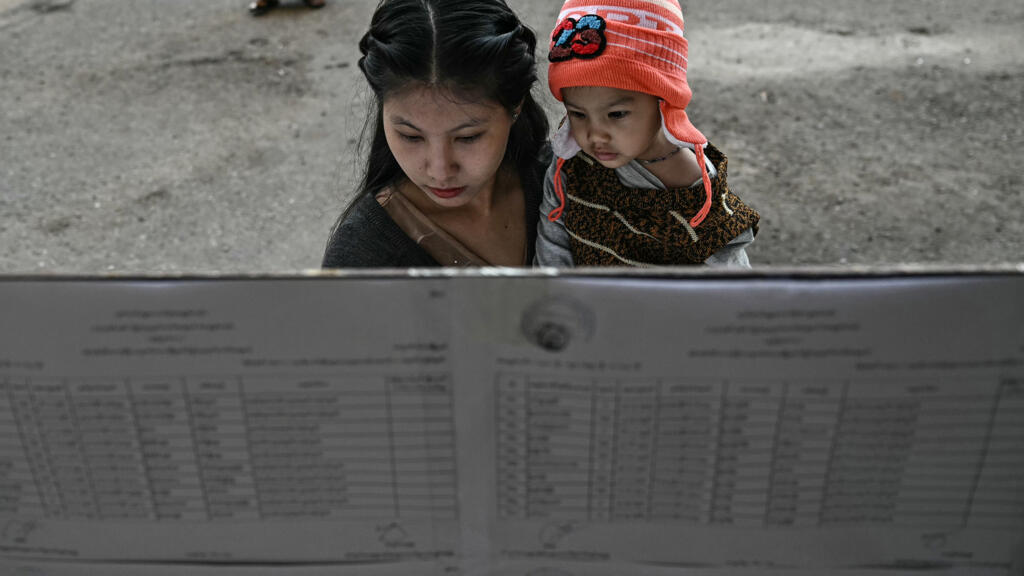
The pro-military Union Solidarity and Development Party is widely expected to emerge as the largest bloc © Lillian SUWANRUMPHA / AFP

Former civilian leader Aung San Suu Kyi remains jailed, while her hugely popular party has been dissolved and was not taking part.

Campaigners, Western diplomats and the United Nations' rights chief have all condemned the phased month-long vote, citing a ballot stacked with military allies and a stark crackdown on dissent.

The pro-military Union Solidarity and Development Party is widely expected to emerge as the largest bloc, in what critics say would be a rebranding of martial rule.
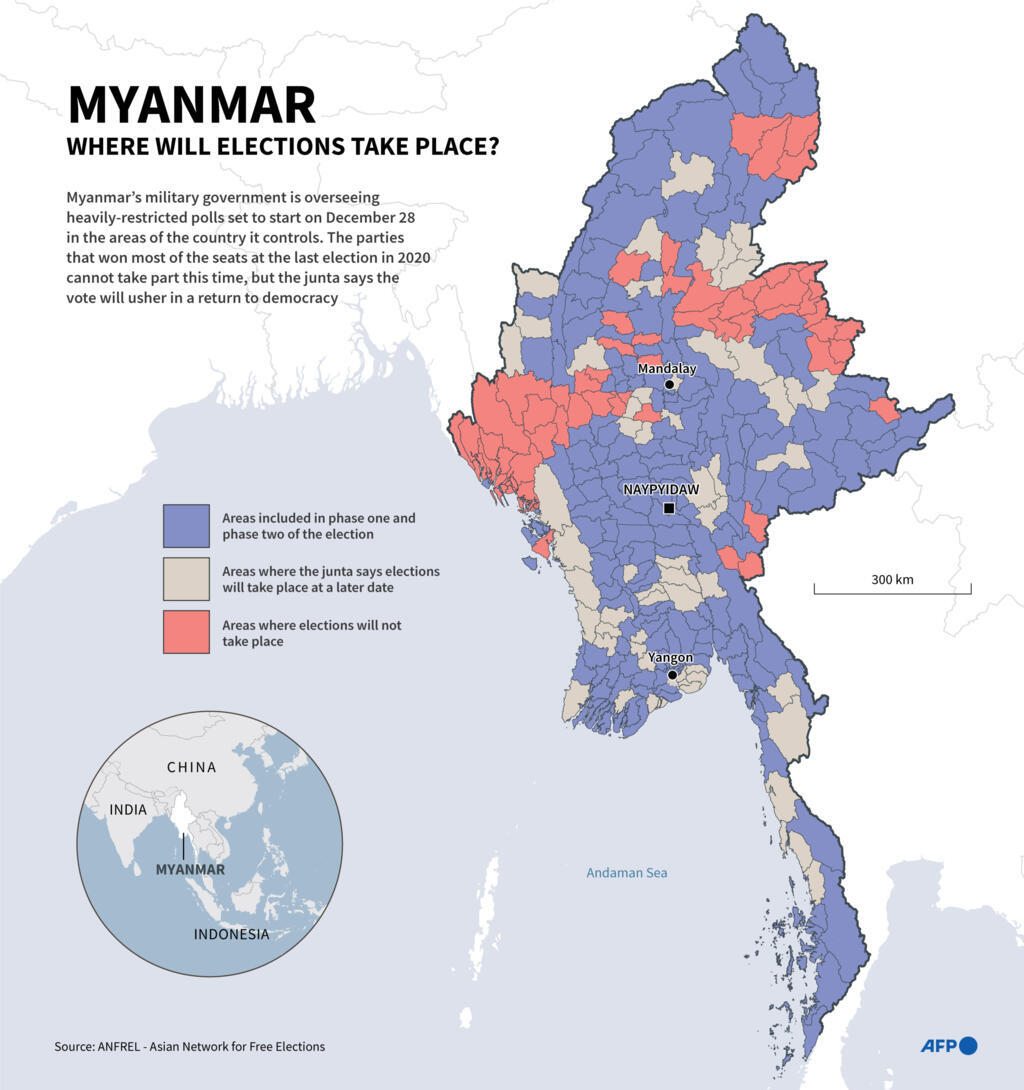
Myanmar: where will elections take place © Nicholas SHEARMAN / AFP


"We guarantee it to be a free and fair election," junta chief Min Aung Hlaing told reporters after casting his ballot in the capital Naypyidaw.

"It's organised by the military, we can't let our name be tarnished."

The Southeast Asian nation of around 50 million people is riven by civil war and there will be no voting in areas controlled by rebel factions that have risen up to challenge military rule.

While opposition factions threatened to attack the election, there were no reports of violence against polling day activities by the time voting ended at 4:00 pm (0930 GMT).
Limited turnout

Snaking queues of voters formed for the previous election in 2020, which the military declared void a few months later when it ousted Aung San Suu Kyi and seized power.

But when a polling station near her vacant home closed on Sunday, only around 470 of its roughly 1,700 registered voters had cast ballots, an election official said -- a turnout of less than 28 percent.

Its first voter, Bo Saw, 63, said the election "will bring the best for the country".

"The first priority should be restoring a safe and peaceful situation," he told AFP.

At a downtown Yangon station near the gleaming Sule Pagoda -- the site of huge pro-democracy protests after the 2021 coup -- 45-year-old Swe Maw dismissed international criticism.

"There are always people who like and dislike," he said at a polling station that later reported a turnout of below 37 percent.

The Southeast Asian nation of around 50 million is riven by civil war and there will be no voting in areas controlled by rebel factions © Lillian SUWANRUMPHA / AFP

The run-up saw none of the feverish public rallies that Aung San Suu Kyi once commanded, and the junta has waged a withering pre-vote offensive to claw back territory.

"I don't think this election will change or improve the political situation in this country," said 23-year-old Hman Thit, displaced by the post-coup conflict.

"I think the air strikes and atrocities on our hometowns will continue," he said in a rebel-held area of Pekon township in Shan state.

The run-up to the election saw none of the feverish public rallies that former civilian leader Aung San Suu Kyi once commanded © Lillian SUWANRUMPHA / AFP


The military ruled Myanmar for most of its post-independence history, before a 10-year interlude saw a civilian government take the reins in a burst of optimism and reform.

However, Min Aung Hlaing snatched power in a coup, alleging widespread voter fraud, after Aung San Suu Kyi's National League for Democracy party trounced pro-military opponents in the 2020 elections.

The military put down pro-democracy protests and many activists quit the cities to fight as guerrillas alongside ethnic minority armies that have long held sway in Myanmar's fringes.

There is no official death toll for Myanmar's civil war and estimates vary widely, but global conflict monitoring group ACLED tallies media reports of violence and estimates that 90,000 people have been killed on all sides since the coup.

Aung San Suu Kyi is serving a 27-year sentence on charges that rights groups dismiss as politically motivated.

"I don't think she would consider these elections to be meaningful in any way," her son Kim Aris said from his home in Britain.
Vote 'disruption' banned

Most parties from the 2020 vote, including Aung San Suu Kyi's, have since been dissolved.

The Asian Network for Free Elections says 90 percent of the seats in the previous election went to organisations that did not appear on Sunday's ballots.

New electronic voting machines did not allow write-in candidates or spoiled ballots.
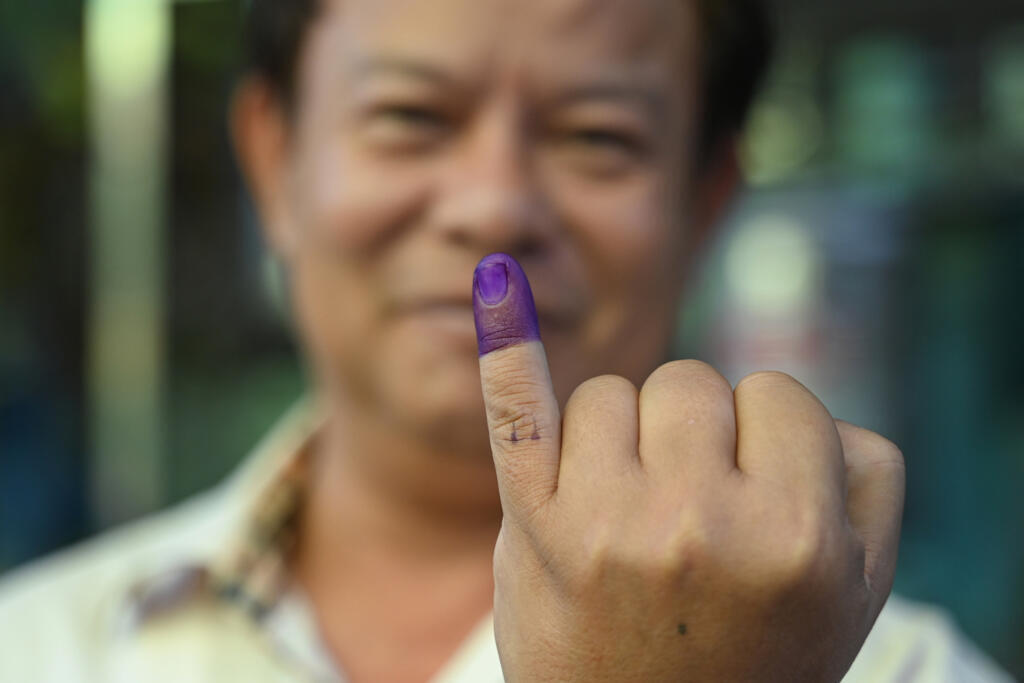

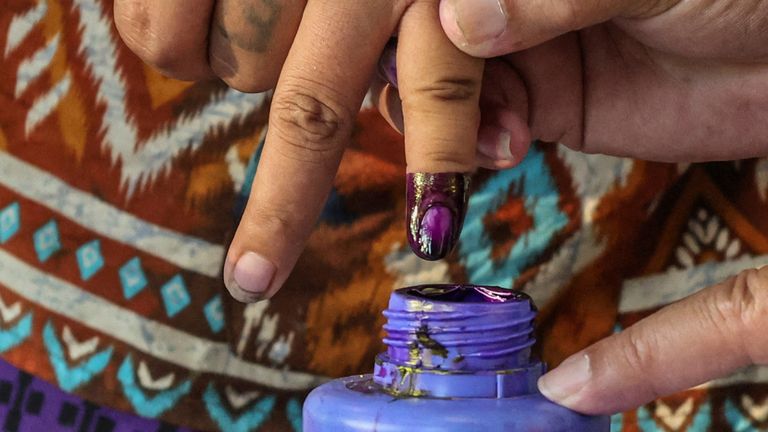
A voter shows an inked finger after casting a ballot © NHAC NGUYEN / AFP


The junta is pursuing prosecutions against more than 200 people for violating draconian legislation forbidding "disruption" of the poll, including protest or criticism.

The United Nations in Myanmar said it was "critical that the future of Myanmar is determined through a free, fair, inclusive and credible process that reflects the will of its people".

The second round of polling will take place in two weeks before the third and final round on January 25, but the junta has acknowledged that elections cannot happen in almost one in five lower house constituencies.

© 2025 AFP
Thailand and Cambodia declare ceasefire

BANGKOK


Thailand and Cambodia agreed to an "immediate" ceasefire on Dec. 27, the two countries said in a joint statement, pledging to end border clashes that killed dozens of people.

Haberin Devamı

U.N. Secretary-General Antonio Guterres welcomed the announcement "as a positive step towards alleviating the suffering of civilians... and creating an environment conducive to achieving lasting peace," spokesman Stephane Dujarric said.

At least 47 people were killed and more than 1 million displaced in three weeks of fighting with artillery, tanks, drones and jets, according to official tallies.

The conflict spread to nearly every border province on both sides, shattering an earlier truce for which U.S. President Donald Trump took credit.

U.S. Secretary of State Marco Rubio on Saturday welcomed the ceasefire, calling on both sides to "immediately honor this commitment."

The ceasefire took effect at 12 p.m. local time, said the declaration signed by the Southeast Asian neighbors’ defense ministers at a border checkpoint on the Thai side.

The truce applies to "all types of weapons, including attacks on civilians, civilian objects and infrastructures, and military objectives of either side, in all cases and all areas."

Both sides agreed to freeze all troop movements and allow civilians living in border areas to return home as soon as possible, the statement said.

They also agreed to cooperate on demining efforts and combatting cybercrime, while Thailand was to return 18 captured Cambodian soldiers within 72 hours.

Thai Defense Minister Nattaphon Narkphanit said the initial three-day window would be an "observation period to confirm that the ceasefire is real."


Trump declares end to Cambodia-Thailand fighting, criticizes UN role

28/12/2025, Sunday

US President Donald Trump has announced that fighting between Cambodia and Thailand will cease, allowing both nations to return to peace following a newly implemented ceasefire. In a statement on social media, he congratulated the countries' leaders and launched a sharp critique of the United Nations, suggesting the US has become the "real United Nations" due to its mediation efforts. The ceasefire ends nearly three weeks of deadly border clashes that caused significant casualties and displacement.

US President Donald Trump has publicly declared an end to the recent border clashes between Cambodia and Thailand, framing the new ceasefire as a successful outcome and using the moment to criticize the United Nations. In a post on his Truth Social platform on Sunday, Trump stated the fighting "will stop momentarily, and they will go back to living in peace, as per our recently agreed to original treaty."

Praise for Leaders and Swift Resolution

Trump extended congratulations to the leaders of both Southeast Asian nations for their "brilliance in coming to this rapid and very fair conclusion." He characterized the diplomatic process as "fast & decisive, as all of these situations should be!" The ceasefire agreement, signed on Saturday, brings to a close nearly 20 days of intense fighting along the disputed border that reportedly resulted in around 99 fatalities and displaced close to a million civilians from border communities.

A Broader Critique of International Institutions

The US president then pivoted to a broader critique of global governance, explicitly targeting the United Nations. "With all of the wars and conflicts I have settled and stopped ... perhaps the United States has become the real United Nations, which has been of very little assistance or help in any of them," Trump asserted. He called for the UN to "start getting active and involved in world peace," contrasting its perceived inaction with American diplomatic engagement under his administration.

Context of the Conflict and Ceasefire

The recent hostilities, which resumed on December 8 after a border skirmish, have taken a heavy toll. Thai authorities reported 26 soldiers and one civilian killed, with 41 other civilian deaths attributed to collateral effects. Cambodia's Interior Ministry cited 31 civilian fatalities. The newly implemented truce reinforces an earlier ceasefire brokered in July by the US, China, and Malaysia, which was later formalized in a Kuala Lumpur meeting in October. Trump's statement highlights the ongoing role Washington sees for itself in mediating regional disputes, even as it questions the effectiveness of established multilateral bodies.

Trump calls US the "real United Nations" amid Cambodia-Thailand ceasefire


Story by Peter Aitken • 
Newsweek
28.12.2025 

President Donald Trump on Sunday touted the peacekeeping role the United States has played in the world since his return to office, calling it the “real United Nations” and pointed to the renewed deal between Thailand and Cambodia as proof of his administration’s accomplishments.

“I am pleased to announce that the breakout fighting between Thailand and Cambodia will stop momentarily, and they will go back to living in PEACE, as per our recently agreed to original Treaty,” the president wrote on Truth Social.

Newsweek reached out to the White House by email on Sunday morning outside of normal business hours for comment.

Why It Matters


The neighboring Southeast Asian nations have spent decades fighting over a 500-mile stretch of disputed border, which was demarcated by the French during their rule of Cambodia. Thailand has therefore argued the border is inaccurate.

Five days of fighting in July ended with intervention from Malaysia and the U.S., resulting in a peace deal that Thailand and Cambodia signed in October. However, the deal collapsed just six weeks later following an extensive propaganda campaign from both sides.

Trump once again said he would end the fighting, and after a series of talks, culminating in three days of lower-level talks between military officials last week, a new deal was struck between the two countries.


President Donald Trump participates in NORAD Santa tracker phone calls on Christmas Eve from the Mar-a-lago club in Palm Beach, Florida, on December 24. (Photo by ANDREW CABALLERO-REYNOLDS / AFP via Getty Images)


What To Know

The new ceasefire agreement between Thailand and Cambodia stipulates that the two countries must observe a 72-hour period of peace before other provisions come into effect, including the repatriation of 18 Cambodian soldiers, “joint humanitarian demining operations,” and eliminating propaganda and disinformation.

However, Trump has already started celebrating the deal, marking it as another conflict he ended since returning to office, although it’s unclear if he’s counting it as a separate conflict from the first one he claimed to end earlier this year.

“I want to congratulate both great leaders on their brilliance in coming to this rapid and very fair conclusion. It was FAST & DECISIVE, as all of these situations should be! The United States of America, as always, was proud to help!” Trump wrote.

He continued: “With all of the wars and conflicts I have settled and stopped over the last eleven months, EIGHT, perhaps the United States has become the REAL United Nations, which has been of very little assistance or help in any of them, including the disaster currently going on between Russia and Ukraine. The United Nations must start getting active and involved in WORLD PEACE!”

The president has helped push through several ceasefires and peace deals across the past 11 months, even though some of the parties involved dispute the degree to which the U.S. was actually involved in negotiations.

The Trump administration also helped broker deals between Armenia and Azerbaijan, Israel and Iran, Rwanda and the Democratic Republic of Congo, as well as Israel and Hamas in their two-year war.

Trump has claimed credit for helping broker a deal between India and Pakistan, however Indian leaders have disputed any involvement from the U.S. in the ceasefire mediations.

Trump will meet with Ukrainian President Volodymyr Zelensky on Sunday in Miami as he seeks to push a deal between Russia and Ukraine over the finish line in their near four-year war, with Zelensky indicating the new deal could see a vote in Ukraine after finding “new ideas” on how to reach a deal with U.S. negotiators.


What People Are Saying

U.S. Secretary of State Marco Rubio said in a statement on Saturday: “The United States welcomes the announcement from Cambodia and Thailand on reaching a ceasefire following the General Border Committee meeting. We urge both countries to immediately honor this commitment and fully implement the terms of the Kuala Lumpur Peace Accords.”

Cambodia’s Defense Minister Tea Seiha to reporters after the signing: “Today’s ceasefire also paves the way for the displaced people who are living in the border areas to be able to return to their homes, work in the fields, and even allow their children to be able to return to schools and resume their studies.”

Thailand’s Defense Ministry spokesperson Surasant Kongsiri in a news briefing: “If the ceasefire does not materialize, this would indicate a lack of sincerity on the Cambodian side to create sure peace. Therefore, the 72- hour ceasefire beginning today is not an act of trust nor unconditional acceptance but a time frame to tangibly prove whether Cambodia can truly cease the use of weapons, provocations and threats in the area.”


Update 12/28/25, 11:15 a.m. ET: This article has been updated with additional information.

Update 12/28/25, 11:45 a.m. ET: This article has been updated with additional information.
Australian cruise ship runs aground off coast of Papua New Guinea, with 123 people on board

Incident occurs about 30 kilometers from Lae, Papua New Guinea's second-largest city, in Morobe province, as Coral Adventurer's operator says 'all passengers and crew are safe'

Berk Kutay Gokmen |28.12.2025 - TRT/AA


ISTANBUL

The Australian cruise ship the Coral Adventurer has run aground after hitting a reef off the coast of Papua New Guinea with 123 people on board.

The incident occurred early on Saturday morning, approximately 30 kilometers (19 miles) from Lae, Papua New Guinea's second-largest city, in Morobe province.

The ship's operator said that none of the 80 passengers or 43 crew members were injured.

"All passengers and crew are safe," a spokesperson for Coral Expeditions said in a statement, according to the Australian Broadcasting Corporation (ABC). "An initial inspection indicates no damage to the vessel.”

The incident has been reported to authorities, and as is standard procedure, additional official inspections of the hull and marine environment will be conducted.

The Australian Maritime Safety Authority (AMSA) said it did not receive a distress call from the Coral Adventurer but was aware it had run aground.

"AMSA is currently monitoring the situation and is ready to support PNG (Papua New Guinea) authorities if requested," a spokesperson said in a statement.

The Coral Adventurer is under investigation by AMSA and Queensland Police following the death of 80-year-old passenger Suzanne Rees, found dead on Lizard Island on Oct. 26.

Rees had been hiking with other passengers but separated for a rest. The ship left without her and returned hours later upon realizing she was missing.

A search operation located her body the next day. The ship was only two days into a 60-day voyage when Rees died, resulting in the cancellation of the cruise.
SPACE/COSMOS

Gemini And Banco Telescopes Unlock Clues To Origin Of Longest Gamma-Ray Burst Ever Observed


This artist’s illustration, which shows a high-speed jet of material being launched from a source that is embedded in a very dusty galaxy, depicts GRB 250702B — the longest gamma-ray burst that astronomers have ever observed. This powerful, extragalactic explosion was first detected on 2 July 2025. It exhibited repeated bursts that lasted over seven hours. Astronomers conducted rapid follow-up observations with multiple telescopes around the world and found that GRB 250702B resides in a large, extremely dusty galaxy. Their data support a range of progenitor scenarios, including interactions between a star and a black hole, or possibly a neutron star.
 CREDIT: NOIRLab/NSF/AURA/M. Garlick


December 28, 2025 
By rasia Review

Gamma-ray bursts (GRBs) are among the most powerful explosions in the Universe, second only to the Big Bang. The majority of these bursts are observed to flash and fade within a few seconds to minutes. But on 2 July 2025, astronomers were alerted to a GRB source that was exhibiting repeating bursts and would end up lasting over seven hours. This event, dubbed GRB 250702B, is the longest gamma-ray burst humans have ever witnessed.

GRB 250702B was first identified by NASA’s Fermi Gamma-ray Space Telescope (Fermi). Shortly after space-based telescopes detected the initial bursts in gamma-rays and pinpointed its on-sky location in X-rays, astronomers around the world launched campaigns to observe the event in additional wavelengths of light.

One of the first revelations about this event came when infrared observations acquired by ESO’s Very Large Telescope (VLT) established that the source of GRB 250702B is located in a galaxy outside of ours, which until then had remained a question.

Following this, a team of astronomers led by Jonathan Carney, graduate student at the University of North Carolina at Chapel Hill, set out to capture the event’s evolving afterglow, or the fading light emissions that follow the initial, extremely bright flash of gamma-rays. The properties of these emissions can provide clues about the type of event that caused the GRB.

To better understand the nature of this record-breaking event, the team used three of the world’s most powerful ground-based telescopes: the NSF Víctor M. Blanco 4-meter Telescope and the twin 8.1-meter International Gemini Observatory telescopes. This trio observed GRB 250702B starting roughly 15 hours after the first detection until about 18 days later. The team presents their findings in a paper published in The Astrophysical Journal Letters.

The Blanco telescope is located in Chile at NSF Cerro Tololo Inter-American Observatory (CTIO), a Program of NSF NOIRLab. The International Gemini Observatory consists of the Gemini North telescope in Hawai‘i and the Gemini South telescope in Chile. It is partly funded by the NSF and operated by NSF NOIRLab.

“The ability to rapidly point the Blanco and Gemini telescopes on short notice is crucial to capturing transient events such as gamma-ray bursts,” says Carney. “Without this ability, we would be limited in our understanding of distant events in the dynamic night sky.”

The team used a suite of instruments for their investigation: the NEWFIRM wide-field infrared imager and the 570-megapixel DOE-fabricated Dark Energy Camera (DECam), both mounted on the Blanco telescope, and the Gemini Multi-Object Spectrographs (GMOS) mounted on Gemini North and Gemini South.

Analysis of the observations revealed that GRB 250702B could not be seen in visible light, partly due to interstellar dust in our own Milky Way Galaxy, but more so due to dust in the GRB’s host galaxy. In fact, Gemini North, which provided the only close-to-visible-wavelength detection of the host galaxy, required nearly two hours of observations to capture the faint signal from beneath the swaths of dust.

Carney and his team then combined these data with new observations taken with the Keck I Telescope at the W. M. Keck Observatory, as well as publicly available data from VLT, NASA’s Hubble Space Telescope (HST), and X-ray and radio observatories. They then compared this robust dataset with theoretical models, which are frameworks that explain the behavior of astronomical phenomena. Models can be used to make predictions that can then be tested against observational data to refine scientists’ understanding.

The team’s analysis established that the initial gamma-ray signal likely came from a narrow, high-speed jet of material crashing into the surrounding material, known as a relativistic jet. The analysis also helped characterize the environment around the GRB and the host galaxy overall. They found that there is a large amount of dust surrounding the location of the burst, and that the host galaxy is extremely massive compared to most GRB hosts. The data support a picture in which the GRB source resides in a dense, dusty environment, possibly a thick lane of dust present in the host galaxy along the line-of-sight between Earth and the GRB source. These details about the environment of GRB 250702B provide important constraints on the system that produced the initial outburst of gamma-rays.

Of the roughly 15,000 GRBs observed since the phenomenon was first recognized in 1973, only a half dozen come close to the length of GRB 250702B. Their proposed origins range from the collapse of a blue supergiant star, a tidal disruption event, or a newborn magnetar. GRB 250702B, however, doesn’t fit neatly into any known category.

From the data obtained so far, scientists have a few ideas of possible origin scenarios: (1) a black hole falling into a star that’s been stripped of its hydrogen and is now almost purely helium, (2) a star (or sub-stellar object such as a planet or brown dwarf) being disrupted during a close encounter with a stellar compact object, such as a stellar black hole or a neutron star, in what is known as a micro-tidal disruption event, (3) a star being torn apart as it falls into an intermediate-mass black hole — a type of black hole with a mass ranging from one hundred to one hundred thousand times the mass of our Sun that is believed to exist in abundance, but has so far been very difficult to find. If it is the latter scenario, this would be the first time in history that humans have witnessed a relativistic jet from an intermediate mass black hole in the act of consuming a star.

While more observations are needed to conclusively determine the cause of GRB 250702B, the data acquired so far remain consistent with these novel explanations.

“This work presents a fascinating cosmic archaeology problem in which we’re reconstructing the details of an event that occurred billions of light-years away,” says Carney. “The uncovering of these cosmic mysteries demonstrates how much we are still learning about the Universe’s most extreme events and reminds us to keep imagining what might be happening out there.”

Iran launches 3 new satellites aboard Russia’s Soyuz carrier

It marks latest launch in growing Iran-Russia space cooperation amid Western criticism

Syed Zafar Mehdi |28.12.2025 - TRT/AA


TEHRAN, Iran

Iran on Sunday successfully launched three new satellites into space aboard a Russian Soyuz rocket in Russia’s Far East.

The satellites – Kowsar 1.5, Paya, and Zafar-2 – represent the latest chapter in a series of Iranian satellite launches in recent years, many of which have been carried out with Russian cooperation.

The Soyuz carrier also carried payloads from other countries, including Kuwait and Belarus.

The Kowsar 1.5 satellite is an upgraded version of Iran’s previous remote-sensing platform, designed for high-resolution imaging with a focus on agricultural applications, according to Iranian officials.

It was developed by a local knowledge-based company in collaboration with the Iranian Space Agency, highlighting growing cooperation between the public and private sectors.

Zafar, another upgraded satellite, is an advanced Earth-observation platform designed and built by Iran University of Science and Technology.

Weighing approximately 100 to 135 kilograms, it is intended to transmit high-resolution images for monitoring and managing natural resources, according to reports.

Paya, the heaviest of the three satellites, was produced by Iran Electronics Industries in collaboration with the Iranian Space Agency. Weighing about 150 kilograms, it is a remote sensing satellite and considered one of the most advanced domestically built imaging satellites.

The launch was widely followed in Iran with a live telecast by the state broadcaster.

There has been no reaction so far from the US or its European allies on the latest launch. They have often expressed concerns over Iran’s space launches, claiming they violate UN Security Council resolutions. Iran has, however, rejected these claims.

In a statement released ahead of Sunday’s launch, Foreign Minister Abbas Araghchi emphasized that Iran’s satellite program is civilian and scientific in nature and expressed the ministry’s full support for the Iranian Space Agency.

“Iran’s activities in nuclear science, defense industries, nanotechnology, and satellite development are entirely peaceful and intended for peaceful purposes,” he said.

While many of Iran’s satellite launches in recent years have faced technical difficulties, this latest launch further strengthens cooperation between Iran and Russia in space technology.

Kazem Jalali, Iran’s ambassador to Russia, speaking ahead of the launch on Sunday, said that Tehran-Moscow collaboration in the space sector is extensive.

He noted Russia’s leading role in space affairs, including satellite technology, launch vehicles, and satellite deployment, saying the latest launch marks the seventh Iranian satellite to be carried into space by Russia.

New race to the moon: could a German be first this time?


Copyright Copyright 2025 The Associated Press. All rights reserved

By Sonja Issel
Published on 28/12/2025 - EURONEWS

Man is returning to the moon - and with him old rivalries and new ambitions. Europe wants to have its say; Germany wants to be at the forefront. A historic opportunity beckons for Berlin.

Humans are due to land on the moon again in 2027—a return that comes at a time of growing geopolitical tensions reminiscent of the Cold War in many respects: rearmament, new power blocs, and increasing tensions between East and West.

As in the past, space has once again become a stage for strategic competition. A new landing on the moon stands for far more than scientific progress: it is seen as an expression of technological leadership and geopolitical power in the new space race. A permanent presence on the moon promises influence on future space standards, questions of resource utilisation and international cooperation.

The ambitions are correspondingly high. In addition to the USA and Europe, Russia and China in particular are currently pushing ahead with their own programmes. In this context, the European Union is increasingly coming into focus. Not only as a partner of the USA, but increasingly as an independent player in space.

This raises a new question: could this race end with a German on the moon for the first time?

US lunar programme with a European signature


The return of humans to the moon is part of the NASA-led Artemis programme. The United States is leading the way, while international partners—above all the European Space Agency (ESA)—are playing a central role.

A manned orbit of the moon is planned for the first half of 2026 with Artemis 2. One year later, Artemis 3 will see astronauts land on the lunar surface for the first time since 1972. In the long term, the programme also envisages the construction of the Gateway lunar station.

Europe is involved not only politically but also technologically. A key component of the missions is the European service module of the Orion spacecraft, which is being developed by ESA on behalf of NASA and largely built in Germany.

This role could now even be honoured with a priority on the moon: The head of the ESA, Josef Aschbacher, explained that he had decided that the first Europeans on a future moon mission should be astronauts of German, French, and Italian nationality. Germany should make the start.

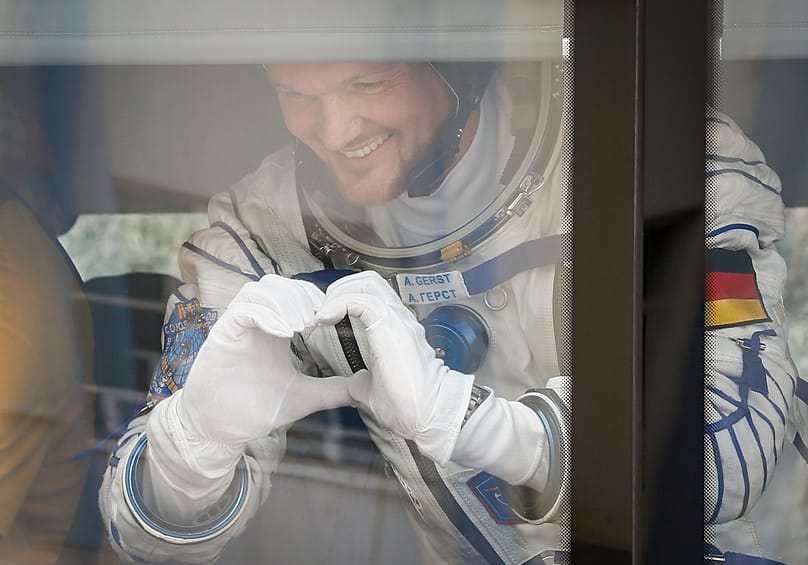
Gerst as the Gagarin of the 21st century?


Four Germans are currently hoping for a ticket to the moon. As things stand today, Alexander Gerst and Matthias Maurer are considered the most promising candidates.

Gerst, a geophysicist and volcanologist, and Maurer, a materials researcher, have already been on the International Space Station (ISS) and are members of the European Space Agency's (ESA) active astronaut team.

Experience is particularly crucial for the selection process: according to current criteria, only astronauts who have already been in space can be considered for a mission to the moon. The two German reserve astronauts, Amelie Schoenenwald, a biochemist, and Nicola Winter, do not yet fulfil this requirement.

However, as it could still be a few years before an actual moon mission is scheduled, it cannot be ruled out that they will also have space experience by then, and therefore also have a chance.

Alexander Gerst on his last space mission in 2018. AP

Gerst is already open to a mission to the moon. When asked whether he could imagine a flight to the moon, he replied, "Of course."

For him, these missions have numerous benefits. Those who play an active role in the lunar programme will also remain at the forefront of key future technologies in space travel—for example, in earth observation, climate research, and Europe's technological autonomy.

Whether a German astronaut will actually be among those who set foot on the Moon cannot be determined at this stage, Gerst said. In his view, this would in any case require a significantly stronger involvement of the European Space Agency in providing key components for the missions.
Europe's striving for independence

However, a European on the moon also has great symbolic significance for Europe. Despite its close co-operation with NASA, Europe remains dependent on the USA in many areas of space travel. At the same time, the European Union is pursuing the goal of becoming more technologically independent.

This strategy is receiving a boost from a record budget for the European Space Agency (ESA). The member states are providing almost 22.1 billion euros for the years 2026 to 2028. One focus is on Europe's independent access to space.

Germany wants to define its role within this framework—as Europe's strongest economic power, preferably at the forefront. Research Minister Dorothee Bär (CSU) speaks of space travel "Made in Germany."

It seems to be no coincidence that her department has officially included the term "space" in its name since the start of the new legislative period.

With 5.1 billion euros, Germany is the largest contributor to the ESA. According to Bär, investment in space travel is necessary despite tight budgets—not only as an investment in the future, but also as a contribution to European sovereignty and security.
Competition in space

Other major powers also have ambitions beyond Earth. In Russia, for example, the state space agency Roskosmos is planning to spend billions and wants to involve private investors to a much greater extent than before.

Among other things, it plans to set up its own satellite internet service modelled on Starlink, which, according to Roskosmos CEO Dmitry Bakanov, is due to launch in 2027.

However, Russia's prospects in the new race to the moon are currently considered limited. Experts are expecting delays due to logistical and financial problems. The Luna-26 moon mission has already been postponed to 2028.

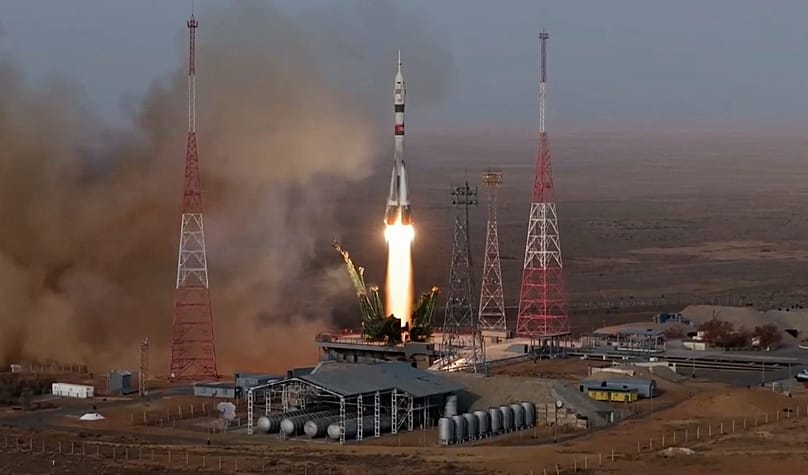
Launch of a Russian Soyuz rocket with a new ISS crew in Kazakhstan, November 2025. AP/Roscosmos space corporation

China, on the other hand, is much more dynamic. The People's Republic is pushing ahead with its space programme at a rapid pace and is increasingly positioning itself as a strategic competitor to the USA. The official goal is to launch a manned mission to the moon by 2030, even if Beijing has so far revealed little about specific timetables.
A symbolic first step towards the moon

As far as Germany is concerned, the journey to the moon could begin as early as 2026—but not directly with a German astronaut for the time being. The Italian designer Giulia Bona, who lives in Berlin, has created a mascot that could fly into space on NASA's Artemis 2 mission.


The design shows a small astronaut on the shoulder of a giant called Orion, named after the mission's space capsule and also an allusion to the mythology in which Orion is associated with the goddess Artemis. Such so-called zero-G indicators have a long tradition: Yuri Gagarin is said to have taken a small lucky charm with him into space in 1961.

Bona said she took part in the competition spontaneously. The fact that her design made it to the final round was an "unexpected joy" for her.

She now hopes to see her mascot floating between the astronauts in the live stream when Artemis 2 is launched, which would at least be a symbolic first step for Germany towards the moon.

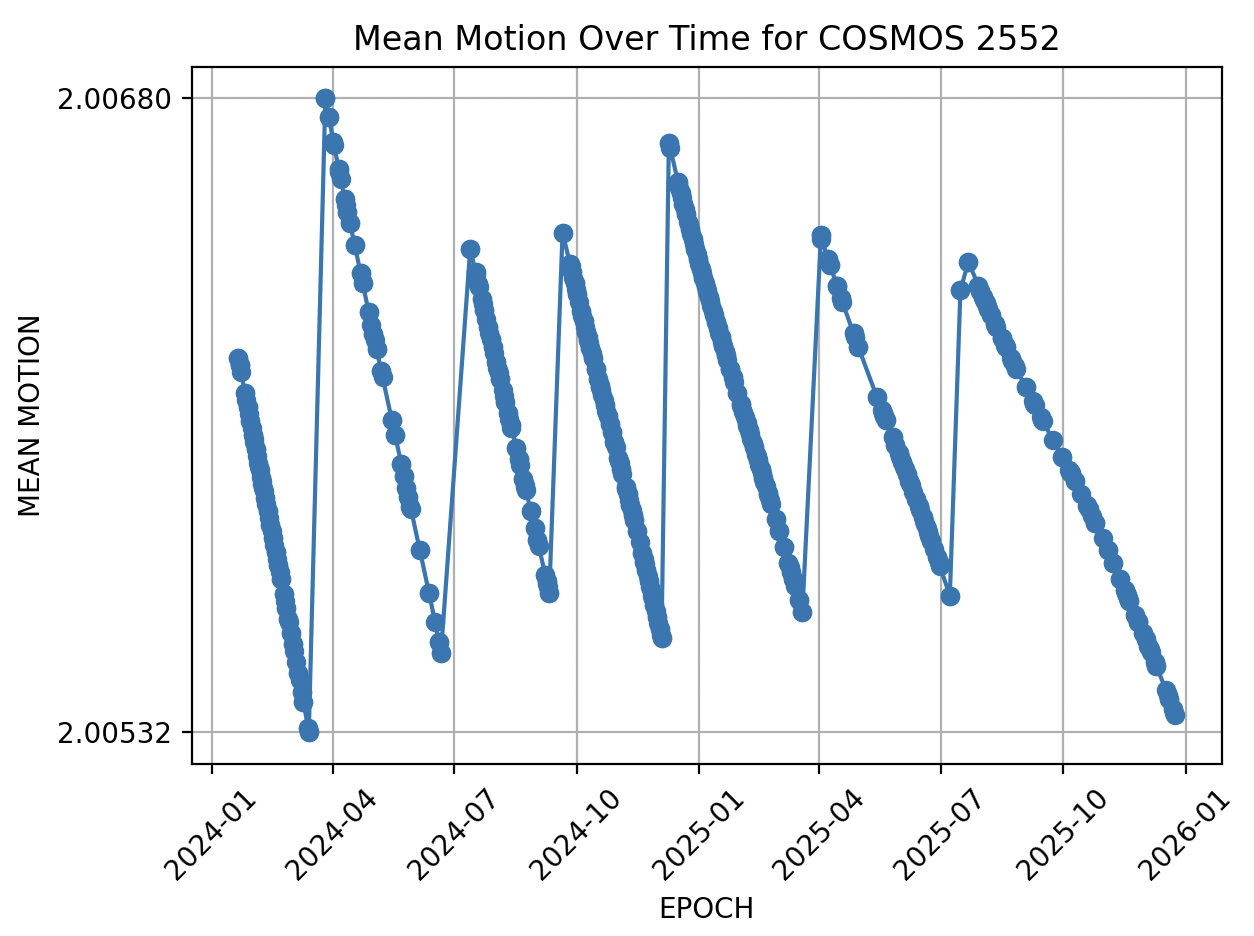
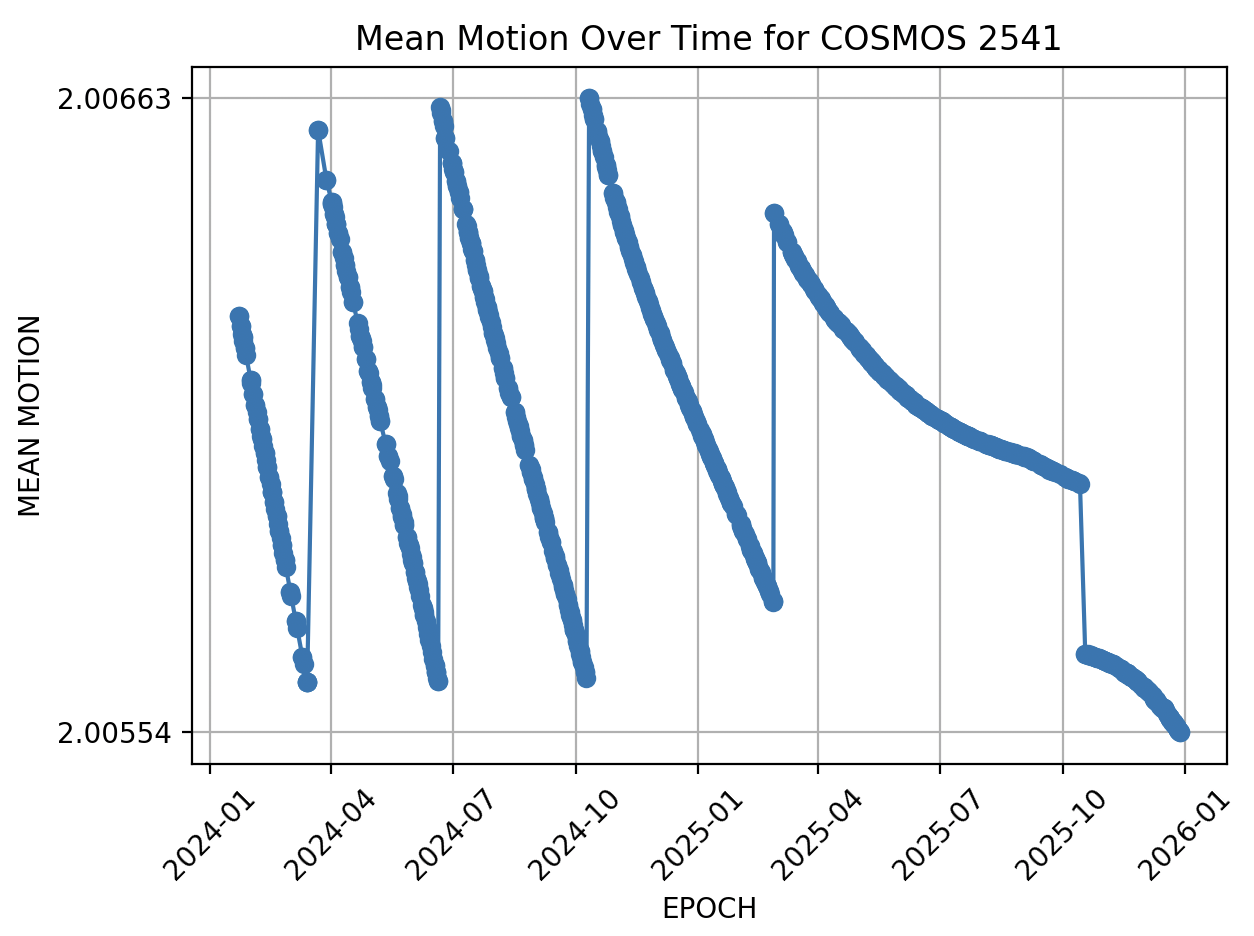
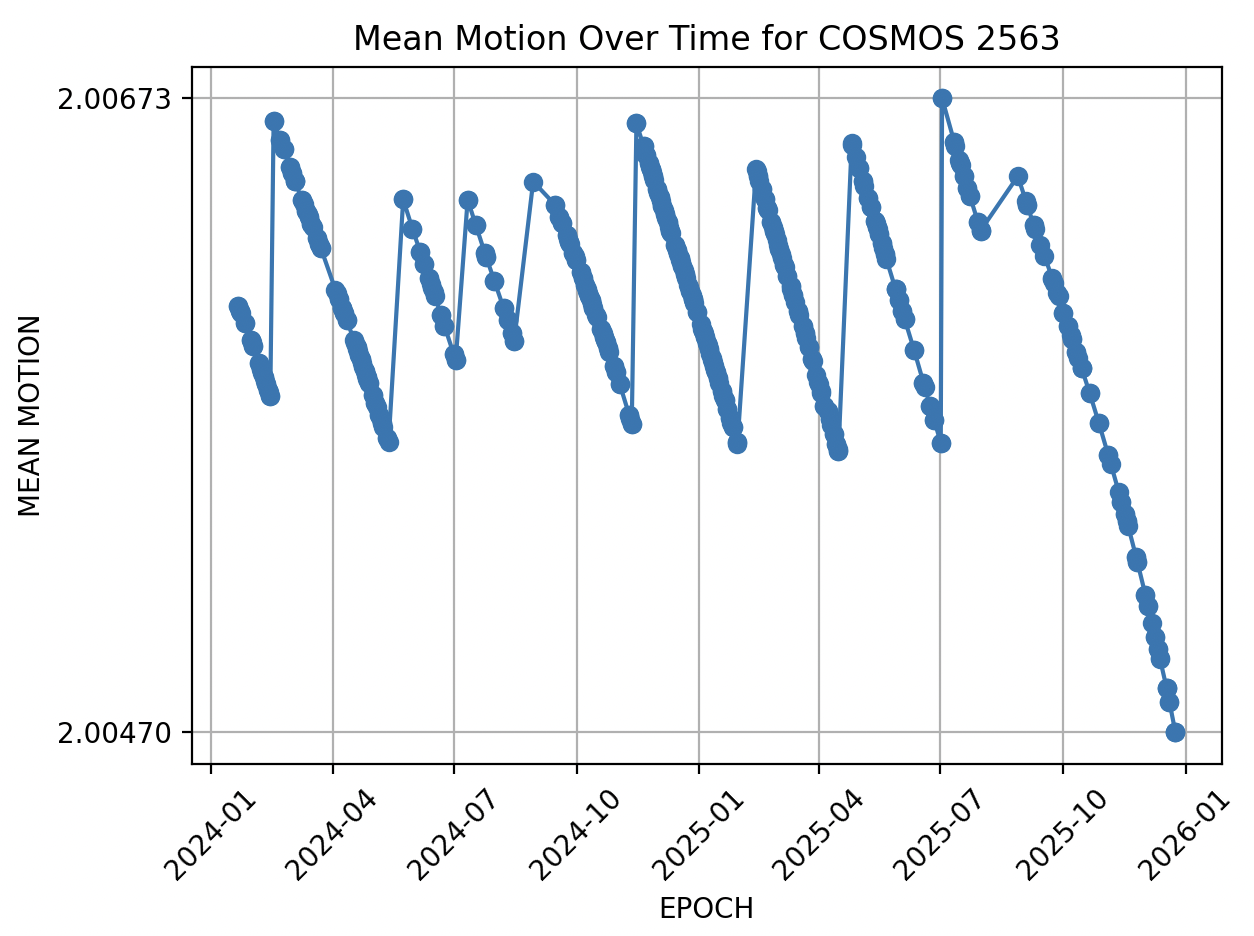
20251218-Cosmos-2552.pngOrbital data suggest that as of the end of 2025 Russia may have only one functioning early-warning satellite of the Tundra type. This is a significant decline from the situation in March 2025, when three satellites of the constellation - Cosmos-2541 (launched in September 2019), Cosmos-2552 (November 2021), and Cosmos-2563 (November 2022) - appeared to be operational.

Now it appears that for Cosmos-2541, the orbit correction maneuver successfully conducted in March 2025 was the last one. Another satellite of those three, Cosmos-2563, appears to have failed at some point after the last successful maneuver in July 2025. Images below show the changes in mean motion that testify to the failures.

20251218-Cosmos-2541.png20251218-Cosmos-2563.png

The only satellite that doesn't show clear signs of failure is Cosmos-2552, launched in November 2021. However, based on recent patterns, it should have performed an orbit correction sometime in November 2025 (see the main image in the post). But it is too early to say that Cosmos-2552 has ended its operations.

I should note again that the apparent loss of early-warning satellites is not necessarily a cause for alarm. Russia does not rely on the space-based segment of its early-warning system to the extent the United States does. For a discussion, see this 2015 post or my Science & Global Security article.

Green Hydrogen’s Uncertain Future

  • Green hydrogen expanded rapidly during the pandemic but has struggled to maintain momentum amid rising costs and limited renewable power availability.

  • Europe’s ambitious hydrogen targets have been undermined by regulatory uncertainty and slower-than-expected project development.

  • New EU funding mechanisms and cross-border infrastructure projects could revive the sector, though long-term success remains uncertain.

During the Covid-19 pandemic, when oil prices fell to a record low, governments and energy companies worldwide began to shift their focus to green alternatives. Many governments introduced ambitious climate pledges and introduced decarbonisation targets, encouraging industries to explore ways to cut carbon. One of the most promising energies for reducing emissions in hard-to-abate industries is green hydrogen, as it can be used for a variety of applications. However, the race to develop commercial green hydrogen seems to have lost momentum as the sector faces several challenges. 

Unlike grey and blue hydrogen, which are produced using natural gas, green hydrogen is made using renewable energy to power an electrolyser, which splits water into hydrogen and oxygen. The gas is then burned to produce power and emits only water vapour and warm air, making it carbon-free. Several energy companies announced plans to invest in green hydrogen production during the pandemic, as it aligned with plans to diversify their portfolios to support a gradual green transition. 

The green hydrogen industry rapidly expanded in several parts of the world, such as Europe and the Middle East, as governments and energy companies invested heavily in the sector. Europe and the Middle East were vying for the top spot as green hydrogen producers, as global demand increased in line with aims to decarbonise industry. In 2022, Spain announced a €50 million green hydrogen plant in Puertollano and the U.K. revealed a £150 million plant in Felixstowe.

However, as several energy companies, such as BP, have backtracked on their renewable energy pledges, the development of the green hydrogen industry is faltering. Several more challenges stand in the way of sectoral progress, such as the need to use renewable energy for power rather than for green hydrogen electrolysis, and the high cost of production. At present, Europe’s green hydrogen output is forecast at around 1.7 million tonnes by 2030, compared to the previous target of 10 million tonnes mentioned in the European Union’s REPowerEU. 

The growing need for renewable electricity to power data centres supporting advanced technologies is making it harder to justify the use of clean energy to power green hydrogen operations. In addition, the cost of producing green hydrogen remains extremely high as the industry has not scaled at the rate needed to drive down prices. The current cost of producing green hydrogen stands at between $5.78 and $23.27 a kilogram, compared to roughly $2 to $3.50 per kg of blue hydrogen

In April, the announcement of the signing of a joint development agreement on the “world’s first” liquid hydrogen corridor, connecting Oman, the Netherlands, and Germany, provided greater optimism around a major advancement in green hydrogen connectivity. The corridor is expected to connect Oman’s Port of Duqm with the Port of Amsterdam in the Netherlands and the Port of Duisburg in Germany. In total, 11 parties entered the deal, including Oman’s national green hydrogen orchestrator Hydrom and Dutch steel producer Tata Steel. 

However, in September, Oman called on the EU to halt ongoing changes to its renewable hydrogen definition, stating that the regulatory uncertainty was deterring final investment decisions in major export projects. Oman’s Energy and Minerals Minister, Salim bin Nasser Al Aufi, said, “Oman is ready to deliver clean hydrogen globally, forging partnerships that drive decarbonisation and sustainable economic prosperity… Do not change the EU's green hydrogen definition while projects are still under development.”

This is not the first time that the EU has been criticised for stalling progress because of its inability to define green hydrogen. In January, German Chancellor Olaf Scholz called for the EU to relax its stringent definitions of the fuel, suggesting that the existing standards were too strict and hindered the competitiveness of planned projects.

Nevertheless, recent developments offer hope for sectoral advancement. In December, the European Commission announced the approval of 100 cross-border hydrogen and electrolyser projects as part of a $1.75-trillion energy infrastructure investment pipeline between 2024 and 2040. The selected projects will be eligible for EU financing from the Connecting Europe Facility and will be provided with more streamlined approval and regulatory processes. “These cross-projects will strengthen energy connectivity across the continent, bringing nearer the completion of the Energy Union,” the Commission stated. 

Spain’s government also announced a $483.3 million contribution to the European Hydrogen Bank's community auction-as-a-service (AaaS) scheme to support the development of new domestic green hydrogen projects. The country’s Deputy Prime Minister, Sara Aagesen, said, “With this contribution, we have reached the figure of €3.155 billion to make hydrogen a reality.” 

Since the pandemic, the outlook for green hydrogen has yoyoed. Initially, several companies seemed highly optimistic about an accelerated rollout of green hydrogen projects, backed by major investments. However, ongoing challenges to the commercial deployment of the clean fuel and complex regulatory standards in the EU have stalled progress. Now, with a fresh promise of investment from the European Commission and several state governments, there is still potential for the green hydrogen industry to grow over the coming decades.

By Felicity Bradstock for Oilprice.com

'Sheer idiocy': Experts pounce on Stephen Miller's comments about history's 'brown people'


David McAfee
December 28, 2025 
RAW STORY

White House deputy chief of staff for policy Stephen Miller came under fire over the weekend for purported racism hidden in comments he made about inventions in history.

Stephen Miller said, "Someone should write an alternate historical novel where Americans are the first to master the automobile, the first in flight, the first to harness the atom, the first to land on the moon — but just keep going and never open our borders to the entire third world for sixty years."

Miller added, "For those who don’t know, the US had negative migration for the half century between the first nonstop transatlantic flight and the moon landing.

That caused an eruption of comments from critics and experts alike.

Geopolitics blogger Anatoly Karlin said, "The first automobile was German, the Manhattan Project was primarily the work of immigrant Budapest Jews (the Martians), and German immigrants of dubious political provenance likewise played an important role in getting the US to the Moon."

Political scientist and right-wing personality Richard Hanania said, "America kept inventing stuff! It’s the center of global innovation, disproportionately due to immigration!"

"What planet are you living on?" he asked.

Hanania added, "Stephen Miller reveals how stupid nativism is as an ideology. Let him keep posting and showing how intellectually empty it all is."

Attorney Danny Miller also chimed in on Sunday, "I keep writing different responses to this and I just can’t wrap my head around its sheer idiocy. Is he not aware that we got the atom bomb first because of a bunch of Jewish scientists fleeing Nazi persecution?"


Dem candidate Fred Wellman said, "Lots of people are pointing out this little racist Nosferatu looking troll doesn’t know an overwhelming majority of our achievements came because of immigrants including our nuclear and space programs."

"He means white immigrants folks. He knows exactly what he’s saying," he wrote on X. "His people were the ‘good immigrants.’ He’s against brown people."


'It is quite concerning': Greenlanders react to appointment of US special envoy to Greenland


Issued on: 28/12/2025 - FRANCE24


Greenlanders react to US President Donald Trump's announcement of the appointment of Louisiana Governor Jeff Landry, a Republican, as US special envoy to Greenland.

Video by: Florent MARCHAIS

Iraqis cover soil with clay to curb sandstorms

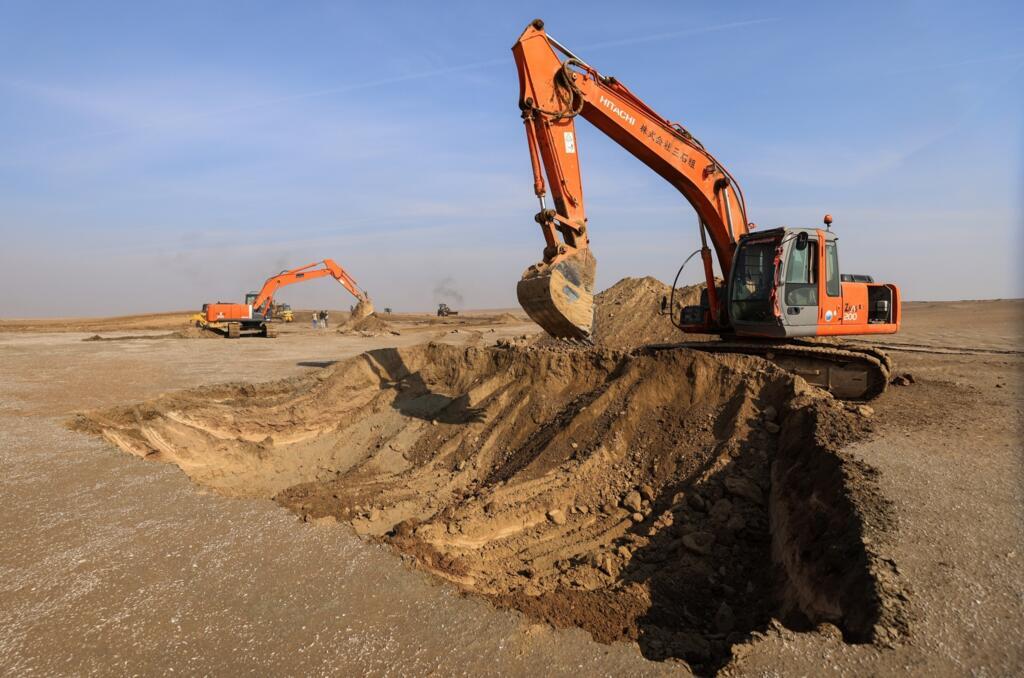
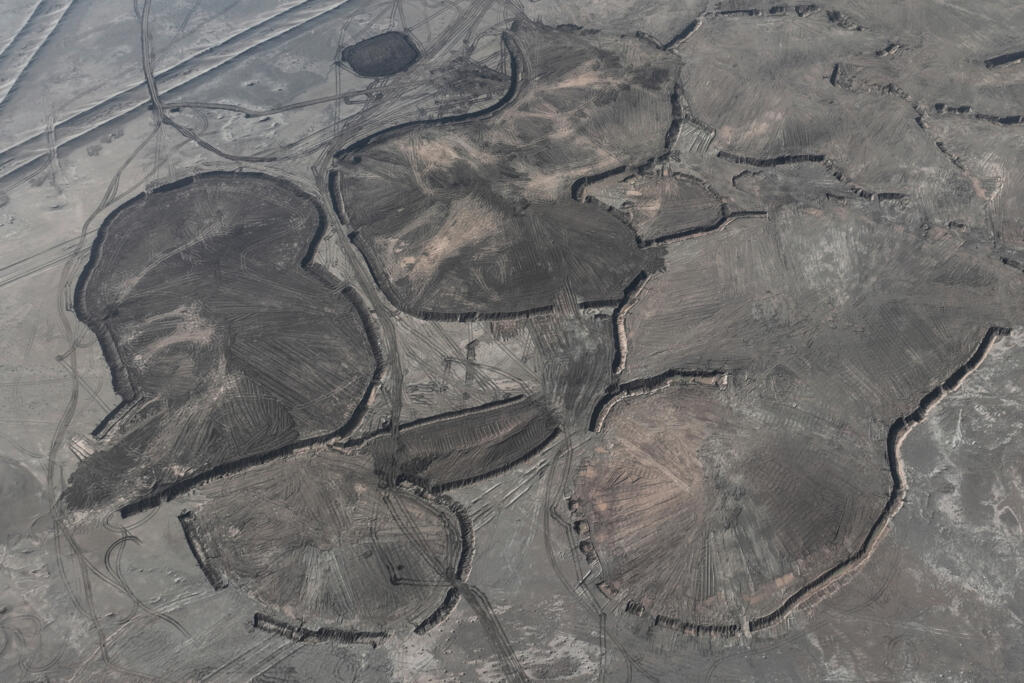
Samawah (Iraq) (AFP) – Deep in Iraq's southern desert, bulldozers and earthmovers spread layers of moist clay over sand dunes as part of a broader effort to fight increasingly frequent sandstorms.


Issued on: 28/12/2025 - RFI

Iraq has long suffered from sand and dust storms, but in recent years they have become more frequent and intense as the country falls prey to the effects of climate change © AHMAD AL-RUBAYE / AFP


Iraq has long suffered from sand and dust storms, but in recent years they have become more frequent and intense as the country falls prey to the effects of climate change.

Sand and dust storms -- driven by severe drought, rising temperatures and deforestation -- have cloaked cities and villages in an endless ochre haze, grounded flights and filled hospitals with patients suffering from breathing difficulties.

Iraqi authorities have warned that these suffocating storms will intensify further, adding urgency to address the root of the problem.

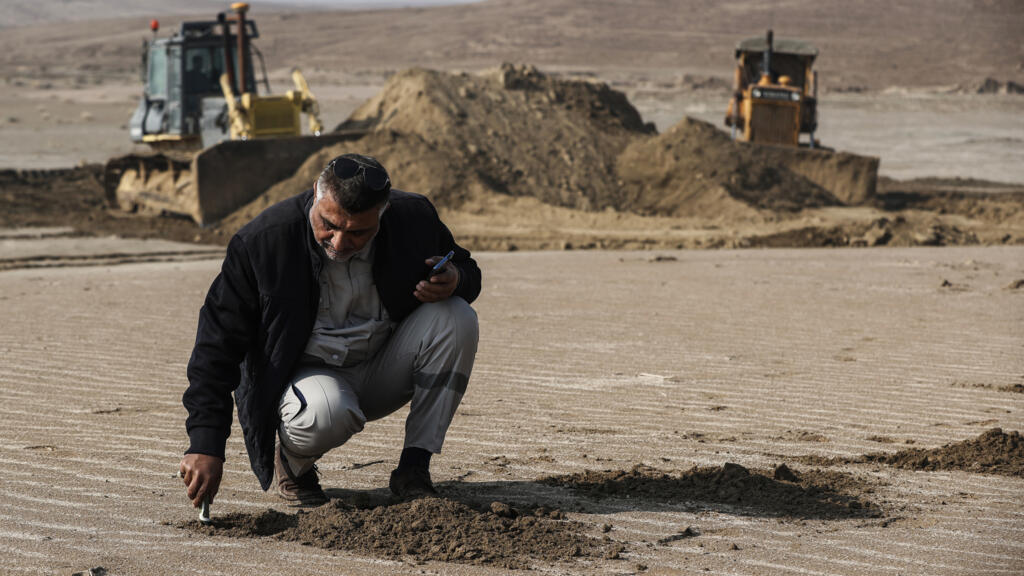
In a relatively small area between the cities of Nasiriyah and Samawah, not far from ancient Sumerian ruins, labourers are working hard to stabilise the soil by applying a layer of moist clay 20–25 centimetres thick.

The project also includes planting heat-tolerant seedlings like Prosopis and Conocarpus to further stabilise the soil.


A short-term objective is to shield a southern highway where many traffic accidents have occurred due to poor visibility during dust storms © AHMAD AL-RUBAYE / AFP


"The main goal is to reduce the impact of transboundary dust storms, which may reach Kuwait, Saudi Arabia and Qatar," said Udai Taha Lafta from UN-Habitat, which is leading the project to combat sandstorms with Iraqi expertise.

"It is a vital area despite its small size, and will hopefully help reduce dust storms next summer," Lafta said.

A short-term objective is to shield a southern highway where many traffic accidents have occurred due to poor visibility during dust storms.
'Slow but steady'

The Ministry of Environment estimates that Iraq now faces about 243 storms per year, and the frequency is expected to increase to 300 "dust days" by 2050 unless drastic mitigation measures are adopted.

In 2023, Iraqi authorities teamed up with the UN-Habitat and the Kuwait Fund for Arab Economic Development in areas that have been identified as major sources of sandstorms.

The project has been implementing several methods in three southern areas, including digging water canals and supplying electricity to pump water from the Euphrates river, preparing barren lands for vegetation.

Between the cities of Nasiriyah and Samawah, not far from ancient Sumerian ruins, labourers are working hard to stabilise the soil by applying a layer of moist clay
 © AHMAD AL-RUBAYE / AFP


One of the project's ultimate goals is to increase green spaces and for farmers to eventually sustain the lands after droughts and chronic water shortages have drastically reduced agricultural areas.

Qahtan al-Mhana, from the agriculture ministry, said that stabilising the soil gives agricultural efforts in sandy areas a chance to endure.

He added that Iraq has extensive "successful" experience in combating desertification and dust storms by stabilising sand dunes.

Since the 1970s, the country has implemented such projects, but after decades of turmoil, environmental challenges have largely fallen by the wayside.

With the severe recent impact of climate change, "work has resumed," said Najm Abed Taresh from Dhi Qar University.

"We are making slow but steady progress," Taresh said.

© 2025 AFP
Stigma and sisterhood: how one Kenyan woman knitted a healthcare revolution

Mary Mwangi turned to her knitting needles for solace during her cancer treatment – and then used them to help other women survivors reclaim their dignity.


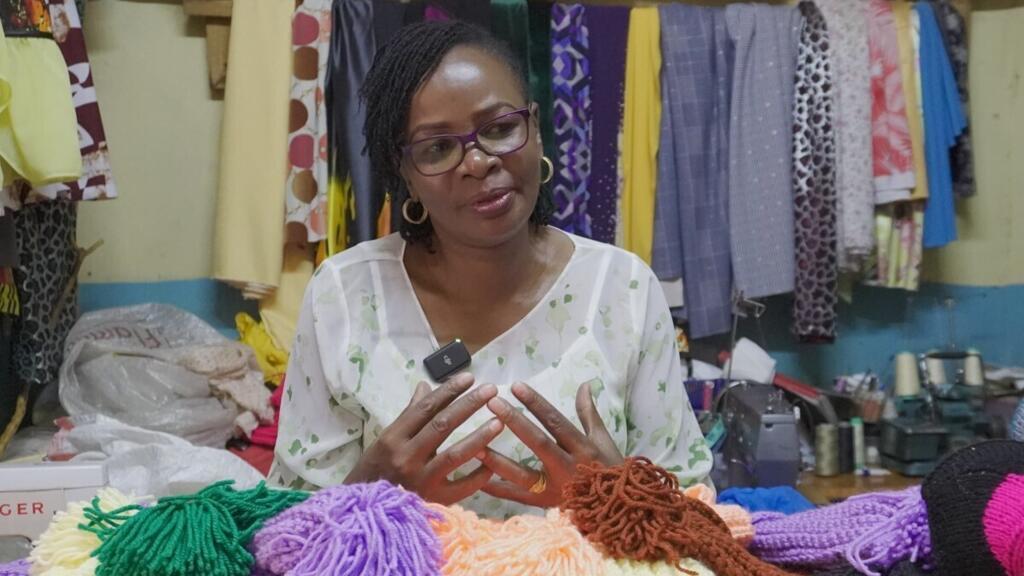
Mary Mwangi at her small shop, where she knits prostheses and teaches other women how to do the same. © Mary Mwangi

By: Anne Macharia in Nairobi
Issued on: 27/12/2025 - RFI

The first thing you notice about Mary is her laughter – warm, loud, and quite unexpected from one who has faced death twice.

Inside a tiny tailoring shop in the town of Thika, near the Kenyan capital Nairobi, rolls of fabric spill off the shelves and sewing machines hum. Mary sits in one corner, yarn in hand, looping stitch after stitch with meditative focus.

Knitting was not always her livelihood, it was once just a childhood hobby, forgotten somewhere between raising three children and building a business. It only resurfaced in 2017, when her body forced her to slow down.

'I felt like the world had slapped me'

That year, Mary was diagnosed with spinal cancer and was bedridden for 11 months. She remembers the silence in her house, the long days and the longer nights, and a mind restless with fear. In an attempt to escape it all, she reached for her knitting needles.

“I just needed something to keep my mind from sinking,” she says, her fingers absently tracing the rim of a basket full of yarn.

She began knitting hats and donating them to cancer patients at Kenyatta National Hospital.

A year later, her cancer was back – this time, stage three breast cancer. Mary remembers the doctor's voice fading into a blur as she was told the news.

"I felt like the world had slapped me," she says. She turned off her phone and withdrew from her friends, telling her husband she didn't want to speak to anyone. "Everything felt violent. Even the air."

Her treatment was gruelling – a mastectomy, 33 rounds of radiotherapy, endless visits to the hospital. Her hair disappeared. Her savings vanished. The loan of $10,000 she had taken out to expand her small tailoring shop was swallowed up by medical bills.
'A common wound'

But what cut deepest for Mary was the stigma around losing her breasts.

“People whispered. They called me ‘the woman whose breasts were cut'. Losing them, and your sense of dignity and womanhood... it's not something you can prepare for,” she says.

When Mary was well enough to walk around the cancer ward, she saw other women draped in scarves and oversized jumpers, disguising the area where a breast used to be.

"The conversations revealed a common wound: stigma and silence," she says.

Silicone prosthetic breasts cost far more than most of these women can afford. So Mary turned again to the thing that had got her through her illness – her knitting, But this time she had a different purpose in mind.

She learned how to make soft yarn breast prostheses, mastered the technique with YouTube videos and long nights of trial and error.

"Knitting saved me mentally," she says. "It pulled me from fear into purpose."

Small shop, big dreams

Today, Mary's tailoring shop is more than a business, it's a sanctuary.

As the staff work the machines, Mary sits by the window knitting prosthesis after prosthesis – round, soft and colourful. She sells them for 1,500 shillings each, and organisations buy them in bulk to donate to cancer survivors.

She has now made more than 600 prostheses and more than 450 hats, and the orders just keep coming.

Every week, Mary also holds classes teaching women – many of whom are fellow survivors – how to knit the prostheses, in order to earn an income.

Hannah Nungari Mugo is a former vegetable seller, who says she felt her identity fade away after her 2019 mastectomy.

"People treated me like a broken thing," she says. Knitting gave her something to hold on to, and she now makes around even prostheses a week.

Mary Patricia Karobia, who had a liver transplant, says she too knows what that stigma feels like. “I heard people whisper about my liver being removed." For her, knitting is about healing, and showing others her strength.

Mary hopes one day to be able to train women throughout Kenya, but space and finances are standing in her way for now.

"Cancer took a lot from me," she says, looking down at the colourful prostheses on her table. "But it also gave me purpose. And I want to pass that purpose on."