Monday, December 29, 2025


DESPITE TARIFFS 

China’s BYD poised to overtake Tesla in 2025 EV sales


By AFP
December 29, 2025


Chinese automaker BYD has been looking to expand overseas sales of its electric vehicles - Copyright AFP Ina FASSBENDER


Elodie Mazein and AFP correspondents in Beijing

Growing Chinese auto giant BYD stands poised to officially surpass Tesla as the world’s biggest electric vehicle company in annual sales.

The two groups are expected soon to publish their final figures for 2025, and based on sales data so far this year, there is almost no chance the American company led by Elon Musk will retain its leadership position.

At the end of November, Shenzhen-based BYD, which also produces hybrid vehicles, had sold 2.07 million EVs so far in 2025.

Tesla, for its part, had sold 1.22 million by the end of September.

Tesla’s September figures included a one-time boost in sales, to nearly half-a-million vehicles in a three-month period, before the expiration of a US tax credit for buyers of electric vehicles — which ended under legislation backed by President Donald Trump, a climate change skeptic.

But Tesla’s sales in the coming quarter are expected to fall to 449,000, according to a FactSet analysis consensus. That would give Tesla about 1.65 million sales for all of 2025, a drop of 7.7 percent and well below the level BYD had attained by end November.

Deutsche Bank, which projects just 405,000 Tesla EV sales during the fourth quarter, sees the company’s sales down by around one-third in both North America and Europe, and by one-tenth in China.

– Transition period –

Industry watchers say it will take time for EV demand to reach a level of equilibrium in the United States following the elimination of the $7,500 US tax credit at the end of September 2025.

Even prior to that, Tesla had seen sales struggle in key markets over CEO Musk’s political support of Trump and other far-right politicians. Tesla has also faced rising EV competition from BYD and other Chinese companies and from European giants.

“We believe Tesla will see some weakness on deliveries” in the fourth quarter, said Dan Ives of Wedbush Securities.

Sales of 420,000 would be “good enough to show stable demand,” with Wall Street “laser focused on the autonomous chapter kicking off in 2026,” Ives added, referring to plans for self-driving vehicles.

Even as it has grown quickly, BYD has faced challenges in its home market.

With profitability in China weighed down by price-wary consumers, the company has sought to strengthen its foothold in foreign markets.

BYD is “one of the pioneers to establish overseas production capacity and supply chains for EVs,” Jing Yang, Director of Asia-Pacific Corporate Ratings at Fitch Ratings, told AFP.

“Going forward, its geographical diversification is likely to help it to navigate an increasingly complicated global tariff environment,” said Yang.

Overseas rivals to BYD have balked at Chinese state subsidies and other state supports that have allowed the company to sell vehicles cheaply.

Trump’s predecessor Joe Biden imposed 100 percent tariffs on Chinese EV imports that could potentially go even higher under Trump. Europe has also imposed tariffs on Chinese imports, but BYD is building manufacturing capacity in Hungary.

While the chance of Tesla reclaiming its global leadership in EVs looks uncertain, the American company is also potentially positioned for growth.

Michaeli of TD Cowen sees autonomous technology playing an increasingly important role for Tesla, with breakthroughs in its “full self-driving” or “FSD” offerings potentially boosting sales.

“As Tesla really begins to roll out eyes-off features and expand FSDs capability, if they do that successfully, that should generate more demand for their vehicles,” Michaeli said.

Musk has said the Cybercab, an autonomous robotaxi model, will begin production in April 2026. The company has also unveiled lower-priced versions of the Models 3 and Y that could boost sales.
New year brings new mayor for New York City


By AFP
December 29, 2025


Raphaëlle PELTIER

New York mayor-elect Zohran Mamdani is set to become the US city’s first Muslim mayor, and the youthful optimism of his Democratic Socialist platform will be put to the test as he takes office Thursday for a four-year term that faces high expectations.

– Festive swearing in –

Just after the stroke of midnight on New Year’s Eve, New York Attorney General Letitia James — friend to Mamdani, foe to President Donald Trump — will swear in the new mayor. In a high-stakes tit-for-tat, James recently sued Trump, and he tried to have her indicted in return.

At midday, left-wing icon and Vermont Senator Bernie Sanders will preside over a ceremony outside City Hall.


The future mayor of New York Zohran Mamdani enters office January 1. — © AFP/File CHARLY TRIBALLEAU

At a neighborhood celebration, festivities will echo “one of his core messages… that this is a great city, and we like living here,” said Lincoln Mitchell, a Columbia University political science professor.

– Policy agenda –

The mayor-elect, an avowed socialist, campaigned on addressing the prohibitive cost of living in the metropolis of 8.5 million.

One of his key proposals is freezing rent on more than a million apartments, but it’s unclear if the city board that handles rent control — packed with appointees of outgoing Mayor Eric Adams — will be supportive.

Details of Mamdani’s other campaign promises — the construction of 200,000 units of affordable housing, universal access to childcare, publicly owned supermarkets and free buses — have yet to be spelled out.

But Mamdani has one ace in his pocket: an excellent relationship with New York Governor Kathy Hochul, who approves measures like the tax hikes he seeks.

Once an election is over, “symbolism only goes so far with voters. Results begin to matter a whole lot more,” New York University lecturer John Kane said.

– Opposition to Trump –

Despite expectations to the contrary, the late November Oval Office meeting between Trump and Mamdani was cordial and calm.

Mamdani “wisely sought a point of common ground with Trump: wanting to make New York City a better place to live,” Kane said.

Trump can “be surprisingly gregarious toward those that he perceives to have little leverage over,” Kane added.

Federal immigration officers are increasingly active in New York, which could become a flashpoint.

– Reassuring the public –

At 34, Mamdani is one of New York’s youngest mayors and his political resume is short — he’s held office once previously, as a local representative in the State Assembly.


New Yorkers have taken note of Mamdani’s enthusiastic support of his wife, Rama Duwaji.— © AFP

To compensate, he is surrounding himself with seasoned aides, recruited from past mayor’s offices and former president Joe Biden’s administration.

Mamdani has also already opened dialogue with business leaders, some of whom predicted a massive exodus of wealthy New Yorkers if he won. Real estate sector leaders debunked those claims in recent weeks.

As a defender of Palestinian rights, the mayor — Muslim and of Indian origin — will also have to reassure the Jewish community of his inclusive leadership style.

Recently, one of his hires resigned after it was revealed she had posted antisemitic tweets years ago.

– ‘Cultural figure’ –

“The mayor of New York is always a cultural figure,” Mitchell said.

Mamdani has already captured some of his generation’s cultural trappings with his brief forays into rap music, improv classes in Manhattan, and wearing what the New York Times called “the quintessential entry-level suit for a 30-something striving to be taken seriously.”

New Yorkers have also noted his enthusiastic support of his wife, Syrian-born artist Rama Duwaji, with approval.

Her Instagram account has gained more than a million followers since November, according to Social Blade statistics.

And on the cover of The Cut, New York magazine’s revered fashion and culture publication, she recently marked her own path — the hallmark of every young generation of city dwellers striving to make it there.

“At the end of the day, I’m not a politician. I’m here to be a support system for Z and to use the role in the best way that I can as an artist,” she said.


UK

What does Andrea Egan’s election as the new Unison general secretary mean for workers and Labour?

Today
Left Foot Forward

While Egan's election has been branded a blow to Labour, it also reflects workers' desire for more vocal, strike-ready union representation.


Left-wing challenger Andrea Egan defeated the incumbent Christina McAnea in the Unison general secretary election on 17 December. The trade unionist and social worker from Bolton, who was expelled from Labour in 2022 for sharing articles from Socialist Appeal and has expressed support for Your Party, will take over leadership of Britain’s largest union in January. What does this mean for the Labour movement and the workers it represents?

In a post on X, Labour MP Clive Lewis called her election “a turning point for the Labour party” and politics in the UK.

Lewis added: “She’s calling time on Reform, Thatcherism and those that support its bastardised form, 40 years on.

“A rallying cry to get behind.”

Egan’s challenge to anti-union politics

These comments came after Egan published an op-ed in the Guardian last Friday, saying Unison will not prop up politicians who are hostile to unions. Egan vowed that she will bring support for “the destructive right wing of the Labour party to an end”. She was critical of Wes Streeting’s handling of the resident doctor dispute, saying it was “simply unacceptable for a Labour politician to describe striking workers as morally reprehensible”.

She also suggested that it is likely that Labour will hold a leadership election in 2026, and that “swapping Starmer out for Streeting or anyone else from the right wing of the party would be no solution to the gigantic challenges facing the country”.


A new approach to leadership

McAnea, an ally of Keir Starmer, had been more critical of the government in recent months, but she has never said she would reconsider Unison’s relationship with Labour. Before McAnea took over as the health union’s general secretary in 2021, Dave Prentis held the position for 19 years. While membership grew to 1.3 million members during his leadership, and he advocated for a real living wage and fought against Private Finance Initiatives and the privatisation of the NHS, critics viewed his leadership as being somewhat cautious and risk-averse.

Even before Egan has taken up her new role, she has made clear she is willing to upend that approach, calling for an end to what she has described as Unison’s “subservience” and “blank cheques” to Labour.

Unite general secretary Sharon Graham has also previously suggested the union could withdraw its support for Labour.

Speaking at the Durham Miners’ Gala in July, Graham said Unite could “leave” or disaffiliate from the party, adding that the union would “forge a new vehicle for our class” and be “an authentic voice for the working class”.


Reviewing Unison’s relationship with Labour

For Unison to disaffiliate, the union would need to pass a rule change. This would require a resolution to be passed at a National Delegate Conference with at least a two thirds majority of delegates voting in favour of the change. While Egan was elected as the new Unison general secretary on 60% of the vote, the turnout in the election was only 7%.

While Egan may be minded to push for Unison to disaffiliate from Labour, that would need the backing of the membership. For now, she has said she will review Unison’s relationship with Labour and the role of Labour Link, which manages how subscription fees are spent on Labour campaigns, to “examine how we can get value for money”. She has also said she will oppose giving funding to Labour MPs and candidates “who fail to stand against welfare cuts and other attacks on our members’ living standards”.

Workers’ frustrations

In addition, although Egan’s win has been portrayed as a blow to Keir Starmer and the Labour leadership, her victory also reflects broader frustrations among workers dealing with the cost-of-living crisis and their deteriorating pay and working conditions.

Egan is the first “lay member” to become general secretary and described herself as “straight talking” and “working class” in her campaign. A core argument of the social worker’s campaign was that, while Unison is the largest union in the NHS, “recently it hasn’t felt like it”. She argued that while Unison has an annual subscription income of £200 million, the current general secretary, McAnea, has failed to raise the profile of Unison, meaning it has “too often” not delivered on pay, safer staffing levels and violence at work.

To deliver better pay and conditions for workers, Egan wants to make Unison more ‘strike-ready’. Her manifesto stated this will involve her studying how other unions run successful industrial action and ensuring branches are ready to run ballots and strikes. Egan will also review why Unison does not currently run multiple ballots at once and will reassess the amount of strike pay the union provides.

While Egan’s win may signal opposition to the Labour leadership, it also reflects members’ desire for a more vocal, strike-ready union. For those frustrated with risk-averse or conservative leadership within unions, Egan looks set to deliver a very different approach.

Olivia Barber is a reporter at Left Foot Forward
Blondeness as a Form of Sacrifice
TRIBUNE
12.29.2025

A timely new book published this year by the cultural critic Philippa Snow observes how the female celebrity magnifies the experiences of her everyday civilian counterparts, using examples from Pamela Anderson to Amy Winehouse.


There’s a meme I think about all the time: a grainy picture of a huge vertical brush, the kind you see in a drive-through car wash, first stationary and drooping, then spinning and puffed-up. ‘To be a woman is to perform’, it reads — an absurd medium reflecting the absurdity of the feminine act of performance.

Cultural critic Philippa Snow’s book It’s Terrible the Things I Have to Do to Be Me: On Femininity and Fame is a more serious, but no less entertaining or essentially true, look at this phenomenon. Through a series of interlinked essays, Snow examines seven pairs of twentieth- and twenty-first-century British and American female celebrities — singers, models, actresses, and multi-hyphenates — to interrogate the tensions between femininity and fame. Crucially, she also shows how much the performance(s) of womanhood cost us all, arguing that the female celebrity’s experiences and attributes are ‘much like those of her civilian counterparts, but magnified into something stranger, more bombastic, and far easier to see from a distance’.

Snow has long been a fascinating voice on contemporary celebrity culture, offering thoughtful and well-researched takes on the Hiltons and Kardashians of this world. Her 2024 book Trophy Lives: On the Celebrity as an Art Object positioned the celebrity as a self-made art object, taking the fame-entangled works of Richard Prince and Urs Fischer to their logical extreme end points. It’s Terrible the Things I Have to Do to Be Me arrives amid an overhaul of 2000s celebrity culture, with books like Sophie Gilbert’s Girl on Girl and Britney Spears’s The Woman in Me exposing the misogyny of the era and arguing for a humane reassessment of the women caught up in it.

Many of Snow’s subjects are from this particularly cursed era, but her pairings illustrate the culture’s stubborn roots in the twentieth-century star system. Lindsay Lohan’s narrative of child star to untamed woman is traced back to the trajectory of Liz Taylor. Anna Nicole Smith’s particular brand of bleach-blonde tragedy is a mirror of her idol Marilyn Monroe’s ‘blondeness as a form of sacrifice’ (Snow argues that Monroe married ‘the abstract idea of heterosexual masculinity the way a nun might be said to marry Christ’). Amy Winehouse takes artistic inspiration from Billie Holiday but also shares her ultimately fatal hunger for extreme hedonism. Kristen Stewart’s refusal to conform to industry standards is compared to the silent film icon — and fellow queer artist — Louise Brooks.

In an essay on Britney Spears and the R&B singer Aaliyah, Snow shows empathy for both women, while demonstrating the stark difference in public support, respectively, for white and black victims of abusive men. While Spears was (eventually) freed from her father’s conservatorship, Aaliyah never lived to see R. Kelly — who controlled her career and married her when she was 15 — face the consequences for his systematic abuse of young black girls.

It’s Terrible… is rigorous but also intensely readable. Snow is a great storyteller, pulling from a kaleidoscope of often unexpected sources and references. Lindsay Lohan’s life plays out as a Powell and Pressburger film: a psycho-sexual melodrama in tabloid technicolour. Snow takes Werner Herzog’s admitted enjoyment of Anna Nicole Smith’s MTV reality show as a prompt for framing Smith as a Herzogian protagonist, embodying the kind of exaggerated, grotesque ‘ecstatic truth’ the great director’s work aims towards. She compares Smith to the titular character of Herzog’s The Enigma of Kaspar Hauser: ‘a feral foundling … rescued by a rich older man, made into a celebrity, then eventually destroyed’. Her references to art and cinema aren’t just novel, but consistent with Snow’s treatment of the audience as people who — like Herzog — see so-called high- and lowbrow art as part of the same continuum, worthy of the same serious consideration. As it should, her thesis laughs in the face of ‘guilty pleasures’.

The only exception comes in the chapter on Louise Brooks and Kristen Stewart, a generational talent who found fame in the 2008–12 franchise Twilight. Snow admits that Stewart’s talent was underestimated at this time, but her belittling of the franchise as a whole — and her dismissal of the first instalment’s director, Catherine Hardwicke — is surprising considering her generous attitude elsewhere. Snow’s description of Stewart’s early rejection of a traditional star image doesn’t necessarily reckon with the image that she currently occupies. It would have been exciting to read Snow’s take on the tension between this ‘rejection’ and her status as the face of Chanel, or as arguably the contemporary face of female queerness — which, despite her considerable talent and charms, is still one of whiteness and thinness.

Similarly, I wanted to read more of Snow’s thoughts about Pamela Anderson’s current makeup-free look — only touched upon in her chapter — and the arguably constructed authenticity of her present-day vegan earth mother persona. However, these further explorations would probably require a much longer book. Several essays beg to be expanded: the chapter on Amy Winehouse and Billie Holiday is a kind of Matryoshka doll, a meta-analysis of the star through her influences and her depictions onscreen that begs a follow-up concentrating on celebrity biopics.

Snow’s most consistent theme is the death drive that she views as inherent to female celebrity, such as the compulsion to kill the ordinary self to become the star and the death wish that comes with the torture of fame. The face of Lindsay Lohan betrays a woman ‘equally afraid of life and death’; Liz Taylor’s portrait by Andy Warhol is interpreted as a death mask; Kristen Stewart has an affair with a married man in order to ‘dramatically explore her life, which she believes intends to kill her via gradual suffocation’.

How to survive an industry — or a world — that consistently drives you into the ground? An answer for Snow is suggested by both Pamela Anderson and the British model Tula, aka Caroline Cossey, often cited as the first mainstream transgender model. Both women stay in control by constructing a dazzling, glamorous public self while keeping hold of it as a construction, distancing themselves from it on their own terms. ‘To survive as a professional babe in a world that both wants you and wants to destroy you,’ Snow states, ‘it is necessary to know how and when to — as if by simply saying abracadabra — make yourself disappear’.

It’s Terrible the Things I Have to Do to Be Me: On Femininity and Fame by Philippa Snow is published by Virago Press.
Contributors

Claire Biddles is a freelance music writer and radio host.
Big success for general strike in Portugal

Monday 29 December 2025, by Antonio Louçã


Portugal’s minority right-wing conservative government (Democratic Alliance) planned to survive thanks to the parliamentary support, alternately, of the Socialists (PS) or the far right. It succeeded in getting the general state budget for 2026 adopted thanks to the abstention of the PS and then intended to pass a set of new employment laws with the complicity of Chega (far right). However, the general strike of 11 December has plunged this project into uncertainty.

A violent attack on the world of work

The government’s confidence in the two “oppositional” pillars that supported its parliamentary minority was such that it dared to announce the most radical legislative package in recent decades. It went far further in its anti-working-class, anti-people brutality than any other government in the fifty years that the counterrevolution has just celebrated. Even the various governments with an absolute majority of the right, after 1975, never dared to consider the extreme measures contained in this “employment package”.

Among the many provisions provided for are, in particular, an unlimited green light for individual dismissals, nullity of judgments ordering the reinstatement of a dismissed worker, the right for the employer to call on external companies to carry out the work of the dismissed persons, the obligation for workers with young children to accept weekend hours, and the implementation of an individual hour counter so that overtime is no longer paid as such, among other things.

And suddenly, the reckless government of Luís Montenegro realized that the conservatives’ comfortable parliamentary majority, backed by the fascists and the PS, and the prospect that only two right-wing candidates would qualify for the second round of the presidential elections in January, no longer corresponded to the revolt of the real country.

At the beginning of December, the polls already showed broad popular support for the call for a general strike, and the indications of the polling institute Vox Populi already reflected the willingness to strike of many people who had never participated in a strike in their lives. The government has tried everything to dissuade the population from joining the strike, promising to raise the minimum wage from 870 euros to 1,600 euros and the average salary from 1,600 euros to 3,000 euros. But these extravagant promises, without any date or guarantee, were ignored.

Unprecedented participation in the strike

On the day itself, participation in the strike reached an unprecedented level. The CGTP, a trade union federation with a Communist majority, estimated the number of strikers at 3 million out of a working population of 5.3 million people. The UGT, a trade union federation with a Socialist majority, announced an even higher figure. Participation statistics are always controversial, but, regardless of the accuracy of the calculations, the strike has demonstrated its strength in an undeniable way by paralyzing essential services.

Public transport was paralyzed in almost the entire country. The Lisbon metro had to close its doors. Trains that were not subject to minimum services were totally paralyzed, and many of those that were included in the minimum services also did not run. At Lisbon airport, the strike led to the cancellation of 400 flights. The boats that cross the Tagus have remained docked. Most schools closed and the strike in education lasted until the next day, 12 December. In hospitals, consultations and scheduled operations were cancelled, with only emergencies being taken care of. Household waste was not collected. Large private companies, such as Auto-Europa, a subsidiary of Volkswagen and the country’s largest exporter, completely ceased activity.

The minister of the Presidency, Leitão Amaro, made a fool of himself by declaring on television that the strike was “insignificant.” The country’s most popular joke became the comparison between this character and Saddam Hussein’s propaganda minister, who continued, unperturbed, to assert in front of the cameras the successes of the Iraqi forces, while the sound of imperialist artillery was already heard in the background of his own broadcast. The man who has gone down in history under the name of “Comical Ali” now has in Amaro a second-rate imitator.

The irrefutable facts speak a more serious and completely different language. Faced with the success of the general strike, the government deemed it prudent to put aside its proclaimed intransigence and announced that it would reopen negotiations on the “employment package.” When the union reopens, it wants only the UGT as an interlocutor, in order to sow discord between the two trade union federations which, since 2013, had never called for a general strike. Another telling fact has been the dramatic change in the position of the far-right Chega party: while a month ago it praised the general meaning of the new laws announced and vilified the call for a strike, it has now shown sympathy for the strikers’ motivations. This apparently means that the “employment package", as it stands, will no longer be able to count on a parliamentary majority.

The confrontation continues

This first success of the workers’ struggle does not mean that the danger has vanished. The government and the employers’ confederations will look for another way to impose their neoliberal agenda and ultimately create a regime of unbridled capitalism without any legal impediments. To do this, they will be able to count on the complicity of the far right and the PS, but also on the collaborationist or, at the very least, demobilizing attitude of the union leaderships.

The UGT declared, just after this day of general strike, that a second strike could be necessary if the government remained intransigent on the substantive issues. This seems a combative attitude, but, in reality, before making a threat that it cannot hold alone, the UGT should have refused the role of sole interlocutor offered to it by the government. As things stand, and knowing the UGT’s track record, the threat of a second day of strike action can only be seen as rhetoric designed to negotiate a few minor concessions at the bargaining table.

The CGTP, for its part, did not get involved this time in the generalized organization of picket lines, limiting itself in many cases to supporting only those organized at the initiative of the rank-and-file. And during the large, young and combative demonstration that it called to go to the parliament, it was content to give the usual speeches to be heard by the head of the procession. It immediately left the area, while columns of protesters continued to pour in for several hours, fighting through the narrow streets to enter the square in front of the parliament. In leaving the premises, the CGTP also abandoned the demonstrators who had responded to its call and who had trusted its leadership, leaving them without instructions, facing the police and at the mercy of provocations that then gave rise to a ferocious repression.

15 December 2025

Translated by International Viewpoint from marx21.ch.

Attached documentsbig-success-for-general-strike-in-portugal_a9333.pdf (PDF - 911.4 KiB)
Extraction PDF [->article9333]

Portugal
The general strike demonstrates that struggle can open up paths for the left
Towards the General Strike in Portugal - Only the strength of those who work can halt the labour package
The bromance between André Ventura and Luis Montenegro in Portugal
“There is a strategic impasse on the left on the issue of race”
Building an anti-liberal left in Portugal is difficult but necessary
Trade unions/workplace organizing
After three days of strike, a vast social movement with no political alternative
Starbucks Workers Continue Strike for Union Contract
1995, the year of the social movement
Support the struggle of the Valeo workers in Poland
China’s labour movement under fire

Antonio Louçã is a journalist in Portugal.


Wagner’s atrocities in Mali

Sunday 28 December 2025, by Paul Martial


In Mali, the violence exerted by Russian mercenaries against the civilian population is taking place in a climate of total impunity, without condemnation or reaction from the Malian authorities. This strategy of terror worsens an already catastrophic security and social situation.


The country’s president, Assimi Goïta, who came to power in a putsch, justified his coup by the previous regime’s inability to defeat the jihadists. Nearly five years later, his record is catastrophic, both economically and security-wise.
Inhumanity

If the religious dimension of the conflict in Mali exists, it should not overshadow social and community issues. Peaceful solutions can only be political and developed by the people themselves. They are urgent, because the more the conflict drags on, the more acts of violence against civilians increase in quantity and horror.

Numerous reports detail the abuses committed by Wagner mercenaries. In Tinzaouaten, drones bombed the town in retaliation. In Moura, hundreds of people were executed for three days. The stories of Malian refugees in Mauritania evoke mass rapes. Journalists from Jeune Afrique have infiltrated a Telegram network called “White Uncles in Africa 18+”, where videos of executions and torture are sold in centres set up in Malian army barracks. Other videos, collected by investigators from the International Criminal Court, show scenes of corpses being butchered and even acts akin to cannibalism.

Testimonies collected by human rights organizations describe the burning of villages, looting and theft of the inhabitants’ meagre possessions. They also report kidnappings for ransom. The main victims are Malians from the Fulani or Tuareg communities, wrongly accused of being accomplices of the jihadists.
Deleterious effects

From the beginning of Wagner’s intervention, in December 2021, evidence of crimes against humanity has multiplied. The mercenaries seemed to act with impunity. The replacement of Wagner in 2024 by the Africa Corps, a structure directly dependent on the Russian Ministry of Defence, has unfortunately not changed this dramatic situation, and for good reason: more than 80% of the members of the company founded by Yevgeny Prigozhin have been integrated into the new entity.

The despicable behaviour of these mercenaries encourages the Malian military to more violence against civilians and accentuates divisions, even community hatred. Villagers forced to cooperate with the jihadists are considered accomplices by the Malian authorities.

The members of the Africa Corps obviously have no interest in seeing the situation in the country improve, because chaos remains a lucrative source of income for them.

In fact, Assimi Goïta guarantees total impunity to a foreign private military company that massacres its own compatriots, thus contradicting his claims to defend Mali’s sovereignty.

24 December 2025

Translated by International Viewpoint from l’Anticapitaliste.

Attached documentswagner-s-atrocities-in-mali_a9331.pdf (PDF - 904.9 KiB)
Extraction PDF [->article9331]

Mali
A dictatorship without complexes in Mali
Mali: the dead end of all-out war
West Africa: rivalry and division between leaders
The imperative of peace in Mali
Crisis in Mali - the position of the radical left

Paul Martial is a correspondent for International Viewpoint. He is editor of Afriques en Lutte and a member of the Fourth International in France.


Combatting Antimicrobial-Resistant Infections


“The Good Virus is the most important documentary film I have seen in years.”

Karl Drlica, Prof. of Microbiology, Biochemistry, and Molecular Genetics, New Jersey Medical School, Rutgers University

New from Bullfrog Films, The Good Virus explores the global efforts of leading scientists combatting one of the most pressing health challenges of our time: the urgent issue of antimicrobial-resistant infections (AMR).

AMR is already killing millions each year. Antibiotics are failing. What will we do when 10 million people are projected to die every year due to bacterial infections? The global medical community is out of solutions for antibiotic-resistant superbugs, and is turning to bacteria’s ancient enemy: bacteriophages. Scientists from all over the world are discovering phage therapy—”the good virus”—that destroys superbugs while leaving “good” bacteria unharmed.

The Good Virus travels the world to meet the heroes who are fighting to bring phages to our hospitals and pharmacies. Filmmaker Rosie Dransfeld was granted unprecedented access to this revolutionary treatment that could save us all. In its One Health approach, the film explores using phages to combat deadly bacteria in the environment, animals, and humans, and to create an equal healthcare system that gives low-income countries independence from Big Pharma.

Watch the trailer for THE GOOD VIRUS on Vimeo
WATCH THE TRAILER
Facebook

Bullfrog Films has become the leading US publisher of independently-produced documentaries on environmental and related social justice issues. Read other articles by Bullfrog Films.
I just wanted to save innocent people, says Bondi Beach hero Ahmed Al Ahmed

Ahmed Al Ahmed made global headlines for disarming one of two shooters who killed 15 people in Sydney on December 14.

TRT WORLD
DECEMBER 28, 2025

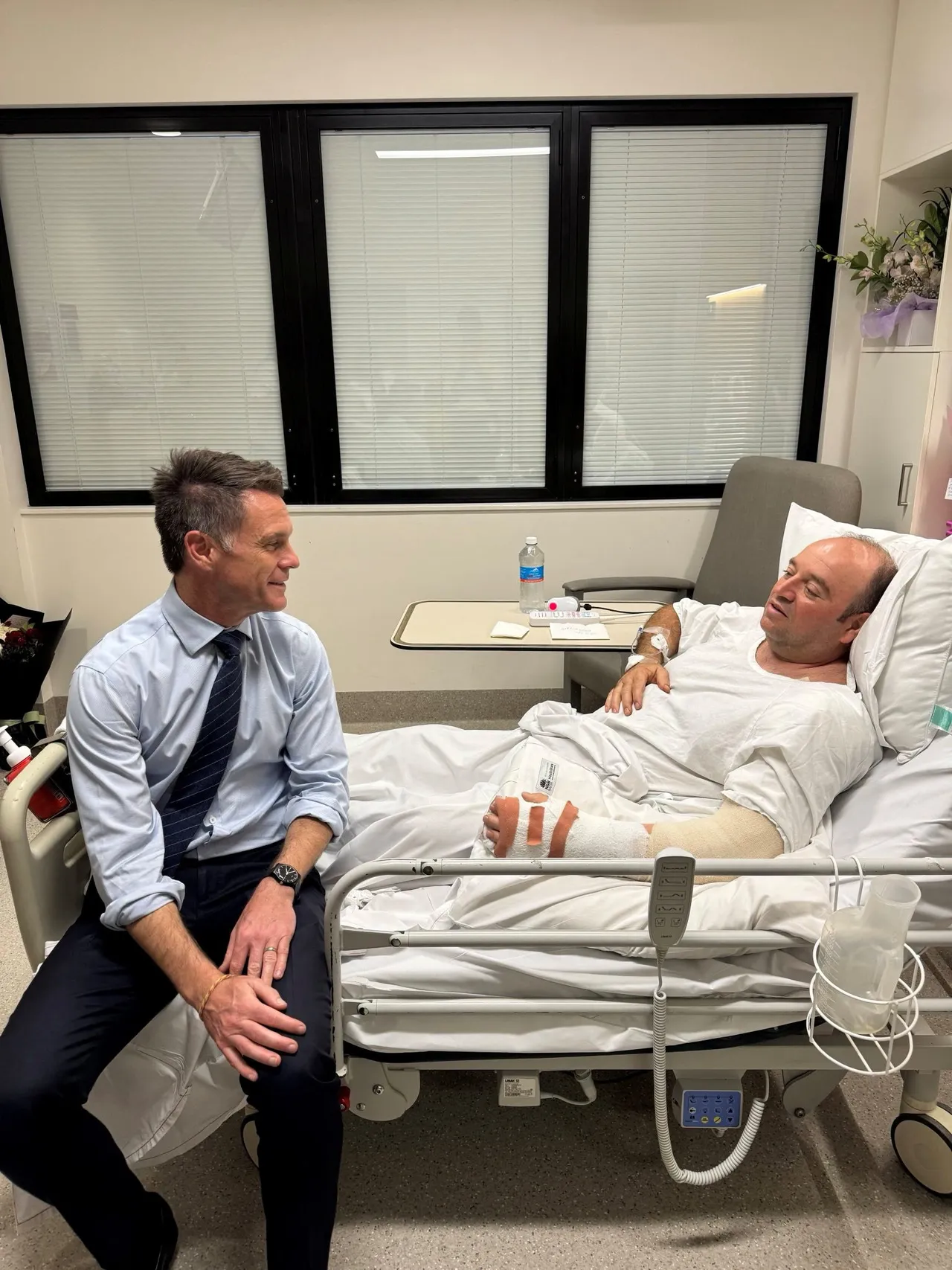
NSW Premier Chris Minns visits Ahmed al Ahmed at the hospital, in Sydney / Reuters

Global hero Ahmed Al Ahmed, who disarmed a gunman during the Bondi Beach shooting in Australia, said he wanted to stop the attacker from killing innocent people.

"My target was just to take the gun from him and to stop him from killing innocent people," Ahmed, who was born in Syria, said in an interview with CBS News.

On the evening of December 14, a man and his son opened fire on the beach in Sydney, killing 15 people and injuring 42 others. Police described the incident as a "terrorist attack."

Ahmed made headlines and won hearts around the world for his bravery when he pounced on one of the two shooters on Bondi Beach in Sydney, Australia's largest city and New South Wales' capital.


RelatedTRT World - ‘Stand with each other’ — Muslim hero of Bondi Beach turns tragedy into call for humanity


Ahmed said he "didn't worry about anything" except for the lives he could potentially save.

"I know I saved lots, but I feel sorry for the loss," he said.

Ahmad explained that to disarm the gunman, he “jumped” on his back and hit him, struggling to remove the weapon.

“I hold (held) him with my right hand and start saying a word, you know, like to warn him, drop your gun, stop doing what you're doing, and it all comes in fast," he said.

“And emotionally, I'm doing something, which is, I feel something, a power in my body, my brain ... I don't want to see people killed in front of me, I don't want to hear his gun, I don't want to see people screaming and begging, asking for help, and that's my soul asking me to do that,” he recalled.

"Everything in my heart, in my brain, everything, it worked just to manage to save the people's lives," Ahmad said.

One of the two shooters was killed, while the other was critically injured.

Australian Prime Minister Anthony Albanese has declared Syrian-born Ahmed “the best of our country.”

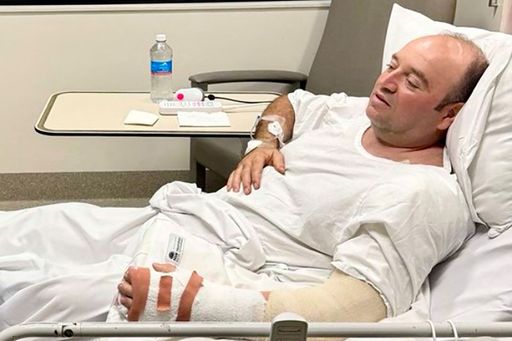
Ahmed, who moved to Australia in 2006 and is the father of two daughters, was shot four to five times in his left shoulder and is receiving treatment at Sydney's St George Hospital.


Bondi victims’ families demand national probe into antisemitism


By AFP
December 28, 2025


Copyright AFP Saeed KHAN


Laura CHUNG

Families of the victims of Australia’s Bondi Beach mass shootings called Monday for a national inquiry into antisemitism and alleged failures in policing, intelligence and policy they blame for the attack.

Father and son Sajid and Naveed Akram are accused of targeting a Hanukkah event on Sydney’s Bondi Beach on December 14, killing 15 people and wounding dozens in what authorities have described as an antisemitic terrorist attack.

Seventeen families urged Prime Minister Anthony Albanese in an open letter to “immediately establish a Commonwealth Royal Commission into the rapid rise of antisemitism in Australia” and examine “law enforcement, intelligence, and policy failures that led to the Bondi Beach massacre”.

“We demand answers and solutions,” they wrote.

“We need to know why clear warning signs were ignored, how antisemitic hatred and Islamic extremism were allowed to dangerously grow unchecked, and what changes must be made to protect all Australians going forward.”

Albanese has resisted calls for a federal inquiry, citing a need for urgent action rather than waiting “years for answers”.

“We need to get on with any changes that are required,” he told reporters Monday.

“I have nothing except sympathy for those families. My job, as prime minister, is to look at how we build unity, how we build social cohesion, how we do what the nation needs at what is a very difficult time.”

Albanese said last week that a New South Wales-led royal commission — where the shooting occurred — would suffice and promised full support.


– ‘Not enough’ –


Canberra has flagged a suite of reforms to gun ownership and hate speech laws, as well as an review of police and intelligence services.

Home Affairs Minister Tony Burke warned Monday that a national royal commission could give “some of the worst statements and worst voices” a platform to relive “the worst examples of antisemitism over the last two years”, which he said was not in the interest of unity or national security.

But the families of those killed said the federal government’s response is “not nearly enough”.

“We have lost parents, spouses, children, and grandparents. Our loved ones were celebrating Chanukah at Bondi Beach, a festival of light and joy, in an iconic public space that should have been safe,” the letter said.

“You owe us answers. You owe us accountability. And you owe Australians the truth.”

The families said the rise of antisemitism was a “national crisis”, adding the “threat was not going away”.

“We need strong action now. We need leadership now. You cannot bring back our loved ones. But with a well-led Commonwealth Royal Commission and strong action, you may be able to save many more.”

The call for a royal commission echoes voices in the broader Jewish community, legal experts and other politicans.

Alex Ryvchin, co-CEO of the Executive Council of Australian Jewry, said the government was not listening.

“We deserve answers. Only a royal commission has the coercive powers to get to the bottom of how this was allowed to happen and what needs to change in this country to prevent the next massacre,” he told national broadcaster ABC.

One of the gunmen, Sajid Akram, 50, was shot and killed by police during the attack. An Indian national, he entered Australia on a visa in 1998.

His 24-year-old son Naveed, an Australian-born citizen, remains in custody on charges including terrorism and 15 murders, as well as committing a “terrorist act” and planting a bomb with intent to harm.

He has yet to enter a plea.
CRIMINAL CAPITALI$M

South Korea’s former first lady took bribes and meddled in state affairs, prosecutor says

Special prosecutor alleges Kim Keon Hee took advantage of her status as president's spouse ‘to receive money and expensive valuables’

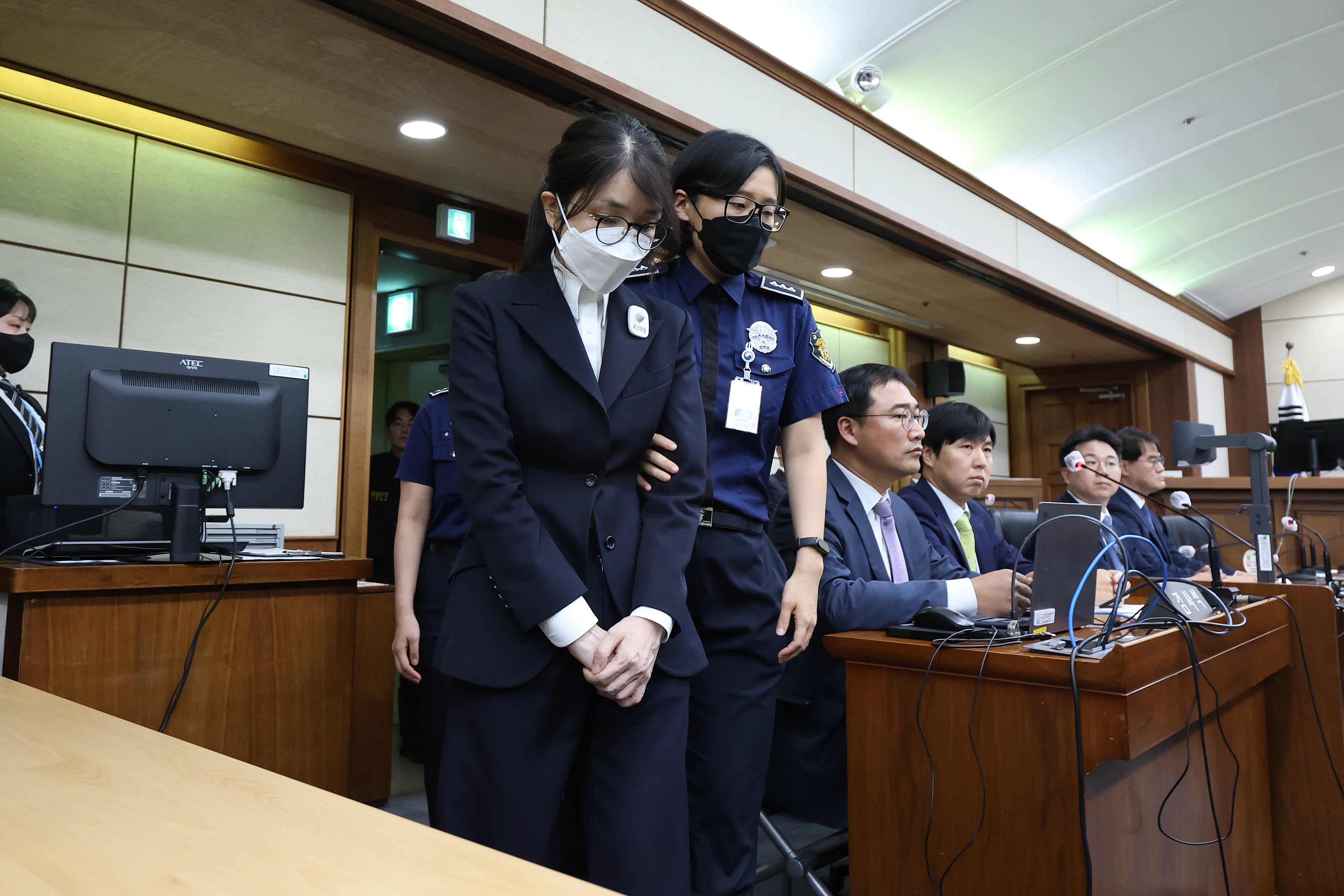
Kim Keon Hee arrives for her first trial hearing on corruption charges at the Seoul Central District Court on 24 September 2025 (Getty)

Monday 29 December 2025 
The Independent

 South Korean prosecutor on Monday alleged that the wife of the impeached president Yoon Suk Yeol allegedly accepted bribes totalling over $200,000 and interfered in state affairs.

The special prosecutor's investigation into the former first lady, which wrapped up on Sunday, came amid a year-long probe into the disgraced president’s brief imposition of martial law last year and related scandals linked to the once-powerful couple.

Kim Keon Hee was arrested in August and placed under investigation for allegedly manipulating stocks and receiving gifts from the cult-like Unification Church. She is also accused of meddling in elections.

The prosecutor earlier this month sought a 15-year prison sentence for Ms Kim, who denied wrongdoing and, during a court hearing, apologised to the public for sparking concerns through her conduct.

Ms Kim “took advantage of the status of the president's spouse to receive money and expensive valuables, and has been widely involved in various personnel appointments and nominations," special prosecutor Min Joong Ki said at a news conference marking the end of his investigation.

She "illegally intervened in state affairs behind the scenes, beyond the public's view", the prosecutor said, adding that the bribes from businesses and politicians taken by her totalled up to $263,000.

Ms Kim previously said that the allegations were "deeply unjust". "Yet when I consider my role and the responsibilities entrusted to me, it seems clear that I have made many mistakes," she claimed.

A lower court’s ruling in Ms Kim’s case is expected on 28 January.

“Investigations do not end because one says so, but are eventually completed with evidence in court," Ms Kim's lawyers said in a statement on Monday, adding that they would work "to ensure that procedural legitimacy and defence rights are thoroughly guaranteed so that facts are not exaggerated or distorted into political framing”.


The prosecutors are also trying Unification Church leader Han Hak Ja as her group is suspected of giving Ms Kim valuables, including Chanel bags and a diamond necklace, as part of an effort to win influence.

Ms Kim allegedly also received a painting by famed South Korean minimalist painter Lee Ufan, a Dior handbag and a watch.

Ms Han denies directing her church to bribe the then first lady.

"Various people who did not have a common denominator with each other visited Kim Keon Hee, not the president, and asked for what they wanted, and gave money and goods," assistant special prosecutor Kim Hyeong Geun, alleged. "As a result, their request was realised."

Mr Yoon is on trial for masterminding an insurrection by imposing martial law late last year, a charge that could mean a life sentence or even a death penalty. He denies the charges.

A lower court ruling on Mr Yoon is expected early next year.

6.0-Magnitude Earthquake Injures at Least 25 in Northern Lima, Peru

Lima, Dec. 29 (SANA) At least 25 people were injured in a 6.0-magnitude earthquake that struck Peru’s Ancash region north of the capital, Lima, authorities reported.

Agence France-Presse (AFP) quoted local authorities as saying that the earthquake, which occurred Sunday near the coastal city of Chimbote, caused injuries to at least 25 people and inflicted damage to the main hospital, as well as numerous homes and schools in the city, which has a population of about half a million.

Peru, with a population of around 34 million, lies within the Pacific “Ring of Fire,” a zone of high seismic activity that extends along the western coast of the Americas. The country was previously hit by a devastating earthquake in 1970 in the Ancash region, which claimed approximately 67,000 lives.