Monday, December 29, 2025

Trump is unpopular in Europe — even among right-wing populist supporters, POLITICO Poll shows


The US president gets favorable views from only about a third of people who support the parties Trump wants to see win power in France and Germany.


December 29, 2025 
By Hanne Cokelaere
POLITICO EU


U.S. President Donald Trump wants to grow Europe’s right-wing populist movement but he might have a harder time than he expects winning over European voters.

The MAGA leader is unpopular in Europe, even among the supporters of right-wing populist parties he sees as allies, according to the new POLITICO Poll in partnership with Public First, which surveyed more than 10,000 people across five countries earlier this month. His biggest fans are in Britain, where 50 percent of Reform-aligned respondents had favorable views of Trump. However, in France and Germany, only about a third of people who said they had supported right-wing parties reported seeing Trump in a favorable light.

The poll findings come after the Trump administration rolled out a new national security strategy aimed at cultivating the “growing influence of patriotic European parties,” which have drawn increasing support in France, Germany and the U.K., though they haven’t yet translated that into electoral wins.

The new POLITICO Poll data offers a potential warning to right-wing populist parties trying to attract broader support while also getting closer to Trump, as people who said they would support such parties in a new vote were more negative about Trump than those who supported them in the past across the U.K., France and Germany.

Divisive figure

Supporters of far-right populist parties tend to think more highly of U.S. President Donald Trump than others, but even they are divided. And support dwindles further among potential new voters, according to the results of The POLITICO Poll.

Percentage of respondents who said they have a positive or a negative opinion of Trump.


The U.S. president is even more unpopular across the general population. In France and Germany, two-thirds of respondents held a negative opinion of him. In the U.K., 55 percent reported negative views; barely more than in the U.S., where 50 percent said they had negative views. Trump is least popular in Canada, where 72 percent of respondents held a negative opinion.

Supporters of the “patriotic” right-wing populist parties the U.S. administration name-checked in its security strategy are far more supportive of the U.S. president than others but, crucially, not even they delivered a ringing endorsement.

In France, voters of the National Rally of French right-wing populist firebrand Marine Le Pen were broadly appreciative of her. But when it came to the U.S. president, more voters said they held a negative view (38 percent) than reported a positive one (30 percent). Alternative for Germany supporters overwhelmingly approved of party leader Alice Weidel, but were also divided over Trump, with 34 percent thinking well of him and 33 percent opposed.

The findings underscore the challenge facing the National Rally, which isn’t just catering to its past voter base but also trying to win broader backing ahead of local elections next year and a key presidential election in 2027. The party of right-wing populist firebrands Le Pen and Jordan Bardella is the third political force but the largest single party in the National Assembly, and is currently polling well ahead of other parties.

Its leaders were quick to dismiss White House efforts to support Europe’s right-wing forces. Bardella told The Telegraph that he rejected the “vassalage” of “a big brother like Trump,” and Thierry Mariani, a member of the party’s national board, told POLITICO that “Trump treats us like a colony — with his rhetoric, which isn’t a big deal, but especially economically and politically.”

The exception was Britain, where 79 percent of Reform supporters reported holding favorable views of their leader Nigel Farage as Trump found a bare majority of favorable views.

America First, friends second?


Across the U.K., France and Germany, right-wing populist supporters stood out because of their strong demand that political leaders put their own country first.

Fifty percent of National Rally voters, 47 percent of AfD voters, and 45 percent of Reform UK voters singled it out as one of the most important attributes in political leaders.


Right-wing populist respondents overwhelmingly agreed that this is a quality Trump possesses over French President Emmanuel Macron (88 percent), German Chancellor Friedrich Merz (93 percent) and U.K. PM Keir Starmer (91 percent). And a clear majority said they want their leaders to try and get along with Trump.

Local right-wing populist movements have a “nationalist instinct” in common, according to Jules Walkden, research manager at Public First — but that might ultimately put them on a collision course with Trump’s MAGA movement favoring U.S. interests.

“Supporters of Europe’s right-wing parties clearly want to see their leaders put their own country first, and they may see Trump as a champion of this approach,” Walkden said. “But once elected, the practical demands of delivering on a ‘country first’ promise may quickly expose the limits of this alignment.”

'Putting the country first'

Supporters of far-right populist parties tend to prize political leaders who "put the country first" and have more positive views about U.S. Donald Trump.

Share of respondents who voted for National Rally, Reform UK or AfD in the most recent election and who listed "putting the country first" as a key characteristic in political leaders, compared with the share that said they have a positive view of Trump.

 National

The POLITICO Poll data also suggests that right-wing populist supporters may admire Trump’s policies, but they don’t trust him.

Right-wing populist voters in France and Germany were likelier than others to think that Trump’s policies benefit the U.S. but also likelier to say that they harm other countries while doing so.

Again, Reform UK supporters were most open to Trump, with 42.8 percent saying everyone would benefit from Trump’s policies.

Across Germany, France and the U.K., right-wing populist supporters were far likelier to agree that when a country’s interests clash with allies, the country should come first. They were also more likely to say that domestic industry should be protected, if need be to the detriment of its global competitiveness. Nearly 67 percent of Reform UK voters, 71 percent of National Rally voters, and 72 percent of AfD voters indicated this in the POLITICO Poll.

In spite of that, supporters of those parties tended to be more accepting of the tariffs the Trump administration has put on European industries.

Sixty-five percent of AfD voters said the tariffs were bad for Germany but just 37 percent thought Germany should slap tariffs on the U.S. in return — well below the overall 47 percent of German respondents who favored this. In Britain, just 45 percent of Reform UK voters considered the tariffs a bad thing and just 35 percent said that the country should match U.S. tariffs with its own tariffs on U.S. imports.

Wary of Trump

Winners and losers of U.S. President Donald Trump's policies, as assessed by respondents to The POLITICO Poll.

Comparing results by country with the answers of respondents who said they voted for a right-wing populist party in the most recent election, the percentage of respondents who say Trump’s policies:

Table with 6 columns and 6 rows.
Benefit the U.S.Harm the U.S.
…but harm other countries…and benefit other countries…and harm other countries…and benefit other countries
FranceTotal37.4%13.1%21.0%9.3%
National Rally42.1%23.8%10.4%7.6%
GermanyTotal30.2%10.6%39.3%8.2%
AfD39.2%28.6%14.4%6.8%
U.K.Total33.3%20.4%27.4%5.2%
Reform UK30.6%42.8%9.4%3.6%


But in a sign that right-wing populist supporters’ appreciation of Trump would only go so far, 60 percent of National Rally voters said Trump’s tariffs on imports from Europe were a bad thing for France’s economy. And while they were less likely than others in France to say that their government should match those tariffs, 48 percent still favored retaliation.

This edition of The POLITICO Poll was conducted from Dec. 5 to Dec. 9, surveying 10,510 adults online, with at least 2,000 respondents each from the U.S., Canada, U.K., France and Germany. Results for each country were weighted to be representative on dimensions including age, gender and geography, and have an overall margin of sampling error of ±2 percentage points for each country. Smaller subgroups have higher margins of error.

The survey is an ongoing project from POLITICO and Public First, an independent polling company headquartered in London, to measure public opinion across a broad range of policy areas. You can find new surveys and analysis each month at politico.com/poll. Have questions or comments? Ideas for future surveys? Email us at poll@politico.com.
Much Talk, Little Outcome: Peace Efforts Yield No Breakthrough on Ukraine

December 29, 2025
NOVITIATE


US President Donald Trump said that Russian President Vladimir Putin has not accepted the idea of a ceasefire during a possible Ukrainian referendum on a proposed peace plan. Trump made the comments at a joint press conference with Ukrainian President Volodymyr Zelensky following their meeting, after Trump had spoken by phone with Putin in advance.

Asked directly whether Putin had agreed to halt the fighting during a referendum, Trump replied that there was no such agreement. He explained that Putin’s position was based on concerns that stopping hostilities and then potentially resuming them could put Russia at a disadvantage. Trump said he understood that logic but added that discussions were ongoing on how to address the issue.

Trump also claimed that, if the war ends, Russia would take part in Ukraine’s reconstruction. He said Moscow supposedly wants to see Ukraine succeed, although he acknowledged that this might sound contradictory. At the same time, Trump complained that unnamed “bad people” had spread false narratives that, in his view, had obstructed efforts by Washington and Moscow to reach agreements.

Earlier, on 23 December, Zelensky said Ukraine was preparing a 20 point peace plan that could either be approved by parliament or put to a nationwide referendum. He noted that such a referendum would require at least 60 days and would only be possible under a full ceasefire during that period. On 28 December, Zelensky and Trump met in Florida and later held a video conference with European leaders. Trump said ahead of that meeting that he had a “good and very productive” conversation with Putin. Putin’s aide, Yuri Ushakov, later stated that both leaders had agreed a temporary ceasefire under the pretext of a referendum would only prolong the conflict.

European leaders responded positively to the Florida talks and the subsequent video call. According to statements cited by Interfax Ukraine, they stressed the importance of joint efforts to secure a just and lasting peace and to keep pressure on Russia. The video conference followed closed door talks between Ukrainian and US delegations at Trump’s Mar a Lago residence.

Finnish President Alexander Stubb confirmed that the call included French President Emmanuel Macron, Polish President Karol Nawrocki, UK Prime Minister Keir Starmer, Italian Prime Minister Giorgia Meloni, Norwegian Prime Minister Jonas Gahr Støre, German Chancellor Friedrich Merz, NATO Secretary General Mark Rutte and European Commission President Ursula von der Leyen. Stubb said the discussion lasted more than an hour and focused on concrete steps to end the war.

Polish President Nawrocki underlined strong US engagement in the peace process and highlighted Poland’s role, noting that Rzeszów Jasionka airport has handled more than 90 percent of aid deliveries to Ukraine since the start of Russia’s full scale invasion. He said Poland’s position would be crucial in any peace agreement and stressed that regional security decisions must involve all stakeholders. According to his statement, US determination combined with European unity offered a real chance to end the war.

Von der Leyen also described the talks as productive and said significant progress had been made. Irish Prime Minister Micheál Martin welcomed what he called progress in the peace discussions and said he hoped it would soon lead to a ceasefire. Dutch Prime Minister Dick Schoof said positive signals from Washington must now be matched by concrete steps from Moscow, adding that the Netherlands would continue supporting Ukraine.

European foreign ministers echoed these messages. Dutch Foreign Minister Wopke van der Linde spoke about next steps in the talks and stressed the need to further increase pressure on Russia. Czech Foreign Minister Jan Lipavský described the outcome of the Zelensky Trump meeting as optimistic, saying Ukraine wants peace and that Russia must be pushed towards it through sanctions and a strong Ukrainian defence.

In a separate statement, von der Leyen said a one hour call with Trump, Zelensky and several European leaders had produced “good progress”. She added that Europe was ready to continue working with Ukraine and the United States to build on these results, stressing that strong security guarantees from the very beginning were essential.

Trump and Zelensky also outlined how work on the peace plan would continue. Trump said the US working group would include Special Envoy Steve Witkoff, Jared Kushner, Secretary of State Marco Rubio, Defence Secretary Pete Hegseth and others. Zelensky said the Ukrainian team would involve National Security and Defence Council Secretary Rustem Umierov, First Deputy Foreign Minister Serhii Kyslytsia and General Staff Chief Andrii Hnatov. Zelensky said he hoped decisions on six key documents could be reached in January. Trump added that these groups would also engage with Russia, saying talks limited to one side would not solve the conflict.

When asked about timelines, Trump said a deal could take a few weeks if progress was smooth, but warned that talks could also collapse over unresolved issues. Zelensky said the teams would meet again in the coming weeks and that Trump had agreed to host further talks in Washington in January.

Trump also addressed the possibility of visiting Ukraine. He said there were no immediate plans but he would be willing to go if it helped secure peace. While he did not see such a visit as necessary at this stage, he said he would consider it if it could help save lives. Zelensky confirmed that Ukraine had invited Trump to address parliament.

The talks did not resolve the issue of Donbas. Trump said progress was being made but acknowledged it remained a major obstacle. He said Russia continued to demand the entire region and that this would need to be worked out, adding he believed the issue could be resolved in the coming months. Zelensky described Donbas as a very difficult matter, stressing Ukraine’s legal position and respect for the territory it controls. He said a referendum was one possible mechanism, alongside a parliamentary vote, depending on legal requirements.

Zelensky later said that Ukraine and the United States had finalised several documents within the broader peace package. He said the 20 point plan was about 90 percent agreed, US Ukraine security guarantees were fully agreed, US Europe Ukraine guarantees were close to completion, and the military dimension was settled. He added that work was continuing on a prosperity plan and on sequencing the next steps. Both leaders agreed that security guarantees were central to achieving lasting peace and confirmed that negotiations would continue.


Thorny questions remain despite positive meeting reports from Trump and Zelensky

Issued on: 29/12/2025 -FRANCE24


US President Donald Turmp and Ukraine President Volodymyr Zelensky both reported progress on two of the most contentious issues regarding a peace deal in Ukraine: security guarantees for the country and the division of the eastern Donbas region, which Russia is trying to capture. But thorny questions remain. David Smith, Washington Bureau Chief for The Guardian, told us more.


'It's insane': Expert makes stunning claim about Trump's chat with Zelenskyy

Robert Davis
December 28, 2025 
RAW STORY


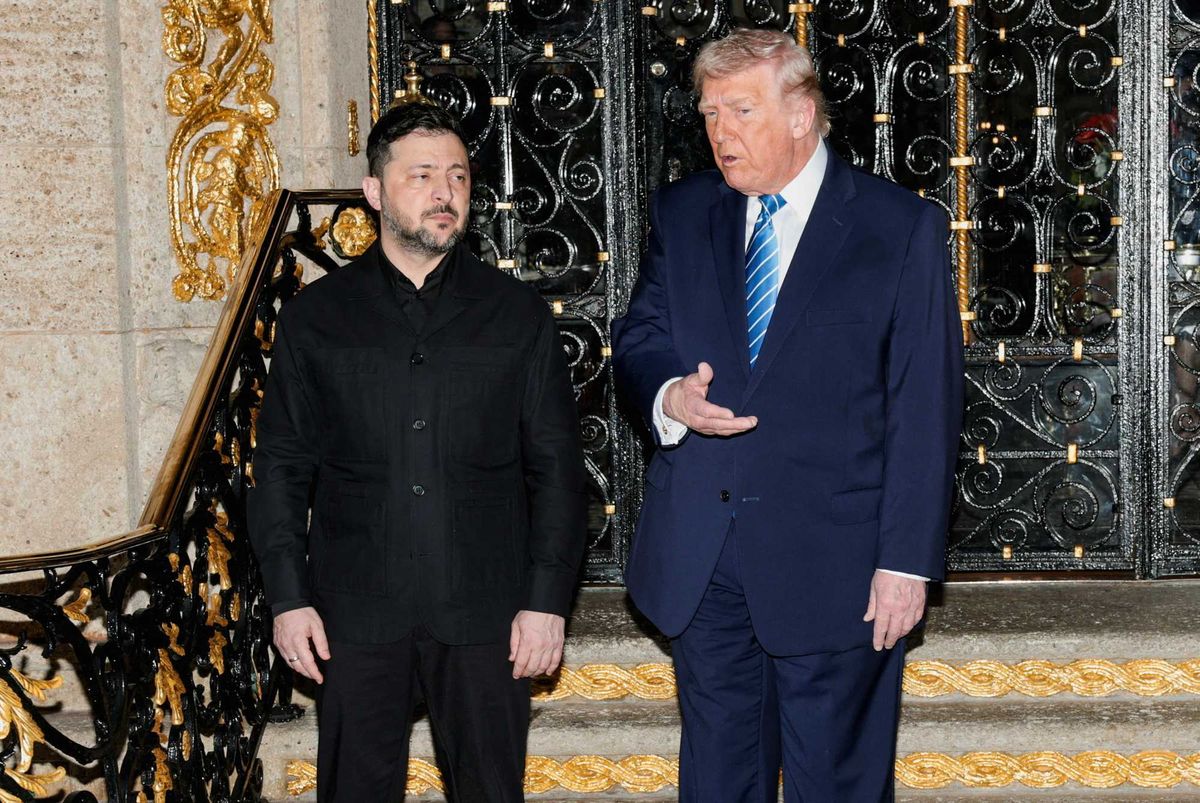
U.S. President Donald Trump speaks next to Ukrainian President Volodymyr Zelenskiy upon his arrival for meetings at Trump's Mar-a-Lago club in Palm Beach, Florida, U.S., December 28, 2025. REUTERS/Jonathan Erns

A military expert revealed on Sunday that President Donald Trump is taking an "insane" approach to ending the war in Ukraine.

Trump held another round of peace talks with Ukrainian President Volodymyr Zelenskyy at Mar-a-Lago on Sunday, where the two leaders discussed the current 20-point peace plan that is on the table. Ahead of Trump's chat with Zelenskyy, the president said he had a phone conversation with Russian President Vladimir Putin following a night of heavy bombing by Russian forces against Ukrainian civilians.

Tom Nichols, a staff writer for The Atlantic, said in an interview on MS NOW's "Alex Witt Reports" that Trump appears to be trying to play the intermediary between Putin and Zelenskyy, a strategy that he said shows either that Trump doesn't understand the conflict or that he is lying about his efforts to end it.


"From the point of diplomatic practice, it's insane," Nicols said. You don't check in with the aggressor when you're talking to a putative friend and ally, and you don't report in afterwards. You talk with your friends, with your allies, with Ukraine, and then you tell the Russians, 'Here's the offer. Here's what you need to do.'"

"And instead, it's almost like Trump is acting like an intermediary, trying to express Putin's wishes to Zelenskyy and to the world, which is what he did after the Alaska summit," Nichols continued. "It's what he does every time he gets off the phone with Putin. The fact is, Vladimir Putin has this hold over Donald Trump that makes Trump and the American government into basically a de facto ally of Russia."


'Almost burst out laughing': MS NOW hosts crack up at Zelenskyy's reaction to Trump boast

Tom Boggioni
December 29, 2025
 RAW STORY


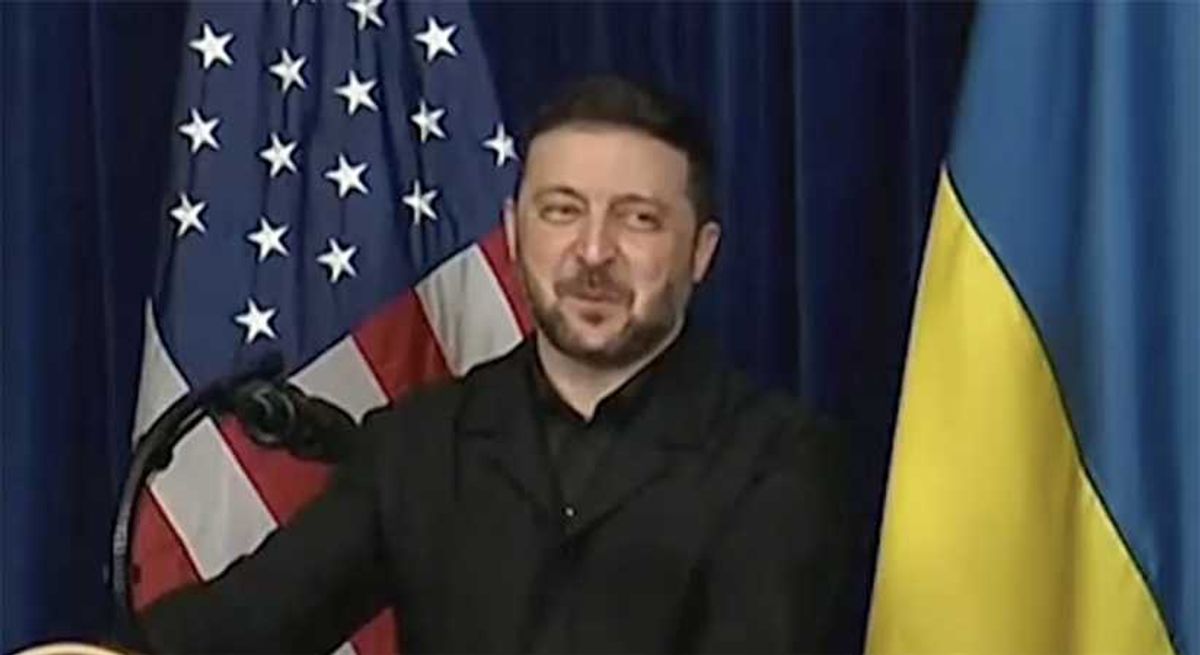
Volodymyr Oleksandrovych Zelenskyy (MS NOW screenshot)

Donald Trump’s boast that Russian strongman Vladimir Putin is very invested in seeing Ukraine “succeed” got a big laugh as the host of MS NOW’s “Morning Joe” noted that Ukraine’s Volodymyr Zelenskyy appeared as amused at the time as they were on Monday morning.

Trump’s comment was roundly roasted on social media on Sunday and hosts Jonathan Lemire and Katty Kay joined in on the fun.

“Let’s just take that comment there from President Trump,” Lemire began before smirking and stating, “No, I don’t think Russian President Vladimir Putin is invested in Ukraine’s success — he’s the one who invaded in the first place.

Laughing as he continued, he remarked, “He’s the one still with aims to conquer it and, I don’t know if we have the footage or not, but there is, as Trump was saying, there was a cutaway shot of Zelenskyy’s reaction, and he almost burst out laughing. He just couldn’t believe what he was hearing.”

After Kay suggested Zelenskyy doing his best to play the part of a diplomat, the bemused commentator added, “I don’t know what he means when he says that Russia is very keen for Ukraine to succeed, unless Russia is keen for Ukraine to succeed under Russia’s control, which is the way that Vladimir Putin would like it to be.”


Top diplomats of China, Cambodia and Thailand meet as Beijing seeks to strengthen role in dispute

TRUMP WAS NOWHERE AROUND

By AP
Dec 29, 2025


In this photo released by Agence Kampuchea Press (AKP), Cambodia's Foreign Minister Prak Sokhonn, left, Thai counterpart Sihasak Phuangketkeow, right, and Chinese counterpart Wang Yi pose in Yunnan province, China, Dec. 29. AP-Yonhap

HONG KONG (AP) — Foreign ministers from Cambodia and Thailand convened with their Chinese counterpart on Monday as the Beijing government, building on its expanding presence in the world diplomatic arena, sought to play a stronger mediating role in the violent border dispute between the two Southeast Asian countries.

The trilateral meeting, held in a southwestern Chinese province north of the contested border, came two days after Thailand and Cambodia signed a fresh ceasefire agreement to end weeks of fighting that killed more than 100 people and forced hundreds of thousands to be evacuated on both sides of the border.

Chinese Foreign Minister Wang Yi called for joint efforts to promote regional peace, stability and development, which is language typical for China in such situations.


“Allowing the flames of war to be reignited is absolutely not what the people of the two countries want, and not what China, as your friend, wants to see. Therefore, we should resolutely look ahead and move forward,” Wang said during the meeting Monday in Yunnan province.

It was noteworthy that the meeting was held there, nearer to the dispute and to Southeast Asia, rather than in Beijing, the Chinese capital and seat of government about 1,300 miles (2,500 kilometers) northeast.

Cambodian Foreign Minister Prak Sokhonn said he believed the latest ceasefire would last and would create an environment for both countries to work on their relations and resume the previously agreed-upon ways to settle their differences, according to a Chinese interpreter.

Thai Foreign Minister Sihasak Phuangketkeow also expressed hopes for peace with neighboring countries, the interpreter said.

The Thai Foreign Ministry later said in a statement that China volunteered to be a platform to support peace between the two countries and Thailand reiterated that adjustments of ties should be conducted “on a step-by-step basis.”


“The Thai side will consider the release of 18 soldiers after the 72 hours ceasefire observation period and requests that Cambodia facilitate the return of Thais along the border,” the ministry said.


This handout photo taken and released by Agence Kampuchea Press (AKP) shows China's Foreign Minister Wang Yi, center, speaking as Cambodia's Deputy Prime Minister Prak Sokhonn, left, who is also the country's Foreign Minister, and Thailand's Foreign Minister Sihasak Phuangketkeow listen during a meeting in China's Yunnan province, Dec. 29. AFP-Yonhap

A day after the fresh pact was signed, Sihasak and Prak Sokhonn held separate meetings with Wang on Sunday, the first day of the two-day gathering.

The meetings represented China's latest efforts to strengthen its role as an international mediator and, in particular, its influence in Asian regional crises. As China grows and becomes more of an economic and political force regionally and globally, Beijing has spent the past decade and more working in various ways to increase its voice as a third party in diplomatic matters.

The two Southeast Asian countries originally reached a ceasefire in July. It was brokered by Malaysia and pushed through under pressure from U.S. President Donald Trump, who threatened to withhold trade privileges unless Thailand and Cambodia agreed. The preliminary pact was followed by a more detailed October agreement .

But Thailand and Cambodia carried on a bitter propaganda war, with minor, cross-border violence continuing. The tensions erupted into heavy fighting in early December.

The Saturday agreement calls for Thailand, after the ceasefire has held for 72 hours, to repatriate 18 Cambodian soldiers who have been held prisoner since the earlier fighting in July. Their release has been a major demand of the Cambodian side.

The agreement also calls on both sides to adhere to international agreements against deploying land mines , a major concern of Thailand.

Cambodian Prime Minister Hun Manet on Monday issued a statement to all Cambodian combatants along the border with Thailand.

“Even though we can still fight," he said, “as a small country we still have nothing to gain from prolonging the fighting for a long time.”


China urges Thailand, Cambodia to continue talks, rebuild ties, mutual trust amid ceasefire

Top Chinese diplomat Wang Yi hosts his Cambodian, Thai counterparts in Yunnan province in southwestern China

Anadolu staff |29.12.2025 

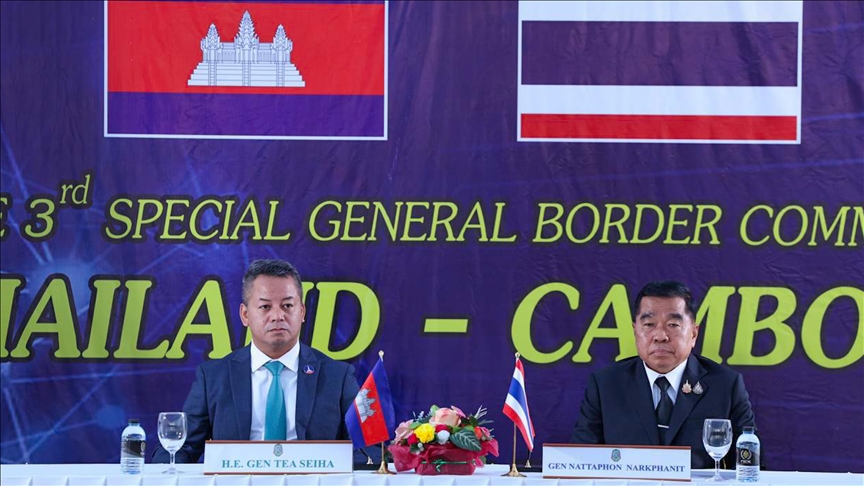
Cambodian Defence Minister Tea Seiha (left) and Thai Defence Minister Natthaphon Narkphanit (right) at the General Border Committee Meeting in Chanthaburi Province, Thailand, on December 27, 2025.

ANKARA

China on Monday urged Thailand and Cambodia to sustain dialogue, restore mutual trust, and rebuild their ties amid the ceasefire agreement following recent border tensions.

The statement came after China's Foreign Minister Wang Yi hosted his Cambodian and Thai counterparts, Prak Sokhonn, and Sihasak Phuangketkeow, alongside military representatives from all three countries in Yuxi city of Yunnan province in southwestern China.

During the trilateral meeting, Wang Yi highlighted China’s active mediation since the outbreak of the border conflict, citing multiple phone calls, four special envoy visits, and ongoing diplomatic and military consultations.

“With the joint efforts of all parties, the Cambodian and Thai militaries recently reached a ceasefire agreement, which China finds gratifying,” he said.

He added that both sides demonstrated a positive and open attitude, showed commitment to easing and de-escalating tensions, and expressed willingness to improve bilateral relations on the basis of the ceasefire.

"We must look forward and move forward together," Wang said.

The Chinese minister emphasized the need for continued communication, gradual restoration of bilateral relations, and rebuilding of mutual trust.

He noted that the conflict had caused a loss of confidence, but stressed that Cambodia and Thailand, as eternal neighbors, should work to heal wounds and remove barriers to reconciliation.

China pledged support in ceasefire monitoring, humanitarian aid, and demining cooperation.

Both Cambodian and Thai top diplomats also expressed gratitude for China’s role, underscoring the importance of peace and their commitment to implementing the ceasefire.

Cambodia and Thailand signed a ceasefire agreement on Saturday, ending nearly 20 days of clashes that killed dozens and displaced nearly 1 million civilians along their disputed border.

Under the arrangement, both sides agreed to halt all armed hostilities and avoid unprovoked fire, troop advances, or movements toward each other’s positions.

The ceasefire applies along the entire border and covers military targets, civilians, and infrastructure, with Thailand set to return 18 Cambodian soldiers after the truce is fully maintained for 72 hours, ending at noon on Tuesday.

Around 99 people were killed in clashes that resumed on Dec. 8, a day after a border skirmish wounded two Thai soldiers.
Peace President? Yeah, Right.


by Thomas Knapp | Dec 29, 2025 
ANTIWAR.COM


On December 17, surrounded by festive holiday decorations, US president Donald Trump delivered an upbeat — one might even say manic — address to the nation, preempting — and enraging fans of — network TV shows such as Survivor, The Floor, and Christmas in Nashville.

While many expected something weighty (perhaps announcement of further military escalation versus Venezuela), what they got was laundry list of Trump’s “accomplishments” since his inauguration in January.

Most of those “accomplishments” — ruinous tariffs on American consumers, immoral and economically damaging immigration raids, etc. — were things we already knew about from watching our bank balances draw inexorably down.

One, however, stood out to me as the most risible. “For the first time in 3,000 years,” Trump said, he’s brought “peace to the Middle East.”

He said that, with as close to a straight face as he ever shows, hours after saluting the flag-draped caskets of two US National Guard members and a civilian interpreter killed in Syria the previous week.

He said that as thousands of Saudi-backed (and therefore US-backed) forces massed on the Yemeni border, preparing for an offensive against one of that country’s dueling political/military factions.

He said that as (US-backed) Israeli forces continued to conduct deadly strikes in Gaza and Lebanon, and raids in Palestine’s occupied West Bank, despite supposed “ceasefires.”

Words can mean more than one thing, but only in the Newspeak Dictionary from George Orwell’s 1984 might we expect to find any of the above defined as “peace” — or Donald Trump described as a “peace president.”

In his first term as president, Trump escalated every war he inherited and re-started the previous war in Somalia. He “surged” troops into Afghanistan and Syria.

In Syria, he dectupled the US military presence, had Marines fire more artillery rounds than were used in the 2003 US invasion of Iraq, briefly feinted toward withdrawing, then decided to stay to “keep the oil.”

In Afghanistan, he eventually negotiated a US withdrawal … but then failed to complete that withdrawal, leaving it to his successor and complaining bitterly about it.

He reneged on the US government’s obligations under the “Iran nuclear deal,” and ordered an Iranian general assassinated while on a diplomatic mission in Iraq.

In Yemen, he ordered the murder of eight-year-old American girl Nawar Anwar al-Awlaki by US Navy SEALs.

The list goes on and on.

In his second term, he’s continued the war in Somalia and on Venezuela (to name but two), while failing on his promise to negotiate an end to the Russia-Ukraine war “in 24 hours” (or, to date, at all).

As Christmas approaches, I’m all in favor of “on earth peace, goodwill toward men.” But I find Trump’s claims and promises on that subject less believable than stories about Santa Claus.


Thomas L. Knapp is director and senior news analyst at the William Lloyd Garrison Center for Libertarian Advocacy Journalism, publisher of Rational Review News Digest, and moderator of Antiwar.com’s commenting/discussion community.


‘Fast and decisive!’ Trump praises himself over debunked claim to have ended ‘eight wars’


Alexander Willis
December 28, 2025 
RAW STORY


President Donald Trump lavished praise on himself Sunday in a self-congratulatory social media post boasting about his “fast and decisive” action in supposedly ending a conflict between Thailand and Cambodia, while also repeating the debunked claim that he had “settled and stopped” eight conflicts during his second term.

“I am pleased to announce that the breakout fighting between Thailand and Cambodia will stop momentarily, and they will go back to living in PEACE, as per our recently agreed to original Treaty,” Trump wrote Sunday on his social media platform Truth Social.

“It was FAST & DECISIVE, as all of these situations should be! The United States of America, as always, was proud to help! With all of the wars and conflicts I have settled and stopped over the last eleven months, EIGHT, perhaps the United States has become the REAL United Nations, which has been of very little assistance or help in any of them, including the disaster currently going on between Russia and Ukraine.”

Thailand launched airstrikes toward Cambodia on Saturday in just the latest flare up of the long-running territorial dispute between the two countries. A ceasefire between the two countries was brokered by Malaysia in July, with Trump claiming he helped facilitate the deal by threatening to revoke trade privileges unless both sides agreed to halt the fighting.

As to Trump’s repeated claim to have ended eight wars, experts have called it a significant exaggeration, with some pointing to two disputes “that weren’t actually wars,” and “one war that is still running,” CNN reported.

“The United Nations must start getting active and involved in WORLD PEACE!” Trump wrote.


This brazen cruelty bodes ill for victims of the Trump regime — and for every American too

Robert Reich
December 28, 2025 
RAW STORY


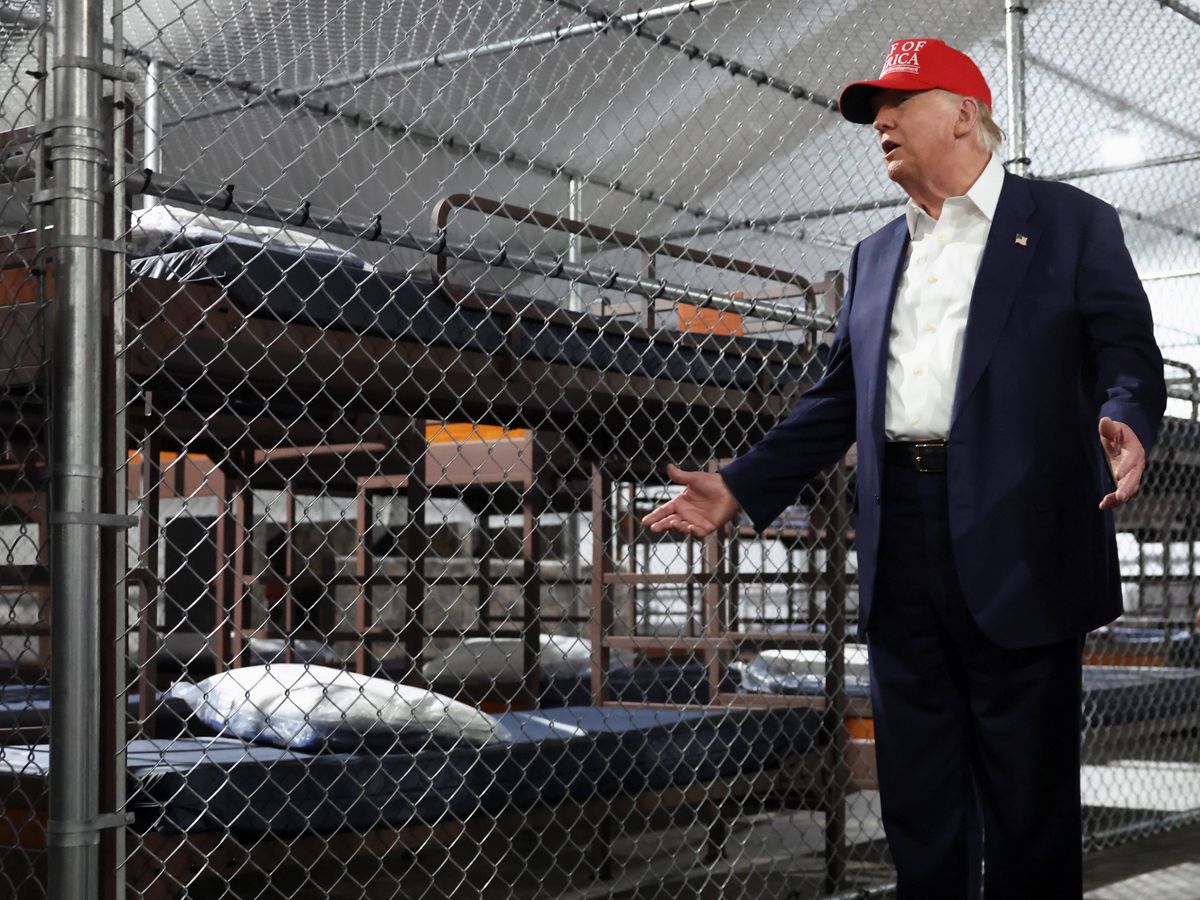
Donald Trump visits a migrant detention center in Ochopee, Florida. REUTERS/Evelyn Hockstein

According to the Washington Post, the Trump regime plans to renovate industrial warehouses to hold more than 80,000 immigrant detainees at a time.

The plan is for newly arrested detainees to be funneled — let me remind you, with no due process, or independent magistrate or judge checking on whether they are in fact in the United States illegally — into one of seven large-scale warehouses holding 5,000 to 10,000 people each, where they would be “staged” for deportation.

The large warehouses would be located close to major logistics hubs in Virginia, Texas, Louisiana, Arizona, Georgia and Missouri. Sixteen smaller warehouses would hold up to 1,500 people each.

America’s immigrant detention system is already the largest in the world.

With the $45 billion Congress appropriated for locking up immigrants, the regime has revived dormant prisons, repurposed sections of military bases, and partnered with Republican governors to build immigrant tent encampments in remote regions.

“We need to get better at treating this like a business,” ICE acting director Todd M. Lyons said at a border security conference in April, according to the Arizona Mirror.

The administration’s goal, he said, was to deport immigrants as efficiently as Amazon moves packages: “Like Prime, but with human beings.”

The logistical problems of converting warehouses into detention camps are significant. Warehouses are designed for storage and shipping of things, not people. They are often poorly ventilated and without precise temperature controls, and they lack access to the plumbing and sanitation systems needed to support thousands of full-time residents.

Beyond logistics is the dehumanization.

Ninety-three years ago, in March 1933, the Nazis established their first concentration camp in what is now Dachau, Poland. Other camps were soon established in Buchenwald and Sachsenhausen.

Initially, the Nazi’s put into these camps Communists, Social Democrats, trade unionists, and others deemed a threat to the Nazi regime.

After the Kristallnacht pogrom of November 9-10, 1938, approximately 30,000 Jewish men were arrested and sent to these camps in a mass, large-scale action that targeted them for being Jewish. The systematic mass murder of Jews in camps designed as extermination camps did not begin until late 1941 and early 1942, as part of the “Final Solution.”

The U.S. began forcibly moving Japanese Americans into America’s own camps in early 1942, following President Roosevelt's signing of Executive Order 9066 of Feb. 19, 1942, which authorized military exclusion zones. Initial roundups of Japanese Americans, deemed "enemy aliens," started immediately after Japan’s attack on Pearl Harbor attack on Dec. 7, 1941.

Around 120,000 people of Japanese descent, mostly U.S. citizens from the West Coast, were incarcerated in ten camps in remote inland states and temporary Assembly Centers. Hundreds more were imprisoned in Hawaii.

Once dehumanization begins, it’s hard to end.


As I noted, ICE is arresting, imprisoning, and deporting people it accuses of being in the United States illegally — but there is no due process, no third-party validation of ICE’s accusations.

ICE now holds more than 68,000 people in detention facilities, according to agency data. Nearly half — 48 percent — have no criminal convictions or pending criminal charges, ICE data shows.

ICE’s biggest current facility is a tent encampment at the Fort Bliss U.S. Army base in Texas, which now holds around 3,000 people but was expected to have a capacity of 5,000 by year’s end.


The largest proposed ICE warehouse would hold up to 10,000 detainees in Stafford, Virginia. Another with capacity for up to 9,500 is planned for Hutchins, near Dallas. A third, with space for 9,000, in Hammond, east of Baton Rouge.

There is no place in a civilized society for the warehousing of people.

There is no justification in a society putatively organized under the rule of law to imprison people without due process.


There is no decency in removing hardworking members of our communities from their families and neighbors and imprisoning them and then deporting them to other countries, some of which are brutal dictatorships.

When the history of this cruel era is written, the shame should be no less than the shame we now feel about the roundups and detention of Japanese Americans in World War II.

Hopefully, the dehumanization of the people that the Trump regime aims to warehouse will not result in the sadistic cruelties of the Nazi’s starting 93 years ago.


Robert Reich is a professor of public policy at Berkeley and former secretary of labor. His writings can be found at https://robertreich.substack.com/.

Robert Reich's new memoir, Coming Up Short, can be found wherever you buy books. You can also support local bookstores nationally by ordering the book at bookshop.org


'Classic Trump hyperbole': Analyst raises concern over president's economic plans

Ewan Gleadow
December 29, 2025
RAW STORY


FILE PHOTO: U.S. President Donald Trump holds a signed executive order on tariffs on aluminum imports in the Oval Office of the White House in Washington, U.S., February 10, 2025. REUTERS/Kevin Lamarque//File Photo

Projected economic plans from Donald Trump are "classic hyperbole" from the president, according to an analyst warning of future economic strife.

A claim made by the president that the stock market will contribute a massive growth boost to the economy has been debunked by CNN analyst David Goldman, who says that a direct impact from the stock market on the economy will not work. Trump's hope for lower interest rates from the new Federal Reserve chair were made clear by the president earlier this year.

Trump posted to Truth Social, "I want my new Fed Chairman to lower Interest Rates if the Market is doing well, not destroy the Market for no reason whatsoever."

Goldman has since explained the new Fed chair, while possibly on Trump's side when it comes to economic projections, will struggle with the "Trump hyperbole" dominating the economic discussion.

He wrote, "Trump claimed that a strong stock market could boost economic growth by up to 20% a year. That’s classic Trump hyperbole – the US economy has never grown by even 9% in a single year, and the fastest growth of the past four decades took place in 2021 – Biden’s first term – when the economy bounced back from the pandemic to surge 6.1%."

"That’s also not how the economy works: The stock market itself doesn’t contribute much to economic growth – it boosts wealthier Americans’ net worth, but the market is more a reflection of investors’ predictions about where the economy is headed than an economic engine in its own right."

Trump's "general sentiment" was described as true by Goldman, though he did warn the Federal Reserve "doesn't operate in the way Trump describes."

Criticism of Trump's administration and their handling of the economy has been frequent, with the Wall Street Journal sounding the alarm on impending economic trouble.

“You’re going to see a lot of wait and see,” chief executive of staffing company Kelly Services Chris Layden told the Journal. “Some of the looming uncertainty will mean that we’re going to continue to see an investment in capital over people.”

According to the report, “66 percent of leaders surveyed” at a recent gathering in Midtown Manhattan “said they planned to either fire workers or maintain the size of their existing teams next year. Only a third indicated they planned to hire.” This comes as the “unemployment rate those to 4.6 percent in November, its highest in four years.”

“We’re close to zero job growth. That’s not a healthy labor market,” Federal Reserve governor Christopher Waller said at the gathering. “When I go around and talk to CEOs around the country, everybody’s telling me, ‘Look, we’re not hiring because we’re waiting to try to figure out what happens with AI. What jobs can we replace? What jobs do we don’t?’”
Bardot: from defending sheep to flirting with the far right

By AFP
December 28, 2025


Bardot inspired a representation of the French republic by artist Alain Aslan - Copyright AFP/File Vincent AMALVY


Laure Fillon

Film legend Brigitte Bardot in her later decades raised eyebrows calling far-right leader Marine Le Pen a modern “Joan of Arc,” but she always maintained she was merely doing what was best for animals.

Bardot, who died on Sunday aged 91, argued she was unfairly labelled as a supporter of the anti-immigration far right after she made explosive remarks in the late 1990s about Muslims slaughtering sheep.

“I never asked anyone to be racist and I don’t think I fuel any racial hatred,” she wrote in her 2018 book “Larmes de Combat,” translated into English under the title “Tears of Battle.”

But the Paris-born star of around 50 films, who walked away from cinema to defend animal rights, was repeatedly convicted for hate speech — mostly against members of the Islamic faith after migration from France’s former colonies.

And she actively backed far-right presidential contender Marine Le Pen when she ran in 2012 and 2017.

“I wish for her to save France. She’s the Joan of Arc of the 21st century,” she told Paris Match in 2014, referring to the legendary teenager who repelled the English in the Hundred Years War in the 15th century.

“She’s the only woman… who has balls,” she later added of Le Pen, who also vied for president in 2022.

– ‘We’ll be slaughtered too’ –

Le Pen may be barred from a fourth run for the Elysee in 2027 due to a graft conviction, but her National Rally party feels its best chance ever to win the presidency in the upcoming polls, with Emmanuel Macron stepping down after two consecutive terms.

Le Pen on Sunday mourned Bardot, calling her “incredibly French: free, untameable, whole”, while her lieutenant Jordan Bardella — who could run instead of Le Pen — described her as an “ardent patriot,” adding French people had lost “the Marianne they so loved.”

France’s republic is traditionally represented by a female figure called Marianne, and Bardot in the 1960s posed for such a statue by artist Alain Aslan.

Macron also alluded to “the face that became Marianne” in his tribute to a woman he called a “legend” of the 20th century.

But he made no mention of her comments leading to convictions for hate speech.

In 1997, Bardot argued against the ritual killing of sheep for the celebration of Eid al-Adha, saying the practice would “stain the soil of France.”

“They’re slitting the throats of women and children, our monks, our civil servants, our tourists, and our sheep. One day we’ll be slaughtered too,” she wrote, appearing to conflate violent Islamists with ordinary Muslims, and warning against “a Muslim France with a North African Marianne.”

In 1996, Islamist insurgents killed French monks in France’s former colony Algeria during the civil war.

Bardot declared herself “against the Islamisation of France” in a 2003 book, arguing “our ancestors, our grandfathers, our fathers have for centuries given their lives to push out successive invaders.”

But in 2018 the former actor told Le Monde newspaper her concerns surrounding Eid al-Adha had been misunderstood, and she was “simply requesting the animals be stunned” to avoid suffering.

– ‘Wild hopes’ in the far right –

In her final book, “Mon BBcedaire” (“My BB Alphabet”), she said right-wing politicians were “the only urgent remedy to France’s agony.”

The animal activist, who has criticised the #Metoo movement, also made derogatory comments about gay and transgender people.

Her fourth husband, Bernard d’Ormale, was an advisor of late French far-right leader Jean-Marie Le Pen, whose daughter Marine took over the party.

In 1996, Bardot described Jean-Marie Le Pen as a “charming” man also worried about the “terrifying rise of immigration.”

He later invoked Bardot to argue Muslim women should not be allowed to wear burkinis in public.

“French beaches are those of Bardot and Vadim,” he said, in an apparent reference to Roger Vadim’s 1956 film “And God created Woman,” featuring the actor dancing with her skirt slit up to her waist.

Often a guest at the Elysee palace, Bardot said French presidents — including Macron — did not do enough to protect animal rights.

“I had wild hopes when the National Front (now called the National Rally) put forward concrete proposals to reduce animal suffering,” she told Le Monde.

But she claimed she also reached out to hard-left leader Jean-Luc Melenchon, “congratulating him for being a vegetarian,” and said that if a communist took up her proposals, she would vote for them.


DESPITE TARIFFS 

China’s BYD poised to overtake Tesla in 2025 EV sales


By AFP
December 29, 2025


Chinese automaker BYD has been looking to expand overseas sales of its electric vehicles - Copyright AFP Ina FASSBENDER


Elodie Mazein and AFP correspondents in Beijing

Growing Chinese auto giant BYD stands poised to officially surpass Tesla as the world’s biggest electric vehicle company in annual sales.

The two groups are expected soon to publish their final figures for 2025, and based on sales data so far this year, there is almost no chance the American company led by Elon Musk will retain its leadership position.

At the end of November, Shenzhen-based BYD, which also produces hybrid vehicles, had sold 2.07 million EVs so far in 2025.

Tesla, for its part, had sold 1.22 million by the end of September.

Tesla’s September figures included a one-time boost in sales, to nearly half-a-million vehicles in a three-month period, before the expiration of a US tax credit for buyers of electric vehicles — which ended under legislation backed by President Donald Trump, a climate change skeptic.

But Tesla’s sales in the coming quarter are expected to fall to 449,000, according to a FactSet analysis consensus. That would give Tesla about 1.65 million sales for all of 2025, a drop of 7.7 percent and well below the level BYD had attained by end November.

Deutsche Bank, which projects just 405,000 Tesla EV sales during the fourth quarter, sees the company’s sales down by around one-third in both North America and Europe, and by one-tenth in China.

– Transition period –

Industry watchers say it will take time for EV demand to reach a level of equilibrium in the United States following the elimination of the $7,500 US tax credit at the end of September 2025.

Even prior to that, Tesla had seen sales struggle in key markets over CEO Musk’s political support of Trump and other far-right politicians. Tesla has also faced rising EV competition from BYD and other Chinese companies and from European giants.

“We believe Tesla will see some weakness on deliveries” in the fourth quarter, said Dan Ives of Wedbush Securities.

Sales of 420,000 would be “good enough to show stable demand,” with Wall Street “laser focused on the autonomous chapter kicking off in 2026,” Ives added, referring to plans for self-driving vehicles.

Even as it has grown quickly, BYD has faced challenges in its home market.

With profitability in China weighed down by price-wary consumers, the company has sought to strengthen its foothold in foreign markets.

BYD is “one of the pioneers to establish overseas production capacity and supply chains for EVs,” Jing Yang, Director of Asia-Pacific Corporate Ratings at Fitch Ratings, told AFP.

“Going forward, its geographical diversification is likely to help it to navigate an increasingly complicated global tariff environment,” said Yang.

Overseas rivals to BYD have balked at Chinese state subsidies and other state supports that have allowed the company to sell vehicles cheaply.

Trump’s predecessor Joe Biden imposed 100 percent tariffs on Chinese EV imports that could potentially go even higher under Trump. Europe has also imposed tariffs on Chinese imports, but BYD is building manufacturing capacity in Hungary.

While the chance of Tesla reclaiming its global leadership in EVs looks uncertain, the American company is also potentially positioned for growth.

Michaeli of TD Cowen sees autonomous technology playing an increasingly important role for Tesla, with breakthroughs in its “full self-driving” or “FSD” offerings potentially boosting sales.

“As Tesla really begins to roll out eyes-off features and expand FSDs capability, if they do that successfully, that should generate more demand for their vehicles,” Michaeli said.

Musk has said the Cybercab, an autonomous robotaxi model, will begin production in April 2026. The company has also unveiled lower-priced versions of the Models 3 and Y that could boost sales.