Wednesday, December 31, 2025


India 2025: Plight of Christian Minority


Ram Puniyani 

  •  

  •  
A compliant State machinery is a major cause for the gradual intensification of anti-Christian activity in diverse forms, including violence.


Image Courtesy: The Leaflet

Violence against the Muslim minority has been a regular phenomenon. Its form and intensity have been varying but the intimidation continues. The other substantial minority, the Christians are also not spared, though violence against them is not in the news most of the time. The major reason being its sub-radar nature. Though it's sub-radar most of the time, around Christmas time, its overt nature becomes more apparent.

One recalls that in the decade of the 1990s, the violence manifested in Orissa and Gujarat. And it is around that time that former Prime Minister and Bharatiya Janata Party (BJP) leader Atal Bihari Vajpayee commented that there was a need for national debate on the issue of conversion.

Conversion has been the major pretext for attacking various events related to the Christian community. The prayers, church meetings, and celebrations are occasions when these attacks are orchestrated more. This year again, it became manifest around Christmas celebrations.

The foot soldiers of Hindutva had a gala time attacking footpath vendors selling Christmas wares, such as caps, dresses and associated things. In some places, they attacked Santa Claus’s replicas, in other places, they vandalised churches and showrooms selling Christmas wares.

Columnist Tavleen Singh wrote in Indian Express, “The more intrepid of these Hindutva warriors stormed into churches and disturbed services with vandalism and violence. Videos of these ‘accomplishments’ were uploaded on social media. In one of them, I saw a BJP legislator enter a church in Jabalpur and harangue a blind woman, whom she accused menacingly of trying to convert Hindus to Christianity…there were nearly a hundred attempts to disrupt Christmas festivities and nearly all of them occurred in states ruled by the BJP. Nobody was punished and no chief minister openly deplored the violence.”

These events have been covered in the international media also. A few newspapers commented about the possibility of retaliatory violence against Hindus in those countries. The interesting aspect of the Indian states’ attitude on these events is their loud silence, and it is no coincidence that most of this violence took place in BJP-ruled states. Fortunately, we have a non-biological Prime Minister who, in the face of all this, visited a church and offered prayers! It was an interesting phenomenon that inside the church, the Hindutva top leader is creating the optics of respecting Christianity, while his followers are doing anti-Christian vandalism on the streets and in churches.

The Citizens for Justice and Peace (December 24, 2025) report very aptly summarises the tremendous rise in anti-Christian violence over the years. “Between 2014 and 2024, documented incidents of violence against Christians rose from 139 to 834, an increase of over 500%. In 2025 alone (January–November), more than 700 incidents have already been recorded, affecting families, churches, schools, hospitals, and service institutions. Dalit Christians, Adivasi Christians, and women are among the most affected.”

The US Commission on International Religious Freedom again recommended designating India as a Country of Particular Concern in its 2025 report, citing concerns over religious freedom. The Human Rights Watch and other bodies also documented issues affecting the minorities in India.

Christmas eve violence is not new. One Bishop reminded people of this while cautioning the churches in Raipur: “In Raipur, however, the Catholic archbishop, Victor Henry Thakur, was very worried. He sent a letter to local churches, schools and other institutions urging caution, “In the light of the call for Chhattisgarh Bandh tomorrow, I feel and suggest that all our churches, presbyteries, convents and institutions should seek protection in writing from the local police. Please consider my suggestion because it seems to have been planned just before Christmas, as was the case at Kandhamal in Odisha.”

This reminds one of violence around Christmas in Orissa in 2007 and 2008. The one which was orchestrated in 2008 took a massive proportion as nearly 70,000 Christians had to flee and nearly 400 churches were vandalised.

In the face of this, one could have expected the Church hierarchy to have expressed their concern about the attacks on Christians, but their silence on this serious matter shows either their lack of concern for their community, or some other hidden vested interest in keeping mum on the issue.

One has also witnessed state after state adopting anti-conversion laws, titled ‘Freedom of Religion Acts’. This is putting rigorous conditions on the religious conduct of the community. Pastors and priests are arrested on pretext of conversion activity and face the legal rigmarole for years.

The propaganda that Christians are converting needs to be visited yet again. Christianity is an old religion in India, having come here through St Thomas in AD 52 on the Malabar Coast. The social perception that it came with British rule has no basis. From AD 52 to 2011, when the last Census was held, the percentage of Christians rose to 2.3%. It is nobody's case to deny that some conscious conversion work might have taken place. Have a look at the figures of the Christian population from 1971 to 2011. In 1971-2.60%, 1981-2.44%, 1991-2.34% and 2001-2.30%. That tells an interesting tale.

Pastor Graham Staines was burnt alive with his two sons, Timothy and Phillip, on the pretext of his indulging in conversion work in Orissa. The Wadhwa Commission that went into this ghastly murder, in its report points out that there was no statistical increase in the number of Christians in Keonjhar, where Pastor Staines was working among leprosy patients.

There are many Christian mission education institutes and hospitals, which are very much sought after. The conversions that have taken place are more among Adivasi and Dalits, who have been thronging to the education and health facilities in the remote areas. It is true that major conversions might have taken place while seeking these facilities in remote areas where State facilities are sparse.

The hatred constructed around conversion is now widespread. The attacks on celebration-related events is a horrific phenomenon. The State in such cases is either mute or absent. The compliant State machinery is the major cause of gradual intensification of the anti-Christian activity in diverse forms.

This years’ attacks are a warning signal of the silence and doublespeak of the ruling dispensation. On one hand, going to pray in a church, and on the other, allow vandals to do their job. One hopes that international repercussions will be in the form of government to government, responding to appeals of religious freedom and conceding to those appeals.  

The writer is a human rights activist, who taught at IIT Bombay. The views are personal.

Forging a Stronger Farmers’ Movement in Tanzania


Prasanth R. , Kate Janse van Rensburg
| 30 Dec 2025


The Annual General Meeting of the organization brought together hundreds of farmers in dialogue about the situation facing farmers in Tanzania and how to continue fighting corporate capture of agriculture


Hundreds of farmers organized in MVIWATA gathered in Morogoro, Tanzania for their AGM in early December, 2025. Photo: MVIWATA


Over 670 farmers gathered in Morogoro, Tanzania, on December 4-5 to chart a course for the future of MVIWATA (National Network of Farmers Groups in Tanzania), one of Africa’s most unique farmers’ organizations. The occasion was MVIWATA’s 30th Annual General Meeting (AGM), which serves as the highest democratic platform for members to voice their aspirations for the organization’s future.

As the powerful slogan, “Mviwata, Sauti ya Mkulima” (MVIWATA is the voice of the farmer) and “Mtetezi wa Mkulima, Mkulima Mwenyewe” (The defender of the farmer is the farmer), rang through the hall time and again, the farmers debated and arrived at conclusions on strengthening their networks in concrete ways.

The AGM opened with a vibrant performance by local MVIWATA cultural groups, featuring energetic dance and powerful lyrics that called for the unity of farmers. This was followed by an acknowledgement of those who had recently lost their lives in the aftermath of the disrupted elections. A collective occasion, the event aimed to define strategies, reinforce solidarity, and reclaim the farmer’s role as the protagonist of Tanzania and the backbone of the national economy.

On the opening day, National Chairperson Apollo Chamwela and Executive Director Stephen Ruvuga stressed the urgent need for solutions rooted in farmer-to-farmer solidarity and a clear understanding of the peasants’ role in Tanzania. Ruvuga highlighted how the global “value chain” marginalizes peasants: they are the primary food producers, yet earn a pittance from valuable cash crops like coffee and cashews. At the same time, agribusiness and middlemen reap huge profits. He concluded: “We are producing a lot of wealth but getting only a slice of it while the benefits only go to those who don’t even know how to farm.”

The crisis is not restricted to markets and prices. Every phase of agriculture is affected. Whether it be synthetic fertilizers or seeds, four to five companies control the market. “A dependence on inputs we don’t produce by ourselves enriches the system that benefits a few and reduces the peasant to a mere buyer,” Ruvuga said, linking MVIWATA’s core concept of self-reliance to the everyday needs of farmers.

MVIWATA Chairperson Apollo Chamwela emphasized that the commitment of delegates – many of whom traveled vast distances (over 2,000 kilometers from regions like Kagera) and financed their own attendance – was a key organizational milestone. This commitment, where farmers use their own resources and do not depend on the organization for travel, signifies genuine self-reliance and a deep sense of ownership: “This organization is ours!” Chamwela added that by actively engaging in the AGM, farmers reinforce MVIWATA as a vital platform used “like a weapon to fight for their rights.”

For over 30 years, MVIWATA has organized farmers to practice self-reliance, especially through agro-ecological farming techniques that enable higher quality production with fewer dependencies. MVIWATA’s foundational philosophy is deeply rooted in the principles of Julius Nyerere’s Ujamaa and self-reliance. By organizing farmers into cohesive, democratic networks to mutually aid one another in production, marketing, and savings, MVIWATA embodies the spirit of self-determination articulated by Nyerere in the 1967 Arusha Declaration. This focus on local, collective ownership and the deliberate resistance to external capitalist dependencies directly reflects the Ujamaa ideal of building an equitable, independent society in which the people – specifically the peasantry – are the protagonists of their own path forward.

However, MVIWATA’s mission does not end there. 

Networks of farmers aid and assist each other in seed development, getting better prices for their crops, building markets, enabling savings schemes, and organizing to prevent and resist efforts to take away their land. From farmers cultivating rice and maize to pineapples, bananas and mangos, and spices like cinnamon and cloves, MVIWATA has, through a process of popular consultation, come up with strategies for all.

Vibrant debates and concrete pillars for a stronger 2026

Intense discussion among delegates, in both group and plenary sessions, was the highlight of the AGM, resulting in concrete strategic pillars for organizational growth and increasing members’ abilities in several key areas in 2026. The consensus focused on strengthening self-reliance, both in farming techniques and organizational management.


Members of MVIWATA participate in the AGM. Photo: MVIWATA

Hundreds of farmers from across the country participated and contributed concrete proposals such as developing natural herbicides and pesticides, and expanding training programmes to increase awareness of agro-ecological practices. A dedicated discussion focused on the question of reconciling traditional landholding patterns to contemporary legal requirements.

The AGM featured a rigorous debate on establishing the organization’s own financial institution. Building on existing local-level capital access schemes, delegates emphasized the urgent need for a more sophisticated, wide-reaching instrument capable of providing loans at reasonable rates and at the necessary junctures to fully serve farmers.

The discussions also stressed the need for training and education, both through farmer-led sessions and MVIWATA FM, the organization’s radio station that serves as a vital tool for highlighting farmers’ voices, unlike mainstream media, which ignores the peasant agenda. Many of the ideas presented by farmers formed key pillars of the organization’s plan for the coming year, announced on December 5.

For Odilia J. Bernad, who has been a member of MVIWATA for nine years, the AGM was “like a school.” She added, “We divided ourselves into groups. There were young people, women, and the elderly, and we sat and discussed our activities and explained the challenges we faced in our regions with a focus on solving them.” The farmer is the bread-winner of the country, she noted, saying that it was essential that farmers have a strategic plan for the coming year. “Farmers must evaluate themselves to see where they came from, where they are, and where they are heading. And if there are mistakes made in the previous year in the strategic plans, they should see what they can do to achieve their goals for the next year.”

Michael Mbago, a farmer who cultivates maize, cassava and yams and has been a veteran of MVIWATA for over 15 years, echoed the sentiment. For him, MVIWATA’s success lay not just in addressing agricultural issues but in educating people about the political, economic, and social aspects. MVIWATA has become a refuge for many small farmers, he said, adding that it will be vital in helping them “achieve victory” in various aspects of farming.

The unity forged at the 30th MVIWATA AGM gave farmers the confidence to meet the demands of the struggle in 2026 and to continue building a stronger farmers’ movement in Tanzania. As summarized by Chairperson Apollo Chamwela: “The struggle we are in needs unity of farmers, across Tanzania, Africa and the world. The defender of the farmer is the farmer.”

Courtesy: Peoples Dispatch

INDIA

NPOA‑SSF: Capitalist Expansion Masked as Community Empowerment?

The National Plan of Action for Small-Scale Fisheries (NPOA‑SSF), 

Sandip Chakraborty 


The small-scale fisheries plan risks becoming another instrument of capitalist expansion, co‑opting the community’s voices while advancing agendas that prioritise profit over people.


Image Courtesy: PxHere

Narendrapur, Kolkata: The National Plan of Action for Small-Scale Fisheries (NPOA‑SSF), unveiled with much fanfare at the Ramakrishna Mission Campus in Narendrapur, is being hailed as a “landmark” in India’s fisheries governance. Government officials, international organisations, and select community leaders gathered on December 28–29 to declare their commitment to a rights-based, inclusive framework. Yet, beneath the rhetoric of empowerment, lies a troubling reality: the NPOA‑SSF risks becoming another instrument of capitalist expansion, co‑opting the fishing community’s voices while advancing agendas that prioritise profit over people.

Promise vs. Reality

The Bay of Bengal Programme (BOBP), which leads the initiative, insists the plan will strengthen communities and safeguard ecosystems. But critics argue that the language of “participation” and “consultation” masks a deeper intent: to integrate small-scale fisheries into global markets, subjecting them to the same exploitative dynamics that have long undermined artisanal livelihoods.

By aligning the NPOA‑SSF with international guidelines, the government positions itself as progressive. Yet, the emphasis on “science-informed management” and “technical expertise” often translates into top-down control, sidelining traditional knowledge and community autonomy. What is framed as modernisation may in fact be a mechanism to discipline fishers into compliance with industrial and export-driven priorities.

A Pattern of Dispossession

India’s fisheries sector has long been a site of conflict between artisanal fishers and industrial interests. Since the 1970s, the introduction of mechanised trawlers has displaced thousands of small-scale fishers. In states, such as Kerala and Tamil Nadu, violent clashes erupted between artisanal communities and trawler operators, leading to bans on night trawling and seasonal restrictions. Yet, enforcement remained weak, and industrial fleets continued to dominate.

The 1990s liberalisation era intensified these pressures. Coastal aquaculture, particularly shrimp farming, expanded rapidly to meet export demand. While India became the world’s largest exporter of farmed shrimp, local communities bore the costs: salinisation of agricultural land, destruction of mangroves, and loss of traditional fishing grounds. Reports from Andhra Pradesh documented widespread displacement, with fisher families forced into precarious wage labour.

The NPOA‑SSF emerges against this backdrop. Its promises of rights and sustainability echo earlier policy rhetoric, yet history suggests such frameworks often serve to legitimise capitalist expansion rather than restrain it.

Case Study 1: Shrimp Aquaculture in Andhra Pradesh

Andhra Pradesh’s aquaculture boom illustrates how “development” can devastate small-scale fishers. By the early 2000s, shrimp farms covered over 100,000 hectares of coastal land. Mangroves, once vital breeding grounds for fish, were cleared. Traditional fishers lost access to estuaries and lagoons.

While the industry generated billions in export revenue, local communities faced declining catches, polluted water, and health hazards. Women, who depended on mangroves for firewood and crabs, were particularly affected. Promises of employment in shrimp farms proved hollow: jobs were seasonal, low-paid, and often unsafe.

The NPOA‑SSF’s emphasis on “livelihood diversification” risks repeating this pattern. By encouraging fishers to enter aquaculture or allied industries, the plan may push them into exploitative labour markets rather than securing their traditional rights.

Case Study 2: Trawler Conflicts in Kerala

Kerala’s coastline has witnessed decades of conflict between mechanised trawlers and artisanal fishers. In the 1980s, fishers organised mass protests against trawler incursions into nearshore waters. The government responded with seasonal bans, but enforcement remained lax.

Artisanal fishers argued that trawlers destroyed juvenile fish and damaged nets, undermining sustainability. Yet, industrial operators, backed by export lobbies, continued to expand. The result was declining catches for small-scale fishers and rising indebtedness.

The NPOA‑SSF’s proposed “co-management frameworks” may appear inclusive, but without structural limits on industrial fleets, they risk becoming token consultative bodies. Fishers may be invited to meetings, but decisions will remain aligned with export priorities.

Case Study 3: Coastal Development in Goa

In Goa, tourism-driven coastal development has displaced fishing communities. Traditional landing sites have been converted into resorts and private beaches. Fisher families report harassment when they attempt to dry nets or sell fish near tourist zones.

Government policies often prioritise tourism revenue over fisher rights. The NPOA‑SSF’s silence on such conflicts is telling. By focusing on “ecosystem health” and “climate resilience,” the plan avoids confronting the structural drivers of dispossession: privatisation of coastal commons and commodification of natural resources.

Scale of the Crisis

India is the second-largest fish producer globally, with annual production exceeding 14 million tonnes. The sector contributes 1.2% to GDP and supports 28 million livelihoods. Yet, marine capture fisheries have stagnated at around 3.5 million tonnes annually since the mid-2000s, reflecting resource depletion.

Small-scale fishers account for 85% of active fishers, but their incomes have declined sharply. A 2023 study found average monthly earnings of artisanal fishers at ₹6,000–8,000, compared with ₹25,000–30,000 for industrial operators. Women, who dominate post-harvest activities, earn less than ₹200 per day, often without social protection.

These figures highlight the structural inequities the plan claims to address. Yet without redistributive measures — curbing industrial fleets, protecting customary rights, and investing in social infrastructure — the NPOA‑SSF risks becoming another technocratic exercise.

Gender and Youth: Token Inclusion

The plan’s emphasis on gender equality and youth engagement is laudable on paper. Yet, fisherwomen continue to face systemic exclusion from decision-making, and young people are pushed into precarious migration due to lack of viable opportunities.

In Odisha, women fish vendors report harassment by police and municipal authorities, who view informal markets as “illegal.” In West Bengal, youth migrate to cities for construction work, abandoning fishing due to declining catches and lack of credit.

Without structural change — redistribution of resources, protection from industrial encroachment, and genuine co-management — these commitments risk becoming token gestures, useful for donor reports but hollow in practice.

Capitalist Logic of ‘Sustainability’

The most insidious aspect of the NPOA‑SSF is its framing of sustainability. By emphasising ecosystem health and climate resilience, the plan appears progressive. But sustainability here is often defined in terms of resource efficiency and market stability, not community well-being.

Fishers are asked to adopt “responsible practices” while corporations continue to profit from large-scale extraction and export. The burden of conservation is shifted onto the poorest, while the structural drivers of ecological collapse — industrial fleets, pollution from coastal industries, and global trade demands — remain untouched.

Community Voices: Co‑opted or Heard?

Community leaders at a recent workshop held in Kolkata spoke passionately about rights and livelihoods. Yet, the very format of such events raises questions: are these voices genuinely shaping policy, or are they being staged to legitimise a predetermined agenda?

Translating documents into vernacular languages and holding consultations may give the impression of inclusivity, but without binding commitments to redistribute power, these measures risk becoming performative.

Need for Vigilance  

The Narendrapur workshop ended with pledges of collaboration and optimism. But for many observers, the NPOA‑SSF represents less a breakthrough than a continuation of capitalist capture of fisheries governance. By cloaking market integration in the language of rights and sustainability, the plan risks undermining the very communities it claims to empower.

If the government is serious about justice for small-scale fishers, it must move beyond symbolic gestures and confront the structural inequities that define India’s fisheries sector. Otherwise, the NPOA‑SSF will be remembered not as a tool of empowerment, but as a policy of pacification — a capitalist cloak draped over communities struggling to survive.

From Algiers to Gaza: Frantz Fanon and the unfinished decolonisation

Fanon at 100: As Algeria criminalises French colonialism, his vision of decolonisation speaks powerfully to Gaza's genocide today, writes Rachid Sekkai.


Perspectives
THE NEW ARAB
Rachid Sekkai
29 Dec, 2025
It was inside the Algerian revolution that Fanon’s thoughts were forged, in its ethics of solidarity and sacrifice, writes Rachid Sekkai.

On the centenary of Frantz Fanon’s birth, Algiers hosted an emotionally charged conference on 6 December that gathered scholars, psychiatrists, and activists from Algeria and beyond. The event came just weeks before Algeria adopted a landmark law officially classifying French colonialism as war crimes and crimes against humanity. This historic act seemed to restore Fanon’s spirit at the heart of political life.

When we entered the unexpectedly trendy conference hall in the unassuming district of Mohamed Belouizdad in central Algiers, the room was already overflowing. A portrait of Frantz Fanon hung on the stage, making it feel like the Martinican psychiatrist was staring out at the crowd with his familiar intense gaze.

Fanon’s thoughts and analysis on decolonisation was the subject of the programme, yet the emotional temperature of the room was set by the present: the ongoing colonisation of Palestine, Congo, and Western Sahara. These are territories where the machinery of empire never disappeared but merely changed form.

His sentences, written for another age of torture centres and counter-insurgency, felt as if they had been drafted for Khan Younis or Goma.

This is the very reason that Fanon’s centenary should not be a nostalgic homage. It is a stress test for Algeria’s own unfinished decolonisation - and for the region’s willingness to confront Fanonian questions about violence, complicity, and what kind of “new human” we are prepared to become.

Indeed, Fanon’s name is splashed everywhere in Algeria — on streets, schools, hospitals, and even psychiatric institutions. Yet, as Raouf Farrah - co-founder of Twala and organiser of the centenary - notes, “his intellectual legacy occupies remarkably little space in contemporary debate.”

The conference, he explains, was designed not to sanctify Fanon but to “move him away from being a totem and back into the terrain.”

It was inside the Algerian revolution that Fanon’s thoughts were forged, in its ethics of solidarity and sacrifice. As the leading psychiatrist at the Blida-Joinville Hospital during French colonisation, his proximity to his colonised patients gave him profound insight into how domination invades both body and psyche, how violence becomes internalised, and how the colonised resist not only externally but psychologically.

Gaza and beyond

Throughout the event it was impossible to ignore Gaza - at once a black hole where international law collapses, and a moral compass.

The genocide compelled a return to Fanon’s central intuition: colonialism is neither abstraction nor metaphor, but “an architecture of domination that dehumanises Indigenous peoples and governs their life and death.”

Fanon’s words from The Wretched of the Earth (1961) echoed through the discussions: “Colonialism is not satisfied merely with holding a people in its grip; it turns to the past of the oppressed people and distorts, disfigures, and destroys it.”

Speakers connected Gaza to a continuum of imperial violence stretching across the Global South – from Western Sahara’s occupation to Sudan and the Democratic Republic of Congo - where extraction and dispossession remain the engines of power.


Sociologist Professor Fatma Oussedik pushed further Fanon’s desire to unsettle power. His legacy, she explained, is not only political but anthropological, and he forces us to confront the coloniser inside ourselves.

“Leaving the posture of the colonised, is the only way to make the coloniser within us disappear,” she added.

Drawing on Black Skin, White Masks (1952), Oussedik argued that the colonised internalise the voice of domination, carrying its violence into postcolonial societies. The task, she insists, “is to abolish those relations of domination — not only intellectually or culturally, but geopolitically.”


This is why Algeria passing the historic law officially classifying the 132 years of French colonisation as war crimes, has echoed with so many populations around the world who have been impacted by imperialism and colonialism. It has marked a rupture for those nations and leaders who assumed the oppression and abuse waged in the name if their empires has been somehow forgotten.

Beyong its legal symbolism, the measure echoes Fanon’s warnings about the dual nature of colonial violence - both physical and psychological - and the danger that the colonised, through fear or assimilation, might be coerced into internalise the coloniser’s methods.

By naming colonialism itself as a crime against humanity, Algeria has, in effect, turned Fanon’s diagnosis into law, asserting that liberation must confront not only historical atrocities but also their lingering psychic imprints.

Elaine Mokhtefi, author of 'Algiers, Third World Capital: Freedom Fighters, Revolutionaries, Black Panthers' at Frantz Fanon centenary in Algiers. [RS]

That also means confronting postcolonial order everywhere, in whichever form it takes, and certainly in Africa we must be pointing the finger at multinationals like French nuclear fuel group Orano, that generate huge profits from natural resources while Niger sinks into misery.

And lest we forget that the Sahara remains partitioned by imperial convenience.


The West must learn from Fanon


The centenary also revealed how Fanon’s work is too often misread in Western academia.

Dr. Latefa Abid Guemar, based at the University of East London, lamented the neglect of Fanon’s essay Algeria Unveiled, often reduced in Western academic spheres to a debate about veiling rather than an analysis of colonial power over women’s bodies.

“Fanon explained that Algerian women used the veil strategically, to join the resistance, to carry messages or explosives,” said Abid Guemar, author of Algerian Women and Diasporic Experience. “His essay was not about culture; it was about control.”

Certainly, it was a significant symbolic moment that global thinkers and scholars gathered in Algiers following over two years of the Gaza genocide during which academic freedoms and free speech on colonialism, occupation and solidarity across the West have been under attack. But it was also crucial in clarifying the direction of travel and reminding us about important lessons from past struggles that will serve in the oppression and repression we face today.

By naming colonial violence as war crimes and crimes against humanity, Algeria reclaims its narrative not as perpetual victim but as moral witness. Yet Fanon would remind us that liberation is never legal alone. It must dismantle the hierarchies of humanity that persist within us.

The law gestures toward that renewal, translating memory into sovereignty. For Algerians, Palestinians, and all peoples still trapped in colonial continuities, the task is to build Fanon’s “new human,” capable of healing without reproducing domination.

Rachid Sekkai is a journalist, media coach, and PhD researcher in identity and belonging.

Follow Rachid on X: @RachidSekkai
Understanding the relationship between Zionism and Fascism

Despite the mutual admiration between Zionists and fascists, they are usually seen as separate political movements. However, when viewed through the lens of Western racism, colonialism, and imperialism, the connections become clear.
 December 28, 2025
MONDOWEISS

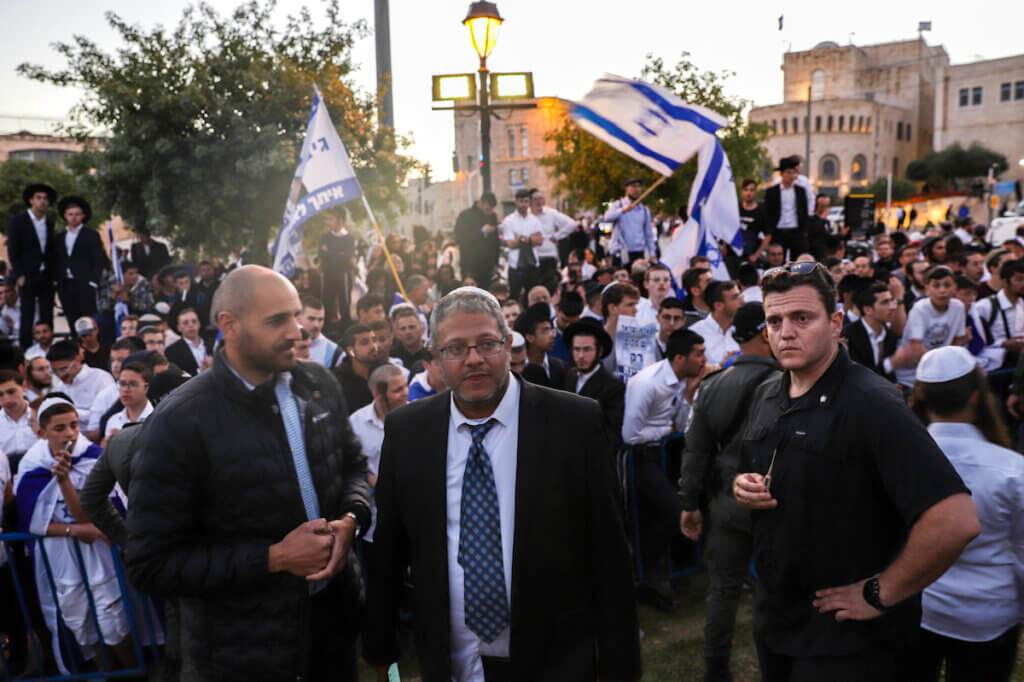
Israeli lawmaker Itamar Ben-Gvir takes part in a march in Jerusalem, on April 20, 2022. (Photo: Jeries Bssier / APA Images)

Editor’s Note: The following paper was presented during the online seminar, “Is Zionism fascist? What will judges think?” hosted by Riverway Law on December 9, 2025.

Despite the mutual admiration of Zionists and fascists, both historically and in the present, it is generally considered unhelpful to characterize Zionism as fascism. However, viewing fascism from the perspective of the Black radical tradition, with its emphasis on racialism, colonialism and imperialism, rooted in supremacist ideas of western civilization, helps make fascism a useful concept for understanding Zionism.

In popular definitions of fascism it is detached from nationalism and associated most strongly with authoritarianism. Israel’s self-presentation as a liberal democracy, the result of a national self-determination project, and even an anticolonial Indigenous manifestation, conflicts with dominant ideas of what fascism is. But this approach to fascism is elusive by design.The history of fascism is dominated by liberal historians who mainly do not see racialism, colonialism and imperialism as central to it. Rather, they tend to see fascism as an aberration of the European/western political project.

In contrast, the revolutionary Black imprisoned intellectual, George Jackson, wrote in 1972 that the definition of fascism is not settled because of ‘our insistence on a full definition… looking for exactly identical symptoms from nation-to-nation.’ In fact, fascism is still under development. For the Black radical political scientist, Cedric Robinson, speaking in 1990, because Black political thought is treated as derivative, Black theories of fascism have generally not been considered ‘worthy of investigation’. Rather, popular culture and mass media are informed by mainstream academic fascist studies which constructs fascism as ‘right-wing extremism’ and ‘neurotic authoritarianism’, and ‘fascism proper… restricted to Europe between the First and Second World Wars.’ These western theorists found it very difficult to see fascism as anything other than the ‘dark side of Western civilization’, briefly flirted with but ultimately rejected.

Black theorists, Robinson goes on to say, based themselves on the experiences of the Black masses. They therefore did not see fascism as the ‘inherent national trait’ of Spain, Italy or Germany, but as ‘composed from the ideological, political and technological materials’ of the entirety of Western civilization. Their approach to fascism was shaped by the ‘crushing defeats’ Black people had already sustained in Cuba, Haiti and Liberia well before Mussolini invaded Libya and East Africa. Indeed, they mobilized en masse against Mussolini’s invasion of Ethiopia in 1935 because, as the Black radical intellectual, W.E.B. Du Bois wrote they recognized that ‘other nations have done exactly what Italy is doing’. Italy wanted a slice of the colonial pie that other European powers had kept for themselves. Italian colonization of East Africa was seen as the latest in a litany of attacks on Black life up to and including enslavement which many descended from directly. ‘Anti-fascism,’ Robinson remarks, ‘was thus spontaneously extended throughout the Black world.’

Not all Black intellectuals took the same approach to fascism. For example, C.L.R James tended to side with Marxists who saw fascism as the result of the clash between capitalism and Communism. Fascism was seen by capitalists as their salvation from a workers’ movement with revolutionary potential. But when the Trinidadian intellectual George Padmore returned to the question in 1956, he saw that something more than the crisis of capitalism within Europe was at stake: fascism was the sign of ‘a new aggression of Europeans in Africa.’

W.E.B. Du Bois already saw this in the early 1930s writing later, ‘I knew that Hitler and Mussolini were fighting Communism, and using race prejudice to make some white people rich and all colored peoples poor. But it was not until later that I realized that the colonialism of Great Britain and France had exactly the same object and methods as the fascists and the Nazis were trying clearly to use.’ This echoes Aimé Césaire’s famous remark that Nazism was the manifestation of what had already been done to non-Europeans before being brought to the Continent and turned inwards.

What Dan Tamir calls, a ‘genuine fascist movement’ also existed in Palestine in the 1920s and 30s, especially within the virulently anti-Communist Revisionist Zionist movement’ of Jabotinsky which opposed the supposedly more gradualist approach of Labor Zionism. Tamir suggests that because fascism emerges in periods of crisis, it is unsurprising that it also emerged in what he calls ‘modern Hebrew society’ in Palestine in the 1920s and 30s, a society riven by deep in crisis. However, like most mainstream fascism scholars, and from a perspective that almost totally ignores the existence of Palestinians, he sidesteps the emphasis placed by Black radicals on race.

For many, it was – and continues to be – unthinkable that Zionists could be fascists because of the centrality of antisemitism to fascism in Europe. However, Zionist fascists, like Abba Ahimeir, an admirer of the authoritarian philosopher Oswald Spengler, believed that fascism had no inherent connection to antisemitism, and that therefore Zionists could be fascists. However, more consistent with the Black radical approach is that the European Zionists – Christian but also Jewish – were in fact antisemites, in addition to being racists. Theodor Herzl famously declared antisemites Zionism’s ‘most dependable friends’ and opposed Jewish immigration, arguing they carried ‘the seeds of anti-Semitism into England; they have already introduced it into America.’ In 1897 he depicted the anti-Zionist caricature, ‘Mauschel’, ‘a distorted, deformed and shabby fellow’ who he did not see as belonging to the same race as the Jewish Zionist who must be freed from association with Mauschel.

It is well-known additionally that Zionists actively thwarted the saving of European Jews from the Nazis. Ralph Schoenman documents that ‘From 1933 to 1935, the WZO turned down two-thirds of all the German Jews who applied for immigration certificates’ because they were seen as of little use to the requirements of the Zionist colony.

Despite this, the dominant tendency to exceptionalize antisemitism leads many to downplay the role of race for Zionism. But there is no colonial project that is not founded on racial rule. Thus, Zionism enacts racial domination over Palestinians. The ability to colonize another’s land is based on the belief that the people are inferior at best, less than human and utterly killable at worst. Statements and actions to that effect are made constantly by Zionists throughout the current genocide.

The case of Zionist collusion with Italian fascism demonstrates the centrality of race to both fascism and Zionism. Mainstream interpreters of Italian fascism have tended to downplay race, for example citing the fact that Mussolini did not enact racial laws until 1938, and only to side with Hitler. However, as Robinson shows, Mussolini believed in Italian racial supremacy before this pivot, but more important than his personal attitudes were his ambitions in Africa. Mussolini’s relationship with Zionists, according to an article by Michael Ledeen discussed by Robinson, was because they ‘could be useful agents’ to destabilize the British mandate in Palestine and to ‘enlist Jewish populations in Libya and east Africa in the “pacification” of colonized populations.’ Mussolini kept Jews on side in various ways, for example allowing a rabbinical school to transfer from Germany.

Jews in Italy and beyond were widely favorable to Mussolini. However, this was not only because of the protection offered them up to 1938, but also because Italian Jews believed in Mussolini’s colonial project, considering, as Shira Klein notes, ‘that Italy’s pride and reputation depended on its colonial conquests.’ There was thus no reason why Jewish Zionists would not see Italy’s ambitions in East Africa and the Levant as consistent with their aspirations in Palestine.

Zionist obsessions with what Max Nordau called ‘muscular Judaism’ echoed Nazi practices, but also the eugenicist beliefs that were widespread among Europeans, US Americans and practiced throughout the colonized world, including by those with ostensibly social democratic views. Medical experiments carried out on Arab Jews were part of the quest to trace the genetic line of Homo Israelensis to Biblical times. Medical experimentation has also been carried out on Palestinian prisoners. Zionist eugenics cannot be detached from its aim to ‘form a portion of a rampart of Europe against Asia, an outpost of civilization as opposed to barbarism’ as Herzl put it in The Jewish State, as European is synonymous with whiteness. This is expressed in Palestine via the appeal to a messianic Jewish destiny, but contra the worrying trend of white nationalist attempting to capture the Palestinian liberation struggle in the west, this should be seen as consistent with all settler colonial visions of manifest destiny.

Indeed, it was the ambition of Zionist founders such as Arthur Ruppin to be accepted as wholly European, something they could only achieve by emulating European Herrenvolk nationalism in Palestine.

Zionism is fascist because it is the tip of the spear of European, western, white supremacist racialism, settler colonialism, and imperialism in the current conjuncture. But it is not unique in that regard. In the context out of which it emerged and of which it is a product – European civilizational supremacism, driving colonialism and imperialism – it is no surprise that Zionists admired and emulated fascism and continue to do so, building ever stronger ties to fascist movements globally, from Trump to Millei and Orban. It is also no surprise that Zionism embodies the ambitions of white supremacist nationalists everywhere.

Fascism’s global nature was remarked upon by George Jackson who noted that ‘we have been consistently misled by fascism’s nationalistic trappings. We have failed to understand its basically international character.’ Zionism can be seen as part of an international movement whose acute manifestations resulted from the crisis of capitalism. But as Black radicals showed, it never developed without its core defining feature: racial supremacism.

Just as Black radicals identified that fascism was a manifestation of their everyday experiences under colonialism and slavery, Zionism’s fascism goes far beyond its most extremist proponents, from Jabotinsky to Kahane to Ben-Gvir. From the perspective of the Black radicals, beyond these figures, it is the fact that almost the entire Israeli population is in lockstep with its genocidal colonial project which makes Zionism fascist in all its dimensions.

2025 End: This Isn’t a Ceasefire; Israeli Genocide Continues


Vijay Prashad 


As 2025 comes to a close, Vijay Prashad assesses the situation in Gaza where Israel has continually violated every ceasefire it has agreed upon, jeopardizing future efforts and the lives of the people in the Gaza Strip.


Injured children at Al-Quds Hospital in Gaza City in the aftermath of an Israeli bombing in August 2025. Photo: PRCS

On January 19, 2025, a ceasefire took effect to halt the Israeli bombing of Palestinians in Gaza. This ceasefire emerged from a mediation process by Egypt, Qatar, and the United States, which had been sealed in June 2024 with United Nations Security Council Resolution 2735. However, the Israelis rejected the agreement and waited until Donald Trump won the US presidential election to proceed so that Trump could take credit for the deal.

Yet, Israel neither fully withdrew from Gaza nor ceased its attacks, nor did it allow the necessary aid into Gaza. Despite the “ceasefire”, the genocide against the Palestinians continued. A month into the ceasefire period, it was clear that Israel had committed at least 265 violations of the agreement (including home demolitions, ground incursions, and shootings targeting civilians). During this time, the United Nations found that 81% of Gaza was either controlled by the Israeli military or subject to arbitrary Israeli displacement orders.

That first ceasefire ended in March and was only revived in October 2025. During the intervening period, Israel took advantage of the situation to pummel Gaza once more without facing criticism from its major backers in Europe and the United States (who continued to arm Israel). The second “ceasefire” has been as ineffective as the first, with Israel having violated its terms 969 times between October 10 and December 29.

Thus, there is a ceasefire in Gaza, insofar as the intensity of the bombing has lessened; but there is no ceasefire in substance, as Israel’s genocidal pressure campaign against the Palestinians continues.

It is worth assessing the situation on the ground in Gaza. Facts are important, and it is key that the United Nations agencies have resumed their basic humanitarian aid work – which includes the collection of data on the problems faced by the Palestinians. I rely heavily on UN data here, especially from the United Nations Relief and Works Agency for Palestine Refugees in the Near East, (UNRWA), which is itself under attack from Israel for being an impediment to its extermination campaign. For clarity, I have provided a brief sketch of four principal areas of bare life in Gaza (some of the data relies on the UN’s dashboard for monitoring UN Security Council Resolution 2720):

Displacement and housing

In March 2025, UNRWA estimated that 92% of all housing in Gaza had been either destroyed or severely damaged. Therefore, the 2.1 million surviving residents of Gaza have been living in UN-run displacement sites or in tents and temporary shelters perilously built into destroyed buildings. The UN Mine Action Service warns that unexploded Israeli bombs litter the rubble and that it would take experts 20 to 30 years to remove them. Heavy rain in Gaza this winter has flooded tents, creating a serious crisis of acute respiratory infections, diarrhea, and hepatitis.

Food and water

The ceasefire deal stated that the Israelis, who control the frontier, would allow 600 trucks of aid into Gaza per day. However, between October and December, the Israelis only allowed an average of 216 trucks per day, according to the UN 2720 Monitoring and Tracking Dashboard. This shortfall is a primary reason why the food, water, and fuel situation in Gaza remains dire. Three sentences from a recent UN report deserve wide coverage: first, “at least 1.6 million people – or 77% of the population – are still facing high levels of acute food insecurity in the Gaza Strip, including over 100,000 children and 37,000 pregnant and breastfeeding women”, second, “Nutrition-rich foods, particularly proteins, remain scarce and prohibitively expensive, leaving 79% of households unable to buy food or have access to clean water”, and third, “No children are reaching minimum dietary diversity and two-thirds experience severe food poverty, consuming one to two food groups” (out of five food groups).

Healthcare

By December 2025, Gaza’s healthcare infrastructure remained severely degraded. Many hospitals and clinics are damaged or only partially functional, with critical shortages of medicines and supplies, frequent interruptions of fuel and electricity, and service availability far below pre-conflict levels. UN agencies describe conditions as fragile, overstretched, and struggling.The Gaza Health Cluster Bulletin provides useful data, with the most recent bulletin noting that “the ongoing military operations continue to exacerbate several operational constraints that has been numerously elaborated including continued restrictions to access program sites and severely limited entry of essential medical supplies, continuous looming threats of deregistration of INGOs [international non-governmental organizations].” Nonetheless, in the ruins of the al-Shifa hospital, 168 Palestinian doctors graduated on Christmas Day.

Education

The UN Education Cluster reports that more than 97% of Gaza’s schools have been damaged, with only 38% of school-aged children able to access any learning over the past two years. Over 700,000 Palestinian children have lost the right to education, including 658,000 who have already lost two academic years. Around 71,000 students in Gaza could not take their General Secondary Education Examinations (Tawjihi) and therefore cannot move to higher education.

Bare life is not yet restored, nor has the capacity for the Palestinians to revive their political institutions. No real progress can be made to end the genocide and occupation if Israel continues to prevent Palestinian leaders of different factions from rebuilding their political institutions. During this “ceasefire”, Israel has assassinated several important Palestinian political leaders, such as Issam al-Da’alis (Hamas’ Government Administrative Committee), Mahmoud Abu Watfa (Interior Ministry), and Huthayfa al-Kahlout (spokesperson for the al-Qassam Brigades), and Israel continues to hold leaders such as Marwan Barghouti (Fatah) and Ahmad Sa’adat (Popular Front for the Liberation of Palestine) in prison. Israel’s insistence on the disarmament of Hamas demonstrates Tel Aviv’s lack of seriousness to negotiate in any direction.

This is both a ceasefire and not a ceasefire. It is a relief that the intensity of the bombing has decreased, but it is no relief for everyday life– especially with no end in sight beyond the anticipation of the next atrocity.

Vijay Prashad is an Indian historian, editor, and journalist. He is a writing fellow and chief correspondent at Globetrotter. He is an editor of LeftWord Books and the director of Tricontinental: Institute for Social Research. He has written more than 20 books, including The Darker Nations and The Poorer Nations. His latest books are On Cuba: Reflections on 70 Years of Revolution and Struggle (with Noam Chomsky), Struggle Makes Us Human: Learning from Movements for Socialism, and (also with Noam Chomsky) The Withdrawal: Iraq, Libya, Afghanistan, and the Fragility of US Power. Chelwa and Prashad will publish How the International Monetary Fund is Suffocating Africa later this year with Inkani Books.

This article was produced by Globetrotter.

Courtesy: Peoples Dispatch