Thursday, January 01, 2026

Why Is the United States Drawn to War?

Source: FPIF

The United States is drawn to war on every front, like a moth to a candle. It does not matter that Americans are sick of foreign wars stretching back 25 years in Afghanistan, Iraq, Syria, Libya, and now Venezuela, wars that have bankrupted the nation. It has no effect that the United States lacks the economic, technological, and manufacturing capacity necessary to sustain a conventional war. Nor would the United States likely win an unconventional war employing nano-technology, bio-technology, and information warfare.

The critics allowed to appear on TV like John Mearsheimer and Jeffrey Sachs attribute this war-mongering to the foolishness and the ignorance of political leaders like Donald Trump, or to the incompetence of bureaucrats. They intentionally avoid any analysis of the economic structure of the United States, or the role of multinational banks and corporations in the formulation of policy. Their only explanation for the drive for war is the foolish actions of a “few bad apples.”

No one wants war, including the rich and powerful on all sides, in Beijing and Washington, in Berlin and Moscow, in Tehran and Tel Aviv. Yet the beating of the drums of war continues, and it grows louder. The appetite for war spreads like a vermillion fungus across the entire nation, with a military culture pushed through newspapers, movies, and television broadcasts. Preparation for war is a means of controlling the “little people” in a totalitarian manner.

The U.S. government is pressuring every ally to rapidly increase defense spending, up to five percent, and to do so far more rapidly than can possibly be done in such a short time without massive corruption and waste. The military buildup is but a transfer of wealth, not an increase in security.

So, Why War?

The United States is collapsing as an economy, as a society, and as a civilization, weighed down by a massive debt, burdened by collapsing infrastructure and dying educational and research institutions, and strangled by a culture of pornography and narcissism. Above all, the extreme concentration of wealth over the last 20 years, since government was captured completely by the super-rich, has meant that a handful of conceited frauds can determine the policy for the entire nation, and decide the fate of everyone. The basic interests of the vast majority of citizens are entirely ignored. The republic, and all traces of participatory democracy, have been consigned to the trash bin of history.

The international trade system and the embrace of “free trade” ideology played a major role in pushing the United States toward war around the world. Supply chains link together factories in loops that encircle the globe. Manufactured goods and agricultural products are brought into the United States from over the world, not because doing so is good for Americans, but because the multinational banks that control the economy seek out the cheapest labor and cheapest goods. Virtually all consumer goods in the United States go through logistics and distribution systems controlled by multinational corporations. Unlike the situation in 1945, a large part of the money that citizens (rebranded as “consumers”) spend at Walmart, Best Buy, or Amazon goes to the stockholders of those corporations and offers little or no benefit for the local economy.

Until the 1950s, most of what Americans ate came from local, family-owned farm. Clothes and furniture were also produced locally. Now that production and distribution have been spread all over the globe, events far away directly impact the U.S. economy, and sometimes politicians feel pressure to use military threats, or responses, to protect American corporate interests (repackaged as “national security”).

So, too, U.S. dependency on petroleum did not exist in the 1920 or dependency on rare earth metals in the 1980s. These are problems created by the decisions of corporations to introduce technologies that offered some conveniences, but at the price of extreme dependency of citizens on technology, which has generated large corporate profits.

The relocation of American manufacturing overseas also means that the only employment available in many regions, especially rural areas, is as police officers, guards at prisons, soldiers, or other positions in the military, police, or surveillance system. These days, security and the military are the only parts of the government budget that are growing.

The last decade has seen employment in defense surge by 40 percent, reaching 1.4 percent of the total employment base. In 2022-2023 alone the workforce expanded by 4.8 percent in contrast to an average of 1.7 percent.

No politician can oppose the increase in the military budget because, although constant foreign wars do great damage to the economy as a whole, the military has become the only part of government that increases opportunities for employment locally.

The U.S. economy is increasingly controlled by a small number of rich families. The wages of American workers have been reduced and the costs of living greatly increased for the profit of the few. The unprecedented concentration of wealth in the hands of a group of oligarchs has changed everything. This restructuring of society may not seem to be military in nature, but it pushes the United States toward a military economy.

The End of the Welfare State

The disposable income of workers increased beginning in the 1940s because of the redistribution of wealth forced by the reforms of the New Deal. These reforms also allowed for corporations to make enormous profits after the 1950s by selling consumer products to working people who had the disposable income to purchase them. From the 1960s on, consumption, growth, and the stock market became the primary tools for assessing the health of the economy.

Particularly from the 1970s on, this system effectively funneled wealth from working people to the wealthiest. But today consumption by workers, the middle class, and even the upper middle class is no longer sufficient to generate profits for corporations because the people cannot spend any more. Banks have been forced to look for some other source of profit to pay off their debts. One direction they looked has been the military. Military spending creates steady demand that is not tied to market conditions, or economic booms and busts. It is funded by the people through taxes, or through the inflation created by the deficit spending that funds military expenditures.

The increase in military spending is a policy choice; it is the only way to avoid economic collapse. It must be justified by threats from China, Russia, and Iran, or terrorism. Intelligence agencies responding to the demands of banks to do everything they can to create trouble with those countries.

Companies like Oracle, Palantir, Google, and Amazon not only grow fat like ticks feeding on the military and intelligence budgets, they are merging with banks and using their control of the IT systems that power banks as a means to seize control of money itself through digitalization of the dollar, or the introduction of cryptocurrencies.

One of the most powerful billionaires, Larry Ellison, has launched a campaign to dominate media through the control of social media, entertainment and news broadcasting. The Trump administration forced TikTok’s Chinese owner ByteDance to turn over its operations in the United States to a consortium headed by Ellison’s company Oracle in December 2025. Oracle grew to global influence as a major contractor for the CIA, and Ellison is a strong Trump supporter.

Since Ellison’s son David was installed as CEO in August 2025 of the new entertainment conglomerate Paramount Skydance—the merger of Paramount Global, Skydance Media and National Amusements—father and son have been raising enormous funds for a hostile takeover of Warner Brothers that would give them unprecedented control over entertainment and journalism in the United States. Already CBS, under Ellison rule, has cancelled at the last minute a 60 Minutes report on the notorious El Salvadorian prison CECOT.

These IT firms made those billions by taking out massive loans that they then used to buy back their own stock. They have nothing but debt and money in digital form. War, the threat of war, the build-up for war, is what keeps them going.

Impact on Governance

The United States government is a republic consisting of three branches: the executive, the legislative, and the judicial. The three branches complement each other, and they also regulate and balance out each other. This system ensures that power is not concentrated in any one place.

That was a long time ago. How does politics really work today?

There are three real branches of government today, and they are quite different than those described in the Constitution. The true three branches of government are the politicians, the bankers, and the generals. They are the ultimate powers behind the government, and they balance each other out because they operate at different levels and have different strengths.

The politicians are able to form temporary alliances among interest groups in business, finance, and government and negotiate among them to determine policy. The bankers control money and have the power of financial manipulation to shut down the entire economy, or the activities of opponents. The generals possess a chain of command that cannot be easily broken by exterior forces, even by money, and they have the ability to use force directly, without relying on a third party, to achieve their goals.

In a healthy society, where citizens actually play a role in politics, the politicians rise to the top because their primary mission is serving the needs of their clients, whether they are bankers, businessmen, generals, or other interest groups in the general population. Politicians can play the central role because they reflect the needs of citizens. As long as politicians can effectively meet the needs of the bankers, the generals, and the citizens, and keep the money flowing to them, the system remains stable.

If wealth is too concentrated, however, to the degree that the bankers can pay off everyone and gain complete control of the economy, then they rise to the top because bankers need only service a small number of the super-rich to obtain absolute power. The politicians become their puppets and the generals are paid off by the bankers. That is what the political system in the United States has become today.

A political system run by bankers, however, will encounter enormous problems over time because everything will be decided on the basis of short-term profits, and no one will do anything for the sake of others, or follow an ideal greater than personal interest. As a result, the foundations of government, and of society, will crumble. Eventually the government will collapse into anarchy, or it will drift into war as a means of generating profits and enforcing the bankers’ iron-fisted rule over the people.

At that historical moment, the generals rise to the top because they have a viable chain of command that continues to function even as the government fails, and because they speak the language of force and violence, which will become the only language that has authority once the legitimacy of politicians and bankers has been destroyed.

The concentration of wealth has almost eliminated the impact of citizens on policy. The finance-driven speculative economy has brought trust in government and business to a new low. As a result, the only politicians in the Democratic Party who are able to take on the Trump administration are all former military and intelligence, and the election of a former CIA officer Abigail Spanberger as governor of Virginia suggests that the “CIA Democrats” have become the driving force in an ideologically bankrupt Democratic Party.

The financial kings, the bankers and billionaires, need make only one little mistake in order for the chain of command to be handed over to the military in the United States. Although military officers may not want war as individuals, once the order goes down, the entire process, especially in light of the massive increase in drones and robots in the military, will be literally on automatic.

Manufacturing Global Crises Won’t Give U.S. Foreign Policy Legitimacy

Source: Originally published by Z. Feel free to share widely.

For anyone paying even modest attention to the current administration’s foreign policy posture, a Christmas Day bombing justified as “protecting Christians from ISIS” in Nigeria was neither shocking nor clarifying. It fits a familiar rhetorical script. What it did not fit was reality.

Nigeria’s violence is real, devastating, and long-standing, but it is not best understood as a campaign of religious extermination. Insecurity there is driven primarily by land disputes, criminal networks, resource competition, ethnic fragmentation, and profound state fragility. Religious identity often becomes the language through which these conflicts are narrated, but it is not their root cause. Reducing Nigeria’s crisis to a story of Christian genocide is not only analytically lazy, it is misleading.

What makes the Christmas Day strike especially troubling is its direct contradiction of the administration’s own stated national security doctrine. That strategy criticizes decades of U.S. foreign policy built on vague platitudes masquerading as strategy and calls instead for disciplined, outcome-driven statecraft with clear political end states.

Yet a one-off bombing on Christmas Day, absent any coherent diplomatic or political framework, is precisely the behavior the strategy claims to reject. What is the actual political or strategic objective? To scare ISIS? To coerce Nigerian authorities into protecting Christians from a genocide that U.S. officials themselves have not demonstrated exists? If there is a theory of change here, it has not been articulated, because it likely does not exist.

The irony is hard to miss. While the administration claims to be acting on behalf of Nigerian Christians, Nigerians themselves remain subject to a partial U.S. visa ban and heightened entry restrictions that, in practice, sharply limit access. This restricts lawful migration pathways for students, professionals, families, asylum seekers, and religious minorities alike, treating an entire population as a presumptive security risk rather than as individuals with rights and agency. Bombing in the name of Nigerian Christians abroad while partially closing America’s doors to them at home does not project moral clarity. It exposes a foreign policy that instrumentalizes human suffering rhetorically while reproducing exclusion materially.

The selectivity of outrage is equally revealing. While Nigeria receives outsized rhetorical and military attention, the administration has been far quieter about Sudan. Thousands of civilians, including Christians, have been killed in Sudan amid mass atrocities carried out by the Rapid Support Forces, particularly in Darfur. U.N. investigators and human-rights groups warn that ethnically targeted violence, church destruction, and attacks on religious minorities there approach genocidal levels. The disparity in attention raises uncomfortable questions about consistency and motive.

This is not an isolated set of decisions but a recurring pattern. Complex global crises are simplified, sensationalized, and weaponized for domestic political signaling rather than addressed through serious diplomacy, multilateral engagement, or long-term strategy. From fantastical claims of a genocide facing Afrikaners in South Africa to open-ended counterterrorism strikes in Somalia conducted without a clear political end state, spectacle substitutes for strategy.

This pattern is also visible in the administration’s hostility toward Venezuela. If the objective is regime change, what happens if it succeeds? Who governs, with what legitimacy, and with what capacity to stabilize a country already devastated by poverty, criminal networks, and institutional collapse? And if regime change fails, is there a diplomatic off-ramp, or does coercion simply become indefinite policy? Drug trafficking is a serious regional problem, but it extends far beyond any single leader. Removing Nicolás Maduro from power would not resolve the structural drivers of the trade, suggesting motivations that go well beyond counternarcotics alone.

Lest we forget history. The United States spent decades using sanctions, covert action, and isolation to unseat Fidel Castro. He remained in power until his death, and the political system he built still governs Cuba. Pressure without a viable political settlement often hardens into permanence rather than producing change.

The intervention in Nigeria raises the same strategic questions about rationale, proportionality, and end goals. Are these bombings symbolic gestures or the start of an open-ended campaign? If they continue, what is the theory of change, and what is supposed to be different on the ground months or a year from now? Conservative talking points erase the real drivers of violence–land competition, resource scarcity, criminality, and state weakness–replacing them with a simplified narrative of religious persecution. That framing is especially questionable given that residents and local officials report the targeted town of Jabo had no history of interreligious violence and no known ISIS presence.

Nor is this approach securing legitimacy at home. Polling by CBS News shows roughly 70 percent of Americans oppose armed conflict in Venezuela. While polling specific to Nigeria has yet to emerge, past public resistance to open-ended foreign interventions suggests this bombing is unlikely to enjoy sustained domestic support.

What did earn the United States legitimacy abroad was sustained engagement with root causes through foreign assistance. Long-term investments in governance, development, conflict prevention, and humanitarian relief addressed instability before it metastasized into violence. Foreign assistance was imperfect, and I have no shortage of criticism for how it was often designed and politicized. But it remained one of the few tools that allowed the United States to exercise influence without coercion.

That credibility has now been hollowed out. By dismantling development and democracy programs and slashing humanitarian aid, the administration has eroded a core pillar of American soft power. Humanitarian organizations and public-health analysts estimate that disruptions linked to recent foreign-assistance cuts have already contributed to over 600,000 preventable deaths worldwide. You cannot bomb your way to legitimacy after defunding the very systems designed to prevent conflict and save lives.

The bottom line is this. Manufactured crises and political theater are fooling no one. They are not making the world safer, they are not advancing U.S. interests, and they are certainly not putting America first. Absent strategy, planning, and clear political end states, they amount to performative uses of force that waste resources at a time when many Americans are already feeling the strain of a rising cost of living. Endless, contradictory conflicts sharpen neither U.S. credibility abroad nor security at home. We deserve better.

Jared O. Bell, PhD, syndicated with PeaceVoice, is a former U.S. diplomat and scholar of human rights and transitional justice, dedicated to advancing global equity and systemic reform.Email.


Source: Originally published by Z. Feel free to share widely.

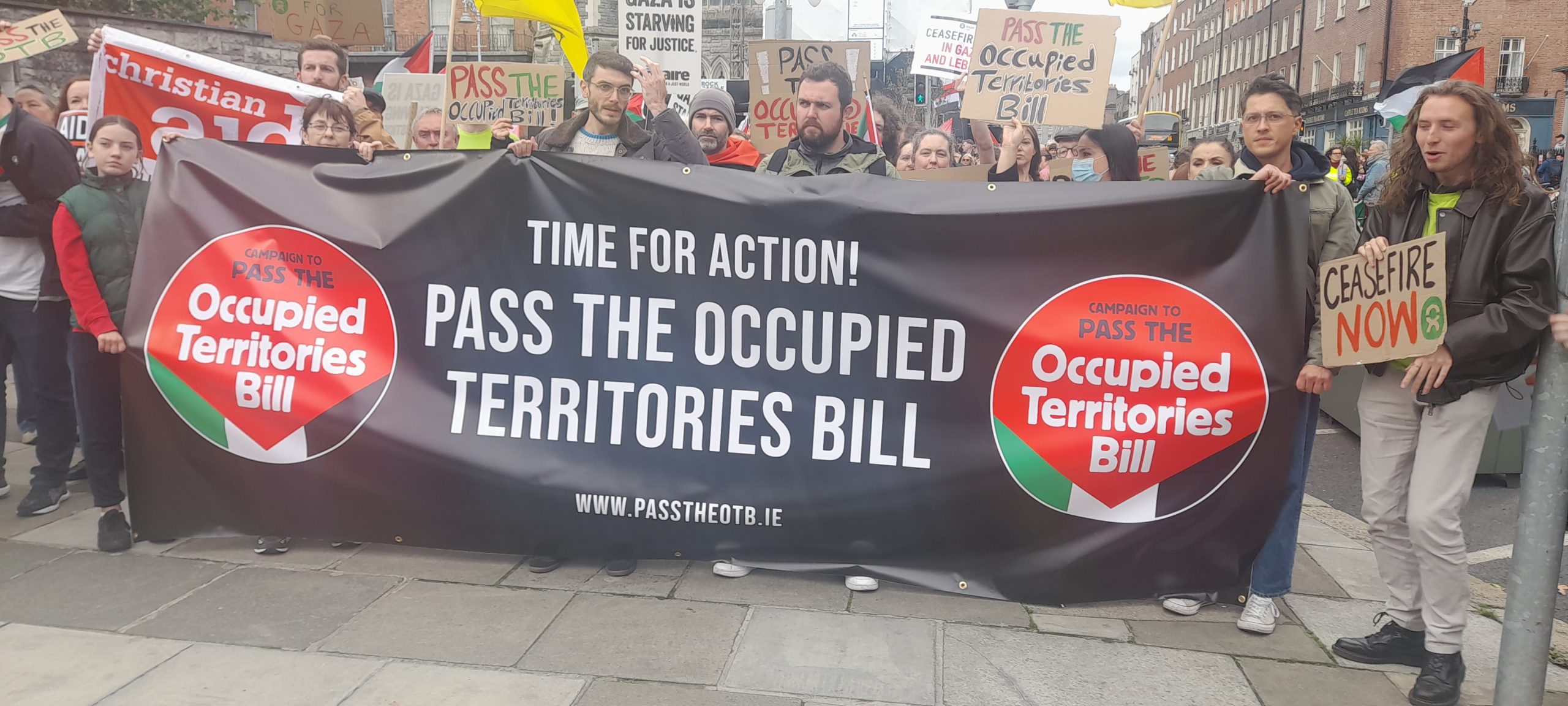
Since the start of Israel’s genocide in Gaza, the Irish people have been pounding the streets week after week in solidarity with Palestine, calling on their government to live up to promises made to implement the Occupied Territories Bill (OTB).  This is legislation that would prohibit the importation into Ireland of goods and services from illegal Israeli colonies in the occupied West Bank.  Both government parties (Fianna Fáil and Fine Gael) pledged to implement the OTB in their election manifestoes ahead of the November 2024 general election but since returning to power have stalled legislation and threatened to dilute the bill by removing trade in services.  This is despite the Tánaiste (deputy prime minister), Simon Harris, describing an International Court of Justice (ICJ) July 2024 ruling on the illegality of settlements as a ‘game changer’. The ICJ placed an obligation on all states ‘not to render aid or assistance in maintaining the situation created by Israel’s illegal presence in the Occupied Palestinian Territory’.  The ruling provided the Irish state with a legal prerogative and greater urgency to implement the OTB having prevaricated at length on the bill being at odds with European Union law.  But Ireland’s Attorney General, Rossa Fanning, confirmed the Bill’s legality in 2024 which should have been the green light for implementation.  But unlike Spain and Slovenia which have become the first European countries to sanction Israel, Ireland has failed to move beyond symbolic forms of support like recognising the state of Palestine in May 2024.

Profit over principle

So, why is Ireland dragging its feet on the OTB?  Well, it seems that the Irish government is caving to warnings from Washington that passing the OTB would ‘cause economic uncertainty for almost 1,000 US companies operating in Ireland’.  The Irish economy runs a significant trade surplus with the US which the Dublin government feared would result in punitive tariffs from the Trump administration if it passed the OTB.  Although the Irish government reneged on its electoral pledge to implement the OTB, it was still hit with a 20 percent tariff as part of measures imposed by Trump on the EU.  So, passing the OTB would arguably have made no difference to Trump’s tariff regime.  More importantly, if it had passed the OTB, Ireland would have taken a principled position of standing in solidarity with Gaza where 71,000 Palestinians have been killed since 7 October 2023 and more than 400 killed since a ‘ceasefire’ was introduced on 10 October 2025.

But not only did Ireland forestall implementation of the OTB, it announced in January 2025 its endorsement of the International Holocaust Remembrance Alliance’s (IHRA) non-legally binding working definition of antisemitism.  The IHRA working definition, as highlighted by UN representatives, Jewish scholars and Palestine Legal is deeply problematic and controversial owing to its conflating antisemitism with legitimate criticism of Israel’s policies vis-a-vis Palestinians. Amnesty International argued that the IHRA definition ‘has been weaponised to suppress criticism of human rights violations by the Israeli authorities’ and called for it to be withdrawn.  In January 2025, the communications firm Edelman published a trust barometer based on surveys in 28 countries including Ireland.  It found that 61 percent of respondents have a moderate or higher sense of grievance defined by a belief that government and business ‘make their lives harder and serve narrow interests’.  This can hardly be a shock to government leaders in Ireland given their bad faith in failing to implement an electoral pledge to pass the OTB.

A complicit ‘third state’

In her latest report, Francesca Albanese, the UN rapporteur for the occupied Palestinian Territories, finds that Israel’s largest dual-use trade is with Ireland in integrated circuits valued at $3.2 billion in 2024.  She writes that ‘Gaza is a collective crime, sustained by the complicity of influential Third States that have enabled longstanding systemic violations of international law by Israel’.  Ireland is one of the ‘Third States’ named in the report and is cited not only for trading in dual-use items with Israel but enabling the use of Shannon Airport as a transit point by the United States military in contravention of Irish neutrality.  Shannonwatch, a group of peace and human rights activists that monitors US military and military contracted aircraft that land at Shannon Airport or travel through Irish airspace, have reported a ‘flagrant abuse of Irish neutrality on a daily basis’.  Moreover, The Ditch web site found that Israel had illegally transported ‘over a tonne of handguns’ through Irish airspace in January 2025.  The same site found that another Israeli flight carrying munitions had flown through Irish airspace on 29 April 2025.  

‘If Ireland acted according to international law’, said Francesca Albanese on a visit to Ireland in March 2025, ‘it probably wouldn’t need an Occupied Territories Bill’.  But far from complying with the provisions of the ICJ ruling and taking what is really a minimal position of stopping trade with illegal colonies, Ireland has maintained ‘business as usual’ with Israel.  At every wheel and turn of the genocide in Gaza, it has asserted economic precedence over action in solidarity with Palestinians.  By doing so it has recklessly undermined international law, damaged its standing as a champion of the global South through its overseas aid programme and UN peacekeeping missions, and created distrust toward government among the Irish electorate.  In a statement to the UN on the 77th anniversary of the Nakba, Noura Erakat, Professor of Africana studies and Criminal Justice at Rutgers University said

“By relegating Palestine to a bilateral political issue beyond the reach of international norms, you have steadily normalized occupation.  By failing to apply sanctions and engage in boycott, many of you normalized apartheid and now by failing to act, you are at risk of normalizing genocide”.

If there is no accountability for governments and corporations that trade with Israel, supply it with arms, goods and services, and continue to profit from occupation and genocide in Palestine then even more depraved violence will become normalised.  Across the world, an enormous coalition of activists and civil society organisations has advanced the cause of Palestine by following the lead of the Palestinian-led BDS Movement like the striking port workers who have disrupted Israeli supply chains.  With enough public support, this kind of activism can change the way politics are done everywhere to end state complicity with Israel’s settler colonialism of Palestine.  
On 24 October 2025, Ireland elected a president, Catherine Connolly, who stood on a platform that condemned Israel’s genocide and strongly supported Irish neutrality.  Connolly positioned herself as being part of a movement working toward a ‘new Republic’ connected to social values and political ideas that made it seem tangible rather than aspirational.  She had overwhelming support among young voters, and her campaign was backed by a united alliance of political parties on the left in the Irish parliament.  It was a firm indicator of a political shift to the left in Ireland and with it a hope that public support for Palestine can be converted into meaningful state action for Palestinians.Email

Stephen McCloskey is Director of the Centre for Global Education, Belfast, and editor of the journal Policy and Practice: A Development Education Review. He is the author of Global Learning and International Development in the Age of Neoliberalism (Routledge, 2022).

Noam Chomsky: An Ordinary Person’s Reflection

Source: Originally published by Z. Feel free to share widely.

Noam Chomsky has been in the news lately for titillating and unpleasant reasons. For me, his relationship with Jeffrey Epstein is relatively unimportant. All it proves is that Chomsky–currently unable to communicate and thereby defend himself because of a stroke suffered several years ago–is a human being at bottom: not always with perfect judgement and not without hypocrisy. 

Perhaps Chomsky was drawn into the orbit of Epstein because of the latter’s massive donations to scientific research; or Epstein’s reputation as a genius financial investor; or Epstein’s facilitation of Chomsky’s search for information via his relationship with such figures as Ehud Barak. In any case, there is no evidence that Chomsky is linked to any of Epstein’s illegal and evil activities. Epstein, although a deeply psychotic predator, was clearly a very intelligent person: perhaps, with his cynicism, he offered insights about the real operations of the ruling class. 

We did not yet know the full context or content of the Chomsky/Epstein interactions. Knowing what we do know, those interactions bring up for me an issue of moral contingency. All of us, unless we are somehow able to stay indoors all the time and take a vow of poverty to protect our chastity, are forced to associate ourselves to some degree with economic, political and social structures–as well as the individuals that represent them–which are fundamentally evil and present extremely difficult moral choices. At this point, I have no desire to lay upon Chomsky the hammer of outright moral condemnation. 

With that being said, as someone–not an established intellectual but a relatively ordinary person–who has been profoundly influenced by Chomsky, I wish to take this opportunity not to dwell on the Epstein controversy but to offer reflections of modest length below on my personal interaction with a few elements of his legacy. 

Chomsky as Oracle

I first read Chomsky when I picked up an original edition of The Fateful Triangle at the Borders bookstore in downtown Seattle in July 1997. I had just graduated high school and it was a deeply fateful moment in my life. From reading that book I soon delved into his other works and found Znet, his main writing forum. From Chomsky’s influence, I became a radical leftist, which I remain to this day. 

Today, it seems not fully possible to convey how magnificent he was to many people coming to political consciousness as I did during the neoliberal era of the 90’s and the truly dark post-9/11 War on Terror. He was an absolute beacon of truth and sanity in a world full of darkness (darkness which, needless to say, is more than ever present). As many others have similarly attested, to me the sources of many of the world’s injustices and seemingly inexplicable phenomena in foreign and domestic affairs all began to make sense by reading Chomsky. He had such a compelling way of presenting his case; moreover he omnivorously devoured newspapers, books, government documents and periodicals to get his vital information. 

As the late Pakistani socialist Eqbal Ahmad once remarked, Chomsky was unique–and in this way I like to think he influenced me most–for virtually never being taken in by any progressive veneer the American ruling class presented for its imperialist or exploitative domestic policies. Ahmad gave the example of Chomsky not being deceived by the “human rights” foreign policy branding given to the presidency of Jimmy Carter (known to Chomsky primarily as the leader who accelerated US support for Indonesia’s genocide in East Timor). 

His access to vital but obscure information and the clear headed analysis he offered made him a true oracle to a person like myself. I well remember in the late 90’s and 00’s how eagerly I awaited Chomsky’s replies on the old Znet forum system to queries made by forum users about current events. Over the course of years, I peppered him with innumerable questions and he responded to them probably much more frequently than I deserved, for I could be slightly obnoxious sometimes. 

Chomsky’s willingness to patiently engage with people from a wide variety of backgrounds and varying levels of education–even with long-winded bores like myself–was an impressive trait of the man. It was clear that with his scientific background and libertarian socialist beliefs he saw the potential for real educational and civilizational advancement in almost every human being and sought to do what he could to cultivate it. As Znet writer Paul Street recently suggested in a  Facebook comment, this mindset was perhaps the source of a certain naivete in his relations with Epstein: he seemed to see the “good” and potential in every human being, even in an evil if curiously intelligent person like Epstein. 

Chomsky and the Khmer Rouge: A Personal Lesson

He could show consternation when people asked him to respond to attempts to discredit him by establishment media hacks; at one point even I was a target of his criticism in this area. The incident demonstrates once again Chomsky’s curiously wide willingness to engage patiently with any human being with whom he came into contact.  

The incident happened in 2013 when Slavoj Zizek–who himself, of course, is not an “establishment hack” although he may be worthy of similar negative labels)–repeated the well worn establishment mantra that Chomsky (and the late Edward S. Herman) defended and minimized the Khmer Rouge genocide of the late 1970’s. 

At the time Chomsky was responding heatedly to Zizek, I simultaneously was going through a short period where reading right wing propaganda about Chomsky’s Khmer Rouge views had caused me some slight misunderstanding of those views. In July 2013, in the comments section of Chomsky’s Znet article responding to Zizek, I made some remarks reflecting my misunderstanding. 

Chomsky then published a fairly blistering response to my comments. He said that my remarks were a symptom of the deep hold of the indoctrination system even on people like myself who tried to see beyond that system. I, of course, then,  as now, was a person of not the slightest consequence in journalism, activism, academia or any such worthy field. I had not made the comments with the intention of Chomsky responding to them. I was merely an unemployed, overeducated, rapidly aging gentleman idly making comments on Znet’s website during a sweltering 2013 summer day. Nonetheless, he took my words seriously enough to write a lengthy response. 

In stern tone but patient detail he proceeded to lay out the sort of talking points that I myself (before my temporary confusion on the issue) had used for years defending Chomsky on internet chat forums and similar humble platforms, against the charge of being a Khmer Rouge apologist. He went through the points one by one: for example, that he and Herman were not defending the Khmer Rouge genocide but rather comparing mainstream US media response to Khmer Rouge atrocities with its reaction to Indonesia’s US backed genocide in East Timor; as well as pointing how the 1969-73 US bombing of Cambodia massacred hundreds of thousands of that country’s people and made it such an unlivable hell on the earth that it substantially created the conditions for the Khmer Rouge to rise to power.

 I think the exchange shows the flaws in my own thinking. It shows Chomsky and I concentrating on different things: me focused on small details in pursuing the question of whether he and Herman were completely accurate in every minutiae of their views on Khmer Rouge atrocities. He, on the other hand, was directing my focus to what, as an American, should have been my primary attention: horrific US war crimes in Cambodia and support for state terrorism in the Third World. 

Years later, I wrote my own defense of the Chomsky/Herman views on the Khmer Rouge for Counterpunch

Final Thoughts

 I am most grateful to Chomsky for teaching me critical thinking when it comes to the policies of the American ruling class. I don’t agree with everything he has ever argued. Nonetheless his libertarian socialist vision of human beings eventually being completely liberated from economic oppression so they can exercise what Karl Marx called their “species being”–their ability to use their own minds to create, build and associate with others in complete freedom–remains deeply inspiring to me. 

This inspiration remains particularly acute to me as a so-called high functioning Autistic person. I’ve always connected a section of the late liberal journalist  Steve Silberman’s 2016 book on Autism entitled NeuroTribes with Chomsky’s glorious libertarian vision. In that book Silberman describes how one of the mid-20th century pioneer researchers into Autism, Leo Kanner, came to a key insight: Autistic people, who were classified while children as severely mentally impaired and in need of lifetime institutionalization–actually developed impressive intellectual capacities in many cases, with some becoming prestigious academics. Kanner discovered that these Autistic persons were able to make these achievements when given conditions of substantial freedom to live, learn and communicate according to their own desires and the particular needs of their own various Autistic neurotypes. 

In conclusion, I will say that Noam Chomsky has made a major contribution to developing whatever intellect I possess and for that I’m eternally grateful. 

Why Working-Class Consciousness Is the Real Threat to Elite Power

Source: The Analysis News

Paul Jay and host Barry Stevens analyze rising progressive movements, from Mamdani’s victory in New York City to Sanders and AOC drawing massive crowds in red states, and why working-class consciousness has always been the real threat to American elites. They discuss why fossil fuel companies have known about the climate crisis for decades but chose denial, why AI could plan a sustainable economy, but is being used for profit and war. They examine the specific dynamics of Christian nationalism, the role of Silicon Valley in the authoritarian turn, and why the 2026 midterms could see significant progressive breakthroughs.