Thursday, January 01, 2026


Groundbreaking discovery reveals Africa’s oldest cremation pyre and complex ritual practices


University of Oklahoma


About 9,500 years ago, a community of hunter-gatherers in central Africa cremated a small woman on an open pyre at the base of Mount Hora, a prominent natural landmark in northern Malawi, according to a new study coauthored by an international team based in the United States, Africa, and Europe. It is the first time this behavior has been documented in the African hunter-gatherer record.  

The study, published in the journal Science Advances, provides the earliest evidence of intentional cremation in Africa and describes the world’s oldest known in situ cremation pyre containing the remains of an adult. While burned human remains appear as early as ~40,000 years at Lake Mungo, Australia, pyres—intentionally built structures of combustible fuel—do not appear in the archaeological record until nearly 30,000 years later. 

Using archaeological, geospatial, forensic, and bioarchaeological methods, including microscopic examination of the pyre sediments and detailed analysis of the human bone fragments, the researchers reconstructed the extraordinary sequence of events surrounding the cremation in unprecedented detail. Their findings demonstrate that the mortuary and other social behaviors of ancient African foragers were far more complex than previously thought.

“Cremation is very rare among ancient and modern hunter-gatherers, at least partially because pyres require a huge amount of labor, time, and fuel to transform a body into fragmented and calcined bone and ash,” said lead author Jessica Cerezo-Román, an associate professor of anthropology at the University of Oklahoma. 

“Not only is this the earliest cremation in Africa, it was such a spectacle that we have to re-think how we view group labor and ritual in these ancient hunter-gatherer communities,” adds senior author Jessica Thompson, an assistant professor of anthropology at Yale University, who leads a long-term research project at the site of the discovery in collaboration with the Malawi Department of Museums and Monuments.

The oldest evidence for an in situ pyre dates to about 11,500 years ago from the Xaasaa Na’ (Upward Sun River) archaeological site in Alaska and contains the remains of a child about three years old. Prior to the discovery of the pyre at Mount Hora, the first definitive cremations in Africa appear around 3,500 years ago in eastern Africa and were associated with Pastoral Neolithic herders. Cremation is more common among ancient food producing societies, who generally possess more complex technology and engage in more elaborate mortuary rituals than earlier hunter-gatherers. 

The cremation site, Hora 1, is under an overhang at the base of a granite inselberg (a large rocky hill or mountain) that rises several hundred feet from the surrounding plain. Archaeological research in the 1950s revealed that the site was used as a hunter-gatherer burial ground, but how long ago remained unknown. Thompson’s work starting in 2016 showed that people first inhabited the site about 21,000 years ago and used it for burials between about 16,000 and 8000 years ago, with all the people interred in a complete state. By contrast, the cremation pyre from ~9500 years ago was part of an ash feature the size of a queen bed and containing a single highly fragmented individual. There is no evidence of anyone else being cremated at the site before or after. 

An analysis of the 170 human bone fragments excavated from the pyre — mostly from arms and legs — suggest that the person cremated was an adult woman between 18 and 60 years old and just under five feet tall. By looking at her bones and the patterns of thermal alteration, the team determined her body was cremated prior to decomposition, probably within a few days of her death. Cutmarks on several limb bones suggest parts of her body were defleshed or removed. 

“Surprisingly, there were no fragments of teeth or skull bones in the pyre,” said Elizabeth Sawchuk, Curator of Human Evolution at the Cleveland Museum of Natural History and a bioarchaeologist involved in the study. “Because those parts are usually preserved in cremations, we believe the head may have been removed prior to burning.” 

Building the pyre required gathering at least 30kg of deadwood and grass, pointing toward significant communal effort, the researchers said. Participants actively disturbed the fire during burning and continually added fuel to sustain high temperatures, according to the analysis of ash sediments and bone fragments. Evidence suggests the blaze reached temperatures greater than 500°C. Discovery of stone tools within the pyre suggest they were either added to or embedded within the burning remains, perhaps as funerary objects.   

“These hands-on manipulations, cutting flesh from the bones and removing the skull, sound very gruesome, but there are many reasons people may have done this associated with remembrance, social memory, and ancestral veneration,” said Cerezo-Román. “There is growing evidence among ancient hunter-gatherers in Malawi for mortuary rituals that include posthumous removal, curation, and secondary reburial of body parts, perhaps as tokens.”

The team also found evidence that about 700 years before the pyre event, the location had been the site of large fires. Then, within 500 years after the cremation event, multiple additional large fires were lit atop the pyre itself. Although no one else was cremated, this suggests that people remembered the pyre’s location and recognized its ongoing significance. The history of large fires in this location, the effort associated with the cremation, and the subsequent burning events reflect a deep-rooted tradition at the site linked to ritual behavior and memory-making tied to a place that was clearly a local landmark. 

While the cremation process is now clear, the motivation behind the event remains mysterious.

“Why was this one woman cremated when the other burials at the site were not treated that way?” Thompson said. “There must have been something specific about her that warranted special treatment.”

Pigs settled Pacific islands alongside early human voyagers


Summary author: Walter Beckwith


American Association for the Advancement of Science (AAAS)


Pigs across the Pacific can trace their ancestry to Southeast Asian domestic pigs that accompanied early Austronesian-speaking groups as they island-hopped across the region, according to a new genomic study. For thousands of years, humans have moved animals far beyond their natural ranges – sometimes accidentally and sometimes deliberately, but often with profound ecological consequences, especially on islands. Pigs are a striking example; although their home ranges lie mostly west of the Wallace Line, multiple species are now widespread across the islands of Southeast Asia and throughout Oceania. Archaeological and genetic evidence suggest that pigs were brought eastward more than 4,000 years ago, predating major Austronesian migrations, with later human expansions bringing them farther across the Pacific. However, studies show that endemic pigs in these regions carry a distinctive “Pacific Clade” genetic signature, which is shared by wild and free-living pigs elsewhere across mainland Southeast Asia. This pattern raises questions about the precise nature of the origin and dispersal of pig populations across the Pacific, and humans’ role in it.


To trace the origins of pigs across Wallacea, Melanesia, Micronesia, and Polynesia, David Stanton and colleagues sequenced 117 modern, historical, and ancient pig genomes spanning the last 2,900 years, and analyzed tooth shape data from 401 modern and 313 archaeological specimens. Stanton et al. found that pigs from the Philippines to Hawaii largely descended from domestic pigs brought by Austronesian-speaking groups from Southeast China and Taiwan about 4,000 years ago. Moreover, pigs in Oceania show no genetic mixing with the wild pig species native to islands along the migration route, indicating that the earliest introduced animals remained genetically isolated from local populations. Only later did isolated feral populations interbreed with endemic wild species. According to the authors, this pattern mirrors early, successive human migrations across the region, which likewise involved limited admixture with local groups, suggesting that these pigs possessed domestic traits well suited for transport and husbandry. Repeated island-to-island movement then shaped their evolution through genetic bottlenecks, selective pressures, and later gene flow, helping explain their success in spreading across Island Southeast Asia and the western Pacific.

Journal

DOI

Article Title

Article Publication Date

How people moved pigs across the Pacific


Genomic study reveals the routes taken by people as they island hopped across Indonesia


Queen Mary University of London

Prehistoric cave painting of two Sulawesi warty pigs, Leang Tedongnge Cave, Sulawesi, Indonesia 

image: 

Prehistoric cave painting of two Sulawesi warty pigs, Leang Tedongnge Cave, Sulawesi, Indonesia. At least 45,000 years old, this is among the world’s oldest known cave art and illustrates the long-standing relationship between pigs and people in the region

view more 

Credit: Adam Brumm (Griffith University) and Adhi Agus Oktaviana (BRIN, Indonesia).


How people moved pigs across the Pacific

Genomic study reveals the routes taken by people as they island hopped across Indonesia

A new study, published today in the journal Science, reveals how millennia of human migration across Pacific islands led to the introduction of invasive pig species all over the Asia-Pacific region.

The study was led by Laurent Frantz, Professor of Palaeogenomics at Queen Mary University of London (QMUL), and the Ludwig Maximilians University of Munich (LMU), David Stanton, from Cardiff University, and Greger Larson, from the University of Oxford.

Plants and animals have not always spread naturally across the islands of Indonesia. The evolutionary biologist Alfred Russell Wallace identified a major biogeographic boundary, the “Wallace Line”, noting that wildlife on either side rarely crossed. Leopards and monkeys, for example, are found on the Asian side, while marsupials and cassowaries are largely limited to the Australasian side.

One notable exception is pigs. Pig populations occur on both sides of the Wallace Line and extend across Southeast Asia to New Caledonia, Vanuatu and remote Polynesia. Pigs are highly effective ecological invaders, and they are also culturally important across the region, raising a key question: what role did people play in their spread?

The new paper looked at the genome of over 700 pigs, including from living and archaeological specimens. This allowed the reconstruction of their movement across southeast Asia and identify when they arrived on certain islands and how they might have interbred with various native pig species.

The researchers found that people of different cultures have moved pig species in the region for millennia. The earliest evidence points to people living in Sulawesi perhaps as early as 50,000 years ago, known to be the earliest cave painters, who both depicted and transported warty pig species as far away as Timor, possibly to establish future hunting stock.

The introduction of pigs in Island Southeast Asia dramatically accelerated, around 4,000 years ago, when early agricultural communities transported domestic pigs in the region. Their journey began from Taiwan, extending across the Philippines, northern Indonesia (Maluku), into Papua New Guinea, and on to the outlying islands as far as Vanuatu, and remote Polynesia. The authors also found evidence for the introduction of pigs from Europe during the colonial period.

Many of these domestic pigs escaped, and became feral, in some cases, like on the Komodo islands, hybridising with the warty pigs brought by people from Sulawesi thousands of years earlier. These hybrid pigs are now a major source of food for the endangered Komodo dragons.

The findings of this study highlight the dramatic and enduring impact of human activity on local ecosystems in the Pacific, raising conservation conundrums. Pigs in the region today have dramatically different statuses and impacts across islands: some are considered spiritual beings, others pests, while some are now so ingrained in local ecosystems that they could almost be considered native. Efficient conservation policy will need to navigate these complexities, going beyond the traditional paradigm of conserving only native fauna.

The study included collaborators from around the world, with more than 50 authors being involved, including scientists from Cardiff University, the University of Oxford, the National Research and Innovation Agency of Indonesia, National Museum of the Philippines, and the Vanuatu Cultural Centre.

  Prof. Laurent Frantz, senior author of the study: “It is very exciting that we can use ancient DNA from pigs to peel back layers of human activity across this megabiodiverse region. The big question now is, at what point do we consider something native? What if people introduced species tens of thousands of years age, are these worth conservation efforts?”

Dr. David Stanton of the University of Cardiff and Queen Mary University of London, the lead author of the study said “This research reveals what happens when people transport animals enormous distances, across one of the world’s most fundamental natural boundaries. These movements led to pigs with a melting pot of ancestries. These patterns were technically very difficult to disentangle, but have ultimately helped us understand how and why animals came to be distributed across the Pacific islands.”

Prof. Greger Larson, of the University of Oxford said: “Wild boar dispersed across all of Eurasia and North Africa and certainly don’t need people to help them disperse into new areas. When people have landed a hand, pigs were all too willing to spread out on newly colonised islands in South East Asia and into the Pacific. By sequencing the genomes of ancient and more recent populations we’ve been able to link those human-assisted dispersals to specific human populations in both space and time.”

Prehistoric cave painting of two Sulawesi warty pigs, Leang Tedongnge Cave, Sulawesi, Indonesia. At least 45,000 years old, this is among the world’s oldest known cave art and illustrates the long-standing relationship between pigs and people in the region

Credit

Adam Brumm (Griffith University) and Adhi Agus Oktaviana (BRIN, Indonesia).


Prehistoric cave painting of two Sulawesi warty pigs, Leang Tedongnge Cave, Sulawesi, Indonesia. At least 45,000 years old, this is among the world’s oldest known cave art and illustrates the long-standing relationship between pigs and people in the region

Credit

Adam Brumm (Griffith University) and Adhi Agus Oktaviana (BRIN, Indonesia).

Prehistoric cave painting of two Sulawesi warty pigs, Leang Tedongnge Cave, Sulawesi, Indonesia. At least 45,000 years old, this is among the world’s oldest known cave art and illustrates the long-standing relationship between pigs and people in the region

Credit

Prehistoric cave painting of two Sulawesi warty pigs, Leang Tedongnge Cave, Sulawesi, Indonesia

How You Can Help Save Boreal Forests in 2026

Want an easy New Years’ resolution? Buy 100% recycled or alternative fiber toilet paper instead of rolls made from virgin forest pulp.


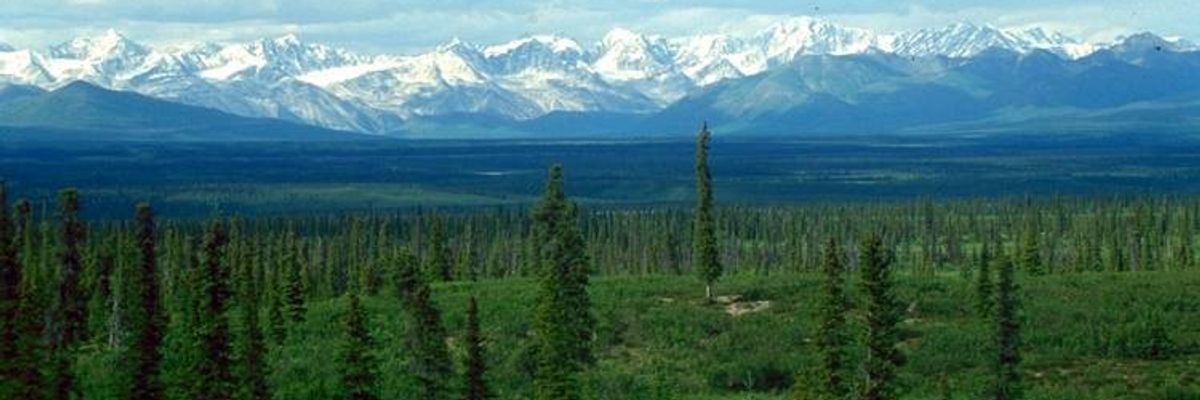
White spruce taiga is seen in the Alaska Range of Alaska, United States.
(Photo by L.B. Brubaker/NOAA)

Brian Rodgers
Jan 01, 2026
OtherWords


North America’s
boreal forests are crucial for wildlife and the climate, but we’re literally trashing them to make pulp for toilet paper and other disposable paper products.

Companies are clear-cutting a million acres a year, according to a new report from the Natural Resources Defense Council (NRDC).

The northern boreal forests are Earth’s largest terrestrial biome. They’re the breeding grounds for 3-5 billion migrating birds that populate our backyards. And they’re a key carbon sink, storing 20% of global forest carbon and 50% of global soil carbon.

Studies show these forests have been overharvested and degraded to such a degree that the ecological damage will be difficult to reverse. They’re increasingly beset by global warming, melting permafrost, fires (including multi-year, spontaneously reigniting “zombie fires”), and pests, which threaten to destroy them and release their carbon back into the atmosphere.

If every American bought just one roll of toilet paper made from recycled paper rather than a conventional forest-fiber roll, it would save 1.6 million trees, 1 billion gallons of water, and 800 million pounds of greenhouse gases.

The United Nations recently warned of an approaching tipping point that could turn them from carbon sinks to carbon sources. That would be catastrophic. The recent COP30 climate summit, held in Brazil’s Amazon rainforest, was billed as “the forest COP.“ But its outcomes were dubious for tropical forests—and nonexistent for boreal forests.

But if climate delegates don’t protect them, consumers can—by buying 100% recycled or alternative fiber products instead of toilet paper made from virgin forest pulp.

A market for these alternatives is emerging. The US toilet paper industry is worth $42 billion, but a whopping 68% of US consumers surveyed want eco-friendly toilet paper made from recycled pulp, bamboo, or cornstalks.

If every American bought just one roll of toilet paper made from recycled paper rather than a conventional forest-fiber roll, it would save 1.6 million trees, 1 billion gallons of water, and 800 million pounds of greenhouse gases—the equivalent of taking 72,000 cars off the road for a year, NRDC found.

Eco-friendly toilet paper start-ups have a $1 billion toehold on the overall market so far—little more than 2%. But they’re growing fast. Imagine how many trees, how much water, and how many emissions we’d save if they gained a 68% share.

The big paper companies are imagining it, too. Procter & Gamble (P&G) makes Charmin, the top US toilet paper brand. This year it launched a bamboo version. That gives the company a green-sounding talk point, and a theoretical way into the growing alternative market. But it isn’t really available in stores and doesn’t do anything to change P&G’s bad practices.

It’s well documented that P&G makes regular Charmin by clear-cutting Canadian boreal forests for pulp, cutting down old-growth groves that have stood for a century or more. Only about 20% of these old-growth trees are left.

Any remnant wood left (called “slash”) after logging gets burned, and the land gets plowed and sprayed with glyphosate (RoundUp), eradicating formerly diverse ecosystems that caribou and birds depend on. They’re replaced with monoculture plantations of softwood trees planted in tight rows, worsening vulnerability to wildfires.

Yet P&G has the chutzpah to claim its slash-and-burn practices “absolutely prohibit deforestation” and “incorporate sustainability.” No wonder the company is being sued for greenwashing, with plaintiffs demanding it be held accountable for “egregious environmental destruction of the largest intact forest in the world” and making “false and misleading claims of environmental stewardship.”

Ultimately though, the power to change practices resides with consumers, not courts. Some 90 million Americans buy regular Charmin—and another 5 billion consumers worldwide buy P&G products. Collectively they have enormous power, provided they’re alerted to the problem and aren’t fooled by greenwashing tactics.

But if those conditions are met, consumers can save the boreal forests, one roll at a time.
Memo to MAGA: Big Government Drives Economic Growth

Since at least World War II, the most dynamic sectors of the American economy have been developed in large part by federal government planning and heavy financial investment.


A person uses the internet in the 1990s.
(Photo by pitchal frederic / Contributor via Getty Images)

Chris Green
Jan 01, 2026
Common Dreams

Few epithets are more heavily utilized among President Donald Trump and his supporters than “socialist” and “communist.” In MAGA’s deeply paranoid Bircher sensibility, “socialism” and even “communism” are defined as even the slightest expansion of governmental intervention in the economy—especially in favor of marginalized groups. In MAGA’s worldview, such interventions are a harbinger of the sort of massive societal disintegration seen in recent years in President Nicolás Maduro’s Venezuela—if not the second coming of Stalinist totalitarianism.

As in so much else in the MAGA worldview, its views on economics have little relation to reality. For it is a fact that since at least World War II, the most dynamic sectors of the American economy (revolving around high tech) have been developed in large part by federal government planning and heavy financial investment. Since World War II, initially on the pretext of Cold War defense spending, technologies from computers and the internet to Google, lifesaving pharmaceuticals, and the components of cell phones have been developed by heavily government-subsidized researchers at universities and private companies. The government agencies providing the subsidies included the CIA, the National Science Foundation (NSF), the National Institutes of Health, and especially the Pentagon’s Defense Advanced Research Projects Agency (DARPA).

This crucial role of government investment in economic success (in the United States as well as Western Europe and East Asia) is generally unknown in MAGA world and even among Americans of a more educated and civilized worldview. But a small group of scholars have explored this fact, ranging from Noam Chomsky to former Richard Nixon adviser Kevin Phillips in his 2003 book Wealth and Democracy. In more recent years, it has been explored by Professor Mariana Mazzucato of University College, London. Mazzucato has served as an adviser to Jeremy Corbyn in the United Kingdom and US Sen. Elizabeth Warren (D-Mass.) in the United States.

As Bill Gates, a prime beneficiary of this government investment, explained in a 2015 interview with The Atlantic, “Since World War II, US government [funded] R&D has defined the state of the art” in almost every advanced sector of the American economy. Gates noted, for example, that it was the Pentagon’s DARPA which provided R&D investment in the 1960s and 70s which laid the foundation for the modern internet. DARPA’s investment was crucial, Gates noted, because as far as being a source of economic innovation, “the private sector is in general inept.” Because of a lack of guaranteed short-term profit, the private sector often refuses to invest in the early stages of development of technologies like the internet. By the 1980’s, the internet had developed to such an extent that many private companies saw its commercial potential and desired partnership with the federal government’s NSF—which had taken over the internet in the 1980s from the Pentagon’s DARPA—to pursue its further evolution. By the mid-1990s, in a somewhat opaque process, the NSF had fully transferred control of the internet to private sector companies.
AI: Big Government Drives Trump Economy

Then there is Artificial Intelligence (AI), the current massive private sector investment that is—according to many experts—the primary factor keeping an otherwise weak US economy afloat since Trump returned to the White House. The foundations for AI were laid by massive government investment in R&D beginning in the 1950s as the Center for Strategic and International Studies explained in October:

Although recent breakthroughs in AI have largely been funded by the private sector, the foundations of modern AI were built through decades of federally funded research. Following World War Two, government agencies like the National Science Foundation (NSF) and the National Institutes of Health (NIH) invested in early AI experiments, such as the first AI program in the 1950s, the first chatbot in the 1960s, and rules-based systems for medical diagnosis in the 1970s. Indeed, public funding advanced many core capabilities like machine learning, neural networks, computer vision, and natural-language processing, which the private sector then developed into the AI systems we use today. In 2024, the House Task Force on Artificial Intelligence released a report of its own, acknowledging that the United States “has maintained its AI leadership largely due to continued and consistent federal investments in AI R&D over decades.”
Big Government Trumpism

During the initial monologue on his November 2, 2015 radio program, Rush Limbaugh ridiculed the above quoted Bill Gates interview; he called Gates’ notion—that government subsidy of high tech R&D had fueled America’s post-World War II economic growth—as among the “craziest, most nonsensical things” he had ever heard in his life.

It seems fair to state that whatever else one might say about him, Bill Gates possesses a much more realistic view of how the world really works than the late Mr. Limbaugh did. It also seems fair to state that even Trump administration policymakers have the same better understanding than Limbaugh.

For all his anti-establishment grandstanding, Trump is just as committed—perhaps more so—to furthering militarism and the economic exploitation of the working class in the US and around the world as any of his Democrat or Republican predecessors.

After all, the Trump administration has been quietly putting tens of billions of taxpayer dollars in service of the private sector, particularly in subsidies for AI’s continued development. The publicly stated rational for such subsidies is national security, specifically the military and economic competition with China. Trump has even spearheaded the purchase by the federal government of shares in a handful of private sector companies in economically vital areas like minerals, steel, and semiconductors.

Normally Trump supporters would object to the federal government buying up shares of private companies. Relatively few of them seem to have even taken notice of Trump doing so, perhaps because Fox News, Newsmax, or their favorite talk radio demagogues have given little or no sustained coverage of it.

The bottom line is that even if some benefits from the Trump administration’s investments do trickle down to America’s working class—or they somehow help fuel long-term American economic dynamism—it is fair to say that his administration is using those investments first and foremost to benefit its billionaire supporters in Silicon Valley and the armaments industry. For all his anti-establishment grandstanding, Trump is just as committed—perhaps more so—to furthering militarism and the economic exploitation of the working class in the US and around the world as any of his Democrat or Republican predecessors. It would be nice if Americans—whether MAGA adherents or not—would become aware of this dynamic and mobilize against it.


Our work is licensed under Creative Commons (CC BY-NC-ND 3.0). Feel free to republish and share widely.


Chris Green
Chris Green has a master's degree in history from Western Washington University and has previously published with Counterpunch and Znetwork.
Full Bio >
Trump’s Buffoonery Reveals That the Empire Has No Clothes

Under his leadership, our political structure is naked and exposed, stripped of its political correctness.


A video posted by US President Donald Trump to Truth Social depicts him in a crown, piloting a fighter jet emblazoned with the words “King Trump,” dumping feces on “No Kings” protesters in Times Square, on October 19, 2025.
(Screenshot: President Donald Trump on Truth Social)


Robert C. Koehler
Jan 01, 2026
Common Dreams

In the Donald Trump era—praise be!—so much is possible that previously no one had ever even imagined. For instance, not only has “the late, great Hannibal Lecter” come back to life, he might even join Trump’s cabinet.

Well, that’s just a guess, but why not? I think he’d fit right in. All of which is to say: “There’s something happening here. What it is ain’t exactly clear...” It’s not simply that Trump is unique (i.e., uniquely crazy). He definitely is, but he’s also American to the core. Under his leadership, our political structure is naked and exposed, stripped of its political correctness. The emperor has no clothes! Suddenly we can’t avoid seeing this.

Indeed, we can’t avoid seeing ourselves. As psychologist John Gartner has pointed out, Trump is not only a malignant narcissist, but—as has been clear in his second term—he’s slithering ever more deeply into dementia. Yet people still support him—enough people to let him win elections. Why?

Because, Gartner notes: “He’s beating up on their shared enemies. There’s a psychological appeal that a Hitler-like character has. Someone who feels disempowered feels re-empowered by someone who, in a punitive way, is attacking their shadow enemies and making them feel powerful and entitled to dominate.”

The “war” on terror, the transcendence of terror—the transformation of humanity, of Planet Earth—begins by looking deeply at ourselves and choosing to evolve.

I would add that these “enemies” may simply be pulled out of the blue... a group his supporters weren’t even aware of. But the strongman has declared them to be the enemy: in effect, creating the enemy. What matters is not that a long-despised group of people are getting what they “deserve,” but that the disempowered supporters now have someone they can feel like they’re dominating.

And, yeah, Trump is going crazy, so to speak, attacking various enemies. As Bret Wilkins writes at Common Dreams:
President Donald Trump—the self-described “most anti-war president in history”—has now ordered the bombing of more countries than any president in history as US forces carried out Christmas day strikes on what the White House claimed were Islamic State militants killing Christians in Nigeria...

In addition to Nigeria, Trump—who says he deserves a Nobel Peace Prize—since 2017 has also ordered the bombing of Afghanistan, Iran, Iraq, Libya, Pakistan, Somalia, Syria, and Yemen, as well as boats allegedly transporting drugs in the Caribbean Sea and Pacific Ocean. Trump has also deployed warships and thousands of US troops near Venezuela, which could become the next country attacked by a president who campaigned on a platform of “peace through strength.”

But this “leadership” is anything but unprecedented. As Palestinian-American comedian Sammy Obeid asks, in a comedy routine with more factual clarity than is often present in the official media: What actually is terrorism, this thing we’ve been trying so hard to eliminate for the last couple decades? To find out, he looked up the definition: Terrorism is “using violence to achieve a political goal.”

Uh... America itself is the biggest terrorist of all time, apparently! Or at least it’s well up there on the list. Beyond the Vietnam War—millions dead—there’s the alleged War on Terror, launched by George W. Bush, continued by Barack Obama, eventually ended by Joe Biden.

According to Brown University’s Costs of War Project: “An estimated over 940,000 people were killed by direct post-9/11 war violence in Iraq, Afghanistan, Syria, Yemen, and Pakistan between 2001-2023. Of these, more than 412,000 were civilians. The number of people wounded or ill as a result of the conflicts is far higher, as is the number of civilians who died ‘indirectly,’ as a result of wars’ destruction of economies, healthcare systems, infrastructure, and the environment. An estimated 3.6-3.8 million people died indirectly in post-9/11 war zones, bringing the total death toll to at least 4.5-4.7 million and counting.”

You might say Trump brings the darkness of all this to light. Isn’t that where war belongs—in raw public scrutiny? Perhaps the greatest enemy of peace is the collective justification and abstraction of war by the political and media complex, along with the financial flow making it possible. This is our national infrastructure. Trump is exposing it, not intentionally, but with snarky, 12-year-old honesty, mixed with dementia.

“Terrorism is using violence to achiever a political goal.” The “war” on terror, the transcendence of terror—the transformation of humanity, of Planet Earth—begins by looking deeply at ourselves and choosing to evolve. If we refuse to do so, we have Donald Trump.