Saturday, January 03, 2026

How Energy Scarcity Is Reshaping the Global Economy

  • Growing inequality reflects deeper physical limits on energy and resource extraction rather than purely financial or policy failures.

  • Rising debt and higher interest rates are emerging as binding constraints on governments, businesses, and households alike.

  • The 2026 downturn is likely to be uneven, with deflationary pressures, weaker oil demand, and selective regional resilience rather than a single global collapse.

Recently, many people have begun talking about the US having a k-shaped economy. In it, a handful of wealthy people are doing very well financially, while many others are falling further and further behind. I expect that the low wages of the majority of workers will soon lead to adverse impacts on businesses, governments, and international organizations. This phenomenon is likely to lead to a very uneven world economic downturn in 2026.

The world economy is subject to the laws of physics. The world economy seems to be reaching growth limits because there are too few easily extractable energy resources (as well as other resources, such as fresh water), relative to the world’s population. The Maximum Power Principle strongly suggests that even as limits are hit, the world economy cannot be expected to collapse all at once. Instead, the most efficient producers of goods and services will be able to succeed as long as resources are available, while less efficient producers will tend to fall by the wayside. Thus, the Maximum Power Principle somewhat limits the speed of the world’s economic downturn.

In this post, I will try to explain the challenges the world economy is now facing. I will also provide some thoughts on how 2026 will turn out.

[1] The k-shaped economy that the US and many other countries are experiencing is an indication that resources are, in some way, “running short.”

Humans all have similar basic needs. They need food to eat, and they need to cook at least some of this food before they eat it. They tend to need transportation services, both for themselves (to get to work) and for goods, such as the food they eat. They also need governments to keep order and to provide basic services, such as roads and schools. All these goods and services require energy of a suitable kind, such as human labor, burned biomass, or fossil fuel energy. They also require arable land, fresh water, and minerals of many kinds.

If there are not enough resources to go around, the easiest way to accomplish this is by creating a k-shaped economy. One example is with farmland. In many traditions, when a farmer dies, his oldest son inherits the farm. Younger children are then forced to find other kinds of employment, such as being a craftsman, farmer’s helper, or priest in a church. Wages for these younger children can easily fall lower than the income of their land-holding older brothers, especially if large families become common. Creating jobs that pay well for all the younger children becomes a problem.

A similar phenomenon has been happening in many Advanced Economies (US, UK, and other countries included in the OECD) in recent years. Parents are doing quite well financially, but their children often have difficulty finding jobs that pay well, even after advanced schooling. Some adult children are also left with educational debt to repay. This is a new type of k-shaped economy.

[2] The world’s current problem is an ever-rising population paired with resources that are becoming ever-more “expensive” to extract.

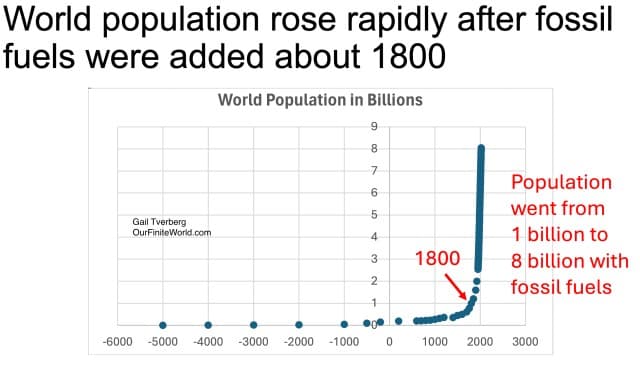
World population has exploded since fossil fuel consumption became abundant. This has allowed more food to be grown, inexpensive transportation of goods and people, and the development of antibiotics and other drugs.
world pop
Figure 1. Chart made by Gail Tverberg based on several population sources.

At the same time, the most accessible resources were extracted first. For example, fresh water initially came from streams, lakes, and shallow aquifers. As the population grew and industrial needs became increased, wells had to be dug deeper and aquifers began to be drained. In some places, desalination now needs to be used. Each of these advances in producing fresh water became more resource-intensive. It became increasingly difficult to gather enough fresh water using human labor alone. Instead, increasing quantities of physical materials, energy supplies, and debt were needed to make the new systems work.

The reason debt was needed to purchase capital goods, such as those required to obtain high-cost water, was because the devices purchased were expected to provide the desired output (water, in this case) for a long time in the future. Securing this future benefit required advance funding, using an approach such as debt. The sale of shares of stock, which are expected to appreciate over time and pay dividends, provides a similar benefit to debt.

A similar issue arises with the increasing extraction of minerals of many kinds, such as copper, tin, uranium, lithium, coal, and oil. Early on, extraction using manual labor and simple tools was sufficient. However, once the easiest to extract resources were removed, capital goods became necessary to make extraction efficient.

Capital goods, such as coal fired power plants, wind turbines, solar panels, and hydroelectric power plants also allowed electricity to be produced, extending the benefits of fossil fuels. Producing these capital devices requires physical materials and energy supplies, as well as debt or the sale of shares of stock for financing.

[3] A major limit on the system seems to be debt and the interest required on the debt.

In an economy, the growth of inexpensive energy supply acts very much like leavening works in making bread; it greatly helps economic growth. With the increasing use of inexpensive energy supply, vehicles can be made ever-less expensively, compared to using much hand labor for manufacturing (literally, making goods by hand). With this growing efficiency, wages rise faster than inflation. In the 1950s and 1960s, young people found that they could marry and live in nicer homes than their parents. Now, the reverse seems to be happening: many adult children are finding it difficult to keep up with the lifestyles of their parents.

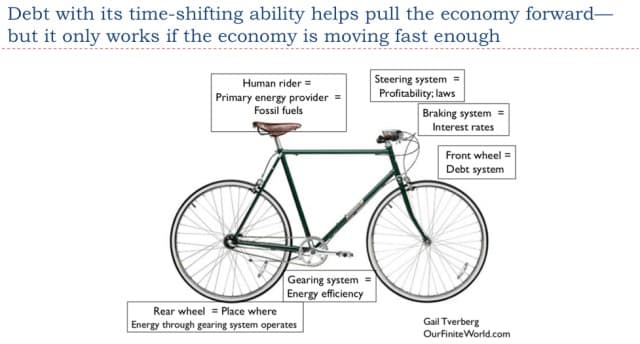
Once the inexpensive-to-extract energy supply is depleted, economies tend to add an increasing amount of debt, in an attempt to pull the economy forward. It seems to me that a major limit on the system comes when an economy slows down so much that it can no longer repay its debt with interest.
Bike
Figure 2. The author’s view of the analogy of a speeding upright bicycle and a speeding economy. “Debt with its time-shifting ability helps pull the economy forward, but it only works if the economy is moving fast enough.”

Political leaders like to believe that growing debt, by itself, will pull the economy forward. In fact, this does work, for a time, as long as interest rates are falling. But falling interest rates stopped happening in 2022.

Fred
Figure 3. Interest rates on 10-year Treasuries (red) and on 3-month Treasuries (blue), based on data of the Federal Reserve of St. Louis.

Of course, all the added debt contributes to the k-shaped economy. The already wealthy disproportionately benefit from debt payments. They also tend to benefit from dividends on shares of stock and from share price appreciation. The poorer people find that an increasing share of their wages goes to paying interest on debt, especially as interest rates rise.

As debt levels grow, governments eventually have a problem with repayment of debt with interest. They need to raise taxes simply to cover their rising interest payments. This is the reason why Donald Trump wants to get interest rates down. Interest payments are rising rapidly, with near-zero interest rates in the rear-view mirror (Figure 3).

[4] Added technology and economies of scale have been adding to the k-shaped economy.

Technology requires specialization. People with more training and higher skill levels tend to earn more than others. Economies of scale encourage the growth of ever-larger businesses. The people at the top of huge organizations tend to earn more than those at the bottom. Also, as international trade is added, low-wage people in the hierarchy increasingly compete for wages with workers from countries with much lower wage scales. Thus, the wages of less-skilled individuals are increasingly squeezed down.

Furthermore, both added technology and economies of scale require added debt. Again, the interest on this debt (and dividends on stock) disproportionately benefits those who are already wealthy.

[5] In a sense, artificial intelligence (AI) is simply an extension of added technology, with a huge need for electricity, water, and debt.

The hope for AI is that it will make our already k-shaped economy, a great deal more k-shaped. The hope is that AI can eliminate a significant share of jobs, with such high profits that the owners of this technology can become very rich. If it works, the wealth will be even more concentrated at the top than today.

I see the need for electricity, water, and debt as stumbling blocks for AI. I expect that, starting in 2026, the AI rapid growth spurt will seize up because it is already using more resources than are available in some areas. I expect that a significant downshift in AI will adversely affect the US stock market and the rate of growth of the US economy. My hope is that the loss of growth in the AI sphere will not, by itself, bring down the US economy–just nudge it toward recession.

[6] In 2026, with an increasingly k-shaped economy, I expect that world oil prices will drift lower than today.

“Demand” for oil really means “the quantity of oil that people, businesses, and governments around the world can afford to purchase.” As the economy becomes more k-shaped, fewer people can afford to buy vehicles of any kind. Poor people, in the lower part of the k, are hardest hit. They will tend to increasingly rely on low energy approaches, such as ride-sharing, walking, or using a bicycle. They will tend to buy fewer goods that are transported internationally. Governments, as they begin collecting less in tax revenue from the many poorer people, will be inclined to cut back their spending on new buildings and road improvements. These changes work in the direction of reducing oil demand, and thus oil prices.

It is this increasingly k-shaped economy that has been holding world oil prices down in 2025. I expect that prices will drift even lower in 2026 because of the increasingly k-shaped world economy. There aren’t enough very rich people to hold up oil and other resource demand by themselves.

Oil production will not immediately drop in response to these low prices, although it may start drifting lower in 2027. The US Energy Information Administration is forecasting that world oil production will rise by 1.1 million barrels per day in 2025 and by 1.2 million barrels per day in 2026. These amounts do not seem unreasonable based on new developments that have already started producing higher amounts of crude oil.

[7] The heavier types of oil, from which diesel and jet fuel are disproportionately made, are in short supply now. They are likely to continue to be in short supply in 2026.

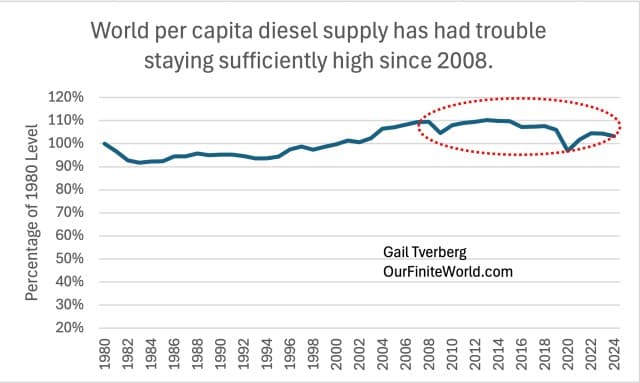
World oil production has risen in recent months. When I investigated, I found that the vast majority of the recent growth seems to be in light oil. Thus, the shortfall in diesel and other heavy fuels is likely to continue as in the recent past.
Pop 2
Figure 4. Chart showing the level of per-capita diesel consumption, relative to the per-capita consumption in 1980. Amounts are based on Diesel/Gasoil amounts shown in the “Oil-Regional Consumption” tab of the 
2025 Statistical Review of World Energy, published by the Energy Institute.

This shortage of the heavy types of oil has several impacts:

  1. With a shortage of heavy oil, a fairly strong country, such as the US, is tempted to attack Venezuela, which has the world’s largest reserves of heavy oil.
  2. Island nations without their own fossil fuel supplies tend to use a disproportionately large share of diesel and jet fuel, for several reasons: (1) Such islands often burn diesel fuel for electricity. This is an expensive way to make electricity; goods produced with this electricity become too expensive to export. (2) Imports and exports need to be shipped in by boat or by air, again using limited types of fuel supply. Physics tends to push these economies down by making their products expensive to sell elsewhere. Examples of islands with these problems include Cuba, Puerto Rico, Madagascar, and Sri Lanka. Such places tend to be adversely affected by shortages of heavy oil sooner than other locations.
  3. Without enough jet fuel, long distance tourism is likely to be reduced in 2026. One issue is the lack of jet fuel for flying planes. Another issue is that an increasing share of the population will not be able to afford long-distance tourism because of the k-shaped economy.
  4. Tariffs are a way of discouraging the shipping of goods long distance, to indirectly save on heavy oil. We should not be surprised by their increasing usage.

[8] In my view, deflation is a greater risk than inflation in 2026.

With a k-shaped economy, demand for apartments (especially smaller ones) tends to stay low. As an economy becomes increasingly k-shaped, low-paid workers tend to share an apartment with one or more friends or move in with family members to save money. In a December 23 report, Apartment Advisor writes that the US average asking rent for studio apartments fell by 2.81% in 2025 compared to 2024. The similar comparison for one-bedroom apartments showed a price drop of 1.72% in 2025. In an increasingly k-shaped economy, I would expect this trend toward lower rental prices of smaller apartments to continue and perhaps become more pronounced.

Real estate selling prices may also be an area for downward price pressure. Young people who have not built up equity through prior home ownership tend to find themselves shut out from buying homes. Also, commercial real estate of many kinds seems to be grossly oversupplied in many areas. Given this situation, downward price adjustments seem likely.

Underlying this downward pressure on prices may be some actual cuts in wages. One law firm reports that cuts in wages are becoming increasingly common, especially for employees of smaller companies.

There are precedents for deflation becoming a problem. The US had problems with deflation at the time of the Great Depression. Japan had problems with deflation after its crash in real estate prices in the 1990s, and China (with its real estate price crash) has recently been having problems with deflation.

[9] “Bread and circuses” become more important as the economy becomes more k-shaped.

Many readers have heard about bread and circuses. Before the Roman Empire collapsed, it used bread and circuses to keep its citizens from rioting from a lack of food. The way to prevent food riots is by making sure everyone has enough to eat through food distribution programs, described as “bread.” Providing circuses offers a distraction from the fact that there are not enough well-paying jobs to go around.

Today, with our increasingly k-shaped economies, leaders have figured out that meeting citizens’ basic needs is essential if unrest is to be avoided. Political leaders somehow need to provide food and healthcare to their poorer citizens. They also need to keep people distracted with entertainment. For many years, governments of Advanced Economies have been trying to provide the equivalent of bread and circuses. In the US, legislation providing Social Security for the elderly was enacted in 1935, during the Great Depression. Many other financial support programs have been added over the years. Today’s circuses today are provided through televised entertainment and video games.

A major problem is that the costs of these programs have become more expensive than tax revenue can support. This is especially true of the cost of “bread,” if its cost is defined as including healthcare and pensions for the elderly, in addition to food. Ultimately, these high-cost programs can bring an economy down. The high cost of bread and circuses is thus a second limiting factor, besides excessive interest payments on government debt, (discussed in Section [3]).

[10] Leaders of many countries are already making plans that can be used to deal with shrinking resources per capita.

If there aren’t enough resources to go around, what can governments do to prevent riots? Two obvious choices come to mind:

(a) Tighten controls on citizens to prevent riots. China has been a leader in this area, and the UK and US seem to be trending in a similar direction. In a sense, the Covid requirements of 2020 were practice with respect to restrictions on movement.

(b) Develop a rationing system that can be used, in case of a shortfall of essential goods. Many countries are looking at central bank digital currencies (CBDCs). These are a digital form of central bank money that is widely available to the public. In the US, I expect CBDCs will be rolled out initially as a way for those who are entitled to food stamps to easily access their benefits. If these digital currencies work, CBDCs can easily be expanded into a widespread rationing system. Government leaders will then be able to decide who can afford to buy what, rather than depending on the way the k-shaped economy currently allocates buying-power.

[11] What lies ahead in 2026?

I don’t think any of us know for certain. The general direction of the world economy seems to be toward contraction, but some parts of the world economy will fare better than others.

Europe looks increasingly like it is an “also-ran” behind the US and China in the world economy. I expect its resource use will continue to shrink back in 2026, indirectly benefiting the United States and the rest of the world. I am hoping that with cutbacks in oil usage by island nations and Europe, and the resulting lower world oil prices, the United States will be able to avoid the worst of the recessionary tendencies looming in 2026.

There are some reports that AI, as it is being applied in China, is providing major success in reducing the cost of coal mining in China. If this is true, it may allow China’s economy to grow in 2026, despite downturns in many other countries.

I am fairly certain that AI, as it is being developed in the US and Europe, cannot continue its recent exponential growth trajectory, and I expect this to become obvious in the next few months. This shift seems likely to pull down US stock market indices. Here again, I am hoping that despite this issue, the US will be able to avoid the worst of the world’s recessionary tendencies.

I don’t expect a world war in 2026. For one thing, no country has adequate ammunition capability. I think civil wars and wars against nearby countries are more likely.

It is possible that the EU will collapse in 2026, leaving the individual countries on their own.

At some point in the future, I expect that the central government of the US will also collapse, in the manner of the Soviet Union in 1991. States will likely regroup and issue new local currencies; the new combined governments will likely provide much more limited benefits than the US government provides today.

Many people think that different leadership will change the current trajectory, but I am doubtful about this. Most of the world’s problems are “baked into the cake” by resource shortages and by too high a population relative to resources. Keeping immigration down is one way of trying to keep resources and population in closer balance.

All in all, I expect a very uneven world economic downturn in 2026. Economies will continue to become more k-shaped. Governments will do their best to hide problems from the public. Stock markets will likely not do well in 2026, if they can no longer count on AI for an uplift.

By Gail Tverberg via Our Finite World


Iron ore price logs annual gain in a dramatic recovery fueled by steel exports

Stock image.

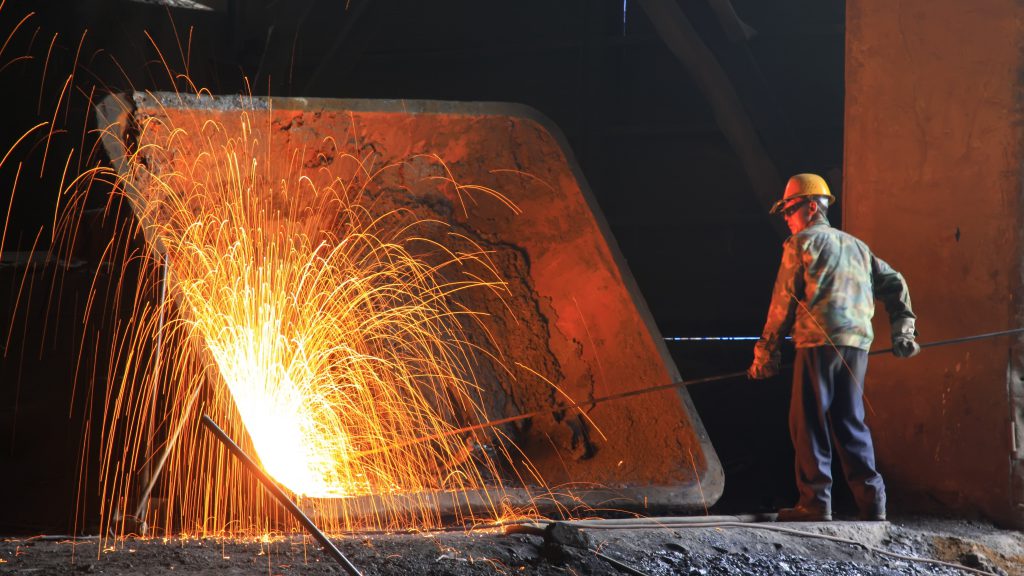
Iron ore futures traded in a tight band on Wednesday, but defied early 2025 fears to post annual gains on the back of resilient demand in top consumer China amid robust steel exports and prospects of improved steel fundamentals.

The most-traded May iron ore contract on China’s Dalian Commodity Exchange (DCE) closed daytime trade 0.57% lower at 789.5 yuan ($112.97) a metric ton, but posted an annual rise of 1.3%.

The benchmark February iron ore on the Singapore Exchange was up 0.2% at $105.55 a ton, as of 07:36 GMT, set for an annual gain of 5.1%.

Prices of the key steelmaking ingredient had come under pressure earlier this year on expectations of a supply glut and forecasts of faltering demand in China.

But China’s consumption proved to be resilient, underpinning iron ore prices, even as crude steel output is set to fall below 1 billion tons this year.

Cost competitiveness of blast furnace-based steelmaking kept operating rates high, boosting iron ore demand, although the cleaner electric-arc-furnace-based steelmakers had to scale down output when margins were squeezed by dwindling local demand and resilient ore prices.

Ballooning steel exports, which are set to hit a record high in 2025 despite growing protectionist measures worldwide, offset sagging demand from the crisis-hit Chinese property sector.

In the near term, ore prices are expected to find support from a flurry of restocking by steelmakers ahead of the Lunar New Year holiday in February. But swelling portside inventories and sluggish steel demand will curb the upside potential.

Other steelmaking ingredients on the DCE were mixed on Wednesday, with coking coal up 0.45% and coke down 1.25%.

Steel benchmarks on the Shanghai Futures Exchange moved sideways. Rebar lost 0.48%, hot-rolled coil fell 0.52%, while wire rod gained 5.66% and stainless steel firmed 0.57%.

($1 = 6.9883 Chinese yuan)

(By Ruth Chai and Amy Lv; Editing by Sonia Cheema and Subhranshu Sahu)

Aluminum price hits $3,000 for first time since 2022 on supply concern

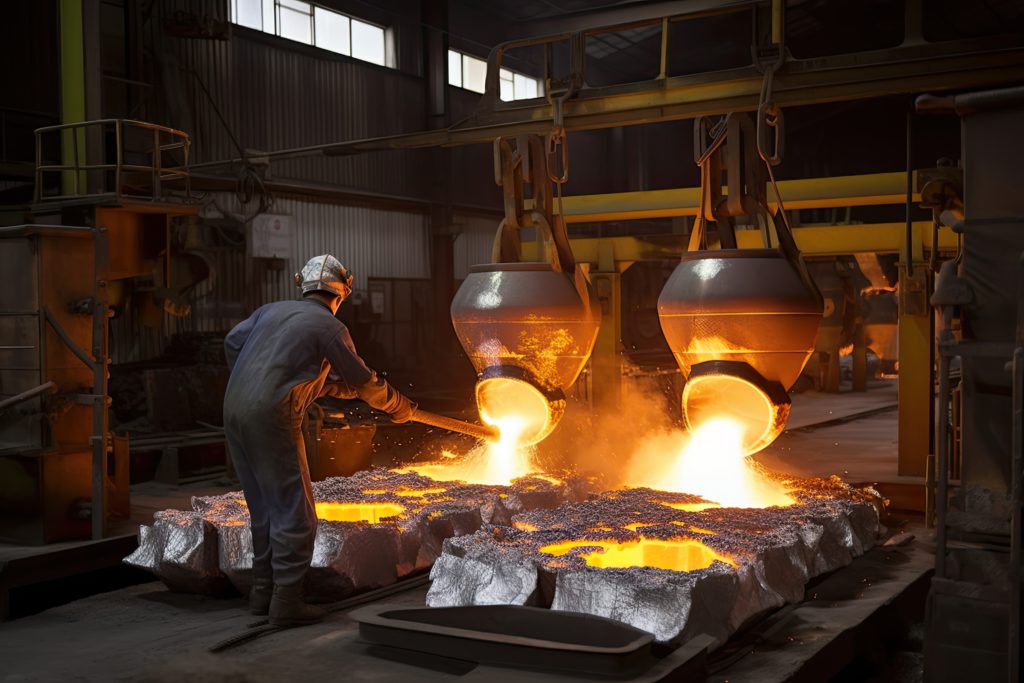
Aluminum processing facility. Stock image.

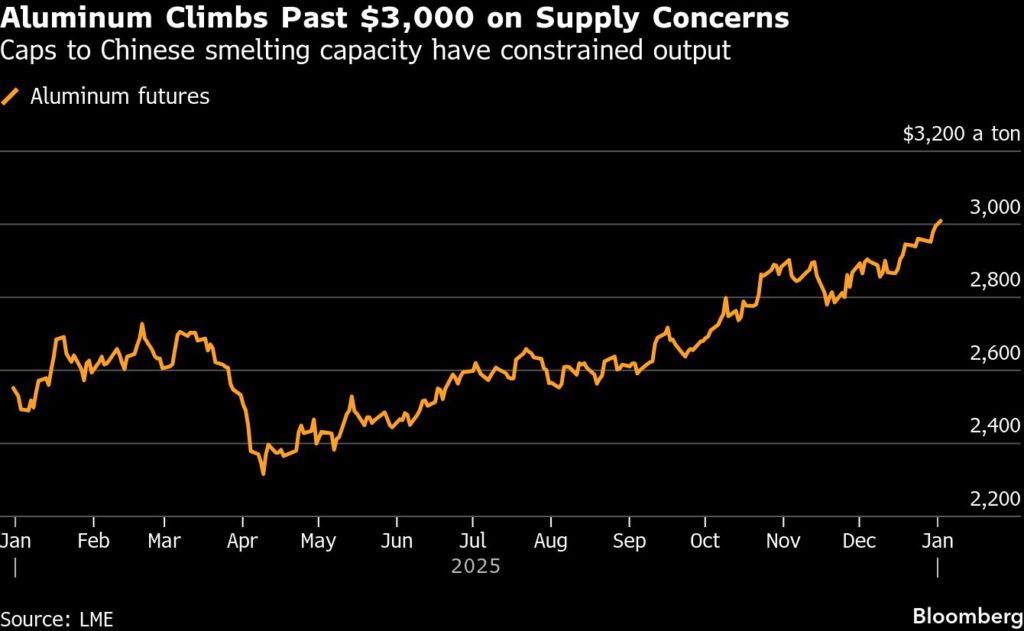
Aluminum climbed above $3,000 a ton for the first time in more than three years on a tightening supply outlook and long-term demand bets, joining other base metals notching recent milestones.

A cap on Chinese smelting capacity and constraints to European production due to higher electricity prices have chipped away at global inventories, while the demand outlook from the construction and renewable sectors remains robust. Futures rallied 17% last year, the most since 2021.

Copper also resumed gains Friday after capping the biggest annual gain since 2009 on tight supply, while nickel jumped after PT Vale Indonesia halted mining following a delayed approval to a work plan from authorities.

The company said the approval is expected soon and the delay is unlikely to impact overall operational sustainability. Delays are not unusual in the Southeast Asian nation, but traders are honing in on supply after Indonesia said it planned to cut output this year.

Copper hit a series of all-time highs during an end-of-year surge, making it the best performer of the six industrial metals on the London Metal Exchange. Mines in Indonesia to Chile and the Democratic Republic of the Congo suffered accidents in 2025, while tariff concerns led traders to ramp up shipments to the US.

The main union at a Capstone Copper Corp.-operated mine in northern Chile began a strike Friday as members push for a bigger share of the windfall from the record prices.

The red metal was 0.4% higher to close at $12,469.50 a ton on the LME. Aluminum rose 0.7% to $3,015.50, a third consecutive gain. Nickel climbed 1% after capping the biggest monthly increase in December since April 2024.

(By Annie Lee)


Mulberry Industries, Ramaco Resources enter rare earth offtake MOU for Brook mine

A view of Ramaco’s Brook mine property in Wyoming. Credit: Ramaco Resources.

Ramaco Resources (NASDAQ: METC) and US-based permanent magnets manufacturer Mulberry Industries have entered into a memorandum of understanding (MOU) to negotiate an offtake partnership that aims to bolster America’s domestic rare earth and permanent magnet supply chain.

Ramaco is developing critical minerals and rare earth elements at its Brook mine in Wyoming, which it says holds what is believed to be the nation’s largest unconventional deposit of rare earth elements and critical minerals sourced from coal and carbonaceous ore. 

Brook is America’s first new rare earth element and critical mineral mine in over 70 years, and it will be initially focused on the vertically integrated production of commercial oxides. Full-scale mining and construction of a pilot processing facility are underway at the mine located near Sheridan. 

The company this year received a second five-year land use approval from the Wyoming Department of Environmental Quality and released summary results of the mine’s preliminary economic assessment.  

Under the MOU, Ramaco will negotiate an agreement to provide Mulberry Industries, on a non-exclusive basis, with a supply of customized oxide blends that include samarium, neodymium-praseodymium, yttrium, gallium and dysprosium/terbium.

Mulberry Industries will use this domestic feedstock to bolster its existing 10-year rare earth stockpile to manufacture advanced permanent magnets at its facility in Georgia for customers across the defense, aerospace, automotive and robotics industries.

“This Ramaco Resources partnership diversifies our rare earth sourcing so we can continue to scale quickly and ensure long-term supply chain freedom for our customers,” Mulberry Industries CEO Kevin Feng said in a December press release. “We can establish a secure, ex-China supply chain for permanent magnets right here at home that strengthens America’s economic and national security.”

Mulberry Industries makes neodymium-iron (NdFeB), samarium-cobalt (SmCo) and aluminum-nickel-cobalt (AlNiCo) permanent magnets. The Georgia-based company is one of the West’s only end-to-end producers of SmCo magnets, which are essential for a variety of defense applications.

“Ramaco is proud to pursue a partnership with Mulberry Industries to supply domestically sourced rare earth oxide blends that underpin a resilient, ex-China permanent magnet supply chain,” Ramaco Resources CEO Randall Atkins stated.

“With mining at the Brook mine in Wyoming commencing earlier this year and construction of a pilot plant now underway, we will be positioned to deliver reliable feedstock tailored to Mulberry’s advanced magnet manufacturing,” Atkins added.

“Together, we seek to build a durable, transparent supply chain that helps US innovators scale with confidence for the decade ahead.”

.


Column: Every mineral is critical in the new metals age


Stock image.

The US Geological Survey’s (USGS) updated critical minerals list now encompasses 60 different materials, representing around 80% of all the mined commodities on the periodic table.

Some are well-known industrial inputs such as copper, nickel and zinc. Many are not. Among the rare earth elements are exotic metals such as gadolinium, ytterbium and praseodymium.

From aluminum through to zirconium, all are considered “essential for national security, economic stability and supply chain resilience,” according to the USGS.

The spectrum of metals now deemed “vital for a modern American economy” speaks to a quiet revolution in how metals are used, one nurtured more in the laboratory than in the blast furnace.

Spice metals

Many critical minerals are “spice metals” – used in only tiny quantities but with a transformative impact.

Consider, for example, the humble semiconductor chip, the foundation stone of modern technology, ubiquitous but unseen in our laptops, mobile phones and cars.

Silicon has been the wafer material of choice for decades but is close to its technical limits when it comes to advanced computing. Sprinkle in a dash of gallium and germanium, however, and the chip’s capacity rises exponentially.

As garnish for the finished product, you’ll need a mix of palladium, arsenic, iridium, titanium, copper and cobalt for plating, wiring, doping and packaging.

It’s a lot of metal for something so small, but the spice is worth it as the semiconductor industry seeks ever more powerful chips.

The spice is also highly prized by the US military, which helped develop the technology at the Defense Advanced Research Projects Agency. Super‑powerful gallium nitride chips enhance radar capability and boost drone-jamming capacity, a major defence priority in an age of drone swarms.

Power metals

The accelerator behind much of the recent metals revolution has been the global drive to reduce carbon emissions.

The road to phasing out fossil fuels is paved with metals such as lithium, cobalt, nickel and manganese.

Lithium was a niche industrial mineral used mainly in industrial lubricants until a little-known start-up called Tesla unveiled the Roadster electric vehicle in 2006.

Now lithium sits at the heart of the shift from internal combustion engines to cleaner technology.

No welding required.

Lithium and other metallic cathode ingredients are blended as powders into bespoke recipes for battery makers. It’s more chemistry than metalwork.

A battery alone won’t make a vehicle move. For that you need an electric motor, and the best are permanent-magnet motors rich in rare earths.

Smaller magnet motors are needed to operate the windscreen wipers, adjust the seats and lower the windows.

Like semiconductors, rare earth magnets are everywhere, just not in plain sight.

Phoenix metals

Copper wires the modern technological age and tin glues the whole thing together.

These are two of the oldest metals used by humans; in combination they defined the Bronze Age.

Thirty or so years ago both were in danger of becoming sunset metals as core applications in telecoms and packaging were steadily replaced by fiber optics and plastics respectively.

Tin is still used for brass decorations and long-life food cans, but together these now account for only 17% of global usage, according to the International Tin Association.

More than half of all the tin used today is for soldering circuit boards together, making it an indispensable part of the bridge between physical and virtual worlds.

As for copper, it’s still the best electrical conductor at the price. It wires every EV, it wires every charging point and it wires every power source.

Millennia after bronze transformed tool-making, these two “phoenix metals” have been reborn as core inputs for modern life.

Metals age

Metals, both old and new, have been seeping into our technology in weird, wonderful and mostly unnoticed ways.

Without them, nothing works.

A study by US defence software company Govini found that more than 80,000 parts across 1,900 US weapon systems incorporate antimony, gallium, germanium, tungsten or tellurium. That’s nearly 78% of all US weapons and just five out of 60 critical minerals.

This is a major problem for the Pentagon, since China is the dominant global producer of just about all of them and has this year shown it is quite prepared to leverage that position in the form of export controls.

It’s also a big problem for everyone, since civilian life depends on the same spicy metallic mixes.

The West’s pressing need to escape China’s chokehold on critical minerals supply has thrust these previously obscure elements to the center of world politics.

US President Donald Trump’s deal with Ukraine in May was underwritten by the country’s mineral resources.

The Washington-brokered peace deal between the Democratic Republic of Congo and Rwanda opens the door to a part of the world rich in copper and cobalt, currently dominated by Chinese operators.

The US International Development Finance Corporation is weighing up an investment with Congo’s state miner Gecamines, which would give the US a right of first refusal on future supply.

Critical minerals are going to stay in the news until further notice. So expect more headlines about metals you’ve never heard of, such as indium, niobium and scandium.

They’re all critical in one form or another in the 21st century.

Welcome to the new metals age.

(The opinions expressed here are those of the author, Andy Home, a columnist for Reuters.)

(Editing by Marguerita Choy)


Copper price climbs on tight supply outlook after best year since 2009

Stock image.

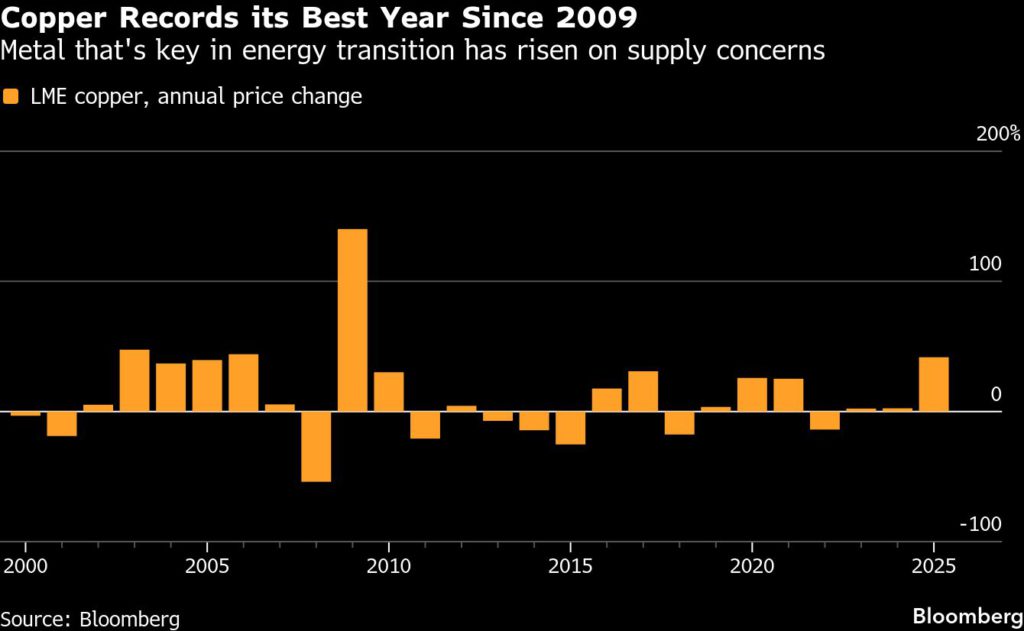
Copper rose on the first trading day of 2026, after capping the biggest annual gain since 2009 on prospects for a tighter market.

The red metal resumed its advance on Friday after losing 1.1% in the previous session. Copper rallied 42% on the London Metal Exchange in 2025, underpinned by mine disruptions and concerns around tariffs, which have led traders to ramp up shipments to the US, creating tightness elsewhere.

Copper notched a series of all-time highs during an end-of-year surge, making it the best performer of the six industrial metals on the LME. Beyond the tariff-driven flows, mines in Indonesia to Chile and the Democratic Republic of the Congo suffered accidents in 2025, crimping output.

The red metal was 1% higher at $12,543.00 a ton at 3:39 p.m. Singapore time, after hitting a record of $12,960 on Monday. Aluminum was little changed at $2,997.50.

Nickel climbed 1.1% to $16,840.00, with PT Vale Indonesia suspending operations at its mines after not receiving approval for an annual work plan from the authorities. Delays in mining-quota approvals are not unusual in the Southeast Asian nation, but traders are honing in on supply after Indonesia said it planned to cut output this year.

Iron ore futures in Singapore rose 0.2% to $105.55 a ton. Chinese markets are closed for public holiday.

(By Annie Lee)

Ivanhoe Mines begins copper anode production at new Congo smelter


Once fully ramped up, the smelter’s overall copper recovery is expected to be 98.5%. Credit: Ivanhoe Mines

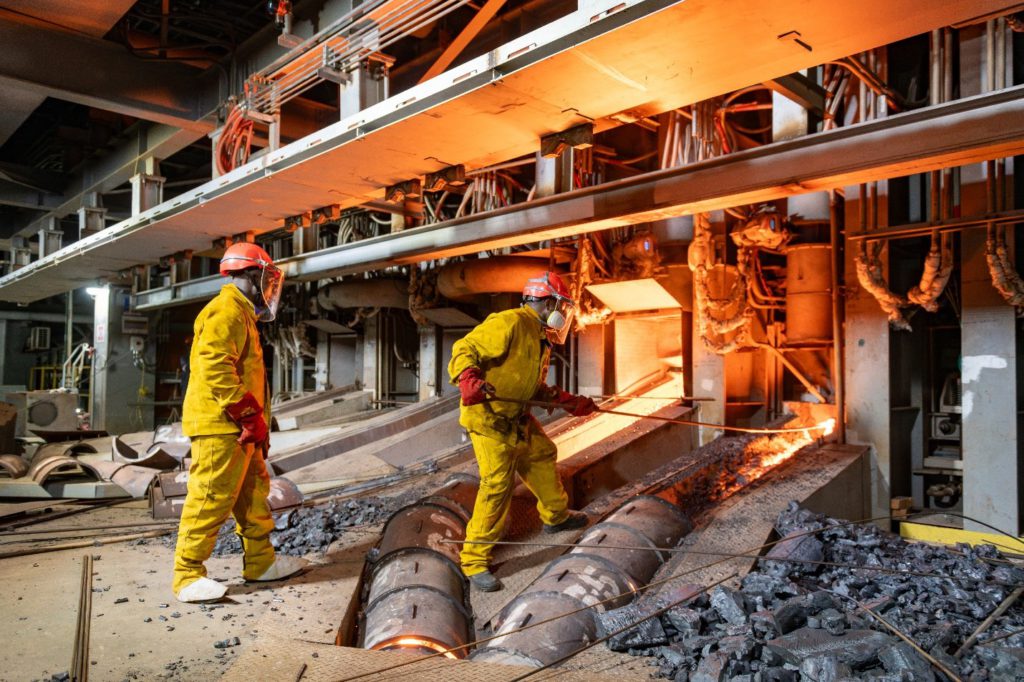
Ivanhoe Mines (TSX: IVN) has officially begun copper anode production at Kamoa-Kakula’s direct-to-blister smelter in the Democratic Republic of the Congo.

First production occurred on Dec. 29, 2025, approximately five weeks after the commencement of smelter’s heat-up and one week after the first feed of concentrate, the company said in a statement Friday. The facility, with a steady-state capacity of 500,000 tonnes per annum, would be the largest in Africa once ramped up.

“The first production of copper anodes from our world-class smelter is a defining moment for Kamoa-Kakula,” Ivanhoe’s founder and executive co-chairman Robert Friedland said in a news release. He added that the facility will “deliver the highest-quality Congolese copper anodes to the international markets, setting a new global benchmark for scale, efficiency, and sustainability.”

Analysts at BMO Capital Markets, in a note published Friday, said Ivanhoe’s announcement of first anode production from the Kamoa-Kakula smelter falls in line with guidance and the bank’s expectations.

Shares of Ivanhoe Mines jumped as much as 5% on the announcement, before paring some gains. By midday in Toronto, it traded at around C$16 apiece with a market capitalization of C$23.2 billion ($16.9 billion).

Ramp-up continues

Ivanhoe said Friday that it is now ramping up the Kamoa-Kakula copper smelter to its annualized rate of 500,000 tonnes of 99.7%-pure copper anode, with completion expected by year-end.

As announced by the company last month, Kamoa-Kakula’s copper production is estimated at between 380,000 and 420,000 tonnes in 2026, with the mid-point of 400,000 tonnes representing approximately 80% of the smelter’s total capacity.

According to the Canadian miner, the Kamoa-Kakula management team is expected to prioritize the processing of concentrates produced by the Phase 1, 2, and 3 concentrators through the on-site smelter, with any excess concentrate toll-treated at the Lualaba smelter near Kolwezi.

Prior to the first feed of concentrate into the smelter, Kamoa-Kakula’s on-site concentrate inventory contained approximately 37,000 tonnes of copper. Total unsold copper in concentrate at the smelter, held in stockpiles and the smelting circuit, is expected to be reduced to approximately 17,000 tonnes during 2026 as the smelter ramps up.

As such, 2026 copper sales are expected to be approximately 20,000 tonnes higher than copper production as the on-site inventory of unsold copper concentrate is destocked, predominantly during the first half of 2026, Ivanhoe said. As destocking occurs, Kamoa-Kakula’s management aims to capitalize on near-record-high copper prices, it added.

Stage 2 dewatering done

Ivanhoe also noted that it has completed the Stage 2 dewatering of the Kakula mine, which became flooded following an earthquake last May. The incident impacted mining operations on the eastern side of the mine, putting a dent in the company’s 2025 copper production.

Following months of dewatering activities, selective mining began on the impacted areas in late December, which Ivanhoe said was ahead of schedule. Stage 3 dewatering will now take over, consisting of re-commissioning the existing, water-damaged underground horizontal pump stations, which are used for steady-state operations.

 Three dewatering activities are expected to continue into Q2 2026 and will not be on the critical path for Kakula’s mining operations, Ivanhoe said.


US must ramp up titanium capacity to avoid squeeze, Project Blue founder says

Stock image.

Titanium isn’t factoring much into current critical minerals mining news headlines the way copper, gold or lithium are, but its importance could become more evident as the conversations around defense metals evolve – and as supply chain risks are exposed.

Considered a critical mineral by the US, EU and Canada because it is essential for defense, aerospace, medical, and industrial technologies, titanium  has a unique strength-to-weight ratio and corrosion resistance with few substitutes.

Titanium is used in two distinctly different forms: as titanium dioxide (TiO2) for pigments and as titanium metal alloyed for aerospace applications. The vast majority – over 90% globally of mined titanium is processed into the pigment – a looming supply chain gap  UK-headquartered market intelligence company Project Blue outlines in its report “Metals and the Security of Nations”.

The report details how geopolitics, especially China’s dominance and export controls, are disrupting defense supply chains for materials like titanium and rare earths. 

In North America, titanium is mined in Florida, Georgia and Virginia in the US and in Canada’s Quebec province for use in pigments – mainly used in paint. 

From a US perspective, the fact that the titanium that is mined is processed into pigment and not metal, makes the actual titanium mining in the US irrelevant for the aerospace industry as US mines still produce for the pigment market and not for metals. 

Western aerospace manufacturers will need 1.6m tonnes of titanium by 2044, the firm says, but notes supply is increasingly controlled by geopolitical rivals Russia and China.

Project Blue’s titanium analysis hones in on the risks posed by Russia’s and China’s grip on the global titanium supply chain to Western aerospace programs.

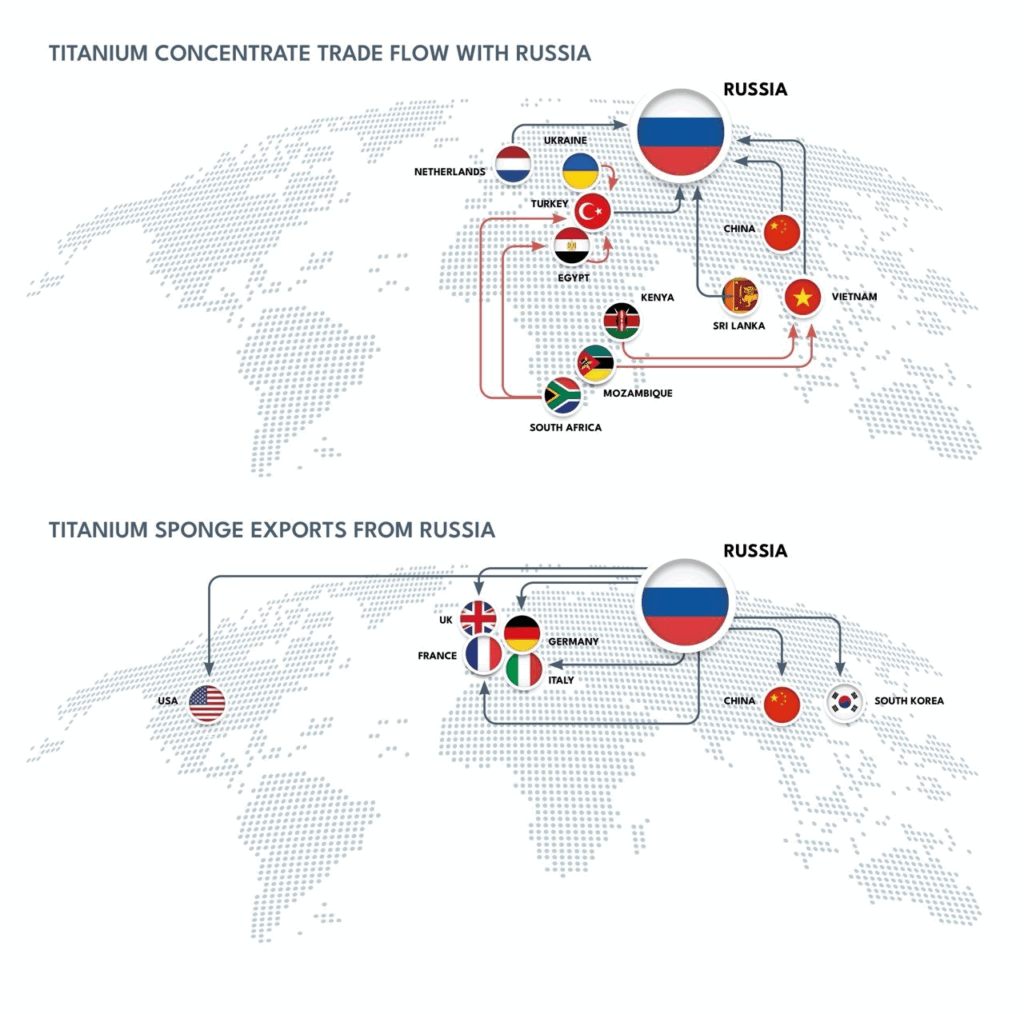
Key to these are titanium sponge – an early form of pure titanium metal later used to produce metal ingots, powders and alloys. The near-term gap is less about mineral mining, and more about aerospace-grade sponge capacity and certification, the firm notes.

Russia is still the leading source of aerospace-grade titanium. Meanwhile, China’s share of global titanium metals has jumped from 40% in 2019 to over 75% in 2025, with growing trade ties to Moscow.

“With China using rare earth and critical metals as leverage in ongoing trade disputes, China could throttle titanium exports to disrupt Boeing and Airbus production, delay Western defence programmes, and give China’s COMAC and J-36 programmes a strategic advantage,” Project Blue says.

China’s aviation industry includes the state-owned commercial manufacturer COMAC, known for its C919 narrow-body jet, and the military focused Chengdu Aircraft Corporation (CAC), which is developing a sixth-generation stealth fighter tentatively designated as the J-36. 

“Titanium is essentially a defence metal –  it can be up to 20% or more of the markets for total titanium consumption that goes into defence. An F 15 can be up to 40% in weight of titanium. There’s some serious volume going in these jet planes,” Project Blue Founder and Director, Dr. Nils Backeberg told MINING.com in an interview. 

“We’ve seen investments in titanium capacity, you’ve got Comac coming out and building their own sort of aerospace program in China.”

Aerospace markets have still been depressed since covid, due to declines in aircraft travel, Backeberg noted.

In April, Airbus SE revealed plans to source some metal to manufacture its aircraft from Saudi Arabia as part of a widebody aircraft deal with the kingdom’s flag carrier.

The European manufacturer signed a deal to buy 2.5 billion Riyals ($666 million) worth of raw material, mainly titanium, from Saudi Arabia. 

Graphic: Project Blue

Supply chain gaps

“The door blew out at the beginning of 2024 – there were all these lenses looking at the supply chain and identifying where these sources are coming from, and that there were shortcuts made, and the specs weren’t met anymore,” Backeberg said.

He pointed out that titanium mining is an industry that’s ‘effectively divorced from the titanium metal industry’.

“That is because the vast majority of ilmenite and rutile, which are the minerals for titanium that are mined, go into pigments,” Backeberg said. “And that is the big volume market for titanium minerals.”

“There’s various pigment producers across the world. And China has massively invested in pigment capacity that’s flooded the market and destroyed that market elsewhere,” he said. 

Backeberg added that some pigment TiO2 facilities are now going into liquidation driven by macroeconomic trends and investments. 

“This is where all the geopolitics is coming into play,” he said.  “The US used to be a massive producer, but the Henderson plant was the last one really operating.” 

“In the US, the sponge [mining] closed in 2021. So they’re reliant on importing sponge, it doesn’t actually matter if the US buys ilmenite,” he said. 

US titanium melt capacity, (total industrial ability to melt and process titanium) is ramping up, Backeberg said,  through significant investments and expansion projects driven by strong demand from the aerospace and defense sectors, and supported by US government initiatives.

“So the mine material, there’s bugger all they can do with that for the metal industry, because they can’t process it into sponge. “So they have to buy sponge  and there’s a lot of melting capacity being built up,” Backeberg said.

Ramping up capacity in the US

The Henderson plant in  Nevada was historically operated by Titanium Metals Corporation (now Timet) as the last large-scale domestic titanium sponge producer. It was a significant site for US defense and aerospace, but eventually closed in 2020, making the U.S. fully reliant on imported titanium sponge, Backeberg said. 

Timet is constructing a new plant in West Virginia to melt titanium using large furnaces, powered by the industrial microgrid utilizing solar and battery storage technology. This facility is being built on the site of a former aluminum smelter.

The company is investing nearly $868 million to build a new 500,000-square-foot facility to melt, roll, and finish aerospace-grade titanium, in North Carolina. The project, operating under the name “Project Aero,” could potentially be operational by 2027.

Timet is also expanding its existing ingot plant in Pennsylvania to increase its electron-beam melting capacity by 8,500 tons per year.

“The demand from a titanium perspective is you’re seeing the recovery from Boeing take place, the deliveries have been ramping up this year, and catching up to where Airbus is,” Backeberg said.  “And with NATO expenditures going up, all of this then adds into titanium demand for the different jet fighter planes that they want to produce.”

“In the titanium industry, they’re seeing a very  positive narrative coming on the demand side,” he said.

“With Japan ramping up, with Saudi Arabia supply as a new source, and with the US actually having its own melt capacity ramping up, this seems to be a sustainable supply chain to meet that, but it has to ramp up.”