Monday, January 05, 2026

The Arctic–Greenland–Florida Conga



 January 5, 2026

Image by Annie Spratt.

According to the National Oceanic and Atmospheric Administration (an agency that is subject to drastic cuts in Trump’s FY2026 budget) from October 2024 to September 2025 temperatures across the entire Arctic region were the hottest in 125 years of modern record keeping,

As of year-end, the status of the Arctic and Greenland present the world with a nerve-racking knuckle-biting dilemma, as apparently, according to climate scientists, they’re coming apart at the seams. Meanwhile, the United States issues policy-after-policy guaranteed to make it much, much worse. Will residents in states like Florida protest policies that promote fossil fuel usage over renewables, as it’s starting to look like higher sea levels on the distant horizon.

In sharp contrast to scientific reports about threats of climate change, a recent U.S. Department of Energy report A Critical Review, d/d July 23, 2025 downplays these concerns about climate change, global warming, rising sea levels, and excessive greenhouse emissions such as CO2.. This has prompted sharp criticism by numerous non-governmental sources, as explained further herein.

Bill McGuire professor emeritus of geophysical and climate hazards at University College London is one of the most outspoken scientists in the field, not afraid to “tell it like it is.” His recent comments about the Arctic and Greenland are chilling.

Bill McGuire X posting (Dec. 16, 2025):

“The huge polar amplification of heating continues Tipping of the Greenland Ice Sheet all but certain now, locking-in an eventual ~7m rise Say goodbye to much of Florida, and coastal towns and cities across the planet.”

Dr. McGuire is likely responding to an article in The Guardian, Arctic Endured Year of Record Heat as Climate Scientists Warn of ‘Winter Being Redefined’ d/d Dec. 16, 2025. According to one interview: “We are seeing cascading impacts from a warming Arctic,’ said Zack Labe, a climate scientist at Climate Central. ‘Coastal cities aren’t ready for the rising sea levels; we have completely changed the fisheries in the Arctic which leads to rising food bills for sea food. We can point to the Arctic as a faraway place but the changes there affect the rest of the world.”

Dr. Labe says “we are seeing cascading impacts…” something that innocent bystanders do not want to see happening in the rugged Arctic. Cascading impacts are chain reactions where the starting event triggers a series of follow-up events, which are amplified to a degree worse than the starting event. As it happens, “cascading impacts” are the worst possible news out of the Arctic for obvious reasons. For starters, it’s becoming a self-fulfilling prophecy.

Moreover, when the Arctic region is massively diminished by global warming, it indirectly and in some cases directly causes adverse whacko weather systems across the Northern Hemisphere, or put another way, out-of-the-ordinary severe weather systems which have been slamming the hemisphere these past few years.

Furthermore, of utmost concern, the Arctic contains oodles of trapped frozen methane CH4 that, once unfrozen and released into the atmosphere, powers up global warming like ‘there’s no tomorrow’ and it is much more effective at trapping heat in the atmosphere than is CO2.

Plus, Greenland is a big-time concern for residents of Florida because it’s one of the world’s largest blocks of ice in direct line of fire of Arctic warming amplification. Thus, the world’s major coastal megacities, like NYC, and major low-lying coastal states, like Florida, are indirectly exposed as Arctic warming amplification quickens the meltdown of Greenland. Hello rising sea levels! The last thing residents of Florida and the Outer Banks want to hear is “cascading impacts in the Arctic.” Well, according to Dr. Labe, it’s happening!

A recent study from the University of Zurich published in ScienceDaily is cause for additional concern: Here’s the headline: Massive Hidden Waves are Rapidly Melting Greenland’s Glaciers: “Calving icebergs unleash hidden wave forces that supercharge Greenland’s melt and push the ice sheet closer to collapse… Our entire Earth system depends, at least in part, on these ice sheets. It’s a fragile system that could collapse if temperatures rise too high,’ warns Dominik Gräff.”

MIT Climate Portal: “Despite the enormous stakes for the future of humanity, it remains frustratingly difficult to know how much sea level rise is in store for us. All we know for sure is that taking strong and immediate action to control our greenhouse gas emissions gives us the best chance to avoid meters of sea level rise.”

MIT acknowledges one of the biggest mysteries in climate science which is the levels and timing of sea level rise because of global warming. Nobody really knows for sure, and this is what makes it so necessary to pay attention to early warning signs so coastal communities can prepare for what might hit them. Once it’s too high too quickly, it’s too late to do much other than move to higher ground.

Unfortunately, the failure of almost all of the voluntary commitments made at the Paris 2015 climate accord to cut greenhouse gas emissions like CO2 by 2030 has been a farce and a fatal weakness for the world as fossil fuel usage continues unabated. Even worse yet, the United States has dropped out of the Paris agreement altogether, becoming the world’s biggest promoter of oil and gas and coal and greenhouse gases like CO2.

This has given several other right-leaning countries license to ease up or abandon altogether mitigation policies. For example: “Sweden, an Early Climate Leader, Is Retreating from Its Environmental Commitments, Part of an EU Trend,” Inside Climate News, August 3, 2025.

DOE Report on Climate Change– No Sweat, No Worries, Plants Love It

The Department of Energy July 150-pg report supports the administration’s fossil fuel policies by downplaying concerns. For example: “U.S. tide gauge measurements reveal no obvious acceleration beyond the historical average rate of sea level rise,” pg 85)

However, “New research from the Woods Hole Oceanographic Institution finds sea level rise is accelerating across the contiguous United States, contradicting a federal report from July that downplayed the risks from climate change.” (New Study Finds Sea Level Rise is Speeding Up, Contradicting Federal Report, WBUR – Boston NPR, December 19, 2025)

When the DOE report was released, more than 85 scientists issued a rebuttal that called many of the assertions “misleading or fundamentally incorrect.” To wit: “Our review reveals that the DOE report’s key assertions—including claims of no trends in extreme weather and the supposed broad benefits of carbon dioxide—are either misleading or fundamentally incorrect. The authors reached these flawed conclusions through selective filtering of evidence (‘cherry picking’), overemphasis of uncertainties, misquoting peer-reviewed research, and a general dismissal of the vast majority of decades of peer-reviewed research.”

Accordingly, Christopher Piecuch, a physical oceanographer at WHOI and author of the study, said the report from the U.S. Department of Energy released this summer referenced only a select few tidal gauge locations in its analysis, which may not properly represent nationwide sea level rise. The DOE report found “no obvious acceleration in sea level rise.” In contrast, Piecuch said his study included all available long-term records from U.S. tidal gauges, 70 in all. “You can’t really just look at a record here and a record there and expect to have representative results for the entire U.S.,” he said. “ There’s a very large disconnect between the data that they show and the conclusions that they draw.”

Nearly one-half of Americans live in coastal counties. Sea level has a direct bearing on them, requiring adequate notice of changes to allow for either mitigation policies, plans for building sea walls, moving out of the area, etc., or conversely, taking no preventative measures if the DOE report is correct, “not to worry.” Which-will-it-be impacts over 130 million American households. In general, and almost universally, scientists believe aggressive mitigation measures are prudent.

Andrew Kemp, a professor of earth and climate sciences at Tufts University who was not part of the research, called the new analysis robust and sound: “The Piecuch study is repeatable, supported by other evidence, and reflects the understanding of the overwhelming majority of sea-level scientists. It was written to address the DOE report that is not robust, lacks sound reasoning, is contradicted by an abundance of other evidence that was ignored, and represents fringe science.”

Citizens depend upon the government for proper guidance. Hopefully, the DOE will issue a response to criticism by scientists that many of the report’s assertions are “misleading or fundamentally incorrect.” Citizens of the country need to know whether a major factcheck of the Trump DOE report is true: Factcheck: Trump’s Climate Report Includes More Than 100 False or Misleading Claims, Carbon Brief, August 15, 2025. If DOE cannot properly address 100 alleged false or misleading statements, the report should be officially censured and removed.

The citizens of Florida deserve it!

Robert Hunziker lives in Los Angeles and can be reached at rlhunziker@gmail.com.


Securing AI systems against growing cybersecurity threats


New EU-funded project SHASAI will address cybersecurity risks in AI systems, from design to real-world operation


European Science Communication Institute gGmbH

SHASAI logo 

image: 

SHASAI logo

view more 

Credit: European Science Comminication Institute gGmbH


The new EU-funded SHASAI project (Secure Hardware and Software for AI systems) will tackle this challenge. Funded under the Horizon Europe programme, SHASAI aims to strengthen the security, resilience and trustworthiness of AI-based systems. The project will address cybersecurity risks from the initial design and development stages through to deployment and real-world operation. 

“With SHASAI, we aim to move beyond fragmented security solutions and address AI cybersecurity as a lifecycle challenge. By combining secure hardware and software, risk-driven engineering and real-world validation, the project will help organisations deploy AI systems that are not only innovative, but also resilient, trustworthy and compliant with European regulations,” says Leticia Montalvillo Mendizabal, Cybersecurity Researcher at IKERLAN and SHASAI Project Coordinator. 

The project will demonstrate and validate its methods and tools in three real-world scenarios: AI-enabled cutting machines in the agrifood sector, eye-tracking systems used in assistive healthcare technologies, and a tele-operated last-mile delivery vehicle in the mobility sector. These diverse use cases will enable the project consortium to test its approach in different fields while ensuring that results can be transferred to other AI applications. 

By translating high-level cybersecurity and AI safety principles into concrete technical practices, SHASAI also supports Europe’s broader efforts to promote trustworthy AI. The project aligns with key EU frameworks and initiatives including the EU AI Act, the Cyber Resilience Act (CRA), the NIS2 Directive and the EU Cybersecurity Strategy. 


SHASAI brings together a European consortium of 16 partners from five countries (Spain, Italy, Germany, the Netherlands and Türkiye), coordinated by IKERLAN (Spain). The consortium combines expertise from research organisations, universities, industry and technology providers. The project started on 1 November 2025 and will run until the end of April 2029. 

Sunday, January 04, 2026

LIBERTARIAN ANTI-IMPERIALISM
Trump’s National Insecurity Strategy – OpEd

January 4, 2026

MISES
By Vincent Cook

Trump’s latest National Security Strategy (NSS) document has predictably sent foreign policy pundits of all stripes into a tizzy, with globalists (both of the unilateralist-neoconservative variety and of the multilateralist “rules-based international order” variety) howling once again about Trump not being one of them, while “NatCons” celebrate the NSS’s assault on censorial Eurowokeness and the NSS’s dire warnings about a “stark prospect of civilizational erasure” in Europe.

In spite of the Euro-bashing orientation of the NSS, America’s militarist/imperialist lobby can take heart in the NSS’s endorsement of the Monroe Doctrine coupled to a “Trump Corollary” that sounds very much like the Roosevelt Corrollary and the Lodge Corrollary, as well as affirming a hodge-podge of other globalist doctrines (though not explicitly naming them) like the Carter Doctrine of keeping unfriendly powers out of the Persian Gulf (i.e., waging endless wars in the Middle East) and the Truman Doctrine of containing the spread of Communism, at least in Asia with respect to the Chinese and North Korean regimes. In terms of the overall spending commitment, the bottom line remains the “Hague Commitment” of increasing Pentagon spending to 5 percent of GDP.

Of course, massive increases in the demand for military goods and services will have to be matched by corresponding increases on the supply side if the Hague spending increases are to strengthen the Pentagon’s and its allies’ ability to enforce the witch’s brew of imperialistic doctrines with which the Pentagon has been tasked. This raises the thorny economic problem of how to increase the physical availability of cutting-edge weapons, munitions, and manpower at reasonable prices. A spending increase by itself doesn’t guarantee an increase in military might if an anemic, underperforming productive sector can’t respond well to the spending; instead, one merely drives up prices as higher spending confronts inelastic supply curves.

This supply problem is not a mere hypothetical concern—the Russo-Ukrainian War clearly demonstrates that modern missile and drone technologies have negated the kind of mechanized, mobile, combined-arms tactics that characterized the Second World War. The days of rapid blitzkrieg attacks and paralyzing “shock and awe” strikes are over. Instead, ground combat in Ukraine has largely degenerated into the brutal static trench warfare that characterized the First World War a little over a hundred years ago. What has been retained from the Second World War playbook unfortunately is the wanton destruction of civilians far from the front lines using long-range missiles and drones.

In this kind of war, combat can drag on for years and years with little to show for all the dreadful carnage and destruction as long as each side is able and willing to keep feeding warm bodies and vast quantities of basic munitions like artillery shells into the meatgrinder. However, the economic capacity of America and its NATO and East Asian allies to wage such old-fashioned prolonged wars of attrition successfully is highly doubtful these days. A temporary halt in munitions and missile deliveries to Ukraine last July out of fears of stockpile depletions flashed an ominous danger signal that Western economies are in no shape to undertake a major mobilization required for a conventional meatgrinder war.

The NSS does take notice of the munitions aspect of the supply problem. The section of the NSS that deals with economic security embraces the following goals:Balanced trade
Securing access to critical supply chains and minerals

Reindustrialization

Reviving our defense industrial base

Preserving and growing America’s financial sector dominance

One critical problem with these goals is that they are mutually incompatible with each other. Reducing trade deficits to zero to achieve “balanced trade” also means reducing net imports of savings from foreigners to zero. When foreigners earn more dollars from sales of their goods to Americans than they spend on purchases of goods made in America, they lend their surplus dollars to Americans. Cutting off vendor-financed imports means fewer inputs and less financing available for reindustrialization and for reviving the defense industrial base.

Balancing of trade is also incompatible with maximizing access to critical supply chains and minerals overseas. If, for example, America has a critical need for cobalt that is only available in the Democratic Republic of the Congo (DRC), why must the US government petulantly insist on the DRC balancing its sales of cobalt to America with purchases of American-made goods? Creating artificial restrictions on what the Congolese can do with their dollar earnings only discourages them from selling cobalt to Americans in the first place.

Intensifying the international dominance of America’s financial sector—that is, artificially propping up foreign demand for US Treasury securities, making foreigners pay a portion of America’s inflation tax, and facilitating discretionary confiscations of the assets of hostile powers—does benefit certain predatory American institutions (both governmental and privileged private sector actors) at the expense of foreigners, but it also thwarts the goals of reindustrialization and revival of the defense industrial base. American industries need more thrift (i.e., restraint of present consumption so that more labor and resources can be devoted to making more capital goods), not more Federal Reserve funny money and more boom/bust cycles spawned by fractional reserve credit. American financial predators gain at the expense of productive Americans too.

Apart from the raging contradictions among the NSS’s economic goals, another critical problem is the NSS’s eerie silence concerning the manpower issue, a problem the Russians and Ukrainians know all too well. If the Pentagon must resort to a meatgrinder strategy to wage more Ukrainian-style wars in East Asia, the Middle East, and Latin America (and maybe in Europe too, if NATO behaves as Trump wishes), it is going to need a lot more meat. With falling birthrates, steeper immigration barriers, and now even mass deportations, the prospects of the Pentagon finding enough young Americans to populate future national cemeteries look rather dim. Moreover, increasing the Pentagon’s manpower requirements would make it more difficult to find the additional workers needed for reindustrializing and for reviving the defense industrial base.

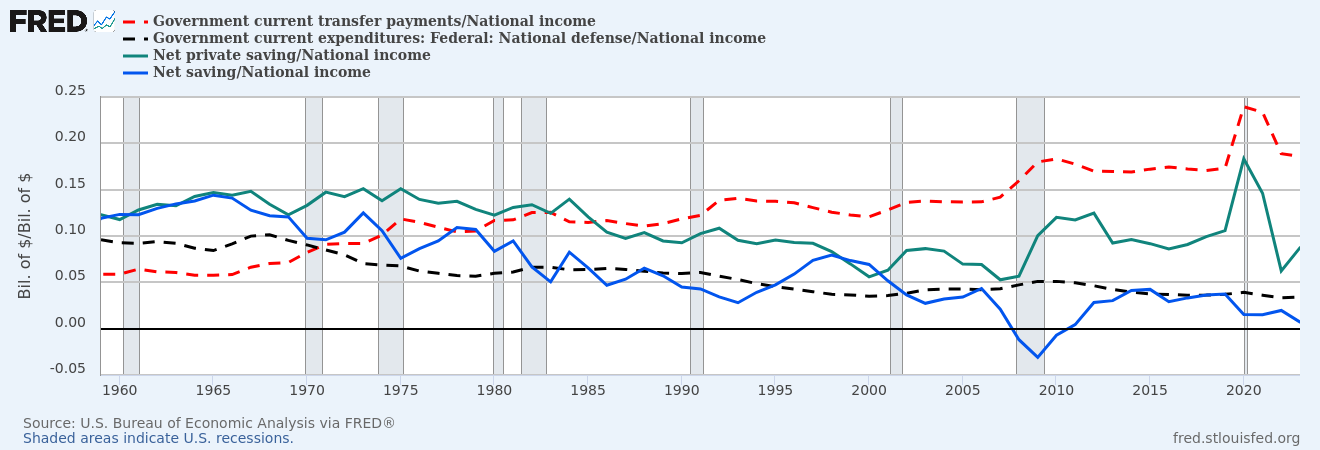
The most critical problem of all is that the NSS doesn’t reverse the growth of welfare statism, which has been deindustrializing America and skewing federal spending priorities away from the Pentagon over the past sixty years. Figure one offers the long-run view of savings and government spending:

Figure 1: National Income Shares—Transfer Payments, Defense, Net Private Saving, and Net Saving


Source: FRED®

The two dashed lines track different categories of government spending as a fraction of National Income; the red line represents transfer payments for benefits like Social Security and Medicare, while the black line represents spending on the Pentagon. Since the late 1960s, the Pentagon has declined from about 10 percent of National Income to well under 5 percent today. Transfer payments, on the other hand, have soared from a little over 5 percent in the mid-1960s to nearly 20 percent today. The Department of Defense over the period has encountered a pair of peer competitors who pose a greater existential threat to it than even the Chinese People’s Liberation Army and the Russian Red Army do: the Department of Health and Human Services and the Social Security Administration.

The two solid lines track net domestic savings as a fraction of National Income. The green line represents net private savings; quantifying thrift by private individuals and businesses as a fraction of National Income. The blue line—representing net savings overall—shows how much of the share of National Income devoted to private savings remains for productive investments after government deficits have been subtracted from the green line.

As transfer spending soared and Americans came to rely increasingly on government promises of future economic security, they became less and less inclined to save, driving the green line down to about half of its 1960s/early-1970s values. Meanwhile, government budgets that were formerly balanced even at the height of the Vietnam War and the “Great Society” have sunk into chronic massive deficits, pushing the blue line further and further below the green line. The result is that the blue line is now at zero, meaning that in aggregate Americans are not setting aside any of their income to grow America’s stock of capital goods. Reindustrialization and revival of defense industries without massive borrowing from foreigners (and the massive trade deficits that accompany them) has become impossible; America can just barely maintain its depleted industries at current levels.

Without massive cuts to Social Security and Medicare, there will be neither reindustrialization nor significant increases in the Pentagon’s conventional military capabilities. The aggressive combination of “doctrines” in the NSS that seek to strategically encircle China and Russia are probably not viable over the long run in any event, but welfare state-induced capital consumption absolutely exposes the NSS’s vain pretense of America gearing up for conventional meatgrinder wars as sheer nonsense. There is no credible strategy for security to be found in this NSS.


About the author: Vincent Cook has a MA in Biophysics from the University of California, Berkeley. He worked as an analyst for thirty years in the University of California’s Office of the President, reporting statistics concerning technology transfers, research grants and expenditures, and faculty salaries on behalf of the ten campus UC system. He has been a supporter of the Mises Institute since its founding in 1982 and has hosted the Epicurus & Epicurean Philosophy website since 1996. Vincent is also a practitioner of the Filipino martial arts; in 2002 he competed in world championship matches, earning medals in sparring and forms divisions.


Source: This article was published by the Mises Institute


MISES

The Mises Institute, founded in 1982, teaches the scholarship of Austrian economics, freedom, and peace. The liberal intellectual tradition of Ludwig von Mises (1881-1973) and Murray N. Rothbard (1926-1995) guides us. Accordingly, the Mises Institute seeks a profound and radical shift in the intellectual climate: away from statism and toward a private property order. The Mises Institute encourages critical historical research, and stands against political correctness.

Trump-brokered Ukraine deal could unsettle Balkans, analyst warns

Trump-brokered Ukraine deal could unsettle Balkans, analyst warns
Analyst warns any settlement that rewards Russia for using force would send a powerful signal far beyond Ukraine, including in the Western Balkans.
By bne IntelliNews January 4, 2026

A US-brokered peace deal in Ukraine that legitimises Russian territorial gains would risk reopening old fault lines in the Western Balkans, emboldening Serbia and weakening the European Union’s credibility as a guarantor of regional stability, according to a new report by the European Council on Foreign Relations (ECFR).

The analysis, written by ECFR senior policy fellow Engjellushe Morina, argues that the outcome of the war in Ukraine is no longer just a question for Kyiv and Moscow but a test case for how borders are treated across Europe – including in fragile regions such as Kosovo, Bosnia & Herzegovina and the wider Balkans.

“A Russia-Ukraine peace deal that capitulates to Putin risks destabilising the Western Balkans, emboldening Serbian territorial claims and undermining EU credibility,” the report said.

With US-led diplomacy intensifying as 2025 draws to a close, Morina warns that any settlement that rewards Russia for using force would send a powerful signal far beyond Ukraine. “Any settlement that legitimises Russia’s use of force to alter its borders would further destabilise Ukraine and have negative repercussions in the Western Balkans,” she wrote.

Ukraine’s President Volodymyr Zelenskiy has insisted that Kyiv will not give up more territory to Russia, a position Morina says is firmly rooted in international law, which holds that “borders cannot be changed by force”.

But she argues that the current US approach to negotiations risks sidelining those principles. The talks have “hardly mentioned multilateralism, or the rules and regulations which govern international order”, instead focusing on “handing Russia the territorial changes it has achieved by force”. (The paper was published before the US military operation in Venezuela, which sparked accusations that Washington had breached international law.)

Such an outcome, the report said, would have dangerous knock-on effects for Europe’s “eastern neighbourhood” – including Georgia and Moldova – as well as in unresolved disputes in the Western Balkans, particularly between Serbia and Kosovo.

“If Russia ‘wins’ in Ukraine, the Western Balkans will be in trouble,” Morina wrote. In that scenario, Serbia could be encouraged to revive territorial claims, urging countries that recognise Kosovo’s borders to instead see the Serb-dominated north as part of Serbia.

She added that Serbia’s president, Aleksandar Vucic, might also be tempted to push for Bosnia’s Serb entity, Republika Srpska, to be folded into Serbia.

Kosovo in the crosshairs

At the centre of those concerns is northern Kosovo, a Serb-majority area that has long been a flashpoint. The EU is trying to broker a normalisation of relations between Belgrade and Pristina, but Morina warned that this delicate process could unravel if global norms on borders are weakened.

“If the US allows a peace deal that gives Russia more Ukrainian territory, or if the EU fails to stop US president Donald Trump from inflaming regional tensions, Vucic might be emboldened to pursue a land grab in Kosovo’s north,” the report said.

Such a move would “undermine Nato and weaken the EU” and would likely enjoy “Putin’s support”, Morina added.

The north of Kosovo remains “in limbo”, she wrote, with Serbia seeking to maintain influence over the local Serb population and Kosovo’s government insisting that the area must be governed under Pristina’s authority. That standoff has helped keep the region volatile, highlighted by a deadly Serb paramilitary attack in the village of Banjska in September 2023.

The report also takes aim at the changing role of the United States under President Donald Trump’s second term. Washington, once the main architect of peace in the Balkans through Nato and diplomacy, is now more focused on commercial interests, according to Morina.

The latest US National Security Strategy says “the United States will prioritise commercial diplomacy”, a shift that she argues puts economic gains ahead of geopolitical stability.

Trump, who has repeatedly portrayed himself as a global “peacekeeper”, has even claimed he “managed to stop the war between Kosovo and Serbia”, with US strategy documents listing the dispute among conflicts he has supposedly resolved.

Morina said this raised the risk that Trump could push for a quick, headline-grabbing deal in the Balkans, just as he did during his first term, when his envoy backed a controversial “land-swap” proposal between Kosovo and Serbia.

That plan, which would have traded Serb-majority areas in northern Kosovo for Albanian-majority areas in southern Serbia, ultimately failed. But Morina warned that similar ideas could resurface if Washington again prioritises speed and optics over long-term stability.

EU under pressure

The report argues that the EU remains “indispensable” in stabilising the Western Balkans, largely because of its power to offer membership. But that leverage is weakening as enlargement stalls and public trust in Brussels erodes.

“Without delivering tangible benefits, the prospect of further European integration will lose its remaining credibility among candidate countries,” Morina wrote, pushing them to look instead to Washington or Moscow for support.

She said EU member states now face a strategic choice: either “retain ownership of Balkan geopolitics” or “stand by as Washington steps in”. Decisions taken in 2026, she argued, would be “decisive” for the future of Kosovo, Serbia and the wider region.

France and Germany, in particular, need to keep pressure on Belgrade and Pristina to implement the EU-brokered “Agreement on the path to normalisation”, while also demonstrating that Europe can still deliver on security and integration.

Suriname’s Oil Dreams Collide With Geological Reality

  • GranMorgu will deliver Suriname its first major offshore oil production, but years later and at a far smaller scale than Guyana’s Stabroek-led boom.

  • Recent drilling results suggest the most prolific petroleum fairway lies largely within Guyana’s waters, limiting Suriname’s upside.

  • High costs, mixed exploration outcomes, and decarbonization pressures may constrain future investment beyond GranMorgu.


Suriname’s government, in the capital Paramaribo, has been hungrily eyeing neighboring Guyana’s massive world-class oil boom since before the 2020 pandemic. Both impoverished South American nations of less than one million share the Guyana Suriname Basin. The offshore basin is delivering an oil boom that is exceeding all expectations, making Guyana, based on GDP per capita, one of the wealthiest nations in the world. Suriname, which is one of South America’s poorest countries and is experiencing a deep, long-running economic crisis, is hungering after the rapid economic growth such a hydrocarbon boom will deliver.

In a stunning development, neighboring Guyana went from first discovery to first oil in a mere four years in an industry where that can take a decade or more. The former British colony is after a decade South America’s third largest oil producer pumping around 900,000 barrels per day. This along with Guyana’s gross domestic product (GDP) soaring nearly nine-fold over the last decade caught the attention of Paramaribo. By 2021, President Chan Santokhi, who was under pressure from a deep economic crisis, was convinced a world class oil boom would lift Suriname out of poverty. This saw the president hopeful the Block 58 discoveries would be developed and operational by 2025.

There was, however, a moment when Suriname’s much-anticipated oil boom wavered. During 2022, TotalEnergies, the operator of Block 58, and 50% partner APA Corporation chose to delay the final investment decision (FID) for developing the Sapakara and Krabdagu oil discoveries. The energy companies made this decision due to poor drilling success, the high gas-to-oil ratio of some discoveries, and a mismatch between seismic data and drilling results. This delayed the prospect of first oil, and consequently Suriname’s urgently needed world-class oil boom, by years. Nonetheless, by October 2024, TotalEnergies announced the $10.5 billion FID had been approved.

The deepwater project, named GranMorgu, is targeting reservoirs containing nearly 760 million barrels of crude oil. The facility will be operated by an all-electric floating production, storage, and offloading unit (FPSO) with a capacity to lift 220,000 barrels per day. First oil from GranMorgu is expected in 2028. This is some years after 2025, which was the initial prediction, but the latest news from TotalEnergies confirms GranMorgu will be a groundbreaking energy project for Suriname. The project will be a model for low-carbon extraction of crude oil in an industry dogged by high emissions. 

You see, aside from the FPSO being all-electric, there will be no routine flaring with all associated gas produced injected into tanks on the vessel. As a result, less than 16 kilograms of carbon are produced per barrel of crude oil lifted. This is less than the global average of 60kg per barrel produced reported for 2015, with industry analysts claiming it has fallen to as low as 18 kg per barrel as big oil strives to become carbon neutral. For these reasons, GranMorgu is viewed with excitement by many in an industry under considerable pressure to reduce greenhouse gas emissions. 

The successful start-up of the TotalEnergies project will go a long way to boosting Suriname’s crisis-riven economy. The International Monetary Fund (IMF) predicts the former Dutch colony’s GDP will grow by a stunning 55% during 2028 when production starts. Nonetheless, there is a long way to go before the former Dutch colony experiences the rapid growth experienced by Guyana. Overall drilling results were not particularly positive despite the view that the oil potential of the Guyana Suriname Basin is far greater than the United States Geological Survey (USGS) initially believed. While APA reported the discovery of oil with the Baja wildcat well in Block 53 offshore Suriname during late 2022, there have been very few such announcements since.

Malaysia’s state-controlled energy company Petronas made a series of hydrocarbon discoveries in offshore Block 52, which is contiguous to Block 58. These are the Sloanea, Roystonea, and Fusaea discoveries. Despite those discoveries, ExxonMobil, which was a 50% partner in Block 52, relinquished that interest, handing it over to Petronas in November 2024. Since then, only Sloanea, which is a natural gas discovery, has been declared commercially viable. The other two discoveries have yet to be fully appraised, with doubts existing as to whether they are commercially viable. Even if they are, it may take a decade or longer for them to be developed and brought online. 

The results of Petronas’ latest multi-well drilling campaign in Block 52 were not stellar. The Caiman-1 wildcat well, the first of four wells to be drilled in 2025 and 2026, was spudded on July 21, 2025, in the western portion of Block 52. The exploration well was plugged and abandoned on December 6, 2025. While Petronas described the results as encouraging, there were no announcements that the well found commercially viable hydrocarbon reservoirs for possible exploitation. Petronas will continue with its planned drilling campaign as it seeks to delineate resources in Block 52 and determine whether the Sloanea natural gas discovery can be developed and brought to production.

This news comes on the back of APA and its partners in Block 53 relinquishing most of the petroleum acreage to Staatsolie, Suriname’s national oil company and industry regulator. That is despite the August 2022 Baja-1 discovery, where oil was discovered in the same depositional system of the Krabdagu discovery in Block 58, seven miles (11.5 kilometers) to the west. Indeed, the Krabdagu discovery forms part of the GranMorgu project. During June 2025, TotalEnergies acquired a 25% working interest in the remaining area of Block 53 around the Baja-1 discovery from Moeve, formerly known as CEPSA.

The acreage relinquished by APA during February 2024 was repackaged by Staatsolie and offered as a new offshore oil block. During June 2025, Suriname’s petroleum regulator awarded that acreage to Petronas as Block 66. Malaysia’s national oil company signed a production sharing contract with Staatsolie, giving it an 80% working interest in the block, with Paradise Oil Company, a wholly owned subsidiary of the national oil company, acquiring the remaining 20%. That deepwater oil acreage is contiguous to Petronas’ 80% controlled Block 52, where the company is the operator, and Paradise Oil is also a 20% partner.

There are signs, as illustrated by recent drilling results, that the petroleum fairway passing through the prolific Stabroek Block in offshore Guyana does not extend as far into Suriname’s territorial waters as initially speculated. For some time, analysts reasoned that the hydrocarbon fairway extended through Block 58 into adjacent Blocks 52 and 53. Indeed, recent drilling results indicate the lion’s share of petroleum held in the Guyana Suriname Basin is primarily located in offshore Guyana rather than in the former Dutch colony.

Offshore Suriname may be the hottest frontier oil and gas exploration in South America, but there are signs that time is running out for the country to explore that vast offshore petroleum potential. While the development of GranMorgu will deliver an economic windfall, the facility’s successful operation may not be sufficient to attract the tremendous capital needed to develop the vast oil potential thought to exist in Suriname’s territorial waters. A combination of uncertain drilling results, high development costs, and pressures to curb carbon emissions, coupled with the threat of peak oil, is weighing heavily on investment in offshore frontier oil basins.

By Matthew Smith for Oilprice.com