It’s possible that I shall make an ass of myself. But in that case one can always get out of it with a little dialectic. I have, of course, so worded my proposition as to be right either way (K.Marx, Letter to F.Engels on the Indian Mutiny)
Monday, January 05, 2026
My Briefing to the UN Security Council Regarding US Aggression Against Venezuela
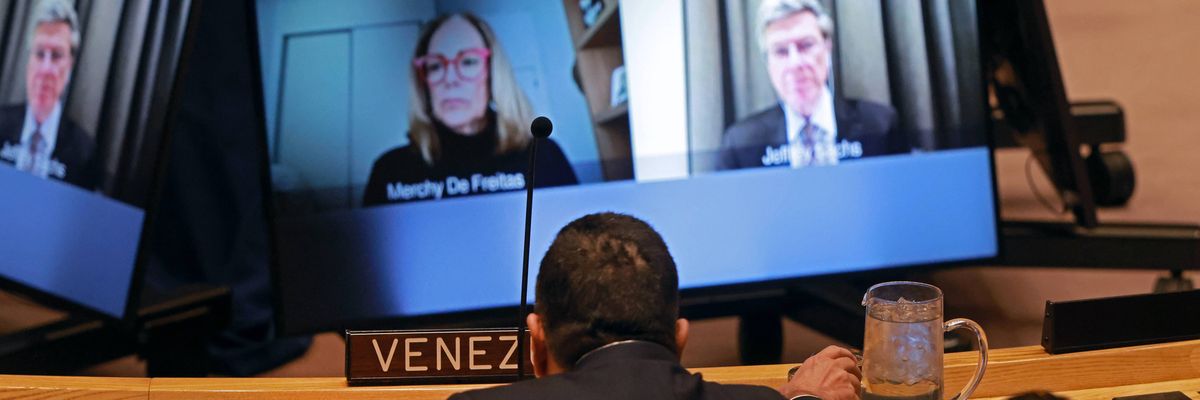
The issue before the Council is whether any Member State—by force, coercion, or economic strangulation—has the right to determine Venezuela’s political future or to exercise control over its affairs. Samuel Reinaldo Moncada Acosta, the Permanent Representative of Venezuela to the United Nations arrives for a Security Council meeting at the United Nations ( concerning the situation in Venezuela on January 05, 2026 in New York City. (Photo by Spencer Platt/Getty Images)
Common Dreams editor’s note: The following remarks, as prepared for presentation, were made by Jeffrey D. Sachs, president of the UN Sustainable Development Solutions Network and director of the Center for Sustainable Development at Columbia University, during an emergency meeting of the UN Security Council on Monday, January 5, 2026 in New York City.
Mr. President, Distinguished Members of the Security Council,
The issue before the Council today is not the character of the government of Venezuela.
The issue is whether any Member State—by force, coercion, or economic strangulation—has the right to determine Venezuela’s political future or to exercise control over its affairs.
This question goes directly to Article 2(4) of the United Nations Charter, which prohibits the threat or use of force against the territorial integrity or political independence of any state.
The Council must decide whether that prohibition is to be upheld or abandoned.
Abandoning it would carry consequences of the gravest kind.
Background and context
Since 1947, United States foreign policy has repeatedly employed force, covert action, and political manipulation to bring about regime change in other countries. This is a matter of carefully documented historical record. In her book Covert Regime Change (2018), political scientist Lindsey O’Rourke documents 70 attempted US regime-change operations between 1947 and 1989 alone.
These practices did not end with the Cold War. Since 1989, major United States regime-change operations undertaken without authorization by the Security Council have included, among the most consequential: Iraq (2003), Libya (2011), Syria (from 2011), Honduras (2009), Ukraine (2014), and Venezuela (from 2002 onward).
The methods employed are well established and well documented. They include open warfare; covert intelligence operations; instigation of unrest; support for armed groups; manipulation of mass and social media; bribery of military and civilian officials; targeted assassinations; false-flag operations; and economic warfare aimed at collapsing civilian life.
These measures are illegal under the UN Charter, and they typically result is ongoing violence, lethal conflict, political instability, and deep suffering of the civilian population.
The case of Venezuela
The recent United States record with respect to Venezuela is clear.
In April 2002, the United States knew of and approved an attempted coup against the Venezuelan government.
In the 2010s, the United States funded civil society groups actively engaged in anti-government protests, notably in 2014. When the government cracked down on the protests, the US followed with a series of sanctions. In 2015, President Barrack Obama declared Venezuela to be “an unusual and extraordinary threat to the national security and foreign policy of the United States.”
In 2017, at a dinner with Latin American leaders on the margins of the UN General Assembly, President Trump openly discussed the option of the US invading Venezuela to overthrow the government.
During 2017 to 2020, the US imposed sweeping sanctions on the state oil company. Oil production fell by 75 percent from 2016 to 2020, and real GDP per capita (PPP) declined by 62 percent.
The UN General Assembly has repeatedly voted overwhelmingly against such unilateral coercive measures. Under international law, only the Security Council has the authority to impose such sanctions.
On 23 January 2019, the United States unilaterally recognized Juan Guaidó as “interim president” of Venezuela and on 28 January 2019 froze approximately $7 billion of Venezuelan sovereign assets held abroad and gave Guaidó authority over certain assets.
These actions form part of a continuous United States regime-change effort spanning more than two decades.
Recent United States global escalation
In the past year, the United States has carried out bombing operations in seven countries, none of which were authorized by the Security Council and none of which were undertaken in lawful self-defense under the Charter. The targeted countries include Iran, Iraq, Nigeria, Somalia, Syria, Yemen, and now Venezuela.
In the past month, President Trump has issued direct threats against at least six UN member states, including Colombia, Denmark, Iran, Mexico, Nigeria and of course Venezuela. These threats are summarized in Annex I to this statement.
What is at stake today
Members of the Council are not called upon to judge Nicolás Maduro.
They are not called upon to assess whether the recent United States attack and ongoing naval quarantine of Venezuela result in freedom or in subjugation.
Members of the Council are called upon to defend international law, and specifically the United Nations Charter.
The realist school of international relations, articulated most brilliantly by John Mearsheimer, accurately describes the condition of international anarchy as “the tragedy of great power politics.” Realism is therefore a description of geopolitics, not a solution for peace. Its own conclusion is that international anarchy leads to tragedy.
In the aftermath of World War I, the League of Nations was created to end the tragedy through the application of international law. Yet the world’s leading nations failed to defend international law in the 1930s, leading to renewed global war.
The United Nations emerged from that catastrophe as humanity’s second great effort to place international law above anarchy. In the words of the Charter, the UN was created “to save succeeding generations from the scourge of war, which twice in our lifetime has brought untold sorrow to mankind.”
Given that we are in the nuclear age, failure cannot be repeated. Humanity would perish. There would be no third chance.
Measures required of the Security Council
To fulfill its responsibilities under the Charter, the Security Council should immediately affirm the following actions:The United States shall immediately cease and desist from all explicit and implicit threats or use of force against Venezuela. The United States shall terminate its naval quarantine and all related coercive military measures undertaken in the absence of authorization by the Security Council. The United States shall immediately withdraw its military forces from within and along the perimeter of Venezuela, including intelligence, naval, air, and other forward-deployed assets positioned for coercive purposes. Venezuela shall adhere to the UN Charter and to the human rights protected in the Universal Declaration of Human Rights. The Secretary-General shall immediately appoint a Special Envoy, mandated to engage relevant Venezuelan and international stakeholders and to report back to the Security Council within fourteen days with recommendations consistent with the Charter of the United Nations, and the Security Council shall remain urgently seized of this matter. All Member States shall refrain from unilateral threats, coercive measures, or armed actions undertaken outside the authority of the Security Council, in strict conformity with the Charter.
In Closing
Mr. President, Distinguished Members,
Peace and the survival of humanity depend on whether the United Nations Charter remains a living instrument of international law or is allowed to wither into irrelevance.
That is the choice before this Council today.
Thank you.
Jeffrey D. Sachs Jeffrey D. Sachs is a University Professor and Director of the Center for Sustainable Development at Columbia University, where he directed The Earth Institute from 2002 until 2016. He is also President of the UN Sustainable Development Solutions Network and a commissioner of the UN Broadband Commission for Development. He has been advisor to three United Nations Secretaries-General, and currently serves as an SDG Advocate under Secretary-General Antonio Guterres. Sachs is the author, most recently, of "A New Foreign Policy: Beyond American Exceptionalism" (2020). Other books include: "Building the New American Economy: Smart, Fair, and Sustainable" (2017) and "The Age of Sustainable Development," (2015) with Ban Ki-moon. Full Bio >
If You Liked Libya, Iraq, Afghanistan, and Vietnam, You’ll Love What Trump Is Offering in Venezuela
Meet the ‘Donroe Doctrine,’ a foreign policy created by the very worst US president ever.
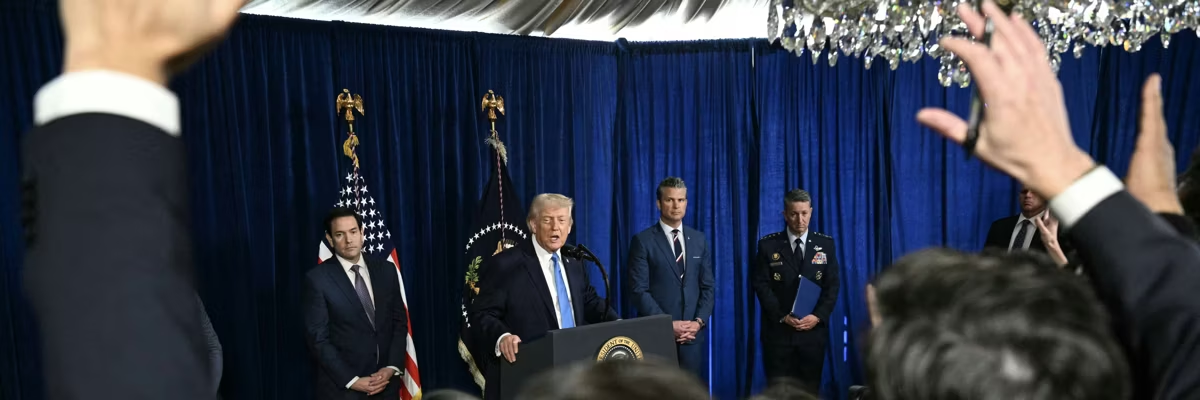
During rambling remarks on January 3, President Donald Trump announced that the United States had bombed Venezuela, “captured” President Nicolás Maduro and his wife, and gained control of that country’s oil reserves.
Now what? Trump has no idea, but historical precedent portends disaster.
The Dubious Legal Basis
As with his bombing of alleged drug-smuggling boats that have killed at least 115 civilians, Trump offered no justification under international law for his actions:The operation was not “self-defense” because Venezuela did not “attack” the United States. Calling Maduro a “narco-terrorist” did not render him or his country an “imminent” national security threat. In fact, Venezuela is a relatively small player in the international cocaine market and has no role in fentanyl—the primary killer in overdose deaths. Trump used the word “oil” more than 20 times in his speech. Venezuela has the world’s largest proven oil reserves. Fifty years ago—in 1976—it nationalized US companies’ oil assets and facilities through a negotiated legal process that netted the firms more than $1 billion. Reversing that nationalization is an absurd—and dangerous—hook on which to hang the military attack in 2026.
Repeatedly, Trump invoked the Monroe Doctrine, saying that he had expanded it “by a lot.” But in fact, Trump has stood President James Monroe’s 1823 seminal proclamation on its head while emboldening China’s President Xi and Russia’s President Putin to follow Trump’s lead in dictating the affairs of sovereign countries.
Trump has no knowledge of history, much less respect for its costly lessons. And with the “Donroe Doctrine,” he has created new danger for the nation and the world.
Monroe v. “Donroe”
In 1823, President Monroe announced a new defensive principle: The United States would object to Europe’s further colonization of the Western hemisphere as “dangerous to our peace and security.” The US would not interfere with existing European colonies, but it would regard future attempts to determine the destiny of these independent nations “as the manifestation of an unfriendly disposition toward the United States.”
In 1904 and 1905, President Theodore Roosevelt’s Corollary expanded the Doctrine, permitting the US to act as an “international police power” to prevent “some civilized nation” from intervening to assure a struggling country’s financial solvency.
Rather than a defensive warning to would-be foreign interlopers, Trump has transformed the Monroe Doctrine into an offensive weapon to invade, conquer, and control independent nations.
Trump calls it the “Donroe Doctrine.” It stems from his 19th-century worldview that the United States, China, and Russia are each entitled to operate within their own spheres of influence—kings carving up the world: China gets the Far East; the United States gets the Western Hemisphere (and Greenland!); Russia gets whatever it wants that’s left.
China’s designs on an independently democratic Taiwan are well known. Russia started a war to absorb Ukraine into the new Russian empire. And now Trump has conquered Venezuela.
The Pottery Barn Rule
Before the United States invaded Iraq in 2003, Gen. Colin Powell warned President George W. Bush that the strategy was fraught with risk
“If you break it, you own it,” Powell said, invoking the “Pottery Barn rule.”
Powell meant that if the US intervened militarily and destabilized a country, it bore long-term responsibility for rebuilding, governing, and managing the consequences. Bush would “own” Iraq’s 25 million people.
Venezuela’s population is 28 million.
Trump said that he, Secretary of State Marco Rubio, Secretary of War Pete Hegseth, and Chairman of the Joint Chiefs of Staff Dan Caine will “run” that country for the indefinite future. But what does that mean?
For starters, Trump is picking its next president. Maduro’s scandal-ridden vice president, Delcy Rodríguez, is subject to US and EU sanctions and has been a central player in the corrupt regime. But she will serve for as long as she does Trump’s bidding.
An alternative, María Corina Machado, is a former lawmaker and the 2025 Nobel Peace Prize winner who led the opposition to Maduro. She won the presidential primary by a landslide in 2023, but Maduro’s government disqualified her from running. Her successor still won the general election; Maduro refused to recognize the outcome.
But Trump declared that Machado can’t be president because she “doesn’t have the support within or respect within the country.” What he probably meant was that she won the Nobel Peace Prize that he coveted.
But what if the Venezuelan people want Machado? Things can turn ugly quickly, especially if Trump makes good on his threat to put “boots on the ground.”
Searching for Monsters
In 1821, Secretary of State John Quincy Adams delivered the most memorable speech of his career, saying: “Wherever the standard of freedom and Independence has been or shall be unfurled, there will her heart, her benedictions and her prayers be. But she goes not abroad, in search of monsters to destroy.”
To do otherwise, he cautioned, the “fundamental maxims of her policy would insensibly change from liberty to force.” America would become “an Imperial Diadem, flashing in false and tarnished luster the murky radiance of dominion and power. She might become the dictatress of the world. She would be no longer the ruler of her own spirit.”
When the United States has departed from Adams’s principle, it has turned out badly.
Coup attempts and more than 500,000 “boots on the ground” for years could not secure victory in South Vietnam.
Nearly 15 years after the US led the ouster of Libya’s dictator, it remains a fractured state.
President Bush’s “pre-emptive” war in Iraq over non-existent weapons of mass destruction became a decade-long quagmire.
America’s 20-year struggle in Afghanistan ended in disaster and the Taliban’s return to power.
Worst President Ever
Trump himself made opposition to foreign entanglements a central issue in his “America First” presidential campaigns. But words spoken to win elections ring hollow today—just like his campaign promises to release the Epstein files and strengthen the economy.
Maduro is a despicable person. But it’s a dangerous quantum leap to bomb a country and kidnap its leader in violation of international law. Trump suggested that Colombia’s president could be next. Secretary of State Marco Rubio hinted that Cuba might be on the target list. And Mexico is in Trump’s crosshairs.
Trump has no knowledge of history, much less respect for its costly lessons. And with the “Donroe Doctrine,” he has created new danger for the nation and the world.
For all mankind, surviving the final three years of his term will be a daunting challenge.
Our work is licensed under Creative Commons (CC BY-NC-ND 3.0). Feel free to republish and share widely.
Steven Harper Steven J. Harper is an attorney, adjunct professor at Northwestern University Law School, and author of several books, including Crossing Hoffa -- A Teamster's Story and The Lawyer Bubble -- A Profession in Crisis. He has been a regular columnist for Moyers on Democracy, Dan Rather's News and Guts, and The American Lawyer. Follow him at https://thelawyerbubble.com. Full Bio >
Trump’s Attack on Venezuela Is Not Your Average American Imperialism
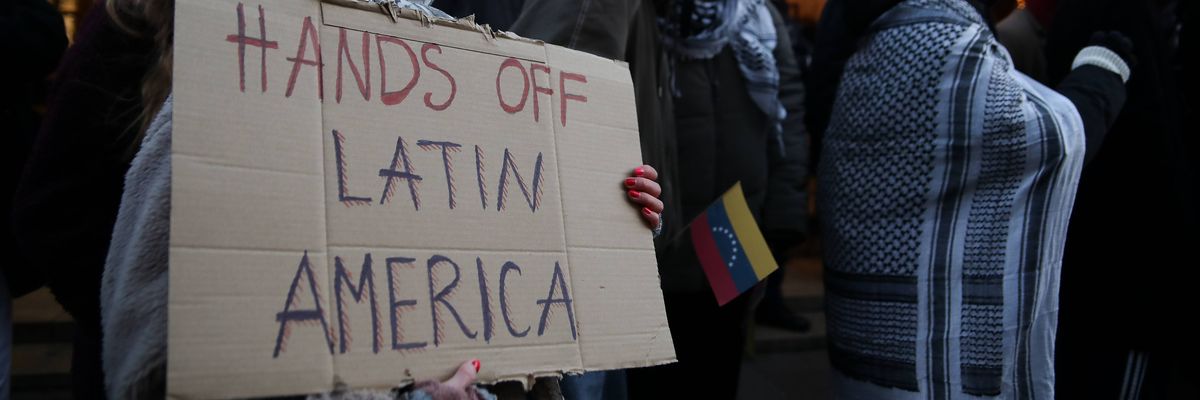
Anyone who cares about democracy in the US or in Venezuela ought to be very concerned about what is happening now. Participants in a solidarity protest with Venezuela gather in front of the US Consulate in Krakow, Poland, on January 4, 2026. (Photo by Klaudia Radecka/NurPhoto via Getty Images)
Right now, MAGA ideologues are apparently cheering Trump’s decision to attack Venezuela, kidnap the Maduros, and declare that the US will now “run” the country and its oil refineries. Because MAGA ideologues always cheer Trump. But also because they understand something that too many other smart people do not seem to fully understand—that this is a triumph for the MAGA ideology, whatever its ultimate outcome, something that no one can predict.
Some on the liberal center are clearly confused. They opine: “How can this be what Trump meant when he said ‘America First?’ How can that idea mean attacking another country? He will obviously outrage his base over this.”
And some on the left are equally confused. They ask: “how can anyone really think there is anything particularly disturbing or dangerous about what Trump is doing, given the fact that he is simply doing what a long line of presidents have done, especially in the Western hemisphere, since the late 19th century? What’s new?”
Both of these responses are deeply confused, because each in a different way fails to take the full measure of Trumpism.
Anyone who considers the current attack on Venezuela as in tension with MAGA has not been paying attention to MAGA.
The centrist liberal confusion rests on a failure to understand that for Trumpism, “America First” cannot be understood apart from “Making America Great Again,” and neither can be understood apart from the distinctive features of Trumpist authoritarianism: contempt for the very idea of law, cynicism about the susceptibility of most Americans to the basest of appeals, and unbounded faith in literal bullshit. None of the rhetoric of Trumpism out to be taken too literally, and all of it is fairly easily transmogrified into its opposite as it suits The Leader. Did anyone serious really take seriously Trump’s bullshit about being “the peace president?”
“America First” has always meant America first. Not “The United States” first. America. Obviously, this is partly a matter of sheer semantics. “America First” is a better slogan, that trips more easily off the tongue. But it’s not only that. And for two reasons.
“The United States” is the name of a specific, federally-organized and yet singular nation-state, designated as such by a Constitution, whose Preamble twice names the nation-state as “the United States of America.” [Note: the language of even the Declaration of Independence is different, and can be read as referring to the thirteen colonies as now united, as independent states, in collectively declaring independence.] This “United States” denotes and constitutes something very particular, and it is linked to a very specific set of Constitutional Articles, a great many subsequent Amendments, and an entire body of law and precedent. For Trump, and his current administration, and for all of those Republicans—almost every single one—who support Trump, all of this constitutional stuff deserves nothing but disdain.
And “America First” has always been about America, where the reference was not to one enormously important nation-state on the continent of North America—the US–but to America, understood as one enormous landmass, connected by an isthmus that was only broken by the construction of the Panama Canal, begun in 1904 after the US acquired the territory after the aptly named “Spanish-American War.” That war pit Spain against the United States of America, but also, especially for US ideologues, against all of America which, thankfully, the US government chose to “liberate.” “America” thus understood means North America, Central America, and South America, as superintended by the benevolent US.
Ever since the Monroe Doctrine, the US has asserted a special hegemony over the Americas and most of the Caribbean.
Trump’s “America First” never meant “we don’t care about what is outside of our borders.” It has always meant “we real authentic Americans–as opposed to the liberals and Marxists and woke lovers of ‘illegals’ and ‘cross dressers’—will decide who deserves to be inside and who outside. And we believe that the great danger confronting us comes from the south, and those brown people who are invading us because they are rapists and killers and drug dealers and sex traffickers.”
Trumpism has always been about ruling the hemisphere, building walls, strengthening borders, and by all means necessary controlling the dangerous populations to the south. A special love for Bolsonaro and Kast and Milei. A special hatred for Maduro but also Chavismo more generally. A special hatred for Cuba no doubt intensified by the “statesmanship” of “Little Marco” Rubio. And above all, an absolute determination to keep those “invaders” at bay.
Trump’s recent national security policy is all about such regional domination, as has been widely observed by commentators, whether they are MAGA enthusiasts who love to imagine a world divided up between the US, Russia, and China, and liberals and progressives who rightly recoil at the thought.
In addition, what could do more to “Make America Great Again” then to cosplay Teddy Roosevelt’s “Rough Riders” by attacking Caracas and seizing Maduro, thereby demonstrating to the world that Pete Hegseth is a man’s man, and his Pentagon is a War Department, and his military is all about the “warrior ethos” of killing and breaking things?
Anyone who considers the current attack on Venezuela as in tension with MAGA has not been paying attention to MAGA. It is true, as some have noted, that this US intervention might turn out to involve the loss of much US blood and treasure, in which case many in Trump’s base might turn on him. But if that happens, it will not be because they were ideologically opposed to US military attacks or even occupations. It will be because they are ideologically opposed to protracted and costly wars. But the MAGA base does not oppose the deployment of massive brutality, either inside or outside the country’s borders, in the name of “American Greatness.”
Leftists who mock those who are confused or incredulous about how Trump could do this are right to insist that Trump’s attack on Venezuela is the latest of many such imperial interventions. But they are wrong to regard Trump’s attack as simply that, and to recycle conventional platitudes about US imperialism that can be found in old Chomsky essays or Howard Zinn book chapters. For in a different way, they too refuse to reckon with the distinct importance, and danger, of Trump’s “America First,” which is not a continuation of US imperial globalism justified by a kind of Wilsonian idealism about “defending democracy,” but a blunt repudiation of globalism, all forms of idealism, Wilsonian and otherwise, and democracy itself.
In global terms, this means utter contempt for human rights anywhere and everywhere, and cynical deference to the power politics of domination and conquest. It has long been well understood that US rhetoric about democracy and human rights has often masked violence and exploitation. But not everywhere and all at once. Further, even in the face of manifest and immoral US hypocrisy—you think the Central European anti-communist dissidents were unaware of US support for Somoza and Pinochet and the Shah of Iran?—democracy activists all over the world have drawn on the rhetoric of human rights and democracy, often sought refuge in the US, and accepted the support of their efforts that was offered by USAID and National Endowment for Democracy and the State Department. When Nelson Mandela was invited to the White House by President George H.W. Bush, he did not declare “down with American imperialism.” He went. Can you imagine anything like this happening with Trump?
US hypocrisy about “making the world safe for democracy” was bad, and sometimes very bad.
Trump’s geopolitical brutalism is worse. Much worse. I seriously doubt that Lula is now thinking “Trump, Biden, Obama, Bush, meh, it’s all the same.” Because he is an experienced and a serious politician of a country that knows the difference between dictatorship and precarious and flawed constitutional democracy, and not an armchair critic of the US holding forth from Berkeley or Ann Arbor.
But it is really in “domestic” US politics that the “what’s new?” rhetoric most comes up short.
Instead of an argument, I would pose these very direct questions, in no particular order of moral or political priority:
Do you not see that this most recent Trump/Hegseth attack on Venezuela is exactly what they both forecast when they spoke at the end of September to assembled generals and admirals at Quantico, and that this forecast was linked to the explicit suggestion that similar things might well be in store for US cities? Remember that? Has any US President and Secretary of Defense ever performed like this before?
Have you not noticed that the months-long US militarism and violence—murder– in the Caribbean has been targeting Venezuela at the same time that Trump and Kristi Noem and Stephen Miller and Tom Homan are targeting Venezuelans and imagined Venezuelans for detention and deportation in the US? And did you notice that Trump today indicated that soon all the Venezuelans in the US will be “liberated” via return to their country, whether they want to or not, whether they have lived here for two years or two decades? There is no daylight between Trump’s brutal ICE deportation policies, and the current attack on Venezuela. None.
Have you noticed that the Trump/Hegseth/Rubio demonization of Venezuela has been consistently articulated as a rabid anticommunism, and that Red-baiting has been a central element not simply of Trump’s campaign rhetoric, but of his current project of attacking the autonomy of US universities and suppressing “anti-American” teaching and learning and speaking and protesting?
Have you noticed that there are interesting coincidences between this attack on Venezuela, and recent judicial pushbacks on Trump’s National Guard deployments? The courts seem to be indicating that such deployments might require either substantial evidence that the US is actually at war or an invocation of the Insurrection Act. Do you think it is possible that a sustained conflict in Venezuela, combined perhaps with protest against such a war, might strengthen Trump’s hand with regard to such questions?
In short, anyone who cares about democracy in the US or in Venezuela ought to be very concerned about what is happening now.
Yes, the US has engaged in scores of reactionary and often very violent interventions in Latin and Central America and the Caribbean—and elsewhere. We should not forget them, nor should we ignore the ways that they are precursors to what is going on now.
But this is different. Because there has never been a US president so hostile to constitutional democracy and the very idea of human dignity and the autonomy of civil society as Trump, and there has never been an administration—linked to a fully cowed Republican majority in Congress—that has behaved so contemptuously in both global and domestic politics.
If you think that this is nothing more than what others have done, then you think that there is no difference between Trump and Biden or Obama, and that there is no difference between Mike Johnson and Hakeem Jeffries, and little difference between possible Democratic Congressional victories in 2026—this year—and continued Republican control of the national government.
And if you believe that, then . . . you really ought to be listening more carefully to what Zohran Mamdani and Alexandria Ocasio Cortez and Ilhan Omar and Bernie Sanders and Jamie Raskin are saying. For none of them are saying that, and with good reason—because they are serious about mobilizing and then exercising power.
We have no idea how this Venezuela debacle will unfold or what its ultimate political consequences will be.
But it would be a huge mistake to be surprised by Trump’s aggression against Venezuela, or to consider it somehow at odds with what he has always stood for. And it would be an equally huge mistake to regard it as “American imperial business as usual.” For nothing about Trump is “business as usual.”
Trump is old and lacking in vigor and he has faced obstacles to his efforts and he is a lame duck (though do you really think “Trump 2028” is a joke?). He has also succeeded in using his authority to poison the public culture and to attack the judiciary, the press, public education, and public health. He has three more years remaining on his term of office, and he possesses virtually absolute control over the Executive branch of the government and especially of the repressive apparatuses of the national state. Trump and his cronies are dead serious about MAGA ideology. And MAGA ideology is dangerous and even deadly, whether in Caracas or in Chicago.
This is not normal.
And it is very, very dangerous.
Our work is licensed under Creative Commons (CC BY-NC-ND 3.0). Feel free to republish and share widely.
Jeffrey C. Isaac Jeffrey C. Isaac is James H. Rudy Professor of Political Science at Indiana University, Bloomington. His books include: "Democracy in Dark Times"(1998); "The Poverty of Progressivism: The Future of American Democracy in a Time of Liberal Decline" (2003), and "Arendt, Camus, and Modern Rebellion" (1994). Full Bio >
Critics See Echoes of Iraq as Corporate Media Carries Water for Unlawful Act of War Against Venezuela
“None of these acts of brazen aggression, violence, and violations of international law have, in any sustained or meaningful way, been referred to as acts of war, a coup, or invasion in US mainstream media reporting.”
US President Donald Trump takes questions as he speaks to the press following US military actions in Venezuela, at his Mar-a-Lago residence in Palm Beach, Florida, on January 3, 2026. (Photo by Jim Watson/AFP via Getty Images)
By the time the Trump administration began its operation this weekend to illegally kidnap Venezuelan President Nicolás Maduro before taking control of the country and its oil reserves, two of the United States’ most storied media outlets were well aware that the attack was about to happen.
According to a Saturday report from Semafor, “the New York Times and Washington Post learned of a secret US raid on Venezuela soon before it was scheduled to begin Friday night—but held off publishing what they knew to avoid endangering US troops, two people familiar with the communications between the administration and the news organizations said.”
Semafor wrote that the decision “to maintain official secrecy is in keeping with longstanding American journalistic traditions.” But critics say it’s part of a different tradition: One in which corporate media outlets act as dutiful stenographers for the US military establishment to help legitimize lawless, imperialist military adventures.
Prior to this weekend, the leading example of this deference was seen during the lead-up to then-President George W. Bush’s war in Iraq, where legacy media outlets had been criticized for parroting the government’s claims that Iraqi President Saddam Hussein possessed weapons of mass destruction, which turned out to be false.
In 2023, the 20-year anniversary of the invasion, which led to the deaths of an estimated half a million people, Adam Johnson wrote for the Real News Network that many of the journalists who pushed the lies that led to war—including the Atlantic’s now-editor-in-chief Jeffrey Goldberg, the marquee MS NOW (formerly MSNBC) morning host Joe Scarborough, and New York nagazine and Atlantic contributor Jonathan Chait—never suffered career consequences for helping to midwife a historic foreign policy crime, and have since seen their careers blossom.
Johnson wrote in the Intercept on Sunday that the Western media’s reaction to yet another regime change war in Venezuela has been similarly uncritical of the Trump administration’s justifications, even as it states, overtly this time, that its primary aim is to commandeer another country’s natural resources: The administration invaded Venezuela’s sovereign territory, bombing several buildings, killing... its citizens, kidnapping Venezuelan President Nicolás Maduro and his wife from their bed, and announcing they will, henceforth, “run” the country.
And yet none of these acts of brazen aggression, violence, and violations of international law have, in any sustained or meaningful way, been referred to as acts of war, a coup, or invasion in US mainstream media reporting.
He added that the media has spent months adopting a “pseudo-legal framing” of President Donald Trump’s threats against Venezuela and his seizure of its oil tankers.
In particular, he noted that both the Times and CNN had referred to “international sanctions” against Venezuela, which are actually just US sanctions. The Times also cited a Navy lawyer who claimed that by stopping Venezuela from trading its oil by seizing its vessels, the US was enforcing the United Nations Convention on the Law of the Sea, a convention that the US itself has not signed.
“It needed to feel vaguely rules-based and international-y, so unilateral US dictates were passed off as ersatz international law,” Johnson wrote.
As numerous legal scholars have pointed out, Article 2(4) of the United Nations Charter plainly states that “all members shall refrain in their international relations from the threat or use of force against the territorial integrity or political independence of any state, or in any other manner inconsistent with the purposes of the United Nations,” making Trump’s actions against Venezuela a blatant violation of the nation’s sovereignty.
However, since Trump’s invasion of Venezuela on Saturday, many media outlets have continued to adopt the dubious framing that US law, which has remained the Trump administration’s sole justification for its kidnapping of Maduro—whom the Department of Justice indicted for alleged drug trafficking—somehow applies across borders and entitles the US to take over the country.
Assal Rad, a fellow at the Arab Center in Washington, DC and a frequent critic of US media coverage of foreign interventions, noted on social media that many outlets—including the Times, as well as Reuters, CNN, and the Associated Press—ran headlines framing the legality of Trump’s kidnapping of Maduro and subsequent assertion of authority to “run” the country as open questions.
“This framing is meant to cast doubt on the most basic principles of international law and sovereignty,” Rad said.
Other outlets have simply denied that Trump’s actions constituted acts of war at all. CBS News said the US had simply “ratcheted up” its “campaign” against Maduro. The Wall Street Journal used similar euphemistic language, describing it as a “pressure campaign” rather than a war. And others, including CNN, described the attack as a limited law enforcement “operation,” rather than the opening salvo of what the White House itself has suggested may be a years-long project of ruling Venezuela for the purpose of converting it into a client state.
While the New York Times editorial board has since criticized Trump’s action in Venezuela as “illegal and unwise,” the Washington Post’s editorial board—which was given a directive by its billionaire owner, Amazon founder Jeff Bezos earlier this year to use its pages to promote “free markets,” issued unconditional support for Trump’s attack and plans to govern Venezuela on Saturday, calling it a “triumph” and a “a major victory for American interests.”
Other outlets have given explicit directives to use whitewashed language to refer to the US’s unilateral snatching of Maduro.
Owen Jones, an independent British journalist and columnist, reported that the BBC had directed reporters not to refer to Maduro—who was whisked away in the dead of night by US soldiers along with his wife and shown bound and blindfolded by the US government—as having been “kidnapped” by the US, but rather “seized” or “captured.”
According to Johnson, CBS News editor-in-chief Bari Weiss, who has previously spiked stories damaging to the Trump administration at the behest of the network’s new owners, directed the network’s newly installed “Evening News” anchor to always refer to Maduro as a “dictator,” echoing the government’s line.
Johnson pointed out that the owner of CBS, Trump-aligned billionaire David Ellison, “recently partnered with Saudi Arabia, Qatar, and the United Arab Emirates” as part of his bid to take over CBS parent company Paramount, “so rest assured these dictatorships will not be getting the label.”
The New York Times has since updated the death toll from Trump’s bombing of Caracas and other sites in Venezuela to at least 80 civilians and military personnel.
Sarah Lazare, an investigative reporter for Workday magazine, questioned why the Times and Post were concerned with the safety of US personnel, but “the danger posed to the Venezuelans killed in the bombing did not enter into the equation” when they decided to keep the story from public view until after the damage was done.
“This kind of fealty to perceived US interests is so ordinary because it’s rewarded—it’s the surest way to rise as a foreign policy reporter,” Lazare added. “Makes me think of all the Iraq War cheerleaders who failed upward, now helm major news outlets, and narrate the events unfolding today. Being wrong about WMDs, being on the wrong side of history, did not hurt them professionally, and probably helped.”
‘None of This Is Legal... Trump Should Be Impeached’: Will Congress Act Against Trump Lawlessness?
“Congress must do the right thing by voting to stop this obvious catastrophe.”
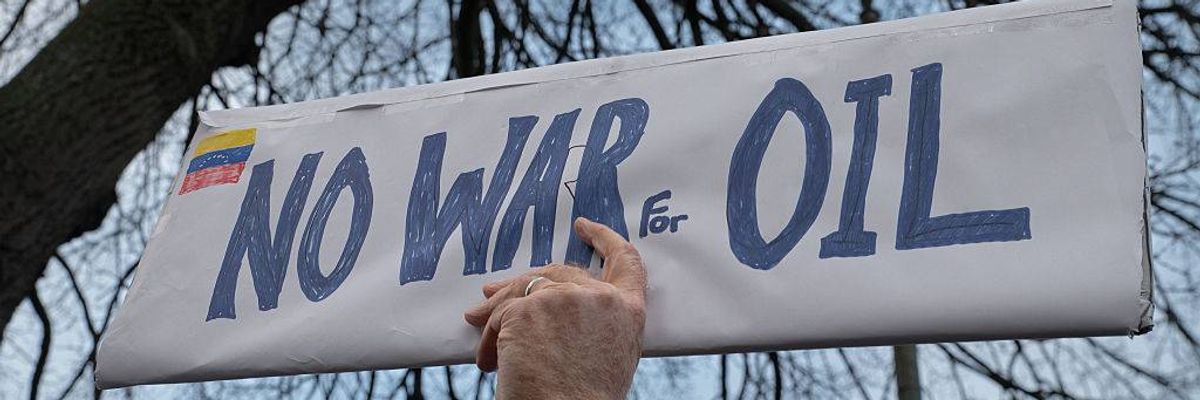
A man’s hand holds a plaque reading “No War for Oil” in front of the U.S. Embassy in Dublin on January 4, 2026 in Dublin, Ireland. (Photo by Natalia Campos/Getty Images)
President Donald Trump’s invasion of Venezuela is generating fresh calls for his impeachment and removal from office.
Shortly after the US military bombed the Venezuelan capital of Caracas and abducted Venezuelan President Nicolás Maduro and his wife, Cilia Flores, many experts on international law argued that the president’s actions were completely illegal.
In an interview with the New Yorker’s Isaac Chotiner, Yale Law School professor Oona Hathaway said that she didn’t believe there “is a legal basis for what we’re seeing in Venezuela,” while adding that the arguments the Trump administration will likely make simply “don’t hold water.”
For instance, Hathaway noted that while the United Nations charter allows nations to use military force in self-defense against military aggression, the administration’s claims that attacking Maduro was a defensive measure intended to stop the flow of illegal drugs into the US was completely outside the scope of traditional self-defense.
“If drug trafficking is a reasonable justification, then a whole range of possible arguments can be made that basically mean that self-defense is no longer a real exception,” she argued. “It’s the new rule. Why couldn’t you make the same argument about communicable diseases? There’s bird flu coming from a country, and therefore we have a legal justification for the use of military force. Once we start going down that road, the idea that there’s any limit evaporates.”
Hathaway also said that Trump’s militaristic ambitions seem to have grown throughout his second term, and she warned they could lead to a long and bloody US military occupation of Venezuela.
“In his press conference, Trump said that the United States would ‘run the country,’” she said. “And he made it clear that he was not ‘afraid’ to put boots on the ground—for years, if necessary... it’s nothing like anything Trump has done before today. His previous illegal uses of force were all over shortly after they began. The scale of the operation that will be required is massive, and it means putting US soldiers at long-term risk.”
Harvard Law School professor Jack Goldsmith wrote a lengthy analysis after the attack on Venezuela and also concluded that it violated the UN charter. What’s more, Goldsmith argued that Trump’s state plan to seize Venezuela’s oil would likely run afoul of the Fourth Geneva Convention, which limits actions that occupying powers can take on the countries they are overseeing.
“There are a lot of international law rules and restrictions that purport to govern what the United States can do as an occupying power,” he explained. “I don’t have space here to review them, but suffice it to say that these rules will touch on President Trump’s stated aim of ‘tak[ing] back the oil’ and ‘get[ting] reimbursed.’ We will see if the administration takes these rules seriously.”
Many Trump critics also argued that, legality aside, toppling a foreign head of state and vowing to seize their nation’s natural resources was morally wrong and deserving of impeachment.
“This is the behavior of a mob boss—but with nuclear weapons and the world’s strongest military,” argued Zeteo editor-in-chief Medhi Hassan. “None of this is legal. Trump should be impeached by Congress and indicted at The Hague.”
Leah Greenberg, co-founder and co-executive director of Indivisible, denounced Trump’s attack on Venezuela as “wildly illegal, immoral, and irresponsible,” and urged the US Congress to exercise its powers to stop the president from further escalation.
“The power to declare war belongs to Congress and the American people,” Greenberg said. “Trump has once again taken power that’s not his. He is attempting to drag the country into war by decree, all while treating the presidency like a throne. Congress must act immediately to stop these illegal strikes and hold the Trump regime accountable. No Kings, No War.”
Cavan Kharrazian, senior policy adviser for Demand Progress, demanded congressional action to “stop this reckless, unconstitutional act of war.”
“We have seen what happens when the White House invents a pretext to launch a regime change war with an oil-rich nation: disaster and suffering for innocent civilians, our troops and their families, all while costing the American taxpayer a fortune as well,” said Kharrazian. “Congress must do the right thing by voting to stop this obvious catastrophe.”
Kat Abughazaleh, a Democratic candidate for US Congress in Illinois, wrote on Bluesky that the time for Democratic politicians to issue mealy-mouthed statements about Trump’s actions was over.
“Democrats need to grow a fucking spine,” she wrote. “No more strongly worded letters. It’s time to draft articles of impeachment. Impeach. Convict. Remove.”
Rep. Ro Khanna (D-Calif.) also demanded that members of his party take a strong stance against Trump’s illegal Venezuela attack.
“The silence from many media-hyped 2028 contenders today is shocking,” he wrote on X. “If you cannot oppose this regime change war for oil, you don’t have the moral clarity or guts to lead our party or nation.”
Trump shocks as he reveals who he first told of Venezuela attack: 'Can’t tell you how insane'
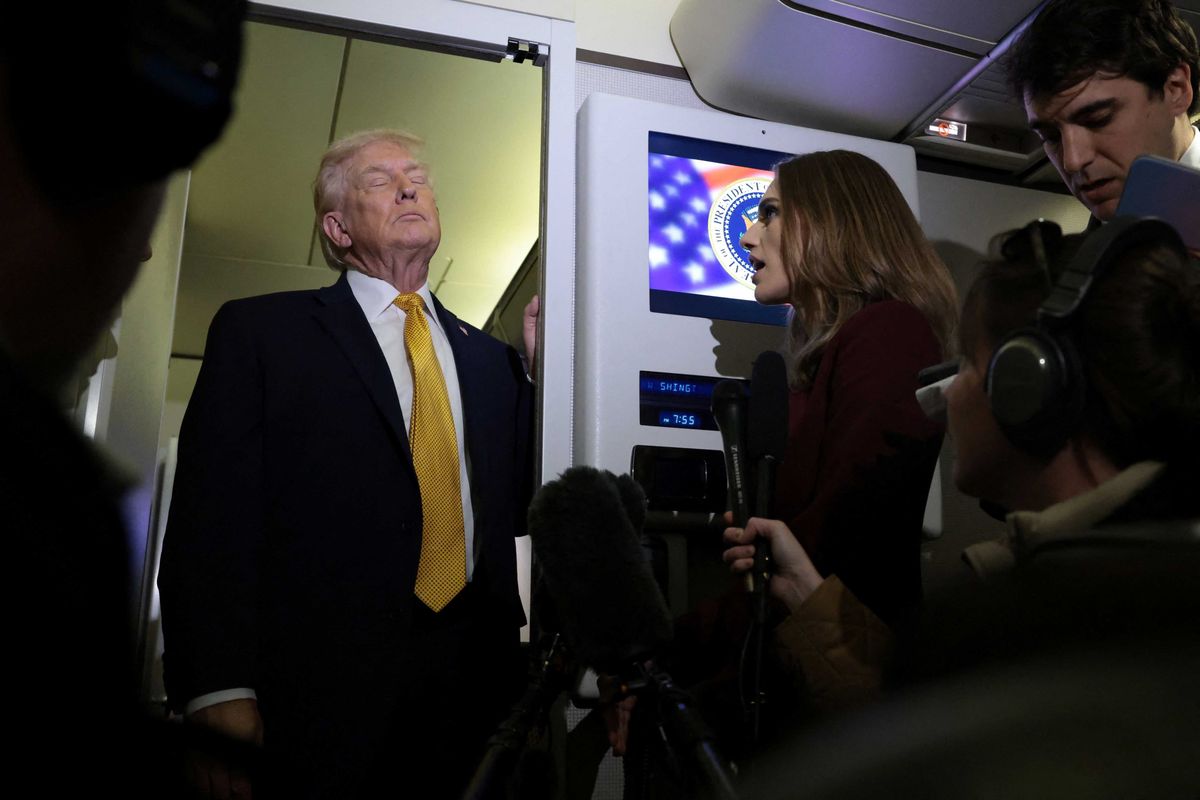
U.S. President Donald Trump pauses before answering a reporter’s question aboard Air Force One en route from Florida to Joint Base Andrews, Maryland, U.S., January 4, 2026. REUTERS/Jonathan Ernst
President Donald Trump is facing renewed calls for impeachment over his unprecedented attack on Venezuela and failure to notify Congress in advance, but while aboard Air Force One Sunday night he made a startling admission about which group he did inform ahead of the operation.
Trump admitted that he had told oil companies of the operation in advance, and championed them for wanting to “go in” to Venezuela and “do a great job” with securing Venezuela’s oil reserves, the single-largest proven oil reserves on earth.
With Trump having not only not informed Congress of the attack beforehand, including the “Gang of Eight” congressional leaders who are traditionally told of such operations, critics, such as Democratic congressional candidate Fred Wellman, were left floored by the admission.
“I can’t begin to tell you how insane this is,” Wellman, who also hosts the “On Democracy” podcast, wrote Sunday night in a social media post on X to his more than 356,000 followers.
“He did not inform Congress but he’s saying he informed the oil companies. Keep in mind who he means. The billionaire mega donor that just got control of Citgo. Our service members were used directly to move the interests of Trump’s donors.”
Rep. Yassamin Ansari (D-AZ) was also shocked by Trump’s startling admission, calling it an indication that his administration now closely resembles an "authoritarian regime.”
“The oil companies were informed about an act of war before it happened, Congress was not,” Ansari wrote Sunday in a social media post on X. “That, my friends, is what an authoritarian regime run by oligarchs looks like.”
Trump has already made clear that he anticipates the United States benefitting economically from having unchallenged access to Venezuela's vast oil reserves, and the stock values of American oil companies have already surged in the wake of the U.S. attack and subsequent takeover of Venezuela.The Texas-based oil giant Chevron – the lone American oil company to currently have a presence in Venezuela – has already vowed to work with the Trump administration in its hostile takeover of the South American nation, and cheered what it hoped would be a “peaceful” transfer of power facilitated by the United States.
‘What an Authoritarian Oligarchy Looks Like’: Trump Says Oil Execs Tipped Off About Venezuela Attack “I can’t begin to tell you how insane this is,” said one critic. “He did not inform Congress but he’s saying he informed the oil companies.”
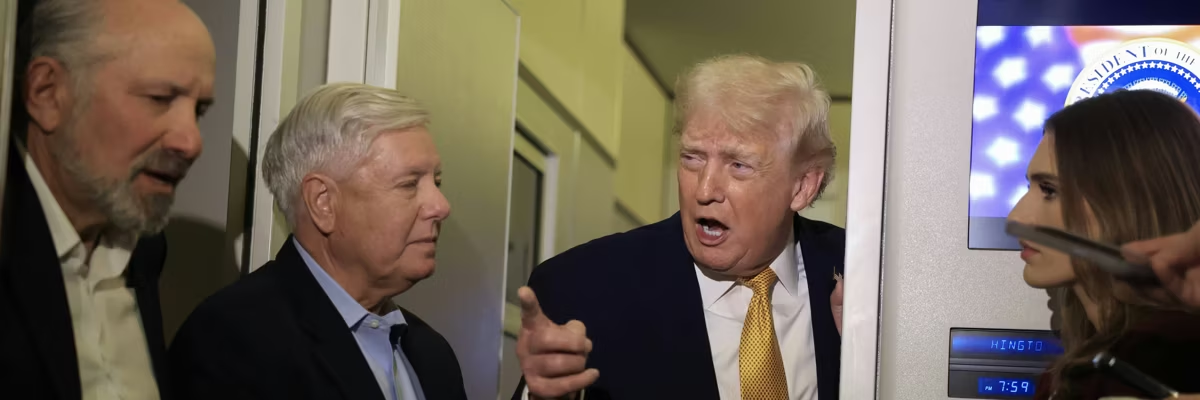
President Donald Trump, Commerce Secretary Howard Lutnick (L) and U.S. Sen. Lindsey Graham (R-SC) (C) speak to the media aboard Air Force One en route to Washington, DC on January 04, 2026. (Photo by Joe Raedle/Getty Images)
President Donald Trump on Sunday told reporters that the heads of American oil companies were informed of the US military’s attack on Venezuela—described as “brazenly illegal” by scholars and experts—even before it took place.
Trump’s admission, a renowned liar, sparked condemnation because the administration refused to consult with US lawmakers about the operation, citing fears of a leak that would compromise operational security.
“Before and after,” Trump told reporters aboard Air Force One on Sunday when asked if he’d spoken with oil executives or perhaps “tipped them off” about the operation. “They want to go in, and they’re going to do a great job for the people of Venezuela.”
Trump’s remarks were condemned by those critical of the president’s actions in recent days, including his failure to consult with or seek authorization from Congress.
“I can’t begin to tell you how insane this is,” said Fred Wellman, an Army combat veteran now running for Congress as a Democrat in Missouri. “He did not inform Congress, but he’s saying he informed the oil companies.”
“Keep in mind who he means,” Wellman added. “The billionaire mega donor that just got control of Citgo. Our service members were used directly to move the interests of Trump’s donors.”
“The oil companies were notified before Congress,” said Melanie D’Arrigo, executive director of the Campaign for New York Health. “This is what an authoritarian oligarchy looks like.”
Rep. Yassamin Ansari (D-Ariz.) echoed that statement. “The oil companies were informed about an act of war before it happened, Congress was not. That, my friends, is what an authoritarian regime run by oligarchs looks like.”
Asked repeatedly during his exchange with reporters about whether “free and fair” elections were a priority for Venezuela, Trump said the country was a “mess”—calling it a “dead country”—and that priority would be on getting the oil flowing.
“We’re gonna have the big oil companies go in, and they’re gonna fix the infrastructure, and they’re going to invest money. We’re not going to invest anything; we’re gonna just take care of the country,” Trump said. “We’re gonna cherish the country.”
When asked which oil companies he spoke with, Trump said, “All of them, basically,” though he did not mention which ones specifically by name.
“They want to go in so badly,” the president claimed.
Despite Trump’s remarks, oil industry experts have said it’s not nearly so clear-cut that oil majors in the US will want to re-enter the Venezuela oil market—or be tasked with funding a significant rebuild of the nation’s oil infrastructure—given the political uncertainty unleashed by Trump’s unlawful military operation and the kidnapping of Venezuela President Nicolas Maduro.
“The issue is not just that the infrastructure is in bad shape, but it’s mostly about how do you get foreign companies to start pouring money in before they have a clear perspective on the political stability, the contract situation, and the like,” Francisco Monaldi, director of the Latin American energy program at Rice University, toldNPR.
The infrastructure investments alone are huge, even under normal political circumstances.
“The estimate is that in order for Venezuela to increase from one million barrels per day—that is what it produces today—to four million barrels, it will take about a decade and about a hundred billion dollars of investment,” Monaldi said.
In an interview with The New Yorker over the weekend, Oona Hathaway, a professor at Yale Law School and the director of its Center for Global Legal Challenges, said there is absolutely no legal justification for Trump’s assault on Venezuela or the kidnapping of Maduro and his wife, Cilia Flores.
“I don’t think there is a legal basis for what we’re seeing in Venezuela,” Hathaway said. “There are certainly legal arguments that the Administration is going to make, but all the arguments that I’ve heard so far don’t hold water. None of them really justify what the President seems to have ordered to take place in Venezuela.”
In a statement on Saturday, Elizabeth Bast, executive director of Oil Change International, said Trump’s assault on Venezuela “defies the US Constitution’s delegation of Congress’s war-making authority and disregards international rules that prevent acts of war without debate or authorization. The US must stop treating Latin America as a resource colony. The Venezuelan people, not US oil executives, must shape their country’s future.”
As Trump and other members of the administration continued to threaten other countries in the region—including Mexico, Colombia, and Cuba—Zeteo editor-in-chief Mehdi Hasan said, “This is the behavior of a mob boss—but with nuclear weapons and the world’s strongest military. None of this is legal. Trump should be impeached by Congress and indicted at The Hague.”
A War That Comes Home: Why The Occupation Of Venezuela Would Weaken The United States From Within – OpEd
The idea of occupying Venezuela, while it may at first glance be presented as a decisive move in foreign policy or a tool for restoring U.S. influence in the Western Hemisphere, is in reality less a response to external crises than a generator of deep internal crises within the United States. American historical experience shows that wars and military occupations—especially when launched with vague objectives and without domestic consensus—sooner or later bring their effects back inside the country’s borders. Venezuela is no exception to this rule; rather, because of its geographic location, social conditions, and political sensitivity, it could become a condensed example of all of America’s previous failures in foreign interventions.
The starting point of this cycle is economic cost. Military occupation, even if conceived as a limited and short-term operation, in practice turns into a long-term commitment whose expenses quickly spiral out of control. The United States has yet to fully absorb the financial consequences of the post–September 11 wars: rising public debt, pressure on the federal budget, and a reduced capacity to invest in domestic infrastructure are all legacies of those interventions. Entering a new occupation in Venezuela would mean injecting billions of additional dollars into the war machine at a time when American society is grappling with a housing crisis, economic inequality, and the deterioration of public services. This growing gap between foreign priorities and domestic needs gradually fuels social dissatisfaction and political distrust.
This economic pressure then flows directly into the realm of domestic politics. American society today is deeply polarized, and consensus on major issues has reached a minimum. The occupation of Venezuela would not heal these divisions; it would intensify them. For a significant segment of public opinion, such an action would revive memories of old interventionist patterns for which the United States has paid dearly. Others, by contrast, would see it as a sign of renewed strength or restored authority. The result would not be the formation of a shared national narrative, but rather a clash of narratives and further erosion of social cohesion—a condition that weakens rational decision-making in domestic politics.
Yet the consequences of occupation do not end there. Any large-scale military intervention inevitably creates social and economic instability in the target country, even if its governing structures were already fragile. In the case of Venezuela, this instability would likely intensify the humanitarian crisis and trigger increased waves of migration. The United States, already facing one of the most sensitive and contentious migration crises in its history, would be confronted with a new influx of refugees flowing directly toward its southern borders. This would place additional strain on local governments, service systems, and the domestic political environment, turning immigration into an even larger political flashpoint.
Alongside these developments, the issue of legitimacy arises—not only at the international level, but within the United States itself. For decades, the U.S. government has justified foreign interventions in the language of democracy, human rights, and a rules-based order. But the wider the gap grows between these slogans and realities on the ground, the more citizens’ trust in the sincerity of governing institutions erodes. An occupation of Venezuela without a clear legal framework and international consensus would deepen this gap and, especially among younger generations, reinforce the perception that U.S. foreign policy is driven less by principles than by short-term, power-centered interests.
This erosion of legitimacy carries even more dangerous consequences. The experience of the past two decades shows that foreign wars often lead to an expansion of the powers of security institutions inside the United States. Increased surveillance, restrictions on civil liberties, and the normalization of the logic of “security over rights” were clearly observed after September 11. The occupation of Venezuela could once again strengthen this trend—particularly if, under the pretext of countering external threats or regional instability, additional security tools are activated domestically. Over the long term, this trajectory stands in contradiction to the spirit of American democracy.
In such an environment, a vicious cycle emerges: economic costs generate social dissatisfaction; social dissatisfaction intensifies political polarization; political polarization makes rational decision-making more difficult; and the government, in an effort to control the consequences, turns to security instruments. The occupation of Venezuela, rather than being a sign of American strength, could become the trigger for this weakening cycle—a cycle that has been experienced many times before.
The crucial point is that these consequences are neither accidental nor unpredictable. Contemporary American history, from Vietnam to Iraq and Afghanistan, has repeatedly shown how wars “far from home” are transformed into crises “at home.” What distinguishes Venezuela is that, due to its geographic proximity and its direct connection to U.S. migration and economic issues, the speed and intensity with which these consequences return could be even greater.
Ultimately, the occupation of Venezuela would be not only a strategic risk in foreign policy, but a dangerous gamble with America’s internal stability. It would drain economic resources, deepen social divisions, erode political legitimacy, and place civil liberties at risk. If the goal of foreign policy is to ensure the security and well-being of citizens, it must be acknowledged that some wars lose at home before they ever lose on the battlefield. Venezuela would be one of those wars—a war that, even if it begins abroad, sooner or later comes home. Peter Rodgers is an international relations graduate of Penn State University.
‘Free our president’, Maduro supporters demand at rally
A supporter of ousted Venezuela's President Nicolas Maduro demonstrates with a national flag in Caracas a day after he was captured in a US strike - Copyright AFP Juan BARRETO
Around 2,000 supporters of ousted Venezuelan president Nicolas Maduro demonstrated Sunday in Caracas to demand that he and his wife, who were nabbed by US forces and taken to a New York jail, be released.
A group of pro-Maduro paramilitaries and bikers accompanied the demonstrators, who waved red, blue and yellow Venezuelan flags.
“Free our president,” read a placard held by a man with a red flannel shirt which bore the image of Maduro’s predecessor and mentor, late socialist firebrand Hugo Chavez.
“Venezuela is no-one’s colony,” another placard read, a swipe at US President Donald Trump’s announcement Saturday that Washington would “run” Venezuela during an unspecified transitional period.
On Monday, Maduro is due in court in New York to face charges of “narcoterrorism” tied to alleged cocaine trafficking into the United States.
“The narcotrafficker and terrorist is Trump,” Nairda Itriago, 56, told AFP angrily, accusing US forces, who carried out airstrikes to neuter Venezuela’s defenses while Maduro was being captured, of killing “innocent people.”
Venezuelan hospitals have refused to divulge the number of people killed or injured in the pre-dawn strikes.
Defense Minister Vladimir Padrino Lopez said a “large part” of Maduro’s security team were killed “in cold blood,” as well as military personnel and civilians, but gave no figures.
A doctors’ group told AFP around 70 people were killed and 90 injured.
The demonstrators in Caracas echoed speculation that Maduro had been betrayed by a member of his inner circle, smoothing the path for US special forces to swoop in and capture him at the country’s biggest military base.
“How is it possible…that the air defenses didn’t work?” a 69-year-old accountant who gave his name as Papa Juancho said.
“Nicolas Maduro was removed by traitors, because with the amount of security he had this should never have happened,” he said.
Maduro’s son Nicolas Maduro Guerra also voiced suspicion about the presence of spies in his father’s entourage in an audio message shared on social media on Sunday.
“History will tell who the traitors were,” he said.
Venezuela And The Decline Of American Democracy
Timothy Snyder sees a familiar connection between US domestic repression and escalating foreign aggression.
In certain ways, last autumn in the United States recalled the autumn of 1938 in Nazi Germany, when mass deportation of undocumented people was one of Hitler’s most ambitious coercive policies before the start of World War II. In the US, too, the connection between domestic repression and foreign aggression is coming into focus.
That fall, the German police and SS rounded up 17,000 Jews with Polish citizenship and dumped them across the border, into neighboring Poland. This set off a chain of events which provides a useful perspective on where the US is now. A family was deported; a desperate refugee took revenge; the government organized a pogrom and re-organized its police; war followed.
The family was the Grynszpans. The father and mother had moved to Germany in 1911 from the Russian Empire. Their children were born in Germany, spoke German, and saw themselves as Germans. Their son Herschel had left to stay with relatives in Paris, where he faced a series of disappointments with his documentation, including the loss of his citizenship.
Denied permanent residence in France in the summer of 1938, Herschel was hiding in an attic to avoid deportation when a postcard from his sister arrived: “everything is finished for us.” Herschel took revenge. On November 7, 1938, he walked into the German embassy in Paris and shot the diplomat Ernst vom Rath. A policy of mass deportation had led to a reaction that, although unpredictable in its details, was not surprising.
Smart, Progressive Thinking on the Big Issues of Our Time
Join 20,000+ informed readers worldwide who trust Social Europe for smart, progressive analysis of politics, economy, and society — free.
Get Free Updates I consent to receiving newsletters and have read and agree to the Privacy Policy. By subscribing, you acknowledge that your information will be transferred to MailerLite for processing.
In Berlin, the Nazis saw an opportunity. Joseph Goebbels invoked a conspiracy and conflated the actions of one person with the responsibility of a group, and Hitler allowed Goebbels to organize a nationwide pogrom – Kristallnacht – two days later. The SA, the SS, and the Hitler Youth, joined by many other Germans, destroyed Jewish businesses, burned Jewish books, desecrated Torah scrolls, and invaded Jewish homes. Some 91 Jews were killed, and hundreds died by suicide. Tens of thousands of Jewish men were sent to concentration camps.
Nine decades later, no one could foresee exactly what would happen when the Trump administration made deportation of the undocumented its basic policy, with the National Guard deployed in Los Angeles and Washington – cities that should be seen as “training grounds for our military” and “war zones.” But it was predictable that there would be some consequence. It arrived in the form of the recent shooting of two National Guard soldiers patrolling in Washington. One subsequently died from her wounds.
The accused is a refugee from Afghanistan who had assisted the US war effort in his homeland. Like Grynszpan, he is someone who experienced trauma and dehumanization. Having fought and killed for a foreign government in his own country, the assassin had reason to expect some sort of shelter after he and his family were evacuated from Afghanistan to the US. It appears he faced only a series of disappointments.
His experience, as reported by The New York Times, was eerily similar to Grynszpan’s. While “it was unclear what exactly triggered” the attacker, a volunteer who worked with the family “sensed part of it was his frustrations with the uncertainty of America’s immigration process” and his family’s fear that they would be “deported to Afghanistan as his application for a Special Immigrant Visa dragged on.” This is not an excuse for a horrible act. It is a fact that is necessary to understand the structure of the historical moment.
It was foreseeable that US President Donald Trump would seek to exploit such violence. He announced his intention to target “Third World countries,” blamed all of America’s problems on migrants, and called Somalis “garbage.” Trump expressed his desire to deport millions of people and to denaturalize – strip citizenship from – Americans whose values he disparages or whom he deems incompatible with “Western civilization.” Life will be made even harder for non-citizens in the US.
What comes next? For the Nazis, the mass deportation and pogrom of autumn 1938 were steps toward creating a centralized national police agency, the Reich Security Main Office, the following year. In the US, something similar is unfolding with Immigration and Customs Enforcement: initially tasked to carry out deportations, ICE has taken on espionage roles, provoked citizens, and been reinforced by soldiers of the National Guard. In these respects, it is becoming something like a national police force, with ideological propaganda and links to the armed forces.
In one way, mass deportations and Kristallnacht advanced the consolidation of the Nazi regime. But this kind of instability was unpopular in Germany – much as ICE raids are unpopular in US cities. The radical next steps were possible only under cover of war. That would be the classic next step in the regime change that Trump seems determined to carry out in the US. War is the easy way to eliminate internal enemies by identifying them with an external enemy.
For Trump, starting a war with Venezuela (or someone) would be the next logical move in advancing regime change at home. It is not hard to see that Trump understands this, given his escalating provocations since the summer, when the US began attacking alleged drug smugglers in the Caribbean Sea, including shipwrecked survivors killed in obvious violation of international law.
The past never repeats, but it does instruct – and it instructs everyone. The people who want authoritarianism in America know that seizing on the emotions associated with political belonging can lead to turmoil and regime change. And the people who want democracy in America can see the pattern and, by naming it, take the crucial first step toward bringing the process to a halt.
This column was first published on 15 December 2025.
Timothy Snyder, the author or editor of 20 books, holds the inaugural Chair in Modern European History at the Munk School of Global Affairs and Public Policy at the University of Toronto and is a permanent fellow at the Institute for Human Sciences in Vienna.