Tuesday, January 06, 2026

Empire through submission (Part II): Neomercantilism, regime changes and the dangers posed for Latin America
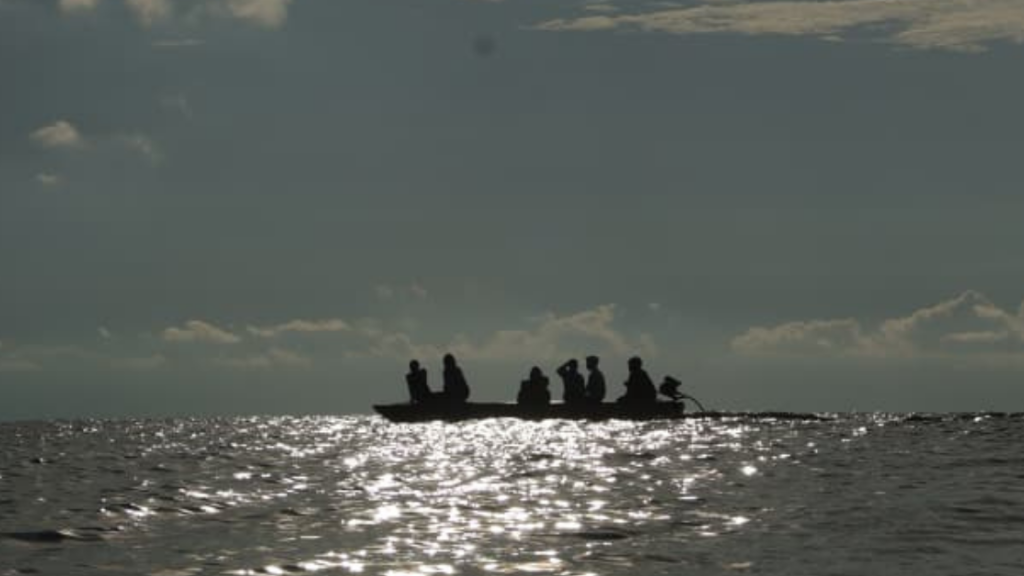

boat

First published in Spanish at CEDES. Translation by LINKS International Journal of Socialist Renewal. Read Part I here.

Just prior to an appeal court ruling invalidating a large chunk of his tariffs, United States President Donald Trump had an epiphany and posted this on Truth Social on August 31, 2025: “If a Radical Left Court is allowed to terminate these Tariffs … we would become a Third World Nation, with no hope of GREATNESS again.”1 Read as a confession about the US’s status within the world capitalist economy, for Trump this is not so much a matter of maintaining greatness but of returning to it, with tariffs being the quintessence of the process. Certain questions therefore flow from this: does Trumpism mean the US is returning to mercantilism to avoid becoming a Third World nation? Or, recalling Andre Gunder Frank’s seminal thesis, is Trumpism seeking to prevent the US transitioning from development to underdevelopment?

When Trump outlines his fear that his country will fall down the rankings in the international division of labour, he is only stating a truism. Immanuel Wallerstein points out: “To argue that economic nationalism is the state policy of the weaker against the stronger and of competitors against each other is merely to accept an orthodoxy.”2 The US intelligentsia, however, has consistently chosen to see the speck in the eye of others, attacking the US’s competitors and, of course, negatively labelling them as “mercantilists.” For example, Walter Russell Mead wrote in 2018: “America must do substantially more to counter an increasingly authoritarian, mercantilist and aggressive China.”3 Seven years later, “authoritarian,” “mercantilist,” and “aggressive” seem excellent descriptions for the US under Trump 2.0.

Against Mead, let us introduce some conceptual precision to the discussion. To do this, I will turn to the concept of mercantilism, as expressed by Max Weber in his essential book, General Economic History:

Mercantilism means the transfer of the capitalist profit motive to politics. The state proceeds as if it were solely and exclusively made up of capitalist entrepreneurs; economic policy abroad rests on the principle of outpacing the adversary, buying from him as cheaply as possible and selling to him as dearly as possible. The highest purpose is to strengthen the power of the state externally. Mercantilism therefore implies powers formed in the modern way: directly through the increase of the public treasury; indirectly by an increase in the tax capacity of the population ... In the theoretical order, this system was based on the theory of the balance of trade, which pointed out that the impoverishment of a country occurs as soon as the value of imports exceeds that of its exports.4

To validate the adequacy of the Trump 2.0 administration’s discourse and practice to Weber's conceptualisation of mercantilism, it is enough to turn to the discourse surrounding Trump’s so-called “Liberation Day” (February 4) executive order. Obviously, we are not proposing an anachronism here; the Trump 2.0 administration is neo-mercantilist. Economic nationalism as a weapon against unbridled competition was reliably demonstrated in the Trump 2.0 administration’s neomercantilist concern about manufacturing. An excerpt from the “Liberation Day” executive order helps make this point:

Both my first Administration in 2017, and the Biden Administration in 2022, recognized that increasing domestic manufacturing is critical to U.S. national security. According to 2023 United Nations data, U.S. manufacturing output as a share of global manufacturing output was 17.4 percent, down from a peak in 2001 of 28.4 percent... Increased reliance on foreign producers for goods also has compromised U.S. economic security by rendering U.S. supply chains vulnerable to geopolitical disruption and supply shocks... The decline of U.S. manufacturing capacity threatens the U.S. economy in other ways, including through the loss of manufacturing jobs. From 1997 to 2024, the United States lost around 5 million manufacturing jobs and experienced one of the largest drops in manufacturing employment in history.5

To understand this neomercantilist zeal as a weapon of the “weak” against the “strong”, we need to turn to a periodisation of the US hegemonic cycle in the world capitalist economy. As is known, the US hegemonic cycle emerged from the dispute against Germany in the collapse/transition phase of the British hegemonic cycle (1914-1945). It then had its boom phase from the post-war period to the stagflation crisis (1945-1973/1982). The following period from the monetarist Counterrevolution to the Great Recession can be seen as both a second golden age of US capitalism as well as a slow but progressive decline amid financialisation. Finally, the outcome of the War on Terror and the effects of the Great Recession opened the door to the crisis/dispute phase of the US hegemonic cycle.6 Historical experience reveals that in phases of hegemonic rise, agro-industrial productive superiority gives rise to preeminence in commercial distribution, which in turn favours financial superiority. On the other hand, phases of hegemonic decline follow the same sequence: first agro-industrial productive superiority is lost, then commercial superiority, with finance being the last bastion of the hegemonic power.7 In the current hegemonic cycle, China surpassed the US in terms of share of global manufacturing output in 2010 and in share of world trade in 2013.

On the other hand, a common mistake made by critics of imperialism in general, and of the US in particular, is to consider the decline as due to the hegemonic power’s integral weakness. On the contrary, in Wallerstein’s words: “This period of decline is not one in which the previous hegemonic power is weak. Quite the contrary. It remains for a long while the most powerful country in the world, politically and militarily (but no longer economically)...”8 The neo-mercantilism that serves as the structure of Trump 2.0’s Hamiltonian Jacksonian foreign policy seeks to reduce the disjunction between the US’ political-military power and the productive, technological and financial bases that support it. In short, the heart of the matter with both old and new mercantilism is the same: “the increase of overall efficiency in the sphere of production”9 as the basis of wealth, power and prestige in a system of competing states.

However, in phases of decline, hegemonic powers face a paradox to which the US was exposed, from the Ronald Reagan administration to the Joe Biden administration: restricting the strengthening of allies while using allies to stop enemies. But the balance-of-power phases of hegemonic cycles, or crisis/dispute phases, are characterised by the emergence of new configurations of power on a global scale. In these phases, all Great Powers seek to ensure alliances that impact on the appropriation of wealth, which serves as the basis for military power. Consequently, the phases of crisis/dispute are usually times of “imperialist” revival, where the logic of territorial expansion and the logic of capital accumulation are knotted even more closely together to redirect supply chains at the service of industrial production.

Trump’s 2.0 neo-mercantilism has been accompanied by its respective dose of territorialism, which seeks to ensure that natural resources and supply chains, at least in the Western Hemisphere, are at the disposal of US wealth and power. It is self-evident that with Trump’s neo-mercantilism, the Monroe Doctrine — which was born as a British policy to guarantee the balance of power between European powers after the Napoleonic Wars, and which, with the Roosevelt Corollary, became the guide of territorialism at the service of capitalism in Latin America during the crisis/dispute phase of the British hegemonic cycle — is undergoing an update, dusting off the little-known Olney Corollary to seek to expel China and other Great Powers from accessing Latin America’s raw materials.

In a classic text, Joan Robinson argued: “The characteristic feature of the new mercantilism is that every nation wants to earn a surplus from the rest.”10 For commodity exporting countries, this means either a drastic drop in revenue captured from state property or the total loss of ownership, unless they are able to create defence mechanisms against territorialism.

A new “hot” Cold War in Latin America?

The periods of balance of power of hegemonic cycles make peremptory the maxim according to which “hegemonic powers had never allowed ideology to interfere in their interests.”11 In other words, they are periods dominated by political realism. In the boom phases of the hegemonic cycle, ideology plays a central role in building both the legitimising façade of the regime of accumulation and domination, as well as that of the enemy and network of alliances. In the phases of crisis/dispute, amid the accelerated disintegration of the world order, interests prevail over ideology as new configurations of power emerge. In nuce, in the phases of crisis/dispute and collapse/transition, realism becomes the nourishment of the strong and ideology the consolation of the weak.

The US had already emerged to become the great champion of capitalism in the crisis/dispute phase of the British hegemonic cycle. That status was built on the fact that, prior to World War I, the US industrial boom was unparalleled, surpassing even Wilhelmine Germany. Victory over the Axis powers in World War II, the pacted interstate system agreed upon at Yalta with the Soviet Union, and the vassalage of Japan and the Federal Republic of Germany in the post-war period, had repercussions on US self-confidence as the home of capitalism. However, the boom phase of the US hegemonic cycle was not built on the basis of the international New Deal of Franklin D Roosevelt, but the Truman Doctrine, George F. Kennan's musings about security, and the invention of the Cold War.

The Soviet Union’s containment during the “First Cold War” continued to be fuelled with the ideological substratum of US capitalism as non plus ultra. The arrival of Reagan to the presidency together with the “Second Cold War” revived capitalist ideology. However, the 1970s stagflation crisis and the 1980s Japanese miracle set off some alarm bells in the “house of being”. The end of the Cold War seemed to put things back in place, until the dot-com crisis and the events of September 11, 2001 served as a preamble to the irreversible break in the identity between the US and capitalism in 2008. Either way, US citizens born between the postwar period and the 2008 financial crisis grew up in a national culture with an ethnocentric awareness of capitalism.

However, the untold story of capitalism’s epic against Communism, culminating in Reagan’s Star Wars, is far more somber and terrifying. For example, in Latin America, the Truman Doctrine, which was preceded by the Monroe Doctrine, the infamous Olney Corollary, and the pragmatic Roosevelt Corollary, quickly leveraged repression. For Kennan, the Communists of the New World were simply traitors.12 At the end of the “First Cold War”, the balance sheet for the US seemed favourable on the surface: triumphs ranged from the coup d'état against Jacobo Arbenz in Guatemala in 1954, through to support for the military coup in Brazil in 1964 and the second invasion of the Dominican Republic in 1965, to the overthrow of Salvador Allende in Chile in 1973. The Cuban Revolution knew how to resist, but the US contained its capacity to spread externally and annihilated its capacity for internal socioeconomic transformation. In the 1980s, the main theatre of operations of Washington’s intervention in Latin America shifted from the South American regimes of terror to the Central American civil wars. The US invasion of Panama in 1989 closed an era. US historian John Coatsworth made an assessment of the Cold War in Latin America that should make us rethink the usual metaphysical considerations about the “right side of history”:

Between the onset of the global Cold War in 1948 and its conclusion in 1990, the US government secured the overthrow of at least twenty-four governments in Latin America, four by direct use of US military forces, three by means of CIA-managed revolts or assassination, and seventeen by encouraging local military and political forces to intervene without direct US participation, usually through military coups d’état..

The human cost of this effort was immense. Between 1960, by which time the Soviets had dismantled Stalin’s gulags, and the Soviet collapse in 1990, the numbers of political prisoners, torture victims, and executions of nonviolent political dissenters in Latin America vastly exceeded those in the Soviet Union and its East European satellites. In other words, from 1960 to 1990, the Soviet bloc as a whole was less repressive, measured in terms of human victims, than many individual Latin American countries.

The hot Cold War in Central America produced an unprecedented humanitarian catastrophe. Between 1975 and 1991, the death toll alone stood at nearly 300,000 in a population of less than 30 million. More than 1 million refugees fled from the region — most to the United States. The economic costs have never been calculated, but were huge. In the 1980s, these costs did not affect US policy because the burden on the United States was negligible.13

It is not surprising that, in the face of such a tragedy, the US moderated its direct interventions in Latin America at the end of the Cold War, prioritising covert operations instead. Many analysts consider the current Sino-American rivalry as a “New Cold War”. I do not agree with that thesis.14 However, the effects on Latin America of the crisis/dispute phase of the US hegemonic cycle may be as tragic as the effects of the previous “hot” Cold War.

On the three forms of regime change

“Regime change” is once again on the order of the day. After being widely discredited in the arc of events from the War on Terror, through to the “First Libyan Civil War”, to the astonishing return of the Taliban, regime change has re-entered the Trump 2.0 administration’s geopolitical conversations regarding Iran and Venezuela. However, being faithful to criticisms made of the foreign policy of neoconservatism and the Obama administration, while also being careful to maintain the support of his isolationist electoral base, Trump has preferred to be cautious about publicly confessing his objectives against the Nicolás Maduro government. At most, in the interview for 60 Minutes, when asked: “Are Maduro’s days as president numbered?” Trump dared to say: “I would say yeah. I think so, yeah.”15 Mead cuts straight to the chase in his November 3 column in The Wall Street Journal, simplifying things as such:

With a carrier strike group joining eight warships already in the region, a squadron of F-35s in Puerto Rico, and assorted elite military units in the area, the Trump administration has ramped up its standoff with Venezuela. Regime change is clearly the goal; the timetable and means are unspecified.16

Trump’s talk of regime change in Venezuela is not new. After the disputed May 2018 presidential elections, Trump 1.0 applied in 2019 what in my book Venezuela’s Long Depression I called a comprehensive sanctions regime against Venezuela and a strategy of collapse, in addition to supporting the opposition led by Juan Guaidó in a politics of dual power.17 According to the canonical definition that the term regime change acquired from US interventionism after the end of the Cold War — that is, the overthrow of the government — the Trump 1.0 administration’s policy towards Venezuela failed.

However, as Perry Anderson has recently highlighted, before its current meaning, regime change enjoyed a much more structural and subtle meaning, one based on coercion. Anderson explains that, in the 1970s, the term meant “not the sudden transformation of a nation-state by external violence, but the gradual installation of a new international order in peacetime.”18 A decade later, with the rise of the monetarist counterrevolution, financialisation and neoliberal globalisation, the term underwent a new mutation, acquiring a tinge of capitalist realism:

What had replaced the world instituted at Bretton Woods was a set of system-wide constraints affecting all governments, no matter their complexion, consisting of macro-policy packages of monetary and financial regulation that fixed the parameters of possible labour market, industrial and social policies…

Such was the original meaning of the formula ‘regime change’, today all but forgotten, erased by the wave of military interventionism that confiscated the term at the turn of the century... Yet the relevance of its original meaning remains. Neoliberalism has not gone away.19

Today, it may be worth reactivating the triple meaning of the term regime change: first, an attempt to establish an international or regional regime by a Great Power; second, structural transformations in the regimes of regulation and accumulation in semi-peripheral and peripheral countries at the service of Great Powers; and, third, a euphemism for overthrowing foreign governments.

In this sense, as I explained in Venezuela’s Long Depression, the financial weapons of mass destruction or comprehensive sanctions regime imposed on Venezuela during the Trump 1.0 administration did not end in failure. Although they did not achieve a “regime change from above” they did contribute to a “regime change from below”. In other words, although they did not achieve regime change in the sense of a violent overthrow of the government, they did achieve it in the sense of transforming the regime of accumulation and regulation in favour of capitalist realism. Combined with an orthodox-monetarist economic program and the pursuit of a “progressive” crony capitalism, the comprehensive sanctions regime achieved a regime change in Venezuela’s political economy. The US government has a high share of responsibility in the gestation of patrimonialism with neoliberal characteristics that has developed in Venezuela since 2018. Today, the strategy of collapse has changed modality, from the comprehensive sanctions regime to the military siege. However, the question arises: would this change of modality have been possible without the success of the previous “regime change”; that is, without the transition towards a neoliberalism with patrimonialist characteristics?

  • 1

    https://truthsocial.com/@realDonaldTrump/posts/115126499944858986

  • 2

    I. Wallerstein, The Modern World System, Vol. 2: Mercantilism and the Consolidation of the European World-Economy, 1600-1750, Berkeley and Los Angeles, California, UNIVERSITY OF CALIFORNIA PRESS, 2011, p. 38

  • 3

    W. R. Mead, "Left and Right Agree: Get Tough on China," The Wall Street Journal, January 8, 2018. Available in: https://www.wsj.com/articles/left-and-right-agree-get-tough-on-china-1515458432 

  • 4

    M. Weber, Historia económica general, Madrid, Fondo de Cultura Económica, 1942, pp. 292-293.

  • 5

    "Donald Trump US reciprocal tariffs: Full text of the Executive Order, Liberation Day," CNBCTV18, April 3, 2025. Available at:  https://www.cnbctv18.com/world/donald-trump-us-reciprocal-tariffs-full-text-of-the-executive-order-liberation-day-19583451.htm.

  • 6

    See M. Gerig, "Between two great powers with different forms of expansion: the incorporation of China into the capitalist world-economy and the future of U.S. Hegemony," Revista Mexicana de Ciencias Políticas y Sociales, vol. 70, no. 253, 2025, doi:10.22201/fcpys.2448492xe.2025.253.80834.

  • 7

    I. Wallerstein, The Modern World System, Vol. 2: Mercantilism and the Consolidation of the European World-Economy, 1600-1750, cit., p. 51-52.

  • 8

    I. Wallerstein, The Modern World System, Vol. 2: Mercantilism and the Consolidation of the European World-Economy, 1600-1750, cit., p. XXVI-XXVII. 

  • 9

    Ibid., p. 50. 

  • 10

    J. Robinson, Contributions to Modern Economic Theory, New York, Academic Press, 1978, p. 205.

  • 11

    Ibid., p. XXIX. 

  • 12

    Anderson, Imperium et Consilium: North American Foreign Policy and Its Theorists, Madrid, Akal, 2014, p. 94. 

  • 13

    J. Coatsworth, "The Cold War in Central America, 1975-1991," cited in Anderson, Imperium et Consilium: North American Foreign Policy and Its Theorists, cit., p. 111.

  • 14

    See M. Gerig, "Cartographies of Metastasis: Cognitive Maps, Financialization, and the Sino-American Hegemonic Dispute." Journal of Global Studies. Historical Analysis and Social Change, vol. 3, no. 5, 2024, doi:10.6018/reg.600241. 

  • 15

    "Read the full transcript of Norah O'Donnell's interview with President Trump here," CBS News, November 2, 2025. Available at: https://www.cbsnews.com/news/read-full-transcript-norah-odonnell-60-minutes-interview-with-president-trump/

  • 16

    W. R. Mead, "Trump's New World Order," The Wall Street Journal, November 3, 2025. Available at:  https://www.wsj.com/opinion/trumps-new-world-order-8c258bb7.

  • 17

    M. Gerig, The Long Venezuelan Depression: Political Economy of the Rise and Fall of the Oil Century, Caracas, Cedes/Trinchera, 2022, p. 48 

  • 18

    P. Anderson, "Regime Change in the West?," London Review of Books 47, no. 6, April 3, 2025. Available: https://www.lrb.co.uk/the-paper/v47/n06/perry-anderson/regime-change-in-the-west.

  • 19

    Ibid.

‘Patriot’ Tommy Robinson calls on Trump to invade UK after Venezuela attack

Yesterday
Left Foot Forward

'Nothing screams ‘patriot’ like asking a foreign President, Donald Trump, to invade your country.'


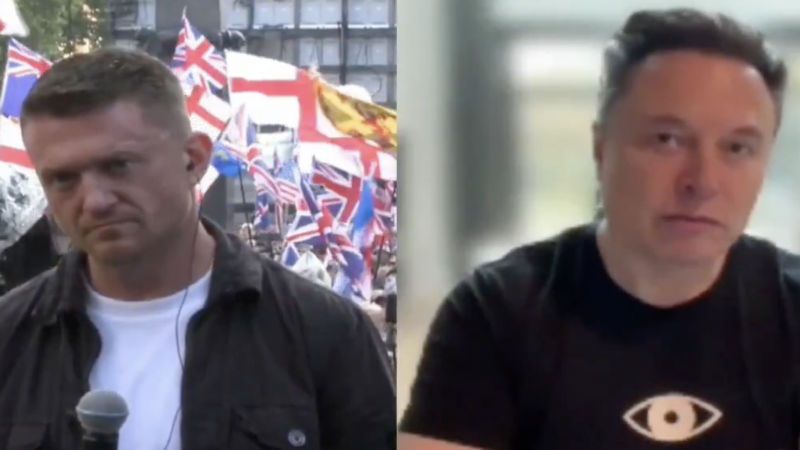
Far-right agitator Tommy Robinson’s “patriotic” credentials have been called into question after he called on Donald Trump to invade the UK and remove Keir Starmer as prime minister.

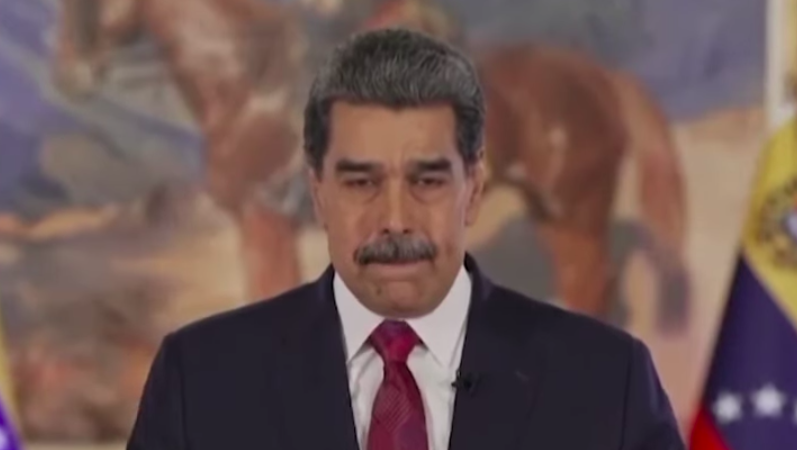
Following Donald Trump’s invasion of Venezuela and removal of its President, Nicolás Maduro, Robinson has made a series of posts describing Starmer as “tyrannical dictator” and calling on Trump to “free us”.

Trump’s attacks on Venezuela have been met with condemnation by the politicians and experts, who have said they were illegal.

On X, Robinson, whose real name is Stephen Yaxley-Lennon, instead praised Trump’s actions and condemned drug trafficking.

In one post on 3 January, he said: “73,000 Americans are dead because of venezuelas [sic] drug imports. Trump warned him time & time again to deal with it. Taking out maduro is America 1st.”

The far-right anti-Islam campaigner has a criminal record for possession of cocaine with intent to supply.

In a post yesterday, Robinson said: “Yo, @realDonaldTrump, as you’re doing the rounds removing dodgy communist dictators.

“I know of one who is allowing violent invaders to pour into the country’s communities, who are killing, raping and pillaging.

“On top of that, he’s making the people pay for it, and jailing people who speak out against the regimes’ wrongdoings.

“This is where he hides under armed guard. Coordinates: 51°30’12” N, 0°07’39” W.”

The tweet contained an image of Starmer coming out of the front door of 10 Downing Street.

In another post, Robinson said: “We would now love America & president trump to free us from our tyrannical dictator @Keir_Starmer.”

Journalist and presenter Sangita Myska, wrote in a post on X: “Nothing screams ‘patriot’ like asking a foreign President, Donald Trump, to invade your country.

“Tommy Robinson is a fraud.”

Another X user wrote: “‘I’m a patriot and I want a foreign leader to invade my country’ Says Tommy Robinson.”

In a speech at Robinson’s Unite the Kingdom rally in September, Elon Musk said called for the dissolution of Parliament and for a change of government.

Musk, who has donated money to Robinson to cover his legal costs, also used inflammatory language at the rally, urging people to “fight back or die”.

Olivia Barber is a reporter at Left Foot Forward


Reform defends Trump’s capture of Nicolás Maduro

Yesterday

"So you’re ok with him trotting around the world abducting presidents?"


Reform UK has defended Donald Trump’s attack on Venezuela and capture of its President, Nicolás Maduro.

The US government captured Maduro and the first lady Cilia Flores and flew them out of Venezuela on Saturday.

Reform deputy leader Richard Tice said that “it’s good news that a serious enemy of the West” has been removed and that he was “illegitimate”.

On Sky News, Tice claimed that Trump’s overthrow of the government was “clearly in accordance with US domestic law”.

He also cited article 51 of the United Nations charter, which “recognises the inherent right of individual or collective self-defense if an armed attack occurs against a UN Member”.

Presenter Trevor Phillips challenged Tice on this, stating: “It seems that this is sort of stretching that a little bit to the point where perhaps any country that the United States disapproves of could expect a visit from the Delta Force on the basis of what you’ve just said”.

Tice again argued that the US constitution allows the US President to act in the self-defense of US citizens.

“So you’re ok with him trotting around the world abducting presidents?,” Phillips asked.

The Reform MP said: “That is a matter for the US President.”

Phillips said it seemed that Tice was backing “a rather active foreign policy” in which the US is able to decide that “a particular leader isn’t really doing the job that the United States thinks it should do as opposed to what its own people say”.

Tice again repeated that Trump had acted to defend the interests of US citizens.

Phillips noted that Russian president Vladimir Putin would make the same argument about NATO’s advance to his borders.

Tice dismissed the comparison as “apples and pears” and “nonsense”, saying Putin wanted to invade the whole of Ukraine and “keep it”.

“President Trump has just said we’re going to run Venezuela until we decide we don’t want to,” Phillips said.

“Until a successful, peaceful transition,” Tice replied.

“And who is going to decide the transition is over?” Phillips asked.

Tice said the challenge was to prevent “chaos from descending into Venezuela”.

Trump initially framed Saturday’s attack on Caracas as an anti-drug operation, with officials calling Maduro and his wife “two indicted fugitives”.

He said the US would run Venezuela until “a safe and proper and judicious transition” was possible.

The US president later made clear that he planned to exploit Venezuela’s vast crude oil reserves, saying American oil companies would move into the country.

Experts have said Trump’s attacks on Venezuela were in breach of international law.

Elvira Domínguez-Redondo, a professor of international law at Kingston University, described the operation as a “crime of aggression and unlawful use of force against another country”.

Geoffrey Robertson KC, a founding head of Doughty Street Chambers, said the attack was against the United Nations charter.

Olivia Barber is a reporter at Left Foot Forward


US out of Venezuela!

3 January, 2026 - 12:59 
Author: Will Roberts
WORKERS LIBERTY


Less than four days after declaring that his new year’s resolution was “peace. Peace on earth”, Donald Trump has bombed Caracas and kidnapped the president of Venezuela, Nicolas Maduro.

In a subsequent press conference at Mar a Lago, Trump made a series of baffling claims. Chief among them: the US will "run the country until such time as we can do a safe, proper and judicious transition". Trump stated that he was "not afraid of boots on the ground", but also that he didn't envisage a lot of US troops being present.

There seems to be (at least) a difference in emphasis between Trump and Marco Rubio. While Trump has since repeated his claim that “we’re going to run things”, Rubio made different comments to the press on Sunday 4 Jan, while clearly trying not to overtly contradict the president. “It’s not running,” he asserted, “it’s running policy”. For now, the model appears to be that Delcy Rodriguez will be made to follow the White House’s decrees, in order to facilitate American-led restructuring of Venezuelan oil. Trump claimed at the press conference that the US had spoken to Rodriguez and she had agreed to cooperate.

At first, Rodriguez declared that the US had illegally invaded, and that Maduro was the country’s “only” president. In an Instagram post on the evening of Sunday 4 January, she changed tack, inviting the US to “collaborate with us on an agenda of co-operation oriented towards shared development within the framework of international law”. This was no doubt influenced by Trump’s threat of a second strike earlier that day.

Rodriguez is an obvious go-between choice: she was central to the discussions during the Biden administration that allowed oil company Chevron to be given special license by the US to operate in Venezuela. She is also a trusted member of the Maduro government. She has helped oversee multiple openly fraudulent elections, and was certainly no opponent to the government arresting and imprisoning thousands of protestors. Although she has ties to America, she is undeniably a “continuity candidate”.

Trump stated that he had not been talking to oppositionist Maria Corina Machado, who he claims lacks support. Machado declared about an hour before the press conference that she wanted Edmundo Gonzalez Urrutia, who the Venezuelan opposition claimed "actually" won the last election, to be named president.

Trump also declared that "American dominance in the Western hemisphere will never be questioned again," quipping that the 'Monroe doctrine' should now be called the "Don-roe doctrine".

The US have announced that Maduro will face trial in New York on charges related to “drugs and weapons offences”. Trump also repeated his recent warning to Colombian president Gustavo Petro, who he has accused of similar involvement in cartels and drug trafficking. He repeated and strengthened these threats on Sunday and Monday, 4-5 January, saying that Petro's "time was up" and that a military operation in Colombia "sounds good". He also repeated his statements that Cuba, reliant on Venezuelan oil imports, was due to collapse any day now, without US involvement.

Trump has been framing Venezuela as a “narcostate” since returning to office, and is clearly trying to clean up unfinished business from his first presidential term, where his campaign against Maduro failed to achieve tangible results. The role played here by Trump’s alarmingly simplistic worldview is real and significant: Maduro is a "socialist" (in Trump's eyes) who scorned the US, and Trump sees it as his role to retaliate.

But there are other significant factors at play. Capturing Maduro matches Trump’s general trend of moving America back to a more “hands-on” imperialist force in world politics. This includes both more overt policies – bombing Iran, threatening to capture Greenland – and admixtures of political and economic foreign policy, such as Trump’s garish plans to renovate Gaza, and the direct profiteering proposed in Ukraine peace plans.

Venezuela has the largest proven oil reserves in the world, around five times those of the US. Since US sanctions imposed in 2017, it has been unable to sell them to much of the global market. In recent years it has pivoted almost entirely towards selling to China (Maduro was kidnapped during the middle of a Chinese diplomatic delegation to Venezuela – something the US government will have been aware of).

In the press conference, Trump was outspoken about the central role American oil companies will play in Venezuela going forward. When asked about how this affected relations with Russia and China, he replied that they were in the oil market, and he would sell it to them. A combined stranglehold on Venezuelan politics and the oil industry would be an incredibly lucrative development and significantly bolster the US's control of global oil markets. The oil companies themselves have been reserved when responding. Chevron first issued a statement saying that they would work with America to "strengthen US energy security", then retracted the statement and released another, stating just "we continue to operate in full compliance with all relevant laws and regulations".

As yet, there is no clear picture what the outcome will be in Venezuela itself. The US lacks even a functioning embassy in Caracas, and there is no visible US military presence on the ground.

Keir Starmer has been even more weaselly than usual on Venezuela. He has refused, in multiple interviews, to call the US attack illegal, and waited until after Trump's press conference to state that Maduro was an illegitimate dictator, and the government would "continue to talk to the US". MP Emily Thornberry has been the most prominent figure to break ranks and declare that the US had violated international law.

Maduro's government has long been a nationalist military rule with Stalinist overtones, reliant on mass repression of political expression and the imposing of austerity on Venezuelan workers. The last Venezuelan presidential election, in 2024, was so clearly corrupt that its critics included not only fellow Latin American left leaders like Gabriel Boric, but even the previously pro-Maduro Communist Party of Venezuela. 2400 people were arrested in protests after that election, the majority of whom have now been released – a tranche of 88 were released just hours before Maduro’s kidnapping. A workers’ alternative to Maduro, a democratic future with open elections and space for workers’ organisations to operate freely, should be the desired goal for socialists the world over.

That future will be won by the Venezuelan working class itself, not by American military intervention. Workers’ democracy cannot be instituted through the barrel of a gun; it is not spread by missile shrapnel.

When asked by the BBC whether Maduro was a “legitimate president”, a former adviser said on the morning of 5 January that the question was “irrelevant”, given the US abducting the elected head of a sovereign nation. It is certainly true that Maduro’s legitimacy or illegitimacy gives the US no right to attack and kidnap him, and Maduro should be released and returned to Venezuela. But the legitimacy of the Chavista government is an entirely “relevant” question for the future of the country.

The demand for free and open elections in Venezuela is not new, and has been necessary throughout Maduro’s presidency. The current US invasion does not negate that fact. Regardless of potential deals and the need to oppose US imposition and invasion, the fundamental question remains: who should rule?

A likely candidate in any free election would be Maria Corina Machado, or Edmundo Gonzalez Urrutia, the candidate who stood in her place when she was banned from standing in the last election. Given that Machado had previously called for American intervention in Venezuela, and has told Giorgia Meloni that she sees recent events as a positive step towards a “peaceful transition”. Any government under her leadership would still leave the Venezuelan working class under the heel of an oppressive boot, ultimately bending to the wishes of the US. But that does not change the fact that calls for an immediate free election are just and should be supported. The anti-Chavista left is small and disorganised, but it exists, and should be the force we look to.

Socialists must stand against the American intervention in Venezuela: solidarity with the Venezuelan people, defend their right to self defence, and solidarity in particular with any independent forces in the Venezuelan working-class movement.

Postscript

The US operation has no close analogue in previous history. The nearest approximations are the early 1960s CIA attempts to assassinate Fidel Castro in Cuba, accompanied by the "Bay of Pigs" invasion attempt in April 1961; and the US invasion of Grenada in 1983.

The Kennedy-CIA attempts in Cuba must have been premised on a hope that they would spark internal revolt against Castro (Castro's first president, Manuel Urrutia, had resigned in July 1959, and fled to the USA), but, on all evidence, groundless hope.

The USA under Reagan invaded Grenada days after Stalinists led by Bernard Coard and Hudson Austin overthrew the left-wing New Jewel Movement (NJM) government of Maurice Bishop, killed Bishop, and declared martial law. Bishop himself was (literally) a former Islington Labour Party leftie; he had come to power in 1979 in an uprising against the corrupt regime of Eric Gairy, widely condemned as having rigged the 1976 election with his political police. The Americans had Grenada's Governor-General (who had worked with Bishop) appoint a new government (Grenadian, not American, and mild conservatives). Mild conservatives (from parties who had been in electoral alliance with the NJM in 1976) have governed and won elections since. Gairy never got back.

On the evidence, the people of Grenada didn't like Coard; they liked Bishop, but Coard had killed him and others from his faction in the NJM (which collapsed); they didn't like the American invasion and subsequent mild-conservative regime much, but thought that better than Coard and Austin continuing.

For the approximations to "work", Trump's administration must think or hope it has a faction in Venezuela's army that will now cooperate. Whether it has a faction of any substance, and whether it can seize power quickly or throw the country into civil war, we don't know yet.

MT


Dame Emily Thornberry says US action in Venezuela not legal, in strongest criticism yet
Yesterday
Left Foot Forward


'We cannot have breaches of international law like this. We cannot have the law of the jungle.'


Dame Emily Thornberry has become the most senior Labour MP thus far to criticise Donald Trump’s strikes on Venezuela over the weekend, which saw President Nicolas Maduro and his wife captured.

The Trump administration attacked Venezuela on Saturday, saying that the US will now “run” Venezuela until a “safe, proper and judicious transition” can be ensured. The US president has also said US oil companies would also fix Venezuela’s “broken infrastructure” and “start making money for the country”.

Senior Democrats have criticised Trump’s military intervention in Venezuela, slamming it as an illegal act carried out in the absence of required congressional approval that would lead to disaster for the American people.

The Trump administration has justified the capture of Maduro, who is now awaiting trial in the US, saying that the Venezuelan has engaged in state-sponsored drug trafficking with its support of notorious gangs, including the Cartel of the Suns, which the US declared a terrorist organisation late last year.

Prosecutors say Maduro has conspired for decades with drug trafficking groups and U.S.-designated terrorist organizations to flood the U.S. with thousands of tons of cocaine.

Maduro was first indicted in 2020 as part of a long-running narcotics trafficking case against current and former Venezuelan officials and Colombian guerrillas.

Maduro is charged with narco-terrorism, cocaine importation conspiracy, possession of machine guns and destructive devices, and conspiracy to possess machine guns and destructive devices.

However, the Trump administration’s justifications have been met with criticism in some quarters, with UN Secretary General Antonio Guterres saying he was “deeply concerned that the rules of international law have not been respected”, his spokesperson said. He also said he was “deeply alarmed” by the strikes, which set a “dangerous precedent.”

Emily Thornberry is among other Labour MPs who have also criticised the actions, with the chair of the Commons Foreign Affairs Committee saying that US military action in Venezuela breaches international law and the UK should make clear it is “unacceptable”.

Dame Emily told BBC Radio 4’s Westminster Hour the strikes were “not a legal action” and she “cannot think of anything that could be a proper justification”.

She said the UK and its allies should collectively say “we cannot have breaches of international law like this. We cannot have the law of the jungle.”

She went on to add: “We condemn Putin for doing it. We need to make clear that Donald Trump shouldn’t be doing it either.

“People just can’t do whatever they want. I mean, we really can’t have a kind of international anarchy.”

Basit Mahmood is editor of Left Foot Forward


Labour MPs raise concerns for international norms as Foreign Secretary responds to US action in Venezuela


Photo: House of Commons

Labour MPs have called on the government to speak out against American intervention in Venezuela as the Prime Minister attempts to balance UK-US relations with upholding international law.

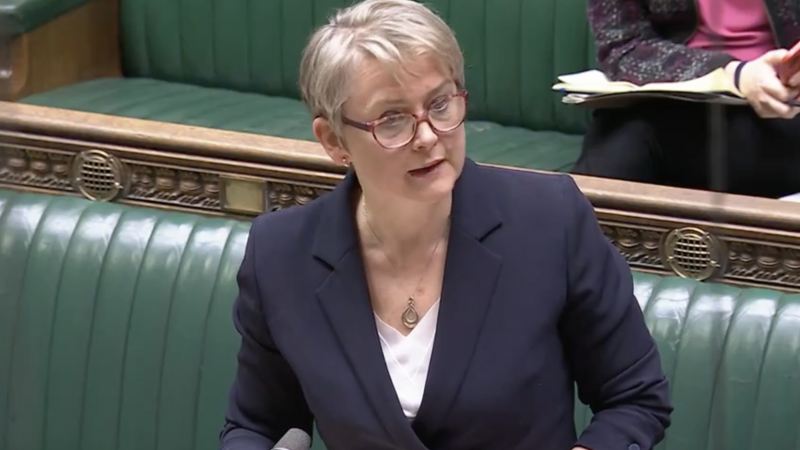
In a statement to MPs last night, Foreign Secretary Yvette Cooper said the government’s position is to “press for a peaceful transition from authoritarian rule to a democracy which reflects the will of the Venezuelan people and maintains security in the region and is in line with international law”.

However, she also expressed the importance of a commitment to international law to the House and said she has reminded her American counterpart Marco Rubio of his obligations.

“Those principles guide the decisions that we make and the actions we take as part of Britain’s foreign policy. That commitment to international law as part of our values is also strongly in the UK’s national interest.”

However, several Labour MPs called on the Foreign Secretary to take a tougher stance, including chair of the Foreign Affairs Select Committee and Islington South MP Emily Thornberry – who warned of a “profound risk of international norms changing”.

She said: “If a large and powerful country abducts the leader of another, however abhorrent that leader is, and tries to intimidate the smaller country to, as it says itself, gain access to its resources, does the Foreign Secretary not agree that this should be called out not just by Britain, but by our western allies?

“We should be calling it out for what it is – a breach of international law. It is not for the country breaking the law to say whether or not it has broken the law; it is surely for the west to stand up and call it as it is.”

Other backbenchers joined MPs from across the House in expressing their concern at the government’s response to the situation in Venezuela.

Leeds East MP Richard Burgon, who has been vocal in his opposition to the US overthrow of Maduro, accused the Prime Minister of a “cowardly, craven approach” and of disregarding the United Nations Charter over the American intervention.

He said: “The reality is that if it were Putin doing this, the Prime Minister would not be saying ‘It’s up to the Russians to decide whether or not this is legal’, but that is exactly what the Prime Minister has said in relation to Trump’s disgusting attack on Venezuela.”

However, criticism was not solely confined to Labour’s left-wing MPs, with those more loyal to the government also expressing their concern.

Sonia Kumar, MP for Dudley, quoted the UN Charter, which states: “All Members shall refrain in their international relations from the threat or use of force against the territorial integrity or political independence of any state.” She then stressed the need for a “peaceful transition” in Venezuela “in the hands of its people and not dictated by foreign governments, who must follow international law”.

Peter Prinsley, MP for Bury St. Edmunds and Stowmarket, expressed fears that the international order could be uprooted and said: “If we do not condemn the American actions in Venezuela, what is to stop dictators around the world acting in a similar way against our allies and our interests?”

The Foreign Secretary told the House that it was “for the US to set out the legal position behind their actions”.

‘Future of Greenland a matter for Greenlanders and Danes and no one else’

Addressing concerns around Donald Trump’s ambitions to annex the Danish territory of Greenland, the Foreign Secretary said: “Let me be very clear on the UK’s position. Greenland is part of the Kingdom of Denmark, our close European partners, our longstanding NATO allies and all our countries work closely together on security issues and will always do so. The future of Greenland is a matter for the Greenlanders and Danes and no one else.”

Dan Carden,  MP for Liverpool Walton and leader of the Blue Labour parliamentary group, expressed concern that American intervention in Venezuela could lead to further military action against other nations.

“This episode shows the US shifting to the western hemisphere, leaving European security more exposed, and the willingness of the US to interfere in foreign states, with serious implications for our NATO ally Denmark.”

As Greenland is part of the kingdom of Denmark, talk of this nature continues to place uncomfortable strain on both transatlantic and NATO alliances for the Labour government to deal with.

The Foreign Secretary remained clear in her responses regarding Greenland, sticking to the comments outlined in the original statement on the matter and echoing the words of the Prime Minister.


Labour MPs urge Keir Starmer to condemn Trump over Venezuela attack


Olivia Barber 
Yesterday
Left Foot Forward 


One MP has accused the prime minister of ‘abandoning international law’ to ‘appease’ Trump


Labour MPs have said Keir Starmer should condemn Donald Trump’s attack on Venezuela and the removal of its president on Saturday.

Several left-wing MPs have criticised the UK government’s refusal to say whether striking Venezuela and capturing the Venezuelan President Nicolás Maduro and the first lady Cilia Flores was illegal.

Trump has said the US will run Venezuela until “safe, proper and judicious transition” of power can be ensured.

Starmer and his chief secretary, Darren Jones, have said it is up to the Americans to decide to lay out the legal basis for their actions.

Senior Labour MP Emily Thornberry told BBC Radio 4’s Westminster Hour that Trump’s strikes on Venezuela were “not a legal action” and that she “cannot think of anything that could be a proper justification”.

Richard Burgon MP has accused Starmer of abandoning international law “to appease Donald Trump”.

In a post on X, he said: “The Prime Minister is the one who chose to abandon international law over the attack on Venezuela in order to appease Donald Trump.

“Other ministers are simply following his script. So the Prime Minister himself should come to Parliament today to explain that appalling decision.”

Responding to Jones’ interview on LBC this morning, Labour MP John McDonnell said: “When you listen to the prevarication of Keir Starmer and his ministers on a basic point of international law we need to be ruthlessly honest and recognise that effectively our country has been rendered up as a Trump colony.”

In the interview, the prime minister’s secretary refused to say whether he would urge the US President not to abduct other foreign leaders.

The Labour MP for Norwich South, Clive Lewis, said: “Trump has launched an illegal act of aggression against Venezuela.

“A clear breach of the Nuremberg principles – which the UK helped write. Now a Lab govt won’t even defend them. This silence isn’t diplomacy. It’s the moral equivalent of a white flag.”

Green Party leader Zack Polanski responded to the interview, stating: “Darren Jones saying repeatedly the Labour Government won’t comment on a hypothetical.

“It’s not hypothetical – Trump is saying very loudly repeatedly what he’s done and boasting about it.

“And yet the UK Government won’t even say it’s a breach of international rules. Shameful.”

The foreign secretary Yvette Cooper will address MPs on the US operation in Venezuela today.

Olivia Barber is a reporter at Left Foot Forward


Prime Minister issues statement on Venezuela


Photo: Simon Dawson/No 10 Downing Street

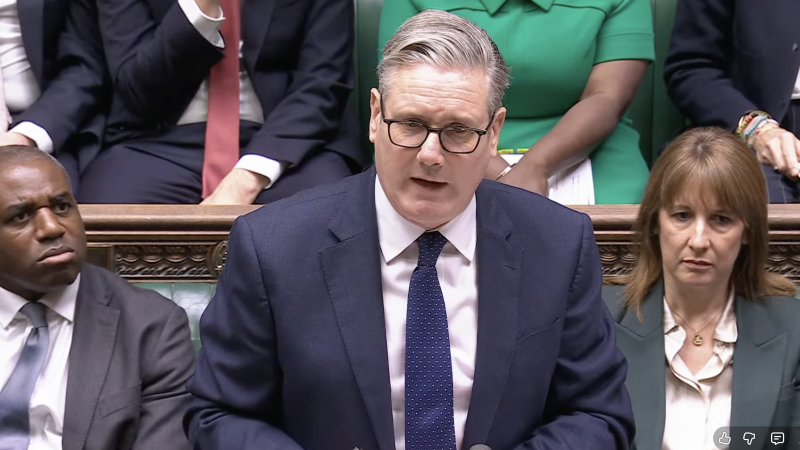
Prime Minister Keir Starmer issued the following statement on the ongoing situation following the US strikes on Venezuala:

 “The UK has long supported a transition of power in Venezuela. We regarded Maduro as an illegitimate President and we shed no tears about the end of his regime.

“I reiterated my support for international law this morning. The UK government will discuss the evolving situation with US counterparts in the days ahead as we seek a safe and peaceful transition to a legitimate government that reflects the will of the Venezuelan people.


Starmer’s Passivity on Venezuela is Cowardice

Tribune 
By Jeremy Corbyn
 6th January, 2026

Keir Starmer’s evasiveness towards Donald Trump’s assault on Venezuela is a clarifying example of Britain’s ‘special relationship’ of unthinking submission to the White House’s interests.


Maduro's kidnapping and US attacks on Venezuela are war crimes. (Credit: Donald Trump, Truthsocial)

In 2003, thousands of us took to the streets to oppose the US-led invasion of Iraq. ‘We shall help Iraq move towards democracy’, Tony Blair told us. Perhaps he shared speech notes with George W. Bush, who promised a better future for the Iraqi people. ‘When the dictator has departed’, the President said, ‘they can set an example to all the Middle East of a vital and peaceful and self-governing nation.’ Ignoring the warnings of ordinary people who could see the catastrophe ahead, and bypassing any approval from the United Nations, the US-led invasion and occupation of Iraq resulted in the deaths of more than a million Iraqis, and set off a spiral of hatred, conflict and misery that is still spinning today.

This was the last time a Labour Prime Minister blindly backed the wishes of the United States and its warmongering President. Twenty-three years later, another Labour Prime Minister is doing his best to cement the UK’s status as a vassal of the United States. On Saturday, the United States launched an unprovoked attack on Venezuela, killing more than 40 people. Our Prime Minister’s response? ‘The UK has long supported a transition of power.’

Unlike Iraq, the UK says it is not involved in the bombing of Venezuela. Like Iraq, however, the UK is proving once again that it has no interest in standing up for international law. It’s really not that complicated: bombing a sovereign nation and abducting its head of state is illegal. It is absolutely staggering that a Prime Minister with a background in law cannot bring himself to say something so obvious.

It’s not that he doesn’t understand. He understands full well. That is the true abomination: he is choosing to desecrate the meaning of international law to avoid upsetting Donald Trump. This is the true meaning of the so-called ‘special relationship’ that government ministers are so desperate to protect: one where the United States tells us to jump, and we ask how high. When ministers go on air and refuse to say whether it is illegal for the United States to kidnap a sitting President, this is no relationship. It is humiliation.

Just like Iraq, we are being treated to increasingly fragile and ludicrous justifications for illegal acts of war. As self-proclaimed defenders of the free world, the loudest cheerleaders of the Iraq war relied on the same old, tired smears those who opposed the invasion and occupation of Iraq were giving succour to authoritarian dictators. But millions of ordinary people knew the truth. That was no moral mission. It was an illegal, imperial conquest, hidden behind the language of democracy and human rights.

Today, nations and leaders are once again falling in line behind the United States, making vague appeals to a ‘democratic transition’. It is telling that Trump’s messianic motivations in Latin America do not extend to Argentina, where a right-wing President has plunged the nation into an unprecedented economic crisis characterised by falling employment, soaring poverty and repeated corruption scandals. According to Trump, Venezuela warrants military intervention; Argentina deserves a bail-out.

The United States tells us it needs to abduct a head of state in order to punish him for ‘narco-terrorism’. This is the same line it has used to justify extrajudicial killings at sea over the past few months. The US has not yet provided any information about the people on board the ships, let alone any evidence that they were transporting drugs. Indeed, it is well known that most of the cocaine does not come from Venezuela on small boats, but via major commercial shipments through the Pacific. You can tell how thin these lies are by how quickly they fade. ‘The oil companies are going to go in’, Donald Trump said, ‘and we’re taking back what they stole.’ This was never about drugs. This is about the United States reasserting imperial power in a mineral-rich nation.

I am not alone in finding the UK government’s response utterly pathetic. The failure to stand up to the United States is not just symbolic. By refusing to stand up for international law, the UK has given the green light to the United States to act with impunity. Venezuela first. Who’s next? Is there anything the United States could do that would warrant condemnation from our government? Unfortunately, given that the UK and the US have spent the past two years enabling the genocide in Gaza together, I am not sure there is any point appealing to hypothetical limits of morality.

As Claudia Sheinbaum, President of Mexico, said this week, ‘The history of Latin America is clear and compelling: intervention has never brought democracy, never generated well-being, nor lasting stability. Only the people can build their own future, decide their path, exercise sovereignty over their natural resources, and freely define their form of government.’

The story of US-led foreign interventions is a story of chaos, instability and misery. How many more of these catastrophic failures do we need before we learn the lesson? And what will it take for the UK to finally defend a consistent, ethical foreign policy based on international law, sovereignty and peace?
Contributors

Jeremy Corbyn is the Member of Parliament for Islington North and a member of the Independent Alliance group of MPs.


CND Condemns Illegal US Military Attack on Venezuela

“It is clear that Donald Trump wants to overthrow the Venezuelan government and take control of the country’s huge oil wealth.”

By the Campaign for Nuclear Disarmament (CND)

CND totally condemns the US illegal military aggression against Venezuela. In the early hours of Saturday morning the US launched military attacks on the Venezuelan capital of Caracas as well as other states including Miranda, Aragua and La Guaira – targeting civilian areas.  These actions are in breach of international law. Trump has also announced the removal of Venezuela’s President, Nicolas Maduro, from the country.

These illegal actions follow months of a huge military build-up on Venezuela’s coast by the US, including nuclear-capable B52 long-range bombers that have been making flights from the US to the Venezuelan coast.

Alongside this, the US had been carrying out illegal attacks against fishing boats, killing over 100 people in what UN experts say amounts to extrajudicial killings.  The seizure of Venezuelan oil tankers in international waters have been further violations.

It is clear that Donald Trump wants to overthrow the Venezuelan government and take control of the country’s huge oil wealth.

This attack against the Venezuelan population, also threatens the whole of Latin America. Trump has made this explicit in his National Security Strategy, which states that the US needs to restore its “pre-eminence in the Western Hemisphere” so that the US can “assert ourselves confidently where and when we need to in the region”.  

Trump’s Strategy aims to install regimes that will ‘work to strengthen our security partnership – from weapons sales, to intelligence sharing to joint exercises.” He wants to turn Latin America into a military alliance, to fight his global war to maintain US dominance.

The result of this would be absolutely horrific. We have all seen the devastating consequences of US military interventions in Latin America before. US sanctions against Venezuela alone have killed over 40,000 people.

The people of Venezuela and Latin America have the right to live in peace, to control their own resources and determine their own future.

We call for an end to this military intervention against Venezuela, its people and its sovereignty. The British government must denounce these illegal actions and call for the release of the Venezuelan President. 


RMT condemn illegal attack on Venezuela

Labour Outlook
Amplifying socialist voices, supporting frontline struggles, building international solidarity.


6th January 2026
Leave a Commenton RMT condemn illegal attack on Venezuela

“We send our solidarity to the people of Venezuela and stand with them against this violent intervention.”

By the RMT

General secretary Eddie Dempsey said: “We condemn the illegal military attack carried out by the United States of America on Venezuela which resulted in President Maduro being kidnapped by US special forces.

“In accordance with international law and respect for sovereign nations, the UK Government must demand the immediate cessation of military hostilities towards Venezuela and the return of its President.

“Only by following the UN Charter can we create a framework for peace, stability and mutual respect between nations.

“We send our solidarity to the people of Venezuela and stand with them against this violent intervention.”You can follow the RMT Union on Facebook, Instagram, Twitter/X and Bluesky.
This statement was originally posted by the RMT on 3 January 2026.
If you support Labour Outlook’s work amplifying the voices of left movements and struggles here and internationally, please consider becoming a supporter on Patreon.


We Condemn Trump’s War on Venezuela – VSC

“Let us be clear: whatever excuses Donald Trump makes, this military aggression is about control of Venezuela’s oil – the largest proven oil reserves in the world.”

By the Venezuela Solidarity Campaign

We utterly condemn the military aggression against Venezuela ordered by Donald Trump — an illegal and dangerous US regime-change operation against a sovereign nation.

This is a flagrant violation of international law and a wholly unjustified attack.

Let us be clear: whatever excuses Donald Trump makes, this military aggression is about control of Venezuela’s oil – the largest proven oil reserves in the world.

It is also part of Trump’s wider attempt to once again turn Latin America into a US colony – as made clear in his recent National Security Strategy.

We demand an immediate end to this illegal US military action against Venezuela and the safe return of President Nicolás Maduro, who has been kidnapped as part of a US regime-change operation aimed at seizing control of Venezuela and its resources.

We call on the UK Government to condemn unequivocally this act of unjustified aggression and blatant violation of Venezuela’s sovereignty and international law.

No War on Venezuela Emergency Actions Organised by Solidarity and Peace Activists


“An emergency online rally has been announced for 6pm on Sunday 4th January, with a demonstration outside Downing Street at the same time on the following day.”

By Ben Hayes

Peace and anti-war campaigns are joining together in opposition to the bombing of Venezuela and kidnapping of the country’s President Nicolás Maduro as part of a US military offensive.

Challenging the stated motivation behind this attack and stating “it is clear that Donald Trump wants to overthrow the Venezuelan government and take control of the country’s huge oil wealth”, campaigners have also demanded that the British government “denounce these illegal actions and call for the release of the Venezuelan President.”

An emergency online rally has been announced for 6pm on Sunday 4th January, with a demonstration outside Downing Street at the same time on the following day.

EMERGENCY ONLINE RALLY: NO WAR ON VENEZUELA – 6pm Sunday, 4 January

No Wat on Venezuela Emergency Online Rally.  6pm Sunday, January 4th.
No Wat on Venezuela Emergency Online Rally. 6pm Sunday, January 4th.

There is an urgent need for solidarity with Venezuela. Stop the War Coalition is organising with the Venezuela Solidarity Campaign and CND for an online rally on Sunday 4 January.

EMERGENCY PROTEST OUTSIDE DOWNING STREET – 6pm Monday, 5 January

We demand the British government condemns the forced removal of Maduro and the US attack on Venezuela. The government must call for an immediate cessation of military action by the US and the return of Maduro to his country.