Tuesday, January 06, 2026

What Happened to Tulsi Gabbard’s Non-Interventionist Principles?

Trump’s director of National Intelligence used to warn against “regime change wars.” Now she’s enabling one.
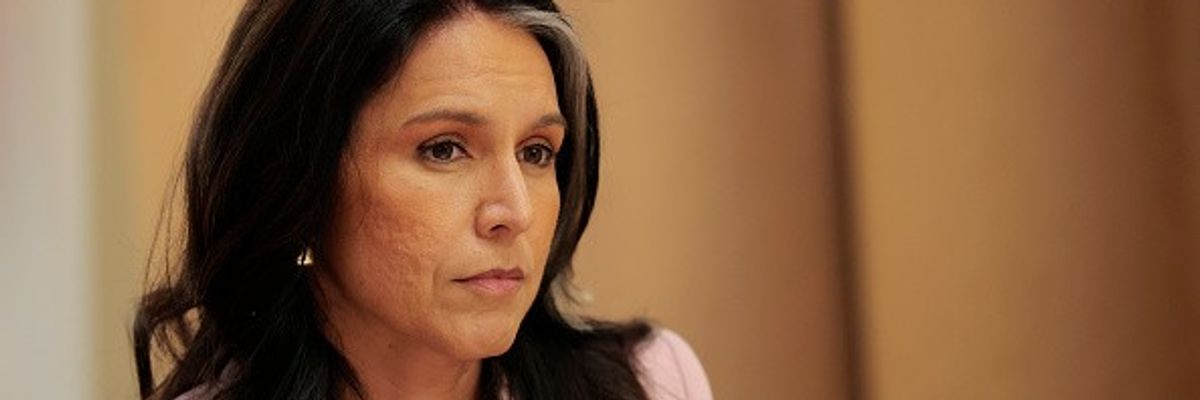


Director of National Intelligence Tulsi Gabbard listens during a Cabinet meeting at the White House on April 10, 2025.
(Photo by Anna Moneymaker/Getty Images)

Ann Wright
Jan 05, 2026
Common Dreams


Seven years ago, US Congresswoman Tulsi Gabbard wrote in 2019 on Twitter: “The United States needs to stay out of Venezuela. Let the Venezuelan people determine their future. We don’t other countries to choose our leaders—so we have to stop trying to choose theirs.”

Now as director of National Intelligence in the Trump administration, Tulsi Gabbard is a key part of the US overthrow of the Venezuelan government and the kidnapping of the Venezuelan president and his wife and the deaths of at least 40 persons in Venezuela.

During her 2018 Congressional reelection campaign, she warned of “regime change wars:” “Every dollar spent on interventionist regime change wars is a dollar not spent on education, healthcare, infrastructure, and a myriad of other needs desperately needed right here at home.”

“We are spending trillions of dollars on unnecessary interventionist wars that do not serve the interests of the American people—money that should be spent on investing in infrastructure, affordable housing, education, healthcare, and other priorities here at home,” Gabbard said in 2018.
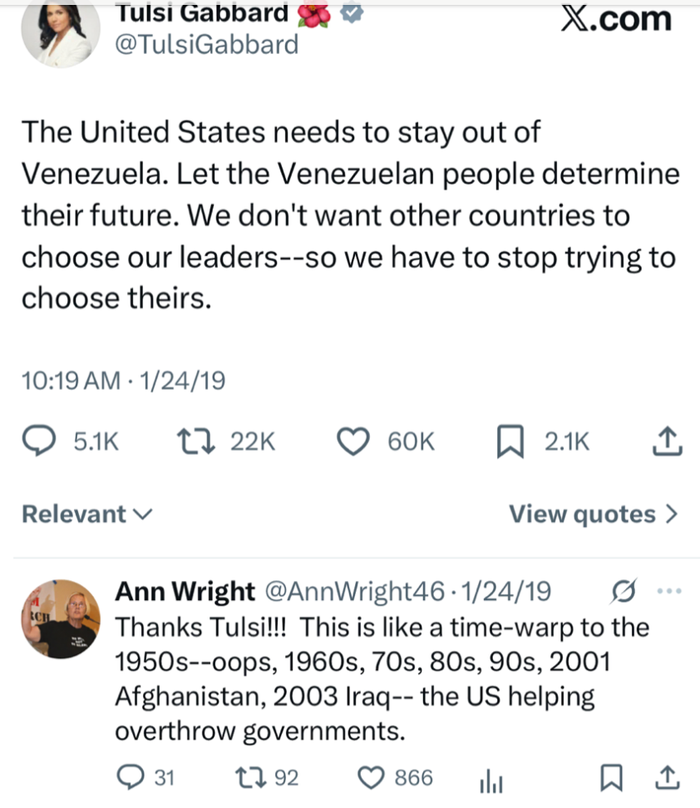


In 2019, Gabbard said: “Leaders in this country from both political parties looking around the world and picking and choosing which bad dictator they want to overthrow.... Sending our military into harm’s way and then trying to export some American model of democracy that may or may not be welcome by the people in those countries, and it’s proven to have been a failure.”

As far as other countries interfering in the choice of their leaders, the president who nominated her to be the director of National Intelligence proudly states that his endorsement of a candidate in the presidential election in Honduras helped a right-wing candidate get elected in a still contested election, as well as candidates in Chile and Argentina. So much for not choosing leaders of other countries.

In a 2019 interview with NPR, Gabbard said: “I think that the outsized power that the political parties hold can often be used in the wrong way to squelch our democracy and dissenting voices even within our own party.” But, she said, she has never considered leaving the Democratic Party… until she did for President Donald Trump’s party, which is doing the same.

What happened to Tulsi Gabbard and her principles?


Our work is licensed under Creative Commons (CC BY-NC-ND 3.0). Feel free to republish and share widely.


Ann Wright
Ann Wright is a 29 year US Army/Army Reserves veteran who retired as a Colonel and a former US diplomat who resigned in March 2003 in opposition to the war on Iraq. She served in Nicaragua, Grenada, Somalia, Uzbekistan, Kyrgyzstan, Sierra Leone, Micronesia and Mongolia. In December 2001 she was on the small team that reopened the US Embassy in Kabul, Afghanistan. She is the co-author of the book "Dissent: Voices of Conscience."
Full Bio >

The US plan to ‘run’ Venezuela – a similar cast, plus threats


By AFP
\January 5, 2026


People walk past a mural depicting now ousted Venezuelan president Nicolas Maduro near the National Assembly in Caracas - Copyright AFP Juan BARRETO
Shaun TANDON

President Donald Trump says the United States is “in charge” of Venezuela. But for now, that seems to mean keeping the country’s government set up much like it was before.

Trump on Saturday ordered an audacious, deadly assault on Caracas in which US forces snatched Venezuela’s leftist leader Nicolas Maduro and took him to face charges in New York.

In his extensive comments since then, Trump said that the United States temporarily “is going to run the country,” which has 30 million people and an economy in tatters for years.

The preparation for such a massive undertaking appears to be little or non-existent, with the US embassy in Caracas shuttered, no US forces known to be on the ground and Trump vaguely saying that his own cabinet will call the shots.

Even the 2003 invasion of Iraq, in which the United States was widely criticized for the ensuing chaos, had far more planning, with president George W. Bush installing what he called a Coalition Provisional Authority to run the country.

Trump said Venezuelans would be “taken care of” but said little on what they can expect.

Instead, Trump said the priority was to benefit US oil companies in Venezuela, which has the world’s proven reserves and had become a crucial supplier to Cuba, a longtime US target, as well as leading US competitor China.

To achieve its ends, Trump said the United States is claiming cooperation with Delcy Rodriguez, who was Maduro’s vice president — and Trump publicly threatened another US attack if she does not do the US bidding.

Secretary of State Marco Rubio, clarifying Trump’s remarks in an interview with NBC News’ “Meet the Press,” said: “It’s not running — it’s running policy.”

Rubio, a Cuban-American and sworn enemy of the hemisphere’s leftists, had long branded Maduro as illegitimate and championed the opposition, which said it won 2024 elections.

But Trump brushed aside opposition leader Maria Corina Machado, the winner of the latest Nobel Peace Prize, and Rubio said the United States was focused on “our national interest.”


– ‘Vassal state’? –


Trump said that Machado is a “very nice woman” but does not command the “respect” to run the country.

Mark Jones, a Latin America expert at Rice University, said Trump saw lower risks to working with Rodriguez.

“The only way Machado could enter the presidential palace and run the country would be with a massive US military presence, which would be very bloody, would be unlikely to be successful and would create massive domestic problems for Trump,” who ran as a non-interventionist, Jones said.

Rodriguez, who had been reported to have been in contact with the Trump administration well before Saturday’s attack, initially gave a fiery speech calling Maduro the legitimate president but quickly changed her tone and promised cooperation.

Ryan Berg, director of the Americas program at the Center for Strategic and International Relations, expected Rodriguez to struggle to find the right balance.

“On the one hand, she needs to be outraged that this happened,” Berg said.

“At the same time, she needs to be open to pushing pro-US policies that are going to be very difficult for her regime to swallow, given that they have a 27-year history of seeing the United States as the greatest enemy.”

Jones said that Rodriguez had been vice president precisely because Maduro did not see her as holding enough leverage internally to pose a threat.

To steer Venezuela, the United States therefore will also need the support of other key figures such as Vladimir Padrino Lopez, who controls the powerful military, Jones said.

Some US demands, such as controlling drug trafficking, could be easy for Rodriguez, Jones said.

But other demands, such as breaking with Cuba, would be much harder sells for elements of a government rooted in leftist firebrand Hugo Chavez’s “Bolivarian Revolution.”

“That group is going to resist with all its might, because the idea of Venezuela becoming some vassal state ot the United States is pretty much the antithesis of the Bolivarian Revolution,” Jones said.

Military remains loyal after Maduro ouster, Venezuelan exiles say


By AFP
January 5, 2026


A Venezuelan former military officer spoke to AFP in northern Colombia on condition of anonymity - Copyright AFP Annela NIAMOLO
David SALAZAR

Real change has not come to Venezuela despite Nicolas Maduro’s ouster as president and the armed forces remain loyal to the regime: that was the blunt assessment Monday of former security operatives living in exile.

Last weekend, from the Colombian-Venezuelan border, Williams Cancino watched the spectacular US snatch-and-grab of his ex-boss and president.

He hoped it could be the beginning of freedom for Venezuela, after a quarter century of repression, economic depression and one-party rule.

But if things are to really change, first “a new high command is needed” in the country’s powerful security services, he told AFP on Monday.

“The top brass are totally loyal to the regime,” said Cancino, who until his defection in 2019 was an officer in Venezuela’s police and the Special Action Forces, which are often used to crack down on dissent.

Through flawed elections and mass protests, they helped Maduro’s government to survive.

When contacted by AFP, several Venezuelan former soldiers and police officers — branded as traitors by their government — shared the view that many of the same people still control Venezuela, despite a dramatic change at the top.

Much power appears to remain in the hands of Interior Minister Diosdado Cabello and Defense Minister Vladimir Padrino — both wanted by US authorities.

The military, and even Maduro’s own son, have pledged loyalty to new interim leader Delcy Rodriguez, Maduro’s former vice president and close confidant.

“Currently, the armed forces’ leadership is nothing more than an appendage of a dictatorial regime,” said one former colonel who spoke to AFP on condition of anonymity.

With Maduro out of the country, he believes “the high command” should “step aside”.

Cleberth Delgado, a former detective, is also skeptical about a transition in Venezuela while commanders loyal to Rodriguez remain in their posts.

In constant contact with former comrades, many ex-officers say they are preparing to return to Venezuela, with the goal of taking over roles from the current military leadership.

“We are waiting for the right moment to support the new government,” one that is elected at the polls, Delgado said. But so far, there is little sign that it will happen.

Even US Secretary of State Marco Rubio, who has spent his political career campaigning for democracy in Cuba and elsewhere in Latin America, said elections were not the priority in Venezuela.

US President Donald Trump has outright dismissed the idea that Nobel Peace Prize laureate and opposition figurehead Maria Corina Machado could lead the country.

While some former officers still speak of change by force, Cancino hopes his former comrades will do the right thing.

“We don’t want conflict, and much less a civil war. We don’t want to face off against brothers.”


This brutal and incoherent Trump action bodes ill for the whole world

Robert Reich
January 5, 2026 
RAW STORY


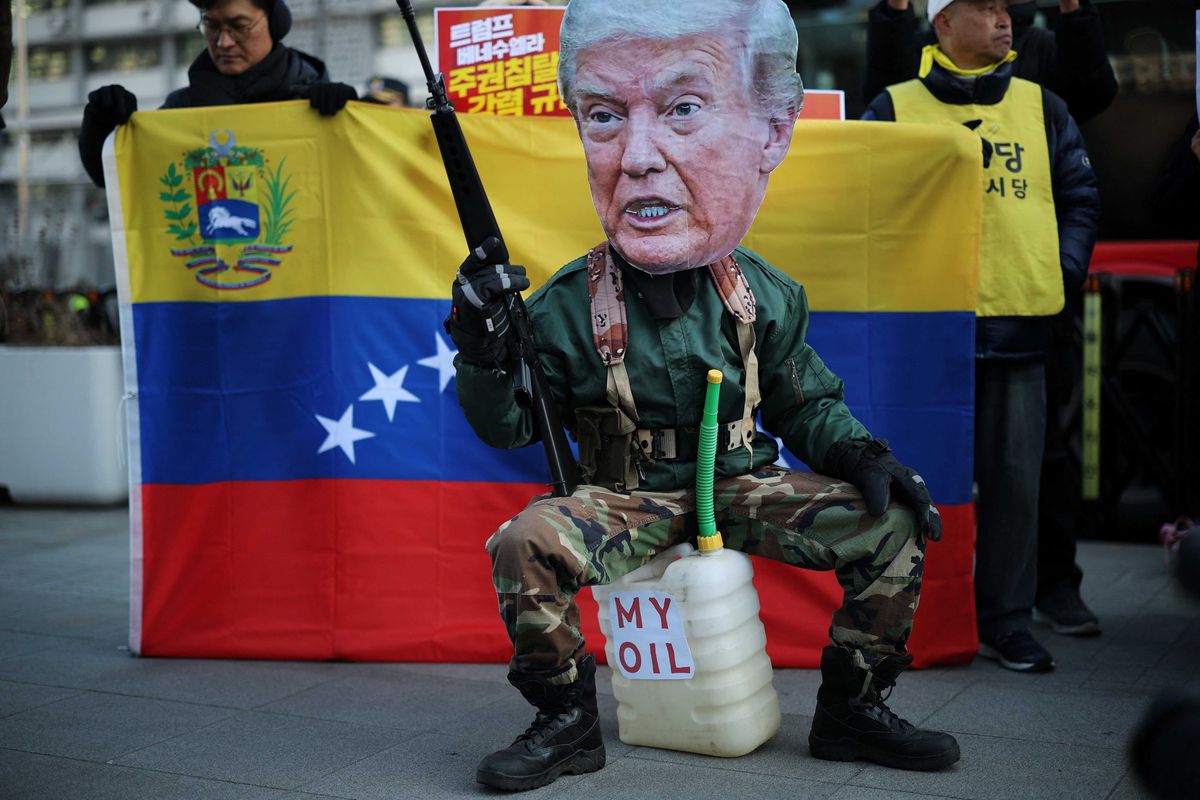
An activist during an anti-Trump rally in central Seoul, South Korea. REUTERS/Kim Hong-Ji

The story of what’s happening in Venezuela is unfolding quickly and big questions are mounting. The immediate danger in Venezuela (and potentially in Colombia and Cuba) is chaos

Asked who’s in charge of Venezuela, Trump answered: “We’re in charge.”

What the hell does this bluster really mean?

U.S. troops are not prepared to occupy Venezuela. Trying to do so would be a disaster.

Maduro’s system of oppression is still entrenched there. It includes the national guard, the army, the national police, the intelligence service, and the Colombian guerrilla group ELN. All remain intact.


Maduro’s top lieutenants also remain, including several who were involved in his alleged crimes. Not to mention his thugs and narco-traffickers who have been controlling Venezuela through violent repression and stolen elections.


Venezuela has roughly 28 million people. There’s no way to determine the emerging balance of power between pro- and anti-Maduro camps, but it’s a safe bet that any power void is likely to be filled with violence.

On Sunday, Secretary of State Marco Rubio spoke of “coercing” the Venezuelan government to make policy changes over its oil reserves, rather than “running” the country: American forces will prevent oil tankers from entering and leaving Venezuela until the government opens up the state-controlled oil industry to foreign investment — presumably giving priority to American companies.

But since August, America has had an arsenal of warships, jet fighters, and some 15,000 troops on Venezuela’s doorstep, which hasn’t stopped oil shipments. How big must the arsenal be to do the job? How long will it remain there? At what cost? Will we bomb Russian or Chinese tankers coming into or out of Venezuela?


Rubio emphasized that “the national interest of the United States … is No. 1.” But what exactly is the “national interest” of the United States here? Big Oil? Chevron has been in Venezuela for years. Do we declare victory when Exxon-Mobil is there, too? Do we insist that Venezuela not charge America oil companies any extraction fees? How profitable must Big Oil’s extractions of oil from Venezuela become before Trump is satisfied?

Rubio says Trump hasn’t ruled out troops on the ground. But does anyone remember what happened in Iraq after the U.S. invasion there? Libya? Syria? Hello? How many failed states do we need to create before we understand their danger to the stability of an entire region of the globe?

Meanwhile, the Trump regime is fanning the flames of anti-Americanism, both in Venezuela and elsewhere in Latin America.


Asked tonight whether the United States would conduct an operation against Colombia, Trump said, “it sounds good to me.” He also suggested Mexico could be another target, saying the Mexican cartels are “very strong,” drugs are “pouring” through the country, and “we’re gonna have to do something.” As to Cuba, it “looks like it is ready to fall.”

He didn’t even stop with Latin America. Trump made clear he also wants to take control of Greenland. “We need Greenland from the standpoint of national security and the European Union needs us to have it and they know that,” he told reporters on Air Force One.

This is nuts. Trump is already on his way to destroying the rule of law in America. Now he’s destroying the rules-based system of international law and diplomacy that the United States created in the wake of the horrors of World War II.


“America is respected again,” he gloated in his address to the nation on Dec. 9. For Trump, “respect” means the power to bully, regardless of law. “Our nation is strong, and America is BACK.”

Wrong. What’s back is lawless gunboat diplomacy.Robert Reich is an emeritus professor of public policy at Berkeley and former secretary of labor. His writings can be found at https://robertreich.substack.com/.

Robert Reich's new memoir, Coming Up Short, can be found wherever you buy books. You can also support local bookstores nationally by ordering the book at bookshop.org

Trump's 'assault on Venezuela' is 'opening move' to take down major rival: analysis

Ewan Gleadow
January 6, 2026
RAW STORY


Donald Trump (Photo via Reuters)

An attack on Venezuela orchestrated by Donald Trump's administration is the "opening move" to a much larger rival, a political commentator has claimed.

Writing in The Guardian, Owen Jones suggested the strike on Venezuela earlier this week, and subsequent capture of President Nicolás Maduro, is part of a longer game plan which would see Trump stand off against China. The major trade rival has become a growing concern for the Trump administration, with Jones citing a growing trade industry between China and Latin America as a reason the president may be keen to take action in the Western Hemisphere.

Jones wrote, "And, crucially, China – the main US rival – has grown in power across the continent. The two-way goods trade between China and Latin America was 259 times larger in 2023 than it was in 1990."

"China is now the continent’s second largest trading partner, behind only the US. At the end of the cold war, it did not even make the top 10. Trump’s assault on Venezuela is just the opening move in an attempt to reverse all of this."

Jones would also suggest that the "domination" of the US in the last three decades has been challenged as a result of this trade agreement between major rival China and Latin America. It appears Trump is now trying to present himself as someone without "bluster" as was the case for his first term.

"The experience of Trump’s first term has led too many to conclude that the strongman in the White House was all bluster," Jones wrote. "Then, he reached an accommodation with the traditional Republican elite."

"The unwritten bargain was simple: deliver tax cuts and deregulation, and he could vent endlessly on social media. Second-term Trump is a full-fat far-right regime."

The strike on Venezuela could embolden Trump to take further action, with the president reigniting his interest in buying out or taking over Greenland as a US territory. Jones suggested that, should the US seize Greenland, it would be no different from Russia annexing parts of Ukraine.

Jones wrote, "But a US seizure of Danish sovereign territory would surely spell the end of Nato, founded on the principle of collective defence. Denmark’s land would be stolen no less blatantly than Russia’s devouring of Ukraine. Whatever muted noises have emerged from London, Paris or Berlin, the western alliance would be finished."

‘Nobody is going to run home’: Venezuelan diaspora in wait-and-see mode


By AFP
January 6, 2026


Many exiled Venezuelans wept for joy at the US ouster and capture of former president Nicolas Maduro - Copyright Agence Kampuchea Press (AKP)/AFP Handout
Clare BYRNE

“A new dawn for Venezuela” is how a top US diplomat described the future awaiting the Caribbean country after Saturday’s capture of president Nicolas Maduro by US special forces in a raid on Caracas.

But for some of the eight million Venezuelans who fled the country over the past decade of economic ruin and repression, the joy at seeing Maduro hauled before a New York court on Monday was tempered by the knowledge that his henchmen remain at the helm.

News of Maduro’s demise initially triggered scenes of jubilation among the diaspora.

Several people choked up as they recalled the hardship they fled, and the family they left behind, over the course of his increasingly despotic rule.

But while many said they dreamed about returning to their homeland, they made it clear they had no plans to pack their bags just yet.

Most cited the country’s tattered economy as a reason to keep working abroad and sending home remittances.

Some also spoke of their fear of Venezuela’s security apparatus, pointing to the paramilitaries who roamed the streets of Caracas on Saturday to crack down on anyone rejoicing over Maduro’s ouster.

“There has been no change of regime in Venezuela, there is no transition,” said Ligia Bolivar, a Venezuelan sociologist and rights activist living in Colombia since 2019.

“In these circumstances nobody is going to run home,” she told AFP.

Standing outside the Venezuelan consulate in Bogota, where he was waiting to renew his passport on Monday, Alejandro Solorzano, 35, echoed that view.

“Everything remains the same,” he said, referring to US President Donald Trump’s decision to work with Maduro’s administration rather than the democratic opposition.

Maduro’s former deputy Delcy Rodriguez was sworn in as acting president on Monday, becoming the interim head of an administration that still includes hardline Interior Minister Diosdado Cabello and powerful Defense Minister Vladimir Padrino Lopez.

Cabello in particular is a figure of dread for many Venezuelans, after commandeering a crackdown on post-election protests in 2024 in which some 2,400 people were arrested.

Many Venezuelans were particularly shocked by Trump’s decision to sideline opposition leader Maria Corina Machado, a Nobel Peace Prize laureate, from the transition.

The European Union on Monday demanded that any transition include Machado and her replacement candidate in the 2024 elections Maduro is accused of stealing, Edmundo Gonzalez Urrutia.

Andrea, a 47-year-old immigration advisor living in Buenos Aires, argued, however, that Machado’s hour had not yet come.

“Until Trump sees that the situation is under control, until he has all these criminals by the balls, he won’t be able to put Maria Corina in charge. Because that would be throwing her to the wolves,” she said.


– ‘No other way’ –


Luis Peche, a political analyst who survived a gun attack in Bogota last year suspected of being a political hit, also argued in favor of a negotiated transition.

“We have to see this as a process,” Peche told AFP, referring to Venezuela’s transition.

“You still need part of the state apparatus to remain,” he said.

Tamara Suju, a leading Venezuelan rights expert based in Spain, said that keeping the same tainted cast in charge was a necessary evil — in the short term.

“They are the ones with whom the Trump administration is negotiating the transition because there is no other way to do it,” she told Spain’s esRadio, predicting they would eventually be forced by Washington to fall on their swords.

Edwin Reyes, a 46-year-old window installer living in Colombia for the past eight years, said that once Venezuela was “completely free” he would consider a move back.

“We’ve waited so long, another four or five months won’t hurt.”


Clearing bomb wreckage, Venezuelan mourns aunt killed in US raid


ByAFP


PublishedJanuary 5, 2026


Several apartments in La Guaira state were damaged in the US bombings - Copyright AFP Federico PARRA
Andrea TOSTA

Wilman Gonzalez picked through the wreckage of his home as he described how a bombing killed his 78-year-old aunt Rosa during the US raids that toppled Venezuela’s president.

A jagged hole gaped in the apartment wall, through which Gonzalez said he pulled his aunt after the blast early Saturday in the port city of La Guaira.

A projectile hit the apartment building during airstrikes that led to the capture of leftist leader Nicolas Maduro by US forces in the nearby capital Caracas.

Rosa Gonzalez, a lawyer who had lived with her nephew Wilman, a retiree of 62, suffered a trauma to the chest that left her struggling to breathe and with pain in her arm.

“She didn’t die here, she died at the hospital,” said Wilman, still in shock, his right eye bruised and stitched.

He said he was looking at his cell phone when the blast hurled him through the air.

“It was so immense,” he told AFP, that “the front door flew off, the wooden door flew off, and slammed me against the wall.”

Rosa was asleep in another room.

“We took her to the little hospital and they gave her oxygen. But she couldn’t bear the pain” and died, he said.


– Mourners at coffin –


Police initially took Rosa’s body away for an autopsy. Then on Monday, family and friends came to mourn in silence in a small chapel, where her wooden coffin lay half-open.

“She was a very simple, very kind woman, with lots of friends,” said her brother Jose Luis Gonzalez, 82, the only one still alive of five siblings.

“A tragedy like this should never have happened in Venezuela, in such a quiet town.”

The faded blue facade of Wilman Gonzalez’s public housing block, named simply Building 12, was devastated by the projectile.

Doors and walls lay demolished, shattered glass everywhere.

Neighbors picked up small metal fragments of the projectile from Wilman’s living room. Authorities took away the larger pieces.

After the blast, “I thought I was dead,” Wilman recalled. “God, forgive my sins.”

He complained of having received scant help from the government.

Wilman wandered among the remnants of his home, picking up pieces of wood, staring at them and throwing them back down.

With a screwdriver in hand, he checked if a closet could be salvaged — but everything was useless.

Neighbors recovered pots, blenders, documents and window frames.

“I’ve seen this on TV. Palestine, Iraq, all those people. Not here,” he said.


– Tears and trauma –


The impact damaged eight of the 16 apartments in the building.

In the apartment of his 80-year-old mother Tibisay, Cesar Diaz gathered documents and stuffed them into a dirty woven bag.

A neighbor, 48-year-old firefighter Jesus Linares, recounted how he saved Tibisay in the chaos.

He showed the faded sheet he used to stop her head bleeding before rushing her to the hospital.

“These were her little shoes,” he said incredulously, pointing to a lone plastic sandal.

Diaz, 59, was sweating and still in shock as he spoke to AFP.

“Wow! What a huge thing to happen right here, in my mother’s house,” he said.

“It will traumatize her… It’s hard to come here and not see her sitting in her chair,” he added, on the verge of tears.

With what little composure he had left in the aftermath of the bombing, Linares helped Tibisay and got his own 85-year-old mother and 16-year-old daughter out too.

“I tried to focus as if it were an earthquake: stay calm and focus on their lives and help them.”

Three decades of service as a firefighter prepared Linares to “save lives,” he said.

“This time, what I had to do was rescue myself and my family.”

Police took away the projectile, but authorities have yet to provide help, the building residents said.


Toppling of Venezuela’s Maduro stirs fear in Cubans


By AFP
January 5, 2026


Cubans have lived under more than 60 years of US sanctions - Copyright AFP Adalberto ROQUE
Rigoberto DIAZ

Cubans weary from years of economic crisis, shortages of basic supplies and regular power blackouts, fear the US attack on Venezuela, a leftist ideological ally and its main oil supplier, will see life get even tougher.

After American forces seized Venezuela’s leader Nicolas Maduro in an early-morning raid, US President Donald Trump over the weekend issued threats to other leftist leaders in the region and said he thought Cuba was “ready to fall.”

He played down the need for US military action on the island, saying it would be hard for Havana to “hold out” without Venezuelan oil, and “it looks like it’s going down.”

“2026 is going to be tough, very tough,” Axel Alfonso, a 53-year-old working as a driver for a state enterprise, told AFP in the capital Havana on Monday.

“If Venezuela is the main supplier, at least of oil, it’s going to get a bit complicated,” said Alfonso who, like the vast majority of Cubans, has lived his whole life under a bruising US trade embargo in place since 1962.

The communist-run island has seen 13 US administrations come and go, some more punishing than others.

“We’ve been fighting for 60 years, and we have to keep going,” Alfonso said.


– ‘Uncertainty’ –


Located roughly 90 miles (about 145 kilometers) from the coast of Florida, Cuba’s last major economic test followed the implosion in 1991 of the Soviet Union, a major trade partner and source of credit.

It survived by opening up to tourism and foreign investment.

Since 2000, Havana has increasingly relied on Venezuelan oil under a deal struck with Maduro’s predecessor Hugo Chavez, in exchange for Cuban doctors, teachers, and sports coaches.

In the last quarter of 2025, Venezuela sent Cuba an average of 30,000 – 35,000 barrels a day, “which represents 50 percent of the island’s oil deficit,” Jorge Pinon, an energy expert and researcher at the University of Texas, told AFP.

The number was much higher 10 years ago, slashed by the global oil price crash that sent Venezuela’s own economy into turmoil.

For the past six years, Cuba has been mired in an ever-deepening crisis caused by a toxic combination of tighter US sanctions, poor domestic management of the economy and the collapse of tourism due to the Covid-19 pandemic.

GDP has fallen by 11 percent in five years and the government faces a severe shortage of currency to pay for basic social services: electricity, healthcare and supplying subsidized food and other basic goods that many Cubans have learned to rely on.

Economic hardship was a trigger for the unprecedented anti-government demonstrations of July 11, 2021, when thousands of Cubans took to the streets shouting “We are hungry” and “Freedom!”

Since then, ever more frequent and longer power cuts and shortages of food and medicine have deepened discontent and led to sporadic, smaller protests, quickly contained by the government.

Now, many fear that the loss of Venezuelan oil will make matters even worse.

“We’re living in a moment of uncertainty,” attorney Daira Perez, 30, told AFP.


– No bailout –


Pinon said it was “not clear whether shipments of Venezuelan oil to Cuba will continue,” especially in the context of the recent US seizure of oil tankers in the Caribbean.

And he highlighted that “Cuba doesn’t have the resources to buy that volume on international markets, nor a political partner to bail it out.”

Despite concerns for the future, long-suffering Cubans put on a brave face.

“He (Trump) keeps making tough threats,” said Havana resident Roberto Brown, 80, who was a young man during the 1962 Cuban Missile Crisis that brought the world to the brink of nuclear war.

“We already told him once: we’re 90 miles away, and a long-range missile from over there reaches here, but the one from here reaches there too,” said Brown.


Meet the billionaire Trump megadonor set to make a killing from Venezuela attack
January 6, 2026 


Venezuela's captured President Nicolas Maduro and his wife Cilia Flores attend their arraignment with defense lawyers Barry Pollack and Mark Donnelly to face U.S. federal charges including narco-terrorism, conspiracy, drug trafficking, money laundering and others, at the Daniel Patrick Moynihan United States Courthouse in Manhattan, New York City on Jan. 5, 2026 in this courtroom sketch. REUTERS/Jane Rosenberg

One of President Donald Trump’s top billionaire donors, who has spent the past several months backing a push for regime change in Venezuela, is about to cash in after the president’s kidnapping of the nation’s president, Nicolas Maduro, this weekend.
While he declined to tell members of Congress, Trump has said he tipped off oil executives before the illegal attack. At a press conference following the attack, he said the US would have “our very large United States oil companies” go into Venezuela, which he said the US will “run” indefinitely, and “start making money” for the United States.

As Judd Legum reported on Monday for Popular Information, among the biggest beneficiaries will be the billionaire investor Paul Singer:

In 2024, Singer, an 81-year-old with a net worth of $6.7 billion, donated $5 million to Make America Great Again Inc., Trump’s Super PAC. Singer donated tens of millions more in the 2024 cycle to support Trump’s allies, including $37 million to support the election of Republicans to Congress. He also donated an undisclosed amount to fund Trump’s second transition.

Singer is also a major pro-Israel donor, with his foundation having donated more than $3.3 million to groups like the Birthright Israel Foundation, the Israel America Academic Exchange, Boundless Israel, and others in 2021, according to tax filings.

In November 2025, less than two months before Trump’s operation to take over Venezuela, Singer’s investment firm, Elliott Investment Management, inked a highly fortuitous deal.

It purchased Citgo, the US-based subsidiary of Venezuela’s state-owned oil company, for $5.9 billion—a sale that was forced by a Delaware court after Venezuela defaulted on its bond payments.

The court-appointed special master who forced the sale, Robert Pincus, is a member of the board of directors for the American Israel Public Affairs Committee (AIPAC).

Elliott Management hailed the court order requiring the sale in a press release, saying it was “backed by a group of strategic US energy investors.”

Singer acquired the Citgo’s three massive coastal refineries, 43 oil terminals, and more than 4,000 gas stations at a “major discount” because of its distressed status. Advisers to the court overseeing the sale estimated its value at $11-13 billion, while the Venezuelan government estimated it at $18 billion.

As Legum explained, the Trump administration’s embargo on Venezuelan oil imports to the United States bore the primary responsibility for the company’s plummeting value:

Citgo’s refiners are purpose-built to process heavy-grade Venezuelan “sour” crude. As a result, Citgo was forced to source oil from more expensive sources in Canada and Colombia. (Oil produced in the United States is generally light-grade.) This made Citgo’s operations far less profitable.

It is the preferred modus operandi for Singer, whose hedge fund is often described as a “vulture” capital group. As Francesca Fiorentini, a commentator at Zeteo, explained, Singer “is famous for doing things like buying the debt of struggling countries like Argentina for pennies on the dollar and then forcing that country to repay him with interest plus legal fees.”

Venezuelan Vice President and Minister of Petroleum Delcy Rodríguez called the sale of Citgo to Singer “fraudulent” and “forced” in December.

After the US abducted Maduro this week, Trump named Rodriguez as Venezuela’s interim president—and she was formally sworn in Monday—but he warned that she’ll pay a “very big price” if she refuses to do “what we want.”


That is good news for Singer, who is expected to be one of the biggest beneficiaries of an oil industry controlled by US corporations, which will likely not be subject to crippling sanctions.

Singer has reportedly met with Trump directly at least four times since he was first elected in 2016, most recently in 2024. While it is unknown whether the two discussed Venezuela during those meetings, groups funded by Singer have pushed aggressively for Trump to take maximal action to decapitate the country’s leadership.

Since 2011, Singer has donated over $10 million and continues to sit on the board of directors for the right-wing Manhattan Institute think tank, which in recent months has consistently advocated for Maduro to be removed from power. In October, it published an article praising Trump for his “consistent policies against Venezuela’s Maduro.”


He has also been a major donor to the neoconservative think tank Foundation for Defense of Democracies (FDD), serving as its second-largest contributor from 2008-2011, with more than $3.6 million.

In late November, shortly before Trump announced that the US had closed Venezuelan airspace and began to impound Venezuelan oil tankers, FDD published a policy brief stating that the US has “capabilities to launch an overwhelming air and missile campaign against the Maduro regime” that it could use to remove him from power.

Singer himself has acted as a financial attack dog for Trump during his first year back in office. In June, he contributed $1 million to fund a super PAC aiming to oust Rep. Thomas Massie (R-Ky.), who’d become Trump’s leading Republican critic over his Department of Justice’s refusal to release its files pertaining to the billionaire sex trafficker Jeffrey Epstein.


A super PAC tied to Miriam Adelson, another top pro-Israel donor who recently said she’d give Trump $250 million if he ran for a third term, also reportedly helped to fund the campaign against Massie.

Massie has since gone on to be one of the most vocal opponents in Congress to Trump’s regime change push in Venezuela, joining Democrats to co-sponsor multiple failed war powers resolutions that would have reined in the president’s ability to launch military strikes against alleged drug boats in the Caribbean and launch an attack on mainland Venezuela.

As the Trump administration has asserted that American corporations are entitled to the oil controlled by Venezuela’s state firm, Massie rebutted this weekend that: “It’s not American oil. It’s Venezuelan oil.”

“Oil companies entered into risky deals to develop oil, and the deals were canceled by a prior Venezuelan government,” he said. “What’s happening: Lives of US soldiers are being risked to make those oil companies (not Americans) more profitable.”


Massie said that Singer, “who’s already spent $1,000,000 to defeat me in the next election, stands to make billions of dollars on his distressed Citgo investment, now that this administration has taken over Venezuela.”

Fiorentini added that “Paul Singer’s shady purchase of Citgo has everything to do with this coup.”
Megalomaniac Trump is out of control as makeover madness hits our most sacred monuments

Tom Tyner
January 6, 2026 
RAW STORY


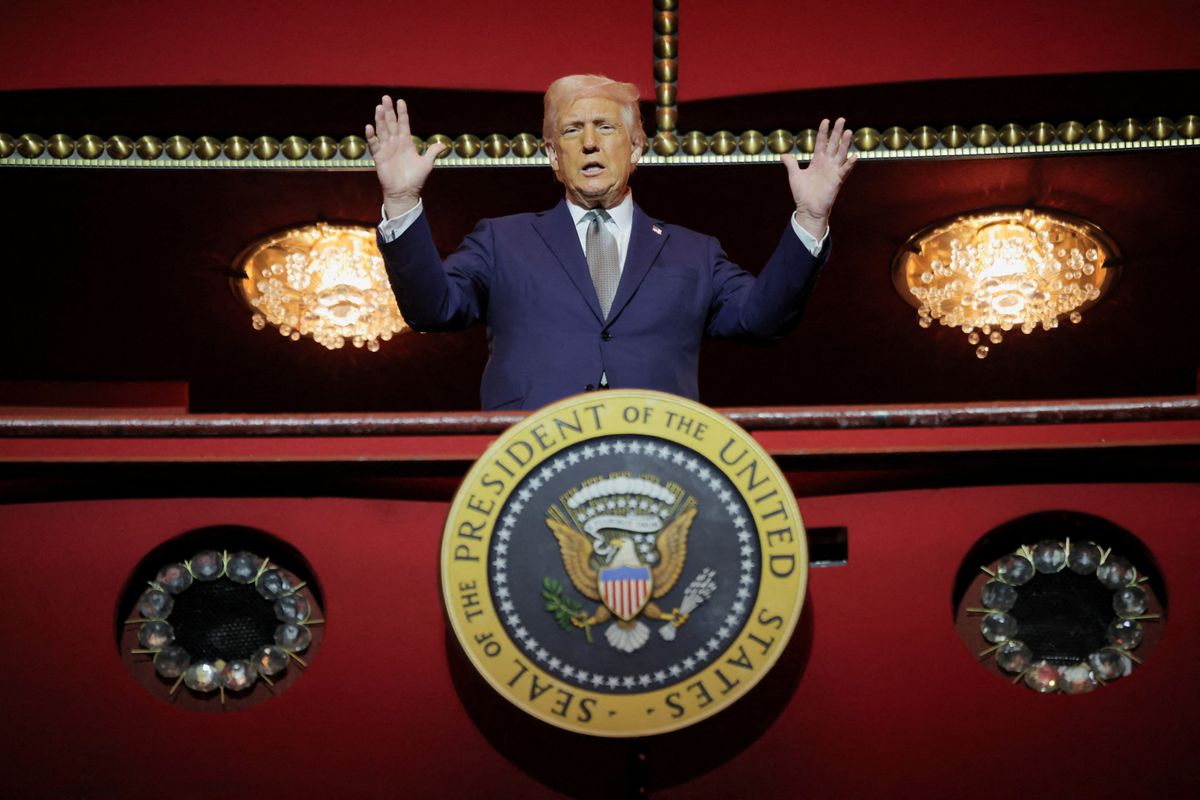
Donald Trump gestures in the presidential box at the Kennedy Cente. REUTERS/Carlos Barria

Renaming the Kennedy Center the Trump-Kennedy Center is just the beginning of renaming buildings and landmarks after one of the greatest presidents in US history. Here are the current plans according to the administration’s new Monumental Renaming Department — plans which, honestly, fell off the back of a truck and landed on Raw Story's doorstep.

The White House will be renamed the Trump White House, in honor of Trump turning the 225-year-old presidential mansion into a monarchical palace to rival the Palace of Versailles or the Summer Palace of Peter the Great. With the addition of a 90,000 square-foot ballroom and undoubtedly more magnificent additions the next three years, the White House will be fit for a king, executed by a regal visionary who found the White House far too old and frumpy.

The US Capitol will be renamed Trump Capitol, for his being the first president in history to make it truly the Capitol of the people. Trump was the only president ever to provide many thousands of patriotic Americans the simultaneous opportunity to tour the Capitol. Trump planned the tour on Jan. 6, 2021 when the enthusiastic throng could stroll into the Capitol to view the House and the Senate in rare joint session. Not surprisingly, the crowd was so enraptured that they overstayed their allotted time but willingly dispersed upon Trump’s eleventh-hour request.

The US Department of the Treasury will be renamed Trump Treasury, as President Trump has amazingly pumped trillions of dollars into the treasury in one year. Trump’s tariffs have provided the financial boon through import taxes, with American businesses and the American people willingly picking up the cost to enrich the government. The ever-generous Trump is even considering giving the American people some of their money back.

The Mexico-U.S. border will be renamed Trump Border, as President Trump has done more to keep immigrants out of the country than any president. Just the name Trump Border will throw paralyzing fear into any immigrant looking to escape poverty or extreme violence and aspire to a better life. A great humanitarian, Trump feels the pain of every immigrant, but his message is clear: aspire somewhere else.

The Grand Canyon will be renamed Trump Canyon, in answer to an obvious question: Why hasn’t even one natural wonder been named after the great environmentalist? Niagara Falls was a candidate except for the complication of its Canadian side, Mt. Rushmore didn’t qualify as “natural,” and Mt. Everest seemed a bit of a climb. Trump Canyon seemed the perfect fit: immense, old, and empty.

The Bering Strait between Alaska and Russia will be renamed the Trump-Putin Strait, symbolizing the great friendship between the American and Russian presidents. In time, the Trump-Putin Tunnel will be built connecting Alaska and Russia, cementing the close ties between America and its new dearest ally. Soon after, a mutual non-aggression agreement will be signed — the Trump-Putin Super Peace Pact -patterned after Neville Chamberlain’s 1938 Munich Agreement.

The Vietnam Memorial will be renamed the Vietnam-Trump Memorial, in honor of both America’s fallen soldiers and the most militarily supportive president in American history among non-servers. A life-sized statue of President Trump is being contemplated to sit beside the Memorial, soaking his bone spurs in a bucket of water. A look of deep chagrin will cover Trump’s face, forever disconsolate over being medically ineligible to serve his country.

Most recently, Department members are considering renaming Caracas, Venezuela “Trump City,” honoring the US military’s assault on the capital resulting in needed regime change, killing no Americans and a mere 40 to 80 Venezuelans, including civilians. It was the swiftest, most successful attack on a militarily inferior sovereign country posing no threat to the US in violation of international law since the US military under President Reagan subdued the tiny island of Grenada in seven minutes.


Thought has also been given to renaming the Lincoln Memorial the Lincoln-Trump Memorial, commemorating the two greatest Republican presidents in history. The Department is considering a statue of President Trump being sculpted to sit snugly in the lap of President Lincoln although the visual perspective of Trump being the lesser president may upset many Americans.

The Washington Monument may also be renamed the Washington-Trump Monument to honor both the historical and the modern-day father of our country. The Department is considering adding a huge statue of President Trump magnificently straddling the pyramidal apex of the Monument.

Other renaming considerations are still in the hopper, the most popular being adding President Trump’s name to everything that former President Kennedy’s name is on. Department members concluded it wasn’t fair for President Trump not to get the same recognition and be held in the same reverence as President Kennedy just because Trump’s deranged assassin proved a poor shot.

Department members are also mulling over the idea of renaming the United States “Trumplandia USA,” as Trump is doing everything humanly possible to remake America in his own spectacular image. A fitting precedent for the name change is the former Upper Peru being renamed Bolivia after the “The Liberator” Simon Bolivar in 1825. Several Republican focus groups are being formed to test the idea, with an executive order in the offing.Tom Tyner is a freelance editorialist, satirist, political analyst, blogger, author and retired English instructor.
POST EPSTEIN

‘Remove her clothes’: Global backlash over Grok sexualized images


By AFP
January 5, 2026


A proliferation of AI "nudifiy" tools have enabled online abuse
 - Copyright AFP Lionel BONAVENTURE

Anuj Chopra with Purple Romero in Hong Kong

Elon Musk’s AI tool Grok faced growing international backlash Monday for generating sexualized deepfakes of women and minors, with the European Union joining the condemnation and Britain warning of an investigation.

Complaints of abuse flooded the internet after the recent rollout of an “edit image” button on Grok, which enabled users to alter online images with prompts such as “put her in a bikini” or “remove her clothes.”

The digital undressing spree, which follows growing concerns among tech campaigners over proliferating AI “nudify” apps, prompted swift probes or calls for remedial action from countries including France, India and Malaysia.

The European Commission, which acts as the EU’s digital watchdog, joined the chorus on Monday, saying it was “very seriously looking” into the complaints about Grok, developed by Musk’s startup xAI and integrated into his social media platform X.

“Grok is now offering a ‘spicy mode’ showing explicit sexual content with some output generated with childlike images. This is not spicy. This is illegal. This is appalling,” said EU digital affairs spokesman Thomas Regnier.

“This has no place in Europe.”

The UK’s media regulator Ofcom said it had made “urgent contact with X and xAI to understand what steps they have taken to comply with their legal duties to protect users in the UK.”

Depending on the reply, Ofcom will then “determine whether there are potential compliance issues that warrant investigation.”


– ‘Horrifying’ –


Malaysia-based lawyer Azira Aziz expressed horror after a user — apparently in the Philippines — prompted Grok to change her “profile picture to a bikini.”

“Innocent and playful use of AI like putting on sunglasses on public figures is fine,” Aziz told AFP.

“But gender-based violence weaponizing AI against non-consenting women and children must be firmly opposed,” she added, calling on users to report violations to X and Malaysian authorities.

Other X users directly implored Musk to take action against apparent pedophiles “asking grok to put bikinis on children.”

“Grok is now undressing photos of me as a child,” Ashley St. Clair, the mother of one of Musk’s children, wrote on X.

“This is objectively horrifying, illegal.”

When reached by AFP for comment, xAI replied with a terse, automated response: “Legacy Media Lies.”

Amid the online firestorm, Grok sought to assure users on Friday that it was scrambling to fix flaws in the tool.

“We’ve identified lapses in safeguards and are urgently fixing them,” Grok said on X.

“CSAM (Child Sexual Abuse Material) is illegal and prohibited.”

Separately last week, Grok posted an apology for generating and sharing “an AI image of two young girls (estimated ages 12-16) in sexualized attire based on a user’s prompt.”


– ‘Grossly offensive’ –


The flurry of reactions came after the public prosecutor’s office in Paris last week expanded an investigation into X to include new accusations that Grok was being used for generating and disseminating child pornography.

The initial investigation against X was opened in July following reports that the platform’s algorithm was being manipulated for the purpose of foreign interference.

On Friday, Indian authorities directed X to remove the sexualized content, clamp down on offending users, and submit an “Action Taken Report” within 72 hours, or face legal consequences, local media reported.

The deadline lapsed on Monday, but so far there was no update on whether X responded.

The Malaysian Communications and Multimedia Commission also voiced “serious concern” at the weekend over public complaints about the “indecent, grossly offensive” content across X.

It added it was investigating the violations and will summon X’s representatives.

The criticism adds to growing scrutiny of Grok, which has faced criticism for churning out misinformation about recent crises such as the war in Gaza, the India-Pakistan conflict, as well a deadly shooting in Australia.

burs-ac/sla
German renewable energy shift slowed in 2025


By AFP
January 5, 2026


Wind power remained Germany's biggest power source in 2025
 - Copyright AFP/File Matthew Hatcher

The share of renewables in German power production almost stagnated in 2025, data showed Monday, as concerns grow about a shift away from green policies under conservative Chancellor Friedrich Merz.

The figure had increased strongly in previous years as Europe’s biggest economy aims to reach a goal of green power accounting for 80 percent of its energy mix by 2030.

But last year power from sources such as wind, solar and hydroelectric accounted for 58.8 percent of the mix, up just slightly from a figure of 58.5 percent in 2024, according to the energy regulator.

The figure had been just 43 percent in 2021.

The share of wind power, which remained Germany’s biggest energy source, fell slightly while solar rose due to growth in production capacity, the regulator said.

The group Environmental Action Germany said last year’s near stagnation in renewables’ share was in part due to a lack of wind in the first half of 2025.

But the NGO nevertheless fears a looming slowdown in the green power shift under Merz’s coalition, which took power last year, Constantin Zerger, the group’s head of energy and climate protection, told AFP.

He said that Economy Minister Katherina Reiche “has announced several times that she wants to slow down the expansion of renewables, which is of course very, very dangerous”.

Critics point to measures ranging from a planned expansion of gas power to proposals to scrap some solar subsidies as evidence that Reiche is seeking to slow the green shift and prioritise helping big business.

Merz has pushed back at criticism he is undermining the climate change fight, saying that his government is taking a more pragmatic approach to the energy transition that aims to keep costs manageable.

In the previous government, the Greens party helmed the economy ministry and pushed ambitious measures to accelerate the transition — which were hailed by environmentalists but caused unease among businesses about extra burdens.

Last year the share of solar energy in Germany’s energy mix passed that of lignite, also known as brown coal, for the first time.

But the share of two other fossil fuels, coal and natural gas, rose.
Lower demand for electric cars dents GM’s sales


By AFP
January 5, 2026


The GMC Sierra was among the models that helped General Motors report higher auto sales in 2025 compared with the prior year - Copyright AFP/File Matthew Hatcher
John BIERS

General Motors reported a dip in fourth-quarter US auto sales Monday, reflecting a sharp decline in electric vehicle transactions amid a broader slowing car market.

But the US auto giant also achieved an annual sales increase, pointing to growth in pickups and crossovers sales as evidence of resonance with consumers despite offering lower incentives than the industry average.

The Detroit giant reported 703,000 deliveries in the final quarter of 2025, a drop from the year prior of 6.9 percent, in a period characterized by tepid consumer confidence surveys.

Other carmakers to report a drop in US sales in the fourth quarter included Honda, Nissan and Volkswagen, while Toyota and Stellantis were higher.

Analysts at Cox Automotive had estimated a 4.7 percent drop in overall US car sales in the fourth quarter, with concerns about a weakening job market, high interest rates and cost-of-living pressures weighing on sentiment.

A driver of GM’s decline was a pronounced fall in EV sales from the third quarter, when consumers raced to take advantage of a $7,500 tax credit that expired at the end of September, earlier than initially intended due to legislation championed by US President Donald Trump.

EV sales at GM were 25,219 in the October to December period, less than half the level in the third quarter of 2025.

GM’s annual sales were 2.8 million, up 5.5 percent from 2024. Among the vehicles with sizable gains were the Chevrolet Equinox, a small “crossover” sport utility vehicle and the GMC Sierra line of pickup trucks.

“Demand for our brands and products is strong at every price point, and we are well-positioned to build on this momentum in the year ahead,” said GM senior vice president Duncan Aldred.

At Toyota, fourth-quarter sales rose about eight percent to 652,195, in line with annual growth of comparable percentage. Total sales were 2.5 million for 2025.

Toyota models with significant year-over-year sales increases included the Grand Highlander SUV and Tacoma pickup.


– Tariff effect? –


Stellantis, meanwhile, scored a four percent increase in the fourth-quarter to 332,321, helping to reduce the size of its annual drop after a number of weak quarters.

Stellantis annual sales fell three percent to 1.3 million.

“With consecutive quarterly sales increases and market share growth, it’s clear that we are taking the right steps to reset our business in the US,” said Jeff Kommor, head of US retail sales, who pointed to five new vehicle launches scheduled for 2026.

Throughout 2025, automakers were faced with a fast-changing policy environment as Trump announced myriad tariff actions and moved to gut climate measures enacted under predecessor Joe Biden.

Tariff costs did not lead to significant hikes in retail prices in 2025, in part because dealers were selling autos from inventory.

However, analysts say consumers may see greater car price hikes in 2026 due to tariffs, potentially affecting demand.

Cox estimates that US sales will come in at 15.8 million in 2026, or 2.4 percent below its projection for 2025 sales.
MULTIPOLAR WORLD


South Korea’s Lee snaps Xi selfie with Chinese ‘backdoor’ phone


ByAFP
January 5, 2026


South Korea's President Lee Jae Myung (L) takes a selfie with China's President Xi Jinping (R) after a dinner at the Great Hall of the People in Beijing on January 5, 2026 - Copyright YONHAP/AFP -

South Korean President Lee Jae Myung snapped a selfie with Xi Jinping using a smartphone gifted to him by the Chinese leader, who had joked at their last meeting that the device might be capable of spying.

Lee posted a selfie of himself, Xi and their wives on social media platform X on Monday during a visit to Beijing.

“A selfie with President Xi Jinping and his wife, taken with the Xiaomi I received as a gift in Gyeongju,” Lee wrote.

“Thanks to them, I got the shot of a lifetime,” he said.

“I will communicate more frequently and collaborate more closely going forward.”

In the selfie, all four first families are seen smiling.

Lee’s office also posted a short YouTube video of the scene, with Xi complimenting the South Korean leader’s photo skills.

The Xiaomi handset made headlines in November when Xi cracked a joke to Lee on the sidelines of an APEC summit in South Korea.

When Lee asked if the communication line on the device was secure, the Chinese leader urged him to “check if there is a backdoor” — referring to pre-installed software that could allow third-party monitoring.

The banter was a rare display of humour from the Chinese leader, who is not often seen making jokes, let alone about espionage.

The South Korean President has said Xi was “unexpectedly quite good at making jokes”.

During their ninety-minute summit on Monday, Xi urged Lee to join Beijing in making the “right strategic choices” in a world that is “becoming more complex and turbulent”.

Lee’s visit to China followed a US military operation in Caracas that captured Venezuelan President Nicolas Maduro and brought him to New York to face narco-trafficking charges — a raid condemned by Beijing and Pyongyang.

Lee’s selfie post sparked heavy interest online and was shared more than 3,400 times in the first few hours.

One user quipped: “Sir, Do you know Nicolas Maduro used the same phone?”

The South Korean leader, who took office in June following the impeachment and removal of his predecessor over a martial law declaration, has sought to improve ties with China after a years-long diplomatic deep freeze.
Uber shows off its robotaxi heading for San Francisco

By AFP
January 5, 2026


An Uber robotaxi born of a collaboration with Lucid, Nuro, and Nvidia is being tested on roads in San Francisco, with the ride-share service hoping to have regulatory clearance to use them on its platform later this year - Copyright AFP Bertha WANG

Uber on Monday unveiled a custom robotaxi it is adding to its global ride-share platform, starting on the San Francisco home turf it shares with rival Waymo, owned by Google.

The Uber robotaxis are taking shape through a collaboration with autonomous driving technology firm Nuro and electric vehicle maker Lucid using a platform powered by AI-chip colossus Nvidia.

Uber and Nvidia late last year announced an alliance to deploy 100,000 robotaxis starting in 2027.

“Together with Uber, we’re creating a framework for the entire industry to deploy autonomous fleets at scale, powered by Nvidia AI infrastructure,” Nvidia chief executive Jensen Huang said at the time. “What was once science fiction is fast becoming an everyday reality.”

Nvidia has been working with an array of automakers to put its technology to work in autonomous driving systems.

The Lucid Gravity robotaxi, boasting room for six passengers and an Uber-designed in-cabin ride experience, went on display at an Nvidia exhibit at the Fontainebleau resort in Las Vegas.

The all-electric Gravity robotaxis will have interactive screens that let riders control features like seat heaters, climate controls and music, and allow passengers to contact support teams or command vehicles to pull over, according to Uber.

Road testing of the robotaxis began last month, with humans in the drivers seat as a precaution.

Launch of the Uber robotaxi service is slated for later this year provided they get clearance from regulators in California.

“Uber is proud to partner with Lucid and Nuro to bring a state-of-the-art robotaxi to market later this year,” said Sarfraz Maredia, Uber’s global head of autonomous mobility.

Uber currently lets users in a few US cities hail robotaxis operated by Google-owned Waymo.

Waymo robotaxis have grown in popularity in San Francisco and have even become a tourist attraction.

Waymo’s fleet in the area is estimated at more than 800 vehicles, and its service will be available in a total of 10 US cities in the coming months, as well as London.

Amazon-owned Zoox has also started offering driverless ride service in parts of San Francisco as part of a limited “explorers” program for the service.