Monday, January 12, 2026


IMO: Raft Of Shipping Rules in Force From January 1, 2026
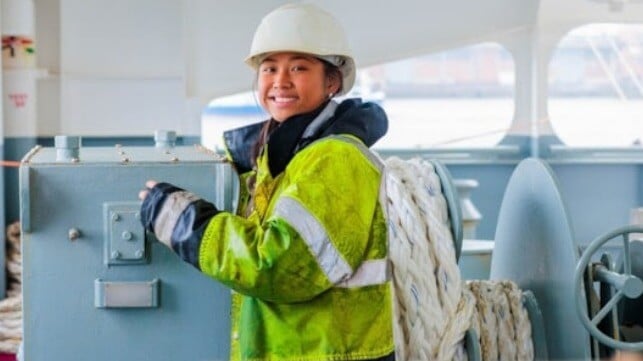
IMO female seafarer

Published Jan 10, 2026 12:31 PM by The Maritime Executive


[By: IMO]

A set of amendments to key IMO treaties and Codes have entered into force on 1 January 2026. They include the following: 

Preventing and responding to bullying, harassment and sexual assault
Amendments to the Seafarers' Training, Certification and Watchkeeping Code (STCW Code) aim to prevent and respond to violence and harassment in the maritime sector, including sexual harassment, bullying and sexual assault.

The amendments are included in table A-VI/1-4 (Specification of minimum standard of competence in personal safety and social responsibilities) of the STCW Code. They outline new mandatory minimum requirements for basic training and instruction for seafarers.

These will equip seafarers with knowledge and understanding of violence and harassment, including sexual harassment, bullying and sexual assault, and information on how to prevent and respond to incidents.

Strengthening safety through improved training and certification of fishing vessel personnel
Amendments to the International Convention on Standards of Training, Certification and Watchkeeping for Fishing Vessel Personnel, 1995 (STCW-F Convention), together with the newly established mandatory Code on Standards of Training, Certification and Watchkeeping for Fishing Vessel Personnel (STCW-F Code), entered into force on 1 January 2026.

These amendments follow a comprehensive review of this treaty in order to respond to the evolving needs of the fishing industry by introducing harmonized qualification standards and establishing a minimum level of competence for personnel serving on fishing vessels covered by the Convention. The revised annex to the STCW-F Convention provides the legal framework within which the mandatory technical standards set out in part A of the STCW-F Code are applied. Part B of the Code offers guidance to support the uniform implementation of the Convention's requirements, particularly for those involved in the education, training, certification, and assessment of fishing vessel personnel.

Mandatory reporting of lost containers
Amendments to the MARPOL and SOLAS Conventions on mandatory reporting of lost containers entered into force on 1 January. Containers lost overboard can be a serious hazard to navigation and safety at sea as well as to the marine environment. 

MARPOL: The amendments to article V of Protocol I of the MARPOL Convention (Provisions concerning reports on incidents involving harmful substances) add a new paragraph to say that "In case of the loss of freight container(s), the report required by article II (1) (b) shall be made in accordance with the provisions of SOLAS regulations V/31 and V/32".

SOLAS: The amendments to SOLAS chapter V (Safety of navigation), address in particular regulation 31 (Danger messages) and require the master of every ship involved in the loss of freight container(s) to communicate the particulars of such an incident to ships in the vicinity, to the nearest coastal State, and also to the flag State which is required to report the incident to IMO. The amendments also address regulation 32 (Information required in danger messages), specifying the information to be reported, including position, number of containers lost, etc.

Safety of onboard lifting appliances and anchor handling winches
A new SOLAS regulation II-1/3-13 covers requirements for the application, design and construction, operation, inspection, testing and maintenance of onboard lifting appliances and anchor handling winches.

Two related sets of guidelines for lifting appliances and anchor handling winches support the implementation of the new SOLAS regulation (MSC.1/Circ.1662 on Guidelines for anchor handling winches and MSC.1/Circ.1663 on Guidelines for lifting appliances).

Enhancing the safety of ships using oil fuel
Amendments to SOLAS chapter II-2 are intended to prevent the supply of oil fuel not complying with SOLAS flashpoint requirements (60°C).

The amendments add new definitions and provisions to SOLAS regulation II-2/4 (Probability of ignition), including requiring that ships carrying oil fuel shall, prior to bunkering, be provided with a declaration signed and certified by the fuel oil supplier's representative that the oil fuel supplied is in conformity with regulation SOLAS II.2/4.2.1 and with the test method used for determining the flashpoint.

Safety measures for non-SOLAS ships operating in polar waters - Polar Code and SOLAS
Amendments to the Polar Code, together with associated amendments to the SOLAS Convention, extend the requirements concerning safety of navigation and voyage planning to fishing vessels of 24 m in length overall and above, pleasure yachts of 300 GT and above not engaged in trade and cargo ships of 300 GT and above but below 500 GT, operating in polar waters.

Amendments to the 2011 ESP Code
New amendments to the International code on the enhanced programme of inspections during surveys of bulk carriers and oil tankers (ESP Code) relate to the role of an Administration in relation to firms conducting thickness measurements of the hull structure of bulk carriers and oil tankers under the 2011 ESP Code, including audits of such firms by the Administration in order to ascertain that the firm is duly organized and managed.

Electronic inclinometers on new containerships and bulk carriers
Amendments to SOLAS Regulation V/19 require containerships and bulk carriers of 3,000 gross tonnage and upwards constructed on or after 1 January 2026 to be fitted with an electronic inclinometer, or other means, to determine, display and record the ship's roll motion.

Fire extinguishing – PFOS ban
Amendments to SOLAS Chapter II-2 (Construction – Fire Protection, Fire Detection and Fire Extinction), as well as the 1994 and 2000 International Code of Safety for High-Speed Craft (HSC Code) prohibit the use or storage of extinguishing media containing perfluorooctane sulfonic acid (PFOS). The amendments aim to protect persons on board against exposure to dangerous substances used in fire fighting, as well as to minimize the impact of fire-extinguishing media that are deemed detrimental to the environment.

The prohibition applies to ships/high-speed craft constructed on or after 1 January 2026; and all ships constructed before 1 January 2026 shall comply with the ban not later than the date of the first survey on or after 1 January 2026.

Fire safety for vehicle, special category and ro-ro spaces
Amendments to SOLAS Chapter II-2 introduce new requirements to adequately protect ships from the fire hazards in vehicle, special category and ro-ro spaces, and weather decks intended for the carriage of vehicles. They include requirements for a fixed fire detection and fire alarm system; an efficient fire patrol system in special category spaces; and an effective video monitoring system in vehicle, special category and ro-ro spaces for continuous monitoring of these spaces, to allow for quick identification of a fire, with cameras to be installed to cover the whole space, high enough to see over cargo and vehicles after loading. Associated amendments introduced to the FSS Code supplement the engineering and installation aspects of fire protection systems in such spaces.

International Maritime Dangerous Goods Code (IMDG)
The revised and updated consolidated International Maritime Dangerous Goods Code (IMDG), incorporating amendment 42-24, entered into force from 1 January 2026. 

The requirements apply to all ships carrying dangerous goods in packaged form.

Grain Code
Amendments to the International Code for the Safe Carriage of Grain in Bulk (Grain Code) introduce a new class of loading conditions for special compartments.

IGF Code amendments to enhance safety
Amendments to the International Code of Safety for Ship Using Gases or Other Low-flashpoint Fuels (IGF Code), adopted at MSC 108. They aim to enhance safety by regulating a variety of issues, such as pump suction wells, safety relief valve discharge, fuel preparation rooms, structural fire protection and hazardous zones.

Application of high manganese austenitic steel for cryogenic service
Amendments to the International Code of the Construction and Equipment of Ships Carrying Liquefied Gases in Bulk (IGC Code) and IGF Code, adopted at MSC 106, concern application of high manganese austenitic steel for cryogenic service. 

Life-saving Appliance (LSA) Code
The amendments introduced to the LSA Code provide new requirements on ventilation for totally enclosed lifeboats (installed on or after 1 January 2029).
 

The products and services herein described in this press release are not endorsed by The Maritime Executive.

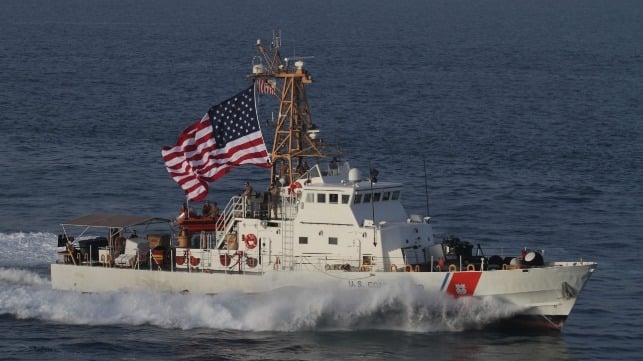
 

U.S. Coast Guard Highlights Operational Successes in 2025

US Coast Guard

Published Jan 10, 2026 11:36 AM by The Maritime Executive


\

[By U.S. Coast Guard]

The U.S. Coast Guard concluded 2025 with significant operational achievements across its missions, including record-setting drug interdictions, major contingency responses, and continued progress in Force Design 2028 – a bold blueprint to transform the Coast Guard to meet evolving and complex maritime challenges. As a member of the Department of Homeland Security team protecting America, and the joint military force that defends it, the Coast Guard is a vital instrument of national power to ensure our Nation’s maritime dominance.

“The men and women of the Coast Guard delivered extraordinary results for our Nation in 2025,” said Adm. Kevin E. Lunday, acting commandant. “From securing the border and interdicting illegal drugs to facilitating maritime commerce and responding rapidly to crises, their success is driving the momentum we carry into 2026. Through Force Design 2028, we are building a more agile, capable, and responsive fighting force to protect the American people and advance national security.”

Interdicting record amount of illegal narcotics

In 2025, Coast Guard forces operating in the Eastern Pacific and Caribbean achieved the largest annual maritime drug interdiction results in service history, seizing over 511,000 pounds of narcotics, valued at more than $3.8 billion, and disrupting transnational criminal organizations. These results, which stopped over 193 million potentially lethal doses from reaching U.S. communities, indicate that Coast Guard counter-drug and law enforcement operations save American taxpayers over $10 billion in avoided costs, including over $2.3 billion in healthcare costs from cocaine interdictions alone.

Operations such as Operation Pacific Viper demonstrated the Coast Guard’s ability to integrate cutters, aircraft, unmanned systems and specialized forces to maintain pressure in key maritime zones. The operation, launched in August 2025, surged forces to the Eastern Pacific to stop the cartels and criminal organizations by interdicting drugs and illegal aliens before reaching American shores. By increasing presence and assets in the region, in less than three months, Coast Guard crews seized over 100,000 pounds of narcotics, averaging approximately 1,600 pounds of cocaine interdicted daily. During the operation, Coast Guard Cutter Stone interdicted the most illegal narcotics ever seized by a unit on a single deployment in the Nation’s history, over 60,000 pounds of cocaine (over 22 million potentially lethal doses) valued at $447 million.

In August 2025, the Coast Guard’s Helicopter Interdiction Tactical Squadron, also known as HITRON, conducted its 1,000th counter-narcotics interdiction, successfully using airborne use of force to disable a narco-smuggling vessel in the Eastern Pacific Ocean. In 2025, HITRON interdicted over $2.1 billion in illicit drugs during operations in the Eastern Pacific and Caribbean.

Controlling, securing, and defending our borders

The Coast Guard patrolled over 100,000 miles of U.S. border and interdicted, deterred and/or transported over 11,000 illegal aliens in 2025. In March 2025, the Coast Guard launched and led Operation Border Trident, an interagency effort to combat transnational terrorist and criminal organizations and illegal alien activity in the California Coastal Region. The Service surged assets, including Fast Response Cutters, National Security Cutters, aircraft, and unmanned systems to curb the flow of illegal maritime migration, increasing interdictions in the region by 44% over 2024 levels. The Service also executed Operation River Wall, a focused maritime border security operation designed to deter, detect and disrupt illicit activity and illegal migration along the Rio Grade Valley River. Through intelligence-driven patrols and close coordination with federal, state and local partners, the operation enhanced maritime domain dominance and helped protect the border.

Strengthening national security through Arctic operations

Arctic readiness remains a critical priority for the Coast Guard as activity in the region continues to increase and strategic interest intensifies. From July to September 2025, five Chinese research vessels operated over the U.S. extended continental shelf in the Arctic, the largest number to date. Coast Guard Cutters Healy, Waesche and Storis – the first Coast Guard icebreaker acquired in over 25 years – intercepted and challenged these vessels.

Maritime security teams carry out targeted boardings

In 2025, the Coast Guard demonstrated its unique expertise and authority in maritime law enforcement and national security by conducting a series of high-profile boardings of oil tankers suspected of violating U.S. sanctions and maritime regulations including M/V Skipper and Centuries. Through close coordination with counterparts at the Departments of Justice, State and War, Coast Guard tactical teams applied specialized capabilities to conduct safe, effective boardings consistent with international law. 

Forces execute rapid response to major contingencies

The Coast Guard responded to major contingencies in 2025, including flooding in the Pacific Northwest, Texas and Alaska.

The Coast Guard launched a multi-agency response to historic flooding in Western Washington, launching 17 air missions to rescue victims and assess damage to maritime infrastructure.
During the catastrophic flash floods in Texas, Coast Guard aircrews from Air Stations Corpus Christi and Houston conducted several flights into the affected area, rescuing and assisting in the evacuation of more than 200 victims.

During the ex-typhoon Halong storm in Western Alaska, the Coast Guard saved 34 lives, evacuated 28 people to Bethel, and oversaw the cleanup of over 500 gallons of spilled fuel to protect Alaskan waters.

Working within an interagency Unified Command, the Coast Guard led successful firefighting, salvage, and recovery operations for a ship fire that occurred aboard the container ship One Henry Hudson in the Port of Los Angeles.

Protecting the American people through search and rescue missions

Throughout 2025, the Coast Guard conducted thousands of search and rescue cases across coastal waters, offshore regions and inland waterways. In total, Coast Guard crews saved 5,220 lives, assisted 19,437 people and saved or assisted more than $1.02 billion in property. These efforts included responses to severe weather, medical emergencies and disabled vessels while coordinating rescues conducted in challenging and often unforgiving maritime environments.

Securing the marine transportation system to facilitate commerce

The Coast Guard plays a critical role in facilitating the safe and secure flow of commerce vital to economic prosperity and strategic mobility, while ensuring the security of the Nation’s ports and waterways. Through vigilant oversight, unique Captain of the Port authorities, strong partnerships with maritime stakeholders, and the maintenance and servicing of more than 50,000 aids to navigation nationwide, the Coast Guard enables mariners to transit U.S. waters safely and efficiently. In support of the marine transportation system, the Coast Guard conducted 33,370 vessel inspections and 16,012 facility inspections and facilitated the movement of more than 1.8 billion tons of cargo through U.S. waters, helping sustain an economic engine projected to move $5.4 trillion in goods to, from, and within the United States in 2026.  

Recruitment achieves new records across the force

The Coast Guard achieved record-setting recruiting results in 2025, marking the Service’s best recruiting performance since 1991 and significantly strengthening workforce readiness. This included the largest number of officer accessions in recorded history. The Coast Guard accessed more than 6,000 active-duty and reserve enlisted members. These results reflect sustained investments in recruiting, opened seven new recruiting offices nationwide, and continued congressional support to build an agile, capable and responsive maritime fighting force.

Force design strengthens operational readiness

In 2025, the Coast Guard launched Force Design 2028 – a transformation of the Service to meet the evolving national challenges and ensure we have the most agile, capable, and responsive maritime fighting force to protect our Nation. Force Design 2028 focuses on workforce readiness, operational alignment, and modernized command and control. These efforts are strengthening mission execution focused on people, organization, acquisitions and technology, including growing the workforce by 15,000 and establishing a Secretary of the Coast Guard.

Looking ahead

The Coast Guard stands watch on the maritime frontlines – controlling, securing, and defending our borders and maritime approaches; facilitating the flow of commerce vital to economic prosperity and strategic mobility; and responding to crises and contingencies that may come with little to no warning. Always ready to act, the Coast Guard will continue to meet evolving threats and deliver decisive results for the American people.
 

The products and services herein described in this press release are not endorsed by The Maritime Executive

Oregon Relaunches Its Only Container Terminal After Scheduled Closing

Portland, Oregon
Portland's container terminal gets fresh start with new operator (Port of Portland)

Published Jan 8, 2026 7:36 PM by The Maritime Executive


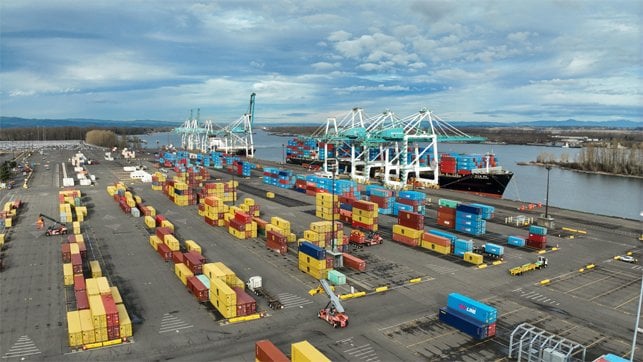
Officials gathered on January 7 at the Port of Portland, Oregon, to mark what they are calling a fresh start for a reborn container shipping terminal. The only one in the state, the small facility known for years as Terminal 6, had faced an imminent closure due to mounting financial losses and the lack of an operator.

Oregon’s Governor Tina Kotek intervened to save the operation while highlighting its critical contribution to the state’s economy and local businesses. The state committed to providing $40 million to bridge the operations while a new operator was located. It also committed to infrastructure improvements for a port that is located far upriver from the ocean.

The new lessee/operator, Harbor Industrial Services, assumed control of the operation on January 1, 2026, and renamed Terminal 6 to become the Oregon Container Terminal. The company has a seven-year lease with four renewal options, each for five years. It also purchased the facilities' seven cranes.

Like many smaller ports, the container operation in Portland faced a range of challenges, which made it difficult to attract carriers. Its location limits the size of vessels and requires more transit time. It is also a smaller economic market driven primarily by agriculture and some manufacturing. The terminal had also found itself caught in a labor jurisdiction dispute that ultimately saw the prior operator walk away, leaving the port attempting to run the terminal on its own.

Portland once had seven carriers operating from the port, but it is now down to two carriers, with the regular service limited to South Korea’s SM Line. The new operator, however, looks to follow the state's plans for strong growth at the terminal and said during yesterday’s ceremony that a third carrier is likely to join soon. It hinted that it would be MSC Mediterranean Shipping Company, which had previously operated from Terminal 6. The port lost most of its carriers in the 2015-2016 timeframe. It had enjoyed a small resurgence during the COVID-19 pandemic, providing an alternative to congested and backup ports on the Pacific Coast.

Harbor International said it wants to double the cargo shipments this year handled at the terminal. It plans to focus on Oregon shippers, which would otherwise have to truck goods to ports such as Seattle. As a first step, the company announced that as of January 16, the container terminal will be handling imports and exports five days a week, up from the current four days of operations.

Longer term, Harbor International looks to expand services, including vessels, railcars, and oversized cargo. Separately, the port continues its larger operations in dry bulk, breakbulk, and RoRo vehicle transport


Two U.S. Ports Add New STS Cranes to Boost Competitiveness

Liebherr cranes
Crane components from Ireland arrive at Port of Oakland (Port of Oakland)

Published Jan 11, 2026 5:29 PM by The Maritime Executive


Two ports in the U.S. are enhancing their competitiveness by investing in new ship to shore cranes, which will improve operational efficiency, advance environmental goals and push growth. Jacksonville Port Authority (Jaxport) in Florida and California’s Port of Oakland have both made big strides with new infrastructure for business growth.

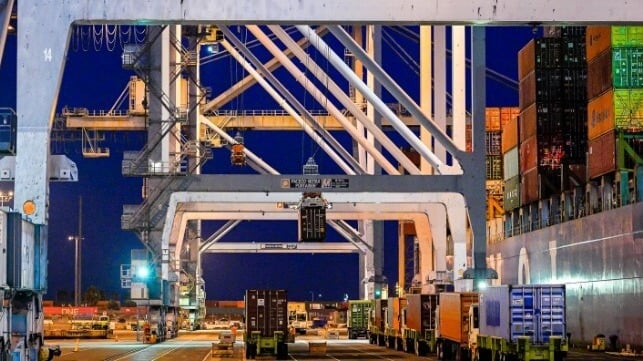
Jaxport reports that two new 50-gauge ship-to-shore container cranes have started operations at its Blount Island marine terminal, a move that significantly expands cargo-handling capabilities at the facility. Installed at a cost of $93 million, including $53 million in state funding, the cranes are designed to serve larger vessels and can reach up to 19 containers across a ship’s deck. They also have the ability to move an average of 33 containers per hour and a lift capacity of up to 65 long tonnes, with heavy-lift capability of up to 75 long tonnes for oversized, non-containerized cargo.

While the two cranes have already started moving containers, a third crane is currently being commissioned at the Talleyrand marine terminal. Featuring a 100-foot lift height and with the ability to reach across 17 containers wide, the crane is expected to be operational in the middle of the year.

Jaxport, which is Florida’s leading container port by volume and one of America's top vehicle-handling ports, says the cranes are central for enhancing energy efficiency and reducing emissions. This emanates from the fact that they feature regenerative power systems that consume energy during container lifts and capture electricity when lowering them.

The seaport that contributed $44 billion in annual economic impact is investing in the new cranes to boost container throughput that has only increased marginally in recent years from 1.2 million TEU in 2022 to 1.3 million in 2024.

“As cargo volumes grow, it’s essential that we continue investing in the equipment needed to serve our customers efficiently,” said Eric Green, Jaxport CEO.

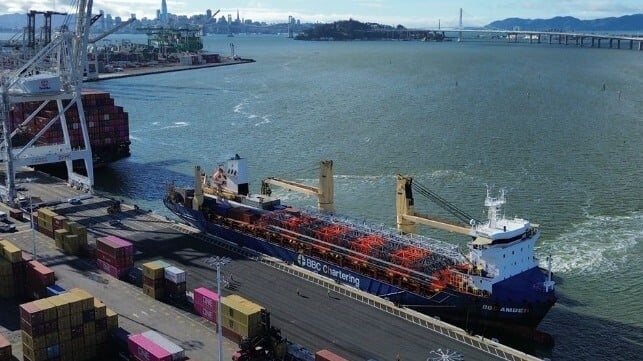
Port of Oakland, on its part, has seen the arrival of two new electric container cranes that will be erected at its TraPac terminal and are expected to commence service in May this year. The new Liebherr cranes, which were manufactured in Ireland, mark the first time European-built ship-to-shore cranes have been deployed on the U.S. West Coast.

The two cranes, which will stand more than 440 feet tall, are the first of four new cranes planned for the TraPac terminal, and the remaining two are scheduled to arrive later this year.

The cranes, which will allow TraPac to handle large container ships more efficiently, are seen as critical in driving growth at Oakland port, where container volume has been stuck at 2-2 .5 million TEU per year over the past decade.

“These new cranes represent an important investment in the future of the terminal,” said Cameron Thorpe, TraPac CEO. “They improve efficiency today while helping move the port toward a greener future.”


Navigating Port Funding Uncertainty: Adaptation Unlocks Opportunities

GHD
Adobe Stock / supplied by GHD

Published Jan 11, 2026 12:36 PM by Michael Vanderbeek and Rebecca Crow


The port funding landscape has shifted dramatically as federal discretionary grants become less predictable and debt capacity reaches its limits. Successful ports are adapting by diversifying funding sources, embracing innovative partnerships and developing strategic approaches that align projects with evolving political priorities. The key is building flexibility into funding strategies while maintaining focus on long-term operational needs.

The new funding reality

Port financing has undergone a fundamental transformation over the past two decades. What began as straightforward debt financing based on individual port authority revenue streams has evolved into a sophisticated ecosystem of public-private partnerships, federal grants and state programs. The recent reduction in federal discretionary funding has created an entirely new challenge: how to navigate an increasingly complex and politically sensitive funding environment.

The funding landscape is changing rapidly, and ports that were successful in securing multiple grant sources are now finding their entire project viability depends on political winds that can shift overnight. Long-term success requires much more strategic thinking about how to position projects and build in flexibility.

The challenge isn't just about finding money – it's about understanding that funding criteria can change dramatically with each new administration. What qualifies as a priority under one iteration of political leadership may become deprioritized or restructured under another. This creates a planning challenge that extends far beyond traditional financial modeling.

The ‘house of cards’ risk

Many ports have become skilled at layering multiple funding sources, using one grant as matching funds for another in increasingly complex arrangements. While this approach can unlock significant capital, it creates what we call the "house of cards" risk – when one funding source disappears, the entire project structure can collapse.

We've worked with port clients who successfully secured multiple grants, only to have a federal program change eliminate their required match and invalidate previously approved funding commitments. The interconnected nature of these funding arrangements means that losing even a small percentage of total project funding can make entire initiatives financially unfeasible.

The solution requires building flexibility into project design from the beginning. We help clients develop multi-benefit modular approaches that allow projects to be scaled or phased based on available funding, ensuring that losing one source doesn't destroy the entire initiative.

Strategic positioning matters

One of the most critical skills in today's funding environment is understanding how to position the same project to meet different political priorities. A port modernization project might emphasize job creation and economic development under one administration, then pivot to highlight climate resiliency and environmental benefits under another.

This isn't about changing the fundamental project – it's about understanding which benefits to emphasize in grant applications and how to describe project components to align with current funding criteria. We work closely with port clients to develop funding applications that can be adapted quickly as political priorities shift.

In many ways, it has become a language game. The projects themselves remain technically sound and necessary, but the ways the benefits are described and the applications structured have to evolve with changing federal and state priorities.

The rise of pass-through partnerships

An emerging trend we're seeing is ports serving as pass-through entities for private operator projects. Because federal and state grants typically go to public port authorities rather than private terminal operators, we're helping structure arrangements where the public port authority sponsors the grant application for a private operator project and then passes the benefits through to the tenant.

This model allows private operators to access public funding they couldn't secure independently while enabling public port authorities to support major infrastructure improvements without contributing their own capital.

These partnerships require careful legal and financial structuring to ensure all parties meet their obligations and avoid real or perceived conflicts of interest while maximizing the benefit of public investment in port infrastructure.

State funding fills federal gaps

As federal discretionary funding becomes less predictable, we're seeing increased reliance on state-level programs. States recognize that ports are significant economic generators and are developing their own funding mechanisms, where possible, to support critical infrastructure improvements.

California's recent Proposition 4, which allocates $475 million for port infrastructure related to offshore wind development projects, demonstrates how states are stepping up to fill funding gaps. However, this creates a patchwork approach where funding availability varies dramatically by location and state-specific financial health.

Resiliency funding remains robust

Despite overall reductions in federal discretionary spending, resiliency and hazard mitigation programs continue to receive strong support across political administrations. These programs recognize that investing in infrastructure protection now prevents much costlier disaster recovery expenses later.

We help clients identify how their infrastructure projects can be positioned to take advantage of resiliency funding while addressing other operational needs. Often, a project justified for storm protection can include electrical upgrades, modernized utilities and other improvements that enhance overall port functionality.

Building adaptive strategies

Success in today's funding environment requires developing what we call "adaptive funding strategies" – approaches that maintain flexibility while ensuring project viability across different scenarios. This includes designing multi-benefit projects that can be positioned for different funding streams, creating phased implementation plans that allow for partial funding and building relationships with diverse funding sources.

Our role as strategic advisors extends beyond traditional engineering services to include helping clients navigate grant applications, understand changing political priorities and structure partnerships that maximize funding opportunities. The ports that thrive in this environment will be those that embrace flexibility while maintaining focus on their fundamental infrastructure and operational needs.

The funding landscape may be more complex than ever, but for ports willing to adapt their strategies, new opportunities continue to emerge.

Michael Vanderbeek is Maritime and Coastal Planning Lead at GHD, and Rebecca Crow is the firm's Project Manager.

This post is sponsored by GHD, combining strategic planning advisory services with infrastructure engineering to help ports navigate complex challenges from energy transition to funding innovation. Discover how we're shaping the future of maritime infrastructure at https://info.ghd.com/funding-article.


The opinions expressed herein are the author's and not necessarily those of The Maritime Executive.


Report: Hanwha Ocean Looks to Expand in US with Possible Second Shipbuilder

Hanwha Philly Shipbuilding drydock construction
Hanwha looks to expand its U.S. shipbuilding operations at Philly and possibly with a second yard (Hanwha Philly Shipbuilding)

Published Jan 9, 2026 5:28 PM by The Maritime Executive


During an exclusive interview with The Wall Street Journal, an executive for Hanwha Defense said the company continues to actively discuss options to expand the Philly Shipyard operation, as well as possibly purchasing a second shipyard in the United States. The South Korean company, the exclusive report said, looks to increase capacity to realize the strong opportunities coming from the Trump administration.

The article reports that Hanwha is already in “active conversation” with the Pentagon for potential deals. It cites the potential for work with surface, subsurface, and unmanned vessels. Yesterday, the company also revealed it has established a new agreement with an American autonomous-vessel company, HavocAI, to compete in the medium-sized unmanned warship space. The firms said they will explore building a 200-foot-long autonomous surface vessel.

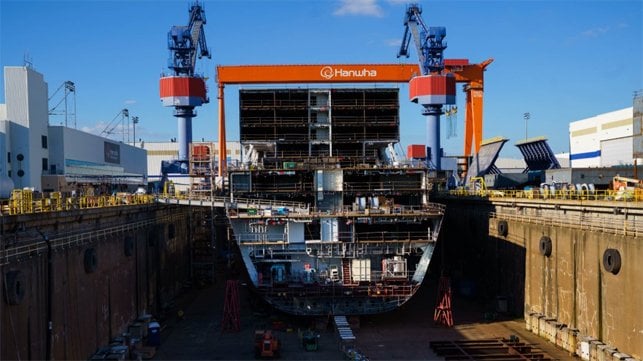
Michael Coulter, who heads Hanwha Defense USA, told The Wall Street Journal that the Philly Shipyard, however, needs more space. It has been previously reported that Hanwha was in discussions in the area for possible additional space at or near the current yard. It acquired the yard in December 2024 for $100 million and recently said it plans a $5 billion investment in the facility to expand capabilities and capacity.

During the interview, the executive, however, also mentioned the option of purchasing a second U.S. shipyard. Coulter said they were “seriously considering” a purchase of a second U.S. shipyard in “another region” of the country. He said it would be within the next several years, and the South Korean parent company confirmed to the local media that they are considering options, but said no specific plans have yet been finalized.

Hawha Ocean has previously said it has a goal of expanding the operations at Philly Shipyard to be able to produce up to 20 ships a year. The yard currently produces about one ship a year. The reports said it has committed to modernizing manufacturing methods with elements such as automation and robotics. It has reportedly committed to the Pentagon to undertake workforce expansion, productivity enhancements, facility investments, and technology transfers.

Philly Shipyard was started in 1997 as a government partnership with Norway’s Kvaerner Shipbuilding at a portion of the former Philly Naval Shipyard. Rhoads Industries has operations on another portion of the former Naval Shipyard. The report says Hanwha is discussing gaining access to “unused or underutilized docks” in the area, as well as an arrangement to share space using docks at other shipyards to execute Hanwha’s orders. 

Near-term, Philly Shipyard has a commercial orderbook to execute. It is currently making repairs to the third MARAD training ship to complete its delivery and has the last two training ships of the order also in progress. It is completing a rock installation vessel for Great Lakes Dredge & Dock Company, and work has started on the first of three containerships for Matson.

The U.S. subsidiary of Hanwha’s shipping arm, Hanwha Shipping, announced last August that it had ordered 10 medium-range (MR) oil and chemical tankers from Hanwha Philly Shipyard, with the first tanker expected to be delivered by early 2029. It previously announced it would buy a Korean-built LNG carrier and complete its outfitting at the U.S. yard to make it the first modern American-flagged LNG carrier built in 50 years. The tanker project leverages the shipyard’s origins, building tankers for the Jones Act market.

Hanwha has expressed its expectations to be a key player in the Korean Make American Shipbuilding Great Again program, and the promise of a $150 billion investment backed by the Korean government made to the Trump administration during trade talks. Hanwha has also been open about its expectations that it would work closely with Austal after the Korean company became the largest shareholder in the shipbuilder.  Hanwha had made an offer to fully acquire Austal, which was rejected by the company by questioning whether the South Korean company could gain clearance from Australia and the United States due to Austal’s role in national security projects.


Hanwha Defense and HavocAI Team Up on Midsize Unmanned Vessels

HavocAI
A swarm of HavocAI drones on the water (HavocAI file image)

Published Jan 8, 2026 6:05 PM by The Maritime Executive


Korean industrial conglomerate Hanwha has been expanding its portfolio of projects in the U.S. naval and defense space, and on Thursday it announced a new agreement with an American autonomous-vessel company to compete in the medium-sized unmanned warship space.  

The deal pairs Hanwha Defense USA and Hanwha Systems with HavocAI, a two-year-old startup run by two Navy veterans. Jointly, the firms will explore building a 200-foot-long autonomous surface vessel, and Hanwha Philly Shipyard is under consideration as the place of production. The goal is to deliver "state-of-the-art ASVs at scale," according to Hanwha Defense USA CEO Michael Coulter.  

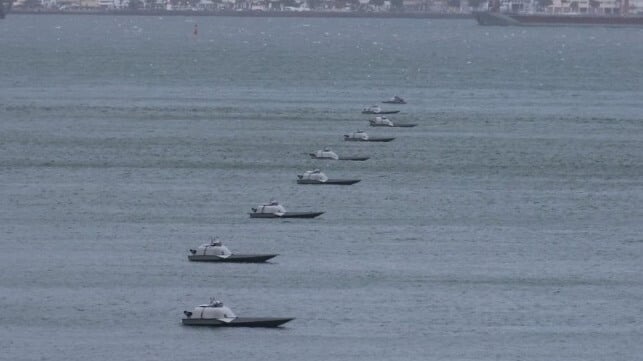
HavocAI specializes in adaptive collaborative autonomy for the control of multiple vessels at once. Its engineers design "systems that self-organize to anticipate, plan, and adapt in dynamic environments." The objective is to enable a single human operator to control a fleet of various unmanned assets. Potential mission sets include force protection, logistics in hostile environments, maritime strike, and area surveillance, among others. Its designs range from small craft up to a 100-foot trimaran design, dubbed Atlas. The firm says that its technology is already out accomplishing missions, and that it has been demonstrated in GPS-denied environments.  

"Militaries will need to be able to fight without persistent connectivity and will need to execute autonomous "combined arms" . . . and detect and engage targets at machine speed with operators on, not in, the loop," the firm said in a statement last year.

In October, HavocAI raised $85 million in a funding round, making it one of the fastest-expanding startups in the space. Its main objectives for the capital raise include integrating its swarming-autonomy stack into even larger vessel sizes and growing its overseas presence in the Indo-Pacific. 

HavocAI has not yet sought to buy its own shipyard site, like competitor Saronic, which is pursuing vertically-integrated development; the agreement with Hanwha gives it a road to large-scale production. Together, the two companies will jointly develop a 200-foot ASV proposal to include technical features and mass-production planning. 

"The Department of War has sent a clear demand signal to the shipbuilding industry: we need more boats, faster, with more capabilities, for less money,” said Paul Lwin, Co-founder and CEO of HavocAI. “Partnerships like this – pairing a leading-edge technology with an established global infrastructure – are exactly how we achieve that goal.”


Container Imports to U.S. Expected to Remain Down Till Spring Says Retailer

container imports
Retailers project container import volumes will continue to be down at least till May 2026 (Port of Long Beach file photo)

Published Jan 9, 2026 9:12 PM by The Maritime Executive


The National Retail Federation issued its first outlook for 2026 imports, saying that it believes retailers are assessing what is ahead for 2026 and, as such, import levels are expected to remain down year-over-year until at least spring. While they expect a slight increase this month due to the change in timing of the Lunar New Year holiday in Asia, the retail trade group expects overall import levels will be down five percent year-over-year for the first five months of 2026.

“There should be a brief bump in imports this month ahead of Lunar New Year factory shutdowns in Asia, but we’re otherwise headed into the post-holiday shipping lull that comes each year,” said NRF Vice President for Supply Chain and Customs Policy Jonathan Gold. “Retailers are hoping for more stability and certainty, especially regarding tariffs and trade policy, in 2026 to help ensure better supply chain operations to meet consumer needs.” 

The NRF cites the “chronic uncertainty” of fluctuating tariffs and trade policies. It believes members frontloaded imports in 2025 to beat some of the expected tariff increases. Volumes also slowed as inventories remained high and concerns built about the economy. 

The Global Port Tracker report projects that when the numbers are tallied for 2025, container imports will have been 25.4 million TEU. The NRF reports an expected 0.4 percent decline for the year, which is similar to a forecast of a 0.2 percent decline by Descartes Systems Group. Both cite the impact of tariffs, trade policies, and a potential cooling economic environment. 

The retailers’ forecast looks for the first month-over-month gain in six months during January at 2.11 million TEU versus approximately 1.99 million TEU in December. However, it is expected to remain down year-over-year versus the 2.22 million TEU in January 2025. From there, the NRF projects monthly declines ranging between five percent to as much as 12.4 percent. They currently expect the first year-over-year gain in May at 2.07 million TEU, which will be a 6.2 percent increase. 

Bloomberg highlighted yesterday that the one positive note is that as the import levels slow, the U.S. trade gap has declined to its lowest levels since 2009. While import levels are down, the U.S. still had a $29.4 billion trade deficit in the last numbers, which were for October 2025.

Ports and other related businesses continue to experience the impact of the trade declines. 


Seafarers Killed and Injured as Russia Strikes Two Ships Near Ukraine

cargo ship struck by drone
A Turkish-owned cargo ship was struck while underway in the Ukrainian Sea Corridor (Oleksiy Kuleba on Telegram)

Published Jan 9, 2026 2:03 PM by The Maritime Executive


Russian forces struck two cargo ships on Friday, January 9, killing one seafarer and injuring a second crewmember, according to Ukrainian officials. It comes as Ukraine continues to accuse Russia of “deliberately targeting civilian facilities, international shipping, and food logistics.”

The attack on civilian shipping came after an overnight barrage, which was one of the largest in the four-year war, and only the second time Russia has used its Oreshnik hypersonic missiles. The hypersonic missile was first deployed in November 2024 and is seen as an attempt at intimidation and a message to Ukraine’s western allies.

Reports said hundreds of drones and missiles were launched against Ukraine, with Kyiv being one of the primary targets. Ukrainian emergency services are reporting four people were killed, and at least 25 were injured in Kyiv. Nearly 6,000 apartment buildings were reportedly left without electricity and heating, and emergency services had brought in portable boilers to restore services at hospitals and public facilities. The Qatari Embassy in Kyiv was also reportedly damaged.


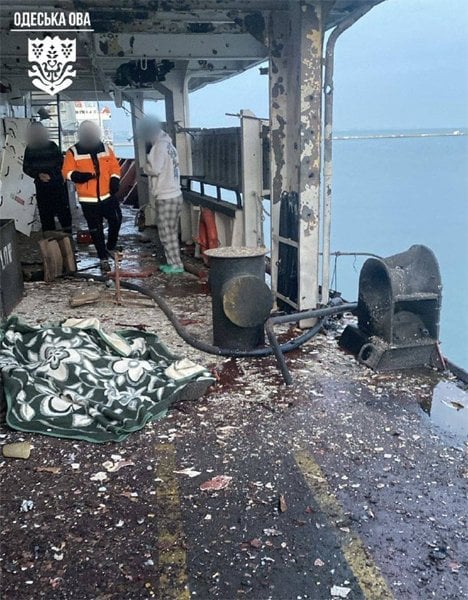
Two cargo ships were damaged with one crewmember killed and another injured on the ships (ODA)


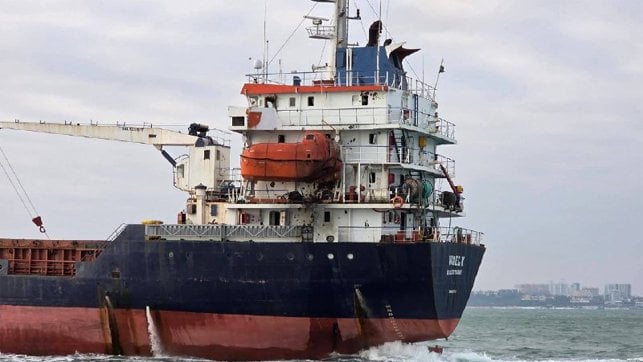
The general cargo ship Wael K, owned by Turkish interests, was reportedly struck on its way to the port of Chornomorsk. The vessel, built in 1994, is 8,000 dwt and registered in St. Kitts and Nevis. It was inbound to load a cargo of grain.

The cargo ship was reportedly in the Ukrainian Sea Corridor when it was struck in its upperworks by a Russian drone. The vessel’s second mate, a Syrian citizen, was reportedly injured and receiving medical attention. The ship was able to continue under its own power and was reported to be heading to the nearest port.

A second vessel, a dry bulk carrier, was also hit while docked in the Great Odesa port complex. Reports said the Ladonna was loading soybeans. The vessel registered in Comoros is also owned by Turkish interests and managed from China. It was built in 1995 and is 22,000 dwt.

Ukraine’s Deputy Prime Minister, Oleksiy Kuleba, announced that one crewmember, a Syrian citizen, had died as a result of the attack. He called it a war crime.

Turkish officials have already called for a de-escalation and a stop to targeting commercial vessels after the earlier attacks on Black Sea shipping. Russia intensified its campaign against Ukraine’s seaports and port infrastructure after attacks on the shadow fleet. Reuters reports the Ukrainian Seaport Authority said attacks on the Greater Odesa seaport complex had almost tripled in 2025 versus 2024 to 96 reports.


Shadow Fleet Tanker Diverts to Turkey After Reporting Drone Attack

tanker off Turkey
Elbus diverted to a Turkisj port after reporting it had been attacked (Turkish TV)

Published Jan 8, 2026 1:45 PM by The Maritime Executive


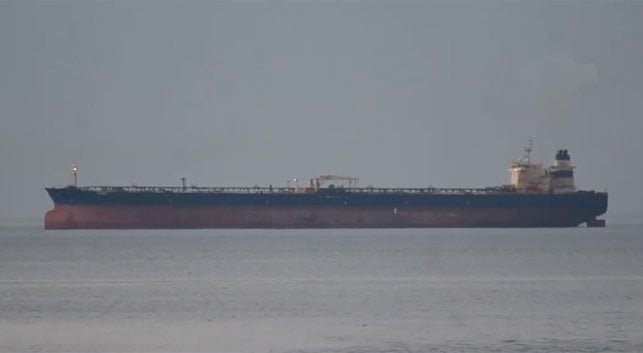
A Chinese-owned and managed crude oil tanker is reporting that it was attacked by a suspected drone while sailing in the Black Sea. The tanker Elbus (159,000 dwt) was traveling only with ballast along the Turkish coast, reportedly bound for the Russian terminal at Novorossiysk.

The vessel called for assistance on Wednesday, January 7, reporting it had been hit and sustained some damage. The reports are conflicting, and an apparently fake photo is circulating online showing smoke billowing from a tanker. Turkish TV captured pictures of the vessel after it arrived at the Black Sea port of Inebolu on Thursday.

The Turkish Coast Guard reportedly responded to the call for assistance. The media said no crewmembers were injured and there was no pollution from the vessel. Early reports said the Coast Guard was arranging for the vessel to be towed to Turkey, but later reports seem to indicate that it arrived at Inebolu under its own power. A Coast Guard vessel can be seen standing by in the TV footage.


Local officials said they would be conducting a detailed inspection of the vessel. They said they would clarify the extent of the damage and seek to identify the source of the attack. Some reports said it appears the engine room was targeted, but others said the ship was struck in the upper works.

Built in 2005, the Elbus is sailing under the flag of Palau. It was acquired by a Chinese company in November 2025. The vessel does not appear in the lists of vessels sanctioned by the United States, the United Kingdom, or the European Union. The ship’s AIS signal shows it was coming from Singapore.

AI marine analytics firm Windward highlights that tankers have been attempting to hug the Turkish coast since the dual attacks in November, which damaged two other shadow fleet tankers. Ukraine took credit for those two attacks, reporting it had used a modified version of its Sea Baby maritime drones. However, Ukraine denied subsequent attacks and has not acknowledged the current incident. Turkish media highlights that five tankers have reported drone attacks since November.

Bulgaria Seeks Reimbursement from Owners of Salvaged Shadow Fleet Tanker

salvage of tanker
Bulgaria has been reimbursed for the costs of salvage the shadow fleet tanker (Ministry of Transport)

Published Jan 7, 2026 3:03 PM by The Maritime Executive


Bulgaria’s Maritime Administration presented a bill to the representatives of the Chinese-owned shadow fleet tanker that it was forced to salvage last month after it washed up on the shores of Bulgaria. The vessel had been attacked by Ukrainian forces while it was in the Black Sea heading to Russia to load crude oil.

The Ministry of Transport and Communications announced on Wednesday, January 7, that it had presented a bill for €270,371 ($315,802) using a private bailiff to deliver the notarized summons. It said the Maritime Administration had incurred the expenses, which included securing three tugs and a specialized generator that was used to power the ship’s hydraulic system to raise the anchor. The summons demanded payment by January 12.

Before day’s end, the Ministry reported it had received the funds from the shipowner’s agent in Bulgaria. It said payment in full was received and would be refunded to the state treasury.

The tanker Kairos had washed up near the Bulgarian seaport of Ahtopol on the afternoon of December 5, with the Bulgarian authorities accusing a salvage tug of releasing the hulk after having brought it from Turkish waters. Ukraine attacked the vessel near the coast of Turkey on November 28 using its Sea Baby drones, setting the empty tanker on fire. Turkish authorities aided in the evacuation of the crew and the firefight.

Bulgaria has continued to demand an explanation over the circumstances of the tow and where the tanker was headed before it drifted toward the port. An emergency operation airlifted some of the crewmembers off the ship and provided supplies as well as an electrical generator. Bulgaria had said it would seek a full reimbursement for its costs, including the tow on December 15 to place the hulk in a more secure location in the Gulf of Burgas.

Because the ship is under EU sanctions, Bulgaria reports that it cannot provide repair services to the vessel. It was permitted to provide emergency services and a port of refuge under the sanctions, but no further assistance is permitted. The Ministry reports that it expects the shipowner will take the necessary actions to prepare and remove the tanker from Bulgarian territorial waters.