Monday, January 12, 2026

Opinion

Communalism

The Quasi-Official State of Apartheid in Today's India


Sarayu Pani
THE WIRE
INDIA

With respect to minorities, we risk the perpetuation of apartheid-like conditions under the cover of a legal system that, on paper, guarantees equality.
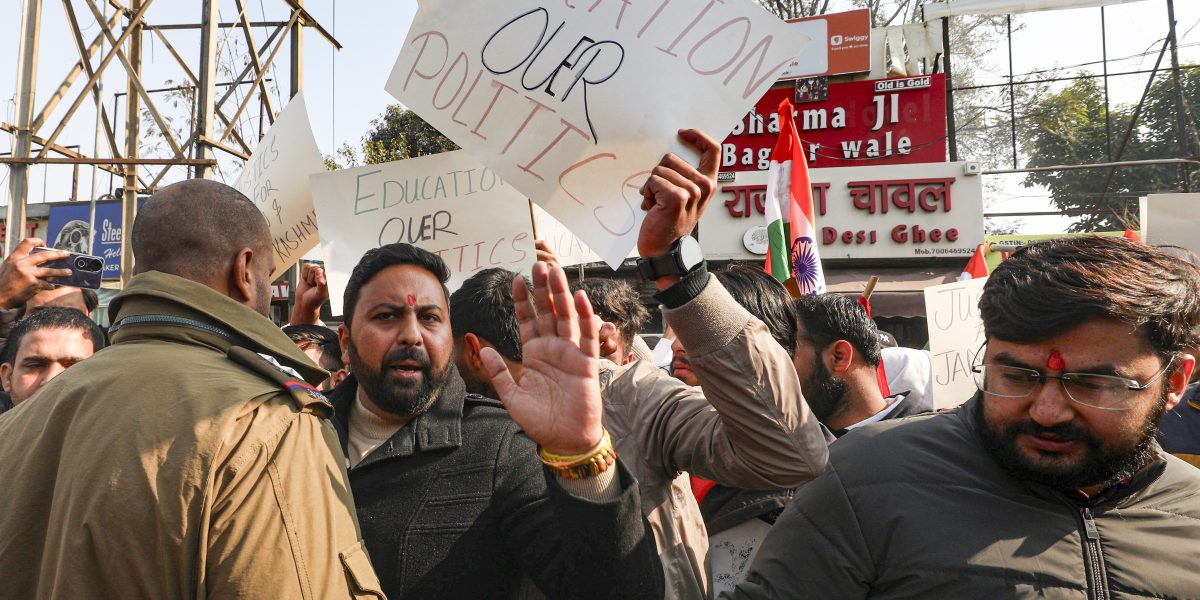

Student wing of the National Conference hold placards during a protest against the withdrawal of the permission letter for Shri Mata Vaishno Devi Medical College, in Jammu, Saturday, Jan. 10, 2026. Photo: PTI

Last week, the National Medical Commission (NMC) withdrew permission previously granted to the Shri Mata Vaishno Devi Institute of Medical Excellence in Jammu, to admit students into a medical programme. The medical college has been at the center of protests led by Hindu right-wing groups who objected to the religious composition of the first batch of students. Reportedly, of the 50 students (who were admitted based on their NEET ranks) over 40 are Muslim. The college which has received significant grants-in-aid from the state government is built on land owned by the Shri Mata Vaishno Devi shrine and is reportedly also funded by donations from the shrine.

While the NMC has cited “severe findings about non-compliance with minimum standards”, Hindu right-wing groups have celebrated the closure of the college as the consequence of their protests. The mostly Muslim students stuck in the middle of this conflict have found themselves deprived of a college admission they gained after a highly competitive entrance test. College officials have meanwhile said that the NMC’s findings are not factually borne out. It is particularly telling that the NMC itself had granted permission to the college to operate barely four months ago, presumably after completing due diligence.

This conflict offers yet another example of a phenomenon that is becoming increasingly commonplace in India today – where dominant sentiments are appeased by weaponising and deploying seemingly neutral administrative provisions and institutions against Muslims. As in the case of “bulldozer justice”, we are reminded that the creation of apartheid-like conditions in India does not necessarily require the enactment of discriminatory laws. When state institutions participate in the appeasement of dominant sentiments, a quasi-official state of apartheid can be created without apartheid laws.


On the face of it, quasi-official apartheid appears like a contradiction in terms because apartheid usually refers to a legalised de jure system of discrimination enforced by the state. In India however, this definition can become inadequate for analysis.

This is because an individual in India typically experiences the law at two levels. First, they experience the formal sovereign system contained in the written law of the land, and second, they experience a non-formal system, derived from caste, where the norms enforced are those dictated by the local dominant group. The enforcement of caste-based norms goes far beyond social convention. It often operates in practice like a parallel legal system that contains hard rules that are enforced by material sanctions like localised violence (including lynching) and social boycotts ordered by local panchayats. The norms enforced by this non-formal legal system today are not limited to caste norms. Hindutva effectively uses the same non formal system against minorities by redefining the dominant group in terms of religion.

The law, as it is experienced in any situation by an individual, is therefore best understood as a contestation between these two distinct legal systems running on contradictory principles. For example, a woman choosing to leave her house to escape a forced marriage or to marry outside of her caste or religion would be perfectly within her formal legal rights to do so, but would risk ostracisation, violence or even death from social and familial punishment, meted out to her or her partner. Similarly, a Muslim family purchasing a house in a Hindu dominated neighborhood has the legal right to do so but risks the neighbors refusing to accept their legal right to live there.
When institutions become enforcers of the norms created by the dominant group

In these contestations, institutions become critical in determining the system of law people really live under. Simply put, on what side does the state act in such contestations? Do they act against sanctions imposed by the dominant group and protect and uphold the rights of the individual granted under the formal legal system or do they themselves become enforcers of the non-formal system and the norms created by the dominant group on ground?

Several examples from the last decade suggest that institutions in India have shifted substantially into the latter role. Municipalities in multiple cities have enthusiastically acquiesced to demands for the demolition of Muslim owned homes in the days following communal conflicts or tensions. In cases of inter-faith marriage, instead of protecting the constitutional freedom of adults to love and marry whoever they choose, multiple states have enacted anti-conversion laws. These laws, which on-paper seek to prevent forced conversion, are often used by the police to arrest Muslim grooms, even when the bride has not been forced to change her faith.

With respect to cattle related lynching, the police rarely intervene when cow slaughter “vigilante” groups assault Muslim traders transporting cattle. Instead, the victims are often picked up and charged with violations of cattle slaughter laws. In multiple cases, Muslim homeowners have been unable to reside in houses they have legally purchased in Hindu majority neighbourhoods after protests by neighbours. The failure of institutions to protect these property rights has hardened the de facto religious segregation of neighbourhoods in Indian cities, and the ghettoisation of Indian Muslims.

In 2020, after stringent protests, the Indian government put on hold plans to create a National Register of Citizens, a move that many feared would lead to the mass disenfranchisement of Indian Muslims. And yet, today, Bengali speaking Muslims are arbitrarily targeted both by local “vigilante” groups, and by the police, who, acting on reports or tip-offs from local dominant groups have picked up people on the suspicion of being Bangladeshi and demanded proof of Indian citizenship. Multiple Muslim owned and Muslim employing small businesses have faced threats from Hindu nationalist groups to oust them from markets, and the state has not stepped in to meaningfully protect them from such threats.

This reimagination of institutions as legitimisers and executors of the dominant will, instead of enforcers of constitutional norms, has not been limited to local or executive controlled bodies like the police or municipalities. The judiciary has played its part as well. The Ram Janmabhoomi judgement for example points to a desire to appease dominant sentiments rather than strictly follow the letter of the law. While there have also been cases where the judiciary has attempted to push against this tide, including the Supreme Court’s bulldozer judgment or the recent refusal by an Uttar Pradesh court to accept the government’s decision not to prosecute the killers in the Akhlaq lynching, these have become the exception rather than the norm, and have been treated as such. The bulldozer judgement for example has failed to curb the punitive use of bulldozers on the ground.

This evolution of institutions in India is unsurprising given the recent trajectory of India’s democracy. Democratic backsliding can happen in two different ways. The manner of such backsliding often determines how the polity is reshaped by it. The first, best exemplified by Indira Gandhi’s Emergency, relies entirely on tools that exist in the domain of formal laws. While Emergency provisions contained in the Constitution suspend civil liberties and put in place an authoritarian structure, power becomes concentrated at the level of the state. Democratic institutions are suspended, but their legitimacy is not eroded in the public domain. While such authoritarianism also causes untold suffering, in the contestation between the formal legal system and the non-formal one, it strengthens the former.
Gradual erosion of democratic institutions

The second type of democratic backsliding, exemplified by the last decade or so, relies on the gradual erosion of democratic institutions. While rights remain untouched on paper, democratic institutions simply cease to enforce them, or enforce them in an increasingly arbitrary manner. In the contestation between the formal and non-formal legal systems, this erosion of democratic institutions weakens the formal legal system and strengthens the non-formal ones. Over time, institutions become rubber stamps for the dominant group’s rule, and political discourse moves away from the preservation of constitutional values and becomes recast as a race between different groups to attain dominance over the non-formal system.

There is a tendency in India today to frame instances of institutional failure as “lawlessness” or a breakdown of the rule of law. In a sense, this framework is comforting because it creates the idea that the formal legal system exists unchanged, and that the issues we face today are simple or individual instances of non-compliance with that system.

The actions of the NMC in this case suggest that our problems are deeper. When a wide variety of institutions repeatedly and consistently enforce the will of the dominant group over the letter of the law, the will of the dominant group effectively becomes the law of the land, enjoying both social legitimacy and the enforcement power of the state. The formal legal system, over time, is relegated to the sidelines, unenforced and delegitimised. Specifically with respect to minorities, this means that we risk the perpetuation of apartheid-like conditions under the cover of a legal system that, on paper, guarantees equality.

Sarayu Pani is a lawyer by training and posts on X @sarayupani.

Missing Link is her column on the social aspects of the events that move India.

INDIA

A Comradely Reply to Manoj Jha’s Letter to Communists


Communists are the only force who address the question of land distribution seriously, aware of its implications for caste and social justice.

Representational image.( File Image)

Rashtriya Janata Dal leader Manoj Jha’s “imaginary letter from Karl Marx to Indian Communist Parties”,

written in a spirit of solidarity and comradeship, however, carries significant elisions and misrepresentations. The letter, published in the form of an article in a national daily, reiterates criticisms that have traditionally been levied against communists, but merits a response given not just the commonality of this criticism but also because addressing such a critique can pave the way for a united and robust attack against the Hindutva forces that govern us today.

A historical and contemporaneous overview on communists and the caste question is hence critical in clarifying the theoretical weaknesses in Jha’s arguments, as it is in strengthening our praxis against the violence of caste.

Jha argues that Indian communists have failed to imbue their theory with “realities around it”. This marks the tone of the article, written in sweeping generalisations, peppered with strawman assertions, and alluding to debates and positions that have long been settled and thoroughly debunked.

Indian communists and their allied organisations have acted decisively against the social reality of caste, with the All India Democratic Women’s Association providing shelter to inter-caste couples in Haryana, under the threat of immediate physical violence; with communist parties in Tamil Nadu leading temple entry movements and with communist-led Kerala being the first state to utilise technology in cleaning manholes and sewers, signalling an end to the degrading practice of manual scavenging.

This praxis of communists is also a product of the democratic structure of communist parties themselves, which ensures that at all levels of the party structure, cadres are educated regarding the criticality of participating proactively in social movements against caste. Thus, communists view the annihilation of caste as axiomatic and antecedent to their project of emancipation.

Further, Jha argues that communists merely view caste as a “cultural residue” and he also points to the prevalence of caste since pre-capitalist society. To understand Jha's point, one must consider pre-capitalist societies, where labourers were bound to their lords through custom, law, and force.

In India, the Brahminical ideology functioned as such a custom, rationalising why specific occupations were assigned to particular castes, while Dalits were barred from owning land and confined to toiling in upper-caste fields. As Ambedkar described it, this created "caste as an enclosed class," where dominant castes profited from the labour of exploited ones, degrading them as second-class citizens under the guise of religion.

Karl Marx viewed capitalism as a relatively progressive mode of production, which in Europe emerged after overthrowing feudal forces and their ideology. Unlike pre-capitalist systems, capitalism exploited labourers directly, through paltry wages, without relying on customs or religious justifications. This is why Marx and Engels write in the Communist Manifesto: "The bourgeoisie, wherever it has got the upper hand, has put an end to all feudal, patriarchal, idyllic relations".

On similar lines, old-guard communists like S.A. Dange argued that machine-based industrial production would erode caste distinctions. Since capitalism exploits labour without needing feudal ideologies like Brahminism, they believed the advent of capitalism would naturally dissolve caste-based exploitation. These ideas ultimately imply that there is no need to fight the caste system separately, as capitalism alone would eradicate it.

Does this view represent mainstream Indian communist thought? To that one can only respond with a resounding no. Most Indian communists argue that capitalism's progression in India was neither organic nor revolutionary; it was superimposed by British colonialism.

Post-Independence, unlike the West—where capitalism overthrew feudalism—India's weak capitalist class allied with feudal landlords rather than dismantling them. Consequently, capitalists preserved semi-feudal relations that sustain caste and its ideology. This materialist lens rejects caste as mere cultural residue, instead rooting it in the bourgeoisie-landlord alliance.

The Communist Party of India (Marxist) Party Programme captures this precisely: “The problem of caste oppression and discrimination has a long history and is deeply rooted in the pre-capitalist social system. The society under capitalist development has compromised with the existing caste system…To fight for the abolition of the caste system and all forms of social oppression through a social reform movement is an important part of the democratic revolution. The fight against caste oppression is interlinked with the struggle against class exploitation.”

The CPI(M) programme thus many years earlier captured exactly what Jha is arguing today. Jha’s deliberate elision of such literature then is also revelatory of how such critiques often stem from vested political interests that knowingly misrepresent communists to malign them.

The refrain that caste is consigned to a post-revolutionary future yet again constitutes a stale criticism levied on Indian communists that Jha merely regurgitates. While Indian communists are internally diverse, there is overwhelming unity in decoding the struggle against caste as immediate and enduring rather than as an afterthought.

Communists adhering to dialectical materialism, view change as constant, and hence understand it as imperative to address casteism in the here and now, through a concrete analysis of the concrete conditions.

Further, since caste does not gain significance only through culture and instead has a material base, communist assertions against capitalism, toward land reform and against feudal remnants and landed elites, also means a direct assault against the caste system. The praxis of parties replicates this theoretical framework, with one-third of the Tamil Nadu unit of the CPI(M) specifically belonging to Scheduled Caste or Scheduled Tribe communities, and with the party regarding anti-caste struggle as key to class struggle with Indian characteristics.

In their struggle against caste, communists place at the centre the necessity of cultivating class consciousness in place of caste consciousness, given how the latter fragments and divides the working class, and thus plays into the interests of the ruling classes. This privileging of class consciousness does not mean a negation of caste, instead indicating a battle to eradicate it.

Jha lectures communists that “to defend constitutional rights is not to abandon class politics,” conveniently erasing the fact that those martyred in defence of democracy and the Constitution, have overwhelmingly been working-classes organised under the banner of the red flag. Before sermonising communist parties on the necessity of defending the Constitution, Jha should have acquainted himself with the rich history in defence of parliamentary democracy that communists have fought for across India.

Even before India had achieved Independence, communists remained the only force that fought without compromises for the demand of universal adult franchise, with political outfits, such as Congress, reconciling themselves to limited franchise. Moreover, in states such as Bihar, communists have led movements against village elites who have prevented, with force, working classes from casting their right to vote.

In realising the secular promise of the Preamble of our Constitution, the communists have the most spotless of records, with the Kerala government passing a resolution against the divisive Citizenship Amendment Act and with the Jyoti Basu’s government in West Bengal undertaking rallies for communal unity in the aftermath of the destruction of the Babri Masjid. The Constitution’s truest allies have been none other than the communists.

Jha makes a compelling point: class formation in India bears the indelible imprint of caste hierarchy. Thus, the fight against caste cannot be confined to self-respect alone; it must target material bases like land, which underpins upper-caste power in the countryside.

Landlessness enforces dependence on upper-caste holdings, perpetuating subservience. However, RJD’s own history reveals a sketchy record on land reforms. Karpoori Thakur—a leader from an oppressed caste—ruled Bihar contemporaneously with Jyoti Basu, yet Thakur's contributions barely touched land redistribution. In stark contrast, Basu, a communist Chief Minister, spearheaded massive reforms in West Bengal.

The Ministry of Rural Development's 2006-07 Annual Report reveals that of 2.1 million SC beneficiaries nationwide had received land, out of which almost 50% SCs who obtained land were from West Bengal. Dalits in Left-governed Bengal, Kerala, and Tripura gained not just land but dignity—stripping upper castes of dominance. However, no comparable land struggle erupted in Bihar either under Karpoori Thakur or RJD’s Lalu Prasad, who positioned himself as an oppressed-caste champion. The record visibly reveals that communists are the only force who address the question of land distribution seriously, aware of its implications for caste and social justice.

We extend Jha our comradely greetings in the New Year, and agree that the evil of caste must be banished to the dustbin of history. In this struggle against caste, it is critical to transcend caste as merely an identity and also the utilisation of caste as merely a metric to toy with during elections. Instead, we hope to see Jha and his party further land struggles and struggles for dignity across Bihar.

Amulya Anita is a student of history and a graduate of law, interested in questions of labour, legality and people's movements.  Aman is a PhD scholar in history at the University of Delhi, with research interests in caste dynamics, agrarian relations, and social movements. The views are personal.

INDIA

New Labour Codes: TUs Pledge to Make Feb 12 General Strike ‘Unprecedented’

Ravi Kaushal 


Workers across sectors, such as insurance, banks, electricity, informal sector as well as agri workers and farmers plan to join the strike.

New Delhi: Amid rousing slogans for workers unity, 10 central trade unions (CTUs) in a National Convention held at Harkishen Singh Surjeet Bhawan last week-end pledged to ensure that the General Strike call on February 12 “will see unprecedented participation” of workers across sectors, including the informal sector.

Addressing the convention, trade union leaders said that the Centre notifying the new Labour Codes meant the “imminent loss of the right to form unions and collective bargaining” opening up new avenues for workers’ exploitation.

While the Narendra Modi government argues that the new Labour Codes will ensure that workers are recruited and compensated fairly along with “easing the rules for doing business”, the CTUs drew attention to provisions, such as relaxing the working hours, new definition of wages and no relief in case of occupational hazards.

In solidarity, the Samyukta Kisan Morcha, a collective of farmers unions, has also announced that it would mobilise farmers and agricultural workers in the February 12 strike in solidarity, and as their protest against the Draft Seeds Bill and Draft Electricity Amendment Bill.

Addressing the convention, Amarjit Kaur, general secretary, All India Trade Union Congress or AITUC, said workers cannot view this attack on their right in isolation. “We are part of the trade union movement, which on May 1 (Labour Day) raises the slogan of ‘Workers of the world, unite!'. We are comrades of trade unions who fought across the entire world to ensure fixed working hours. We are humans, not animals. We will work for eight hours, rest for eight hours, and give eight hours to our families. This struggle began in Chicago in 1886, spread throughout the world, and gained momentum after the October Revolution in Russia in 1917. The struggle intensified, and more labour organisations took to the streets across the globe,” she said.

Reminding workers of the immense struggles and sacrifices, Kaur said: “This is our history of fighting and struggling the 19th Century onward. In that struggle, we have stood together with each other all over the world. We have never been in favour of wars; we have always spoken of peace and tranquility in every corner of the world. But what are we seeing now? Mr. (Donald) Trump, who threatens India with with tariffs of 25%, and if we buy oil from Russia, another 25%, making it 50%, and recently, 100%, 600%. He just says anything. Is this just talk? No.

The AITUC leader flayed the way Venezuela was attacked, its elected President and his spouse and comrade were abducted, “and now US says it will attack Cuba, destroy Mexico, and destroy Brazil. This global policing and thievery are not happening in isolation; they are not separate.” She added that this was happening “because for several decades, capitalism across the world has been facing a crisis. It is unable to emerge from its capitalist crisis, and for that purpose, we know how Iraq was destroyed under a false slogan, how Libya was devastated, and how the Taliban were prepared in Afghanistan, only to be fought against for 20 years, destroying Afghanistan, and then leaving those same Taliban in power."

Kaur pointed out how “repeatedly Iran is being threatened. We see how more than 65,000 people, half of whom were women and children, were killed in the Gaza Strip. We know well that they have no regard even for UN agencies; those who arrived to help from all over the world were also killed; those who brought grain and medicine were also killed. How Palestinians were attacked, attempts were made to destroy them, and genocide was attempted. What is this fight? This is a fight to capture the world's natural resources, to capture oil and gas, to capture markets and trade across the world to increase their own business, and to capture routes—whether by air, road, train, or sea and rivers."

The AITUC leader said that "therefore, in that entire international context, we must take the attack on our country more seriously.”

She appealed to all participants in the national convention, “all of you trade union colleagues sitting here, think collectively. You are residents of India, a country that has always shown the way to the world. The direction this country takes affects many other countries. So, if today the government in India is engaged in crushing and suppressing everyone, and trade unions protest, they want to silence them through Labour Codes. They want to snatch away our union rights.”

Kaur pointed out how 198 years ago, the workers of this country went on strike in Kolkata, Bengal, “and today they are snatching our right to strike. Today they are dumping all our social security laws; they are changing the way unions are formed in our country; they are making the de-registration and de-recognition of unions easy,” adding that “in every way, these Labour Codes are meant to throw us toward slavery.”

E Kareem, general secretary, Centre of Indian Trade Unions or CITU noted that the process of the curtailment of rights of workers had, in fact, begun several years ago. “Even before the introduction of the Labour Codes, labour rights were already being diluted through four simultaneous processes: procedural changes in labour administration directed at curtailing inspection to check on labour laws compliance along with the granting of exemptions and self-certification by the employers; legislative and executive changes directed at increasing flexible employment relations, allowing employers to hire temporary contract or casual workers rather than permanent employees; restructuring of the premises and principle of social security for workers by reducing employer's contribution, greater emphasis on limited private insurance, linking benefits to market behavior rather than assured public provisioning; and imposition of additional conditions and restraints on registration of trade unions and collective bargaining."

Kareem pointed out that before notifying the labour code, in Tamil Nadu, in a company owned by Samsung, workers formed a trade union. “It was not registered. The union applied for registration to the Labour Department, who denied the registration. After a two-month-long agitation, strike, and action, the government intervened. This is the situation.”

The CITU leader noted that a brief look at the provisions of the Labour Codes illustrated how these processes were set to be further entrenched in an intensive manner. “The Code on Wages, which repeals four existing laws, restricts the definition of employees or worker to those employed in establishment or industry. Thus, preceding private households omitted therefrom are the vast majority of especially women workers: domestic workers, gig and platform workers, auxiliary nurses, apprentices, home-based workers, scheme-based workers—that is including Asha, Anganwadi, MNREGA workers—and the rather absolutely named new names to the poor workers, 'Sisters and Friends”

Kareem said "a section of workers are named by government: Pashu SakhiBank SakhiVaidya SakhiDrone Didis. These are the new names of the workers. All these are left out of the definition of a worker or establishments where five or fewer workers are employed, which implies the exclusion of 98.6% of agricultural establishments and informal sector workers from any benefits.”

Other labour rights and protection achieved as a result of many long struggles have thus become non-applicable, he said, adding that “for instance, this code reverses the achievement of the historic movement of the bidi workers of Nipani through which they obtained houses, subsidies, housing, and the cancellation of wrongful deduction by contractors under the guise of their workers being rejected."

Harbhajan Singh Sidhu, general secretary, Hind Mazdoor Sabha or HMS said trade unions had already conducted five strikes. “This will be the sixth strike on February 12. The previous strike was on July 9, 2024. Every sector in the country contributed to it. However, some sectors among us did not join. They thought, 'Our jobs are permanent, our salaries are very good, and we have secured good facilities through our struggles.' But if a pigeon closes its eyes on seeing a cat, thinking the cat won't do anything, there can be no greater foolishness. The cat will get a great opportunity to strike you down without a second thought. And that is happening now,” he added.

The HMS leader pointed out that in the last Budget session of Parliament, what Bill did the government bring? “They introduced 49% FDI (Foreign Direct Investment) in all our nationalised banks. If, within five or seven months, someone like Gautam Adani buys NDTV through the back door by purchasing its shares, you’ll wake up one morning to find all the banks have gone to Gautam Adani. And your entire insurance sector has opened 100% FDI to foreign investors. This means insurance is finished. Now, what choice is left for insurance employees? They will have to come and fight with us; they will join the movement because their jobs are at risk.”

Sindhu said “our banking comrades are fighters—they have fought before—and insurance workers have too. But right now, there is a fierce attack. All private banks in our country hold Rs 85 lakh crore of public domestic savings, and now foreign banks have entered all of them. Our domestic savings will also be taken over by foreign banks.”


Bengal: How Adi Ganga River Was Turned into a Drain & Why a New Barrage Could End Job


Sandip Chakraborty 


Civil society groups, environmentalists and river scientists have come together to oppose the project.

Image Courtesy: Wikimedia Commons

Kolkata: On a humid September evening, as the monsoon rain lashed South Kolkata, 39-year-old Purnima Modak stood ankle-deep in murky water inside her one-room hutment near Garia station. By nightfall, the water level had risen further, submerging clothes, utensils and the few possessions she owns. The floodwater had entered from the Adi Ganga—a river that once carried boats, trade and tide, but today resembles little more than a stagnant, polluted drain.

Purnima, a divorcee, who earns her living selling flowers at the local Garia market, has lived beside the Adi Ganga for over three decades. Her father migrated from Bongaon in North 24 Parganas when she was three years old, settling along the river’s edge at a time when river water still flowed and fishing was possible.

Today, she lives with the consequences of a river slowly killed by neglect, encroachment and infrastructure projects—most of them state-sponsored. So, when news spread that the West Bengal government is planning to construct a barrage near the mouth of the Adi Ganga where it meets the Hooghly, her reaction was one of anger.

“Eta bhishon baje project (this is a bad project),” she said, adding  “This will block the river even more. If waterlogging is this bad now, imagine what will happen after the barrage.”

She pointed to the Kudghat sluice gate and the concrete pillars of the Kolkata Metro that slice across the river. Development has already killed it,” she said, adding “Now they want to bury it completely.”

A Barrage Without a River

The fear that residents like Purnima have is rooted in an official decision that has so far escaped sustained public scrutiny. On January 24, 2022, the West Bengal Chief Secretary, in a meeting with the Kolkata Municipal Corporation (KMC), directed officials to construct a barrage at the Adi Ganga–Hooghly confluence near Outram Ghat. The estimated cost of the project is ₹135 crore.

The stated objective, according to internal documents, is to regulate water flow and improve “aesthetic restoration.” But river experts and environmental planners warn that any such intervention—especially at the river mouth—without first restoring the upstream flow, is ecologically disastrous.

Civil society groups, environmentalists and river scientists have now come together to oppose the project. A convention scheduled for January 10 is expected to bring together hydrologists, urban planners, engineers and residents from across the Adi Ganga basin.

Dipankar Singha, former Director General of Town Planning for Kolkata, calls the barrage “a classic example of engineering arrogance.”

“You cannot regulate what no longer flows,” Singha said. “The Adi Ganga has been fragmented, encroached upon and strangled upstream. Blocking tidal exchange at the mouth will only increase stagnation, flooding and pollution.”

According to Singha, the proposal reflects a deeper institutional failure to understand rivers as ecological systems rather than linear drains to be managed with gates and concrete.

From Sacred Channel to Sewer

Historically, the Adi Ganga was not a minor canal but one of the principal distributaries of the Ganges. Scholars believe it was the main channel through which the Ganga flowed into the Bay of Bengal until tectonic shifts and sedimentation altered its course around the 16th century.

Archaeological discoveries along its banks—coins, stone idols, wooden boats and skeletal remains -- in areas like Lashkarpur, Garia Bazaar, Baishnabghata and Baruipur, point to a thriving riverine civilisation. Medieval merchant vessels are believed to have travelled through this route, connecting Bengal to Southeast Asia, Sri Lanka and the Arakan coast.

Local folklore speaks of Chand Saudagar, the legendary merchant of Bengal, whose boat is said to have capsized near present-day Garia Bazaar. A centuries-old Shiva temple near the Garia cremation ghat still stands as a reminder of the river’s earlier course.

“In the early 1980s, boats could reach Kudghat and even parts of Garia,” recalled Angshuman Das, a 45-year-old management professional who grew up near the river. “After desiltation in the 1990s, navigation briefly returned. Then came the Metro. That was the final blow.”

The construction of the north-south Metro corridor in the late 1990s introduced massive concrete pillars across the river, severely constricting flow. What followed was a slow ecological death.

Encroachment as Policy

Across large stretches of Rajpur Sonarpur and southern Kolkata, the Adi Ganga has effectively been forced underground. Encroachments—both informal settlements and permanent constructions—have narrowed the river to a fraction of its original width. In some areas, the surface channel has disappeared entirely.

While the river re-emerges near Baruipur and Joynagar-Majilpur, hydrologists warn that upstream damage has permanently altered the basin’s hydrology. Floodplains have been built over, natural drainage paths erased, and tidal exchange disrupted.

Ironically, one of the few stretches protected from encroachment lies beneath the Eastern Metropolitan Bypass—saved not by environmental foresight, but by transport infrastructure.

Despite multiple litigations in the Calcutta High Court and Supreme Court, state response has largely been limited to the formation of fact-finding committees. Under successive governments, even stretches once protected under the Ganga Action Plan have been reclassified as “environmental hazards,” paving the way for further intervention rather than restoration.

Namami Gange and the Politics of Failure

The Adi Ganga is officially recognised as a tertiary channel of the Ganges under the National Ganga Council. Under the Namami Gange programme, it was to be cleaned to maintain acceptable coliform levels in the Hooghly, which is considered the final stretch of the Ganga in West Bengal after Farakka.

Yet, environmental activists point out that this recognition exists largely on paper.

Not a single sewage treatment plant along the Adi Ganga functions effectively. Untreated domestic sewage and industrial effluents continue to flow into the river, turning it into a toxic drain. Groundwater in surrounding neighbourhoods is increasingly contaminated, while vector-borne diseases such as dengue have become seasonal constants.

“The barrage proposal comes without addressing the complete collapse of sewage treatment,” said an environmental engineer associated with the anti-barrage movement. “You are trying to regulate polluted stagnation instead of removing pollution.”

Real Estate, Elections and the River

As West Bengal enters another election cycle, the Adi Ganga has once again become politically visible. Small and medium real estate operators are already positioning themselves to benefit from “restoration” projects along the nearly 75-km river corridor.

In areas like Patuli, real estate whisper campaigns project the locality as a future “model suburb,” riding on the promise of riverfront development. At least two to three Lok Sabha constituencies fall along the Adi Ganga basin, making it electorally significant.

Before 2011, the Left Front government refused to grant land pattas to refugee families settled along Tolly’s Nullah and the Adi Ganga, citing environmental concerns. That policy, however, did not prevent illegal land transactions during earlier Congress regimes.

The Bharatiya Janata party (BJP) has promised “restoration” of the Adi Ganga, though without clarifying whether this would involve eviction, rehabilitation or compensation. Ruling Trinamool Congress leaders have made similar promises but remain non-committal on reclaiming encroached land.

Kamal Ganguly, former chairman of Rajpur Sonarpur Municipality and a CPI(M) leader, insists that river restoration cannot bypass the question of reclamation.

“You cannot legalise encroachment and call it rejuvenation,” he said. “First reclaim the river, then talk about rehabilitation.”

Lives on the Edge

For residents living along the river, these debates are not about policy abstractions. They are about survival.

Waterlogging has become routine. Drinking water sources are contaminated. Dengue outbreaks return every year. During heavy rainfall, entire neighbourhoods go under water because the river can no longer drain excess flow into the Hooghly.

“If they block the river further, we will drown,” Purnima Modak said quietly.

Her fear is echoed across the basin—from Garia to Baruipur—where the Adi Ganga is no longer seen as a river, but as a threat.

A Choice Still Unmade

As civil society prepares to challenge the barrage proposal, the Adi Ganga stands at a critical juncture. One path leads to ecological restoration—reclaiming floodplains, removing obstructions, treating sewage and allowing the river to breathe again. The other leads to irreversible engineering, real estate-driven beautification and further ecological collapse.

The choice is not merely about a barrage. It is about whether urban governance in Bengal can move beyond concrete-driven solutions and acknowledge rivers as living systems—and whether the lives of people like Purnima Modak count in that decision.

For now, the Adi Ganga waits—buried under neglect, flowing only in fragments, carrying the memory of a river that once shaped Bengal’s history, and the warning of what happens when development erases ecology.