Monday, January 12, 2026

Somalia annuls all agreements with UAE, including port deals


Residents wave Somali flags as they attend a rally denouncing Israel’s recent announcement recognizing the breakaway Somaliland region at Mogadishu Stadium in Mogadishu. (File/AFP)

Reuters
January 12, 2026

“The Council of Ministers has annulled all agreements concluded with the United Arab Emirates,” a statement from Somalia’s Council of ​Ministers said

MOGADISHU: Somalia’s government ​said on Monday that it was annulling all agreements with the United Arab Emirates, including port deals and defense and ‌security cooperation, ‌citing ‌evidence ⁠the UAE ​had ‌undermined its national sovereignty.

“The Council of Ministers has annulled all agreements concluded with the United Arab Emirates, ⁠including those involving federal governmental ‌institutions, affiliated entities, and ‍regional administrations ‍operating within the territory ‍of the Federal Republic of Somalia,” a statement from Somalia’s Council of ​Ministers said.

“This decision applies to all agreements ⁠and partnerships relating to the ports of Berbera, Bosaso, and Kismayo ... (and) bilateral security and defense cooperation agreements,” the statement added.

There was no immediate comment from UAE authorities.
Analysis

After Aleppo: What SDF-Damascus clashes mean for Syria's future

The deadly clashes in Aleppo expose the fragility of the post-Assad order, highlighting the challenges of integrating the northeast and the risk of renewed war


Cian Ward
12 January, 2026
THE NEW ARAB

Aleppo, Syria - Syria is teetering on the brink of a return to full-scale war, as bloodshed returned to Aleppo’s streets following the Syrian government’s offensive to seize the Kurdish-majority neighbourhoods of Achrafieh and Sheikh Maqsoud from the Kurdish-dominated Syrian Democratic Forces (SDF).

Fighting erupted last Tuesday and continued for days as the SDF was gradually pushed out of neighbourhoods it has controlled for a decade. Humanitarian crossings were opened on Wednesday and Thursday mornings, through which large crowds of people were moving, carrying with them all their personal belongings.

They carried their pets, their children and their lives on their shoulders. “God protect us,” Ada, a resident, told The New Arab. “We are going back to Afrin now - back home.” In 2018, 300,000 people, mostly Kurds, fled Afrin as the Syrian National Army (SNA), a Turkish-backed armed faction, seized control of the city from the SDF.

By Thursday, 149,000 people had fled the embattled neighbourhoods, according to Aleppo’s Directorate of Social Affairs and Labour. Many, like Ada, were travelling to the Kurdish-majority city of Afrin, whilst others, without a place to go, were given shelter in a number of mosques around Aleppo that had been converted into temporary displacement shelters.

The Zain Al-Abidi Mosque had reached capacity by Wednesday, according to Shahed Baki Zada, an official of the Aleppo Governorate tasked with managing the centre. “We have been working since the morning to get the centre ready, but the situation is very difficult,” he told TNA.


Not long after a 1:30pm deadline expired on Thursday for civilians to leave, heavy clashes between the Syrian government and the SDF commenced. The Al-Zahoor crossing, which only minutes earlier had been the safe passage for families of fleeing civilians, became the site of street fights involving the use of artillery, rockets, and tanks.

These clashes were to continue late into the night as the SDF was pushed out of its stronghold of Achrafieh. Around 3:00am, a ceasefire - which had been mediated with US support - was announced, and largely held throughout the morning.

On Friday, it was expected that a convoy of buses would evacuate the remaining armed SDF fighters from Sheikh Maqsoud to SDF territory in Syria’s northeast. They never did. Instead, the deal collapsed. At the evacuation point, which was only tens of meters from the SDF lines, security officials gave hasty orders for the assembled press to quickly vacate the site. Soon after, intense heavy machine gunfire sent the assembled crowds ducking behind cars.

Related
Cian Ward

Fighting recommenced on Friday evening after a 6:00pm deadline ended for civilians to leave the enclave. Many fighting-aged men were being pulled out of the fleeing crowds under suspicion of being SDF fighters attempting to escape under the guise of being civilians.

The clashes continued into Sunday morning as the SDF was pushed out of the neighbourhood of Sheikh Maqsoud. By Sunday morning, the SDF’s commander-in-chief, Mazloum Abdi, posted on X that, “we have reached an understanding that leads to a ceasefire and securing the evacuation of the martyrs, wounded and fighters to northern and eastern Syria”.

The city is now “empty of SDF fighters,” according to Aleppo Governor Azzam al-Gharib, with the last fighters reportedly being evacuated out on buses as part of a US-mediated deal.

Over the week, at least 30 people were killed in the clashes, while more than 150,000 were displaced, in some of the most intense fighting that Syria has witnessed since the fall of Bashar Al-Assad’s regime over a year ago.

A conflict between Syria's two largest armed camps would dwarf the spates of violence that have erupted in Syria in the last 12 months. [Getty]


How did we get here?

Tensions between the two armed camps have been growing over the last year as negotiations to integrate the SDF into the Syrian government, ongoing since March, have failed to make progress. A deadline at the end of 2025 to resolve the standoff was passed without resolution.

The last year has seen frequent bouts of violence between the two, although most incidents have been limited to minor skirmishes using light weaponry.

Aleppo itself has also witnessed two previous rounds of clashes between the SDF positioned in the Kurdish-majority neighbourhoods and the government forces surrounding them; however, both bouts were quickly ended by rushed diplomatic efforts to avoid full-scale conflict.


Yet this time was different - neither side seemed willing to back down. There may be a few reasons as to why. With the passing of the end-of-year deadline, it may be “that the government doesn't want there to be a ceasefire,” says Alex McKeever, a researcher and author of the "This Week in Northern Syria" blog.

The “most recent visit to Damascus [by SDF leader Mazloum Abdi] apparently went very badly,” McKeever told TNA. It also seems that the “Americans are frustrated with the SDF and their perceived intransigence”.

McKeever believes that the US could be allowing the Syrian government to “increase the pressure on the SDF,” in order to bring them to the negotiating table.

If this is the case, then it would perhaps signal that recent fighting in Aleppo does not necessarily presage a wider conflict between the two sides, but rather was enacted to pressure the SDF into making concessions in negotiations.

What comes next?

However, it remains to be seen whether this strategy is going to bring both sides to the table or deepen mutual distrust and hostility.

“We don’t really know the status of the March agreement [which lays out the framework for SDF integration],” says McKeever. Since Mazloum Abdi’s unsuccessful visit to Damascus on 4 January, there appear to have been no further developments in the negotiation.

There might be a push from the US to continue the negotiations, but I don't see how the SDF can proceed due to the lack of trust now,” says Wladimir van Wilgenberg, an Iraq-based Kurdish affairs analyst. Instead, he believes that “there is a high possibility that the conflict will continue”.

All SDF fighters have now reportedly left Aleppo after a ceasefire deal was reached. [Getty]

The SDF warned on Wednesday that the government’s actions “will lead to serious repercussions that will not be limited to the city of Aleppo alone but will risk plunging all of Syria back into an open battlefield”.

On Saturday, a number of suicide drones launched from SDF-controlled positions hit Aleppo, including the municipality building during a press conference being held by several senior government ministers.

In response, the Syrian government claimed to strike the launch sites of the drones around the SDF-controlled town of Deir Hafer, which marks one of the likely flashpoints in any continuation of the SDF-government conflict.


On Sunday, Syria’s Army Operations Command announced that it was monitoring the SDF “bringing medium and heavy weaponry to the Deir Hafer front,” and that “all scenarios are being prepared for”.

This is possibly one of the most precarious moments Syria has faced since the fall of Bashar Al-Assad’s government just over a year ago, as a conflict between Syria’s two largest armed camps would dwarf the spates of violence that have erupted in Syria in the last 12 months.

Related
Natacha Danon


What does the battle for Aleppo tell us about a future conflict?

An all-out war between the SDF and Syria’s young government would present an unprecedented challenge for its fledgling security services.

The government managed to seize two heavily fortified neighbourhoods in a matter of days, which may boost its assessment of its prospects in a broader fight; however, this isn’t quite so certain, according to analysts.

“I’m not too surprised it fell that quickly,” says McKeever, “as the SDF found itself heavily outgunned.” On Wednesday, the highway to Aleppo was full of convoys of heavy weaponry rushing to the fight, and during the clashes, the heavy thud of artillery was almost constant, making it clear that the government had decided to deploy large amounts of heavy weaponry to the fight.

Whereas “there is little evidence that the SDF was utilising heavy weaponry,” explains McKeever, “as they moved all of it out of Aleppo last April as part of an agreement with the government”.

Equally, despite some rhetoric from pro-government media, the SDF accepted the establishment of the government’s humanitarian corridors and did not prohibit the local population from leaving.

“They could have acted far more aggressively, and morally dubiously, by forcing civilians to stay in place, which would have made the task of capturing the neighbourhood far more complicated.”

Finally, he adds that the neighbourhoods of Achrafieh and Sheikh Maqsoud, “aren’t particularly defensible areas,” whereas the SDF defensive positions in the north-east are far easier to defend.

A full-scale war between the two would be far larger than any of the bouts of violence that the new government has faced since it stormed to power over a year ago. According to McKeever, the SDF is “very well organised, disciplined and motivated - and much better armed” than the Druze or Alawite groups that have clashed with the government over the last year.

The SDF claims to have tens of thousands of fighters, many of whom are veterans hardened by years of fighting against the Islamic State (IS).

“Predicting how such a conflict would play out also really depends on the role of Turkey,” says McKeever, which could play a pivotal role in any potential conflict, by providing key air support to the government forces.

Turkey’s Ministry of Defence announced last Thursday that it was ready “to provide the necessary support” to the Syrian government in a conflict with the SDF.

Ankara later launched a drone strike on SDF positions near the city of Tabqa, the first such strike in almost a year, in a clear signal of Turkish willingness to intervene.

Cian Ward is a journalist based in Damascus, covering conflict, migration, and humanitarian issues

Follow him on X: @CP__Ward

Edited by Charlie Hoyle
UK pays ‘substantial’ compensation to Palestinian Guantanamo detainee over torture


Dressed in bright orange coveralls, al-Qaida and Taliban prisoners wash before midday prayers at Camp X-Ray, where they are being held, at the US Naval Base at Guantanamo Bay, Cuba. [Photo by J. SCOTT APPLEWHITE/AFP via Getty Images

January 12, 2026 
Middle East Monitor 

A Palestinian man who was falsely accused of being a senior Al-Qaeda figure and subjected to years of extreme torture by the CIA has received “substantial” compensation from the UK government in settlement of a case over British complicity in his abuse.

Abu Zubaydah, a Palestinian born in Saudi Arabia, has been held without charge or trial at Guantanamo Bay since 2006, after being captured in Pakistan in 2002 at the height of the so-called “war on terror”. US claims that he was a senior member of Al-Qaeda were later withdrawn, with Washington no longer contending that he belonged to the organisation at all.

Despite this, Zubaydah became the first prisoner subjected to the CIA’s notorious “enhanced interrogation” programme, effectively serving as a human experiment for techniques developed after the 11 September 2001 attacks. He has since been widely described as a “forever prisoner”.

The financial settlement follows a legal claim brought by Zubaydah against the UK, arguing that British intelligence services were complicit in his torture. Evidence showed that MI5 and MI6 passed questions to the Central Intelligence Agency for use during his interrogations, despite being aware of the extreme mistreatment he was suffering.

The exact sum paid by the UK government cannot be disclosed for legal reasons, but Zubaydah’s international legal counsel, Professor Helen Duffy, confirmed it was a “substantial amount of money” and that payment is under way.

“The compensation is important, it’s significant, but it’s insufficient,” Duffy said. “These violations of his rights are not historic, they are ongoing.” She urged the UK and other governments that share responsibility for his abuse and continued detention to act to secure his release.

Zubaydah spent four years in a network of secret CIA “black sites” in at least six countries before being transferred to Guantanamo. These sites operated entirely outside any legal framework. Internal CIA assessments concluded early on that he should be cut off from the outside world for the rest of his life.

According to a US Senate Select Committee on Intelligence report, Zubaydah was subjected to treatment that by UK standards constitutes torture. This included being waterboarded 83 times, forced into coffin-shaped boxes, slammed against walls, deprived of sleep and physically assaulted. He was also kept naked for prolonged periods and exposed to extreme cold. The report described him as a “guinea pig” for interrogation methods that were later used on other detainees.

Internal British intelligence communications revealed that MI6 believed his treatment would have “broken” 98 per cent of US special forces soldiers if they had been subjected to the same abuse. Despite this assessment, it took four years before the UK sought any assurances from the US regarding how he was being treated.

Zubaydah’s capture was initially trumpeted by former US president George W Bush as one of the biggest successes of the war on terror, with claims that he was “plotting and planning murder”. Those assertions have since been formally abandoned by the US government.

A 2018 report by the UK Parliament’s Intelligence and Security Committee was highly critical of British involvement in Zubaydah’s case, concluding that UK agencies had been aware of the risk of mistreatment and failed to act decisively. The committee also raised questions about other cases, including that of alleged 9/11 mastermind Khalid Sheikh Mohammed, and whether similar legal liability could arise.


Dozens of NGOs in UK reject ‘dangerous’ proposal bringing more anti-protest powers

January 12, 2026 

Tens of thousands of Palestine supporters demonstrate despite police banning the previously agreed route and imposing severe restrictions on Whitehall Street, where the Prime Minister’s Office is located in London, United Kingdom on January 18, 2025 [Aysu Biçer/Anadolu Agency]

More than 40 rights groups, charities, and unions on Monday rejected the British government’s “dangerous” plan to give the police new powers to effectively ban repeat protests, Anadolu reports.

In a joint statement titled Defend the Right to Protest Civil Society, UK-based civil society organizations, including Palestine Solidarity Campaign, Greenpeace, Trades Union Congress, and Jewish Voice for Liberation, said they believe that the right to protest is “precious and should be defended.”

“We therefore oppose the government’s draconian crackdown on our rights to freedom of expression and assembly,” read the statement signed by a total of 44 non-governmental organizations (NGOs).

They called the new amendment in the Crime and Policing Bill, which would require police to consider the “cumulative impact” of repeated protests in the same area when imposing conditions on demonstrations, an “extreme proposal.”

“If this becomes law, the police in England and Wales will be required to consider any past protests or planned future protests in the same ‘area’ when deciding whether to impose restrictions,” they warned.

Saying that the government statements “make clear” these powers have been brought forward in response to the pro-Palestine rallies, however, the statement highlighted that the impact of this change of law “would be wide-ranging.”

Announcing the new police powers in October, Home Secretary Shabana Mahmood said repeated large-scale protests over Gaza had caused “considerable fear” for the Jewish community after a deadly terror attack on a synagogue in Manchester.

An anti-racist march could be blocked from Whitehall because of a previous farmers’ protest, or a pride march restricted because a far-right demonstration was recently held in the same town.

“Clamping down on peaceful protests will not protect anyone’s rights or safety, and we reject cynical attempts by government to present this repressive proposal as protection for vulnerable groups,” it added.

Reiterating that the right to protest must be defended, the statement called on the government to immediately drop its “dangerous proposal” and repeal the succession of anti-protest laws on which it builds.​​​​​​​
Hamas says it will transfer governance in Gaza to independent Palestinian body

January 12, 2026 


Hamas’ military wing, the Izzeddin al-Qassam Brigades and Red Cross conduct first phase of search operations to locate the remains of two missing Israeli hostages at Jabalia Refugee Camp in Gaza City, Gaza on December 1, 2025. [Saeed M. M. T. Jaras – Anadolu Agency]

The Islamic Resistance Movement (Hamas) said on Sunday that it has issued instructions for all government bodies and institutions in the Gaza Strip to prepare for a full handover of authority to an independent Palestinian technocratic body.

Hamas spokesperson Hazem Qassem said in a televised statement that the decision followed an announcement by US President Donald Trump regarding his intention to form a peace council for the Gaza Strip. Qassem stressed that the movement’s decision to relinquish control of government institutions was “clear and final”.

He added that directives had been issued to facilitate a smooth handover process in order to ensure the success of the technocratic authority’s work, describing the move as being in line with the “higher Palestinian interest”. He said the step also comes as part of the implementation of the plan that led to the halt of the war on Gaza, which was signed in Sharm El-Sheikh.

Qassem noted that Palestinian factions had previously agreed to transfer the administration of the Gaza Strip to a temporary Palestinian committee made up of independent figures and experts from the territory. That agreement was reached during a meeting held in Cairo on 24 October.

The factions also called for the development of a unified national strategy to revitalise the Palestine Liberation Organization as the sole legitimate representative of the Palestinian people and to ensure its leading role in the next phase.
Israeli officials openly call for permanent occupation of Gaza

January 12, 2026 


Israeli Justice Minister Yariv Levin takes part in the voting to approve a controversial bill as part of the government’s judicial overhaul plan in Jerusalem on July 24, 2023.[Noam Moskowitz – Knesset – Handout – Anadolu Agency]

Senior Israeli officials on Monday publicly advocated for a permanent occupation of the Gaza Strip, defying a US-backed plan that explicitly rules out Israel’s military presence or annexation of the territory, Anadolu reports.

The statements were made during a conference held at the Israeli Knesset titled “Gaza – The Day After,” Israel’s right-wing Channel 7 reported.

Justice Minister Yariv Levin said Israel must maintain control over Gaza as part of what he described as its broader territorial claims.

“We need to be present in Gaza and across the entire Land of Israel,” Levin said. “This is, first and foremost, our country.”

Also speaking at the conference, far-right lawmaker Simcha Rothman said Israel should retain full authority over Gaza.

“Israel must keep control of the Gaza Strip,” Rothman said, according to the broadcaster.

Channel 7 reported that discussions at the event focused on proposals including continued Israeli security control, the disarmament of Hamas, and measures aimed at encouraging the forced displacement of Palestinians from the enclave.

The remarks came despite Israel’s formal approval of a plan announced by US President Donald Trump, which states that Israel would neither occupy nor annex Gaza.

Trump unveiled the proposal in late September as part of a broader initiative to end the war on Gaza. The plan includes a ceasefire, the release of Israeli captives, the disarmament of Hamas, Israel’s withdrawal from the enclave, the formation of a technocratic administration, and the deployment of an international stabilization force.

The Israeli army has killed more than 71,000 people, most of them women and children, and injured over 171,000 others in a brutal offensive since October 2023 that left the Gaza Strip in ruins.

Despite a ceasefire that began last Oct. 10, the Israeli army has continued its attacks, killing 442 Palestinians and wounding 1,236 others, according to the Gaza Health Ministry.
Opinion...

The Trilateral Fortress: “Why the fall of Damascus didn’t end the Middle East’s long war”


A large poster depicting Saudi Arabia, Syria, Oman, and Lebanon leaders alongside U.S. President Donald Trump and Israeli Prime Minister Benjamin Netanyahu is placed on a billboard to highlighting the push for diplomatic relations in Tel Aviv, Israel on June 26, 2025. [Mostafa Alkharouf – Anadolu Agency]

by Jasim Al-Azzawi
January 12, 2026 

The geopolitical shorthand for Iranian power used to be the “Land Bridge”—a 1,000-mile artery of influence stretching from the Zagros Mountains to the Mediterranean. In December 2024, that bridge collapsed into the rubble of the Assad regime. With rebels pouring into the capital of Damascus, Washington-Tel Aviv orthodoxy held that Iran’s “Axis of Resistance” had finally been beheaded. This was a moment of rash exuberance.

However, it became evident in January 2026 that this festive assessment was also hasty. The bridge, far from disappearing, has been replaced by something much more intense and turbulent: The Trilateral Fortress.

Without the Syrian buffer zone, the clerical regime in Tehran, the Shiite-dominated security apparatus in Baghdad, and the battle-hardened Hezbollah have merged into a survivalist bloc. This is no longer an ambitious empire trying to export the revolution. Those days are finished. This is now a transnational paramilitary operation aimed at averting the meltdown of the three remaining poles. The ‘Syrian Void’ has not removed the threat to the US and Israel—it has simply shifted the battle line to the doorsteps of Baghdad and Tehran.

The domestic mercenary shift

However, the most terrifying expression of this new reality is now taking place on Iranian streets. As the “Economic Uprising” of 2026 enters its second month, following the “12-Day War” in June 2025 and the subsequent hyperinflation, the Islamic Republic has launched a desperate strategic response. With its security factions either exhausted and potentially switching sides, the IRGC has called on its trusted allies for help in saving the regime.

Reports coming in from the entry points in Mehran and Shalamcheh point to the importation of some 850 fighters from the ranks of Hezbollah and the Iraqi militias, who have gained combat experience in the Syrian Civil War, into the restless provinces of Iran. They are placed in these areas because they have no cultural or emotional affinity with the protesters in Iran, which would otherwise cause them to hold back when the use of force becomes necessary. In the Trilateral Fortress, Hezbollah is not merely the Lebanese Border Guard but rather the Primary’ Special Forces’ node for the expertise required in suppressing urban dissent so that the Supreme Leader remains in power.

“The survival of the core now dictates the movement of the periphery; IRGC no longer seeks to guard the border, but rather the throne itself, behind a foreign shield to dull a domestic sword,” The Mercenary Pivot states in its 2026 Iranian Uprising analysis for the Institute of Middle East Security Studies.

Iraq: The brittle link

Now that Syria is out, Iraq has transformed from a transit country into the alliance’s new central treasury or “rear guard.” In turn, following the UN “Snapback” sanctions in 2025, Tehran has become entirely reliant on banking transactions in Iraq and oil-for-gas swaps to keep its economy afloat. By doing this, however, the US-Israeli alliance has created a new “Trilateral Trap” in which some of the Iranian missile and drone command offices may currently be based in Iraq’s infrastructure.

However, a key distinction must be made regarding the resilience of these three tenets. Hezbollah is a resistance movement that is impossible to beat; it has managed to resist Israeli attacks and assassinations for decades and has now become an integral part of the Lebanese landscape. Similarly, Iran has also become a seasoned player during the “Long Siege” and has managed to resist US attempts through pressure, bombings, and sanctions for almost five decades now.

The softer, more brittle component of this Trilateral Fortress is Iraq itself. Contrary to the ideological blocs in Beirut and Tehran, the Iraqi state can best be characterized as a makeshift amalgam of antagonists with hostile allegiances, dependent to the point of vulnerability on the international financial network and on the auctions of the United States dollar. This fissure has been identified by the United States, which has found itself in its midst. Special Envoy Mark Savaya has adopted the same maximalist position, declaring that 2026 marks the end of the “uncontrolled weapons” era. Savaya has remained adamant that the PMF be eliminated or neutralized.

“Iraq cannot be either a partner of the global finance system or a shelter for the people who intentionally damage that system. The year 2026 will be the final goodbye for the era of the militia; your time is up,” stated Savaya, possibly an indication that the former Iraqi military generals, ex-pilots, and military intelligence personnel dissolved by Paula Bremer are being secretly re-established by US special forces for the purpose of toppling the Iraqi government at the appropriate moment.

The myth of neutralization

The present policy of “containing” Iran by removing its regional limbs has now come to a point of diminishing returns. The fall of Damascus only managed to trap the beast. By early 2026, the trilateral bloc had instead increased its nuclear hedging and integration in response to its growing isolation. The borders between IRGC, Hezbollah, and Iraqi militias have become strictly vestigial; instead, they now act as a single organism in their defensive nature.

The US and Israel no longer find themselves dealing with a “proxy network,” let alone a nuclear-ambitious proxy alliance. The effort to isolate Iran has instead invited a degree of trilateral integration that has made traditional diplomacy seem impossible. However, this trilateral integration contains a deadly fault. The survival of this Iranian regime is now linked to a country, Iraq, that lacks the strength to withstand the full power of American economic war.

A new strategic reality

The downfall of the Assad regime was a historic blow to Iranian prestige; however, it did not shatter the ideological resistance movement but instead removed the “soft” political aspects of the alliance, leaving the “hard” radical foundation intact.

The West must realize that the “Trilateral Fortress” cannot be dismantled by old-world maps. While Hezbollah and Tehran are prepared to weather a thousand strikes, the political structure in Baghdad is likely to buckle first. Mark Savaya’s mission is clear: by forcing Iraq to choose between the dollar and the militia, the US is aiming at the triangle’s weakest point. The uprising in Iran may be the final blow from within, but the breaking of the Iraqi link is the key to dismantling the fortress from the outside.

“The Fortress is only as strong as its most brittle pillar; if Baghdad yields to the pressure of the state and the dictate of the dollar, the wall around Tehran finally crumbles,” predicts a December 2025 report by the Global Risk Intelligence, titled: The fragility of the Baghdad link: Economic pressure and the PMF.

The war for the Middle East hasn’t ended; it has simply moved home.


The views expressed in this article belong to the author and do not necessarily reflect the editorial policy of Middle East Monitor.


Opinion

Economic hegemony as a doctrine: A reading of current US foreign policy


People gather outside Downing Street to protest against the US military attack on Venezuela, calling on the British government to condemn the forced removal of Nicolás Maduro and demanding his return to Venezuela in London, United Kingdom on January 05, 2026. [Wiktor Szymanowicz – Anadolu Agency]

by Dr Sania Faisal El-Husseini
January 11, 2026 
 Middle East Monitor.

After months of US military pressure on the Maduro regime, American forces carried out a raid on Caracas in the early hours of 3 January, abducting Venezuelan President Nicolás Maduro and his wife and airlifting them out of the country. They are now being held in New York City, where Maduro faces charges related to narcotics trafficking and weapons offenses.

At a press conference held last Saturday, US President Donald Trump confirmed that Washington would administer the country for an indefinite period. He also hinted at launching a further military operation should Venezuela’s vice president refuse to cooperate with the United States.

Trump’s handling of Maduro marks a dangerous turning point in US foreign policy, one that openly tramples state sovereignty, particularly when read alongside his threats toward Iran, Lebanon, Gaza, Cuba, and Greenland.

This moment inevitably recalls events from twenty-three years ago, when the United States invaded Iraq to overthrow President Saddam Hussein on the basis of flimsy public justifications and under a broader American strategy branded as the “war on terror.” That framework was activated and sustained for an entire era in the Middle East, exacting a devastating toll on Iraq, Afghanistan, and other countries, measured in the blood of their peoples, the erosion of their security and social fabric, and the destruction of their economic resources.

US foreign strategies, at their core, are driven by the pursuit of American self-interest, often with little regard for the costs borne by the societies caught in their path. Today, a growing number of countries appear to be confronting the risk of absorbing the consequences of Trump-era American strategy, one that threatens to push beyond already dangerous boundaries, especially for those on the receiving end.

Economic objectives were never absent from past US strategic thinking, even when they operated alongside broader geopolitical and security goals, often without being openly highlighted or overstated. What is new, however, is that Trump makes these economic–strategic aims explicit. He articulates them without hesitation, presumably a reflection of a background that treats commercial deals and financial returns as the overriding priority.

Trump has stated that the United States will “administer Venezuela,” regardless of what role Venezuelans themselves may play, in order to extract and sell its oil through American companies. Venezuela holds the world’s largest proven oil reserves, the majority of which consist of heavy crude, accounting for roughly 17–18 per cent of global reserves. Incorporating Venezuelan oil into US production would give Washington greater leverage over global oil prices, while equipping it with a powerful bargaining tool across energy markets, sanctions regimes, and regional alliances

The commercial impulse in US foreign policy is not new. What has changed under Trump is that it has become openly declared, and far more brazen. This orientation has shaped American policy since the dawn of the twenty-first century, as the United States emerged as the world’s sole superpower and then consolidated that position within the post–Cold War international order.

In a 2001 report published by the US national security establishment in the aftermath of the September 11 attacks, the invasion of Afghanistan was framed as a means of achieving regional stability that would enable the future passage of energy corridors from Central Asia. This, of course, was presented alongside other core objectives: neutralising terrorist threats, preventing Afghanistan from serving as a base for future attacks, and reshaping the security environment of Central Asia

As for Iraq, US Department of Defense assessments from 2002 and 2003 asserted that, following the invasion, Iraq would emerge as a stable state and an open market, that its reconstruction would be self-financed through oil revenues, and that the United States would not bear a long-term financial burden. A report circulated at the time under the title America in the New Millennium went further, arguing that American control over Iraq would redraw the map of the Middle East, secure global energy flows, and strengthen US economic dominance worldwide.

In the aftermath of the invasion, however, official reports acknowledged that assumptions about rapid stabilisation, self-funded reconstruction, and limited costs were either deeply flawed or grossly overstated.

The pattern appears even more clearly in the context of the Western war, initiated and fueled by the United States, against Russia in Ukraine. Prior to the outbreak of the Russian–Ukrainian war in February 2022, Russia and the European Union were bound by an exceptionally close commercial relationship, one that had long unsettled Washington. In 2017, the EU accounted for roughly 44 per cent of Russia’s total foreign trade, while Russia stood as the EU’s fourth-largest trading partner.

Russian gas alone supplied close to 40 per cent of the European Union’s gas imports, a remarkably high share within Europe’s overall energy mix. Before 2022, Russia was also the EU’s largest supplier of both oil and natural gas

It is not difficult to trace the effects, and beneficiaries, of that war. Following the war, transatlantic trade between Europe and the United States surged to more than $1.5 trillion, while energy emerged as a central pillar of the relationship. The United States became Europe’s largest supplier of liquefied natural gas, accounting for more than half of European imports, effectively displacing Russia and surpassing its former role.

Now that Washington has secured these deals in its favor, the continuation of the war appears to hold diminishing strategic value, an assessment reflected in Trump’s desire to close the file. This comes despite the likelihood of prolonged instability and the risk that the countries involved may slide into deeper crises. The consequences of US-led wars in Afghanistan, Iraq, Libya, and now Ukraine bear witness to this pattern.

This helps explain the centrality of energy, and of energy-rich states, to US strategy more broadly, and especially under a president who approaches politics as commerce. It is here that the discussion returns to Gaza, and to Trump’s own statements about his economic ambitions and future projects there. By positioning himself as the head of a proposed “peace council,” Trump signals his intention to preside over Gaza’s reconstruction, an outcome that appears less incidental than deliberate, and likely central to his broader design. During Trump’s first term, and throughout his reelection campaign, he appeared to challenge the very foundations of America’s grand defense strategy. He complained openly about the size of the US defence budget, questioned the utility of NATO and the US–Korea alliance, and cast doubt on Ukraine’s relevance to American interests.

In his second term, however, Trump seems to have discovered the strategic value of profitable foreign ventures, particularly those tied to energy markets. His policy trajectory shifted toward expansion. He confronted Iran in ways that went beyond the approach of his predecessors, orchestrated the abduction of Venezuela’s president in a military operation that was both lucrative and low-cost, and moved to place Gaza under his administration, financed by Arab donors. Rather than dismantling alliances he once derided, Trump preserved them and began actively supporting increased US defence spending, deploying military power as a means to advance ventures he views as commercially rewarding.

The history of US foreign policy and grand defense strategy has been marked by a broad, sustained expansionist impulse. For 101 years, from the inauguration of George Washington as the first president in 1789 to the Battle of Wounded Knee in 1890, which effectively brought armed conflict with indigenous peoples to an end, the United States pursued a sweeping strategy of territorial expansion. In doing so, it transformed itself from a narrow strip of land along the Atlantic coast into a continental power.

In the eras that followed, US policy continued to operate within a strategic framework rooted in that same logic, albeit shaped by different contexts and calculations.

The views expressed in this article belong to the author and do not necessarily reflect the editorial policy of Middle East Monitor.

Opinion

From Gaza to Caracas: Trump’s Maduro abduction signals a new era of lawless power


People stage a protest against a U.S. military intervention targeting Venezuelan President Nicolas Maduro and his wife, as well as against Israel’s attacks on Gaza in violation of the ceasefire, in Stockholm, Sweden on January 10, 2026. [Atila Altuntaş – Anadolu Agency]

January 11, 2026 

The abduction of Nicolás Maduro is part of a larger pattern. It belongs to the same doctrine that flattened Gaza under the language of “self-defence” and threatened Iran with “locked and loaded” retaliation while bypassing diplomacy and international law. In each case, Washington has used force not as a last resort but as a sharp instrument of statecraft, corroding the norms it once claimed to uphold. From Gaza’s ruins to Tehran’s anxieties and now Caracas’s violation, the message is unmistakable: sovereignty is conditional, law is optional, and power is the ultimate decider, echoing the famous phrase of the Florentine Niccolo Machiavelli: “A prince never lacks legitimate reasons to break his promise.” This is not containment. It is a contagion designed to restructure the Middle East and the Global South in ways the United States can no longer control.

The world recoiled in horror not because Donald Trump seized Nicolás Maduro, but because the United States kidnapped a sitting head of state. This was not law enforcement. It was a flagrant display of imperial power that shreds the last remaining threads of an international order based on sovereignty and the rule of law. The avalanche of global condemnation gathering force across Latin America, Africa, and much of the Global South reflects a more profound truth. This act cannot be justified under any moral, legal, or strategic framework.

To dress the operation up as a “war on drugs” is a grotesque lie. Washington knows Venezuela is not the primary source of the narcotics devastating American communities. Mexico holds that distinction. Venezuela may be a transit point, but it is not the engine of the crisis. The drug narrative functions as a fig leaf, a familiar pretext used whenever the United States decides to impose its will by force. It is the same feeble justification that accompanied interventions from Panama to Honduras, from Iraq to Afghanistan.


This was not about narcotics. It was about power.

The capture of Maduro marks a dangerous escalation: the extraction of a foreign leader under the banner of domestic prosecution. Even Washington’s refusal to recognize Maduro as Venezuela’s legitimate president does not grant it the right to violate another country’s territorial integrity. The UN Charter is unambiguous. The use of force against a sovereign state is illegal except in self-defence or with Security Council authorization. Neither condition exists here.

Legal scholars have been blunt. The operation violates Article 2(4) of the UN Charter and risks constituting a crime of aggression. By normalizing regime change through force, the United States invites other powers to follow suit. Washington can abduct leaders it dislikes; why should Beijing, Moscow, or Ankara restrain themselves? The erosion of norms does not stop at one border.

In the US, the constitutional damage is equally severe. Congress alone has the authority to declare war, yet Trump launched what is effectively a regime-change operation without congressional authorization. This is executive overreach of the most dangerous kind, hollowing out the separation of powers and turning military force into a presidential tool of convenience. It is not a strength. It is recklessness.

Trump styles himself as the “President of Peace,” boasting that he ended eight wars. Yet his actions tell a different story. Venezuela is now destabilized, its region inflamed, its sovereignty trampled. The Southern Hemisphere has taken note. For countries long scarred by American interventions, this episode confirms their worst suspicions: that US rhetoric about democracy masks a hunger for control.

The economic implications are impossible to ignore. Venezuela holds the world’s largest proven oil reserves. Within days of Maduro’s capture, US officials were already discussing Venezuela’s oil future on global markets. This is the Monroe Doctrine reborn in its crudest form: this hemisphere is ours, and we will take what we want.

History offers no comfort here. Vietnam consumed fifteen years and millions of lives. Iraq shattered an entire region and birthed endless war. Panama and Honduras left scars that never healed. Each intervention was justified as necessary, temporary, and righteous. Each ended in strategic failure and moral disgrace.

The ghosts of the Bay of Pigs in Cuba linger. That humiliating fiasco taught the world that American power, when untethered from reality, defeats itself. Today, as Trump eyes Greenland and toys with fantasies that would fracture NATO, the same hubris is on display. The difference is that now the damage spreads faster and wider.

International reaction has been swift. Emergency sessions at the United Nations exposed Washington’s isolation. Allies wavered. Adversaries smiled. As Napoleon once advised, “When your enemy is making mistakes, let him continue”. In Beijing, Moscow, and beyond, leaders are laughing as the United States dismantles its own credibility.

The legal process ahead only deepens the peril. Maduro’s trial, if it proceeds, will inevitably raise questions of head-of-state immunity and jurisdiction. A ruling ordering his release would not merely embarrass Trump; it would detonate his presidency. Trump himself seems to sense this fragility, publicly warning that failure in the upcoming elections could lead to his impeachment. The strongman façade cracks easily when power depends on impunity.

What remains is the damage to America’s standing. This operation tells the world that US law is selective, its principles negotiable, its commitments disposable. It confirms that might has replaced right, and that international law applies only to the weak. Trump, obviously, has not read Dwight D. Eisenhower’s prophetic warning: “A people that values its privileges above its principles soon loses both.”

Trump’s kidnapping of Maduro will not be remembered as a victory against crime. It will be remembered as a sad chapter when the United States abandoned even the pretence of moral leadership and dismissed the warning of the first American president, George Washington, against “foreign entanglement.” It accelerated the decline of an empire already drowning in debt, addicted to foreign adventures, and blind to the cost of its own arrogance.

The tragedy is not only Venezuela’s. It is America’s. An empire that kidnaps leaders in the name of justice has already lost the very thing it claims to defend.


The views expressed in this article belong to the author and do not necessarily reflect the editorial policy of Middle East Monitor.


Trump posts himself as ‘Acting President of Venezuela’

January 12, 2026 

US President Donald Trump watches Venezuelan President Nicolas Maduro’s capture unfold in Washington, United States on January 3, 2026. [Donald Trump’s Truth Social Account – Anadolu Agency]


US President Donald Trump on Sunday posted a picture of himself as the “Acting President of Venezuela,” days after a US military operation that led to the capture of the country’s President Nicolas Maduro, Anadolu reports.

On his social media company Truth Social, Trump posted himself as the acting leader of the South American country as of January 2026.

The US carried out a military operation in Venezuela on Jan. 3, capturing Maduro and his wife Cilia Flores to try them in a New York court over drug- and weapons-related charges. Trump said his administration would “run” Venezuela and its oil assets during a transition period.

Following Maduro’s capture, his vice president, Delcy Rodrigues, was sworn in as interim president.

The country’s new government has continued to engage with the Trump administration throughout this period, with a US team of diplomatic and security personnel traveling to Caracas to assess the possibility of resuming operations at the US Embassy.
Books

How a British Archaeologist's Discovery of an Ancient Port Site Helped Bridge Gaps in South India's History

Sowmiya Ashok
10/Jan/2026
THE WIRE
INDIA

In North India, there was a gap of 1,000 years or more between the end of the IVC and the beginning of the Persian Empire around 600 bce. In South India, the problem was even more far-ranging, as it was unclear exactly what occurred before the Greco–Roman interactions of the first century ce.


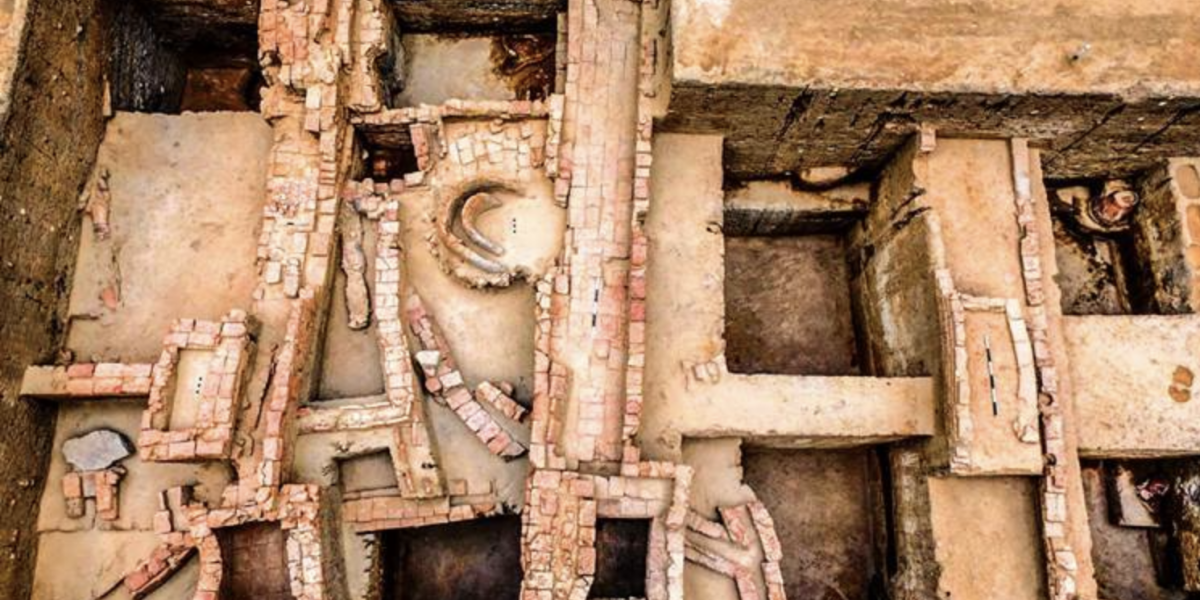
Exposed brick walls at Keeladi site. Photo: keeladimuseum.tn.

In 1945, British archaeologist Mortimer Wheeler discovered an ancient port site, Arikamedu, when he sank a trowel 20 kilometres outside present-day Puducherry. I had first heard of Wheeler through Tamil cinema. His reel version appeared in the opening scenes of the Kamal Haasan–starrer Hey Ram, telling Haasan and Shahrukh Khan to pack up the dig since Partition was imminent. After serving in World War II, Wheeler was appointed Director-General of Archaeology in the Government of India, serving from 1944 to 1947. He identified two major problems in historical knowledge in the subcontinent. In North India, there was a gap of 1,000 years or more between the end of the IVC and the beginning of the Persian Empire around 600 bce.

In South India, the problem was even more far-ranging, as it was unclear exactly what occurred before the Greco–Roman interactions of the first century ce. Wheeler aimed to bridge these gaps in the sequence of cultures between Protohistory (3000 bce to 600 bce), the period between prehistory and written history, and the Early History of India (600 bce to 300 bce). Much of archaeology serves to fill such cultural gaps, showing the baton passing as one culture evolved into another, or how migration occasionally disrupted existing cultures.

Wheeler’s choice of sites in India and his interpretation were informed by his educational background in classics and his experience excavating Romano–British sites in Wales and England. He sought to establish a chronological framework for the entire country. Between 1945 and 1947, he helped define a sequence of South Indian cultures, comprising a stone axe culture, megalithic settlements, and local Andhra cultures, and pottery featuring Mediterranean designs. Wheeler discovered this pottery in Arikamedu. In a museum in Pondicherry, now Puducherry, he had noticed the remains of a Roman amphora – a tall Greco–Roman jug with two handles and a narrow neck – which sparked his interest.


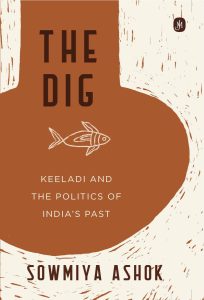
The Dig: Keeladi and the Politics of India’s Past, by Sowmiya Ashok, Published by John Murray, December 2025.

At Arikamedu, Wheeler excavated along the banks of the Ariyankuppam River’s mouth, where it opened into the Bay of Bengal, uncovering fragments of amphorae and a bright red, polished pottery called Arretine ware. He compared these finds with references in classical literary accounts such as the Periplus Maris Erythraei, a logbook maintained by sailors where they recorded a ship’s itinerary and impressions they had of the ports they visited. Wheeler concluded that Arikamedu had been an Indo-Roman port thriving during the first two centuries ce, a timeline later revised by subsequent excavators to the second to the third centuries bce. Scholars who followed Wheeler to the site discovered that the Romans had reached Pattanam in Kerala, navigated around Sri Lanka, and arrived on India’s east coast. They left intriguing traces, such as amphora jars that likely transported fish sauce and wine.

Wheeler’s discovery also validated a line of inquiry that had long fascinated Tamil intellectuals: could classical literary accounts provide clues to the locations of material remains? By sequencing Roman ceramics, amphorae, and Arretine ware and correlating them with literary sources Wheeler proposed that Arikamedu was indeed an Indo-Roman trading station.

Arikamedu was once a vibrant port city, manufacturing a wide range of textiles, including muslin cloth, as well as delicate terracotta objects, jewellery made of beads and semi-precious stones, glass, and gold. One of the earliest finds was an intaglio reported to bear a portrait of Augustus, which led to further excavations revealing an unfinished intaglio of a cupid and a bird, thought to have been completed in India by Greco–Roman artisans.

By the time Wheeler excavated at Arikamedu, he had perfected a scientific way of digging a trench, named after him. The Wheeler Method allowed archaeologists to understand both the horizontal layout and the vertical timelines of ancient settlements. Under this method, the site was divided into squares resembling grids. Some squares were left unexcavated, forming vertical walls of earth known as balks, which revealed the story of time in the soil layers. Even today, archaeologists across sites in India and Tamil Nadu continue to use this method, digging a series of squares within a large grid, allowing for a freestanding wall of earth that exposes the stratigraphy of ancient settlements.

At the Government Museum, Puducherry, I had seen some of the Arikamedu finds behind poorly maintained display cases. Amongst them were beads. Arikamedu was the birthplace of the glass bead industry, which supplied much of the Old World with monochrome Indo–Pacific beads for over 2,000 years. These were small, angular glass beads. The bead makers eventually relocated from Arikamedu to other sites in Sri Lanka, Malaysia, Vietnam, and Thailand, continuing their craft.

This is an excerpt from Sowmiya Ashok’s The Dig: Keeladi and the Politics of India’s Past.