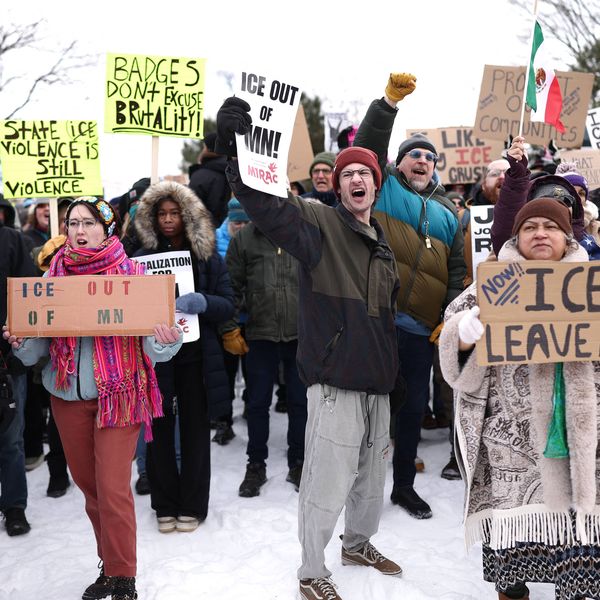
Monday, January 12, 2026

Cuba braces for economic collapse as US blocks Venezuelan oil supplies

Cuba braces for economic collapse as US blocks Venezuelan oil supplies
Analysts believe Cuban President Díaz-Canel, who belongs to the post-revolution generation, does not command the same credibility as the Castro brothers, even if he remains committed to the ideology of the revolution.
By bnl editorial staff January 12, 2026

US President Donald Trump has warned Cuba it will no longer receive oil supplies or financial support from Venezuela, calling on the island's government to negotiate terms with Washington in the aftermath of last week's operation that resulted in Nicolás Maduro's capture.

Writing on Truth Social on January 11, Trump stated no oil or money would reach Cuba from its South American ally, providing no specifics about what kind of agreement he sought or its intended purpose.

Cuban President Miguel Díaz-Canel responded swiftly, rejecting any external interference in his country's affairs and pledging the nation stood prepared to defend itself completely. "Cuba is a free, independent and sovereign nation. No one tells us what to do," Díaz-Canel wrote on X.

The exchange follows the January 3 US commando operation in Caracas that resulted in Maduro's detention alongside his wife. According to Havana's government, 32 Cuban nationals died during the raid, individuals whom Washington claims provided protection services to the Venezuelan leadership.

Trump's threats come as Cuba's communist system shows mounting signs of strain amid deepening economic hardship and crumbling infrastructure. The island has experienced severe food shortages, with an estimated 1.4mn people failing to meet daily caloric requirements in 2023, whilst extreme poverty affected 88% of the population by 2024. Growing numbers of Havana residents have been forced to scavenge through rubbish bins for sustenance as the government's socialist safety net has collapsed.

Trump asserted that Cuba had depended on substantial petroleum deliveries and monetary transfers from Venezuela over many years, receiving these benefits in return for supplying security personnel to Maduro and former president Hugo Chávez. He stated most of these Cuban operatives were killed in the recent American assault.

Foreign Minister Bruno Rodríguez, however, disputed the allegations, insisting Cuba has never accepted payment or material compensation for providing security assistance to foreign governments. He maintained his country possesses full authority to acquire fuel from any exporter willing to conduct business, rejecting Washington's economic restrictions as legitimate constraints on such commerce.

On January 12, Díaz-Canel clarified that bilateral discussions with Washington were limited to technical migration coordination, contradicting Trump's implications about broader negotiations. The Cuban leader specified that meaningful engagement would require "adherence to sovereign equality, reciprocal respect, international legal principles, mutual advantage, non-interference in domestic matters and complete recognition of Cuban independence.”

Trump last week stated Cuba appeared on the verge of collapse, pointing out that the island had depended entirely on Venezuelan petroleum for its income and would struggle without this resource.

Indeed, Cuba faces severe economic difficulties, compounded by long-standing US sanctions and what was an already dwindling supply of subsidised Venezuelan crude oil. The island uses this fuel to operate diesel generators that support an unstable electrical system experiencing regular power failures. The country's power infrastructure has suffered from years of underinvestment and is "literally crumbling", according to Philip Paterson, senior analyst for Latin America at Oxford Analytica, causing frequent nationwide blackouts.

The oil arrangement between ideologically aligned Havana and Caracas dates back to 2000, when Chávez established the subsidised supply agreement. This Venezuelan backing offered a crucial lifeline after the Soviet Union's collapse ended Moscow's economic support to Cuba. However, as Venezuela's own crisis worsened, this aid has largely dried up.

"China is willing to deal with Cuba, but it's not ideologically committed to supporting it the way the Soviet Union or Venezuela were, and it's not keen to deal with charity cases," Paterson said last July during an Oxford Analytica webinar.

American crippling economic sanctions against Cuba have remained in force for over six decades. Washington's reclassification of Cuba as a "state sponsor of terrorism" under Trump's first term has made travel to the United States more difficult for anyone who has visited the island, and placed additional restrictions on companies seeking to do business there. As a result, many tour operators have stopped operating in Cuba, cutting off a critical source of foreign currency.

On January 11, Trump shared a social media post suggesting Marco Rubio might assume leadership of Cuba, voicing his approval of the idea. Rubio, whose parents emigrated from Cuba, currently holds the secretary of state position whilst serving simultaneously as national security adviser and previously heading the US Agency for International Development.

According to analysts, Rubio views Venezuelan regime change as a stepping stone to his ultimate objective of ending communist rule in Cuba. He has long argued that toppling Maduro's government would deal a fatal blow to the communist-run island by undermining Havana's principal supporter.

Another key factor differentiating the current period from earlier crises is leadership. Díaz-Canel, who belongs to the post-revolution generation, does not command the same credibility as the Castro brothers, even if he remains committed to the ideology of the revolution, according to Paterson.

"Expectations of government collapse are writ large now," Paterson said, pointing to reduced external assistance, increasing external pressure, and a leadership that lacks the historic legitimacy of its predecessors.

Maduro's abduction, framed by the White House as law enforcement activity to prosecute the authoritarian leader on narcoterrorism charges, generated widespread international criticism over what critics described as a blatant violation of international law.

The latest warnings to Cuba form part of Trump's broader regional strategy, which he branded the "Donroe Doctrine" in reference to nineteenth-century American foreign policy asserting hemispheric influence. Following the Venezuela operation, Trump has directed threatening statements towards Colombia, Mexico, Iran and Greenland.


Cuba denies being in talks with Trump on potential deal


By AFP
January 12, 2026


Cubans have lived under more than 60 years of US sanctions - Copyright AFP Adalberto ROQUE

Cuba’s leader on Monday reacted defiantly to President Donald Trump’s threats to “make a deal” or pay the price in the aftermath of key ally Nicolas Maduro’s ouster in a US military raid.

Trump has been ramping up pressure on Cuba, one of the few Latin American countries still run by an authoritarian leftist administration after Venezuelan leader Maduro’s capture on January 3.

“We’re talking with Cuba,” Trump said aboard Air Force One on Sunday, hours after urging Havana to do a deal to head off unspecified US actions.

The Republican president, who says Washington is now effectively running Venezuela, earlier vowed to cut off all oil and money Caracas had been providing to ailing Cuba.

“THERE WILL BE NO MORE OIL OR MONEY GOING TO CUBA – ZERO!” Trump said on his Truth Social platform.

“I strongly suggest they make a deal, BEFORE IT IS TOO LATE,” he said, without specifying what kind of deal he was promoting or what would happen if Cuba refused to negotiate.

Cuba, which is struggling through its worst economic crisis in decades, has reacted defiantly to the US threats even as it reels from the loss of a key source of economic support from Caracas.

President Miguel Diaz-Canel denied Monday being in talks with Washington, saying there are “no conversations with the US government except for technical contacts in the area of migration.”


– ‘To the last drop’ –


On Sunday, Diaz-Canel vowed that the Caribbean island’s residents were “ready to defend the homeland to the last drop of blood.”

Cuba has been a thorn in the side of the United States since the revolution that swept communist Fidel Castro to power in 1959.

The deployment of Soviet nuclear missile sites on the island triggered the Cuban missile crisis of 1962, when Washington and Moscow took the world to the brink of nuclear war.

During his first presidential term, Trump walked back a detente with Cuba launched by his predecessor Barack Obama.

Immediately after the US capture of Maduro in a dramatic raid in Caracas, Trump stated that Cuba was “ready to fall.”

He noted that the island, which has been plagued by blackouts due to crippling fuel shortages, would find it hard to “hold out” without heavily subsidized Venezuelan oil.

The Financial Times last week reported that Mexican oil exports to Cuba had surpassed those of Venezuela last year.


– Role for Rubio? –


Trump’s Secretary of State Marco Rubio, a child of Cuban immigrants who is a sworn foe of the communist government, has long had Havana in his sights.

“If I lived in Havana and I was in the government, I’d be concerned at least a little bit,” he told reporters on January 3, after Maduro’s capture and transfer to the United States on drug trafficking and weapons charges.

Aboard Air Force One on Sunday, Trump referred to the generations of Cubans, like Rubio’s parents, who had fled the island to the United States.

“Most importantly, right now, we’re going to take care of the people that came from Cuba, that are American citizens, or in our country,” Trump said, without saying how he would achieve that.

He also reposted a message that jokingly suggested Rubio could serve as president of Cuba.

burs-cb/msp


Trump tells Cuba to ‘make a deal, before it is too late’

By AFP
January 11, 2026


About a quarter of Cuba's citizens are eldery, and many of them are poor
 - Copyright AFP YAMIL LAGE

US President Donald Trump urged Cuba on Sunday to “make a deal” or face unspecified consequences, warning that the flow of Venezuelan oil and money to Havana would now stop.

The communist-run island near Florida has been a US foe and ally of Caracas for decades, but Trump has ramped up his threatening language in recent days — particularly after Washington toppled Venezuela’s leftist leader Nicolas Maduro.

“THERE WILL BE NO MORE OIL OR MONEY GOING TO CUBA – ZERO!” Trump said on his Truth Social platform. “I strongly suggest they make a deal, BEFORE IT IS TOO LATE.”

Trump provided no details about what potential deal he referred to, or what such an arrangement would achieve.

His remarks come a week after US forces seized Venezuela’s authoritarian leader Maduro in a nighttime operation in Caracas that killed dozens of Venezuelan and Cuban security forces.

A week ago, Trump stated that “Cuba is ready to fall,” noting that the island’s economic crisis was worsening and that it would be difficult for Havana to “hold out” without receiving heavily subsidized Venezuelan oil.

Earlier on Sunday the president reposted a message suggesting US Secretary of State Marco Rubio — a child of Cuban immigrants — could become the president of Cuba.


US President Donald Trump is heaping pressure on Cuba, the communist-ruled island nation barely 90 miles (145 kilometers) from the state of Florida – Copyright AFP OMAR HAJ KADOUR

Trump shared that post with the comment: “Sounds good to me!”

In a separate message soon afterwards, Trump said that “Cuba lived, for many years, on large amounts of OIL and MONEY from Venezuela. In return, Cuba provided ‘Security Services’ for the last two Venezuelan dictators, BUT NOT ANYMORE!”

“Most of those Cubans are DEAD from last week’s U.S.A. attack, and Venezuela doesn’t need protection anymore from the thugs and extortionists who held them hostage for so many years.”

Cuba’s communist government rejected the suggestion that Havana had been in the pocket of Caracas.

Cuba has “never received monetary or material compensation for the security services it has provided to any country,” Foreign Minister Bruno Rodriguez posted on X.

He noted Havana has the right to import fuel from any willing exporter, “without interference or subordination to the unilateral coercive measures of the United States.”

– ‘Beginning of the end’ –

Under a US trade embargo, Havana since 2000 has increasingly relied on Venezuelan oil provided as part of a deal struck with Maduro’s predecessor, the firebrand leftist Hugo Chavez.

Trump’s provocative language on Cuba comes as the emboldened American leader has hinted he has other countries in his sights after capturing Maduro.

Trump, who had openly sought last year’s Nobel Peace Prize, has recently threatened Colombia, Mexico, Iran and Greenland.

Some Republican US lawmakers on Sunday lauded Trump for his aggressive comments on Cuba, including Mario Diaz-Balart, a US congressman from Florida.

“We are witnessing what I am convinced will be the beginning of the end of the regime in Havana,” Diaz-Balart posted in Spanish on X.

“The tyranny in Cuba will not survive the second term of President Trump, and Cuba will finally be free after decades of misery, tragedy, and pain.”

Trump vows to cut off Cuba’s oil after toppling Venezuelan ally Maduro

AFP 
Published January 12, 2026 


US President Donald Trump urged Cuba on Sunday to “make a deal” soon, pledging to cut off all oil and money flowing to the communist-run island after the toppling of Havana’s key ally, Venezuelan leader Nicolas Maduro.

The threatening social media post drew an angry retort from Cuban President Miguel Diaz-Canel, who said “no one” would tell his country what to do.

Washington has imposed economy-crippling sanctions on its island neighbour for decades, but Trump has ramped up the pressure in recent days.

US special forces seized Maduro and his wife this month in a lightning raid that left dozens of the ousted Venezuelan president’s security personnel dead — many of whom were Cuban.

Though Maduro’s allies have become interim leaders, Trump has claimed the United States now actually controls Venezuela through a US naval blockade of its vital oil sector.

“THERE WILL BE NO MORE OIL OR MONEY GOING TO CUBA - ZERO!” Trump said on his Truth Social platform.

“I strongly suggest they make a deal, BEFORE IT IS TOO LATE.”

He said, “Cuba lived, for many years, on large amounts of OIL and MONEY from Venezuela. In return, Cuba provided ‘Security Services’ for the last two Venezuelan dictators, BUT NOT ANYMORE!” “Most of those Cubans are DEAD from last week’s U.S.A. attack, and Venezuela doesn’t need protection anymore from the thugs and extortionists who held them hostage for so many years.”


Trump provided almost no details about what potential deal he referred to, or what such an arrangement would achieve.

Asked about it later on Sunday, Trump told reporters travelling with him on Air Force One that he wanted people forced out of Cuba or who “left under duress” to be taken care of.

“Most importantly, right now, we’re going to take care of the people that came from Cuba, that are American citizens, or in our country,” Trump said, without clarifying how this would be achieved under a deal with Havana.


“…THERE WILL BE NO MORE OIL OR MONEY GOING TO CUBA - ZERO! I strongly suggest they make a deal, BEFORE IT IS TOO LATE. Thank you for your attention to this matter.”- President Donald J. Trump


‘Ready to fall’


A week ago, Trump stated that “Cuba is ready to fall,” noting that the island’s economic crisis was worsening and it would be difficult for Havana to “hold out” without receiving heavily subsidised Venezuelan oil.

Earlier on Sunday, the president reposted a message that jokingly suggested US Secretary of State Marco Rubio — a child of Cuban immigrants who concurrently holds the posts of national security advisor, acting head of the US archives, and acting international aid administrator — could also become the president of Cuba.

Trump shared that post with the comment: “Sounds good to me!” Cuba’s president rebuffed Trump’s threatening language, saying the Caribbean island’s residents were “ready to defend the homeland to the last drop of blood.” “Cuba is a free, independent and sovereign nation. No one tells us what to do,” Diaz-Canel wrote on X.

Foreign Minister Bruno Rodriguez also weighed in to stress that Cuba is within its rights to import fuel from any willing exporter, “without interference or subordination to the unilateral coercive measures of the United States.”
‘Talk, talk, talk’

A Cold War-era US trade embargo has cinched Cuba’s economy beginning in 1962, and since 2000 Havana has increasingly relied on Venezuelan oil provided as part of a deal struck with Maduro’s predecessor, the firebrand leftist Hugo Chavez.

On Sunday in the streets of Havana, retiree Mercedes Simon seemed to dismiss the US leader’s latest bluster.

“Trump is not going to touch Cuba,” the 65-year-old told AFP.

“All the presidents talk, talk, talk” about Cuba, for decades, “but they don’t act.” Marcos Sanchez, a 21-year-old working in the restaurant business, said the two countries should find common ground, “without resorting to violence.”

Trump’s provocative language on Cuba comes as the emboldened American leader has hinted he has other countries in his sights after capturing Maduro.

Trump, who had openly sought last year’s Nobel Peace Prize, has recently threatened Colombia, Mexico, Iran and Greenland.

Some Republican US lawmakers on Sunday lauded Trump for his aggressive comments on Cuba, including Congressman Mario Diaz-Balart from Florida.

“The tyranny in Cuba will not survive the second term of President Trump,” Diaz-Balart posted in Spanish on X, “and Cuba will finally be free after decades of misery, tragedy, and pain.”


Trump, Vance, and Noem Launch a 
Pre-emptive Strike Against the Truth

In light of the Trump administration’s lies, the odds of getting a credible federal probe into the killing of Renee Good are slim.


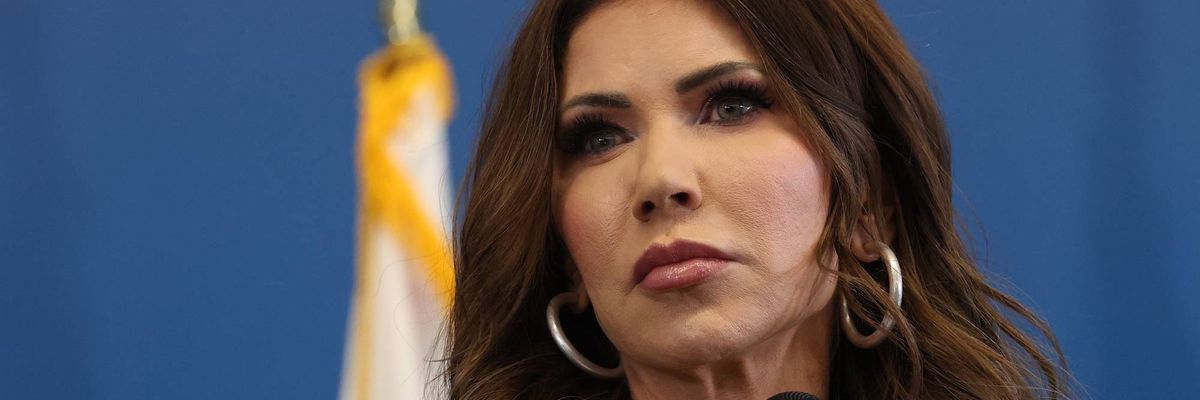
US Secretary of Homeland Security Kristi Noem attends a press conference in New York City on January 8, 2026.
(Photo by Timothy A. Clary/ AFP via Getty Images)


Steven Harper
Jan 12, 2026
Common Dreams


Please take five minutes to watch these two videos.

First, Immigration and Customs Enforcement (ICE) officer Jonathan Ross’ video:


Then watch this New York Times compilation of bystanders’ videos prepared before officer Ross’ video was publicly available


The Facts

Renee Nicole Good was a US citizen, the mother of three, an award-winning poet, and the widow of a military veteran. On Wednesday morning January 7, she dropped her six-year-old son at school and proceeded in her Honda Pilot down Portland Avenue—a one-way residential street in south Minneapolis. Around 10:40 am, she had a brief encounter with ICE officers during which she smiled at officer Ross, who was filming the episode on his smartphone.

“That’s fine, dude. I’m not mad at you,” she told Ross.

Another officer yelled at her to “get out of the f*cking car” and grabbed her door handle. By then, Ross was standing near the front driver’s side of the Honda. Attempting to avoid him as she drove away, Good turned the steering wheel sharply to the right. Ross fired three shots, and the Honda careened toward a parked car before crashing into it.

ICE officers receive CPR training, but none went to Good’s aid. A physician nearby tried to help, but ICE officers blocked him.

Fifteen minutes later, medics arrived. Shortly thereafter, she died at Hennepin County Medical Center.
The Lies Begin

An hour later, Kristi Noem’s Department of Homeland Security (DHS) issued a statement defending Ross and demonizing Good.

According to DHS, “[R]ioters began blocking ICE officers and one of these violent rioters weaponized her vehicle, attempting to run over our law enforcement officers in an attempt to kill them—an act of domestic terrorism.”

The statement continued:
An ICE officer, fearing for his life, the lives of his fellow law enforcement, and the safety of the public, fired defensive shots. He used his training and saved his own life and that of his fellow officers. The alleged perpetrator was hit and is deceased. Thankfully, the ICE officers who were hurt are expected to make full recoveries.

Minneapolis Mayor Jacob Frey called that description of the event “bullsh*t.”

With her press release, Noem had launched a preemptive strike on the truth.
Trump Doubles Down on the Lies

Three hours after DHS’ statement, President Donald Trump posted on Truth Social a 13-second clip showing Good’s vehicle smashing into the parked car. It revealed nothing about the events that had led to the shooting.

But that didn’t prevent Trump from embellishing Noem’s false narrative. He said that “the woman driving the car was very disorderly, obstructing and resisting, who then violently, willfully, and viciously ran over the ICE officer, who seems to have shot her in self defense.”
Noem and Vance Double Down on the Lies

It’s worth noting that Noem can ill afford the publicity of an ICE officer committing a potential homicide. In December, The Bulwark reported that Trump was considering three candidates to replace her, although the White House denied it.

At 6:00 pm, Noem held a press conference. She said that Good was among a “mob of agitators,” had “weaponized her vehicle,” and committed an “act of domestic terrorism” that justified ICE officers responding with deadly force.

The following morning, Vice President JD Vance—who oozes ambition—called Good a “deranged leftist who tried to run [the officer] over” and was certain that she had broken the law. He said that the officer was protected by “absolute immunity.” Vance, a Yale Law School graduate, knows better.
Will Patel’s FBI Seal the Deal?

Trump’s Justice Department then excluded Minnesota officials from participating in the FBI investigation into the killing. Noem said that the FBI has “exclusive jurisdiction,” which is incorrect. Minnesota has jurisdiction over state crimes, including potential homicides.

But following the launch of the Trump administration’s false narrative of the killing, barring an objective investigation is the second phase of the preemptive strike against the truth. FBI Director Kash Patel is a fierce Trump loyalist who has likened Trump to a king. But like Noem, he has been the subject of recent reports that his position is precarious. He will fall in line behind the Trump-Vance-Noem false narrative of the event.
Evaluating the Evidence

Vance said that Ross was “doing his job.” Noem insisted that he “followed his training.” Let’s test those claims.

DHS requires its officers to follow these guidelines on the use of force:Respect human life;Deescalate confrontations;Use safe tactics that minimize the risk of personal and property damage; don’t put yourself in a situation where your only alternative is using deadly force;When feasible, give a warning before using force and give the subject a reasonable opportunity to comply;As soon as practicable, obtain appropriate medical assistance for anyone injured;Don’t fire warning shots solely to disable moving vehicles;Use of deadly force must be reasonable in lights of the facts and circumstances confronting the officer;Use deadly force only when you have a reasonable belief that the subject of such force poses an imminent threat of death or serious bodily injury to you or another person; “reasonableness” is an objective standard (“what would a reasonable person in that position do”);Do not use deadly force solely to prevent the escape of a fleeing subject, unless you have a reasonable belief that the subject poses a significant threat of death or serious physical harm to you or others and such force is necessary to prevent escape;Discharging a firearm against a person constitutes the use of deadly force and shall be done only with the intent of preventing or stopping the threatening behavior that justifies the use of deadly force; andDo not discharge firearms at the operator of a moving vehicle… unless the use of deadly force against the operator is justified under the standards articulated elsewhere in this policy. Before using deadly force under these circumstances, you must take into consideration the hazards that may be posed to law enforcement and innocent bystanders by an out-of-control vehicle.

To the same effect are Justice Department guidelines.

In light of the Trump administration’s preemptive strike on the truth, the odds of getting a credible federal probe are slim. Officer Ross fired three shots; each was a use of deadly force. How many guidelines did he violate?

Watch The Minnesota Star Tribune‘s analysis that incorporates five videos of the tragedy and decide for yourself.

Our work is licensed under Creative Commons (CC BY-NC-ND 3.0). Feel free to republish and share widely.


Steven Harper
Steven J. Harper is an attorney, adjunct professor at Northwestern University Law School, and author of several books, including Crossing Hoffa -- A Teamster's Story and The Lawyer Bubble -- A Profession in Crisis. He has been a regular columnist for Moyers on Democracy, Dan Rather's News and Guts, and The American Lawyer. Follow him at https://thelawyerbubble.com.
Full Bio >

‘Goebbels Could Not Have Improved On This’: DHS Spreads ‘Propaganda’ on ICE Killing as Violence Mounts

“I never imagined that my government would so blatantly lie like this,” said one author and attorney.


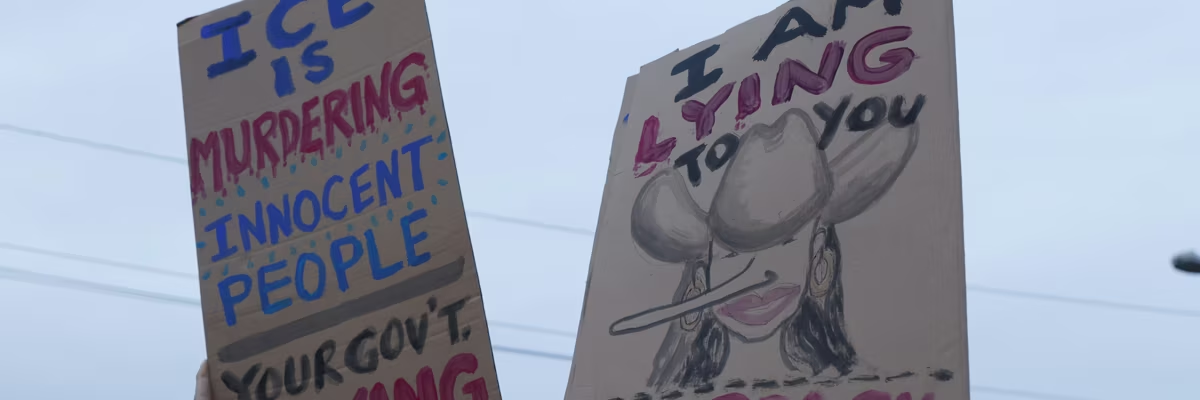
Protesters gather in Austin, Texas on January 8, 2026, to rally against US Immigration and Customs Enforcement following the fatal shooting of Renee Nicole Good.
(Photo by Stephanie Tacy/NurPhoto via Getty Images)

Julia Conley
Jan 12, 2026
COMMON DREAMS

As Americans have continued to document federal agents violently pushing a bystander to the ground during an arrest, handcuffing a screaming mother, and demanding to see citizenship papers of people of color, observers said the US Department of Homeland Security’s latest video about a federal officer’s killing of Renee Good in Minneapolis last week showed it has resorted to “blatant propaganda” to shape public opinion on the Trump administration’s violent crackdown on immigrants and dissenters.

“This agency, and the way it now speaks, is the most repulsive and un-American things I have ever seen,” said one writer of a video featuring Lauren Bis, the deputy assistant secretary of homeland security, that was released four days after Good was fatally shot by a US Immigration and Customs Enforcement (ICE) officer.


‘Reign of Terror’: ICE Builds Appalling Record of Killings, Beatings, Kidnappings, and More


‘We Are Not Afraid’: Nationwide Protests Against ICE Killing of Renee Good, Fascist Trump

The video was posted to social media Sunday, accompanied by the text: “Defend the Homeland. Protect the American way of life.” Bis presented footage of Good’s vehicle before and after she was shot while sitting in the driver’s seat of her car by an ICE agent who had approached the driver’s side of the front of the vehicle.

Bis repeated claims that have been pushed by Homeland Security Secretary Kristi Noem, Vice President JD Vance, and President Donald Trump: that Good was a “rioter” who “weaponized her vehicle, attempting to run over our law enforcement officers in an attempt to kill them.”


She said that “the American people can watch this video with their own eyes and ears and judge for themselves,” but legal experts, news outlets, and members of the public have already spent the past several days doing just that.

Experts and media organizations have extensively analyzed footage of the killing and said that despite the administration’s repeated claims, there is no evidence that Good was part of any riot. As the Guardian reported last week, “The officer who fired the fatal shots walked up to the front of Good’s car, which was turning away from him as it began to move forward, and he remained on his feet as the vehicle passed him.”

Author and University of Missouri law professor Thom Lambert said that the government “may argue that the ICE agent feared for his life, perhaps even reasonably, but the video CLEARLY shows that Good had turned away from the officer.”

“I never imagined that my government would so blatantly lie like this,” added Lambert, who also took issue with Bis’ insistence that the administration “pray[s]” for Good and her family—even as another White House official, press secretary Karoline Leavitt, called the victim a “lunatic” in comments to reporters on Monday.

Despite DHS’ display of footage that many observers have said proves Good’s wheels were turned away from the ICE agent when she began driving, David J. Bier of the libertarian Cato Institute said: “They are still using verbatim the utterly inaccurate statement from the first day. This is pathological.”

Another critic noted that the video was edited by DHS to make it appear that Good “weaponized her vehicle” by “speeding across the road”—“obviously failing to mention that footage is of when she had just been shot in the fucking face and her dead foot hit the pedal.”

Jessica Simor, an expert in human rights law in the UK, said that Joseph Goebbels, the architect of Adolf Hitler’s propaganda machine in Nazi Germany, “could not have improved” on Bis’ video.


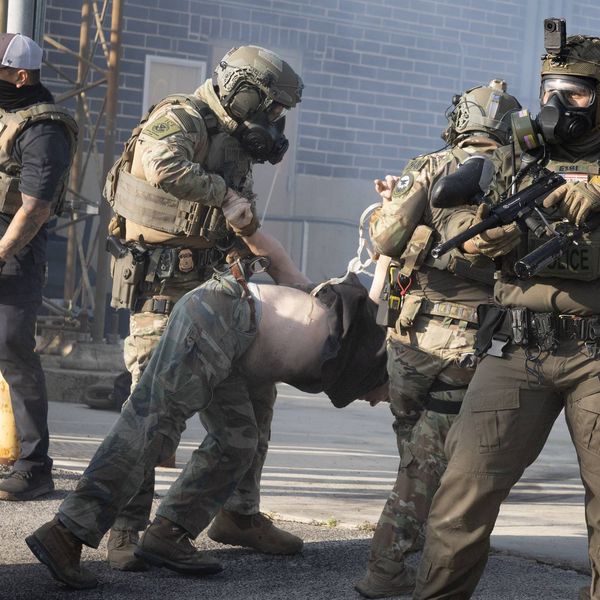
As the video circulated online Monday, ICE and Border Patrol agents were seen in numerous new footage treating people in Minneapolis and elsewhere violently and appearing the warn them against even acting as bystanders to their enforcement actions.

Federal agents were seen chasing and tackling a man to the ground, apparently for filming with his cellphone as they carried out an arrest at a gas station in St. Paul, Minnesota.

In another video, a federal officer approached a woman who was filming him and said, “Listen, have you all not learned from the past couple of days?” before snatching her phone.


It is legal under the First Amendment for bystanders to film ICE and other federal agents as long at they are not obstructing their operations.

Organizer and attorney Aaron Regunberg said in response to that video that the US will ultimately “need some serious Truth and Reconciliation/Nuremberg shit for every fascist scumbag member of this administration.”

Neighbors in Minneapolis protect each other from US immigration police


By AFP
January 10, 2026


Neighbors are banding together to protect one another from US Immigration and Customs Enforcement raids in the wake of a fatal shooting by a federal agent - Copyright AFP CHARLY TRIBALLEAU

Elodie SOINARD

When Jennifer Arnold learned one of her neighbors in the midwestern city of Minneapolis had been arrested by immigration authorities late last year, she reached out to lend a hand.

“She answered the phone sobbing because she had gone to a work site with her husband, and he had been pulled out of their car and picked up,” Arnold recalled.

Now, a month later, Arnold is connecting neighbors to help immigrants survive the sweeping crackdown by the administration of US President Donald Trump, which turned deadly this week when a federal agent opened fire on a woman driving an SUV.

Arnold said at first she helped her neighbors, who were terrified of leaving their homes “because it’s not safe.”

Then she noticed that the school bus stop nearby, which usually had 20 children waiting for a ride to school in the morning, only had 10 kids.

“Many of those families didn’t feel safe sending their kids because they had to walk” a couple blocks to get to the stop, Arnold said.

She took action, asking neighbors “if I could get someone to walk with your kid to the bus stop, or take them, drive them to school, would you send them?”

Neighbors said yes.

With that, Arnold began helping a dozen children get to school beginning the second week of December.

“And then the next week, it was 18 kids. And now I have 30 on my list,” Arnold said.


– Adopting a family –


Parents, neighbors and friends of friends signed up to take children to and from school — walking them to a bus stop or driving them — to help them avoid falling behind in class.

And when Christmas came and schools closed for the holiday, Arnold asked volunteers to adopt a family for the holiday and organized food deliveries.

“They went shopping and brought bags of groceries to the family they adopted. We did one right before Christmas and one right before New Year’s. And folks said to me ‘my kids would have been hungry’ if we hadn’t done that,” Arnold said.

Wednesday’s shooting death of 37-year-old Renee Nicole Good at the hands of masked ICE agents — who are still conducting operations on Minneapolis streets — has only inspired more volunteers.

“I went to pick up a four-year-old and introduce him to a neighbor who’s gonna walk him home every day. And there were all these people out on the streets who were like, ‘Can we do this too?’ And since what happened on Wednesday, my list is growing,” Arnold said.

Now, schools are adapting to the families’ fears: Minneapolis announced Friday that it is launching remote learning through mid-February for students who need it.

On the streets, neighbors have been vigilant in using whistles to alert each other about the presence of ICE agents.

Education union leader Natasha Dockter says she wears her whistle “all the time now,” adding: “I use it more often that I would like to.”

She said it also becomes “an invitation to talk to other neighbors about what’s going on,” and she keeps extra whistles in her pocket to share with those who are interested in helping.

While neighbors in Minneapolis are trying to alert each other to potential suffering, there are also those who are coping in silence.

“There are kids who have lost a family member, who are completely traumatized, who are terrified every day, who can’t leave their houses other than to go to school,” Becca Dryden, 36, told AFP, adding that the duty of parents to inform kids about what was happening was a tough one.

“As parents, we keep having to explain these tragedies to them. Whether they are targeted themselves or watching their neighborhood and community be targeted, this is a trauma that’s happening to all of our children.”

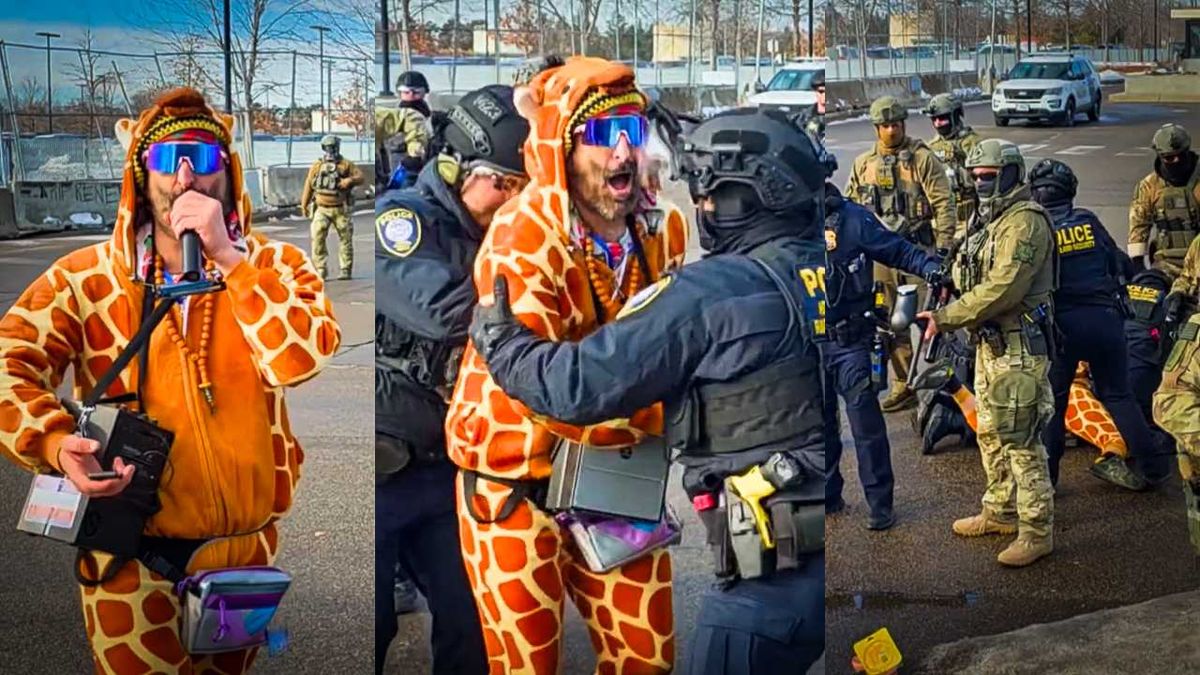
'Leave the giraffe alone!' ICE violently arrests comedian mocking them in animal costume

David Edwards
January 12, 2026 

Robby Roadsteamer/Facebook/screen grab

Comedian Rob Potylo said he was arrested by Immigration and Customs Enforcement (ICE) agents in Minneapolis while performing in a giraffe costume as a fictional character known as Robby Roadsteamer.

Several Robby Roadsteamer social media accounts claimed that ICE had arrested Potylo. The social media posts included a video showing around a dozen law enforcement officers approaching the comedian and violently forcing him to the ground without any explanation.

As Potylo was handcuffed, protesters screamed at the officers.

"Leave the giraffe alone!" one person shouted.

The comedian has previously had encounters while mocking federal agents in Portland.


‘I know the pain’: ex-refugee takes over as UNHCR chief


ByAFP
January 12, 2026


Barham Salih has experienced torture and exile as an Iraqi Kurd
- Copyright AFP Peter PARKS

Julie CAPELLE

Barham Salih has known torture and the wrenching loss of exile. Four decades after his own ordeal, he has taken the helm of the UN refugee agency as it grapples with a funding shortfall and ever-rising needs.

A former Iraqi president, Salih, 65, became the first former head of state to run the United Nations High Commission for Refugees (UNHCR) at the start of the year.

“It is a profound moral and legal responsibility,” Salih told AFP during his first trip in the new role — to Kakuma refugee camp in Kenya.

“I know the pain of losing a home, losing your friends,” he said.

The Kakuma refugee camp, which Salih visited on Sunday, is east Africa’s second largest, hosting roughly 300,000 people from South Sudan, Somalia, Uganda and Burundi. It has been in place since 1992.

The world “should not allow this to continue”, Salih said, praising a new initiative by Kenya to turn its camps into economic hubs.

“We should not only protect refugees… but also enable them to have more durable solutions,” he said, while adding: “The better way is to have peace established in their own countries… nowhere is nicer than home.”


– ‘Electric shocks, beating’ –


The son of a judge and a women’s rights activist, Salih was born in 1960 in Sulaymaniyah, a stronghold of the Patriotic Union of Kurdistan (PUK), which sought self-determination for Iraq’s Kurds.

He went into exile in Iran in 1974, spending a year at a school for refugees. As a teenager in 1979, back in Iraq and already a member of the PUK, he was arrested twice by former dictator Saddam Hussein’s regime.

“I was released after 43 days after having suffered torture, electric shocks, beating,” he said.

Upon release, he still managed to rank among Iraq’s top three high school students, according to a former colleague, before fleeing with his family to Britain where he earned a degree in computer engineering and a doctorate.

Salih has “real experience of exile… He brings a personal perspective of displacement, which is very important,” Filippo Grandi, his predecessor at UNHCR, told AFP last month.

Salih went on to a successful career in Iraqi Kurdistan and Iraq’s federal government after Hussein’s overthrow in 2003, holding the largely ceremonial role of president from 2018 to 2022.


– ‘Serious budget cuts’ –


Refugee numbers have doubled to 117 million in the past decade, the UNHCR said in June, but funding has dropped sharply, especially since Donald Trump returned to the White House.

UN Secretary-General Antonio Guterres recently praised Salih’s experience as a “crisis negotiator and architect of national reforms” at a time when the agency faces “very serious challenges”.

“We have had very serious budget cuts last year. A lot of staff have been reduced,” Salih told AFP.

“But we have to understand, we have to adapt,” he said, calling for “more efficiency and accountability” while also insisting the international community meets its “legal and moral obligations to help”.

burs-jcp/mnk/er/kjm
Myanmar pro-military party claims Suu Kyi’s seat in junta-run poll


By AFP
January 12, 2026


Myanmar's military deposed democratic leader Aung San Suu Kyi in 2021 after claiming she won a landslide election victory by massive voter fraud - Copyright AFP/File ROMEO GACAD

Myanmar’s main pro-military party on Monday claimed victory in the parliamentary seat of sidelined democratic leader Aung San Suu Kyi in elections being derided as a ploy to prolong junta rule.

The armed forces have ruled Myanmar for most of the nation’s post-independence history before a decade-long democratic thaw saw civilians assume control.

But the military snatched back power with a 2021 coup, deposing and detaining Suu Kyi after claiming she won a landslide election win over pro-military party by means of massive voter fraud.

The junta says the current month-long vote — which has its final phase scheduled for January 25 — will return power to the people.

With Suu Kyi still held in seclusion and her hugely popular party dissolved, democracy advocates say the vote has been rigged by a crackdown on dissent and a ballot stacked with military allies.

An official from the Union Solidarity and Development Party (USDP), speaking anonymously because they were unauthorised to share results, said they “won in Kawhmu” — Suu Kyi’s former seat in Yangon region.

“We won 15 lower house seats out of 16 places in Yangon region,” they added, after Kawhmu and dozens of other constituencies voted in the election’s second stage on Sunday.

The official did not say by what margin the party claimed its win and official results of the second round have yet to be posted by the junta-stacked election commission.

But the USDP — described by many analysts as the military’s prime proxy — won nearly 90 percent of lower house seats in the first phase, official results say.

“It should surprise no one that the military-backed party has claimed a landslide victory,” UN rights expert Tom Andrews said in a statement last week.

“The junta engineered the polls to ensure victory for its proxy, entrench military domination, and manufacture a facade of legitimacy while violence and repression continue unabated.”

Regardless of the vote, a quarter of parliamentary seats will be reserved for the armed forces under a constitution drafted during a previous period of military rule.

The coup plunged Myanmar into civil war and voting is not taking place in huge territories controlled by rebel factions running parallel administrations in defiance of military rule.

There is no official toll for Myanmar’s civil war but monitoring group ACLED, which tallies media reports of violence, estimates that 90,000 people have been killed on all sides.

The day of the election’s first phase, December 28, saw 52 incidents — more than any other day for eight months — with a total of 68 people killed, according to its figures.

Meanwhile more than 330 people are being pursued under new junta-enacted laws, including clauses that punish protest or criticism of the poll with up to 10 years in prison.

There are more than 22,000 political prisoners languishing alongside Suu Kyi in junta detention, according to the Assistance Association for Political Prisoners advocacy group.
Australia recalls parliament early to pass hate speech, gun laws

By AFP
January 12, 2026


Australia has flagged stricter hate crime and gun laws since the Bondi Beach mass shooting - Copyright AFP/File DAVID GRAY

Australia’s parliament will reopen two weeks early to crack down on hate crimes and gun ownership following the mass shooting at Bondi Beach, the government said Monday.

Australia has flagged a suite of reforms to hate crime and gun laws since the December 14 attack on a Jewish festival that killed 15 people — the country’s deadliest mass shooting in nearly three decades.

Prime Minister Anthony Albanese said he would recall both houses of parliament for a sitting from January 19-20 to pass the new legislation and offer condolences to the victims.

Members of parliament had been scheduled to return from their summer break on February 3.

“The terrorists at Bondi Beach had hatred in their minds but guns in their hands — this law will deal with both,” Albanese told a news conference.

The legislation would create new offences for “hate preachers”, stiffen hate crime penalties, expand a ban on prohibited symbols, and set the framework for a new list of banned hate groups.

It would allow the home affairs minister to reject or cancel visas for people intending to spread hatred, the prime minister said.

The laws would enable the launch of a national guns buyback scheme, the largest since Australia last targeted firearms following a mass shooting in 1996 that killed 35 people at Port Arthur, Tasmania.

Stricter checks would also be imposed for gun licences, the government said.

Details of the draft laws are to be released publicly on Tuesday.

Last week, the government announced a royal commission inquiry into the Bondi Beach shooting.

The federal royal commission — the highest level of government inquiry — will probe everything from intelligence failures to the prevalence of antisemitism in Australia.

Sajid Akram and his son Naveed allegedly targeted Jews attending a Hannukah celebration at Bondi Beach.

Sajid, 50, was shot and killed by police during the assault. An Indian national, he entered Australia on a visa in 1998.

His 24-year-old son Naveed, an Australian-born citizen who remains in prison, has been charged with terrorism and 15 murders.
Australia’s ambassador to US leaving post, marked by Trump rift


By AFP
January 12, 2026


Australia said Tuesday its ambassador to the United States is leaving after a three-year tenure overshadowed by President Donald Trump’s verdict on him: “I don’t like you either.”

Former prime minister Kevin Rudd, who departs his post on March 31 to become president of the Asia Society think tank in New York, had sharply criticised Trump while he was out of office.

Trump expressed disdain for Rudd during a televised US-Australia meeting at the White House in October last year, prompting some Australian opposition calls for his posting to be ended.

“Rudd has delivered concrete outcomes for Australia — during both Democrat and Republican Administrations — in collaboration with our closest security ally and principal strategic partner,” Prime Minister Anthony Albanese said in a joint statement with his foreign minister.

“We thank Dr Rudd for his exceptional service as Ambassador and as a former Prime Minister and Foreign Minister of Australia.”

Before taking up his post in Washington, Rudd had described Trump as the “most destructive president in history” and a “traitor to the West” who “drags America and democracy through the mud.”

Rudd deleted the comments after Trump won back the White House in November 2024.

At the White House meeting in October, the US president suggested Rudd might want to apologize for his earlier remarks.

Turning to Albanese at his side, Trump said, “Where is he? Is he still working for you?”

Albanese smiled awkwardly before gesturing to Rudd, who was sitting directly in front of them.

Rudd began to explain, “That was before I took this position, Mr. President.”

Trump cut him off, saying, “I don’t like you either. I don’t. And I probably never will.”

Rudd, a Mandarin-speaking former career diplomat, had been tapped as ambassador during Joe Biden’s presidency, with Australia hoping his expertise on China would gain him influence in Washington.


Meta urges Australia to change teen social media ban


By AFP
January 12, 2026


Meta has called for Australia's social media for under-16s to target app stores - Copyright AFP Saeed KHAN

Tech giant Meta urged Australia on Monday to rethink its world-first social media ban for under-16s, while reporting that it has blocked more than 544,000 accounts under the new law.

Australia has required big platforms including Meta, TikTok and YouTube to stop underage users from holding accounts since the legislation came into force on December 10 last year.

Companies face fines of Aus$49.5 million (US$33 million) if they fail to take “reasonable steps” to comply.

Billionaire Mark Zuckerberg’s Meta said it had removed 331,000 underage accounts from Instagram, 173,000 from Facebook, and 40,000 from Threads in the week to December 11.

The company said it was committed to complying with the law.

“That said, we call on the Australian government to engage with industry constructively to find a better way forward, such as incentivising all of industry to raise the standard in providing safe, privacy-preserving, age appropriate experiences online, instead of blanket bans,” it said in statement.

– ‘Whack-a-mole’ –

Meta renewed an earlier call for app stores to be required to verify people’s ages and get parental approval before under-16s can download an app.

This was the only way to avoid a “whack-a-mole” race to stop teens migrating to new apps to avoid the ban, the company said.

The government said it was holding social media companies to account for the harm they cause young Australians.

“Platforms like Meta collect a huge amount of data on their users for commercial purposes. They can and must use that information to comply with Australian law and ensure people under 16 are not on their platforms,” a government spokesperson said.

Meta said parents and experts were worried about the ban isolating young people from online communities, and driving some to less regulated apps and darker corners of the internet.

Initial impacts of the legislation “suggest it is not meeting its objectives of increasing the safety and well-being of young Australians”, it said.

While raising concern over the lack of an industry standard for determining age online, Meta said its compliance with the Australian law would be a “multilayered process”.

Since the ban, the California-based firm said it had helped found the OpenAge Initiative, a non-profit group that has launched age-verification tools called AgeKeys to be used with participating platforms.