Tuesday, January 13, 2026

Loss for Trump as federal judge rules budget chief broke the law to punish blue states


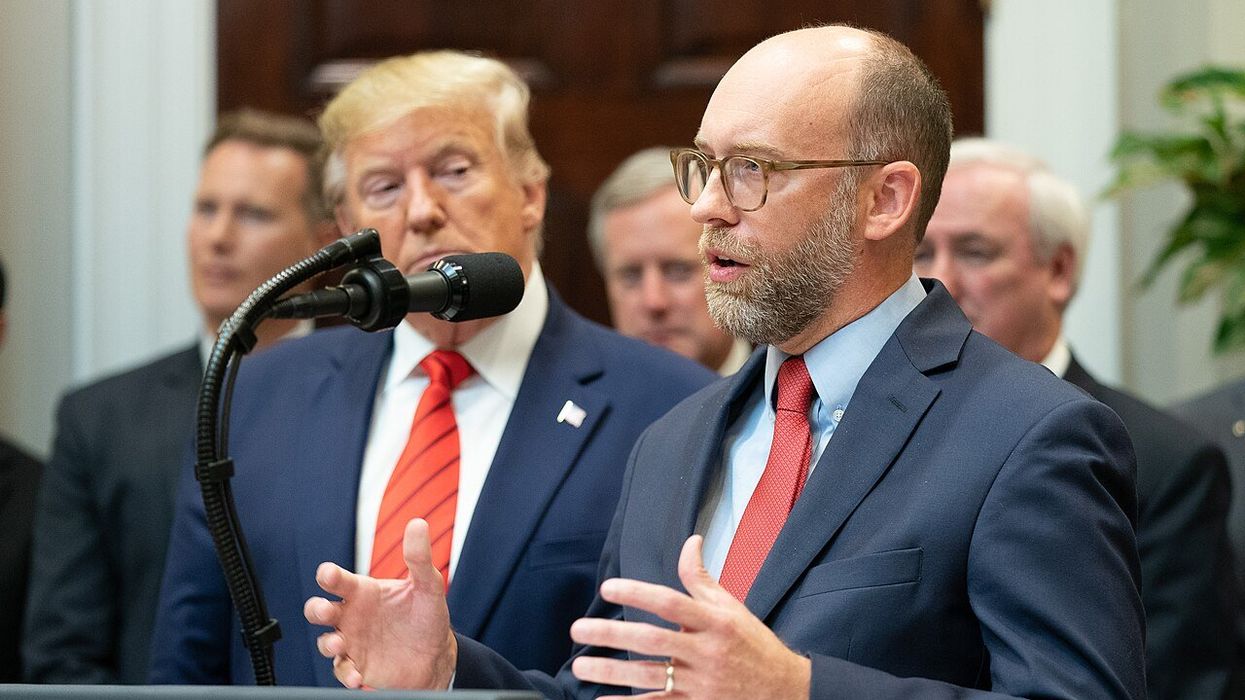
Russell Vought with Donald Trump in 2019 (Creative Commons)
January 12, 2026 
ALTERNET

In the fall of 2025, President Donald Trump's administration revoked billions of dollars in in renewable energy projects — all in states that 2024 Democratic nominee Kamala Harris won. Now, one federal judge is ruling that those cuts violated the U.S. Constitution.

NOTUS reported Monday that U.S. District Judge Amit Mehta (who was appointed by former President Barack Obama) ruled that the Trump administration will now have to revive seven of the cuts made by Office of Management and Budget Director Russ Vought in 2025. Judge Mehta found that the targeting of blue states was a violation of the Equal Protection clause in the Fifth Amendment to the Constitution.

"The terminated grants had one glaring commonality: all the awardees (but one) were based in states whose majority of citizens casting votes did not support President Trump in the 2024 election," Mehta wrote in his 17-page ruling.

Mehta's decision came about in response to a lawsuit filed by the City of Minneapolis, Minnesota in conjunction with several environmental groups. The projects that were cancelled included solar energy infrastructure, electric vehicle charging stations and reduction of methane emissions. Plaintiffs accused Vought and the Trump administration's Department of Energy of making the cuts based solely on politics.

The U.S. Department of Energy countered in several filings made in response to the lawsuit that the cancellations were only made to implement the administration's energy priorities, and pointed to multiple cuts that were not made. However, Mehta disagreed, writing that the administration made "no plausible rational connection" between cancelling projects in blue states and advancing the president's agenda.

"There is no reason to believe that terminating an award to a recipient located in a state whose citizens tend to vote for Democratic candidates — and, particularly, voted against President Trump — furthers the agency’s energy priorities any more than terminating a similar grant of a recipient in a state whose citizens tend to vote for Republican candidates or voted for President Trump," Mehta's opinion read.

Vought initially announced the cuts in an October post to his official X account, writing: "Nearly $8 billion in Green New Scam funding to fuel the Left's climate agenda is being cancelled. The projects are in the following states: CA, CO, CT, DE, HI, IL, MD, MA, MN, NH, NJ, NM, NY, OR, VT, WA."

Click here to read NOTUS' report in full.
Largest Nurses Strike in NYC History as Nearly 15,000 Healthcare Workers Hit the Picket Line

“No nurse should be asked to accept less pay, fewer benefits, or less dignity for doing lifesaving work,” said New York City Mayor Zohran Mamdani.


Members of the New York State Nurses Association strike at the Mount Sinai West hospital in New York City on January 12, 2026.
(Photo via New York State Nurses Association/Twitter)

Brad Reed
Jan 12, 2026
COMMON DREAMS
Thousands of nurses are hitting the picket lines in what will be the largest nurses strike in the history of New York City.

The New York State Nurses Association (NYSNA) on Monday announced that nearly 15,000 nurses at Mount Sinai Hospital, Mount Sinai Morningside and West, Montefiore, and NewYork-Presbyterian are going on strike after “greedy hospital management at these wealthy private hospitals have given frontline nurses no other choice.”

The NYSNA posted a long list of sticking points on contract negotiations, including “safe staffing for our patients, protections from workplace violence, and healthcare for frontline nurses.”

NYSNA president Nancy Hagans said that any patients in need of care at these hospitals should enter them, emphasizing that “going into the hospital to get the care you need is not crossing our strike line.” She also encouraged patients to join the picket line with the nurses after receiving care.

New York City Mayor Zohran Mamdani spoke out in solidarity with the striking nurses, while also emphasizing the importance of “ensuring New Yorkers have the care they need... especially during flu season.”

“No New Yorker should have to fear losing access to healthcare,” Mamdani wrote in a social media post. “And no nurse should be asked to accept less pay, fewer benefits, or less dignity for doing lifesaving work. Our nurses have kept this city alive through its hardest moments. Their value is not negotiable.”

Sen. Bernie Sanders (I-Vt.) also expressed support for the striking nurses, while denouncing “NewYork-Presbyterian, Montefiore, and Mount Sinai hospitals for being willing to spend millions on replacement nurses rather than bargain for a fair contract.”

The NYSNA also got a boost from 1199SEIU, which is the largest union of healthcare workers in New York.

“At this time of unprecedented cuts to Medicaid and other healthcare programs by Republican leaders in Washington, DC healthcare workers should not bear the brunt of funding shortfalls,” said 1199SEIU president Yvonne Armstrong. “More than ever, we need stability in our healthcare system, which means investing in the type of good healthcare jobs which are fundamental to the wellbeing of caregivers and the communities they serve.”

Armstrong also called on the hospitals to “bargain in good faith with NYSNA, refrain from committing unfair labor practices, and sign fair contracts that honor nurses’ contributions.”

Big Data Is a Bad Idea: Why AI Factory Farms Will Not Save Rural America

AI data centers have been added to the limited menu for economic development in marginalized US communities, but people in those communities have good reason to oppose them.


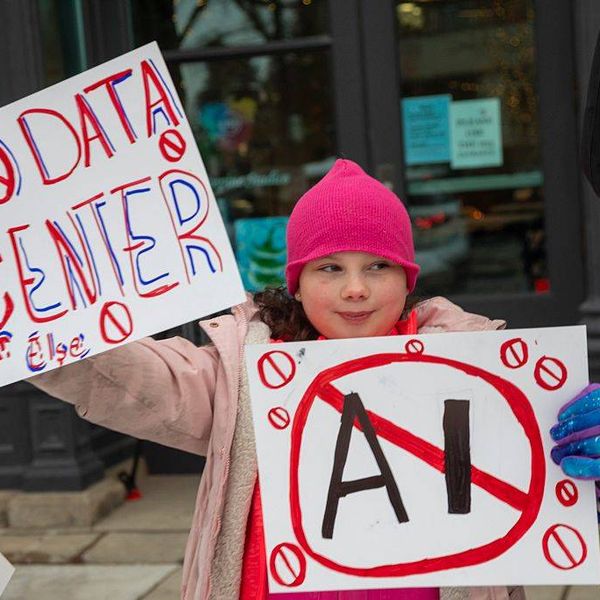
A sign on a rural Michigan road opposes a planned $7 billion data center on southeast Michigan farm land in Saline, Michigan on December 1, 2025.
(Photo by Jim West/UCG/Universal Images Group via Getty Images)

John Peck
Jan 12, 2026
Common Dreams


One word—plastics. That was the golden grail that Dustin Hoffman learned about from some well-wisher in the movie The Graduate. I remember watching the film as a farm kid and thinking about the updated version I was being told by my guidance counselors—one word: computers. We are now in the midst of the “Fourth Industrial Revolution” and the latest mantra is: artificial intelligence. Such free advice, though, could really be a costly warning in disguise.

Granted, there is a lot of poverty in the “richest” nation on Earth, and marginalized US communities often have few choices for economic (mal) development. It becomes a twisted game of pick your own poison: supermax prison, toxic waste dump, ethanol facility, tar sands pipeline… Now, AI data centers have been added to the limited menu. Someone recently shared a map of looming AI data centers across the world. It reminded me of how a tumor spreads and Edward Abbey’s quote that “growth for the sake of growth is the ideology of the cancer cell.”


Big Tech Ramps Up Propaganda Blitz As AI Data Centers Become Toxic With Voters


US Electric Grid Heading Toward ‘Crisis’ Thanks to AI Data Centers

The fact that Big Data has targeted Rural America for its latest mastitis should be no surprise. We have lots of available land to grab, thanks to the legacy of settler colonialism and family-farm foreclosure. Back in August I remember driving past Beaver Dam, Wisconsin and watching bulldozers flattening over 800 acres along Hwy 151 and my first hunch was: data center. Sure enough, the secretive $1 billion deal with Meta was finally revealed in a November press release. Just north of Madison in the town of DeForest, Blackstone subsidiary QTS Realty Trust is aiming to build another $12 billion data center on close to 1,600 acres. And if we need to free up more land for AI, we quaint rural folks could just abandon growing real Xmas trees and force people to buy plastic ones instead, as one Fox News “expert” suggested over the holidays. Former President Joe Biden visited Mt. Pleasant, Wisconsin in May 2024 to promote Microsoft’s new $3.3 billion 300+ acre AI campus on the former site of flat screen maker, Foxconn, that welcomed President Donald Trump for its groundbreaking back in 2018. Foxconn abandoned that $10 billion project and its 13,000 job promise, after getting millions in state subsidies and local tax deferrals.

The Microsoft AI complex in Mt. Pleasant will also require over 8 million gallons of water per year from Lake Michigan. We still have some clean water, though that may not last long thanks to agrochemical monocultures, CAFO manure dumping, and PFAS-laden sludge spreading. And AI certainly is thirsty—the Alliance for the Great Lakes noted in its August 2025 report that a hyperscale AI data center needs up to 365 million gallons of water to keep itself cool—that is as much water as is needed by 12,000 people! A recent investigative report by Bloomberg News found that over two-thirds of the AI data centers built since 2022 are in parts of the country already facing water stress. And it is really hard to drink data.

But is all the AI hype just another bubble about to burst? Rural communities (and public taxpayers) have been offered many “amazing” schemes in the past that ended up being just a “bait and switch”—another hollow promise.

In the Midwest we also have potential access to vast electricity (fracked natural gas, wind and solar farms, methane digesters), and relatively under-stressed high voltage grids (unlike California or Texas), though the loss of “cheaper” imported Canadian hydropower with the latest trade war could be a serious challenge. In 2023 the US had over a $2 billion electricity trade deficit vis-a-vis Canada. According to a recent Clean Wisconsin report, just two of our proposed AI data centers will require 3.9 gigawatts—1.5 times the current power demand of all 4.3 million homes in the state.

But, no worry, there are dilapidated US nuclear reactors with massive waste dumps that could be put back online such as Palisades in Michigan, despite opposition from environmental activists and family farmers. The Trump administration also just announced a $1 billion low-interest loan to reanimate Three Mile Island in Pennsylvania for the sake of AI. Until all that happens, though, regular ratepayers can expect a huge hike in their energy bills as Big Data has the market clout to siphon off what it needs first, especially as it colludes with utility monopolies. Many people in Wisconsin are already paying for $1+ billion in stranded assets—mostly defunct coal plants, as well as nuclear waste storage facilities—while utility investors continue to receive guaranteed dividends of 9-10%.

But is all the AI hype just another bubble about to burst? Rural communities (and public taxpayers) have been offered many “amazing” schemes in the past that ended up being just a “bait and switch”—another hollow promise. If we subsidize a massive data center, will the projected “market” for increasing algorithms actually come? Many within the AI industry don’t think so, and are now invoking the lessons we should have learned from the Enron scandal decades ago or the even worse sequel in the subprime mortgage-fueled financial meltdown. Corporate cheerleaders can be quite clever when it comes to inflating prices (and stocks) for goods and services that may not even exist, while hiding their massive debt obligations in a whole cascading series of shadowy shell subsidiaries and dishonest accounting shenanigans.

Many industry insiders are ringing alarm bells. “These models are being hyped up, and we’re investing more than we should,” said Daron Acemoglu, who won the 2024 Nobel Economics Prize, quoted in a recent NPR story about the current AI boom or bubble. OpenAI says it will spend $1.4 trillion on data centers over the next eight years, while Amazon, Google, Meta, and Microsoft are going to throw in another $400 billion. Meanwhile, just 3% of people who use AI now pay for it, and many are frantically trying to figure out how to turn off AI mode on their internet searches and to reject AI eavesdropping on their Zoom calls. Where is the real revenue going to come from to pay for all this AI speculation? The same NPR story notes that such a flood of leveraged capital is equal to every iPhone user on Earth forking over $250 to “enjoy” the benefits of AI—and “that’s not going to happen,” adds Paul Kedrosky, a venture capitalist who is now a research fellow at MIT’s Institute for the Digital Economy. Morgan Stanley estimates AI companies will shell out $3 trillion by 2028 for this data center buildout—but less than 50% of that money will come from them. Hmmm...

Special purpose vehicle (SPV) may sound like a fancy name for a retrofitted tractor, but that is how Big Data is creating a Potemkin Village to hide their Ponzi Scheme. Here is one example from Richland Parish, Louisiana where Meta is now building its Hyperion Data Center—a massive $27 billion project. A Wall Street outfit, Blue Owl, borrows $27 billion, using Meta’s future rent payments for a data center to back up its loan. Meta’s 20% “mortgage” on the facility gives them 100% control of the purported data crunching from the facility. This debt never shows up on Meta’s books and remains hidden from carefree investors and shallow analysts, but, like other synthetic financial instruments such as the now infamous mortgage backed security (MBS), the reality only comes home to roost when the house of cards collapses and Meta has to eventually pay off Blue Owl.

In the meantime, as the Louisiana Illuminator reports, the residents of Richland Parish (where 25% live below the poverty level) are bearing the brunt of all the real costs of having an AI factory farm. Dozens of crashes involving construction vehicles; damage to local roads; and massive future energy demands (three times that required for the entire city of New Orleans), which will entail new natural gas power plants to be built (subsidized by existing ratepayers even as fossil fuel-induced climate change floods the Louisiana delta). Beyond the initial building flurry, AI data centers are ultimately job poor. It just doesn’t take that many people to tend computers once they are built. As Meta’s VP, Brad Smith, admitted, the 250,000 square foot Hyperion data center may need 1,500 workers to build but barely 50 to operate. Beyond all the ballyhoo, the main reason a particular community is chosen to “host” one seems to be based upon the bought duplicity of elected officials and the excessive generosity of local taxpayers. Not a good cost-benefit analysis—unless you are Big Data.

And then there are the questionable kickback schemes between the suppliers of the technology and those owning the data centers. If you are maker of computer chips, would you not be tempted to fork over capital to a major buyer of your own products to ensure future demand? Nvidia just announced a $100 billion stake in OpenAI to help bankroll the data centers. In turn OpenAI signed a $300 billion deal with Oracle to actually build the AI data centers that will require Nvidia’s graphics processing units (GPUs). OpenAI also signed a separate $6+ billion deal with former BitCoin miner, CoreWeave, which rents out internet cloud access (using Nvidia’s chips once again). This type of incestuous circular financing should raise eyebrows to anyone who studies business ethics—and perhaps remind others of how a toilet operates.

What is all this AI doing? Promoters will point to many innovations—faster screening for cancer cells, closer connection to far-flung relatives, precision application of fertilizers and pesticides, elimination of drudgery in the workplace through automation. A bright future indeed—or perhaps not?

The real issue is whether or not AI data centers are economically viable, socially appropriate, environmentally sustainable, and actually serve the public interest.

In August 2025, ProPublica reported that the Food and Drug Administration (FDA) had lost 20% of its staff devoted to food safety thanks to DOGE cuts. Inspection of food import facilities is now at a historic low even as our dependence on the rest of the world to feed us grows. But not to worry, the FDA announced in May that AI was coming to the rescue thanks to a large language model (LLM)—dubbed Elsa—that would be deployed alongside what’s left of its human staff to expedite their oversight work. Hopefully, Elsa knows melamine when it sees it. AI chatbots are also growing in popularity and available 24-7 to “talk or advise” people on all sorts of pressing issues—how to win more friends, how to cheat on this exam, how to make up fake legal opinions, even encouraging a teenager to commit suicide and suggesting to someone else that they murder their own parents.

But there is an even dirtier AI underbelly. Some have dubbed these AI slop, AI smut, and AI stazi—three 21st-century horsemen of the digital apocalypse. What is this all about? Well, a lot of these accelerating AI algorithms are actually devoted to selling “products” that many people do not want and would find objectionable, as well as providing “services” that undermine our basic freedoms. Slop (Merriam Webster’s word of 2025) is used to describe when AI generates internet content that is only meant to make money through advertising. Right now there are thousands of wannabe internet “creatives” all over the globe, watching “how-to videos” to manufacture AI social media to grab the eyeballs of US consumers. That cute puppy video you see on Instagram or that shocking “news” story you read on Facebook is not by accident—the goal is to monetize clicks per thousand (cost per mille, or CPM) where advertisers pay for how much their ad is viewed online. This is also why online content is often overly long (where is the actual recipe in this cooking blog?), since that increases ad scrolling. The average US consumer is now subject to between 6,000 and 10,000 ads per day—70% of which are online. For more on AI slop, visit: https://www.visibrain.com/blog/ai-slop-social-media.

An even worse virtual commodity is AI smut—literally algorithms creating pornography. This perverted version of AI scraps the internet for images (high school yearbooks, red carpet fashion shows, popular music concerts, street cam footage, etc.) and then uses “face swap” programs to create personalized hardcore rubbish. There is little if any accountability for this theft of public images and violation of personal privacy—at best those involved are “shamed” into taking down their AI sites after being exposed due to fears of liability and prosecution for child abuse. But that has hardly stopped this seedy AI subsector. Can you imagine your face or image being put into such a lucrative sexploitative scenario without your permission? At this point, there are hardly any internet police walking the beat in the virtual AI world. We don’t even have the right to be forgotten on the internet.

Which brings us to AI stazi—the updated version of the Cold War-era East German secret police. University of Wisconsin Madison just announced the creation of a College of Computing and Artificial Intelligence (CAI), in part thanks to a $140 million donation from Cisco. Few Bucky Badger fans know that 30 years ago they were used as guinea pigs while cheering at Camp Randall Stadium to help create facial recognition technology through a UW-Madison grant from the Department of Defense Applied Research Agency (DARPA). Visitors to the UW campus today will no doubt “enjoy” the automated license plate readers (ALRPs) owned by Flock Safety. According to an August 2025 Wisconsin Examiner expose, there are hundreds of Flock cameras across the state in use by law enforcement agencies, including Wisconsin county sheriff departments with active 287(g) cooperation agreements with Immigration and Customs Enforcement. No warrant is needed for law enforcement agencies to browse the national Flock database. In fact, agents have used Flock to track peaceful protesters, spy on spouses, or just stalk people they don’t like. To see where Flock cameras are near you, visit: www.deflock.me. Of course, Flock Security has outsourced its AI programming to cheaper (and more secure?) Filipino contractors. Similar AI spying networks such as Pegasus have been widely exposed and have become “bread and butter” for authoritarian regimes from Israel to Saudi Arabia. China and Russia have their own versions (Skynet, SORM, etc.). Thanks to the cozy relationship between Trump and Peter Thiel, the US-based AI mercenary outfit, Palantir, is now being redeployed for domestic surveillance—first revealed by Edward Snowden back in 2017.

The latest executive bluster from Trump is that states’ rights are out the window when it comes to regulating AI data centers—such federal preemption of local democratic control is part of the larger neoliberal “race to the bottom” forced-trade agenda. But the cat is already out of the bag as dozens of communities have successfully blocked AI data center projects and others are poised to do the same based upon their winning strategies. Better yet, this is a bipartisan grassroots organizing issue!

What is the best way to keep out an AI factory farm? No non-disclosure agreements (NDAs)! These are massive development schemes that could not exist without the approval and support of elected officials, so any agreement should not be secret. They can hardly claim to be providing a public good if they are not subject to transparency and oversight. No sweetheart deals! Big Data is among the wealthiest sectors of our current economy and does not need or deserve subsidies, discounted electric rates, tax increment financing, property tax holidays, or other incentives. It is a classic move of crony capitalism to privatize the benefits and socialize the costs. No regulatory loopholes! Given their huge demands for land, water, and energy, Big Data should not be allowed to cut legal corners and needs to follow all the rules of any other normal enterprise—full liability coverage, no special economic zones, consideration of cumulative impacts, protections for ratepayers, no unregulated toxic pollution or illegal water transfer in violation of the Clean Water Act or the Great Lakes Compact, etc. How much water your data center demands is hardly a “trade secret.”

And most important, don’t let Big Data boosters belittle your legitimate concerns as “neo-Luddite!” Everyone uses technology—even the Amish. The real issue is whether or not AI data centers are economically viable, socially appropriate, environmentally sustainable, and actually serve the public interest. People have good reasons to be wary and oppose them on all those fronts.

For more info, checkout: Big Tech Unchecked: A Toolkit for Community Action

As well as the North Star Data Center Policy Toolkit


Our work is licensed under Creative Commons (CC BY-NC-ND 3.0). Feel free to republish and share widely.


John Peck
John E. Peck is the executive director of Family Farm Defenders.
Warren Warns Democrats Against Letting Billionaires Dictate Their Economic Agenda

“If Democrats want to win elections, they need to read the room—or I should say, they need to read literally any room anywhere in America that isn’t filled with big donors.”


WALL ST. DEMS ARE THE NEW GOP


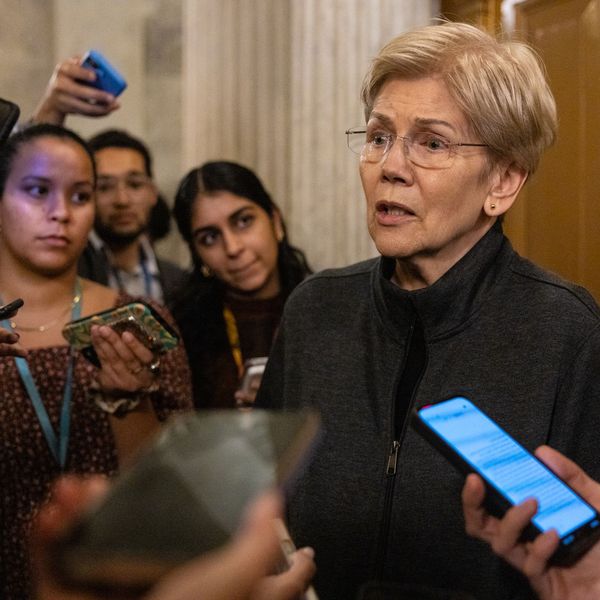
Sen. Elizabeth Warren (D-Mass.) holds a discussion at the National Press Building on January 12, 2026 in Washington, DC.
(Photo by Heather Diehl/Getty Images)

Brad Reed
Jan 12, 2026
COMMON DREAMS

Sen. Elizabeth Warren on Monday warned the Democratic Party against reshaping its economic agenda in the hopes of winning over billionaire donors.

In a speech delivered before the National Press Club in Washington, DC, Warren (D-Mass.) argued that watering down a progressive economic agenda to appeal to big-money donors made little sense at a time when the richest in America are taking ever greater shares of wealth and US families are struggling to keep their heads above water.


Warren Warns ‘Trump Could Be Setting the Stage’ for Next Financial Crash

Warren pointed to many US elites maintaining friendly relationships with the late billionaire sex offender Jeffrey Epstein, even after he pleaded guilty to soliciting a minor, as evidence of a broken system.

“Over the past generation, the wealthy have avoided accountability time and again,” she argued. “Regular Americans must play by every rule or face real consequences. You don’t need to read every news article about Jeffrey Epstein and his good buddies like [former Treasury Secretary] Larry Summers and [President] Donald Trump to understand how consistently rich and powerful insiders protect each other, regardless of politics and regardless of how obscene the situation has become.”


Warren acknowledged that Democrats needed to broaden their appeal to more voters given that they lost the popular vote to Trump for the first time in 2024, but she argued that targeting wealthy donors would not accomplish that goal.

“There are two visions for what a big tent means,” she said. “One vision says that we should shape our agenda and temper our rhetoric to flatter any fabulously rich person looking for a political party that will entrench their own economic interests. The other vision says we must acknowledge the economic failures of the current rigged system, aggressively challenge the status quo, and chart a clear path for big, structural change.”

Warren also criticized the “abundance” agenda that has been promoted by New York Times columnist Ezra Klein over the last several months as a way to fix Democrats’ electoral woes.

The senator began her critique by touting what she said were good points that Klein and Abundance co-author Derek Thompson make about government needing to work more simply and efficiently to deliver benefits.

However, Warren said that what their analysis of government failures has often missed is that there are powerful interests that are working to keep these inefficiencies from being addressed.


“For years, I’ve fought for a simple, free government tax filing system so no one has to pay a couple of hundred bucks just to file their taxes,” she explained. “Every step of the way, the giant tax prep companies have thrown up roadblocks to stop it. And when the [Internal Revenue Service] finally built a free—and wildly popular—filing option for American taxpayers, the tax prep companies swooped in to kill it the minute Donald Trump took office.”

Warren also said that many major Democratic donors, including LinkedIn co-founder Reid Hoffman, have been latching onto “abundance” in order to drive the conversation in the party away from US wealth inequality.

“We are now in a new election cycle, and according to Axios, Reid Hoffman is sending everyone he knows a copy of Ezra Klein and Derek Thompson’s book on Abundance and backing pro-abundance candidates,” Warren explained. “On his podcast, Hoffman has used the framework to argue against regulations that slow down data center construction. That’s right—when families are already getting crushed by rising costs and a data center boom means even higher utility costs... Hoffman wants Democratic candidates to stand with the billionaires for higher costs.”

The senator then said that “if Democrats want to win elections, they need to read the room—or I should say, they need to read literally any room anywhere in America that isn’t filled with big donors.”
As 2026 Begins, the Pendulum Is Swinging Toward War and Oppression

Even though many things are currently moving in the wrong direction, there are also reasons for hope and prospects for positive developments.


A Border Patrol Tactical Unit agent sprays pepper spray into the face of a protester attempting to block an immigration officer vehicle from leaving the scene where a woman was shot and killed by a federal agent earlier, in Minneapolis, Minnesota on Wednesday, January 7, 2026.
(Photo by Alex Kormann/The Minnesota Star Tribune via Getty Images)

Klaus Moegling
Jan 12, 2026
Common Dreams

The beginning of 2026 falls into a period of increasing global social destruction. Multilateral institutions such as the United Nations and the Organization for Security and Co-operation in Europe OSCE are being systematically destroyed. Countries such as the US and Russia are withdrawing from these institutions or attempting to obstruct them through blocking behavior.

Rich and Undemocratic ‘elites’ Are Appropriating the State

US President Donald Trump and Russian President Vladimir Putin are political leaders who are dismantling or destroying the remnants of democracy in their countries, increasing repressive pressure on their populations, and acting aggressively toward the outside world. They find international law rather annoying, ignore it, and develop a right-wing and authoritarian nationalism, within the framework of which the ruling circles in the US and Russia enrich themselves excessively and disregard everything that previous values in terms of decency and justice demand.


IRC Warns of ‘Surging Crises and Shrinking Support’ as Sudan, Palestine Top 2026 Watchlist


Ex-Presidents, What More Do You Need to See Before Calling for Trump’s Impeachment?

This goes hand in hand with a publicly declared shift in the definition of terrorism. People who demonstrate by peaceful and legitimate means against the excesses of the system and the policies of the corrupt and enriching class are not seen as opposition figures with a legitimate claim, but are increasingly classified as terrorists and criminals. This is the case, for example, in the US, Russia, and Turkey. The aim is to intimidate people and, once they are caught, to lock them up without a fair trial.

The self-enrichment of people who are already rich, multimillionaires and billionaires, goes hand in hand with the widening of the social divide in the countries affected. The lower social classes are deprived of what the super rich acquire. The USA is one example among many: Taxes have been drastically reduced for the rich, while at the same time the government is trying to withdraw healthcare support from millions of people.


The World Does Not Consist Only of the West


Certainly, only a few selected aspects can be addressed here.

The Global South is trying to organize itself and is pushing for a say in decision-making and an end to unfair economic exchange relationships. However, huge Western corporations continue to seek contact with regional despots and corrupt African leaders in order to gain access to Africa’s mineral resources. South America is also affected by the eco-imperialist encroachments of the US. The US government even openly admits that its aggression in Venezuela, for example, is motivated by a desire to secure and exploit the world’s largest oil reserves there.

Even if the pendulum has swung in the wrong direction so far, only gradual and internationally coordinated disarmament could enable an effective peace dividend that could be used to combat world hunger and the climate catastrophe.

China’s role in the world is not yet clear. The People’s Republic of China is attempting to gain economic access to the global economy and is particularly focused on its own interests in this regard. Step by step, internal social surveillance and repression are also being intensified. Ultimately, the assessment of China will be decided by the development of the Taiwan issue and China’s behavior in Southeast Asia, particularly with regard to territorial issues in the South China Sea with other Southeast Asian neighboring countries.

Israel’s government, which is in part right-wing extremist, has reacted completely disproportionately to the terrible attack by Hamas. Approximately 60,000 Palestinians, half of them women and children, were killed and the Gaza Strip was almost completely destroyed. It will take generations to overcome the hatred resulting from these murders and killings.

In Sudan, a civil war supported by foreign powers is raging, with mass rape and killings. Over 10 million people are fleeing Sudan.

Massive Armament Programs Promise a Deceptive Sense of Security

The eco-imperialist and geostrategic wars instigated by right-wing nationalist governments are also coming closer and closer to the center of Europe. Concerns about being drawn into a war over Russia’s attack on Ukraine are spreading there as well. At the same time, almost all European countries are arming themselves militarily, incurring massive debt, and wasting the resources of future generations on the destructive production of increasingly dangerous weapons.

This leads to substantial returns for the owners and shareholders of the arms industry. The political-military-industrial complex is functioning and is becoming increasingly accepted by society through media influence, growing fear of war, and the creation of jobs.

The new weapons systems below the nuclear threshold are becoming increasingly dangerous. Hypersonic missiles in particular pose a major threat, as they are capable of carrying out “decapitation strikes” that are difficult to intercept due to their high speed and maneuverability. The planned deployment of hypersonic missiles and cruise missiles under US command in Germany in 2026 is a provocation that the peace movement is trying to resist.

The ever-evolving drones with increasingly dangerous warheads are also changing the war situation not only on the front lines, but also for civil societies at home. No one is safe from the drones lurking in war zones anymore. Drone operators, hidden in the hinterland, can kill and destroy with relatively little risk.

Nuclear weapons systems are currently being modernized in all nuclear states with huge investments and developed to be increasingly dangerous. These states hope that the deterrent effect will provide security and also enable them to assert their geostrategic interests with the conventional weapons systems of a nuclear power. There are now also calls for a nuclear protective shield for Europe. But the security promise of a nuclear protective shield is an illusion. No country in the world is capable of reliably defending itself against attacking hybrid weapon systems, which also include hypersonic missiles with nuclear warheads.

But even without the use of nuclear weapons, modern society is extremely vulnerable. Drone and hacker attacks on critical infrastructure cannot be defended against in their entirety. They can lead to chaos in a society and the collapse of the social organization of life, combined with social unrest, violence, and looting.

Ultimately, societies can only be protected from these dangers by reorganizing and restructuring their multilateral relations in a cooperative direction. Even if the pendulum has swung in the wrong direction so far, only gradual and internationally coordinated disarmament could enable an effective peace dividend that could be used to combat world hunger and the climate catastrophe. This can only be achieved through a significant reform of the United Nations. In particular, the right of aggressive states such as Russia and the US to block decisions in the highest bodies of the UN, especially the UN Security Council, must be abolished. Overall, the United Nations needs to be strengthened and democratized.

AI Can Have Positive but Also Dangerous Effects


The further development of artificial intelligence (AI) in connection with newer weapon systems means that humans are increasingly losing control over weapons. AI information is difficult to verify when decisions must be made within minutes about whether a nuclear attack is taking place and a counterattack should be launched. In such cases, decision-makers are ultimately at the mercy of AI, which transmits messages based on information from hundreds of sensors. Misinformation cannot be clarified. There is a risk of accidental nuclear war.

In this context, it is also important to warn very clearly about the danger of superintelligence developing on the internet, AI that becomes autonomous. Superintelligence achieves cognitive performance that far exceeds human capabilities and intelligence. Such AI could have a disruptive or even destructive effect on critical infrastructure and, in the worst case, gain uncontrolled access to nuclear weapons systems.

AI can be used positively in many ways, such as in skin cancer screening or language translation. However, there must be no unrestrained AI development in the hands of large, profit-oriented tech companies. Instead, development must be controlled by ethically guided international rules and strictly sanctioned in the event of violations.

The World Is Increasingly on the Run

Millions of people, especially in the Global South, are currently fleeing the consequences of the climate crisis and wars that are destroying their livelihoods. At the same time, the countries of the Global North are trying to shield themselves from these refugee movements. This is also being done in the defense against right-wing extremist political movements and parties, which exploit the flight of these people for their political propaganda. Nevertheless, even countries that still seriously pursue democratic goals are threatened by right-wing extremist takeovers of their governments.

That is how things currently stand. It would be wrong to look away or gloss over the situation.

And yet: Perspectives for Positive Developments

Especially in this difficult global situation, it is important to pay attention to social countermovements and successful examples of social organization and social resistance against the destruction of civilization.

The pendulum may well swing back when the civilian population and parts of the ruling classes realize that war is not a solution to global problems, but only costs livelihoods, human lives, financial resources, and destroys our shared world.

The influence of those parts of the global economy that compete with the political-military-industrial complex and depend on peace and the undisturbed global exchange of goods and services should not be underestimated. They will try to assert their influence.

People in a society will not put up with decades of oppression and exploitation.

The trillions of dollars that will be spent in the future on measures to prevent and mitigate the approaching climate catastrophe will also give large sections of society pause for thought. The climate catastrophe will occur earlier than expected due to emissions from wars and military operations. If, in addition, social resources are invested in wars and states go into debt for this purpose, they will lack the financial resources and social energy to even begin to address human-made climate change.

Even if the world’s largest fossil fuel dealers try to assert their interests by military means, their time will be up in the medium term. The development of technology based on renewable energy generation can no longer be stopped globally.

Furthermore, people in a society will not put up with decades of oppression and exploitation. They will reorganize themselves into civil society and begin to work together to bring about change, even in the face of pressure from authoritarian societies.

These are some weighty arguments as to why the current destruction can develop in a more constructive direction and the pendulum can swing back.

In addition to these economic, sociopolitical, and peace-ecological perspectives, there are other developments in which new ideas are already being tried out, new forms of community life and work are emerging, and civil society protest movements are evolving.

Thus, the new is already emerging from the old.

Even though many things are currently moving in the wrong direction, there are also reasons for hope and prospects for positive developments. I still believe that a peaceful and sustainably developed world is possible through a realignment of social conditions at the local, national, regional, and global levels.

But all those who see this and desire it must intensify and expand their efforts together. A social realignment can only come about if visions of social development based on precise analysis are thought through, then formulated in a way that is feasible and can be put into practice.


Our work is licensed under Creative Commons (CC BY-NC-ND 3.0). Feel free to republish and share widely.


Klaus Moegling
Prof. Dr. Klaus Moegling is a political scientist, sociologist, and author of the book "Realignment. A peaceful and sustainably developed world is (still) possible." Which you can read here: https://www.klaus-moegling.de/international-edition/
Full Bio >

Monday, January 12, 2026

Judge shoots down Trump's 'national security' excuse to kill wind farm


Matthew Chapman
January 12, 2026 
RAW STORY


A federal judge on Monday rejected the Trump administration's latest rationale for blocking an offshore wind project under construction by a Danish company.

According to Bloomberg News, "The Revolution Wind project, intended to power hundreds of thousands of homes in Rhode Island and Connecticut, 'would be irreparably harmed' unless work was allowed to continue during the legal fight, US District Judge Royce C. Lamberth in Washington concluded Monday. The project is almost 90% complete."

Revolution Wind is being developed by Orsted A/S, an energy firm based in Denmark.

The Trump administration initially halted approval for the project last August. At the time, Lamberth granted a preliminary injunction against the order, allowing work to resume as Orsted argued the administration didn't have authority to cancel pre-existing approval for the project without explanation.

Trump's Department of the Interior subsequently issued a new order in December that paused the leases for Revolution Wind and four other offshore wind energy projects, "due to national security risks identified by the Department of War in recently completed classified reports" — the off-books name the Trump administration has declared for the Department of Defense — until such time as Pentagon officials assess mitigation for these unspecified risks.

Lamberth's new order blocks this decision for the time being, as the matter continues to be litigated on the merits. It comes a month after another federal court blocked the Trump administration's moratorium on new approvals for wind energy projects.

President Donald Trump has despised wind power ever since an array of turbines altered the view at one of his golf properties in Scotland. He frequently rants against wind turbines, which he calls "windmills," at his rallies and press functions, parroting wildly exaggerated Fox News claims that they pose a threat to birds and marine life.

His attacks on renewable energy have thrown a monkey wrench into bipartisan talks on permitting reform and have put additional pressure on energy prices as the growing buildout of artificial intelligence data centers already strains the power grid.
EPA to Stop Counting Public Health Benefits When Setting Air Pollution Standards

“This policy will cause more deaths of vulnerable Americans, like infants and the elderly,” said one critic. “Also, it appears to be a violation of the Clean Air Act.”


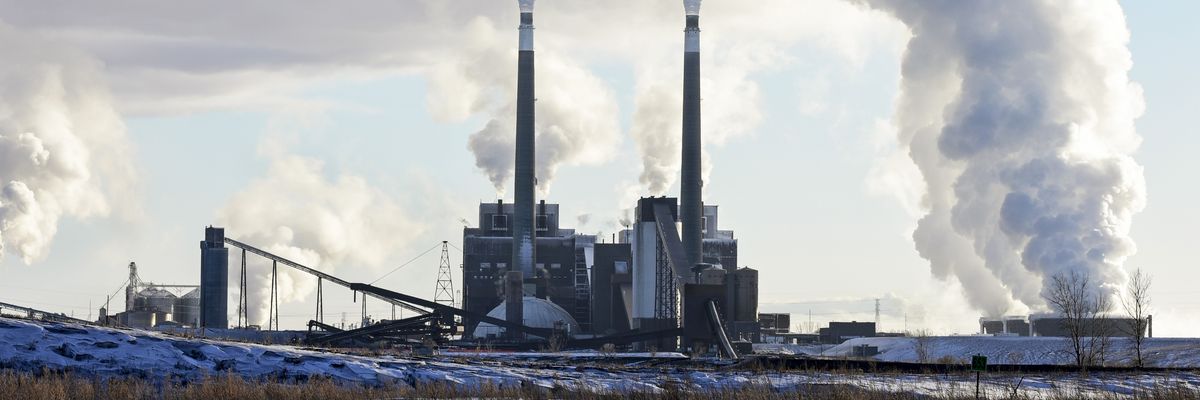
Smoke billows from the Coal Creek Station, a coal-fired power plant located near Underwood, North Dakota, on January 9, 2022.
(Photo by Dan Koeck/Washington Post via Getty Images)

Brett Wilkins
Jan 12, 2026
COMMON DREAMS

The Trump administration plans to stop calculating the monetary value of the public health benefits from reducing air pollution and instead focus exclusively on the cost to industry when setting pollution limits, the New York Times reported Monday.

Intragency emails and other documents reviewed by the Times revealed that the Environmental Protection Agency (EPA) is planning to stop tallying the financial value of health benefits caused by limiting fine particulate matter (PM2.5) and ozone when regulating polluting industries.

Research published in 2023 showed that PM2.5 pollution from coal-fired power plants alone killed approximately 460,000 people in the US from 1999 to 2020.

“This policy will cause more deaths of vulnerable Americans, like infants and the elderly,” American University School of Public Affairs professor Claudia Persico said on X Monday. “Also, it appears to be a violation of the Clean Air Act. This is incredibly foolish.”

The EPA proposal would mark a stark reversal of decades of policy under which the agency cited the estimated cost of avoided asthma attacks and premature deaths to support stronger clean air rules. The change is likely to make it easier to roll back limits on PM2.5 and ozone from coal-burning power plantsoil refineries, steel mills, and other polluting facilities.

“The idea that EPA would not consider the public health benefits of its regulations is anathema to the very mission of EPA,” Richard Revesz, faculty director at the Institute for Policy Integrity at New York University School of Law, told the Times.

“If you’re only considering the costs to industry and you’re ignoring the benefits, then you can’t justify any regulations that protect public health, which is the very reason that EPA was set up,” Revesz added.


The Environmental Protection Network (EPN), an advocacy group, said in a statement Monday that “EPA’s reported decision to ignore prevented deaths is part of a pattern of ignoring or downplaying health effects in the rulemaking process, including in its rulemaking on effluent guidelines for coal-fired power plants and its recent Waters of the United States rulemaking.”

Critics of President Donald Trump’s policies accuse his administration of repeatedly putting polluters—who contributed hundreds of millions of dollars toward reelecting the president and supporting other Republicans—over people.

“EPA should strengthen how it values human life and health, not pretend it doesn’t matter,” Katie Tracy, senior regulatory policy advocate at the consumer advocacy group Public Citizensaid Monday. “By refusing to monetize the benefits of cleaner air, the agency is effectively saying that preventing asthma attacks, heart disease, and early deaths have no dollar value at all.”

“This unconscionable decision by the EPA should be called out for what it really is—a favor to corporate interests at the expense of the environment and public health,” Tracy added. “EPA’s decision is not only shocking—it’s illegal and violates the Supreme Court’s instruction that the government cannot stack the deck to benefit polluters. Accordingly, if this disturbing policy leads to regulatory repeals or weak standards, it will certainly be challenged in court.”

During Trump’s second term, the EPA has moved to repeal or replace the stronger carbon emission limits on fossil-fueled power plants put in place by the Biden administrationrescinded Biden-era fuel efficiency and emissions standards for cars and light trucks, revoked California’s ability to enact stricter vehicle emissions rules, and signaled plans to overturn the agency’s finding that greenhouse gases are a public health hazard.

The EPA has also weakened water and wetland protections, rolled back regulations limiting so-called “forever chemicals” in drinking water, dramatically cut or eliminated environmental justice programs, reduced enforcement of environmental violations, dismantled long-standing advisory and scientific panels, removed all mentions of human-caused climate change from its website, and more.

According to a 2024 EPN analysis, Trump’s rollbacks could cause the deaths of nearly 200,000 people in the United States by 2050.

EPA Administrator Lee Zeldin—a former Republican congressman from New York with an abysmal 14% lifetime rating from the League of Conservation Voters—has also boasted about canceling around $20 billion worth of Biden-era green grants.

“EPA’s current leadership has abandoned EPA’s mission to protect human health and safety,” EPN senior adviser Jeremy Symons said Monday. “Human lives don’t count. Childhood asthma doesn’t count. It is a shameful abdication of EPA’s responsibility to protect Americans from harm. Under this administration, the Environmental Protection Agency is now the Environmental Pollution Agency, helping polluters at the expense of human health.”

'Not The Onion': Internet aghast at Trump admin's 'seismic' pollution change

Nicole Charky-Chami
January 12, 2026 
RAW STORY

The Environmental Protection Agency plans to reverse a longstanding policy that calculated the health benefits of reducing air pollution.

The agency has referred to "estimates of avoided asthma attacks and premature deaths to justify clean-air rules" for decades, and that is now set to end under the Trump administration, according to a New York Times report.

The Times reportedly obtained internal agency emails and documents indicating that the EPA will no longer factor the "gains from the health benefits caused by curbing two of the most widespread deadly air pollutants, fine particulate matter and ozone, when regulating industry."

"It’s a seismic shift that runs counter to the E.P.A.’s mission statement, which says the agency’s core responsibility is to protect human health and the environment, environmental law experts said," The Times reported.

On social media, users responded to the major policy change.

"This reads like an Onion Headline of something a Republican would do," user Conor Rogers wrote on X.


"Capitalism at work once again!" Tech and culture journalist Taylor Lorenz wrote on X.

"Not The Onion," author David Fenton wrote on X.

"Less than ideal," climate analyst Will Nichols wrote on X.

"Making America healthy again?" Activist and president of Leaders We Deserve David Hogg wrote on X.

"This admin literally doesn’t care if you live or die, as long as their billionaire buddies do okay," Sen. Ruben Gallego (D-AZ) wrote on X.

"Your zip code is more determining of your health than your genetic code. Pollution isn’t racist, but policies are," anesthesiologist Ebony Jade Hilton, MD, wrote on X.


"Corruption costs lives, by the way," Tiffany Muller, president of End Citizens United, wrote on X.

"Beyond parody," journalist and editor-in-chief of Zeteo Mehdi Hasan wrote on X.
Trump declares himself president of Venezuela — and sends 'wake-up call' to world

Alexander Willis
January 12, 2026 
RAW STORY

President Donald Trump declared Sunday night that he was the new “acting president of Venezuela” by sharing a doctored image of his online biography bearing the new title — a declaration that produced shockwaves for onlookers.

“He’s spiraling into a singularity of narcissistic terror over [Jeffrey] Epstein, and decompensating with performative dictatoring,” wrote Jim Stewartson, a journalist and podcast host, in a social media post.

“His alternate reality is sealed and the people around him are riding his collapse to get what they want – total destruction of the world order. What a timeline.”

Trump took to his social media platform Truth Social to share the image of himself that's featured in his biography on Wikipedia — edited to list him as Venezuela’s “acting president.” The declaration comes just over a week after his unprecedented U.S. attack on Venezuela, which Trump said shortly thereafter would be run by the United States until a transfer of power could be facilitated.

Trump declaring himself to be Venezuela's interim president was just the latest sign, some critics said, that the president was potentially sparking even more civil unrest across the world.

“Not satire… Zero presidents have ever publicly declared executive authority over a foreign nation,” wrote author and analyst Shanaka Anslem Perera in a social media post on X, where he’s amassed more than 111,000 followers. “The greatest energy realignment since the 1973 embargo is hiding in plain sight as a ‘troll post.’ When the world realizes this isn’t a joke, the repricing won’t be gradual. It will be violent.”

Others, like Brian Berletic, a geopolitical analyst and former U.S. Marine, called Trump’s unprecedented declaration a “wake-up call to the rest of the world.”

“A US president declaring himself president of another nation 1000 miles from his own nation's borders is unhinged criminality,” Berletic wrote in a social media post on X, where he’s amassed nearly 120,000 followers.

“This is done to prime the US public for wider criminality to come. This is a wake-up call to the rest of the world, nations big and small, that this is no longer a matter of diplomacy, international relations, or deal-making.”


Of course Trump has no Venezuela plan — look what made him attack it

John Stoehr
January 12, 2026 
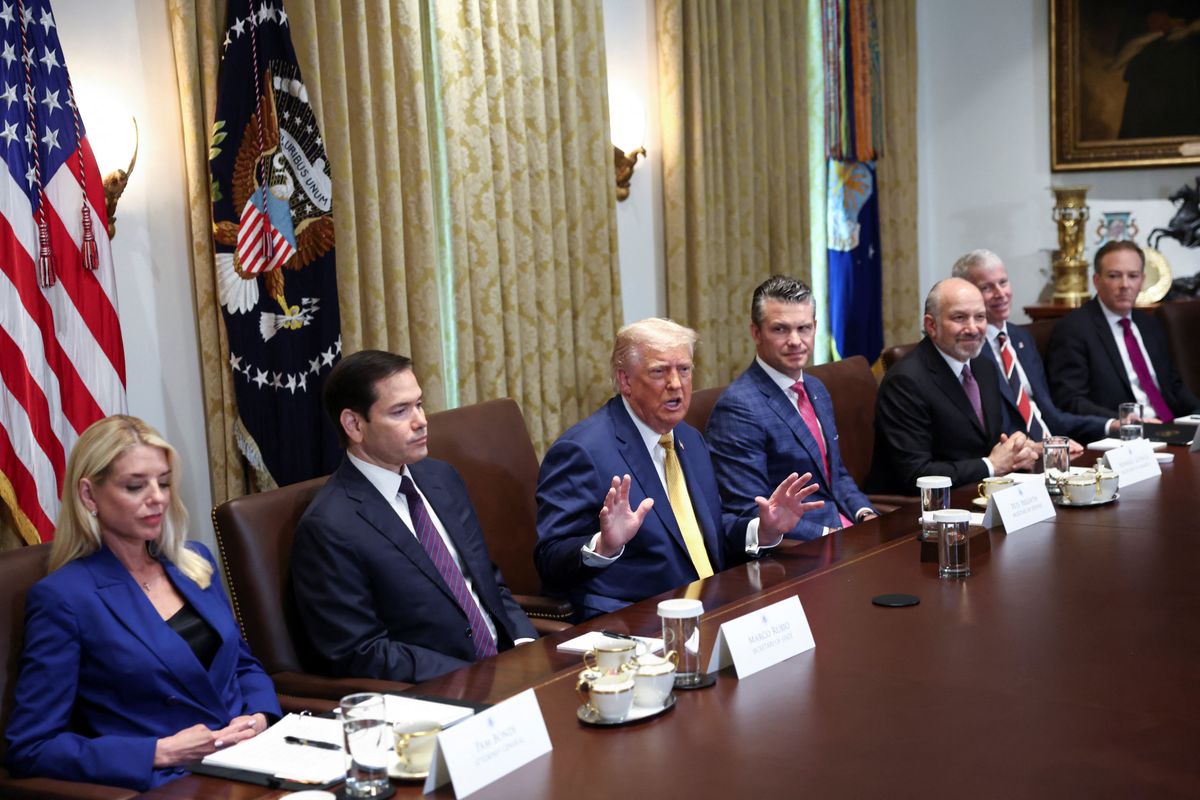
Donald Trump hosts a cabinet meeting at the White House. REUTERS/Kevin Lamarque

Why did Donald Trump invade Venezuela? His id made him.

Look at me, love me — every reason for doing anything is downstream from there.

I was telling you the other day that it’s not really clear why the president ordered the illegal and unconstitutional invasion of Venezuela and the kidnapping of its head of state. Regime officials provided reasons but were often contravened by Trump.

“Aren't We Tired of Trying to Interpret Trump's Foreign Policy Gibberish?” asked Marty Longman in the headline of a piece published after news of the attack. Indeed, we are, and I hasten to add that endless attempts to figure it all out are a form of oppression.

It isn’t normal.


Even if you disagreed with the 2003 invasion of Iraq, you understood the argument for it. George W Bush said Saddam Hussain had weapons of mass destruction. That was a lie, but at least the thinking above and below it was coherent.


In contrast, senior officials in the Trump regime are all over the place about why the US had to violate Venezuela’s sovereignty, giving the impression that no one above the level of military operations actually knows what they’re doing or why they’re doing it.

Meanwhile, critics can’t form a precise counterargument since the original “argument” is, well, no one really knows what it is. So, for the most part, liberals have decided to brush aside the confusion and incoherence to pinpoint two reasons that makes sense to them: Vladimir Putin and oil.

Don’t get me wrong. If you believe Trump is a tool of a Russian dictator, I’m with you. If you think Trump is a criminal president who is willing to use the awesome power of the United States military to commit international crimes, I’m with you.


But I also think these arguments tend to share a flaw.

They make more sense than Trump has ever made.

I’m reminded of that time Susie Wiles seemed to trash other people in the Trump regime. The White House chief of staff called Russ Vought “a rightwing absolute zealot,” for instance.


To savvy observers, she seemed to be looking for a scapegoat for her boss’s troubles. But in this White House, what you see is often what you get — if it looks like chaos, it probably is.

As I said at the time:

“There are no anchoring principles, no moral guideposts, no concept of national interest, no sense of the common good. It’s just mindless impulse and rationalizations after the fact.”


Set aside Putin and oil to consider something Trump values above everything else: “ratings.” He believes the more people watch him, the more they love him. What better way to get everyone’s attention than to be seen as a war president on TV?

Not just any war, though.

In a recent interview with me, the Secretary of Defense Rock (a pen name) said Trump “dislikes large, open-ended occupations that produce visible casualties and political backlash.”


(That’s almost certainly a result of watching coverage of the Iraq War in which images of death and destruction were common.)

Instead, he likes “coercive actions below the threshold of war — air strikes, sanctions, seizures, energy pressure, and threats that generate profit and leverage without requiring public buy-in.”

In other words, he likes one-and-done military ops. Venezuela was one of those. So was the bunker bombing of Iran last June. Though they look good on TV, they looked even better with Donald “War President” Trump at the center of it all.


That’s Trump’s id: look at me, love me.

Every reason for doing anything is downstream from there.

What does it all mean? That’s what everyone is asking, but the question itself is more dignified than the thing it’s questioning.

Trump got his made-for-TV war. He got everyone buzzing about what he’s going to do next about Greenland, MexicoCanada, wherever.


Meanwhile, back in Venezuela, it looks like life is going to go on pretty much as it had been, the difference being that the new leader is even more tyrannical than the last one.

“The idea that she can't rig another election or the opposition will magically take over seems pretty far-fetched, especially because we don't have troops on the ground,” the Secretary of Defense Rock said.

The Secretary of Defense Rock doesn’t use his real name, because Trump is president. He’s the publisher of History Does Us, a newsletter about the intersection of military and civilian life. The last time we spoke, we discussed how the commander-in-chief undermines military discipline.


“The idea that we will launch more air strikes or raids or blockades if she doesn't play ball seems kind of dumb, given where the polling is,” he told me. “At this point, I kinda assume the status quo will hold, and that this entire episode will ultimately amount to little more than content-production and performative-posting.”

Here’s our conversation.
JS: The US now opposes democracies in Europe. We have invaded Venezuela. We are war-drumming about Greenland. Is Vladimir Putin's investment in Donald Trump finally bearing fruit?

SDR: I’d be careful with the phrase “investment bearing fruit,” because it implies command-and-control that we don’t have evidence for. What is clear is something more structural and, frankly, more troubling: Vladimir Putin doesn’t need to control Donald Trump to benefit from him. He benefits from Trump’s own instincts.

Putin’s core objective isn’t territorial conquest in the Cold War sense. It’s the erosion of Western cohesion, legitimacy and confidence. On that score, Trump has been extraordinarily useful without being directed. Attacking allies, casting doubt on democratic norms, treating sovereignty as transactional, and framing international politics as raw deal-making all weaken the post-1945 order that constrains Russia.

On Venezuela specifically, what you’re seeing isn’t a coherent imperial project so much as improvisational, performative power politics — noise that signals disregard for norms rather than a plan to replace them. That norm-breaking itself is the point. It tells allies that rules are optional and tells adversaries that the West no longer believes in its own system.

So no, this isn’t about Putin cashing in some secret investment. It’s about a global environment where authoritarian leaders benefit when the United States abandons restraint, consistency, and democratic solidarity—and Trump does that instinctively. The fruit isn’t conquest. It’s corrosion.
Most of the Democrats in the Congress seem to be pushing back against Trump's imperial overtures. Is that your perspective? If not, what do you think they should do?

There is meaningful pushback from a lot of Democrats (no matter what Democrats are complaining about on background on Axios), more quickly and more openly than during Trump’s first term.

You’re seeing sharper rhetoric and a greater willingness to use oversight, but they don't control any branch of government, so there isn't much they can do.

But with such tight margins, particularly in the House, I don't think it's crazy to shut down the government again (I believe funding expires at the end of the month?), or hold up an NDAA (National Defense Authorization Act). You have senior administration officials openly stating they want Greenland and would use military force, which is so insane that you might as well take extreme measures.
Sad to say, Stephen Miller might be right. 'Nobody is gonna fight the US militarily over the future of Greenland,' he said. If so, NATO could be a paper tiger. Is that what could happen?

I still can't believe this is a thing. Miller is probably right on the narrow, grim point that Denmark isn’t going to “fight the US military” in a conventional war over Greenland. But the leap from that to “NATO becomes a paper tiger” is not automatic — because NATO’s credibility isn’t just “can Denmark win a shooting war with the US.”

It’s whether the alliance remains a political commitment to mutual sovereignty. A US move to seize Greenland would be less a “test of NATO’s tanks” than a self-inflicted alliance-killer that destroys Atlanticism probably forever.

But it is a move that is so outrageous that I think there would be more alarm among congressional GOP's and the military.
Fighting foreign wars is as popular as Jeffrey Epstein's child-sex trafficking ring. Yet Trump continually takes the side of elite interests, in this case, oil companies. What is going on?

I think this is basically Marco Rubio.

I thought he would have very little influence because he came from the internationalist wing of the GOP, but being both secretary of state and national security advisor (and archivist if you care about that) clearly gives Rubio a lot of influence, and Venezuela has been a pet project of his for a while. Add support from Stephen Miller and this was probably an inevitability.

I'm not even sure a lot of the oil companies want anything to do with Venezuela, because of the security concerns, age of infrastructure, and the capital investment that would be required to get any meaningful profit. I also thought the US was supposed to be energy independent?

In addition, Trump’s “anti-war” image is real only in a very narrow sense. He dislikes large, open-ended occupations that produce visible casualties and political backlash. What he’s perfectly comfortable with are coercive actions below the threshold of war — air strikes, sanctions, seizures, energy pressure, and threats that generate profit and leverage without requiring public buy-in.

If a helo goes down, we're having a very different conversation.
There is no followup plan for Venezuela, is there? Trump is just winging it. He has no idea what he's doing. Every choice is made with how it looks on TV in his mind. Am I wrong?

Ya, this is why I never understood all the editorializing about how things have really changed and this is a really great success.

The structures and principals of the Venezuelan government that were set up by Maduro are still intact. From everything I have read, Delcy Rodriguez is a more ruthless political operator than Maduro was, so the idea that she can't rig another election or the opposition will magically take over seems pretty far-fetched, especially because we don't have troops on the ground.

The idea that we will launch more air strikes or raids or blockades if she doesn't play ball seems kind of dumb, given where the polling is. At this point, I kinda assume the status quo will hold, and that this entire episode will ultimately amount to little more than content-production and performative-posting.


Maduro loyalists stage modest rally as Venezuelan govt courts US


By AFP
January 10, 2026


Hundreds of protesters rallied in Caracas - Copyright AFP Juan BARRETO


Javier TOVAR

Supporters of Venezuela’s deposed leader Nicolas Maduro staged protests Saturday, a week after his dramatic capture by US forces, but only hundreds turned out to demand his release as the interim government moved to revive ties with Washington.

Waving flags and placards with the face of the mustachioed ex-leader and his wife Cilia, around 1,000 protesters rallied in the west of Caracas and a few hundred in the eastern Petare district — far smaller than demonstrations Maduro’s camp has mustered in the past.

“I’ll march as often as I have to until Nicolas and Cilia come back,” said one demonstrator, Soledad Rodriguez, 69, of the presidential couple who were taken by US forces to New York to face trial on drug-trafficking charges.

“I trust blindly that they will come back — they have been kidnapped.”

Notably absent from the rallies were top figures from the government, which has said it is reviving diplomatic contact with Washington and discussing possible oil sales to the United States.

Interim president Delcy Rodriguez instead attended an agricultural fair, where she vowed in televised comments she would “not rest for a minute until we have our president back.”

The other two hardline powers in the government, Interior Minister and street enforcer Diosdado Cabello, and Defense Minister Vladimir Padrino Lopez, were not seen at the demos either.


– Diplomatic maneuvers –


Despite the shock of Maduro’s capture during deadly nighttime raids on January 3, signs emerged Friday of cooperation with Washington after US President Donald Trump’s claim to be “in charge” of the South American country.

Washington said US diplomats visited Caracas on Friday to discuss reopening the American embassy.

A State Department official told AFP on Saturday they left again on Friday “as scheduled.”

“The Trump Administration remains in close contact with interim authorities” in Venezuela, the official added.

The Venezuelan government did not reply when asked by AFP whether the US officials had met with Rodriguez.

She has pledged to cooperate with Trump over his demands for access to Venezuela’s huge oil reserves.

But she also moved to placate the powerful pro-Maduro base by insisting Venezuela is not “subordinate” to Washington.

The US embassy in Colombia warned American citizens on Saturday that “the security situation in Venezuela remains fluid” and advised its nationals to leave the country “immediately” as commercial flights become available.


– Anxiety over prisoners –


Anxious relatives meanwhile camped outside jails, awaiting the promised release of political prisoners by the interim government.

Rodriguez’s camp on Thursday began releasing prisoners jailed under Maduro, promising a “large” number would be freed in a gesture of appeasement that Washington took credit for.

However, prisoners’ rights groups said on Saturday that fewer than 20 had been freed, including several prominent opposition figures.

Families slept out overnight under blankets near El Rodeo prison east of Caracas, hoping for the release of their loved ones.

“I am tired and angry,” Nebraska Rivas, 57, told AFP, as she waited for her son to be released.

“But I have faith that they will hand him over to us soon,” she said, after sleeping out on the pavement for two nights.


– Oil talks –


Following Maduro’s capture, Trump vowed to secure access for US companies to Venezuela’s vast oil reserves.

Chevron is currently the only US firm licensed to operate in Venezuela, through a sanctions exemption.

The White House said Saturday Trump had signed an emergency executive order protecting US-held revenues derived from sales of Venezuelan oil, to prevent them from being seized by courts or creditors.

At a White House meeting on Friday, he pressed top oil executives to invest in Venezuela’s reserves, but was met with a cautious reception.

ExxonMobil chief executive Darren Woods dismissed the country as “uninvestable” without sweeping reforms.

Experts say Venezuela’s oil infrastructure is creaky after years of mismanagement and sanctions.