Wednesday, January 14, 2026


Source: Originally published by Z. Feel free to share widely.

In the U.S., seventeen million people, across multiple generations, have a shared personal identity based on their past military service. About 1.3 million former service members currently work in union jobs, with women and people of color making up the fastest-growing cohorts in their ranks. According to the AFL-CIO, veterans are more likely to join a union than nonveterans. In a half dozen states, 25 percent or more of all actively employed veterans belong to unions. 

In the heyday of industrial unionism in the 1950s and ‘60s, tens of thousands of former soldiers could be found on the front lines of labor struggles in auto, steel, meat-packing, electrical equipment manufacturing, mining, trucking, and the telephone industry. Many World War II vets became militant stewards, local union officers, and, in some cases, well-known union reformers in the United Mine Workers (UMW) and Oil, Chemical and Atomic Workers.

According to labor consultant and author Jane McAlevy, the post-war union movement better understood the “strategic value” of veterans than organized labor today. In her own advice to labor clients about contract campaign planning, she recommended the enlistment of former service members whose past “experience with discipline, military formation, and overcoming fear and adversity” could be employed on picket-lines and strike committees.

In addition, the high social standing of military veterans in many blue-collar communities can be a valuable PR asset when “bargaining for the public good” or trying to general greater public support for any legislative/political campaign.

A D-Day Rally in DC

The wisdom of that advice has been confirmed repeatedly– since January of this year—by the front-line role that veterans in labor have played in resisting Trump Administration attempts to cut government jobs and services and strip federal workers of their bargaining rights. At agencies like the Department of Veterans Affairs (VA), more than 100,000 former service members have been adversely affected by these right-wing Republican attacks. 

In response, the Union Veterans Council of the national AFL-CIO brought thousands of protestors to a June 6 rally on the Mall in Washington, D.C., to hear speakers including now retired United Mine Workers President Cecil Roberts, a Vietnam veteran. 

With local turnout help from the American Federation of Government Employees (AFGE), National Nurses United, and the Labor Notes-assisted Federal Unionist Network (FUN), other anti-Trump activists participated in 225 simultaneous actions in locations around the country, including in red states like Alaska, Alabama, Florida, Georgia, North Carolina, Idaho, Kansas, and Kentucky. Some “watch parties,” organized for real-time viewing of the D.C. event, were held in local union halls to highlight the labor-vet overlap. 

James Jones, a FUN member and Gulf War veteran from Boone, North Carolina, traveled all the way to D.C. on the 81st anniversary of D-Day because he wanted Congress to understand the importance of VA services to veterans like himself. 

Jones now works for the National Park Service and belongs to AFGE. He’s urging all his friends who are vets, fellow VA patients, and federal workers to start “going to rallies, and join these groups that are really fighting back. The government needs to keep the promise it made to veterans. We served our country, and now they’re breaking their promise to take care of us. We can’t accept that.”

VA Not For Sale

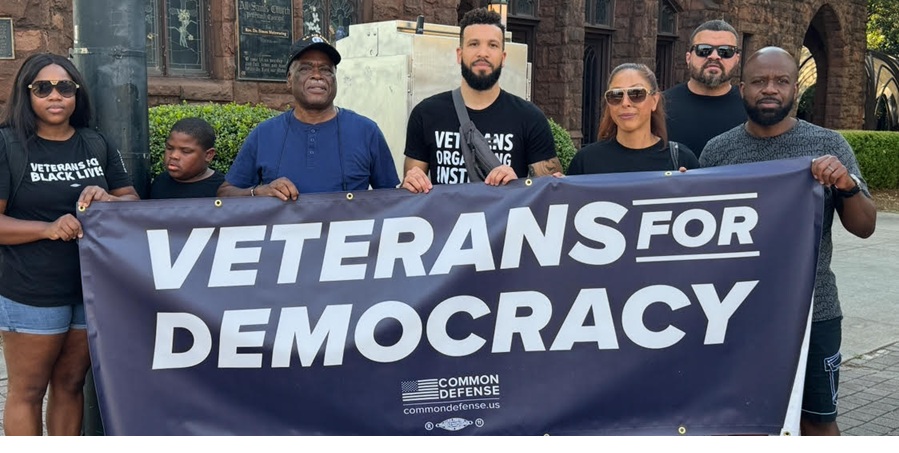
Private sector union activists, like CWA Local 6251 Executive Vice-President David Marshall, a former Marine and member of Common Defense, the progressive veterans’ group, have also been rallying their fellow veterans, inside and outside the labor movement.

Marshall has joined rank-and-file lobbying in Washington, D.C. against Trump-Vance cuts in VA staffing and services, calling them “a betrayal of a promise to care for us.”  Supporters of Common Defense’s “VA Not for Sale” campaign fear that privatization of veterans’ healthcare will destroy what Marshall calls the “sense of community and solidarity” that VA patients experience when they get in-house treatment, as opposed to the costly and less effective out-sourced care favored by President Trump. “Regular hospitals don’t understand PTSD or anything else about conditions specifically related to military service,” he says.

An AT&T technician in Dallas, Marshall was also a fiery and effective speaker at that city’s big “No Kings Day” rally last June, when he explained why he and other veterans in labor are opposing MAGA extremism, political and state violence and related threats to democracy. “We’ve seen peaceful protestors met with riot gear, and we’ve heard the threats to deploy active-duty Marines against American citizens,” he told a crowd of ten thousand in Dallas last June. “Let me be clear: using the military to silence dissent is not strength; it’s tyranny. And no one knows that better than those who have worn the uniform.”

Veterans for Social Change

Marshall is a third-generation union member born and raised in southern West Virginia. His father and grandfather were coal miners; his grandmother Molly Marshall was active in the Black Lung Association that helped propel disabled World War II veteran Arnold Miller into the presidency of the UMW in 1972. During his own 25- year career as a CWA member, Marshall has served as a safety committee member, national union convention delegate, and now officer of his local. 

Marshall belongs to CWA’s Minority Caucus, the Coalition of Black Trade Unionists, and the NAACP. Along with Britni Cuington, a Local 6251 steward and Air Force vet, he attended a founding meeting of Common Defense’s Black Veterans Caucus at the Highlander Center in Tennessee. 

Both Marshall and Cuington have since lobbied against the re-districting scheme concocted by Texas Republicans to secure more House seats in mid-term voting this year. Testifying at a public hearing  on behalf of the Texas AFL-CIO, Cuington pointed out that “minority veterans already face barriers to access to the services, benefits, and economic opportunities we have earned.” She condemned the state’s new district lines as racial gerrymandering in disguise that will disenfranchise “veteran heavy, working class neighborhoods.”  

In his role as a CWA organizer, Marshall has signed up thirty Common Defense field organizers around the country—almost all fellow vets—as new members of his local. He’s now helping them negotiate their first staff union contract. In addition, Marshall encourages former service members in other bargaining units to participate in the union’s Veterans for Social Change  program, which has done joint Veterans Organizing Institute training with CWA.

One fellow leader of that rank-and-file network is Keturah Johnson, a speaker at the 2024 Labor Notes conference. She got a job at Piedmont Airlines in 2013 as a ramp agent, after her military service and then become a flight attendant. A decade later, she became the first queer woman of color and combat veteran to serve as international vice president of the fifty-thousand-member Association of Flight Attendants-CWA.

A National Guard Casualty 

One CWA member much in the news lately because of his current National Guard service is 24-year-old Andrew Wolfe, a lineman for Frontier Communications in Martinsburg, W. Va. He was seriously wounded—and a fellow Guard member killed– in late November after being sent to patrol duty in Washington, D.C. (His assailant was a mentally ill, CIA-trained former death squad member from Afghanistan, relocated to the U.S. after the collapse of the U.S. backed government there in 2021.)

According to Marshall, “it’s shameful that they were ever put in that position,” by a Republican governor going along with Trump’s federalization of Guard units for domestic policing purposes. “It’s all political theatre,” he says. “They were just props, just standing around, with no real mission.” Along with Common Defense, Marshall praises the six fellow veterans in Congress whose recent video statement reminding active duty service members of their “duty not to follow illegal orders” led President Trump to call them “traitors” guilty of “seditious behavior” that should be punished by hanging.

“We have to stay in lock-step with them and show everyone following the Constitution that we have their back,” Marshall says.Email

avatar

Steve Early has worked as a journalist, lawyer, labor organizer, or union representative since 1972. For nearly three decades, Early was a Boston-based national staff member of the Communications Workers of America who assisted organizing, bargaining and strikes in both the private and public sector. Early's free-lance writing about labor relations and workplace issues has appeared in The Boston Globe, Los Angeles Times, USA Today, Wall Street Journal, New York Times, Washington Post, Philadelphia Inquirer, The Nation, The Progressive, and many other publications. Early's latest book is called Our Veterans: Winners, Losers, Friends and Enemies on the New Terrain of Veterans Affairs (Duke University Press, 2022). He is also the author of Refinery Town: Big Oil, Big Money, and the Remaking of An American City (Beacon Press, 2018); Save Our Unions: Dispatches from a Movement in Distress (Monthly Review Press, 2013); The Civil Wars in U.S. Labor: Birth of a New Workers’ Movement or Death Throes of the Old? (Haymarket Books, 2011); and Embedded With Organized Labor: Journalistic Reflections on the Class War at Home (Monthly Review Press, 2009). Early is a member of the NewsGuild/CWA, the Richmond Progressive Alliance (in his new home town, Richmond, CA.) East Bay DSA, Solidarity, and the Committees of Correspondence for Democracy and Socialism. He is a current or past editorial advisory board member of New Labor Forum, Working USA, Labor Notes, and Social Policy. He can be reached at Lsupport@aol.com and via steveearly.org or ourvetsbook.com.


Source: Originally published by Z. Feel free to share widely.

January 3, 2026, should be the date to end all discussion:  Trump’s raid on Venezuela should have clarified reality even to the most obtuse:  the US is not an “ordinary” country, as is claimed by observers all around, but is the center of the US Empire.  Its “leaders” seek to dominate the world.  Those of us on the radical left have been correct:  the United States is an imperialist country, and currently, the most powerful one on the planet.

After observing the war in Vietnam, as a US Marine who spent his four years in the United States (1969-73), and taking some time to try to reconsider my thinking after getting out of the military, I began serious writing in 1984, trying to understand what was going on in the world.  Obviously, what I had been told while growing up by my family, schools, and government had been a series of lies.

Vietnam had not been invaded by an external force; the war there was a civil war, and the United States had, in its arrogance, stuck its nose into.  (Years later, I learned that in Geneva during1954, the US had agreed with the French, the Chinese, the Soviets, and “North” Vietnamese to allow the people of “South” Vietnam to have a free and fair election so as to decide whether they wanted to live as an “independent” country under a French puppet regime or if they wanted to join with those in the north of Vietnam, under Ho Chi Minh, to be part of Vietnam.  The election was to take place in 1956.  That year, the “independent” regime cancelled the agreed-upon elections, which were never held.  The reason, according to then-President Dwight Eisenhower in his memoirs, was that ‘Every poll showed that Ho Chi Minh would have won 80 percent of a free, fair election,’ and that’s why 3.8 million Vietnamese were killed and another 5.7 million wounded, and over 58,000 Americans and other allies were killed, and hundreds of thousands were wounded and often traumatized for life.  See Turse, 2013.)

But that information, which I picked up along the way, was not what I was ultimately seeking; I was trying to figure out how changes in the global economy were affecting US workers (Scipes, 1984).

I was, at the time, taking a graduate course in international relations at San Francisco State University while working as a union printer and labor activist in the Bay Area.  To try to grasp the economic developments beginning during the late 1970s, I felt it necessary to go back to the end of World War II, in 1945.

Trying to begin with the big picture, I recognized that there were two empires in the world, one led by the United States and one by the Union of Soviet Socialist Republics (USSR or Soviet Union) and, while recognizing the existence of each, I concentrated on the US Empire.

This was unusual; at that time; no scholar that I found had used this term.  [Years later, I learned that William Appleman Williams in his 1959/1962 book had used this term, and then in Black Against Empire by Joshua Bloom and Waldo E. Martin, Jr. (2013), that the Black Panthers had used it during the late 1960s-early ‘70s in presenting their understanding of the world.  In 1989, Jan Nederveen Pieterse, a Dutch-born scholar, used the term in his title, Empire and Emancipation.  There probably have been others.]  And later, the late William Blum (1986, 2000, 2013)—whose work has been so influential upon many US activists—thought he was responsible for revival of the term; when I stayed with him in his apartment in Washington, DC the last time we saw each other—probably somewhere around 2016-18—we discussed this and I showed him I had revived the term before him; obviously, his important books popularized the term far beyond my simple paper.  In any case, I think it’s safe to say that I was among the earliest of those who used it after the end of the American war in Vietnam.

Yet today, as far as I can tell, I am among only a few who have used the term consistently over the years (for a few examples, see Scipes, 1989, 2010a, 2010b, 2016, 2023), although Alfred W. McCoy finally adopted it in 2017, and he reported in his brilliant Shadows of the American Century (2017) that it had been adopted by a range of scholarly writers; he continues in his 2026 subtitle.

Now, I can understand why my limited range of published articles had such a minor impact, but I cannot understand the same for a major distinguished scholar such as McCoy.  (In fact, I reviewed his 2017 book in an on-line, peer-reviewed scholarly journal, “Class, Race, and Corporate Power,” in an effort to expand his impact, and as of today, there have been over 4,500 downloads of my review around the world. See Scipes, 2018).

What I find shocking, however, is the almost total absence of the term “empire” in the writings of our best political activists today, wherever they are located.  And while I’d like to get whatever credit due me for my work, my concern is much larger; to me, the use of empire signifies taking a global approach to the world.  And that its absence in our writings suggests strongly that most North American political writers are confining our analysis to the United States of America and, possibly, Canada.  (And obviously, we must exempt those living and writing overseas who utilize a global perspective.)

To me, if one is writing about the United States in the world, then—almost by definition—this cannot be confined to domestic politics.  Period.

The folks I see who are doing this seem to have some sort of “social democratic” perspective and politics, whether they claim it or not.  These are reformist politics, not radical ones.  In other words, rather than to struggle for a new world, they want to “reform” the current one around the edges, so that the jagged parts can be dislodged and then the remainder smoothed off.  (I’m trying to be descriptive here, not pejorative.)  In general, they do not want to address the reality that the US is an imperialist nation.

The problem, from my perspective, is that the United States is acting globally, and has been a global project since Europeans first “found” it.  (Rough dating because its existed continuously since then is 1607 in Virginia; there were earlier Spanish and English settlements previously, but they didn’t survive.)  In any case, the US has continuously been effecting and effected by global forces since that time.

We are not taught this in the overwhelming majority of our schools, including, from what I can tell, most universities.  If we were, there would have to be major changes in the “American” story.

Let me give on example to clarify.  We are taught about the Louisiana Purchase where, in 1803, US President Thomas Jefferson bought most of the US “west” from France (lands other than those claimed at the time by Spain).  By why were the French even willing to sell?  That is rarely addressed….

In general, the world at the time saw major European powers—especially England, France, and Spain—competing to dominate the world.  They each had colonies in the Caribbean; the English in Jamaica, the French in Haiti, and the Spanish in the Dominican Republic and Cuba.  These colonies each produced massive amounts of profits from the slave-produced sugar and other natural resources for its imperial master, plus they each had ports for their respective military, both to provide internal control over the slaves and to protect the supply lines to the respective countries from the imperial homeland.  This way, they were able to protect respective trading routes from competitors, as well as from independent pirates who preyed on shipping.

However, in 1791, the slaves of Haiti under Toussaint L’Ouverture rebelled and overthrew the French colonists.  Napoleon then sent the French Army to recapture the colony, but the self-liberated slaves defeated them.  The British decided to take advantage of the situation, sent their Army to Haiti and, in turn, were also defeated by the former enslaved.  (To put this in contemporary terms, these were like the  and  competitors for the World Heavyweight Boxing Crown!)  Haiti has made to suffer ever since for its impertinence (see Geggus. 2014; James, 1938; Nederveen Pieterse, 1989, Chapter 14).

Why haven’t we in the US been taught about the Haitian Revolution of 1791?  Simply, it didn’t fit well with the myth of white supremacy to have Black former slaves defeat white armies.  This myth had been projected around the world, especially by the white imperialists, to justify their degradation, enslavement, and killing of people of color as the imperialists stole their lands, raw materials, natural resources, and in many cases, their peoples for the well-being of the rich in the imperial countries.  The imperialists—including those in the United States, which included most of the white elites—certainly didn’t want to undermine this established myth!

Second, the newly liberated Haitians provided political and economic support for forces in northern South America that were fighting under Simon Bolivar for their liberation from Spain, as well as inspiration for Black slave revolts, such as Gabriel Prosser’s and Denmark Vesey’s in the US South.  We cannot talk about global solidarity, can we?

And third, and immediately pertinent to this article, is that without Haiti, the French could no longer protect their supply lines from the English, Spanish and various pirates, supply lines that had formerly run from France, through Haiti, and on to New Orleans, the headquarters of the French colony in the “American” west.  The Revolution in Haiti had deprived the French of their protective bases and maintenance of New Orleans was simply unsustainable without them.  Thus, the French cut their losses and sold to the United States and avoided another possible war as US colonists were heading west.

I share this story to make my point:  we cannot understand the development of nor the actions of the United States in the world today without taking a global perspective.  Truthfully, it never has been possible, but this has not been told to us.

So, when we fail to place our political understandings, strategies, and tactics in anything other than a global perspective, we are limiting and lying to ourselves and others!  It is that clear.

And yet, most of the US left fails to take a global perspective; we try to understand the world by limiting our vision to the US and maybe, in a few cases, Canada and Mexico.

But wait:  what about US support for struggles in Vietnam, Central America, the Philippines, South Africa, Iraq, Afghanistan, Gaza, Venezuela, etc.?  Support for each has been strong, albeit some support stronger than others.  This support has been impressive, but it has often been detached from our politics as home in the US.  In other words, I argue that political struggles in the US have been detached from those overseas.

But this is stupid!  Yes.  Why the disjunction?

I believe a major factor here is in the nature of the US left.  Most of us, and especially leaders, have gone to college and have at least a bachelor’s degree. 

[Truth in advertising:  not only do I have a Bachelor’s, I have a Master’s and a Ph.D.  I taught at a university in Northwest Indiana for 18 ½ years, however, it was after years of serving in the US military, and working for years as an industrial printer, office worker, and high school teacher.  Please focus on my argument if possible.]

What most people do not recognize is the impact of a college degree.  What students learn going through these programs is how to systematically generalize and analyze their subjects, and these are skills that few non-college attendees attain unless they get specific, specialized training as through some union training programs, some military occupational specialties, and/or advanced technical training.

At the same time, as my friend, Kayla Vasilko reminds me, “above all college students are taught to compete for the American dream. They are graded against each other to compete for the best jobs, of which there are few. They are taught not to trust others; they are not taught how to work together and organize. They are taught to obey authority.”

The importance of recognizing both of these outcomes is that many college grads feel uncomfortable around more working class people, and we fail to interact with them.  (I definitely am not suggesting that all working class people are wonderful, much less perfect, or any such thing:  they are as good as the best of us and as bad as the worst of us.)  Worse, we often denigrate them. (I’d argue that working class people of all colors deserve all the respect each of expect for ourselves, at least until they prove themselves undeserving.)

The larger point here being that we have knowledge to share, as well as they have knowledge and experiences to share with us, and we need to directly and forthrightly confront this gap.

Without doing this, we lose our major source of power as a political project:  people power.  We don’t have the guns, we don’t have legal “rights” to stop the mistreatment of us all:  the only real potential power we have—as has been shown recently in Los Angeles, Chicago and Portland, Oregon in their resistance to the fascists in the Trump Administration and particularly in ICE—is the power of the people.

Yet, how to we build these connections?  We have to be able to communicate across our differences in ways that make sense to each other.  That means, we must try to understand the world in all of its complexities and be able to convey those understandings in ways that can be understood.

The fact is that the elites’ escalating assault on all of us around the world is connected to its assault on Venezuela, tolerance of the Israeli genocide in Gaza, and its assault on the environment of our planet:  their greed and search for total domination of all people is a literal death threat to each of us, as Renee Good unfortunately found out.  We have to not only be able to explain this, but we have to have the patience to respond to questions and/or opposition to these ideas.

For those of us on the left, this means confronting our fears of being unable to do so; we’ve got to get out and find ways to successfully interact and communicate with those unlike us.  This means we must see the interconnectivity of it all, and from a global perspective. We’ve got to reject limiting our focus to only subjects at hand, but we need to help people understand the whole world and show them how everything is connected:   without that, we’re doomed to failure.

The US left needs to quit being so chickenshit.  As we used to say in the 1960s and ‘70s:  dare to struggle, dare to win!


avatar

Kim Scipes, PhD, is Professor Emeritus of Sociology at Purdue University Northwest in Westville, Indiana. He has published four books and over 280 articles and book reviews in the US and 11 different countries. A free copy of his book on the KMU in its entirety is available on his website at https://www.pnw.edu/personal-faculty-pages/kim-scipes-ph-d/publications just below the pictures of his books, along with links to many of his articles. Scipes has been an industrial worker (a printer), high school teacher, and office worker over the years, and has been a member of the Graphic Communications International Union, the American Federation of Teachers, and the National Education Association, and is currently a member of the National Writers Union; all but the NEA are affiliated with the AFL-CIO. His newest book, tentatively titled Unions, Race and Popular Democracy: Learning from the CIO to Rebuild a Progressive US Labor Movement in the Mid Twenty-first Century, will be published in late 2025 or early 2026.

Source: Originally published by Z. Feel free to share widely.

There is a widening gap today between global possibilities and global realities.

The possibilities are enormous, for―thanks to a variety of factors, ranging from increases in knowledge to advances in economic productivity―it’s finally feasible for all of humanity to lead decent and fulfilling lives.

No longer is poverty necessary, for the enormous global economy can produce adequate food, goods, and services for all the world’s people.

Human health and longevity can be improved substantially, thanks to breakthroughs in science and medicine.

Education, communications, transportation, and culture have made huge strides toward enriching human existence and could finally be made available to all.

Meanwhile, the rise of the United Nations and of international law holds the promise of moving beyond the violent, bloodstained past and securing peace, human rights, and justice on the international level.

And yet, current realities fall far short of these possibilities. 

Despite some advances in countering worldwide poverty, it remains at a startlingly high level.  According to the World Bank, half of humanity lives on less than $6.85 per day per person, with over 700 million people living on less than $2.15 per day. 

Moreover, economic inequality is vast and increasing.  A recently-released World Inequality Report, produced in conjunction with the United Nations, found that, in almost every region of the world, the richest 1 percent is wealthier than the bottom 90 percent combined.  Indeed, the richest 0.001 percent of the world’s population controls three times the wealth of the poorest half, and its wealth is growing at a faster rate.

As the charitable organization Oxfam has observed, there is no morally defensible justification for this state of affairs.  “Extreme wealth is not accumulated simply as a reward for extreme talent,” it has noted.  “The majority of billionaire wealth . . . is unearned, derived from inheritance, crony connections, and monopolistic power.”  Moreover, billionaires and giant corporations are fostering greater economic inequality and misery by opposing labor laws and policies that benefit workers, undermining progressive taxation, employing modern colonial systems of wealth extraction in the Global South, and using monopoly power to control markets and set the rules and terms of exchange. 

Furthermore, when it comes to respecting international law, the rulers of some powerful nations are behaving increasingly like gangsters.

Donald Trump is particularly flagrant in this regard.  During his second term as President of the United States, he has already bombed seven nations (Iran, Iraq, Nigeria, Somalia, Syria, Venezuela, and Yemen), threatened to invade or seize five others (Canada, Colombia, Cuba, Greenland, and Mexico ), blown up 33 foreign boats and their sailors, kidnapped the president of a sovereign nation (Venezuela), and announced plans to “run” Venezuela and take control of its vast oil resources.  “I don’t need international law,” he explained.

Trump’s “America First” policy―redolent of traditional great power imperialism―is complemented by other measures showing contempt for key international institutions.  Trump quickly withdrew the U.S. government from leading UN agencies like the World Health Organization and the UN Human Rights Council, refused to participate in the UN Relief and Works Agency, and announced plans to withdraw from UNESCO.  On January 7, 2026, the White House followed up by announcing U.S. withdrawal from 66 international and UN entities.  It has also withheld at least two years of mandated dues to the UN’s regular budget and has placed sanctions on the judges and chief prosecutor of the International Criminal Court.

Clearly, Trump has other priorities.  He dramatically increased U.S. military spending soon after he returned to power and, in January 2026, proposed raising military spending by another $600 billion to a record $1.5 trillion, thereby creating his “Dream Military.”  Apparently, this dream does not include ending the menace of nuclear annihilation, for―asked about renewing the last nuclear arms control agreement remaining with Russia, scheduled to expire next month―Trump responded:  “If it expires, it expires.”

Unfortunately, leaders of other nations are also working full-time to destroy what remains of international law and humanity’s hopes for the future.

Vladimir Putin has stopped at nothing to revive what he considers Russia’s imperial glory by waging nearly four years of war to conquer and annex his far smaller, weaker neighbor, Ukraine.  Ignoring strong condemnations by the UN General Assembly, the International Court of Justice, and the International Criminal Court, Putin has pressed on with an imperialist war that has reduced cities to rubble, damaged or destroyed thousands of schools and health care facilities, and sent 6 million Ukrainians fleeing abroad.  The wounded or dead number hundreds of thousands of Ukrainians and as many as 1.2 million Russian soldiers.

Nor is this the extent of Putin’s military interventionism.  Until quite recently, he conducted a brutal bombing campaign for nearly a decade in Syria to prop up the Assad dictatorship against its domestic foes.  He also employed the Wagner Group, a shadowy private mercenary army headquartered in Russia, to conduct military operations elsewhere in the Middle East and in numerous African nations.

Like Trump, Putin has scrapped nuclear arms control agreements and occasionally threatened nuclear war.

Other national rulers, enamored with military power and widening their realms, have also turned their countries into rogue nations.  Kim Jong Un, despite offers from the South Korean and U.S. governments to improve diplomatic relations, has chosen instead to dramatically expand North Korea’s nuclear arsenalthreaten nuclear war, and dispatch more than 14,000 combat troops to help Russia subdue Ukraine.  Benjamin Netanyahu, while constantly claiming Israel’s victimization, has in fact superintended a genocidal slaughter of Palestinian civilians, staged military attacks on numerous nations, and―in defiance of a ruling by the International Court of Justice―refused to end Israel’s decades-long occupation of Palestinian territory.

Although it’s tragic that powerful forces seem intent on building an unjust, lawless, and violent planet, let’s not forget that another world remains possible.  Indeed, with an organized international effort, it could be a wonderful world.


This article is syndicated by PeaceVoice.Email

avatar

Lawrence ("Larry") Wittner was born and raised in Brooklyn, NY, and attended Columbia College, the University of Wisconsin, and Columbia University, where he received his Ph.D. in history in 1967.  Thereafter, he taught history at Hampton Institute, at Vassar College, at Japanese universities (under the Fulbright program), and at SUNY/Albany.  In 2010, he retired as professor of history emeritus.  A writer on peace and foreign policy issues, he is the author or editor of twelve books and hundreds of published articles and book reviews and a former president of the Peace History Society.  Since 1961, he has been active in the peace, racial equality, and labor movements, and currently serves as a national board member of Peace Action (America's largest grassroots peace organization) and as executive secretary of the Albany County Central Federation of Labor, AFL-CIO.  On occasion, he helps to fan the flames of discontent by performing vocally and on the banjo with the Solidarity Singers.  His latest book is Working for Peace and Justice: Memoirs of an Activist Intellectual (University of Tennessee Press).  More information about him can be found at his website:  http://lawrenceswittner.com.