Wednesday, January 14, 2026

America Under Siege: Fear and the Unchecked Presidency

A republic cannot survive this indefinitely. The removal of Donald Trump from office—which is now imperative—is not about vengeance; it is about preservation.


US Border Patrol agents detain a person near Roosevelt High School during dismissal time as federal immigration enforcement actions sparked protests in Minneapolis, Minnesota, on January 7, 2026.
(Photo by Kerem Yucel / AFP via Getty Images)

Angel Gomez
Jan 14, 2026
Common Dreams

There are moments when the danger facing a nation is not announced by sirens or declarations of war, but by something quieter and more corrosive: fear—abroad and at home—paired with the normalization of lawlessness at the very top of power.

The United States is living through such a moment.
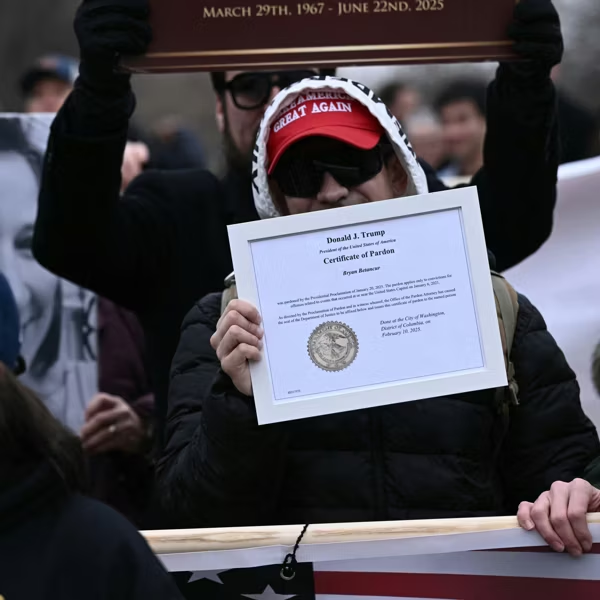


5 Years After Jan. 6 Attack, Trump Assault on Constitution and Democracy Reaches New Heights
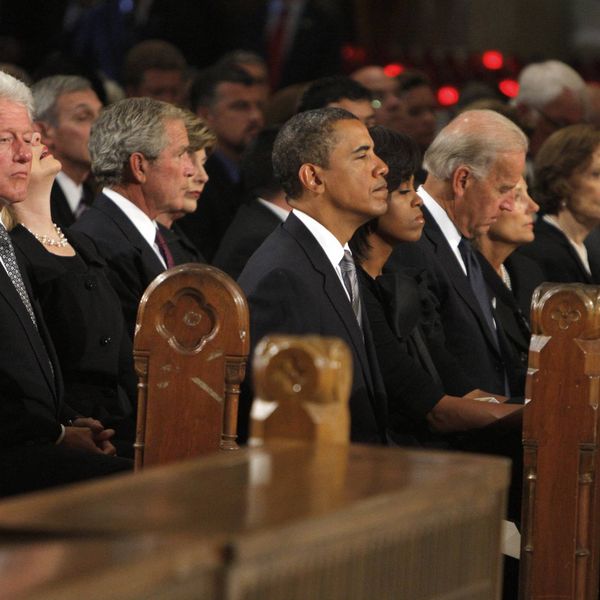


Ex-Presidents, What More Do You Need to See Before Calling for Trump’s Impeachment?

A growing number of economists, constitutional scholars, and foreign-policy experts—including Professor Jeffrey Sachs—have warned that the country is now operating under an effectively unchecked presidency, and this is very dangerous. What once sounded theoretical has become tangible. Executive conduct has crossed from aggressive policy into outright violations of constitutional structure, international law, and basic norms of human dignity—leaving Americans and foreign populations alike unsure where law ends and coercion begins.

Consider Venezuela. A sitting head of state was forcibly apprehended and remains detained despite long-established principles of head-of-state immunity recognized by both international law and US courts. No congressional declaration of war was issued. No authorization for the use of military force was granted. Yet naval deployments, explicit threats of escalation, and coercive demands have proceeded as if constitutional limits were optional.

This is not a policy disagreement. It is a rupture of the separation of powers.

A republic cannot survive this indefinitely.

Under the Constitution, Congress—not the President—decides when the nation enters hostilities. When force is used without that authorization, the injury is not foreign; it is domestic. It alters the legal obligations of service members, bypasses elected representatives, and establishes precedents that future presidents will inherit and may get to expand. What is done once without consequence becomes permissible forever.

The international consequences are equally severe. When restraint is publicly described as conditional on “cooperation,” the message is unmistakable: compliance is demanded under threat. Under international law, consent extracted through coercion is no consent at all. Agreements reached in such conditions are void, unstable, and corrosive to global order. They invite retaliation, miscalculation, and escalation.

Against this backdrop, the President’s own conduct has crossed from provocation into mockery.

Posting a mug-style image of himself online with the caption “Interim President of Venezuela” is not political satire—it is a display of contempt for a population already living under the shadow of military threat. Venezuelan civilians fear for their lives. Survivors of armed attacks have described, in horrific detail, the killing of guards and soldiers by US troops acting like mercenaries with no mercy, aligned with US objectives, sparing only the President and his wife to be taken alive. In that context, ridicule from the most powerful office on earth is not harmless. It is psychological warfare by indifference.

And the fear does not stop at the border.

Inside the United States, many citizens have grown quiet—not because they are indifferent, but because they are afraid. Afraid of retaliation. Afraid of being singled out. Afraid that the institutions meant to protect them are bending rather than holding. Silence, under these conditions, is not consent. It is duress.

That fear is reinforced when the President openly refuses to rule out acquiring foreign territory by force. When Greenland and Denmark rejected his demands, the response was not reassurance but continued ambiguity. Sovereignty, once treated as inviolable, was suddenly spoken of as negotiable—through pressure, leverage, or worse. This is not how democracies speak. It is how empires test boundaries.

What ties these episodes together is not ideology, but the erosion of restraint. Courts are pressured to proceed where jurisdiction is barred. Congress is sidelined in matters of war and peace. Sovereign resources are discussed as assets to be reassigned under coercive conditions. Threats substitute for diplomacy. Mockery substitutes for leadership.

A republic cannot survive this indefinitely.

The Constitution was designed precisely to prevent this concentration of power. War powers were placed in Congress to slow escalation. Immunities were recognized to prevent cycles of retaliation. Diplomacy was meant to replace force, not disguise it. When these guardrails fail, the danger is not merely to foreign nations—it is to the constitutional order itself.

The most alarming feature of the present moment is not outrage, but normalization. Each uncorrected violation lowers the threshold for the next. Each silence under fear teaches power that it need not explain itself.

America is now at a point where clarity is no longer optional. A President who acts beyond constitutional authority must be confronted with the limits of that authority. Violations of the Constitution and of international law must be acknowledged—not obscured, denied, or ridiculed—and immediately remedied through full and lawful redress (as guaranteed by the First Amendment’s right to petition the Government for a redress of grievances). The alternative is not ambiguity. It is consequence.

If redress is refused, if illegality is neither recognized nor corrected, the Constitution provides a final safeguard. Removal from office is not vengeance; it is a mechanism of preservation. It exists precisely for moments when power becomes unmoored from law.

“America Under Siege” does not mean tanks in the streets. It means a nation deciding whether constitutional limits still matter when they become inconvenient. And history is unforgiving to republics that delay that decision for too long.


Our work is licensed under Creative Commons (CC BY-NC-ND 3.0). Feel free to republish and share widely.

Angel Gomez
Mr. Angel Gomez is a researcher specializing in the societal impact of government policies. He has a background in psychoanalytical anthropology and general sciences.
Full Bio >
How Will the Billionaires React If Trump Cancels the 2026 Elections?

We now know that most of the big money boys couldn’t care less about democracy, but it’s worth asking how the markets will react if the current US president tries to end American democracy.


Trump has made it clear that he considers both cancellation and ordering that some votes not be counted as serious options for midterm elections, warns Baker.
(Photo: Getty Images)

Dean Baker
Jan 14, 2026
Beat the Press

The lack of market reaction to the news that Trump ordered his Justice Department to investigate criminal charges against Fed Chair Jerome Powell surprises many people. After all, everyone knows that the claims about cost overruns being the basis for the investigation is nonsense. Trump wants to threaten Powell with criminal charges because he ignored Trump’s demand that he lower interest rates.

This ordinarily would be seen as a very big deal. Ever since Nixon, presidents have been reluctant to be seen as pressuring the Fed. In fact, their concern on this issue often seemed absurd to my view. President Biden didn’t want his Council of Economic Advisors to even comment on interest rate policy, as though giving a view based on the economic data would be undue pressure.

But there is a big difference between presenting an economic argument and threatening to imprison a Fed chair who disagrees. And we now see which side Trump comes down on.

But apparently, the markets are just fine with this new threat. The major stock indexes all rose on Monday, although bond prices fell slightly, pushing long-term rates higher. The dollar also fell modestly.

The non-reaction of the stock markets might seem surprising. After all, the independent Fed is considered a sacred feature of US prosperity. There is no shortage of economists who will insist that a Fed that is subordinate to the whims of a president is quick route to double-digit or even triple digit inflation. (I’m more agnostic on this one, but the markets generally don’t listen to me.)

Anyhow, Trump is now not just looking to fire an insubordinate Fed chair, he’s looking to throw him in prison. And the markets just yawned.

This reaction should cause us to start asking how the markets might react if Trump just cancels or outright steals the 2026 elections in order to keep his lackeys in control of Congress. Under any other modern president, the fear of a cancelled or stolen election would be silly. While they might have used dubious tactics leading up to an election, we could be comfortable that the votes would be counted, and the outcome would be binding. (Florida in 2000 is a major exception.) No one ever suggested that an election would be cancelled.

But Trump has made it clear that he considers both cancellation and ordering that some votes not be counted as serious options in his recent New York Times interview. No one can be safe in assuming that we will have a normal democratic election this year.

Given this reality, we might want to speculate on how the markets would react in the event that Trump does decide to end American democracy. We now know that most of the big money boys couldn’t care less about democracy. Jeff Bezos, Mark Zuckerberg, and Tim Cook have been happy to cozy up to Trump in Mar-a-Lago, even as he violates one democratic norm after another. Elon Musk has made it clear that he has contempt for democracy, insofar as it means allowing non-white people to vote.

This gang would obviously have no moral issues with a cancelled or stolen election. But what about the economics?

Trump has already made it clear that he will favor businesses whose leaders praise him and punish those who criticize him. His most recent effort in this direction was saying that he intended to ban ExxonMobil from access to Venezuelan oil because its CEO said what every oil analyst has said since Trump became president of that country: it will be difficult for companies to profitably invest there.

The economies of countries where the leader can reward or punish companies on a whim tend to not do very well. The courts have provided a limited check on Trump’s whims as has even this pathetic Congress. However, if Trump is deciding who serves in Congress, the checks will be gone. We will have full-rule by our demented 79-year-old president.

Perhaps markets will be fine with that. With enough rear-end licking some companies may still do fine, but it would seem on the straight economics most people with money would probably prefer to invest in a serious country. Let’s hope we don’t have to find out.


This work is licensed under a Creative Commons Attribution 4.0 International License


Dean Bake is the co-founder and the senior economist of the Center for Economic and Policy Research (CEPR). He is the author of several books, including "Getting Back to Full Employment: A Better bargain for Working People," "The End of Loser Liberalism: Making Markets Progressive," "The United States Since 1980," "Social Security: The Phony Crisis" (with Mark Weisbrot), and "The Conservative Nanny State: How the Wealthy Use the Government to Stay Rich and Get Richer." He also has a blog, "Beat the Press," where he discusses the media's coverage of economic issues.
Full Bio >
Do the Democrats Have the Guts to Outflank Trump on Defense Industry Looting?

The Democrats could push Trump—or go around him to make better inroads with working people—but will they dare to take that leap? One would hope so, but don’t hold your breath.


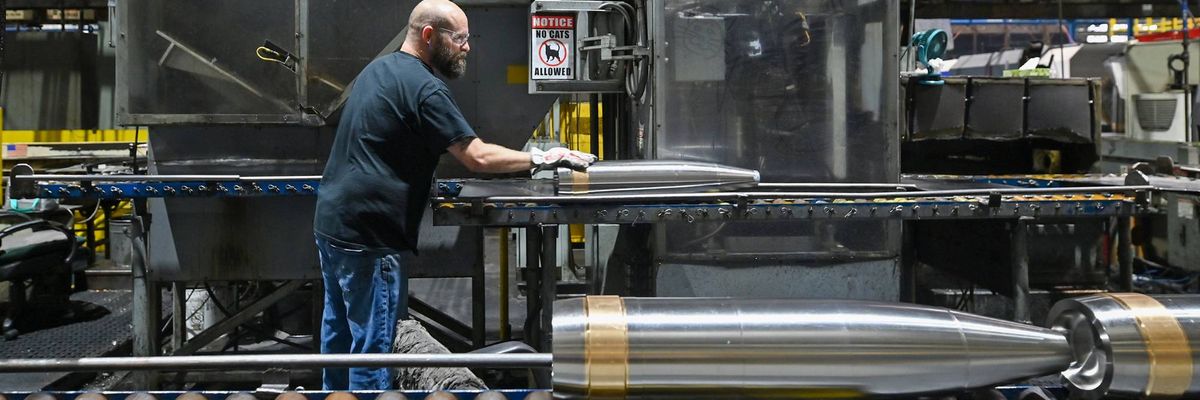
An employee at General Dynamics Scranton moves a mortar along the production line. The plant produces 155 mm shells.
(Photo by Aimee Dilger/SOPA Images/LightRocket via Getty Images)


Les Leopold
Jan 14, 2026
Common Dreams


Trump has decided that the government should not give money to defense contractors who then reroute our tax dollars via stock buybacks to stockholders and executives.

A stock buyback, for those unfamiliar, is when a corporation repurchases its own shares, thus boosting the share’s price, a legalized form of stock manipulation. CEOs, who are paid mostly in stock incentives, and large investors directly benefit from stock buybacks, and unlike with dividends, don’t have to pay taxes until they sell their shares.

In the weapons industry, this isn’t news. Studies show that defense contractors spent three times more on dividends and stock buybacks than on capital investments needed to fulfill their contracts over the last decade. In Europe, it was the other way around with defense companies spending twice as much on capital investments compared to dividends. (They don’t do stock buybacks.)

The New York Times cited a Department of Defense study during the Biden administration that “found that top US defense contractors spent more on returning cash to shareholders in the form of dividends and stock buybacks between 2010 and 2019 compared to the previous decades, while spending on research and new or upgraded factories had declined.”

You’ve got to wonder why the Biden administration didn’t try to stop this scam. Maybe it feared looking anti-military. Or maybe it thought such an action would be too upsetting to their Wall Street donors who feast on stock buybacks?

Now we have Trump doing what the Democrats should have done long ago, announcing he will stop buybacks and cap executive salaries at profligate defense contractors:His Executive Order directs the Secretary of War to take steps to ensure that future contracts prohibit stock buybacks and corporate distributions during periods of underperformance, non-compliance, insufficient prioritization or investment, or insufficient production speed.
The Secretary shall further take steps to ensure that future contracts permit the Secretary to, upon determining that a contractor is experiencing such issues, cap executive base salaries at current levels (with inflation adjustments permitted) while scrutinizing executive incentives to ensure they are directly, fairly, and tightly tied to prioritizing the needs of the warfighter.

How about Preventing Mass Layoffs?

If the Democrats wanted to show more concern for working people they would jump all over this executive order and push legislation to expand it to include a prohibition of compulsory layoffs at all defense contractors. If a contractor wants to change staffing levels, they should offer voluntary financial buyout packages. No one should be forced to leave.

This is an easy case to make. Why should taxpayers give money to corporations that then lay off taxpayers so that they can shovel more and more of our tax dollars to the wealthy? If the problem is that these defense contractors fail to deliver products on time they need more workers, not fewer.

Instead of wallowing in the Epstein files, the Democrats should declare again and again that mass layoffs are the weapon of choice to enrich executives and Wall Street. Fight for the damn jobs!

In April, the Labor Institute, in cooperation with the Center for Working Class Politics, produced a YouGov survey of 3,000 voters in Michigan, Ohio, Pennsylvania, and Wisconsin. In the survey, we asked voters to evaluate a state ballot initiative we invented that read:
“Corporations with more than 500 employees that receive taxpayer-funded federal contracts are prohibited from conducting involuntary layoffs of American workers. All layoffs during the life of a taxpayer-funded contract must be voluntary, based on employer financial incentives. No one shall be forced to leave.”

Overall, 42 percent supported the proposal, while 26 percent opposed it and 32 percent were not sure. The no-layoff proposal was brand new, unheard of by anyone before the survey was administered, yet it tied for fifth in popularity among 25 economic proposals. Furthermore, we reported that:
“Respondents from key demographic groups that Democrats have struggled to reach in recent electoral cycles showed robust support for the policy, which was tied for fifth among respondents without a four-year college degree and those whose family income was less than $50,000 per year, and tied for sixth among respondents who reported a declining standard of living and those who live in rural areas and small towns.”

This no-layoffs policy would be a big winner for the Democrats leading up to the mid-terms. But it would not be a winner for the financial backers of the party who cherish their stock buybacks.

So here we are again. Trump outflanking the Democrats on a populist economic proposal, like cancelling NAFTA, one that the Democrats failed to address while in power. In this case, the Democrats could push Trump even further by tying job stability to federal defense contracts, something that working people would greatly value but would be upsetting to Wall Street.

The Democrats could push Trump, but will they dare to take that leap? One would hope so, but don’t hold your breath.
The failure to rigorously defend working people over the last forty years against needless mass layoffs may be why so many voters right now are willing to consider a new political party, independent of the two billionaire parties.

Much more on that to come.


Our work is licensed under Creative Commons (CC BY-NC-ND 3.0). Feel free to republish and share widely.


Les Leopold  is the executive director of the Labor Institute and author of the new book, “Wall Street’s War on Workers: How Mass Layoffs and Greed Are Destroying the Working Class and What to Do About It." (2024). Read more of his work on his substack here.
Full Bio >
No, Says Rights Coalition, Recording ICE Agents Is Not Illegal

“The First Amendment unequivocally protects the right to observe, monitor, and take pictures and video of government officials conducting their duties in public.”


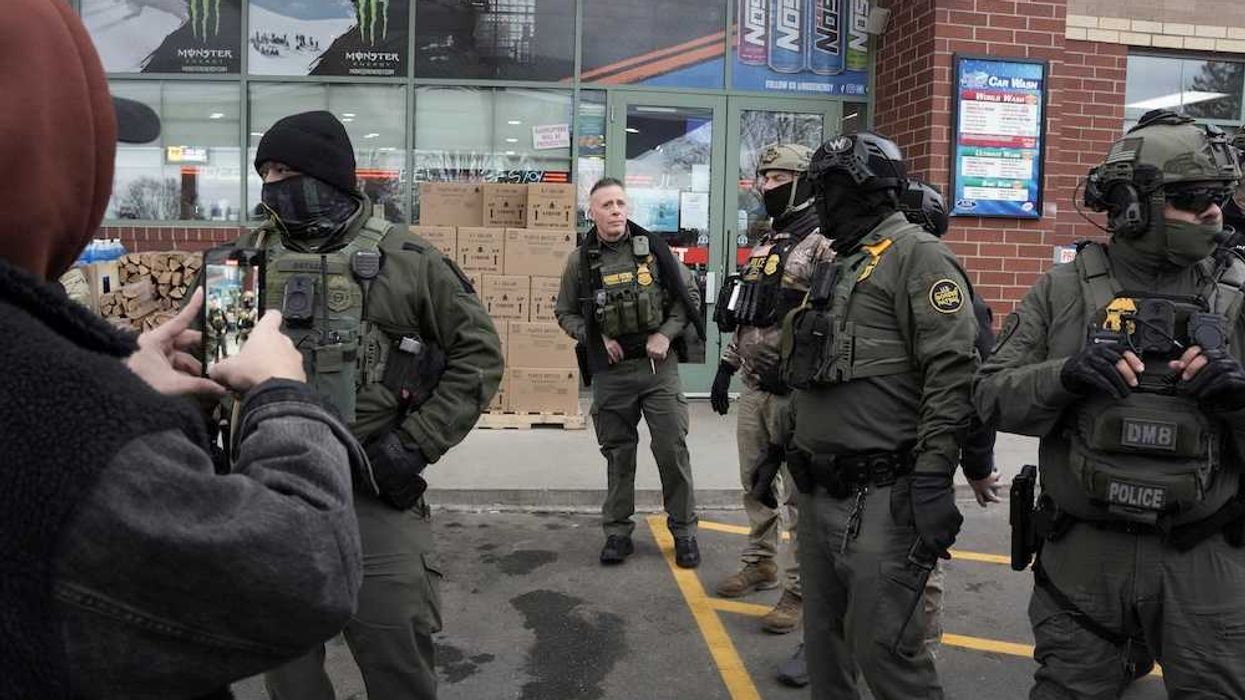
A man gestures at US Border Patrol agents as they detain an unidentified man of Somali descent in Minneapolis, Minnesota, on January 8, 2026.
(Photo by Octavio Jones/AFP via Getty Images)

Jessica Corbett
Jan 14, 2026
COMMON DREAMS

Since President Donald Trump returned to power and unleashed Immigration and Customs Enforcement on US cities, members of the National Coalition Against Censorship have periodically reminded Americans that “yes, you have the right to film ICE.” The NCAC did so again on Tuesday, as videos emerge of agents telling observers to stop recording.

“We join together as nonprofit civil rights and free expression advocates to condemn the Trump administration’s statements that it is illegal to record videos of ICE agents. These claims are incorrect as a matter of law, directly contrary to our First Amendment values, and deeply troubling for democratic governance,” NCAC said in a statement.


‘Reign of Terror’: ICE Builds Appalling Record of Killings, Beatings, Kidnappings, and More


‘To Be Clear,’ Contrary to Vance’s Claims, ICE Agents Do Not Have ‘Absolute Immunity,’ Say Legal Experts

“The ability to hold the government accountable is at the very core of our democracy. To preserve that ability, the First Amendment unequivocally protects the right to observe, monitor, and take pictures and video of government officials conducting their duties in public. This explicitly includes law enforcement officers engaged in their public duties,” the coalition continued, citing decisions from all federal appellate courts that have addressed the issue.

In a Wednesday appearance on KQED‘s podcast Close All Tabs, CJ Ciaramella, a criminal justice reporter at Reason, similarly highlighted that while the US Supreme Court “actually hasn’t put out a ruling saying there’s an unambiguous First Amendment right to film the police,” the circuit courts “that have considered the issue have pretty much said there is a First Amendment right to record the police and observe the police, and they’ve all decided that pretty unambiguously.”

“And this ranges from, you know, the 9th Circuit, which is traditionally a pretty liberal leaning court, to the 5th Circuit, which has a reputation as a more conservative circuit court,” Ciaramella explained. “The 5th Circuit looked at it and said, you know, based on the First Amendment tradition, the Supreme Court precedents, this seems pretty unambiguous to us.”

“So it’s not a completely like black and white issue, but it’s also not... a thorny or divisive First Amendment question. Every court that’s looked at it has said, yeah, based on our long First Amendment traditions. And in America, you have a right to record the police,” he added. “Now, Minnesota is in one of the circuits that hasn’t yet ruled on this.”


The NCAC statement comes amid a flurry of videos of violent and otherwise problematic ICE actions, especially in Minneapolis, where Trump has sent thousands of troops and ICE officer Johnathan Ross fatally shot Renee Nicole Good in the head last week. Ross was recording on his phone, and amid mounting calls for his arrest and prosecution, the Department of Homeland Security (DHS) has put out a “propaganda” video defending the actions of ICE agents.

Journalists and other critics of Good’s killing have debunked DHS claims in part by pointing to bystanders’ footage from the scene.

While the NCAC statement doesn’t point to any specific incidents with agents, it does sound the alarm about Homeland Security Secretary Kristi Noem’s suggestion last July that videotaping ICE operations is “violence” and anyone “doxing” agents will be prosecuted.

After playing a clip of Noem’s remarks on Close All Tabs, host Morgan Sung said: “Notice the use of the word doxing here. That’s the act of posting private information about someone to target and harass them, usually like their home address or personal phone number. The Trump administration has equated identifying and publicly naming ICE agents to doxing.”

NCAC argued that “statements such as Secretary Noem’s misinform the public about their First Amendment rights and chill constitutionally protected speech. As a policy matter, threats to punish those who monitor law enforcement increase the likelihood that people will be intimidated out of exercising their constitutional rights and lead to precisely the outcome such oversight is intended to prevent—law enforcement agents who act with impunity as transparency is demonized by political leaders.”

Like ICE, agents with Customs and Border Protection, another DHS agency, have been sent to various cities and recorded behaving violently in recent months, often while donning masks. After Ross killed Good, Border Patrol Commander Greg Bovino—who is currently in Minnesota—sent a “legal refresher” to agents in the field stating that taking photos and recordings is protected activity under the First Amendment.


The coalition said that “regardless of one’s views on immigration policy, the increased budget and enforcement operations of ICE were a core campaign issue in the presidential election, and are a widespread topic of conversation and concern.”

“Recordings of law enforcement directly inform the public, shape policy discussions, and even serve as the catalyst for large-scale political movements across the political spectrum. They have helped to expose horrific and illegal acts by the government,” NCAC pointed out. “At the same time, they also protect law enforcement officers. If an officer is acting within the bounds of the law, a recording will help prove as much.”

“We stand behind the public’s well-established right to record public officials, law enforcement, and ICE agents engaged in their public duties. We jointly condemn this administration’s refusal to recognize the First Amendment right to record officers in public. And we call on this administration to recognize that constitutional rights are a feature, not a bug, of democratic governance,” the coalition concluded. “For our constitutional rights to be real, our public officials must uphold them—as they have sworn to do.”

The groups that signed on to the statement are the ACLU, Center for Democracy & Technology, Center for Protest Law & Litigation at the Partnership for Civil Justice Fund, Defending Rights & Dissent, Electronic Frontier Foundation, Freedom of the Press Foundation, Government Information Watch, Knight First Amendment Institute, National Coalition Against Censorship, People for the American WayPublic Citizen, Tully Center for Free Speech, and Woodhull Freedom Foundation.

Joining them as individuals are writer and historian Pat McNees, and three experts from Yale Law School: David A. Schulz, Stacy Livingston, and Tobin Raju.

Trump's DOJ now argues filming police not protected by First Amendment


An observer uses a mobile phone to document Border Patrol commander Greg Bovino and his convoy, days after an ICE agent fatally shot Renee Nicole Good in Minneapolis, as Bovino stops at a gas station in Columbia Heights, Minnesota, U.S., January 13, 2026. REUTERS/Tim Evans
January 13, 2026 
ALTERNET

President Donald Trump's Department of Justice (DOJ) is now claiming that Americans do not have a Constitutional right to film law enforcement officers.

NOTUS reported Tuesday that the DOJ made the claim during a hearing in U.S. District Judge Katherine Menendez's courtroom. The hearing was the result of ongoing litigation by Minneapolis residents over claims that U.S. Immigration and Customs Enforcement (ICE) agents pepper-sprayed and arrested them without cause. While the initial complaint was filed prior to the fatal shooting of U.S. citizen Renee Nicole Good by ICE agent Jonathan Ross, the plaintiffs cited Good's death as reason to issue a temporary restraining order against federal agents.

DOJ attorney Jeremy Newman defended the recent trend of ICE agents drawing their weapons on civilian vehicles following them, saying that "following" can lead to "dangerous activity," and that it was "reasonable for officers to be concerned about their safety. NOTUS further reported that Newman cited the 2023 Molina v. Book case to support his argument that "observing and recording police is not a clearly established First Amendment right."

"It’s very clear that this is an ongoing emergency," Newman said.

However, other court cases decided at the federal appellate court level have ruled that Americans do indeed have the right to document police officers in the course of their duties. In the 2022 Irizarry v. Yehia case, the U.S. Court of Appeals for the Tenth Circuit ruled that the First Amendment guaranteed the right to film police officers "subject to reasonable time, place and manner restrictions."

Judge Menendez – an appointee of former President Joe Biden — reportedly chided ICE agents for not including copies of any police reports, body camera footage or statements from agents involved in altercations with plaintiffs. Newman responded that the agency "did the best we could" as their response to the litigation was cobbled together over the holiday season.

Menendez also told plaintiffs she would rule on their petition for emergency relief by Thursday or Friday, and hinted that any ruling would pertain to their specific case, rather than a broader decision impacting all protesters in Minneapolis.

Click here to read NOTUS' article in its entirety.
THIN SKINNED TRUMP

‘He Believes in Freedom of Speech’: UAW Stands Behind Michigan Worker Flipped Off by Trump

“We stand with our membership in protecting their voice on the job.”


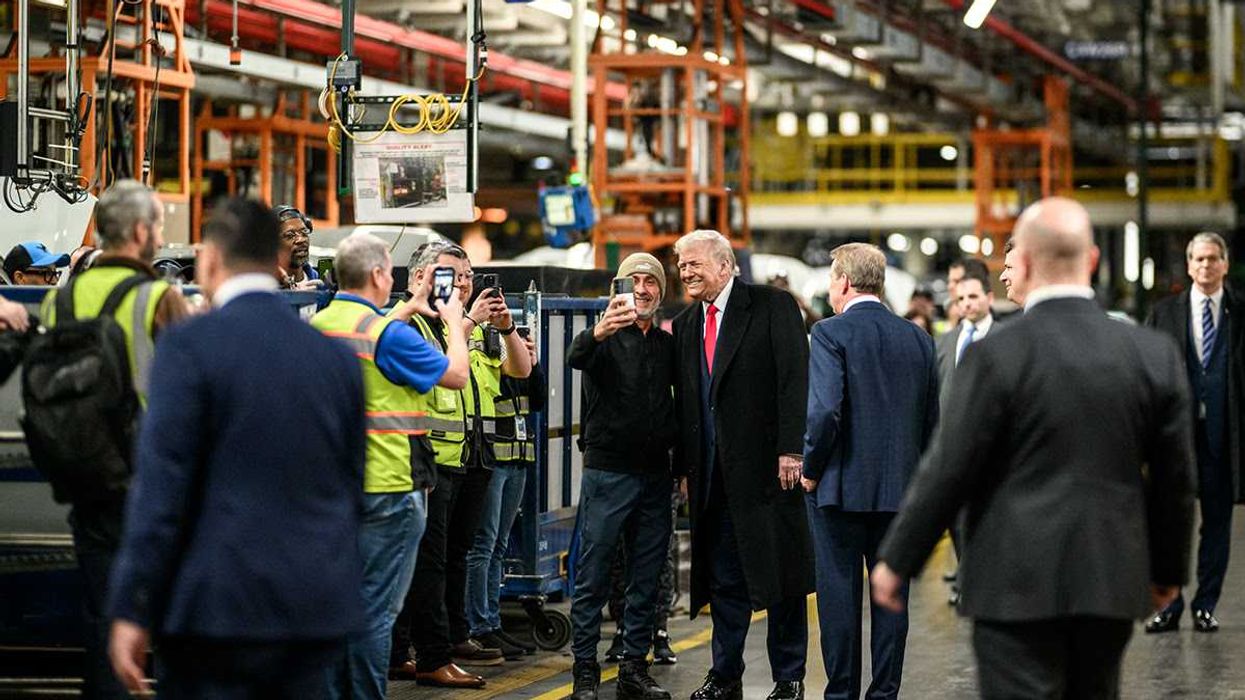
US President Donald Trump, alongside Ford CEO Jim Farley, Treasury Secretary Scott Bessent, and plant manager Corey Williams, tours Ford Motor Company’s River Rouge complex in Dearborn, Michigan, on January 13, 2026.
(Photo by Mandel NGAN / AFP via Getty Images)

Brad Reed
Jan 14, 2026
COMMON DREAM

TJ Sabula, the Michigan auto worker who was suspended from his job at Ford after calling President Donald Trump a “pedophile protector,” has the backing of the largest US auto union.

United Auto Workers (UAW) on Wednesday pledged to support Sabula, whom it described as “a proud member of a strong and fighting union,” further noting that “he believes in freedom of speech, a principle we wholeheartedly embrace, and we stand with our membership in protecting their voice on the job.”

UAW vowed that Sabula will receive “the full protection of all negotiated contract language safeguarding his job and his rights as a union member.”

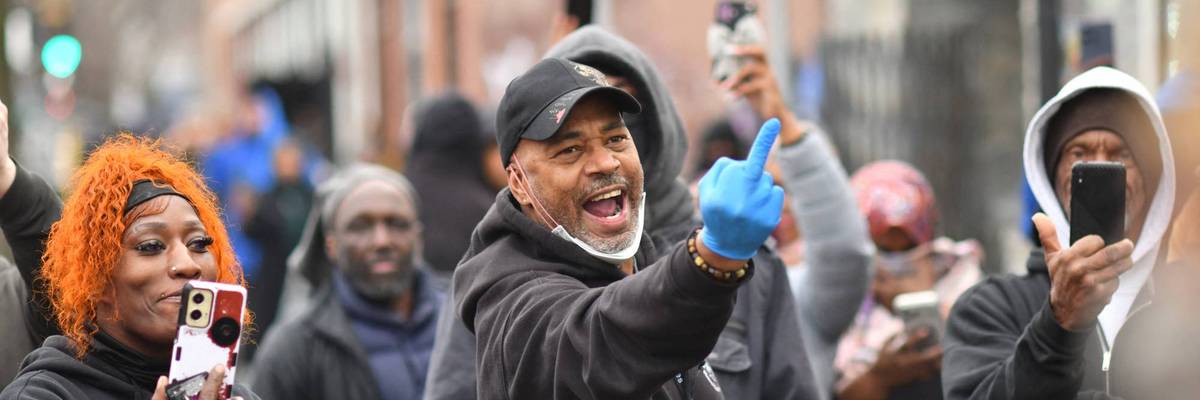
Sabula on Tuesday accused Trump of being a “pedophile protector”—in reference to the president’s reluctance to release files related to the criminal investigation of late sex offender Jeffrey Epstein—while the president was visiting a Ford truck plant in Dearborn, Michigan.

Trump responded by giving Sabula the middle finger, while appearing to mouth or yell “fuck you” back at the auto worker.


Sabula has received an outpouring of support since heckling Trump. A GoFundMe campaign aimed at raising money in support of the suspended auto worker has so far raised more than $350,000.

In a Tuesday interview published by the Washington Post, Sabula said he had “no regrets whatsoever” about yelling at the president, despite the uncertain future he now faces at his job.

“I don’t feel as though fate looks upon you often, and when it does, you better be ready to seize the opportunity,” Sabula told the Post. “And today I think I did that.”

Ford Worker Trump flipped off has now been suspended


President Donald Trump talks with workers at Ford’s F-150 factory in Dearborn. Jan. 13, 2025 | White House photo
January 14, 2026 

A union-backed auto worker at Ford Motor Co. was caught on video heckling President Donald Trump as a “pedophile protector” when he visited a Dearborn factory on Tuesday ahead of his address to the Detroit Economic Club. The video that has now gone viral shows Trump responded in kind by mouthing an expletive at the worker, twice, and displaying a middle finger as he walked away.

Now, the union says the worker has been suspended while Ford looks into the matter.

A representative from the UAW told Michigan Advance that they could confirm that he was suspended but the length of the suspension was unknown. The union was also uncertain about the process that would follow to investigate the matter.

A message seeking comment from Ford to confirm if the worker was fired or suspended was not immediately returned on Tuesday evening.

In a statement to the Advance, White House communications director Steven Cheung called the worker “a lunatic” who was “wildly screaming expletives in a complete fit of rage.”

“And the president gave an appropriate and unambiguous response,” Cheung said.

U.S. Rep. Rashida Tlaib (D-Detroit) said she spoke to a well placed source in the worker’s local union who said he was facing disciplinary action.

“Ford said they can’t talk about it because it’s a human resources issue,” Tlaib said. “In the past, when President Obama (went) onto the plant floor and other times people have said some terrible things, they didn’t get fired.”

U.S. Rep. Debbie Dingell (D-Ann Arbor) also told the Advance that the union confirmed that the confrontation meant the man was facing disciplinary action.

Dingell also said she was inquiring with Ford about the status of the man’s employment, and if he was being suspended and investigated in violation of his free speech rights.

“When you’re on a factory floor with union members that have strong feelings, you need to be prepared for whatever they’re gonna say, and I hope they’re not firing him because I believe in free speech,” Dingell said in an interview. “The UAW worker was expressing his right to free speech, and I’m asking questions as to what has happened.”

The video, which was first published by Distill Social shows Trump walking around a raised portion of the Dearborn F-150 plant when the worker, who is not seen on screen, yells to Trump and calls him a “pedophile protector,” a reference to Trump’s widely reported connections to deceased pedophile and sex trafficker Jeffery Epstein and the Trump administration’s bungling of a new law that ordered the FBI to release all of the files that the department had available to them.

Some have seen the constant delays from the FBI and the slow walk to release the files as Trump protecting either himself or his wealthy elite friends from scrutiny or a clear connection to Epstein.

In response to the confrontation, the Democratic National Committee denounced Trump for being “more concerned with his ego than his spiraling economy, where job cuts are skyrocketing, hiring has slowed, unemployment remains high, and prices continue to soar.”

“As working families struggle to make ends meet in Trump’s economy, the Trump family and their wealthy donors keep getting richer — there’s no bigger ‘F-you’ than that,” said DNC Senior Advisor for Messaging, Mobilization and Strategy Tim Hogan in a statement. “The real question is: Why does the mere mention of Epstein set him off?”

Tlaib echoed that point.

“The worker could have said anything, but this worker felt compelled to say you’re protecting a pedophile. I feel very strongly that Ford Motor Company is sending a message that people can’t stand up for sexual abuse survivors,” Tlaib said.

'Put your big boy pants on': Ex-RNC chair tears into Trump after wild meltdown at heckler

Matthew Chapman
January 13, 2026 
RAW STORY

President Donald Trump debased his office when he lost control and flipped the bird at a heckler in Detroit who called him a "pedophile protector," MS NOW anchor and former Republican National Committee chief Michael Steele observed in a discussion with Rep. Ro Khanna (D-CA) on Tuesday's edition of "The Weeknight."

"So we all know we have a very, in my estimation, a very underdeveloped man sitting in the White House," said Steele to Khanna, one of the main sponsors of legislation to compel the White House to release the Jeffrey Epstein sex trafficking case files, which have still not been released in full despite legal deadlines.

"That was just a punkish move," Steele continued. "I don't know who he thinks he was impressing. I guess it's more impressive if the President of the United States flips you off. But put your big boy pants on, Mr. President, the country is a big country, and we have opinions. We have opinions about you. We have opinions about your actions. So that's all I want to say about that."

Furthermore, Steele added, "The fact that the White House response was 'a lunatic was wildly screaming expletives in a complete fit of rage,' their overdramatization of stuff is another bit of crap we have to put up with."

"Look, it's not a coincidence of what sets him off," said Khanna. "What set him off is the heckler saying you're a protector. I was just on a podcast with Shawn Ryan. Shawn Ryan is the number two podcaster in the country. He was all in on Trump, and he said, what lost [him] is Trump is protecting — that's what this Epstein issue is about. It has gotten under his skin because he knows he's losing the MAGA base on this. He was elected to expose the corruption, to hold these people accountable. Instead, every move they made is to protect people who raped underage girls."

"And now you have, today, a federal judge who responded to Marcy and my motion, quite a breakthrough, where he's now ordered the Department of Justice to brief him on whether he should appoint a special master to actually get these documents released," said Khanna.


Gavin Newsom's Press Office blasts Trump for 'attacking fellow American' at Ford factory

Ewan Gleadow
January 14, 2026 
RAW STORY


U.S. President Donald Trump visits a Ford production center in Dearborn, Michigan, U.S., January 13, 2026. REUTERS/Evelyn Hockstei

Donald Trump has come under fire from Gavin Newsom's Press Office after the president was seen flipping off a factory worker.

Footage of Trump's trip to a Ford factory in Michigan went viral yesterday and was denounced by politicians and political analysts. Gavin Newsom's Press Office, in a now viral post to X, blasted the president for rising to the crowd's heckles. A factory worker appeared to yell "pedophile president" as Trump walked by on a walkway above.

The president reacted by giving the middle finger to the factory worker, while also reportedly shouting "f**k you". Footage of the incident has since gone viral, with Gavin Newsom's Press Office sharing the clip. They added, "Why is the President attacking a fellow American?"

Trump was touring a Ford F-150 plant in the Motor City just before his speech on the United States economy at the Detroit Economic Club when a worker started shouting at him as the president walked above the workers.

White House spokesperson Steven Cheung said of the incident, "A lunatic was wildly screaming expletives in a complete fit of rage, and the president gave an appropriate and unambiguous response."

A statement from a Ford spokesperson added that they do not condone "anyone saying anything inappropriate". They added, "When that happens, we have a process to deal with it but we don’t get into specific personnel matters."

The worker was calling Trump out for his association with Jeffrey Epstein, the disgraced financier and convicted child sex offender — a former friend — who he said he cut ties and threw Epstein out of his Mar-a-Lago club when he had a falling out about poaching and recruiting his staff.

Trump has not been charged with any crime or involvement with Epstein's sex trafficking ring. He has denied any wrongdoing in connection with Epstein.

ICE protester permanently blinded after feds shoot him point blank with 'nonlethal weapon'

Travis Gettys
January 14, 2026
RAW STORY


Kaden Rummler dragged by DHS agent/X

A protester claims immigration agents taunted and laughed at him after blinding him by firing a non-lethal weapon directly at his face at close range during a confrontation in southern California.

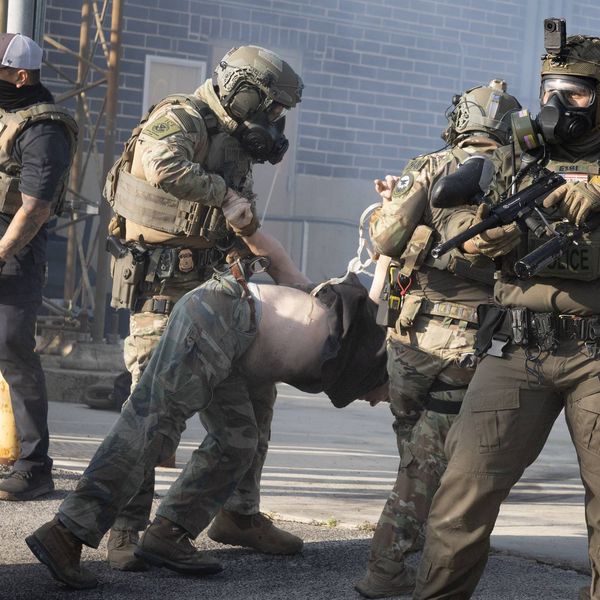
Video shows a Homeland Security agent grab a protester and drag them away, and then another federal officer fires a non-lethal weapon point blank at 21-year-old Kaden Rummler as he steps forward from the group holding a megaphone, reported the Los Angeles Times.

The demonstrators had gathered Friday outside a federal building in Santa Ana to protest the fatal shooting of 37-year-old Renee Good two days before in Minneapolis by an Immigration and Customs Enforcement officer.

Rummler was permanently blinded in his left eye, he told the newspaper, and he said his tear duct was destroyed and the “flaps of my eye are barely holding on."

“[Doctors] pulled a piece of plastic the size of a nickel from my eye,” Rummler said, and he said they also found pieces of plastic and glass in his skull, metal in his stomach lining and metal lodged millimeters way from his carotid artery. "[I'll have to live with metal pieces there for the rest of my life."

“I focused on the voices of the people, the voices of my friends and comrades,” Rummler added. “I believe that’s what kept me alive, hearing them continue the fight despite how aggressive our oppressors were.”

Rummler said he begged federal agents to call an ambulance, but he said said they instead taunted him, “laughing at the fact that I would never get to see out of my left eye again,” he said.

The first protester, Skye Jones, was taken into custody during the incident and held for nearly three days until his release Monday.

“When confronting those who enforce ICE terror, they will snatch us out of a crowd, they will shoot us point blank with pepper-ball bullets, and they will throw us to the ground,” Jones said. “Repression is inevitable when demanding justice, so we must not cower at it.”

Santa Ana police said demonstrators tossed orange cones at federal agents, but said they were unaware of any other violence at the event, and Homeland Security assistant secretary Tricia McLaughlin disputed accounts by Rummler and Jones.

“This is absurd. DHS law enforcement took this rioter to the hospital for a cut and he was released that nigh," McLaughlin said. "Make no mistake: Rioting and assaulting law enforcement is not only dangerous but a crime.”


Pentagon accused of 'participating in a strategic suicide pact' with Trump as war looms

Tom Boggioni
January 14, 2026 
RAW STORY


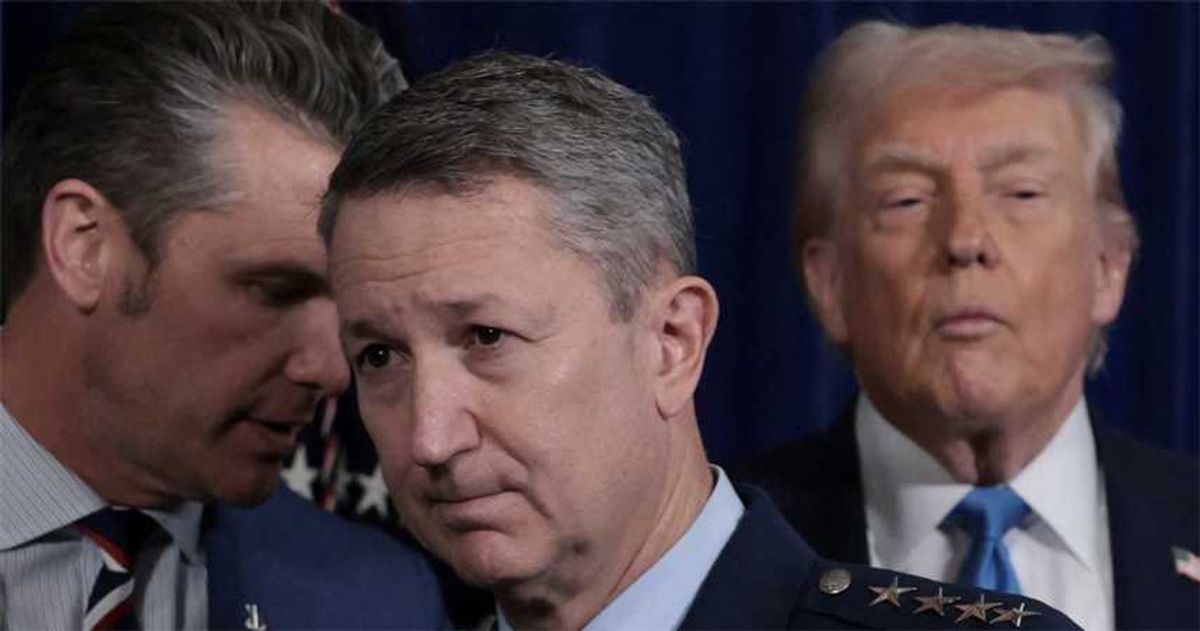
General Dan Caine, Chairman of the Joint Chiefs of Staff, U.S. President Donald Trump and Secretary of Defense Pete Hegseth attend a press conference following a U.S. strike on Venezuela where President Nicolas Maduro and his wife, Cilia Flores, were captured, from Trump's Mar-a-Lago club in Palm Beach, Florida, U.S., January 3, 2026. 
REUTERS/Jonathan Ernst

While the focus of most Americans in on the invasion of Minnesota by lawless masked agents of the Department of Homeland Security who are grabbing U.S. citizens off the streets, former conservative campaign advisor Rick Wilson raised the alarm that the Pentagon appears to be going full steam ahead with plans for a Greenland invasion.

Wilson warned on his Substack platform that the Joint Chiefs of Staff appear supportive of military action, at the expense of the NATO alliance.

Wilson wrote that the Joint Chiefs, tasked with preventing military adventurism and unnecessary conflicts, are instead "trying to figure out how to drape a flag over an impending crime of such sweeping malice, stupidity, and toxicity that it will shame this nation for generations."

He criticized military participation in what he characterized as a "colonial land-grab" demanded by Trump. "Here is the terrifying part: the Joint Chiefs of Staff, men who have spent four decades wearing the uniform, men who talk endlessly about 'honor,' 'integrity,' and the 'rules-based international order,' are currently sharpening the knives."

Wilson dismissed assessments that Greenland poses any strategic threat, noting that neither China nor Russia harbors territorial ambitions there despite Trump's claims.

Rather than characterizing the proposal as merely "controversial," Wilson warned of catastrophic consequences. "They are participating in a strategic suicide pact that will dismantle seventy-five years of American alliances in a single afternoon," enabling China to invade Taiwan and Russia to seize Baltic states while continuing its war against Ukraine, the ex-strategist added.

Wilson argued that a U.S. military presence in Greenland without invitation would effectively end NATO. "The moment an American boot hits Greenlandic soil without an invitation, NATO, the most successful military alliance in the history of the world, is dead. Article 5 becomes a cruel joke, a relic of a time when America's word actually meant something."

He concluded with stark warnings about geopolitical consequences: "In Moscow, Vladimir Putin is salivating. He has worked for a quarter-century to fracture the West, and Trump is handing him the pieces on a silver platter. A U.S. invasion of a NATO ally is the ultimate 'Go' signal for Russian tanks to roll into Tallinn, Riga, and Vilnius. If America won't respect the borders of its friends, why should Russia respect the borders of its 'near abroad'?"

You can read more here.
RACIST MISOGYNY
Pregnant mom dies as red state docs fear abortion — and leave heart crisis untreated
RAW STORY
Ciji Graham and her son, SJ Courtesy of the Graham family

When Ciji Graham visited a cardiologist on Nov. 14, 2023, her heart was pounding at 192 beats per minute, a rate healthy people her age usually reach during the peak of a sprint. She was having another episode of atrial fibrillation, a rapid, irregular heartbeat. The 34-year-old Greensboro, North Carolina, police officer was at risk of a stroke or heart failure.

In the past, doctors had always been able to shock Graham’s heart back into rhythm with a procedure called a cardioversion. But this time, the treatment was just out of reach. After a pregnancy test came back positive, the cardiologist didn’t offer to shock her. Graham texted her friend from the appointment: “Said she can’t cardiovert being pregnant.”

The doctor told Graham to consult three other specialists and her primary care provider before returning in a week, according to medical records. Then she sent Graham home as her heart kept hammering.

Like hundreds of thousands of women each year who enter pregnancy with chronic conditions, Graham was left to navigate care in a country where medical options have significantly narrowed.

As ProPublica has reported, doctors in states that ban abortion have repeatedly denied standard care to high-risk pregnant patients. The expert consensus is that cardioversion is safe during pregnancy, and ProPublica spoke with more than a dozen specialists who said they would have immediately admitted Graham to a hospital to get her heart rhythm under control. They found fault, too, with a second cardiologist she saw the following day, who did not perform an electrocardiogram and also sent her home. Although Graham’s family gave the doctors permission to speak with ProPublica, neither replied to ProPublica’s questions.

Graham came to believe that the best way to protect her health was to end her unexpected pregnancy. But because of new abortion restrictions in North Carolina and nearby states, finding a doctor who could quickly perform a procedure would prove difficult. Many physicians and hospitals now hesitate to discuss abortion, even when women ask about it. And abortion clinics are not set up to treat certain medically complicated cases. As a result, sick pregnant women like Graham are often on their own.

“I can’t feel like this for 9mo,” Graham wrote her friend. “I just can’t.”

She wouldn’t. In a region that had legislated its commitment to life, she would spend her final days struggling to find anyone to save hers.

Graham hated feeling out of breath; her life demanded all her energy. Widely admired for her skills behind the wheel, she was often called upon to train fellow officers at the Greensboro Police Department. At home, she needed to chase her 2-year-old son, SJ, around the apartment. She was a natural with kids — she’d helped her single mom raise her nine younger siblings.

She thought her surprise pregnancy had caused the atrial fibrillation, also called A-fib. In addition to heart disease, she had a thyroid disorder; pregnancy could send the gland into overdrive, prompting dangerous heart rhythms.

When Graham saw the first cardiologist, Dr. Sabina Custovic, the 192 heart rate recorded on an EKG should have been a clear cause for alarm. “I can’t think of any situation where I would feel comfortable sending anyone home with a heart rate of 192,” said Dr. Jenna Skowronski, a cardiologist at the University of North Carolina. A dozen cardiologists and maternal-fetal medicine specialists who reviewed Graham’s case for ProPublica agreed. The risk of death was low, but the fact that she was also reporting symptoms — severe palpitations, trouble breathing — meant the health dangers were significant.

All the experts said they would have tried to treat Graham with IV medication in the hospital and, if that failed, an electrical shock. Cardioversion wouldn’t necessarily be simple — likely requiring an invasive ultrasound to check for blood clots beforehand — but it was crucial to slow down her heart. A leading global organization for arrhythmia professionals, the Heart Rhythm Society, has issued clear guidance that “cardioversion is safe and effective in pregnancy.”

Even if the procedure posed a small risk to the pregnancy, the risk of not treating Graham was far greater, said Rhode Island cardiologist Dr. Daniel Levine: “No mother, no baby.”

Custovic did not answer ProPublica’s questions about why the pregnancy made her hold off on the treatment or whether abortion restrictions affect her decision-making.

The next day — as her heart continued to thump — Graham saw a second cardiologist, Dr. Will Camnitz, at Cone Health, one of the region’s largest health care systems.

According to medical records, Graham’s pulse registered as normal when taken at Camnitz’s office, as it had at her appointment the previous day. Camnitz noted that the EKG from the day before showed she was in A-fib and prescribed a blood thinner to prepare for a cardioversion in three weeks — if by then she hadn’t returned to a regular heart rhythm on her own.

Some of the experts who reviewed Graham’s care said that this was a reasonable plan if her pulse was, indeed, normal. But Camnitz, who specializes in the electrical activity of the heart, did not order another EKG to confirm that her heart rate had come down from 192, according to medical records. “He’s an electrophysiologist and he didn’t do that, which is insane,” said Dr. Kayle Shapero, a cardio-obstetrics specialist at Brown University. According to experts, a pulse measurement can underestimate the true heart rate of a patient in A-fib. Every cardiologist who reviewed Graham’s care for ProPublica said that a repeat EKG would be best practice. If Graham’s rate was still as high as it was the previous day, her heart could eventually stop delivering enough blood to major organs. Camnitz did not answer ProPublica’s questions about why he didn’t administer this test.

Three weeks was a long time to wait with a heart that Graham kept saying was practically leaping out of her chest.

Camnitz knew about Graham’s pregnancy but did not discuss whether she wanted to continue it or advise her on her options, according to medical records. That same day, though, Graham reached out to A Woman’s Choice, the sole abortion clinic in Greensboro.

North Carolina bans abortion after 12 weeks; Graham was only about six weeks pregnant. Still, there was a long line ahead of her. Women were flooding the state from Tennessee, Georgia and South Carolina, where new abortion bans were even stricter. On top of that, a recent change in North Carolina law required an in-person consent visit three days before a termination. The same number of patients were now filling twice as many appointment slots.

Graham would need to wait nearly two weeks for an abortion.

It’s unclear if she explained her symptoms to the clinic; A Woman’s Choice spokesperson said it routinely discards appointment forms and no longer had a copy of Graham’s. But the spokesperson told ProPublica that a procedure at the clinic would not have been right for Graham; because of her high heart rate, she would have needed a hospital with more resources.

Dr. Jessica Tarleton, an abortion provider who spent the past few years working in the Carolinas, said she frequently encountered pregnant women with chronic conditions who faced this kind of catch-22: Their risks were too high to be treated in a clinic, and it would be safest to get care at a hospital, but it could be very hard to find one willing to terminate a pregnancy.

In states where abortions have been criminalized, many hospitals have shied away from sharing information about their policies on abortion. Cone Health, where Graham typically went for care, would not tell ProPublica whether its doctors perform abortions and under what circumstances; it said, “Cone Health provides personalized and individualized care to each patient based on their medical needs while complying with state and federal laws.”

Graham never learned that she would need an abortion at a hospital rather than a clinic. Physicians at Duke University and the University of North Carolina, the premier academic medical centers in the state, said that she would have been able to get one at their hospitals — but that would have required a doctor to connect her or for Graham to have somehow known to show up.


Had Graham lived in another country, she may not have faced this maze alone.

In the United Kingdom, for example, a doctor trained in caring for pregnant women with risky medical conditions would have been assigned to oversee all of Graham’s care, ensuring it was appropriate, said Dr. Marian Knight, who leads the U.K.’s maternal mortality review program. Hospitals in the U.K. also must abide by standardized national protocols or face regulatory consequences. Researchers point to these factors, as well as a national review system, as key to the country’s success in lowering its rate of maternal death. The maternal mortality rate in the U.S. is more than double that of the U.K. and last on the list of wealthy countries.

Graham’s friend Shameka Jackson could tell that something was wrong. Graham didn’t seem like her usual “perky and silly” self, Jackson said. On the phone, she sounded weak, her voice barely louder than a whisper.


When Jackson offered to come over, Graham said it would be a waste of time. “There’s nothing you can do but sit with me,” Jackson said she replied. “The doctors ain’t doing nothing.”

Graham no longer cooked or played with her son after work, said her boyfriend, Shawn Scott. She stopped hoisting SJ up to let him dunk on the hoop on the closet door. Now, she headed straight for the couch and barely spoke, except to say that no one would shock her heart.

“I hate feeling like this,” she texted Jackson. “Ain’t slept, chest hurts.”

“All I can do is wait until the 28th,” Graham said, the date of her scheduled abortion.

On the morning of Nov. 19, Scott awoke to a rap on the front door of the apartment he and Graham shared. He’d been asleep on the couch after a night out with friends and thought that Graham had left for work.

A police officer introduced himself and explained that Graham hadn’t shown up and wasn’t answering her phone. He knew she hadn’t been feeling well and wanted to check in.

Most mornings, Graham was up around 5 a.m. to prepare for the day. With Scott, she would brush SJ’s teeth, braid his hair and dress him in stylish outfits, complete with Jordans or Chelsea boots.

When Scott walked into their bedroom, Graham was face down in bed, her body cold when he touched her. The two men pulled her down to the floor to start CPR, but it was too late. SJ stood in his crib, silently watching as they realized.

The medical examiner would list Graham’s cause of death as “cardiac arrhythmia due to atrial fibrillation in the setting of recent pregnancy.” There was no autopsy, which could have identified the specific complication that led to her death.

High-risk pregnancy specialists and cardiologists who reviewed Graham’s case were taken aback by Custovic’s failure to act urgently. Many said her decisions reminded them of behaviors they’ve seen from other cardiologists when treating pregnant patients; they attribute this kind of hesitation to gaps in education. Although cardiovascular disease is the leading cause of death in pregnant women, a recent survey developed with the American College of Cardiology found that less than 30% of cardiologists reported formal training in managing heart conditions in pregnancy. “A large proportion of the cardiology workforce feels uncomfortable providing care to these patients,” the authors concluded in the Journal of the American Heart Association. The legal threats attached to abortion bans, many doctors have told ProPublica, have made some cardiologists even more conservative.

Custovic did not answer ProPublica’s questions about whether she felt she had adequate training. A spokesperson for Cone Health, where Camnitz works, said, “Cone Health’s treatment for pregnant women with underlying cardiac disease is consistent with accepted standards of care in our region.” Although Graham’s family gave the hospital permission to discuss Graham’s care with ProPublica, the hospital did not comment on specifics.

Three doctors who have served on state maternal mortality review committees, which study the deaths of pregnant women, told ProPublica that Graham’s death was preventable. “There were so many points where they could have intervened,” said Dr. Amelia Huntsberger, a former member of Idaho’s panel.

Graham’s is the seventh case ProPublica has investigated in which a pregnant woman in a state that significantly restricted abortion died after she was unable to access standard care.

The week after she died, Graham’s family held a candlelight ceremony outside of her high school, which drew friends and cops in uniform, and also Greensboro residents whose lives she had touched. One woman approached Graham’s sisters and explained Graham had interrupted her suicide attempt five years earlier and reassured her that her life had value; she had recently texted Graham, “If it wasn’t for you, I wouldn’t be here today, expecting my first child.”

As for Graham’s own son, no one explained to SJ that his mother had died. They didn’t know how to describe death to a toddler. Instead, his dad and grandmother and aunts and uncles told him that his mom had left Earth and gone to the moon. SJ now calls it the “Mommy moon.”

For the past two years, every night before bed, he asks to go outside, even on the coldest winter evenings. He points to the moon in the dark sky and tells his mother that he loves her.
‘This Cruelty Will Be Measured in Lives Lost’: Trump Axes $2 Billion in Mental Health, Addiction Grants

“So much for Make America Healthy Again and saving Americans from addiction and suicide,” said US Sen. Patty Murray.


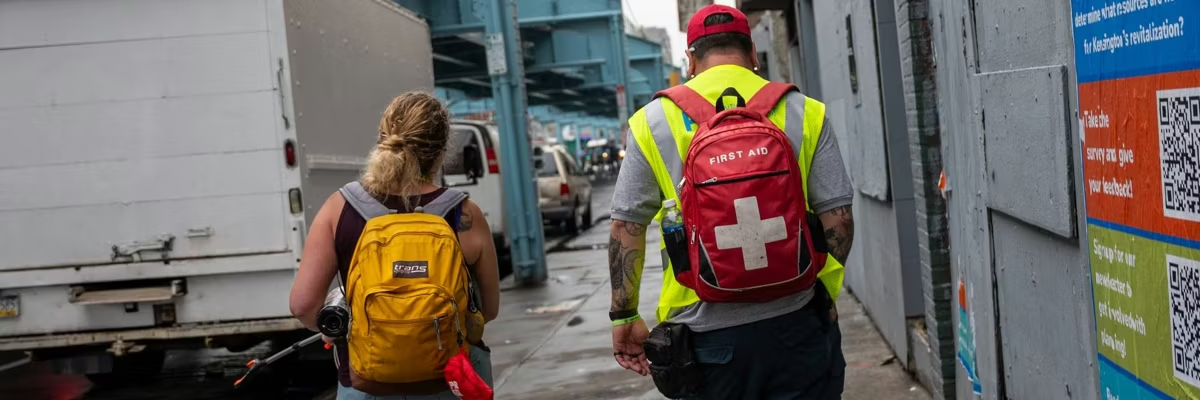
People part of an outreach team walk during a clearing of a homeless encampment on May 8, 2024 in Philadelphia.
(Photo by Spencer Platt/Getty Images)

Jake Johnson
Jan 14, 2026
COMMON DREAMS

The Trump administration, which has claimed its illegal boat bombing spree in international waters and assault on Venezuela were motivated by a deep desire to combat the drug overdose crisis in the US, moved late Tuesday to eliminate up to $2 billion worth of federal grants supporting mental health and addiction services across the country.

Organizations that provide street-level support to people experiencing mental health crises, homelessness, and addiction said they were notified of the cuts overnight in the form of emailed grant termination letters.

NPR first reported the cuts by the US Substance Abuse and Mental Health Services Administration (SAMHSA), which is overseen by Health and Human Services Secretary Robert F. Kennedy Jr. The estimated $2 billion in cuts represents roughly a quarter of SAMHSA’s budget.

Ryan Hampton, founder of the nonprofit Mobilize Recovery, told NPR that his group is out $500,000 because of the Trump administration’s move, which could impact thousands of organizations nationwide.

“Waking up to nearly $2 billion in grant cancellations means front-line providers are forced to cease overdose prevention, naloxone distribution, and peer recovery services immediately, leaving our communities defenseless against a raging crisis,” Hampton said. “This cruelty will be measured in lives lost, as recovery centers shutter and the safety net we built is slashed overnight. We are witnessing the dismantling of our recovery infrastructure in real-time, and the administration will have blood on its hands for every preventable death that follows.”

Jonathan Cohn of The Bulwark reported that impacted organizations “had applied for these grants, had them approved, and were operating with the funds—and then, on Tuesday night, received notices that those grants had been terminated.”

“The affected programs include ones that provide services like housing and peer support for people who are in recovery, as well as ones that train substance abuse professionals,” Cohn observed.

Yngvild Olsen, a national adviser at Manatt Health and former director of SAMHA’s Center for Substance Abuse Treatment, told Cohn that the cuts mean “tens of thousands of people” will “lose access to services” and many providers will “lose access to their training and technical assistance resources.”

“These organizations are going to have to lay off staff,” Olsen warned. “They don’t have high margins and other sources of funding that they can necessarily turn to. I heard from one grantee that said she doesn’t know how she’s going to pay staff and bills.”

News outlets that reviewed the grant termination emails sent out late Tuesday reported that the administration characterized the funding as out of step with its priorities, even as the White House claims it is waging a righteous war on the drug overdose crisis.

“Every boat that we knock out, we save 25,000 American lives,” President Donald Trump claimed, without evidence, during an October press conference. “So when you think of it that way, what we’re doing is actually an act of kindness.”

US Sen. Patty Murray (D-Wash.) said in a statement Wednesday that, in light of the massive grant cuts to mental health and addiction-related grants, “this administration’s claims about taking on the opioid crisis couldn’t be more hollow.”

“So much for Make America Healthy Again and saving Americans from addiction and suicide,” said Murray. “This decision is going to mean real people in Washington state and every part of the country do not get the care and treatment they are counting on—and that could save their life. Republicans must join me in demanding these cuts be reversed.”

Expert warns 'people will die' after Trump risks 'Armageddon' with new budget cuts

January 14, 2026
ALTERNET

Overnight and without warning, the Trump administration slashed around $2 billion from mental health and addiction programs, leaving organizations, front-line providers, and possibly millions of patients without immediate recourse.

The cuts were announced by the Substance Abuse and Mental Health Services Administration, a branch of the U.S. Department of Health and Human Services (HHS). The scope is “vast,” STAT reported.

“Three sources said they believe total cuts to nonprofit groups, many providing street-level care to people experiencing addiction, homelessness and mental illness, could reach roughly $2 billion,” NPR reported.

“Waking up to nearly $2 billion in grant cancellations means front-line providers are forced to cease overdose prevention, naloxone distribution, and peer recovery services immediately, leaving our communities defenseless against a raging crisis,” Ryan Hampton, the founder of the nonprofit Mobilize Recovery, told NPR.

“This cruelty will be measured in lives lost, as recovery centers shutter and the safety net we built is slashed overnight,” Hampton added. “We are witnessing the dismantling of our recovery infrastructure in real-time, and the administration will have blood on its hands for every preventable death that follows.”

Hampton said his own group lost $500,000 “overnight.”

“It feels like Armageddon for everyone who’s on the frontlines of the addiction and mental health space,” Hampton told The Guardian. “The scope of care that’s disrupted by these grants is catastrophic. Tens of thousands, if not hundreds of thousands, of people will die.”

The loss is extensive.

According to The Guardian, “cuts will affect overdose-prevention work, naloxone distribution and use by first responders, mental health and substance use support within schools, support for pregnant and postpartum women who receive assistance for substance use disorder, underage drinking prevention and recovery support programs.”

The American Psychiatric Association’s president, Theresa M. Miskimen Rivera, M.D., said the cuts are “nothing short of catastrophic,” and place “millions of Americans with unmet mental health and substance use disorder needs at even greater risk.”

U.S. Senator Patty Murray (D-WA) wrote, “So much for Make America Healthy Again and saving Americans from addiction and suicide—last night, the Trump administration decided to rip $2 billion away from communities across the country to tackle the fentanyl crisis and get people mental health care.”

“This administration’s claims about taking on the opioid crisis couldn’t be more hollow,” she said.