Wednesday, January 14, 2026


French Exploration Cruise Ship Exploris One to Hit Auction Block
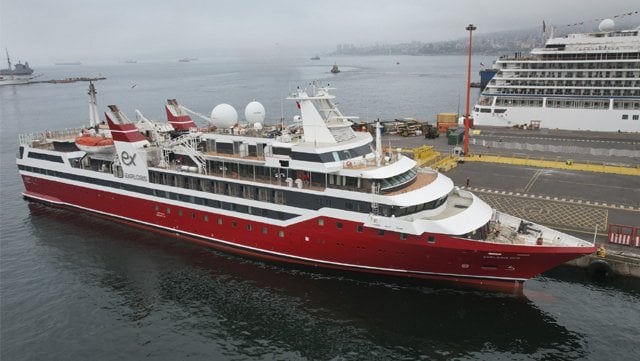
expedition cruise ship
Exploris One is due to hit the auction block this month after the exploration cruise line went into liquidation (Exploris)

Published Jan 14, 2026 4:01 PM by The Maritime Executive


The small exploration cruise ship Exploris One, which had started service in 2023 for a French company of the same name, is now set to hit the auction block at the end of January. A previous attempt at a court-supervised sale of the vessel failed to proceed.

The company Exploris Croiseres & Expeditions was launched in 2023 by a former executive of another French cruise company, Ponant, and had promoted that they would be “the best an expedition cruise has to offer.” The ship was refurbished and registered in France for a launch in 2023. The website shows cruises currently scheduled from Ushuaia to the Antarctic Peninsula and Chilean fjords. It was due to transit to Europe in April. For the summer of 2026, it was scheduled to operate cruises under charter to Adventure Canada as well as trips for Exploris from Iceland.

Exploration cruising is one of the hottest segments in the cruise industry. It is enjoying rapid growth and an increased influx of luxury offerings to appeal to travelers seeking unique experiences.


Exploris One was offering a French-speaking exploration cruise product (Exploris)


Exploris acquired the ship in 2023 from Royal Caribbean Group’s Silversea Cruises. Built in 1989, the ship, which is 6,158 gross tons with accommodations for a maximum of 144 passengers, was promoted as “a global benchmark” in exploration cruising. The ship has operated under 10 different names in her career, but in 2008 was relaunched as Prince Albert by Silversea as the brand's first ice-class luxury cruise ship. In 2011, the company renamed her Silver Explorer, but she was sold in 2022 as the brand introduced new, luxury ships.

Despite the strong interest in the exploration cruise segment, media reports said Exploris operated at just 50 percent occupancy. The founder of the company told the French media they had over 2,000 passengers but were forced to cancel 500 advance bookings in September as the company fell into financial trouble. They had hoped to refinance, but said the cancelltion of the charter by Adventure Canada severely impacted cash flows.

Exploris was ordered into a court administration in September. The court rejected the refinancing plan and ordered the company into liquidation. The ship was laid up in Caen, France, where it remains.

Reports said negotiations were underway with several potential buyers for Exploris One under a court-supervised process. Bids were due to the court by late November.

The ship is now posted online in an auction with Interencheres. Bids are due by January 30, with no minimum price indicated.

 

Dewatering of Fire-Damaged ONE Containers Ship Completed

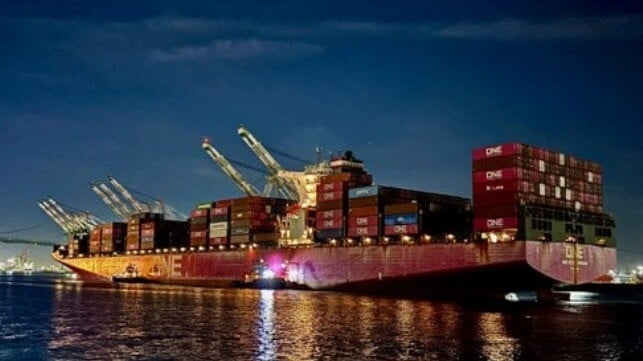
fire-damaged containership
ONE Henry Hudson continues to clear cargo and fire water after returning to the dock (USCG)

Published Jan 14, 2026 6:04 PM by The Maritime Executive


Approximately eight weeks after a blaze struck the containership ONE Henry Hudson while working containers at the Port of Los Angeles, operator Ocean Network Express (ONE) is reporting progress in the recovery operation for the vessel. They report that the General Average Survey process is now underway and are highlighting the arrangements for the discharge and onward movement of the import and export cargoes.

The fire had begun on the evening of November 22 forcing the evacuation of the vessel and for a time suspending operations in the Port of Los Angeles. Sources said they believed it was an electrical fire, and it was mostly contained to the hold, but they had still decided to move the ship outside the port’s breakwall.

The ONE Henry Hudson (8,212 TEU) was moved back to the Yusen Terminal at the Port of Los Angeles after teams were confident that the fire had been extinguished. The vessel’s owners quickly declared General Average, starting the process to manage the discharge of cargo from the ship within the terms of the claims.

ONE reports that water discharge operations and the discharge of distressed cargo were completed on Monday, January 12. The removal of the firefighting water required the placement of a barge alongside the ship. Water, which was contained in the flooded cargo hold, was pumped off the vessel for treatment and disposal. The first phase of the water discharge operation was completed on December 19.

The cargo discharge is a systematic process. It started with the discharge of dry containers from the affected cargo hold that were not impacted by the fire or firefighting water. That was completed by December 26.   It moved on to the distressed containers.

Discharge operations for all the remaining containers was scheduled to start in the middle of this week. The company did not say how long it expected it would take to remove these containers.

At the same time, the GA surveyor was expected to commence surveys today, January 14. Once that is completed, ONE reports containers can be released to customers at the Yusen Terminal, or it would make rail by ONE arrangements to Oakland or arrangements for inland point destinations. The company expects to continue to arrange shipment of export cargo unless instructed otherwise.


Iran Releases Greek Tanker Seized Two Years Ago

tanker
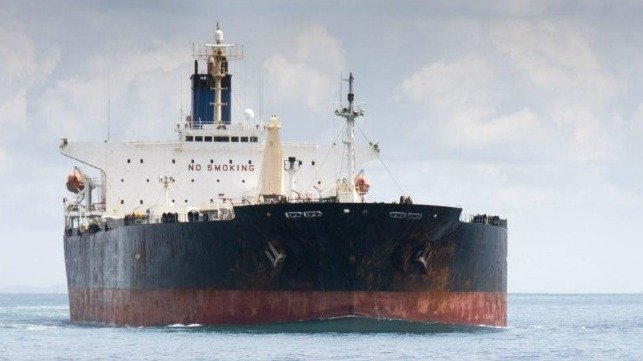
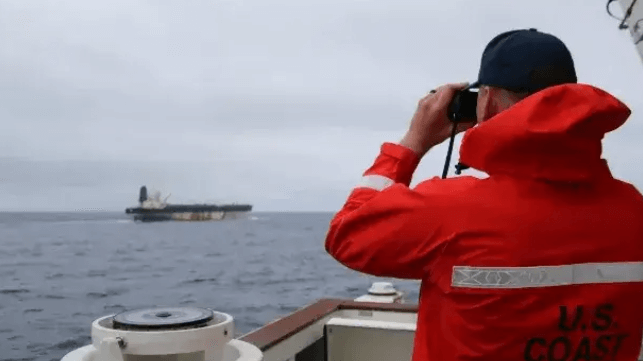
Iran released a Greek-owned tanker held for two years in retaliation against the United States (file photo)

Published Jan 13, 2026 5:20 PM by The Maritime Executive


A Greek-owned tanker that was caught in a series of back-and-forth maneuvers between the United States and Iran in 2023 and 2024 has quietly been released two years after the Iranians seized the ship and said they were taking its oil cargo. The move comes as Iran appears to be making moves to ease tensions with the West, as the regime is also facing widespread unrest inside the country.

The tracking service TankerTrackers.com broke the news on Monday, reporting on X.com that the tanker St. Nikolas (158,573 dwt) had quietly been released. It later said the tanker, which had been held since January 2024, was on its way to Oman.

Bloomberg is quoting a statement from the tanker's manager, Empire Navigation, that confirmed the ship reached Oman on January 10, and that the crew is in good health. They are reporting that the Iranians damaged some of the equipment aboard the vessel while holding it to prevent its detection. Iran initially had said it was seizing the oil cargo aboard in retaliation for a U.S. seizure, but Reuters reported months later that Iran quietly released the oil in a ship-to-ship transfer.

The release of the tanker ends more than three years of drama as the U.S. started chasing the vessel’s cargo. Then known as the Suez Raja, the ship was held off Singapore, and in 2023, the U.S. went to court, winning an order to seize the cargo. Empire Navigation agreed to assist the U.S. and pay a fine, and bring the ship to Houston, Texas, where it was offloaded. The vessel later abandoned her identity, quietly slipping away in September 2023 under the new ID of St Nikolas.

Iran had vowed retaliation and in January 2024 seized the tanker while it was outbound from the Persian Gulf with a cargo of Iraqi oil. Iranian forces directed the ship to port and took it into custody. A Greek cadet was released shortly after, and the captors permitted a crew change later in 2024.

There was no statement on what led up to the vessel’s release, but it comes as Donald Trump has threatened U.S. action if the regime acts against the protestors who have taken to the streets in Iran demanding economic reforms. Trump has been reported to be considering military action, but on Sunday night told reporters that Iran wanted to meet with the U.S. in an effort to reduce tensions. Trump has said that a meeting would be arranged, but continues to threaten unspecified actions in support of the demonstrators. Reports indicate that many have already been killed, but the Iranian government started a blackout on news over the weekend and shut down Internet access.

Iran has continued to hold several Western vessels seized during various actions in the Persian Gulf. It also holds the MSC Aries, a containership that was seized in support of the Houthis’ actions in the Red Sea. Last fall, Iran announced it was seeking a $170 million “fine” from the vessel’s owners, Zodiac Maritime, after saying the vessel was held for violating “maritime regulations.”


U.S. Coast Guard and Local Volunteers Save Crew of Grounded Crab Boat

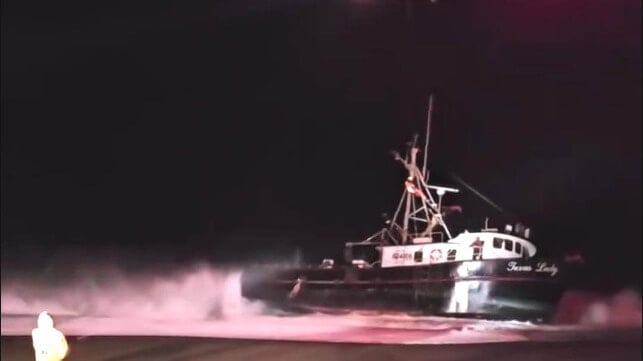
Texas Lady
Courtesy Sixes Fire Department

Published Jan 13, 2026 7:38 PM by The Maritime Executive


A combined Coast Guard and volunteer response effort resulted in the rescue of two people and two dogs from a crab boat that washed ashore at Port Orford, Oregon on Sunday, according to local accounts. 

On Sunday morning, the Coos Bay-based fishing vessel Texas Lady drifted aground on a sandy beach at Paradise Point, northwest of Port Orford. The Coast Guard responded to the scene, along with the local fire department and a volunteer search and rescue squad. In challenging conditions in the surf zone, the volunteers retrieved two dogs from the stranded vessel, and a Coast Guard helicopter aircrew helped the two crewmembers disembark. One additional crewmember self-rescued by jumping over the side and made it safely to shore. A bystander video showed the aircrew taking position over the grounded Texas Lady as she rolled in heavy surf. 

The initial wreck removal plan called for bringing in nearly 2,000 feet of towing hawser and rigging up the vessel to pull it off with a tug. Dive crews, a tug out of Coos Bay and a hawser were all sourced and en route to the scene, along with a team of 10 salvors.  

However, the plan reportedly changed as conditions on scene evolved. In an update Tuesday, local outlet Oregon Coast Explored reported that the vessel had sustained too much damage to be salvageable. Water and sand penetrated the interior, making it difficult to refloat and remediate. Instead, it will be hauled up onto the beach with heavy equipment, then demolished in place for removal. 


South Africa Rescues 21 Fishermen from a Burning Fishing Trawler

fishing boat fire rescue
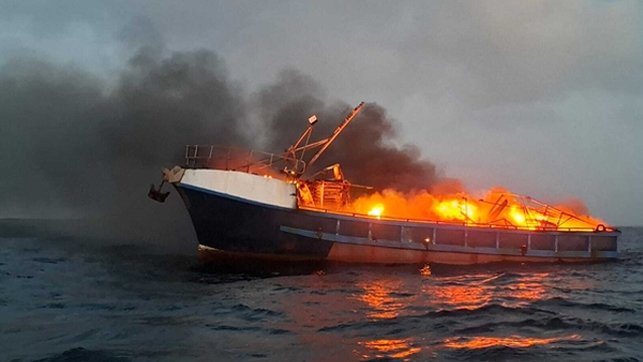
Other fishing boats rushed to the rescue of the crew that had gone overboard (NSRI)

Published Jan 13, 2026 8:10 PM by The Maritime Executive


South Africa is reporting one of its most dramatic rescue operations in recent years, saving the lives of 21 fishermen who were forced to abandon ship after their trawler went up in flames Monday evening.

The National Sea Rescue Institute (NSRI) reports that multiple rescue teams were activated after it received a distress mayday call from the crew of the fishing vessel Silver Dorado. The crew said they were preparing to abandon ship as the fire overtook their vessel.

The mayday indicated the vessel was approximately one nautical mile offshore of Noordhoek, Gqeberha, in the Eastern Cape region. The fishing vessel had departed the Port of Port Elizabeth earlier in the day.

Before receiving the mayday alert, NSRI had received a call at 1752 local time on its emergency operations center from an eyewitness who raised the alarm of the burning fishing vessel. A local ski-boat club member, also called NSRI, alerting it to the fire.


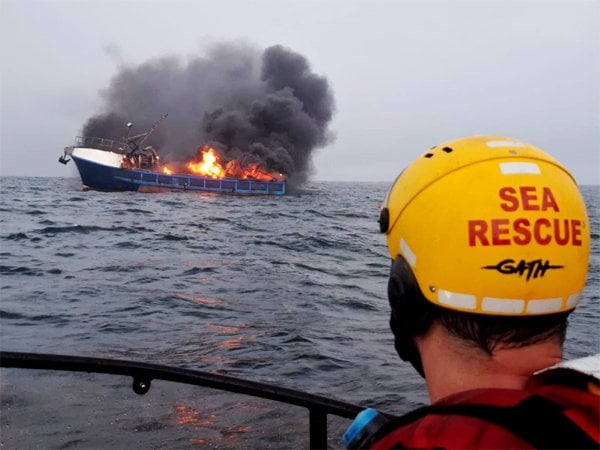
Sea Rescue coordinated the effort along with other fishing boats to get the crew from the water (NSRI)


Rescue teams were activated while vessels in the area were instructed to divert to the burning trawler to assist the fishermen, all of whom had abandoned the burning vessel into the sea. Among the first responders was a local fishing vessel, Leguga, which arrived on the scene and launched its own life raft to assist the fishermen who were in the water.

NSRI reports that at least five other fishing vessels that had also intercepted the mayday distress call arrived on the scene, while the Legugu had already managed to recover 12 fishermen from their life raft and from the sea. Three of the arriving fishing vessels managed to rescue the nine remaining fishermen. All the 21 crew of the burning vessel, believed to be South African, were accounted for and said to be safe.

The fishermen on the four fishing vessels were transferred to the NSRI rescue Bay Guardian and were taken to NSRI’s rescue base at the Port of Port Elizabeth, where they were medically assessed.

The South African Maritime Safety Authority (SAMSA) and the police have initiated investigations into the cause of the fire. NSRI says that it appears that the fire of undetermined cause spread fast after being discovered onboard by the skipper.

“We believe all remaining 20 crew were in bunks resting in preparation for reaching fishing grounds. We believe the skipper alerted his crew and they were forced to abandon ship without having time to launch their own life raft, but the skipper was able to dispatch a mayday distress VHF radio call,” said NSRI.

Following the dramatic rescue, the owners of the vessel have appointed a salvage and spill response company that is monitoring and attempting to gain access to the burning vessel, but they are being hampered by the dangerous reef and darkness.

With the burning vessel still drifting in the high seas, authorities are warning of navigational hazards and are instructing vessels in the area to proceed with caution.

Chinese-Led South African Naval Exercise Slides into Diplomatic Disaster

BRICs warships in South Africa
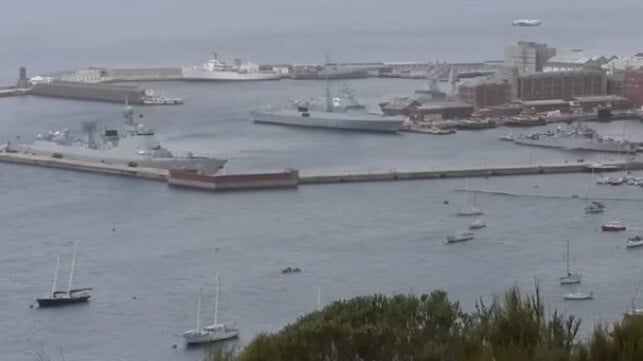
BRICs warships gathering at Cape Town (Screengrab from Times New World)

Published Jan 14, 2026 1:00 PM by The Maritime Executive


The Chinese-led BRICs Exercise "Will for Peace 2026," now taking place in Cape Town,  is turning into a diplomatic disaster for its host South Africa.

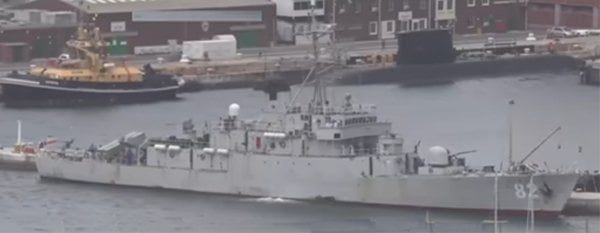
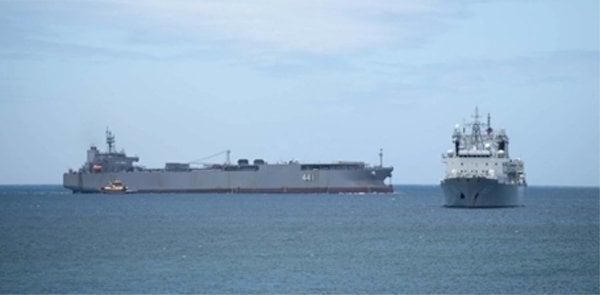
Alongside participants from Russia, China, and the United Arab Emirates, three Iranian warships arrived in False Bay to participate in the exercise, with the Bayandor Class corvette IRINS Naghdi (F82) coming alongside in the Simon’s Town Naval Base, and two converted oil tankers now serving as logistics vessels - IRINS Makran (K441) and the Islamic Revolutionary Guard Corps Navy (Nedsa, IRIS Shahid Mahdavi (L110-3) anchoring off in False Bay. Iranian personnel took part in dockside parades and inter-Navy sports events which occupied the first two days of the exercise.

But before the sea-going phase of the exercise commenced on January 13, the South African government requested that the Iranians withdraw their active participation from the exercise and become observers instead, a request to which the Iranian acceded.


The Iranian Navy corvette IRINS Naghdi (F82) alongside, with a South African diesel-electric attack Heroine Class Type 209 submarine behind (Screengrab from Times New World)


The South African move was prompted by the realization at this late stage, that diplomatically it did not look good to be aligned with an Iranian regime which by some estimates has now killed 12,000 of its own citizens in anti-government riots. The South Africans also realized that its highly favorable trade position under the African Growth and Opportunity Act was in jeopardy, with the Act is coming before the U.S. House of Representatives this week for its scheduled three-year renewal.

These dangers were already apparent back in September, when The Maritime Executive noted that South African Chief of Staff General Rudzani Maphwanya had visited Tehran to issue an invitation to the exercise, a visit not apparently approved beforehand by South African President Cyril Ramaphosa. President Ramaphosa objected to the visit, but did not fire the General for his freelancing in the political arena. Political opponents of the President said at the time that his response was weak, exceedingly so as events have turned out.


Observers are now watching the Simon’s Town Naval Base to see when the Iranian naval vessels depart – and in which direction. There is still some mystery concerning the whereabouts of the Iranian Navy’s 104th Flotilla and the Navy’s force of frigates, which are at sea somewhere. Since most ships of the Navy left Bandar Abbas Naval Harbor on about January 8, the internal security situation in Bandar Abbas city has deteriorated, with one large protest in particular occurring close to the Naval Harbor. 

The aim of Exercise "Will for Peace 2026," a highly inappropriate name for a naval exercise given the character of its participants, is to practice naval drills supporting the protection of commercial shipping in shipping lanes, including counter-terrorism rescue, counter-boarding and maritime strike operations. The exercise is scheduled to last until January 16, and is the first naval exercise to be held under the auspices of BRICS, hitherto seen as an economic bloc. The exercise director is from the PLAN.

Nedaja forward base ship IRINS Makran (K441) and PLAN replenishment ship CNS Taihu (K889) approaching Simon’s Town, January 9 (Screen grab from Sharjah TV)

With Five Shadow Fleet Tankers in Custody, U.S. Could Seize Dozens More

USCG
The seized tanker Bella 1 (Image courtesy USCG)

Published Jan 14, 2026 5:51 PM by The Maritime Executive


As the U.S. Coast Guard ushers five recently-seized shadow fleet tankers into U.S. custody, the Department of Justice is seeking warrants to capture dozens more, according to Reuters.

The legal petitions are not public, but an insider told the news agency that the administration is asking federal courts to write warrants for civil forfeiture of a large number of sanctioned tankers. The warrants would enable boarding, search and seizure missions to capture the vessels and take them to the U.S., where the government could start proceedings to take possession of the ships and cargoes for alleged sanctions violations. 

Several prior court warrants related to the tanker campaign have been unsealed, including the authorization for the seizure of the stateless vessel Bella 1. The Bella 1's case was unique: mid-voyage, with the Coast Guard behind in a low speed pursuit across the Atlantic, Bella 1 changed her name to Marinera and reflagged with the Russian register of shipping. U.S. forces boarded and captured the vessel despite the registry change, and Bella 1 is now under Coast Guard escort.

Ship spotters have identified the Bella 1 off the coast of northern Scotland, in the Moray Firth. The government of the UK understands that the vessel is anchoring in British waters briefly to take on new supplies, including food. Scottish first minister John Swinney told BBC that he was not consulted before the sanctioned tanker arrived. 

"It is not appropriate for the Scottish government to learn about these issues through media reports," Swinney told BBC. "There should be advanced briefing from the United Kingdom government and I am insisting on that."

The UK Ministry of Defense declined to comment on the Bella 1's status or its plans for ongoing operations. The vessel has not transmitted an AIS signal since January 7, making her movements harder to track without satellite imaging.

Trump’s policies have cost the auto industry a staggering $25 billion so far


Two L3Harris employees at Advanced Manufacturing Facility in Huntsville, Alabama, U.S. October 9, 2024. L3Harris Technologies/Handout via REUTERS./File Photo

January 14, 2026
ALTERNET

The American automobile industry is at risk thanks to President Donald Trump’s war against green energy.

Business journalist Bill Saporito wrote in The New York Times that most car companies had shifted to prioritizing electric vehicles (E.V.s) before Trump canceled efforts to support the industry. He likened the move to insisting that all music should only be accessible on vinyl rather than streamed digitally.

"Ford Motor has mothballed production of the all-electric version of its flagship F-150 pickup truck, and last month announced a $19.5 billion charge related to restructuring its E.V. business," Saporito wrote. "General Motors, citing the loss of tax incentives for E.V. buyers and laxer pollution regulations, switched production at its Orion, Mich., plant from E.V.s to full-size S.U.V.s and pickups powered by internal combustion engines (ICE, in industry parlance). In doing so, G.M. last week announced that it was taking a $6 billion loss in the fourth quarter — on top of a similar $1.6 billion hit the quarter before."

Ultimately, Trump has cost automakers $25 billion in losses.

The ordeal is a repeat of 2008, when car companies prioritized building giant S.U.V.s and trucks. Oil prices spiked so high that buyers began shifting to lower-fuel vehicles like Toyotas and Volkswagens. Then the housing market collapsed. The federal government swooped in with a $50 billion bailout for G.M. after it was forced into bankruptcy.

Meanwhile, Detroit was too slow to adapt when Tesla began to corner the E.V. market. Carmakers then fast-tracked their E.V. programs and joined the global shift to cleaner vehicles. Then Trump was reelected in 2024 and ushered in hefty tariffs on markets that are still promoting fuel-efficient vehicles and E.V.s.

Trump's "tariffs raised their manufacturing costs and scrambled a trilateral supply chain built on autos, parts and subassemblies flowing freely among the United States, Canada and Mexico," the report explained.

The main reason Trump opposed the fast-growing global push for E.V.s is that President Joe Biden championed it. The $1.2 trillion Infrastructure and Jobs Act funded projects to build and repair bridges and roads, but it also expanded the support structure for E.V.s with larger charging networks on major interstates.

"The vindictive, oil-loving Mr. Trump, who equates green with woke and views climate change as heresy, has worked assiduously to undo it, working to cancel consumer tax incentives and billions in funds for E.V. charging and battery manufacturing projects," the report continued.

The costs continue to mount for the business community. To make matters worse, Trump’s promises to increase U.S. manufacturing have fallen flat in his first year back in office. Job growth hit the brakes, with seven straight months of manufacturing job declines, according to recent federal data, as Politico reported last week.

Speaking to CNBC at the end of last year, Director of the National Economic Council Kevin Hassett was asked about the seven straight months of manufacturing job decline in the U.S. Hassett acknowledged the slump but promised that in the new year new plants would open and those numbers would turn around.

"Superior technology ultimately wins out. By the time the automobile industry is dominated by E.V.s, G.M. and Ford may have fallen well behind China, thanks to the Trump administration," Saporito wrote at the close of the story.
'Moral stain': Catholic outlet questions VP's faith after his Minneapolis shooting speech


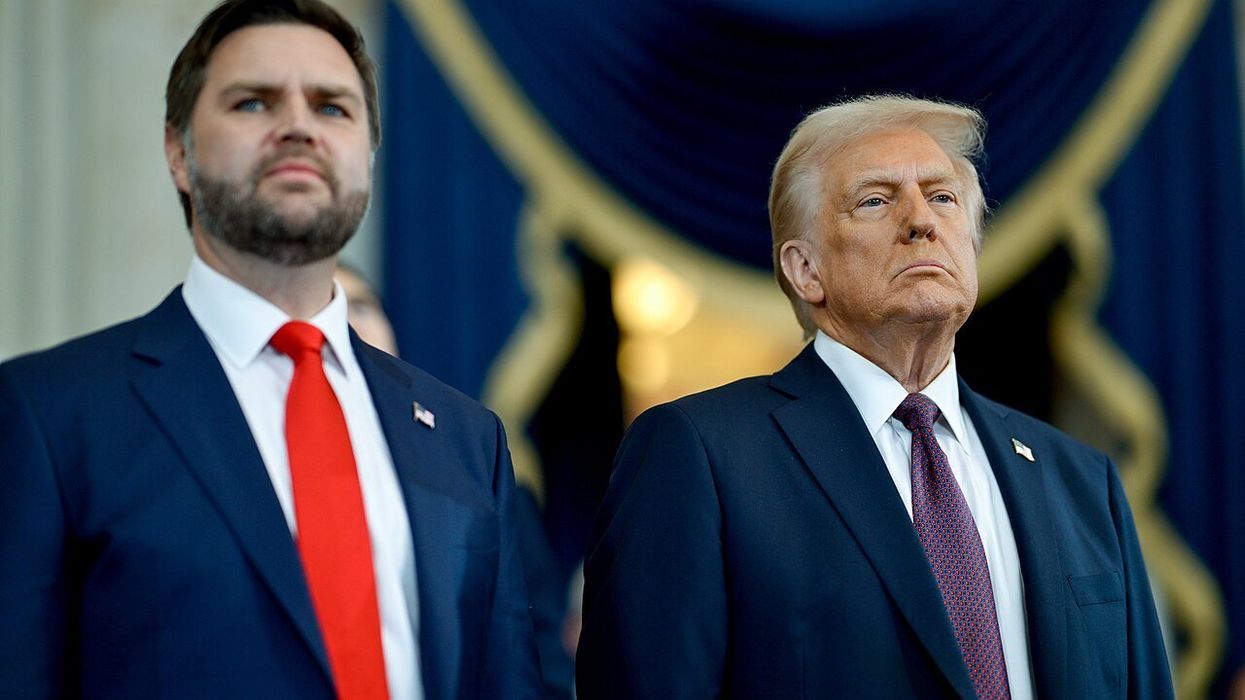
President Donald Trump and Vice President JD Vance on January 20, 2025 (The White House/Wikimedia Commons)
January 08, 2026
ALTERNET

Vice President JD Vance's comments on U.S. Customs and Immigration Enforcement (ICE) agent Jonathan Ross' shooting of Minneapolis, Minnesota resident Renee Nicole Good are now attracting harsh criticism from one of his fellow Catholics.

In a Thursday column, National Catholic Reporter (NCR) digital editor John Grosso took Vance — who converted to Catholicism in 2019 — to task for saying that Good's death was "of her own making." Grosso also doubted Homeland Security Secretary Kristi Noem's claim that Good — a widow and mother of three — was carrying out an act of "domestic terrorism."

"There is no evidence that Good was in any way involved in domestic terrorism. Video evidence seems to entirely contradict Trump's explanation of the situation," Grosso wrote. "The ICE officer does not appear to have been injured and is seen casually walking away after the shooting."

Grosso lamented that despite Vance expressing solidarity with ICE in multiple social media posts, the vice president has yet to show "any remorse, prayers or condolences regarding Good and her loved ones." He noted that Vance is instead "leaning into divisive, tribalistic language to demonize Democrats" rather than offering thoughts and prayers to Good's family.

"A leader might take the opportunity provided by a fresh day to soothe the broken heart of a nation and appeal to the better angels among us," he wrote. "JD Vance went in a different direction."

"As a Catholic, Vance knows better than to peddle this brand of gaslighting and agitation," he continued. "Vance knows that, by virtue of her humanity, Good was endowed with inherent dignity, made in the image and likeness of God. Vance knows that only God can take life. Vance knows that protesting, fleeing or even interfering in an ICE investigation (which there is no evidence that Good did) does not carry a death sentence. Vance knows that lying and killing are sins."

"The vice president's comments justifying the death of Renee Good are a moral stain on the collective witness of our Catholic faith. His repeated attempts to blame Good for her own death are fundamentally incompatible with the Gospel," Grosso added. "Our only recourse is to pray for his conversion of heart."

Click here to read Grosso's full op-ed in the NCR.
How Christian Reconstructionism influences US politics: scholar


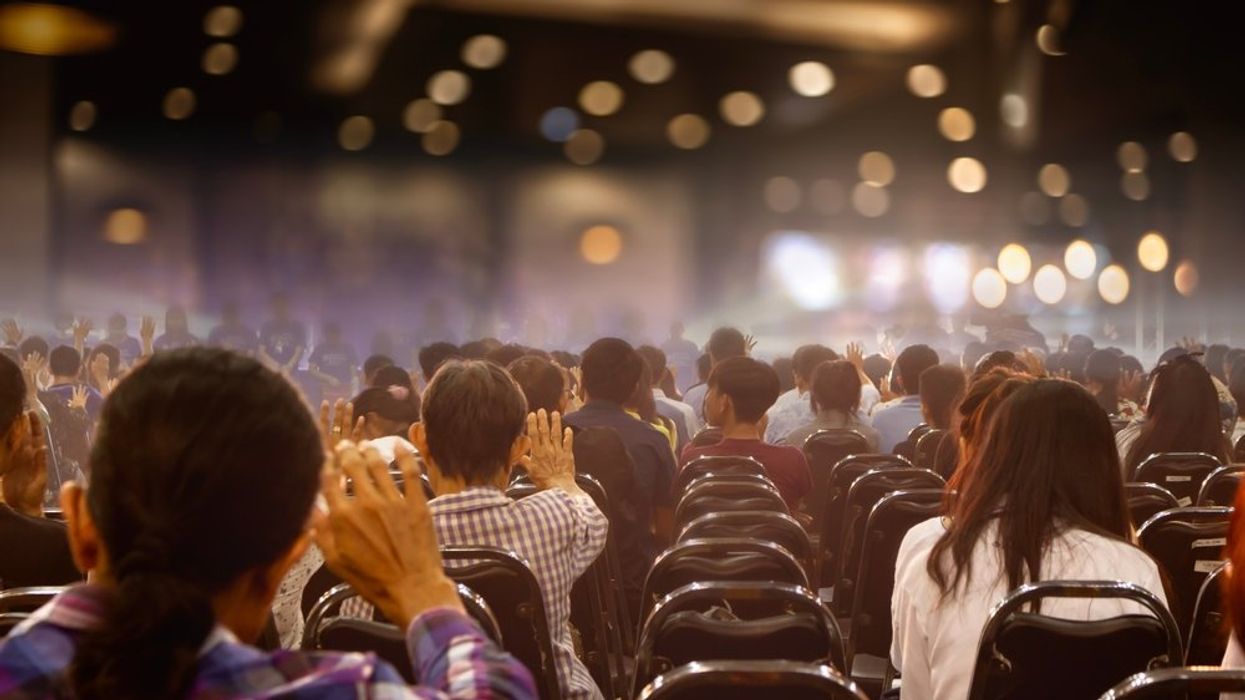
A Christian chruch service on July 8, 2024 (Paul Shuang/Shutterstock.com)
January 12, 2026 

Christian Reconstructionism is a theological and political movement within conservative Protestantism that argues society should be governed by biblical principles, including the application of biblical law to both personal and public life.

Taking shape in the late 1950s, Christian Reconstructionism developed into a more organized movement during the 1960s and 1970s.

It was born from the ideas of theologian R. J. Rushdoony, an influential Armenian-American Calvinist philosopher, theologian and author. In his 1973 book, “The Institutes of Biblical Law,” Rushdoony argued that Old Testament laws should still apply to modern society. He supported the death penalty not only for murder but also for offenses listed in the text such as adultery, blasphemy, homosexuality, witchcraft and idolatry.

As a scholar of political and religious extremism, I am familiar with this movement. Its following has been typically very small – never more than a few thousand committed adherents at its peak. But since the 1980s, its ideas have spread far beyond its limited numbers through books, churches and broader conservative Christian networks.

The movement helped knit together a network of theologians, activists and political thinkers who shared a belief that Christians are called to “take dominion” over society and exercise authority over civil society, law and culture.

These ideas continue to resonate across many areas of American religious and political life.
Origins of Christian Reconstructionism

Rushdoony’s ideas were born from a radical interpretation of Reformed Christianity – a branch of Protestant Christianity that follows the teachings of John Calvin and other reformers. It emphasizes God’s authority, the Bible as the ultimate guide and salvation through God’s grace rather than human effort.

Rushdoony’s ideas led him to found The Chalcedon Foundation in 1965, a think tank and publishing house promoting Christian Reconstructionism. It served as the movement’s main hub, producing books, position papers, articles and educational materials on applying biblical law to modern society.

It helped train Greg Bahnsen, an Orthodox Presbyterian theologian, and Gary North, a Christian reconstructionist writer and historian, both of whom went on to take key leadership roles in the movement.

At the heart of reconstructionism lies the conviction that politics, economics, education and culture are all arenas where divine authority should reign. Secular democracy, they argued, was inherently unstable, a system built on human opinion rather than divine truth.

These ideas were, and remain, deeply controversial. Many theologians, including conservatives within the Reformed tradition, rejected Rushdoony’s argument that ancient Israel’s civil laws should apply in modern states.
Christian dominionism and different networks

Nonetheless, reconstructionist ideas grew as people who more broadly believed in dominionism began to align with it. Dominionism is a broader ideology advocating Christian influence over culture and politics without requiring literal enforcement of biblical law.

Dominionism did not begin as a single, unified movement. Rather, it emerged in overlapping strands during the same period that Christian Reconstructionism was developing.

Between the 1960s and 1980s, Christian Reconstructionism helped turn dominionist beliefs into an explicit political project by grounding them in theology and outlining how biblical law should govern society. Religion historian Michael J. McVicar explains that Rushdoony’s work advocated applied biblical law as both a theological and political alternative to secular governance. This helped in influencing the trajectory of the Christian right.

At the same time, parallel streams – especially within charismatic and Pentecostal circles – advanced similar claims about Christian authority over society using different theological language.

The broad network of those who believe in Christian dominionism includes several approaches: Rushdoony’s reconstructionism, which provides the theological foundation, and charismatic kingdom theology.

Charismatic kingdom theology, which emerged in Pentecostal and charismatic circles, teaches that believers – empowered by the Holy Spirit – should shape politics, culture and society before Christ’s return.

Unlike reconstructionism, it emphasizes prophecy and spiritual authority rather than formal biblical law; it seeks influence over institutions such as government, education and culture.

What unites them is the idea that Christian faith should be the basis of the nation’s moral and political order.

Taken together, I argue that these strands have reinforced one another, creating a larger movement of thinkers and activists than any single approach could achieve alone.
From reconstructionism to the New Apostolic Reformation

Christian reconstructionist and dominionist ideas gained wider popularity through C. Peter Wagner, a leading charismatic theologian who helped shape the New Apostolic Reformation, or NAR, by adapting elements of Christian Reconstructionism. NAR is a charismatic movement that builds on dominionist ideas by emphasizing the use of spiritual gifts and apostolic leadership to shape society.

Wagner emphasized spiritual warfare, prophecy and modern apostles taking control of seven key areas – family, church, government, education, media, business and the arts – to reshape society under biblical authority. This is known as the “Seven Mountains Mandate.”

Both revisionist and dominionist movements share the belief that Christians should lead cultural institutions.

Wagner’s dominion theology, however, adapts Christian Reconstructionism to a charismatic context, transforming the goal of a Christian society into a spiritually driven movement aimed at influencing culture and governments worldwide.
Doug Wilson and homeschooling

Another key bridge between reconstructionism and contemporary dominionist thought is Doug Wilson, a pastor and author in Moscow, Idaho.

Though Wilson distances himself from some of reconstructionism’s harsher edges, he draws heavily from Rushdoony’s intellectual framework. Wilson’s influence can be seen in publications such as “Reforming Marriage,” where he argues for applying biblical principles to law, education and family life.

He has promoted Christian schools, traditional family roles and living out a “Christian worldview” in everyday life, bringing reconstructionist ideas into new areas of society.

Through his writings, teaching and leadership within the Communion of Reformed Evangelical Churches – the CREC – network, Wilson encourages a vision of society shaped by Christian values, connecting reconstructionist thought to contemporary cultural engagement.

Wilson’s publishing house, Canon Press, and his classical school movement have brought these ideas into thousands of Christian homes and classrooms across the U.S. His local congregation – the Christ Church in Moscow, Idaho – numbers around 1,300.

The Christian homeschooling movement offers parents a curriculum steeped in reformed theology and resistance to secular education.
Enduring influence

Some critics warn that the fusion of dominionist and reconstructionist theology with political action can weaken pluralism and democratic norms by pressuring laws and policies to reflect a single religious worldview. They argue that even moderated forms of these visions challenge the separation of church and state. They risk undermining the rights of religious minorities, nonreligious citizens and others who do not share the movement’s beliefs.

Supporters frame their mission as the renewal of a moral society, one in which divine authority provides the foundation for human flourishing.

Today, Christian Reconstructionism operates through small but influential networks of churches, Christian homeschool associations and media outlets. Its reach extends far beyond its original movement.

Even among those unfamiliar with Rushdoony, the political and theological patterns he helped shape remain visible in modern evangelical activism and the ongoing debates over religion’s place in American public life.

Art Jipson, Associate Professor of Sociology, University of Dayton

This article is republished from The Conversation under a Creative Commons license. Read the original article.


MAGA claims of 'massive religious revival' meticulously debunked


CEO of Turning Point USA Erika Kirk reacts as she speaks during AmericaFest, the first Turning Point USA summit since the death of Charlie Kirk, in Phoenix, Arizona, U.S. December 18, 2025. REUTERS/Cheney Orr

January 07, 2026
ALTERNET


Christian nationalist themes were alive and well at Turning Point USA's AmericaFest 2025 gathering at the Phoenix Convention Center, which found Vice President JD Vance declaring that the United States "always will be a Christian nation." But that claim was debunked by MS NOW's Steve Benen, who noted what the Founding Fathers had to say on the subject — for example, John Adams, in 1797, writing that "The government of the United States of America is not in any sense founded on the Christian Religion," and Thomas Jefferson saying, in 1802, that the U.S. Constitution created "a wall of separation between church and state."

Another prominent Christian nationalist theme at AmericaFest 2025 is that the U.S. is seeing a widespread evangelical renaissance, which is also what the Moral Majority's Rev. Jerry Falwell Sr. claimed during the 1980s. But Salon's Amanda Marcotte, in an article published on January 7, counters that the U.S. is moving in a more "secular" direction — not converting to evangelical Christian fundamentalism in huge numbers.

"For decades now," Marcotte explains, "the Christian Right has been the most powerful and influential force in the GOP, and yet even by their standards, this marked a dramatic shift toward the theocratic impulse. From a purely rational perspective, this is bad politics. Only 23 percent of Americans identify as evangelicals. Trump was able to win in 2024 only by convincing large numbers of people outside of evangelical Christianity that he has a secular worldview. This was aided by the fact that he quite clearly doesn't believe all the Christian language, both coded and overt, his aides coax him to say."

The Salon journalist continues, "But none of that seems to register with MAGA leadership right now. They've convinced themselves — or at least are trying to persuade their donors and followers — that the U.S. is undergoing a massive religious revival. Right-wing media has been pushing the view that huge numbers of Americans, especially young Americans, are converting to fundamentalist Christianity."

Right-wing media, Marcotte observes, are claiming that the murder of Turning Point USA's Charlie Kirk in September is fueling a "tidal wave of Americans, especially young Americans, discovering or returning to Christianity." But that "imaginary religious awakening," she stresses, isn't materializing.

"There is no evidence-based reason to believe there's a religious revival among the young that is about to create massive election windfalls for Republicans," Marcotte writes. "On the contrary, a December report from Pew Research found that, 'on average, young adults remain much less religious than older Americans. Today's young adults also are less religious than young people were a decade ago.'"

Amanda Marcotte's full article for Salon is available at this link.