It’s possible that I shall make an ass of myself. But in that case one can always get out of it with a little dialectic. I have, of course, so worded my proposition as to be right either way (K.Marx, Letter to F.Engels on the Indian Mutiny)
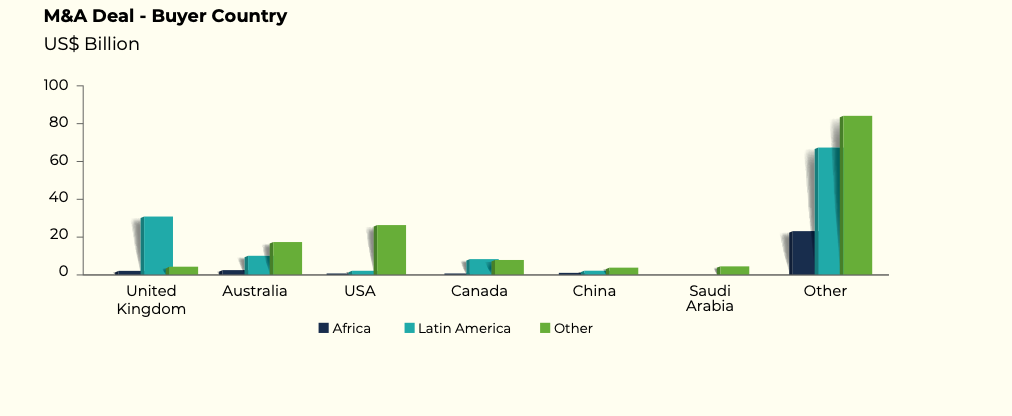
Global mining mergers and acquisitions hit about $30 billion in the first three quarters of 2025, with 74% of deal value flowing to Latin America as investors retreat from higher-risk jurisdictions, a report from McKinsey & Company and the Future Minerals Forum shows.
The figures are part of the Future Minerals Barometer Report 2025, which tracks supply-chain readiness across Africa, West Asia, Central Asia and Latin America.
Developed in partnership with McKinsey & Company and other sector experts S&P Global Market Intelligence, Global AI and GlobeScan, the barometer integrates stakeholder sentiment, data, market intelligence and project-level evidence into a single authoritative platform to guide global decision-making.
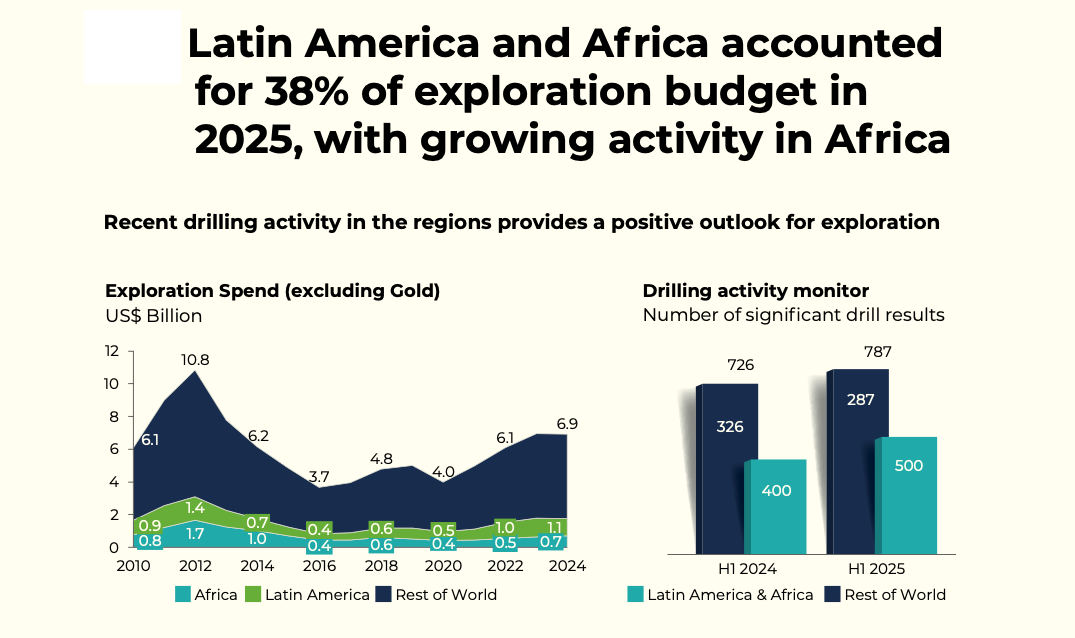
The report found there is a widening gap between mineral endowment and investment. More than 50% of global critical mineral reserves sit in the so-called Super Region — Africa, West Asia and central Asia — yet it attracts the lowest exploration spending worldwide, heightening long-term supply risks.
Deals value skyrockets
Since 2021, mining deal values in Latin America are up more than 200%, while Africa has seen an almost 80% decline as capital gravitates toward jurisdictions perceived as more stable.
The barometer builds on McKinsey’s Global Materials Perspective, released in October last year, which shows mining productivity has improved by just 1% a year since 2018, reinforcing why investors are increasingly focused on capital discipline and permitting certainty.
The report warns that global critical mineral supply chains are under growing strain just as demand accelerates, driven by the energy transition, digitalization and rising defence needs.
Demand for copper, lithium, nickel and rare earths is rising faster than new supply can be brought online, while long permitting timelines, infrastructure gaps, capital intensity and policy uncertainty continue to slow project development.
More than 45% of refined production for electric vehicle materials is concentrated in a single region, increasing exposure to geopolitical risk, trade disruptions and price volatility.
Anglo American (LON: AAL) CEO Duncan Wanblad said global copper demand is projected to rise 75% to 56 million tonnes a year by 2050, requiring about 60 new mines the size of Quellaveco in Peru to be developed over the next decade to offset declining output from aging assets.
Risk reset
Investment flows reflect a broader reset in risk perception. McKinsey partner Jeffrey Lorch said the barometer integrates market data and stakeholder sentiment to give companies a practical roadmap to navigate volatility. GlobeScan CEO Chris Coulter said the Super Region faces major challenges but also a significant opportunity if policy, financing and infrastructure gaps can be addressed.
The report estimates the world will need about $5 trillion in cumulative investment by 2035 to meet critical minerals demand, while exploration spending remains 40% to 50% below what is required. Compounding the shortfall is an average 16-year timeline from discovery to first production, meaning projects found today are unlikely to contribute meaningfully to 2030 or 2035 climate targets.
Industry leaders at the forum argued that faster development will depend on regulatory harmonization, new funding mechanisms and deeper collaboration between governments, miners and investors to unlock supply in Africa, Asia and Latin America.
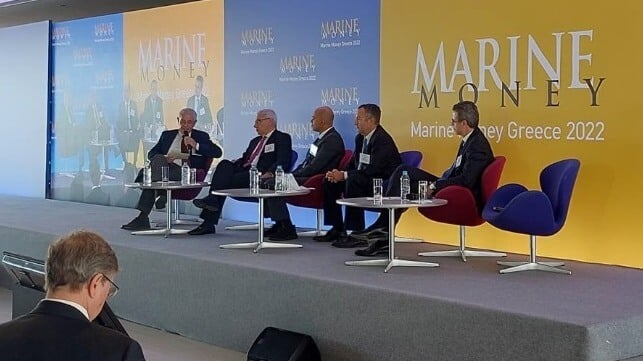
Diversified, the Maine-based maritime media and conference company, has purchased the shipping-finance event firm Marine Money. The acquisition brings together two of the best-known names on the maritime conference circuit.
Marine Money has been organizing high-level gatherings for shipping executives and financiers since the 1980s, and is the premier platform for connecting shipping finance professionals. Its panel talks and networking events are quite often the talk of the town.
Diversified's portfolio includes a variety of adjacent events, like the Workboat show, which usually features a Marine Money event on the day before the conference floor opens. The company has years of experience in managing panel events and shows; in addition, the staff of Marine Money are staying on to continue to run the business, including owners Matt and Mike McCleery.
"This acquisition represents a highly strategic step forward in expanding and deepening our Commercial Marine portfolio," said Diversified's Commercial Marine Group Vice-President Wes Doane. "Just as important, we are gaining exceptional partners in both Matt and Mike, whose decades of industry leadership, trusted relationships, and commitment to the shipping finance community will be instrumental."
Diversified had been actively looking for opportunities to expand its commercial marine portfolio, according to Oakley Dyer, VP of strategy and corporate development. The parties see synergies to be had: Diversified can provide Marine Money with technology, in-house services, and expertise as it seeks to expand its offerings.
The price of the acquisition was not disclosed. However, it is understood that the purchase had been discussed under the previous leadership of Marine Money founder Jim Lawrence, who passed away in 2025.
The purchase leaves Diversified with a portfolio of 18 brands and 13 news sites across multiple industries, plus more than two dozen conference dates. Its network covers everything from running sports to seafood to UAVs to solar power, and much more.
Hapag’s Terminal Operator Takes Full Ownership of Port Everglades Facility
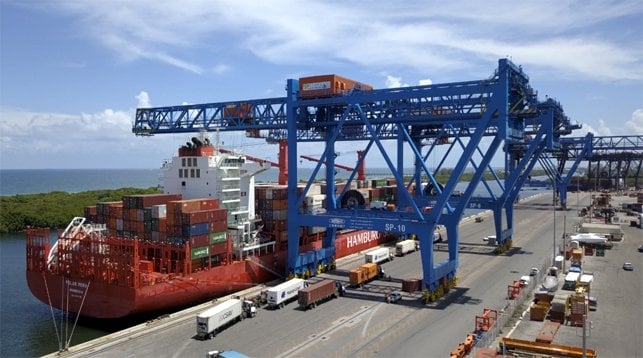
Port Everglades' Florida International Container Terminal (Hanseatic Global Terminals)
Hapag-Lloyd’s Hanseatic Global Terminals is continuing to execute on its growth strategy, with reports that it has taken full ownership of Port Everglades'Florida International Terminal. Major carriers have been working to build out their terminal operations in support of corporate goals and a positive business opportunity.
Hapag-Lloyd and Grupo Empresas Navieras, through its affiliate Agunsa Universales, have operated the terminal in Port Everglades for a decade. The companies reported they have reached an agreement regarding the capital structure of the operation. Hanseatic Global Terminals will become the sole owner of FIT. Agunsa USA, which is working to consolidate GEN's port, logistics, and towage operations, had previously owned approximately a third of the joint operation in Fort Lauderdale.
According to the companies, FIT is strategically located in South Florida, serving one of the largest consumer markets globally. The terminal specializes in container and general cargo handling and provides direct connectivity to major highways and rail networks, ensuring efficient inland and intermodal transportation and access to the region’s hinterland.
In 2024, the terminal announced a new 10-year lease with the port running to 2035 for the facility located on 46 acres in the Southport area of Port Everglades. As part of the concession, it reported plans to invest $25 million. The terminal has four berths with six ship-to-shore cranes. It handled over 330,000 in 2024 and over 2.8 million tonnes of cargo.
Established in 2023, Hanseatic Global Terminals operates as an independent entity within the Hapag-Lloyd Group, focusing on terminals and infrastructure. Hanseatic aims to grow from 21 port terminals to approximately 30 globally by 2030.
Baltimore’s Sparrows Point Container Terminal Receives Key Permits
Sparrows Point will double contaienr caapcity at the Port of Baltimore (Tradepoint Atlantic)
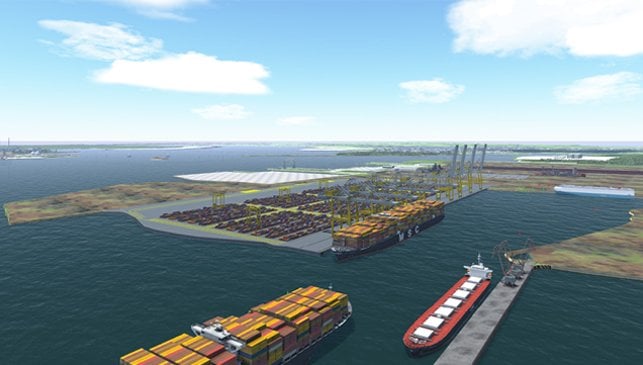
Plans to develop a new container terminal as part of the redevelopment of the Sparrow’s Point region of Baltimore marked key steps with the US Army Corps of Engineers and federal authorities granting construction permits. The project is a joint venture with MSC’s Terminal Investment Limited (TIL), which calls for doubling Baltimore’s container capacity and further establishing the port as a critical gateway to the Mid-Atlantic and central United States.
The Army Corps announced late last week that it has issued its permit decision for the Sparrows Point Container Terminal after having completed its Final Environmental Impact Statement last fall. The Army Corps has authorized the construction of approximately 3,000 linear feet for the terminal’s wharf. The project will require mechanical dredging and placement of approximately 4.2 million cubic yards of material. In addition to the wharf, the project was also seeking permission to create a turning basin and to lower the depth to 52 feet to accommodate large containerships.
The project requires Army Corps approval as USACE oversees harbor and river improvements, construction of structures on navigable waters, and ocean disposal of dredged material. It must also permit the maintenance dredging for the facility.
In December, the Federal Permitting Improvement Steering Council also announced the completion of federal permitting for the project. The Council was created a decade ago to improve the permitting process for infrastructure projects that require federal environmental review.
The Sparrows Point Container Terminal is a $1 project that will redevelop 330 acres at the former Bethlehem Steel Sparrows Point manufacturing plant. Tradepoint Atlantic acquired the site in 2014 for redevelopment into a multi-use facility. More than 50 companies are already located at Sparrows Point, and the area includes a marine terminal and rail link
Tradepoint Atlantic and TIL announced plans in October 2022 to develop the new container facility, saying it would be opened by 2028. The container facility will consist of 168 acres for the terminal and intermodal yard, with an additional 162 acres for support facilities. Plans call for up to nine ship-to-shore cranes as well as an intermodal rail facility.
The project has won key support as part of the overall plan to expand and improve operations in the Port of Baltimore. It will provide critical jobs and economic enhancement to the region.
Shanghai Exceeds 55 Million TEU in Container Throughput for 2025
Shanghai topped 55 million TEU for the first time (SIPG)
The Shanghai International Port Group is highlighting that its port operation has remained the world’s busiest container port for the 16th consecutive year. They also report completion of the 14th Five-Year Plan as it looks toward the future by taking more steps to build its role as a global container transshipment hub.
Releasing its final tally for 2025, SIPG says the Shanghai port overall handled 55.06 million TEU, which was a 6.9 percent increase in throughput. Over volume, however, lagged at 600 million tons, up just over 3 percent from the 580 million tons in 2024.
It reports that the Yangshan Deep Water Port accounted for just over half the port complex’s total volume, an increase of just over 10 percent for the port area’s throughput. Critically, it points out that the Yangshan Phase III Terminal surpassed 10 million TEU for the first time, highlighting its role as a core pillar of the port. Observers note that few ports around the world handle 10 million TEU in a year.
One of the key focuses for the port is growth in its role as an international transshipment hub. SPIG highlights its transshipment volume surpassed 7.9 million TEU, up 10.6 percent for the year. They said this is evidence of its reach and influence as a global hub. Efforts such as a water-to-water transshipment effort and increased efficiency helped it grow this operation.
The overall throughput they report “underscores the port’s resilience and stability as a critical node in the global supply chain.”
SPIG highlights a range of challenges that it had to address and manage in 2025. It points to “complex and volatile global trade conditions,” saying there were frequent geopolitical conflicts and an accelerated restructuring of global supply chains. SPIG points to deepening its strategic collaboration with shipping companies and improving resource utilization efficiency to help it manage the challenges. It also points to “extreme weather events” and surges in peak logistics periods.
Technology plays a critical role in the port’s ability to handle these massive volumes. It points to a rollout of automated terminals among the innovations. They are using digital twins and big data analytics to increase quay crane productivity. It also points to technologies such as smart yards and AI-based stowage models to significantly reduce the re-stowage rate. They call this movement “China speed.”
SPIG also highlights strong growth in its sea-rail inter-model volumes. They report it exceeded 1 million TEU for the first time, up just over 16 percent year-on-year.
Looking ahead, it says the operations will focus on strengthening hub resilience. One of the key goals is to increase the share of international transshipment cargo.
“SIPG will accelerate major infrastructure development, optimize port layout, and enhance container-handling capacity and vessel berthing efficiency. With a strategic focus on international transshipment, it will further expand global shipping networks and scopes of cabotage operations, and water-to-water transshipment, increasing the share of international transshipment cargo and consolidating its position as a core international transshipment hub in Northeast Asia,” the company writes in its report for 2025.
The volume growth came after a report that Shanghai, after 11 months, had already reached 50 million TEU. They said it was 26 days earlier than 2024, forecasting a new record for the full year. Shanghai had been expected to exceed 53 million TEU for the year.
The growth in volumes was not limited to just Shanghai. Last week, the operators of the Ningbo-Zhoushan port reported it had handled 43 million TEU in 2025. It continues to rival Singapore, which reported today that it had a throughput of 44.66 million TEU in 2025, up 8.6 percent. Singapore handled a total of 3.22 billion gross tonnage of vessel arrivals in 2025, which was up 3.5 percent year-on-year.
HII's Unmanned Vessel Will Be Fitted to Launch Unmanned Submersible
Huntington Ingalls Industries has designed and built a deployment system that will allow an unmanned surface vessel to autonomously launch and recover a autonomous underwater vehicle (AUV), without human intervention. The launcher would give HII's new Romulus USV line the ability to conduct a wider range of survey and ISR work by pairing it with the company's own Remus AUV.
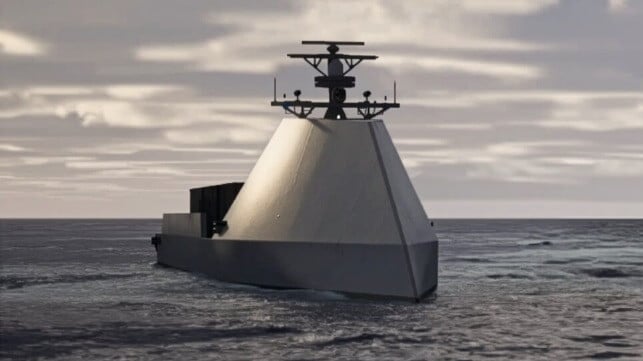
The first Romulus prototype is currently under construction. It is a midsize unmanned vessel with a speed of 25 knots and a range of 2,500 miles. Early renderings show that it has a crewboat layout with a long aft deck, suitable for modular payloads.
HII envisions a wide variety of roles for Romulus, including ISR, counter-drone, mine countermeasures, strike, and the launch and recovery of unmanned platforms. Remus - with 750 units in operation - ranks high on the candidate list for pairing with Romulus. In naval service, Remus is used for seabed survey, deep sea search, mine countermeasures and surveillance, extending the reach of manned assets. With an automated launch and recovery system, Remus would be deployable from an unmanned platform - and easier to use for a manned vessel, too. Over-the-side launch and recovery is inherently risky for human personnel, so HII sees safety benefits from automating that process as well.
The first Romulus prototype is under construction at Breaux Brothers, a midsize shipyard that is new to defense work. HII said that work is moving fast - in keeping with the speed of its many competitors in the startup world, like Saronic and Anduril.
"Romulus is progressing at a pace that reflects the urgency of the mission and the strength of our partnerships," said Andy Green, president of HII’s Mission Technologies division, in a statement last month.
ABB Chosen to Supply Technology for BC Ferries’ New Major Vessels
ABB’s integrated power, propulsion and control solution has been chosen for BC Ferries’ four new hybrid-electric major vessels. The New Major Vessels have been designed to minimize emissions and underwater radiated noise (URN), with the goal of contributi
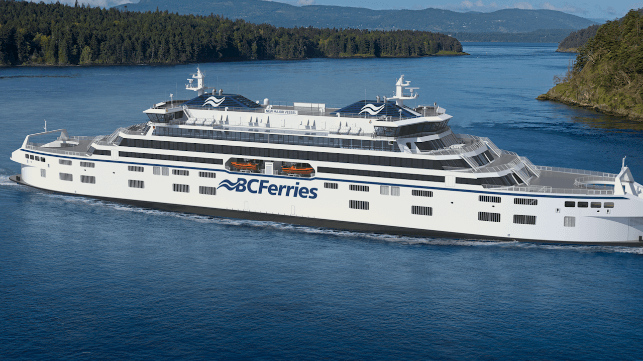
ABB will supply a complete package of power, propulsion and control technology for four new double-ended passenger and car ferries operated by British Columbia Ferry Services (BC Ferries). One of the largest ferry operators in the world, BC Ferries provides year-round vehicle and passenger service on 25 routes to 47 terminals, carrying approximately 9.7 million vehicles and 22.7 million passengers annually. Demand on the ferry system is expected to increase as the province’s population is forecast to grow 44 percentby 2046.
The hybrid-electric ferries, which will replace four end-of-life vessels, are part of the BC Ferries’ New Major Vesselsprogram, aimed at delivering safe, environmentally sustainable and reliable operations in and around the Strait of Georgia, the body of water separating Vancouver Island from the Lower Mainland of British Columbia. The order was booked in the fourth quarter of 2025.
Scheduled for delivery beginning in 2029 from China Merchants Industry Weihai (CMI Weihai) Shipyard, the vessels will be equipped with ABB’s gearless, steerable Azipod® electric propulsion.The system offers proven reliability thanks to significantly fewer moving parts than mechanical thrusters, while the special propeller design helps reduce underwater radiated noise (URN). This helps safeguard at-risk species, such as the Southern Resident killer whale, and preserve one of the world’s most biologically rich marine ecosystems3.
ABB’s Onboard DC Grid™ power distribution system will serve as the backbone for efficient energy flow, minimizing conversion losses and enabling higher overall system efficiency and lower emissions than comparable propulsion arrangements.
Each ferry will be equipped to accommodate up to 70 megawatt-hours (MWh) of battery energy storage. This enables efficient hybrid operations today and supports a future shift to fully electric, zero-emission service. The hybrid configuration uses biofuel or renewable diesel and continuously balances energy between generators and batteries. Each vessel can also connect to a high-capacity shore charging system rated above 60 megawatts (MW) for full electric operation. This system is more than 100 times more powerful than the fastest public electric vehicle charging stations in North America, which typically deliver up to 500 kilowatts (kW) per plug. This high-capacity charging supports fast turnaround in port and enables the transition to zero-emission operations.
ABB’s digital solutions will give crews a clear overview of ship operations and support safe, efficient journeys. These digital technologies are intended to help BC Ferries deliver an improved travel experience for passengers while reducing environmental impact.
“BC Ferries’ New Major Vessels represent the largest capital investment in our history and are essential to renewing our fleet, increasing capacity on our busiest routes, and strengthening system resilience,” said Nicolas Jimenez, President & CEO, BC Ferries. “Their design reflects what our customers value most: comfort, accessibility and environmental stewardship. With diesel-battery hybrid technology that can operate on bio and renewable diesel today and transition to full electrification as infrastructure evolves, these ships are a critical part of building a cleaner, quieter, and more reliable ferry system for the future."
“We proudly support BC Ferries’ goals to reduce greenhouse gas emissions from their operations, striving to meet British Columbia’s 2030 greenhouse gas emissions reduction target for the transportation sector4 by at least 27 percent by 2030, from 2008 levels, in support of a cleaner future for British Columbia, and its ambitions to transition to all-electric operation,” said Rune Braastad, President, ABB’s Marine & Ports division. “ABB’s deep roots in Canada make it possible to support generational infrastructure projects like the New Major Vessels.”
“Winning the contract to deliver such a wide scope of solutions is highly significant for ABB’s marine business in North America,” said Timo Vesala, Head of Sales, Marine Systems, Americas, ABB’s Marine & Ports division. “As someone who lives and works in Vancouver, I recognize the importance of this initiative for British Columbia – not only in providing consistently reliable and resilient ferry services, but also in helping local communities experience cleaner air and quieter waterways.”
The products and services herein described in this press release are not endorsed by The Maritime Executive.
HMM and HD KSOE Start Demonstration and Testing of Wing Sail on Tanker
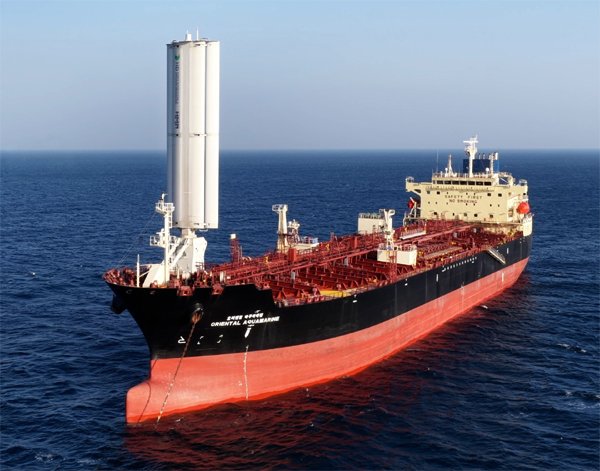
HD KOSE installed its first domestically developed wing sail on HMM's product tanker for demonstration and testing (HD KSOE)
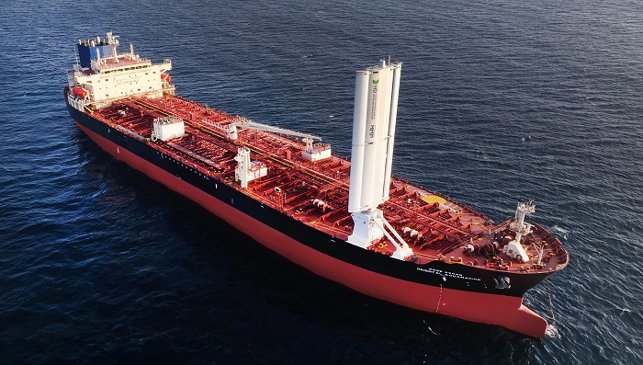
South Korea’s HD Korea Shipbuilding & Offshore Engineering and HMM are starting a demonstration and test period for Korea’s first domestically developed wing sail for wind-assisted propulsion. The shipbuilder has been developing its version of the technology as part of its efforts to advance value-added, green ship designs and technology.
The wing sail was recently installed on the product tanker Oriental Aquamarine (50,000 dwt). The vessel was built in 2020 and has been owned by HMM since 2023. Registered in Liberia, it is 183 meters (600 feet) in length.
Over the next two years, HMM reports it plans to assess the performance of wing sail based on actual operational data and, subject to the results, expand its installation across its entire bulk fleet. The company highlights that the technology is particularly suited to vessels that do not carry deck cargo, such as bulk carriers and tankers. It projects a fuel saving of between 5 and 20 percent with the deployment of wind-assisted technology.
HD KSOE reported in 2021 that it had been awarded an Approval in Principle from DNV as it worked to develop its wind-assisted technology concept for a wing sail. It reports that the design has undergone structural safety and basic performance verification through onshore demonstrations.
HMM plans to analyze the data as it looks to expand the technology across its fleet (HMM)
The version installed on the MR tanker is 30 meters (98 feet) high and 10 meters (33 feet) wide. In addition to the main sail, it uses auxiliary wings on both sides to enhance utilization efficiency. It also features a tilting function, which allows the wings to be folded during inclement weather or to increase air draft.
The shipbuilder reports that recent sea trials have confirmed normal operation. It has also undergone inspection by the Korean Register. They report that the data from this demonstration will be precisely analyzed to understand the operating characteristics of the wing sail in a real-world marine environment. They expect to use this data to develop commercial models of the technology.
Analysts expect wind-assisted propulsion to continue to grow in application as it requires relatively low capital expense and adds incremental fuel and emissions savings. They report that installations are doubling annually, nearing 100 large vessels equipped by year-end.
Lockheed Martin and Saildrone: Accelerating Maritime Readiness at Scale
With a $50 million investment in Saildrone, Lockheed Martin is forging a strategic collaboration to rapidly scale unmanned maritime defense capability.
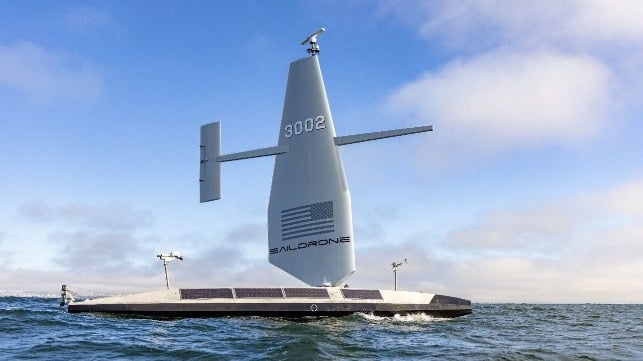
Together, the companies will pair Saildrone’s proven unmanned surface vessel (USV) platforms with Lockheed Martin’s combat-tested defense tech and mission integration expertise —delivering powerful, defense-ready USVs to the fleet faster.
Anticipating Needs. Accelerating Capability Saildrone’s USVs are built for endurance and autonomy. Their long-established track record includes more than a decade operating in remote, open-ocean environments, with millions of nautical miles logged. First deployed by the U.S. Navy in 2021, they are currently operational today, working around the clock, 365-days alongside American Sailors in combat theaters across the globe.
Recently, after months-long use of Saildrone’s USVs, more than 130,000 nautical miles over 2,700 cumulative mission days were logged with 116,000 unique contacts detected.
Starting with the JAGM Quad Launcher on Saildrone’s Surveyor platform, Lockheed Martin is integrating its defense payloads to transform commercial-grade autonomy into a multi-mission maritime solution capable of fleet defense, undersea surveillance, reconnaissance and strike.
Speed, Scale and Readiness The partnership is designed to accelerate the Navy’s unmanned vision at scale. The teams will begin work immediately, integrating the JAGM Quad Launcher onto the Saildrone Surveyor and expanding to additional Lockheed Martin payloads across multiple platforms.
Lockheed Martin’s investment helps mitigate risk on the path to Distributed Maritime Operations and supports the Navy’s drive for affordable mass by 2027. The open-architecture approach and secure command-and-control framework ensure rapid, reliable integration while preserving security and interoperability.
By anticipating needs before they become requirements, this forward-looking approach reinforces Lockheed Martin’s commitment to turning innovation into decisive advantage for the United States and its allies.
What’s Next Lockheed Martin and Saildrone plan to deliver proof-of-concept integrations and live fire demonstrations in 2026. Larger Saildrone vehicles are already in development to support significantly larger payloads and capabilities to include Lockheed Martin’s Mk70 VLS launcher and thin line towed arrays.
The strategic relationship brings together the best of commercial and defense technologies to deliver unparalleled naval solutions at speed and scale.
The products and services herein described in this press release are not endorsed by The Maritime Executive.
Dalian Shipbuilding's Wind-Assisted LNG Carrier Secures Bureau Veritas AiP
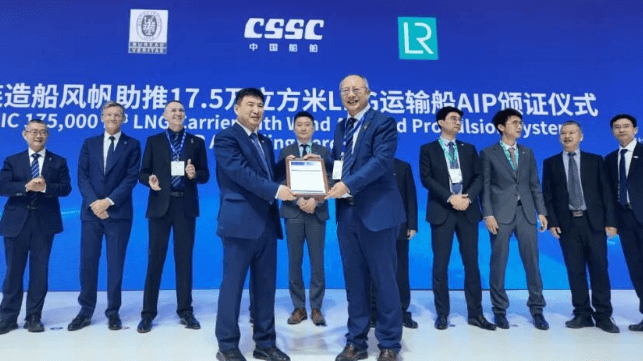
Dalian Shipbuilding Industry Co., Ltd. (DSIC) has unveiled a new generation of decarbonization-focused vessel designs, including a wind-assisted 175,000 m³ LNG carrier that has received Approval in Principle (AiP) from Bureau Veritas Marine & Offshore (BV). The endorsement confirms the technical feasibility and regulatory readiness of integrating wind-assisted propulsion into mainstream LNG carrier operations.
Developed by DSIC, the wind-assisted LNG carrier introduces an integrated solution combining LNG dual-fuel propulsion with sail-assisted technology, offering a practical and cost-controlled upgrade pathway for the global fleet of 175,000 m³ LNG carriers. The concept is designed to deliver improved energy efficiency while maintaining operational reliability and ease of maintenance.
The vessel is equipped with three next-generation foldable wing sails based on proprietary technology. Manufactured using lightweight composite materials, the sails feature independent folding and rotation functions. An intelligent monitoring and control system continuously collects route-specific wind data and automatically adjusts sail angles in real time, ensuring optimal performance across different operating conditions.
On typical trading routes, the design is expected to achieve more than a 5% reduction in overall energy consumption and cut annual CO? emissions by approximately 2,900 tons. The resulting Energy Efficiency Design Index (EEDI) is projected to be around 58% below the baseline, supporting compliance with the IMO’s greenhouse gas reduction strategy while enhancing long-term asset value and competitiveness for shipowners.
As part of the AiP process, BV carried out targeted assessments covering structural strength, material durability, and operational safety to confirm the design’s suitability for demanding ocean-going LNG transport. The review also verified the technical feasibility of the vessel’s energy-efficiency objectives against the latest IMO standards.
The AiP marks another step in the long-standing cooperation between BV and DSIC in advancing low-carbon ship innovation. Building on previous collaboration in LNG carriers and alternative-energy vessels, both parties continue to support the transition of green ship concepts from design to commercial application, contributing to the sustainable development of LNG shipping.
The products and services herein described in this press release are not endorsed by The Maritime Executive.
BAN DEEP SEA MINING
Japan Launches Trial Voyage to Recover Rare Earths From the Seabed
When it comes to subsea mining, polymetallic nodules get most of the public interest and investor focus, but they're not the only resource base in the deep. Japan's Agency for Marine-Earth Science and Technology (JAMSTEC) has just launched a trial expedition to recover mud from the seabed in Japan's far-flung Pacific territory, hoping to extract rare earth elements from the sediment on the bottom.
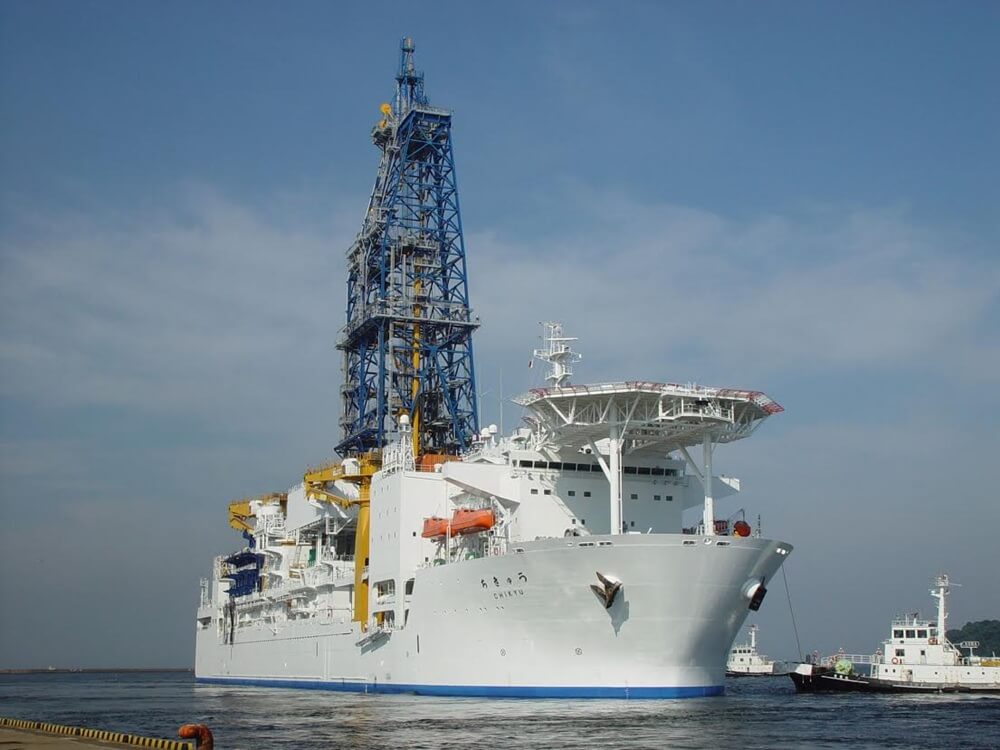
The Japanese research drillship Chikyu got under way from Shizuoka on Monday, bound for Minamitori Island. Near the remote atoll lies a rich deposit of rare earth elements, potentially measured in the millions of tonnes. If recoverable in commercial quantities, and if domestically refined, the deposit could satisfy Japan's needs for many of the high-tech manufacturing ingredients it currently has to import from China. In an era of rising competition in East Asia, this would be a strategic resource, giving Japan more independence of action.
"The goal is to secure a domestic supply to enhance national security, rather than to enable private companies to profit from selling rare earths," Japanese Cabinet Office official Shoichii Ishii told Reuters last year.
Japanese researchers discovered the trove of concentrated rare earth ore deposits in clay sediment in 2013. The sediments contain commercially-valuable yttrium, europium, terbium and dysprosium in vast quantity. Importantly, the mud is low in radioactive compounds, so extracting and processing it from the sediment would be less environmentally harmful. The sheer volume of material-handling required is daunting: for every tonne of mud extracted, just four pounds of the target minerals will be recovered.
The journey from discovery to production has taken so long in part because the technology to perform the resource recovery did not previously exist. JAMSTEC had to invent systems for ultradeepwater drilling - deeper than rated operating depths for a 7th-generation drillship. The pipe for the drillstring is also fully customized to deal with the abrasive, viscous mud.
Development of deep sea mining resources could come at a cost, researchers and environmentalists warn. Extracting material from the seabed surface means damaging or removing seabed habitat, and the excess sediment that is returned to the water could potentially harm marine life, depending on volume and location of placement. In the case of Chikyu, the mud will be extracted by a cylindrical device on the end of the drillstring and pumped up to the ship for processing. The layer containing rare earths is thin, according to Japan Times, so the ship will have to change position often to pick up more material.
If the trial run with Chikyu proves successful, JAMSTEC wants to move to full-rate production at the site in early 2027.
Report: India Wants to Ramp Up its Warship Exports
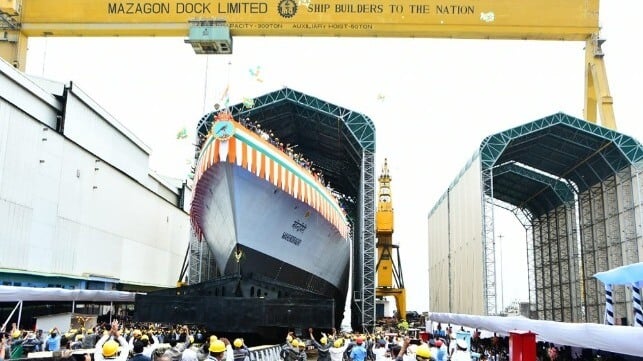
A new P-17A class frigate, Mahendragiri, at launch at Mazagon Dock (Gov't of India)
India is reportedly working to expand warship exports as part of the ongoing push to revamp its shipbuilding industry. The Ministry of Defense (MOD) has already issued directives to the state-owned shipyards, instructing the facilities to build their capacities for export orders. According to a report by the defense news site Indian Defense Research Wing, the MOD’s directive covers expansion of docking and manufacturing infrastructure in the shipyards. In addition, the shipyards are expected to customize their blueprints for naval platforms in readiness for export orders.
The targeted public sector shipbuilders include Mazagon Dock, Garden Reach (GRSE), Goa Shipyard and Hindustan Shipyard. At a time India is investing heavily to transform its shipbuilding sector, it sees an opportunity in fulfilling the massive demand for warship exports. India has already mapped this opportunity under its "Security and Growth for All in the Region" (SAGAR) vision, which seeks to assert its role as a net security provider in the Indian Ocean Region (IOR).
Under SAGAR, India has been expanding maritime cooperation with countries such as Sri Lanka, Maldives, Seychelles and Mauritius. In these markets, India has tested its capability to export smaller naval platforms. In 2014 for instance, GRSE delivered its first corvette class warship to Mauritius. Since 2015 onwards, India has also delivered fast attack craft to Seychelles and Sri Lanka. However, these exports have remained limited, with little revenue share to the Indian shipyards.
In addition, emerging regional naval powers in Southeast Asia - including the Philippines, Indonesia and Vietnam - are looking to expand their warship fleets. According to estimates, these countries require 20-30 frigates over the next decade, especially as they all try to counter Chinese expansion in the South China Sea. India has started to make inroads to these markets as well.
Back in 2023, India made a first-of-its-kind corvette donation to Vietnam, ramping up its defense ties in the South East Asia region. Moving forward, India wants to shift its focus in the region in supplying big-ticket naval platforms such as frigates and destroyers. India hopes to leverage on cost-competitiveness of its platforms, undercutting traditional defense suppliers such as Europe, where cost could exceed $800 million per warship.
But to sustain the competition, India has to achieve economies of scale in shipbuilding. While expansion of shipyards solves part of the problem, a lot of emphasis has to be on clearing inefficiencies in construction. Currently, India takes 5-7 years to deliver a warship compared to China’s 3-4 years. In this regard, MOD’s directive has mandated the public sector shipyards to adopt integrated ship construction systems. Partly, this will see simultaneous prefabrication of hull blocks, superstructures and internal systems before assembly.
China Begins Enforcing its Ban on Shipboard Starlink
A Starlink satellite launch (SpaceX handout image)
China does not allow the use of Starlink internet connectivity in its waters, and prefers to route all traffic through networks that are subject to its own licensing process. The restriction is unpopular with seafarers, who like Starlink's high speeds and low latency for video calls and general-purpose browsing - but Chinese authorities are beginning to enforce their rules more rigorously. P&I correspondent Oasis reports that the first known Chinese investigation related to shipboard Starlink usage was launched in December, indicating that vessel operators need to start ensuring compliance in order to avoid difficulties.
China's Maritime Traffic Safety Law requires all vessels in Chinese jurisdiction to route their digital communications through authorized coast stations or satellite gateway stations, licensed and approved by the authorities. Satcom service providers need legal approval to operate in China, and using unapproved vendors for internet connectivity is a breach of Chinese law. Starlink - intimately connected with the U.S. defense establishment and with American-backed military operations in Ukraine - is not on China's list of approved operators.
The possible fine for noncompliance is as high as 100,000 yuan ($14,000) for serious cases, accompanied by a license suspension of up to three months. A separate set of radio regulations provides for another fine of up to 50,000 yuan, and up to 500,000 yuan ($72,000) if the radio equipment is used for illegal activities.
China has recently increased its enforcement effort to crack down on Starlink usage, Oasis says, and the maritime safety administration for the port of Ningbo began the first known Chinese inquiry into a vessel's connectivity last month.
To avoid problems, Oasis recommends taking proactive steps to demonstrate that Starlink is not in use. The terminal should be turned off and visibly disconnected from the ship's network before entering China's EEZ, 200 nautical miles out. Even though Chinese legal jurisdiction for surface vessels only extends to 12 miles from shore, the overcompliance is advisable, Oasis said. The time and location of shutdown should be noted in the deck log.
To make sure the terminal stays shut down, the crew should be trained on the rules, and the equipment should be labeled with reminders that it cannot be used within reach of Chinese regulators.
Other options for connectivity exist within China, and the Starlink ban is one reason why many operators opt for hybrid networks. These multilayer solutions incorporate LEO services like Starlink or OneWeb, backed up with a GEO service like FleetXPress or Intelsat. Many incorporate terrestrial connectivity via LTE or wifi for in-port service, ideal for near-coastal operations in China.
Egyptian Authorities Rescue Crew After Master Grounds Damaged Ship
Egypt recued the crew of a damaged cargo ship after the master grounded the vessel (SCA)
Egyptian authorities are reporting that they were able to rescue a dozen crewmembers from a small cargo ship that was in danger of sinking in the anchorage near Port Said. The rescue was the successful conclusion after a series of calamities.
The Turkish-owned cargo ship Fener (4,500 dwt) had come from Turkey to load a cargo of salt at Port Said. Built in 1982, the ship is 138 meters (453 feet) in length and registered in St. Kitts and Nevis.
The Suez Canal Authority reports the ship was leaving Egypt early on Tuesday, January 13, but shortly after departing, the captain requested permission to anchor due to bad weather in the area. The intent was to wait out the weather before proceeding.
The Fener next notified the Suez Canal Authority’s maritime salvage unit that it had a breach in one of its holds. The ship said it was taking on water and requested assistance. As a precaution, the captain, however, decided to move the ship south of the anchorage and ground it to prevent it from sinking.
At 2330 local time last night, the ship again requested assistance, issuing a distress call. The Fener had taken on a 10-degree list to starboard, and the master said they feared the ship was “coming close to sinking.”
The Suez Canal Authority dispatched two tugboats and three speedboats. They rescued the 12 crewmembers from the ship and brought them to the port for medical attention. One crewmember was reported to be suffering from a dislocated shoulder.
In relaying the details of the rescue, the Suez Canal Authority emphasized that the incident did not impede the operations of the canal. The Fener was reported to be 5 miles west of the northern entrance of the Suez Canal. The Authority said 35 vessels made the transit on Tuesday without incident, representing 1.6 million tons.
The Suez Canal Authority reports it has been using the time during the recent lull in volume to enhance its maritime and safety operations. It recently highlighted efforts to build new tugs that are being used to support operations at the ports and in the canal. They note the SCA has experience and established teams to respond to salvage, navigational safety, and pollution control incidents.