Friday, January 16, 2026

The Absurdity and Barbarity of the “Immigration Debate”: Breaking Free of the “Colonial Framework”

 January 16, 2026

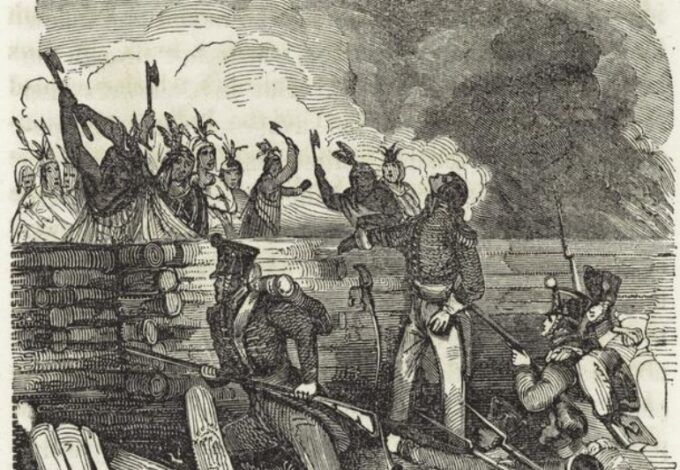
U.S. troops storm the breastworks at Horseshoe Bend – Public Domain

Andrew Jackson led armed forces into what is now Alabama on a homicidal mission against Creek Indians. Refusing to discriminate between the armed and helpless; men and women; adults and children, his agents of genocide murdered eight hundred Indigenous people. It was such a “successful” attack that Jackson feared his military superiors would not trust the veracity of his account. Given the mores and incentives of prevailing US culture ,they would assume that he was exaggerating in order to receive promotion, accolades, and other professional benefits. To gather evidence, he had his men slice off the noses of each fatality, and place them in handmade wicker baskets that, in an act of grave robbery, they stole from the villages of the murdered Natives. Jackson would later receive the award of becoming president. The US celebrates and honors his legacy with the placement of his face on the twenty dollar bill; currency functioning, without intention, as a nifty metaphor for the dark side of American “progress” and affluence. A portrait of Jackson’s face also adorns a wall in the Oval Office, where Donald Trump, while claiming to advance the legacy of his “populist” predecessor, decides what cities to strike with his secret police force, what immigrants to accost, abuse, and assign to overseas torture chambers, and what excuses to offer, no matter how flimsy, for the cold blooded execution of American citizens in the middle of residential streets.

Jackson’s war crimes amount to a straw of hay in a haystack. Through a series of official massacres, the awarding of lucrative bounties for private killers responsible for the deaths of Indigenous people, and forced removal programs, most infamously the “Trail of Tears” on which 16,000 Natives died due to starvation, freezing conditions, and preventable diseases, the US, a nation no small amount of patriotic politicians and academics tell us was founded on the ideals of freedom and equality, eliminated 96 percent of the Native population, while confiscating 98 percent of their ancestral lands. These lands included most of the minerals and resources, from fertile ground for agriculture to timber, and eventually, natural gas and oil, that allowed the US to become the wealthiest nation since the fall of the Roman Empire. Of crucial significance is the Indigenous land that settlers would transform into cotton plantations, making viable the entire system of chattel slavery for Africans.

Like a pack of wolves tearing into the flesh of mutilated deer, the US appetite for expansion was ravenous; its thirst for the spoils of bloody conquest unquenchable. From 1846 to 1848, the US fought a war with Mexico, declaring that it had a God-given right to their land. Not bothering to obtain notarization from the office of real estate in Heaven, American forces invaded Mexico, treating the people who had already lived there as brush to clear on a ranch. The result of the “Manifest Destiny” policy of invasion was Mexico’s cessation of what the world now calls Texas, Nevada, Utah, Arizona, New Mexico, and the southern part of California. Novelist Carlos Fuentes referred to the borderline between Mexico and the US as a “scar.” Immigration activists have often said, “We didn’t cross the border. The border crossed us.”

There is a word that applies to the US slaughter of the indigenous population, the expropriation of natural resources, and the violent theft of land from its neighbor to the south: colonialism. This is also the word missing from the immigration “debate” in current US discourse. Its absence renders said debate as absurd, degrading it from an opportunity for clarity, edification, and leadership into insipid chatter for officials and pundits who take for granted that the white figures of authority who inherited the benefits and advantages of the colonial system have the right to impose their will on any given situation, no matter the human costs or social consequences.

The willful failure to acknowledge the legacy and influence of colonialism creates a culture that functions according to the colonial mindset. One of the main features of this mentality is suspicion, if not outright contempt, for the population caught in the crosshairs. They are the problem, not the men or the system aiming the weapon.

And so we arrive at the hideous point of escalation when an agency founded as recently as 2003 under the name, Immigration and Customs Enforcement, has murdered an American citizen in broad daylight. Renee Nicole Good, a 37-year-old mother of three, attempted to steer her vehicle away from an ICE checkpoint, not unlike the stations of armed interrogation in occupied cities of war, when a masked ICE officer fired three bullets directly into her vehicle. If the Trump administration did not order ICE to patrol, raid, and terrorize Minneapolis, the city where the shooting occurred, Renee Good would be alive. Blaming individuals, no matter how psychopathic, misses the point, but in case anyone was prepared to resort to the “bad apple” theory, the vice president of the United States, JD Vance put that notion to rest. Standing at a podium in the White House, like a vampire whose eyeliner protects him from the sun, he said, “The precedent here is very simple. You have a federal law enforcement official engaging in federal law enforcement action. That’s a federal issue. That guy is protected by absolute immunity.”

Acting and retired prosecutors, as well as legal scholars, have rejected Vance’s “absolute immunity claim.” Legalities aside, Vance’s heartless assertion is politically useful, as it concedes governmental responsibility for Good’s death. Her murder wasn’t merely the act of a rogue agent, but the predictable consequence and logical endpoint of official US policy. Vance requested prayers for the killer, but not the victim’s family. The victim, like the millions of Indigenous people before her, the Mexican fatalities of the Mexican-American war, and immigrants who ICE separates from their families, assaults, and intimidates, are not human beings. They are colonial subjects, whose removal, as in the Indian Removal Act that led to the “Trail of Tears,” and exclusion, as in the Chinese Exclusion Act of 1882, which codified oppressive measures against Chinese immigrants, is essential to the maintenance of colonial society.

Renee Good was white, but her shared identity with the dominant culture did not provide her with any protection. Like the white allies who police beat nearly to death at Selma, she had crossed over to the other side, becoming a traitor to her race and class. After receiving training as an ICE observer through her aptly named church, St. Joan of Arc, she pledged solidarity with immigrants, vowing to use the agency of her citizenship to monitor, and to the extent that it was possible, mitigate the destructive immigration policies of US power. One protestor in Minneapolis asked on television, “If they killed a white woman in front of witnesses, how are they treating Black and brown people behind closed doors?”

She could find the answer to her question in Louisiana, where thousands of former detainees of ICE detention centers have spoken to journalists, the ACLU, and the Robert F. Kennedy Human Rights Center about widespread physical abuse, sexual harassment and assault, medical neglect, and arbitrary and retaliatory solitary confinement. Inhumane conditions include cockroach-infested food, filthy drinking water, lack of feminine hygiene products, and the use of painful shackles.

ICE sadists target women for the worst forms of violence and humiliation, advancing the colonial tradition of reserving particularly intense hatred for those who bear and most often nurture children, and therefore, protect and promote the future of their people. Beginning in the 1920s and extending through the 1970s (not exactly ancient history), federal and state programs across the US sterilized Black, Latina, and Indigenous women, either through force or without their consent during other surgical procedures. As many as 150,000 women, according to documentation obtained through a federal lawsuit, were victims of genocidal eugenics. Outside the continental United States, American officials enhanced its imperial relationship with Puerto Rico by sterilizing nearly one third of Puerto Rican women between the ages of 20 and 49. The program persisted into the 1960s. Depriving despised women of the ability to conceive children became so common that Fannie Lou Hamer, herself a victim of involuntary sterilization, referred to it as “the Mississippi appendectomy.”

The first words that the ICE agent who killed Renee Nicole Good spoke after observing her vehicle crash into a telephone pole were, “fucking bitch.” The derogation is an echo from the killing fields of Indigenous land, the Trail of Tears, and the operating rooms where thousands of women, under anesthesia and unable to speak, suffered the theft of their potential for motherhood.

The mainstream media’s indifference to the Louisiana story, along with the general public’s relative silence in the face of daily ICE actions against Latino immigrants, provokes the painful, but necessary inquiry into the morality and priorities of the American people. Vance’s admission of federal responsibility for Renee Good’s murder reflects back onto the citizenry. Despite the Trump regime’s best efforts, the US is still a democracy. As a result, the people, or “demos,” are culpable in Good’s murder, ICE’s systemic abuse of detainees, and the ongoing violation of human rights from border to border.

Camilo Pérez-Bustillo, a law professor and member of the leadership team at Witness at the Border, an immigrant advocacy and ICE-tracking organization, has dedicated his life to the cultivation of solidarity, anti-racist organization, and the elevation of consciousness within a dormant democracy. When I spoke to Pérez-Bustillo, he said, “Colonialism and imperialism provide a useful framework for connecting what is happening in Minneapolis, other cities, Venezuela, and at the border. It is not only theoretical or rhetorical. It is also concrete and material.”

“The poison of rhetoric from the White House,” as Pérez-Bustillo calls it, is intended to “not only dehumanize Renee Nicole Good, but also demonize and criminalize what she represents.” Through his work and connections with Witness at the Border, Pérez-Bustillo was able to confirm that Good received training as a “legal ICE observer.” To disparage such civil and lawful activism as “domestic terrorism,” as Vance has done repeatedly, is to spotlight that Good enrolled into the resistance against, to use Pérez-Bustillo’s words, “the colonial occupation of American cities.”

“To understand the deployment of ICE as an occupational force in our communities is the same way that the Black Panthers understood white police in Black neighborhoods,” Pérez-Bustillo said. He then referred to the civil rights movement more broadly, quoting Dr. Martin Luther King’s Riverside Church address against the Vietnam War: “The bombs that fall in Vietnam explode at home.”

In a rhythmic reprise of the late 1960s, the Trump regime’s imperial incursion into Venezuela, murder of 40 Venezuelans in their capture of Nicolás Maduro, and promise to expropriate the country’s oil forms of a figure eight knot with the domestic war against immigrants of color. The white nationalist obsession with countering an increasingly multicultural American demography, in which whites have become a minority in many cities and several states, harmonizes with the Trump administration aim to establish hemispheric dominance through the installation of right-wing governments in South America. The “Donroe Doctrine,” as Trump calls it to remind everyone that the malevolence of modern fascism is on par with its stupidity, is a more aggressive and brazen iteration of Ronald Reagan’s murderous interventions in Latin America, Bush the elder’s capture of Noriega in Nicaragua, and W. Bush’s attempted coup in Venezuela.

If Donald Trump is fentanyl to the body politic, there were plenty of gateway drugs. Perhaps there is no issue on which the inducement of psychosis that functions as US politics is more destructive than immigration. Through a series of military aggressions, typically producing high death counts, ruination of local economic orders, and termination of homegrown political movements, the US created the very conditions that birthed the so-called “migrant crisis” of mass immigration across the southern border. To maintain economic domination and political influence in the region, the US toppled governments in Guatemala, Chile, Nicaragua, and Ecuador. With subterfuge and subversion, often using tactics of violence, the US has also “intervened” in the affairs of El Salvador, Panama, and the Dominican Republic, while the CIA, with Operation CHAOS, undermined several political independence movements in Puerto Rico.

Add exploitative “trade deals,” and it becomes clear that many of the Latino immigrants to the US are merely following their wealth in search of the freedom that colonial forces on the ground in their own countries had obliterated. When they arrive, they can find employment with a multinational corporation, performing backbreaking and unsanitary labor for miserly wages, then contend with a political movement that targets them for hate crimes and harassment.

To underline the racist intent of the Trump regime, and to trace a clear connection between the colonial founding of the US and present-day policy, ICE recently detained five Native Americans in Minneapolis. Agents also tried to gain entry to Little Earth, an urban Native housing project. This is the equivalent of a cat burglar calling the police to arrest the residents of the house he plans to rob.

Camilo Pérez-Bustillo makes it clear that it is only an escape from the “colonial framework” that will emancipate the US from its cycle of violence, and generate a genuine transformation in political policy and morality. The inability to break free of the ideological restrains of the colonial mentality explains why, according to Pérez-Bustillo, nearly everyone across the mainstream political spectrum “concedes that undocumented immigrants, or at least many of them, constitute a threat to the United States, and concedes the necessity of militarization of the border.”

“A decolonial framework can liberate us from the limits of our discourse,” Pérez-Bustillo said. As ICE spreads terror in American cities, with tactics that now include homicide, it is helpful to remember that “Abolish ICE” was one a popular slogan and movement on the left. All Republicans and most Democrats treated the position as it was a manifesto for the demolition of indoor plumbing.

Natascha Elena Uhlmann, an immigrant rights activist and journalist, wrote a book in 2019 with the slogan as her title. She begins with following sentences: “Perhaps the greatest value of history is that it reveals to us how contingent so much of the world really is. Institutions that seem unyielding and hierarchies that seem immutable reveal themselves to be the products of chance and ideology.” The colonial ideology rests on the foundation of the racist assumption that, as Uhlmann argues, immigration is “an affront to an imagined racial/national identity.” Her warning that “we cannot allow a nation so steeped in violence set the terms of the [immigration] debate” now reads like a meteorological forecast of a category five hurricane that no one in the eye of the storm bothered to consider.

Another consistent voice against the whirlwind, pleading for solidarity and sanity is the National Book Award winning poet and Puerto Rican activist, Martín Espada. I spoke to him about immigration and colonialism, and he said, “The true borders for Latinos in this country have always been the borders of racism.” He later explained that there is “so little solidarity with Latinos,” especially of the heroic quality that Renee Nicole Good demonstrated, because “Latinos do not have a place at the table. Latinos constitute approximately twenty percent of the population, yet there is a serious underrepresentation in electoral politics, media, education, and the arts.”

Too often missing from the discourse is the clarity and profundity that Espada offers with his poem, “The Iguanas Skitter Through the Cemetery by the Sea.”

Set in Viejo San Juan, Puerto Rico, Espada’s poem presents iguanas in different form in each stanza, beginning with their invasion of sovereignty and history. “The iguanas slither from the branches of trees splintered by the hurricanes,” Espada writes in the opening line, later locating the reptilian predators elsewhere, “The iguanas multiply through the night of blackouts in hospitals and morgues. / The iguanas burrow beneath roads to bury their eggs in the lungs of cities. / The iguanas slap their clawed feet as they churn the earth of the farmer’s field.”

The iguanas are omnipresent, gathering strength in numbers and power in their ubiquity. As they slither, crawl, and claw their way into every corner of Puerto Rico, they soon claim the island as their own. But they know nothing of the history and culture that they violate. “…The iguanas stare stupefied at the bust / of a mustachioed poet who died after the bacteria feasted on his heart,” Espada tells his audience before elaborating on their state of ignorance: “The iguanas know nothing of Albizu: The lawyer and the cane cutters’ strike, the crowd listening in the rain, cane stalks in their heads igniting like torches.”

Their small minds and obliviousness cannot slow down their march. Signs of their influence are soon everywhere. “The green of the iguanas in the cemetery is the green of soldiers in uniform. / The green of the iguanas in the cemetery is the green of felt at the casinos. / The green of the iguanas in the cemetery is the green of cash on cruise ships.”

The poem continues until Espada puts the lizards through another metamorphosis, reminding readers that filmmakers during the Cold War used iguanas to depict dinosaurs. Espada ends with a reminder that even the most ferocious and monstrous beasts eventually find their doom:

“The dead eyes of the iguanas, keeping vigil over the city of the dead, will never / see the asteroid of their extinction, the earth melting to suck their bones into / whirlpools of mud, the wave sweeping them to sea, the flight of the poet’s kingbird.”

As millions of people struggle for freedom and self-determination, they await an extinction event for colonialism. The murder of Renee Nicole Good, like the deaths of immigrants whose names the powerful never even utter, becomes yet another tragic means of marking the time until there is transformation of our political ecology. It is a transformation that depends upon the propulsion of mourning; the alchemy of pain into action.

This essay also ran on the author’s Substack, Absurdia Now

David Masciotra is the author of six books, including Exurbia Now: The Battleground of American Democracy and I Am Somebody: Why Jesse Jackson Matters. He has written for the Progressive, New Republic, Liberties, and many other publications about politics, literature, and music. His Substack is Absurdia Now.

Far right and academic freedom
Academic freedom under attack


Thursday 15 January 2026, by Liz Lawrence


Growing attacks on academic freedom are an aspect of the rise of the far right and authoritarianism that does not always get enough attention outside the university sector.

 What are the various ways this threat plays out?

Under-funding and ongoing marketisation of universities have reduced staff time for research and scholarship; they have destroyed collegiality in academic governance and have produced a managerial layer without commitment to academic and educational values. Far-right politicians target universities as sectors of independent, critical thinking. They would prefer a sector which trains students for technocratic jobs, but does not encourage them to think.

Authoritarian regimes endeavour to clamp down on academic freedom both within their own countries and abroad.

In this context it is useful to look at some recent events in the sector, which are indicators of how academic freedom is under threat and how its defence is being addressed within the trade union movement.

Conference on academic freedom

Academic freedom refers to the right of academics to study, teach and research freely in their academic subject areas. It is more specific than freedom of speech. It is about the role of universities in contributing to the advancement of knowledge. One important component of academic freedom is that university staff should not encounter persecution or lose their jobs because of their academic work. Academic freedom is not simply a privilege of academics; it is a contributor to the creation of free and democratic societies.

On 15 October 2025 there was a conference in London and online about academic freedom. It was organised by UCU (University and College Union) and Education International. UCU is a UK trade union which recruits academic and related staff in post-16 education and has over 120,000 members. Education International is an international trade union federation which represents 33 million education workers in 180 countries and has 375 member institutions. There is a report of the conference on the Education International site.

The first speaker was Haldis Holst, Deputy General Secretary of Education International. She spoke about growing threats to academic freedom. The last World Congress of Education International in 2024 re-affirmed the importance of academic freedom. It is being undermined by erosion of tenure and job security and increasing marketisation. Some subjects in the arts and humanities especially are coming under attack; this is related to attacks by the far-right on diversity, equality and inclusion policies. Moreover, conservative religious groups and right-wing pressure groups are targeting academics.

 Unions have a vital role to play in defending academic freedom.

Dr Jo Grady, UCU General Secretary, warned of the dangers of a Reform/Tory coalition government in the UK in a few years’ time which would shut down some universities. Academic freedom must include freedom from state interference. University managements are exercising growing control over what can be taught and researched. Precarious employment undermines academic freedom. Some university staff have been investigated for organising events about Gaza and there is growing censorship over the question of Palestine.

Robert Quinn, Executive Director of Scholars at Risk Network spoke about the work of his organisation. Scholars at Risk supports persecuted academics in many countries, including in conflict zones. He argued there is a need for more training in universities about what academic freedom is and how it can be supported. In some countries there is disparagement of knowledge and truth and research. Some scholars have been harassed by foreign governments who have objected to what they have researched and published about their countries. Defenders of academic freedom need to engage with the public to clarify what academic freedom is and its benefits to society. Academic freedom must be supported by processes around tenure, funding and university governance.

There were questions about sources of threats to academic freedom, what happens when research funding is linked to institutional priorities and how to support free speech on campus, but not hate speech, which can constantly undermine some groups.

Dr Todd Wolfson, President of the American Association of University Professors, made the point that while the recent attacks on academic freedom are obvious, there are longstanding roots to the problem. He talked about how research projects have been axed. For instance, research on Alzheimer’s in the USA is being decimated. This means promises to research subjects, who participated because they thought they would help others and find a cure in future, are being broken, and this puts researchers in a difficult ethical position.

Wolfson went on to explain that in the USA there is an alliance between white Christian nationalism and a tech-oligarchy. Trump is using the military to attack his political rivals, who are defined as internal enemies, including the anti-fascist left. The Trump regime is targeting the courts, the press and higher education. Higher education is under attack as an independent force in society, not controlled by government.

These attacks come in a context where higher education has been privatised, with massive tuition fee hikes and precarious employment. In the USA universities are now under pressure to take a loyalty oath to the government. One academic, Dr Mark Bray, who researched anti-fascism had to flee abroad because of death threats. Forty academics have been among the large numbers of workers sacked for comments after the murder of right-wing US activist Charlie Kirk.

In relation to the UK, researchers from the University of Lincoln reported on research with UCU members about perceptions of academic freedom. Most thought the situation was getting worse. Increased digital monitoring of work was also experienced as negative and as a threat to academic freedom.

The presentations and discussion at the conference showed that academic freedom is under threat from reactionary governments and political movements, from marketisation of education and from deterioration in working conditions, particularly around job security and workloads.

Since the conference two cases have come to public notice: in one case the sacking of an academic for being a socialist, and in the other the temporary silencing of academic research because of the objection of the Chinese government. In both cases we see the influence of reactionary pressures outside the university and the failure of university leaderships to stand up for academic freedom.

Tom Alter victimised

The case of Dr Tom Alter is a blatant example of political victimisation of an academic for being a socialist. Tom Alter, a labour historian and a socialist, was dismissed on 13 October 2025 from his tenured post at Texas State University in the USA for political activism. He attended and spoke at a socialist conference where he was filmed by a right-wing activist, who contacted the university and demanded his dismissal, using selective and edited film evidence of what he said at the conference.

Alter attended this conference in his own time, outside working hours, and so the dismissal also constitutes an attack on the right of university staff to have any time where their activities are not potentially controlled by their employer.

The case is important in several ways. By sacking someone just for speaking at a socialist conference Texas State University is saying that people who hold left-of-centre views have no right to teach and research at a university. The decision also attacks the right of university staff to engage in any political activities as citizens unless their political views coincide with the view of the current US government.

This case shows the spinelessness of university leaders when faced with complaints from far-right agitators from outside the university. it shows their complete disregard for academic freedom and for the rights of university staff as citizens.

There is a strong labour movement campaign for Tom Alter’s reinstatement, supported by the Texas State Employees Union and the American Association of University Professors and various learned societies. There has been a petition and formation of a defence committee. All trade unionists should defend Tom Alter.

Research silenced

Sheffield Hallam University is a post-92 university in the UK. It was seen as one of the more successful former polytechnics, which were granted university status in 1992. Recent events have damaged the university’s reputation.

Since 2012 many universities in the UK are dependent for funding principally on tuition fees paid by students, following the removal of government funding for tuition. This has particularly hit teaching-focused universities, which have less research income than research-intensive universities.

Overseas students, since they pay significantly higher rates of tuition fees, are particularly valued by university managements as customers. UK tuition fees for home-based students are currently capped at £9, 535 per year, but international students pay significantly more per year, on a range between £11,000 and £38,000 for undergraduate degrees and £9,000 to £30,000 for postgraduate degrees.

Within the UK higher education sector, there have been significant job losses, including over 15,000 job losses in 2025, and industrial action by unions to defend jobs and educational provision. Sheffield Hallam University has shed around 1000 academic and administrative jobs in the last two years. At the Trade Union Congress – the annual conference of UK trade unions affiliated to the single federation here – in September 2025 the UCU President, Dr Maria Chondrogianni, spoke about a ‘jobs massacre’ in the sector.

While the post-92 university sector is less well-funded to support research some research does take place there. At Sheffield Hallam University Professor Laura Murphy was researching supply chains and exploitation and ill-treatment of the Uyghurs in China. Forced labour is a major problem in the world today and an entirely valid subject for academic research. Anti-Slavery International estimates that around 50 million people in the world today are trapped in various forms of forced labour.

In February 2025 Professor Murphy was forced to halt her research for eight months after the university came under pressure from the Chinese government, which objected to this research and threatened to halt recruitment of Chinese students by the university. The research has now resumed, but questions are being asked about the university’s complicity in silencing research because a government objected. Again, this is a case where a university leadership failed to stand up for academic freedom.
Struggles

Universities and university staff trade unions are involved in the struggles against the far-right and against authoritarianism and fascism in a number of ways: defending free speech on Palestine on university campuses; standing up for academic freedom and science; defending the right to research and teach in areas such as the climate emergency, diversity and equality, the politics of the Middle East, the crimes of the powerful, and human rights.

In fascist and other authoritarian regimes academic freedom is removed. Research and teaching are warped to suit government interests. Sometimes authoritarian politicians simply have no time for Philosophy and Sociology and other subjects which encourage students to think critically. Sometimes the far-right agenda is to reduce the overall student population and restrict education for the masses to a narrow technical set of skills related directly to employment. At other times far-right politicians take an active interest in how subjects such as Archaeology and History are taught, using them to create and spread national origin myths. The absence of independent trade unions and lack of free speech under such regimes provides the context in which academic freedom can be removed and universities turned into narrow propaganda and training outfits.

What has happened in the cases of Dr Tom Alter and Professor Laura Muphy indicates the need for strong unions in the university sector and vigorous campaigns to defend academic freedom.

29 December 2025

Source: Anti*capitalist Resistance.

Attached documentsacademic-freedom-under-attack_a9364.pdf (PDF - 984.4 KiB)
Extraction PDF [->article9364]


Liz Lawrence is a member of A*CR in Britain, a past President of the University and College Union and active in UCU Left. She is one of the organisers of UCU members for Ukraine.
War Powers Resolution: The U.S. Senate Had One Job

by Thomas Knapp | Jan 16, 2026 | 
 Antiwar.com.


On January 14, a “war powers resolution” went down to defeat in the US Senate on a 50-50 vote, with vice president JD Vance breaking the tie.

The resolution, which would have required US president Donald Trump to at least casually mention to Congress that he planned more military misadventures in Venezuela before, rather than after, launching such misadventures, was a half-hearted half-measure, but somehow only half of US Senators could bring themselves to go even that far.

Let’s go over the way things are supposed to work:

The US Constitution assigns the power to declare war to Congress, not to the president.

If the president attacks another country without such a declaration, it’s not a war, it’s just a crime — a “high crime” legally meriting and ethically requiring that president’s impeachment and removal from office.

Unfortunately, presidents have been getting away with such crimes on a routine basis since the end of World War 2. The list is too long to fit in an op-ed, but a few high points include Korea, Vietnam, Iraq, and Afghanistan.

Those conflicts weren’t wars, at least so far as US law was concerned. They were criminal acts carried out by lawless presidents with the acquiescence — and often co-conspiracy — of Congress.

Toward the end of the Vietnam fiasco, Congress passed (and overrode Richard Nixon’s veto of) something called the War Powers Resolution of 1973.

Nixon’s veto message claimed that the Resolution included “unconstitutional restrictions” on his power to kill as many people as he pleased, when and how it pleased him to kill those people.

What it actually included was an unconstitutional — absent ratification by 3/4 of the states’ legislatures — repeal of the Constitution’s Article I, Section 8 assignment of the power to declare war solely and exclusively to Congress.

The Resolution supposedly gave the president wiggle room to engage in illegal military operations if he got congressional “authorization” or made up a “national emergency,” and as long as he subsequently bothered to tell Congress about it.

Why would Congress (a notoriously power-hungry body) try so hard to give up its power to declare war? Because if there’s anything a politician hates more than he or she loves power, it’s being held responsible for the consequences of exercising that power. By trying to give up its power, Congress thought it could also rid itself of culpability.

The Senate had one job to do. It wasn’t an especially hard job, it wouldn’t have had any great effect (even if it passed the House, Trump would have vetoed it), and it didn’t even meet the bare minimum constitutional standard.

And yet 50 Senators, and the vice-president acting as president of the Senate, couldn’t bring themselves to get that one little tiny, insignificant job done.

One more confirmation of Lysander Spooner’s observation:

“But whether the Constitution really be one thing, or another, this much is certain — that it has either authorized such a government as we have had, or has been powerless to prevent it. In either case, it is unfit to exist.”

Thomas L. Knapp is director and senior news analyst at the William Lloyd Garrison Center for Libertarian Advocacy Journalism, publisher of Rational Review News Digest, and moderator of Antiwar.com’s commenting/discussion community.

Bulgaria’s euro entry to bring limited boost to economy, says Capital Economics

Bulgaria’s euro entry to bring limited boost to economy, says Capital Economics
A light show dedicated to Bulgaria's accession to the eurozone is projected onto the facade of the Bulgarian National Bank in Sofia, Bulgaria, on January 1, 2026. / European Central Bank
By Clare Nuttall in Glasgow January 15, 2026

Bulgaria’s entry into the eurozone this month is unlikely to transform the country’s economic trajectory, with income convergence towards Western Europe set to remain slow over the coming decade, Capital Economics said in a report published on January 14.

The country adopted the euro on January 1, becoming the 21st member of the single-currency bloc and its poorest. While living standards are expected to keep catching up with the rest of the bloc, the pace will lag behind that seen in other Central and Eastern European economies at a similar stage of development.

“We forecast per capita GDP to rise from around 40% of the euro-zone average to about 55% by 2035, leaving Bulgaria at the bottom of the euro-zone income distribution,” Capital Economics said.

Analysts argued that joining the euro would have “only a small macroeconomic impact” because Bulgaria had already effectively surrendered monetary policy under its long-standing currency board, which pegged the lev first to the Deutsche mark and later to the euro.

“Bulgaria’s long-standing currency board had already delivered most of the benefits associated with eliminating exchange-rate risk,” it said, adding that any gains from lower reserve requirements, narrower bond spreads or a stronger ECB backstop would be “marginal or have already occurred”.

Still, the near-term outlook looks relatively bright. Capital Economics expects GDP growth of around 3% in 2026-27, making Bulgaria one of the faster-growing economies in the euro zone, driven mainly by strong household spending. Inflation, which stood at 3.7% in November, is expected to ease but remain above the European Central Bank’s 2% target through 2027.

“While the fiscal deficit may remain near the upper limit of the EU fiscal rules at 3% of GDP – particularly in light of recent protests and renewed political turbulence – Bulgaria’s very low public debt suggests that the public finances will not present a major risk to macroeconomic stability for the next few years,” the report said.

Over the longer term, however, Bulgaria’s prospects will be shaped by a shrinking and ageing population and only moderate productivity gains. The working-age population is projected to fall by about 7% by 2035, one of the steepest declines in the European Union.

Productivity growth is expected to average just over 3% a year, faster than the euro-zone average but weaker than in some regional peers. “This would be higher than our forecasts for Czechia and Hungary but lower than Poland,” the report said.

Capital Economics noted that Bulgaria could outperform if it strengthens its IT sector, improves governance and makes better use of EU funds. 

Meanwhile, political instability and corruption remain major risks. Bulgaria has held seven elections since 2021 and is set for another in 2026, after the recent collapse of Rossen Zhelyakov’s government. 

“Downside risks include political instability, which could result in excessive fiscal deficits and weaker governance, as well as a failure to draw down the substantial EU funding available,” the report said.

Persistent corruption also weighs on investment and growth. Bulgaria ranks near the bottom of the EU in Transparency International’s corruption index, and a World Bank study cited by Capital Economics found that “bid-rigging and cartel behaviour” can inflate public procurement costs by up to 50%.


4.7 million accounts scrubbed as Australia bans social media for kids

dpa 16.01.2026

Photo: Mascha Brichta/dpa-tmn

Social media platforms have disabled, deleted or restricted more than 4.7 million accounts since Australia banned under-16s from holding their own accounts, in what the government calls an "important" step to keeping children safe online.

The law, which entered force in December, makes Australia the first country to introduce nationwide age-based restrictions of this kind and positions it as a global test case for online child protection.

The rules apply to platforms including Instagram, TikTok, Snapchat, Facebook, YouTube, X, Reddit and Twitch. Messaging and gaming services such as Roblox, WhatsApp and Facebook Messenger are exempt.

Preliminary assessments by the eSafety Commissioner show affected platforms are making "meaningful effort" to prevent minors from accessing their services, Prime Minister Anthony Albanese says.

"We want our kids to have a childhood and parents to know we have their backs," Albanese says.

"Every account deactivated could mean one extra young person with more free time to build their community and identity offline," says Communications Minister Anika Wells.

Parliament passed the legislation in late 2024 with backing from most major parties. Affected companies were given a year to introduce age verification measures, and violations will result in hefty fines of up to $49.5 million Australian ($33 million).

Legal challenge by Reddit

Reddit, a social media platform and forum-style website where content is socially curated and promoted by site members through voting, is challenging the ban in court. It says the move infringes on free political speech and poses privacy risks.

But Australia says when governments take strong action to protect citizens against highly addictive, highly damaging products, companies that profit most from them often take legal steps against them.

These world-leading social media reforms "are going to do so much to improve the social skills, the learning skills, and, importantly, the mental health of young Australians," says Health Minister Mark Butler.

Worldwide, countless parents and children alike are already wrangling with the best way to handle technology.

After all, many phone users of all ages struggle with low energy, lack of focus, a sense of aimlessness when scrolling online and overall online dread.

Plus, overuse of our phones and devices harms our bodies as we gaze at screens all day, tiring out our eyes, getting "tech neck" and disrupting our circadian rhythms, lowering our sleep quality.

Many of us may be trying to find more mindful ways of using social media, with options that include setting time limits, turning off notifications and curating our feeds more carefully.