Sunday, January 18, 2026

Trump’s Occupation of Minnesota and the Resistance

Sunday 18 January 2026, by Dan La Botz
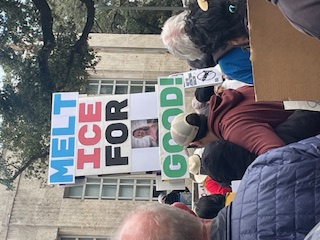


At the moment, Minneapolis is the frontline of the resistance.

President Donald Trump is at war with Governor Tim Walz of Minnesota, whom he hates as a political rival, and at war with liberal Minneapolis, the state’s largest city. Trump has now sent 3,000 agents of Immigration and Customs Enforcement (ICE) into Minneapolis, 1,000 more than there were before ICE murdered activist Renée Nicole Good. There are now more ICE agents in Minneapolis than there are police in the metropolitan area. The majority of the inhabitants see this as an occupation that is bringing fear and more violence into their city.

ICE agents, masked, wearing bulletproof vests, and carrying firearms and chemical sprays, appear at schools, hospitals, churches, and businesses, and without arrest warrants, grab brown and black people, both immigrants and U.S. citizens, put them into cars and take them away. Some are later released; some are shipped to far away cities to make it difficult for friends and families to find and help them. Because of ICE patrols, Minneapolis and other nearby districts have closed their schools for the next few weeks, offering virtual learning instead.

President Trump and Kristi Noem, head of the Department of Homeland Security, claim that ICE agents enjoy “absolute immunity.” But a federal judge, Kate M. Menendez issued a temporary injunction forbidding ice agents from retaliating against people “engaging in peaceful and unobstructive protest activity,” and from using “crowd dispersal tools” in retaliation for protected speech and from stopping and detaining people in cars unless they were forcibly blocking ICE. Judges in California, Illinois and Washington, D.C. have issued similar rulings in suits brought by immigrant rights organizations.

Both ordinary people and the city’s and state’s politicians, like Governor Tim Walz and mayor Jacob Frey consider what is happening to be an illegal, violent occupation. And there is resistance. Wherever ICE agents appear, members of activist networks blow their whistles to alert their neighbors and many come into the street to shout at the ICE agents to get out. Others have used their cars to block the streets and impede ICE. Some activists have thrown snowballs at ice agents, others have slashed ICE agents’ cars’ tires, and some have fired fireworks at the agents. The confrontations often become chaotic and highly emotional as local residents filled with fear and anger take courage to challenge the armed masked men who have come into their communities.

While on the one hand the militant resistance is admirable, on the other there is fear that it may provide Trump with the excuse to invoke the Insurrection Act which allows the president to send federal troops into any city or state. The Act can be invoked “to address an insurrection, domestic violence, unlawful combination, or conspiracy, in any state, which results in the deprivation of constitutionally secured rights, and where the state is unable, fails, or refuses to protect said rights.” The people of Minneapolis would argue that it is Trump who is creating the violence and depriving people of their rights.

Trump’s Justice Department has opened a criminal investigation into the actions of Governor Walz and Mayor Frey, accusing them of interfering with ICE. Frey told ICE to “get the fuck out of Minneapolis.”

Trump hates Walz because he was the Democratic vice-presidential candidate on the ticket that opposed him and vice-president J.D. Vance in 2024. And he hates Minneapolis where a large majority vote Democratic. And he hates brown immigrants because he’s a racist.

The people of Minneapolis are standing up to Trump and around the country people are hoping they continue their impressive bottom-up peaceful protests and that they—and we—will win.

17 January 2026


Attached documentstrump-s-occupation-of-minnesota-and-the-resistance_a9370.pdf (PDF - 1021.5 KiB)
Extraction PDF [->article9370]


Dan La Botz  was a founding member of Teamsters for a Democratic Union (TDU). He is the author of Rank-and-File Rebellion: Teamsters for a Democratic Union (1991). He is also a co-editor of New Politics and editor of Mexican Labor News and Analysis.


Ice: The new face of the United States’ deportation machine

There is a long history of displacement and deportations in the US, and Ice is the latest expression of this racist regime, writes Camilla Royle

SOCIALST WORKER
UK
Sunday 18 January 2026


People at Federal Plaza in New York City protesting against Ice and mass deportation in the second presidency of Donald Trump, September 2025 (Picture: SWinxy)

Donald Trump has waged war on Minneapolis as people resist mass deportations and protest the state murder of Renee Good.

His use of federal agents to try to sweep people off the streets of United States’ cities is an escalation of state violence against migrants.

But, as Adam Goodman’s book The Deportation Machine shows, driving out immigrants has long been part of the way the US state manages the capitalist system.

There is a popular idea that the US is a “nation of migrants”.

But there are contradictions.

While US capitalism needs migrant labour, it has always relied on anti-migrant racism to divide ­working class people.

And the first Europeans who moved to the US were not simply migrants, but settler colonialists who wiped out Indigenous people.

It is this tradition that Republican and Democrat administrations stand in when they seek to forcibly remove people from the country and shut the borders.

In the 1880s and 1890s, the ­federal government gave itself the authority to admit or exclude people through a series of acts of Congress and Supreme Court decisions.

As well as formal deportation, Goodman explains how removing people from the US has often involved both self-deportation and voluntary deportation.

But there is nothing “voluntary” about coercing people into agreeing to leave.

Goodman estimates that some 90 percent of expulsions of people throughout US history have been through voluntary deportation, largely hidden from the legal system.

In 1931, William N Doak was appointed to oversee the Bureau of Immigration—one of the precursors to today’s Ice. He set out to remove 100,000 “evaders of our alien laws”.

Agents searched “homes, churches, picket lines, public spaces, bars, dance halls and pool halls, sometimes without a warrant”.

The spectacular brutality of the raids was intended to work ­alongside the self-deportation drives by ­scaring people into leaving cities like Los Angeles on their own accord.

The deportation machine has ­targeted different groups throughout history, from Chinese labourers in the late 19th century to Minnesota’s Somali community today.

But the history of deportation in the US has largely been, according to Goodman, “the history of removing Mexicans”. They make up nine out of ten deportees.

An article in Life magazine in 1951 referred to an “invasion force” of Mexican migrants. It spread fear that the Mexican agricultural worker would never be unemployed.

This was “because he can weed a 1,000 foot furrow without once straightening up and he willingly works with the short-handled hoe”, which “tortures American spines”.

Some workers bought into the lie that migrants would undermine wages and conditions.

Biological racism was also used to define who was American and who was deportable.

Migrants were portrayed as ­economically inactive and a ­potential burden on the state.

They were seen as potential ­carriers of infectious ­diseases, as political subversives and as a sexual threat to women and girls.

This highlights a ­contradiction in the way the US controls migration.

The labour of migrant workers has been indispensable to bosses for over 100 years.

At times the state has ­tolerated unauthorised migration as a source of cheap labour, especially if migrants can be kept in a state of fear and precarity.

But in times of crisis the state can revert to cracking down on migration.

In the 1990s, Democrat Bill Clinton launched a campaign to “regain control” of the border with Mexico.

The total number of deportations reached an all-time high of over ­1.86 million in the year 2000.

Goodman explains how since then there has actually been a steady decline in the numbers of people removed.

But for the first time the number of formal removals began to overtake so-called voluntary departures.

This was backed up by ­militarised borders. A rapidly expanding ­network of privately run detention facilities has incarcerated people whose only “crime” is crossing a border and ­separated them from family, friends and legal support.

Between 1986 and 2016, the number of Border Patrol officers increased from 3,700 to over 23,000.

It has more officers licensed to carry weapons than any other branch of the federal government except the military.

Ice was established in 2003, replacing several existing agencies. While the Border Patrol polices the borders, Ice investigates and removes people from within US territory.

As author Amy Kaplan argues, this fuels the idea that the US is in ­constant danger from migrants both within and outside its borders.

Despite the dangers they face, migrants in the US have organised for decades to defend their rights.

In the 1970s, trade unions became more sympathetic to organising undocumented migrants.

Factory bosses exploited migrant workers by exposing them to dangerous working conditions, which in turn harmed all workers.

Trade unionists from the ILGWU garment workers’ union saw directly how anti-migrant raids were ­damaging their ability to organise.

At one point, a raid removed 17 of the 20 strikers on their picket line.

In 2006, there were mass marches in over 160 cities and a day without migrants on 1 May. Over one million people took action. The movement was key to preventing the Senate passing a draconian anti-migrant bill.

The movement in Minneapolis today can deepen as students walk out of schools and universities and workers from all backgrounds ­organise to resist Ice.

It is this working class power that can throw a spanner in the works of the deportation machine.


Counter-protesters in Minneapolis drown out far-right influencer


 ORNING STAR, UK

Jake Lang, center in the vest, who organized the March Against Minnesota Fraud, clashes with pro-immigration counterprotesters near Minneapolis City Hall, January 17, 2026, in Minneapolis


by Our International Desk


HUNDREDS of counter-protesters drowned out a far-right activist’s attempt to hold a small rally in support of the Trump administration’s latest immigration crackdown in Minneapolis on Saturday.

Far-right influencer Jake Lang organised an anti-Islam, anti-Somali and pro-Ice demonstration, saying on social media beforehand that he intended to “burn a Koran” on the steps of City Hall. But it was not clear if he carried out that plan.

This came as the governor’s office announced that National Guard troops were mobilised and ready to assist law enforcement though not yet deployed to city streets.

There have been protests every day since the Department of Homeland Security ramped up immigration enforcement in the Twin Cities of Minneapolis and St Paul by bringing in more than 2,000 federal officers.

Only a small number of people showed up for Mr Lang’s demonstration, while hundreds of counter-protesters converged at the site, yelling over his attempts to speak and chasing the pro-Ice group away.

They forced at least one person to take off a shirt they deemed objectionable.

Mr Lang was eventually forced to leave the scene in some discomfort. He was previously charged with assaulting an officer with a baseball bat, civil disorder and other crimes before receiving clemency as part of President Donald Trump’s sweeping act of clemency for January 6 defendants last year. He recently announced that he is running for the US Senate in Florida.

In Minneapolis, snowballs and water balloons were also thrown before an armoured police van and heavily equipped city police arrived.

“We’re out here to show Nazis and Ice and DHS and Maga you are not welcome in Minneapolis,” protester Luke Rimington said. “Stay out of our city, stay out of our state. Go home.”

The Minneapolis immigration clampdown saw Renee Good, a US citizen and mother of three, shot dead by an Ice officer, Jonathan Ross, during a January 7 confrontation


Pardoned January 6 rioter pelted with snowballs and water balloons at rally

Sarah Hooper
Published January 18, 2026 
METRO UK

One of the men Donald Trump pardoned for taking part in the January 6 insurrection sparked fury from protesters after holding a rally in support of ICE officers.

Jake Lang gathered a small group of supporters in Minneapolis, Minnesota, playing the song ‘Ice Ice Baby’ and talking about how immigrants were ‘replacing’ white people.

He advertised the rally as a ‘Crusader March’ on ‘Little Somalia’, which was labelled as racist and Islamophobic. He also vowed to burn a copy of the Quran.

Lang posted on social media before the rally: ‘America is a CHRISTIAN COUNTRY; we will not allow Somali Daycare Pirates to overtake Minneapolis.’

The scene quickly descended into chaos, as protesters marching against immigration raids in Minneapolis clashed with Lang’s group.

Emotions are running high in Minnesota after an ICE agent fatally shot US citizen Renee Good as she was sitting in her car earlier this month.
His march was called a ‘Crusader March’ (Picture: Reuters)
Snowballs rained down on the Conservative influencer (Picture: Reuters)

Lang and his group had water balloons and snowballs thrown at them by anti-immigration protesters, and quickly left the scene.

He posted on social media afterwards, claiming he had been ‘stabbed by a crazy white commie leftist rioter’. It’s unclear if his claims are true.

These protests have become common on the streets of Minneapolis since a federal agent shot Good on January 7.

Agents have pulled people from cars and homes and been confronted by angry bystanders demanding that officers pack up and leave.

Minneapolis mayor Jacob Frey described the situation as not ‘sustainable’ and has urged ICE to leave.

On Friday, Trump threatened to invoke the Insurrection Act, which would allow him to deploy troops as protests against Immigration and Customs Enforcement operations continue in Minneapolis.
Lang had water balloons and snowballs thrown at him (Picture: Reuters)
Lang led chants with his small group before others began protesting (Picture: Reuters)

Trump has repeatedly threatened to invoke the rarely used federal law to deploy the US military or federalise the National Guard for domestic law enforcement, over the objections of state governors.

‘If the corrupt politicians of Minnesota don’t obey the law and stop the professional agitators and insurrectionists from attacking the Patriots of I.C.E., who are only trying to do their job, I will institute the INSURRECTION ACT, which many Presidents have done before me, and quickly put an end to the travesty that is taking place in that once great State,’ he wrote on social media.

Minnesota attorney general Keith Ellison responded by saying he would challenge any deployment in court.

He is already suing to try to stop the surge by the Department of Homeland Security, which says it has made more than 2,000 arrests in the state since early December.
.
Europe in 2025

Saturday 17 January 2026, by Éric Toussaint


This report was initially presented at the CADTM International Council meeting held in Liège and Brussels from 13 to 16 October 2025.


The political situation in Europe is very bad.

The far right is in government in several countries: Italy, Hungary, Belgium (the Prime Minister is from the NVA), Slovakia, the Czech Republic, Finland, Croatia, not to mention Sweden (where the far right, without being part of the minority government, supports it). [1]

The far right has succeeded in becoming the leading political force in Italy (Brothers of Italy), France (RN), Hungary (Fidesz-Hungarian Civic Union), the Netherlands (Geert Wilders’ PVV Partij voor de Vrijheid) [2] and Austria (FPÖ). The Vlaams Belang (neo-fascist) in Flanders was the party that received the most votes in the European elections in June 2024, ahead of the Flemish far-right party NVA.

The Presidency of the European Commission (led by German conservative Ursula Von Der Leyen) reached an agreement with the far-right parliamentary group led by Georgia Meloni of Italy, which allowed this far-right parliamentary group to obtain a position as Executive Vice-President of the European Commission and three committee presidencies. [3] This is extremely important because the three committees that Meloni’s European parliamentary group has obtained are agriculture, budget and petitions. As a result, petitions from the European people, such as attempts to obtain a referendum, will be handled by a committee chaired by the far right. [4]

Ursula Von Der Leyen is supported by four European parliamentary groups: 1. the European People’s Party group (CDU-CSU Germany, PP Spain, ND Greece, etc.); 2. the Socialists and Social Democrats group (French PS, French-speaking Belgian PS, Flemish, Spanish, Greek, German SPD, etc.); 3. the RENEW group, which includes Macron and the French-speaking Belgian MR, which is very right-wing; 4. The European Greens group [5]. As mentioned above, Ursula Von der Leyen, supported by these four groups, has entered into agreements with Meloni’s far right (i.e. the ECR group, of which the far-right Flemish NVA is a member). This is extremely serious.

A recent positive note: in the Irish presidential elections on 24 October 2025, Catherine Connolly, the candidate supported by the entire left, was elected. She opposes Ireland’s membership of NATO and criticises what she calls the ‘militarisation of the European Union’. Catherine Connolly supports migrants’ rights, denounces the ongoing genocide in Gaza, defends public services and wants a housing programme for the working classes.

The European Union is:
– directly complicit in the genocide carried out by the neo-fascist government in Israel;
– applying and reinforcing an INHUMANE migration policy;
– significantly increasing arms spending and strengthening its participation in NATO by submitting itself even more to the leadership of the United States;
– abandoning its commitments to combat climate change and the ecological crisis;
– increasing illegitimate public debt;
– reinforcing austerity policies directed against the working classes;
– is in favour of increasing gifts to big business and the richest 1%;
– is significantly reducing the amounts allocated to what is called development aid;
– is continuing to sign free trade agreements (such as the one with MERCOSUR) while applying a protectionist policy towards China.

National governments in and outside the EU are stepping up repressive policies against protests.

The economic situation in Europe is very bad: economic growth is very low (almost zero). We are not at all fans of growth, but from a capitalist point of view, having growth close to zero is a problem for European capitalists. [6]

The economic sectors that are growing are mainly those involved in the production of weapons of war.

In general, there is a sharp increase in poor-quality jobs with precarious contracts.
The increase in public and private debt in Europe

It is clear that there is a very sharp increase in both public and large private corporate debt. The indebtedness of the working classes has also increased, given the downward pressure on real incomes, whether in terms of wages or social benefits and allowances. The loss of purchasing power is offset by greater recourse to debt on the part of working-class households.

The argument that public debt has reached record levels and is becoming unsustainable for the budget is once again being systematically used by governments that are in fact responsible for the increase in debt. They have increased public debt because they refused to make the large private companies and the major shareholders who continued to enrich themselves pay for the costs of the crises caused by capitalism. Examples include Big Pharma, GAFAM, energy production and distribution companies, food and distribution companies, banks, and arms manufacturers, all of which have made huge profits.

So, by not increasing taxes on large corporations and continuing to give gifts to the richest, the public authorities have increased public debt.

In 2025, France’s public debt reached 114% of gross domestic product, Italy’s was 138%, Greece’s 152%, Belgium’s 107%, Spain’s 103% and the other countries were generally below 100%. A large majority of European Union countries are well above the 60% of GDP stipulated in the Maastricht Treaty. We question the validity of comparing debt stock to GDP, but since this ratio is used by governments and the treaties governing the EU, it constitutes a means of measurement, however flawed it may be.

What is certain is that, contrary to what the right wing claims, the increase in public debt is not caused by excessive social spending or wage expenditure in the civil service or public investment in the fight against climate change.

The increase in public debt is the result of two factors: 1. a policy of increasing illegitimate spending, such as public aid to large companies and an increase in public orders to the arms industry, Big Pharma (during the pandemic), etc. 2. a policy of insufficient public revenue due to the refusal to tax the rich and their (super) profits.

The right wing, which was looking for an argument to take austerity policies and attacks on the gains made since the Second World War to a new level, is seizing on this situation to argue that cuts in social spending and public investment, particularly in relation to the fight against climate change and the ecological crisis, must be increased.

They also took advantage of the situation to reduce development aid spending. We had no illusions about how development aid is carried out, but we realise that reducing it is not in the interests of the peoples of the South: when Trump shut down US Aid altogether, it had disastrous effects on the health of millions of people in Africa who were receiving treatment for AIDS, for example.
Those in power are deliberately dramatising the issue of debt

The issue of debt is being dramatised, and we must denounce this. We are not facing the prospect of collapse or an inability to repay. What is needed from the left’s point of view is a government that would declare, on the basis of a citizen-participatory debt audit, that part of the public debt is illegitimate or even odious, and that a significant portion of it must be cancelled. We would like to see a left-wing government implementing policies that benefit the population and making huge public investments in the fight against the ecological crisis take such a decision.

For example, the European Central Bank still holds nearly €3.6 trillion in public debt securities from eurozone countries, or just under 20% of each country’s public debt. If the ECB were to cancel these debts, there would be a reduction of around 20% and the argument for pursuing austerity policies would fall away. Indeed, as long as the ECB is a creditor of a significant portion of the debt, it can exert pressure on progressive governments that would like to pursue anti-austerity policies.

It should be remembered that in 2021, an international appeal for the cancellation of public debts held by the European Central Bank (ECB) attracted considerable attention. The opinion piece titled Cancel the public debt held by the ECB and ’take back control’ of our destiny, published on 8 February 2021, appeared simultaneously in major media outlets across eight European countries on 5 February 2021.

In December 2021, an international appeal revisited the same subject: Call: Why Eurozone countries’ debt to the ECB must be cancelled, CADTM, 7 December 2021, signed by Éric Toussaint, Sonia Mitralias, CADTM Europe, Paul Murphy, Miguel Urbán Crespo, Andrej Hunko, Cristina Quintavalla, Manon Aubry, Leïla Chaibi and others.

This is an extremely important issue when it comes to discussing alternatives. But of course there are also the debts claimed by big capital, which buys public debt securities, and in this case, progressive governments that are elected should take measures to cancel/repudiate them.

Now, if the right wing remains in power, it will use the argument of the amount of public debt to pursue more severe austerity policies. This will in no way solve the economic problems of the European Union, but it will increase big capital’s capacity to attack labour.

It will not solve the structural economic problems of the European Union, but in the battle between capital and labour, capital will score points thanks to attacks carried out in the name of the need to make cuts in order to repay the public debt.

The issue of public debt is therefore a central one. And on this point, in response to some on the left who say that there is no public debt problem, CADTM must say that this response is too simplistic, that there really is a public debt problem because a large part of it is illegitimate.

Yes, the amount of public debt is not dramatic, but it is very significant and unjustified. This public debt must be radically reduced. Not by accelerating repayments, but on the contrary by largely refusing to make repayments and by making big capital – which has systematically profited from it – pay the cost of these debt cancellations in order to free up resources for a different type of policy and a different model of human development that respects ecological balances.
The level of popular resistance and international solidarity

There have been significant social protests in 2025: in France, Greece, Belgium, Italy, Serbia, etc. There was a strong social protest in Ukraine on the theme of the fight against corruption in July 2025.

There is a very significant movement of solidarity with the Palestinian people, with millions of people mobilizing and continuing to mobilize in Europe against genocide. This is very positive.

There is also a movement of solidarity with the Ukrainian people.

Movements of solidarity with migrants are significant but insufficient.

Mobilisations for climate justice have declined, particularly because the priority has shifted towards solidarity with the Palestinian people, which is entirely understandable.
Assessment of anti-illegitimate debt movements in Europe

Anti-debt movements have not regained momentum over the last three years, despite the increase in debt and the increase in austerity policies.

At the social movements university held in Bordeaux from 23 to 26 August 2025, there was a good turnout from CADTM Europe and Africa.

The CADTM Autumn Meetings held in Liège from 10 to 12 October 2025 were a great success, with more than 300 participants, bringing us closer to the mobilisation capacity we had in 2015-2018.

Nevertheless, in terms of strengthening CADTM in Europe, there is still a long way to go to reach the level we had before the coronavirus pandemic.
Conclusions

1. Europe is experiencing an authoritarian and reactionary drift, marked by the normalisation of the far right and its integration into the power structures of the European Union, with serious consequences for democracy, social rights and civil liberties.
2. The European Union acts as a central player in the neoliberal and militarist order, prioritising the interests of big capital, the arms industry and NATO, to the detriment of social justice, climate justice and human rights.
3. Public debt is a political instrument, not an inevitable technical problem: its growth is the result of conscious decisions by governments that protect the beneficiaries of crisis capitalism and shift the costs to the working classes.
4. Austerity policies do not solve Europe’s structural problems, but rather deepen inequality, weaken public services and reinforce capital’s offensive against labour.5. The auditing and cancellation of illegitimate debt is a key condition for a progressive alternative, along with fair taxation, a break with militarism and massive public investment geared towards ecological and social transition.
5. Despite the adverse context, there are dynamics of resistance and solidarity, which show the persistence of a social and popular Europe capable of articulating struggles against war, racism, austerity and climate injustice.

1 January 2026

Source: CADTM.


Attached documentseurope-in-2025_a9369-2.pdf (PDF - 986.7 KiB)
Extraction PDF [->article9369]

Footnotes


[1] In the Netherlands, the far right (= Geert Wilders’ PVV) has not been anymore in government since June 2025. And following the results of the elections on 29 October 2025, in which this party’s results fell sharply, a new government will probably be formed without the participation of the PVV.


[2] In 2023, the far-right PVV had grown significantly, from 17 seats in 2021 to 37 in 2023. In October 2025, the party suffered a significant setback, losing around 11 seats and falling to 26. In the elections, the center-right D66 party enjoyed electoral success, enabling it to overtake the PVV by around 30,000 votes. D66 obtained around 1,790,000 votes, compared with around 1,760,000 for the PVV.


[3] The ECR group secured the appointment of one of its members, Raffaele Fitto (Italy) from Meloni’s party (Fratelli di Italia), as Executive Vice-President of the European Commission (mandate of the ‘von der Leyen II’ Commission, which took office on 1 December 2024) for the ‘Cohesion and Reforms’ portfolio.


[4] Johan Van Overtveldt (member of Meloni’s ECR group in the European Parliament and of the N-VA party in Belgium) was elected chair of the Committee on Budgets (BUDG). Veronika Vrecionová (ECR, Czech Republic) was elected chair of the Committee on Agriculture and Rural Development (AGRI). Bogdan Rzońca (ECR, Poland) was elected Chair of the Parliament’s Committee on Petitions (PETI).


[5] In the vote on 18 July 2024, the Greens/EFA voted in favour of von der Leyen’s re-election, after obtaining certain commitments from her on climate, social justice and ecological transition. Commitments that she is not keeping.


[6] For an alternative see Europe: For a different economic policy in response to the far right and Trump’s offensive, an interview with Eric Toussaint by Antoine Larrache.

Europe
Ukraine: To avoid warlike escalation, weapons for Ukraine!
For a campaign against rearmament, wars and imperialism
In support of “synchronized global disarmament”
Europe in the Trump-Putin Axis Trap
Brussels conference lifts Ukraine solidarity to higher plane


Éric Toussaint is a historian and political scientist who completed his Ph.D. at the universities of Paris VIII and Liège, is the international spokesperson of the CADTM (Committee for the Abolition of Illegitimate Debt) , and sits on the Scientific Council of ATTAC France.
He is the author of Debt System (2019), Bankocracy (2015); Glance in the Rear View Mirror. Neoliberal Ideology From its Origins to the Present, Haymarket books, Chicago; “Debt, the IMF, and the World Bank, Sixty Questions, Sixty Answers”, Monthly Review Press, New York, 2010. He has published extensively in this field. He is a member of the Fourth International leadership.


How America Plans to Refill Its Emergency Oil Stockpile Using Venezuelan Crude

The Trump administration is exploring a workaround to America’s Strategic Petroleum Reserve problem: swapping heavy Venezuelan crude for U.S. medium sour barrels that can actually go straight into SPR caverns.

According to Reuters, the Department of Energy is considering moving Venezuelan heavy crude into commercial storage at the Louisiana Offshore Oil Port, while U.S. producers deliver medium sour crude into the SPR in exchange. It’s a crude-for-crude swap designed to solve a very practical issue that Washington rarely likes to admit exists.

Not all oil belongs in the SPR.


The reserve was built to hold mostly medium and heavy sour barrels. This is inconvenient because the US has an abundance of light, sweet shale crude. That mismatch has quietly complicated every refill effort since the reserve was drained during the 2022 price spike. As of the latest EIA data, SPR inventories sit just under 400 million barrels, barely more than half of capacity.

Venezuelan heavy crude fits into the SPR better than much of what the U.S. pumps today—on paper. But in practice, it’s not that simple. Heavy Venezuelan oil often needs blending, specialized handling, and infrastructure that the SPR itself doesn’t provide. Solution? Park the Venezuelan barrels elsewhere and backfill the reserve with U.S. medium sour crude.

This isn’t quite an SPR refill either. It’s a logistical sleight of hand that highlights how boxed-in the refill strategy has become. Buying hundreds of millions of barrels outright would cost tens of billions of dollars. Slow-walking purchases risks turning the SPR into a permanent half-empty museum exhibit.

The irony is that the U.S. doesn’t lack oil. It lacks the right oil in the right place at the right time. Net imports are negative, production is near record highs, and yet Washington is still improvising to make the reserve work as designed in the 1970s.

By Julianne Geiger for Oilprice.com


Oil Majors Tell Washington They Want PDVSA Out of the Way

International oil companies are wasting no time testing how serious Washington and Caracas really are about reviving Venezuela’s oil industry. And their opening demand is refreshingly blunt: if we’re going to invest, we need to control our barrels.

According to Reuters sources, international oil executives and lawyers are pushing for fast, targeted changes to Venezuela’s hydrocarbons law that would allow foreign partners to export the oil they produce directly, rather than handing it over to state oil company PDVSA to sell on their behalf. The ask is narrow by design. Leave PDVSA as majority owner, they say, but let international partners control their share of production, access export terminals, and—most importantly—get paid quickly.

Oil companies are likely to be sticklers on the last point. Under the current framework, PDVSA controls sales and deposits proceeds into joint venture accounts. That system collapsed under U.S. sanctions, leaving billions of dollars owed to partners including Chevron, ENI, and Repsol. For oil companies with long memories, Venezuela isn’t short on geology—it’s short on trust.


The industry is also pushing to roll back extra taxes layered onto the law in 2021, which pushed Venezuela’s government take to some of the highest levels in Latin America. Companies are signaling they can live with royalties and income tax. Extra taxes, opaque fees, PDVSA-controlled sales, delayed payments, or contracts open to interpretation, not so much.

This legal pressure campaign dovetails neatly with the Trump administration’s broader strategy. According to a Friday interview with Axios, Energy Secretary Chris Wright said the U.S. is pursuing oil and critical minerals deals with Venezuela as part of a plan to stabilize the country economically and redirect exports away from China. The goal, Wright said, is higher production, cleaner flows, and a more predictable business environment—without U.S. government subsidies.

What’s emerging is a pragmatic alignment. Washington wants oil flowing under U.S. supervision. Oil companies want export control and legal clarity. Caracas wants cash flow and investment yesterday.

By Julianne Geiger for Oilprice.com

Oil’s Problem Isn’t Iran or Russia — It’s Too Much Oil

  • Oil prices are retreating after a geopolitics-driven spike, as the glut narrative regains control.

  • Rising inventories, sanctioned crude weighing on tanker data, and new Venezuelan barrels reinforce oversupply fears.

  • Geopolitical risks still lurk, from Iranian unrest to drone attacks near key export routes, but so far they have failed to override expectations of ample supply and weaker price support.

Crude oil prices are in retreat after rising on the possibility of U.S. strikes on Iran. Before the retreat, however, Brent crude and WTI had jumped to the highest in months, countering bearish forecasts for the year—and tearing traders between geopolitics and fundamentals.

In fundamentals, the majority of observers and forecasters are unanimous that the supply of crude oil is substantially higher than demand. In fact, Goldman Sachs recently revised its price predictions for 2026, saying it now expected Brent crude to go even lower after shedding about a fifth of its value last year.

“Rising global oil stocks and our forecast of a 2.3mb/d surplus in 2026 suggest that rebalancing the market likely requires lower oil prices in 2026 to slow down non-OPEC supply growth and support solid demand growth, barring large supply disruptions or OPEC production cuts,” Goldman said earlier this week—even though protests in Iran were already making headlines and pushing the benchmarks higher.


On the other hand, the effective takeover by the United States of Venezuela’s oil industry has had an understandably bearish effect on prices. This week, a Washington official told media that the U.S. has sold the first batch of Venezuelan crude for $500 million, and more sales would follow. In terms of fundamentals, this strengthens the case for a bearish mood. However, statements by oil industry executives urging caution about the possibility of a quick turnaround in Venezuelan oil production have had a restraining effect on that mood.

Meanwhile, drone strikes on three tankers in the Black Sea fueled a new bout of supply disruption concern, to add to expectations of possible disruption in Iranian oil flows abroad. A Reuters report cited an unnamed source as saying Kazakhstan had suffered a 35% drop in its oil output over the first two weeks of January because of attacks that also included strikes on the Caspian Pipeline Consortium by Ukrainian forces. Kazakhstan has called on the United States and the European Union to help secure oil transport in the Black Sea.

Speaking of the European Union, reports emerged this week saying Brussels was planning a further cut in its price cap for Russian oil in a bid to reduce Russia’s oil revenues by tying Western insurance coverage to the price cap. The new level of the price cap will be set at $44.10 per barrel from next month. So far, the price caps have failed to cause much pain to the Russian budget, but the EU considers them a working mechanism to hurt Russia’s economy in a bid to make it withdraw from Ukraine.

Perhaps the most bullish development for oil from the past few days was the signal, from President Donald Trump, that he was not excluding the possibility of a military strike against Iran. That signal, however, has been quite quickly replaced by observations by the U.S. president that the Iranian government was easing its crackdown on the protesters, reducing the likelihood of a military strike. That’s when oil’s retreat began and continues today, in evidence that the glut narrative holds sway over the oil market.

Expectations of further growth in oil production remain dominant on that market, with forecasters such as the U.S. Energy Information Administration and the International Energy Agency both predicting further supply growth, even as OPEC pauses its unwinding of production cuts implemented back in 2022 to prop up prices. Even so, shale drillers are signaling they would not be happy with WTI closer to $50 than to $60, and production growth is slowing. Indeed, the EIA forecast in its latest Short-Term Energy Outlook that U.S. oil production will flatten this year, even inch down and extend that decline into 2027.

This has been ignored by the oil market so far, even though U.S. oil production has been the main driver behind bearish market predictions thanks to its fast and significant growth. That growth is now gone but everyone seems to be ignoring the fact in the firm belief there is already too much oil in the world—and the data seems to support this, with media citing a Kpler calculation there were some 1.3 billion barrels of crude on water in December, which was the highest since 2020 and the pandemic lockdowns.

Reuters’ Ron Bousso, however, noted in a recent column that a quarter of that oil comes from Russia, Iran, and Venezuela—the sanctioned producers. That oil takes longer to find buyers because of the sanctions but it does find buyers, Bousso pointed out. This suggests the number of barrels on tankers is not necessarily the most accurate indication of a physical glut, especially in light of recently released Chinese import data, showing oil imports into the country hit a record both in December and in 2025 as a whole. Predicting oil prices is notoriously unreliable. These days it is even more unreliable than usual, it seems, as conflicting narratives and agendas keep clashing, making the oil market a confusing place to be.

By Irina Slav for Oilprice.com


Venezuela: Epitaph for a revolution?

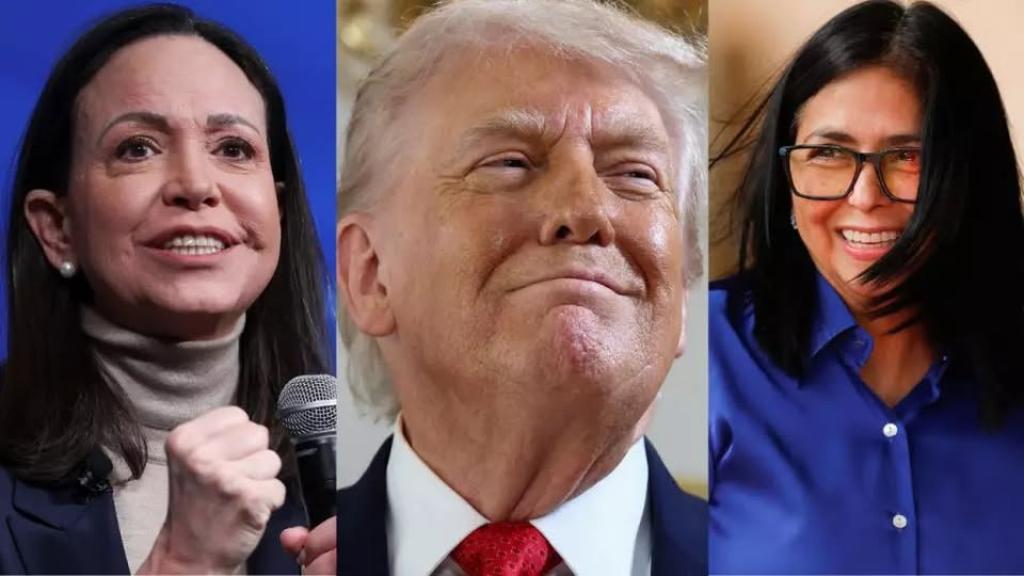
Machado Trump Rodriguez

First published at Luís Bonilla-Molina's blog. Translated by LINKS International Journal of Socialist Renewal.

“We are in a new political moment.” This is how [Acting President] Delcy Rodríguez concisely summed up the situation in Venezuela. The United States intervention in Venezuela, involving two-hours of relentless bombing of Caracas, La Guaira and elsewhere, along with the most shameful event in the national Armed Forces’ history, seem a distant memory. The events of January 3 have quickly become a historical event, worthy of commemorating in activist-packed halls, and for international audiences who prefer to live in Narnia in order to prop up their national political projects.

Anti-imperialism is conspicuously absent from contemporary Venezuelan public discourse. Although [former president Hugo] Chávez's cry, “Fucking Yankees, go to hell!” still echoes outside Miraflores Palace, for the past two weeks, the presidential palace microphones have, in a measured manner, indicated that any complaints about the events of January 3 [including the kidnapping of President Nicolas Maduro and First Lady Cilia Flores] will be made exclusively through diplomatic channels, in an attempt to overcome the stain left on US-Venezuelan relations.

Bewilderment still pervades Madurismo’s social base, where there are few meetings in which activists speak ill of the gringos — though, of course, always careful not to mention the orange man in the White House — a kind of consolation for those just beginning to awaken from the grief of their loss.

[US President Donald] Trump’s assertion on the afternoon of January 3 — as the cries of humble mothers for the deaths of a hundred sons reverberated across the besieged homeland — cannot be refuted by the facts: Rodríguez has pledged to cooperate and not repeat Maduro’s mistakes. The mistake Trump referred to appears to have been made by Maduro himself.

Between 2014-25 Maduro dismantled the national-popular program — not to mention so-called 21st-century socialism — that Chávez had embodied, but failed to fully implement the political, legal, and institutional measures needed to transform Venezuela into a new US colony.

Maduro’s error was not one of principles, but political calculation: he believed he could negotiate his continued hold on power in exchange for selling off the country’s wealth to the US. Maduro successfully dismantled a frustrated revolution, but did not know how to present its demise without losing his base. None of this stops us from denouncing his kidnapping on January 3 and demanding his release, because Venezuela is a republic that must resolve its affairs without the intervention of any empire.

The Fantastic Four and Wonder Woman

On January 15, Trump, who enjoys the spectacle of professional wrestling so much that he appointed wrestling entrepreneur Linda McMahon to head the Department of Education, decided to use terms from the Marvel and DC Universes to describe his political options in Venezuela.

He said that he had a long telephone conversation that morning with Rodríguez, whom he described as “fantastic” and with whom, he said, they were working very well. That afternoon, he met with right-wing opposition leader María Corina Machado behind closed doors. He had brushed Machado aside on January 3 as a potential option to lead Venezuela, but now referred to her as “wonderful” — after, of course, she presented him with her Nobel Peace Prize medal.

Perhaps Trump wanted to replace the “Super moustache” and “Cilita” saga — action figures Venezuela’s government created to represent Maduro and Flores, which were given as Christmas gifts to poor children — with his own rhetorical imagery.

But, in fairness, the term “fantastic” is shared by three other figures who, along with Rodríguez, are at the helm of the Venezuelan administration: Jorge Rodríguez (National Assembly president), Diosdado Cabello (Minister of the Interior and Justice), and [Vladimir] Padrino López (Minister of Defense). They are the “Fantastic Four” of this “new political moment,” who must avoid angering the Lex Luthor in the White House.

The “Wonder Woman” moniker, however, is clearly for Machado, who seems to have distanced herself from the rest of the Venezuelan opposition, which is more inclined to reach agreements with Maduro and now Delcy Rodríguez. As Bifo Berardi would say, these are merely reflections of the mental health problems surrounding power in the 21st century.

Dismantling the remnants of the Bolivarian revolution

The Bolivarian process reached January 3 like a zombie feeding on rhetoric devoid of any basis in reality — a terrible caricature of the promises enshrined in the 1999 Constitution. The decline began before the Unilateral Coercive Measures (US sanctions), but these clearly accelerated the transition from entropy to counterrevolutionary dissolution, most starkly expressed in the 2018 package of economic measures. This package shifted the burden of the crisis onto the working class while protecting circuits of capital accumulation.

The Maduro government became authoritarian, dismantling even the most basic democratic freedoms and ruthlessly creating the worst material conditions any Venezuelan worker alive today has experienced. The “Fantastic Four” were structural components of this decline; they did just inherit this situation, but were co-participants.

The question everyone asked was whether the January 3 imperialist attack on Venezuela could trigger an internal revolutionary response, with the ruling quartet at its head, that could resume the path outlined in the 1999 Constitution. Subsequent events have shattered that illusion. Not only are diplomatic relations between Caracas and Washington being normalised within the framework of an illiberal and colonialist agenda, but the needed counter-reforms are solidifying the new status of US-Venezuelan relations.

At Delcy Rodríguez’s request, the National Assembly has simplified trade regulations to remove restrictions on foreign investment, while initiating reforms to the Hydrocarbons Law to legitimise the plundering of Venezuela’s oil and re-entry of transnational corporations ousted by the Chávez revolution. These rapid restoration measures seek to align Venezuela with Trump’s aims, which were presented to the 16 oil magnates gathered to establish a $100 billion investment fund. This fund will allow the US to increase its current control of nearly one million barrels of Venezuelan oil to more than four million within a couple of years.

Venezuela is rejoining the SWIFT banking system, allowing local financial transactions to be routed through the US. Four private banks (BNC, BBVA Provincial, Banesco, and Mercantil) have already been authorised by the Trump administration to receive a portion of the foreign currency transferred to the country from oil sales. It appears these private banks will sell the foreign currency, while the Central Bank of Venezuela will only receive Bolivars generated from this auction, less the respective intermediary fees.

Delcy Rodríguez promotes this mechanism as a form of “energy cooperation with the US, which will allow any incoming currency to be allocated to two funds: the first for social protection to improve workers’ wages and strengthen areas such as health, education, food, and housing; the second for infrastructure and services.” A quick calculation of the impact of the first US$300 million to be transferred shows how ineffective the 30% of the revenue from oil sales that the US plans to send to Venezuela through the colonial form of intermediation will be in improving the working class’s living conditions.

On January 9, the White House made public its executive order, “Safeguarding Venezuelan oil revenue for the Good of the American and Venezuelan people,” the embodiment of the colonial relationship when it comes to managing resources derived from oil sales. The US assumed for itself the role of “custodian” of Venezuela’s funds, whose use and circulation depends on the US Secretary of State. This was tested with the 50 million barrels of oil the US announced it had confiscated for this purpose.

The Delcy Rodríguez government responded by initiating legislative and institutional reforms to facilitate this. On January 15, the same day as the phone conversation between Delcy Rodríguez and Trump, the reform of Venezuela's Hydrocarbons Law was announced. It was like witnessing a competition to see who could present themselves as the most obedient to the White House occupant: Machado presented Trump with the Nobel Prize medal while Delcy Rodríguez introduced the Hydrocarbon Law reform.

As a smokescreen, the Trump administration ordered the closure of Venezuela’s El Helicoide detention centre, which had been denounced as a torture site, and the release of political prisoners held there. The National Assembly president went from claiming Venezuela had no political prisoners to reporting that more than 400 had been released, with the remaining cases being reviewed. Human rights advocates have previously said the number of political prisoners could be more than 1000. It is important to emphasise that these releases are the result of the struggle waged by the families of political prisoners and human rights organisations that have supported them, and are not an imperial handout.

All this is occurring while Article 5 of Venezuela's State of Emergency decree continues to allow the arrest of anyone who criticises the government. Today, it is common to see police and military personnel in Venezuelan cities checking phones and arresting anyone with information against the government. Most people now leave their homes without a phone, or with a device incapable of receiving WhatsApp messages or accessing social media.

As if this was not enough, on January 15 it was announced that the executive and legislative branches, together with the bureaucratic and employer-oriented Bolivarian Socialist Workers' Central (whose key architect was Maduro), would fast-track a labour legislation reform, creating a new Labor Code adjusted to the new political moment.

The reaction of the capitalist class and business leaders remains to be seen. However, Delcy Rodríguez is very adept at moving in business, financial and banking circles. In fact, between 2018–25, she was tasked by Maduro with finding common ground with the traditional business sector, something she accomplished efficiently.

[The main big business chamber] Fedecamaras had participated in the 2002 coup against Chávez and severed all ties with the government. But Delcy Rodríguez successfully achieved the seemingly impossible: not only was she the star guest at national business meetings starting from 2021, but she managed to break them away from Machado’s calls for confrontation. This experience could prove useful for Delcy Rodríguez in achieving what Maduro could not: an agreement among the various capitalist factions for an orderly transition, where all the wealthy win and no particular sector loses. Of course, in such agreements, those at the bottom always lose.

Changes are happening at breakneck speed while any anti-imperialist perspective seems to further fade.

The great absentee

Internationally, people are asking: Where is the popular response? The truth is that there have been no spontaneous mass mobilisations and autonomous responses to what occurred. The small marches that have taken place have been called by the government, mobilising mainly public employees and the social base it still maintains, which, although diminished, is nonetheless important for these purposes.

How can we explain this? Maduro’s regime has created such a disaster for workers’ living conditions that large segments of the population see his departure as the only chance for change. Citizens seem to have reached a point where they are willing to see if the new circumstances leads to improved wages, allows for the return of the 8 million migrants whose exit fractured Venezuelan families, restore the regular and stable functioning of public services (water and electricity), and establish institutions to address the healthcare, food and housing needs of the vast majority.

However, the colonial-style administration is unlikely to meet these aspirations. A mobilised social movement will only return to the extent that this becomes evident.

In the land of the blind…

Now everyone in politics is talking about transition and solving problems in the short term. But this cannot be done with good intentions alone; it demands a comprehensive understanding of the structural causes of the current situation.

From our perspective, Venezuela’s current crisis originated in February 1983 with the collapse of the rentier model of capitalist accumulation, class collaborationism and political representation. It deepened with the disappearance of the “people” as a unifying element of the nation-state, beginning with the Caracazo uprising of 1989.

This was further exacerbated by the crisis within the military, manifested in the February 4 and November 27 uprisings in 1992. To this we should add the profound crisis of credibility in democracy, a phenomenon that became undeniable with the 1993 election results, and intensified with each subsequent election.

The 1999 Constituent Assembly garnered majority support, but failed to reconstitute the people as the subject of state consensus; on the contrary, chaos deepened, punctuated by periods of apparent stability. The emergence of a new capitalist class in 2002, following the military-backed coup against Chávez, sparked a struggle for wealth accumulation that nearly erupted into civil war between 2014–17.

This inter-capitalist conflict remains unresolved and, worse still, reveals a tendency in both sides to reject class collaboration; that is, they seek to dismantle even the minimum basis for a reformist social agenda that could keep the seeds of radical revolution at bay. We also must now add the trauma of the loss of sovereignty inflicted with the January 3 imperialist attack and the shameful role of the armed forces.

This represents 43 years of unresolved structural crisis in the model of accumulation and political representation. A transition conceived from the perspective of the working class must be capable of addressing each and every component of this crisis. Machado has stated that her approach is different, and the Delcy Rodríguez government seems more interested in clinging to power than resolving this structural crisis. The coming months will be key to understanding and determining the course of events in the country.

So much swimming only to die on the shore

Cuban writer Leonardo Padura recently published a novel that could easily include a chapter about Venezuela. Morir en la arena (To Die on the Shore) tells the story of a disillusioned generation that criticised capitalism as a result of the political, economic, social, cultural and technological problems; that embraced socialism as an alternative; and now seems to accept that the only solution to its problems is a return to a savage, free-market capitalism of competition and labour exploitation, but with a decent wage.

Explaining that what happened in Venezuela was not a socialist experiment, but rather an appropriation by dispossession of the narrative of radical transformation, is not easy. Certainly, the Chávez government had some redeeming qualities, as did the Fourth Republic, but both ultimately became attempts to resolve the capitalist crisis without changing the rentier model of production and accumulation.

More than creating formulas, relaunching future projects today means listening to the people, because a revolution is only possible and sustainable when it resonates with the expectations, needs and requirements of the humble. It is about swimming against the current to avoid drowning on the shore.

The difficult task of revolutionaries

Given this situation, there is no doubt about the priorities. The central task is defending national sovereignty from an anti-imperialist working class perspective; that is, every step in defence of the republic must be accompanied by the demand to re-democratise Venezuelan society and for wage justice. There is no territorial sovereignty without political sovereignty.

It is very difficult to cohere a defence of Venezuelan sovereignty that omits the need to resolve inequality and lack of freedoms in Venezuela. Correctly combining these demands is the challenge of anti-imperialism today.

Therefore, the call for a global anti-imperialist front, based on solidarity with Venezuela, must include the demand to fully restore political, labour and civil freedoms in Venezuela. This will require tact and creativity, commitment and a clear vision.

In this spirit, and with this orientation, we raise our voice as part of the call to organise a global platform, which began to take shape with the online meeting on January 17, bringing together diverse and pluralistic voices that continue to believe that another world and another Venezuela are possible.


Trump’s Christian Nationalist Pseudo-Historians Attack the Smithsonian

Photograph, Alice Paul with Suffrage Banner. 1991.3016.042.

If you’re planning a visit to the Smithsonian, you may want to go sooner rather than later — before the nation’s most important public history institution becomes another casualty of Trump-era historical revisionism.

For example, on January 10, People magazine’s Charlotte Phillipp reported that Trump complained that his portrait in the Smithsonian Institution’s Portrait Gallery pointed out that he was “impeached twice, on charges of abuse of power and incitement of insurrection.” The White House provided an updated portrait, “along with a new caption that has omitted text that mentioned his impeachments and the Jan. 6 insurrection.”

According to January 8 report by the New York Times’ Graham Bowley and Robin Pogrebin, “After a months long lull in tensions, the Smithsonian is facing an ultimatum from the White House to comply next week with a comprehensive review of the institution’s content and plans — or risk potential cuts to its budget. … [Secretary Lonnie Bunch III ] noted that it would be impossible to turn over the full volume of records sought in the time frame, and he reiterated that the institution is autonomous.”

The Smithsonian is one of the largest and most respected cultural institutions in the U.S., and its exhibits influence public understanding of American history. Efforts to politically pressure or intervene in how it presents history raise serious questions about academic independence, historical accuracy, and the role of ideology in public education.

In a recent story titled “Father-Son Christian Nationalist Pseudo-Historians David And Tim Barton Are Shaping The Trump Administration’s War On The Smithsonian,” Right Wing Watch points out how the pseudo historian David Barton and his apple-not-falling-far-from-the-tree son Tim, are on assignment by the Trump administration “to control how American history is presented at the federal level.”

David Barton, and now his son, have built their careers “spread[ing] demonstrably false claims about the Founding Fathers, the Founding Era, and the founding of the United States to bolster their modern-day Christian nationalist political agenda,” Right Wing Watch’s Kyle Mantyla reported in mid-April of last year. Barton has even gone so far as to attempt to make a biblical case for Trump’s tariffs, Mantyla noted in an early April story.

David Barton, who has no formal academic credentials in history, has long been the go-to guy for the Religious Right and Christian nationalists’ maintaining that the Founding Fathers intended to establish America to be a Christian nation that operates according to the laws of God as set out in the Bible.

Tim Barton has taken over as president of the WallBuilders organization, serving as co-host of the daily “WallBuilders Live” radio program, and traveling the nation delivering presentations filled with Christian nationalist disinformation.

Right wing Watch reported that on their WallBuilders radio program “Tim and his father celebrated the news that the White House is now threatening to withhold funding from the Smithsonian if the institution does not submit additional documentation amid the administration’s review of its content and displays.”

The Christian nationalist Bartons, claim they were integral in bringing this about.

“This is one that is dear to our heart,” Tim Barton said. “The White House warned the Smithsonian that if the museum did not submit more documentation to the administration to enable a review of its contents, funds may be withheld from the institution.”

“What they said is, ‘We want to know [the] chain of command. Who approved all this?'” he continued. “What they’re asking is, who is accountable? Who’s going to be responsible? Who gets held accountable for all of the nonsense. This is not a crazy request. Museums are supposed to keep record of who approved what, what areas, what displays, what wall mounts.”

“The Smithsonian failed to tell them who put up some of the crazy stuff that is there,” Tim Barton said. “And dad, you and I have gone through and reviewed several of the Smithsonians and there’s some crazy stuff there.”

“Yeah, I was going to point out that earlier in the year, the White House asked us to look at some of that,” David Barton responded. “At that point, you were leading a tour of legislators in Washington, D.C. … By the way, we love the American History Museum, the Smithsonian because of the artifacts, but not because of the way they present them. The way they present them is terrible. And so as the legislators went through, Tim, they came back to you and said, ‘Oh man, this is terrible and this is bad.’ And so you turned that over to the White House on how bad the stuff was, how misleading it was.”

“You were right in the middle of that story,” David celebrated.

“This is so encouraging that we actually have an administration saying, ‘Let’s tell the truth, let’s stop this woke propaganda nonsense, let’s tell the truth,'” Tim responded. “This is such good news and I’m so excited for what this could mean for the 250th celebration because this is part of what they’re gearing it for; they want to make sure we’re telling good stories for the 250th.”

The Smithsonian exists so Americans can confront their past honestly, in all its achievement, cruelty, contradiction, and struggle. The Bartons are not defending history, they are prosecuting it. And in the Trump administration, they have found a willing partner. They would eagerly replace historical inquiry with ideological loyalty; reshaping the public memory with Christian nationalist myths.

The Smithsonian was never meant to serve any administration’s political narrative — let alone the theological agenda of Christian nationalist activists who reject mainstream scholarship. If Trump succeeds in bending the institution to his will, the loss will not belong to historians alone. It will belong to every American who believes history should be examined, not edited.

Bill Berkowitz is a longtime observer of the conservative movement. Read other articles by Bill.