Monday, January 19, 2026


When aging affects the young: Revealing the weight of caregiving on teenagers


COVID era survey explores care burdens young carers face


Osaka Metropolitan University

Care burdens on young carers 

image: 

Surveys during and after COVID-19 shed light on young caregivers and the impact on their well-being.

view more 

Credit: Osaka Metropolitan University


Caregiving in the modern era is challenging for even the most prepared adults. So, what happens when this burden falls on children?

As Japan's population ages, the number of children and young people responsible for caregiving is increasing. However, the impact of this on their health and daily lives remains not well understood.

To gain better insight, Professor Bing Niu and Dr. Ziyan Wang from Osaka Metropolitan University’s Graduate School of Economics conducted two rounds of surveys, one in 2021 during the COVID-19 pandemic and another in 2024 after the pandemic. The surveys targeted 1,581 young carers aged 15 to 19 across Japan to clarify how caregiving burdens affect the psychology and emotions of young carers.

The survey incorporated the Kessler 6-Item Psychological Distress Scale and the Positive and Negative Outcomes of Caring questionnaire as indicators to measure the degree of psychological stress and subjective responses, such as feelings and thoughts, toward caregiving. It then analyzed the actual state of the caregiving burden and its impact on carers' psychological and emotional well-being.

Results revealed that young carers with greater care responsibilities tend to experience higher stress levels, with approximately 20% of young carers in our surveys falling into the high-risk group. However, they also possesspositive emotions, such as a sense of accomplishment and pride. In particular, the 2024 survey revealed that both positive and negative emotions stemming from caregiving experience were more pronounced than in 2021.

“Both positive and negative emotions were strongly expressed in the 2024 survey, which suggests that even as the burden of care persists, societal understanding and support for young carers have grown, and they themselves have begun to embrace their roles more positively,” Dr. Wang stated. Professor Niu concluded, “It is suggested that while both positive and negative aspects exist in the caregiving experiences of young caregivers, it is crucial to develop support tailored to each individual's specific circumstances.”

The findings were published in Scientific Reports.

###

About OMU

Established in Osaka as one of the largest public universities in Japan, Osaka Metropolitan University is committed to shaping the future of society through the “Convergence of Knowledge” and the promotion of world-class research. For more research news, visit https://www.omu.ac.jp/en/ and follow us on social media: XFacebookInstagramLinkedIn.


Can Canada’s health systems handle increased demand during FIFA World Cup?


Current health system already at, or above, capacity


Canadian Medical Association Journal


Excitement is building for FIFA World Cup soccer games in Toronto and Vancouver in June and July, yet Canada’s overburdened health systems may buckle with any additional demand, cautions an editorial published in CMAJ (Canadian Medical Association Journalhttps://www.cmaj.ca/lookup/doi/10.1503/cmaj.252094.

“Canada is increasingly vulnerable to events that may result in a surge in health care utilization, including climate emergencies, mass gathering events, infectious diseases outbreaks, and global defence escalations,” writes Dr. Catherine Varner, an emergency medicine physician in Toronto and Deputy Editor, CMAJ.  

World Cup organizers are planning for a range of scenarios with the help of local and provincial health and emergency authorities, but can they plan for increased volumes in health systems already stressed and over capacity with current patient loads?

Dr. Varner, an emergency physician who worked during Games 1 and 7 of the 2025 MLB World Series, has direct experience with how stretched health care capacity is in Toronto. She calls for urgent action on a national plan to bolster health systems to meet potential needs from large-scale events like the World Cup and others.

“A coherent, feasible, actionable, and national plan is urgently needed to increase hospital beds and train the required personnel such that quality of care can be maintained,” she writes.

This year’s flu season has placed exceptional burden on hospitals, patients, and health care providers, with emergency departments across Canada facing huge patient volumes and long wait times for care.

“Health care providers in Canada are accustomed to flexing and triaging acute care and public health resources,” Dr. Varner writes. “Being in a constant state of surge capacity is actually the norm. However, even when anticipated surges occur, bedside experiences and provincial quality metrics suggest that systems cannot absorb more load when they are already operating at or above capacity without compromising the quality and safety of patient care.”

A potential solution would be for hospitals near the World Cup sites in the two cities to increase staffing to cope with higher demand for health services, but Dr. Varner cautions that “increasing staff, even for the duration of these events, is likely not feasible since Canadian hospitals and public health systems already face health human resource challenges and budget shortfalls in these years following the COVID-19 pandemic, a problem that has been widely recognized in other important spheres of governance.”

Recent reports have identified health care system capacity and health care personnel as major weaknesses in Canadian sovereignty and defence, a priority area for the government under Prime Minister Mark Carney. Scenario planning for a large-scale war in Europe made it clear that Canada’s health care systems would struggle to function if health care personnel were sent overseas or wounded soldiers returned to Canada for care.

“With the recent commitment to increase defence spending in the 2025 federal budget, increasing acute care capacity should be prioritized as part of Canada’s emergency preparedness systems to support national defence and security purposes.”

National poll: Less than half of parents say swearing is never OK for kids


Friends and classmates, not parents, cited as the top source of swear words


Michigan Medicine - University of Michigan

Parent views on swearing 

image: 

Parents report different strategies to address their children's swearing, poll suggests.

view more 

Credit: Sara Schultz, Michigan Medicine


ANN ARBOR, Mich. – Today’s parents may be growing more relaxed about their children using curse words, according to a national poll.

Only about half of parents say children should never swear, even as many acknowledge that their own kids sometimes do, according to the University of Michigan Health C.S. Mott Children’s Hospital National Poll on Children’s Health.

Meanwhile, more than a third of parents say whether it’s acceptable depends on the situation, while fewer say it depends on the specific word being used or that swearing is not a big deal.

At the same time, one in four parents say their child uses curse words at least occasionally, including nearly four in 10 parents of teens.

“Parents are navigating a gray area when it comes to language,” said Mott Poll Co-Director Sarah Clark, M.D.H. “Many don’t love hearing these words, but they also recognize that context, age and intent matter.”

The nationally representative report is based on responses from 1,678 parents with at least one child ages 6–17, surveyed in August 2025.

Peers play a major role

When asked where children learn profanity, two in three parents pointed to friends or classmates, making peers the most commonly cited source.

Popular media followed closely, while many parents also acknowledged that children hear adult language at home, including from parents themselves.

About one in three parents believe their child swears to fit in, highlighting the role of social pressure, particularly during adolescence.

Parents of teens were more likely to say the behavior is about fitting in, while parents of younger children more often attributed it to trying to be funny or to get attention.

Some children may also use strong language to express negative emotions, Clark says, which may signal a need for help naming and managing anger or frustration in more appropriate ways.

“Swearing can be a form of social currency for kids,” Clark said. “For some, it’s about belonging. For others, it’s about getting a reaction. Understanding the ‘why’ can help parents respond more effectively.”

Parents set rules but enforcement varies

Parents who object to children using curse words likely have a variety of reasons, Clark notes. Some view it through a religious lens, believing certain words conflict with their beliefs.

Others see it as a manners issue, she says, worrying that harsh language is rude or disrespectful. For these parents, context matters: such language might be off-limits at school or in public, for example, but less of a concern when kids are with friends.

Most parents say they feel responsible for their child’s word choices, yet responses vary widely. When their child swears, parents most often say they tell them to stop or explain why they dislike it. Fewer say they ignore it, and only a small number rely on punishment.

Parents of teens are more likely than parents of younger children to ignore it altogether.

“It can be challenging for parents to maintain a consistent approach to swearing,” Clark said. “Parents should sort through their own attitudes to determine which words and situations will merit a response. Young children may not realize certain terms are inappropriate, so parents may need to explain meaning, context or social impact to build understanding and empathy.”

To limit exposure, parents report watching their own language, restricting certain media and asking others to respect household rules.

About one in five parents also discourage friendships with children who frequently swear, suggesting concerns that go beyond language alone.

“These findings show that swearing isn’t just a discipline issue,” Clark said. “It’s tied to peer relationships, family norms and how parents want to guide behavior without overreacting.”

Sunday, January 18, 2026

Is Russia imperialist? A response to Renfrey Clarke


Russian troops

In his article, “The sources of the Ukraine conflict: A reply to Chris Slee,” Renfrey Clarke disputes my contention that Russia is imperialist. Clarke says:

As analysed by Lenin early in the last century, imperialism is a characteristic of the richest and most developed capitalist countries.

However, he acknowledges that Vladimir Lenin regarded Russia as imperialist, despite the fact that the Russian empire of his day remained a “primitive and dependent state”. Clarke recognises that Russia was “a ranking military power, able to keep large non-Russian populations in subjection and to throw millions of soldiers into its wars.”

Clarke also notes that:

In his writings, Lenin never fully untangled this conundrum. But he left us a definite pointer to his views. In articles in 1915 and 1916 he described the Russian imperialism of his time as “feudal” and as “crude, medieval, economically backward”. Clearly, he did not include it in the same category with the modern imperialism of the advanced Western countries.

Instead, the Russian empire was a relic of an earlier, pre-industrial imperialism, based not on finance capital and advanced productive methods, but on peasant rents, handicraft production and merchants’ profits. For Lenin, it may be said, the Russian empire despite its military power belonged in a historical category with such empires as that of the Ottomans.

Military power and foreign interventions as indicators of imperialism

Certainly tsarist Russia was backward and semi-feudal. But some of Lenin’s writings indicate that he regarded military strength and interventions in foreign countries as indicators of imperialism, regardless of the economic system. For example, Lenin wrote:

The last third of the nineteenth century saw the transition to the new, imperialist era. Finance capital not of one, but of several, though very few, Great Powers enjoys a monopoly. (In Japan and Russia the monopoly of military power, vast territories, or special facilities for robbing minority nationalities, China, etc, partly supplements, partly takes the place of, the monopoly of modern, up-to-date finance capital)

Note the reference to Japan, which at that time was capitalist, though with feudal remnants, and where the development of finance capital was still limited. Despite this, Lenin highlighted its military power and interventions abroad (Lenin mentions China, but Japan had also invaded Korea). Clearly, Lenin regarded military power and foreign interventions as important factors in judging if a country is imperialist.

I am not aware of any writing by Lenin where he gives a full explanation of his views on this question. Lenin’s pamphlet Imperialism, the Highest Stage of Capitalism is often quoted as the definitive summary of his views. But Lenin himself noted its limitations. In his preface to the April 1917 edition, he said:

This pamphlet was written with an eye to the tsarist censorship. Hence, I was not only forced to confine myself strictly to an exclusively theoretical, particularly economic, analysis of facts, but to formulate the few necessary observations on politics with extreme caution, by hints, in an allegorical language — in that accursed Aesopian language — to which tsarism compelled all revolutionaries to have recourse whenever they took up their pens to write a “legal” work.

Thus, Imperialism only deals with the economic aspects of imperialism. But Lenin’s other writings make clear that imperialism is not just an economic phenomenon. Political and military aspects are also important.

Clarke says:

Russia’s “feudal, medieval” imperialism perished in 1917. To characterise the country today using the tsarist regime as a historical reference is far-fetched.

Russia today is not semi-feudal, as it was in 1917. But its military strength makes it a great power. Lenin wrote: “The epoch of imperialism has turned all the 'great' powers into the oppressors of a number of nations…” This applies to Russia today.

Modern Russia

Clarke notes that:

The return of capitalism to Russia from 1991 saw the Russian Federation emerge as a typical “upper tier” country of the Global South; part of the “semi-periphery” of world capitalism along with countries such as Brazil, Mexico, or Türkiye.

Lenin never used the terms “Global South” or “semi-periphery”. Global South is an imprecise concept, while semi-periphery comes from World Systems Theory, which divides countries into the “core” and “periphery”, with semi-periphery as an intermediate category. This theory implies that the world capitalist system has a single “core” (or centre), ignoring the fact of inter-imperialist rivalry. 

In my view, Turkey, which intervenes militarily in Syria, Iraq and several African countries, is imperialist, even if on a much smaller scale than the United States.

Clarke says:

While Russia in 1991 inherited an industrial economy from the Soviet Union, the level of its technology in all but a few sectors was decidedly backward.

One sector, however, in which Russia was NOT backward was its military industry. This sector is crucial for Russia’s ability to intervene beyond its borders.

Clarke writes:

Entry to the “gated community” of the world’s rich states is effectively locked and barred; the list of genuinely wealthy countries, which apart from mini-states number about 20 in all, has barely altered since Lenin’s time.

Yet imperialism is not static. Japan, once a formerly poor country, is today an imperialist power.

Clarke says:

Imperialist states, if we read Lenin correctly, are marked by a surfeit of underused capital, seeking employment at the rates of profit its owners think they deserve. But the data cited above show that, compared to undoubted imperialist countries, Russia is strikingly capital-poor. Russian industry and infrastructure, the military sector aside, suffer from a severe lack of investment.

Meanwhile, the country is home to legendary natural resources that, in normal times, command high prices on world markets. To the extent that Russian entrepreneurs have capital to invest, they have the opportunity to draw very agreeable rates of profit at home, without the obloquy and vast expense of invading foreign countries.

This assumes that capitalists and their governments always act in a rational manner, avoiding unnecessary risks. In fact, they often act in a reckless and potentially self-destructive manner. Capitalists always want more wealth, and capitalist governments often seek to expand the territory under their control, even if it is unwise to do so. Russia’s invasion of Ukraine is an example.

Clarke writes:

The charge that Russia launched its “special military operation” in Ukraine from an imperialist drive to territorial expansion is therefore absurd. If we discard (as we should) the “crazed dictator” narratives current in the West, that leaves us compelled to accept that the reason for Moscow’s “special military operation” is exactly what the Russians say it is: a defensive response to determined, persistent Western menaces.

Andriy Movchan has convincingly refuted the idea that Vladimir Putin’s invasion of Ukraine was defensive. Movchan points out that Putin showed little concern when Finland and Sweden joined NATO, even though Finland is very close to St Petersburg.

He argues that Russian chauvinist ideology played a key role. I agree that ideology is important, but would add that this ideology is not simply the result of Putin being a “crazed dictator”. It has a purpose: to unite Russia’s population on a nationalist basis under Putin’s leadership, and thereby suppressing dissent.

Clarke writes:

The World Beyond War site puts the number of US military bases on foreign territory in 2025 at 877, in 95 countries. According to the same source, Russia has 29, the great majority of them inherited from and located in countries of the former Soviet Union. Several more Russian bases are in Syria. Moves by Russia to secure a naval station on Sudan’s Red Sea coast appear to have stalled.

This pattern does not suggest the pursuit by Russia of world hegemony, but rather, a focus on its own security. All of Russia’s military bases, actual or mooted, outside of the former Soviet Union are in the Middle East — a strategically sensitive area of Russia’s “near abroad”.

Many imperialist countries have few, if any, foreign military bases: for example, Japan, Germany and Sweden. Russia has more foreign bases than these countries.

Clarke explains the presence of Russian bases in the Middle East by saying it is “a strategically sensitive area of Russia’s ‘near abroad’.” But the US could say the same about Latin America.

Should the left just accept Russia’s peace terms?

Clarke says:

In any war, after victory has ceased to be a realistic prospect, there comes a point where the implications of continuing to fight approach national extermination. The killing in the Ukraine conflict has been monstrous. Now it must stop, on whatever terms might plausibly be enduring. For the international left that means, in practice, calling for acceptance of the peace terms, outlined above, put forward by the Russian side.

There is no guarantee that such an agreement would be “enduring”. Putin's ideology, which says that Ukraine is not a real nation but a part of Russia that was artificially separated from the rest by the Bolsheviks, implies that he may renew the war when he judges conditions for victory are favourable.

Peace is essential, but there need to be guarantees that Russia will not renew the war. Perhaps an international peace-keeping force sponsored by the United Nations should be considered. This could be combined with referendums in the disputed areas to ascertain which state the people want to join.

Putin would probably reject such a proposal, unless subject to strong pressure from within Russia. The best guarantee of peace would be a strong anti-war movement in Russia, combined with democratic rights enabling such a movement to organise and express its views.

INTERVIEW

Former Archbishop of Canterbury: Putin is a heretic – he has no holy mission in Ukraine


For years, the Russian Orthodox Church has given its blessing to Moscow’s brutal invasion and attempted to frame it in religious terms. The former archbishop tells Maira Butt that Vladimir Putin’s violence directly contradicts the message preached by Christ


Putin calls Ukraine invasion his ‘holy mission’ in bizarre Christmas address


Sunday 18 January 2026 

The Independent


The former Archbishop of Canterbury, Rowan Williams, has accused Vladimir Putin of “heresy” after the Russian President claimed his invasion of Ukraine was a “holy mission”.

During a speech to mark Orthodox Christmas earlier this month, Putin called his soldiers “warriors” who were acting “as if at the Lord’s behest” and “defending the fatherland”.

Mr Williams, who served as the Archbishop of Canterbury from 2002 to 2012, condemned the use of religion to justify the invasion as “disturbing” and said that Putin’s revanchism directly contradicts the message preached by Jesus Christ.

“I’d certainly say we’re talking about heresy,” he told The Independent. “We’re talking about something which undermines a really fundamental aspect of religious belief, of Christian belief, which assumes that we have to defend God by violence.”

Following Russia’s invasion of Ukraine in February 2022, more than 1,600 theologians and clerics from the Eastern Orthodox Church issued the Volos Declaration, which condemned the “Russian World” ideology as a heretical belief and practice. The belief system grants Russia a special place in the cosmic order and claims the country has a divine right to build the “Holy Rus”: a land chosen by God for the Russian people.


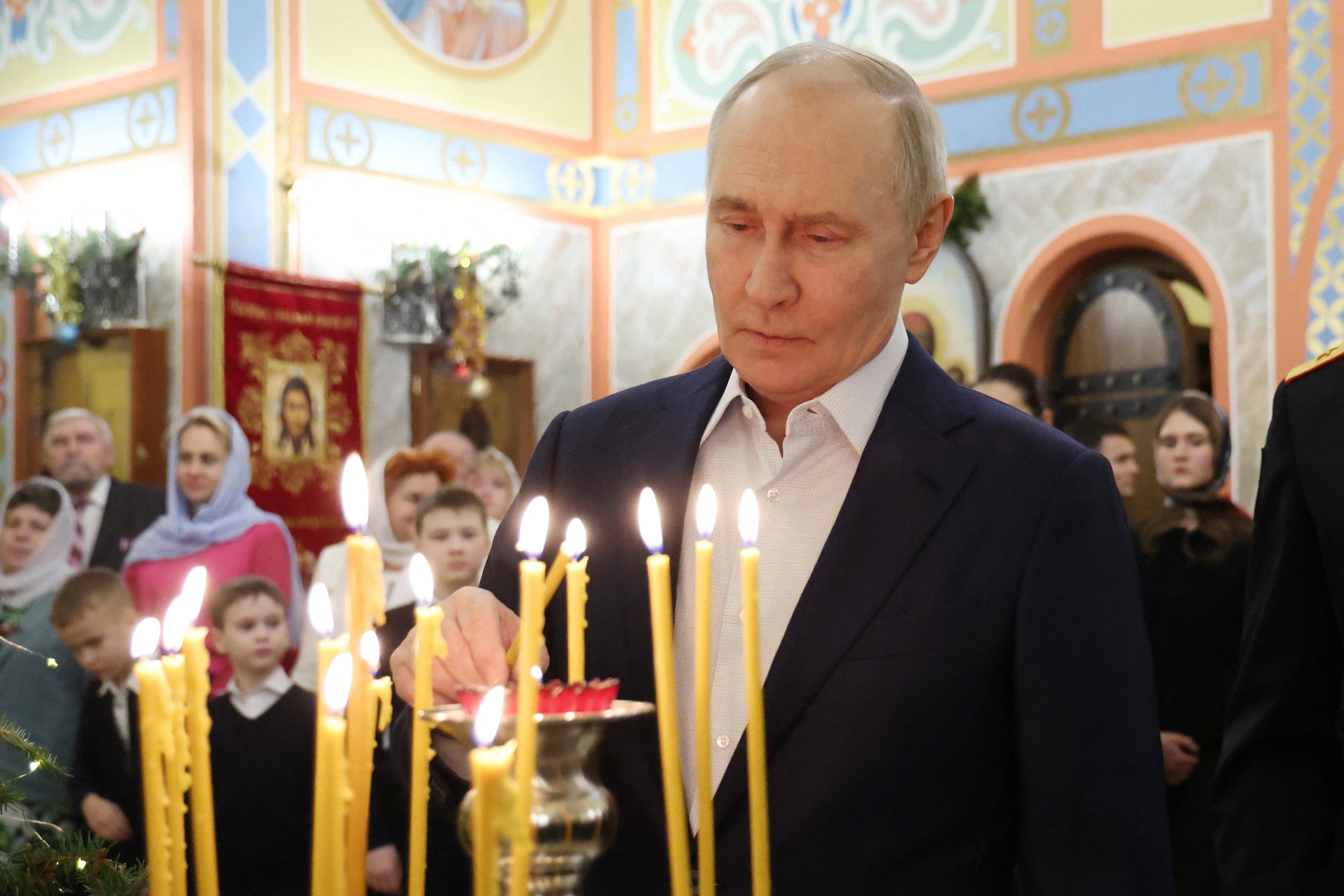
Vladimir Putin lights a candle as he attends a Christmas service at a church in Moscow (AFP via Getty)

“The idea that death in battle for your country equates to Christian martyrdom seems to be the most bizarre and unjustifiable interpretation you could take,” Mr Williams said.

“There is something really, really disturbing about the systematic, comprehensive rebranding of Christianity as Russian national ideology.”

He referred to statements made by Christ that his kingdom is “not of this world” and “if it were of this world, my servants would fight”.

Mr Williams pointed to the fact that Putin often resists calls to scale back fighting and violence over Christian religious periods, including Christmas and Easter.


The former Archbishop of Canterbury, Rowan Williams (PA)

He also pointed to the arrest and detention of two young Orthodox seminary members, Denis Popovich and Nikita Ivankovich. They are facing up to 20 years in prison on what critics say are trumped-up charges, according to Public Orthodoxy, a publication that is part of the Orthodox Christian Studies Centre.


Mr Popovich was arrested as he was walking to Sretensky Monastery in Moscow for “petty hooliganism” and “allegedly shouting and using obscene language”. Public Orthodoxy wrote in a newsletter on the anniversary of his arrest: “Anyone who knew this devout young man understood immediately that such behaviour was inconceivable for him”. Six weeks later, the allegations had transformed into terrorism charges.

Asked what he would say to Putin, the theologian said: “The word Christianity contains the name Christ. Which Christ do you think you’re serving? The one of the Gospels or some nationalist goblin?”

In 2024, the Ukrainian parliament outlawed the Moscow-based Russian Orthodox Church because of its strong support for Russia's invasion.

The Russian Orthodox Church has been a powerful ally of Putin, giving its blessing to the war and supporting his campaign to uphold what he calls traditional values in Russian society, in contrast to perceived Western decadence.


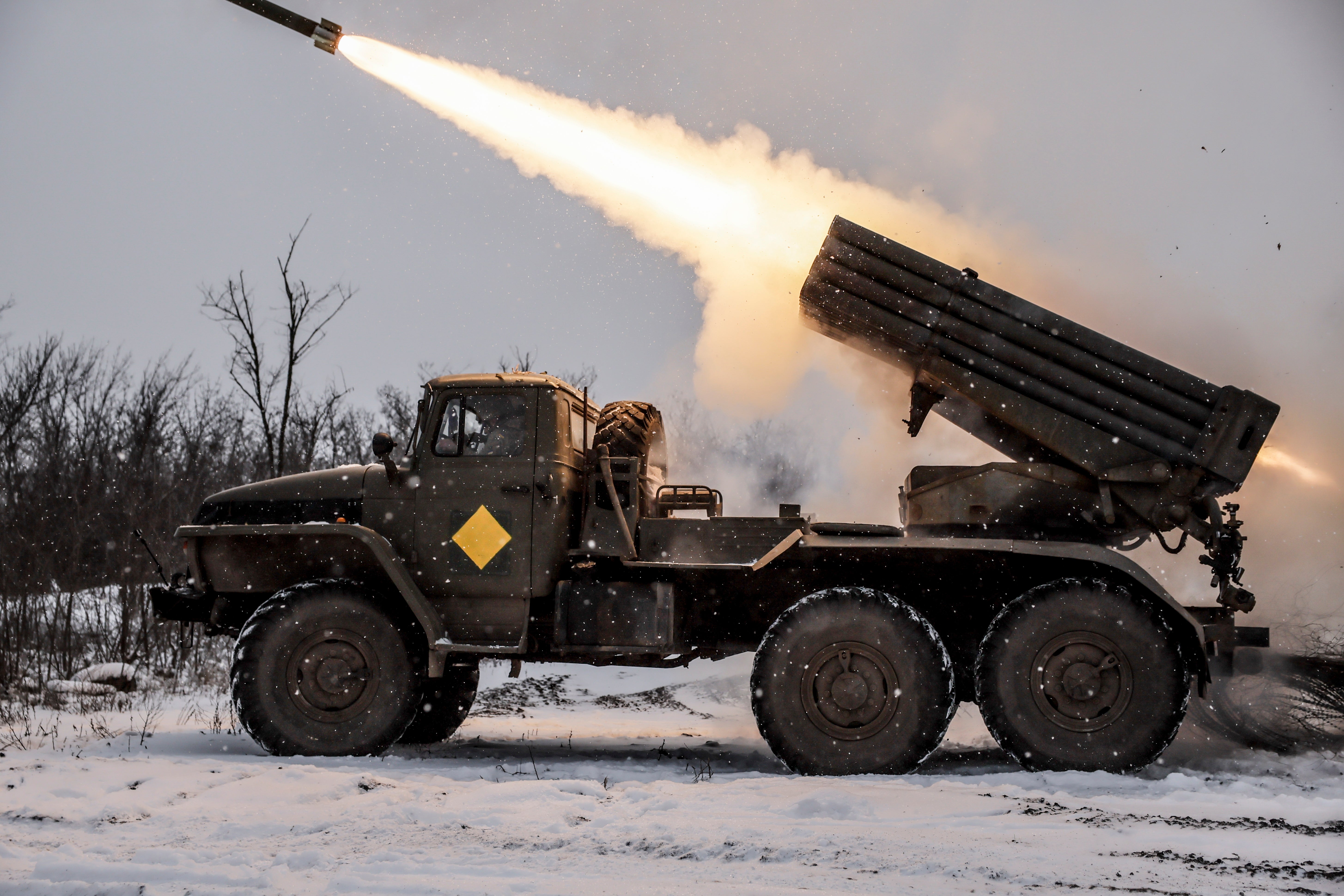
Russia’s leader has referred to his invasion of Ukraine as a ‘holy mission’ (Ukrainian Armed Forces)

Mr Williams said that Russia’s use of faith as a justification for war should be an alarm bell for the West. Governments are in denial about the extent to which religion is being “weaponised” to drive human conflict across the world, and religious leaders should step up their condemnation of violence, he suggested.

“In the West, we might think that religion is draining away but it certainly isn’t in other parts of the world,” he said. “To imagine that faith can only be defended by violence is a bit of an insult to faith really. If you're saying faith can only be strong if I beat the living daylights out of unbelievers, you're not saying much about the strength of faith, are you?”


Orthodox priests told The Independent last week that Putin is more akin to the “Antichrist” than a messiah, and that he holds “demonic” beliefs antithetical to the faith.

“Seen from a Christian perspective, you don’t use unholy means to pursue a holy mission,” the former Bishop of Leeds, Nick Baines, told The Independent. “When that unholy means involves slaughtering people, invading their country, and telling lies.”