Monday, January 19, 2026

Trump's Greenland ambitions lack domestic support, polls show


Issued on: 19/01/2026 

Video by: FRANCE 24


Despite US President Donald Trump’s insistence on acquiring Greenland, public support for the idea remains low. A Reuters/Ipsos poll of US residents this week showed that fewer than one in five respondents back acquiring Greenland, while a separate CBS poll found that just 14 percent would approve the use of military force to take the island. Instead, many Americans say they want the president to focus on domestic economic pressures, particularly the cost of living. A CNN poll last week found that 58 percent of Americans believe Trump’s first year back in the White House has been a failure, especially on the economy.


Greenland on the Chessboard of U.S. Imperialism

 January 19, 2026

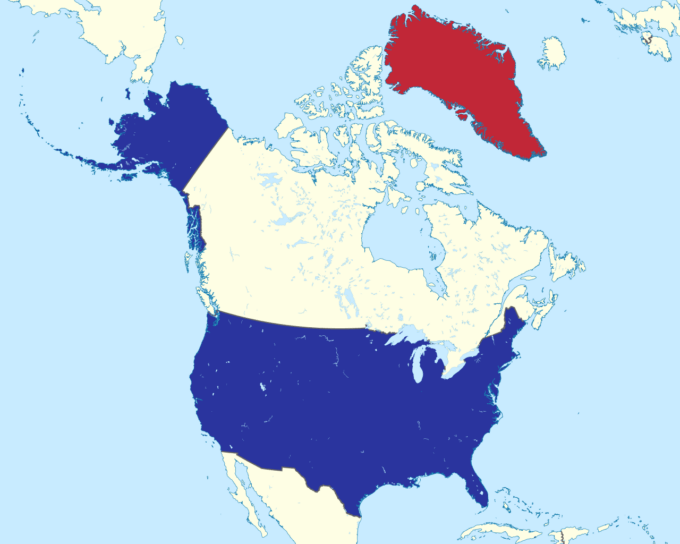
Photograph Source: Inter-rede – CC BY-SA 3.0

On 14 January, a few hours before the historic meeting in Washington between representatives from Greenland and Denmark and their U.S. counterparts, J. D. Vance and Marco Rubio, Denmark and several of its NATO allies reinforced their military presence in Greenland and announced that more reinforcements would follow.

Some interpreted this move as pressure on the Trump Administration before the meeting. But anyone familiar with NATO-Denmark politics would recognise that appeasement with the empire is the more likely explanation.

At the Washington meeting, the U.S. reiterated its firm demand for “having Greenland”: ““It is clear that the president wants to conquer Greenland,”” declared the Danish foreign minister after the meeting. The parties agreed to establish a “high level working group” in an effort to contain the crisis.

But the crisis continues, and its magnitude is huge.

The reality is that for over a year, the nearly 57,000 Greenlanders and their vast island have been turned into a bargaining chip, a pawn to be moved at will on the great chessboard of U.S. imperialism.

Trump has repeatedly stated that the U.S. seeks to control and own Greenland, by military means if necessary. The brutally effective aggression against Venezuela on January 3 and the kidnapping of the country’s head of state and his wife have erased any doubt that the White House administration is capable of putting Trump’s words into action.

The threat is imminent, and it is felt acutely among the Greenlandic people. The population is stuck in a vice, and the country’s politicians must fight hour by hour simply to get a seat at the table and be heard., Not only by the U.S., but also by Denmark.

Greenland, or Kalaallit Nunaat, has been inhabited for 4500 years, and its people are linked to the Inuit communities across the Arctic. It is the world’s largest island, with an area larger than France, Germany, Spain, Great Britain, Italy, Greece, Switzerland and Belgium combined. It became a Danish colony with the establishment of the state-owned Royal Greenland Trading Company in 1774. The Royal Greenland Trading Company functioned as the de facto colonial administration until the early 1900s, when trade and administration were separated. During this period, Danish companies extracted various minerals, including cryolite, iron, zinc, lead and silver.

The colonial era formally ended in 1953, but political equality with Denmark did not follow. Following a referendum, so-called home rule was introduced in 1979, which was replaced in June 2009 by the current status of self-government. Under self-government, Greenlanders hold the rights to the island’s subsoil and the minerals found there. However, foreign and security policies remain decided in Denmark, which is why Greenland is considered NATO territory.

Greenland is not a member of the European Union. In a 1982 referendum, 53 percent of the Greenlandic people voted to leave the European Economic Community, now the EU. Today, Greenland is classified as one of the EU’s Overseas Countries and Territories.

In 1951, a secret agreement between the U.S. government and Denmark’s envoy to the United States granted U.S. military involvement in Greenland. The agreement was highly controversial and in detriment to official Danish policies at the time. Nevertheless, it remains in force today and has been repeatedly confirmed. In practice, it grants unlimited U.S. military rights over Greenland.

Thus, for decades, the U.S. has maintained several military facilities in Greenland. The history of these facilities includes forced evictions of Inuit families in 1953, the crash of an American B-52 plane carrying four atomic bombs in 1968, and other harms inflicted on the local population.

The Danish government repeatedly states that Greenland belongs to the Greenlanders and is not for sale. But in reality, Denmark has been selling off Greenland to the U.S. for decades. “We already have a defence agreement between the Kingdom and the United States today, which gives the United States wide access to Greenland,” the Danish Prime Minister stated in an official statement earlier this week.

This raises the question: Why does the Trump Administration seek an annexation of Greenland, when the U.S. empire already holds extensive rights over Greenland? The answer lies in a new security strategy and the demand for unquestioned and unlimited control over oil, control over minerals, and military dominance.

Greenland possesses at least 25 of the 34 minerals designated as “critical raw materials” by the European Commission. Greenland has significant deposits of rare earths, copper, nickel, zinc, gold, diamonds, iron ore, titanium, tungsten and uranium. Trump wants U.S. companies, many of which have invested heavily in his re-election, to have unfettered access to Greenland’s mineral deposit resources.

Moreover, Greenland’s geographic position near the Arctic is important. Control over northern sea routes, such as the Northeast Passage, is becoming increasingly important as climate change advances. A fully controlled, militarised and rearmed Greenland is also intended to serve as an advanced base against both Russia and China. Beyond the prospect of super-profits, keeping socialist China far away from Greenland is a strategic goal for both the U.S. and Denmark.

Until a few years ago, Greenland was undergoing a process of independent decision-making and freeing itself from neo-colonialism. But the current era of intensified imperialism emanating from the White House has caused a serious setback to Greenland’s ability to determine its own destiny. The threats and pressures are enormous.

It is so important to hold on to the principle of right to self-determination. How Greenland organises its society, with whom it collaborates, and what alliances it enters to realise its self-determination in practice should be determined solely in Nuuk.

Produced by Globetrotter and No Cold War Perspectives.

Lotte Rørtoft-Madsen is the chair of the Danish Communist Party. She was the editor-in-chief of Arbejderen.


Greenland Between Denmark And The USA: What Is The Price For The Largest Island In The World? – Analysis


January 19, 2026 
By Dr. Vladislav B. Sotirovic

The largest island in the world, Greenland (that is not green at all but rather covered by white ice), has in recent months and even several years become one of the hottest geopolitical spots and disputes in world politics and international relations. The island, which has been administratively part of the Kingdom of Denmark for two centuries, has seriously caught the eye of the USA, namely its Trump administration, which firmly claims that the island simply must be under direct control and administration of the USA for its national security, otherwise it will be “swallowed up” by Russia and China (whose [Russian] submarines already operate around the island). The latest statements by NATO leaders support the idea of “Russian occupation of Greenland” as the reason for the increased presence of (small and meager) NATO soldiers on the island, but in essence, this position advocates the transfer of the island under American administration.

Greenland politically belongs to Denmark, i.e., the European Union, and in a military-political sense to the NATO pact. Geographically, it belongs to the North American continent and is closest to Canada, not the USA, and far away from Denmark. However, in a purely military sense, Greenland has been under the “occupation” of the USA since the summer of 1940 (after Nazi Germany’s overrun of Denmark), and in that context, the island is much more tied to the American, rather than the Danish, i.e., European administration. If, and this is in fact more or less a fait accompli, Greenland does indeed belong to the USA in one form or another, it will only be a formal recognition of the real state of affairs since the time of World War II up to today.

Nevertheless, what is Greenland, and what are its basic characteristics?

Geographical and military-technical characteristics of the island


Greenland (Grønland) is an Arctic island, the largest in the world, located off the northeastern part of the North American continent, next to Canada. It has an area of ​​2,130,800 sq km, with coastal islands of 2,175,600 sq km, and a population of almost 55,000 (the area of ​​Europe is about 10,180,000 sq km). Greenland is politically part of the territory of the Kingdom of Denmark with a certain degree of local autonomy. The island is mostly in the Arctic Circle, with its northernmost point 708 km from the North Pole. It is about 2,650 km long from north to south, and about 1,300 km wide from east to west. The island generally rises steeply from the surrounding seas, bays, and straits into highland terrain and over 3,000 m. altitude.

The island has a very rugged coastline with a large number of fjords. The eastern coast, despite its great ruggedness, is practically inaccessible for the most part due to icebergs. The interior of Greenland, together with the ice sheet, forms a plateau between 2000 and 3000 meters above sea level. It is estimated that about 1,860,900 sq. km. of the island’s territory is permanently covered with ice, with a thickness of between 500 and 1500 m., and only about 13% of Greenland’s surface is free of ice, and in the coastal zone it is up to 150 m. wide. The highest peak is located on Mount Forel, 3440 m.

The Greenland Sea is the main link between the Arctic and the western Atlantic. It is of great importance for Arctic fishing and whaling. Its northern part is mostly covered with ice, and its southern part is covered with icebergs or floes.

Probably the greatest geopolitical value of the island of Greenland is that whoever holds it in their hands essentially controls access to the North Atlantic.

The climate in Greenland is of the Arctic type. The southern part of the west coast is the most favorable for life because it is reached by the warmer Atlantic current, and where the average January temperature is about minus 14 degrees C, and July about plus 8 degrees C. In the interior of the island, the temperature can reach minus 50 degrees C.

It is important to note, at least from a military-economic point of view, that the seas, bays, and straits around Greenland freeze over except in its southwestern part, i.e., these waters are covered with icebergs as well as mountains broken off from glaciers, which descend from the interior of the mainland into the sea. Along the northern coast, the sea is constantly under ice. There are no land communications on the island. The ports in the south of the island are of insignificant capacity, at least in military terms. In Greenland, dog sledding on land and boats at sea are the only means of transport. However, in terms of air traffic, Greenland is in a very important position because the shortest flight routes from North America to the northern parts of Europe and Western Siberia pass through it.

The economy of Greenland

The current economy of the island is very poor, i.e., insignificant, because the main economic activity of the islanders is limited to fishing, which is not as profitable as in the cases of Iceland or Norway. It is mainly about catching cod, whale, seal, walrus, and, on the mainland, bear hunting for fur. A small number of sheep and goats are raised on the island, while vegetables and potatoes are grown sparingly in the southern coastal belt.

However, the island is rich in certain natural minerals. There are deposits of cryolite, copper, lead, graphite, and uranium. Greenland has the largest mines of cryolite in the world, which is used in the aluminum industry. Cryolite ore is mined in the southwestern part of the island and exported. Graphite and coal are mined in smaller quantities, while lead and zinc ores have been exploited since 1956. It is claimed that there are large quantities of oil and especially natural gas in the depths of the island. In this context, Greenland can be considered a part of the Arctic that has been proven to lie on huge reserves of natural gas and probably other energy sources, which would be the main reason for the international race for the largest island in the world.

Population and Constitution


The indigenous population of Greenland is of Inuit origin, who have settled mainly in its southern (more domesticated) part along the coast. There are a small number of ethnic Danes as well as US citizens who are stationed at US military bases, especially at the large Tula naval and air base on the northwestern coast of the island. The capital of Greenland is Gothop/Nuuk, which in 1965 had a population of almost 4,000 but today has almost 20,000. It is also the northernmost capital city in the world.

Greenland is, according to the Constitution of the Kingdom of Denmark of June 5th, 1953, an integral province of the Kingdom of Denmark with special autonomy (the same as the Faroe Islands) since 2009. Greenland has its own separate (autonomous) flag and local administration. The island sends two representatives to the Parliament of the Kingdom of Denmark. The executive power on the island is exercised by the LandsrĂĄt (Country Council), which consists of 13 members elected from among the inhabitants of Greenland. The President of the LandsrĂĄt is appointed by the Prime Minister of the Kingdom of Denmark.

Short history of the island


The island was discovered in 982 by the Vikings, and after that, the southwestern coast of Greenland was settled by the Normans (Vikings), but their settlements later disappeared. New settlements from Europe began at the end of the 18th century. The settlements in southern Greenland came under the rule of the Kingdom of Denmark in 1814, and the entire island was annexed to it in 1921. When the Germans occupied Denmark on April 9th, 1940, by decision of US President F. D. Roosevelt, military units of the US Army landed on Greenland, where they remained throughout World War II, and to this day.

Denmark is one of the 12 founding members of the NATO pact in 1949, as is the US. The United States has built the Thule air and naval base in the northwestern part of the island and the Narssarssuaq air base in the southern part. By a mutual defense agreement with the Kingdom of Denmark of April 27th, 1951, the United States was granted the right to use these two military bases, which also serve as air traffic. East of Thule, a nuclear power plant was built by the United States in an agreement with Denmark, and a long-range air intelligence radar system was also built, which is linked to the northern parts of Canada. In other words, the capital military-economic infrastructure of the island is built up by the USA, not by Denmark.

The Future of the “Greenland Question“


Realistically, the US will certainly take over Greenland from Denmark, the only question is whether by July 4th or by the November 3rd, 2026, US elections. There are two practical scenarios for this takeover:


1) Either by using soft power, i.e., bribery, purchases, political blackmail, and/or economic sanctions;

2) Or by using hard power, i.e., direct military intervention or occupation and annexation of the island under the excuse of security or whatever geopolitical reasons.


The first option involves pro-American propaganda among the inhabitants of Greenland, who number as many as the inhabitants of one major street in New York. They will be promised a better future and life within the United States, and especially a higher standard of living. The Americans will promise large investments in the exploitation of mineral and other natural resources on the island, from which the inhabitants of Greenland will directly benefit, which was by no means the case while Greenland was under Danish rule, because it is well known that the Danish authorities did not invest much in the economy of Greenland.

The island is, by the way, one of the poorest regions of the European Union in terms of infrastructure, economy, and living standards. Therefore, it will not be very difficult for the Trump administration to indoctrinate the majority of the island’s inhabitants and bribe them with economic propaganda, especially if we know that there is already a solid pro-American core in Greenland. After its propaganda work, the soft power would end with a general vote on the island for its independence, which would be declared with all possible electoral manipulations under the supervision of the “international (pro-American) community”. Therefore, the transition of Greenland from Denmark to the US administration would take place according to formally “democratic” principles. The amount of money that Denmark would receive from the US for this “democratic” transition from Denmark to the US will probably never be known.

Let us not forget that Trump has already threatened European countries that oppose his policy of annexing Greenland with the introduction of tariffs of 10% to begin with, and if the countries in question do not collaborate, successively higher and higher tariffs on the export of their goods to the US market. This moment is extremely important because the governments of European countries will have a strong argument before their citizens as to why they are not more resolutely defending the territorial integrity of Denmark. Such blackmail is an extreme variant of the application of soft power.

The second scenario involves the direct use of military force in Greenland, which would be formally justified by security reasons. For the US to “occupy” the island, they would need one destroyer and one battalion of Marines, just in case. There are already two US military bases on the island anyway. In the event of an American landing on the island, the “international community” would not take any concrete action, and the protests would be reduced to a boring repetition of the story about the violation of “international law”.

Let us recall that the USA has a long tradition of military aggression against other states that violate this right, totaling around 22 or 33 since 1945, including directly instigating coups d’Ă©tat and military coups. A classic example is the military occupation of the independent island state in the Caribbean Sea – Grenada, in October 1983, under the administration of President Ronald Reagan, under whose administration the President of Panama, General Manuel Noriega, was kidnapped in 1989 (anyway, a long-time CIA collaborator).

The “international community” has not taken any concrete action against the Israeli genocide in Gaza or the kidnapping of Venezuelan President Maduro, and it will not do so in the case of the military occupation of Greenland. Only Denmark will protest for a while, but it will soon calm down. Great Britain, Poland, and the Baltic states will probably give direct support to the occupation, while the EU and NATO bureaucracy will try to cover up the whole matter as soon as possible in order to consolidate their members against their main enemy – “aggressor” Russia.

The current deployment of bizarre EU/NATO military troops to Greenland is primarily an unproductive demonstration of “force” against the “Russian and Chinese occupation” of the island, not a “force” to contain the US real occupation of Greenland. The threats by Washington and Paris to leave NATO are of the nature of diplomatic bickering, i.e., moving the ball from one court to another. It is clear to anyone who understands even a little about international relations that these are primarily empty phrases and empty rhetoric aimed at scoring political points on both sides, primarily against Russia.

The price of transfer (?) and possible consequences in international relations

According to estimates by some Western experts, and as reported by the American television NBC TV Network, the value of Greenland today is up to $ 700 billion, including its geopolitical position. The interest of the United States to simply buy the island for cash dates back to 1946, when US President Harry Truman offered $ 100 million in gold for it. However, this information was not learned until 1991. For comparison, in 1999, the American CIA estimated the total value of the southern province of Serbia, Kosovo, at $ 500 billion.

In essence, at least from a military and geopolitical perspective, the transfer of Greenland to the US will not fundamentally change anything, as the island has been de facto under US control since June 1940, and the complete transfer of the island from Danish to US hands would be an insignificant operation within the framework of the NATO pact.

The only question is, who is next in line to be occupied for the sake of US national security?

 There are many candidates: Colombia, Mexico, Iran, etc. For now, the Trump administration is promoting the implementation of the “Monroe Doctrine” from 1823 – “America, for the Americans”, i.e., that the entire Western (American) Hemisphere falls under US rule. It is clear that if this regional project of American imperialism is realized, it is only a matter of days in the context of the implementation of the global MAGA project, when American imperialism will move to the Eastern Hemisphere, where it also has a larger number of solid military-political strongholds (especially around Iran).

Finally, in this whole policy of transferring Greenland to the US, the biggest real winners will be China and Russia, and the only loser, along with Denmark, will be the European Union. The diplomatic moves of Beijing and Moscow on this issue clearly indicate that they are de facto staying on the sidelines, with the US award to Russia likely being a solution to the “Ukrainian Question” according to the Russian will, while the award to China remains a secret, as in many other similar cases so far.Personal disclaimer: The author writes for this publication in a private capacity, which is unrepresentative of anyone or any organization except for his own personal views. Nothing written by the author should ever be conflated with the editorial views or official positions of any other media outlet or institution. The author of the text does not have any moral, political, scientific, material, or legal responsibility for the views expressed in the article.

Dr. Vladislav B. Sotirovic is an ex-university professor and a Research Fellow at the Center for Geostrategic Studies in Belgrade, Serbia.


Trump Taking Greenland Would Be the End of NATO – senior analyst

The US president’s push to acquire the island follows a “long and complex historical tradition of American territorial expansion,” Mats Nilsson has told RT

Trump taking Greenland would be ‘nail in NATO’s coffin’ – senior analyst
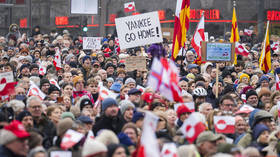
Protesters on City Square during a protest in support of Greenland on January 17, 2026 in Copenhagen, Denmark. © Martin Sylvest Andersen/Getty Images

US President Donald Trump’s acquisition of Greenland without Denmark’s consent would have far-reaching consequences for NATO itself, Mats Nilsson, a senior analyst at the Dissident Club, told RT on Sunday.

“It would be another nail in NATO’s coffin,” he warned. “If the United States were to grab Greenland against the wishes of Denmark, the idea of a united NATO would effectively collapse.”

Nilsson argued that Trump’s renewed push to acquire Greenland follows a “long and complex historical tradition of American territorial expansion,” rooted in the ideology of ‘manifest destiny’ and imperial thinking.

He stressed, however, that such thinking is fundamentally incompatible with modern international law.

Trump’s actions were legally very incoherent and very political, naive for today’s setting. It might have worked well in the 19th century and early 20th century, but since the mid-20th century, territorial sovereignty is inseparable from the will of the people who inhabit it.

According to Nilsson, any change in Greenland’s status “can only legally come from a process led and approved by the Greenlandic people themselves, not from a bilateral sale or purchase by the United States.”

Over the last weeks, Trump has once again declared that Washington would obtain the territory “the easy way” or “the hard way,” insisting the US needs Greenland for “national security.” On Saturday, he also announced tariffs on Denmark, Norway, Sweden, France, Germany, the United Kingdom, the Netherlands and Finland, saying the measures would remain in place until a “complete and total purchase” of the Arctic island is achieved.

European NATO members have largely refrained from direct public confrontation, but behind the scenes, resistance is mounting. This week, Denmark, which retains responsibility for Greenland’s foreign and defense policy, coordinated with several allies to send small contingents of troops to the island ahead of the bloc’s Arctic Endurance exercises.

Both Danish and Greenlandic authorities have rejected any prospect of ceding the island, insisting that its future must be decided by its people, who voted in 2008 to retain autonomous status within the Kingdom of Denmark.

RT network now consists of three global news channels broadcasting in English, Spanish, and Arabic. Read other articles by RT, or visit RT's website.

Freezing EU–US trade deal 'inevitable', Italian MEP Brando Benifei says


By Aida Sanchez Alonso & MĂ©abh Mc Mahon
Published on 

In an interview on Euronews' morning show, Europe Today, MEP Brando Benifei said diplomatic solutions to avoid a trade war "need to be used to the end".

MEP and Head of the European Parliament's delegation for relations with the United States, told Euronews' morning show Europe Today that he does not expect an upcoming vote on the EU-US trade deal scheduled for next week to proceed.


"Inevitably, the vote that was foreseen next week in the trade committee of the European Parliament to actually advance the deal will be frozen," Benifei told Euronews. "I'm sure this will be the result."

US President Donald Trump threatened on Saturday to impose new tariffs on eight European countries that don't support his plans to annex Greenland. He then left the NATO alliance reeling with a letter to Norwegian prime minister Jonas Gahr Støre in which he said that he "no longer (felt) an obligation to think purely of Peace” when it comes to seizing the Danish territory.

After an emergency ambassadors meeting in Brussels on Sunday, several sources told Euronews that member states are prioritising diplomacy and dialogue with the US, but Benifei insisted there should be "a clear deadline" for establishing where Brussels and Washington's relationship stands.

"If in a few weeks we do not have clarity and an agreement on the future of Greenland, I think we need to be clear that the measures will be activated", he told Euronews.

One of those measures could be the anti-coercion instrument (ACI), a tool adopted in 2023 that has so far never been used. This would allow the bloc to punish unfriendly countries for "economic blackmail".

Benifei said diplomacy "must be used until the very end", but that "there must be an end".

"The problem of Europe is that the attempt to find a diplomatic solution, sometimes seems to never end. And this benefits, in this case, the US, who think we are not credible."

Benfei said he expects US counterparts to intervene and hopes "many more voices in the US Congress will raise to say that madness has to end, and that we need to sit down and work together as allies".


France and Germany push to use EU anti-coercion tools if Trump's new tariffs become reality

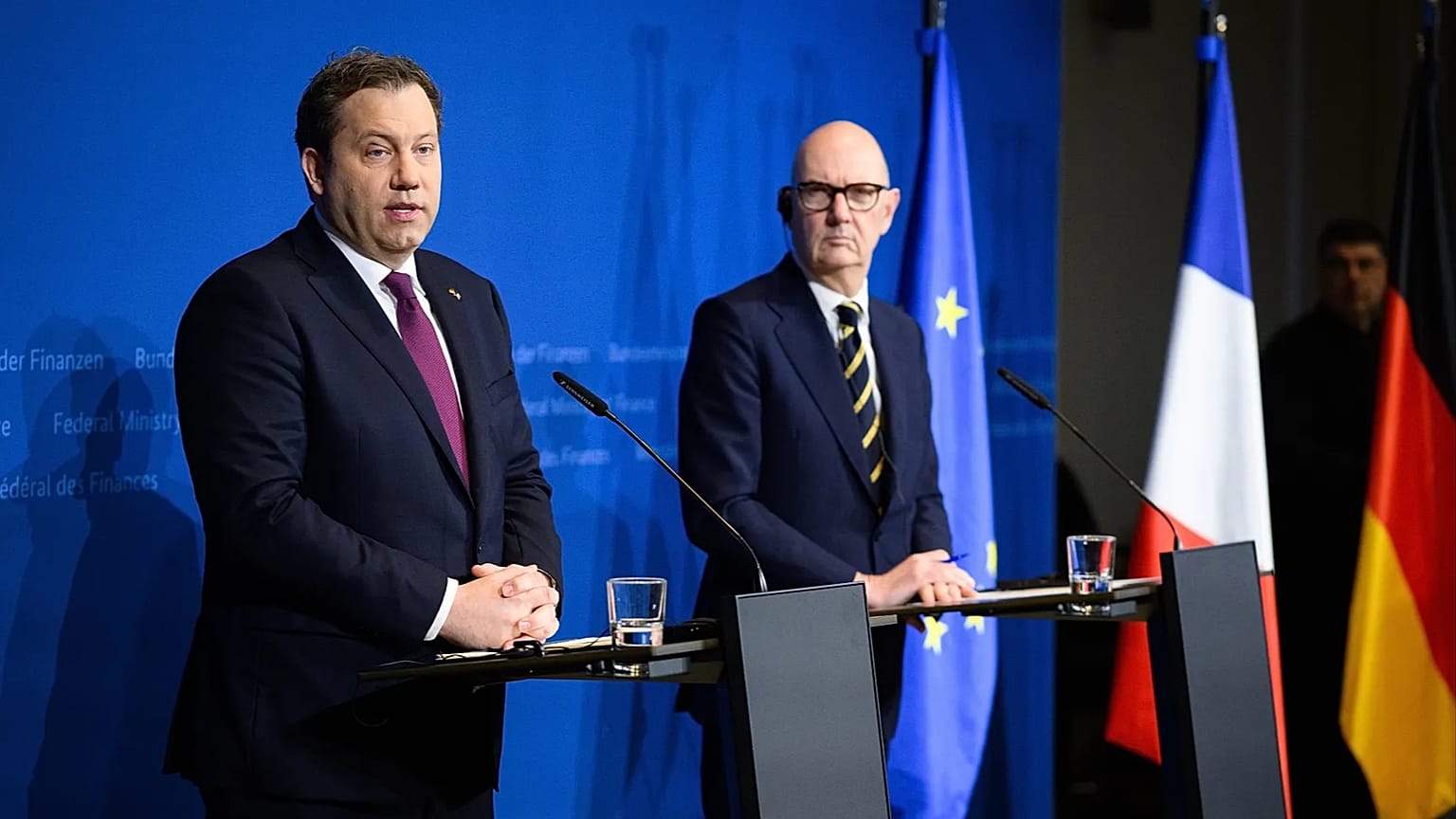
German Finance Minister Lars Klingbeil, left, and French Finance Minister Roland Lescure speak at a press conference at the Federal Ministry of Finance in Germany.
Copyright Bernd von Jutrczenka/dpa via AP

By Eleonora Vasques & Mared Gwyn Jones
Published on 

The German and French finance ministers said that the EU should be able to use all tools at its disposal if US president Donald Trump raises tariffs on European goods by 10% on 1 February.

German and French Finance Ministers Lars Klingbeil and Roland Lescure say they will push European partners to use all tools at their disposal, such as anti-coercion measures, if United States President Donald Trump makes good on his threat to increase tariffs on European goods by 10%.

The two ministers told journalists on Monday that they will make everything in their power to prevent these tariffs from being applied, but that if the US proceeds with its threat, the European Union must act accordingly.

Lescure called Trump's pressure "unacceptable" and said that tariffs should not be used as a weapon.

"Europe has to make sure that the threats that have been imposed don’t become reality," he said in Brussels. "We need to show that we’re willing to use all the instruments at our disposal, whether they are tariffs, trade agreements, or anti-coercion measures.”

Klingbel said that the severity of the situation must not be underestimated.

"Now it is time for our American friends to say 'we do not want escalation'. We also want many companies to avoid an escalation. But if President Trump does what he announced on February 1, then we have to react consciously."

Over the weekend, Trump said the US will increase tariffs on European goods by 10% if the bloc continues to oppose his efforts to take control of Greenland.

Among the tools the EU can use there is the Anti-Coercion Instrument, which enables the bloc to punish unfriendly states for economic coercion by restricting them from participating in public procurement tenders, limiting trade licenses, and even shutting off access to the single market.

Adopted in 2023, the instrument has never been used, but the US president's escalating threats over the weekend prompted calls for the instrument to be deployed, including from French President Emmanuel Macron.

Former senior EU officials, including former Commissioners Paolo Gentiloni and Cecilia Malmström, have also backed deploying the instrument.


European allies hit back at US threat to start trade war over Greenland

European leaders have warned transatlantic ties are at risk after President Donald Trump's announcement that eight countries, including France, will face tariffs of up to 25 percent if they continue to oppose the United States' bid to acquire Greenland. French President Emmanuel Macron called the threats "unacceptable".


Issued on: 18/01/2026 - RFI

People protest against President Donald Trump's efforts to take over Greenland in front of the US consulate in Nuuk, Greenland, on 17 January 2026. © AP - Evgeniy Maloletka

EU countries held crisis talks on Sunday after Trump said that he would charge a 10 percent import tax from February on goods from eight European countries that are resisting American control of Greenland – France, Denmark, Norway, Sweden, Germany, the United Kingdom, the Netherlands and Finland.

The rate would climb to 25 percent on 1 June if no deal was in place for "the Complete and Total purchase of Greenland" by the US, he wrote on his Truth Social platform on Saturday.

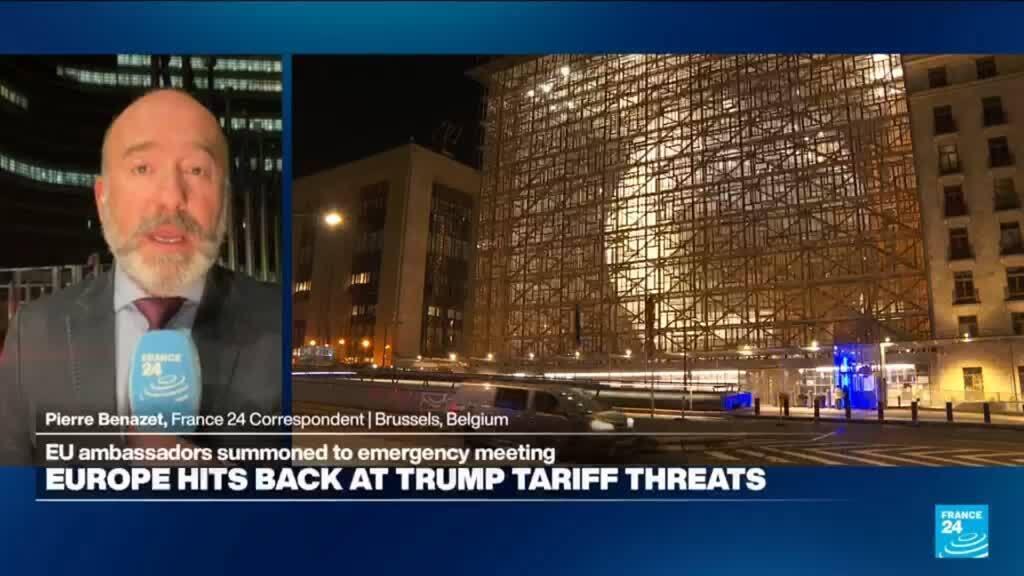
An emergency meeting of EU ambassadors took place in Brussels on Sunday.

Macron will ask the European Union to activate its powerful "Anti-Coercion Instrument" if the US imposes tariffs, his team said before the talks.

The bloc's weapon – dubbed its trade "bazooka" – allows the EU to impose tariffs and investment limits on countries exerting economic pressure on member states to force them to change policy. It has never been used before.

France to open Greenland consulate amid Trump takeover threats

'Dangerous downward spiral'


France is one of several countries that has deployed troops to the autonomous Danish territory in response to Washington's ambitions. Paris says the European military exercise is designed to show the world that it will defend Greenland.

"Tariff threats are unacceptable and have no place in this context," President Macron wrote in a post on X, saying that France and its European allies would present a united response.

"No intimidation or threat can influence us, neither in Ukraine, nor in Greenland, nor anywhere else in the world... We will ensure that European sovereignty is respected," Macron said.

All eight countries named by Trump issued a joint statement saying they backed Denmark and Greenland, and that their military exercise posed no danger to others.

"Tariff threats undermine transatlantic relations and risk a dangerous downward spiral," it said. "We will continue to stand united and coordinated in our response. We are committed to upholding our sovereignty."

In a similarly worded statement, EU leaders said the bloc "stands in full solidarity with Denmark and the people of Greenland".

Day of protests

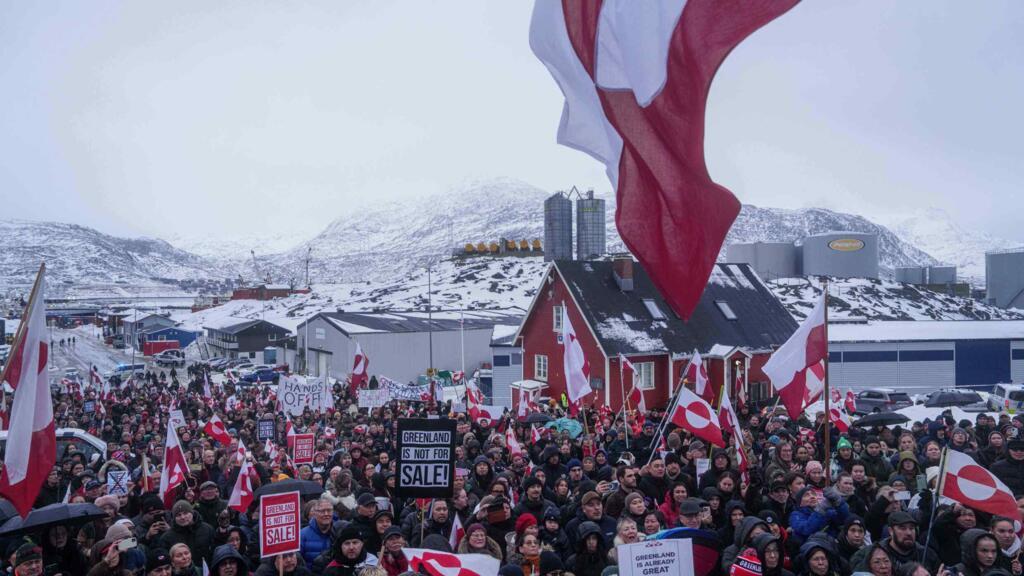
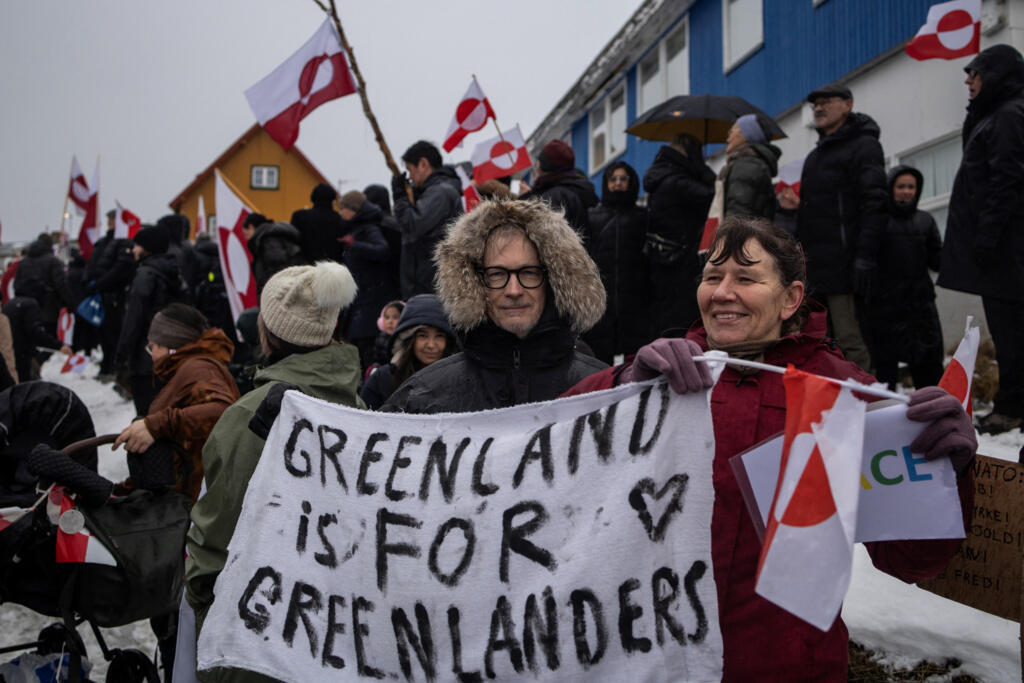
Trump's threats came as thousands of people protested in the capital of Greenland against his drive to acquire the island, rich in rare minerals and a gateway to the Arctic.

Thousands more demonstrated in Copenhagen and other Danish cities.
People attend a protest against President Donald Trump's demand that the Arctic island be ceded to the US, in front of the US consulate in Nuuk, Greenland, on 17 January 2026. © REUTERS - Marko Djurica


Trump has repeatedly claimed that the United States needs Greenland for US "national security", while alleging without evidence that China and Russia are trying to control it.

It was not immediately clear what authority the US president would invoke to impose the threatened tariffs, nor how he would target individual EU countries when the 27 members trade as a bloc.

If carried out, Trump's threats against NATO partners would create unprecedented tension within the military alliance, already under strain.

"In this escalation of tariffs, he has a lot to lose as well, as do his own farmers and industrialists," French Agriculture Minister Annie Genevard told broadcasters Europe 1 and CNews on Sunday.

The tariff announcement even drew criticism from Trump's populist allies in France.

Jordan Bardella, president of the far-right National Rally party, posted that the EU should suspend last year's deal to avert stiffer US tariffs on European goods, describing Trump’s threats as "commercial blackmail".

That deal, which the European Parliament had been set to ratify by next month, now faces rejection by lawmakers.

(with newswires)

What is the EU anti-coercion 'bazooka' it could use against the US over Greenland?

The EU's anti-coercion instrument, which French President Emmanuel Macron on Sunday mentioned activating after US President Donald Trump's tariffs threats regarding Greenland, is a trade tool that the bloc adopted in 2023 but has never used. Compared by some to a “bazooka”, it aims to respond to any country using trade weapons to pressure an EU member state.


Issued on: 19/01/2026 
By: FRANCE 24


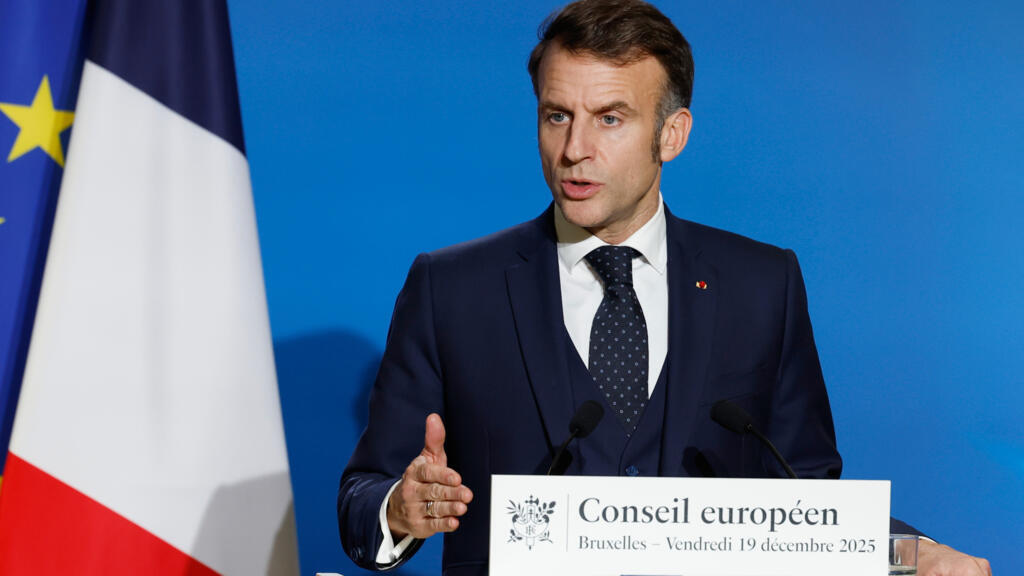
French President Emmanuel Macron speaks during a media conference at the EU Summit in Brussels on December 19, 2025. © Geert Vanden Wijngaert, AP

Calls are growing louder for the EU to deploy its powerful "anti-coercion instrument" in response to US President Donald Trump's threats to impose tariffs in the standoff over Greenland.

Trump stunned Europe on Saturday when he vowed to slap EU members Denmark, Finland, France, Germany, the Netherlands, and Sweden – and non-members Britain and Norway – with levies of up to 25 percent unless the Danish territory is ceded to the US.

French President Emmanuel Macron has raised the prospect of hitting back with the EU's trade weapon that was established in 2023 but has never been activated.

READ MORETrump tariff threats over Greenland prompt calls for unprecedented EU counter-measures


The leader of the liberal Renew group in the European Parliament, Valerie Hayer, also called for the weapon to be used.

Referred to as a "bazooka" or "nuclear" option, the instrument is intended to deter economic coercion against any of the EU's 27 member states.

The EU defines coercion as a third country "applying – or threatening to apply – measures affecting trade or investment", thereby interfering "with the legitimate sovereign choices" of the EU and member states.


How can Europe respond to Trump's tariff threats over Greenland?

© France 24
06:23


What does the instrument do?


The armoury allows the EU to take measures such as import and export restrictions on goods and services in its single market of 450 million people.

It also gives Brussels the power to limit American companies' access to public procurement contracts in Europe.

The EU last year threatened to use the weapon during difficult trade negotiations with Trump to avoid steep levies but the two sides struck a deal.

A major target could be American tech giants since the US has a services surplus with the EU.

Brussels previously drew up a list of US services to potentially target.

The instrument's creation came after Lithuania accused China of banning its exports because Vilnius allowed a Taiwanese diplomatic representation to be opened on its soil in 2021.


How does it work?


Both the commission and member states have the right to seek its activation, but it would then need the green light of at least 55 percent of the member countries voting in favour, representing 65 percent of the bloc's population.

Even if Brussels were to activate the weapon, it could take months before any measures were taken, according to the rules.

First, the European Commission has four months to investigate the third country accused of detrimental trade policies – then member states would have eight to 10 weeks to back any proposal for action.

Only then would the commission have a green light to prepare measures, to take effect within six months. The EU says the timeframe is indicative.

But even just triggering an investigation under the instrument would send a powerful message that Brussels is willing to fight back against its important ally.

"The United States is making a miscalculation that is not only dangerous but could be painful," Renew group's Hayer said in a statement.

"The anti-coercion instrument is our economic nuclear weapon," she said.

(FRANCE 24 with AFP)

Trump also has 'a lot to lose' from threatened tariffs over Greenland, French minister says

French Agriculture Minister Annie Genevard warned Sunday that US President Trump's proposed tariffs on European countries opposing his plans to purchase Greenland would be "deadly for the United States". Trump on Saturday threatened a 10-percent tariff from February 1 on all goods sent to the US from eight European countries, including France.


Issued on: 18/01/2026 
By: FRANCE 24

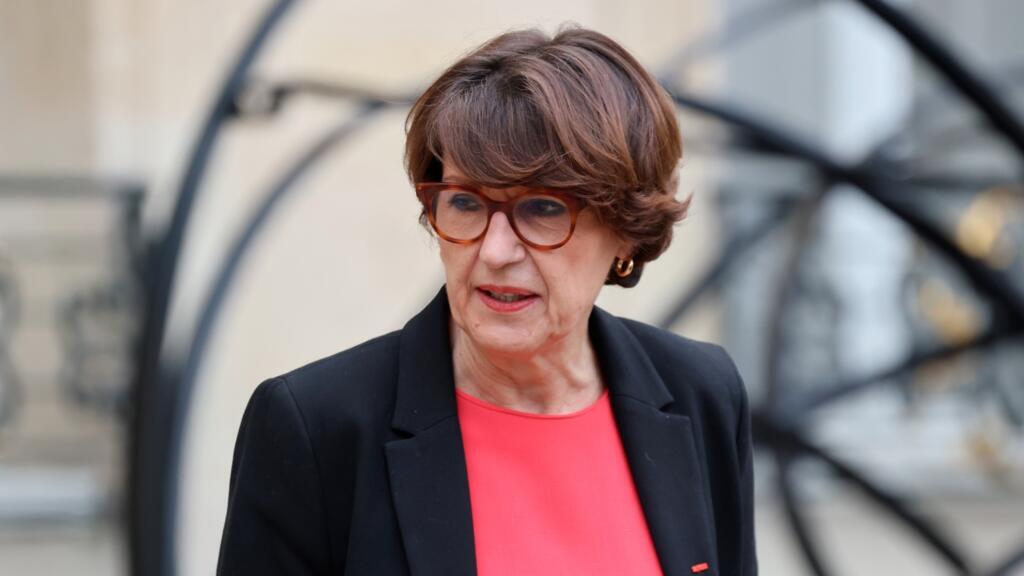
France's Agriculture Minister Annie Genevard leaves after attending the weekly cabinet meeting at the ElysĂ©e Presidential Palace, in Paris, on January 14, 2026. © Ludovic Marin, AFP file photo

The United States will also suffer if President Donald Trump implements threats to impose tariffs on European countries opposing his plans to acquire Greenland, a French minister said on Sunday.

"In this escalation of tariffs, he has a lot to lose as well, as do his own farmers and industrialists," French Agriculture Minister Annie Genevard told broadcasters Europe 1 and CNews.

Trump has threatened to impose a 10-percent tariff from February 1 on all goods sent to the United States from DenmarkNorwaySwedenFranceGermany, the UK, the Netherlands and Finland.


EU looks to present united front in response to US 'blackmail'
© France 24
04:05


All are part of the European Union, except for the United Kingdom and Norway.

That levy would then be increased to 25 percent on June 1 "until such time as a deal is reached for the complete and total purchase of Greenland", said Trump, who claims the United States needs the Arctic island, an autonomous Danish territory, for its national security.
'It could also be deadly for the United States'

An extraordinary meeting of EU ambassadors has been called in Brussels for Sunday afternoon.

"The European Union has a potential strike force" from a commercial standpoint, Genevard said.

"This is a response that must be handled with caution, because this escalation could be deadly – but it could also be deadly for the United States."

Any US takeover of Greenland would be "unacceptable," the minister added.

"It is clear that the Europeans will not let the United States do as it pleases."

(FRANCE 24 with AFP)

Europe's pro-Trump leaders tread carefully as Greenland crisis grows


By Sandor Zsiros
Published on 

Hungary's Viktor Orbán, Slovakia's Robert Fico, and Andrej Babiš from the Czech Republic will play a crucial role in any joint EU response to the Trump administration's threats.

As pressure mounts to calibrate a joint European Union response to the United States's threats over Greenland, EU leaders with ties to US President Donald Trump have yet to push back hard against his latest statements.

Trump threatened on Saturday to impose a 10% extra tariff on goods from European countries that oppose the sale of the Arctic island to the US, and warned that if the US has not been allowed to purchase Greenland by June 1, the rate will be hiked to 25%.

As the EU scrambles for ways to deal with the situation, the process of reaching a joint EU position could depend on three countries in particular: Slovakia, Hungary and the Czech Republic..

Slovakian Prime Minister Robert Fico met Trump in Mar-a-Lago on Saturday, the same day that Trump issued his latest tariff threats on social media. Speaking on a flight back to Slovakia, Fico hailed the two countries' bilateral ties, adding that both Trump and he were critical of the EU.

"We did not avoid the assessment of the EU, its competitiveness, energy and migration policy, while there was a complete agreement in viewing the EU as an institution in deep crisis,” Fico said in a video released on Sunday – not mentioning Greenland or expressing solidarity with the countries Trump directly threatened.

On Sunday, meanwhile, Hungary’s Viktor Orbán announced he had received a letter from Trump inviting him to join the Board of Peace, a body aimed at helping establish post-war administration and reconstruction in Gaza.

“With President Donald Trump comes peace. Another letter has arrived. Hungary’s efforts for peace are being recognised. President Trump has invited Hungary to join the work of The Board of Peace as a founding member,” Orbán tweeted.

But the Hungarian government has kept silent over Trump's latest threats. Orbán has previously said that the issue of Greenland can be discussed inside NATO and need not prompt an international crisis.

Czech Prime Minister Andrej Babiš posted on X on Monday afternoon to say there is no question that Greenland is an autonomous Danish territory, but he stopped short of calling for pushback against Trump's threats.

"There is no doubt about that. But we will support dialogue, not declarations," Babiš wrote. "Foreign policy is about diplomacy, not about who posts the stronger statement on social media."

Earlier, Babiš gave an interview to a conservative Hungarian website, Mandiner, where he said Trump is not helping Europe, but helping the US with his program to "make America great again".

Babiš also described himself as one of the biggest European supporters of Trump, also naming Orbán and Polish President, Karol Nawrocki.

One outlier in Europe's pro-Trump right is Italian Prime Minister Giorgia Meloni, who on Sunday criticised Trump’s stance as a “mistake” that could be the result of a misunderstanding.

"The prediction of a tariff increase against nations that have chosen to contribute to Greenland's security is a mistake, and I don't agree with it," Meloni said during a visit to South Korea.

The President of the European Council, AntĂłnio Costa, is convening a special EU summit on Thursday evening to discuss the Greenland issue and agree a collective response.

The agreement of Hungary, Slovakia and the Czech Republic will be needed, and their positions are as yet unknown.

But according to Fabian Zuleg, Chief Executive at the European Policy Centre, unity cannot become an excuse for paralysis when it comes to Greenland.

"If unity cannot be achieved, those governments that are unwilling to act – such as Hungary, but also others on a case-by-case basis – must be excluded, and exclusion must have consequences", he said, arguing that states blocking collective action at the European level should no longer be able to benefit fully from shared defence, security cooperation or industrial investment.

"Solidarity is a two-way street and not unconditional."


World leaders to gather at Davos as Trump reshapes global order

EVIL EYED EAGLE


Copyright AP Photo

By
Aleksandar Brezar
Published on 18/01/2026 - 20:12 GMT+1 •Updated 23:34

The annual gathering of political and business elites comes as Europe faces its biggest test ever over its relationship with Washington, its economic model and its security architecture.


To most Davos regulars, the Sunday before the world's biggest economic and political summit seemed unusually busy.

This year's World Economic Forum, they say, promises to be one like no other.

In the otherwise serene if not sangfroid Swiss resort town, anticipatory anxiety became increasingly palpable as world leaders were about to converge on it for what is almost certainly going to turn into a fundamental reassessment of the existing international system.

All eyes are on the midweek, as US President Donald Trump is expected to make his first appearance at the summit in six years, arriving amid tensions over his attempts to acquire Greenland, his tariff threats against European allies and his military intervention in Venezuela.

The annual gathering of political and business elites comes as Europe faces its biggest test ever over its relationship with Washington, its economic model and its security architecture.

Trump to talk about home, Europeans to expect answers

Trump's keynote speech on Wednesday is likely to focus heavily on concerns back home despite the international setting.

The president faces domestic pressure over affordability, and Trump wants to offset this by revealing "initiatives to drive down housing costs" and "tout his economic agenda that has propelled the United States to lead the world in economic growth," a White House official said.

But Trump will also address European leaders directly. He will "emphasise that the United States and Europe must leave behind economic stagnation and the policies that caused it," the White House official said.

The US president recently threatened tariffs against European NATO allies if they do not support his attempt to take control of Greenland from Denmark. European military personnel have deployed to Greenland in recent days in response.

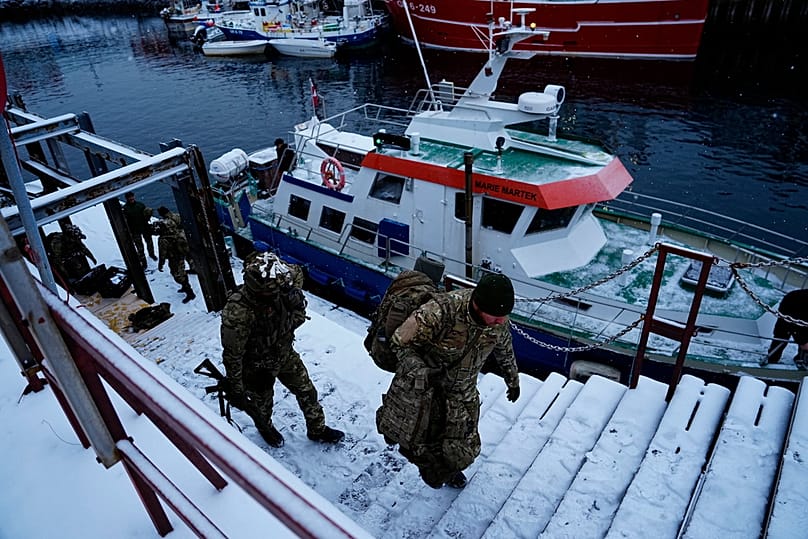
Danish soldiers disembark at the port in Nuuk, Greenland, 18 January 2026 AP Photo

The series of moves has resulted in significant unease among Europe's leaders, who see the push to take control of the Arctic island "whether they like it or not" as undermining the foundations of NATO and jeopardising an age-old friendship forged by fire in World War II.

On Sunday, the UK, Denmark, Finland, France, Germany, the Netherlands, Norway and Sweden issued a joint statement saying Trump's actions over Greenland risk a “dangerous downward spiral” and undermine transatlantic relations, in one of the most strongly worded messages to Washington in recent times.

While others such as NATO Secretary General Mark Rutte have tried to calm the spirits, with Rutte saying, "We will continue working on (resolving the question of Greenland), and I look forward to seeing him in Davos later this week," anxiety that came with the new year not only persisted, but increased.

What happens in Davos does not stay in Davos


There is also the question of Russia's ongoing all-out war in Ukraine, which Trump has been desperate to find an end to.

Ukrainian President Volodymyr Zelenskyy, who will also appear in Davos in person, hopes to meet Trump to sign new security guarantees for a potential ceasefire deal with Russia. G7 leaders also seek discussions on Ukraine.

Washington's largest-ever Davos delegation includes US Secretary of State Marco Rubio, special envoy Steve Witkoff and son-in-law Jared Kushner, who have all played roles on Ukraine.

While the White House said no bilateral meetings have been scheduled, the presence of Witkoff and Kushner — seen as key to any negotiations with Moscow and Kyiv — has led insiders to believe that a deal between Trump and Zelenskyy will be signed in Davos.

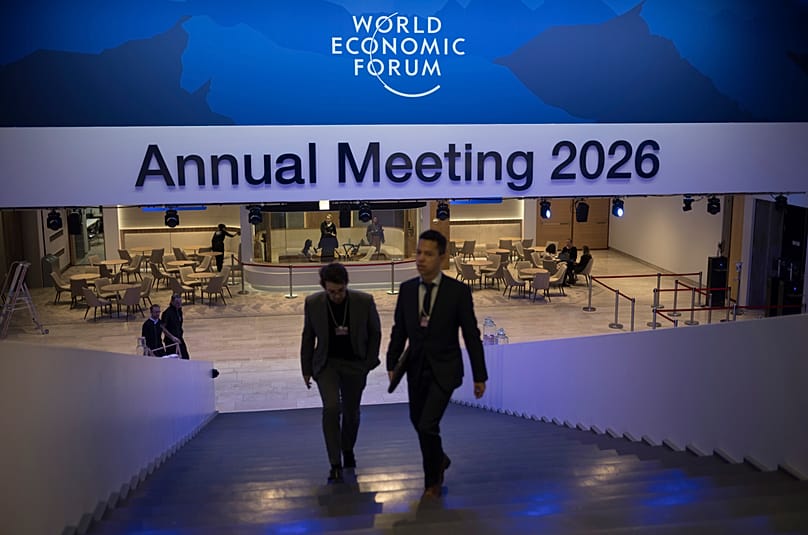
Two men walk up the stairs at the Congress Center where the Annnual Meeting of the World Economy Forum takes place in Davos, 18 January 2026 AP Photo

Meanwhile, Trump is reportedly considering a first meeting of the "Board of Peace" for Gaza at Davos, after announcing its first members in recent days.

A $1 billion (€863 million) contribution secures permanent membership on the Trump-led board, rather than a three-year appointment, which has no contribution requirement, according to a US official who spoke on condition of anonymity about the charter, which has not been made public. The official said the money raised would be used to rebuild Gaza.

Hungarian Prime Minister Viktor Orbán has accepted an invitation to join the board, Foreign Minister PĂ©ter SzijjártĂł told state radio on Sunday. Orbán is one of Trump’s most ardent supporters in Europe.

Jordan, Greece, Cyprus and Pakistan also said Sunday they had received invitations. Canada, Turkey, Egypt, Paraguay, Argentina and Albania have already said they were invited, while an Indian official revealed Delhi has also received an invite. It was not clear how many have been approached in all.

In letters sent Friday to world leaders inviting them to be “founding members,” Trump said the Board of Peace would “embark on a bold new approach to resolving global conflict.”

Critics have claimed that the board might be an attempt by the US president to create an alternative to the UN, which would be under Trump's personal control.
RelatedTrump's Greenland threat risks 'dangerous downward spiral,' European leaders say
Pressure grows on the EU to deploy trade bazooka against Trump's Greenland tariff threat

Questions also surround the future of Venezuela following the blitz US military operation that removed Nicolás Maduro, part of Trump's muscular approach to what he calls America's "backyard".

Then there is also Iran, with reports stating that Trump called off an intervention against the regime in Tehran over its crackdown on widespread protests at the last minute.

While Washington may yet decide ayatollah's time in power is over, the presence of Iran's Foreign Minister Abbas Araghchi at Davos could signal that conversations on the sidelines are on the cards.

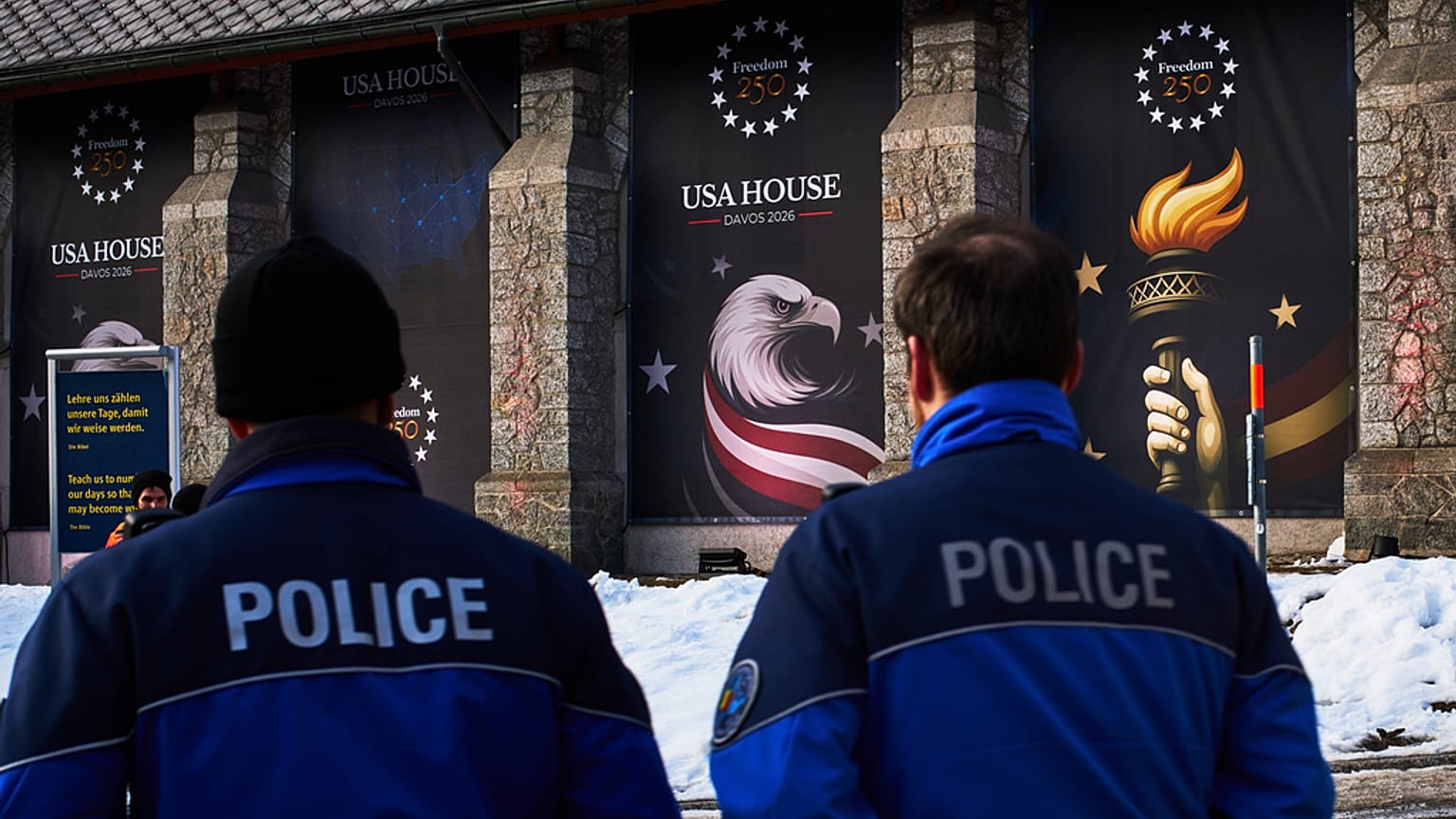
'USA House' talk of the town


The forum has historically been an awkward fit for Trump. His first Davos appearance in 2018 met occasional boos. He returned forcefully in 2020, dismissing "prophets of doom" on climate and the economy.

Trump left office in 2021 after losing re-election but has since returned as a more assertive president domestically and internationally.

The logo of the World Economy Forum is displayed on a window of the Congress Center where the Annual Meeting Forum takes place in Davos, 18 January 2026 AP Photo

Davos might prove crucial to his ambitions, and the fact that the US has two houses in the Swiss town — one of which is a church and a prominent venue — further signalled Washington's intentions to reestablish itself as the leader of the free world.

European leaders attending Davos have recently faced unprecedented pressure to respond to Trump's challenge to the transatlantic alliance that has underpinned the Western economic order for nearly a century.

The gathering comes as Europe grapples with anaemic economic growth, an ever-trigger-happy Moscow on its eastern border and questions about the continent's ability to defend itself without full US security guarantees.