Trump in Greenland: Old-Fashioned Colonialism And Acceleration Of The Climate Catastrophe!

Almost everyone is currently talking, and rightly so, about Trump’s clearly stated intention to occupy and annex Greenland “by hook or by crook.” However, no one has even mentioned what would be by far the most important and serious consequence of this imperialist and colonialist act of unbridled Trumpism: the enormous acceleration and worsening of the climate catastrophe already underway! An acceleration of the climate crisis with nightmarish effects for humanity, which would be incomparably greater than all the—much-discussed—geopolitical and other consequences of its occupation by the United States.
Indeed, given that Greenland is the nerve center of global warming, warming about four times faster than the rest of the world, Trump’s intention to gut it in order to proceed with the widespread plundering of its subsoil, rich in rare earths and even gold and oil, in the name of “US national security,” will only greatly accelerate what is already happening: the melting of its ice cap—the second largest after Antarctica—which has the direct consequence of raising sea levels! A rise in sea levels that is already disrupting ocean currents, to the point of threatening them with collapse.
And to leave no doubt as to the seriousness of this threat, here is what was reported by the world’s major news agencies two months ago: “ Iceland has designated the potential collapse of a major Atlantic Ocean current system a national security concern and an existential threat, enabling its government to strategize for worst-case scenarios, the country’s climate minister told Reuters. ” (1). Indeed, according to climatologists, the increasingly likely collapse of the ocean current system known as AMOC (Meridional Overturning Circulation) “would have devastating and irreversible consequences, particularly for Nordic countries, but also for other regions of the world.” It would raise sea levels in the Atlantic, alter monsoons in South America and Africa, reduce rainfall in Europe and North America, causing a winter cold snap in Europe, with sea ice likely to extend southward to the United Kingdom!
In short, the imminent (?) occupation of Greenland by Trump and his acolytes confirms once again not only how little the climate-denying Trump cares about protecting the environment, but also his total disregard for international law and the rights of indigenous peoples. This contempt was highlighted in all its facets a few days ago by the White House ideologue and strongman Stephen Miller during his interview with CNN.
Preaching a return to the good old days of unapologetic colonialism, Trump’s chief advisor and confidant Stephen Miller, who takes pleasure in drawing inspiration from… Goebbels in his speeches and ideas (!), caused a scandal by making the following statements: “” Not long after World War II the West dissolved its empires and colonies and began sending colossal sums of taxpayer-funded aid to these former territories (despite have already made them far wealthier and more successful). The West opened its borders, a kind of reverse colonization, providing welfare and thus remittances, while extending to these newcomers and their families not only the full franchise but preferential legal and financial treatment over the native citizenry. The neoliberal experiment, at its core, has been a long self-punishment of the places and peoples that built the modern world“. And after this veritable eulogy to old-style colonialism, followed by an unequivocal condemnation of decolonization, Miller concluded by describing the frightening credo of Trumpism: ” We live in a world in which you can talk all you want about international niceties and everything else. But we live in a world, in the real world … that is governed by strength, that is governed by force, that is governed by power. These are the iron laws of the world. (…) We’re a superpower. And under President Trump, we are going to conduct ourselves as a superpower “.
So we have been warned. The real novelty is not that the United States under Trump will act like a superpower, which it already did long before him, but rather that it will act like an old-fashioned colonial superpower! That is to say, practicing direct domination and plunder, unapologetic racism and brute military violence, without the intermediaries, the pseudo-solidarity and democratic hypocrisy, the half-measures, and everything that has made up neocolonialism over the last 6-7 decades! Clearly, the break with the imperialist past is quite significant. This means that Trump’s claims on Venezuela or Greenland are not the passing whims of a deranged and megalomaniacal old man, but rather the first signs and manifestations of a long-term global political, economic, and military project designed to upset all existing balances, including those between the imperialist powers. (2) All the more so as Trump no longer hesitates to publicly display his nostalgia for the good old days when white supremacists practiced their deadly racism with impunity, or his criticism of the American Civil War that saw the defeat of his beloved Southern slave owners…
How naive and irresponsible, then, are those who persist in confusing Trump with Biden, Bush, or the… European Commission. Or who are not preparing to face the racist, militaristic, and warmongering cataclysm heralded by this return to the most extreme capitalist barbarism promised by Trumpism through the mouth of its ideologue Stephen Miller. It is therefore up to all of us to stop Trump and his evil and criminal plans before it is too late. For only our fatalism and passivity can guarantee Trump the success of his predatory, criminal policies, steeped in delusional racism and deeply inhuman. In short, nothing is decided in advance and the outcome of this mother of all battles depends exclusively on us, on those from below everywhere in the world. Starting with those who are already fighting at the heart of the fascist monster, in the United States of America…
Notes
1. Iceland deems possible Atlantic current collapse a security risk: https://www.reuters.com/sustainability/cop/iceland-sees-security-risk-existential-threat-atlantic-ocean-currents-possible-2025-11-12/
2. Testifying in 2019 before the US Congress, Fiona Hill, then Trump’s senior advisor on Russia and Europe, reported on “suggestions” from Kremlin circles regarding Moscow’s possible acceptance of the US occupation of Venezuela in exchange for Washington’s acceptance of Russia’s occupation of Ukraine. Returning a few days ago to her 2019 testimony, Ms. Hill said that the lack of reaction and relative passivity shown by the Kremlin in response to the recent US military operation in Venezuela and the subsequent looting of its hydrocarbons would suggest a possible update of this “exchange” suggested by Moscow in 2019 and rejected at the time by Trump.
Comment
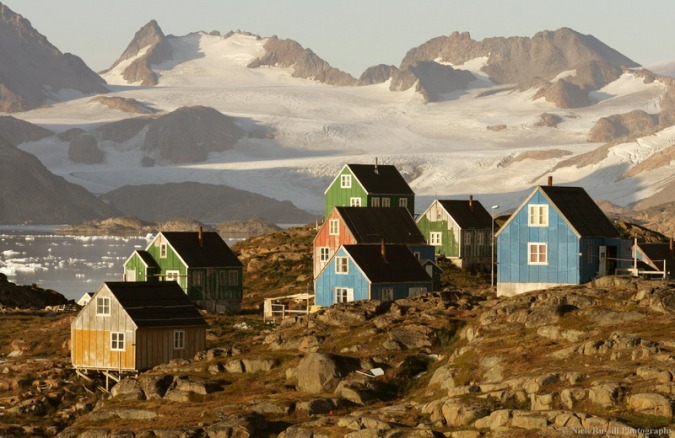
President Donald Trump started his second term with his sights set on Greenland.
When Trump first proposed buying the arctic nation during his first administration, it was treated like a joke. But in a phone call last week with Denmark’s prime minister, who controls the autonomous territory’s foreign policy, the president doubled down on his efforts to seize power. In the “aggressive and confrontational” conversation, Trump threatened tariffs if he didn’t get his way. In a news conference earlier this month, he also refused to rule out the use of military force. Now Denmark is taking him seriously: on Monday, it announced a $2 billion military expansion in the Arctic.
Though the island is not for sale, the president emphasized Greenland’s importance to US national security. Left unspoken: a US takeover could weaken the country’s mining laws and ban on private property, aiding Trump donors’ plans to profit from the island’s mineral deposits and build a libertarian techno-city.
Trump, who has summarized his own natural resources policy as “drill, baby, drill,” would likely approach the island’s natural resources quite differently from Greenland’s current government, which has opposed large extractive projects.
In 2019, Trump’s ambassador to Denmark and Greenland visited a major rare-earth mining project on the island shortly before Trump’s first calls to buy the country. Opposition to the mine ushered liberal political party Inuit Ataqatigiit into power two years later, which halted the mine and banned all future oil development.
The president’s renewed intention to take over Greenland has reignited debates over its sovereignty, as the country grapples with the trade-offs between economic opportunity and independence from Denmark. As the country’s glaciers recede, it’s also facing sweeping climate-driven transformations, threatening traditional industries like fishing and hunting and exposing valuable mineral resources.
These shifts have prompted interest from powerful players associated with Trump. Tech moguls in the front row of his inauguration, like Mark Zuckerberg and Jeff Bezos, are also investors in a start-up aiming to mine western Greenland for materials crucial to the artificial intelligence boom.
That company, KoBold Metals, uses artificial intelligence to locate and extract rare earth minerals. Their proprietary algorithm parses government-funded geological surveys and other data to locate significant deposits. The program pinpointed southwest Greenland’s rugged coastline, where the company now has a 51 percent stake in the Disko-Nuussuaq project, searching for minerals like copper.
Just two weeks before some of its investors were glad-handing at the Capitol celebrations, KoBold Metals raised $537 million in its latest funding round, bringing its valuation to almost $3 billion. Among the contributors was a leading venture capital firm founded by Marc Andreessen, an early Silicon Valley entrepreneur who has helped shape the administration’s technology policies, including consulting with Trump’s Department of Government Efficiency as a self-proclaimed “unpaid intern.”
“We believe in adventure,” Andreessen wrote in a lengthy 2023 manifesto that outlined his criticisms of centralized government, advocating for technologists to take control, “rebelling against the status quo, mapping uncharted territory, conquering dragons, and bringing home the spoils for our community.” Connie Chan, a general partner at his venture capital firm Andreessen Horowitz, is listed as a KoBold director in its 2022 Securities and Exchange Commission filing.
In addition to KoBold, Andreessen has also backed other ventures eyeing the arctic nation: he is a significant investor in Praxis Nation, a project aiming to use Greenland to establish a “crypto state,” a self-governing, experimental community built around libertarian ideals and technology like cryptocurrency.
The venture is also funded in part by Pronomos Capital, a venture capital group founded by the grandson of economist Milton Friedman and bankrolled by libertarian figures such as Peter Thiel, whose own family reportedly managed a uranium mine in Namibia. Pronomos aims to create private, business-friendly charter cities like Praxis, often in developing countries where investors could write their own laws and regulations.
These “broligarchs” now have the ear of the president. Thiel has been a significant supporter of Trump, throwing millions of dollars behind him throughout his political career and introducing him to current Vice President J. D. Vance.
Most notable, in December, Trump announced Thiel’s partner Ken Howery as his Danish ambassador, making his intentions explicitly clear: “The United States of America feels that the ownership and control of Greenland is an absolute necessity,” he wrote on TruthSocial, his social media platform.
Greenland’s prime minister Múte Egede flatly rejected the idea, responding on Facebook, “Greenland is ours. We are not for sale and will never be for sale. We must not lose our long struggle for freedom.”
When the Price Is Too High
For centuries, the fight to control Greenland has revolved around its natural resources. The ice-gripped country has been part of Denmark since 1721 when a merchant-backed missionary expedition sought to spread Christianity to its Inuit population — and expand whaling and trade routes.
Greenland gained autonomy from Denmark in 1979, though the Danes continued to control its foreign relations and defense, allowing the United States to build and operate military bases there. In a 2008 referendum, Greenlanders voted for greater independence, allowing them to take control of their natural resources along with other state functions.
That same year, the US Geological Survey found the country had one of the world’s largest potential oil and gas reserves. More recent estimates suggest that the Arctic could hold 13 percent of the world’s undiscovered oil and 30 percent of its undiscovered natural gas. The report drew the attention of major oil companies like ConocoPhillips, Chevron, and BP, which began acquiring exploration licenses and conducting surveys around Greenland and its offshore areas.
But producing oil in such harsh conditions is difficult and expensive due to high transportation costs and infrastructure limitations. ExxonMobil, for example, withdrew its application in 2013, as a downward trend in oil prices made further development economically unfeasible.
When Siumut, a pro-independence political party, came into power earlier that year, leader Aleqa Hammond declared the country would instead transition to mineral extraction, saying, “If we want greater autonomy from Denmark, we have to finance it ourselves. This means finding new sources of income.” In 2014, the government announced a four-year national plan to create “new income and employment opportunities in the area of mineral resources activities.”
Because Greenland’s vast mineral deposits often contain uranium, however, the burgeoning mining industry quickly came into conflict with Denmark’s strict policy against extracting radioactive materials. Denmark chose not to develop nuclear energy in the 1980s, and has comparatively strict regulations around radiation protections.
One of the measures the Siumut-led government took in 2014 was proposing a bill that would have limited public access to environmental information and decision-making processes around mineral extraction. It also lowered environmental standards for uranium mining.
The bill failed to pass, but with Siumut’s support, an international project hoping to extract uranium and rare-earth metals gained preliminary approval. The Australian-based company Greenland Minerals (now called Energy Transition Minerals) found backing from Chinese Shenghe Resources Holdings, and brought Trump’s Greenland ambassador Carla Sands to the site for a visit in July 2019. The following month, Trump announced he wanted to buy the island, comparing it to “a large real estate deal.”
Sands, a former chiropractor and soap opera actress, now works for the America First Policy Institute, a conservative think tank concerned with strengthening the US mineral supply chains, among other nationalist issues.
Energy Transition Minerals’ proposed mine triggered massive controversy: concerns over the potential impact on critical fishing industries and food supplies ushered the Siumut party out of decades of power in 2021. “There is an ongoing, generational dialectic,” says Barry Zellen, a senior fellow of Arctic Security at the Institute of the North, between pro-development and pro-subsistence movements “that tends to swing pendularly.”
As the more left-leaning Inuit Ataqatigiit party took over, it quickly passed a law reinstating limits around uranium that revoked Energy Transition Minerals’ permits and banned all future oil and gas exploration.
“The price of oil extraction is too high,” the party wrote in a statement at the time. “This is based upon economic calculations, but considerations of the impact on climate and the environment also play a central role in the decision.”
These kinds of environmental protections are exactly what Trump aims to remove from American mining. On his own first day in office, one of Trump’s many executive orders directed government officials to remove “undue burdens” on the industry, so that the United States could become “the leading producer and processor of nonfuel minerals, including rare earth minerals.”
“I Went to Greenland to Try to Buy It”
The push for control of the arctic country comes as deep-pocketed investors like Andreessen have been drawn to start-ups hoping to build experimental enclaves, sold by the promise of freedom from the constraints of government.
Proposals for these cryptostates have sprung up in Honduras, Nigeria, the Marshall Islands, and Panama, the latter of which Trump has also recently proposed taking over by military force. While each concept looks a little different, often the sales pitch includes replacing taxes and regulations with cryptocurrency and blockchain.
For Praxis, these utopian dreams have led to Greenland, which is often incorrectly imagined as an unpopulated frontier. “I went to Greenland to try to buy it,” Praxis founder Dryden Brown posted on X in November, noting he first became interested in the island “when Trump offered to buy it in 2019.” Once in Nuuk, he learned that the country has long sought independence from Denmark and that many Greenlanders support sovereignty, though the country remains reliant on Denmark for financial support. It currently receives $500 million a year in Danish subsidies that account for 20 percent of the economy.
“They do not want to be ‘bought,’” Brown belatedly discovered, concluding, “There is an obvious opportunity here.” He proposed taxes from an independently run city like Praxis could help replace Danish subsidies.
Greenland, however, does not allow private property, an arrangement that historically has given communities a stronger voice in determining how or if its natural resources are developed — and could prove a problem for Brown’s planned utopia. But perhaps that could change under a new government.
On Monday, in response to a post referencing “Trump’s projects related to Greenland,” Praxis’s official X account — whose bio reads “We’re meant for more” below a version of the endeavor’s hallucinogenic flag — boasted about “A new post-state in the far North.”
The start-up “nation” has raised $525 million, though Brown, who dropped out of New York University and was fired from his last hedge fund job, hasn’t shared many specifics on Praxis’s website about his proposal for Greenland. (His previous efforts to build a city somewhere in the Mediterranean have also so far remained vague, beyond a branding guide that focused on “traditional, European/Western beauty standards” and recruiting tech employees with “hot girls.”)
But other tech tycoons’ plans for the island are more concrete.
“This Is About Critical Minerals”
Greenland is warming at a much faster rate than the rest of the planet, causing its glaciers to precipitously retreat. As the ice recedes, these valuable deposits are becoming more accessible. A 2023 European Commission survey revealed that Greenland has twenty-five out of thirty-four minerals classified as critical raw materials, or resources that are essential to the green energy transition but have a high risk of disrupted supply chains. The country boasts some of the world’s largest deposits of nickel and cobalt, and collectively, its mineral reserves almost equal those of the United States.
This wealth of resources has drawn the attention of companies like KoBold Metals, whose Silicon Valley backers have a vested interest in supplying materials for the tech industry.
KoBold has positioned itself as providing critical solutions for climate change, facilitating a global reduction in greenhouse gas emissions by supplying the materials needed for batteries and other renewable technologies. The company hailed President Joe Biden’s use of the Defense Production Act to encourage mining in 2022, along with the Inflation Reduction Act’s measures to subsidize international mining for rare earth minerals.
In Greenland, KoBold Metals’ exploration licenses focus on searching for nickel, copper, cobalt, and platinum-group minerals — materials important for green energy, but also for data centers’ rapid growth.
KoBold’s primary development so far has been developing a copper mine in Zambia, the largest such find in a century. Copper is used as a key material in the construction of data centers, and is crucial for artificial intelligence’s infrastructure. The AI boom is expected to nearly double the demand for copper by 2050. “We invested in KoBold,” OpenAI chief executive officer Sam Altman said, to “find new deposits.”
Its Zambia venture, too, has been part of a global power struggle, as the Biden administration backed the development of a railway to transport metals from the region to a port in Angola. The initiative was part of a broader US effort to counter China’s growing presence in Africa, offering investments as an alternative to its Belt and Road Initiative, a trade and infrastructure package.
KoBold’s top executive, however, likes to focus on lithium. “The growth [of lithium demand] is sort of staggering,” KoBold CEO Kurt House said in a 2023 presentation at Stanford. “It’s like a 30x increase in global production that you need.” One of the places the United States might turn to for this critical mineral is Greenland, where promising deposits were recently discovered.
“Everyone wants to have lithium” for its role in creating batteries, says Majken D. Poulsen, a geologist at the Geological Survey of Denmark and Greenland. She explains the first exploration for lithium in Greenland was just conducted last summer in collaboration with the US State Department. Under Biden, the agency also helped the country draft a mining investment law, aimed at encouraging investment in Greenland.
Though quite different in tone, Trump’s Greenland bluster shares similar goals. Charlie Byrd, an investment manager at global assets management firm Cordiant Capital, is one of many investors now hoping the president’s gambit will result in policy changes that are more favorable to foreign investment. “There is no doubt that that would lead to bigger institutional involvement and more strategic investment,” he told trade publication Institutional Investor this week.
Much of this interest is driven by tensions with China, which currently accounts for around 70 percent of global rare-earth mining and 90 percent of its processing. This gives the Asian powerhouse enormous leverage over global tech supply chains.
Control over the minerals that power technology has become a major form of soft power, pulling invisible strings in global markets and shaping alliances. That makes mining regulations in Greenland a geopolitical chess move.
Today “regulations from the government of Greenland are quite high,” the Geological Survey’s Poulsen explains. “They have really strict regulations,” she says, including both environmental and social considerations, like “local benefits such as taxes, local workforce, local companies, [and] education.”
Michael Waltz, Trump’s incoming national security advisor, appeared to confirm that gaining access to the country’s minerals was driving Trump’s interest. “This is about critical minerals; this is about natural resources,” he told Fox News.
“You Can’t Put a Name on Land”
Glaciers loomed through Trump Force One’s cockpit window as Greenland’s coast unspooled behind a bobblehead of the forty-seventh president, his plastic bouffant bobbing in the turbulence. Dropping through the sharp, thin air, the plane delivered Donald Trump Jr to the island’s capital of Nuuk in early January with his father’s message: we intend to take over.
The tour de force — which included bribing people to participate in photo shoots — failed to win over many Greenlanders, says Inuuteq Kriegel, a Nuuk resident. “We don’t want to be Americans. We don’t want to be Danish. We’re Greenlanders,” he said.
A week after Trump Jr’s trip, Rep. Andy Ogles (R-TN) introduced the Make Greenland Great Again Act, instructing Congress to support Trump’s negotiations with Denmark to acquire Greenland immediately. (Ogles is currently the subject of an FBI probe around his campaign finance filings and last week announced an amendment that would allow Trump to run for a third term.)
“It might sound crazy, and one might ask, ‘Why would you want Greenland?’” Ogles said in a recent video. He was speaking with Kuno Fencker, a member of Greenland’s parliament representing the Siumut party, who had traveled to Washington, DC. “Your security interest is our security interest,” Ogles told Fencker. “Our ability to make best use of your minerals, your resources, and your riches — to benefit your people and ours — is in our best interest.”
Fencker, who says taxes and royalties from the island’s minerals and fossil fuels could pave the way for the island’s independence, responded, “We have other vast resources, like oil and gas, but that has been stopped by the current government. But my personal view is that we have to utilize those resources.”
Fencker’s US trip ignited local controversy. Typically Greenland’s international negotiations require coordination and approval from Denmark; imagine someone like Rep. Marjorie Taylor Greene (R-GA) single-handedly deciding to negotiate with the European Union without congressional approval. Fencker’s party said he was not authorized to discuss Greenland’s foreign affairs, while Fencker defended his travel as a private mission at his own expense.
The rogue nature of recent developments has been reinforced by bombastic press coverage. In Greenland, Kriegel says foreign reporters “often talk to the loud people — and often the same people — and they can generalize a whole population by speaking to only a few.” His own social networks are deeply uncomfortable with Trump’s attempts to purchase the country.
Trump and his tech donors’ eagerness to seize Greenland, existing culture and laws be damned, are “representative of a particular colonial and extractive worldview,” wrote Anne Merrild Hansen, professor of social science and arctic oil and gas studies at the University of Greenland. The approach treats land and resources as commodities to be claimed, regardless of the rights or interests of the people who live there.
All the unwelcome commotion, however, has succeeded in delivering one change: Kriegel says the country is now unified in wanting to find a path to independence from Denmark, even if there’s not yet agreement on how to do so.
“You can’t put a name on land,” he says. “Land belongs to the people. It’s a part of us, and we’re part of it.”



Nice article! Lays bare the base nature of Trump. The man has little regard for anything but his absurd desire to be perceived by humanity as the most powerful and proficient political figure of all time. Why any American citizen supports him or any US military person will work for him escapes me entirely. If we Americans allow Trump to remain in office and lead America for the next three years, then there will not be a new world order, only world chaos… and lots of human suffering resulting therefrom. Many of us Americans, including me, will certainly do all we can do legally to try take all political power from Trump and his like-minded associates.