The Disconnected Present: Neoliberal Fascism and the Politics of Erasure
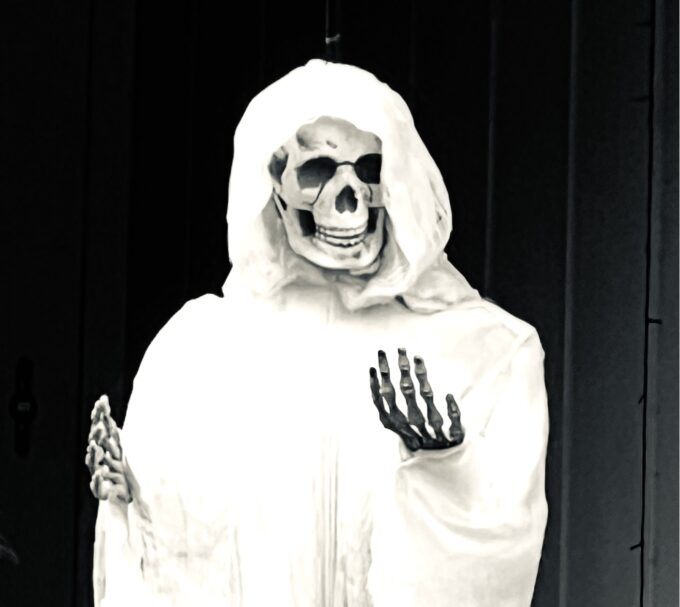
Death comes calling. Photo: Jeffrey St. Clair.
Weaponizing Distraction: Spectacle as Governance
Under the Trump administration, the politics of diversion has hardened into a governing strategy and been normalized by a compliant mainstream media ecosystem. As James Oliphant observes in Reuters, “Donald Trump is a human hurricane,” generating so many simultaneous controversies that tracking any single event becomes nearly impossible. Oliphant is only partly right, because what he describes as chaos is in fact method. Trump is more than a whirlwind of chaos and distraction. He is an unchecked authoritarian who poses a grave threat to democracy and the planet—he is a modern day avatar of domestic terrorism. What masquerades as spectacle and turbulence is, in fact, the calculated exercise of power, a form of governance that weaponizes confusion, accelerates cruelty, and functions as a domestic analogue of terrorism, designed to intimidate, disorient, and exhaust the public into submission. It is through this machinery of distraction and shock that state terrorism now takes shape, not as a single event, but as a continuous sequence of calculated ruptures and relentless acts of violence.
Aftershocks of Power: Kinetic Action and State Terror
State terrorism unfolds through what the historian Nikhil Pal Singh calls its “aftershocks,” a cascading sequence of spectacles engineered to generate emotional outrage intense enough to displace sustained analysis and comprehensive understanding. As Singh writes, such shocks fragment public attention and dull critical judgment, rendering brutality episodic rather than systemic. These acts do not simply terrorize; they instruct. In this register, “kinetic action” names a new grammar of governance: landing a Black Hawk helicopter packed with armed police atop an apartment building in Chicago’s South Shore, hurling stun grenades and zip-tying residents; seizing roofers at gunpoint from the top of a house in upstate New York; or blowing up a small boat carrying people in the Caribbean.
In this political climate, outrage is incessantly manufactured and then swiftly displaced, replaced by the next shock before the public can assemble the fragments into a coherent political picture. Each incident appears as an isolated rupture rather than as part of an unfolding structure of power, severed from the conditions that produce it and from the larger architecture of domination it sustains. This fragmentation is not accidental. It is a calculated strategy to drain meaning from public life, exhaust critical attention, and foreclose any sustained democratic reckoning or resistance. In the age of escalating fascism and a nihilistic worship of greed and raw power, American politics has devolved into a theater of violence aligned with a ceaseless stream of spectacles severed from history and emptied of systemic meaning. What vanishes in this fractured field of sensation is the recognition that these acts are not excesses or breakdowns. They are the governing grammar of a neoliberal–fascist gangster capitalist order, organized around militarization, white supremacy, historical erasure, dispossession, and punishment, now treated as inevitabilities rather than indictments.
Depoliticization by Design: Renée Good and the Machinery of Erasure
In early January 2026, the U.S. staged a dramatic military abduction of Venezuelan President Nicolás Maduro and his wife, a flagrant breach of sovereignty that should have dominated global headlines and provoked profound legal and ethical debate. Instead, by the time many Americans were beginning to process that emerging foreign crisis, the nation’s attention had been reshaped by another state-sanctioned act of violence: on January 7, Minneapolis resident Renée Nicole Good was murdered by a federal ICE agent during an immigration operation. Good, a 37-year-old mother, was killed while driving away from federal agents, a lethal encounter the administration defended as self-defense despite eyewitness accounts and video footage disproving the official narrative.
Racist violence now saturates American society, no longer confined to the margins but woven into the fabric of everyday governance. Under Trump, people of color, whether citizens or noncitizens, are rarely exempt from being cast as targets, whether inside the nation’s borders or beyond them. As the historian Greg Grandin observes, the logics of extraction, violence, and permanent threat have fused foreign and domestic policy into a single, brutal continuum. He writes: “The same rule by domination Mr. Trump showcases abroad is little different from what is being applied at home. Polarization is deepening, cities are under assault by federal forces, and the degrading, at times lethal treatment of citizens and noncitizens alike by government agents is now routine.” What emerges is a politics that governs through fear and force, erasing any meaningful distinction between war overseas and repression at home.
What followed reveals how distraction functions not merely as diversion but as a technology of depoliticization. Rather than treating Good’s killing as a moment demanding scrutiny of unaccountable force and part of a broader strategy of state violence and domestic terrorism, top federal officials immediately doubled down on enforcement and sought to recast the incident as evidence of domestic threat. Homeland Security leaders described her actions as “domestic terrorism,” and the administration launched Operation Salvo — a nationwide increase in ICE raids and enforcement initiatives in the aftermath of her death. This mass retribution was choreographed through government-produced propaganda videos.
Vice President JD Vance alleged, without a vestige of evidence that Renee Good was “part of a broader left-wing network to attack, to dox, to assault and to make it impossible for our ICE officers to do their job” and “that she used the techniques of domestic terrorism to target federal officials.” He further stated, shamelessly and without evidence, that she was “brainwashed” and tied to a “broader, left-wing network.”
Within days of Renée Good’s killing, the mainstream media cycle shifted once again, overtaken by a cascading series of distractions engineered to smother sustained attention. Trump allies demanded criminal investigations of Bill and Hillary Clinton. Federal officials revived anti-communist delusions, falsely claiming that left-wing organizations constituted domestic terrorist threats, while repeated speculation erupted over Epstein-linked scandals. At the same time, renewed fascination attached itself to Trump’s incendiary threats against Mexico, Cuba, and Colombia, alongside his grotesque annexation “fantasies” directed at Greenland.
The mainstream press once again performs its role as an army of stenographers, loudly amplifying Trump’s feigned concern for Iranian protesters while remaining willfully blind to the central contradiction it refuses to name, his ruthless suppression of dissent at home, most notably his escalating assault on those who stand in solidarity with Palestinian freedom. These spectacles did not merely compete for public attention, they functioned as acts of erasure, actively burying any serious reckoning with Good’s killing and with the chilling threat issued by the proto-fascist ideologue Stephen Miller to “create an empire in reverse,” that is, to turn the full machinery of a militarized empire inward, “toward the homeland, and its enemies within.”
In this inversion, the war on terror comes home saturated with state violence, marked by the routine shooting of civilians by an increasingly rogue police apparatus and by a calculated effort to ensure that public attention dissipates before the underlying pattern of domestic terrorism and authoritarian rule can be named. What is lost in this relentless mix is not simply narrative or a comprehensive understanding of the many strands of neoliberal fascism, but the very capacity to recognize these acts as part of a coherent political project, one aimed at normalizing repression, criminalizing dissent, fragmenting resistance, and emptying democracy of its remaining substance.
This is the operation of the politics of disconnection: a system in which state violence, institutional complicity, and media spectacle combine to fragment public consciousness. One crisis eclipses another not because they are unrelated but because meaning itself is being strategically dissolved, emptied out, and walled into rhetorical silos. Violence becomes episodic, power becomes opaque, and citizens are trained to react rather than analyze, conditions that enable dangerous forms of authoritarian governance and fascist politics to take hold. This is pedagogy at the level of governance, teaching people how not to think historically, critically, and comprehensively. What makes this regime of depoliticization both durable and deadly is that it is anchored in an economic ideology that rarely names itself, even as it structures the conditions under which disconnection becomes common sense.
Neoliberalism is the dominant ideology of our time, yet it remains largely unnamed within mainstream political discourse. Its power lies precisely in this invisibility. Shielded by anonymity, neoliberalism disguises the systemic devastation it produces, the evisceration of public health care and education, the assault on the global environment, the dismantling of public services, and the normalization of staggering inequality, political corruption, and an expanding punishing state. Rarely are these crises understood as interconnected expressions of a single economic and political order. Instead, crumbling infrastructures, mass poverty, food insecurity, social isolation, and massive tax giveaways to the wealthy are treated as isolated failures rather than as symptoms of neoliberal capitalism itself. At the core of this politics of disconnection, private suffering is severed from public responsibility, structural causes disappear from view, and crises intensify in isolation. It is under these conditions that authoritarianism mutates into rebranded forms of fascism, nourished by economic abandonment, historical amnesia, and the systematic evacuation of political accountability and ethical and social responsibility.
What makes this regime of depoliticization both durable and deadly is that it is anchored in an economic ideology that rarely names itself, even as it structures the conditions under which disconnection becomes common sense. State violence is fragmented into isolated incidents, militarism is recoded as security, dissent is reframed as extremism, and institutions charged with defending democratic life either become complicitous with Trump’s extortion politics or retreat into silence. The killing of Renée Good by federal agents, the militarization of U.S. cities through ICE raids, the open embrace of imperial aggression abroad, and the brutal attack on immigrants and people of color at home are treated as unrelated crises. They are not. Together, they reveal a governing logic whose primary function is depoliticization, a strategy that severs events from historical contexts, structural causes, private suffering from public responsibility, and erodes the very language through which power can be held accountable and democracy can be named, defended, and struggled over.
Politics, at its most vital, is the domain of collective engagement, where citizens deliberate, contest power, and negotiate, name, and struggle over the conditions of a shared future. Yet under contemporary authoritarianism, politics is steadily hollowed out and replaced by a culture of fear, fragmentation, manufactured ignorance, and managed spectacles. What emerges is a politics of disconnection that isolates social problems, obscures systemic violence, and transforms collective struggle into individualized anxiety. This not only represses dissent; it also renders it unintelligible by stripping it of context, history, and ethical meaning.
To understand how the logic of Trump’s gangster capitalism operates, it is crucial to refuse the temptation to treat its manifestations as discrete or unrelated phenomena. In the most immediate sense, Ruth Fowler writing in Counterpunchis right to insist, for instance, that Renée Good’s death cannot be “processed by the right as an isolated incident, or by the left as a symbol of the horrors of Trump’s America.” It is neither. Rather, it belongs to a decades-long continuum in which state violence has come to mirror the “dynamics survivors recognize from private life: domination framed as protection,” punishment justified as necessity, and “rage framed as fear.” Trump could only accelerate this necropolitical machinery because “America was already deeply rotten long before he arrived.”
The escalation of ICE violence, the normalization of permanent war abroad, the assault on higher education, and the granting of unchecked state power are not parallel developments unfolding by chance. They are interlocking components of a coherent political project that governs through fear, erasure, unchecked militarization, and the systematic dismantling of the foundations of a robust democracy. Together, they form an ensemble of horrors rooted in America’s darkest historical legacies, now reanimated through corporate-controlled disimagination machines, a complicit media culture, the scandalous surrender of higher education to extortionary politics, the creation of a military apparatus that is unaccountable to Congress, and a sustained attack on social responsibility, informed and engaged thought, and the institutions capable of cultivating civic courage, critical thought, and compassionate citizens.
Militarism Without Limits: Empire Abroad, Occupation at Home
What links the Trump administration’s escalating threats and interventions abroad with the militarization of cities at home is not merely a shared reliance on force, but a more profound transformation in how power itself now operates. Militarism has been severed from accountability, constitutional restraint, and international law, mutating into a roaming logic of governance void of morality and unmoored from limits and increasingly insulated from democratic oversight. We now inhabit an age of unaccountable power, naked in its ambitions, theatrical in its display, and relentlessly militarized in its brutality.
Trump has long treated the U.S. military not as a constitutional institution bound by law and public consent, but as a personal instrument of domination, an extension of authoritarian politics repurposed as a roaming police force. In doing so, he follows the well-worn playbook of past dictators, seeking to sever military power from public accountability and democratic restraint. This is the defining logic of a police state: armed force unmoored from law, answerable not to the people but to the imperatives of domination itself. Unconstrained by congressional approval, military power is aggressively deployed as both spectacle and threat, used to intimidate the public and normalize the permanent presence of armed force in civilian life.
This same logic governs Trump’s actions abroad. His assault on Venezuela, alongside open threats aimed at Mexico, Greenland, Cuba, and Brazil, signals the return of an imperial order stripped even of its liberal alibis, an empire no longer burdened by the need to disguise domination as diplomacy. Trump has become increasingly entangled in Latin American politics, collapsing foreign policy into a blunt instrument of coercion and punishment. Sovereignty is rendered conditional, borders reduced to inconveniences, and international law recast as an obstacle to be bypassed rather than a constraint to be honored. Military force is no longer framed as a tragic last resort but as an ordinary instrument of rule, a form of gangster diplomacy that collapses the distinction between law enforcement and war. When the kidnapping or removal of foreign leaders can be normalized through bureaucratic euphemisms such as “capture” or “stabilization,” militarism becomes self-justifying, accountable only to itself, and indistinguishable from the authoritarian violence it claims to secure.
What makes this moment especially dangerous is that the same logic of domination now operates fully inside the United States. The militarization of ICE is not an aberration or policy excess but the domestic extension of an imperial, colonizing mindset long rehearsed abroad. ICE has metastasized into a sprawling internal lawless enforcement regime, brutal in its methods and expansive in its reach, equipped with military-grade weapons, aerial surveillance, sweeping discretionary power, and near-total immunity. Operating with minimal transparency and virtually no public accountability, federal agents now conduct raids with helicopters, battering rams, and tactical gear once reserved for war zones. Entire neighborhoods are treated as hostile territory, civilian space reimagined as a battlefield.
What has followed, as documented by investigative journalists and civil rights advocates, is an escalation that marks a decisive crossing of the line into the political terrors historically associated with dictatorships. ICE agents have fired into civilian vehicles, with multiple reports of people being shot in this manner, including confirmed fatalities. Other cases reveal a pattern of systemic abuse rather than isolated excess: an autistic, disabled woman forcibly removed from her car while driving to a medical appointment; vehicles stopped and windows smashed to apprehend occupants; tear gas canisters and pepper balls deployed against peaceful demonstrators; detainees denied medication and subjected to degrading conditions inside immigration facilities.
As reported by Zeteo, Americans have been inundated with viral images of ICE agents conducting Gestapo-like “citizen checks,” using battering rams to force entry into homes, allegedly without warrants, and “routinely threatening civilians with bullet-to-face murder.” Due process is suspended in the name of security, and fear itself becomes a governing instrument, teaching obedience through terror and normalizing the disappearance of rights once presumed inviolable.
This is not law enforcement in any democratic sense. It is a form of domestic occupation that deliberately blurs the boundary between policing and warfare. ICE shootings, arbitrary detentions, and the use of overwhelming force are not unfortunate excesses; they are pedagogical acts. They teach not only fear, but racial hierarchy and political exclusion. They teach the public who is disposable, whose lives are ungrievable, and which populations can be governed through terror rather than consent. Militarism, in this form, functions as a mode of depoliticization. Violence is individualized, stripped of context, and presented as a technical response to threats rather than as a political strategy rooted in racialized power and authoritarian control.
The crucial point is this: when the military and militarized agencies are freed from democratic restraint, they no longer serve the public. They serve power itself. The same contempt for limits that enables foreign interventions without congressional authorization or international legitimacy also authorizes domestic enforcement regimes that operate beyond constitutional norms. Militarism becomes a unifying force, binding foreign aggression to internal repression. What emerges is a state that increasingly governs through force while hollowing out the political language needed to contest it.
Just as crucial to this transformation is the role of corporate media in laundering and legitimating this militarized power. As Trump expands imperial aggression in Venezuela, major news networks have not interrogated the legality, morality, or geopolitical consequences of the assault. Instead, they have fallen into lockstep with state power, broadcasting images of celebration, repeating official talking points, and refusing to name the invasion for what it is: a flagrant violation of sovereignty and international law. In this coverage, the kidnapping of a foreign leader is rendered routine, even triumphant, while fundamental questions about legality, civilian harm, and imperial ambition disappear from view.
This is not journalistic failure alone; it is a pedagogical failure with enormous political consequences. Militarism is not only enforced through weapons and raids, but taught through images, language, and spectacle. By framing imperial violence as a necessary security response or a moment of national pride, corporate media help transform war into entertainment and domination into common sense. Violence is stripped of history and politics, repackaged as inevitability. In this way, the public is trained to witness brutality without moral reckoning and to accept aggression without democratic debate.
What emerges is a tightly coordinated apparatus of power in which state violence, corporate media, and public consciousness collapse into a single regime of normalization. Militarism becomes not only unaccountable in practice but unquestionable in narrative. This is the cultural machinery that makes the politics of disconnection possible, severing imperial aggression abroad from its domestic counterparts and insulating both from collective resistance.
This is how the politics of disconnection works. By treating militarized violence abroad and at home as separate issues, the public is prevented from seeing their shared logic. Citizens are encouraged to debate tactics rather than question legitimacy. Militarism becomes normalized, routinized, and ultimately invisible, even as it corrodes the foundations of democratic life.
ICE Violence and the Pedagogy of Fear
The killing of Renée Nicole Good, a U.S. citizen shot by an ICE agent in Minneapolis, should have provoked national outrage and institutional reckoning among the mainstream media. Instead, it has largely been absorbed into the background noise of normalized state violence. Treated as an isolated incident rather than a structural indictment, her death exemplifies how the politics of disconnection shields authoritarian power from accountability. And this torrent of mindless dribble takes place against massive protests in Minneapolis and other cities around the United States.
In recent years, federal immigration enforcement has shifted from sporadic border control to an interior hard-line regime that treats entire cities as zones of control. Militarized raids, mass detentions, and surveillance operations now function less as mechanisms of law enforcement than as public spectacles designed to intimidate and discipline. The expansion of ICE’s budget, staffing, and technological infrastructure has transformed it into a domestic security force deeply intertwined with private detention industries, defense contractors, and local police departments.
This apparatus is not simply about immigration policy. It represents a broader project to redraw the boundaries of civic belonging through force. When entire communities are subjected to raids, when ordinary citizens are detained for monitoring federal activity, and when protest is met with flash-bangs and tear gas, the message is unmistakable. Fear is governance. Compliance is survival.
Crucially, these practices are depoliticized through bureaucratic language and media framing. Raids become enforcement priorities. Shootings become tragic encounters. Violence is detached from power and recoded as necessity. In this way, the enforcement regime weakens civic trust, fractures solidarity, and conditions the public to accept terror as administrative routine.
Higher Education Under Siege: Criminalizing Dissent
Nowhere is the politics of disconnection more devastating than in the Trump administration’s ongoing assault on higher education. Universities, once understood, however imperfectly, as spaces for critical inquiry, moral witness, and democratic debate, are increasingly recast as threats to national security. Students and faculty who protest state violence, militarism, or racial injustice are no longer recognized as engaged citizens but are instead branded as radicals, extremists, or even domestic terrorists. In this climate, dissent itself becomes a crime. Education is dangerous to authoritarians precisely because it cultivates the capacities they most fear. At their best, higher and public education offer students the histories, knowledge, and ethical frameworks necessary to think critically, act courageously, and recognize injustice when it appears. Such institutions nurture engaged and critical agents, capable of holding power accountable, asking the questions that must be asked, and speaking, writing, and acting from positions of agency and collective responsibility. That type of empowering pedagogy has no place in Trump’s America.
In the wake of ICE violence, the killing of Renée Good, and the broader militarization of public life, many universities have responded with silence or evasive neutrality. This silence is not politically innocent. It signals a profound institutional failure, a retreat from the university’s responsibility to speak when fundamental rights are under assault. When institutions issue statements for reputational safety but fall quiet in the face of state violence, neutrality becomes a form of complicity.
This failure is compounded by direct political pressure. Universities are increasingly threatened with funding cuts, investigations, and public vilification if they do not conform to authoritarian demands. Protest is reframed as disruption, solidarity as extremism, and critique as indoctrination. Faculty are surveilled, students disciplined, and entire fields of study, especially those addressing race, colonialism, gender, and imperial power, are marked as suspect. The consequences are already visible. In conservative universities such as Texas A&M professors are warned not to teach subjects dealing with race and gender, resulting in one instance of removing the teaching of Plato from their courses.
Universities are targeted precisely because they connect private troubles and suffering to structural forces. They provide the language through which people learn to see beyond isolated events and recognize systemic injustice. By criminalizing protest and narrowing the boundaries of permissible discourse, authoritarian power seeks to depoliticize the very act of thinking critically. Students are trained to fear consequences rather than exercise judgment. Faculty are encouraged to self-censor rather than bear witness. The result is a university hollowed out from within, reduced to a managerial institution that prioritizes compliance over conscience.
This is pedagogical repression. It teaches withdrawal rather than engagement, silence rather than solidarity. When universities abandon their role as sites of critique and moral courage, they help produce a citizenry habituated to disconnection, if not authoritarianism.
Neoliberal Fascism and the Struggle for Democratic Language
Taken together, militarism abroad, ICE violence at home, and the repression of higher education reveal not chaos but a coherent political project. Each depends on severing events from structures, erasing historical memory, and criminalizing the very forms of critique capable of challenging authoritarian power. What appears as disorder is, in fact, a carefully orchestrated pedagogy of domination. At its core lies an unabashed commitment to white supremacy, now normalized as policy and spectacle alike. The evidence is unmistakable: Black history is censored in schools and museums; ships and military bases are renamed after Confederate figures; the language of white grievance is openly embraced by Trump and echoed by his appointees; and leading acolytes such as Steve Bannon and Elon Musk perform Nazi salutes in public without consequence. ICE recruiters openly court white nationalists with lavish signing bonuses to “repel foreign invaders,” while racist propaganda invites Americans to imagine a nation purified “after 100 million deportations.”
As Liz Landers notes, media platforms are increasingly saturated with images and posts that borrow directly from the language and symbolism of right-wing and white nationalist movements. Slogans such as “One homeland, one people, one heritage. Remember who you are, American” do not merely echo fascist rhetoric, they actively reproduce its racial logic. These messages circulate relentlessly, reinforced and legitimated by Trump’s own public racism. This is evident in his interview with The New York Times, where he claimed that the 1964 Civil Rights Act, legislation designed to end racial segregation and guarantee Black Americans equal access to education and employment, “accomplished some very wonderful things, but it also hurt a lot of people,” dismissing its core purpose as “reverse discrimination.” This is a classic white supremacist trope which argues that white men are the real victims in American society.
Such statements invert history, recasting white grievance as victimhood while erasing the structural violence the law sought to confront. This racial and white nationalist reasoning does not stop at the nation’s borders. It extends outward into foreign policy, surfacing in Trump’s warnings about a supposed European “civilization crisis” allegedly caused by immigration itself. In this way, racism becomes a governing framework rather than an aberration, normalizing domination by making it feel natural rather than imposed. Politics is reduced to affect and reaction, while power trains the public to feel fear and resentment instead of engaging in critical thought.
In this model, citizens are invited not to engage politically but to react emotionally. Fear replaces critique. Fragmentation replaces solidarity. Spectacle replaces deliberation. The politics of disconnection functions as a technology of power, ensuring that people experience injustice without understanding its causes and witness violence without recognizing their collective capacity to resist it.
What we are witnessing is not simply a return to older forms of authoritarianism but the consolidation of neoliberal fascism as a pedagogical project. This project does not rule primarily through persuasion or democratic consent but through the management of consciousness, the normalization of cruelty, and the systematic dismantling of the public imagination. It educates people to disconnect, to see violence as inevitable, to accept militarism as common sense, normalize racial cleansing, white Christian nationalism, and authoritarian cruelty. It replaces political agency with fear, historical memory with amnesia, and solidarity with atomization.
Neoliberal fascism thrives precisely because it empties politics of meaning while saturating everyday life with intimidation and spectacle. It teaches through raids and bombings, through censorship and silence, through the criminalization of protest and the hollowing out of institutions charged with defending democracy. Its success depends on destroying the language that allows people to connect the dots and recognize patterns of power.
What is urgently needed as a precondition for a mass movement of resistance is a new democratic language, one capable of reconnecting what authoritarianism works relentlessly to fracture. Such a language must name militarism as a political choice rather than an inevitability, repression as a mode of governance rather than a form of security, and education as a site of struggle rather than a neutral space. It must insist that democracy is not merely a set of procedures or rituals, but a way of life grounded in shared responsibility, historical consciousness, and the courage to hold power accountable.
This language must also reclaim pedagogy itself as a central terrain of resistance. Education, broadly understood, remains one of the few forces capable of transforming fear into understanding, outrage into solidarity, and private suffering into collective action. To resist neoliberal fascism is to refuse the politics of disconnection and to rebuild the connective tissue of democratic life, linking struggles across borders, institutions, and communities. It is to recognize that resistance begins not only in the streets or the courts, but in the stories we tell, the histories we preserve, and the forms of knowledge that shape how people imagine themselves and their futures.
The task and challenge of mass resistance before us is neither abstract nor optional. Without a language capable of exposing the economic, racist, and authoritarian pedagogical machinery that sustains contemporary forms of domination, resistance will remain fragmented, reactive, and easily contained. Martin Luther King Jr. was right to call for a revolution in values, one inseparable from a rhetoric of systemic analysis that linked militarism, racism, and poverty as mutually reinforcing forces. To name neoliberal fascism as a pedagogical project is to recognize that the struggle for democracy is inseparable from the struggle over meaning, memory, and education itself. In this fight, silence is complicity, neutrality is surrender, and reconnecting the political becomes not simply a strategy of resistance but the first act of democratic renewal.


