Tuesday, January 20, 2026

Black church leaders aid Minneapolis, seek laws curtailing federal agents' mask usage
(RNS) — Minneapolis-area AME Church officials stated Renee Good’s death 'never should have happened' and listed more than a dozen ways they have tried to meet community needs there.
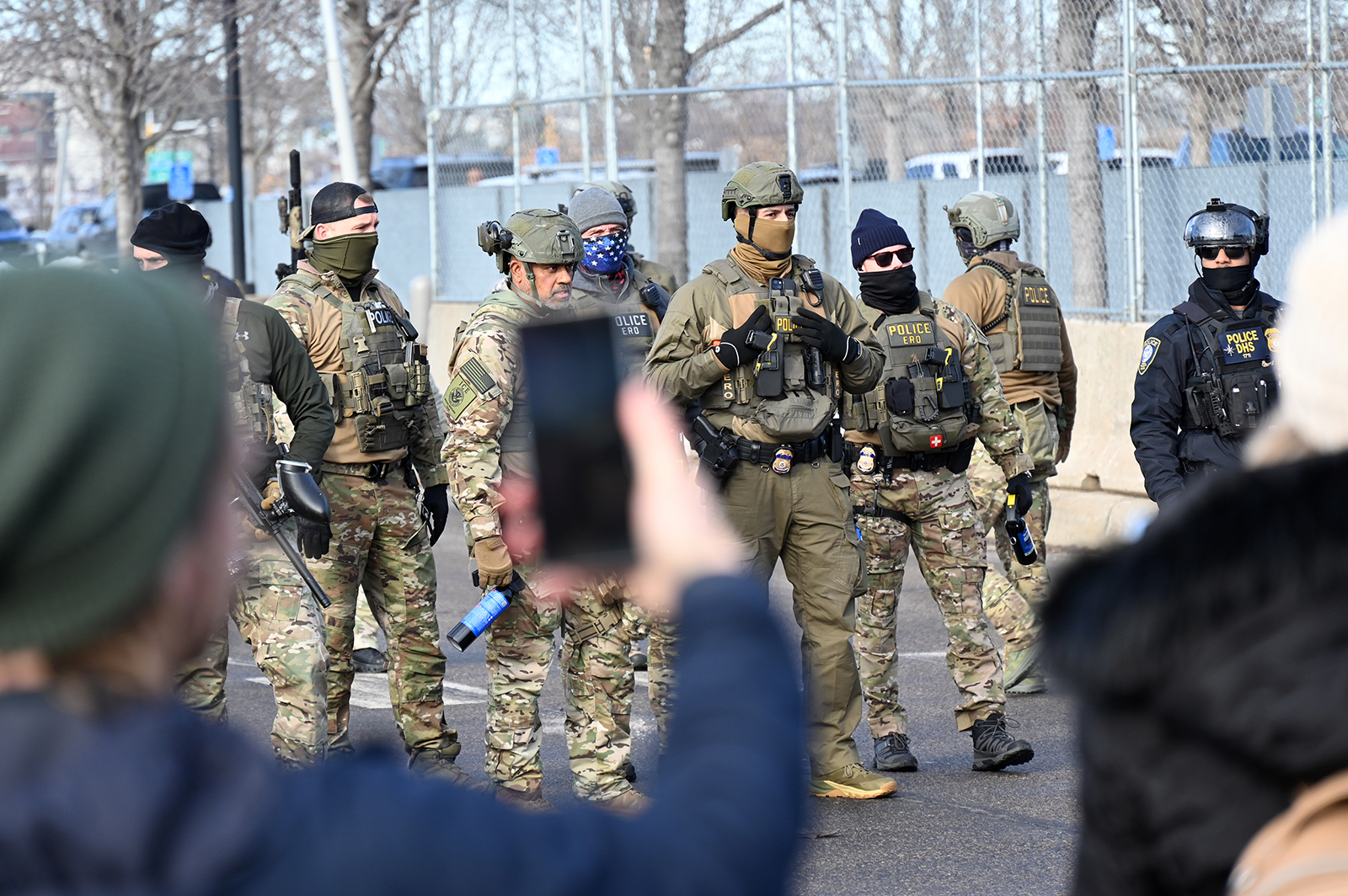
Department of Homeland Security agents outside the Bishop Henry Whipple Building, Monday, Jan. 12, 2026, in Minneapolis. (RNS photo/Jack Jenkins)

(RNS) — As tensions in Minneapolis continue between residents, federal agents and protesters, the Rev. Stacey Smith, an African Methodist Episcopal Church presiding elder, said Black churches are taking action to address complex needs in the Twin Cities area.

“We recognize that we are in profound crisis,” said the supervisor of 10 AME churches in Minneapolis and St. Paul. “And when you’re in profound crisis, it’s like putting your finger in a dike, and another hole opens up, and you have to put your finger over here.”

Black faith leaders are taking steps to aid Minneapolis residents who have seen an influx of federal officers in their city and are joining calls for new legislation to increase their accountability. A week after the shooting death of Renee Good and more than five years after the death of George Floyd, each at the hands of law enforcement, some are seeking to defuse the tensions between protesters and Immigration and Customs Enforcement agents or between agents and the people they seek to detain.


On Thursday (Jan. 15), Smith and other Twin Cities-area AME Church officials issued a statement, saying Good’s death “never should have happened,” and listed more than a dozen ways they have tried to meet community needs there, including being present on the streets or at the state capital, bringing food to families that are fearful of leaving their homes, or “intentionally patronizing immigrant-owned businesses harmed by ICE operations.”

The Rev. Stacey Smith. (Courtesy photo)

Smith said AME church members have long supported such businesses, but it has been particularly important to help them in recent weeks.

“These are legal citizens of our country, and their businesses are being targeted, and they are being harassed,” she said. “These people have to live, they have to eat, they have to pay bills. They have to do all those things, too. So it’s important for us to support those communities and to allow them to know that they have the community behind them as well.”


RELATEDIn Minneapolis, George Floyd-era faith networks reignite after Renee Good’s killing by ICE


Smith is also collaborating with the Rev. Al Sharpton’s National Action Network on plans for an upcoming vigil in Minneapolis to honor Good’s memory.

The Rev. Jerry McAfee, pastor of New Salem Missionary Baptist Church in North Minneapolis, describes his church as having “boots on the ground,” in the streets, seeking to defuse tensions. However, he urged caution. 

“Normally what our group would do is be between ICE, the police and the protesters,” said McAfee, former president of the Minnesota Baptist State Convention. “What we’ve consistently tried to tell people is, ‘Protest all you want, but what we don’t want you to do is agitate and provoke to where our people get hurt.’”


He also said he has begun conversations with leaders of the local Somali community that involve “hard questions,” like whether someone in the country illegally should leave instead of hiding from federal authorities.

The Rev. Jerry McAfee. (Courtesy photo)

“If you know your papers ain’t right, and you know if they catch you, they’re going to take you, or your kids are just going be left,” he said he suggested in a Thursday meeting, “would it not make better sense for us to have a conversation about another action plan that could help get you to a place safe, as well as your kids, to where you’re not in danger?”

And as tensions continue in Minneapolis, some Black faith leaders across the country are calling for state and national legislators to pass laws that limit some of the activities of divisions of the Department of Homeland Security, such as ICE.

The Rev. Boise Kimber, president of the National Baptist Convention U.S.A., on Wednesday urged leaders of his historically Black denomination to call on cities and states to follow California Gov. Gavin Newsom’s lead and enact laws that prevent ICE and other law enforcement from wearing face masks, comparing them to members of the white supremacist Ku Klux Klan who covered their heads as they terrorized Black people.

“When you go back home, you go back home sharing with your pastors and sharing with the leaders that we no longer will support you if you do not come out with legislation — saying to your mayor, saying to your chief, saying to this state legislator and governor, take the mask off,” Kimber said at a news conference during the denomination’s midwinter meeting in Florida.

Both Smith and McAfee said they agree with passing such legislation. “Some of them need to be identified because here’s the reality: How do you ramp up ICE as quickly as it has been ramped up and safeguard against bigots being part of ICE?” McAfee said. 


And on Thursday, a wider coalition of 74 faith, civil rights and advocacy organizations signed onto a letter urging Congress to take steps to reduce “this Administration’s ongoing, lawless campaign that is terrorizing American communities.” The NAACP, which signed the letter, noted it was sent in the wake of not only Good’s death but also the killing of another U.S. citizen, Keith Porter Jr., who was shot by an off-duty ICE officer on New Year’s Eve in Carson, California.

The letter, spearheaded by UnidosUs, another civil rights organization, also included signatories from the Sikh American Legal Defense and Education Fund, the United Church of Christ, and Faith in Action East Bay in Oakland, California. Among its demands were banning the use of masks by federal agents and forbidding military members and resources from being deployed for domestic policing operations and immigration enforcement.

 Two Episcopal bishops say clergy may have to put 'bodies on the line' to resist ICE
(RNS) — ‘I’ve asked (clergy) to get their affairs in order, to make sure they have their wills written,’ said the Rt. Rev. A. Robert Hirschfeld, the Episcopal bishop of New Hampshire.
Federal immigration officers confront protesters outside Bishop Henry Whipple Federal Building, Jan. 15, 2026, in Minneapolis. (AP Photo/Adam Gray)

(RNS) — Last Friday (Jan. 9), the Rt. Rev. A. Robert Hirschfeld, the Episcopal bishop of New Hampshire, stepped in front of a microphone under a tent erected outside the Statehouse in Concord. He looked out at the small crowd that assembled in the rain for a vigil to mourn Renee Good, the 37-year-old mother killed by an Immigration and Customs Enforcement officer days earlier, and began to offer a closing prayer.

But Hirschfeld, who told Religion News Service he did not have prepared remarks, suddenly launched into something closer to a short sermon.

“We are entering a new era of martyrdom,” he said, framing Good — who family members have said was Christian — as a martyr. He rattled off other examples such as Óscar Romero, the Catholic archbishop who was killed in El Salvador in 1980. He also mentioned local hero Jonathan Daniels, a white Episcopal seminarian and civil rights activist who was killed in 1965 while shielding a Black girl from a shotgun blast fired by a racist.


Faith leaders of today, Hirschfeld said, may end up in similar situations as they push back against the actions of federal immigration agents in cities across the country.

“I have told the clergy of the Episcopal Diocese of New Hampshire that we may be entering into that same witness,” he said. “I’ve asked them to get their affairs in order, to make sure they have their wills written. Because it may be that now is no longer the time for statements, but for us — with our bodies — to stand between the powers of this world and the most vulnerable.”
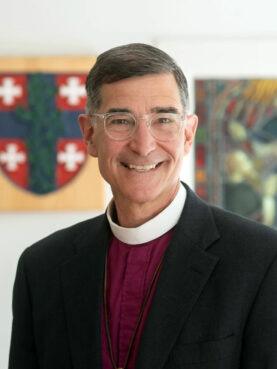
The Rt. Rev. A. Robert Hirschfeld. (Photo by Joanne Smith)

The crowd at the assembly was hardly sprawling, but Hirschfeld’s remarks were filmed, clipped and shared widely on social media. Amplified by algorithms and word of mouth, his message was heralded by critics of President Donald Trump’s mass deportation efforts, as well as by faith leaders who have been protesting Department of Homeland Security agents — sometimes being injured or arrested while doing so — for nearly a year.

And while Hirschfeld’s comments were off-the-cuff, his sentiment seems to be shared by many of his fellow Episcopalians, including bishops in places where DHS agents have shown up in force, such as Minneapolis.

In an interview with RNS, Hirschfeld said the attention given to his message was something of a shock. He said he has issued similar warnings to clergy for years, such as when fellow priests and bishops gathered to push for gun control legislation. And he stressed that whenever he broaches the subject, he’s referring to a tragic situation that may occur — not one that faith leaders should seek out.

“I’m not telling clergy, ‘Go find a rifle to stand in front of,’” Hirschfeld said. “I’m not saying, ‘Go look for a way to martyr yourself.’ All I’m saying is, when we put on those garments of our Christian faith, they are not always welcomed in this society. Those virtues and those postures in this world can be met with rage and even violence.“


But he has found himself invoking the idea more often in recent months, especially in reference to the actions of the Trump administration. That was the context, he said, in October, when his diocese hosted a clergy conference with priests from across the region. There, he communicated to priests that “It’s not too much to say we should have our wills in order in case we’re met with violence.”

The room, he said, reacted with surprise. “There was a little gasp,” he said. “And then there was, ‘Oh, well, maybe I should be doing that anyway.’”

Indeed, there is a long history of faith leaders who participate in protests preparing for the worst. In a 2020 documentary, the late Georgia congressman and civil rights icon John Lewis recalled eating Chinese food shortly before embarking on a trip in the 1960s as a Freedom Rider seeking equal rights for Black Southerners.

“Growing up in rural Alabama, I never had Chinese food before,” Lewis said. “But someone that evening said, ‘You should eat well because this might be like the Last Supper.’”

Other faith leaders have also linked civil rights leaders and religious people killed while advocating for a cause to Good, who has ties to the Presbyterian tradition. On Monday, the Presbyterian Church (USA)’s Office of Public Witness released a statement lamenting Good’s killing and lauding her as someone who “put herself in harm’s way not out of any desire to do harm, but to observe and bear witness to the actions of ICE.”

Like Hirschfeld, the office compared Good to figures such as the Rev. Martin Luther King Jr. and the four Catholic nuns and missionaries who were abducted and killed in El Salvador in 1980 for standing alongside the Salvadoran citizens.


“(Good’s) story is a testament to the power of the Presbyterian mission and a challenge to our conscience,” the statement read.

Some religious leaders have praised Trump’s mass deportation efforts. But religious pushback has been widespread, and while no clergy have been killed in the past year while protesting DHS agents in the U.S., many have been met with violence. The Rev. David Black, a Presbyterian minister, made headlines after he was shot in the head with pepper balls last September while praying outside of a DHS facility in Illinois. Several other clergy were also hit with pepper balls and tear gas launched by DHS agents while protesting outside that same facility, and the Rev. Jorge Bautista, a United Church of Christ minister, was shot in the face with a pepper round fired by a DHS officer during a protest in California last fall.
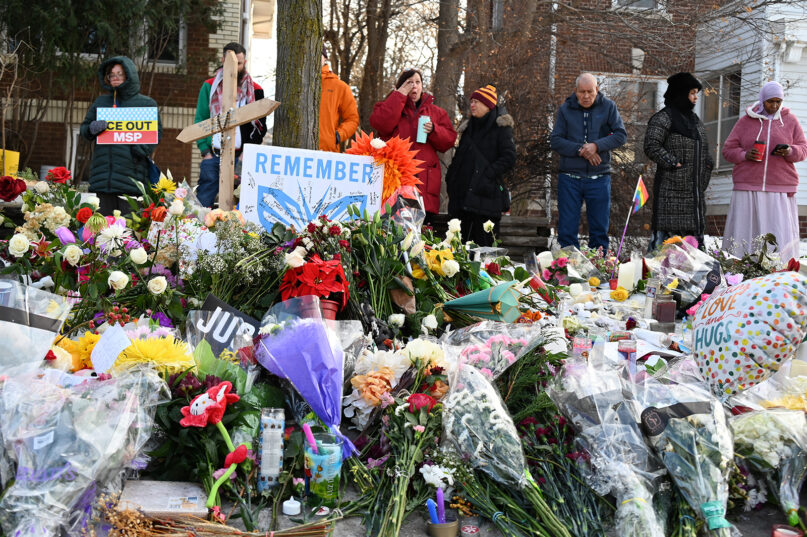
People gather around a makeshift memorial honoring Renee Good, who was fatally shot by an Immigration and Customs Enforcement officer, near the site of the shooting in Minneapolis, Jan. 9, 2026. (RNS photo/Jack Jenkins)

Several faith leaders have been arrested while protesting immigration enforcement, and when clergy rushed to the scene of Good’s shooting last week, at least two pastors — a Unitarian Universalist minister and a UCC minister — were forced to dodge or were even hit with pepper spray or pepper rounds fired at protesters by DHS agents.

And since October of last year, nearly 290 faith leaders from the Chicago area have signed a letter voicing firm opposition to ICE’s actions and declaring that they “accept that following Christ’s example may mean we are mocked and assaulted, opposed and even arrested.”

Hirschfeld said he was thinking about these examples when he made his viral remarks — which were echoed by the Rt. Rev. Craig Loya, the Episcopal bishop of Minnesota, this week. Loya had been at a contemplative bishops’ retreat with Hirschfeld when the news of Good’s shooting came, and the Minnesota prelate told RNS that recent days have been “incredibly painful” for the churches he serves — especially congregations with large immigrant populations.


Even so, the church is called to take a stand, he said.

“I agree wholeheartedly with my colleague Bishop Hirschfeld’s comments,” Loya said. “This may be a time when we are called to put our own bodies on the line, to stand with those who are marginalized and targeted in this moment.”
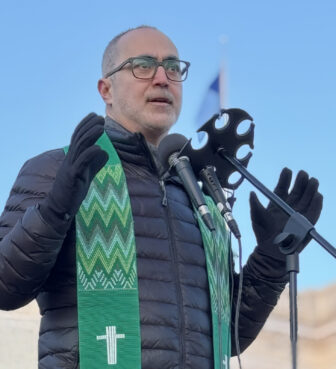
Episcopal Bishop Craig Loya speaks at a vigil outside the Minnesota Capitol in response to the killing of Renee Good, Jan. 9, 2026. (Photo by Gnube/Wikimedia/Creative Commons)

Loya said that in his diocese, standing with immigrants has meant clergy participating in demonstrations. Last Friday, a group of four Episcopal priests stood together at a vigil for Good outside the Minnesota Capitol in St. Paul, among them the Rev. Ramona Scarpace, rector of St. Paul’s Church on Lake of the Isles.

“As followers of Jesus, we’re called at our core to stand with the oppressed, to stand with those who have been wronged, to stand with a grieving community of people who are deeply sad and whose hearts are broken by the death of Renee Good,” Scarpace said.

Resistance was also the theme of a prayer offered by the Most Rev. Sean W. Rowe, the presiding bishop of the Episcopal Church, during an online vigil this week that also included Loya.

“We keep resisting, advocating, bearing witness and repairing the breach,” Rowe said. “We keep sheltering and caring for those among us who are immigrants and refugees because they are beloved by God, and without them, we cannot fully be the church.”


Loya stressed that standing with immigrants has also meant churches providing food and other resources to immigrant families afraid to leave their homes, and establishing a fund specifically to aid immigrants in the diocese who need help paying for things such as legal services. The idea, Loya argued, is for fellow Episcopalians to “resist the forces that are breaking down beloved children of God” — referring to the influx of federal agents into the city — but do so in ways that are rooted in love.

“We will not meet cruelty with cruelty,” he said. “We will disrupt anger with love. We will agitate the forces of oppression with the power of love. From our perspective, that is neither weakness nor resignation, but it grows out of our firm conviction that there is no force in the universe that is more powerful or irresistible than the power of God’s love.”

Similar sentiments may soon be heard elsewhere. The Episcopal Diocese of Maine shared Hirschfeld’s remarks on its Facebook page earlier this week, calling it a “powerful message.” A day later, news broke that DHS may soon launch an immigration enforcement effort in the city of Lewiston, Maine, home to a large population of Somali Americans — a group the administration has targeted.

And while Hirschfeld acknowledged his New Hampshire diocese has yet to become a hub of ICE activity, he noted locals have recently rallied to oppose a proposed DHS immigrant processing center in Merrimack. The far-reaching scope of Trump’s mass deportation effort, he said, is part of what animated his comments — and perhaps why it resonated so widely.

“My words were meant to be words of encouragement and solidarity,” he said. “We’re in this together.”

Opinion

The US — and its churches — can’t look away from MLK’s warnings about power any longer

(RNS) — The celebration of King often comes at the cost of his most radical critiques.


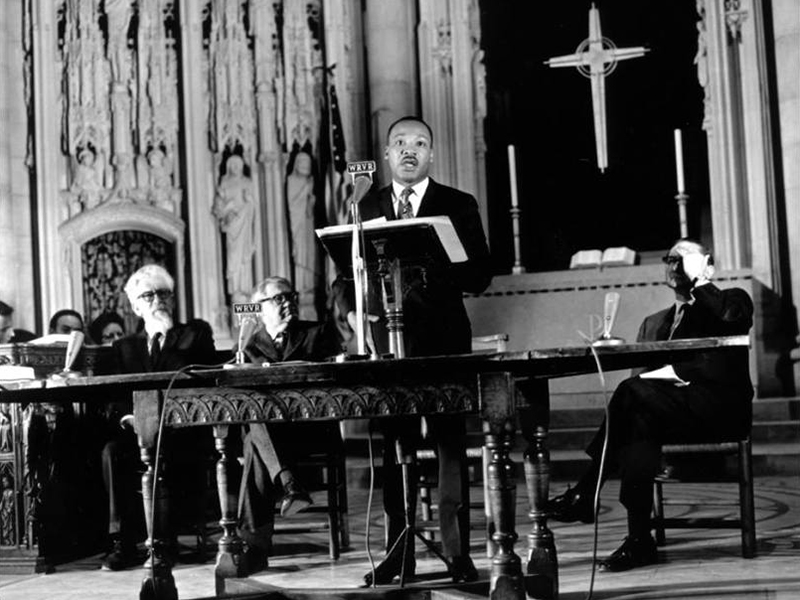
FILE - The Rev. Martin Luther King Jr. speaks about his opposition to the war in Vietnam at Riverside Church on April 4, 1967, in New York. (RNS file photo by John C. Goodwin)
RNS


(RNS) — Nearly six decades ago, the Rev. Martin Luther King Jr. stood in the pulpit of Riverside Church in New York City and delivered a most controversial sermon, “Beyond Vietnam: A Time to Break Silence.” In that historic address, he named the “giant triplets” of racism, extreme materialism and militarism as intertwined evils corroding the soul of our nation.

King understood then what we are forced to reckon with today: A nation that continues to prioritize military might over human dignity loses its moral compass.

Today, we have Christian nationalists in the White House, in Congress, in state and local leadership, in our police forces, in Immigration and Customs Enforcement and in positions of power across our communities that would have us believe that God uniquely blesses the people of the United States, and therefore, our violence is a moral duty. When military power is framed as divinely sanctioned — the church has an obligation to speak out as King did.

The U.S. has created two Martin Luther Kings. One is a revolutionary in the way Christ was; the other is a sanitized, color-blind counterfeit. The version most Americans celebrate has been reduced to a single concluding refrain: “I Have a Dream.” This version is safe for textbooks and monuments because it allows the nation to praise King’s hope while ignoring his demands.

The real King was not a passive visionary. He was a radical agitator who called for reparations, challenged the moral legitimacy of the American empire and named whiteness as a system of power sustained by racial ignorance. As scholars like Monroe H. Little and Vincent Harding have long argued, the celebration of King often comes at the cost of his most radical critiques. When we sever the dream from its demands for structural change, we turn Black resistance into spectacle and survival into performance.

King’s clarity feels especially urgent in these first weeks of 2026, as the nation prepares to honor his birthday on Monday (Jan. 19). On Jan. 3, the United States executed “Operation Absolute Resolve,” a military raid in Caracas, Venezuela, that President Donald Trump is already estimating will engage the U.S. in foreign aggression, if not war, for the long-term future. And on Jan. 7, a masked ICE agent shot a woman to death in her car in Minneapolis — the latest act in a swell of rising violence from an agency that largely used to construct its treacherous work without deaths.


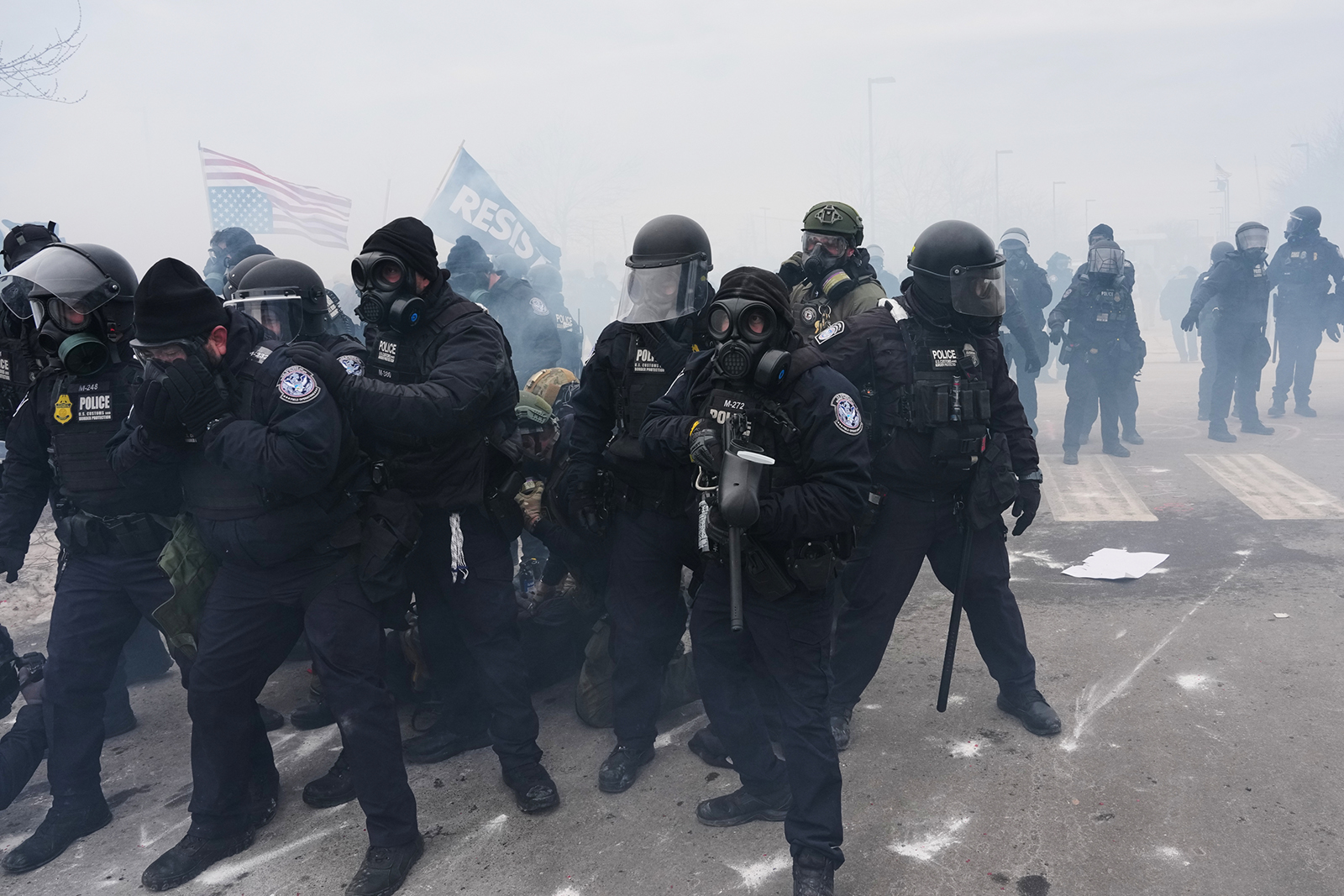
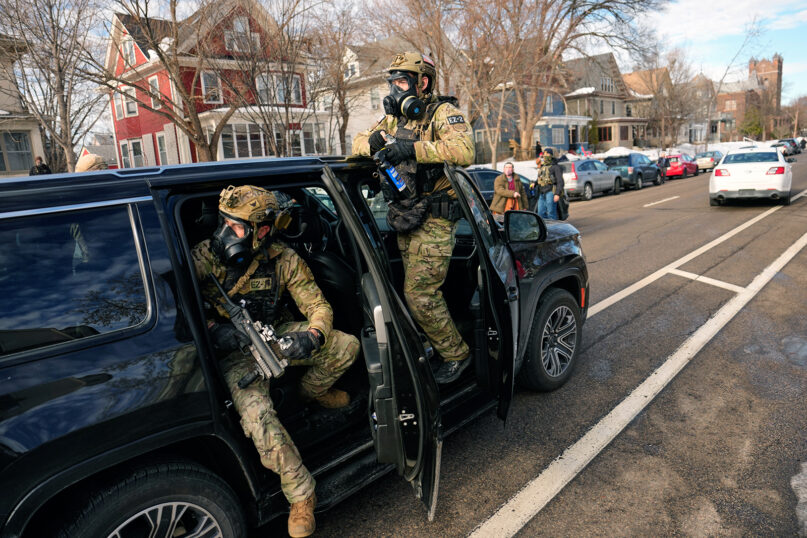
Federal immigration officers get in a car as they prepare to deploy tear gas at a protest, Monday, Jan. 12, 2026, in Minneapolis. (AP Photo/John Locher)

King’s warning against militarism is chillingly resonant. At Riverside, King spoke about Vietnam, but his warning was true of Libya, Iraq and dozens of other countries since. We are experiencing the “cruel irony” King spoke of — watching the poor die in the name of a democracy that remains fragile and contested.

Recent U.S. military and ICE actions — and the rhetoric used to justify them — have reignited concern about the use of force cloaked in moral or even religious certainty. When violence is framed as divinely sanctioned, when national interest is confused with God’s will, then Jesus’ church must speak. King warned us precisely about this danger: a nation that baptizes violence while ignoring its human cost loses its moral compass. There is nothing holy about domination.

In this moment, remembrance without recommitment is a betrayal. We are living in an era where the hard-won gains of the Civil Rights Movement are under renewed threat. Voting rights are being pulverized, history is being distorted and protest is being criminalized. At home and abroad, fear is weaponized, and power quickly seeks moral cover. King’s legacy does not belong to the past. It presses upon us in this present moment.

In his “Letter from Birmingham Jail,” King predicted what might happen to his beloved church if it failed to act as the moral compass of the nation: “If today’s church does not recapture the sacrificial spirit of the early church, it will lose its authenticity, forfeit the loyalty of millions, and be dismissed as an irrelevant social club with no meaning for the twentieth century.”

As two Black faith leaders, we echo King. But this work was never meant to be carried by Black people alone. Black people are tired. We are tired of being asked to save a nation that refuses to listen, and tired of being asked to dream while others benefit from the luxury of delay. The dream was born out of oppression. Dreaming is what oppressed people do when they lack power. Black people are weary of dreaming because everyone eventually wants to wake up to a safe reality. Our dreams were meant to change the world, not entertain it.

If white Christian nationalists continue to hold hostage Jesus’ message in this country, and if we uplift leaders who bless violence and hold sacred the power of Trump over all else, surely our beloved church may become an irrelevant social club — something entirely apart from what Christ calls us to be in the face of injustice.

The arc of the moral universe does not bend on its own — we must produce the pressure to bend the arc. King insisted that justice was conditional, dependent on our willingness to organize and love boldly in the face of fear. Hope, for King — and for Christ — was a disciplined practice subverting the powers that be in the face of empire.

For that reason, on Sunday, Jan. 18, Episcopal Divinity School and Riverside Church will host MLK NOW. This gathering is not a sentimental birthday observance, but a summons to truth and action. Starting with worship at 11 a.m., led by the Rev. Rashad Raymond Moore, and continuing with a major program at 3 p.m., we will lift up King’s radical vision. Joined by voices such as leading theologian and former dean of EDS the Rev. Canon Kelly Brown Douglas and the Very Rev. Lydia Bucklin, we will hear King’s words not as distant echoes, but as living demands.

Come if you are weary of a world shadowed by domination. Come if you are angry at the weaponization of faith. Come to remember that King’s dream was never about slumber — it was about waking up.

The struggle continues. So must we.

(The Rev. Adriene Thorne is senior minister at The Riverside Church in New York City. The Rev. Brandon Thomas Crowley is director of theological education at Episcopal Divinity School and senior pastor of the Historic Myrtle Baptist Church in Newton, Massachusetts. The views expressed in this commentary do not necessarily reflect those of RNS.)

Interview 


Coretta Scott King Publicly Opposed Vietnam War Before MLK — and Urged Him to Follow

Coretta Scott King’s vision shaped MLK’s politics and the broader freedom struggle, says historian Jeanne Theoharis.
January 17, 2026

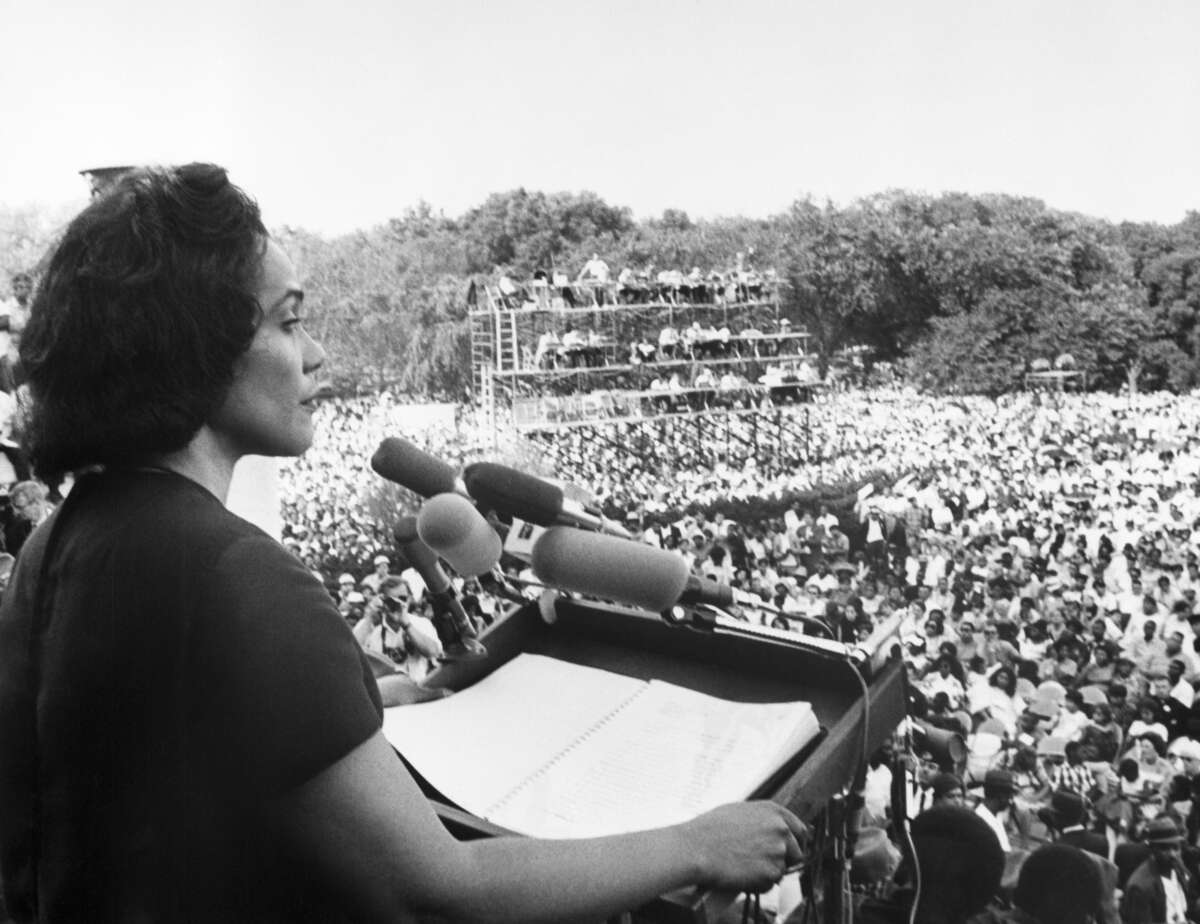
Coretta Scott King addresses the "Solidarity Day" rally of the Poor People's Campaign from the steps of the Lincoln Memorial in Washington, D.C., on June 19, 1968.Bettmann / Contributor via Getty Images

As Immigration and Customs Enforcement (ICE) raids schools, states ban honest teaching about race and gender, and public officials invoke Martin Luther King Jr. to call for restraint and “civility,” King’s legacy is being aggressively stripped of its political substance.

Much of the scholarship and public memory of King has long privileged his work in the South, reinforcing the idea that racism was a regional aberration rather than a national system. This narrowing also obscures the intellectual and political partnership at the heart of King’s work, particularly the leadership of Coretta Scott King, whose global vision, antiwar activism, and organizing shaped both King’s politics and the broader freedom struggle.

King’s sustained campaigns in Northern cities reveal how deeply he understood racism as structural — embedded in schools, housing, policing, and liberal governance — and how challenging this structural racism required disruption, organizing, and sustained pressure, rather than moral appeals alone.

Historian and civil rights scholar Jeanne Theoharis challenges this hollowed-out version of King. In her new book, King of the North, she shows that King understood racism as a national crisis and devoted years to fighting school segregation, housing discrimination, police brutality, and liberal resistance in Northern cities such as Chicago, New York, and Los Angeles. These efforts were often met with hostility from white liberals who supported civil rights in theory while resisting it in practice.

As the author of The Rebellious Life of Mrs. Rosa Parks and A More Beautiful and Terrible History and more, Theoharis is a leading historian of the civil rights movement whose work has reshaped how we understand Black freedom struggles, state repression, and the politics of historical memory. Her latest book offers one of the most rigorous and timely accounts of Martin Luther King Jr.’s Northern activism — and what it reveals about structural racism, liberal resistance, and the work required to confront injustice today. In the interview that follows, Theoharis discusses King not only as a gifted orator, but as an organizer committed to disrupting unjust systems. She also speaks about King’s sustained organizing with gangs in Chicago; the central leadership of Coretta Scott King; and why confronting the “silence of our friends” remains essential for movements resisting repression today.

Related Story

Trump Wants to Bury Slavery. My Family Went South to Unearth It.
Trump wants a populace unaware of the Black freedom struggle — because it is a guide for defeating his fascist plans. By Jesse Hagopian , Truthout   September 12, 2025

Jesse Hagopian: We’re living through very dangerous times: imperialist wars, ICE agents raiding schools, books and curricula about Black history and LGBTQ+ lives being banned, and right-wing politicians criminalizing honest teaching about structural racism. Many of the same politicians driving this wave of repression cynically quote Dr. King’s words about judging people by the “content of their character, not the color of their skin” — weaponizing his legacy to shut down conversations about racial justice. Given that context, how do you think Dr. King would respond to this current wave of rising authoritarianism, censorship, ICE raids, and repression — and to the movement erupting against it with student walkouts and mass protests?

Jeanne Theoharis: One of the most common misuses of King — both on the MLK Day holiday and throughout the year — comes from people we might call moderates (drawing on King’s “Letter from Birmingham Jail”) who agree with the goals but not the tactics, who prefer order to justice. We see that today in arguments about protesting the “right” way.

King is often invoked to tell young people to quiet down, to stop being disruptive. But looking at King’s actual life shows his deep belief in disruption — because injustice is comfortable.

Injustice isn’t maintained only by violent actors, whether the Klan or ICE agents today, but also by people who benefit from systems of segregation, discrimination, and criminalization.

Even the Montgomery Bus Boycott was a disruptive consumer boycott meant to disrupt the city. King’s nonviolence wasn’t sanitized sit-ins — it included rent strikes, tenant organizing, school boycotts, and forcing injustice into public view.

So yes, I think King would support disruption of the status quo and cheer students walking out to protest repression.

In your new book, King of the North, you show that Dr. King saw racism as a national crisis, not just a southern one. You challenge the familiar story of the civil rights movement as one where heroic southern activists were ultimately aided by enlightened northern liberals. How does looking at King’s work outside the South complicate that narrative — and what does it reveal about who actually stood in the way of racial justice?

When we look at Dr. King outside of the South, we’re forced to see a variety of people who stood in the way of the civil rights movement.

The easy tale we often tell on King Day and in textbooks is that Dr. King and courageous southerners built this movement and, with the help of northern liberals and journalists, ultimately succeeded in passing the Civil Rights Act of 1964 and the Voting Rights Act of 1965. And that’s huge.

But that story is comfortable because it centers northern liberal “good guys.” What King of the North forces us to see is that many of those liberals, as King would put it, were not so liberal at home. They might condemn segregation in the South while allowing — or even defending — it in New York, D.C., Chicago, or Seattle.

Looking at King outside the South reminds us how injustice is maintained and shielded. We can think about his phrase “the silence of our friends,” and his insistence that if so-called allies object to tactics rather than injustice itself, they were never truly allies.

You write that despite the avalanche of King biographies, many fail to connect the dots on his work in the North. What do you see as the most significant new contribution your book makes to our understanding of King?

I began this research nearly two decades ago while working on the civil rights movement in Los Angeles before Watts. I kept finding King in LA talking about police brutality, school segregation, and housing discrimination — and I realized this wasn’t the story we’re usually told.

We’re often told King “discovers” northern racism after the Watts rebellion of 1965, but that’s simply untrue.

I think of the book like a kaleidoscope: You turn it slightly and the entire picture changes. The book begins with Martin Luther King Jr. and Coretta Scott both going to school outside the South.

King’s own experiences with segregation in the North — and the way supposed allies retreated when injustice was close to home — shaped everything.

In 1950, while King was at Crozer Seminary, he and friends were refused service at a New Jersey bar despite a new anti-discrimination law. When they considered legal action, white law students who had been served refused to testify because it might hurt their futures.

Meanwhile, Coretta Scott was at Antioch College, one of the most liberal campuses in the country. When the town of Yellow Springs refused to allow Black student teachers, Antioch sided with the town. Her classmates — who protested many issues — would not stand with her.

Both of them learned early that northern segregation was real, and that allies often disappeared when confronting it.

King never “discovers” northern racism later. That’s why, in his first book on the Montgomery Bus Boycott, he insists that injustice anywhere is a threat to justice everywhere — and that northerners must confront injustice where they live.

The second thing the book shows is how King understood leadership — not just leading from the front, but showing up for other people’s struggles. Between 1958 and 1965, he traveled 6 million miles supporting local campaigns against police brutality, school segregation, and urban renewal.

And the third major contribution I make in the book is about Coretta Scott King.

Yes! Your portrait of Coretta is incredibly moving. Can you talk about how King of the North repositions her — not just as King’s partner, but as a leader in her own right, someone who deeply shaped King’s worldview, and also carried their shared vision forward after his assassination?

Thanks for putting it that way, because I think Coretta Scott King is often remembered as only King’s helpmate. Some books portray her as an activist before she met Martin, then as sidelined during their marriage, and only emerging with her own voice after his assassination. That narrative is deeply misleading.

She was more politically engaged than Martin when they met. She had already met Bayard Rustin and Paul Robeson. She had organized with the Progressive Party and attended its 1948 convention, which challenged segregation, economic injustice, and Cold War militarism — the “triple evils” we associate with King’s final year.

On their first date, they talked about racism and capitalism. Like any good first date, right? He’s smitten. He’s never met a woman like her. At the end of their first date, he tells her, You have everything I want in a wife — you’re beautiful, you’re principled, you’re brilliant. And she responds, You don’t even know me.

Looking closely at their early courtship shows that he has to bring his A-game with her. Some of the lines he’s used to relying on simply don’t work — she shuts them down, calling them “intellectual jive.”

There’s a beautiful passage at the end of Toni Morrison’s Beloved about having a “friend of your mind,” and I think that’s what they find in each other: a shared political commitment, but also a shared religious and moral grounding.

Coretta was deeply Christian, but critical of church hypocrisy. King respected that. She was not a passive figure; she shaped his theology and politics as much as figures like Benjamin Mays and Howard Thurman.

When they get married, in 1953 — not 1973, not 1993 — she did not wear white. She did not wear a long dress. And she gets her very imposing father-in-law to take “obey” out of their vows, because it makes her feel like an “indentured servant,” — and those are her words.

This was the partner King wanted.

Her global vision shaped the movement. She joined the Women’s International League for Peace and Freedom, organized against nuclear weapons, and traveled internationally for peace work.

After King won the Nobel Prize, she saw it as a global responsibility. She pushed him to oppose the Vietnam War — and she went public against the war before he did, at great personal risk.

From 1965 on, she is publicly opposed to the war in Vietnam. That places her in a very small minority at the time — something we often forget because of how large the antiwar movement becomes by the late 1960s and early 1970s. To oppose the war in 1965 meant being labeled un-American and subjected to FBI surveillance.

In many ways, she is one of the early leaders of the antiwar movement. She speaks at one of the first major rallies at Madison Square Garden in June 1965 — the only woman on the program — and later that year speaks again in Washington, D.C. When a reporter asks Martin whether he educated her on Vietnam, he responds, “She educated me.”

She later reflects on how Martin’s star burned so brightly that her work was often overlooked or attributed to him. But those who knew her described her as “beyond steel” in her ability to withstand both the political pressure and the personal costs of taking such a public stand.

Another thing you document is King’s sustained organizing with gangs in Chicago — work he was doing before Fred Hampton’s efforts to unite gangs — which may surprise many readers because it runs so counter to the sanitized, respectability-focused version of King we’re often taught. What drew King into that work, and what did he see in those young men that others — including city leaders and the media — refused to see?

The very first night when they moved to Chicago, six members of the Vice Lords come by because the Kings are living in Vice Lords territory. At first, it’s exactly what you might expect — you’re on our turf.

But they keep coming back. Lawrence Johnson, the head of the Vice Lords, later says that you couldn’t help but fall in love with King. They talked, they argued, they spent hours together strategizing and thinking. King saw these young men as key community resources and as potential leaders.

That really gives us a different way of understanding King, who is so often reduced to a kind of respectability-politics finger-wagger. Looking at these interactions — and at the fact that he was working not only with the Vice Lords but with gangs across the city, including the Blackstone Rangers on the South Side — we see a King who listened. He didn’t interrupt.

He was trying to reduce violence between gangs, but he was also helping redirect their energy toward confronting educational inequality, urban renewal, and the slum housing conditions affecting their families. This is happening before Fred Hampton’s efforts to unite gangs — to stop them from killing each other and to turn their collective power against white supremacy.

Hampton himself credits King as part of how he arrives at that approach. Just out of high school, Hampton joins the open-housing marches that summer. The multiracial, race- and class-based gang organizing that we associate with him begins earlier.

As gangs become more political, police repression intensifies. In Chicago in the late 1960s, gang violence goes down, but police repression goes up. The kind of chilling effect we associate with Fred Hampton’s assassination can already be seen in how the Chicago Police and the FBI respond to the politicization of gangs — particularly as they forge truces and begin organizing collectively. That political turn is seen as far more threatening.

In King of the North, you challenge the common myth that segregation was only a southern problem, asking, “What if the 1964 Civil Rights Act had actually been enforced against northern school districts?” You show how King’s activism in Chicago and other northern cities — especially around school and housing segregation — was met with fierce resistance and often dismissed or downplayed by the media. Can you talk about how segregation was maintained in the North, and what kind of resistance King faced when he confronted it?

By the mid-1960s, Chicago was one-third Black. The city responded by deepening segregation. Black residents were compressed into overcrowded neighborhoods, and schools followed suit.

Chicago used “double-session days,” cutting school days in half for tens of thousands of Black students rather than integrating schools. When that wasn’t enough, the district spent millions on trailers — “Willis Wagons” — to avoid desegregation.

These schools were overcrowded, under-resourced, and deteriorating.

In October 1965, the assistant secretary of Health, Education, and Welfare (HEW), Francis Keppel, decided to withhold $32 million in federal funds from Chicago Public Schools because the district was in probable noncompliance with the Civil Rights Act. White Chicago erupted. Members of Congress who had voted for the Act insisted, This is not what we meant.

Mayor Daley was furious. He boarded a plane to New York, where President Johnson was meeting with the Pope, and confronted him directly. Less than a week later, Johnson ordered HEW to reverse course and release the funds. In effect, the president of the United States halted the enforcement of the Civil Rights Act against Chicago’s schools.

I don’t usually like counterfactuals, but had the federal government held the line and forced Chicago to comply, it’s possible that cities like New York, Los Angeles, and Washington, D.C. — places that still experience deep segregation today — might have been compelled to follow as well.

Much of your work has focused on the politics of memory — how we remember Rosa Parks, Martin Luther King Jr., and the civil rights movement more broadly. What did you learn from researching this book and what do you hope people take from King’s legacy — not just King as an orator, but as an organizer?

King connected with people across the country around police brutality. He had experienced police brutality himself, and he spoke with Chicago gang members and with people in Harlem about it. He understood police violence not as isolated incidents, but as a structural problem.

By the mid-1960s, King was describing cities like New York, Los Angeles, and Chicago through the lens of domestic colonialism, arguing that police and courts functioned as enforcers to keep Black communities in line. That language matters. When we see that King, we see someone who speaks directly to our moment — someone who clearly understood forces that are still with us today.

For many years, like a lot of scholars and organizers, I’ve talked about the misuses of King and the misuses of the holiday. But this research also showed me how much there was still to learn about him. Even as we’ve challenged some myths, others have remained — especially the tendency to southernize him, to see him only at the front of marches rather than supporting movements, listening, and being changed by the people around him. It also reshaped how I understand who King recognized as leaders, and the diversity of people he saw as central to the struggle.

King consistently focused on structure. One of my favorite moments is when a well-meaning liberal white woman suggests that Black people should just clean up their neighborhoods. King responds, that’s the job of sanitation. No amount of individual effort, he insists, can substitute for equitable public infrastructure.

Finally, King was clear that the deliberate manipulation of history is central to the maintenance of injustice. That brings us back to where we began — today’s attempts to ban certain histories or restrict what can be taught. King understood that telling some histories while erasing others has long been a way injustice sustains itself.

Telling an honest history, then, helps us not only better see the past, but also where we are — and where we need to go.

This article is licensed under Creative Commons (CC BY-NC-ND 4.0), and you are free to share and republish under the terms of the license.


Jesse Hagopian

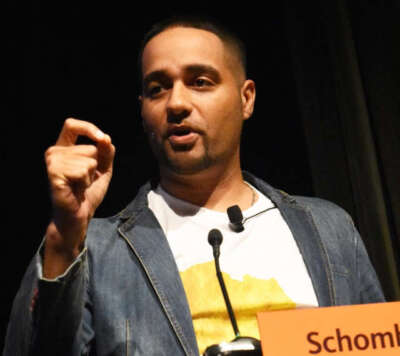
Jesse Hagopian is a Seattle educator, the director of the Zinn Education Project’s Teaching for Black Lives Campaign, an editor for Rethinking Schools, and the author of the book, Teach Truth: The Struggle for Antiracist Education. You can follow him at IAmAnEducator.com, Instagram, Bluesky or Substack.


Venezuelan procession for La Divina Pastora takes on new weight in tense political moment

WASHINGTON (RNS) — Venezuelans in the diaspora and homeland are navigating uncertainty, big emotions and fervent prayers in the aftermath of the US military's seizure of Venezuelan President Nicolás Maduro.


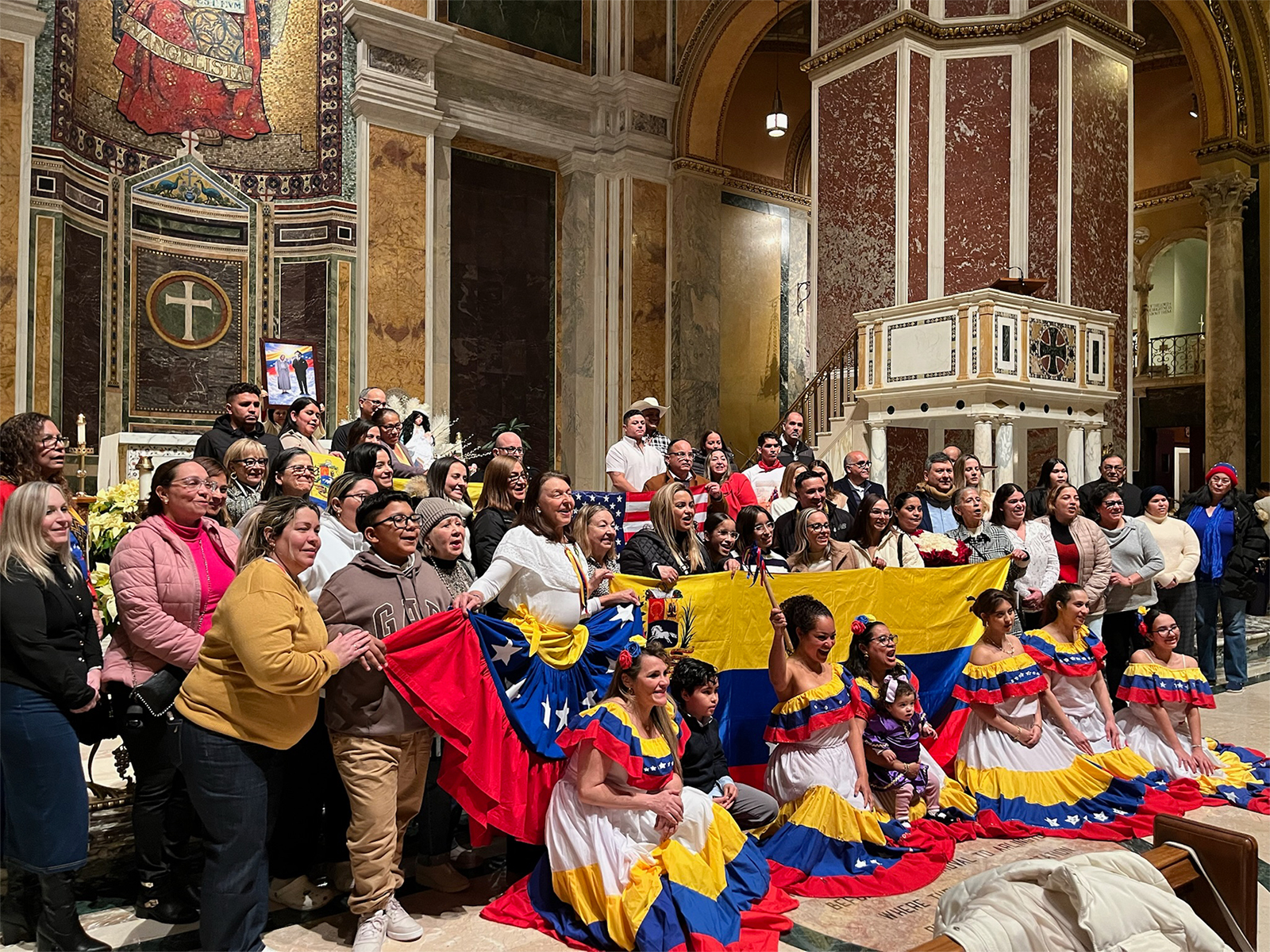
Washington-area Venezuelans pose for photos with a statue of La Divina Pastora, rear, after a Mass celebrated in her honor at the Cathedral of St. Matthew the Apostle, Wednesday, Jan. 14, 2026, in Washington. (RNS photo/Aleja Hertzler-McCain)


Aleja Hertzler-McCain
January 16, 2026
RNS

WASHINGTON (RNS) — It’s been 30 years since Jorge Garcia last joined the millions of people who have crowded the streets of Barquisimeto in northwest Venezuela for a procession with La Divina Pastora or “the Divine Shepherdess.”

But three decades and thousands of miles have not dimmed his devotion to the Marian image and statue credited with several miracles, including interceding to end a 19th-century cholera epidemic. This year, after months of work by the four members of the Washington-area Society of La Divina Pastora, she was honored for the first time with a Mass on Wednesday (Jan. 14) in Washington’s Cathedral of St. Matthew the Apostle and with a new statue shipped from Venezuela where it was created by a famous teenage artist.

The statue of La Divina Pastora arrived on Jan. 2, just hours before the U.S. military seized Venezuelan President Nicolás Maduro.

“It’s not us. It’s God who moves everything,” Garcia said.

La Divina Pastora’s celebration came at a moment when Venezuelans in the diaspora and homeland are navigating uncertainty, big emotions and fervent prayers. Many Catholics agree the church will play a significant role in guiding Venezuela’s future — though they are not all in agreement of what’s needed. Many Venezuelan Catholics in the diaspora are hopeful Maduro’s capture and U.S. intervention signals an end to government corruption and an opportunity for economic growth. Catholics in the country are less convinced and more divided on who should lead the country — and where Venezuela’s Catholic leadership should lend its support.

Garcia, who immigrated to the U.S. from Venezuela in 1996, hopes that he can someday soon take his children to Barquisimeto for the procession and return to Venezuela, which he has not returned to because of opposition to the socialist government.


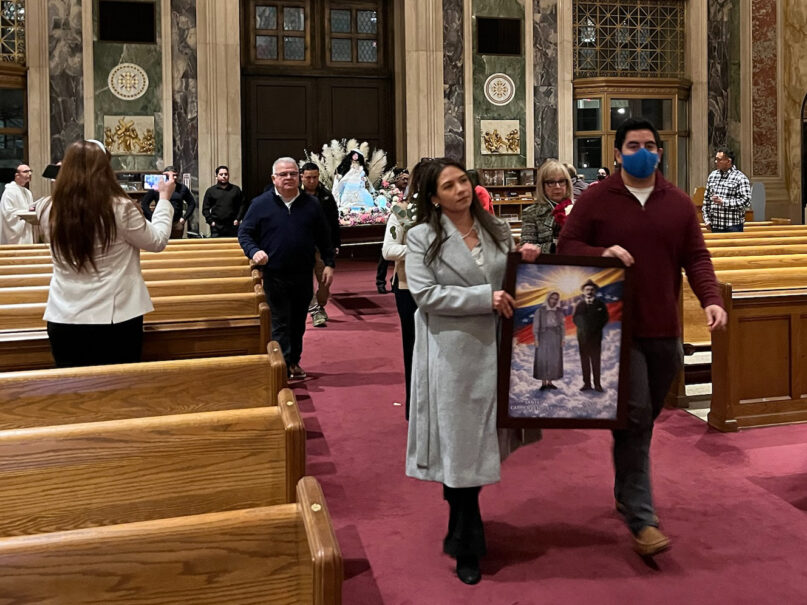
A statue of La Divina Pastora is carried through the Cathedral of St. Matthew the Apostle at a Mass celebrated in her honor, Wednesday, Jan. 14, 2026, in Washington. (RNS photo/Aleja Hertzler-McCain)

The society for La Divina Pastora worked to keep the celebration free from politics, with no specific political mentions in the Prayers of the Faithful or the homily about listening to God. But politics still bled through in the crowd’s shouts for a free Venezuela after “Long Live the Divina Pastora” and in the posters calling for the freedom of political prisoners, held up while participants took photos next to the statue.

In Barquisimeto, where Venezuelan media said almost 4 million people turned out to walk with La Divina Pastora on Wednesday, Archbishop Polito Rodríguez Méndez also prayed publicly for rights to free expression and for political prisoners, saying, “We pray for all those deprived of liberty. We applaud that some have already been released, but there are many others whose cries and those of their families cannot continue to be ignored.”

He also prayed for migrants, those experiencing hunger and those killed in “the events of Jan. 3.”

Venezuela’s Catholic bishops have often taken a critical stance toward Maduro and President Hugo Chávez, Maduro’s predecessor. Archbishop Ramón Ovidio Pérez Morales, the 93-year-old retired archbishop of Los Teques, has long accused the Maduro government of violating human rights and of corruption.

In a Spanish-language interview with RNS on Wednesday, Pérez Morales commented on the ongoing international discussions about the fate of Venezuela and its sovereignty, debates he said that can distance the conversation from human rights.


The statue of La Divina Pastora is processed through the streets of Barquisimeto, Venezuela, Jan. 14, 2026. (Video screen grab)

“Sovereignty is made for the people, not people for the sovereignty,” he said, echoing Jesus’ teaching that “the Sabbath was made for man, not man for the Sabbath.”

Pérez Morales said he believes there is a path opening “that will lead to the reshaping of the country along democratic and constitutional lines.”

“The constitution isn’t ideal or perfect, but it is a fairly acceptable constitution,” he added.

Venezuelan opposition leader María Corina Machado, a Catholic, met with President Trump on Thursday, presenting him with her Nobel Peace Prize. Her party’s candidate was recognized by international observers as winning the 2024 election, even as Maduro’s government claimed it won. Despite the meeting with Machado, the White House press secretary said she expected “cooperation” to continue between Trump and Maduro’s successor, Delcy Rogriguez, who is now acting president.

While the Venezuelan diaspora has overwhelmingly approved of Maduro’s capture, according to an AtlasIntel poll conducted shortly afterward, less than half of Venezuelans inside Venezuela approved of his capture — about a quarter of Venezuelans disapproved and another 28% said they were unsure how they felt. Venezuelans remain polarized between those who opposed Chávez’s socialist policies and those who felt Chávez saved Venezuela from western oil companies and saw his programs as giving that wealth back to Venezuelans.

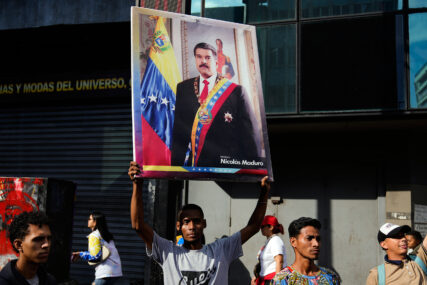
A government supporter holds a banner with a photo of President Nicolás Maduro during a protest demanding his release from U.S. custody in Caracas, Venezuela, Sunday, Jan. 4, 2026. (AP Photo/Ariana Cubillos)
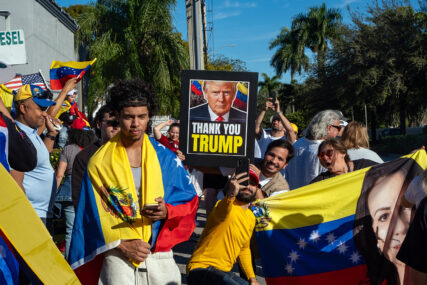
People celebrate in Doral, Fla., after President Donald Trump announced Venezuelan President Nicolás Maduro had been captured and flown out of Venezuela, Jan. 3, 2026. (AP Photo/Jen Golbeck)

Sister Maria Eugenia Russian, president of Fundalatin, an ecumenical Christian organization founded in Venezuela and inspired by liberation theology, called Trump “the Herod of this time” and said U.S. leaders should denounce his intervention in Venezuela, which killed more than 100 people according to the Venezuelan government, and instead tell him to focus on the poor people of the U.S.

“The Catholic people continue denouncing in the streets the imprisonment of the constitutional president of the Bolivarian Republic of Venezuela by the United States,” said Russian, who is also director of the religious community named for Fundalatin’s founder, the Rev. Juan Vives Suriá.

Russian accused the Venezuelan bishops of having “no closeness with the poor” and said there are two churches in the country — that of the hierarchy and that of the people.

“Over 26 years they have allied themselves with the power of money,” she said of the bishops.

In Spanish WhatsApp messages to RNS on the day of the Divina Pastora celebration, she wrote, “The bishops continue with their lies to use the space of processions to spread lies and defame the reality of a government whose priority is the poor.”

Macky Arenas, a television presenter based in Caracas and the editor of Venezuelan publication “Reporte Católico Laico,” or the “Lay Catholic Report,” believes “the duty of the church is to be brave.”

She cited Cardinal Rosalio Castillo Lara’s 2006 homily for the celebration of the Divina Pastora, where he warned that the democratically elected Chávez government was showing signs of becoming a dictatorship by restricting freedom of expression and abusing human rights. She also called Pérez Morales, the retired archbishop, a “leading voice” for the country.

Arenas said the government’s corruption had led to a humanitarian disaster in Venezuela and that Venezuelan families are facing “intolerable” conditions.

“The people are having less and less access to basic necessities,” she said, and they are facing barriers to access for education and health care.

In a webinar for the Maryknoll Office for Global Concerns, Lisa Sullivan, who served as a Maryknoll lay missioner and lived in Venezuela for more than 30 years until she came back to the U.S. in 2022, instead blamed U.S. sanctions during Trump’s first term for Venezuela’s massive inflation and “hunger years,” saying that sanctioning the oil industry was “like putting a boot on the throat of the Venezuelan people.”

“There was an average weight loss of 20 pounds,” she said. “It was the thinnest I’d ever been. We were all hungry.”

Back in Barquisimeto on Wednesday, Angel González said that, while he was unable to attend the procession, he heard the prayers of many are focused on peace and that the social media videos of the race held in La Divina Pastora’s honor showed large crowds showing up despite the rain.


FILE – The statue of La Divina Pastora is processed through Barquisimeto, Venezuela, Jan. 14, 2017. (Photo by Rodolfo Pimentel/Wikimedia/Creative Commons)

González, who works to empower children through the Regional Coordination for Boys, Girls and Youth Workers called CORENATS, said in Spanish that, after the “criminal” bombing of Caracas, local children in Barquisimeto are feeling “fear for what could happen in the future if the situation gets worse, fear of losing a family member or losing their own lives.”

Historically, he said, the people have asked La Divina Pastora “for peace in our country, for us to have a country of justice and equity, for healing of illnesses.”

“I think it’s important, as I understand it, that the call that the church is taking up is the call for peace and reconciliation and for the self-determination of the Venezuelan people,” González said.

In southern Venezuela, an indigenous Baniwa Catholic human rights worker told RNS that he still did not feel it was safe for him to speak openly about his opposition to the government and about the “complex emergency humanitarian situation in the country.” He said in Spanish, “there’s a perception that apparently things are changing, going to change, but in terms of reality that hasn’t happened.”

He said that, despite his convictions, he has family members who are committed to the government’s socialist party and that the country faces political fragmentation. In that environment, he said the church must work toward helping Venezuelans understand each other and not see each other as enemies.

“The Catholic church and the evangelical church and all of the organizations of social order in this country have to play an important role in encounter, in forgiveness, in national reconciliation,” the leader said.