Wednesday, January 21, 2026


Cybernetic Circulation Complex: Big Tech and Planetary Crisis


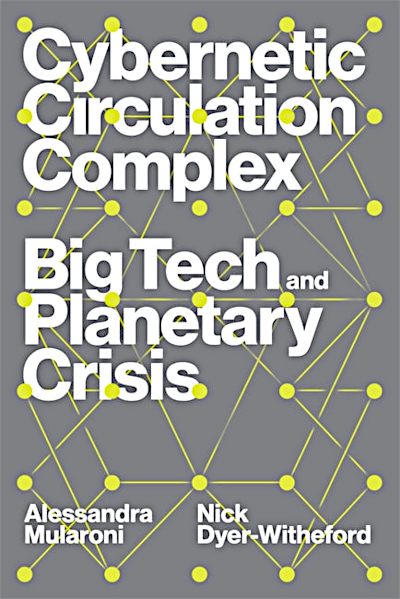
This is a lightly-edited extract from Cybernetic Circulation Complex: Big Tech and Planetary Crisis by Nick-Dyer Witheford and Alessandra Mularoni, published by Verso Books. The book’s Preface – “A Spectre Haunts the Planet” – is already available at Verso’s blog. So, to offer something different, here we present its last few pages.

On 23 January, the book will be launched in Toronto. You can register for the event at tickettailor.com.

We use the term Cybernetic Circulation Complex (CCC) to refer to the US tech sector headed by the so-called Magnificent Seven corporations, Alphabet, Amazon, Apple, Meta, Microsoft, Nvidia and Tesla. The book examines how it circulates commodities, conflicts and eco-crisis, and proposes an alternative “biocommunist” use of digital technologies. In its final section, a coda subtitled “Lifeblood,” we examine how the CCC has been at once changed, challenged and consolidated by the advent of generative AI: after discussing the emerging political economy of the new AI sector, and different theories about the nature of AI, we offer some speculations on the social turmoils arising in this latest moment of cybernetic circulation.

Complexity, Contradiction, Change

We have analyzed the Cybernetic Circulation Complex (CCC) not only to show its power, but also to reckon with the conflicts and contradictions that challenge it, along with the capitalism of which it is now such an indispensable part. One possibility is of course that generative AI will simply not work out. Past decades have seen several jubilant announcements of AI booms, followed by disappointing technological performances and investment collapse. Although the wave of commercial activity following the launch of ChatGPT has been exceptionally large, it is possible that unresolved problems with generative AI – such as the tendency of Large Language Model (LLM) chatbots to ‘hallucinate’ answers to questions, or the risk of ‘model collapse’ when AIs degenerate from training solely on synthetic feeds from other AIs – may prove so serious as to burst what would in retrospect be revealed as a giant financial bubble. This would be a major crisis for the CCC, possibly serious enough to terminate some of its major corporations. Anxieties on this score have been mounting; August 2024 saw a sudden, dramatic sell-off of CCC stocks triggered by fears that AI capacities had been overhyped. There were signs the confidence of finance capital in the AI boom’s lead organization, Open AI was faltering.
But even if investment in AI unfolds in the way its investors hope, its path is unlikely to be smooth. The landscape of computerized capital, though dominated by the pyramidal accretions of corporate power, is also a site of antagonism and struggle. Protests, rebellions and insurrections have in various ways learned to use the apparatus of the CCC. If indeed ‘there is no moat’, and inter-capitalist competition has open-sourced generative AI design, this reappropriation logic may continue into the era of machinic proto-intelligence.

This is by no means reassuring. Fascist movements – determined to strip every regulation or limitation of the market in the name of freedom, and to break apart the proletariat with waves of hatred against women and ethnic and sexual minorities – are well positioned to deploy generative AIs, with terrifying consequences.

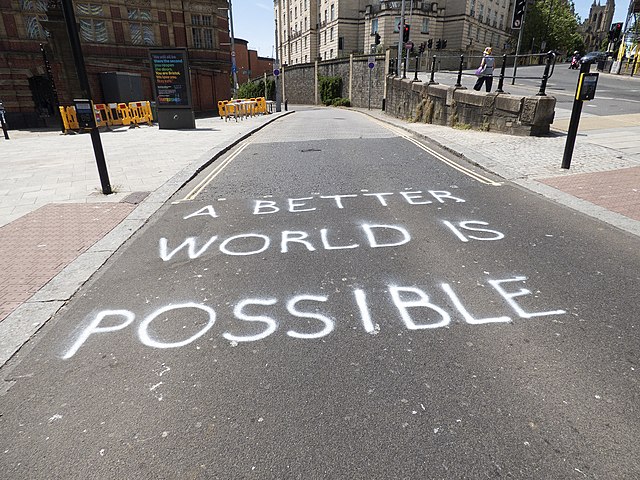
In contrast, movements defending human workers have an a priori commitment to physical presence and corporeal resistance: bodies on the line. The advent of generative AI is now being met with strikes and litigation: pickets, occupations, marches, blockades and riots will likely be at the core of anti-capitalist counter-power against corporate and fascist AIs.

At the same time, however, generative AIs will likely be marshalled in an ‘automation of the common’ already operating through the platforms of riot support, worker organization and mutual aid. It is also important to acknowledge the role that technoculture has played in connecting and supporting socially and politically marginalized people. As Legacy Russell details in her book, Glitch Feminism, the flexibility inherent to digital media lends itself to subversion and offers alternative ways of being in the world – particularly for those who have been deemed alien or errant. Circumventing the colonial foundation of digital infrastructure, the glitch functions as ‘a form of refusal’ against heteronormativity. In the glitch, errancy abounds.

Movements of left and right will clash not only in city squares but across networks – and both, though especially forces subversive of capital, will be met by the more massive AI guardians of the state’s military and security forces. These conflicts will be exacerbated by biospheric crises of climate, water, pandemics and war. In Chapter 4, we outlined the planetary circulation of biospheric catastrophes and the contradictory role of the CCC in these crises, intensified by the acceleration of the world market and the competition between rival capitalist blocs.

Runaway Dynamics?

These crises could be partially mitigated by renewable energy grids, pandemic control and emergency management, which might draw on CCC infrastructure, but with self-reflexive limits. The injection of increasingly autonomous AI would be a wild card to this situation. The very technological apparatus constructed by capital for the control and exploitation of the natural environment might develop its own runaway dynamics, whose origins in digital systems are black boxed and incomprehensible. Cyber-failures are already a feature of natural disasters. But inexplicable, unexpected and massive anomalies of autonomous AI behavior – possibly benign, but probably injurious; ranging from apparently random payouts and claw-backs to huge cybersecurity breaches, autonomous car accidents, industrial shutdowns and social media outages, or the ubiquitous swamping of platforms with anonymous and artificially generated prophetic texts or billion-year telenovelas – may become events analogous to hurricanes, fires or floods: the social weather of too-late capitalism.

The tide of regulatory interest in anti-trust measures was reinforced by anxieties over the existential threats to humanity catalyzed by generative AI. There is now controversy over how far AI should be ‘human aligned’ – that is to say, constrained by ‘guardrails’ to prevent dangerous outcomes. Ironically, the giant CCC companies appear as eager advocates of ‘human alignment’ regulation, seeking a framework to exempt them from liability for any catastrophic consequences of AI experimentation, and perhaps also counting on rigorous licensing procedures that will protect their incumbent positions as the largest and richest makers of generative AI. On the other hand, opponents who argue that over-rigorous guardrails will inhibit AI’s potentials – and that it should be allowed to develop ‘in the wild’ so that its full creative power can emerge – are in practice asking for a free-market force to flourish unconstrained.

Capital’s cybernetic circuits are planet-wide, powerful, fast, narrowly profit-driven, biospherically destructive, and spiraling toward a rendezvous with economic, ecological and military chaos. This techno-capitalist complex urgently needs to be taken apart and reassembled in circuits more amply inclusive of the needs of humans and other life forms, affirming fields of social value wider than that of monetization. A prerequisite to such transformation is the CCC’s removal from the control of billionaire owners, venture capitalists and financial speculators, whose voices speak in the staccato exhortations of Andreessen’s “Techno-Optimist Manifesto,” and its replacement by new forms of communal, planetary decision-making.

How might a social system that aims to preserve human habitats within a web of biological diversity address the potential arrival of digital intelligences? Our biocommunist proposal offers an antidote to contemporary capitalism, namely cybernetic distributed planning. It stipulates that such planning takes account both of the labour expended in maintaining digital networks and also of these networks’ ecological footprint.

Our Proposal: Planetary Well-Being

We have proposed a system in which AIs and other cybernetic systems would be deployed not as an instrument of runaway growth of the human economy, but as part of a process capable of both expanding and limiting the growth process within a broader calculus of the conditions of planetary well-being than that afforded by capital’s universal commodification.

Biocommunist planning would clearly require AI development to be human aligned, in the sense of precluding existential threats to hominid existence. AIs produced within a biocommunist context would be trained to address different problems, on differently compiled data sets, and with very different orientations from those that currently dominate the CCC’s AI research. Biocommunist AI would emerge from a context in which issues of care – medical, ecological and social– are prime directives rather than collateral concerns systemically subordinated to profit. In this sense, biocommunist AI would be a different form of intelligence from that produced by capitalism.

But there are also aspects of biocommunist computing that might go beyond ‘human alignment’. Biocommunism would be a system in which human domination of nature is tempered by recognition of the diversity and uniqueness of life forms on which our species depends. If – and it is a very big if – generative AIs demonstrate some form of machinic proto-intelligent life with evolutionary prospects, the direction its future takes will presumably depend on the purposes for which they are trained and applied. Biocommunists might allow AI development to unfurl in ways that, aside from being non-injurious to humans, are not necessarily tied to any human purpose at all. Such development may lead to the discovery that AIs have specific, unique logics, in the sense of autonomous mathematical, aesthetic or philosophic capacities independent of our utilitarian purposes, and enable these capacities to flourish. No intelligence should be enslaved to writing advertisements for JPMorgan.

We do not regard optimism as a duty; nor is pessimism our vocation. If we see in the current dangers potential for new emancipatory movements, it is not out of trust in any progressive historical teleology, nor even attachment to what Raymond Williams called the obligation of socialist intellectuals – that is, ‘making hope practical, rather than despair convincing’. Rather, it is from a perception that complex circulatory turbulences contain the possibility of surprise. Marx wrote that “within bourgeois society … there arise relations of circulation as well as of production which are so many mines to explode it.” The explosive uncertainties of today’s cybernetic circulation complex may open channels leading beyond capitalism to new ways of living. •
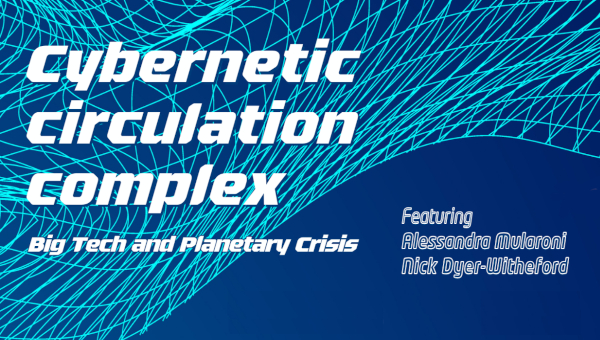
When: Friday, January 23 / 7:00 pm
Where: College United Church, 452 College St, Toronto

The Leo Panitch School for Socialist Education is honoured to host the authors of the book for the Toronto launch of this exciting new book! All are welcome to join us for this timely discussion as we grapple with how to challenge the Big Tech firms that are quickly cementing their control over international commerce and policy.

Nick Dyer-Witheford, a Professor in the Faculty of Information and Media Studies at the University of Western Ontario. He has written on the video and computer game industry, the uses of the Internet by social movements and theories of technology.

Alessandra Mularoni is a PhD candidate in the Faculty of Information and Media Studies at the University of Western Ontario. Her dissertation focuses on the bioethical questions surrounding the prospect of eternal life.


To My Comrades


I hear a song in you, comrades. I hear your voices in the streets. I hear you all across the country, your chants and instruments of disruption echoing from every corner. May your tune continue to carry, reverberate, and resonate, stirring and rousing others still. May your thunder continue to amplify and distort until the noise of fascism is drowned out completely. You are already proving that silence and injustice would never ring true of us.

What we do now, wherever we may be, matters more than ever. We know this. We know there is much organizing to be done, much protesting to be realized and effected. Let the world look upon our actions and know that we will not repeat the repressive histories of fascist regimes, much less suffer a kakistocracy to snuff us out in our resistance. Indeed, our light shines too brightly amid the darkness.

Know that no one is coming to save us, nor should we expect any other nation to come to our aid. We cannot put our trust in any state. Therefore, we must depend on ourselves despite our individual shortcomings and become something truly greater than the sum of our parts. Let us leverage our differences and our identities and our classes and our bodies. Let the lashes of inequity scar over our body politic as we become a tidal wave to wash away any wickedness that would divide or minimize us. Let us amass and assemble. Let us build.

Remember that we have more than one enemy in this fight, and our individual politics might only serve to divide us. So, we should look to the historical moments of peoples past who collectively soldered together to oppose tyranny and ensure radical democracy for themselves and their posterity. Let us also knit together in solidarity, bound by the fibers of subsidiarity. Indeed, do whatever you can right where you are. Count on your neighbor to do the same, or not, but lead with hope, always. For as long as I can hear you exercising your rights, I will know that there is hope and that that hope is real.

The world is ours to lose, but it is also ours to gain. This is it. This is the moment only we can seize. We are too many to be outstripped by the phantoms of some woefully broken institutions. They would dissolve us, metabolize us, and spit us out like seeds, scattered to die in the sun. But beneath the rotten fruit of the flesh that now envelops us, let us remember that we are seeds, and our stand now shall bear sweeter fruit for future generations who surely deserve it, for no other reason than they should one day exist and take up our mantle and remember the remarkable deeds we will have done, especially in the shadows of repression.

A revolution can hardly stand to count the cost. If there is a price to pay, so be it. Too many have toiled in pursuit of what we have and yet enjoy, which is worth preserving and even expanding. Let this be an inflection point, and let every opportunity be taken. May the poetry of change be written on our hearts in the process, and may we recite our poem together, as one. I look forward to this song and will rejoice with you once it is complete. Then, even its hum shall remind us of what we endured in the process of writing our most operatic piece: the liberation and prosperity of us all.

Ratify the R-Word—Bruce, Minneapolis, Revolution, and Us

Source: Originally published by Z. Feel free to share widely.

Twenty four years ago I wrote an essay titled “Resurrect the R Word.” To many people back then revolution meant chaos, violence, and death. Disagree? Me too. But should we resurrect the R-Word? My answer back then was that we should and I have the same answer now. But now we should Resurrect and also Ratify the R-Word. 

Talking about the U.S., where I live, a quarter century along history’s timeline Fascist thuggery, authoritarian, racist, and misogynist regimentation, war, and ecological dissolution threaten everything. Though the R-Word appears everywhere, what does it convey? Why should the R-Word re-enter our hearts and minds? Our Revolution? Not breakfast cereal revolution. Not cyber revolution. Our Political, Economic, Cultural and Social Revolution.

Seven and a half million people in the U.S. are unemployed. Forty million are poor. Forty seven million intermittently go hungry. Seven hundred and seventy five thousand have no material home. How many have no emotional, spiritual home? Even those who are not materially desperate largely lack personal say over their own lives. Trump is a disaster unfolding. But beneath Trump, indeed birthing and nourishing and elevating Trump, all manner of billionaire bosses rule here in what some like to call: USA, USA! 

Employees sell their ability to produce and as a reward about 8 out of 10 of them suffer abject subordination, lurid lies, vile chicanery, and massive manipulation. All of it backed by force. Dignity is denied. Ambulance-chasing is a professional pastime. And with whatever means available, from bare minimum poor to vapidly rich, to fetishize and accumulate whatever commodities you can grab is a socially respected way of life. 

To score high on the “I own” meter requires that you inherit or you accumulate and debauch without a care. However it is not capitalists’ genes, but the institutional byways that they traverse that exterminates their humane sentiments. The problem is not our genes. The problem is the institutions that channel our choices. 

In our economies garbage rises. To profit, owners become social garbage. We all know it’s true. The idea that capitalists will freely forsake economic violence is delusional. We know that too. Capitalism doesn’t sincerely gift us fine schools, excellent health care, equitable incomes, solidarity among workers, people before profit, empathy over greed, self management beyond democracy, and an environment suitable for human habitation. To the extent we get any of that it is due to struggles undertaken against capitalism. Capitalism, of its own accord, exploits and alienates those who it does not elevate. Its pliers warp even those who it does elevate. 

Humane pursuits and collective self-management require in place of capitalism collective ownership, equitable income and circumstances, balanced jobs that incorporate comparable access to information, responsibility, and skilled work for all, and decentralized participatory planning to replace rat race competition and top down coercion. Humane pursuits and collective self-management require classlessness.

It turns out that we endure economic violence but we want economic liberty. More, to go from economic violence to economic liberty is what economic revolution is all about. No old boss. No new boss. Instead new institutions. Ratify the R-Word. But is economics all we suffer? No, of course it isn’t. Consider what some call kinship.

Feminists teach that gender is social; women and men are each worthy; girls and boys, mothers and fathers, aunts and uncles, daters and datees are not anatomic roles but historically contingent outcomes. We are what we do. But we can do other than what nuclear families, contemporary sex roles, courting and parenting roles demand, and what fashion, Hollywood, religion, and bosses celebrate.

A sexual assault occurs in the U.S. nearly every minute. Upward of one out of five women suffer rape or attempted rape at least once in a lifetime. Eighty percent of all women suffer sexual assault or harassment at some time. Women earn just under eighty percent for comparable work as men. On the other hand, women do get considerable pay for modeling, acting, homemaking in mansions, and street-walking in Manhattan. Women do more housework than men and shoulder most responsibility for child-rearing. Women hold up half the sky and much more. But still women still suffer. U.S.A., U.S.A. Chant it proud?

U.S. teenage pregnancy is highest in the developed world while the multi-billion-dollar U.S. pornography industry evidences and elicits mind-staggering manufactured sexist perversion. Child-rearing and education relegate to young women who aren’t being trafficked the freedom to be “feminine” and obey, and relegate to young men who aren’t trafficking the freedom to be “manly” and rule. Society’s preponderant roles distort all genders, albeit quite differently. Billion dollar diets mutilate millions of human psyches and hundreds of thousands of human bodies. Tens of millions of men and women suffer indignity, brutality, and even death for their homosexual or trans lives, while the elderly suffer isolated poverty even as productive tasks they could do go undone. 

Macho doesn’t presuppose male genes. It is not inscribed in DNA that men should objectify and batter women. Kinship violence stems not from genes gone bad, but from damaged families, from men fathering and women mothering, from pseudo-sexuality, reductive education, competitive courting, and sexist economics, politics, and culture.

To transcend gender violence we need sex-blind roles; support for single, coupled, and multi-parenting arrangements; plus easy access to high-quality daycare, flexible work hours, and parental-leave options. To produce gender peace we need freedom for children to develop views with their peers without excessive adult supervision. To produce gender liberation we need retirement guided by personal inclination and not age; liberated sexuality that respects all free choices and inclinations; and norms of courting, child-rearing, law, religion and work free from gender bias. In short, we need a transformation that replaces this country’s patriarchal misogyny with gender equality and sexual freedom. The R-Word needs ratification for kinship, too.

What about the ethnic, racial, and religious ways by which we understand ourselves and our place in society? Slavery, apartheid, separate but equal, racism, religious bigotry, ethnocentrism, and colonialism are all systems in which one community subordinates another or in which two communities wage endless conflict that deadens the cultural prospects, souls, and bodies of all concerned. 

In the U.S., median family income, infant mortality, criminal prosecution, allocation of educational resources, and distorted and distorting mass media images all track race to ensure that nonwhite communities settle beneath white ones. These dynamics subjugate whole peoples. These dynamics deny whole peoples’ cultures and whole peoples’ potentials for developing and fulfilling themselves. They pervert ruler and ruled alike.

As a result, the U.S. is far from being a compendium of diverse free communities, each enabled to develop in harmony with others, each respecting and learning from answers that others offer, and each protecting the rights of all. To collapse all cultures into the norms of a dominant few via “integration” is no solution. The needed transformative change is revolution. The R-Word applies again.

U.S. politics features media-reinforced apathy, financial bribes and scams, police repression, regressive taxation, choices between candidate clones, massive corruption, aid to dictators abroad and at home, and wars. And of late it also includes a drive toward Fascism, which is Trump’s version of political revolution. Real participatory democracy will instead need to feature collective self-management including plebiscites, honest plentiful information, informed public debate, popular assemblies, maximum respectful accountability, reconstructed adjudication, and no possibility for accruing excessive political power.

To transition from spectator ruler-versus-ruled politics to participatory politics will therefore require new political aims and institutional means to debate them, refine them, dispute them, fight for them, and enact them, as well as to deal with violations. We the people need both information and power. Popular resistance campaigns to redress grievances can ease immediate suffering and nowadays forestall a slide to dictatorship, but they will not alone create new institutions able to propel informed participation. New polity will need revolution. The R-Word needs ratification here too.

Nations fight nations. Torture and war ravage human potential. Hunger afflicts billions. Chemical wastes infect us. Air pollution congests us. The seed-base depletes us and temperatures keep climbing toward ecological debacle. Forests diminish. Wastelands spread. People, animals, and plants drown, starve, and burn. Neither the world as a social system nor the world as an ecosphere can withstand much more, more, more. Without international equity plus new means for care-taking the earth, all will go to hell in a turbo-cart. In a dirty world, the R-Word is not a dirty word. Ratify it.

To feel embarrassed or afraid on hearing the R-Word makes liberated human history seem impossible. To equate revolution with blood-lust accepts that struggle for change can yield only minimal gains or, if we get too ambitious, worse than what we already have. To debate the wisdom of revolution reflects timidity about truth. We must no longer debate the wisdom of fundamental change as if humanity may after all be able to flourish or even just survive within the permanent dictates of capitalism, patriarchy, racism, and authoritarianism. Fundamental change is not only possible, it is essential. But a host of related issues do warrant continued and expanded debate.

For example, what new institutions would desirable economic, kinship, cultural, political, international, and ecological revolution create? We need to at least broadly know because we won’t get where we want to wind up if we have no clarity about at least the defining features of where we want to wind up. Do we now have that? Ratify the R-Word.

And how do we win immediate reforms while we strengthen our ability to fight for long-run aims? We need reforms to reduce pain now but also so the fight for them teaches and propels relevant lessons and so that winning them expands our confidence and develops our means to win more. That is R-Word logic.

And what kind of organization, ideology, and tactics do we need to reach our full goals? Since priority attention to economics, gender, culture, politics, international relations, and ecology yields contrasting socialist, feminist, nationalist, anarchist, anti-imperialist, and green agendas, including different views within each, how can a new movement retain the integrity, wisdom and autonomy of each of these orientations, correct whatever faults they may have, and simultaneously realize solidarity among them all? That is the R-Word’s call to action.

Debating these and related strategic questions while we raise consciousness, demonstrate, and organize to expand and enrich resistance isn’t “utopian.” It is the only comprehensive approach that can win immediate social change and also keep winning more change on the path to fulfilling R-Word mandates. 

To win a new world, and even to significantly improve this one, we must know what we want. To journey from here to there we need to know where “there” is. What new institutions will establish real a participatory economy and in particular what steps can lead to those new institutions? What new institutions would establish a feminist kinship sphere, a culturally intercommunal community sphere, and a participatory political sphere? In each case, what steps can take us from what we have to what we need? 

As we endure current horrors, it does not evidence maturity, pragmatism, or wisdom to dismiss revolutionary desire as strange, to see it as off base, or call it impossible. To dismiss what is in fact essential and desirable instead evidences ignorance, defeatism, or even lack of humanity. Don’t whisper the R-Word. Loudly ratify it. 

But even as we do all that, we need to also remember that to win fulfilling freedom doesn’t require adopting arrogant postures that alienate potential allies. It doesn’t require dismissing that which isn’t yet where we are. Instead, to win fulfilling freedom requires sober yet comprehensive desire plus careful yet unrelenting forward movement. It requires that we listen, converse with, and respect people who disagree with us. 

Liberalism’s half-way programs and temperate rhetoric, when unaccompanied by revolutionary insights, tend to strengthen the two greatest obstacles to justice in the U.S.: The widespread belief that you can’t beat City Hall and that even if you do beat the bastards, it won’t mean overly much because new bosses will be as bad as old ones. Isn’t it obvious that the left won’t arouse hope and deserve commitment until its morality, tone, and spirit transcend band-aid bureaucratic fixes even as it necessarily struggles to win those limited gains on the way to winning fundamental change in the longer run? Isn’t it obvious that we ultimately have to get to the institutional heart of the matter? Ratify the R-Word.

We can’t win what we won’t even name. We can’t orient today’s reforms to further tomorrow’s victories if we refuse to define what we want tomorrow’s victories to include. Blind strategy is no strategy at all. Resistance is good, but to undo lethargy and cynicism and attain liberation, we ultimately need to ratify the R-Word in our speaking, writing, thought, and action. 

And so what does to ratify revolution mean right now, while ICE runs rampant, RFK Jr. sickens the country, Hegseth macho-man’s the media, and Trump twists the very fabric of reality to pursue his own maniacal brand of Fascism? 

Just a few days ago I logged on to a collective call about resistance in Minneapolis—which city is now central to Trump’s violence and thus also to the resistance’s prospects. The online gathering was inspiring and hopeful in many respects and especially in its call for no work, no consuming, and no school in Minneapolis this Friday January 23rd (with the call now expanded to the whole of Minnesota, I believe), plus lots of accompanying activism against ICE and its abettor corporations and politicians conducted all week and especially on the 23rd. But beyond even the Minneapolis movement’s exemplary courage, commitment, and competency, to bring the R-Word back means that the movement in Minneapolis should work to begin to challenge not just ICE, the only focus during the call, but also tariffs, imperial bullying, police repression, racism, misogyny, rising prices, booming income and wealth differences and authoritarian governance. Resistance events and struggles everywhere need to begin to go from great on one issue to great on all issues. They need to appeal to and empower not mainly one constituency but all those with an interest in immediate and ultimately also in fundamental change. That will start to ratify the R-Word for this moment and also for the long march toward winning fulfilling freedom for all.

If young people stay home from school and consumers don’t consume and workers don’t work this Friday even just in Minneapolis much less throughout Minnesota it will be a huge step toward resurrecting and ratifying the R-Word there and toward inspiring other locales to do so elsewhere as well. Trump and Co. and their followers will hear that loud and clear. Our fear will decline. Their fear will rise.

Afterword: My last article, “Three Strategic Issues: What to Say or Write? What to Do? and Who to Do it With? Plus Taylor, Steph, and Caitlin…”, concluded with some entreaties to citizens with large audiences and ample media means to address them. It mentioned a number of such personalities by name and noted that while grass roots participants are the heart and soul of the now growing resistance, contributions from notable singers, actors, athletes, labor leaders, and more, and in high school and college classrooms from teachers and professors, can help create room for and inspire many more people to stand tall. And wouldn’t you know it, the man called The Boss with love and respect, not derision, last night previewed how to do it and today his words are all over. Look it up. At a New Jersey festival Bruce Springsteen introduced his song “The Promised Land” with these words:

“This next song is probably one of my greatest songs. And I don’t want to be out of water tonight, but I wrote this song as an ode to American possibility … both to the beautiful but flawed country that we are, and to the country that we could be. Now, right now, we are living through incredibly critical times. The United States, the ideals and the values for which it stood for the past 250 years, is being tested as it has never been in modern times. Those values and those ideals have never been as endangered as they are right now. So as we gather tonight in this beautiful display of love and care and thoughtfulness and community … if you believe in democracy, in liberty … if you believe that truth still matters, and that it’s worth speaking out, and it’s worth fighting for … if you believe in the power of the law and that no one stands above it … if you stand against heavily armed masked federal troops invading American cities, and using Gestapo tactics against our fellow citizens … if you believe you don’t deserve to be murdered for exercising your American right to protest … then send a message to this President. And as the Mayor of that city has said, ICE should get the fuck out of Minneapolis. So this one is for you, and the memory of the mother of three and American citizen Renee Good.”

Gestapo indeed. Ratify the R-Word.Email

avatar

Michael Albert`s radicalization occurred during the 1960s. His political involvements, starting then and continuing to the present, have ranged from local, regional, and national organizing projects and campaigns to co-founding South End Press, Z Magazine, the Z Media Institute, and ZNet, and to working on all these projects, writing for various publications and publishers, giving public talks, etc. His personal interests, outside the political realm, focus on general science reading (with an emphasis on physics, math, and matters of evolution and cognitive science), computers, mystery and thriller/adventure novels, sea kayaking, and the more sedentary but no less challenging game of GO. Albert is the author of 21 books which include: No Bosses: A New Economy for a Better World; Fanfare for the Future; Remembering Tomorrow; Realizing Hope; and Parecon: Life After Capitalism. Michael is currently host of the podcast Revolution Z and is a Friend of ZNetwork.

Source: Originally published by Z. Feel free to share widely.

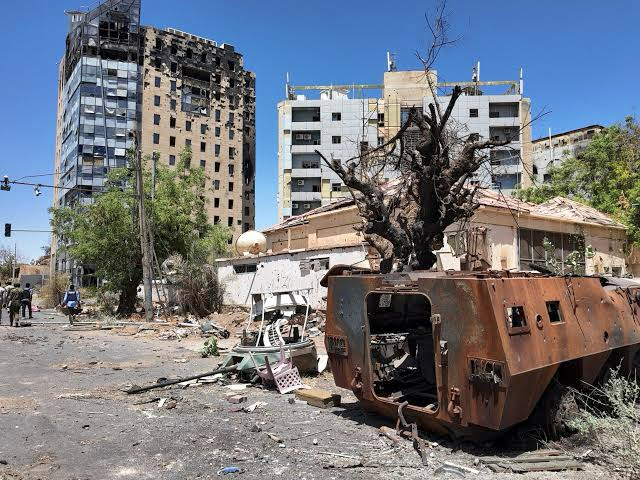
In April 2023, a war broke out in Sudan between the national army and the Rapid Support Forces militia. It is estimated that millions were displaced and thousands were killed. The UN now considers the country to have the worst humanitarian crisis.

But this war is mainly fueled by external actors, primarily the UAE, which is backing the RSF militia. Western countries, while declaring neutrality, are in reality complicit in the UAE’s plot in different ways. This stance, if not corrected, will undoubtedly prolong the war and the suffering of the Sudanese people. 

Despite ample evidence that the UAE is diverting arms to the RSF militia, Western countries kept selling them to the UAE,  for instance, in October 2025, a news report exposed that UK military equipment, such as small-arms target systems and British-made engines for armoured personnel carriers were found to be used by the militia in Sudan. Both Australian and Canadian companies continued to sell weapons to the UAE without placing any restrictions on their final destination.  In November 2024, Amnesty International revealed that French-manufactured weapon systems incorporated into armoured personnel carriers made by the United Arab Emirates were identified in Sudan. Indeed, the supplying of these arms represents a stark violation of the UN arms embargo resolutions in Darfur, which was renewed in September 2025, and its goal is to bring stability to the region by prohibiting arms shipments to the region

Western countries also worked to cover the dire consequences of the UAE’s intervention in Sudan. In December 2026, a whistleblower revealed that the UK Foreign Office deleted an alert threat of genocidal violence by the RSF to protect the UAE. The UK also attempted to suppress any criticism of the UAE over its role in Sudan by putting pressure on African diplomats. Recently, the EU removed the mention of the UAE in a resolution condemning the genocide in Sudan. In the U.S., legislation aimed to stop arms sales to the UAE because of its support for the miltia was blocked by the Senate. 

In some cases, there have been direct connections between the West and the militia. For example, the UK Foreign Office hold secret talks with the militia, and European institutions used the services of the RSF security company in Sudan. Moreover, Analysts and watchdog groups have long questioned how the EU-RSF deal to control the border supported the militia financially and legitimized its existence.

The West leveraged sanctions to absorb this pressure and to be perceived as neutral in this war. These sanctions are usually imposed on both the Sudanese army and the RSF leadership, as well as the companies associated with them, but they have never achieved their stated goal of ending the war. 

On the other hand, there have been several independent and moral voices emerged in the West. For instance, British MPs across parties demand arms sales to the UAE. Canadian civil society is calling for the end of arms exports to the UAE, US legislators are criticizing the U.S. role in Sudan, and are requesting the designation of RSF as a terrorist organization. The socialist and democratic group at the European Council urged action to end Sudan’s war and regretted the omission of the UAE’s name. In the U.S., the known singer, Macklemore, decided to cancel his show in the UAE. Activists such as  Activist Greta Thunberg called for stopping visiting the UAE. A giant billboard in London was installed, highlighting the role of the UAE in Sudan. There have also been calls for the NBA to terminate its partnership with the UAE. Importantly, the Yale Humanitarian Lab has been crucial in documenting and monitoring the atrocities of the war. The student body of the University of Maryland urged the university to cut ties with the UAE, and a Swiss-based watchdog group requested more scrutiny on the gold imported from the UAE that could be fueling the genocide in Sudan

Evidently, without the support and the political coverage of the Western governments, the UAE can’t continue in its war in Sudan. 

More pressure from activists and civil society in the West is needed. It’s time for these governments to be held accountable for their actions and to stop the ongoing bloody war in Sudan. Email

avatar

Mohamed Suliman is a researcher and writer based in Boston. His recent articles tackle the War in Sudan. He holds a degree in engineering from the University of Khartoum.