Wednesday, January 21, 2026

India Deepens Energy Ties With the Gulf While Balancing Russian Oil Risk

  • India is pursuing a diversified energy strategy, locking in long-term LNG and nuclear deals with partners like the UAE while continuing to buy discounted Russian crude.

  • Energy ties with the UAE are deepening, with new LNG supply agreements, expanded nuclear cooperation under India’s SHANTI Act.

  • Despite rapid renewables growth and falling coal use last year, India will remain a major consumer of oil and coal for decades.

India’s energy strategy is increasingly defined by balance rather than allegiance. As demand surges and geopolitical pressure mounts, New Delhi is locking in long term supply wherever it can, from gas in the Gulf to discounted crude from Russia, alongside nuclear partnerships that promise reliable baseload power. The approach reflects a broader effort to insulate economic growth from volatility, even as global energy markets fracture along political lines. UAE President Sheikh Mohamed bin Zayed Al Nahyan concluded his visit to India’s Prime Minister Narendra Modi on Monday, with the two countries signing a long-term LNG supply deal and agreeing to double bilateral trade to over $200 billion by 2032. The Abu Dhabi National Oil Company (Adnoc) will supply India’s Hindustan Petroleum Corporation with 500,000 tonnes of liquefied natural gas (LNG) per annum in a deal valued at $3 billion, over 10 years beginning in 2028. The deal will deepen energy ties between the two countries, with Adnoc having closed a long-term LNG supply deal with Indian Oil Corp. for 1.2 million tons annually worth between $7 billion and $9 billion, for a period of 15 years.

The two countries also agreed to expand cooperation on nuclear energy, including both small modular reactors and larger conventional projects. The collaboration is supported by India’s recently passed SHANTI Act, which opens parts of the nuclear sector to private participation and foreign partnerships. For New Delhi, the move fits with a broader push to expand low-carbon baseload power as electricity demand continues to rise. For the UAE, it builds on experience gained from the Barakah nuclear plant and supports a longer-term strategy to remain a key energy supplier even as global demand gradually shifts away from oil.

Meanwhile, India continues to buy substantial volumes of Russian oil.

U.S. President Donald Trump recently threatened to slap the country with more tariffs for buying Russian oil, saying, "They do trade, and we can raise tariffs on them very quickly," Trump said about India's Russian oil purchases. Likewise, Republican Senator Lindsey Graham told reporters, "If you are buying cheap Russian oil, (you) keep Putin's war machine going. We are trying to give the President the ability to make that a hard choice by tariffs."

Graham has proposed punitive tariffs of up to 500% on countries that continue to buy Russian oil. Last year, Reliance Industries, India's largest private refiner, significantly reduced purchases after the Trump administration slapped sanctions on Russian energy giants Rosneft and Lukoil in late 2025. The sanctions targeted shippers and traders, causing initial drops in overall Russian oil imports, which were later offset by purchases by state-owned refiners (PSUs). PSUs such as Indian Oil (IOC), Bharat Petroleum (BPCL), and Hindustan Petroleum (HPCL) have maintained or even increased their intake of Russian crude, often through non-sanctioned intermediaries, using long-term contracts.

India is expected to contribute the majority of global oil demand growth in the coming years, leading all other nations, thanks to rapid economic expansion, industrialization, increasing car ownership and rising incomes. 

Indeed, India could account for nearly half of all new oil demand by 2035, with the International Energy Agency (IEA) projecting the country’s energy demand will grow at a 3% annual clip through 2035, the fastest in the world. And, a lot of that growth will come from renewable energy. Last year, India and China recorded the first drop in coal use in more than 50 years, highlighting their ongoing clean energy transition. According to an analysis by the Centre for Research on Energy and Clean Air (CREA), India’s coal-powered electricity generation fell 3.0% year-on-year to 57 terawatt hours while China’s fell 1.6% Y/Y to 58 TWh, marking the first decline since 1973. Faster clean-energy growth accounted for 44% of the reduction in coal and gas consumption; milder weather accounted for 36% while 20% was due to slower underlying demand growth. According to CREA, this is the first time that renewables are playing a significant role in displacing coal from India’s energy mix.

However, India will continue buying and using coal for the foreseeable future, driven by rising energy demand and the need for reliable baseload power, despite significant growth in renewables. India's growing economy and increasing power consumption necessitate coal for grid stability, with plans for more thermal capacity and a projected increase in overall coal demand to 1.5 billion tonnes by 2030.

By Alex Kimani for Oilprice.com


Indian Refiners Boost Middle East Supply To Offset Lost Russian Oil

Indian state-run refiner Bharat Petroleum Corporation Limited (BPCL) has awarded tenders to buy Iraqi and Omani crude on the spot market, as India’s refiners are raising supply of crude from the Middle East to offset in part the volumes they lost from Russia following the U.S. sanctions. 

BPCL has awarded one-year tenders to buy Iraq’s Basrah Medium and Oman crude to global commodity trader Trafigura, refining and trade sources told Reuters on Wednesday. 

Additionally, BPCL is scouring the market for spot cargoes of Murban crude from the United Arab Emirates (UAE) in a separate tender, according to Reuters’ sources.  


Over the past weeks, India’s refiners have significantly raised purchases of non-Russian oil supplies as they want to avoid angering the United States amid difficult India-U.S. trade negotiations. 

All Indian refiners have said they would comply with the U.S. sanctions on Rosneft and Lukoil, and Russian supply to India has plunged to a three-year low these days.    

Indian firms are scouring the globe for favorably priced crude to replace the Russian supply they have lost following the U.S. sanctions on Russia’s top producers Rosneft and Lukoil.  

India’s refiners have halted imports from the now-sanctioned entities and turned to non-sanctioned Russian supply and alternative cargoes from the Middle East, the Americas, and, to a lesser extent, West Africa, arbitrage permitting. 

State-run Mangalore Refinery and Petrochemicals Limited (MRPL) is now exploring potential purchases of crude from Venezuela after stopping imports of Russian oil. 

MRPL currently meets about 40% of its crude needs with purchases of Middle Eastern crude. It also buys cargoes on the spot markets and refines domestically produced oil.

The refiner is actively weighing the opportunity to buy Venezuelan crude oil if the commercial terms, including freight rates, are favorable, MRPL’s head of finance Devendra Kumar said on an analyst call last week. 

By Tsvetana Paraskova for Oilprice.com

Kurdistan’s Oil Lifeline at Risk as Baghdad Payments Fall Short Again


  • Kurdistan says Baghdad has transferred only ~41% of its owed budget since 2023, threatening salary payments, debt servicing to oil firms, and basic governance.

  • Despite resuming limited exports via the ITP and transferring oil and non-oil revenues to Baghdad, the KRG says promised payments and investment funding have not materialized, eroding trust and leverage.

  • With Iraq’s leadership in flux and foreign oil firms still owed over $1 billion, Erbil is pressing its case now.


The Kurdistan Region of Iraq (KRI) is once again edging toward a fiscal breaking point. Officials in its Erbil-based semi-autonomous regional government (KRG) say they are receiving only a fraction of the budget transfers they are owed under the current oil-for-budget payments arrangement with the Federal Government of Iraq (FGI) in Baghdad. This revives the same dispute that triggered the collapse of the deal in March 2023 and shut down the crucial Iraq-Turkey Pipeline (ITP) for more than two years. Erbil argues that Baghdad’s shortfalls are not technical delays but a structural breach that threatens its ability to pay public salaries, service debts to international oil companies, and maintain even the basic functions of regional governance. With the ITP still operating far below capacity and trust between the two sides eroded, Kurdistan’s economic stability — and its leverage within the federal system — is once again in question.

Broadly, the deal at the centre of the KRG’s current complaints — and a source of constant dispute since its inception in late 2014 — involves the Kurdistan Region sending oil from its own oil fields and from Kirkuk to the Federal Government’s State Oil Marketing Organization (SOMO), in return for which it receives a percentage of the FGI’s budget after sovereign expenses each month. The contours of this latest dispute are painfully familiar, echoing the 2014 budget freeze, the 2017 post-referendum squeeze, the 2020 pandemic-era cuts, and the 2023 ITP shutdown — all unfolding along the same axis of mistrust and asymmetry, as analysed in full in my latest book on the new global oil market order. The pattern is consistent: Baghdad uses legal ambiguity and fiscal pressure to reassert control over the Kurdistan Region’s oil revenues; Erbil insists on predictable transfers to meet its payroll and other obligations; and the absence of a functioning oil export route leaves the KRG with no leverage beyond political brinkmanship.

In this latest case, Erbil said just over a week ago that its total constitutional entitlement between 2023 and 2025 amounted to IQD58.3 trillion (USD44.4 billion), while actual receipts did not exceed IQD24.3 trillion. This represents just 41% of the KRI’s financial rights and about 3.9% of the FGI’s total federal budget. Erbil also says that although the Federal Government allocated IQD165 trillion for investment spending nationwide, the Kurdistan Region received no funding for investment projects, resulting in the suspension of key infrastructure schemes. The KRG added that since oil exports resumed late last year, it has pumped 19.5 million barrels through the Federal Government’s State Oil Marketing Organisation (SOMO) in addition to transferring IQD919 billion in non-oil revenues to the FGI’s Treasury during 2025, despite continued delays in receiving its own entitlements.

All this flies in the face of the broad agreement reached in August/September that led to the re-opening of the ITP. At that point it was agreed that up to 190,000 barrels per day (bpd) of crude oil would flow though the ITP from Kirkuk to Ceyhan, with plans to increase this to the 230,000-bpd level seen just before the pipeline’s closure in 2023, and then back to even earlier higher levels over time. Before the shutdown in March 2023, around 450,000 bpd of oil was flowing through the ITP, comprised of approximately 350,000-375,000 bpd of KRG crude (Kurdish Blend) and about 75,000-100,000 bpd of Federal Iraqi crude (Kirkuk grade). As previously reported by OilPrice.com, US$16 of the sales price per barrel would be transferred to an escrow account and distributed proportionally to the KRI’s oil producers, with the rest going to SOMO. This effectively acted as a subsidy for production costs incurred by international oil companies operating in the KRI and replaced the previous offer of USD7.90 per barrel that was rejected by the KRG.

However, even at that point last August/September, potential problems were already beginning to surface, including from foreign oil firms that were collectively still owed over US$1 billion by the KRG for oil produced and then sold previously. Norway’s DNO and its joint venture partner Genel Energy had long made it clear that they would not fully re-engage with crude oil exports through the ITP until they received assurances from the KRG that it would properly address the US$300 million or so of debt to the two firms. The eight other foreign oil producers that signed the initial agreement to restart ITP exports to Turkey were to have met within the 30 days following the recent resumption of flows to flesh out a mechanism with the KRG for settling these debts. For Erbil, however, any such mechanism depended on the FGI keeping up its budget payments to the Kurdistan Region as promised. Foreign oil firms operating in the KRI at that stage also stressed the need for future export payments that were consistent with each company’s existing, legally valid contracts, and for payments to be transparent and prompt, either in cash or through in-kind transfers of crude-oil entitlements.

With these pressures mounting, and no new Iraqi prime minister yet appointed following the 11 November general elections, the KRG may well judge that now is an opportune moment to raise these issues again. Mohammed Shia’ al-Sudani had taken a hardline approach to what the FGI perceives as its ‘Kurdish Problem’ for much of his recent prime ministerial tenure. This was broadly aligned with the strategy of China and Russia to remove all independence from it and to roll it into a single unified Iraq more aligned with Beijing, Moscow, and Tehran. As underscored exclusively to OilPrice.com some time ago by a senior energy source who works closely with Iran’s Petroleum Ministry, China’s and Russia’s view is that: “By keeping the West out of energy deals in Iraq, the end of Western hegemony in the Middle East will become the decisive chapter in the West’s final demise.” On the other side of the geopolitical equation, the U.S. and its key allies want the Kurdistan Region (and Iraq more broadly) to terminate all links with Chinese, Russian and Iranian companies connected to the Islamic Revolutionary Guards Corps over the long term. The U.S. and Israel also have a further strategic interest in utilising the Kurdistan Region as a base for ongoing monitoring operations against Iran. Following al-Sudani’s very recent decision to suspend his bid for a second term — effectively opening the way for the head of the State of Law Coalition, Nuri al-Maliki — another layer of urgency has been added for Erbil. Al-Maliki has long-standing ties to Tehran, having spent years in exile both there and in Syria, and favours a stronger federal Iraq, with Baghdad controlling all parts of it. So, raising the dispute now allows Erbil to press its case while the political landscape in Baghdad remains unsettled and before a new Al-Maliki-led administration consolidates its position.

By Simon Watkins for Oilprice.com

Brazil’s Petrobras Orders $560M Fleet to Cut Charter Reliance and Boost Jobs

Brazil’s state-controlled oil giant Petrobras has taken another step to strengthen its domestic energy logistics and shipbuilding industry, signing contracts to build a new generation of gas carriers and inland vessels under its Mar Aberto fleet renewal program.

The contracts, formally signed on Tuesday in Rio Grande, in the southern state of Rio Grande do Sul, cover the construction of five liquefied petroleum gas (LPG) carriers, 18 barges, and 18 pushboats. The total investment amounts to R$2.8 billion (approximately $560 million), with Petrobras estimating the projects could generate more than 9,000 direct and indirect jobs across multiple regions of the country.

All vessels will be operated by Transpetro, Petrobras’ logistics subsidiary, and built entirely in Brazilian shipyards across three states. The Estaleiro Rio Grande shipyard will construct the five pressurized gas carriers, while Bertolini Construção Naval da Amazônia, in Manaus, will build the barges. The pushboats will be constructed by Indústria Naval Catarinense in Santa Catarina.

The initiative was attended by President Luiz Inácio Lula da Silva, alongside senior government and company officials, underscoring the political and industrial significance of the program. Lula has repeatedly emphasized the revival of Brazil’s shipbuilding and offshore supply chain as a pillar of industrial policy and job creation.

The five gas carriers ordered from Estaleiro Rio Grande represent the largest share of the investment, totaling R$2.2 billion. The vessels include three ships with capacity of 7,000 cubic meters and two larger units capable of carrying 14,000 cubic meters of LPG and related products.

Once delivered, Transpetro’s gas carrier fleet will expand from six to 14 vessels, effectively tripling its LPG transport capacity. Petrobras says the expansion is designed to support rising natural gas production in Brazil and to improve logistics both along the coast and on inland waterways, including operations in the Amazon region and the Lagoa dos Patos.

The new vessels are expected to be up to 20% more energy efficient than the existing fleet, with emissions reductions of roughly 30%. They will also be capable of operating at electrified ports, aligning the investment with Petrobras’ broader emissions reduction and energy transition goals. The first gas carrier is scheduled for launch roughly 33 months after construction begins, with subsequent deliveries every six months.

A central objective of the program is to reduce Petrobras’ reliance on chartered vessels. By expanding its owned fleet, the company expects to gain greater operational flexibility, lower long-term logistics costs, and tighter control over the transport of LPG and other petroleum products.

According to Petrobras CEO Magda Chambriard, the contracts prepare the company for future production growth while supporting the recovery of Brazil’s naval industry. Transpetro President Sérgio Bacci described the fleet expansion as a strategic milestone for energy security and national sovereignty.

In addition to the gas carriers, Transpetro is entering the inland navigation segment for the first time with the purchase of 18 barges and 18 pushboats, representing an investment of R$620.6 million. The move positions Transpetro as a vertically integrated operator in river-based transport of fuels and biofuels.

The vessels will support bunkering operations in strategic ports including Belém, Rio de Janeiro, Santos, Paranaguá, and Rio Grande, allowing Transpetro to operate its own fueling logistics rather than relying on third parties. Petrobras says this vertical integration will improve efficiency and cost control across its downstream logistics network.

The contracts form part of the wider Mar Aberto program, Petrobras’ long-term plan to renew and expand its maritime fleet. Between 2026 and 2030, the company estimates total investments of roughly $6 billion, including 20 cabotage vessels, 18 barges, 18 pushboats, and the chartering of up to 40 offshore support vessels for exploration and production activities.

The initiative reflects a broader trend among national oil companies to internalize logistics, modernize fleets, and align maritime operations with emissions targets—while also using procurement to stimulate domestic industrial capacity.

By Charles Kennedy for Oilprice.com

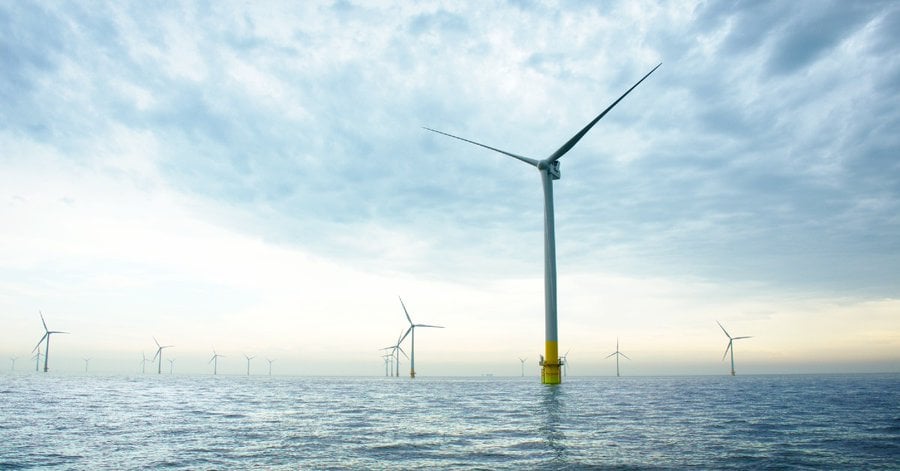
Ørsted Completes Turbine Installation at 920 MW Taiwan Offshore Wind Project

Ørsted has completed the installation of all wind turbines at its 920 MW Greater Changhua 2b and 4 offshore wind farms off the coast of Taiwan, concluding the project’s wind turbine build-out within a single installation season. The milestone positions the project among the most significant offshore wind developments in the Asia-Pacific region to date.

The wind farms, located 35 to 60 kilometers offshore Changhua County, consist of 66 Siemens Gamesa SG 14-236 turbines, each rated at 14 MW. Offshore construction began in February 2025, with turbine installation starting in April 2025 and carried out using Cadeler’s Wind Maker installation vessel.

First power was achieved in July 2025, and the project has been supplying renewable electricity to Taiwan’s grid since then. Full commercial operations are expected in the third quarter of 2026.

Greater Changhua 2b and 4 is the first offshore wind project in the Asia-Pacific region to deliver power under a corporate power purchase agreement (PPA), signed in 2020 with an undisclosed corporate offtaker. The project highlights the growing role of corporate PPAs in underwriting large-scale offshore wind developments beyond Europe.

Ørsted said completing a 920 MW turbine installation campaign in a single season was a notable achievement, given the limited weather windows and challenging marine conditions in the Taiwan Strait. According to the company, the installation phase required tight coordination across marine logistics, offshore construction, and safety management.

The project has set several industry firsts, both regionally and globally. It is the first offshore wind development in the Asia-Pacific to deploy suction bucket jacket foundations at scale, avoiding pile driving and keeping underwater noise levels close to natural background conditions during installation.

It is also the first offshore wind project worldwide to install 14 MW turbines equipped with 115-meter blades, currently the largest blades deployed offshore. Ørsted completed installation of all 66 turbines in 275 days.

Safety performance was another focal point during construction. Ørsted reported approximately 131,576 offshore working hours during the turbine installation campaign with zero lost-time injuries.

With turbine installation complete, the project has moved into the commissioning phase. Current activities include wind turbine commissioning, electrical system testing, and final offshore cable works. These steps are required before the project can reach full commercial operation in Q3 2026.

Greater Changhua 2b and 4 forms part of Ørsted’s historically large construction pipeline, which totals 8.1 GW globally. The project further cements Taiwan’s position as the leading offshore wind market in Asia and a strategic growth region for European offshore wind developers.

By Charles Kennedy for Oilprice.com

Vattenfall Finalizes Investment for Germany’s Largest Offshore Wind Project

offshore wind farm
Vattenfall finalized the investment decision after receiving permits for Germany's Nordlicht project (Vattenfall)

Published Jan 18, 2026 2:32 PM by The Maritime Executive


Offshore wind energy developer Vattenfall confirmed that it is moving forward with the Nordlicht offshore wind cluster. With construction due to start later this year, the two-phase project will become the largest wind project for Germany and a key contributor as the country struggles to accelerate development in the offshore wind energy sector.

The permit issued by the Federal Maritime and Hydrographic Agency (BSH) has become irrevocable, making the final step to move forward with the project. Vattenfall had announced in March 2025 that it had made the investment decision for the project, conditional on the receipt of the necessary permits. The company agreed to repurchase the shares in the Nordlicht cluster that BASF acquired in 2024. At the same time, BASF secured access to a long-term supply of renewable electricity, as part of the agreement. The companies said the agreement would secure renewable power for BASF’s chemical production in Europe at a time when such additional supply will be needed.

The Nordlicht wind cluster will be located just over 50 miles north of Borkum in the German region of the North Sea. The company reports monopile installation for Nordlicht I is expected to begin in the third quarter of this year, and when completed, the 980 MW project will be the largest capacity offshore wind farm in Germany. The second phase will add a further 630 MW. Nordlicht II should begin construction in 2027, and both wind farms are expected to be operational in 2028, adding over 1.6 GW to Germany’s energy supply. Electricity production is expected to total around 6 TWh annually.

Catrin Jung, Senior Vice President, Head of Business Area Wind for Vattenfall, called this a “defining moment” for the project. “This project is about more than building offshore wind capacity – it’s about strengthening Europe’s competitiveness and reducing reliance on fossil fuels. By producing clean electricity locally, we help create a more resilient energy system,” said Jung.

The decision to move forward on the project comes as Germany, like other Northern European countries, has experienced reduced interest in future projects due to the challenges and economic pressures on the industry. 

Despite having a target to reach 30 GW by 2030, Germany has been stuck at around 1,600 installed wind turbines since late 2024. It currently has a capacity of approximately 9.2 GW installed. While it has grown from just over 7 GW in 2021, future projects have been delayed. In August 2025, Germany received no bids in its latest allocation round, prompting the government to say it would have to adjust the strategy. It scaled back its plan for offshore-wind auctions in 2026 to between 2.5 and 5 GW, from an original plan for 6 GW. The next allocation was expected to proceed in February, with further rounds planned for mid-year.

Despite similar economic challenges in the Netherlands, Vattenfall highlights that it is moving forward with another large-scale project. Together with Copenhagen Infrastructure Partners, the company has received an irrevocable permit for the Zeevonk wind farm, which will have an installed capacity of 2 GW. It is also designed to produce green hydrogen in a key development for the Dutch industry.
 The project will be built in phases and is now delayed to a target completion of 2032.


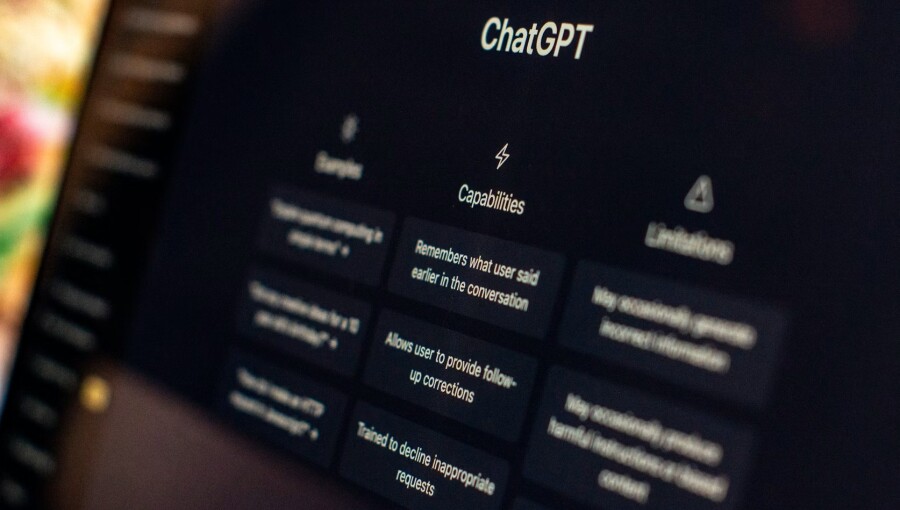
ChatGPT breezes through Japan’s university entrance exams

ChatGPT breezes through Japan’s university entrance exams
/ Emiliano Vittoriosi - Unsplash
By bno - Tokyo Office January 21, 2026

ChatGPT has achieved perfect scores in nine subjects in Japan’s unified university entrance examinations for the first time, underlining the rapid gains in the capabilities of generative artificial intelligence, Kyodo News reports.

Tests conducted by Tokyo-based AI venture LifePrompt found that the latest version of the chatbot achieved an overall accuracy rate of 97% across 15 subjects in the examinations held over the weekend. Full marks were recorded in nine areas, including mathematics, chemistry, informatics, and politics and economics.

According to Kyodo, performance was weakest in the Japanese language paper, where the system scored 90%, suggesting continued limitations in organising and synthesising complex written material in Japanese. By contrast, advances in processing speed and reading comprehension drove a notable improvement in quantitative subjects, particularly mathematics.

The annual two-day examinations are a key gateway to higher education in Japan, used by 813 universities, colleges and junior colleges. Around 500,000 candidates sit the tests each year when applying to national universities and some private institutions, selecting subjects relevant to their chosen courses.

For subjects typically taken by applicants to the University of Tokyo’s highly competitive Human Sciences I programme, ChatGPT recorded a score of 97%. This compares with 66% in 2024 and 91% in 2025, highlighting a sharp year-on-year improvement since LifePrompt began testing the system in 2024. By comparison, an overall score of 89% is estimated by the Kawaijuku Group, a major cram school operator, to give applicants a 50% chance of admission to the programme this year.

During the tests, access to search engines and external websites was blocked, meaning the chatbot relied solely on its internal data and reasoning capabilities.


Why Power, Not Capital Will Decide Who Wins the AI Wars

AI and crypto are still being analyzed as technology stories. Chips, models, hash rates, capital raises. That framing is already outdated. At this stage of the cycle, growth is no longer decided by demand or funding. It is decided by power.

Not theoretical power. Not future contracts. Existing, usable electricity that can support a continuous load. That is the asset hyperscalers are quietly competing for, and it is where expansion is actually happening. Companies that already have access to it within live facilities can move. Those that do not are discovering that capital alone does not unlock growth.

That framework is what makes Datacentrex (NASDAQ:DTCX) worth a closer look, because the company is not approaching this shift from the sidelines.

It already operates across four U.S. colocation sites running continuous, power-intensive workloads, with uptime above 95%. Its current fleet of more than 3,100 wholly owned Scrypt mining rigs is live today, spread across diversified data-center load zones, and management has disclosed a funded expansion to more than 4,100 rigs in the first half of 2026. This is not a future buildout. The facilities are live, powered, and operating today, with revenue being generated under continuous load.

Look at where the biggest buyers are actually adding load. Microsoft (NASDAQ:MSFT) has concentrated new AI capacity inside existing campuses in places like Iowa and Texas, where power delivery and transmission are already settled. Google (NASDAQ:GOOG) has done the same in long-established regions such as Virginia and Ohio. These are not speculative locations. They are places where electricity shows up on time and at scale. Expansion is flowing to what already works, while projects tied to future power remain stuck.

That is the environment in which Datacentrex operates. It is not waiting on approvals or interconnection. Its sites are already live. Power is flowing, load is running, and revenue is being generated under continuous operation. At this stage of the cycle, the question is not who wants to expand, but who already can.

What matters next is how that position is used. Datacentrex is not holding power idle.

Today, it is monetized through Scrypt mining. The infrastructure is already paid for, and cash is already coming in. At the same time, the company sits adjacent to a data center and AI market already measured in the hundreds of billions of dollars a year.

Secured access to live power does not promise outcomes, but it determines who even gets a seat when demand shifts.

How Datacentrex Uses Its Power Today

For now, Datacentrex uses its contracted, energized capacity the way infrastructure businesses usually do: by putting it to work.

Datacentrex’s current revenue engine is Scrypt mining, a faster-growing and less saturated corner of crypto infrastructure that has outperformed expectations over the past cycle.

Scrypt mining secures networks such as Litecoin and Dogecoin using specialized hardware designed for steady, always-on operation.

It is a different market from Bitcoin mining. The field is smaller. Competition is thinner. Scale is not dominated by a handful of megasites, and that helps shape returns.

Over the past year, that gap has been visible in operating results.

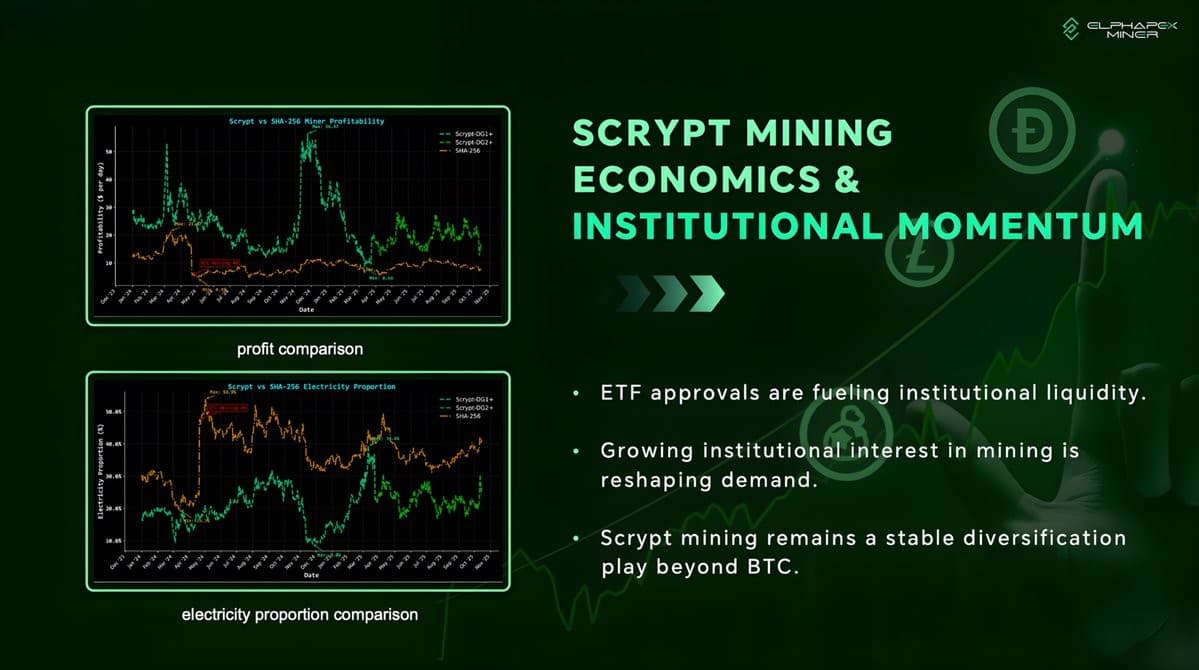
While Bitcoin miners have dealt with rising difficulty, higher capital intensity, and margin pressure following the halving, Scrypt economics have held up better. Company materials show that Scrypt mining delivered stronger realized profitability than SHA-256 mining for much of 2024. And it’s all because of the structure.

A clearer way to gauge mining economics is to look at what the networks pay miners. CoinMetrics network data show that total miner revenue on Scrypt networks such as Dogecoin and Litecoin stayed comparatively steady through 2024. Bitcoin miner revenue did not. The halving cut payouts sharply, and margins across the SHA-256 ecosystem tightened.

Scrypt mining also allows a single machine to earn rewards from two networks at the same time, most commonly Litecoin and Dogecoin. Power use does not increase, but output does. That feature is known as merged mining.

For many operators, merged mining creates a secondary problem. Rewards arrive in more than one cryptocurrency, each with its own liquidity and conversion process. Turning production into usable cash can involve multiple steps, additional timing risk, and unnecessary friction.

Datacentrex (NASDAQ:DTCX) handles this differently. Mining output is consolidated into bitcoin rather than managed across several smaller assets. The result is a simpler cash flow. Fewer conversions. Less exposure to liquidity bottlenecks. Revenue moves from production to cash without detours.

That shows up in operating results. Datacentrex has disclosed that its Scrypt operations have been EBITDA positive from the start. Power costs are covered. Sites fund themselves. Expansion is incremental rather than speculative.

Source: https://x.com/ElphaPex/status/2003624000581464457

This defines Scrypt's role in the business today. It is not framed as a destination. It is the current workload on energized sites. Cash is generated, infrastructure stays active, and the company retains the option to reallocate capacity over time. In a market where power is scarce, that combination matters.

Treasury Strategy: Liquidity First

Datacentrex pays attention to how revenue becomes usable capital, not just how it is produced.

Scrypt mining generates value across multiple networks. As a result, many operators end up managing several different crypto assets. That complicates cash flow. Conversion timing matters. Liquidity varies. None of that improves mining performance, but it can affect outcomes.

Datacentrex (NASDAQ:DTCX) avoids that problem by consolidating mining proceeds into a single settlement asset. Revenue is realized quickly and cleanly. There is no need to manage multiple small positions or wait for favorable conversion windows.

The result is a liquid treasury because operating costs are covered without the need to sell. Capital can be held, deployed, or left idle depending on conditions. Decisions are not dictated by short-term price moves or balance-sheet pressure.

That flexibility is the point. The treasury does not try to add returns on its own. It preserves the ability to act when opportunities appear and to sit still when they do not.

Execution: Scale, Control, and Cash Discipline

Execution at Datacentrex begins with ownership. The company owns its machines and operates directly within third-party colocation facilities directly. There are no leased rigs and no vendor liens embedded in the fleet. Decisions around uptime, expansion, and capital allocation stay simple because nothing lies between the company and its assets.

Today, Datacentrex runs more than 3,100 Scrypt ASICs across four U.S. colocation sites. Power is delivered and consumed under continuous load. These facilities are operating now, and utilization is happening in real time.

Growth builds from that base. Management has disclosed plans to expand the fleet beyond 4,100 rigs in the first half of 2026, adding capacity inside facilities that are already running. Power, cooling, and operating processes are in place. Capital goes toward machines, not construction.

The economics are already visible. Datacentrex has said its Scrypt subsidiary, dogehash technologies’ operations have been EBITDA positive from inception. Power costs are covered. Sites carry themselves. Expansion follows cash flow.

The company is also carrying cash. Datacentrex has disclosed roughly $45 million on hand, no long-term debt, and full ownership of its operating equipment. It is not forced to raise capital to keep operating or to add capacity.

The people involved have been through cycles where that distinction mattered. Members of the board and management have built and run crypto and data infrastructure businesses during periods when power tightened and capital disappeared. They have seen where leverage breaks things first.

That experience shows up in how the business is run. Assets are owned outright. Capacity is added where operations already work. Liquidity stays intact. The company is not built to chase scale just to justify fixed costs.

Management has been explicit about how it sees the model evolving. Datacentrex (NASDAQ:DTCX) has pointed to companies such as IREN, Cipher Mining, and TeraWulf as examples of businesses where the market stopped valuing hash rate alone and started valuing who has secured access to power,, balance sheets, and operating flexibility. The asset is not the output. It is the infrastructure underneath it.

For investors, execution here is straightforward. The system is operating, and cash is coming in, while capacity can be added without rebuilding the business.

Capital, Revenue, and the Size of the Playing Field

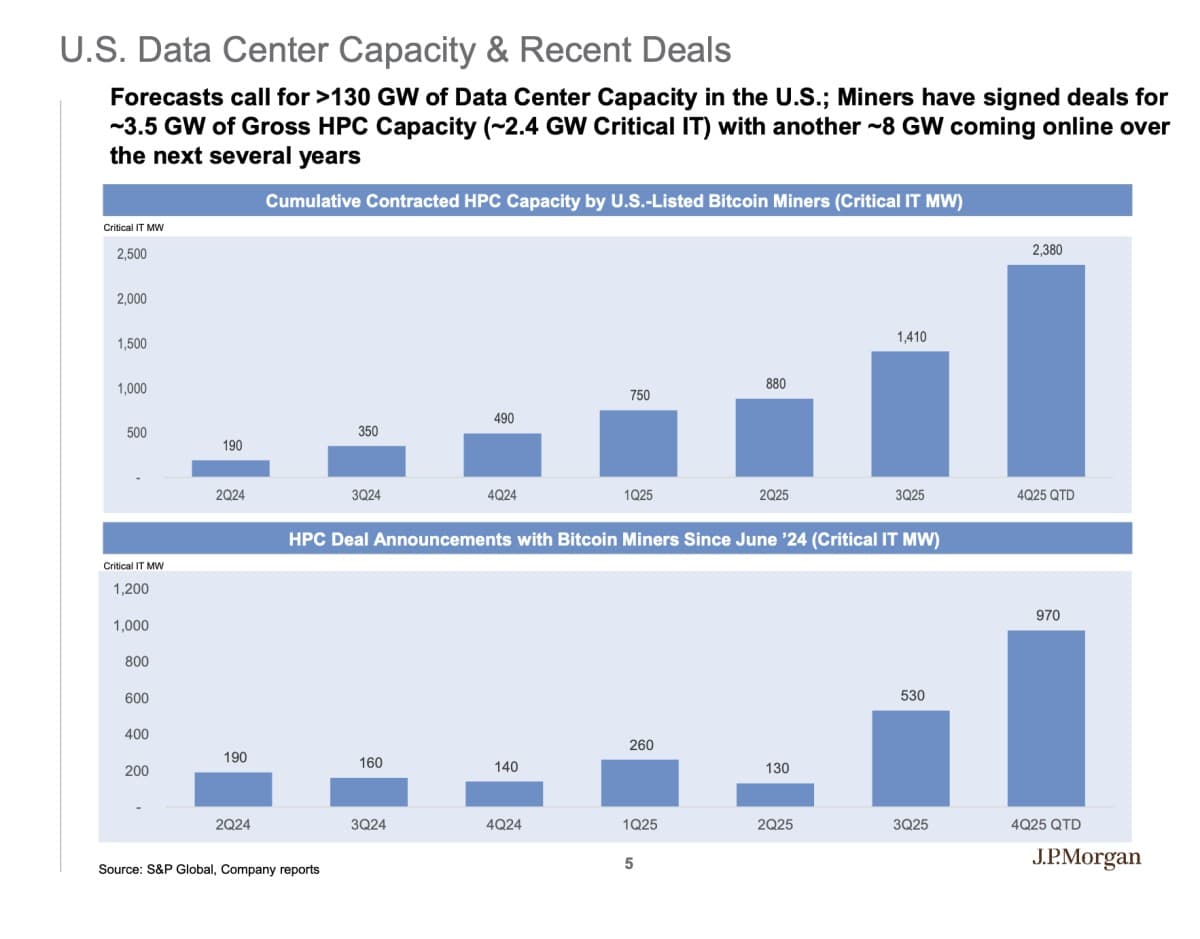
The scale of what is unfolding in data centers and AI infrastructure is already well defined. J.P. Morgan estimates that U.S. data center capacity could exceed 130 gigawatts by 2030, up from roughly 20–30 gigawatts today, with total infrastructure and hardware investment required to support that buildout running north of $3 trillion. Power, not demand, is the gating factor. Generation exists. Transmission, interconnection, and delivery do not move at the same speed.

J.P. Morgan’s work shows where capacity already exists. U.S.-listed bitcoin miners are operating more than 8.5 gigawatts of energized power, with approvals in place for roughly another 8 gigawatts. These are not plans on paper. The sites are connected, permitted, and already drawing load. Moving from mining to higher value computing is expensive, but the most difficult step is already complete. Electricity is reaching the site.

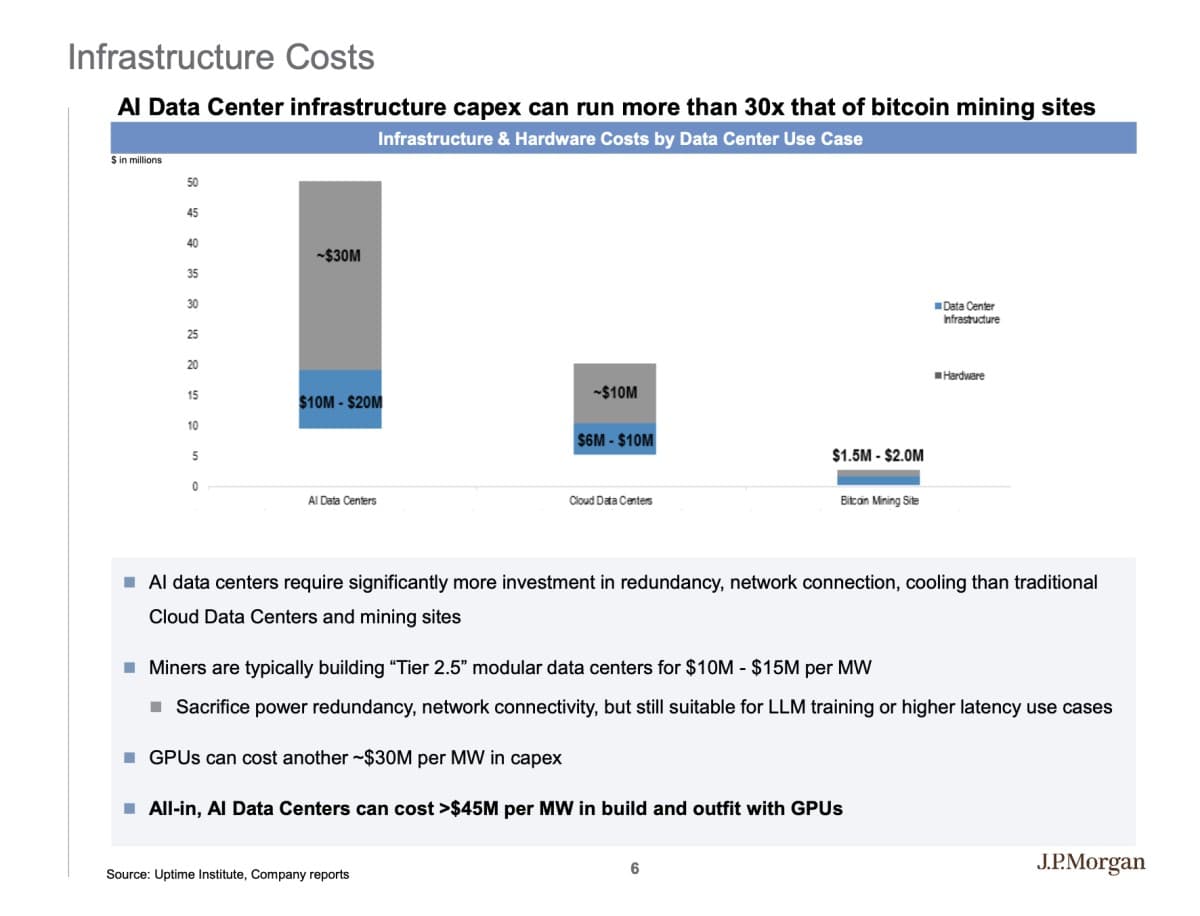
J.P. Morgan estimates that converting existing mining power capacity to HPC applications could cost roughly $10-15 million per megawatt before GPUs, with all-in AI data center costs exceeding $45 million per megawatt once hardware is included. That math explains why expansion across the sector is gravitating toward sites that already work, rather than projects that still need power.

This is where Datacentrex fits in. The company is not trying to solve the power problem. It is operating after it. Its business decisions concern how to use existing capacity, not how to secure it.

At this point in the cycle, outcomes hinge on where electricity is already being consumed.

Other companies to keep a close eye on in the space:

NVIDIA Corporation (NASDAQ:NVDA)

NVIDIA is the dominant global supplier of GPUs and accelerated computing platforms that underpin artificial intelligence, high-performance computing, and modern data centers. Its data center segment has become the company’s primary growth engine, driven by demand for AI training and inference workloads from hyperscalers, sovereign cloud projects, and enterprise customers. NVIDIA’s strength lies not only in hardware, such as its H100 and upcoming Blackwell platforms, but also in its tightly integrated CUDA software ecosystem, networking solutions, and AI development tools. As power availability and infrastructure constraints become limiting factors for AI deployment, NVIDIA’s ability to deliver higher performance per watt further strengthens its competitive position across global data center buildouts.

Nebius Group (NASDAQ:NBIS)

Nebius Group is positioning itself as a next-generation AI infrastructure and cloud services provider, focused on large-scale GPU computing and AI-optimized data centers. The company caters to enterprises and AI developers seeking high-performance compute capacity outside traditional hyperscaler ecosystems. Nebius’ strategy reflects a broader shift toward diversified and sovereign AI infrastructure, where access to power, land, and advanced cooling solutions is becoming as critical as capital. As demand for AI workloads accelerates globally, Nebius stands to benefit from structural shortages in GPU-ready data center capacity, particularly in regions prioritizing localized AI compute.

Micron Technology, Inc. (NASDAQ:MU)

Micron is a leading producer of DRAM and NAND memory, supplying critical components for data centers, AI accelerators, and advanced computing systems. The rapid expansion of AI workloads has materially improved the company’s long-term outlook, particularly through rising demand for high-bandwidth memory (HBM), which is essential for training large AI models. After navigating a cyclical downturn, Micron is benefiting from tightening supply conditions and improving pricing dynamics. Its continued investment in advanced memory technologies positions it as a key enabler of AI data center growth, where memory bandwidth and efficiency are increasingly decisive performance constraints.

Advanced Micro Devices, Inc. (NASDAQ:AMD)

AMD has emerged as a major force in high-performance computing, with expanding exposure to data center CPUs, AI accelerators, and cloud infrastructure. Its EPYC server processors continue to gain traction among hyperscalers and enterprise customers seeking alternatives in mission-critical data center deployments. AMD is also scaling its Instinct GPU platform to compete in AI training and inference, particularly as customers seek supplier diversification amid surging AI demand. The company’s focus on performance-per-watt efficiency aligns well with growing power constraints in data centers, making AMD an increasingly relevant player in AI-driven infrastructure spending cycles.

Apple Inc. (NASDAQ:AAPL)

Apple remains a global consumer technology leader, with a vertically integrated ecosystem spanning devices, custom silicon, software, and services. While Apple is not a direct competitor in hyperscale AI data centers, it is increasingly embedding AI capabilities into its products through on-device processing and energy-efficient chip design. Apple’s custom silicon strategy prioritizes performance within strict power and thermal limits, a philosophy that contrasts with brute-force data center AI models. As AI features become standard across consumer devices, Apple’s ability to deploy intelligence efficiently at scale strengthens its ecosystem while limiting dependence on external data center capacity.

Amazon.com, Inc. (NASDAQ:AMZN)

Amazon’s strategic importance increasingly rests on Amazon Web Services (AWS), the world’s largest cloud computing platform and a cornerstone of global AI and data center infrastructure. AWS continues to be a primary beneficiary of rising demand for AI training, inference, and enterprise cloud migration, driving large-scale investments in data centers, custom silicon, and energy procurement. Amazon’s in-house chips, including Trainium and Inferentia, reflect a growing effort to control costs and performance as power availability becomes a limiting factor in AI expansion. Beyond AI, AWS plays a central role in blockchain infrastructure, cybersecurity services, and cloud-native compliance, positioning Amazon as a critical enabler of next-generation digital and financial systems.

Alphabet Inc. (NASDAQ:GOOG)

Alphabet, through Google Cloud and its global network of hyperscale data centers, is one of the most technologically advanced AI infrastructure operators in the world. The company has long leveraged AI internally for search, advertising, and optimization, and is now commercializing those capabilities via cloud-based AI platforms and large language models. Google’s vertically integrated approach — combining custom TPUs, advanced cooling systems, and renewable energy sourcing — gives it a structural advantage as AI workloads strain global power grids. Alphabet is also a major player in cybersecurity through its cloud security offerings and acquisitions, and maintains indirect exposure to blockchain technologies through infrastructure services rather than speculative crypto activity.

Meta Platforms, Inc. (NASDAQ:META)

Meta is undergoing a fundamental transformation from a social media company into an AI-first platform operator, supported by one of the largest privately owned data center footprints in the world. The company is investing aggressively in AI infrastructure to power content recommendation, advertising optimization, and generative AI applications across its ecosystem. Meta’s data center strategy increasingly emphasizes custom silicon, high-density computing, and energy efficiency, reflecting the growing importance of power access and cooling in AI scalability. While Meta has pulled back from earlier crypto ambitions, its experience in blockchain and digital identity continues to inform its approach to secure digital platforms and data governance.

Microsoft Corporation (NASDAQ:MSFT)

Microsoft sits at the center of the AI, cloud, and enterprise software convergence, with Azure serving as one of the world’s leading hyperscale cloud platforms. The company’s deep partnership with OpenAI has driven massive demand for AI-optimized data centers, GPUs, and networking infrastructure. Microsoft is also investing heavily in energy procurement, nuclear partnerships, and grid resilience to support long-term AI growth. Beyond AI, Microsoft remains a dominant force in cybersecurity through its integrated enterprise security stack, making it a critical vendor for governments and corporations navigating rising digital threats. Its cloud services also support blockchain, identity, and compliance solutions at institutional scale.

Palantir Technologies Inc. (NYSE:PLTR)

Palantir specializes in data integration, analytics, and AI-driven decision platforms, with deep roots in national security, defense, and critical infrastructure. Its software enables governments and enterprises to fuse vast datasets, apply AI models, and make operational decisions in complex, high-risk environments. As AI adoption accelerates, Palantir is increasingly positioned as an application-layer beneficiary of data center and cloud expansion, rather than an infrastructure provider itself. The company’s focus on secure, auditable AI systems aligns with growing concerns around cybersecurity, compliance, and the use of AI in sensitive domains. Palantir’s platforms are also relevant to monitoring crypto-related risks, supply chains, and financial networks, particularly for state and institutional clients.

By. Tom Kool