By AFP
January 22, 2026

Image: — © AFP/File Nicolas TUCAT
Marisha Goldhamer and Anuj Chopra
The White House’s X account on Thursday posted a doctored photo of a protester arrested in Minnesota, showing her face contorted with tears without disclosing that the photorealistic image had been altered.
The edited photo of Nekima Levy Armstrong — among three people arrested for allegedly disturbing a church service while protesting an immigration crackdown — illustrates how President Donald Trump’s administration is increasingly using deepfakes or AI imagery to make political arguments.
On Thursday morning, Secretary of Homeland Security Kristi Noem posted an image on X showing Armstrong’s arrest, her face calm and expressionless.
About 30 minutes later, the White House posted the same image on the platform, but altered to show Armstrong sobbing, her mouth open, forehead wrinkled, and tears streaming down her face.
A caption superimposed on the image read “ARRESTED,” labeling Armstrong a “far-left agitator.”
The White House post offered no disclaimer that the image had been edited, and it was not immediately clear whether the alteration was done using an AI tool or other photo editing software.
The White House’s X account on Thursday posted a doctored photo of a protester arrested in Minnesota, showing her face contorted with tears without disclosing that the photorealistic image had been altered.
The edited photo of Nekima Levy Armstrong — among three people arrested for allegedly disturbing a church service while protesting an immigration crackdown — illustrates how President Donald Trump’s administration is increasingly using deepfakes or AI imagery to make political arguments.
On Thursday morning, Secretary of Homeland Security Kristi Noem posted an image on X showing Armstrong’s arrest, her face calm and expressionless.
About 30 minutes later, the White House posted the same image on the platform, but altered to show Armstrong sobbing, her mouth open, forehead wrinkled, and tears streaming down her face.
A caption superimposed on the image read “ARRESTED,” labeling Armstrong a “far-left agitator.”
The White House post offered no disclaimer that the image had been edited, and it was not immediately clear whether the alteration was done using an AI tool or other photo editing software.
In the first year of his second term in the White House, US President Donald Trump ramped up his use of hyper-realistic but fabricated visuals on social media.
When reached for comment, the White House redirected AFP to a post on X by White House Deputy Communications Director Kaelan Dorr, who tacitly acknowledged that the image had been modified.
“YET AGAIN to the people who feel the need to reflexively defend perpetrators of heinous crimes in our country I share with you this message,” Dorr wrote on X, resharing the White House post featuring Armstrong’s altered photo.
“Enforcement of the law will continue. The memes will continue. Thank you for your attention to this matter.”
Underneath the White House post, several users questioned why the image had been altered to make Armstrong appear to be crying.
“We should be disturbed by any party using AI to manipulate photographs and presenting them as fact, which appears to be the case here,” one user wrote.
“This point of view should have bipartisan agreement.”
– ‘Lack of decorum’ –
In the age of deepfakes and AI, such edited images are now “commonplace in partisan politics,” said Walter Scheirer of the University of Notre Dame.
“They are frequently used to humiliate opposition figures or make exaggerated political statements that resonate with a political base,” Scheirer told AFP.
“One could consider this the contemporary version of newspaper political cartoons, but there is a notable lack of decorum when it comes through official government communication channels.”
During the first year of his second White House term, Trump ramped up his use of hyper-realistic but fabricated visuals on Truth Social and other platforms, often glorifying himself while lampooning his critics.
Trump or the White House have similarly shared AI-made images depicting the president dressed as the pope, roaring alongside a lion, and conducting an orchestra at the Kennedy Center — Washington’s premier arts complex — where he installed himself as chair of the board.
Underscoring the strategy’s potential appeal to younger voters, similar AI-driven messaging has also been adopted by other arms of the Trump administration as well as by some of the president’s political rivals.
‘Dark, Bizarre Stuff’: White House Posts Deepfake Image of Arrested ICE Protester Crying
“All of us are on full notice that this White House feels no compunction about concocting obvious lies, concedes nothing when its lies are exposed, and should be presumptively disbelieved in all matters.”
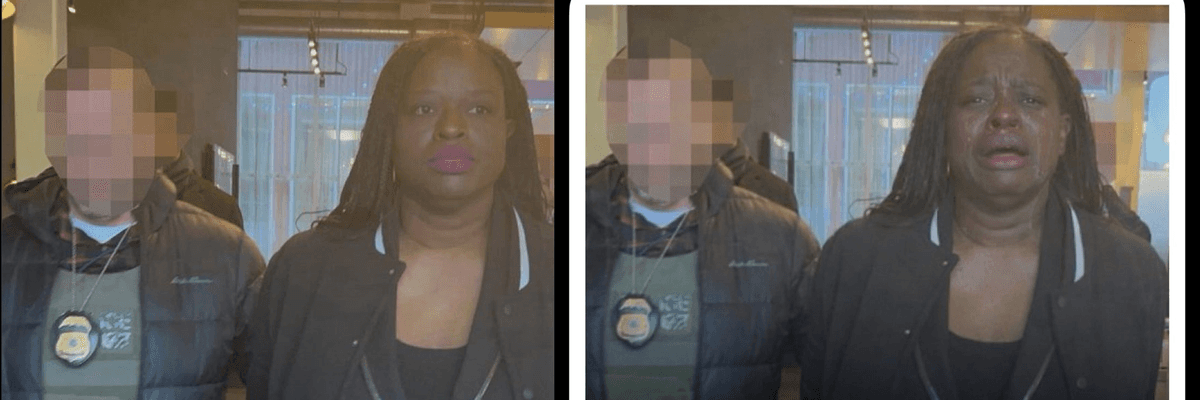
The official White House social media account posted a digitally altered photograph (R) of Nekima Levy Armstrong being arrested for her participation in a protest against US Immigration and Customs Enforcement (ICE) on January 22, 2025.
(Original photo from Secretary of Homeland Security Kristi Noem, altered photo from the White House)
“All of us are on full notice that this White House feels no compunction about concocting obvious lies, concedes nothing when its lies are exposed, and should be presumptively disbelieved in all matters.”
The official White House social media account posted a digitally altered photograph (R) of Nekima Levy Armstrong being arrested for her participation in a protest against US Immigration and Customs Enforcement (ICE) on January 22, 2025.
(Original photo from Secretary of Homeland Security Kristi Noem, altered photo from the White House)
Stephen Prager
Jan 22, 2026
COMMON DREAMS
Continuing its bizarre and often legally questionable use of social media to publicize law enforcement operations, the official White House account published an artificially generated deepfake image of a protester arrested on Thursday by the FBI.
Earlier that day, Secretary of Homeland Security Kristi Noem had posted about Nekima Levy Armstrong, one of three people who were arrested for disrupting a service last week at the Cities Church in St. Paul, Minnesota, where an Immigration and Customs Enforcement (ICE) officer and field office leader, David Easterwood, reportedly serves as a pastor.
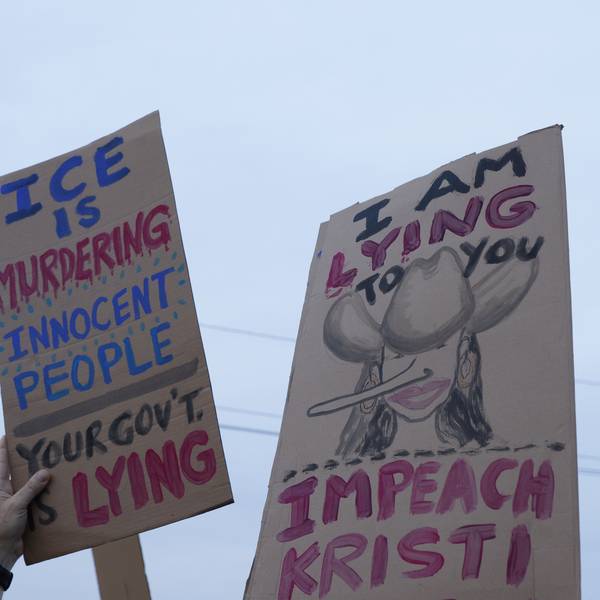
‘Goebbels Could Not Have Improved On This’: DHS Spreads ‘Propaganda’ on ICE Killing as Violence Mounts
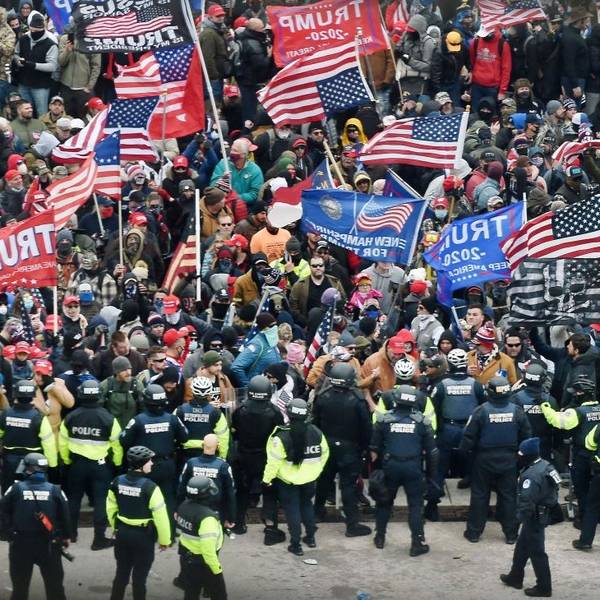
‘Filled With Lies’: Trump White House Releases False History of Jan. 6
Noem described Levy Armstrong, who leads a local civil rights organization known as the Racial Justice Network, as someone “who played a key role in orchestrating the Church Riots in St. Paul, Minnesota.”
There is notably no evidence that the protesters engaged in or threatened violence, as implied by her use of the word “riot.” Video shows protesters disrupting the service by chanting slogans like “ICE out” and demanding justice for Renee Good, who was fatally shot by an ICE officer in Minneapolis earlier this month.
Attorney General Pam Bondi said the protesters had been charged under the 1871 Ku Klux Klan Act, which makes illegal any conspiracy to “injure, oppress, threaten, or intimidate,” people from exercising “any right or privilege secured to him by the Constitution or laws of the United States.”
In her post, Noem shared a photo of Levy Armstrong being led away by an agent, whose face is pixelated to hide his identity. In the photo, Levy Armstrong appears stone-faced and unfazed by the arrest.
Hours later, the official White House account shared the exact same image—accompanied by text describing her as a “far-left agitator”—but with one notable difference. Levy Armstrong’s face was digitally altered to make it appear as if she was sobbing profusely while being led out by the agent. Nowhere did the account make clear that the image had been doctored.
“Did the White House digitally alter this image of Nekima Levy to make her cry???” asked Peter Rothpletz, a reporter for Zeteo, who described it as “bizarre, dark stuff.”
Sure enough, CNN senior reporter Daniel Dale later said the White House had “confirmed its official X account posted a fake image of a woman arrested in Minnesota after interrupting a service at a church where an ICE official appears to be a pastor,” and that “the White House image altered the actual photo to wrongly make it seem like the defendant was sobbing.”
Asked for comment, Dale said the White House directed him to a social media post by Kaelan Dorr, the White House deputy communications director, who wrote: “Enforcement of the law will continue. The memes will continue.”
Posting artificially generated images of their targets sobbing has become a house style of sorts for the White House account.
In March 2025, the account posted an image, altered to appear in the style of a Studio Ghibli film, of Virginia Basora-Gonzalez, an alleged undocumented immigrant and convicted fentanyl trafficker, crying while handcuffed during her ICE arrest in Philadelphia.
In July, the White House posted an AI-altered photograph of Rep. Jimmy Gomez (D-Calif.) after he criticized an ICE raid in which agents arrested hundreds of farmworkers in Ventura County, California. They edited Gomez’s congressional photo to make it appear as if he was crying, referring to him as “Cryin’ Jimmy.”
But the fake image of Levy Armstrong hardly appeared as a “meme.” It was subtle enough that, without having seen the original, it was not immediately apparent that it had been altered, raising concerns about the White House’s willingness to publish blatantly deceptive information pertaining to a criminal investigation.
Anna Bower, a senior editor at Lawfare, suggested that for the government to post a fake, degrading image of a criminal suspect could be considered a “prejudicial extrajudicial statement,” which can undermine the case against Levy Armstrong.
The Trump administration has been caught in an untold number of lies, particularly about those arrested, brutalized, and killed by its law enforcement agencies. This includes Renee Good herself, whom members of the Trump administration tarred as a “domestic terrorist” within hours after her killing, without conducting an investigation and despite video evidence to the contrary.
Bulwark journalist Will Saletan said that with this deepfake post, “all of us are on full notice that this White House feels no compunction about concocting obvious lies, concedes nothing when its lies are exposed, and should be presumptively disbelieved in all matters. Nothing they say should be accepted without independent confirmation.”
Jan 22, 2026
COMMON DREAMS
Continuing its bizarre and often legally questionable use of social media to publicize law enforcement operations, the official White House account published an artificially generated deepfake image of a protester arrested on Thursday by the FBI.
Earlier that day, Secretary of Homeland Security Kristi Noem had posted about Nekima Levy Armstrong, one of three people who were arrested for disrupting a service last week at the Cities Church in St. Paul, Minnesota, where an Immigration and Customs Enforcement (ICE) officer and field office leader, David Easterwood, reportedly serves as a pastor.
‘Goebbels Could Not Have Improved On This’: DHS Spreads ‘Propaganda’ on ICE Killing as Violence Mounts
‘Filled With Lies’: Trump White House Releases False History of Jan. 6
Noem described Levy Armstrong, who leads a local civil rights organization known as the Racial Justice Network, as someone “who played a key role in orchestrating the Church Riots in St. Paul, Minnesota.”
There is notably no evidence that the protesters engaged in or threatened violence, as implied by her use of the word “riot.” Video shows protesters disrupting the service by chanting slogans like “ICE out” and demanding justice for Renee Good, who was fatally shot by an ICE officer in Minneapolis earlier this month.
Attorney General Pam Bondi said the protesters had been charged under the 1871 Ku Klux Klan Act, which makes illegal any conspiracy to “injure, oppress, threaten, or intimidate,” people from exercising “any right or privilege secured to him by the Constitution or laws of the United States.”
In her post, Noem shared a photo of Levy Armstrong being led away by an agent, whose face is pixelated to hide his identity. In the photo, Levy Armstrong appears stone-faced and unfazed by the arrest.
Hours later, the official White House account shared the exact same image—accompanied by text describing her as a “far-left agitator”—but with one notable difference. Levy Armstrong’s face was digitally altered to make it appear as if she was sobbing profusely while being led out by the agent. Nowhere did the account make clear that the image had been doctored.
“Did the White House digitally alter this image of Nekima Levy to make her cry???” asked Peter Rothpletz, a reporter for Zeteo, who described it as “bizarre, dark stuff.”
Sure enough, CNN senior reporter Daniel Dale later said the White House had “confirmed its official X account posted a fake image of a woman arrested in Minnesota after interrupting a service at a church where an ICE official appears to be a pastor,” and that “the White House image altered the actual photo to wrongly make it seem like the defendant was sobbing.”
Asked for comment, Dale said the White House directed him to a social media post by Kaelan Dorr, the White House deputy communications director, who wrote: “Enforcement of the law will continue. The memes will continue.”
Posting artificially generated images of their targets sobbing has become a house style of sorts for the White House account.
In March 2025, the account posted an image, altered to appear in the style of a Studio Ghibli film, of Virginia Basora-Gonzalez, an alleged undocumented immigrant and convicted fentanyl trafficker, crying while handcuffed during her ICE arrest in Philadelphia.
In July, the White House posted an AI-altered photograph of Rep. Jimmy Gomez (D-Calif.) after he criticized an ICE raid in which agents arrested hundreds of farmworkers in Ventura County, California. They edited Gomez’s congressional photo to make it appear as if he was crying, referring to him as “Cryin’ Jimmy.”
But the fake image of Levy Armstrong hardly appeared as a “meme.” It was subtle enough that, without having seen the original, it was not immediately apparent that it had been altered, raising concerns about the White House’s willingness to publish blatantly deceptive information pertaining to a criminal investigation.
Anna Bower, a senior editor at Lawfare, suggested that for the government to post a fake, degrading image of a criminal suspect could be considered a “prejudicial extrajudicial statement,” which can undermine the case against Levy Armstrong.
The Trump administration has been caught in an untold number of lies, particularly about those arrested, brutalized, and killed by its law enforcement agencies. This includes Renee Good herself, whom members of the Trump administration tarred as a “domestic terrorist” within hours after her killing, without conducting an investigation and despite video evidence to the contrary.
Bulwark journalist Will Saletan said that with this deepfake post, “all of us are on full notice that this White House feels no compunction about concocting obvious lies, concedes nothing when its lies are exposed, and should be presumptively disbelieved in all matters. Nothing they say should be accepted without independent confirmation.”