A Changing U.S. Color Line?
Photograph Source: SWinxy – CC BY 4.0
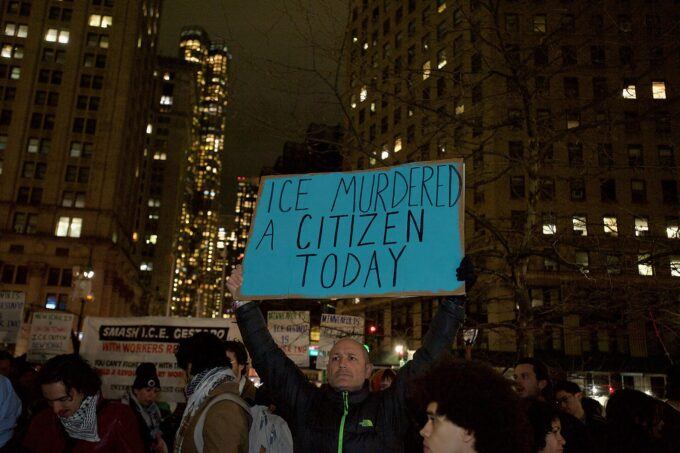
I turned to W.E.B. Du Bois’ thoughts on the centrality of America’s color line when U.S. Immigration and Customs Enforcement’s (ICE) Officer Jonathan Ross shot dead Renee Nicole Good on January 7, 2026. Let me explain.
What Du Bois called the “color line” in the U.S. is the racial division which is a part of–not apart from–labor conditions of a market economy. He viewed this separation of people via their appearances as an integral part of the global system of colonization and segregation. The legal use of state-sanctioned violence to enforce such subjugation of living human beings has a bloody history.
Crucially, Good was a supporter of immigrants, engaged in legal observance of ICE actions in Minneapolis, MN. She perished from a gunshot wound to the head not far from where Derek Chauvin, a city police officer, murdered George Floyd, an African American male and criminal suspect, on May 25, 2020. His killing sparked multi-racial protests that African Americans led during the Covid pandemic.
Then, there was a demand to defund the police. Now, there is a call to defund ICE.
Good, in solidarity with immigrants without U.S. citizenship papers, put her body on the line for them as targets of daily brutality at the hands of ICE agents. They wear masks like a 2026 version of the Ku Klux Klan, a group of white supremacist vigilantes that formed after the U.S. Civil War to terrorize the former slave population of the Confederate States of the American South.
Today, Central American and Somali immigrants and those from other lands in and away from the Twin Cities have been victims of an extractive and exploitative U.S. corporate state. It is driving immigrants to arrive stateside. For instance, climate catastrophe from Big Oil’s militarized dominance of the global economy is causing drought and famine abroad. Suffering peasants flee their homelands, desperate for food, shelter and water. Demonizing them as threats to U.S. national security is absurd on its face, and a way to distract attention away from a billionaire class sucking income and wealth from the American working class.
A thread connecting the deaths of Good and Floyd is this: lethal police violence against unarmed citizens affects black, brown, red, white and yellow Americans. This violence also resembles that which people in foreign lands experience under Uncle Sam’s military hand, directly or by proxy. Witness U.S. bombings of a Nigerian village to protect Christians where none of them live to Israel’s genocide of Palestinians in Gaza, a barbaric and blood-soaked campaign of extermination that American taxpayers, the working class, fund for reasons of monopoly profits flowing to a politically connected military-industrial-complex.
In our Big Tech moment of surveillance capitalism, the ubiquity of cell phone cameras empowers people shut (shit?) out of political power to show us the barbarity of state-sanctioned violence against civilians. In this way, the powerless until they organize and make political demands, can and do communicate. It’s a revolutionary advancement.
Who will the viewers of the police killings of Good and Floyd believe? Their eyes or the official sources? This digital dynamic also applies to Israel’s ongoing high-tech slaughter of Palestinians in Gaza.
Digital communication also swims in the water of fabrications and falsifications. There’s no denying the online culture of spectacle. It’s more than technology and its magic wand of AI to caricature and impersonate.
Speaking of misrepresentation, the social fiction of race lacks a biological basis. This reality also disempowers and divides workers. The fictional cleavage between groups of Americans and immigrants from the Global South is a social but not biological reality. Thus Americans like Good and many more are showing their revulsion against ICE deportations brutalizing working class people from abroad and their native-born backers.
Demography matters in the unpacking of white supremacy for class solidarity. Good was an American Caucasian woman. Floyd was an African American male. Both were members of the working class. They relied upon wage-income to get by.
In contrast, capitalists live on the labor services of the working class across occupations in various ways. The class of capitalists are takers, not makers. The class of makers whether in goods or services has more in common with each other than the tiny minority of takers.
Good was part of a surging popular rebellion against anti-immigrant messaging from President Donald J. Trump and his backers for nearly a decade. Good and her allies rejected the message that immigrants are the cause of the American people’s struggles, from rising prices to falling real wages.
Researchers such as Ben Zipperer at the Economic Policy Institute have shown that immigrant deportation policies of President Trump, like his tariffs, or taxes, on U.S. imports, harm the native-born working class, including small businesses. Removing immigrant workers from the U.S. labor force equals slower economic growth and fewer jobs. ICE deporting immigrants is a job-killer policy. This is not rocket science, folks.
Meanwhile, African Americans such as Floyd experience police violence far away from nonviolent protests for social justice of the kind Good and her allies supported. No protest chants or dissident signs are required for blacks to experience state-sanctioned violence.
Driving while black is all it takes for police to fire rounds at blacks. Hell, sleeping while black is cause enough, as the case of Breonna Taylor, a 26-year-old EMT and African American, shows. She died in a hail of police gunfire in her Louisville apartment during a no-knock attack on March 13, 2020.
There are scores of similar deadly police attacks on blacks in the U.S., far out of proportion to their numbers in the population of 330 million Americans. That police violence is a morbid symptom of an increasingly unequal U.S. society, where billionaire wealth is ballooning under the Trump administration. It’s no coincidence that the president’s recent tax cut shoveled more wealth to his billionaire donors such as Adelson, Bezos and Musk, while impoverishing the working class.
Resisting economic inequality while struggling to weaken white supremacy are two sides to the same coin. Ideology (false consciousness), economics and politics are forces that push apart and pull together the working class. The push sows division and strengthens a class system that requires cutthroat competition. The pull serves the opposite purpose of building community and solidarity.
Fostering division between groups of working-class people is a tried-and-true method of class rule that helps those who sit atop the social order. Resisting that division requires working-class solidarity, a step forward for humanity in and out of the U.S. The people of the Twin Cities are showing us how.